
Daniel 9:15

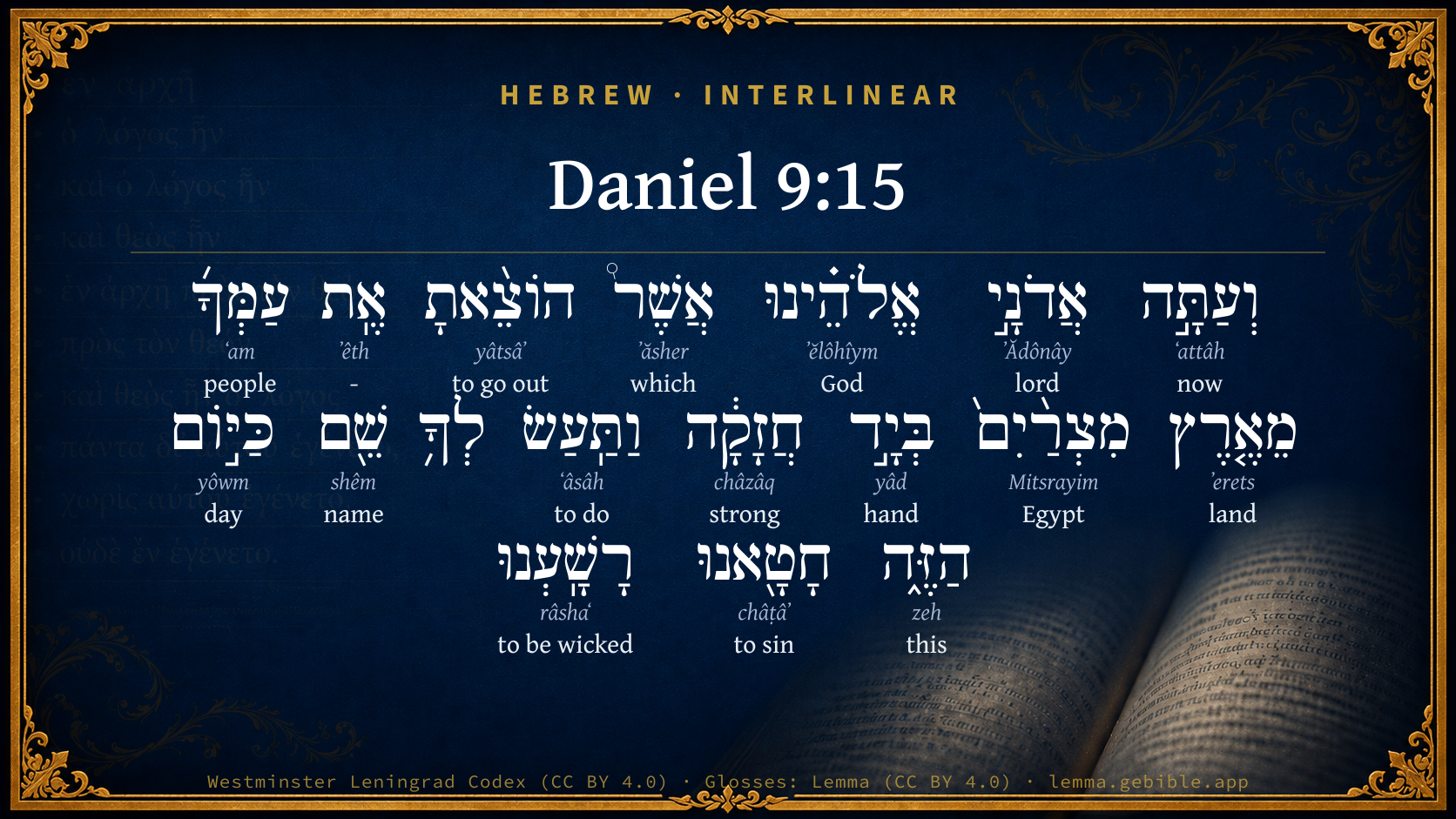
Hebrew (Westminster Leningrad Codex) Daniel 9:15 appears in the Hebrew Old Testament. The text above is from the Westminster Leningrad Codex. Each word links to its Strong’s number, a concise gloss, and parsing drawn from the Open Scriptures Hebrew Bible morphology. Click any word for its full Brown-Driver-Briggs (BDB) entry.
Download image
Cite this verse

Daniel 9:15 (World English Bible). Public Domain. Lemma interlinear Bible study tool, https://lemma.gebible.app/v/daniel/9/15.

Show BibTeX & RIS
BibTeX
RIS
English Translation
Now, Lord our God, who has brought your people forth out of the land of Egypt with a mighty hand, and have gotten you renown, as at this day; we have sinned, we have done wickedly.
World English Bible · Public Domain
Download a study sheet

One document with this verse’s original text, its word-by-word gloss line, the meaning frame, cross-references with their text, attributed commentary, and full source and license credits — printable, and it pastes into notes with its structure intact.

This verse Autodidact and up

Study sheet (.html) Plain text (.txt)

A passage Seminary Student

Up to 50 verses in one chapter. A passage sheet keeps up to 6 commentary sources and 12 cross-references per verse, in the order this page ranks them, and says so on the sheet whenever that leaves anything out. Ask for a single verse and you get the Autodidact verse sheet above.

Everything on this page stays free to read, with no account — the sheet is a download of what is already on screen, not access to it.

Want to remove ads? Support Godless Engineer
Compare translations 3

The same verse in 3 English versions, stacked beneath the original-language interlinear above. Click any original word for its lexicon entry.

Each is an independent rendering of the whole verse — the interlinear is not word-aligned to these translations.

Highlighted words mark where these versions differ — a whole-verse word diff, not a word-by-word alignment.

  • World English Bible Public Domain
    Now, Lord our God, who has brought your people forth out of the land of Egypt with a mighty hand, and have gotten you renown, as at this day; we have sinned, we have done wickedly.
  • King James Version Public Domain
    And now, O Lord our God, that hast brought thy people forth out of the land of Egypt with a mighty hand, and hast gotten thee renown, as at this day; we have sinned, we have done wickedly.
  • unfoldingWord Literal Text CC BY-SA 4.0
    Now, O Lord our God, who brought your people out of the land of Egypt with a mighty hand, and have made a name for yourself, as it is this day, we have sinned, we have been wicked.

unfoldingWord Literal Text — © unfoldingWord, licensed CC BY-SA 4.0. Word-aligned USFM3 via Door43 (git.door43.org/unfoldingWord/en_ult).

Versions to compare (up to 4)

3 of 4 selected

Show all 18 translations

Every available English version of this verse, each an independent rendering of the whole verse.

  • World English Bible Public Domain
    Now, Lord our God, who has brought your people forth out of the land of Egypt with a mighty hand, and have gotten you renown, as at this day; we have sinned, we have done wickedly.
  • Berean Standard Bible Public Domain
    Now, O Lord our God, who brought Your people out of the land of Egypt with a mighty hand, and who made for Yourself a name renowned to this day, we have sinned; we have acted wickedly.
  • Majority Standard Bible Public Domain
    Now, O Lord our God, who brought Your people out of the land of Egypt with a mighty hand, and who made for Yourself a name renowned to this day, we have sinned; we have acted wickedly.
  • King James Version Public Domain
    And now, O Lord our God, that hast brought thy people forth out of the land of Egypt with a mighty hand, and hast gotten thee renown, as at this day; we have sinned, we have done wickedly.
  • American Standard Version (1901) Public Domain
    And now, O Lord our God, that hast brought thy people forth out of the land of Egypt with a mighty hand, and hast gotten thee renown, as at this day; we have sinned, we have done wickedly.
  • Revised Version (1885) Public Domain
    And now, O Lord our God, that hast brought thy people forth out of the land of Egypt with a mighty hand, and hast gotten thee renown, as at this day; we have sinned, we have done wickedly.
  • Geneva Bible (1599) Public Domain
    And nowe, O Lord our God, that hast brought thy people out of the land of Egypt with a mightie hand, and hast gotten thee renoume, as appeareth this day, we haue sinned, we haue done wickedly.
  • Douay-Rheims (1899) Public Domain
    And now, O Lord our God, who hast brought forth thy people out of the land of Egypt with a strong hand, and hast made thee a name as at this day: we have sinned, we have committed iniquity,
  • Young's Literal Translation Public Domain
    And now, O Lord our God, who hast brought forth Thy people from the land of Egypt by a strong hand, and dost make for Thee a name as at this day, we have sinned, we have done wickedly.
  • Literal Standard Version CC BY-SA 4.0
    And now, O Lord our God, who has brought forth Your people from the land of Egypt by a strong hand, and makes for Yourself a name as at this day, we have sinned, we have done wickedly.
  • Unlocked Literal Bible CC BY-SA 4.0
    Now, Lord our God, you brought out your people from the land of Egypt with a mighty hand, and you have made a famous name for yourself, as in this present day. But still we sinned; we have done wicked things.
  • unfoldingWord Literal Text CC BY-SA 4.0
    Now, O Lord our God, who brought your people out of the land of Egypt with a mighty hand, and have made a name for yourself, as it is this day, we have sinned, we have been wicked.
  • Darby Bible Public Domain
    -- And now, O Lord our God, who broughtest thy people forth out of the land of Egypt with a strong hand, and hast made thee a name, as it is this day, -- we have sinned, we have done wickedly.
  • World Messianic Bible Public Domain
    “Now, Lord our God, who has brought your people out of the land of Egypt with a mighty hand, and have gotten yourself renown, as it is today, we have sinned. We have done wickedly.
  • Webster's Bible Public Domain
    And now, O Lord our God, that hast brought thy people out of the land of Egypt with a mighty hand, and hast obtained thee renown, as at this day; we have sinned, we have done wickedly.
  • Free Bible Version CC BY-SA 4.0
    You, our Lord God, by your great power brought us out of Egypt, making a name for yourself that lasts even until now. But we have sinned, we have done wicked things.
  • Bible in Basic English Public Domain
    And now, O Lord our God, who took your people out of the land of Egypt with a strong hand and made a great name for yourself even to this day; we are sinners, we have done evil.
  • JPS Tanakh (1917) Public Domain
    And now, O Lord our God, that hast brought Thy people forth out of the land of Egypt with a mighty hand, and hast gotten Thee renown, as at this day; we have sinned, we have done wickedly.

Literal Standard Version (2020), Covenant Press — licensed CC BY-SA 4.0. Text via the HelloAO Bible API (eBible.org). Unlocked Literal Bible (unfoldingWord) — licensed CC BY-SA 4.0. Text via the HelloAO Bible API (eBible.org). unfoldingWord Literal Text — © unfoldingWord, licensed CC BY-SA 4.0. Word-aligned USFM3 via Door43 (git.door43.org/unfoldingWord/en_ult). Free Bible Version, Dr. Jonathan Gallagher — licensed CC BY-SA 4.0. Text via the HelloAO Bible API (eBible.org).

Word by word

More ways to search: Search by grammar → Find every occurrence → Compare this word →

Practice this passage: Drill this verse → Learn its vocabulary →

רָשָֽׁעְנוּ
râshaʻ
H7561
“to be wicked”
Verb, Qal, Perfect, 1st Person, Common, Plural
Part of Speech
Verb
Stem
Qal
Form
Perfect
Person
1st Person
Gender
Common
Number
Plural
Full BDB Definition

Origin: a primitive root

TWOT: 2222

to be wicked, act wickedly - (Qal) - to be wicked, act wickedly - to be guilty, be condemned - (Hiphil) - to condemn as guilty (in civil relations) - to condemn as guilty (in ethical or religious relations) - to act wickedly (in ethics and religion)
  1. וְעַתָּ֣ה ʻattâh H6258 “and · now” Conjunction + Adverb
  2. אֲדֹנָ֣י ʼĂdônây H136 “Lord · my” Noun, Common, Masculine, Plural, Construct + Suffix, Personal, 1st Person, Common, Singular
  3. אֱלֹהֵ֗ינוּ ʼĕlôhîym H430 “God(s) · our” Noun, Common, Masculine, Plural, Construct + Suffix, Personal, 1st Person, Common, Plural
  4. אֲשֶׁר֩ ʼăsher H834 “which” Particle, Relative
  5. הוֹצֵ֨אתָ yâtsâʼ H3318 “to go out” Verb, Hiphil, Perfect, 2nd Person, Masculine, Singular
  6. אֶֽת ʼêth H853 “-” Particle, Direct Object
  7. עַמְּךָ֜ ʻam H5971 “people · your” Noun, Common, Masculine, Singular, Construct + Suffix, Personal, 2nd Person, Masculine, Singular
  8. מֵאֶ֤רֶץ ʼerets H776 “from · land of” Preposition + Noun, Common, Both, Singular, Construct
  9. מִצְרַ֨יִם֙ Mitsrayim H4714 “Egypt” Noun, Proper
  10. בְּיָ֣ד yâd H3027 “in/at · hand” Preposition + Noun, Common, Both, Singular, Absolute
  11. חֲזָקָ֔ה châzâq H2389 “strong” Adjective, Adjective, Feminine, Singular, Absolute
  12. וַתַּֽעַשׂ ʻâsâh H6213 “and · to do” Conjunction + Verb, Qal, Sequential Imperfect, 2nd Person, Masculine, Singular
  13. שֵׁ֖ם shêm H8034 “name” Noun, Common, Masculine, Singular, Absolute
  14. כַּיּ֣וֹם yôwm H3117 “like/as the · day” Preposition, Determined + Noun, Common, Masculine, Singular, Absolute
  15. הַזֶּ֑ה zeh H2088 “the · this” Particle, Definite Article + Pronoun, Demonstrative, Masculine, Singular
  16. חָטָ֖אנוּ châṭâʼ H2398 “to sin” Verb, Qal, Perfect, 1st Person, Common, Plural

About this verse

These counts appear in no published source. They are computed here, from the morphology-tagged text and Lemma’s own curated glosses. What Lemma adds →

18
words
17
distinct lemmas
Prophets
section

Shared distinctive vocabulary

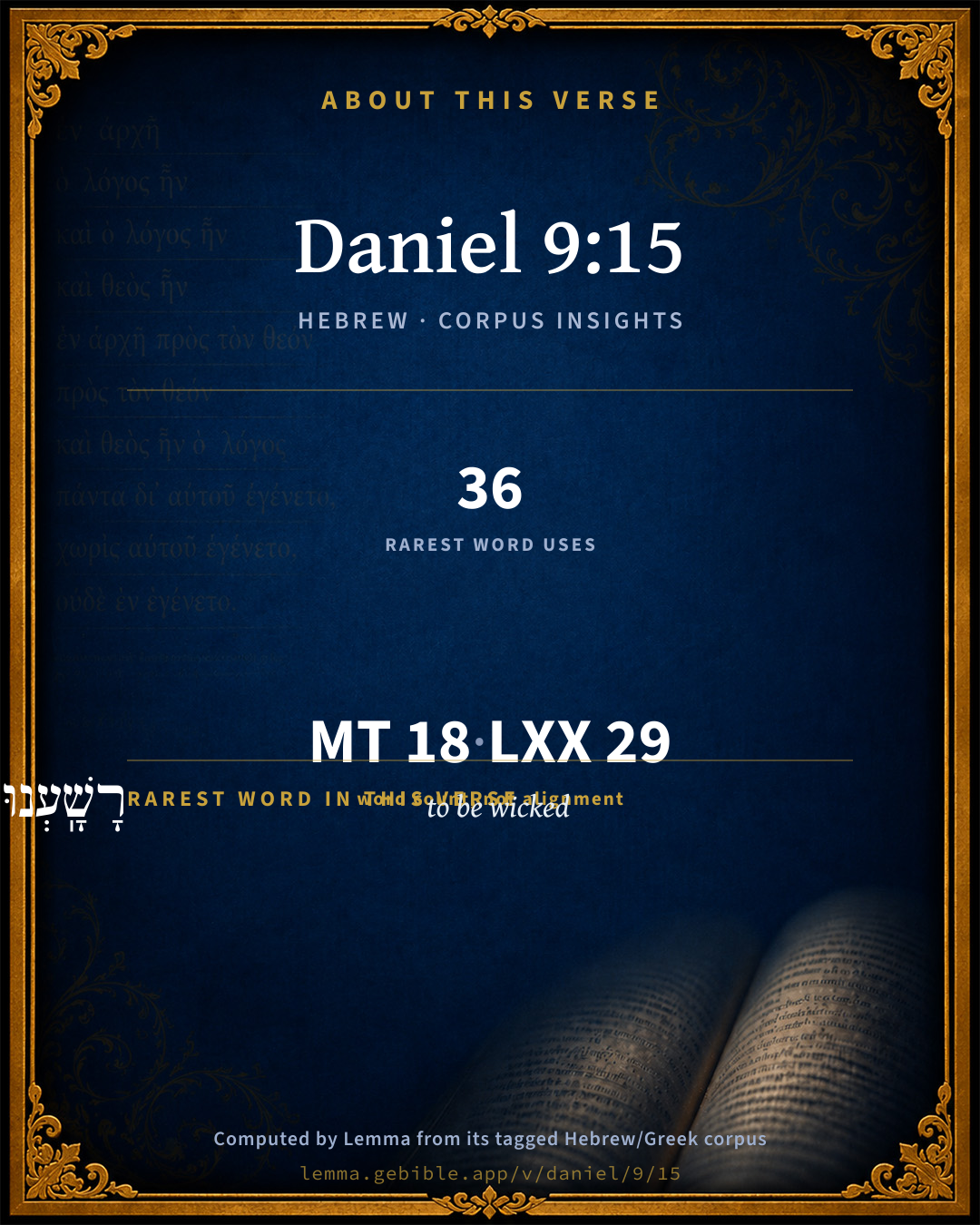
רָשָֽׁעְנוּ to be wicked H7561 occurs in 35 verses of the Hebrew Bible. Also found in:

Grammatical profile

  • 4 verbs
  • 8 nouns
  • 1 adjective
  • 1 pronoun
  • 1 preposition
  • 1 adverb
  • 2 particles

Verb forms

  • הוֹצֵ֨אתָ Hiphil · Perfect
  • וַתַּֽעַשׂ Qal · Sequential Imperfect
  • חָטָ֖אנוּ Qal · Perfect
  • רָשָֽׁעְנוּ Qal · Perfect

Hebrew & Septuagint length

In English translation the verse runs 36 words from the Hebrew and 36 from the Septuagint (LXX English) — the same length.

A rough comparison of the two English renderings, which tokenize alike — not a word-level alignment.

Word counts can differ between the Hebrew and the Greek without any difference in meaning — e.g. the Hebrew direct-object marker אֵת has no separate Greek word, and Greek often adds the article ὁ.

In the original languages it is 18 Hebrew tokens and 29 Greek tokens — but the two are counted differently (Hebrew bundles its prefixes and suffixes into one token; the Greek is in lemma form), so that isn’t a like-for-like length.

Cross-references

18

Topical passages linked to Daniel 9:15 in the Treasury of Scripture Knowledge — connected by theme and wording, ordered by reader-vote popularity; previews shown in the World English Bible.

  • Nehemiah 9:10 and shown signs and wonders on Pharaoh, and on all his servants, and on all the people of his land; for you knew that they dealt proudly against them, and did get you a name, as it is this day.
  • Daniel 9:5 we have sinned, and have dealt perversely, and have done wickedly, and have rebelled, even turning aside from your precepts and from your ordinances;
  • Exodus 6:1 Yahweh said to Moses, "Now you shall see what I will do to Pharaoh, for by a strong hand he shall let them go, and by a strong hand he shall drive them out of his land."
  • Exodus 14:18 The Egyptians shall know that I am Yahweh, when I have gotten myself honor over Pharaoh, over his chariots, and over his horsemen."
  • Exodus 32:11 Moses begged Yahweh his God, and said, "Yahweh, why does your wrath burn hot against your people, that you have brought forth out of the land of Egypt with great power and with a mighty hand?
  • Nehemiah 1:10 Now these are your servants and your people, whom you have redeemed by your great power, and by your strong hand.
  • Exodus 6:6 Therefore tell the children of Israel, 'I am Yahweh, and I will bring you out from under the burdens of the Egyptians, and I will rid you out of their bondage, and I will redeem you with an outstretched arm, and with great judgments:
  • Exodus 9:16 but indeed for this cause I have made you stand: to show you my power, and that my name may be declared throughout all the earth;
  • Exodus 14:1–15 Yahweh spoke to Moses, saying,
  • 1 Kings 8:51 (for they are your people, and your inheritance, which you brought forth out of Egypt, from the midst of the furnace of iron);
  • Psalms 106:8 Nevertheless he saved them for his name's sake, That he might make his mighty power known.
  • Isaiah 55:13 Instead of the thorn shall come up the fir tree; and instead of the brier shall come up the myrtle tree: and it shall be to Yahweh for a name, for an everlasting sign that shall not be cut off.
  • Jeremiah 32:10 I subscribed the deed, and sealed it, and called witnesses, and weighed him the money in the balances.
  • Jeremiah 32:20–23 who performed signs and wonders in the land of Egypt, even to this day, both in Israel and among [other] men; and made you a name, as in this day;
  • Luke 15:18–19 I will get up and go to my father, and will tell him, "Father, I have sinned against heaven, and in your sight.
  • Luke 15:21 The son said to him, 'Father, I have sinned against heaven, and in your sight. I am no longer worthy to be called your son.'
  • Luke 18:13 But the tax collector, standing far away, wouldn't even lift up his eyes to heaven, but beat his breast, saying, 'God, be merciful to me, a sinner!'
  • 2 Corinthians 1:10 who delivered us out of so great a death, and does deliver; on whom we have set our hope that he will also still deliver us;

Cross-references courtesy of OpenBible.info (CC BY 4.0).

Hebrew and Greek witnesses Masoretic Hebrew ↔ Greek Septuagint

The same verse in the two great witnesses to the Old Testament, shown verse-for-verse.

These are two independent witnesses, not word-aligned to each other, and the Septuagint is shown in lemma (dictionary) form.

Hebrew Daniel 9:15 Masoretic · Westminster Leningrad Codex

וְעַתָּ֣ה אֲדֹנָ֣י אֱלֹהֵ֗ינוּ אֲשֶׁר֩ הוֹצֵ֨אתָ אֶֽת עַמְּךָ֜ מֵאֶ֤רֶץ מִצְרַ֨יִם֙ בְּיָ֣ד חֲזָקָ֔ה וַתַּֽעַשׂ לְךָ֥ שֵׁ֖ם כַּיּ֣וֹם הַזֶּ֑ה חָטָ֖אנוּ רָשָֽׁעְנוּ

Now, Lord our God, who has brought your people forth out of the land of Egypt with a mighty hand, and have gotten you renown, as at this day; we have sinned, we have done wickedly.

World English Bible · Public Domain

Greek LXX Daniel 9:15 Septuagint · lemma form

καί νῦν δεσπότης κύριος ὁ θεός ἐγώ ὁ ἐκἄγω ὁ λαός σύ ἐκ αἴγυπτος ὁ βραχίων σύ ὁ ὑψηλός καί ποιέω σεαυτοῦ ὄνομα κατά ὁ ἡμέρα οὗτος ἁμαρτάνω ἀγνοέω

And now, O Lord our God, who brought your people out of the land of Egypt with a mighty hand, and made to yourself a name, as at this day; we have sinned, we have transgressed.

LXX2012 (modern English Septuagint) · Public Domain

Hebrew: Westminster Leningrad Codex (CC BY 4.0). Greek: Septuagint (public domain); English from LXX2012 (modern English Septuagint) (Public Domain). How the Septuagint differs from the Hebrew →

Commentary

Notes on Daniel 9:15 from classic Christian and Jewish commentators (each source and its license shown beneath its notes). The classic Christian expositions comment on the surrounding passage and are grouped to its opening verse, so a note may address several verses; the Jewish commentaries on the Tanakh (Rashi and others) are per-verse, so they appear only where the commentator wrote on this verse.

Lemma curates 59 commentaries, every one of them public domain or Creative Commons licensed, each selected and text-cleaned for this edition rather than reprinted as found. About our sources →

Trapp's Complete Commentary

John Trapp

Dan 9:15 And now, O Lord our God, that hast brought thy people forth out of the land of Egypt with a mighty hand, and hast gotten thee renown, as at this day; we have sinned, we have done wickedly.

Ver. 15. And now, O Lord God, that hast brought thy people.] Thanksgiving is an artificial begging; and every former mercy is a pledge of a future. {2Ch 20:10; 2Ch 7:12}

And hast gotten thee renown.] Heb., Made thee a name, and yet a greater name hast promised to make thee by bringing us back from Babylon. {Jer 16:15}

We have sinned, we have done wickedly.] Such as desire mercies, must first deny their worthiness of them, {2Sa 5:18} confessing their sins with utmost aggravation.

John Trapp, A Commentary or Exposition upon All the Books of the Old and New Testament (1647–1656) — public domain. Text from a community e-Sword module.

Joseph Benson's Commentary

Dan 9:15. And now, O Lord, who hast brought thy people forth, &c. — A form of supplication used in several places of Scripture, whereby devout persons entreat God to continue his favours, by recounting his former mercies toward them. And hast gotten thee renown, or, made thee a name, as at this day — That is, even to this day, namely, by bringing Israel out of Egypt; and wilt thou lose the credit of that, by letting them perish in Babylon? Didst thou get renown by that deliverance which we have so often commemorated, and wilt thou not now also get thee renown by this which we have so often prayed for, and so long waited for? We have sinned, we have done wickedly — Here Daniel confesses again God’s being just and good in all his ways; and that it was owing to themselves only that all these evils were come upon them.

Joseph Benson's Commentary on the Old and New Testaments (1811–1818) — public domain. Text from a community e-Sword module.

Tyndale Open Study Notes

Tyndale Open Resources

9:15-19 Daniel cried out for God to rescue his people and end the Exile, relying on God’s mercy and God’s desire to honor his own name. Daniel’s prayer is among the great intercessory prayers of God’s Old Testament people (see also Exod 32:11-14; Ezra 9:1-15; Neh 9:1-37).

9:15 God could bring lasting honor to his name by rescuing his people from exile in Babylonia, just as he did when he rescued them from Egypt (cp. Ezek 36:19-24).

Tyndale Open Study Notes — © Tyndale Open Resources, licensed CC BY-SA 4.0. Text via the HelloAO Bible API.

Jamieson, Fausset & Brown

Robert Jamieson, A. R. Fausset & David Brown

brought thy people . . . out of . . . Egypt--a proof to all ages that the seed of Abraham is Thy covenant-people. That ancient benefit gives us hope that Thou wilt confer a like one on us now under similar circumstances (Psa 80:8-14; Jer 32:21; Jer 23:7-8).

as at this day--is known.

Jamieson, Fausset & Brown — Commentary Critical and Explanatory on the Whole Bible (1871) — public domain (CC PDM 1.0). Text via the HelloAO Bible API.

John Calvin's Commentaries

After Daniel has sufficiently confessed the justice of those judgments which God had inflicted upon the people, he again returns to beg for pardon. First, he would conciliate favor for himself; next, he would stir up the minds of the pious to confidence, and so he sets before them that proof of grace which ought to avail to support the minds of the pious even to the end of the world. For when God led his people out of Egypt, he did not set before them any momentary benefit merely, but he bore witness to the adoption of the race of Abraham on the condition of his being their perpetual Savior. Therefore, whenever God wishes to gather together those who have been dispersed, and to raise their minds from a state of despair to cheerful hope, he reminds them of his being their Redeemer. I am that God, says he, who led you out of Egypt. (Leviticus 11:45, and often elsewhere.) God not only commends his own power in such passages, but denotes the object of their redemption; for he then received his people under his care on the very ground of never ceasing to act towards them with the love and anxiety of a father. And when in their turn such anxiety seized upon the faithful as to lead them to apprehend their own utter desertion by God, they are in the habit of seizing upon this shield — God did not lead our fathers out of Egypt in vain. Daniel now follows up this reasoning-Thou, O Lord our God, says he, who hast led forth thy people; as if he had said, he called upon God, because by one single proof he had testified to all ages the sacred character of the race of Abraham. We observe, then, how he stirs up himself and all the rest of the pious to prayer, because by laying this foundation, he could both complain familiarly, and fearlessly request of God to pity his people, and to put an end to their calamities. We now understand the Prophet’s meaning, when he says, the people were led forth from Egypt.

He afterwards adds another cause, God then acquired renown for himself, as the event evidently displayed He here joins God’s power with his pity, implying, when the people were led forth, it was not only a specimen of paternal favor towards the family of Abraham, but also an exhibition of divine power. Whence it follows, his people could not be cast off without also destroying the remembrance of that mighty power by which God had acquired for himself renown. And the same sentiment often occurs in the prophets when they use the argument: — If this people should perish, what would prevent the extinction of thy glory, and thus whatever thou hadst conferred upon this people would be buried in oblivion? So, therefore, Daniel now says, By bringing thy people from the land of Egypt, thou hast made thyself a name; that is, thou hast procured for thyself glory, which ought to flourish through all ages unto the end of the world. What, then, will occur, if the whole of thy people be now destroyed? He next adds, We have done impiously, and have acted wickedly In these words Daniel declares how nothing was left except for God to consider himself rather than his people, as by looking to them he would find nothing but material for vengeance. The people must necessarily perish, should God deal with them as they deserved. But Daniel here turns away God’s face by some means from the people’s sins, with the view of fixing his attention on himself alone and his own pity, and on his consistent fidelity to that perpetual covenant which he had made with their fathers.

John Calvin's Commentaries (1540-1563) — public domain. Text from the Calvin Translation Society English edition (1840s-50s) via the Christian Classics Ethereal Library (ccel.org). Calvin's coverage is partial (roughly two-thirds of the Bible); uncommented books and verses are honest gaps, never fabricated. The 19th-century editor's footnotes and remarks are omitted so the notes are faithfully Calvin's own voice.

Ellicott's Commentary for English Readers

(15) Thou hast brought.—The mention of past mercies moves Daniel to pray that future mercies may be granted. His language is founded partly upon Jer_32:17-23, and partly upon Isa_63:11-16. The Babylonian exile is frequently compared by Isaiah (e.g., Isa_51:9-10) to Egyptian bondage. Daniel reproduces the thought in this verse.

A Bible Commentary for English Readers, edited by Charles John Ellicott (1878–1897) — public domain. Text from a community e-Sword module.

The Cambridge Bible for Schools and Colleges

gen. ed. J. J. S. Perowne

15. that hast brought, &c.] Deu_6:21; Deu_9:26; Deu_26:8; cf. Jer_32:21.

and hast made thee a name, as at this day] verbatim (in the Heb.), though not quite literatim, as Jer_32:20 and Neh_9:10; to make oneself a name (i.e. to gain renown), also, Gen_11:4, and (of God) Isa_63:12; Isa_63:14, and (with a syn. in the Heb. for make) 2Sa_7:23.

we have sinned, we have done wickedly] 1Ki_8:47.

15–19. The confession passes now gradually into a supplication for help. Cf. Bar_2:11-12 a, 13 a, 14 a, 16 b, 17 a, 19.

The Cambridge Bible for Schools and Colleges (gen. ed. J. J. S. Perowne; Cambridge University Press, 1878–1918) — public domain. Text from a community e-Sword module.

John Gill's Exposition

And now, O Lord our God,.... The Lord of the whole earth in general, the sovereign Ruler of the universe, and the God of Israel in a special and peculiar manner; which is used to encourage faith in prayer, and carries in it a tacit argument or plea with God to be heard, in what he was about to say in behalf of Israel; and to which purpose also is the following description of God, from an ancient benefit he had granted to that people:

that hast brought thy people forth out of the land of Egypt with a mighty hand; which though it may be considered as an aggravation of their sin, that after this they should behave so wickedly, as to be carried captive for their sins, out of the land they were brought into; yet it seems to be mentioned to put the Lord in mind of his former favours to them, and of his promise that he would bring them out of Babylon, as he had brought them out of Egypt, Jer 16:14,

and hast gotten thee renown, as at this day; by the many wonders wrought in Egypt, and at the Red sea, when Israel was brought from thence; as particularly by slaying the firstborn of Egypt, dividing the waters of the sea, and destroying the Egyptians in it, as Saadiah observes; the memory and fame of which continued to that day, and will continue throughout all ages: and the prophet suggests, that he would also get a name or renown in the world, and among his people, should he deliver them from their present captivity; but for this they had nothing to plead but his promise and mercy; for, as for them, they were obliged to confess themselves sinners, and unworthy of such a favour:

we have sinned, we have done wickedly; the prophet knows not how to leave off confessing sin; there had been so much committed, and there was so much need of confessing it.

John Gill's Exposition of the Whole Bible (1746–1763) — public domain (CC PDM 1.0). Text via the HelloAO Bible API.

Albert Barnes' Notes on the Bible

And now, O Lord our God, that hast brought thy people forth out of the land of Egypt - In former days. The reference to this shows that it is proper to use “arguments” before God when we plead with him (compare the notes at Job 23:4); that is, to suggest considerations or reasons why the prayer should be granted. Those reasons must be, of course, such as will occur to our own minds as sufficient to make it proper for God to bestow the blessing, and when they are presented before him, it must be with submission to his higher view of the subject. The arguments which it is proper to urge are those derived from the Divine mercy and faithfulness; from the promises of God; from his former dealings with his people; from our sins and misery; from the great sacrifice made for sin; from the desirableness that his name should be glorified. Here Daniel properly refers to the former Divine interposition in favor of the Hebrew people, and he pleads the fact that God had delivered them from Egypt as a reason why he should now interpose and save them. The strength of this argument may be supposed to consist in such things as the following:

(a) in the fact that there was as much reason for interposing now as there was then;

(b) in the fact that his interposing then might be considered as a proof that he intended to be regarded as their protector, and to defend them as his people;

(c) in the fact that he who had evinced such mighty power at that time must be able to interpose and save them now, etc.

And hast gotten thee renown - Margin, “made thee a name.” So the Hebrew. The idea is, that that great event had been the means of making him known as a faithful God, and a God able to deliver. As he was thus known, Daniel prayed that he would again interpose, and would now show that he was as able to deliver his people as in former times.

As at this day - That is, as God was then regarded. The remembrance of his interposition had been diffused abroad, and had been transmitted from age to age.

We have sinned ... - This turn in the thought shows how deeply the idea of their sinfulness pressed upon the mind of Daniel. The natural and obvious course of thought would have been, that, as God had interposed when his people were delivered from Egyptian bondage, he would now again interpose; but instead of that, the mind of Daniel is overwhelmed with the thought that they had sinned grievously against one who had shown that he was a God so great and glorious, and who had laid them under such obligations to love and serve him.

Albert Barnes' Notes on the Bible (1834–1885) — public domain. Text from a community e-Sword/MySword module.

Matthew Poole's English Annotations

Daniel mentions this deliverance now, that God would please to put forth the same power in this deliverance out of Babylon, according to his promise, Psa 80:8; Jer 16:14; 23:7; this lie grounds his faith upon, Jer 32:13, read thence to the end.

1. How the Lord assured them they should return out of captivity, by the prophet’s making a purchase and sealing evidences, and laying them up safe.

2. How the Lord would certainly plague them notwithstanding for their wickedness.

3. How he would deliver them, as once out of Egypt.

Matthew Poole's English Annotations on the Holy Bible (1683–1685) — public domain. Text from a community e-Sword/MySword module.

Whedon's Commentary on the Bible

Daniel D. Whedon

15. By Jehovah’s marvelous deliverance of Israel from Egyptian bondage he had gotten for himself “a name even for this day” (an exact quotation from Jer_32:20). After this mention of God’s mercies in the past the sins of Israel appear to the prophet even worse than before.

Daniel D. Whedon (gen. ed.), Commentary on the Old and New Testaments (1874–1909) — public domain. Text from a community e-Sword module.

The Pulpit Commentary

And now, O Lord our God, that hast brought thy people forth out of the land of Egypt with a mighty hand, and hast gotten thee renown, as at this day; we have sinned, we have done wickedly.

The versions are in agreement with the Masoretic text. This verse also has many resemblances to Jer_32:20, Jer_32:21. Hast brought thy people forth out of the land of Egypt with a mighty hand In Jeremiah we have, "Hast brought forth thy people Israel with signs and with wonders and with a strong hand." In Jeremiah it is fuller, in Daniel we have only a condensed reference. Hast gotten thee renown, as at this day. This is an exact quotation from Jeremiah. The exactness is obscured in our Authorized Version, in which), Jer_32:20 is give "Hast made thee a name, as at this day:" the words rendered, "made thee a name," in Jeremiah, are precisely the same as these rendered above," gotten thee renown." The last clause is very much a repetition of the opening of ver. 5, "we have sinned," missed the mark; "we have done wickedly," violently trangressed.

The Pulpit Commentary (1880–1919), ed. H.D.M. Spence-Jones & Joseph S. Exell — public domain. Text from a community e-Sword module.

unfoldingWord translationNotes

Door43 World Missions Community

with a mighty hand

Here "mighty hand" is a metonym for strength. AT: "with great strength" (See: Metonymy)

you have made a famous name for yourself, as in this present day

"you caused people to know how great you are, as you still do today"

still we sinned; we have done wicked things

These two clauses mean basically the same thing and are used together to emphasize how bad sin is. (See: Parallelism)

we sinned; we have done wicked things

Daniel and Israel sinned and did wicked things, but "we" does not include God. (See: Exclusive and Inclusive "We")

your anger and your wrath

The words "anger" and "wrath" mean basically the same thing and emphasize how terrible God's anger is when he acts on it. (See: Doublet)

your holy mountain

This mountain may be holy because God's temple is there. AT: "the mountain where your holy temple is"

our sins ... our ancestors

Here "our" refers to Daniel and Israel, but not to God. (See: Exclusive and Inclusive "We")

an object of scorn

"a target of disrespect"

translationWords

lord

God

people of God

Egypt

hand

name

sin

evil

anger

wrath

turn

Jerusalem

holy

iniquity

unfoldingWord translationNotes — © Distant Shores Media and the Door43 World Missions Community, licensed CC BY-SA 4.0. Source: git.door43.org/Door43/en_tn.

Rashi

Rabbi Shlomo Yitzchaki (Rashi)

And now, O Lord, our God We confess that we have sinned and have dealt wickedly.

Rashi on the Tanakh — English translations: “The Judaica Press complete Tanach with Rashi, translated by A. J. Rosenberg” (CC BY 4.0); “Pentateuch with Rashi's commentary by M. Rosenbaum and A.M. Silbermann, 1929-1934” (public domain); “The Metsudah Tanach series, Lakewood, N.J” (CC BY 4.0); and “The Book of Joshua, Metsudah Publications, 1997” (CC BY 4.0). Text via Sefaria.

Lesson kit

Teaching starters — assembled from the data on this page, not authored interpretation. Every prompt links to the verse data it draws on. Edit before teaching.

Daniel, in the Prophets, opens this verse with 18 words (17 distinct Hebrew lemmas). Its most distinctive word is râshaʻ (“to be wicked”). A historical commentator’s framing appears above. Read the whole chapter for the surrounding context.

Discussion questions

  1. The word râshaʻ carries the sense “to be wicked.” How does it shape the verse?
  2. Exodus 22:9 shares the word «to be wicked» with this verse. How do the two illuminate each other?
  3. These translations render this verse differently. What is at stake in choosing one wording over another?
  4. The verb «הוֹצֵ֨אתָ» is Hiphil Perfect. How does its form color the action?
  5. Reading how Trapp's Complete Commentary and Joseph Benson's Commentary read this verse, where do the two commentators agree and where do they part?

Things to notice

Reading settings

Reading text

Shown beneath each verse's original-language words.

Old Testament
Old Testament edition

Read the OT as the Masoretic Hebrew (MT) or the Greek Septuagint (LXX).

English shown for the Greek Septuagint (in the Hebrew ↔ Greek comparison).

Comparing translations? Open the Compare panel on any verse page to stack up to four side by side.