
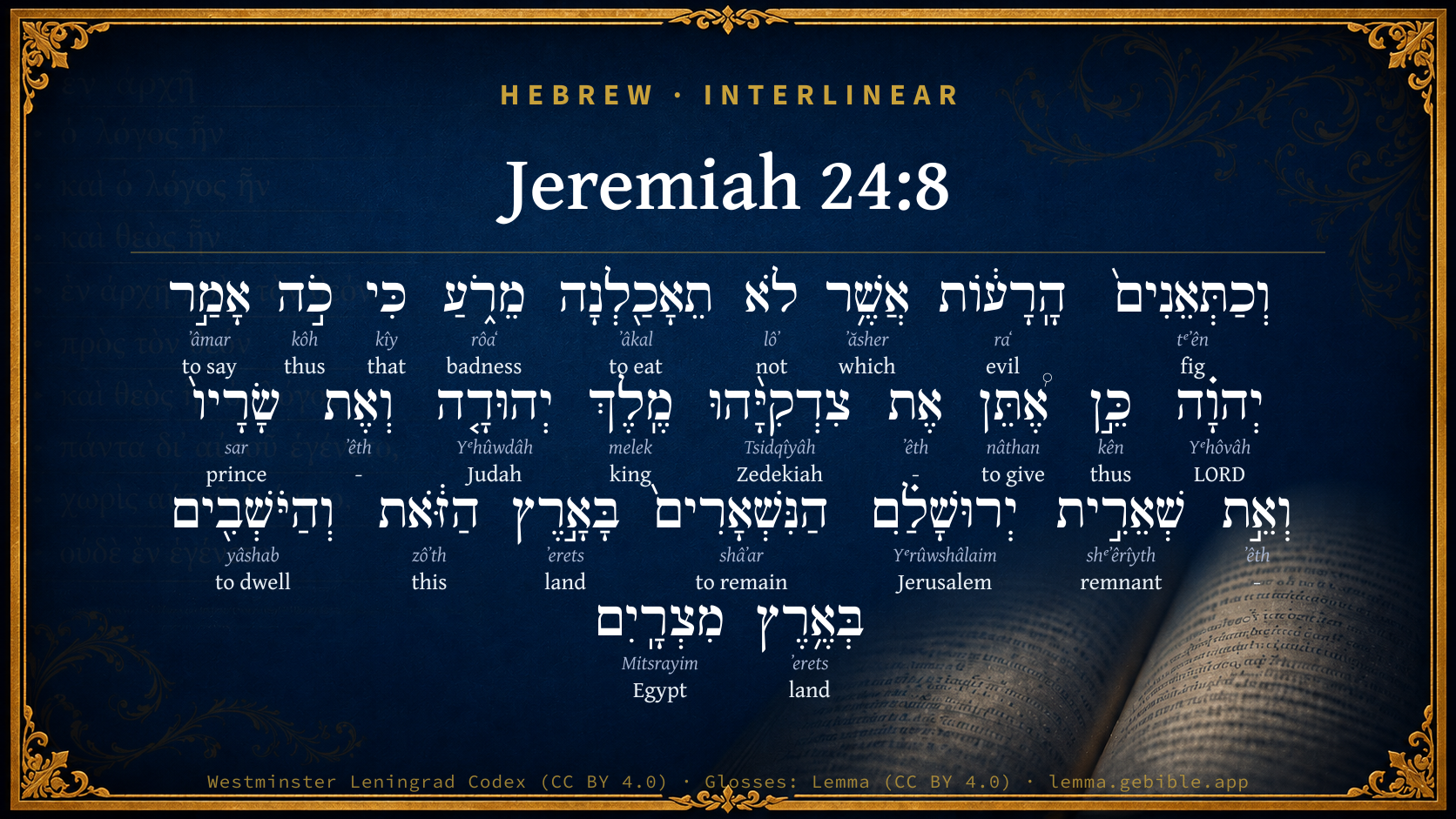
Jeremiah 24:8

Hebrew (Westminster Leningrad Codex) Jeremiah 24:8 appears in the Hebrew Old Testament. The text above is from the Westminster Leningrad Codex. Each word links to its Strong’s number, a concise gloss, and parsing drawn from the Open Scriptures Hebrew Bible morphology. Click any word for its full Brown-Driver-Briggs (BDB) entry.
Download image
Cite this verse

Jeremiah 24:8 (World English Bible). Public Domain. Lemma interlinear Bible study tool, https://lemma.gebible.app/v/jeremiah/24/8.

Show BibTeX & RIS
BibTeX
RIS
English Translation
As the bad figs, which can't be eaten, they are so bad, surely thus says Yahweh, So will I give up Zedekiah the king of Judah, and his princes, and the residue of Jerusalem, who remain in this land, and those who dwell in the land of Egypt,
World English Bible · Public Domain
Download a study sheet

One document with this verse’s original text, its word-by-word gloss line, the meaning frame, cross-references with their text, attributed commentary, and full source and license credits — printable, and it pastes into notes with its structure intact.

This verse Autodidact and up

Study sheet (.html) Plain text (.txt)

A passage Seminary Student

Up to 50 verses in one chapter. A passage sheet keeps up to 6 commentary sources and 12 cross-references per verse, in the order this page ranks them, and says so on the sheet whenever that leaves anything out. Ask for a single verse and you get the Autodidact verse sheet above.

Everything on this page stays free to read, with no account — the sheet is a download of what is already on screen, not access to it.

Want to remove ads? Support Godless Engineer
Compare translations 3

The same verse in 3 English versions, stacked beneath the original-language interlinear above. Click any original word for its lexicon entry.

Each is an independent rendering of the whole verse — the interlinear is not word-aligned to these translations.

Highlighted words mark where these versions differ — a whole-verse word diff, not a word-by-word alignment.

  • World English Bible Public Domain
    As the bad figs, which can't be eaten, they are so bad, surely thus says Yahweh, So will I give up Zedekiah the king of Judah, and his princes, and the residue of Jerusalem, who remain in this land, and those who dwell in the land of Egypt,
  • King James Version Public Domain
    And as the evil figs, which cannot be eaten, they are so evil; surely thus saith the LORD, So will I give Zedekiah the king of Judah, and his princes, and the residue of Jerusalem, that remain in this land, and them that dwell in the land of Egypt:
  • unfoldingWord Literal Text CC BY-SA 4.0
    And like the bad figs that cannot be eaten from badness—for thus says Yahweh—so I will give Zedekiah, king of Judah, and his officials, and the remnant of Jerusalem, the ones remaining in this land, and the ones dwelling in the land of Egypt.

unfoldingWord Literal Text — © unfoldingWord, licensed CC BY-SA 4.0. Word-aligned USFM3 via Door43 (git.door43.org/unfoldingWord/en_ult).

Versions to compare (up to 4)

3 of 4 selected

Show all 18 translations

Every available English version of this verse, each an independent rendering of the whole verse.

  • World English Bible Public Domain
    As the bad figs, which can't be eaten, they are so bad, surely thus says Yahweh, So will I give up Zedekiah the king of Judah, and his princes, and the residue of Jerusalem, who remain in this land, and those who dwell in the land of Egypt,
  • Berean Standard Bible Public Domain
    But like the bad figs, so bad they cannot be eaten,’ says the LORD, ‘so will I deal with Zedekiah king of Judah, his officials, and the remnant of Jerusalem—those remaining in this land and those living in the land of Egypt.
  • Majority Standard Bible Public Domain
    But like the bad figs, so bad they cannot be eaten,’ says the LORD, ‘so will I deal with Zedekiah king of Judah, his officials, and the remnant of Jerusalem—those remaining in this land and those living in the land of Egypt.
  • King James Version Public Domain
    And as the evil figs, which cannot be eaten, they are so evil; surely thus saith the LORD, So will I give Zedekiah the king of Judah, and his princes, and the residue of Jerusalem, that remain in this land, and them that dwell in the land of Egypt:
  • American Standard Version (1901) Public Domain
    And as the bad figs, which cannot be eaten, they are so bad, surely thus saith Jehovah, So will I give up Zedekiah the king of Judah, and his princes, and the residue of Jerusalem, that remain in this land, and them that dwell in the land of Egypt,
  • Revised Version (1885) Public Domain
    And as the bad figs, which cannot be eaten, they are so bad; surely thus saith the LORD, So will I give up Zedekiah the king of Judah, and his princes, and the residue of Jerusalem, that remain in this land, and them that dwell in the land of Egypt:
  • Geneva Bible (1599) Public Domain
    And as the naughtie figges which can not bee eaten, they are so euill (surely thus saith the Lord) so wil I giue Zedekiah the King of Iudah, and his princes, and the residue of Ierusalem, that remaine in this lande, and them that dwell in the lande of Egypt:
  • Douay-Rheims (1899) Public Domain
    And as the very bad figs, that cannot be eaten, because they are bad: thus saith the Lord: So will I give Sedecias the king of Juda, and his princes, and the residue of Jerusalem, that have remained in this city, and that dwell in the land of Egypt.
  • Young's Literal Translation Public Domain
    And like the bad figs, that are not eaten for badness, Surely thus said Jehovah: So do I make Zedekiah king of Judah, And his heads, and the remnant of Jerusalem, Who are left in this land, And who are dwelling in the land of Egypt,
  • Literal Standard Version CC BY-SA 4.0
    And like the bad figs that are not eaten for badness, || Surely thus said YHWH: So I make Zedekiah king of Judah, || And his heads, and the remnant of Jerusalem, || Who are left in this land, || And who are dwelling in the land of Egypt,
  • Unlocked Literal Bible CC BY-SA 4.0
    But like the bad figs that are too bad to be eaten—this is what Yahweh says—I will act in this way with Zedekiah, king of Judah, with his officials, and with the rest of Jerusalem who remain in this land or go to stay in the land of Egypt.
  • unfoldingWord Literal Text CC BY-SA 4.0
    And like the bad figs that cannot be eaten from badness—for thus says Yahweh—so I will give Zedekiah, king of Judah, and his officials, and the remnant of Jerusalem, the ones remaining in this land, and the ones dwelling in the land of Egypt.
  • Darby Bible Public Domain
    And as the bad figs, which cannot be eaten for badness, surely, thus saith Jehovah: So will I make Zedekiah the king of Judah, and his princes, and the remnant of Jerusalem, that remain in this land, and them that dwell in the land of Egypt.
  • World Messianic Bible Public Domain
    “‘As the bad figs, which can’t be eaten, they are so bad,’ surely the LORD says, ‘So I will give up Zedekiah the king of Judah, and his princes, and the remnant of Jerusalem who remain in this land, and those who dwell in the land of Egypt.
  • Webster's Bible Public Domain
    And as the bad figs, which cannot be eaten, they are so bad; surely thus saith the LORD, So will I give Zedekiah the king of Judah, and his princes, and the residue of Jerusalem, that remain in this land, and them that dwell in the land of Egypt:
  • Free Bible Version CC BY-SA 4.0
    But the bad figs, so bad they cannot be eaten, says the Lord, represent the way I will deal with Zedekiah, king of Judah, his officials, and those who are left of Jerusalem, as well as those remaining in this country and those living in Egypt.
  • Bible in Basic English Public Domain
    And like the bad figs which are so bad that they are of no use for food, so I will give up Zedekiah, king of Judah, and his chiefs and the rest of Jerusalem who are still in this land, and those who are in the land of Egypt:
  • JPS Tanakh (1917) Public Domain
    And as the bad figs, which cannot be eaten, they are so bad; surely thus saith the LORD: So will I make Zedekiah the king of Judah, and his princes, and the residue of Jerusalem, that remain in this land, and them that dwell in the land of Egypt;

Literal Standard Version (2020), Covenant Press — licensed CC BY-SA 4.0. Text via the HelloAO Bible API (eBible.org). Unlocked Literal Bible (unfoldingWord) — licensed CC BY-SA 4.0. Text via the HelloAO Bible API (eBible.org). unfoldingWord Literal Text — © unfoldingWord, licensed CC BY-SA 4.0. Word-aligned USFM3 via Door43 (git.door43.org/unfoldingWord/en_ult). Free Bible Version, Dr. Jonathan Gallagher — licensed CC BY-SA 4.0. Text via the HelloAO Bible API (eBible.org).

Word by word

More ways to search: Search by grammar → Find every occurrence → Compare this word →

Practice this passage: Drill this verse → Learn its vocabulary →

מֵרֹ֑עַ
rôaʻ
H7455
“from · badness”
Preposition + Noun, Common, Masculine, Singular, Absolute
Part of Speech
Preposition + Noun
Type
Common
Gender
Masculine
Number
Singular
State
Absolute
Full BDB Definition

Origin: from H7489

TWOT: 2191b

badness, evil - badness, bad quality - wilfulness - evil, badness (ethical) - sadness
  1. וְכַתְּאֵנִים֙ tᵉʼên H8384 “and · like/as the · figs” Conjunction + Preposition, Determined + Noun, Common, Feminine, Plural, Absolute
  2. הָֽרָע֔וֹת raʻ H7451 “the · evil” Particle, Definite Article + Adjective, Adjective, Feminine, Plural, Absolute
  3. אֲשֶׁ֥ר ʼăsher H834 “which” Particle, Relative
  4. לֹא lôʼ H3808 “not” Particle, Negative
  5. תֵאָכַ֖לְנָה ʼâkal H398 “to eat” Verb, Niphal, Imperfect, 3rd Person, Feminine, Plural
  6. כִּי kîy H3588 “that” Conjunction
  7. כֹ֣ה kôh H3541 “thus” Adverb
  8. אָמַ֣ר ʼâmar H559 “to say” Verb, Qal, Perfect, 3rd Person, Masculine, Singular
  9. יְהוָ֗ה Yᵉhôvâh H3068 “LORD” Noun, Proper
  10. כֵּ֣ן kên H3651 “thus” Particle, Demonstrative
  11. אֶ֠תֵּן nâthan H5414 “to give” Verb, Qal, Imperfect, 1st Person, Common, Singular
  12. אֶת ʼêth H853 “-” Particle, Direct Object
  13. צִדְקִיָּ֨הוּ Tsidqîyâh H6667 “Zedekiah” Noun, Proper
  14. מֶֽלֶךְ melek H4428 “king of” Noun, Common, Masculine, Singular, Construct
  15. יְהוּדָ֤ה Yᵉhûwdâh H3063 “Judah” Noun, Proper
  16. וְאֶת ʼêth H853 “and · -” Conjunction + Particle, Direct Object
  17. שָׂרָיו֙ sar H8269 “princes · his” Noun, Common, Masculine, Plural, Construct + Suffix, Personal, 3rd Person, Masculine, Singular
  18. וְאֵ֣ת ʼêth H853 “and · -” Conjunction + Particle, Direct Object
  19. שְׁאֵרִ֣ית shᵉʼêrîyth H7611 “remnant of” Noun, Common, Feminine, Singular, Construct
  20. יְרוּשָׁלִַ֗ם Yᵉrûwshâlaim H3389 “Jerusalem” Noun, Proper
  21. הַנִּשְׁאָרִים֙ shâʼar H7604 “the · remaining” Particle, Definite Article + Verb, Niphal, Participle Active, Masculine, Plural, Absolute
  22. בָּאָ֣רֶץ ʼerets H776 “in/at the · land” Preposition, Determined + Noun, Common, Both, Singular, Absolute
  23. הַזֹּ֔את zôʼth H2063 “the · this” Particle, Definite Article + Pronoun, Demonstrative, Feminine, Singular
  24. וְהַיֹּשְׁבִ֖ים yâshab H3427 “and · the · dwelling” Conjunction + Particle, Definite Article + Verb, Qal, Participle Active, Masculine, Plural, Absolute
  25. בְּאֶ֥רֶץ ʼerets H776 “in/at · land of” Preposition + Noun, Common, Both, Singular, Construct
  26. מִצְרָֽיִם Mitsrayim H4714 “Egypt” Noun, Proper

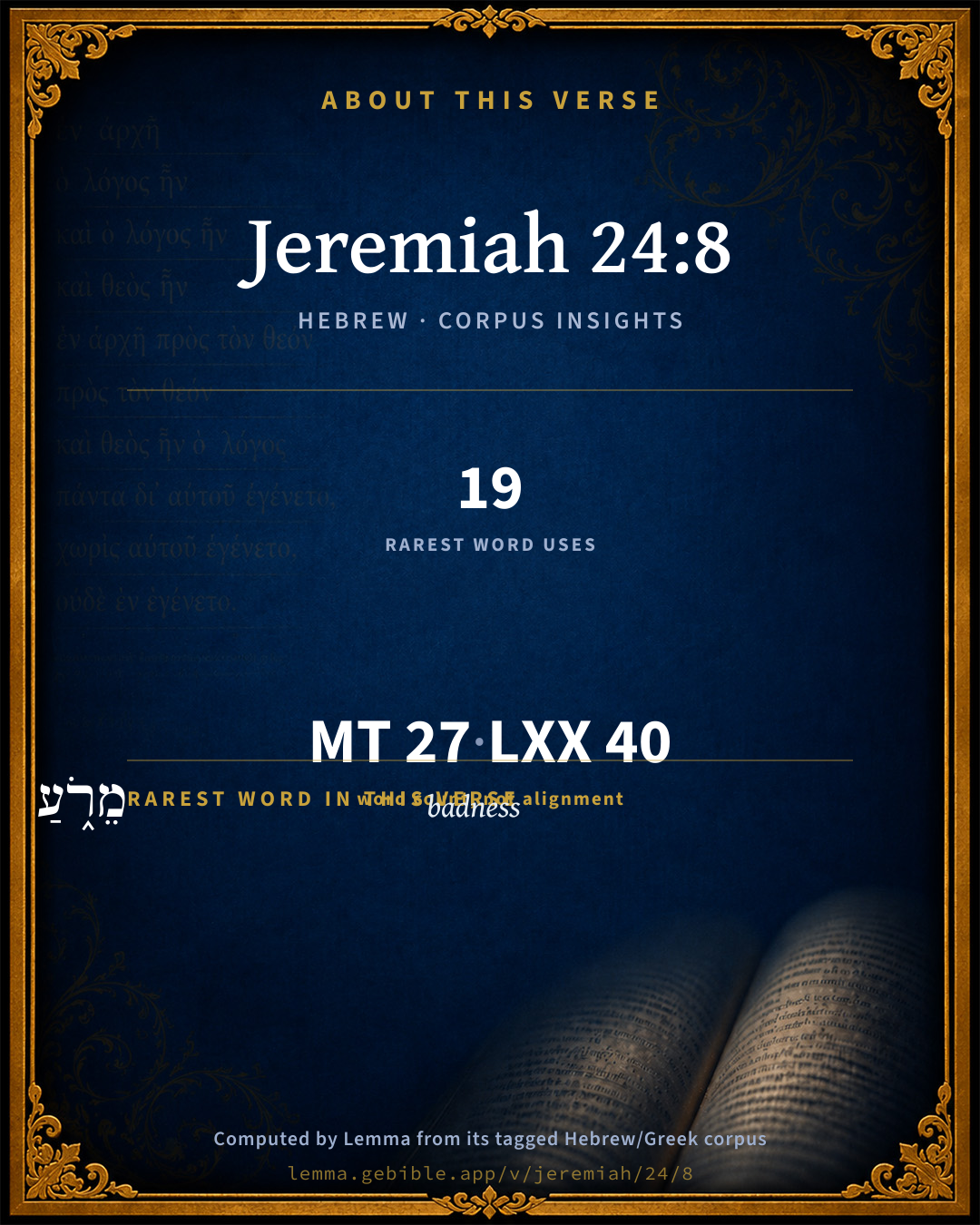
About this verse

These counts appear in no published source. They are computed here, from the morphology-tagged text and Lemma’s own curated glosses. What Lemma adds →

27
words
24
distinct lemmas
Prophets
section

Notable vocabulary

The rarest word here is מֵרֹ֑עַ badness H7455 — appearing just 19 times in the whole Hebrew Bible.

Shared distinctive vocabulary

מֵרֹ֑עַ badness H7455 occurs in 19 verses of the Hebrew Bible. Also found in:

Grammatical profile

  • 5 verbs
  • 12 nouns
  • 1 adjective
  • 1 pronoun
  • 1 conjunction
  • 1 adverb
  • 6 particles

Verb forms

  • תֵאָכַ֖לְנָה Niphal · Imperfect
  • אָמַ֣ר Qal · Perfect
  • אֶ֠תֵּן Qal · Imperfect
  • הַנִּשְׁאָרִים֙ Niphal · Participle Active
  • וְהַיֹּשְׁבִ֖ים Qal · Participle Active

Repetition

A word recurs within this verse — often emphatic in Hebrew:

  • בָּאָ֣רֶץ land H776 ×2

Hebrew & Septuagint length

In the original languages it is 27 Hebrew tokens and 40 Greek tokens — but the two are counted differently (Hebrew bundles its prefixes and suffixes into one token; the Greek is in lemma form), so that isn’t a like-for-like length.

Cross-references

15

Topical passages linked to Jeremiah 24:8 in the Treasury of Scripture Knowledge — connected by theme and wording, ordered by reader-vote popularity; previews shown in the World English Bible.

  • Jeremiah 43:1–44:1 It happened that, when Jeremiah had made an end of speaking to all the people all the words of Yahweh their God, with which Yahweh their God had sent him to them, even all these words,
  • Jeremiah 24:2 One basket had very good figs, like the figs that are first-ripe; and the other basket had very bad figs, which could not be eaten, they were so bad.
  • Jeremiah 29:16–18 thus says Yahweh concerning the king who sits on the throne of David, and concerning all the people who dwell in this city, your brothers who haven't gone forth with you into captivity;
  • Jeremiah 37:17 Then Zedekiah the king sent, and fetched him: and the king asked him secretly in his house, and said, Is there any word from Yahweh? Jeremiah said, There is. He said also, You shall be delivered into the hand of the king of Babylon.
  • Jeremiah 39:2–9 in the eleventh year of Zedekiah, in the fourth month, the ninth day of the month, a breach was made in the city),
  • Jeremiah 21:10 For I have set my face on this city for evil, and not for good, says Yahweh: it shall be given into the hand of the king of Babylon, and he shall burn it with fire.
  • Jeremiah 24:5 Thus says Yahweh, the God of Israel: Like these good figs, so will I regard the captives of Judah, whom I have sent out of this place into the land of the Chaldeans, for good.
  • Jeremiah 32:28–29 Therefore thus says Yahweh: Behold, I will give this city into the hand of the Chaldeans, and into the hand of Nebuchadrezzar king of Babylon, and he shall take it:
  • Jeremiah 34:17–22 Therefore thus says Yahweh: you have not listened to me, to proclaim liberty, every man to his brother, and every man to his neighbor: behold, I proclaim to you a liberty, says Yahweh, to the sword, to the pestilence, and to the famine; and I will make you to be tossed back and forth among all the kingdoms of the earth.
  • Jeremiah 37:10 For though you had struck the whole army of the Chaldeans who fight against you, and there remained but wounded men among them, yes would they rise up every man in his tent, and burn this city with fire.
  • Jeremiah 38:18–23 But if you will not go forth to the king of Babylon's princes, then shall this city be given into the hand of the Chaldeans, and they shall burn it with fire, and you shall not escape out of their hand.
  • Jeremiah 44:26–30 Therefore hear the word of Yahweh, all Judah who dwell in the land of Egypt: Behold, I have sworn by my great name, says Yahweh, that my name shall no more be named in the mouth of any man of Judah in all the land of Egypt, saying, As the Lord Yahweh lives.
  • Jeremiah 52:2–11 He did that which was evil in the sight of Yahweh, according to all that Jehoiakim had done.
  • Ezekiel 12:12–16 The prince who is among them shall bear on his shoulder in the dark, and shall go forth: they shall dig through the wall to carry out thereby: he shall cover his face, because he shall not see the land with his eyes.
  • Ezekiel 17:11–21 Moreover the word of Yahweh came to me, saying,

Cross-references courtesy of OpenBible.info (CC BY 4.0).

Hebrew and Greek witnesses Masoretic Hebrew ↔ Greek Septuagint

The same verse in the two great witnesses to the Old Testament, shown verse-for-verse.

These are two independent witnesses, not word-aligned to each other, and the Septuagint is shown in lemma (dictionary) form.

Hebrew Jeremiah 24:8 Masoretic · Westminster Leningrad Codex

וְכַתְּאֵנִים֙ הָֽרָע֔וֹת אֲשֶׁ֥ר לֹא תֵאָכַ֖לְנָה מֵרֹ֑עַ כִּי כֹ֣ה אָמַ֣ר יְהוָ֗ה כֵּ֣ן אֶ֠תֵּן אֶת צִדְקִיָּ֨הוּ מֶֽלֶךְ יְהוּדָ֤ה וְאֶת שָׂרָיו֙ וְאֵ֣ת שְׁאֵרִ֣ית יְרוּשָׁלִַ֗ם הַנִּשְׁאָרִים֙ בָּאָ֣רֶץ הַזֹּ֔את וְהַיֹּשְׁבִ֖ים בְּאֶ֥רֶץ מִצְרָֽיִם

As the bad figs, which can't be eaten, they are so bad, surely thus says Yahweh, So will I give up Zedekiah the king of Judah, and his princes, and the residue of Jerusalem, who remain in this land, and those who dwell in the land of Egypt,

World English Bible · Public Domain

Greek LXX Structure differs

In the Septuagint, Jeremiah is about an eighth shorter than the Hebrew and arranges its material differently — the Oracles Against the Nations (Hebrew chapters 46–51) appear in the middle of the Greek book, after 25:13. Because the chapter and verse boundaries do not line up, a verse-for-verse comparison with the Hebrew is not shown.

A verse-for-verse comparison isn’t shown here because the chapters and verses don’t line up. Switch to the LXX edition with the MT / LXX toggle above to read the Greek directly.

On this verse, Keil & Delitzsch discusses the Septuagint’s reading. Read the note in Commentary ↓

Hebrew: Westminster Leningrad Codex (CC BY 4.0). Greek: Septuagint (public domain); English from a public-domain English Septuagint. How the Septuagint differs from the Hebrew →

Targum (Aramaic paraphrase)

1

The Targum is the ancient Jewish Aramaic paraphrase of the Hebrew Scriptures — an interpretive translation, not the Hebrew text itself. Onkelos (literal) and Pseudo-Jonathan (expansive) render the Torah, and Jonathan the Prophets. Coverage is partial: where no permissively-licensed English translation exists for a verse, only the Aramaic is shown. This is verse-level text, not a word-by-word alignment to the Hebrew.

  1. Targum Jonathan Prophets (Joshua–Malachi)
    וּכְתֵינַיָא בִּישְׁתָא דְלָא מִתְאַכְלָא מִבִּישׁוּ אֲרֵי כִדְנַן אֲמַר יְיָ כֵּן אֶתֵּן יַת צִדְקִיָהוּ מְלַךְ שִׁבְטָא דְבֵית יְהוּדָה וְיַת רַבְרְבוֹהִי וְיַת שְׁאָרָא דִירוּשְׁלֵם דְאִשְׁתְּאָרוּ בְּאַרְעָא הָדָא וּדְיַתְבִין בְּאַרְעָא דְמִצְרָיִם:

    (no public-domain English translation for this verse)

    Targum Jonathan — Aramaic: “Mikraot Gedolot” (public domain). English: “Sefaria Community Translation” (CC0 1.0 (public-domain dedication)); “London "Chaldee Paraphrase," 1871” (public domain). Text via Sefaria.

Commentary

Notes on Jeremiah 24:8 from classic Christian and Jewish commentators (each source and its license shown beneath its notes). The classic Christian expositions comment on the surrounding passage and are grouped to its opening verse, so a note may address several verses; the Jewish commentaries on the Tanakh (Rashi and others) are per-verse, so they appear only where the commentator wrote on this verse.

Lemma curates 59 commentaries, every one of them public domain or Creative Commons licensed, each selected and text-cleaned for this edition rather than reprinted as found. About our sources →

Trapp's Complete Commentary

John Trapp

Jer 24:8 And as the evil figs, which cannot be eaten, they are so evil; surely thus saith the LORD, So will I give Zedekiah the king of Judah, and his princes, and the residue of Jerusalem, that remain in this land, and them that dwell in the land of Egypt:

Ver. 8. And as the evil figs.] Zedekiah and his subjects, who were looked upon as the happier, because at home; and derided, likely, Jeconiah and his concaptives as cowards. Sure it is, that they were not bettered by their brethren’s miseries.

John Trapp, A Commentary or Exposition upon All the Books of the Old and New Testament (1647–1656) — public domain. Text from a community e-Sword module.

Joseph Benson's Commentary

Jer 24:8-10. As the evil figs — so will I give Zedekiah — Or rather, so will I make Zedekiah, as אתןshould be rendered here, and as the same verb is rendered Jer 29:17. And they that dwell in the land of Egypt — Whither, it is probable, many of the Jews had fled upon the coming, or the report of the coming, of the king of Babylon: see chap. 43., 44. I will deliver them to be removed into all the kingdoms, &c. — The Lord, by his prophet, uses the words of Moses, wherewith to express those tremendous judgments which he designed to bring upon this wicked prince and people, as well because the Jews had, or professed to have, great reverence for that man of God, how little soever they had for Jeremiah, as to let them see that what the Lord here threatened, and soon would bring to pass, was but an accomplishment of what he foretold by Moses should befall them in case of their disobedience, by which predictions they ought to have taken warning. To be a reproach, and a proverb, and a taunt —

To be made a jest of and a by-word: see Dan 9:16. And a curse in all places whither I shall drive them — Men shall use this phrase as a form of execration, “God make thee like Zedekiah, and those who remained with him;” compare Jer 29:22. On the contrary, to make a man a blessing, implies that his name should be mentioned as a signal instance of God’s favour: see Gen 48:20; Zec 8:13. Till they be consumed from off the land — My judgments shall follow them so closely that neither they nor any of their posterity shall ever enjoy any possession or property in their own country. This seems to be spoken of those miserable remains of the Jews who, when the rest were carried into captivity, were, either by secreting themselves, or some other means left in the desolated country.

Joseph Benson's Commentary on the Old and New Testaments (1811–1818) — public domain. Text from a community e-Sword module.

Keil & Delitzsch

C. F. Keil & F. Delitzsch

And as one deals with the bad uneatable figs, i.e., throws them away, so will the Lord deliver up to ignominious ruin Zedekiah with his princes and the remainder of the people, both those still staying in the land and those living in Egypt. This, the fate awaiting them, is more fully described in Jer 24:9 and Jer 24:10. In Jer 24:8 the "yea, thus saith," is inserted into the sentence by way of repetition of the "thus saith," Jer 24:5. כּן is resumed and expanded by וּנתתּים in Jer 24:9. The "princes" are Zedekiah's courtiers. Those in Egypt are they who during the war had fled thither to hide themselves from judgment. From the beginning of Jer 24:9 to הארץ is verbally the same as Jer 15:4, save that לרעה is added to make more marked the contrast to לטובּהּ, Jer 24:5 - the evil, namely, that is done to them. Hitz., Ew., Umbr., Gr., following the lxx, delete this word, but without due cause. The further description of the ill-usage in "for a reproach," etc., is based on Deu 28:37; and is intensified by the addition of "and for an object of cursing," to show that in their case the curse there recorded will be fulfilled. From the last words, according to which disgrace will light on them in all the lands they are driven into, it appears that captivity will fall to the lot of such as are yet to be found in the land. But captivity involves new hostile invasions, and a repeated siege and capture of Jerusalem; during which many will perish by sword, famine, and plague. Thus and by deportation they shall be utterly rooted out of the land of their fathers. Cf. Jer 29:17., where Jeremiah repeats the main idea of this threatening.

Keil & Delitzsch — Biblical Commentary on the Old Testament (1861–1891) — public domain (CC PDM 1.0). Text via the HelloAO Bible API. (Old Testament only.)

Tyndale Open Study Notes

Tyndale Open Resources

24:8-10 The bad figs were those left in Jerusalem, and the Lord would scatter them because of their rottenness. Those included in this group ranged from the remainder of the royal family to the common people. In 586 BC, Zedekiah’s reign ended exactly as predicted here.

Tyndale Open Study Notes — © Tyndale Open Resources, licensed CC BY-SA 4.0. Text via the HelloAO Bible API.

Geneva Bible (1599)

Geneva Bible translators

Which fled thither for succor.

Geneva Bible (1599) marginal notes — public domain. Text via Bolls.life.

Jamieson, Fausset & Brown

Robert Jamieson, A. R. Fausset & David Brown

in . . . Egypt--Many Jews had fled for refuge to Egypt, which was leagued with Judea against Babylon.

Jamieson, Fausset & Brown — Commentary Critical and Explanatory on the Whole Bible (1871) — public domain (CC PDM 1.0). Text via the HelloAO Bible API.

Adam Clarke's Commentary

Verse 8. So will I give Zedekiah] I will treat these as they deserve. They shall be carried into captivity, and scattered through all nations. Multitudes of those never returned to Judea; the others returned at the end of seventy years.

Adam Clarke's Commentary on the Bible (1810–1826) — public domain. Text from a community e-Sword/MySword module.

John Calvin's Commentaries

God, after having promised to deal kindly with the captives, now declares that he would execute heavier punishment on King Zedekiah, and the whole people who yet remained in their own country. We have stated why God exhibited this vision to the Prophet, even that he might support their minds who saw nothing but grounds of despair, and that also, on the other hand, he might correct their pride who flattered themselves in their own lot, because God had deferred his vengeance as to them. Then the Prophet, having given comfort to the miserable exiles, now speaks against Zedekiah and his people, who boasted that God was propitious to them, and that they had not only been fortunate, but also wise in continuing in their own country.

He then says that Zedekiah and his princes, and all who remained in Judea, were like the bad figs, which could not be eaten on account of their bitterness. I have said that this is to be referred to punishment and not to guilt. They had sinned, I allow, most grievously; but we are to regard the design of the Prophet. The meaning then is, that though the condition of those who had been driven into captivity was for the present harder, yet God would deal more severely with those who remained, because he had for a time spared them, and they did not repent, but hardened themselves more and more in their wickedness.

Now we know that Zedekiah was set over the kingdom of Judah, when Jeconiah surrendered himself to Nebuchadnezzar: he was the uncle of Jeconiah, and reigned eleven years; and during that time he ought to have been at least wise at the expense of another. For Eliakim, who was also called Jehoiakim, had been chastised, and that not only once; but Nebuchadnezzar, after having spoiled the temple, rendered him tributary to himself, on his return to Chaldea. At length, after having been often deceived by him, he became extremely displeased with him; and his son, who had reigned with his father, three months after his death, voluntarily surrendered himself into the power and will of the conqueror. Mathaniah afterwards reigned, of whom the Prophet speaks here. So, he says, will I render Zedekiah (called previously Mathaniah) the king of Judah, and his princes, and the remnants of Jerusalem, who remain in this land, (for the greater part had been led into exile,) and those who dwell in the land of Egypt, for many had fled thither; and we know that they were confederates with the Egyptians, and that through a vain confidence in them they often rebelled.

And this was also the reason why the prophets so sharply reproved them: they relied on the help of Egypt, and took shelter under its protection. When, therefore, they found themselves exposed to the will of their enemies, they fled into Egypt. But Nebuchadnezzar afterwards, as we shall see, conquered Egypt also. Thus it happened that they were only for a short time beyond the reach of danger. But as fugitive slaves, when recovered, are afterwards treated more severely by their masters, so also the rage of King Nebuchadnezzar became more violent against them. It now follows —

John Calvin's Commentaries (1540-1563) — public domain. Text from the Calvin Translation Society English edition (1840s-50s) via the Christian Classics Ethereal Library (ccel.org). Calvin's coverage is partial (roughly two-thirds of the Bible); uncommented books and verses are honest gaps, never fabricated. The 19th-century editor's footnotes and remarks are omitted so the notes are faithfully Calvin's own voice.

Ellicott's Commentary for English Readers

(8) And them that dwell in the land of Egypt.—These were, in fact, such as had been carried into captivity with Jehoahaz by Pharaoh-nechoh (see Note on Jer_22:11), or had fled thither in order to avoid submission to Nebuchadnezzar, and were settled in Migdol, and Tahpanhes, and Noph. We meet with them later on in Jeremiah 44. For these there was to be no return, no share in the work of restoration. They formed the nucleus of the Jewish population of Egypt, and in course of time (B.C. 150) set up a rival temple at Leontopolis. (See Note on Isa_19:19.)

A Bible Commentary for English Readers, edited by Charles John Ellicott (1878–1897) — public domain. Text from a community e-Sword module.

The Cambridge Bible for Schools and Colleges

gen. ed. J. J. S. Perowne

8. them that dwell in the land of Egypt] Whether those who accompanied Jehoahaz (2Ki_23:34), or others who during the subsequent reigns also took refuge there, as being a kingdom opposed to the Babylonian power. The Assuan papyri (see Intr. p. xix., note) shew that in b.c. 525 there was a colony which had existed there for a considerable time previously.

The Cambridge Bible for Schools and Colleges (gen. ed. J. J. S. Perowne; Cambridge University Press, 1878–1918) — public domain. Text from a community e-Sword module.

John Gill's Exposition

And I will deliver them to be removed into all the kingdoms of the earth for their hurt,.... Jeconiah and the captives with him were only carried into Babylon; but these should be scattered one from another into the several parts of the world. The former were carried captive for their good, and it issued in that; but these were carried away for their hurt, to the injury of their persons and properties, and without having any effect upon them to the good of their souls: though this might begin to be fulfilled by the seventy years' captivity in Babylon, yet it had a more complete fulfilment in the destruction of this people by the Romans; to which these and the following words seem more particularly to refer:

to be a reproach and a proverb, a taunt and a curse, in all places whither I shall drive them; their names to be used as a proverb for their riches ill gotten, their falsehood and tricking; and under the curse of God, and the reproach of man, as they are this day; see Deu 28:37.

John Gill's Exposition of the Whole Bible (1746–1763) — public domain (CC PDM 1.0). Text via the HelloAO Bible API.

Haydock's Catholic Bible Commentary

Egypt, to which they fled contrary to the prophet’s advice, 4 Kings xxv. 26.

George Leo Haydock (1774–1849), Haydock's Catholic Family Bible and Commentary, 1859 edition — public domain. Excludes Psalms (Douay-Rheims chapter numbering differs from Protestant) and Deuterocanonical books (Catholic canon only).

Matthew Poole's English Annotations

Whither it is probable many of the Jews had fled, upon the coming, or noise of the coming, of the king of Babylon, as they had done before, Isa 30:2; 31:1.

Matthew Poole's English Annotations on the Holy Bible (1683–1685) — public domain. Text from a community e-Sword/MySword module.

Whedon's Commentary on the Bible

Daniel D. Whedon

8. But as one throws away evil figs, so God will throw away Zedekiah and his princes. Even those who have taken refuge in Egypt are remembered in this curse. The language here used is taken substantially from Deu_28:25; Deu_28:37, which see.

Daniel D. Whedon (gen. ed.), Commentary on the Old and New Testaments (1874–1909) — public domain. Text from a community e-Sword module.

The Pulpit Commentary

And as the evil figs. (So Jer_29:16) That dwell in the land of Egypt. Those who had fled thither during the war; (comp. Jer 42,jer 43) hardly those who had been carried captive to Egypt with Jehoahaz, who would presumably have been of the better sort, such as are symbolized by the good figs.

The Pulpit Commentary (1880–1919), ed. H.D.M. Spence-Jones & Joseph S. Exell — public domain. Text from a community e-Sword module.

unfoldingWord translationNotes

Door43 World Missions Community

But like the bad figs that are too bad to be eaten

This simile speaks of the evil officials in Jerusalem as if they were bad figs that were too rotten to eat. Just as bad figs are useless, so these people who do not follow Yahweh are also useless. (See: Simile)

I will turn them into a frightening thing, a disaster ... a disgrace and a subject for proverbs, taunts, and curses

These phrases mean the same thing and emphasize how thoroughly Yahweh will judge the people of Jerusalem. They will become something that will frighten other people when they see it. (See: Doublet and Metaphor)

I will send out sword, famine, and plague against them

"I will kill them with war, famine and sicknesses"

I will send out sword

Here "sword" refers to war or enemy armies. AT: "I will send enemy armies" or "I will send out war" (See: Metonymy)

sword, famine, and plague

These things are spoken of as if they were living things that could attack the people of Jerusalem. (See: Personification)

they are destroyed from the land

"none of them remain in the land"

translationWords

fig

Yahweh

Zedekiah

kingdom of Judah

Jerusalem

Egypt

kingdom

earth

proverb

curse

cast out

send

sword

famine

plague

unfoldingWord translationNotes — © Distant Shores Media and the Door43 World Missions Community, licensed CC BY-SA 4.0. Source: git.door43.org/Door43/en_tn.

Lesson kit

Teaching starters — assembled from the data on this page, not authored interpretation. Every prompt links to the verse data it draws on. Edit before teaching.

Jeremiah, in the Prophets, opens this verse with 27 words (24 distinct Hebrew lemmas). Its most distinctive word is rôaʻ (“badness”). A historical commentator’s framing appears above. Read the whole chapter for the surrounding context.

Discussion questions

  1. What does “badness” (rôaʻ) contribute to the verse as a whole?
  2. How does Genesis 41:19, which shares the word «badness», read alongside this verse?
  3. What does the repetition of “land” (2× in this one verse) do in this verse?
  4. The translations on this page render this verse differently — a whole-verse word diff, not a word-by-word alignment. What might account for the different wordings?
  5. «תֵאָכַ֖לְנָה» is a Niphal Imperfect verb. How does that grammatical form shape the action described?
  6. Compare how Trapp's Complete Commentary and Joseph Benson's Commentary read this verse. Where do they agree or differ?

Things to notice

Reading settings

Reading text

Shown beneath each verse's original-language words.

Old Testament
Old Testament edition

Read the OT as the Masoretic Hebrew (MT) or the Greek Septuagint (LXX).

English shown for the Greek Septuagint (in the Hebrew ↔ Greek comparison).

Comparing translations? Open the Compare panel on any verse page to stack up to four side by side.