
Ezekiel 20:6

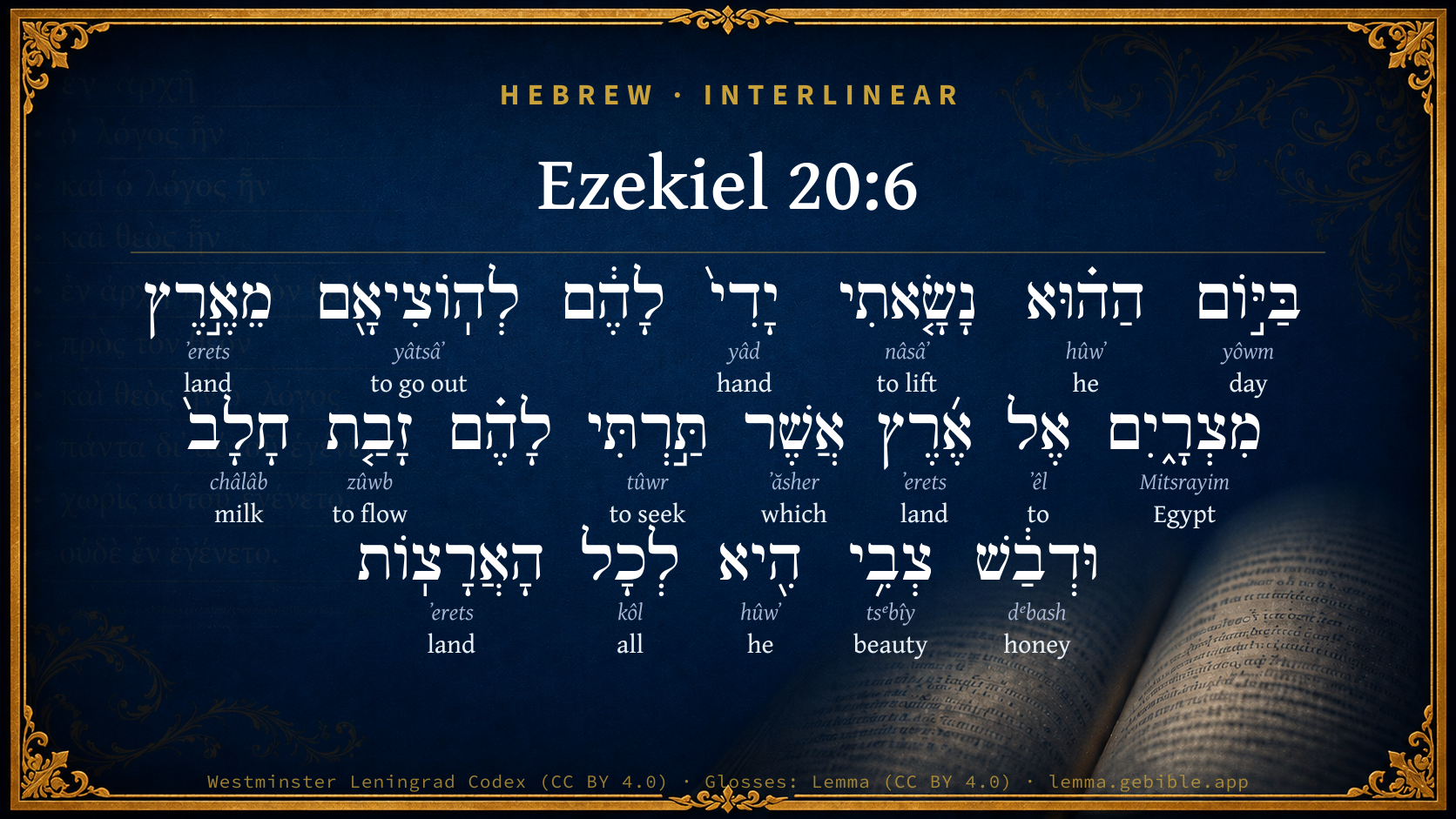
Hebrew (Westminster Leningrad Codex) Ezekiel 20:6 appears in the Hebrew Old Testament. The text above is from the Westminster Leningrad Codex. Each word links to its Strong’s number, a concise gloss, and parsing drawn from the Open Scriptures Hebrew Bible morphology. Click any word for its full Brown-Driver-Briggs (BDB) entry.
Download image
Cite this verse

Ezekiel 20:6 (World English Bible). Public Domain. Lemma interlinear Bible study tool, https://lemma.gebible.app/v/ezekiel/20/6.

Show BibTeX & RIS
BibTeX
RIS
English Translation
in that day I swore to them, to bring them forth out of the land of Egypt into a land that I had searched out for them, flowing with milk and honey, which is the glory of all lands.
World English Bible · Public Domain
Download a study sheet

One document with this verse’s original text, its word-by-word gloss line, the meaning frame, cross-references with their text, attributed commentary, and full source and license credits — printable, and it pastes into notes with its structure intact.

This verse Autodidact and up

Study sheet (.html) Plain text (.txt)

A passage Seminary Student

Up to 50 verses in one chapter. A passage sheet keeps up to 6 commentary sources and 12 cross-references per verse, in the order this page ranks them, and says so on the sheet whenever that leaves anything out. Ask for a single verse and you get the Autodidact verse sheet above.

Everything on this page stays free to read, with no account — the sheet is a download of what is already on screen, not access to it.

Want to remove ads? Support Godless Engineer
Compare translations 3

The same verse in 3 English versions, stacked beneath the original-language interlinear above. Click any original word for its lexicon entry.

Each is an independent rendering of the whole verse — the interlinear is not word-aligned to these translations.

Highlighted words mark where these versions differ — a whole-verse word diff, not a word-by-word alignment.

  • World English Bible Public Domain
    in that day I swore to them, to bring them forth out of the land of Egypt into a land that I had searched out for them, flowing with milk and honey, which is the glory of all lands.
  • King James Version Public Domain
    In the day that I lifted up mine hand unto them, to bring them forth of the land of Egypt into a land that I had espied for them, flowing with milk and honey, which is the glory of all lands:
  • unfoldingWord Literal Text CC BY-SA 4.0
    on that day I raised my hand to swear an oath to them that I would bring them out of the land of Egypt into a land that I had carefully selected for them. It was flowing with milk and honey; it was the most beautiful ornament among all the lands.

unfoldingWord Literal Text — © unfoldingWord, licensed CC BY-SA 4.0. Word-aligned USFM3 via Door43 (git.door43.org/unfoldingWord/en_ult).

Versions to compare (up to 4)

3 of 4 selected

Show all 18 translations

Every available English version of this verse, each an independent rendering of the whole verse.

  • World English Bible Public Domain
    in that day I swore to them, to bring them forth out of the land of Egypt into a land that I had searched out for them, flowing with milk and honey, which is the glory of all lands.
  • Berean Standard Bible Public Domain
    On that day I swore to bring them out of the land of Egypt into a land that I had searched out for them, a land flowing with milk and honey, the glory of all lands.
  • Majority Standard Bible Public Domain
    On that day I swore to bring them out of the land of Egypt into a land that I had searched out for them, a land flowing with milk and honey, the glory of all lands.
  • King James Version Public Domain
    In the day that I lifted up mine hand unto them, to bring them forth of the land of Egypt into a land that I had espied for them, flowing with milk and honey, which is the glory of all lands:
  • American Standard Version (1901) Public Domain
    in that day I sware unto them, to bring them forth out of the land of Egypt into a land that I had searched out for them, flowing with milk and honey, which is the glory of all lands.
  • Revised Version (1885) Public Domain
    in that day I lifted up mine hand unto them, to bring them forth out of the land of Egypt into a land that I had espied for them, flowing with milk and honey, which is the glory of all lands:
  • Geneva Bible (1599) Public Domain
    In the day that I lift vp mine hand vnto them to bring them forth of the land of Egypt, into a land that I had prouided for them, flowing with milke and hony which is pleasant among all lands,
  • Douay-Rheims (1899) Public Domain
    In that day I lifted up my hand for them, to bring them out of the land of Egypt, into a land which I had provided for them, flowing with milk and honey, which excelleth amongst all lands.
  • Young's Literal Translation Public Domain
    In that day I did lift up My hand to them, To bring them forth from the land of Egypt, Unto a land that I spied out for them, Flowing with milk and honey, A beauty it `is' to all the lands,
  • Literal Standard Version CC BY-SA 4.0
    In that day I lifted up My hand to them, || To bring them forth from the land of Egypt, || To a land that I spied out for them, || Flowing with milk and honey, || It [is] a beauty to all the lands,
  • Unlocked Literal Bible CC BY-SA 4.0
    on that day I raised my hand to swear an oath to them that I would bring them out of the land of Egypt into a land that I had carefully selected for them. It was flowing with milk and honey; it was the most beautiful ornament among all the lands.
  • unfoldingWord Literal Text CC BY-SA 4.0
    on that day I raised my hand to swear an oath to them that I would bring them out of the land of Egypt into a land that I had carefully selected for them. It was flowing with milk and honey; it was the most beautiful ornament among all the lands.
  • Darby Bible Public Domain
    in that day I lifted up my hand unto them, to bring them out of the land of Egypt into a land that I had espied for them, flowing with milk and honey, which is the ornament of all lands;
  • World Messianic Bible Public Domain
    in that day I swore to them to bring them out of the land of Egypt into a land that I had searched out for them, flowing with milk and honey, which is the glory of all lands.
  • Webster's Bible Public Domain
    In the day that I lifted up my hand to them, to bring them forth from the land of Egypt into a land that I had espied for them, flowing with milk and honey, which is the glory of all lands:
  • Free Bible Version CC BY-SA 4.0
    I promised them on that day to lead them out of Egypt and take them to a country that I had chosen for them, a land flowing with milk and honey—better than any other country.
  • Bible in Basic English Public Domain
    In that day I gave my oath to take them out of the land of Egypt into a land which I had been searching out for them, a land flowing with milk and honey, the glory of all lands:
  • JPS Tanakh (1917) Public Domain
    in that day I lifted up My hand unto them, to bring them forth out of the land of Egypt into a land that I had sought out for them, flowing with milk and honey, which is the beauty of all lands;

Literal Standard Version (2020), Covenant Press — licensed CC BY-SA 4.0. Text via the HelloAO Bible API (eBible.org). Unlocked Literal Bible (unfoldingWord) — licensed CC BY-SA 4.0. Text via the HelloAO Bible API (eBible.org). unfoldingWord Literal Text — © unfoldingWord, licensed CC BY-SA 4.0. Word-aligned USFM3 via Door43 (git.door43.org/unfoldingWord/en_ult). Free Bible Version, Dr. Jonathan Gallagher — licensed CC BY-SA 4.0. Text via the HelloAO Bible API (eBible.org).

Word by word

More ways to search: Search by grammar → Find every occurrence → Compare this word →

Practice this passage: Drill this verse → Learn its vocabulary →

תַּ֣רְתִּי
tûwr
H8446
“to seek”
Verb, Qal, Perfect, 1st Person, Common, Singular
Part of Speech
Verb
Stem
Qal
Form
Perfect
Person
1st Person
Gender
Common
Number
Singular
Full BDB Definition

Origin: a primitive root

TWOT: 2500

to seek, search out, spy out, explore - (Qal) - to seek out, select, find out how to do something - to spy out, explore - explorers, spies (participle) - to go about - merchant, trader (participle) - (Hiphil) to make a search, make a reconnaissance
  1. בַּיּ֣וֹם yôwm H3117 “in/at the · day” Preposition, Determined + Noun, Common, Masculine, Singular, Absolute
  2. הַה֗וּא hûwʼ H1931 “the · he” Particle, Definite Article + Pronoun, Personal, 3rd Person, Masculine, Singular
  3. נָשָׂ֤אתִי nâsâʼ H5375 “to lift” Verb, Qal, Perfect, 1st Person, Common, Singular
  4. יָדִי֙ yâd H3027 “hand · my” Noun, Common, Both, Singular, Construct + Suffix, Personal, 1st Person, Common, Singular
  5. לְהֽוֹצִיאָ֖ם yâtsâʼ H3318 “to go out · them” Preposition + Verb, Hiphil, Infinitive Construct + Suffix, Personal, 3rd Person, Masculine, Plural
  6. מֵאֶ֣רֶץ ʼerets H776 “from · land of” Preposition + Noun, Common, Both, Singular, Construct
  7. מִצְרָ֑יִם Mitsrayim H4714 “Egypt” Noun, Proper
  8. אֶל ʼêl H413 “to” Preposition
  9. אֶ֜רֶץ ʼerets H776 “land” Noun, Common, Both, Singular, Absolute
  10. אֲשֶׁר ʼăsher H834 “which” Particle, Relative
  11. זָבַ֤ת zûwb H2100 “flowing” Verb, Qal, Participle Active, Feminine, Singular, Construct
  12. חָלָב֙ châlâb H2461 “milk” Noun, Common, Masculine, Singular, Absolute
  13. וּדְבַ֔שׁ dᵉbash H1706 “and · honey” Conjunction + Noun, Common, Masculine, Singular, Absolute
  14. צְבִ֥י tsᵉbîy H6643 “beauty” Noun, Common, Masculine, Singular, Absolute
  15. הִ֖יא hûwʼ H1931 “he” Pronoun, Personal, 3rd Person, Feminine, Singular
  16. לְכָל kôl H3605 “to/for · all of” Preposition + Noun, Common, Masculine, Singular, Construct
  17. הָאֲרָצֽוֹת ʼerets H776 “the · lands” Particle, Definite Article + Noun, Common, Both, Plural, Absolute

About this verse

These counts appear in no published source. They are computed here, from the morphology-tagged text and Lemma’s own curated glosses. What Lemma adds →

20
words
15
distinct lemmas
Prophets
section

Notable vocabulary

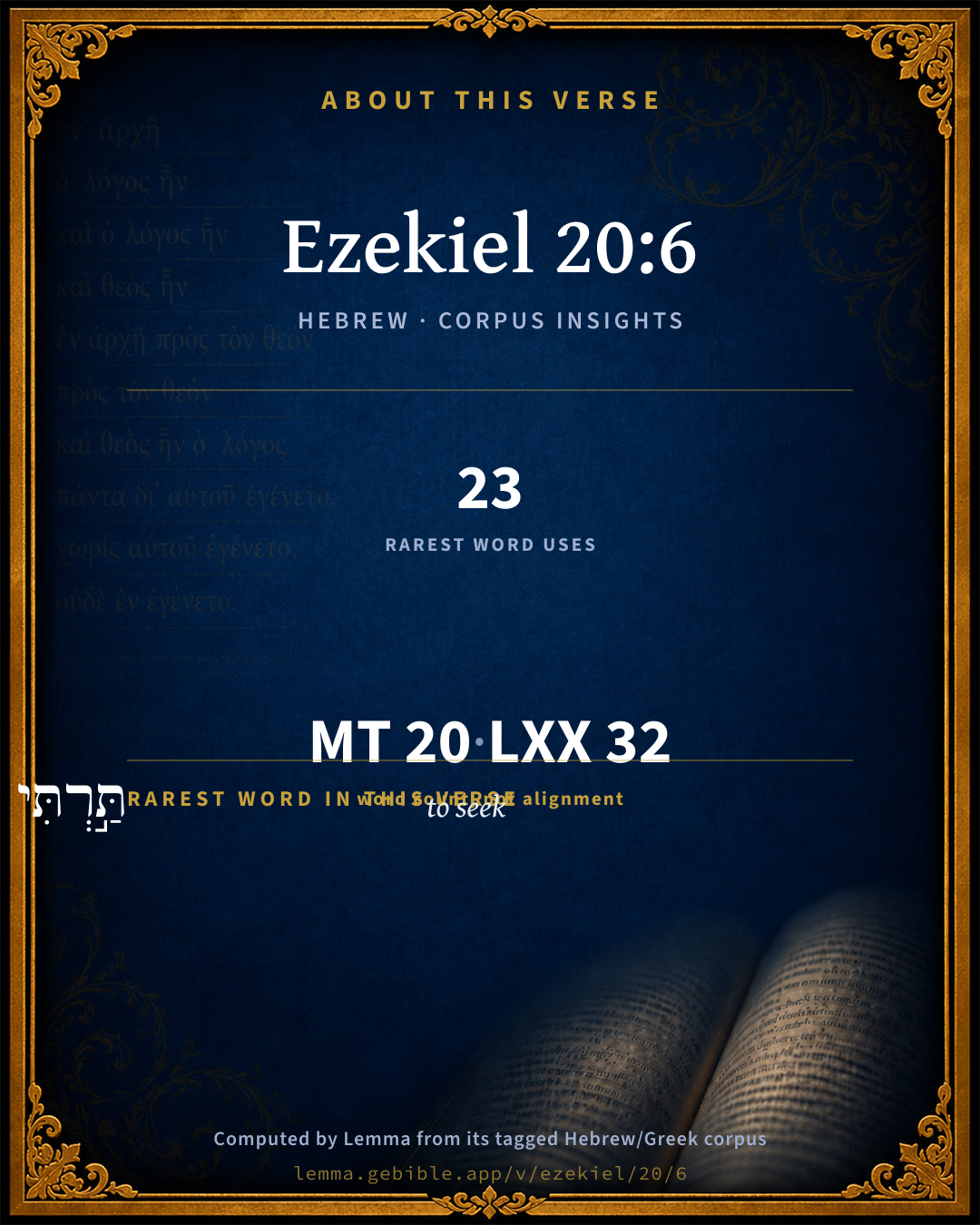
The rarest word here is תַּ֣רְתִּי to seek H8446 — appearing just 23 times in the whole Hebrew Bible.

Shared distinctive vocabulary

תַּ֣רְתִּי to seek H8446 occurs in 22 verses of the Hebrew Bible. Also found in:

Grammatical profile

  • 4 verbs
  • 10 nouns
  • 2 pronouns
  • 3 prepositions
  • 1 particle

Verb forms

  • נָשָׂ֤אתִי Qal · Perfect
  • לְהֽוֹצִיאָ֖ם Hiphil · Infinitive Construct
  • תַּ֣רְתִּי Qal · Perfect
  • זָבַ֤ת Qal · Participle Active

Repetition

Words recur within this verse — often emphatic in Hebrew:

  • מֵאֶ֣רֶץ land H776 ×3
  • הַה֗וּא he H1931 ×2

Hebrew & Septuagint length

In English translation the verse runs 39 words from the Hebrew and 39 from the Septuagint (LXX English) — the same length.

A rough comparison of the two English renderings, which tokenize alike — not a word-level alignment.

Word counts can differ between the Hebrew and the Greek without any difference in meaning — e.g. the Hebrew direct-object marker אֵת has no separate Greek word, and Greek often adds the article ὁ.

In the original languages it is 20 Hebrew tokens and 32 Greek tokens — but the two are counted differently (Hebrew bundles its prefixes and suffixes into one token; the Greek is in lemma form), so that isn’t a like-for-like length.

Cross-references

31

Topical passages linked to Ezekiel 20:6 in the Treasury of Scripture Knowledge — connected by theme and wording, ordered by reader-vote popularity; previews shown in the World English Bible.

  • Exodus 3:8 I have come down to deliver them out of the hand of the Egyptians, and to bring them up out of that land to a good and large land, to a land flowing with milk and honey; to the place of the Canaanite, the Hittite, the Amorite, the Perizzite, the Hivite, and the Jebusite.
  • Jeremiah 32:22 and gave them this land, which you did swear to their fathers to give them, a land flowing with milk and honey;
  • Ezekiel 20:15 Moreover also I swore to them in the wilderness, that I would not bring them into the land which I had given them, flowing with milk and honey, which is the glory of all lands;
  • Psalms 48:2 Beautiful in elevation, the joy of the whole earth, Is Mount Zion, on the north sides, The city of the great King.
  • Daniel 8:9 Out of one of them came forth a little horn, which grew exceeding great, toward the south, and toward the east, and toward the glorious [land].
  • Zechariah 7:14 "but I will scatter them with a whirlwind among all the nations which they have not known. Thus the land was desolate after them, so that no man passed through nor returned: for they made the pleasant land desolate."
  • Genesis 15:13–14 He said to Abram, "Know for sure that your seed will live as foreigners in a land that is not theirs, and will serve them. They will afflict them four hundred years.
  • Exodus 3:17 and I have said, I will bring you up out of the affliction of Egypt to the land of the Canaanite, the Hittite, the Amorite, the Perizzite, the Hivite, and the Jebusite, to a land flowing with milk and honey."'
  • Exodus 14:1–15 Yahweh spoke to Moses, saying,
  • Leviticus 20:24 But I have said to you, "You shall inherit their land, and I will give it to you to possess it, a land flowing with milk and honey." I am Yahweh your God, who has separated you from the peoples.
  • Numbers 13:27 They told him, and said, We came to the land where you sent us; and surely it flows with milk and honey; and this is the fruit of it.
  • Deuteronomy 6:3 Hear therefore, Israel, and observe to do it; that it may be well with you, and that you may increase mightily, as Yahweh, the God of your fathers, has promised to you, in a land flowing with milk and honey.
  • Deuteronomy 8:7–9 For Yahweh your God brings you into a good land, a land of brooks of water, of springs and springs, flowing forth in valleys and hills;
  • Deuteronomy 11:11–12 but the land, where you go over to possess it, is a land of hills and valleys, [and] drinks water of the rain of the sky,
  • Deuteronomy 26:9 and he has brought us into this place, and has given us this land, a land flowing with milk and honey.
  • Deuteronomy 26:15 Look down from your holy habitation, from heaven, and bless your people Israel, and the ground which you have given us, as you swore to our fathers, a land flowing with milk and honey.
  • Deuteronomy 27:3 and you shall write on them all the words of this law, when you are passed over; that you may go in to the land which Yahweh your God gives you, a land flowing with milk and honey, as Yahweh, the God of your fathers, has promised you.
  • Deuteronomy 32:8 When the Most High gave to the nations their inheritance, When he separated the children of men, He set the bounds of the peoples According to the number of the children of Israel.
  • Deuteronomy 32:13–14 He made him ride on the high places of the earth, He ate the increase of the field; He made him to suck honey out of the rock, Oil out of the flinty rock;
  • Joshua 5:6 For the children of Israel walked forty years in the wilderness, until all the nation, even the men of war who came forth out of Egypt, were consumed, because they didn't listen to the voice of Yahweh: to whom Yahweh swore that he wouldn't let them see the land which Yahweh swore to their fathers that he would give us, a land flowing with milk and honey.
  • Jeremiah 11:5 that I may establish the oath which I swore to your fathers, to give them a land flowing with milk and honey, as at this day. Then answered I, and said, Amen, Yahweh.
  • Ezekiel 20:5 and tell them, Thus says the Lord Yahweh: In the day when I chose Israel, and swore to the seed of the house of Jacob, and made myself known to them in the land of Egypt, when I swore to them, saying, I am Yahweh your God;
  • Ezekiel 20:23 Moreover I swore to them in the wilderness, that I would scatter them among the nations, and disperse them through the countries;
  • Ezekiel 20:42 You shall know that I am Yahweh, when I shall bring you into the land of Israel, into the country which I swore to give to your fathers.
  • Daniel 11:16 But he who comes against him shall do according to his own will, and none shall stand before him; and he shall stand in the glorious land, and in his hand shall be destruction.
  • Daniel 11:41 He shall enter also into the glorious land, and many [countries] shall be overthrown; but these shall be delivered out of his hand: Edom, and Moab, and the chief of the children of Ammon.
  • Exodus 33:3 to a land flowing with milk and honey: for I will not go up in the midst of you, for you are a stiff-necked people, lest I consume you in the way."
  • Deuteronomy 11:9 and that you may prolong your days in the land, which Yahweh swore to your fathers to give to them and to their seed, a land flowing with milk and honey.
  • Exodus 13:5 It shall be, when Yahweh shall bring you into the land of the Canaanite, and the Hittite, and the Amorite, and the Hivite, and the Jebusite, which he swore to your fathers to give you, a land flowing with milk and honey, that you shall keep this service in this month.
  • Numbers 14:8 If Yahweh delight in us, then he will bring us into this land, and give it to us; a land which flows with milk and honey.
  • Deuteronomy 31:20 For when I shall have brought them into the land which I swore to their fathers, flowing with milk and honey, and they shall have eaten and filled themselves, and grown fat; then will they turn to other gods, and serve them, and despise me, and break my covenant.

Cross-references courtesy of OpenBible.info (CC BY 4.0).

Hebrew and Greek witnesses Masoretic Hebrew ↔ Greek Septuagint

The same verse in the two great witnesses to the Old Testament, shown verse-for-verse.

These are two independent witnesses, not word-aligned to each other, and the Septuagint is shown in lemma (dictionary) form.

Hebrew Ezekiel 20:6 Masoretic · Westminster Leningrad Codex

בַּיּ֣וֹם הַה֗וּא נָשָׂ֤אתִי יָדִי֙ לָהֶ֔ם לְהֽוֹצִיאָ֖ם מֵאֶ֣רֶץ מִצְרָ֑יִם אֶל אֶ֜רֶץ אֲשֶׁר תַּ֣רְתִּי לָהֶ֗ם זָבַ֤ת חָלָב֙ וּדְבַ֔שׁ צְבִ֥י הִ֖יא לְכָל הָאֲרָצֽוֹת

in that day I swore to them, to bring them forth out of the land of Egypt into a land that I had searched out for them, flowing with milk and honey, which is the glory of all lands.

World English Bible · Public Domain

Greek LXX Ezekiel 20:6 Septuagint · lemma form

ἐν ἐκεῖνος ὁ ἡμέρα ἀντιλαμβάνω ὁ χείρ ἐγώ αὐτός ὁ ἐκἄγω αὐτός ἐκ γῆ αἴγυπτος εἰς ὁ γῆ ὅς ἑτοιμάζω αὐτός γῆ ῥέω γάλα καί μέλι κηρίον εἰμί παρά πᾶς ὁ γῆ

in that day I helped them with my hand, to bring them out of the land of Egypt into the land which I prepared for them, a land flowing with milk and honey, it is abundant beyond every land.

LXX2012 (modern English Septuagint) · Public Domain

On this verse, Haydock's Catholic Bible Commentary discusses the Septuagint’s reading. Read the note in Commentary ↓

Hebrew: Westminster Leningrad Codex (CC BY 4.0). Greek: Septuagint (public domain); English from LXX2012 (modern English Septuagint) (Public Domain). How the Septuagint differs from the Hebrew →

Targum (Aramaic paraphrase)

1

The Targum is the ancient Jewish Aramaic paraphrase of the Hebrew Scriptures — an interpretive translation, not the Hebrew text itself. Onkelos (literal) and Pseudo-Jonathan (expansive) render the Torah, and Jonathan the Prophets. Coverage is partial: where no permissively-licensed English translation exists for a verse, only the Aramaic is shown. This is verse-level text, not a word-by-word alignment to the Hebrew.

  1. Targum Jonathan Prophets (Joshua–Malachi)
    בְּיוֹמָא הַהוּא קַיְמִית לְהוֹן בְּמֵימְרִי לְאַפָּקוּתְהוֹן מֵאַרְעָא דְמִצְרַיִם לְאַרְעָא דִיהָבֵית לְהוֹן עַבְדָא חֲלַב וּדְבָשׁ תּוּשְׁבְּחָא הִיא לְכָל מְדִינָתָא:

    (no public-domain English translation for this verse)

    Targum Jonathan — Aramaic: “Mikraot Gedolot” (public domain). English: “Sefaria Community Translation” (CC0 1.0 (public-domain dedication)); “London "Chaldee Paraphrase," 1871” (public domain). Text via Sefaria.

Commentary

Notes on Ezekiel 20:6 from classic Christian and Jewish commentators (each source and its license shown beneath its notes). The classic Christian expositions comment on the surrounding passage and are grouped to its opening verse, so a note may address several verses; the Jewish commentaries on the Tanakh (Rashi and others) are per-verse, so they appear only where the commentator wrote on this verse.

Lemma curates 59 commentaries, every one of them public domain or Creative Commons licensed, each selected and text-cleaned for this edition rather than reprinted as found. About our sources →

Trapp's Complete Commentary

John Trapp

Eze 20:6 In the day [that] I lifted up mine hand unto them, to bring them forth of the land of Egypt into a land that I had espied for them, flowing with milk and honey, which [is] the glory of all lands:

Ver. 6. Into a land that I had espied for them.] Humanitus dictum. Finding it out, as it were, by diligent search. {Num 10:33} Look how a father findeth out for his son a habitation fit for him, a help meet for him, other things necessary for his comfortable subsistence; so dealt God by his Israel. He brought them to a land which himself had carefully sought out; his eyes were always upon it, from the beginning of the year even unto the end of the year. {Deu 11:12}

Flowing with milk and honey,] i.e., Abounding with choice and cheap commodities.

Which is the glory of all lands.] Or, Flower; decorem et desiderium. It was so then, it is not so now, since the Jews were disprivileged and dejected; but as in the earthly paradise, after man fallen, cecidit rosa, mansit spina, the rose fell off, the brier whereon it grew remained; so here. See on Dan 8:9; Dan 11:16.

John Trapp, A Commentary or Exposition upon All the Books of the Old and New Testament (1647–1656) — public domain. Text from a community e-Sword module.

The Biblical Illustrator

Joseph S. Exell

Eze_20:6

A land . . . which is the glory of all lands.

The glory of all lands

Palestine, as it appears to the modern traveller, is so totally different from the land as it is described in the Bible, that anticipations are disappointed on seeing it. One never sees the brooks, or the fountains, or the milk and honey. A more sterile--save for the plains along the seaboard--a more forbidding country it is scarcely possible to conceive. Is there anything that by any stretch of imagination could justify us in turning to the world with the Bible in our hands and saying, Here is the glory of all lands? Has its geographical position given it that prominence? A rugged strip of country, with a confused mass of rugged hills, many of them, especially towards the south, absolutely forbidding, so bare, so barren, so scarred are they that one would think some cancer had eaten into them. And this is the land, no bigger than Wales, half the size of Scotland, with a population not equal to a fourth-rate town in Scotland, that is said to be the glory of all lands. It is not its position, therefore, or anything we can see in its towns. What, then, is it? Its beauty? Why, no one would ever dream of going to the Holy Land for its scenery. No doubt the Lake of Galilee is a pleasant sheet of water, but anyone who has stood on the shores of Loch Lomond would never for a moment dream of comparing them. There is nothing in the scenery. No one who is a mere pleasure seeker, no artist, would ever dream of spending time and strength in such a land. Nor would the mere holiday seeker find anything to justify or anything to repay his visit. Travelling through the land is toilsome and perilous for lack of roads, and even where roads are, they are extremely dangerous. Suppose the scientist goes, there is no attraction for him. The botanist will add nothing particular to his store. Even the boasted Rose of Sharon is but a bastard poppy. A scientist has nothing to gain, nor an archaeologist, nor a student. There are no old libraries, there is no native literature, no great school. And those who go for gaiety have gone to the wrong place. There is no theatre, no music hall. No poet could weave romance round such a land as Palestine. What, then, is the attraction? It is the religious. The Crusaders left home, birth, everything, not to add to territory, not for the mere love of conquest. It was the Cross that was the emblem carried before them, and that accustomed them to all the hardships they endured and the triumphs that they won. So, too, with the modem traveller. There is but one Holy Land, and the one thing that makes it holy is that there the Word was made flesh. It is that that makes the land holy, that makes it the glory of all lands. They can take the obelisks of Egypt, and bring them to Paris and to London, and so in some measure transfer the glory of the past; but there is a glory upon that land that no power can take from it or transfer to another land. The Galilean has triumphed. And if He had not, where would have been the glory of the land? There is nothing to make it in ones mind conceivably associated with grand events; and yet see how they flock to it, how many hearts draw to it, how many hearts throb at the mere mention of it--all because Christ has made it the glory of all lands. (G. Davidson, B. Sc.)

The Divine conditions of nationality

I. A country was chosen and assigned to them, and this was the very first step in the process of preparation for the national existence. It is very evident that the repeated references to the land in connection with the prophecies and promises of a national existence and mission made the impression upon the mind of the patriarchs that the possession and enjoyment of the country was essentially a condition of nationality. Accordingly the occupation of Canaan became the object of their highest hopes and the goal of their aims in labour and patience (Gen_50:24-26). And the land was adapted to furnish all the needful conditions of support and unification of the nation.

1. It was described as a land flowing with milk and honey. It was able to afford not merely subsistence, but the means of wealth ample for the material and appliances of an advanced civilisation.

2. The means of communication were sufficient. For the land was not large, and although broken by ranges of hills, was permeated by valleys and torrent beds dry for a considerable portion of the year, and bordered by the sea, which was the highway of the ancient peoples.

3. The land was separated from the surrounding peoples by the sea and the deserts; passable for purposes of commerce, natural barriers in time of war.

II. At the time of founding of the nation a code of laws was given and promulgated. The principles of government may be gathered by analysis of the statutes and synthesis of the results. There can be no doubt that there was an intention to provide for the greatest good and largest liberty of the individual compatible with association, at least in view of the state of the people in that early age, and in their rise from a servile condition. And in the first instance a popular form of government was contemplated rather than a monarchy. The latter was considered as dependent upon certain contingencies, and if it was foreseen as a necessity it was only because it was to be made a necessity by the people themselves. Provision was made for education and discipline in the knowledge of the law, and in habits of obedience. The first, the best, and the only really effective school of instruction and culture was secured and guarded, namely, the family. The infant child was marked with the sign and seal of his rights and duties in the commonwealth, and the household was ordained as a means of training and practice in obedience to righteous precepts. Besides this domestic education, provision was made for public teachers of the law. These were not merely instructors in specifically religious duties, but in social and civil duties also. It would be impossible to cite all the passages in the history which makes it manifest that the Lawgiver expected obedience to be secured through the moral judgment and sensibility. Indeed, the careful student of his teaching cannot fail to find abundant sources for the impression that he intended to secure his people a distinctively and intense ethical life. His aim was righteousness. The accomplishment of this was necessary in his view to the fulfilment of the mission of the nation in the earth. And, finally, to the moral motives to obedience he added the sanctions of religion. He taught that the law came from God Himself, that obedience to the law was loyalty to God, and disobedience was rebellion against God.

III. Provision was made for the nurture of patriotism and for the strengthening of the national bond. The people were attached to the soil by the law of the permanence of the tenure of it in the families and tribes to whom it was assigned after the conquest. The title to each estate was perpetual. And ample provision was made that the life of toil might be lightened and graced by the enjoyments and ceremonies of domestic, social, and national festivals. The seasons of the year of labour were marked by the gathering of the families, and common participation in the fruits of the earth and the more joyful services of religion. Three times each year the heads of families were summoned to the metropolis and the common altar, and in their journeyings to and from the Holy City, and their fellowship within its walls, its dwellings, and its temple courts, they were knit together in personal friendships and united in the common bond of citizenship.

IV. The national spirit was animated and nourished by the call to a mission for all the peoples on the earth. At the very beginning it was said to the father of the Hebrew people, In thee and in thy seed shall all the nations of the earth be blessed. And this was repeated again and again in ampler form by lawgiver, and teacher, and king, and prophet, and it became the matter of the highest reaches of patriotic eloquence and the burden of the loftiest inspirations of national song. The Messianic hope was the very life of the nation in its greatest days, send the anchor of its faith in the darkest days of humiliation and suffering. And by it the fainting national life was revived and reinvigorated after the deliverance from captivity, and sustained in the conflicts of the Maccabean age and the struggle of the Grecian conquest, and the endurance of the Roman domination. (J. T. Duryea, D. D.)

The Biblical Illustrator, edited by Joseph S. Exell (c. 1880s–1900s) — public domain. Text from a community e-Sword module.

Joseph Benson's Commentary

Eze 20:6. To bring them into a land that I had espied for them — Which I chose out of all others to bestow it upon them. So God is said to go before them, to search out a place to pitch their tents in, Deu 1:33. The expressions import, that every step the people took, till their settlement in the land of Canaan, was under the immediate care and conduct of providence. Flowing with milk and honey — Judea is often called a land flowing with milk and honey, both on account of its own fruitfulness, and also from God’s peculiar blessing upon it: see Deu 11:12. The great number of inhabitants which it nourished is an evident proof of its fertility. Bochart observes, that this phrase occurs about twenty times in the Scriptures; and that it is an image frequently used in the classics: as Ρει δε γαλακτι πεδον, ρει δ’ οινω, ρει δε μελισσων νεκταρι. The land flows with milk, flows with wine, flows with nectar of bees. Eurip. Bacch. 142. Which is the glory of all lands — The Hebrew, צבי היא לכל הארצות, may either mean, that this circumstance of flowing with milk and honey is a glory to all lands, namely, in which it is found; or, that Judea was the glory of all lands. The Vulgate takes it in the latter sense, rendering the clause, Quæ est egregia inter omnes tetras, which is excellent among all lands. Judea might justly be called the glory of all lands, because it was the place where the temple of the true God was fixed, Psa 48:2-3; Dan 11:16; Dan 11:41; Dan 11:45.

Joseph Benson's Commentary on the Old and New Testaments (1811–1818) — public domain. Text from a community e-Sword module.

Jamieson, Fausset & Brown

Robert Jamieson, A. R. Fausset & David Brown

espied for them--as though God had spied out all other lands, and chose Canaan as the best of all lands (Deu 8:7-8). See Dan 8:9; Dan 11:16, Dan 11:41, "the glorious land"; see Margin, "land of delight," or, ornament"; "the pleasant land," or "land of desire," Zac 7:14, Margin.

glory of all lands--that is, Canaan was "the beauty of all lands"; the most lovely and delightful land; "milk and honey" are not the antecedents to "which."

Jamieson, Fausset & Brown — Commentary Critical and Explanatory on the Whole Bible (1871) — public domain (CC PDM 1.0). Text via the HelloAO Bible API.

Adam Clarke's Commentary

Verse 6. To bring them forth of the land of Egypt] When they had been long in a very disgraceful and oppressive bondage.

A land that I had espied for them] God represents himself as having gone over different countries in order to find a comfortable residence for these people, whom he considered as his children.

Flowing with milk and honey] These were the characteristics of a happy and fruitful country, producing without intense labour all the necessaries and comforts of life. Of the happiest state and happiest place, a fine poet gives the following description: -

Ver erat aeternum, placidique tepentibus auris

Mulcebant Zephyri natos sine semine flores.

Mox etiam fruges tellus inarata ferebat:

Nec renovatus ager gravidis canebat aristis.

Flumina jam lactis, jam flumina nectaris ibant:

Flavaque de viridi stillabant ilice mella.

OVID'S Metam. lib. i., 107.

On flowers unsown soft Zephyr spreads his wing,

And time itself was one eternal spring;

Ensuing years the yellow harvest crowned,

The bearded blade sprang from the untilled ground,

And laden, unrenewed, the fields were found.

Floods were with milk, and floods with nectar filled,

And honey from the sweating oaks distilled.

In the flourishing state of Judea every mountain was cultivated as well as the valleys. Among the very rocks the vines grew luxuriantly.

Adam Clarke's Commentary on the Bible (1810–1826) — public domain. Text from a community e-Sword/MySword module.

Ellicott's Commentary for English Readers

(6) The glory of all lands.—So Palestine is constantly spoken of, both in the promise and in its fulfilment. (Comp. Dan_11:16.) However strange this may seem to us now in regard to parts of the land, after centuries of desolation, misrule, and oppression, it is plain from Jos_23:14, and many other passages, that at the time the Israelites entered upon its possession it fulfilled their utmost expectation.

A Bible Commentary for English Readers, edited by Charles John Ellicott (1878–1897) — public domain. Text from a community e-Sword module.

The Cambridge Bible for Schools and Colleges

gen. ed. J. J. S. Perowne

6. the day that I lifted] On that day I lifted … 7 and I said unto them. On “milk and honey” cf. Exo_3:8; and on the idea of Canaan as the “glory” of all lands, a frequent judgment in late writings, cf. Jer_3:19; Dan_8:9; Psa_48:2.

The Cambridge Bible for Schools and Colleges (gen. ed. J. J. S. Perowne; Cambridge University Press, 1878–1918) — public domain. Text from a community e-Sword module.

John Gill's Exposition

In the day that I lifted up my hand unto them, to bring them forth of the land of Egypt,.... Not only promised and swore to it, but exerted his power in the miracles he wrought, by bringing plagues upon the Egyptians, to oblige them to let them go forth from thence:

into a land that I had espied for them; which he had in his eye and in his heart for them; which he had in his mind provided for them, and was determined in his purposes to bring them to; and which he, as it were, looked out for them, and singled out as the best and most suitable for them:

flowing with milk and honey; a phrase often used, to express the fruitfulness of the land, of Canaan, and the great plenty of provisions in it:

which is the glory of all lands; that is, either which fertility, signified by milk and honey, is the glory of all lands, or makes all countries desirable where they are found; or else, which land of Canaan, being so fruitful, is more glorious or desirable than any other country; it greatly surpassing all others in its situation, soil, and climate. The Targum is,

"which is the praise of all provinces;''

that is, was praised and commended by the inhabitants of all other provinces for the plenty in it; which must needs be very great, to support so large a number of inhabitants in it, and yet its compass but small.

John Gill's Exposition of the Whole Bible (1746–1763) — public domain (CC PDM 1.0). Text via the HelloAO Bible API.

Haydock's Catholic Bible Commentary

Excelleth. Hebrew, "is beauty or a desire." Septuagint, "honeycomb." (Calmet)

George Leo Haydock (1774–1849), Haydock's Catholic Family Bible and Commentary, 1859 edition — public domain. Excludes Psalms (Douay-Rheims chapter numbering differs from Protestant) and Deuterocanonical books (Catholic canon only).

Matthew Poole's English Annotations

After the manner of man God speaks, as if he had been the spy to go from place to place to search out the best, and to appoint it for them; it was his wise and good providence which assigned this land to them. Literally, milk and honey in abundance were in the land of Canaan, and continued till this fruitful land was turned into barrenness, for the sins of its inhabitants. Proverbially, it speaks the choicest, best, the most useful and pleasant, and the plenty and abundance of all these blessings for life, and so to be here taken; and though the whole country in the utmost extent of it, as proposed for Israel, (whose sins kept them out of much of it,) were naturally a fruitful land, yet this great plenty was more from the special favour and blessing of God.

Which is the glory of all lands; makes every country desirable.

Matthew Poole's English Annotations on the Holy Bible (1683–1685) — public domain. Text from a community e-Sword/MySword module.

Whedon's Commentary on the Bible

Daniel D. Whedon

6. The glory of all lands — This was a favorite phrase of the Hebrews to describe Palestine (Eze_20:15; Psa_48:2; Dan_8:9; Dan_11:41; Jer_3:19).

Daniel D. Whedon (gen. ed.), Commentary on the Old and New Testaments (1874–1909) — public domain. Text from a community e-Sword module.

John Wesley's Explanatory Notes

I had espied - God speaks after the manner of men. Milk and honey - Literally milk and honey in abundance were in the land of Canaan. Proverbially it speaks the plenty and abundance of all the blessings of life.

John Wesley, Explanatory Notes Upon the Whole Bible (1754–1765) — public domain. Text via the GEBible commentary corpus.

Lesson kit

Teaching starters — assembled from the data on this page, not authored interpretation. Every prompt links to the verse data it draws on. Edit before teaching.

Ezekiel, in the Prophets, opens this verse with 20 words (15 distinct Hebrew lemmas). Its most distinctive word is tûwr (“to seek”). A historical commentator’s framing appears above. Read the whole chapter for the surrounding context.

Discussion questions

  1. The word tûwr carries the sense “to seek.” How does it shape the verse?
  2. How does Numbers 10:33, which shares the word «to seek», read alongside this verse?
  3. What does the repetition of “land” (3× in this one verse) do in this verse?
  4. These translations render this verse differently; the difference is in the English rendering, not the original. What questions does that raise?
  5. «נָשָׂ֤אתִי» is a Qal Perfect verb. How does that grammatical form shape the action described?
  6. Compare how Trapp's Complete Commentary and The Biblical Illustrator read this verse. Where do they agree or differ?

Things to notice

Reading settings

Reading text

Shown beneath each verse's original-language words.

Old Testament
Old Testament edition

Read the OT as the Masoretic Hebrew (MT) or the Greek Septuagint (LXX).

English shown for the Greek Septuagint (in the Hebrew ↔ Greek comparison).

Comparing translations? Open the Compare panel on any verse page to stack up to four side by side.