
Jeremiah 26:21

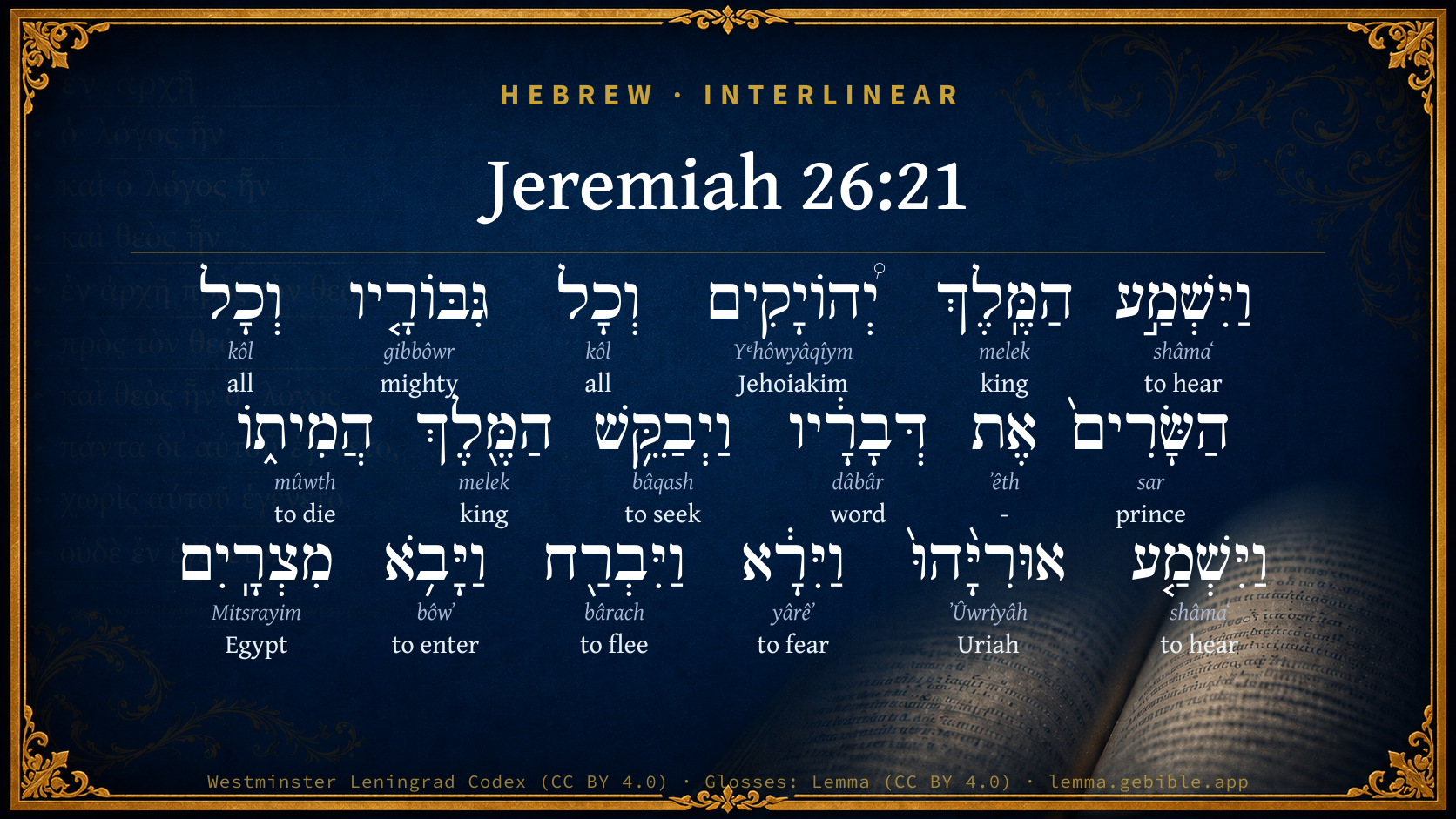
Hebrew (Westminster Leningrad Codex) Jeremiah 26:21 appears in the Hebrew Old Testament. The text above is from the Westminster Leningrad Codex. Each word links to its Strong’s number, a concise gloss, and parsing drawn from the Open Scriptures Hebrew Bible morphology. Click any word for its full Brown-Driver-Briggs (BDB) entry.
Download image
Cite this verse

Jeremiah 26:21 (World English Bible). Public Domain. Lemma interlinear Bible study tool, https://lemma.gebible.app/v/jeremiah/26/21.

Show BibTeX & RIS
BibTeX
RIS
English Translation
and when Jehoiakim the king, with all his mighty-men, and all the princes, heard his words, the king sought to put him to death; but when Uriah heard it, he was afraid, and fled, and went into Egypt:
World English Bible · Public Domain
Download a study sheet

One document with this verse’s original text, its word-by-word gloss line, the meaning frame, cross-references with their text, attributed commentary, and full source and license credits — printable, and it pastes into notes with its structure intact.

This verse Autodidact and up

Study sheet (.html) Plain text (.txt)

A passage Seminary Student

Up to 50 verses in one chapter. A passage sheet keeps up to 6 commentary sources and 12 cross-references per verse, in the order this page ranks them, and says so on the sheet whenever that leaves anything out. Ask for a single verse and you get the Autodidact verse sheet above.

Everything on this page stays free to read, with no account — the sheet is a download of what is already on screen, not access to it.

Want to remove ads? Support Godless Engineer
Compare translations 3

The same verse in 3 English versions, stacked beneath the original-language interlinear above. Click any original word for its lexicon entry.

Each is an independent rendering of the whole verse — the interlinear is not word-aligned to these translations.

Highlighted words mark where these versions differ — a whole-verse word diff, not a word-by-word alignment.

  • World English Bible Public Domain
    and when Jehoiakim the king, with all his mighty-men, and all the princes, heard his words, the king sought to put him to death; but when Uriah heard it, he was afraid, and fled, and went into Egypt:
  • King James Version Public Domain
    And when Jehoiakim the king, with all his mighty men, and all the princes, heard his words, the king sought to put him to death: but when Urijah heard it, he was afraid, and fled, and went into Egypt;
  • unfoldingWord Literal Text CC BY-SA 4.0
    And King Jehoiakim and all his mighty men and all the officials heard his words, and the king sought to put him to death. And Uriah heard, and he was afraid, and he fled and went to Egypt.

unfoldingWord Literal Text — © unfoldingWord, licensed CC BY-SA 4.0. Word-aligned USFM3 via Door43 (git.door43.org/unfoldingWord/en_ult).

Versions to compare (up to 4)

3 of 4 selected

Show all 18 translations

Every available English version of this verse, each an independent rendering of the whole verse.

  • World English Bible Public Domain
    and when Jehoiakim the king, with all his mighty-men, and all the princes, heard his words, the king sought to put him to death; but when Uriah heard it, he was afraid, and fled, and went into Egypt:
  • Berean Standard Bible Public Domain
    King Jehoiakim and all his mighty men and officials heard his words, and the king sought to put him to death. But when Uriah found out about it, he fled in fear and went to Egypt.
  • Majority Standard Bible Public Domain
    King Jehoiakim and all his mighty men and officials heard his words, and the king sought to put him to death. But when Uriah found out about it, he fled in fear and went to Egypt.
  • King James Version Public Domain
    And when Jehoiakim the king, with all his mighty men, and all the princes, heard his words, the king sought to put him to death: but when Urijah heard it, he was afraid, and fled, and went into Egypt;
  • American Standard Version (1901) Public Domain
    and when Jehoiakim the king, with all his mighty-men, and all the princes, heard his words, the king sought to put him to death; but when Uriah heard it, he was afraid, and fled, and went into Egypt:
  • Revised Version (1885) Public Domain
    and when Jehoiakim the king, with all his mighty men, and all the princes, heard his words, the king sought to put him to death; but when Uriah heard it, he was afraid, and fled, and went into Egypt:
  • Geneva Bible (1599) Public Domain
    Nowe when Iehoiakim the King with all his men of power, and all the princes heard his wordes, the King sought to slay him. But when Vriiah heard it, he was afraide and fled, and went into Egypt.
  • Douay-Rheims (1899) Public Domain
    And Joakim, and all his men in power, and his princes heard these words: and the king sought to put him to death. And Urias heard it, and was afraid, and fled and went into Egypt.
  • Young's Literal Translation Public Domain
    And the king Jehoiakim, and all his mighty ones, and all the heads, hear his words, and the king seeketh to put him to death, and Urijah heareth, and feareth, and fleeth, and goeth in to Egypt.
  • Literal Standard Version CC BY-SA 4.0
    and King Jehoiakim, and all his mighty ones, and all the heads, hear his words, and the king seeks to put him to death, and Urijah hears, and fears, and flees, and goes to Egypt.
  • Unlocked Literal Bible CC BY-SA 4.0
    But when King Jehoiakim and all his soldiers and officials heard his word, then the king tried to put him to death, but Uriah heard and was afraid, so he ran away and went to Egypt.
  • unfoldingWord Literal Text CC BY-SA 4.0
    And King Jehoiakim and all his mighty men and all the officials heard his words, and the king sought to put him to death. And Uriah heard, and he was afraid, and he fled and went to Egypt.
  • Darby Bible Public Domain
    and Jehoiakim the king, and all his mighty men, and all the princes, heard his words, and the king sought to put him to death; but Urijah heard it, and he was afraid, and fled, and went into Egypt.
  • World Messianic Bible Public Domain
    When Jehoiakim the king, with all his mighty men and all the princes heard his words, the king sought to put him to death; but when Uriah heard it, he was afraid, and fled, and went into Egypt.
  • Webster's Bible Public Domain
    And when Jehoiakim the king, with all his mighty men, and all the princes, heard his words, the king sought to put him to death: but when Urijah heard it, he was afraid, and fled, and went into Egypt;
  • Free Bible Version CC BY-SA 4.0
    King Jehoiakim and all his military officers and officials heard what he was saying, and the king wanted to have him executed. But when Uriah found out about it, he was frightened and ran away to Egypt.
  • Bible in Basic English Public Domain
    And when his words came to the ears of Jehoiakim the king and all his men of war and his captains, the king would have put him to death; but Uriah, hearing of it, was full of fear and went in flight into Egypt:
  • JPS Tanakh (1917) Public Domain
    and when Jehoiakim the king, with all his mighty men, and all the princes, heard his words, the king sought to put him to death; but when Uriah heard it, he was afraid, and fled, and went into Egypt;

Literal Standard Version (2020), Covenant Press — licensed CC BY-SA 4.0. Text via the HelloAO Bible API (eBible.org). Unlocked Literal Bible (unfoldingWord) — licensed CC BY-SA 4.0. Text via the HelloAO Bible API (eBible.org). unfoldingWord Literal Text — © unfoldingWord, licensed CC BY-SA 4.0. Word-aligned USFM3 via Door43 (git.door43.org/unfoldingWord/en_ult). Free Bible Version, Dr. Jonathan Gallagher — licensed CC BY-SA 4.0. Text via the HelloAO Bible API (eBible.org).

Word by word

More ways to search: Search by grammar → Find every occurrence → Compare this word →

Practice this passage: Drill this verse → Learn its vocabulary →

יְ֠הוֹיָקִים
Yᵉhôwyâqîym
H3079
“Jehoiakim”
Noun, Proper
Part of Speech
Noun
Type
Proper
Full BDB Definition

Origin: from H3068 abbreviated and H6965 , cf. H3113

TWOT: None

Jehoiakim = "Jehovah raises up" - son of Josiah and the third from the last king of Judah; subject vassel of Nebuchadnezzar who reigned for 11 years before he died a violent death either in combat or by the hands of his own subjects
  1. וַיִּשְׁמַ֣ע shâmaʻ H8085 “and · to hear” Conjunction + Verb, Qal, Sequential Imperfect, 3rd Person, Masculine, Singular
  2. הַמֶּֽלֶךְ melek H4428 “the · king” Particle, Definite Article + Noun, Common, Masculine, Singular, Absolute
  3. וְכָל kôl H3605 “and · all of” Conjunction + Noun, Common, Masculine, Singular, Construct
  4. גִּבּוֹרָ֤יו gibbôwr H1368 “mighty · his” Adjective, Adjective, Masculine, Plural, Construct + Suffix, Personal, 3rd Person, Masculine, Singular
  5. וְכָל kôl H3605 “and · all of” Conjunction + Noun, Common, Masculine, Singular, Construct
  6. הַשָּׂרִים֙ sar H8269 “the · princes” Particle, Definite Article + Noun, Common, Masculine, Plural, Absolute
  7. אֶת ʼêth H853 “-” Particle, Direct Object
  8. דְּבָרָ֔יו dâbâr H1697 “words · his” Noun, Common, Masculine, Plural, Construct + Suffix, Personal, 3rd Person, Masculine, Singular
  9. וַיְבַקֵּ֥שׁ bâqash H1245 “and · to seek” Conjunction + Verb, Piel, Sequential Imperfect, 3rd Person, Masculine, Singular
  10. הַמֶּ֖לֶךְ melek H4428 “the · king” Particle, Definite Article + Noun, Common, Masculine, Singular, Absolute
  11. הֲמִית֑וֹ mûwth H4191 “to die · him” Verb, Hiphil, Infinitive Construct + Suffix, Personal, 3rd Person, Masculine, Singular
  12. וַיִּשְׁמַ֤ע shâmaʻ H8085 “and · to hear” Conjunction + Verb, Qal, Sequential Imperfect, 3rd Person, Masculine, Singular
  13. אוּרִיָּ֨הוּ֙ ʼÛwrîyâh H223 “Uriah” Noun, Proper
  14. וַיִּרָ֔א yârêʼ H3372 “and · to fear” Conjunction + Verb, Qal, Sequential Imperfect, 3rd Person, Masculine, Singular
  15. וַיִּבְרַ֖ח bârach H1272 “and · to flee” Conjunction + Verb, Qal, Sequential Imperfect, 3rd Person, Masculine, Singular
  16. וַיָּבֹ֥א bôwʼ H935 “and · to enter” Conjunction + Verb, Qal, Sequential Imperfect, 3rd Person, Masculine, Singular
  17. מִצְרָֽיִם Mitsrayim H4714 “Egypt” Noun, Proper

About this verse

These counts appear in no published source. They are computed here, from the morphology-tagged text and Lemma’s own curated glosses. What Lemma adds →

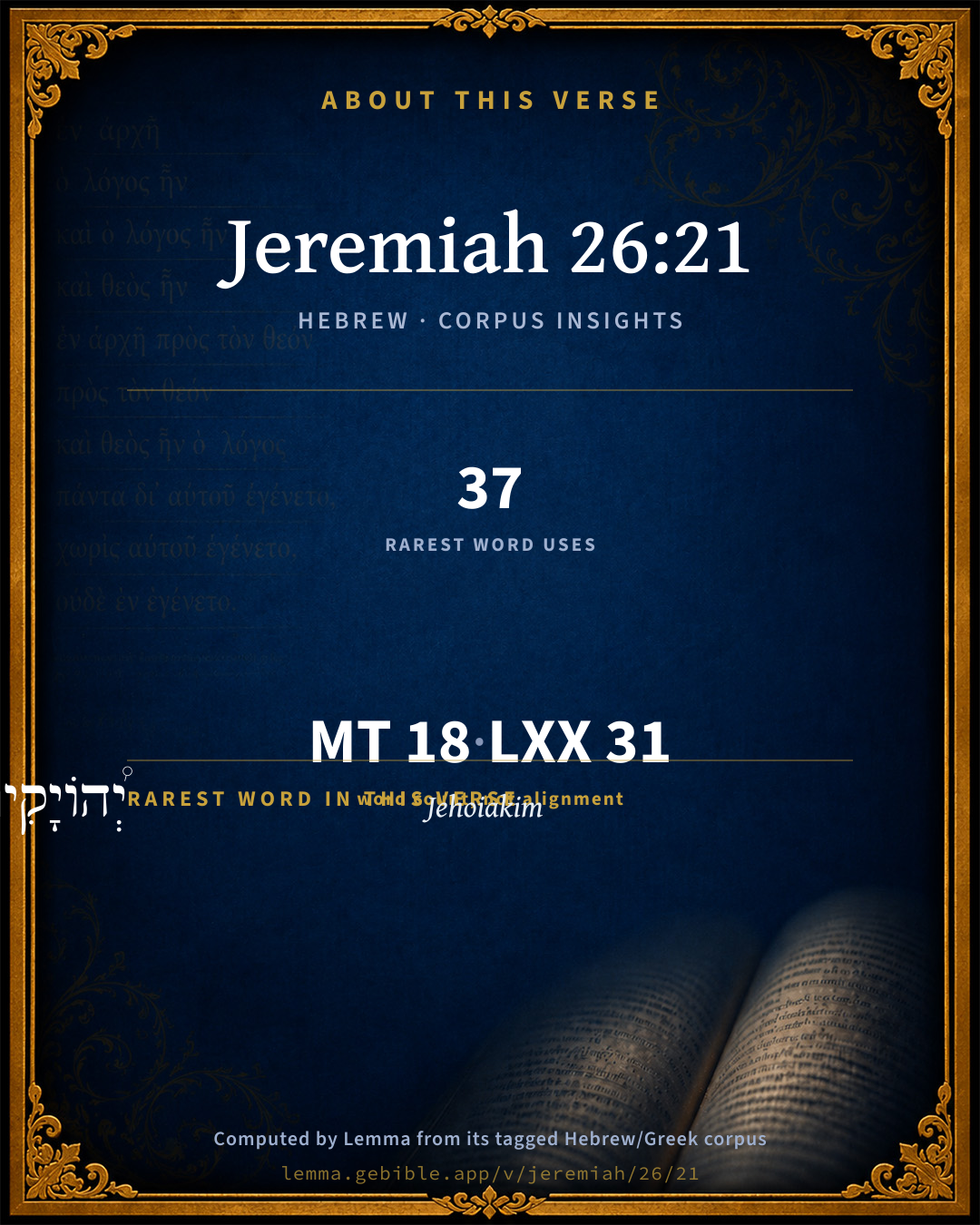
18
words
15
distinct lemmas
Prophets
section

Shared distinctive vocabulary

יְ֠הוֹיָקִים Jehoiakim H3079 occurs in 37 verses of the Hebrew Bible. Also found in:

Grammatical profile

  • 7 verbs
  • 9 nouns
  • 1 adjective
  • 1 particle

Verb forms

  • וַיִּשְׁמַ֣ע Qal · Sequential Imperfect
  • וַיְבַקֵּ֥שׁ Piel · Sequential Imperfect
  • הֲמִית֑וֹ Hiphil · Infinitive Construct
  • וַיִּשְׁמַ֤ע Qal · Sequential Imperfect
  • וַיִּרָ֔א Qal · Sequential Imperfect
  • וַיִּבְרַ֖ח Qal · Sequential Imperfect
  • וַיָּבֹ֥א Qal · Sequential Imperfect

Repetition

Words recur within this verse — often emphatic in Hebrew:

  • וַיִּשְׁמַ֣ע to hear H8085 ×2
  • הַמֶּֽלֶךְ king H4428 ×2
  • וְכָל all H3605 ×2

Hebrew & Septuagint length

In the original languages it is 18 Hebrew tokens and 31 Greek tokens — but the two are counted differently (Hebrew bundles its prefixes and suffixes into one token; the Greek is in lemma form), so that isn’t a like-for-like length.

Cross-references

11

Topical passages linked to Jeremiah 26:21 in the Treasury of Scripture Knowledge — connected by theme and wording, ordered by reader-vote popularity; previews shown in the World English Bible.

  • Matthew 10:23 But when they persecute you in this city, flee into the next, for most assuredly I tell you, you will not have gone through the cities of Israel, until the Son of Man has come.
  • 2 Chronicles 16:10 Then Asa was angry with the seer, and put him in the prison-house; for he was in a rage with him because of this thing. Asa oppressed some of the people at the same time.
  • Jeremiah 36:26 The king commanded Jerahmeel the king's son, and Seraiah the son of Azriel, and Shelemiah the son of Abdeel, to take Baruch the scribe and Jeremiah the prophet; but Yahweh hid them.
  • Matthew 14:5 When he would have put him to death, he feared the multitude, because they counted him as a prophet.
  • 1 Kings 19:1–3 Ahab told Jezebel all that Elijah had done, and withal how he had slain all the prophets with the sword.
  • Psalms 119:109 My soul is continually in my hand, Yet I won't forget your law.
  • Proverbs 29:25 The fear of man proves to be a snare, But whoever puts his trust in Yahweh is kept safe.
  • Matthew 10:28 Don't be afraid of those who kill the body, but are not able to kill the soul. Rather, fear him who is able to destroy both soul and body in Gehenna.
  • Matthew 10:39 He who finds his life will lose it; and he who loses his life for my sake will find it.
  • Matthew 16:25–26 For whoever desires to save his life will lose it, and whoever will lose his life for my sake will find it.
  • Mark 6:19 Herodias set herself against him, and desired to kill him, but she couldn't,

Cross-references courtesy of OpenBible.info (CC BY 4.0).

Hebrew and Greek witnesses Masoretic Hebrew ↔ Greek Septuagint

The same verse in the two great witnesses to the Old Testament, shown verse-for-verse.

These are two independent witnesses, not word-aligned to each other, and the Septuagint is shown in lemma (dictionary) form.

Hebrew Jeremiah 26:21 Masoretic · Westminster Leningrad Codex

וַיִּשְׁמַ֣ע הַמֶּֽלֶךְ יְ֠הוֹיָקִים וְכָל גִּבּוֹרָ֤יו וְכָל הַשָּׂרִים֙ אֶת דְּבָרָ֔יו וַיְבַקֵּ֥שׁ הַמֶּ֖לֶךְ הֲמִית֑וֹ וַיִּשְׁמַ֤ע אוּרִיָּ֨הוּ֙ וַיִּרָ֔א וַיִּבְרַ֖ח וַיָּבֹ֥א מִצְרָֽיִם

and when Jehoiakim the king, with all his mighty-men, and all the princes, heard his words, the king sought to put him to death; but when Uriah heard it, he was afraid, and fled, and went into Egypt:

World English Bible · Public Domain

Greek LXX Structure differs

In the Septuagint, Jeremiah is about an eighth shorter than the Hebrew and arranges its material differently — the Oracles Against the Nations (Hebrew chapters 46–51) appear in the middle of the Greek book, after 25:13. Because the chapter and verse boundaries do not line up, a verse-for-verse comparison with the Hebrew is not shown.

A verse-for-verse comparison isn’t shown here because the chapters and verses don’t line up. Switch to the LXX edition with the MT / LXX toggle above to read the Greek directly.

On this verse, The Cambridge Bible for Schools and Colleges discusses the Septuagint’s reading. Read the note in Commentary ↓

Hebrew: Westminster Leningrad Codex (CC BY 4.0). Greek: Septuagint (public domain); English from a public-domain English Septuagint. How the Septuagint differs from the Hebrew →

Targum (Aramaic paraphrase)

1

The Targum is the ancient Jewish Aramaic paraphrase of the Hebrew Scriptures — an interpretive translation, not the Hebrew text itself. Onkelos (literal) and Pseudo-Jonathan (expansive) render the Torah, and Jonathan the Prophets. Coverage is partial: where no permissively-licensed English translation exists for a verse, only the Aramaic is shown. This is verse-level text, not a word-by-word alignment to the Hebrew.

  1. Targum Jonathan Prophets (Joshua–Malachi)
    וּשְׁמַע מַלְכָּא יְהוֹיָקִים וְכָל גִבָּרוֹהִי וְכָל רַבְרְבֵיָא יַת פִּתְגָמוֹהִי וּבְעָא מַלְכָּא לְמִקְטְלֵיהּ וּשְׁמַע אוּרִיָה וּדְחִיל וַעֲרַק וַאֲתָא לְמִצְרָיִם:

    (no public-domain English translation for this verse)

    Targum Jonathan — Aramaic: “Mikraot Gedolot” (public domain). English: “Sefaria Community Translation” (CC0 1.0 (public-domain dedication)); “London "Chaldee Paraphrase," 1871” (public domain). Text via Sefaria.

Commentary

Notes on Jeremiah 26:21 from classic Christian and Jewish commentators (each source and its license shown beneath its notes). The classic Christian expositions comment on the surrounding passage and are grouped to its opening verse, so a note may address several verses; the Jewish commentaries on the Tanakh (Rashi and others) are per-verse, so they appear only where the commentator wrote on this verse.

Lemma curates 59 commentaries, every one of them public domain or Creative Commons licensed, each selected and text-cleaned for this edition rather than reprinted as found. About our sources →

Trapp's Complete Commentary

John Trapp

Jer 26:21 And when Jehoiakim the king, with all his mighty men, and all the princes, heard his words, the king sought to put him to death: but when Urijah heard it, he was afraid, and fled, and went into Egypt;

Ver. 21. And when Jehoiakim.] This tiger laid hold with his teeth on all the excellent spirits of the times. See Jer 36:26.

He was afraid, and fled.] Not out of timorousness, but prudence. Tertullian was too rigid in condemning all kinds of flight in times of persecution. God hath not made his people as standing buttmarks to be shot at, &c. See Mat 10:23.

John Trapp, A Commentary or Exposition upon All the Books of the Old and New Testament (1647–1656) — public domain. Text from a community e-Sword module.

John Calvin's Commentaries

It then follows, And when, Jehoiakim the king, and all his mighty men and the princes, heard his words, etc. This verse seems to favor the opinion of those who conclude that godly men were the speakers; for they spoke dishonorably of the king and his counsellors; the king heard and his mighty men, (powerful men, literally,) and also all the princes; and the king sought to slay him These words, however, may also be ascribed to the ungodly and the wicked, for they wished to terrify the common people by first mentioning the king and then the mighty men and the princes. And to seek to kill him, might also have been excused, even that the king could not bear such a reproach without revenging it; for he saw that the Prophet had taken such a liberty as not, to spare the holy city nor the Temple: The king then heard, and his mighty men and princes; and then, the king sought to slay him

But when Uriah heard it, he feared and fled This passage teaches us that even the faithful servants of God, who strive honestly to fulfill their office, are yet not always so courageous as boldly to despise all dangers; for it is said that the Prophet feared; but he was not on this account condemned. This fear was not indeed blameless; but his fear was such, that he yet continued in his vocation. He might indeed have pleased the king, but he dreaded such perfidy more than death. He, therefore, so feared, that he turned not aside from the right course, nor denied the truth., nor admitted anything unworthy of his dignity or of the character he sustained. His fear then, though wrong, did not yet so possess the Prophet, but that he was ever faithful to God in his vocation. It then follows, that he went into Egypt We hence conclude, that the king’s wrath and cruelty were so great, that the holy man could not find a corner to hide himself in through the whole land of Judea, nor even in other regions around. He was therefore forced to seek a hiding place in Egypt.

John Calvin's Commentaries (1540-1563) — public domain. Text from the Calvin Translation Society English edition (1840s-50s) via the Christian Classics Ethereal Library (ccel.org). Calvin's coverage is partial (roughly two-thirds of the Bible); uncommented books and verses are honest gaps, never fabricated. The 19th-century editor's footnotes and remarks are omitted so the notes are faithfully Calvin's own voice.

Ellicott's Commentary for English Readers

(21) And when Jehoiakim the king . . .—The fact that the princes of Judah, who defended Jeremiah, were against Urijah, suggests the inference either that his words were more vehemently denunciatory, or that he was less fortunate in finding a personal friend and protector like Ahikam. The flight into Egypt presents a parallel to that of Jeroboam 1Ki_11:40), Hadad (1Ki_11:18), and Joseph and Mary (Mat_2:13-15). Egypt was at all times the natural asylum for political refugees from Judæa. The presence of the deposed Jehoahaz and of other Jews in Egypt may possibly have been an attraction (2Ch_36:4; Jer_24:8; Jer_44:1).

A Bible Commentary for English Readers, edited by Charles John Ellicott (1878–1897) — public domain. Text from a community e-Sword module.

The Cambridge Bible for Schools and Colleges

gen. ed. J. J. S. Perowne

21. with all his mighty men] The LXX omit, and the expression is not found elsewhere in the Book.

The Cambridge Bible for Schools and Colleges (gen. ed. J. J. S. Perowne; Cambridge University Press, 1878–1918) — public domain. Text from a community e-Sword module.

John Gill's Exposition

And when Jehoiakim the king, with all his mighty men,.... Either his courtiers, or his soldiers, or both:

and all the princes, heard his words; the words of the Prophet Urijah; not with their own ears very probably, but from the report of others:

the king sought to put him to death; as being a messenger of bad tidings, tending to dispirit his subjects, and allay the joy of his own mind upon his advancement to the throne:

but when Urijah heard it, he was afraid, and fled, and went into Egypt; which some understand as a piece of prudence in him; but rather it was the effect of pusillanimity and cowardice: it seems to show want of faith and confidence in the Lord; and the fear of man, which brings a snare; and besides, it was no piece of prudence to go to Egypt, whatever it was to flee; since there was such an alliance between the kings of Egypt and Judah; and the latter, though dependent on the former, yet the king of Egypt would easily gratify him in delivering up a subject of his, and a person of such a character.

John Gill's Exposition of the Whole Bible (1746–1763) — public domain (CC PDM 1.0). Text via the HelloAO Bible API.

Albert Barnes' Notes on the Bible

His mighty men - The commanders of his army; the princes are the civil officers.

Albert Barnes' Notes on the Bible (1834–1885) — public domain. Text from a community e-Sword/MySword module.

Matthew Poole's English Annotations

When Jehoiakim, our present king, and all his great men, heard of it, (probably by the information of others,) they judged it a capital crime, and used means to apprehend him, in order to the putting him to death, upon which the prophet being advertised of it, and fearing the issue, fled into Egypt.

Matthew Poole's English Annotations on the Holy Bible (1683–1685) — public domain. Text from a community e-Sword/MySword module.

The Pulpit Commentary

His mighty men. The "mighty men" (gibborim) are not mentioned again in Jeremiah, and the Septuagint omits the word. But it is clear from Isa_3:2 that the "mighty men" were recognized as an important part of the community. From 1Ch_10:10 it appears that the term indicates a position of high command in the army, which is in accordance with the notice in 2Ki_24:16. Went into Egypt. Egypt was the natural refuge for a native of Palestine, (comp. 1Ki_11:17, 40 Mat_2:14) just as Palestine was for a native of Egypt. The latter, however, proved to be not a safe asylum for Urijah, as Pharaoh was the liege lord of Jehoiakim, (2Ki_23:34) and the extradition of Urijah as a criminal naturally followed.

The Pulpit Commentary (1880–1919), ed. H.D.M. Spence-Jones & Joseph S. Exell — public domain. Text from a community e-Sword module.

Lesson kit

Teaching starters — assembled from the data on this page, not authored interpretation. Every prompt links to the verse data it draws on. Edit before teaching.

Jeremiah, in the Prophets, opens this verse with 18 words (15 distinct Hebrew lemmas). Its most distinctive word is Yᵉhôwyâqîym (“Jehoiakim”). A historical commentator’s framing appears above. Read the whole chapter for the surrounding context.

Discussion questions

  1. What does “Jehoiakim” (Yᵉhôwyâqîym) contribute to the verse as a whole?
  2. 2 Kings 23:34 shares the word «Jehoiakim» with this verse. How do the two illuminate each other?
  3. “to hear” occurs 2× in this one verse. What is the effect of the repetition?
  4. These translations render this verse differently. What is at stake in choosing one wording over another?
  5. The verb «וַיִּשְׁמַ֣ע» is Qal Sequential Imperfect. How does its form color the action?
  6. Reading how Trapp's Complete Commentary and John Calvin's Commentaries read this verse, where do the two commentators agree and where do they part?

Things to notice

Reading settings

Reading text

Shown beneath each verse's original-language words.

Old Testament
Old Testament edition

Read the OT as the Masoretic Hebrew (MT) or the Greek Septuagint (LXX).

English shown for the Greek Septuagint (in the Hebrew ↔ Greek comparison).

Comparing translations? Open the Compare panel on any verse page to stack up to four side by side.