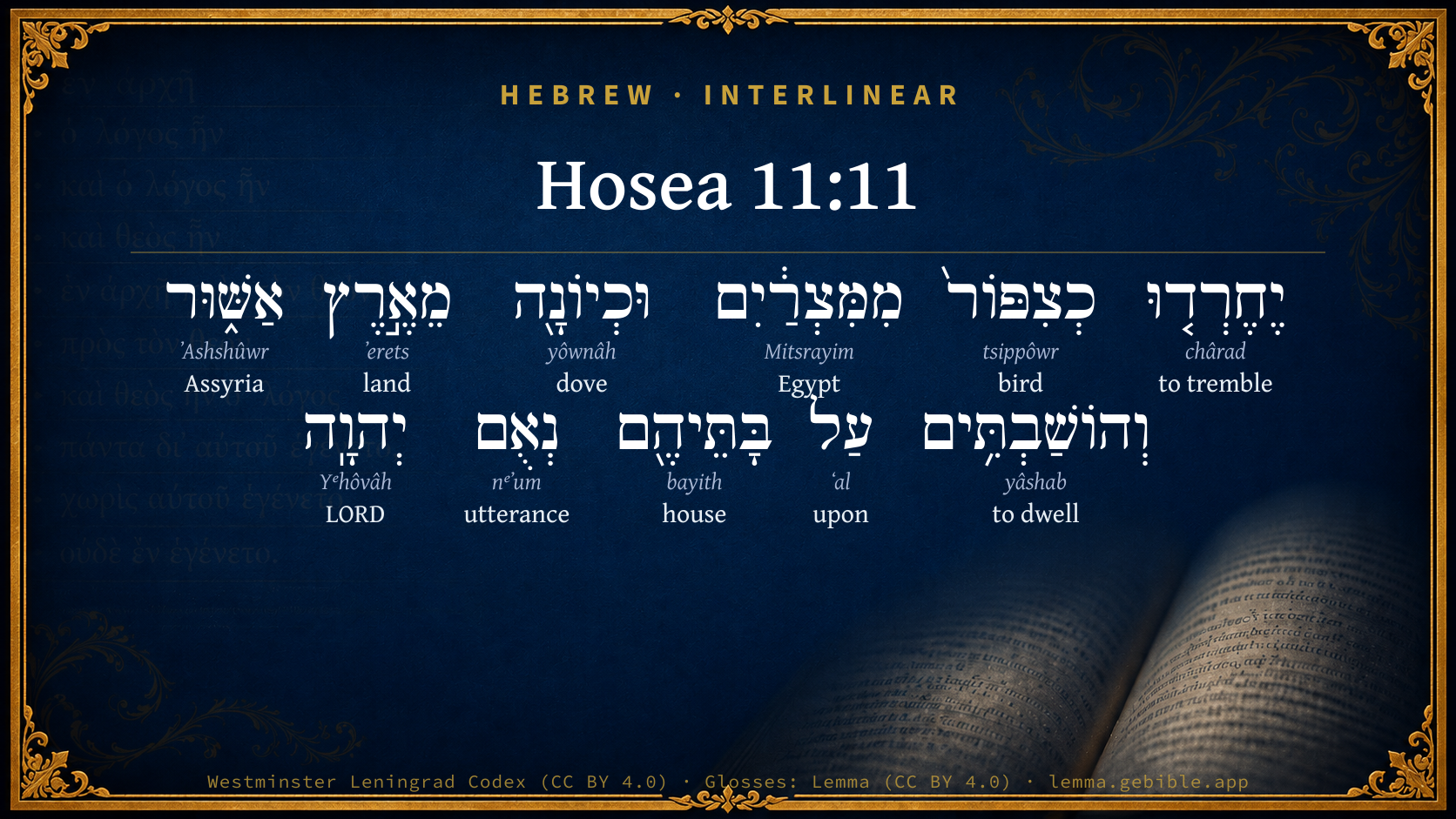
Hosea 11:11

Hebrew (Westminster Leningrad Codex) Hosea 11:11 appears in the Hebrew Old Testament. The text above is from the Westminster Leningrad Codex. Each word links to its Strong’s number, a concise gloss, and parsing drawn from the Open Scriptures Hebrew Bible morphology. Click any word for its full Brown-Driver-Briggs (BDB) entry.
Download image
Cite this verse

Hosea 11:11 (World English Bible). Public Domain. Lemma interlinear Bible study tool, https://lemma.gebible.app/v/hosea/11/11.

Show BibTeX & RIS
BibTeX
RIS
English Translation
They will come trembling like a bird out of Egypt, And like a dove out of the land of Assyria; And I will settle them in their houses," says Yahweh.
World English Bible · Public Domain
Download a study sheet

One document with this verse’s original text, its word-by-word gloss line, the meaning frame, cross-references with their text, attributed commentary, and full source and license credits — printable, and it pastes into notes with its structure intact.

This verse Autodidact and up

Study sheet (.html) Plain text (.txt)

A passage Seminary Student

Up to 50 verses in one chapter. A passage sheet keeps up to 6 commentary sources and 12 cross-references per verse, in the order this page ranks them, and says so on the sheet whenever that leaves anything out. Ask for a single verse and you get the Autodidact verse sheet above.

Everything on this page stays free to read, with no account — the sheet is a download of what is already on screen, not access to it.

Want to remove ads? Support Godless Engineer
Compare translations 3

The same verse in 3 English versions, stacked beneath the original-language interlinear above. Click any original word for its lexicon entry.

Each is an independent rendering of the whole verse — the interlinear is not word-aligned to these translations.

Highlighted words mark where these versions differ — a whole-verse word diff, not a word-by-word alignment.

  • World English Bible Public Domain
    They will come trembling like a bird out of Egypt, And like a dove out of the land of Assyria; And I will settle them in their houses," says Yahweh.
  • King James Version Public Domain
    They shall tremble as a bird out of Egypt, and as a dove out of the land of Assyria: and I will place them in their houses, saith the LORD.
  • unfoldingWord Literal Text CC BY-SA 4.0
    “They will come trembling like a bird from Egypt, and like a dove from the land of Assyria. And I will settle them in their homes”—the declaration of Yahweh.

unfoldingWord Literal Text — © unfoldingWord, licensed CC BY-SA 4.0. Word-aligned USFM3 via Door43 (git.door43.org/unfoldingWord/en_ult).

Versions to compare (up to 4)

3 of 4 selected

Show all 18 translations

Every available English version of this verse, each an independent rendering of the whole verse.

  • World English Bible Public Domain
    They will come trembling like a bird out of Egypt, And like a dove out of the land of Assyria; And I will settle them in their houses," says Yahweh.
  • Berean Standard Bible Public Domain
    They will come trembling like birds from Egypt and like doves from the land of Assyria. Then I will settle them in their homes, declares the LORD.
  • Majority Standard Bible Public Domain
    They will come trembling like birds from Egypt and like doves from the land of Assyria. Then I will settle them in their homes, declares the LORD.
  • King James Version Public Domain
    They shall tremble as a bird out of Egypt, and as a dove out of the land of Assyria: and I will place them in their houses, saith the LORD.
  • American Standard Version (1901) Public Domain
    They shall come trembling as a bird out of Egypt, and as a dove out of the land of Assyria; and I will make them to dwell in their houses, saith Jehovah.
  • Revised Version (1885) Public Domain
    They shall come trembling as a bird out of Egypt, and as a dove out of the land of Assyria: and I will make them to dwell in their houses, saith the LORD.
  • Geneva Bible (1599) Public Domain
    They shall feare as a sparrow out of Egypt, and as a doue of the lande of Asshur, and I will place them in their houses, sayth the Lord.
  • Douay-Rheims (1899) Public Domain
    And they shall fly away like a bird out of Egypt, and like a dove out of the land of the Assyrians: and I will place them in their own houses, saith the Lord.
  • Young's Literal Translation Public Domain
    They tremble as a sparrow out of Egypt, And as a dove out of the land of Asshur, And I have caused them to dwell in their own houses, An affirmation of Jehovah.
  • Literal Standard Version CC BY-SA 4.0
    They tremble as a sparrow out of Egypt, || And as a dove out of the land of Asshur, || And I have caused them to dwell in their own houses,” || A declaration of YHWH.
  • Unlocked Literal Bible CC BY-SA 4.0
    They will come trembling like a bird from Egypt, like a dove from the land of Assyria. I will make them live in their homes—this is the declaration of Yahweh.
  • unfoldingWord Literal Text CC BY-SA 4.0
    “They will come trembling like a bird from Egypt, and like a dove from the land of Assyria. And I will settle them in their homes”—the declaration of Yahweh.
  • Darby Bible Public Domain
    they shall hasten as a bird out of Egypt, and as a dove out of the land of Assyria; and I will cause them to dwell in their houses, saith Jehovah.
  • World Messianic Bible Public Domain
    They will come trembling like a bird out of Egypt, and like a dove out of the land of Assyria; and I will settle them in their houses,” says the LORD.
  • Webster's Bible Public Domain
    They shall tremble as a bird out of Egypt, and as a dove out of the land of Assyria: and I will place them in their houses, saith the LORD.
  • Free Bible Version CC BY-SA 4.0
    Like a flock of frightened birds they will come from Egypt, like doves they will come from Assyria, and I will bring them back home, declares the Lord.
  • Bible in Basic English Public Domain
    Shaking with fear like a bird, they will come out of Egypt, like a dove out of the land of Assyria: and I will give them rest in their houses, says the Lord.
  • JPS Tanakh (1917) Public Domain
    They shall come trembling as a bird out of Egypt, and as a dove out of the land of Assyria; and I will make them to dwell in their houses, saith the LORD.

Literal Standard Version (2020), Covenant Press — licensed CC BY-SA 4.0. Text via the HelloAO Bible API (eBible.org). Unlocked Literal Bible (unfoldingWord) — licensed CC BY-SA 4.0. Text via the HelloAO Bible API (eBible.org). unfoldingWord Literal Text — © unfoldingWord, licensed CC BY-SA 4.0. Word-aligned USFM3 via Door43 (git.door43.org/unfoldingWord/en_ult). Free Bible Version, Dr. Jonathan Gallagher — licensed CC BY-SA 4.0. Text via the HelloAO Bible API (eBible.org).

Word by word

More ways to search: Search by grammar → Find every occurrence → Compare this word →

Practice this passage: Drill this verse → Learn its vocabulary →

וּכְיוֹנָ֖ה
yôwnâh
H3123
“and · like/as · dove”
Conjunction + Preposition + Noun, Common, Feminine, Singular, Absolute
Part of Speech
Conjunction + Preposition + Noun
Type
Common
Gender
Feminine
Number
Singular
State
Absolute
Full BDB Definition

Origin: probably from the same as H3196

TWOT: 854a

dove, pigeon
  1. יֶחֶרְד֤וּ chârad H2729 “to tremble” Verb, Qal, Imperfect, 3rd Person, Masculine, Plural
  2. כְצִפּוֹר֙ tsippôwr H6833 “like/as · bird” Preposition + Noun, Common, Both, Singular, Absolute
  3. מִמִּצְרַ֔יִם Mitsrayim H4714 “from · Egypt” Preposition + Noun, Proper
  4. מֵאֶ֣רֶץ ʼerets H776 “from · land of” Preposition + Noun, Common, Both, Singular, Construct
  5. אַשּׁ֑וּר ʼAshshûwr H804 “Assyria” Noun, Proper
  6. וְהוֹשַׁבְתִּ֥ים yâshab H3427 “and · to dwell · them” Conjunction + Verb, Hiphil, Sequential Perfect, 1st Person, Common, Singular + Suffix, Personal, 3rd Person, Masculine, Plural
  7. עַל ʻal H5921 “upon” Preposition
  8. בָּתֵּיהֶ֖ם bayith H1004 “houses · their” Noun, Common, Masculine, Plural, Construct + Suffix, Personal, 3rd Person, Masculine, Plural
  9. נְאֻם nᵉʼum H5002 “utterance of” Noun, Common, Masculine, Singular, Construct
  10. יְהוָֽה Yᵉhôvâh H3068 “LORD” Noun, Proper

About this verse

These counts appear in no published source. They are computed here, from the morphology-tagged text and Lemma’s own curated glosses. What Lemma adds →

11
words
11
distinct lemmas
Prophets
section

Shared distinctive vocabulary

וּכְיוֹנָ֖ה dove H3123 occurs in 33 verses of the Hebrew Bible. Also found in:

Grammatical profile

  • 2 verbs
  • 8 nouns
  • 1 preposition

Verb forms

  • יֶחֶרְד֤וּ Qal · Imperfect
  • וְהוֹשַׁבְתִּ֥ים Hiphil · Sequential Perfect

Hebrew & Septuagint length

In English translation the verse runs 30 words from the Hebrew and 34 from the Septuagint (LXX English) — closely comparable.

A rough comparison of the two English renderings, which tokenize alike — not a word-level alignment.

Word counts can differ between the Hebrew and the Greek without any difference in meaning — e.g. the Hebrew direct-object marker אֵת has no separate Greek word, and Greek often adds the article ὁ.

Cross-references

13

Topical passages linked to Hosea 11:11 in the Treasury of Scripture Knowledge — connected by theme and wording, ordered by reader-vote popularity; previews shown in the World English Bible.

  • Isaiah 11:11 It shall happen in that day, that the Lord will set his hand again the second time to recover the remnant of his people, who shall remain, from Assyria, and from Egypt, and from Pathros, and from Cush, and from Elam, and from Shinar, and from Hamath, and from the islands of the sea.
  • Isaiah 60:8 Who are these who fly as a cloud, and as the doves to their windows?
  • Zechariah 10:10 I will bring them again also out of the land of Egypt, And gather them out of Assyria; And I will bring them into the land of Gilead and Lebanon; And there won't be room enough for them.
  • Hosea 7:11 "Ephraim is like an easily deceived dove, without understanding. They call to Egypt. They go to Assyria.
  • Amos 9:14–15 I will bring back the captivity of my people Israel, And they will rebuild the ruined cities, and inhabit them; and they will plant vineyards, and drink wine from them. They shall also make gardens, And eat the fruit of them.
  • Jeremiah 31:12 They shall come and sing in the height of Zion, and shall flow to the goodness of Yahweh, to the grain, and to the new wine, and to the oil, and to the young of the flock and of the herd: and their soul shall be as a watered garden; and they shall not sorrow any more at all.
  • Ezekiel 28:25–26 Thus says the Lord Yahweh: When I shall have gathered the house of Israel from the peoples among whom they are scattered, and shall be sanctified in them in the sight of the nations, then shall they dwell in their own land which I gave to my servant Jacob.
  • Ezekiel 36:33–34 Thus says the Lord Yahweh: In the day that I cleanse you from all your iniquities, I will cause the cities to be inhabited, and the waste places shall be built.
  • Ezekiel 37:21 Say to them, Thus says the Lord Yahweh: Behold, I will take the children of Israel from among the nations, where they are gone, and will gather them on every side, and bring them into their own land:
  • Ezekiel 37:25 They shall dwell in the land that I have given to Jacob my servant, in which your fathers lived; and they shall dwell therein, they, and their children, and their children's children, forever: and David my servant shall be their prince for ever.
  • Hosea 3:5 Afterward the children of Israel shall return, and seek Yahweh their God, and David their king, and shall come with trembling to Yahweh and to his blessings in the last days.
  • Hosea 9:3–6 They won't dwell in Yahweh's land; But Ephraim will return to Egypt, And they will eat unclean food in Assyria.
  • Obadiah 1:17 But in Mount Zion, there will be those who escape, and it will be holy. The house of Jacob will possess their possessions.

Cross-references courtesy of OpenBible.info (CC BY 4.0).

Hebrew and Greek witnesses Masoretic Hebrew ↔ Greek Septuagint

The same verse in the two great witnesses to the Old Testament, shown verse-for-verse.

These are two independent witnesses, not word-aligned to each other, and the Septuagint is shown in lemma (dictionary) form.

Hebrew Hosea 11:11 Masoretic · Westminster Leningrad Codex

יֶחֶרְד֤וּ כְצִפּוֹר֙ מִמִּצְרַ֔יִם וּכְיוֹנָ֖ה מֵאֶ֣רֶץ אַשּׁ֑וּר וְהוֹשַׁבְתִּ֥ים עַל בָּתֵּיהֶ֖ם נְאֻם יְהוָֽה

They will come trembling like a bird out of Egypt, And like a dove out of the land of Assyria; And I will settle them in their houses," says Yahweh.

World English Bible · Public Domain

Greek LXX Hosea 11:11 Septuagint · lemma form

καί ἐκἵστημι ὡς ὄρνεον ἐκ αἴγυπτος καί ὡς περιστερά ἐκ γῆ ἀσσύριος καί ἀπο καταἵστημι αὐτός εἰς ὁ οἶκος αὐτός λέγω κύριος

They shall be amazed and fly as a bird out of Egypt, and as a dove out of the land of the Assyrians: and I will restore them to their houses, says the Lord.

LXX2012 (modern English Septuagint) · Public Domain

Hebrew: Westminster Leningrad Codex (CC BY 4.0). Greek: Septuagint (public domain); English from LXX2012 (modern English Septuagint) (Public Domain). How the Septuagint differs from the Hebrew →

Targum (Aramaic paraphrase)

1

The Targum is the ancient Jewish Aramaic paraphrase of the Hebrew Scriptures — an interpretive translation, not the Hebrew text itself. Onkelos (literal) and Pseudo-Jonathan (expansive) render the Torah, and Jonathan the Prophets. Coverage is partial: where no permissively-licensed English translation exists for a verse, only the Aramaic is shown. This is verse-level text, not a word-by-word alignment to the Hebrew.

  1. Targum Jonathan Prophets (Joshua–Malachi)
    כְּעוֹפָא דְאָתֵי בִגְלֵי כֵּן יֵיתוּן דִגְלוֹ לְאַרְעָא דְמִצְרַיִם וּכְיוֹנָה דְיָתְבָא לְגוֹ שׁוֹכְבָא כֵּן יְתוּבוּן דְאִיטַלְטְלוּ לְאַרְעָא דְאַתּוּר וַאֲתִיבִינוּן בִּשְׁלָם לְבָתֵּיהוֹן וּמֵימְרִי יְהֵי בְסַעֲדְהוֹן אֲמַר יְיָ:

    (no public-domain English translation for this verse)

    Targum Jonathan — Aramaic: “Mikraot Gedolot” (public domain). English: “Sefaria Community Translation” (CC0 1.0 (public-domain dedication)); “London "Chaldee Paraphrase," 1871” (public domain). Text via Sefaria.

Commentary

Notes on Hosea 11:11 from classic Christian and Jewish commentators (each source and its license shown beneath its notes). The classic Christian expositions comment on the surrounding passage and are grouped to its opening verse, so a note may address several verses; the Jewish commentaries on the Tanakh (Rashi and others) are per-verse, so they appear only where the commentator wrote on this verse.

Lemma curates 59 commentaries, every one of them public domain or Creative Commons licensed, each selected and text-cleaned for this edition rather than reprinted as found. About our sources →

John Gill's Exposition

They shall tremble as a bird out of Egypt,.... They shall come from thence with fear and trembling; which may allude to the trembling of birds at the roaring of a lion, or to the trembling motion of their wings in flying; and denotes the swiftness of the motion of the Israelites and Jews to Christ, and to his church and people, and to their own land, under divine influence and direction: or "shall come with honour" (k); with all readiness and cheerfulness, in the obedience of faith:

and as a dove out of the land of Assyria; which is expressive of the same things, the dove being both a timorous and swift creature. Birds in common are very timorous, and tremble at any noise, and fearful of everything that disturbs them, and therefore make all the haste and speed they can to get out of the way, and to do which they are naturally provided; and more especially the dove is always represented as very fearful and trembling, especially when pursued by the hawk, as the poet (l) observes. Though, it may be, these figures may only signify, as the weak and impotent state of the Jews, considered in themselves at this time, so the quick speed and haste they shall make to their own land. And perhaps there may be something alluded to in the text, that may refer to the dove as peculiar to Assyria, as it should seem to be. Now it is said of Semiramis, an ancient queen of Assyria, that being exposed when an infant, was nourished by doves, and at her death was turned into one; and from hence it is not only said she had her name, which signifies a dove, in the Syriac tongue, but doves by the Syrians were worshipped as deities (m). And Derceto, a Syrian goddess, supposed to be her mother, having a temple at Askelon, perhaps the above story may be the reason why the inhabitants of that place reckoned doves so sacred that they did not kill them; for Philo (n), who lived there some time, having observed great numbers of them in the highways, and in every house, asked the reason of it; and he was answered, that the citizens were of old forbid the use of them: and it may be further observed, that, in honour of Semiramis, the kings of Assyria bore a dove in their coat of arms (o); but whether there is any thing peculiar or no in this reference is not certain: and, besides what has been observed of the fearfulness of this creature, and its swiftness and haste it makes in flying, it may also denote the characters of meekness, humility, and harmlessness, which the Jews, now converted, will have by the grace of God, as well as their mournful disposition. Egypt and Assyria are particularly mentioned, as they generally are where the return of Israel and Judah into their own land is prophesied of, Isa 11:11; and may signify the Turks, in whose possession these countries are, and among whom many Jews live: and the one lying to the south, and the other to the north of Judea, and the west being observed before, this shows that these people should be gathered from all parts of the world, where they are dispersed; the east is not mentioned, because their land they will be returned unto lies there;

and I will place them in their houses, saith the Lord; it is not said in towns and cities, and fortified places, but in houses, signifying that they should dwell in their own land, in a civil sense, securely, and in their habitations, under their vines and fig trees, being in no fear and danger of enemies, and live in the utmost safety, under the government and protection of the King Messiah; or, in a spiritual sense, they will be placed in the congregations of the saints in the churches of Christ, which will be as dove houses to them, and whither they shall fly as doves to their windows, Isa 60:8; and it is observed of doves, that they fly the swiftest when they make to their own houses: and at last, as all the people of God will, they will be placed in the mansions of glory, in Christ's Father's house, those everlasting habitations. These words, "saith the Lord", are added, for the certain and sure accomplishment of all this. The Targum of the whole is,

"as a bird which comes openly, so shall they come who are carried captive into the land of Egypt; and as a dove that returns to its dove house, so shall they return who are carried into the land of Assyria; and I will return them in peace to their houses, and my word shall be their protection, saith the Lord.''

(k) "cum honore advenient", Schmidt. (l) "Sic ego, currebam, sic me ferus ille premebat, Ut fagere accipitrem penna trepidante columba, Ut solet accipiter trepidas urgere columbas". Ovid. Metamorph. l. 5. Fab. 10. (m) Diodor. Sicul. Bibliothec. l. 2. p. 92, 93, 107. (n) Apud Euseb. Evangel. Praepar. l. 8. p. 398. (o) Vid. Gregor. Posthuma, p. 235.

John Gill's Exposition of the Whole Bible (1746–1763) — public domain (CC PDM 1.0). Text via the HelloAO Bible API.

Trapp's Complete Commentary

John Trapp

Hos 11:11 They shall tremble as a bird out of Egypt, and as a dove out of the land of Assyria: and I will place them in their houses, saith the LORD.

Ver. 11. They shall tremble as a bird out of Egypt] Trepide accurrent, so Tremellius; they shall run tremblingly. Fear causeth haste. Men delay and trifle till God strikes their hearts with fear; then it is Ecce ego, mitre me, Here I am, send me; Speak, Lord, for thy servant heareth; What wilt thou have me to do, Lord? &c. Timor addidit alas. As the doves when pursued by the hawk fly quicky into their dove cotes, as birds frightened fly to their nests, and other creatures to their holes and harbours; so do those that are pricked at heart with the terrors of the law flee to the precious promises of the gospel, hiding themselves in the wounds of Christ crucified, and are relieved. All St Paul’s care was, that when he was sought for by the justice of God, he might be found in Christ, not having his own righteousness, but that which is through the faith of Christ, Php 3:9.

And as a dove out of the land of Assyria] i.e. out of what country soever, where they shall be scattered, I will recollect them by my gospel, which is therefore called God’s arm, because thereby he gathereth his elect into his bosom. Doves fly swiftly, Psa 55:6, and by flocks, Isa 60:8; so shall the elect to Christ, both of Jews and Gentiles. By the children of the west may be meant these western Churches, and plus the northern parts. By Egypt, the whole south. By Asshur, all the eastern tract, those large and mighty kingdoms that lie eastward from Judea, even to the sunrising. Thus "many shall come from east and west, and shall sit down with Abraham, Isaac, and Jacob, in the kingdom of heaven," Mat 8:11. The molten sea stood upon twelve oxen, which looked to all the four quarters of the world; so did the twelve gates of the new Jerusalem.

And I will place them in their houses] Not in strong garrisons, but in their own houses; where they shall dwell securely under their own vines and fig trees; for they shall have the gospel of peace and the peace of the gospel, see 2Sa 7:10. Or thus, I will place them in their own houses, that is, in my Church (saith Polanus), which hath its houses and places of receipt among all people the whole world throughout, where they may serve God without fear, in holiness and righteousness before him all their days. Thus the apostles in their travels, wherever they came, found brethren, &c., and having nothing, yet they possessed all things, 2Co 6:10. True tranquillity and sound security is to be found nowhere but in Christ, Mic 4:4; Mic 5:5, nor by any but by those that hear him roaring, and calling them to the participation of his grace and peace. Those that hearken to Christ’s oracles shall dwell in his tabernacle.

John Trapp, A Commentary or Exposition upon All the Books of the Old and New Testament (1647–1656) — public domain. Text from a community e-Sword module.

Geneva Bible (1599)

Geneva Bible translators

The Egyptians, and the Assyrians shall be afraid when the Lord maintaineth his people.

Geneva Bible (1599) marginal notes — public domain. Text via Bolls.life.

Jamieson, Fausset & Brown

Robert Jamieson, A. R. Fausset & David Brown

tremble--flutter in haste.

dove--no longer "a silly dove" (Hos 7:11), but as "doves flying to their windows" (Isa 60:8).

in their houses-- (Eze 28:26). Literally, "upon," for the Orientals live almost as much upon their flat-roofed houses as in them.

Jamieson, Fausset & Brown — Commentary Critical and Explanatory on the Whole Bible (1871) — public domain (CC PDM 1.0). Text via the HelloAO Bible API.

Adam Clarke's Commentary

Verse 11. They shall tremble as a bird] Those of them that are in Egypt shall also be called thence, and shall speed hither as a bird. Those in Assyria shall also be called to return, and they shall flee as doves to their windows. All shall, in the fulness of time, return to their own land. And,

I will place them in their houses, saith the Lord.] They shall have their temple once more, and all their holy ordinances.

Adam Clarke's Commentary on the Bible (1810–1826) — public domain. Text from a community e-Sword/MySword module.

John Calvin's Commentaries

In the last lecture, we began to explain what the Prophet means by saying, that the Israelites shall come after the Lord: that is, that when the time of the exile shall be completed, God will be the leader of his people in their journey, that they might return safe to their country. And for this reason, he also subjoins, that the Egyptians as well as the Assyrians would be timid; and hence he compares them to doves and sparrows, or birds; for when the nations should attempt to hinder the return of the people, and strive against them with great forces and great efforts, God would break down their courage. For as God had determined to redeem his people, his decree could not have been nullified, no, not by the whole world. Whatever then, the Assyrians, and also the Egyptians, might attempt to do, though powerful in forces, it would yet avail nothing; nay, God would strike into both such fear and dread, that they should not make any stir when the Lord restored his people. There is a similar mode of speaking in Joel, except that he does not introduce the similitudes that they would be like birds and doves. But he speaks of the roaring of God, as though he said, that the power of God would be terrible and invincible, so that he would defend and protect his people, and no one would dare to rise up against him; and that if one should dare, he would be constrained instantly to succumb. Let us now proceed —

John Calvin's Commentaries (1540-1563) — public domain. Text from the Calvin Translation Society English edition (1840s-50s) via the Christian Classics Ethereal Library (ccel.org). Calvin's coverage is partial (roughly two-thirds of the Bible); uncommented books and verses are honest gaps, never fabricated. The 19th-century editor's footnotes and remarks are omitted so the notes are faithfully Calvin's own voice.

Ellicott's Commentary for English Readers

(11) Will place them.—Better, will cause them to dwell. The prophetic word looks beyond the restoration of the sixth century B.C. to the gathering together of some from east and west, from all the places where they are hidden in exile under the lion of the tribe of Judah; the broader and grander accomplishment will satisfy and more than fulfil the yearnings of the spiritual Israel.

A Bible Commentary for English Readers, edited by Charles John Ellicott (1878–1897) — public domain. Text from a community e-Sword module.

The Cambridge Bible for Schools and Colleges

gen. ed. J. J. S. Perowne

11. tremble as a bird … as a dove] ‘Tremble’ is the literal rendering, but the context shows that a thrill of eagerness doubling the speed of motion is what is meant (comp. Ovid’s ‘pennâ trepidante’). Render therefore, come hurriedly, and continue, as sparrows … as doves. Doves were very early known in both Egypt and Assyria. Elsewhere (Hos_7:11) Hosea compares the Israelites to doves for their folly. [For the rendering ‘come hurriedly’ comp. the Syriac r’hab which combines the meanings of haste and trembling.]

place them] Rather, cause them to dwell.

The Cambridge Bible for Schools and Colleges (gen. ed. J. J. S. Perowne; Cambridge University Press, 1878–1918) — public domain. Text from a community e-Sword module.

Albert Barnes' Notes on the Bible

They shall tremble as a bird out of Egypt - The West denoted Europe; Egypt and Assyria stand, each for all the lands beyond them, and so for Africa and Asia; all together comprise the three quarters of the world, from where converts have chiefly come to Christ. These are likened to birds, chiefly for the swiftness with which they shall then haste to the call of God, who now turned away the more, the more they were called. The dove, especially, was a bird of Palestine, proverbial for the swiftness of its flight, easily aftrighted, and flying the more rapidly, the more it was frightened, and returning to its cot from any distance where it might be carried; from where Isaiah also says of the converts, “Who are these that fly as a cloud, and as the doves to their windows?” Isa 60:8. “The Hebrews,” says Jerome, “refer this to the coming of the Christ, who, they hope, will come; we shew that it hath taken place already. For both from Egypt and Aasyria, i. e., from East and West, from North and South, have they come, and daily do they come, who sit down with Abraham, Isaac and Jacob.”

And I will place them in their houses - “Their houses” may be their own particular Churches, in the one Church or “House of God” 1Ti 3:15. In this house, God says, that He will make them to dwell, not again to be removed from it, nor shaken in it, but in a secure dwelling-place here until they be suited to be removed to everlasting habitations. : “In their houses, i. e., in the mansions prepared for them. For from the beginning of the world, when He created our first parents, and blessed them and said, “Increase and multiply and replenish the earth,” He prepared for them everlasting houses or mansions. Whereof He said, just before His Death, “In My father’s house are many mansions,” and in the Last Day, He will say, “Come ye blessed of My Father, inherit the kingdom prepared for you from the foundation of the world.”

Albert Barnes' Notes on the Bible (1834–1885) — public domain. Text from a community e-Sword/MySword module.

Haydock's Catholic Bible Commentary

Egypt. Some returned soon; others not before the reign of Alexander, or perhaps later. (Calmet, Diss.)

George Leo Haydock (1774–1849), Haydock's Catholic Family Bible and Commentary, 1859 edition — public domain. Excludes Psalms (Douay-Rheims chapter numbering differs from Protestant) and Deuterocanonical books (Catholic canon only).

Matthew Poole's English Annotations

The summary of the first part of this verse seems to be, that some should hasten, yet with solicitude, out of Egypt, whither they fled for shelter, like as a bird that hath been cast out of her nest hasteth to it; others like doves shall hasten out of Assyria unto Judea, but with fear and solicitude, which cannot but attend them in a land, though their own, yet now desolate and horrid under one hundred and eighty years’ devastation since Shalmaneser transported them, i.e. one hundred and ten years before and seventy years concurrent with the Jews’ captivity in Babylon.

I will place them in their houses; they will find none, but I will place them in houses, and they shall be theirs too. It is a very seasonable and comfortable promise, and suited to the state and wants of those returning exiles, and in the letter of it refers to them; and they as types of what is more mysteriously and more darkly contained in them, viz. the gathering of believers from all quarters to Christ with the alacrity and speed which birds make in flying to their nests, and God’s providing mansions of rest for them: well resembled here in these similes.

Matthew Poole's English Annotations on the Holy Bible (1683–1685) — public domain. Text from a community e-Sword/MySword module.

The Pulpit Commentary

They shall tremble as a bird out of Egypt. The trembling here is eager haste, or precipitate agitation, in which they would hurry home, and that from west and east and south from west as we infer from ver. 10, from Assyria in the east and Egypt in the south. They would thus hurry as a bird home to its nest in the greenwood; as a dove no longer a silly dove, but flying home to its window. This chapter is regarded by some as ending here. Others include ver. 12.

The Pulpit Commentary (1880–1919), ed. H.D.M. Spence-Jones & Joseph S. Exell — public domain. Text from a community e-Sword module.

John Wesley's Explanatory Notes

They shall tremble - At their return into their own land, some shall hasten, yet with solicitude, out of Egypt, whither they fled for shelter; others like doves shall hasten out of Assyria, but with fear and trembling. I will place them - A seasonable and comfortable promise.

John Wesley, Explanatory Notes Upon the Whole Bible (1754–1765) — public domain. Text via the GEBible commentary corpus.

Lesson kit

Teaching starters — assembled from the data on this page, not authored interpretation. Every prompt links to the verse data it draws on. Edit before teaching.

Hosea, in the Prophets, opens this verse with 11 words (11 distinct Hebrew lemmas). Its most distinctive word is yôwnâh (“dove”). A historical commentator’s framing appears above. Read the whole chapter for the surrounding context.

Discussion questions

  1. How does “dove” (yôwnâh) shape what this verse is saying?
  2. Genesis 8:8 shares the word «dove» with this verse. How do the two illuminate each other?
  3. These translations render this verse differently; the difference is in the English rendering, not the original. What questions does that raise?
  4. The verb «יֶחֶרְד֤וּ» is Qal Imperfect. How does its form color the action?
  5. Reading how John Gill's Exposition and Trapp's Complete Commentary read this verse, where do the two commentators agree and where do they part?

Things to notice

Reading settings

Reading text

Shown beneath each verse's original-language words.

Old Testament
Old Testament edition

Read the OT as the Masoretic Hebrew (MT) or the Greek Septuagint (LXX).

English shown for the Greek Septuagint (in the Hebrew ↔ Greek comparison).

Comparing translations? Open the Compare panel on any verse page to stack up to four side by side.