
Isaiah 19:2

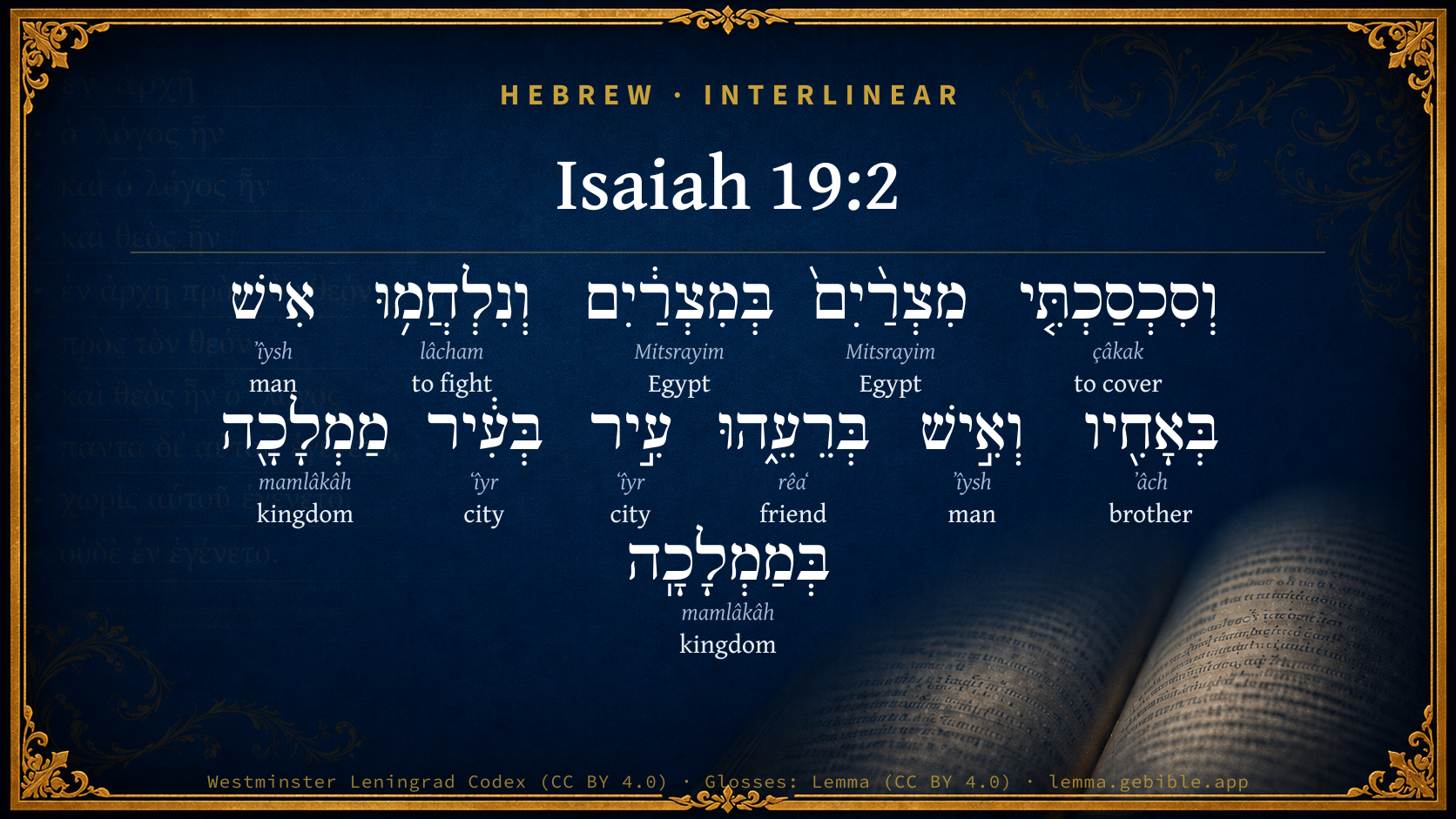
Hebrew (Westminster Leningrad Codex) Isaiah 19:2 appears in the Hebrew Old Testament. The text above is from the Westminster Leningrad Codex. Each word links to its Strong’s number, a concise gloss, and parsing drawn from the Open Scriptures Hebrew Bible morphology. Click any word for its full Brown-Driver-Briggs (BDB) entry.
Download image
Cite this verse

Isaiah 19:2 (World English Bible). Public Domain. Lemma interlinear Bible study tool, https://lemma.gebible.app/v/isaiah/19/2.

Show BibTeX & RIS
BibTeX
RIS
English Translation
I will stir up the Egyptians against the Egyptians: and they shall fight everyone against his brother, and everyone against his neighbor; city against city, [and] kingdom against kingdom.
World English Bible · Public Domain
Download a study sheet

One document with this verse’s original text, its word-by-word gloss line, the meaning frame, cross-references with their text, attributed commentary, and full source and license credits — printable, and it pastes into notes with its structure intact.

This verse Autodidact and up

Study sheet (.html) Plain text (.txt)

A passage Seminary Student

Up to 50 verses in one chapter. A passage sheet keeps up to 6 commentary sources and 12 cross-references per verse, in the order this page ranks them, and says so on the sheet whenever that leaves anything out. Ask for a single verse and you get the Autodidact verse sheet above.

Everything on this page stays free to read, with no account — the sheet is a download of what is already on screen, not access to it.

Want to remove ads? Support Godless Engineer
Compare translations 3

The same verse in 3 English versions, stacked beneath the original-language interlinear above. Click any original word for its lexicon entry.

Each is an independent rendering of the whole verse — the interlinear is not word-aligned to these translations.

Highlighted words mark where these versions differ — a whole-verse word diff, not a word-by-word alignment.

  • World English Bible Public Domain
    I will stir up the Egyptians against the Egyptians: and they shall fight everyone against his brother, and everyone against his neighbor; city against city, [and] kingdom against kingdom.
  • King James Version Public Domain
    And I will set the Egyptians against the Egyptians: and they shall fight every one against his brother, and every one against his neighbour; city against city, and kingdom against kingdom.
  • unfoldingWord Literal Text CC BY-SA 4.0
    “And I will provoke Egypt against Egypt, and they will fight, a man against his brother and a man against his neighbor, city against city, kingdom against kingdom.

unfoldingWord Literal Text — © unfoldingWord, licensed CC BY-SA 4.0. Word-aligned USFM3 via Door43 (git.door43.org/unfoldingWord/en_ult).

Versions to compare (up to 4)

3 of 4 selected

Show all 18 translations

Every available English version of this verse, each an independent rendering of the whole verse.

  • World English Bible Public Domain
    I will stir up the Egyptians against the Egyptians: and they shall fight everyone against his brother, and everyone against his neighbor; city against city, [and] kingdom against kingdom.
  • Berean Standard Bible Public Domain
    “So I will incite Egyptian against Egyptian; brother will fight against brother, neighbor against neighbor, city against city, and kingdom against kingdom.
  • Majority Standard Bible Public Domain
    “So I will incite Egyptian against Egyptian; brother will fight against brother, neighbor against neighbor, city against city, and kingdom against kingdom.
  • King James Version Public Domain
    And I will set the Egyptians against the Egyptians: and they shall fight every one against his brother, and every one against his neighbour; city against city, and kingdom against kingdom.
  • American Standard Version (1901) Public Domain
    And I will stir up the Egyptians against the Egyptians: and they shall fight every one against his brother, and every one against his neighbor; city against city, `and' kingdom against kingdom.
  • Revised Version (1885) Public Domain
    And I will stir up the Egyptians against the Egyptians: and they shall fight every one against his brother, and every one against his neighbour; city against city, and kingdom against kingdom.
  • Geneva Bible (1599) Public Domain
    And I will set the Egyptians against the Egyptians: so euery one shall fight against his brother, and euery one against his neighbour, citie against citie, and kingdome against kingdome.
  • Douay-Rheims (1899) Public Domain
    And I will set the Egyptians to fight against the Egyptians: and they shall fight brother against brother, and friend against friend, city against city, kingdom against kingdom.
  • Young's Literal Translation Public Domain
    And I armed Egyptians against Egyptians, And they fought, each against his brother, And each against his neighbour, City against city, kingdom against kingdom.
  • Literal Standard Version CC BY-SA 4.0
    And I armed Egyptians against Egyptians, || And they fought, each against his brother, || And each against his neighbor, || City against city, kingdom against kingdom.
  • Unlocked Literal Bible CC BY-SA 4.0
    “I will stir up Egyptians against Egyptians: A man will fight against his brother, and a man against his neighbor; city will be against city, and kingdom against kingdom.
  • unfoldingWord Literal Text CC BY-SA 4.0
    “And I will provoke Egypt against Egypt, and they will fight, a man against his brother and a man against his neighbor, city against city, kingdom against kingdom.
  • Darby Bible Public Domain
    And I will incite the Egyptians against the Egyptians; and they shall fight every one against his brother, and every one against his neighbour; city against city, kingdom against kingdom.
  • World Messianic Bible Public Domain
    I will stir up the Egyptians against the Egyptians, and they will fight everyone against his brother, and everyone against his neighbor; city against city, and kingdom against kingdom.
  • Webster's Bible Public Domain
    And I will set the Egyptians against the Egyptians: and they shall fight every one against his brother, and every one against his neighbor; city against city, and kingdom against kingdom.
  • Free Bible Version CC BY-SA 4.0
    I will encourage Egyptians to attack other Egyptians. They will fight each other, neighbor versus neighbor, town versus town, and kingdom versus kingdom.
  • Bible in Basic English Public Domain
    And I will send the Egyptians against the Egyptians: and they will be fighting every one against his brother, and every one against his neighbour; town against town, and kingdom against kingdom.
  • JPS Tanakh (1917) Public Domain
    And I will spur Egypt against Egypt; and they shall fight every one against his brother, and everyone against his neighbour; city against city, and kingdom against kingdom.

Literal Standard Version (2020), Covenant Press — licensed CC BY-SA 4.0. Text via the HelloAO Bible API (eBible.org). Unlocked Literal Bible (unfoldingWord) — licensed CC BY-SA 4.0. Text via the HelloAO Bible API (eBible.org). unfoldingWord Literal Text — © unfoldingWord, licensed CC BY-SA 4.0. Word-aligned USFM3 via Door43 (git.door43.org/unfoldingWord/en_ult). Free Bible Version, Dr. Jonathan Gallagher — licensed CC BY-SA 4.0. Text via the HelloAO Bible API (eBible.org).

Word by word

More ways to search: Search by grammar → Find every occurrence → Compare this word →

Practice this passage: Drill this verse → Learn its vocabulary →

וְסִכְסַכְתִּ֤י
çâkak
H5526
“and · to cover”
Conjunction + Verb, Pilpel, Sequential Perfect, 1st Person, Common, Singular
Part of Speech
Conjunction + Verb
Stem
Pilpel
Form
Sequential Perfect
Person
1st Person
Gender
Common
Number
Singular
Full BDB Definition

Origin: a primitive root

TWOT: 1475 , 1492 , 2259 , 2260

(Qal) to hedge, fence about, shut in - to block, overshadow, screen, stop the approach, shut off, cover - (Qal) - to screen, cover - to cover oneself - protector (participle) - (Hiphil) - to screen, cover - to cover, defecate (euphemism) - (Qal) to cover, lay over - to weave together - (Qal) to weave together - (Pilpel) to weave, weave together
  1. מִצְרַ֨יִם֙ Mitsrayim H4714 “Egypt” Noun, Proper
  2. בְּמִצְרַ֔יִם Mitsrayim H4714 “in/at · Egypt” Preposition + Noun, Proper
  3. וְנִלְחֲמ֥וּ lâcham H3898 “and · to fight” Conjunction + Verb, Niphal, Sequential Perfect, 3rd Person, Common, Plural
  4. אִישׁ ʼîysh H376 “man” Noun, Common, Masculine, Singular, Absolute
  5. בְּאָחִ֖יו ʼâch H251 “in/at · brother · his” Preposition + Noun, Common, Masculine, Singular, Construct + Suffix, Personal, 3rd Person, Masculine, Singular
  6. וְאִ֣ישׁ ʼîysh H376 “and · man” Conjunction + Noun, Common, Masculine, Singular, Absolute
  7. בְּרֵעֵ֑הוּ rêaʻ H7453 “in/at · friend · his” Preposition + Noun, Common, Masculine, Singular, Construct + Suffix, Personal, 3rd Person, Masculine, Singular
  8. עִ֣יר ʻîyr H5892 “city” Noun, Common, Feminine, Singular, Absolute
  9. בְּעִ֔יר ʻîyr H5892 “in/at · city” Preposition + Noun, Common, Feminine, Singular, Absolute
  10. מַמְלָכָ֖ה mamlâkâh H4467 “kingdom” Noun, Common, Feminine, Singular, Absolute
  11. בְּמַמְלָכָֽה mamlâkâh H4467 “in/at · kingdom” Preposition + Noun, Common, Feminine, Singular, Absolute

About this verse

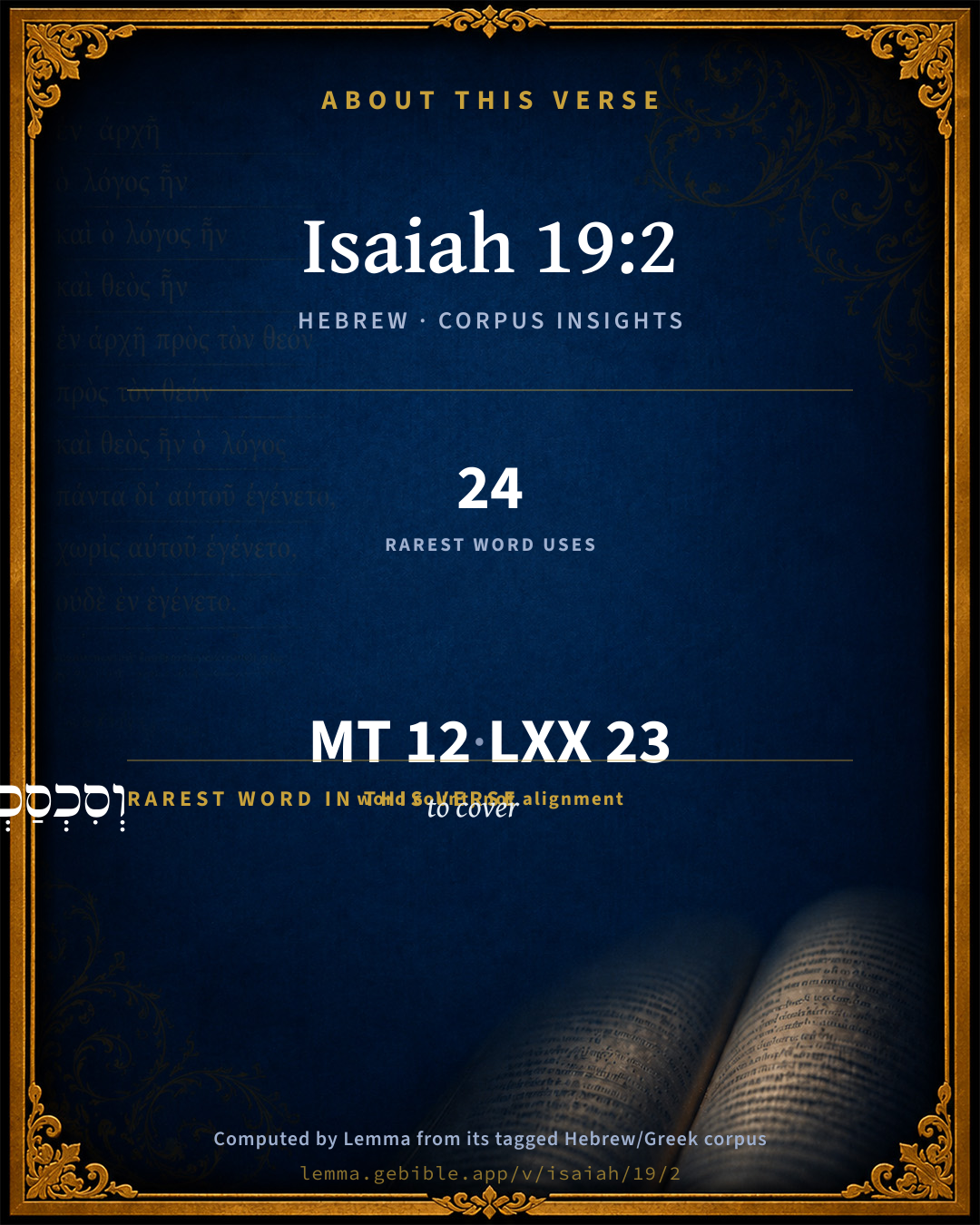
These counts appear in no published source. They are computed here, from the morphology-tagged text and Lemma’s own curated glosses. What Lemma adds →

12
words
8
distinct lemmas
Prophets
section

Notable vocabulary

The rarest word here is וְסִכְסַכְתִּ֤י to cover H5526 — appearing just 24 times in the whole Hebrew Bible.

Shared distinctive vocabulary

וְסִכְסַכְתִּ֤י to cover H5526 occurs in 24 verses of the Hebrew Bible. Also found in:

Grammatical profile

  • 2 verbs
  • 10 nouns

Verb forms

  • וְסִכְסַכְתִּ֤י Pilpel · Sequential Perfect
  • וְנִלְחֲמ֥וּ Niphal · Sequential Perfect

Repetition

Words recur within this verse — often emphatic in Hebrew:

  • מִצְרַ֨יִם֙ Egypt H4714 ×2
  • אִישׁ man H376 ×2
  • עִ֣יר city H5892 ×2
  • מַמְלָכָ֖ה kingdom H4467 ×2

Hebrew & Septuagint length

In English translation the verse runs 29 words from the Hebrew and 31 from the Septuagint (LXX English) — closely comparable.

A rough comparison of the two English renderings, which tokenize alike — not a word-level alignment.

Word counts can differ between the Hebrew and the Greek without any difference in meaning — e.g. the Hebrew direct-object marker אֵת has no separate Greek word, and Greek often adds the article ὁ.

In the original languages it is 12 Hebrew tokens and 23 Greek tokens — but the two are counted differently (Hebrew bundles its prefixes and suffixes into one token; the Greek is in lemma form), so that isn’t a like-for-like length.

Cross-references

12

Topical passages linked to Isaiah 19:2 in the Treasury of Scripture Knowledge — connected by theme and wording, ordered by reader-vote popularity; previews shown in the World English Bible.

  • Judges 7:22 They blew the three hundred trumpets, and Yahweh set every man's sword against his fellow, and against all the host; and the host fled as far as Beth-shittah toward Zererah, as far as the border of Abel Meholah, by Tabbath.
  • 1 Samuel 14:20 Saul and all the people who were with him were gathered together, and came to the battle: and, behold, every man's sword was against his fellow, [and there was] a very great confusion.
  • Matthew 10:36 A man's foes will be those of his own household.
  • Ezekiel 38:21 I will call for a sword against him to all my mountains, says the Lord Yahweh: every man's sword shall be against his brother.
  • Matthew 10:21 "Brother will deliver up brother to death, and the father his child. Children will rise up against parents, and cause them to be put to death.
  • Matthew 12:25 Knowing their thoughts, Jesus said to them, "Every kingdom divided against itself is brought to desolation, and every city or house divided against itself will not stand.
  • Revelation 17:12–17 The ten horns that you saw are ten kings who have received no kingdom as yet, but they receive authority as kings, with the beast, for one hour.
  • 2 Chronicles 20:22–23 When they began to sing and to praise, Yahweh set liers-in-wait against the children of Ammon, Moab, and Mount Seir, who had come against Judah; and they were struck.
  • Isaiah 9:21 Manasseh, Ephraim; and Ephraim, Manasseh; and they together shall be against Judah. For all this his anger is not turned away, but his hand is stretched out still.
  • Isaiah 19:13–14 The princes of Zoan are become fools, the princes of Memphis are deceived; they have caused Egypt to go astray, who are the corner-stone of her tribes.
  • Judges 9:23 God sent an evil spirit between Abimelech and the men of Shechem; and the men of Shechem dealt treacherously with Abimelech:
  • 1 Samuel 14:16 The watchmen of Saul in Gibeah of Benjamin looked; and, behold, the multitude melted away, and they went [here] and there.

Cross-references courtesy of OpenBible.info (CC BY 4.0).

Hebrew and Greek witnesses Masoretic Hebrew ↔ Greek Septuagint

The same verse in the two great witnesses to the Old Testament, shown verse-for-verse.

These are two independent witnesses, not word-aligned to each other, and the Septuagint is shown in lemma (dictionary) form.

Hebrew Isaiah 19:2 Masoretic · Westminster Leningrad Codex

וְסִכְסַכְתִּ֤י מִצְרַ֨יִם֙ בְּמִצְרַ֔יִם וְנִלְחֲמ֥וּ אִישׁ בְּאָחִ֖יו וְאִ֣ישׁ בְּרֵעֵ֑הוּ עִ֣יר בְּעִ֔יר מַמְלָכָ֖ה בְּמַמְלָכָֽה

I will stir up the Egyptians against the Egyptians: and they shall fight everyone against his brother, and everyone against his neighbor; city against city, [and] kingdom against kingdom.

World English Bible · Public Domain

Greek LXX Isaiah 19:2 Septuagint · lemma form

καί ἐπιἐγείρω αἰγύπτιος ἐπί αἰγύπτιος καί πολεμέω ἄνθρωπος ὁ ἀδελφός αὐτός καί ἄνθρωπος ὁ πλησίον αὐτός πόλις ἐπί πόλις καί νόμος ἐπί νομός

And the Egyptians shall be stirred up against the Egyptians: and a man shall fight against his brother, and a man against his neighbor, city against city, and law against law.

LXX2012 (modern English Septuagint) · Public Domain

On this verse, Joseph Benson's Commentary discusses the Septuagint’s reading. Read the note in Commentary ↓

Hebrew: Westminster Leningrad Codex (CC BY 4.0). Greek: Septuagint (public domain); English from LXX2012 (modern English Septuagint) (Public Domain). How the Septuagint differs from the Hebrew →

Targum (Aramaic paraphrase)

1

The Targum is the ancient Jewish Aramaic paraphrase of the Hebrew Scriptures — an interpretive translation, not the Hebrew text itself. Onkelos (literal) and Pseudo-Jonathan (expansive) render the Torah, and Jonathan the Prophets. Coverage is partial: where no permissively-licensed English translation exists for a verse, only the Aramaic is shown. This is verse-level text, not a word-by-word alignment to the Hebrew.

  1. Targum Jonathan Prophets (Joshua–Malachi)
    וֶאֱגָרֵי מִצְרָאֵי בְּמִצְרָאֵי וִיגִיחוּן קְרָב גְבַר בַּאֲחוּהִי וּגְבַר בְּחַבְרֵהּ קְרִי בִּקְרִי וּמָלְכוּ בְמָלְכוּ:

    And I will excite Egyptians against Egyptians, and they shall wage war, every man against his brother, and every man against his neighbour: city against city, kingdom against kingdom.

    Targum Jonathan — Aramaic: “Mikraot Gedolot” (public domain). English: “Sefaria Community Translation” (CC0 1.0 (public-domain dedication)); “London "Chaldee Paraphrase," 1871” (public domain). Text via Sefaria.

Commentary

Notes on Isaiah 19:2 from classic Christian and Jewish commentators (each source and its license shown beneath its notes). The classic Christian expositions comment on the surrounding passage and are grouped to its opening verse, so a note may address several verses; the Jewish commentaries on the Tanakh (Rashi and others) are per-verse, so they appear only where the commentator wrote on this verse.

Lemma curates 59 commentaries, every one of them public domain or Creative Commons licensed, each selected and text-cleaned for this edition rather than reprinted as found. About our sources →

Trapp's Complete Commentary

John Trapp

Isa 19:2 And I will set the Egyptians against the Egyptians: and they shall fight every one against his brother, and every one against his neighbour; city against city, [and] kingdom against kingdom.

Ver. 2. And I will set the Egyptians against the Egyptians.] Commiscebo Egyptios inter se, I will embroil them in a civil war. This happened, saith Junius, under King Psammeticus, after the death of Sethon, about the end of Hezekiah’s reign, or the beginning of Manasseh’s, while Isaiah was yet alive. {a}

And kingdom against kingdom.] Or, Rectory against rectory; for as here in the heptarchy, so there the land was divided into many provinces or jurisdictions, even sixty-six, saith Ortelius.

{a} Herod., lib. ii. Diod. Sic., lib. i.

John Trapp, A Commentary or Exposition upon All the Books of the Old and New Testament (1647–1656) — public domain. Text from a community e-Sword module.

The Biblical Illustrator

Joseph S. Exell

Isa_19:2

And I will set the Egyptians against the Egyptians

Divine providence in civil strife

This method of administration, we say, obtains and prevails in all ages.

This is the meaning of many a controversy, of many a quarrel, of many a dissension, in cabinets, in families, in nations. Men are surprised that they should turn upon their brothers with disdain, and even with cruel hatred. It is indeed matter of surprise and great sorrow, and if looked at within narrow limits it would seem to be a reflection upon Providence: but when does God ask to be judged within the four comers of human imagination or criticism? He not only does the deed, He does it within a field which He Himself has measured, and within the range of declarations which have about them all the mystery and graciousness of evangelical prophecies. We must, therefore, look not only at the incident, but at all its surroundings and to all its issues. When we are puzzled by household difficulties, by commercial perplexities, by unions that only exist for a moment and then dissolve or are turned into sourness and alienation, we must never forget that there is One who rules over all. (J. Parker, D. D.)

The Biblical Illustrator, edited by Joseph S. Exell (c. 1880s–1900s) — public domain. Text from a community e-Sword module.

Joseph Benson's Commentary

Isa 19:2-3. I will set the Egyptians against the Egyptians — Two principal calamities to befall Egypt are foretold in this prophecy; the first of which is here described: civil wars should arise among them. They shall fight every one against his brother and neighbour — Whom he ought to love as himself. City against city, and kingdom against kingdom — “The LXX. read, νομος επι νομον, province against province, Egypt being divided into prefectures, or provinces. Vitringa and others apply this to the time of the twelve kings, the anarchy that preceded, and the civil wars that ensued, in which Psammitichus prevailed over the rest; but it may, perhaps, be more properly applied to what agrees better, in point of time, with other parts of the prophecy, the civil wars between Apries and Amasis, at the time of Nebuchadnezzar’s invasion; and the civil wars a little before the country was finally subdued by Ochus. It is no wonder, that in such distractions and distresses as these, the Egyptians, being naturally a cowardly people, should be destitute of counsel, and that the spirit of Egypt should fail in the midst thereof, as the prophet foretels, (Isa 19:3,) and that, being also a very superstitious people, they should seek to the idols, and to the charmers, and to them that had familiar spirits, and to the wizards. But their divination was all in vain,” God having determined that they should be subdued and oppressed by cruel lords and tyrants, as it follows.

Joseph Benson's Commentary on the Old and New Testaments (1811–1818) — public domain. Text from a community e-Sword module.

Keil & Delitzsch

C. F. Keil & F. Delitzsch

"And I spur Egypt against Egypt: and they go to war, every one with his brother, and every one with his neighbour; city against city, kingdom against kingdom. And the spirit of Egypt is emptied out within it: and I swallow up its ready counsel; and they go to the idols to inquire, and to the mutterers, and to the oracle-spirits, and to the soothsayers. And I shut up Egypt in the hand of a hard rule; and a fierce king will reign over them, saith the Lord, Jehovah of hosts." Civil war will rage in Egypt (on sicsēc, see at Isa 9:10). The people once so shrewd are now at their wits' end; their spirit is quite poured out נבקה, with the reduplication removed, for נבקּה, according to Ges. 68, Anm. 11 - as, for example, in Gen 11:7; Eze 41:7), so that there is nothing left of either intelligence or resolution. Then (and this is also part of the judgment) they turn for help, in counsel and action, where no help is to be found, viz., to their "nothings" of gods, and the manifold demoniacal arts, of which Egypt could boast of being the primary seat. On the names of the practisers of the black art, see Isa 8:19; 'ittim, the mutterers, is from 'âtat, to squeak (used of a camel-saddle, especially when new), or to rumble (used of an empty stomach): see Lane's Lexicon. But all this is of no avail: Jehovah gives them up (סכּר, syn. הסגּיר, συγκλείειν to be ruled over by a hard-hearted and cruel king. The prophecy does not relate to a foreign conqueror, so as to lead us to think of Sargon (Knobel) or Cambyses (Luzzatto), but to a native despot. In comparing the prophecy with the fulfilment, we must bear in mind that Isa 19:2 relates to the national revolution which broke out in Sais, and resulted in the overthrow of the Ethiopian rule, and to the federal dodekarchy to which the rising of the nation led. "Kingdom against kingdom:" this exactly suits those twelve small kingdoms into which Egypt was split up after the overthrow of the Ethiopian dynasty in the year 695, until Psammetichus, the dodekarch of Sais, succeeded in the year 670 in comprehending these twelve states once more under a single monarchy. This very Psammetichus (and the royal house of Psammetichus generally) is the hard ruler, the reckless despot. He succeeded in gaining the battle at Momemphis, by which he established himself in the monarchy, through having first of all strengthened himself with mercenary troops from Ionia, Caria, and Greece. From his time downwards, the true Egyptian character was destroyed by the admixture of foreign elements;

(Note: See Leo, Universalgesch. i. 152, and what Brugsch says in his Histoire d'Egypte, i. 250, with regard to the brusques changements that Egypt endured under Psammetichus.)

and this occasioned the emigration of a large portion of the military caste to Meroe. The Egyptian nation very soon came to feel how oppressive this new dynasty was, when Necho (616-597), the son and successor of Psammetichus, renewed the project of Ramses-Miamun, to construct a Suez canal, and tore away 120,000 of the natives of the land from their homes, sending them to wear out their lives in forced labour of the most wearisome kind. A revolt on the part of the native troops, who had been sent against the rising Cyrene, and driven back into the desert, led to the overthrow of Hophra, the grandson of Necho (570), and put an end to the hateful government of the family of Psammetichus.

Keil & Delitzsch — Biblical Commentary on the Old Testament (1861–1891) — public domain (CC PDM 1.0). Text via the HelloAO Bible API. (Old Testament only.)

Tyndale Open Study Notes

Tyndale Open Resources

19:2 Egypt had a history of civil wars that ravaged the country. Egypt’s fragile unity was breaking apart.

Tyndale Open Study Notes — © Tyndale Open Resources, licensed CC BY-SA 4.0. Text via the HelloAO Bible API.

Geneva Bible (1599)

Geneva Bible translators

As he caused the Ammonites, Moabites and Idumeans to kill one another, when they came to destroy the Church of God, 2 Chron. 20:22; Isa. 49:26.

Geneva Bible (1599) marginal notes — public domain. Text via Bolls.life.

Jamieson, Fausset & Brown

Robert Jamieson, A. R. Fausset & David Brown

set--stir up. GESENIUS translates, "arm."

Egyptians against the Egyptians--Lower against Upper: and Saitic against both. (See Isa 3:10). NEWTON refers it to the civil wars between Apries and Amasis at the time of Nebuchadnezzar's invasion; also between Tachos, Nectanebus, and the Mendesians, just before Ochus subdued Egypt.

kingdom against kingdom--The Septuagint has "nome against nome"; Egypt was divided into forty-two nomes or districts.

Jamieson, Fausset & Brown — Commentary Critical and Explanatory on the Whole Bible (1871) — public domain (CC PDM 1.0). Text via the HelloAO Bible API.

Ellicott's Commentary for English Readers

(2) I will set the Egyptians against the Egyptians . . .—The discord predicted was probably the natural consequence of the overthrow of the Ethiopian power by Sargon, the Assyrian king, in B.C. 720. Under Piankhi each nome, or district, had been governed by a chief, owning the suzerainty of the Ethiopian king, and these, when the restraint was removed, would naturally assert their independence. So Herodotus (ii. 147) relates that on the overthrow of Sabaco, the last of the Ethiopian dynasty, the unity of Egypt was broken up into a dodecarchy.

A Bible Commentary for English Readers, edited by Charles John Ellicott (1878–1897) — public domain. Text from a community e-Sword module.

The Cambridge Bible for Schools and Colleges

gen. ed. J. J. S. Perowne

2. Jehovah speaks. The description of anarchy and civil war recalls ch. Isa_3:5, Isa_9:18 ff.

I will set … Egyptians] Lit. I will stir up (see ch. Isa_9:11) Egypt against Egypt—the general expression for civil discord which is explained in the remainder of the verse. kingdom against kingdom] LXX. νομὸς ἐπὶ νομόν—a correct translation drawn from the translator’s local knowledge of Egypt. The numerous nomes or cantons were but loosely federated, and dissensions and local jealousies were always apt to break out when the central government was paralysed.

The Cambridge Bible for Schools and Colleges (gen. ed. J. J. S. Perowne; Cambridge University Press, 1878–1918) — public domain. Text from a community e-Sword module.

John Gill's Exposition

And I will set the Egyptians against the Egyptians,.... Or mingle and confound them together; in which confusion they should fall upon and destroy one another, as the Midianites did: the phrase is expressive of rebellions and civil wars, as the following words explain it; and which show, that the calamities of Egypt should be brought upon them, not by means of a foreign invasion, but by internal quarrels, and other means, which the Lord would in judgment send among them:

and they shall fight everyone against his brother, and everyone against his neighbour; and destroy one another:

city against city; of which there were great numbers in Egypt; in the times of Amasis, it is said (s), there were twenty thousand:

and kingdom against kingdom; for though Egypt was but originally one kingdom, yet upon the death of Sethon, one of its kings, who had been a priest of Vulcan, there being no successor, twelve of the nobility started up, and set up themselves as kings, and divided the kingdom into twelve parts (t), and reigned in confederacy, for the space of fifteen years; when, falling out among themselves, they excluded Psammiticus, one of the twelve, from any share of government; who gathering an army together, fought with and conquered the other eleven, and seized the whole kingdom to himself, and who seems afterwards regarded in this prophecy; all this happened in the times of Manasseh king of Judah, and so in or quickly after Isaiah's time: though some understand this of the civil wars between Apries and Amasis, in the times of Nebuchadnezzar. The Septuagint version renders the phrase here, "nome against nome"; for the whole land of Egypt, by Sesostris, one of its kings, was divided into thirty six (u) nomes, districts, or provinces, whose names are given by Herodotus (w), Pliny (x), and others; for so the words of that version should be rendered, and not as they are by the Latin interpreter, and in the Arabic version, which follows it, "law upon law".

(s) Herodot. l. 2. c. 177. (t) Ib. c. 147. (u) There were ten of them in Thebais, the same number in Delta, and sixteen between them. (w) Euterpe, sive l. 2. c. 164, 165, 166. (x) Nat. Hist. I. 5. c. 9. Ptolem. Geograph. l. 4. c. 4. Strabo Geogr. l. 17. P. 541.

John Gill's Exposition of the Whole Bible (1746–1763) — public domain (CC PDM 1.0). Text via the HelloAO Bible API.

Albert Barnes' Notes on the Bible

And I will set - (סכסכתי sı̂ksaketı̂y). This word (from סכך sākak) means properly “to cover,” to spread over, to hide, conceal, to protect. Another signification of the verb is, to weave, to intermingle. It may mean here, ‘I will arm the Egyptians against each other’ (Gesenius); or, as in our version, ‘I will mingle, confound, or throw them into discord and strife.’ The Septuagint renders it, Ἐπεγερθήσονται Epegerthēsontai - ‘They shall be excited,’ or, ‘raised up.’ Symmachus, Συμβαλῶ Sumbalō. Syriac and Chaldee, ‘I will excite.’ The sense is, that there would be discord and civil war, and this is traced to the agency or overruling providence of God - meaning that he would “permit and overrule” it. Compare the notes at Isa 45:7 : ‘I make peace, and I create evil; I, Yahweh, do all these things;’ Amo 3:6 : ‘Shall there be evil in a city and Jehovah hath not done it?’ The civil war here referred to was probably that which arose between the twelve kings in the time of the dodekarchy (see the Analysis to the chapter), and which resulted in the single dominion of Psammetichus. Dr. Newton (“On the Prophecies,” xii.) supposes, however, that the prophet refers to the civil wars between Apries and Amasis at the time of the invasion by Nebuchadnezzar. But it agrees much better with the former discord than with this. The description which follows is that of anarchy or civil strife, where “many” parties are formed, and would naturally lead to the supposition that there were more than two engaged.

And kingdom against kingdom - Septuagint, Νόμος έπὶ νόμων Nomos epi nomōn - ‘Nome against nomes.’ Egypt was formerly divided into forty-two “nomes” or districts. The version by the Septuagint was made in Egypt, and the translators would naturally employ the terms which were in common use. Still the event referred to was probably not that of one “nome” contending against another, but a civil war in which one dynasty would be excited against another (Gesenius), or when there would be anarchy and strife among the different members of the dodekarchy. See the Analysis of the chapter.

Albert Barnes' Notes on the Bible (1834–1885) — public domain. Text from a community e-Sword/MySword module.

Haydock's Catholic Bible Commentary

Kingdom. Under the twelve kings. (Calmet)

George Leo Haydock (1774–1849), Haydock's Catholic Family Bible and Commentary, 1859 edition — public domain. Excludes Psalms (Douay-Rheims chapter numbering differs from Protestant) and Deuterocanonical books (Catholic canon only).

Matthew Poole's English Annotations

I will set the Egyptians against the Egyptians; I will raise civil wars among them.

Kingdom against kingdom; for although all Egypt was now one kingdom, and under one king, yet not many years after this time it was divided into twelve several kingdoms, between whom there were many and cruel wars, as is related by the historians of those times, and particularly by Herodotus and Diodorus.

Matthew Poole's English Annotations on the Holy Bible (1683–1685) — public domain. Text from a community e-Sword/MySword module.

Whedon's Commentary on the Bible

Daniel D. Whedon

2-4. Opinions greatly vary as to when the events here described took place. Of the most plausible, one refers them to times shortly following the destruction of Sennacherib’s army, during which times the affairs of Egypt were in great confusion. Another opinion (and which is to be preferred) places the events in successu; the reference to Nebuchadnezzar’s conquest being general, and to the conquest of Cambyses particular; and the whole referring to successive disciplinary punishments, but ending with deliverances, such as the final adoption of the worship of the true God will bring. The lesson taught is, that Jehovah is the God of all nations, especially of Egypt and Assyria, the greatest kingdoms then known; and that his worship effects the only true salvation for all.

2. Egyptians against… Egyptians — One district or nome against another. So the Septuagint: or, Upper, Middle, and Lower Egypt against each other. The former is the more probable meaning. In all Egypt there were at various times from thirty-six to forty-two of such divisions. Or, the immediate thought of divisions may be that of the Dodakarchy, or the twelve provinces, from B.C. 695 till Psammetichus. (See SMITH’S History, vol. 1.)

Daniel D. Whedon (gen. ed.), Commentary on the Old and New Testaments (1874–1909) — public domain. Text from a community e-Sword module.

The Pulpit Commentary

I will set the Egyptians against the Egyptians. The disintegration of Egypt commenced about B.C. 760-750, towards the close of the twenty-second dynasty. About B.C. 735 a struggle began between Plan-khi, King of Upper Egypt, and Tafnekhf, King of Sais and Memphis, in which the other princes took different sides. Ten or twelve years later there was a struggle between Bocchoris and Sabaeo. From this time onwards, until Psamatik I reestablished the unity of Egypt (about B.C. 650), the country was always more or less divided, and on the occurrence of any crisis the princes were apt to make war one up, n another. Kingdom against kingdom. During the period of disintegration, the title of" king" was assumed by most of the potty princes, though they were little more than chiefs of cities (see "Records of the Past," vol. 2. p. 100; G. Smith, "History of Asshur-bani-pal," pp. 20-22).

Vers. 2-10. A picture of penalty.

The threatened penalty of Egypt as painted by the prophet here will, on examination, be found to be essentially the penalty with which God causes sin to be visited always and everywhere.

I STRIFE, especially internal strife (ver. 2). The guilty nation will find itself plunged into civil war (Egypt, Greece, Rome, France, America northern and southern states, etc.), or rent with bitter and vindictive factions; the guilty family will have its domestic harmony destroyed by petty broils and miserable disagreements; the individual soul will be compelled to expend its powers in internal strife conscience having a long and perhaps desperate struggle with passion; reason, which urges to immediate decision, contending with the evil spirit of procrastination; the will to submit to Divine demands doing stern, protracted battle with a desire to conform to the good pleasure of the unholy and the unwise.

II DELUSION. (Ver. 3.) As the, Egyptians, paying the penalty of disobedience, were to abandon the counsels of human wisdom for the fancies and fooleries of the juggler, so will men find that sin leads down from the guidance of reason to the dictates of folly and the misleadings of delusion. It is not long before the sinner experiences "the deceitfulness of sin;" before he finds that he does not impose ca other men half so much as he is imposed upon, or as he imposes on himself. He comes to think that utterances which are earthly, or of lower origin than that, are the voices of heaven; he "calls evil good, and good evil;" counsel which he ought to abjure as diabolical, he deems excellent and wise; neglecting truths and principles which would be his salvation, he falls back upon sentiments which lead down, with certain path, to innermost and uttermost ruin.

III BONDAGE. (Ver. 4.) It is one of the most certain and one of the saddest penalties of sin that the wrong-doer is handed over to the despotism of "a cruel lord." By what truer or more descriptive terms could these enemies of the soul be characterized into whose iron grasp the transgressor falls? Is not the insatiable craving for strong drink or for the hurtful narcotic a "cruel lord?" What but cruel lords are covetousness, ambition, lasciviousness, the voracity or extreme delicacy of those "whose God is their belly the passion which demands and will not be denied, which consumes the time, which saps the energy, which steals the manhood that should be devoted to nobler ends, that should be laid on a worthier altar? The victims of vice are "holden with the cords of their sins;" they are "in the hand of a cruel lord," who will make them pay "the uttermost farthing.

IV SHRINKAGE. (Vers. 5-10.) Egypt should be pitiably reduced; the waters of its life-giving river should be wanting (ver. 5), its vegetation should fade and die (ver. 6), its industries should be stopped (vers. 8, 9), its chief men should be overthrown (ver. 10). All Egyptian life, through its length and breadth, should be struck a ruinous blow, should shrink from fullness and power into feebleness and decline. Under the dominion of sin, human life suffers a ruinous reduction. Made for God, for his likeness, for his fellowship, for his service, for the highest forms of usefulness and the noblest order of enjoyment, we sink into folly, into selfishness, into smallness of aim and littleness of accomplishment; our lives are narrowed, lessened, shriveled. It is the pitiful penalty of departure from God, of withholding our hearts from our Divine Friend. In Christ we realize the fair and blessed opposites of these. In him is

(1) peace; (Joh_14:27 Joh_16:33 Eph_2:14)

(2) enlightenment; (1Co_14:20 Eph_1:18 Col_1:9) freedom; (Joh_8:32-36 Rom_6:18 Gal_5:1) enlargement. C. (Mat_5:45 Joh_15:14 Rom_8:17 Eph_2:6 Rev_1:6)

HOMILIES BY R. TUCK Ver. 2. Political commotion regarded as Divine judgment.

"And I will spur Egypt against Egypt, and they shall fight every one against his brother, and every one against his fellow, city against city, and kingdom against kingdom." Civil war does far more serious and permanent mischief to a nation than foreign war. There are no such distressing conditions brought about by any other agencies as those which follow civil war. There can be no true heroism in its scenes; because the impulse is either mercenary, or it is class hatred and passion. Patriotism is swallowed up in mere sectional interests. The historical connections of this prophecy seem to be made clear by the recent discoveries of Egyptian and Assyrian inscriptions. There has been found an inscription containing a proclamation of one Piankhi, who, in the eighth century B.C., united under his scepter the whole of Egypt and Ethiopia. Lower Egypt was divided among rival princes, whose connection with their over-lord was merely nominal, and civil wars from time to time arose. That which is true of actual civil war, is in measure true of times of political excitement and conflict, when party feeling runs high. Some of the evils of such times may be pointed out.

I THESE TIMES OF COMMOTION SET CLASS AGAINST CLASS. It is curious to notice that political conflict is never confined to the subject about which it arose. It is opening the flood-gates and letting out all the waters of class jealousy.

II THESE TIMES DISTURB SOCIAL ORDER. Breaking up families and friendships, and diverting men"s minds and energies from their ordinary occupations.

III THESE TIMES INTERFERE WITH BUSINESS. Which is very sensitive to disturbed conditions of the body politic. Mutual trust is essential to business development, and the sense of security gives value to property.

IV THESE TIMES GIVE INFLUENCE TO EVIL MEN. The demagogue finds then his opportunity. The masses of society gain undue importance. Noise has more power than intelligence. Reason"s voice can seldom be heard. She keeps still, for it is an evil time.

V THESE TIMES SERIOUSLY HINDER CHRISTIAN AND CHARITABLE ENTERPRISE. Diverting both energy and money. So seasons of political commotion become agencies in executing Divine judgments, and become times of national warning and correction. R.T.

The Pulpit Commentary (1880–1919), ed. H.D.M. Spence-Jones & Joseph S. Exell — public domain. Text from a community e-Sword module.

John Wesley's Explanatory Notes

I will set - Egypt was now one kingdom, but not many years after this time it was divided into twelve kingdoms, between whom there were many and cruel wars.

John Wesley, Explanatory Notes Upon the Whole Bible (1754–1765) — public domain. Text via the GEBible commentary corpus.

J. A. Alexander on Isaiah

Joseph Addison Alexander

“And I will excite Egypt against Egypt, and they shall fight, a man with his brother, and a man with his fellow, city with city, kingdom with kingdom.” The first verb is by some rendered arm, by others join or engage in conflict; but the sense of stirring up or rousing is preferred both by the oldest and the latest writers. The version usually given, Egyptians against Egyptians, though substantially correct, is neither so expressive nor so true to the original as Egypt against Egypt, which involves an allusion to the internal divisions of the kingdom, or rather the existence of contemporary kingdoms, more explicitly referred to in the other clause. Some understand this verse as referring specifically to the civil wars of Egypt in the days of Sethos or Psammetichus. But while the coincidence with history adds greatly to the propriety and force of the description, there is no sufficient reason for departing from its obvious import, as a description of internal strife and anarchy in general. The expressions bear a strong resemblance to those used in the description of the state of Judah, Isa 3:5. Some regard these as the words to be uttered by Jehovah when He enters Egypt. It may, however, be a simple continuation of the prophecy, with a sudden change from the third to the first person, of which there are many other examples.

Joseph Addison Alexander, The Prophecies of Isaiah (1846–1847; New York: Scribner, 1870–1878) — public domain. Text from a community e-Sword module.

Rashi

Rabbi Shlomo Yitzchaki (Rashi)

And I will stir up Egyptians against Egyptians The end of the verse explains its beginning: And they shall war one man against his brother.

Rashi on the Tanakh — English translations: “The Judaica Press complete Tanach with Rashi, translated by A. J. Rosenberg” (CC BY 4.0); “Pentateuch with Rashi's commentary by M. Rosenbaum and A.M. Silbermann, 1929-1934” (public domain); “The Metsudah Tanach series, Lakewood, N.J” (CC BY 4.0); and “The Book of Joshua, Metsudah Publications, 1997” (CC BY 4.0). Text via Sefaria.

Ibn Ezra

Rabbi Abraham ibn Ezra

וסכסכתי And I will set. Comp. יסכסך He will set up (9:10)

Ibn Ezra on the Tanakh — English translations: “Sefaria Community Translation” (CC0 1.0 (public-domain dedication)); “Yalkut, Sifsei Chachomim Chumash, Metsudah Publications, 2009” (CC BY 4.0); and “Commentary of Ibn Ezra on Isaiah - trans. by M. Friedlander, 1873” (public domain). Text via Sefaria.

Lesson kit

Teaching starters — assembled from the data on this page, not authored interpretation. Every prompt links to the verse data it draws on. Edit before teaching.

Isaiah, in the Prophets, opens this verse with 12 words (8 distinct Hebrew lemmas). Its most distinctive word is çâkak (“to cover”). A historical commentator’s framing appears above. Read the whole chapter for the surrounding context.

Discussion questions

  1. What does “to cover” (çâkak) contribute to the verse as a whole?
  2. How does Exodus 25:20, which shares the word «to cover», read alongside this verse?
  3. What does the repetition of “Egypt” (2× in this one verse) do in this verse?
  4. The translations on this page render this verse differently — a whole-verse word diff, not a word-by-word alignment. What might account for the different wordings?
  5. «וְסִכְסַכְתִּ֤י» is a Pilpel Sequential Perfect verb. How does that grammatical form shape the action described?
  6. Compare how Trapp's Complete Commentary and The Biblical Illustrator read this verse. Where do they agree or differ?

Things to notice

Reading settings

Reading text

Shown beneath each verse's original-language words.

Old Testament
Old Testament edition

Read the OT as the Masoretic Hebrew (MT) or the Greek Septuagint (LXX).

English shown for the Greek Septuagint (in the Hebrew ↔ Greek comparison).

Comparing translations? Open the Compare panel on any verse page to stack up to four side by side.