
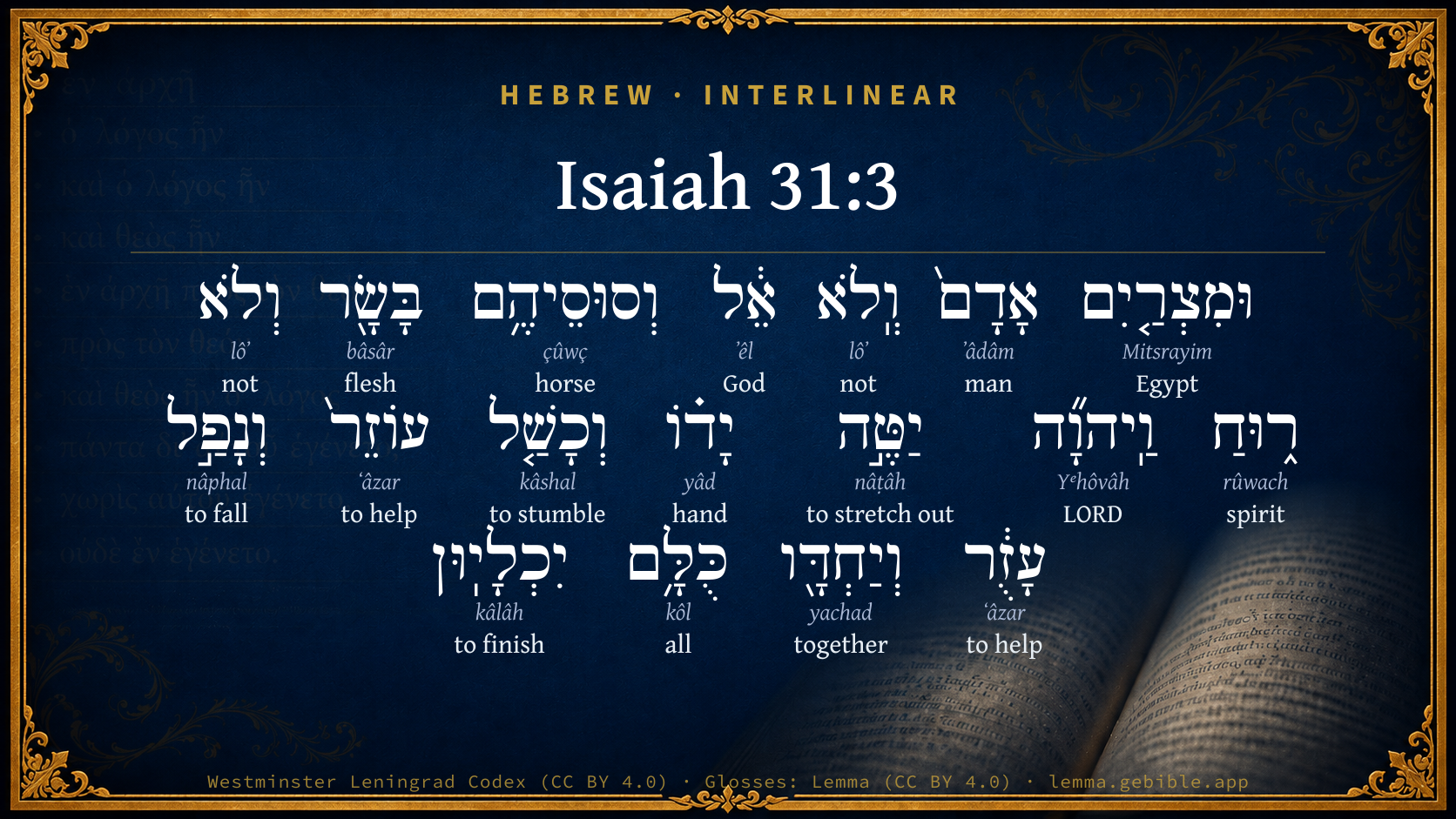
Isaiah 31:3

Hebrew (Westminster Leningrad Codex) Isaiah 31:3 appears in the Hebrew Old Testament. The text above is from the Westminster Leningrad Codex. Each word links to its Strong’s number, a concise gloss, and parsing drawn from the Open Scriptures Hebrew Bible morphology. Click any word for its full Brown-Driver-Briggs (BDB) entry.
Download image
Cite this verse

Isaiah 31:3 (World English Bible). Public Domain. Lemma interlinear Bible study tool, https://lemma.gebible.app/v/isaiah/31/3.

Show BibTeX & RIS
BibTeX
RIS
English Translation
Now the Egyptians are men, and not God; and their horses flesh, and not spirit: and when Yahweh shall stretch out his hand, both he who helps shall stumble, and he who is helped shall fall, and they all shall be consumed together.
World English Bible · Public Domain
Download a study sheet

One document with this verse’s original text, its word-by-word gloss line, the meaning frame, cross-references with their text, attributed commentary, and full source and license credits — printable, and it pastes into notes with its structure intact.

This verse Autodidact and up

Study sheet (.html) Plain text (.txt)

A passage Seminary Student

Up to 50 verses in one chapter. A passage sheet keeps up to 6 commentary sources and 12 cross-references per verse, in the order this page ranks them, and says so on the sheet whenever that leaves anything out. Ask for a single verse and you get the Autodidact verse sheet above.

Everything on this page stays free to read, with no account — the sheet is a download of what is already on screen, not access to it.

Want to remove ads? Support Godless Engineer
Compare translations 3

The same verse in 3 English versions, stacked beneath the original-language interlinear above. Click any original word for its lexicon entry.

Each is an independent rendering of the whole verse — the interlinear is not word-aligned to these translations.

Highlighted words mark where these versions differ — a whole-verse word diff, not a word-by-word alignment.

  • World English Bible Public Domain
    Now the Egyptians are men, and not God; and their horses flesh, and not spirit: and when Yahweh shall stretch out his hand, both he who helps shall stumble, and he who is helped shall fall, and they all shall be consumed together.
  • King James Version Public Domain
    Now the Egyptians are men, and not God; and their horses flesh, and not spirit. When the LORD shall stretch out his hand, both he that helpeth shall fall, and he that is holpen shall fall down, and they all shall fail together.
  • unfoldingWord Literal Text CC BY-SA 4.0
    For Egypt man and not God, and their horses flesh and not spirit. And Yahweh will stretch out his hand, and the helper will stumble, and the helped will fall, and all of them will perish together.

unfoldingWord Literal Text — © unfoldingWord, licensed CC BY-SA 4.0. Word-aligned USFM3 via Door43 (git.door43.org/unfoldingWord/en_ult).

Versions to compare (up to 4)

3 of 4 selected

Show all 18 translations

Every available English version of this verse, each an independent rendering of the whole verse.

  • World English Bible Public Domain
    Now the Egyptians are men, and not God; and their horses flesh, and not spirit: and when Yahweh shall stretch out his hand, both he who helps shall stumble, and he who is helped shall fall, and they all shall be consumed together.
  • Berean Standard Bible Public Domain
    But the Egyptians are men, not God; their horses are flesh, not spirit. When the LORD stretches out His hand, the helper will stumble, and the one he helps will fall; both will perish together.
  • Majority Standard Bible Public Domain
    But the Egyptians are men, not God; their horses are flesh, not spirit. When the LORD stretches out His hand, the helper will stumble, and the one he helps will fall; both will perish together.
  • King James Version Public Domain
    Now the Egyptians are men, and not God; and their horses flesh, and not spirit. When the LORD shall stretch out his hand, both he that helpeth shall fall, and he that is holpen shall fall down, and they all shall fail together.
  • American Standard Version (1901) Public Domain
    Now the Egyptians are men, and not God; and their horses flesh, and not spirit: and when Jehovah shall stretch out his hand, both he that helpeth shall stumble, and he that is helped shall fall, and they all shall be consumed together.
  • Revised Version (1885) Public Domain
    Now the Egyptians are men, and not God; and their horses flesh, and not spirit: and when the LORD shall stretch out his hand, both he that helpeth shall stumble, and he that is holpen shall fall, and they all shall fail together.
  • Geneva Bible (1599) Public Domain
    Now the Egyptians are men, and not God, and their horses flesh and not spirite: and when the Lord shall stretch out his hand, the helper shall fall, and hee that is holpen shall fall, and they shall altogether faile.
  • Douay-Rheims (1899) Public Domain
    Egypt is man, and not God: and their horses, flesh, and not spirit: and the Lord shall put down his hand, and the helper shall fall, and he that is helped shall fall, and they shall al be confounded together.
  • Young's Literal Translation Public Domain
    And the Egyptians `are men', and not God, And their horses `are' flesh, and not spirit, And Jehovah stretcheth out His hand, And stumbled hath the helper, And fallen hath the helped one, And together all of them are consumed.
  • Literal Standard Version CC BY-SA 4.0
    And the Egyptians [are men], and not God, || And their horses [are] flesh, and not spirit, || And YHWH stretches out His hand, || And the helper has stumbled, || And the helped one has fallen, || And together all of them are consumed.
  • Unlocked Literal Bible CC BY-SA 4.0
    Egypt is a man and not God, their horses flesh and not spirit. When Yahweh reaches out with his hand, both the one who helps will stumble, and the one who is helped will fall; both will perish together.
  • unfoldingWord Literal Text CC BY-SA 4.0
    For Egypt man and not God, and their horses flesh and not spirit. And Yahweh will stretch out his hand, and the helper will stumble, and the helped will fall, and all of them will perish together.
  • Darby Bible Public Domain
    And the Egyptians are men, and not ùGod, and their horses flesh, and not spirit; and Jehovah shall stretch forth his hand, and he that helpeth shall stumble, and he that is helped shall fall, and they all shall perish together.
  • World Messianic Bible Public Domain
    Now the Egyptians are men, and not God; and their horses flesh, and not spirit. When the LORD stretches out his hand, both he who helps shall stumble, and he who is helped shall fall, and they all shall be consumed together.
  • Webster's Bible Public Domain
    Now the Egyptians are men, and not God; and their horses flesh, and not spirit. When the LORD shall stretch out his hand, both he that helpeth shall fall, and he that is helped shall fall down, and they all shall fail together.
  • Free Bible Version CC BY-SA 4.0
    The Egyptians are only human beings—they're not God! Their horses are only physical, not spiritual. When the Lord lifts up his hand to attack, those who came to help will stumble, and those who are helped will fall. They will all die together.
  • Bible in Basic English Public Domain
    For the Egyptians are men, and not God; and their horses are flesh, and not spirit: and when the Lord's hand is stretched out, the helper and he who is helped will come down together.
  • JPS Tanakh (1917) Public Domain
    Now the Egyptians are men, and not God, and their horses flesh, and not spirit; so when the LORD shall stretch out His hand, both he that helpeth shall stumble, and he that is helped shall fall, and they all shall perish together.

Literal Standard Version (2020), Covenant Press — licensed CC BY-SA 4.0. Text via the HelloAO Bible API (eBible.org). Unlocked Literal Bible (unfoldingWord) — licensed CC BY-SA 4.0. Text via the HelloAO Bible API (eBible.org). unfoldingWord Literal Text — © unfoldingWord, licensed CC BY-SA 4.0. Word-aligned USFM3 via Door43 (git.door43.org/unfoldingWord/en_ult). Free Bible Version, Dr. Jonathan Gallagher — licensed CC BY-SA 4.0. Text via the HelloAO Bible API (eBible.org).

Word by word

More ways to search: Search by grammar → Find every occurrence → Compare this word →

Practice this passage: Drill this verse → Learn its vocabulary →

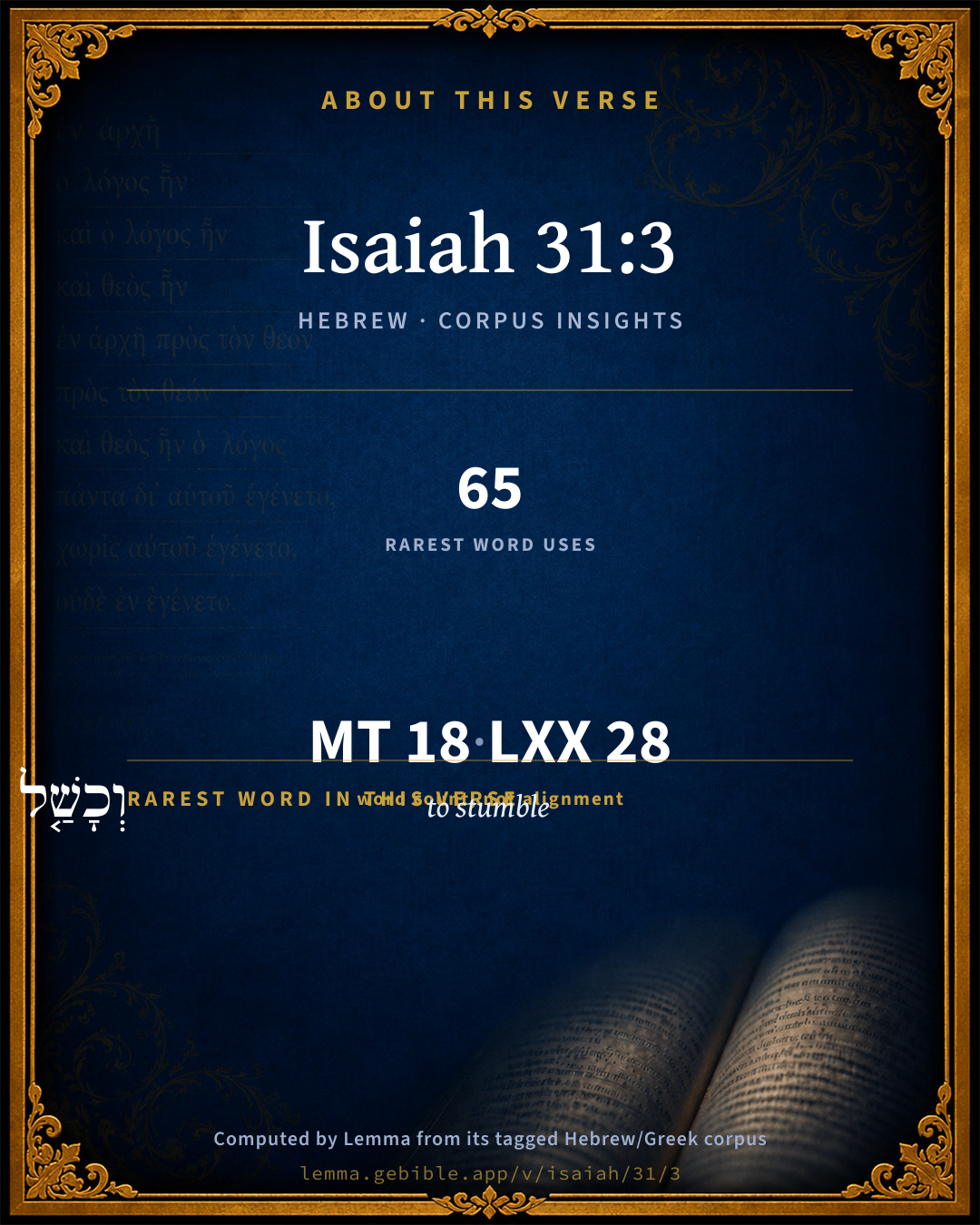
וְכָשַׁ֤ל
kâshal
H3782
“and · to stumble”
Conjunction + Verb, Qal, Sequential Perfect, 3rd Person, Masculine, Singular
Part of Speech
Conjunction + Verb
Stem
Qal
Form
Sequential Perfect
Person
3rd Person
Gender
Masculine
Number
Singular
Full BDB Definition

Origin: a primitive root

TWOT: 1050

to stumble, stagger, totter - (Qal) - to stumble - to totter - (Niphal) - to stumble - to be tottering, be feeble - (Hiphil) - to cause to stumble, bring injury or ruin to, overthrow - to make feeble, make weak - (Hophal) to be made to stumble - (Piel) bereave
  1. וּמִצְרַ֤יִם Mitsrayim H4714 “and · Egypt” Conjunction + Noun, Proper
  2. אָדָם֙ ʼâdâm H120 “man” Noun, Common, Masculine, Singular, Absolute
  3. וְֽלֹא lôʼ H3808 “and · not” Conjunction + Particle, Negative
  4. אֵ֔ל ʼêl H410 “God” Noun, Common, Masculine, Singular, Absolute
  5. וְסוּסֵיהֶ֥ם çûwç H5483 “and · horses · their” Conjunction + Noun, Common, Masculine, Plural, Construct + Suffix, Personal, 3rd Person, Masculine, Plural
  6. בָּשָׂ֖ר bâsâr H1320 “flesh” Noun, Common, Masculine, Singular, Absolute
  7. וְלֹא lôʼ H3808 “and · not” Conjunction + Particle, Negative
  8. ר֑וּחַ rûwach H7307 “spirit” Noun, Common, Both, Singular, Absolute
  9. וַֽיהוָ֞ה Yᵉhôvâh H3068 “and · LORD” Conjunction + Noun, Proper
  10. יַטֶּ֣ה nâṭâh H5186 “to stretch out” Verb, Hiphil, Imperfect, 3rd Person, Masculine, Singular
  11. יָד֗וֹ yâd H3027 “hand · his” Noun, Common, Both, Singular, Construct + Suffix, Personal, 3rd Person, Masculine, Singular
  12. עוֹזֵר֙ ʻâzar H5826 “helping” Verb, Qal, Participle Active, Masculine, Singular, Absolute
  13. וְנָפַ֣ל nâphal H5307 “and · to fall” Conjunction + Verb, Qal, Sequential Perfect, 3rd Person, Masculine, Singular
  14. עָזֻ֔ר ʻâzar H5826 “helped” Verb, Qal, Participle Passive, Masculine, Singular, Absolute
  15. וְיַחְדָּ֖ו yachad H3162 “and · together” Conjunction + Adverb
  16. כֻּלָּ֥ם kôl H3605 “all · their” Noun, Common, Masculine, Singular, Construct + Suffix, Personal, 3rd Person, Masculine, Plural
  17. יִכְלָיֽוּן kâlâh H3615 “to finish” Verb, Qal, Imperfect, 3rd Person, Masculine, Plural + Suffix, n

About this verse

These counts appear in no published source. They are computed here, from the morphology-tagged text and Lemma’s own curated glosses. What Lemma adds →

18
words
16
distinct lemmas
Prophets
section

Grammatical profile

  • 6 verbs
  • 9 nouns
  • 1 adverb
  • 2 particles

Verb forms

  • יַטֶּ֣ה Hiphil · Imperfect
  • וְכָשַׁ֤ל Qal · Sequential Perfect
  • עוֹזֵר֙ Qal · Participle Active
  • וְנָפַ֣ל Qal · Sequential Perfect
  • עָזֻ֔ר Qal · Participle Passive
  • יִכְלָיֽוּן Qal · Imperfect

Repetition

Words recur within this verse — often emphatic in Hebrew:

  • עוֹזֵר֙ to help H5826 ×2
  • וְֽלֹא not H3808 ×2

Hebrew & Septuagint length

In English translation the verse runs 43 words from the Hebrew and 38 from the Septuagint (LXX English) — closely comparable.

A rough comparison of the two English renderings, which tokenize alike — not a word-level alignment.

Word counts can differ between the Hebrew and the Greek without any difference in meaning — e.g. the Hebrew direct-object marker אֵת has no separate Greek word, and Greek often adds the article ὁ.

In the original languages it is 18 Hebrew tokens and 28 Greek tokens — but the two are counted differently (Hebrew bundles its prefixes and suffixes into one token; the Greek is in lemma form), so that isn’t a like-for-like length.

Cross-references

15

Topical passages linked to Isaiah 31:3 in the Treasury of Scripture Knowledge — connected by theme and wording, ordered by reader-vote popularity; previews shown in the World English Bible.

  • Isaiah 9:17 Therefore the Lord will not rejoice over their young men, neither will he have compassion on their fatherless and widows; for everyone is profane and an evil-doer, and every mouth speaks folly. For all this his anger is not turned away, but his hand is stretched out still.
  • Ezekiel 20:33–34 As I live, says the Lord Yahweh, surely with a mighty hand, and with an outstretched arm, and with wrath poured out, will I be king over you:
  • Psalms 9:20 Put them in fear, Yahweh. Let the nations know that they are only men. Selah.
  • Psalms 33:17 A horse is a vain thing for safety, Neither does he deliver any by his great power.
  • Isaiah 30:7 For Egypt helps in vain, and to no purpose: therefore have I called her Rahab who sits still.
  • Jeremiah 15:6 You have rejected me, says Yahweh, you are gone backward: therefore have I stretched out my hand against you, and destroyed you; I am weary with repenting.
  • Ezekiel 28:9 Will you yet say before him who kills you, I am God? but you are man, and not God, in the hand of him who wounds you.
  • Deuteronomy 32:30–31 How should one chase a thousand, Two put ten thousand to flight, Except their Rock had sold them, Yahweh had delivered them up?
  • Psalms 146:3–5 Don't put your trust in princes, Each a son of man in whom there is no help.
  • Isaiah 30:5 They shall all be ashamed because of a people that can't profit them, that are not a help nor profit, but a shame, and also a reproach.
  • Isaiah 36:6 Behold, you trust on the staff of this bruised reed, even on Egypt, whereon if a man lean, it will go into his hand, and pierce it: so is Pharaoh king of Egypt to all who trust on him.
  • Isaiah 36:9 How then can you turn away the face of one captain of the least of my master's servants, and put your trust on Egypt for chariots and for horsemen?
  • Jeremiah 37:7–10 Thus says Yahweh, the God of Israel, Thus shall you tell the king of Judah, who sent you to me to inquire of me: Behold, Pharaoh's army, which is come forth to help you, shall return to Egypt into their own land.
  • Acts 12:22–23 The people shouted, "The voice of a god, and not of a man!"
  • 2 Thessalonians 2:4–8 he who opposes and exalts himself against all that is called God or that is worshiped; so that he sits as God in the temple of God, setting himself up as God.

Cross-references courtesy of OpenBible.info (CC BY 4.0).

Hebrew and Greek witnesses Masoretic Hebrew ↔ Greek Septuagint

The same verse in the two great witnesses to the Old Testament, shown verse-for-verse.

These are two independent witnesses, not word-aligned to each other, and the Septuagint is shown in lemma (dictionary) form.

Hebrew Isaiah 31:3 Masoretic · Westminster Leningrad Codex

וּמִצְרַ֤יִם אָדָם֙ וְֽלֹא אֵ֔ל וְסוּסֵיהֶ֥ם בָּשָׂ֖ר וְלֹא ר֑וּחַ וַֽיהוָ֞ה יַטֶּ֣ה יָד֗וֹ וְכָשַׁ֤ל עוֹזֵר֙ וְנָפַ֣ל עָזֻ֔ר וְיַחְדָּ֖ו כֻּלָּ֥ם יִכְלָיֽוּן

Now the Egyptians are men, and not God; and their horses flesh, and not spirit: and when Yahweh shall stretch out his hand, both he who helps shall stumble, and he who is helped shall fall, and they all shall be consumed together.

World English Bible · Public Domain

Greek LXX Isaiah 31:3 Septuagint · lemma form

αἰγύπτιος ἄνθρωπος καί οὐ θεός ἵππος σάρξ καί οὐ εἰμί βοήθεια ὁ δέ κύριος ἐπιἄγω ὁ χείρ αὐτός ἐπί αὐτός καί κοπιάω ὁ βοηθέω καί ἅμα πᾶς ἀποὀλλύω

even an Egyptian, a man, and not God; the flesh of horses, and there is no help in them: but the Lord shall bring his hand upon them, and the helpers shall fail, and all shall perish together.

LXX2012 (modern English Septuagint) · Public Domain

Hebrew: Westminster Leningrad Codex (CC BY 4.0). Greek: Septuagint (public domain); English from LXX2012 (modern English Septuagint) (Public Domain). How the Septuagint differs from the Hebrew →

Targum (Aramaic paraphrase)

1

The Targum is the ancient Jewish Aramaic paraphrase of the Hebrew Scriptures — an interpretive translation, not the Hebrew text itself. Onkelos (literal) and Pseudo-Jonathan (expansive) render the Torah, and Jonathan the Prophets. Coverage is partial: where no permissively-licensed English translation exists for a verse, only the Aramaic is shown. This is verse-level text, not a word-by-word alignment to the Hebrew.

  1. Targum Jonathan Prophets (Joshua–Malachi)
    וּמִצְרַיִם אֱנַשׁ וְלָא רָב וְסוּסְוָתְהוֹן בְּסַר וְלָא רוּחַ וַיָי יָרִים מְחַת גְבוּרְתֵּהּ וְיִתְקַל סָעִיד וְיִפּוֹל סָעִיד וְכַחֲדָא כּוּלְהוֹן יִשְׁתֵּיצוּן:

    And the Egyptians are men, and none of them a mighty one, and their horses are flesh, and not spirit: and the Lord shall deal the stroke of His power, and he that helpeth shall stumble, and he that is holpen shall fall, and all of them together shall be destroyed.

    Targum Jonathan — Aramaic: “Mikraot Gedolot” (public domain). English: “Sefaria Community Translation” (CC0 1.0 (public-domain dedication)); “London "Chaldee Paraphrase," 1871” (public domain). Text via Sefaria.

Commentary

Notes on Isaiah 31:3 from classic Christian and Jewish commentators (each source and its license shown beneath its notes). The classic Christian expositions comment on the surrounding passage and are grouped to its opening verse, so a note may address several verses; the Jewish commentaries on the Tanakh (Rashi and others) are per-verse, so they appear only where the commentator wrote on this verse.

Lemma curates 59 commentaries, every one of them public domain or Creative Commons licensed, each selected and text-cleaned for this edition rather than reprinted as found. About our sources →

Trapp's Complete Commentary

John Trapp

Isa 31:3 Now the Egyptians [are] men, and not God; and their horses flesh, and not spirit. When the LORD shall stretch out his hand, both he that helpeth shall fall, and he that is holpen shall fall down, and they all shall fail together.

Ver. 3. Now the Egyptains are men, and not God.] Poets fain that in the Trojan war one god fought against another.

“ Mulciber in Troiam, pro Troia stabat Apollo. ”

But the Jews could not imagine that these Egyptians, in whom they confided, were fit matches for God, and able to deal with him. "Who would set those briers and thorns against me in battle I would go through them, I would burn them together." {Isa 27:4}

And their horses flesh, and not spirit.] God is Lord of hosts; and as the Rabbis well observe, he hath his cavalry and his infantry, or his horse and his foot; his upper forces and his lower, ready pressed. "The chariots of God are twenty thousand, even thousands of angels," {Psa 68:17} and what can the Egyptian horse do against such worthy warriors?

John Trapp, A Commentary or Exposition upon All the Books of the Old and New Testament (1647–1656) — public domain. Text from a community e-Sword module.

The Biblical Illustrator

Joseph S. Exell

Isa_31:3

Men, and not God . . . flesh, and not spirit

Spiritual existences the chief forces of the world

It is here evidently implied that a spirit is mightier than a horse.

The ancients attached the idea of immense force to a well-trained war-horse.

I. SPIRIT IS THE ORIGINAL POWER We see power everywhere around us. We see it in the inanimate world, as the effect which one element produces upon another, and in the motion which one body, in a certain relation, produces upon another. We see it, also, in the world of life: in the plant that turns to its use, and transmutes into its own essence, the elements that play about it; in the beast that drags along the farmers harvest-wain, and in the bird that rises on the wing, and chants its victories over that force that binds the earth and links it to the sun. All these powers are manifestly effects, not ultimate causes--are derived, not primal. All true science suggests this, and the Bible declares it. Spirit is the fontal force. It was spirit that gave to the elements the proclivity to act and re-act on each other; and that so poised the masses of the universe that one should gently press its fellow into lines and ratios of motion, and thus conduce to the harmony and well-being of all. And the forces of life too, whether in the fibres of plants or the muscles of flesh, are but the breathings of that Spirit which reneweth the face of the earth. He stretcheth out the north over the empty place, and hangeth the earth upon nothing. By His Spirit He hath garnished the heavens; His hand hath formed the crooked serpent.

II. SPIRIT IS THE SUBORDINATING POWER. The horses of the Egyptians were flesh and not spirit. Implying, probably, the fact, that the Egyptian cavalry lacked that intelligence and skill necessary to render the noble animal of service in the field of battle. The value of the steed in the strife is ever in proportion to the skill of the rider. Wisdom is better than weapons of war. Reason is mightier than brute force. What force is there on earth that man cannot subordinate to his will? Man can press every element into his service as well as every living creature. Let us rise to a sense of the greatness of the nature with which God has endowed us. We are spirit; emanations of the Infinite Mind, and members of that spiritual system for which matter, in all its functions and forms, was made. Let us assert our supremacy over the material--use the world as not abusing it. In one sense we can never think too highly of ourselves. what shall it profit a man? &c. (D. Thomas, D. D.)

Spirituality of the Divine nature

In these words we are reminded of an important and infinite disparity between God and man, arising from a great peculiarity in the character of the former, which rendered the Egyptian monarch and his cavalry infinitely inferior to Him in power, and Gall those other qualities which entitle the possessor of them to confidence and trust.

I. The spirituality of the Divine nature is intimately connected with THE POSSESSION OF ALMIGHTY POWER. The vulgar notion which would restrict the exercise of power to what is corporeal, and deny it to that which is spiritual and immaterial, is a mere prejudice, founded on gross inattention or ignorance. If we inquire after the original seat of power, we shall invariably find it in mind, not in body; in spirit, not in flesh. The changes we are able to effect in the state of the objects around us are produced through the instrumentality of the body, which is always previously put in motion by the mind. As we can move certain parts of our bodies at pleasure, and nothing intervenes betwixt the volition and the corresponding movements, so the great original Spirit impresses on the machine of the universe what movements He pleases, and without the intervention of any other cause. He speaks, and it is done; He commands, and it stands fast.

II. His spirituality is closely connected with His INVISIBILITY. The King eternal, immortal, invisible, whom no man hath seen, nor can see.

Whatever is the object of sight must be perceived under some determinate shape or figure; it must be, consequently, bounded by an outline, and occupy a determinate portion of space, and no more; attributes utterly incompatible with the conceptions of an infinite being. He was pleased formerly, indeed, to signalise His presence with His worshippers by visible symbols, by an admixture of clouds and fire, of darkness and splendour; but that these were never intended to exhibit His power, but merely to afford a sensible attestation of His special presence, is evident, from the care He took to prevent His worshippers from entertaining degrading conceptions of His character, by the solemn prohibition of attempting to represent Him by an image or picture.

III. That God is spirit, and not flesh, is a view of His character closely connected with His OMNIPRESENCE. Matter is subjected to a local circumscription; God, as a Spirit, is capable of co-existing with every other order of being.

IV. Because God is spirit and not flesh, He is possessed of INFINITE WISDOM AND INTELLIGENCE. Thought and perception are the attributes of mind, not of matter; of spirit, not of flesh; and, for this reason, the original and great Spirit possesses them in an infinite degree.

V. The spirituality of the Divine nature lays A FOUNDATION FOR THE MOST INTIMATE RELATION BETWEEN THE INTELLIGENT PART OF THE CREATION AND HIMSELF. He is emphatically the Father of spirits.

VI. The spirituality of the Divine nature FITS HIM FOR BECOMING OUR ETERNAL PORTION AND SUPREME GOOD. (Robert Hall, M. A.)

The Biblical Illustrator, edited by Joseph S. Exell (c. 1880s–1900s) — public domain. Text from a community e-Sword module.

Geneva Bible (1599)

Geneva Bible translators

Meaning, both the Egyptians and the Israelites.

Geneva Bible (1599) marginal notes — public domain. Text via Bolls.life.

Jamieson, Fausset & Brown

Robert Jamieson, A. R. Fausset & David Brown

not spirit--not of divine power (Psa 56:4; Psa 146:3, Psa 146:5; Zac 4:6).

he that helpeth--Egypt.

holpen--Judah.

Jamieson, Fausset & Brown — Commentary Critical and Explanatory on the Whole Bible (1871) — public domain (CC PDM 1.0). Text via the HelloAO Bible API.

Adam Clarke's Commentary

Verse 3. He that helpeth (the Egyptians) shall fall and he that is holpen (the Israelites) shall fall down - together.

Adam Clarke's Commentary on the Bible (1810–1826) — public domain. Text from a community e-Sword/MySword module.

Ellicott's Commentary for English Readers

(3) The Egyptians are men . . .—We hear again the key-note of Isaiah’s teaching. The true strength of a nation lay in its spiritual, not in its material, greatness: in seeking the Holy One of Israel by practising holiness. Without that condition the alliance with Egypt would be fatal both to those that sought for help and those who gave it.

A Bible Commentary for English Readers, edited by Charles John Ellicott (1878–1897) — public domain. Text from a community e-Sword module.

The Cambridge Bible for Schools and Colleges

gen. ed. J. J. S. Perowne

3. men, and not God … flesh, and not spirit] In these antitheses Isaiah formulates his religious conception of history. The present crisis has not been brought about by the mere collision of earthly forces (Egypt, Assyria, Judah); faith discerns in it the operation of a spiritual principle, and knows that that principle must be victorious. “Spirit” is the energetic indestructible element in the universe, by which all life is sustained; and that which is distinctive of the teaching of Isaiah and the prophets generally is (1) the identification of this principle with the moral purpose of Jehovah, and (2) the assertion of the supremacy of the spiritual, thus ethically conceived, over the material. That men could not stand against God, or flesh against spirit, Isaiah’s contemporaries did not need to be taught; what separated him from his hearers was the conviction that there is but one Divine Person, and one spiritual power in the universe, viz.: Jehovah and His moral government as revealed in the consciousness of the prophet. Hence he continues:—And Jehovah shall stretch out his hand, and the helper (Egypt) shall stumble and the holpen (Judah) shall fall; and together they shall all of them perish.

The Cambridge Bible for Schools and Colleges (gen. ed. J. J. S. Perowne; Cambridge University Press, 1878–1918) — public domain. Text from a community e-Sword module.

John Gill's Exposition

Now the Egyptians are men, and not God,.... Be it that they are mighty, they are not mighty, as God is; and indeed they are but frail, feeble, mortal, and mutable men, and therefore not to be trusted in, and depended on; or to be put upon an equality with God, and even to be preferred to him, as they were by the Jews; and of what use and service could they be unto them, seeing God was against them?

and their horses flesh, and not spirit; only flesh, without an immortal soul or spirit, which man has; and therefore a foolish thing in man to trust in them, who must be entirely guided and directed by them; and much less angelic spirits, or like them, which are incorporeal, invisible, and exceedingly mighty and powerful, which excel all creatures in strength, and are called the mighty angels; these are God's cavalry, his horses and chariots; see Psa 68:17, Hab 3:8 and what mighty things have been done by them, even by a single one? Witness the destruction of the Assyrian army, in one night, by one of them; wherefore the Egyptian cavalry was not to be named with them (q):

When the Lord shall stretch out his hand; as soon as he does it, before he strikes, and when he does this in order to it:

both he that helpeth shall fall; or "stumble", take a false step; meaning the Egyptians, sent for and come forth to help the Jews; but, stumbling and falling themselves, would be but poor assistants to them. Aben Ezra interprets this of the king of Assyria destroying the Egyptians, when he came to Jerusalem:

and he that is holpen shall fall down; the Jews, helped by the Egyptians, who should fall, and be destroyed, though not now; yet hereafter by the Chaldeans, as they were:

and they all shall fail together; both the Egyptians and the Jews.

(q) So Ben Melech interprets "spirit" of an angel, as he does the word "God" in the preceding clause.

John Gill's Exposition of the Whole Bible (1746–1763) — public domain (CC PDM 1.0). Text via the HelloAO Bible API.

Albert Barnes' Notes on the Bible

Now the Egyptians are men - They are nothing but people; they have no power but such as other people possess. The idea here is, that the case in reference to which they sought aid was one in which “divine” help was indispensable, and that, therefore, they relied on the aid of the Egyptians in vain.

And their horses flesh, and not spirit - There is need, not merely of “physical” strength, but of wisdom, and intelligence, and it is in vain to look for that in mere brutes.

Both he that helpeth - Egypt, whose aid is sought.

And he that is holpen - Judah, that had sought the aid of Egypt. Neither of them would be able to stand against the wrath of God.

Albert Barnes' Notes on the Bible (1834–1885) — public domain. Text from a community e-Sword/MySword module.

Haydock's Catholic Bible Commentary

Hand. If God neglect to support empires, they fall of themselves.

George Leo Haydock (1774–1849), Haydock's Catholic Family Bible and Commentary, 1859 edition — public domain. Excludes Psalms (Douay-Rheims chapter numbering differs from Protestant) and Deuterocanonical books (Catholic canon only).

Matthew Poole's English Annotations

Are men, and not God; and therefore utterly unable to defend you, either without or against my will.

Their horses flesh; weak and frail, as that word signifies, Psa 78:39; Heb 5:7, and elsewhere.

Not spirit; not like spiritual substances, such as the angels, who are immortal, and invisible by men; whereof we have instances, Exo 12:29,30; Isa 37:36.

Matthew Poole's English Annotations on the Holy Bible (1683–1685) — public domain. Text from a community e-Sword/MySword module.

John Wesley's Explanatory Notes

Flesh - Weak and frail.

John Wesley, Explanatory Notes Upon the Whole Bible (1754–1765) — public domain. Text via the GEBible commentary corpus.

J. A. Alexander on Isaiah

Joseph Addison Alexander

“And Egypt (is) man and not God, and their horses flesh and not spirit, and Jehovah shall stretch out His hand, and the helper shall stumble and the helped fall, and together all of them shall cease (or be destroyed).” This verse repeats the contrast between human and divine aid, and the threatening that the unbelievers and their foreign helpers should be involved in the same destruction. The antithesis of flesh and spirit, like that of God and man, is not metaphysical but rhetorical, and is intended simply to express extreme dissimilitude or inequality. Reliance upon Egypt is again sarcastically represented as reliance upon horses, and as such opposed to confidence in God. As Egypt here means the Egyptians, it is afterwards referred to as a plural. Stumble and fall are here poetical equivalents.

Joseph Addison Alexander, The Prophecies of Isaiah (1846–1847; New York: Scribner, 1870–1878) — public domain. Text from a community e-Sword module.

unfoldingWord translationNotes

Door43 World Missions Community

Egypt is a man

Here Egypt refers to the soldiers of Egypt. AT: "The soldiers of Egypt are men" (See: Metonymy)

their horses flesh and not spirit

This means that their horses are only horses and not spiritual beings. AT: "their horses are only horses; they are not powerful spirits" (See: Assumed Knowledge and Implicit Information)

When Yahweh reaches out with his hand

The term "hand" is often used in reference to God's power and action. AT: "When Yahweh uses his power against them" (See: Metonymy)

both the one who helps will stumble, and the one who is helped will fall

These two phrases mean basically the same thing. Stumbling and falling are metaphors of failing. This can be stated in active form. AT: "these two things will happen: I will destroy Egypt, who helps you, and I will destroy you, whom Egypt helps" (See: Active or Passive and Metaphor and Parallelism)

the one who is helped

This can be stated in active form. AT: "the one who is seeking help" (See: Active or Passive)

translationWords

Egypt

God

horse

flesh

spirit

Yahweh

hand

stumble

perish

unfoldingWord translationNotes — © Distant Shores Media and the Door43 World Missions Community, licensed CC BY-SA 4.0. Source: git.door43.org/Door43/en_tn.

Rashi

Rabbi Shlomo Yitzchaki (Rashi)

shall turn His hand For the Holy One, blessed be He, supports everything with His hand, and when He turns it, they will fall, like one who holds something in his hand, and when he inclines his hand, it falls. So is the Midrash Aggadah (Mechilta, Exodus 15:12). Jonathan, however, renders: shall raise the blow of His might.

Rashi on the Tanakh — English translations: “The Judaica Press complete Tanach with Rashi, translated by A. J. Rosenberg” (CC BY 4.0); “Pentateuch with Rashi's commentary by M. Rosenbaum and A.M. Silbermann, 1929-1934” (public domain); “The Metsudah Tanach series, Lakewood, N.J” (CC BY 4.0); and “The Book of Joshua, Metsudah Publications, 1997” (CC BY 4.0). Text via Sefaria.

Ibn Ezra

Rabbi Abraham ibn Ezra

And not a spirit, that is, not an angel. Comp. ורוחו and His spirit═and His angel (48:16).

His hand. The striking with His hand.

And they all together, Egypt and those that fled thither. The King of Assyria attacked Egypt at the same time that Jerusalem was threatened by him.

יכליון They shall fail. It is the full form, without dropping the third radical, like יחסיון they trust (Ps. 36:8)

Ibn Ezra on the Tanakh — English translations: “Sefaria Community Translation” (CC0 1.0 (public-domain dedication)); “Yalkut, Sifsei Chachomim Chumash, Metsudah Publications, 2009” (CC BY 4.0); and “Commentary of Ibn Ezra on Isaiah - trans. by M. Friedlander, 1873” (public domain). Text via Sefaria.

Lesson kit

Teaching starters — assembled from the data on this page, not authored interpretation. Every prompt links to the verse data it draws on. Edit before teaching.

Isaiah, in the Prophets, opens this verse with 18 words (16 distinct Hebrew lemmas). Its most distinctive word is kâshal (“to stumble”). A historical commentator’s framing appears above. Read the whole chapter for the surrounding context.

Discussion questions

  1. How does “to stumble” (kâshal) shape what this verse is saying?
  2. Isaiah 9:17 shares this passage’s theme. How do the two illuminate each other?
  3. “to help” occurs 2× in this one verse. What is the effect of the repetition?
  4. The translations on this page render this verse differently — a whole-verse word diff, not a word-by-word alignment. What might account for the different wordings?
  5. The verb «יַטֶּ֣ה» is Hiphil Imperfect. How does its form color the action?
  6. Reading how Trapp's Complete Commentary and The Biblical Illustrator read this verse, where do the two commentators agree and where do they part?

Things to notice

Reading settings

Reading text

Shown beneath each verse's original-language words.

Old Testament
Old Testament edition

Read the OT as the Masoretic Hebrew (MT) or the Greek Septuagint (LXX).

English shown for the Greek Septuagint (in the Hebrew ↔ Greek comparison).

Comparing translations? Open the Compare panel on any verse page to stack up to four side by side.