
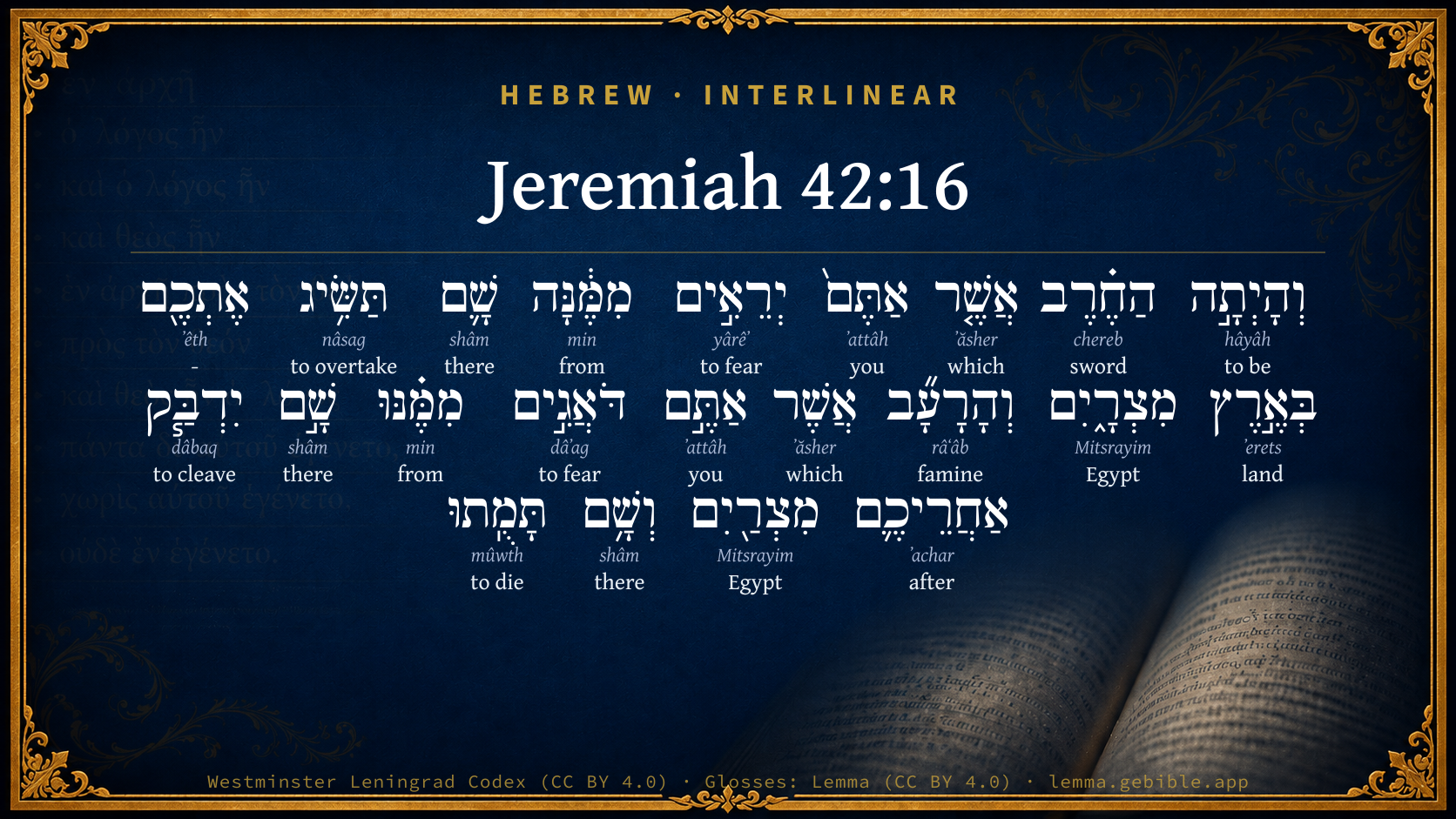
Jeremiah 42:16

Hebrew (Westminster Leningrad Codex) Jeremiah 42:16 appears in the Hebrew Old Testament. The text above is from the Westminster Leningrad Codex. Each word links to its Strong’s number, a concise gloss, and parsing drawn from the Open Scriptures Hebrew Bible morphology. Click any word for its full Brown-Driver-Briggs (BDB) entry.
Download image
Cite this verse

Jeremiah 42:16 (World English Bible). Public Domain. Lemma interlinear Bible study tool, https://lemma.gebible.app/v/jeremiah/42/16.

Show BibTeX & RIS
BibTeX
RIS
English Translation
then it shall happen, that the sword, which you fear, shall overtake you there in the land of Egypt; and the famine, about which you are afraid, shall follow hard after you there in Egypt; and there you shall die.
World English Bible · Public Domain
Download a study sheet

One document with this verse’s original text, its word-by-word gloss line, the meaning frame, cross-references with their text, attributed commentary, and full source and license credits — printable, and it pastes into notes with its structure intact.

This verse Autodidact and up

Study sheet (.html) Plain text (.txt)

A passage Seminary Student

Up to 50 verses in one chapter. A passage sheet keeps up to 6 commentary sources and 12 cross-references per verse, in the order this page ranks them, and says so on the sheet whenever that leaves anything out. Ask for a single verse and you get the Autodidact verse sheet above.

Everything on this page stays free to read, with no account — the sheet is a download of what is already on screen, not access to it.

Want to remove ads? Support Godless Engineer
Compare translations 3

The same verse in 3 English versions, stacked beneath the original-language interlinear above. Click any original word for its lexicon entry.

Each is an independent rendering of the whole verse — the interlinear is not word-aligned to these translations.

Highlighted words mark where these versions differ — a whole-verse word diff, not a word-by-word alignment.

  • World English Bible Public Domain
    then it shall happen, that the sword, which you fear, shall overtake you there in the land of Egypt; and the famine, about which you are afraid, shall follow hard after you there in Egypt; and there you shall die.
  • King James Version Public Domain
    Then it shall come to pass, that the sword, which ye feared, shall overtake you there in the land of Egypt, and the famine, whereof ye were afraid, shall follow close after you there in Egypt; and there ye shall die.
  • unfoldingWord Literal Text CC BY-SA 4.0
    then the sword that you fear will overtake you there in the land of Egypt. The famine that you are worrying about will pursue you to Egypt, and you will die there.

unfoldingWord Literal Text — © unfoldingWord, licensed CC BY-SA 4.0. Word-aligned USFM3 via Door43 (git.door43.org/unfoldingWord/en_ult).

Versions to compare (up to 4)

3 of 4 selected

Show all 18 translations

Every available English version of this verse, each an independent rendering of the whole verse.

  • World English Bible Public Domain
    then it shall happen, that the sword, which you fear, shall overtake you there in the land of Egypt; and the famine, about which you are afraid, shall follow hard after you there in Egypt; and there you shall die.
  • Berean Standard Bible Public Domain
    then the sword you fear will overtake you there, and the famine you dread will follow on your heels into Egypt, and you will die there.
  • Majority Standard Bible Public Domain
    then the sword you fear will overtake you there, and the famine you dread will follow on your heels into Egypt, and you will die there.
  • King James Version Public Domain
    Then it shall come to pass, that the sword, which ye feared, shall overtake you there in the land of Egypt, and the famine, whereof ye were afraid, shall follow close after you there in Egypt; and there ye shall die.
  • American Standard Version (1901) Public Domain
    then it shall come to pass, that the sword, which ye fear, shall overtake you there in the land of Egypt; and the famine, whereof ye are afraid, shall follow hard after you there in Egypt; and there ye shall die.
  • Revised Version (1885) Public Domain
    then it shall come to pass, that the sword, which ye feel shall overtake you there in the land of Egypt, and the famine, whereof ye are afraid, shall follow hard after you there in Egypt; and there ye shall die.
  • Geneva Bible (1599) Public Domain
    Then the sworde that ye feared, shall take you there in the land of Egypt, and the famine, for the which ye care, shall there hang vpon you in Egypt, and there shall ye die.
  • Douay-Rheims (1899) Public Domain
    The sword which you fear, shall overtake you there in the land of Egypt: and the famine, whereof you are afraid, shall cleave to you in Egypt, and there you shall die.
  • Young's Literal Translation Public Domain
    then it hath come to pass, the sword that ye are afraid of, doth there overtake you, in the land of Egypt; and the hunger, because of which ye are sorrowful, doth there cleave after you in Egypt, and there ye die.
  • Literal Standard Version CC BY-SA 4.0
    then it has come to pass, the sword that you are afraid of, overtakes you there, in the land of Egypt; and the hunger, because of which you are sorrowful, cleaves after you there in Egypt, and there you die.
  • Unlocked Literal Bible CC BY-SA 4.0
    then the sword that you fear will overtake you there in the land of Egypt. The famine that you are worrying about will pursue you to Egypt, and you will die there.
  • unfoldingWord Literal Text CC BY-SA 4.0
    then the sword that you fear will overtake you there in the land of Egypt. The famine that you are worrying about will pursue you to Egypt, and you will die there.
  • Darby Bible Public Domain
    then it shall come to pass, that the sword which ye fear shall overtake you there in the land of Egypt, and the famine, whereof ye are afraid, shall follow hard after you there in Egypt; and there ye shall die.
  • World Messianic Bible Public Domain
    then it will happen that the sword, which you fear, will overtake you there in the land of Egypt; and the famine, about which you are afraid, will follow close behind you there in Egypt; and you will die there.
  • Webster's Bible Public Domain
    Then it shall come to pass, that the sword, which ye feared, shall overtake you there in the land of Egypt, and the famine of which ye were afraid, shall follow close after you there in Egypt; and there ye shall die.
  • Free Bible Version CC BY-SA 4.0
    then the war you're so frightened of will catch up with you there, and the famine you're so terrified of will chase after you into Egypt, and you will die there.
  • Bible in Basic English Public Domain
    Then it will come about that the sword, which is the cause of your fear, will overtake you there in the land of Egypt, and need of food, which you are fearing, will go after you there in Egypt; and there death will come to you.
  • JPS Tanakh (1917) Public Domain
    then it shall come to pass, that the sword, which ye fear, shall overtake you there in the land of Egypt, and the famine, whereof ye are afraid, shall follow hard after you there in Egypt; and there ye shall die.

Literal Standard Version (2020), Covenant Press — licensed CC BY-SA 4.0. Text via the HelloAO Bible API (eBible.org). Unlocked Literal Bible (unfoldingWord) — licensed CC BY-SA 4.0. Text via the HelloAO Bible API (eBible.org). unfoldingWord Literal Text — © unfoldingWord, licensed CC BY-SA 4.0. Word-aligned USFM3 via Door43 (git.door43.org/unfoldingWord/en_ult). Free Bible Version, Dr. Jonathan Gallagher — licensed CC BY-SA 4.0. Text via the HelloAO Bible API (eBible.org).

Word by word

More ways to search: Search by grammar → Find every occurrence → Compare this word →

Practice this passage: Drill this verse → Learn its vocabulary →

דֹּאֲגִ֣ים
dâʼag
H1672
“fearing”
Verb, Qal, Participle Active, Masculine, Plural, Absolute
Part of Speech
Verb
Stem
Qal
Form
Participle Active
Gender
Masculine
Number
Plural
State
Absolute
Full BDB Definition

Origin: a primitive root

TWOT: 393

to fear, be anxious, be concerned, be afraid, be careful - (Qal) - to be anxious, be concerned - to fear, dread
  1. וְהָיְתָ֣ה hâyâh H1961 “and · to be” Conjunction + Verb, Qal, Sequential Perfect, 3rd Person, Feminine, Singular
  2. הַחֶ֗רֶב chereb H2719 “the · sword” Particle, Definite Article + Noun, Common, Feminine, Singular, Absolute
  3. אֲשֶׁ֤ר ʼăsher H834 “which” Particle, Relative
  4. אַתֶּם֙ ʼattâh H859 “you” Pronoun, Personal, 2nd Person, Masculine, Plural
  5. יְרֵאִ֣ים yârêʼ H3372 “fearing” Adjective, Adjective, Masculine, Plural, Absolute
  6. מִמֶּ֔נָּה min H4480 “from · her” Preposition + Suffix, Personal, 3rd Person, Feminine, Singular
  7. שָׁ֛ם shâm H8033 “there” Adverb
  8. תַּשִּׂ֥יג nâsag H5381 “to overtake” Verb, Hiphil, Imperfect, 3rd Person, Feminine, Singular
  9. אֶתְכֶ֖ם ʼêth H853 “- · you” Particle, Direct Object + Suffix, Personal, 2nd Person, Masculine, Plural
  10. בְּאֶ֣רֶץ ʼerets H776 “in/at · land of” Preposition + Noun, Common, Both, Singular, Construct
  11. מִצְרָ֑יִם Mitsrayim H4714 “Egypt” Noun, Proper
  12. וְהָרָעָ֞ב râʻâb H7458 “and · the · famine” Conjunction + Particle, Definite Article + Noun, Common, Masculine, Singular, Absolute
  13. אֲשֶׁר ʼăsher H834 “which” Particle, Relative
  14. אַתֶּ֣ם ʼattâh H859 “you” Pronoun, Personal, 2nd Person, Masculine, Plural
  15. מִמֶּ֗נּוּ min H4480 “from · us” Preposition + Suffix, Personal, 1st Person, Common, Plural
  16. שָׁ֣ם shâm H8033 “there” Adverb
  17. יִדְבַּ֧ק dâbaq H1692 “to cleave” Verb, Qal, Imperfect, 3rd Person, Masculine, Singular
  18. אַחֲרֵיכֶ֛ם ʼachar H310 “after · you” Preposition + Suffix, Personal, 2nd Person, Masculine, Plural
  19. מִצְרַ֖יִם Mitsrayim H4714 “Egypt” Noun, Proper
  20. וְשָׁ֥ם shâm H8033 “and · there” Conjunction + Adverb
  21. תָּמֻֽתוּ mûwth H4191 “to die” Verb, Qal, Imperfect, 2nd Person, Masculine, Plural

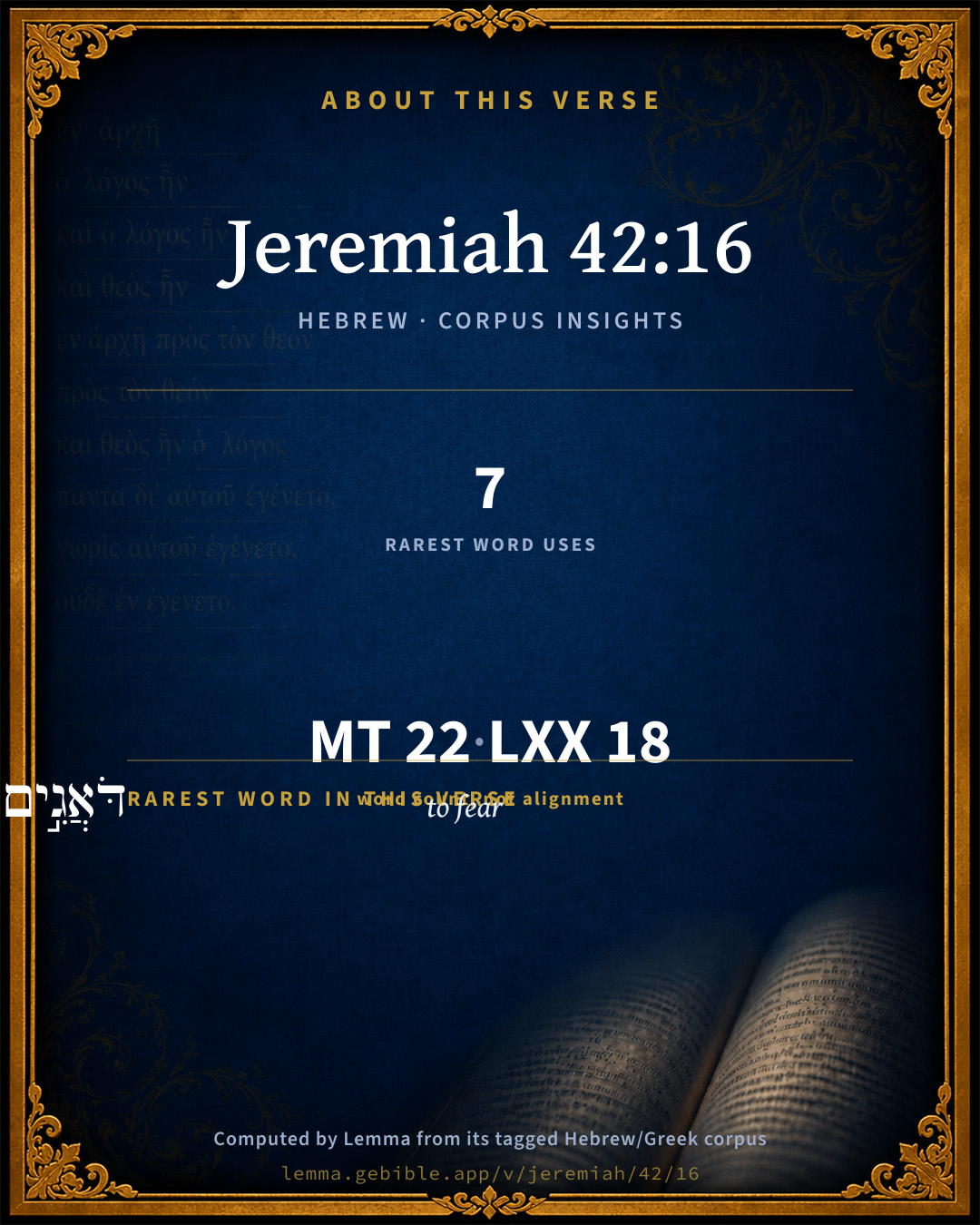
About this verse

These counts appear in no published source. They are computed here, from the morphology-tagged text and Lemma’s own curated glosses. What Lemma adds →

22
words
16
distinct lemmas
Prophets
section

Notable vocabulary

The rarest word here is דֹּאֲגִ֣ים to fear H1672 — appearing just 7 times in the whole Hebrew Bible.

Shared distinctive vocabulary

דֹּאֲגִ֣ים to fear H1672 occurs in 7 verses of the Hebrew Bible. Also found in:

Grammatical profile

  • 5 verbs
  • 5 nouns
  • 1 adjective
  • 2 pronouns
  • 3 prepositions
  • 3 adverbs
  • 3 particles

Verb forms

  • וְהָיְתָ֣ה Qal · Sequential Perfect
  • תַּשִּׂ֥יג Hiphil · Imperfect
  • דֹּאֲגִ֣ים Qal · Participle Active
  • יִדְבַּ֧ק Qal · Imperfect
  • תָּמֻֽתוּ Qal · Imperfect

Repetition

Words recur within this verse — often emphatic in Hebrew:

  • שָׁ֛ם there H8033 ×3
  • מִצְרָ֑יִם Egypt H4714 ×2
  • אֲשֶׁ֤ר which H834 ×2
  • אַתֶּם֙ you H859 ×2
  • מִמֶּ֔נָּה from H4480 ×2

Hebrew & Septuagint length

In the original languages it is 22 Hebrew tokens and 18 Greek tokens — but the two are counted differently (Hebrew bundles its prefixes and suffixes into one token; the Greek is in lemma form), so that isn’t a like-for-like length.

Cross-references

11

Topical passages linked to Jeremiah 42:16 in the Treasury of Scripture Knowledge — connected by theme and wording, ordered by reader-vote popularity; previews shown in the World English Bible.

  • Jeremiah 44:27 Behold, I watch over them for evil, and not for good; and all the men of Judah who are in the land of Egypt shall be consumed by the sword and by the famine, until there be an end of them.
  • Ezekiel 11:8 You have feared the sword; and I will bring the sword on you, says the Lord Yahweh.
  • Amos 9:1–4 I saw the Lord standing beside the altar, and he said, "Strike the tops of the pillars, that the thresholds may shake; and break them in pieces on the head of all of them; and I will kill the last of them with the sword: there shall not one of them flee away, and there shall not one of them escape.
  • John 11:48 If we leave him alone like this, everyone will believe in him, and the Romans will come and take away both our place and our nation."
  • Deuteronomy 28:15 But it shall come to pass, if you will not listen to the voice of Yahweh your God, to observe to do all his commandments and his statutes which I command you this day, that all these curses shall come on you, and overtake you.
  • Deuteronomy 28:22 Yahweh will strike you with consumption, and with fever, and with inflammation, and with fiery heat, and with the sword, and with blasting, and with mildew; and they shall pursue you until you perish.
  • Deuteronomy 28:45 All these curses shall come on you, and shall pursue you, and overtake you, until you are destroyed; because you didn't listen to the voice of Yahweh your God, to keep his commandments and his statutes which he commanded you:
  • Proverbs 13:21 Misfortune pursues sinners, But prosperity rewards the righteous.
  • Jeremiah 42:13 But if you say, We will not dwell in this land; so that you don't obey the voice of Yahweh your God,
  • Jeremiah 44:11–13 Therefore thus says Yahweh of Hosts, the God of Israel: Behold, I will set my face against you for evil, even to cut off all Judah.
  • Zechariah 1:6 But my words and my decrees, which I commanded my servants the prophets, didn't they overtake your fathers? "Then they repented and said, 'Just as Yahweh of Hosts determined to do to us, according to our ways, and according to our practices, so he has dealt with us.'"

Cross-references courtesy of OpenBible.info (CC BY 4.0).

Hebrew and Greek witnesses Masoretic Hebrew ↔ Greek Septuagint

The same verse in the two great witnesses to the Old Testament, shown verse-for-verse.

These are two independent witnesses, not word-aligned to each other, and the Septuagint is shown in lemma (dictionary) form.

Hebrew Jeremiah 42:16 Masoretic · Westminster Leningrad Codex

וְהָיְתָ֣ה הַחֶ֗רֶב אֲשֶׁ֤ר אַתֶּם֙ יְרֵאִ֣ים מִמֶּ֔נָּה שָׁ֛ם תַּשִּׂ֥יג אֶתְכֶ֖ם בְּאֶ֣רֶץ מִצְרָ֑יִם וְהָרָעָ֞ב אֲשֶׁר אַתֶּ֣ם דֹּאֲגִ֣ים מִמֶּ֗נּוּ שָׁ֣ם יִדְבַּ֧ק אַחֲרֵיכֶ֛ם מִצְרַ֖יִם וְשָׁ֥ם תָּמֻֽתוּ

then it shall happen, that the sword, which you fear, shall overtake you there in the land of Egypt; and the famine, about which you are afraid, shall follow hard after you there in Egypt; and there you shall die.

World English Bible · Public Domain

Greek LXX Structure differs

In the Septuagint, Jeremiah is about an eighth shorter than the Hebrew and arranges its material differently — the Oracles Against the Nations (Hebrew chapters 46–51) appear in the middle of the Greek book, after 25:13. Because the chapter and verse boundaries do not line up, a verse-for-verse comparison with the Hebrew is not shown.

A verse-for-verse comparison isn’t shown here because the chapters and verses don’t line up. Switch to the LXX edition with the MT / LXX toggle above to read the Greek directly.

Hebrew: Westminster Leningrad Codex (CC BY 4.0). Greek: Septuagint (public domain); English from a public-domain English Septuagint. How the Septuagint differs from the Hebrew →

Targum (Aramaic paraphrase)

1

The Targum is the ancient Jewish Aramaic paraphrase of the Hebrew Scriptures — an interpretive translation, not the Hebrew text itself. Onkelos (literal) and Pseudo-Jonathan (expansive) render the Torah, and Jonathan the Prophets. Coverage is partial: where no permissively-licensed English translation exists for a verse, only the Aramaic is shown. This is verse-level text, not a word-by-word alignment to the Hebrew.

  1. Targum Jonathan Prophets (Joshua–Malachi)
    וּתְהֵי חַרְבָּא דִי אַתּוּן דַחֲלִין מִנֵיהּ תַּמָן תַּדְבֵּיק יַתְכוֹן בְּאַרְעָא דְמִצְרַיִם וְכַפְנָא דִי אַתּוּן יָצְפִין מִנֵיהּ תַּמָן יַדְבֵּיק בַּתְרֵיכוֹן לְמִצְרַיִם וְתַמָן תְמוּתוּן:

    (no public-domain English translation for this verse)

    Targum Jonathan — Aramaic: “Mikraot Gedolot” (public domain). English: “Sefaria Community Translation” (CC0 1.0 (public-domain dedication)); “London "Chaldee Paraphrase," 1871” (public domain). Text via Sefaria.

Commentary

Notes on Jeremiah 42:16 from classic Christian and Jewish commentators (each source and its license shown beneath its notes). The classic Christian expositions comment on the surrounding passage and are grouped to its opening verse, so a note may address several verses; the Jewish commentaries on the Tanakh (Rashi and others) are per-verse, so they appear only where the commentator wrote on this verse.

Lemma curates 59 commentaries, every one of them public domain or Creative Commons licensed, each selected and text-cleaned for this edition rather than reprinted as found. About our sources →

Trapp's Complete Commentary

John Trapp

Jer 42:16 Then it shall come to pass, [that] the sword, which ye feared, shall overtake you there in the land of Egypt, and the famine, whereof ye were afraid, shall follow close after you there in Egypt; and there ye shall die.

Ver. 16. Then it shall come to pass, that the sword which ye feared shall overtake you there.] Categorice intonat propheta. God hath long hands; neither can wicked men anywhere live out of the reach of his rod.

And the famine whereof ye were afraid.] Egypt was very fertile, the granary of the world, and yet God could cause a famine there; he hath treasures of plagues for sinners, and can never be exhausted.

John Trapp, A Commentary or Exposition upon All the Books of the Old and New Testament (1647–1656) — public domain. Text from a community e-Sword module.

Geneva Bible (1599)

Geneva Bible translators

Thus God turneth the policy of the wicked to their own destruction: for they thought themselves sure in Egypt, and there Nebuchadnezzar destroyed them and the Egyptians, Jer. 46:25.

Geneva Bible (1599) marginal notes — public domain. Text via Bolls.life.

Jamieson, Fausset & Brown

Robert Jamieson, A. R. Fausset & David Brown

sword, which ye feared, shall overtake you--The very evils we think to escape by sin, we bring on ourselves thereby. What our hearts are most set on often proves fatal to us. Those who think to escape troubles by changing their place will find them wherever they go (Eze 11:8). The "sword" here is that of Nebuchadnezzar, who fulfilled the prediction in his expedition to Africa (according to MEGASTHENES, a heathen writer),300 B.C.

Jamieson, Fausset & Brown — Commentary Critical and Explanatory on the Whole Bible (1871) — public domain (CC PDM 1.0). Text via the HelloAO Bible API.

Adam Clarke's Commentary

Verse 16. The sword - and the famine - shall follow close after you] Shall be at your heels; shall overtake and destroy you; for there ye shall die.

Adam Clarke's Commentary on the Bible (1810–1826) — public domain. Text from a community e-Sword/MySword module.

John Gill's Exposition

So shall it be with all the men that set their faces to go into Egypt to sojourn there,.... Not all that went into Egypt, but all that were resolutely set upon it; that were obstinately bent to go there, and did go, contrary to the express command of God; for otherwise there were some that were forced to go against their wills, as Jeremiah, Baruch, and no doubt others:

they shall die by the sword, by the famine, and by the pestilence; three of the Lord's sore judgments; some should die by one, and some by another, and some by a third; all should die by one or the other:

and none of them shall remain or escape from the evil that I will bring upon them; that is, none of those who wilfully, and of their own accord, went down to Egypt; they all perished there, none could escape the hand of God, or the evil he determined to bring upon them; which is to be understood of the above judgments.

John Gill's Exposition of the Whole Bible (1746–1763) — public domain (CC PDM 1.0). Text via the HelloAO Bible API.

Albert Barnes' Notes on the Bible

Translate it: “Then shall the sword of which ye are afraid reach you there in the land of Egypt, and the famine whereof ye pine shall cleave close unto you in Egypt, and there shall ye die; and all the men who have set their faces to go into Egypt to sojourn there shall die ... by the pestilence, nor shall they have anyone that is left or escaped from the evil which I will bring upon them.”

Albert Barnes' Notes on the Bible (1834–1885) — public domain. Text from a community e-Sword/MySword module.

Matthew Poole's English Annotations

In the general the prophet threateneth them, that in Egypt they should meet with the very same evils the fear of which made them flee out of their own country, the sword and famine; the sword of Nebuchadnezzar, who, after this, fully conquered Egypt; and a famine through want of bread; for although Egypt was a fruitful country, yet we know there was a famine there, against which Joseph provided; besides that scarcity of victuals commonly followeth great armies. Those who shun dangers, or think to shun them, by acts of disobedience to God, ordinarily are suffered by God to take such courses as they fall into the same or worse dangers than what they labour to avoid.

Matthew Poole's English Annotations on the Holy Bible (1683–1685) — public domain. Text from a community e-Sword/MySword module.

Whedon's Commentary on the Bible

Daniel D. Whedon

16. It shall come to pass — The evils which we seek to escape by disobedience we multiply unto ourselves thereby.

Daniel D. Whedon (gen. ed.), Commentary on the Old and New Testaments (1874–1909) — public domain. Text from a community e-Sword module.

The Pulpit Commentary

The sword, which ye feared; rather, which ye fear. The calamities mentioned were precisely these of which the Jews were apprehensive in their own country. So afterwards, "whereof ye are afraid." Shall overtake you there. For a further explanation, see Jer_43:8-13.

The Pulpit Commentary (1880–1919), ed. H.D.M. Spence-Jones & Joseph S. Exell — public domain. Text from a community e-Sword module.

Lesson kit

Teaching starters — assembled from the data on this page, not authored interpretation. Every prompt links to the verse data it draws on. Edit before teaching.

Jeremiah, in the Prophets, opens this verse with 22 words (16 distinct Hebrew lemmas). Its most distinctive word is dâʼag (“to fear”). A historical commentator’s framing appears above. Read the whole chapter for the surrounding context.

Discussion questions

  1. The word dâʼag carries the sense “to fear.” How does it shape the verse?
  2. 1 Samuel 9:5 shares the word «to fear» with this verse. How do the two illuminate each other?
  3. “there” occurs 3× in this one verse. What is the effect of the repetition?
  4. The translations on this page render this verse differently — a whole-verse word diff, not a word-by-word alignment. What might account for the different wordings?
  5. The verb «וְהָיְתָ֣ה» is Qal Sequential Perfect. How does its form color the action?
  6. Reading how Trapp's Complete Commentary and Geneva Bible (1599) read this verse, where do the two commentators agree and where do they part?

Things to notice

Reading settings

Reading text

Shown beneath each verse's original-language words.

Old Testament
Old Testament edition

Read the OT as the Masoretic Hebrew (MT) or the Greek Septuagint (LXX).

English shown for the Greek Septuagint (in the Hebrew ↔ Greek comparison).

Comparing translations? Open the Compare panel on any verse page to stack up to four side by side.