
Ezekiel 30:25

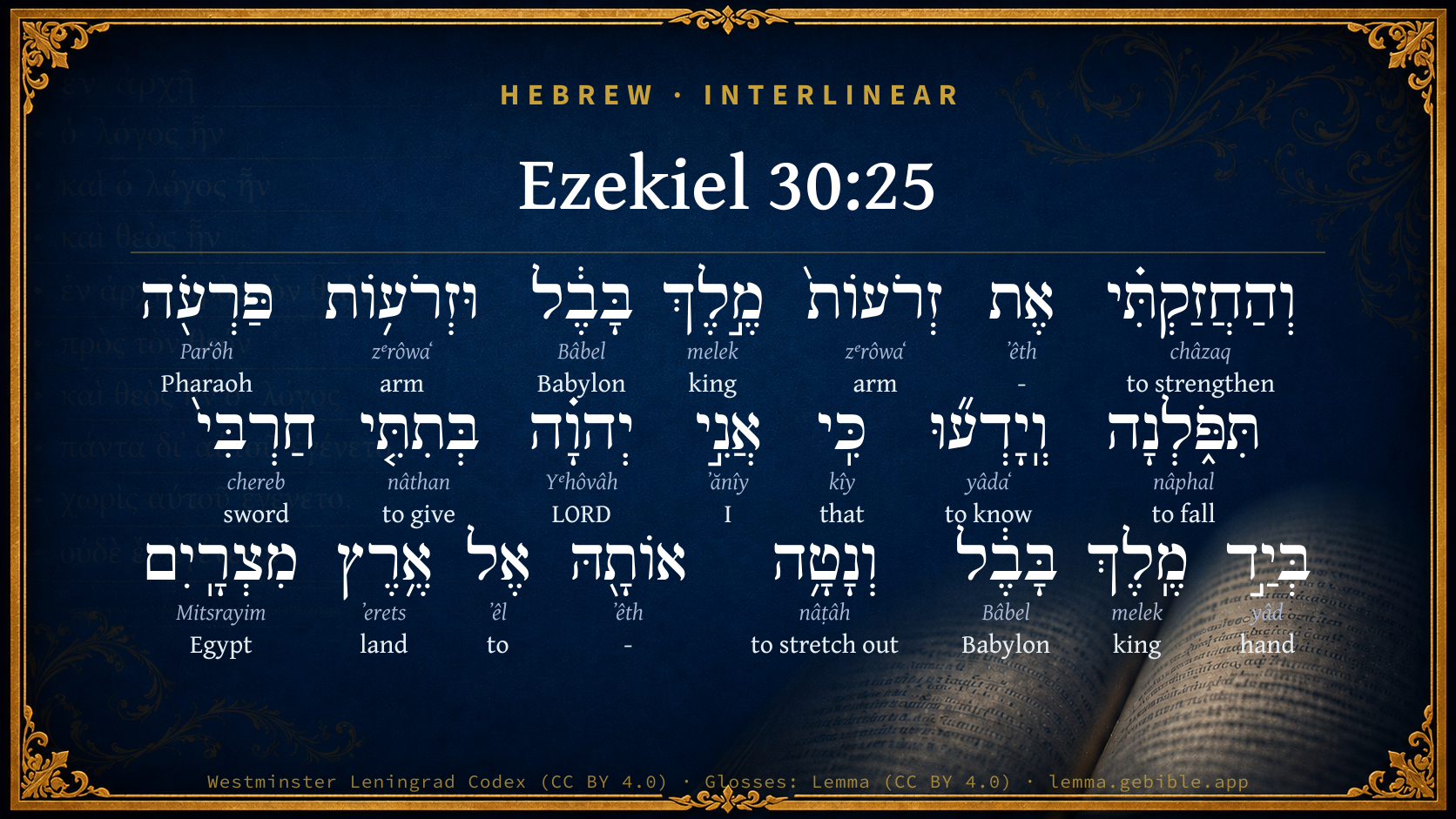
Hebrew (Westminster Leningrad Codex) Ezekiel 30:25 appears in the Hebrew Old Testament. The text above is from the Westminster Leningrad Codex. Each word links to its Strong’s number, a concise gloss, and parsing drawn from the Open Scriptures Hebrew Bible morphology. Click any word for its full Brown-Driver-Briggs (BDB) entry.
Download image
Cite this verse

Ezekiel 30:25 (World English Bible). Public Domain. Lemma interlinear Bible study tool, https://lemma.gebible.app/v/ezekiel/30/25.

Show BibTeX & RIS
BibTeX
RIS
English Translation
I will hold up the arms of the king of Babylon; and the arms of Pharaoh shall fall down; and they shall know that I am Yahweh, when I shall put my sword into the hand of the king of Babylon, and he shall stretch it out on the land of Egypt.
World English Bible · Public Domain
Download a study sheet

One document with this verse’s original text, its word-by-word gloss line, the meaning frame, cross-references with their text, attributed commentary, and full source and license credits — printable, and it pastes into notes with its structure intact.

This verse Autodidact and up

Study sheet (.html) Plain text (.txt)

A passage Seminary Student

Up to 50 verses in one chapter. A passage sheet keeps up to 6 commentary sources and 12 cross-references per verse, in the order this page ranks them, and says so on the sheet whenever that leaves anything out. Ask for a single verse and you get the Autodidact verse sheet above.

Everything on this page stays free to read, with no account — the sheet is a download of what is already on screen, not access to it.

Want to remove ads? Support Godless Engineer
Compare translations 3

The same verse in 3 English versions, stacked beneath the original-language interlinear above. Click any original word for its lexicon entry.

Each is an independent rendering of the whole verse — the interlinear is not word-aligned to these translations.

Highlighted words mark where these versions differ — a whole-verse word diff, not a word-by-word alignment.

  • World English Bible Public Domain
    I will hold up the arms of the king of Babylon; and the arms of Pharaoh shall fall down; and they shall know that I am Yahweh, when I shall put my sword into the hand of the king of Babylon, and he shall stretch it out on the land of Egypt.
  • King James Version Public Domain
    But I will strengthen the arms of the king of Babylon, and the arms of Pharaoh shall fall down; and they shall know that I am the LORD, when I shall put my sword into the hand of the king of Babylon, and he shall stretch it out upon the land of Egypt.
  • unfoldingWord Literal Text CC BY-SA 4.0
    For I will strengthen the arms of the king of Babylon, while Pharaoh’s arms will fall. Then they will know that I am Yahweh, when I put my sword into the hand of the king of Babylon; for he will attack the land of Egypt with it.

unfoldingWord Literal Text — © unfoldingWord, licensed CC BY-SA 4.0. Word-aligned USFM3 via Door43 (git.door43.org/unfoldingWord/en_ult).

Versions to compare (up to 4)

3 of 4 selected

Show all 18 translations

Every available English version of this verse, each an independent rendering of the whole verse.

  • World English Bible Public Domain
    I will hold up the arms of the king of Babylon; and the arms of Pharaoh shall fall down; and they shall know that I am Yahweh, when I shall put my sword into the hand of the king of Babylon, and he shall stretch it out on the land of Egypt.
  • Berean Standard Bible Public Domain
    I will strengthen the arms of Babylon’s king, but Pharaoh’s arms will fall limp. Then they will know that I am the LORD, when I place My sword in the hand of Babylon’s king, and he wields it against the land of Egypt.
  • Majority Standard Bible Public Domain
    I will strengthen the arms of Babylon’s king, but Pharaoh’s arms will fall limp. Then they will know that I am the LORD, when I place My sword in the hand of Babylon’s king, and he wields it against the land of Egypt.
  • King James Version Public Domain
    But I will strengthen the arms of the king of Babylon, and the arms of Pharaoh shall fall down; and they shall know that I am the LORD, when I shall put my sword into the hand of the king of Babylon, and he shall stretch it out upon the land of Egypt.
  • American Standard Version (1901) Public Domain
    And I will hold up the arms of the king of Babylon; and the arms of Pharaoh shall fall down; and they shall know that I am Jehovah, when I shall put my sword into the hand of the king of Babylon, and he shall stretch it out upon the land of Egypt.
  • Revised Version (1885) Public Domain
    And I will hold up the arms of the king of Babylon, and the arms of Pharaoh shall fall down; and they shall know that I am the LORD, when I shall put my sword into the hand of the king of Babylon, and he shall stretch it out upon the land of Egypt.
  • Geneva Bible (1599) Public Domain
    But I will strengthen the armes of the king of Babel, and the armes of Pharaoh shall fall downe, and they shall knowe, that I am the Lord, when I shall put my sworde into the hand of the King of Babel, and he shall stretch it out vpon the land of Egypt.
  • Douay-Rheims (1899) Public Domain
    And I will strengthen the arms of the king of Babylon, and the arms of Pharao shall fall: and they shall know that I am the Lord, when I shall have given my sword into the hand of the king of Babylon, and he shall have stretched it forth upon the land of Egypt.
  • Young's Literal Translation Public Domain
    And I have strengthened the arms of the king of Babylon, And the arms of Pharaoh do fall down, And they have known that I `am' Jehovah, In My giving My sword into the hand of the king of Babylon, And he hath stretched it out toward the land of Egypt.
  • Literal Standard Version CC BY-SA 4.0
    And I have strengthened the arms of the king of Babylon, || And the arms of Pharaoh fall down, || And they have known that I [am] YHWH, || In My giving My sword into the hand of the king of Babylon, || And he has stretched it out toward the land of Egypt.
  • Unlocked Literal Bible CC BY-SA 4.0
    For I will strengthen the arms of the king of Babylon, while Pharaoh's arms will fall. Then they will know that I am Yahweh, when I put my sword into the hand of the king of Babylon; for he will attack the land of Egypt with it.
  • unfoldingWord Literal Text CC BY-SA 4.0
    For I will strengthen the arms of the king of Babylon, while Pharaoh’s arms will fall. Then they will know that I am Yahweh, when I put my sword into the hand of the king of Babylon; for he will attack the land of Egypt with it.
  • Darby Bible Public Domain
    And I will strengthen the arms of the king of Babylon, and the arms of Pharaoh shall fall down; and they shall know that I [am] Jehovah, when I have put my sword into the hand of the king of Babylon, and he shall have stretched it out upon the land of Egypt.
  • World Messianic Bible Public Domain
    I will hold up the arms of the king of Babylon, but the arms of Pharaoh will fall down. Then they will know that I am the LORD when I put my sword into the hand of the king of Babylon, and he stretches it out on the land of Egypt.
  • Webster's Bible Public Domain
    But I will strengthen the arms of the king of Babylon, and the arms of Pharaoh shall fall down; and they shall know that I am the LORD, when I shall put my sword into the hand of the king of Babylon, and he shall stretch it out upon the land of Egypt.
  • Free Bible Version CC BY-SA 4.0
    I will make the arms of Babylon's king strong, but Pharaoh's arms will drop to his sides, weak and useless. Then they will acknowledge that I am the Lord, when I put my sword in the hand of the king of Babylon and he uses it to attack Egypt.
  • Bible in Basic English Public Domain
    And I will make the arms of the king of Babylon strong, and the arms of Pharaoh will be hanging down; and they will be certain that I am the Lord, when I put my sword into the hand of the king of Babylon and it is stretched out against the land of Egypt.
  • JPS Tanakh (1917) Public Domain
    And I will hold up the arms of the king of Babylon, and the arms of Pharaoh shall fall down; and they shall know that I am the LORD, when I shall put My sword into the hand of the king of Babylon, and he shall stretch it out upon the land of Egypt.

Literal Standard Version (2020), Covenant Press — licensed CC BY-SA 4.0. Text via the HelloAO Bible API (eBible.org). Unlocked Literal Bible (unfoldingWord) — licensed CC BY-SA 4.0. Text via the HelloAO Bible API (eBible.org). unfoldingWord Literal Text — © unfoldingWord, licensed CC BY-SA 4.0. Word-aligned USFM3 via Door43 (git.door43.org/unfoldingWord/en_ult). Free Bible Version, Dr. Jonathan Gallagher — licensed CC BY-SA 4.0. Text via the HelloAO Bible API (eBible.org).

Word by word

More ways to search: Search by grammar → Find every occurrence → Compare this word →

Practice this passage: Drill this verse → Learn its vocabulary →

זְרֹעוֹת֙
zᵉrôwaʻ
H2220
“arms of”
Noun, Common, Both, Plural, Construct
Part of Speech
Noun
Type
Common
Gender
Both
Number
Plural
State
Construct
Full BDB Definition

Origin: from H2232

TWOT: 583a

arm, forearm, shoulder, strength - arm - arm (as symbol of strength) - forces (political and military) - shoulder (of animal sacrificed)
  1. וְהַחֲזַקְתִּ֗י châzaq H2388 “and · to strengthen” Conjunction + Verb, Hiphil, Sequential Perfect, 1st Person, Common, Singular
  2. אֶת ʼêth H853 “-” Particle, Direct Object
  3. מֶ֣לֶךְ melek H4428 “king of” Noun, Common, Masculine, Singular, Construct
  4. בָּבֶ֔ל Bâbel H894 “Babylon” Noun, Proper
  5. וּזְרֹע֥וֹת zᵉrôwaʻ H2220 “and · arms of” Conjunction + Noun, Common, Both, Plural, Construct
  6. פַּרְעֹ֖ה Parʻôh H6547 “Pharaoh” Noun, Proper
  7. תִּפֹּ֑לְנָה nâphal H5307 “to fall” Verb, Qal, Imperfect, 3rd Person, Feminine, Plural
  8. וְֽיָדְע֞וּ yâdaʻ H3045 “and · to know” Conjunction + Verb, Qal, Sequential Perfect, 3rd Person, Common, Plural
  9. כִּֽי kîy H3588 “that” Conjunction
  10. אֲנִ֣י ʼănîy H589 “I” Pronoun, Personal, 1st Person, Common, Singular
  11. יְהוָ֗ה Yᵉhôvâh H3068 “LORD” Noun, Proper
  12. בְּתִתִּ֤י nâthan H5414 “in/at · to give · me” Preposition + Verb, Qal, Infinitive Construct + Suffix, Personal, 1st Person, Common, Singular
  13. חַרְבִּי֙ chereb H2719 “sword · my” Noun, Common, Feminine, Singular, Construct + Suffix, Personal, 1st Person, Common, Singular
  14. בְּיַ֣ד yâd H3027 “in/at · hand of” Preposition + Noun, Common, Both, Singular, Construct
  15. מֶֽלֶךְ melek H4428 “king of” Noun, Common, Masculine, Singular, Construct
  16. בָּבֶ֔ל Bâbel H894 “Babylon” Noun, Proper
  17. וְנָטָ֥ה nâṭâh H5186 “and · to stretch out” Conjunction + Verb, Qal, Sequential Perfect, 3rd Person, Masculine, Singular
  18. אוֹתָ֖הּ ʼêth H853 “- · her” Particle, Direct Object + Suffix, Personal, 3rd Person, Feminine, Singular
  19. אֶל ʼêl H413 “to” Preposition
  20. אֶ֥רֶץ ʼerets H776 “land of” Noun, Common, Both, Singular, Construct
  21. מִצְרָֽיִם Mitsrayim H4714 “Egypt” Noun, Proper

About this verse

These counts appear in no published source. They are computed here, from the morphology-tagged text and Lemma’s own curated glosses. What Lemma adds →

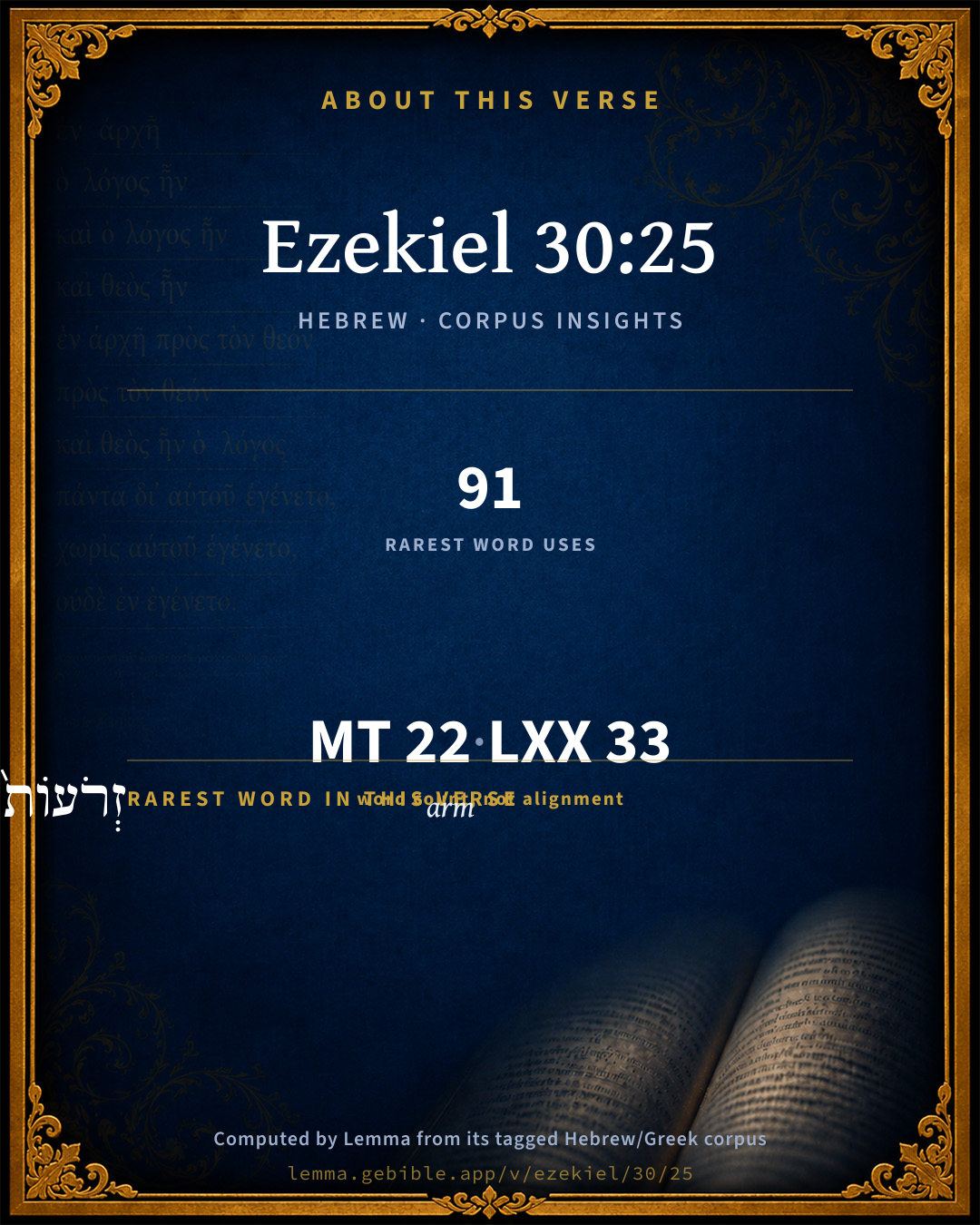
22
words
18
distinct lemmas
Prophets
section

Grammatical profile

  • 5 verbs
  • 12 nouns
  • 1 pronoun
  • 1 preposition
  • 1 conjunction
  • 2 particles

Verb forms

  • וְהַחֲזַקְתִּ֗י Hiphil · Sequential Perfect
  • תִּפֹּ֑לְנָה Qal · Imperfect
  • וְֽיָדְע֞וּ Qal · Sequential Perfect
  • בְּתִתִּ֤י Qal · Infinitive Construct
  • וְנָטָ֥ה Qal · Sequential Perfect

Repetition

Words recur within this verse — often emphatic in Hebrew:

  • זְרֹעוֹת֙ arm H2220 ×2
  • מֶ֣לֶךְ king H4428 ×2
  • בָּבֶ֔ל Babylon H894 ×2

Hebrew & Septuagint length

In English translation the verse runs 52 words from the Hebrew and 52 from the Septuagint (LXX English) — the same length.

A rough comparison of the two English renderings, which tokenize alike — not a word-level alignment.

Word counts can differ between the Hebrew and the Greek without any difference in meaning — e.g. the Hebrew direct-object marker אֵת has no separate Greek word, and Greek often adds the article ὁ.

In the original languages it is 22 Hebrew tokens and 33 Greek tokens — but the two are counted differently (Hebrew bundles its prefixes and suffixes into one token; the Greek is in lemma form), so that isn’t a like-for-like length.

Cross-references

9

Topical passages linked to Ezekiel 30:25 in the Treasury of Scripture Knowledge — connected by theme and wording, ordered by reader-vote popularity; previews shown in the World English Bible.

  • Psalms 9:16 Yahweh has made himself known. He has executed judgment. The wicked is snared by the work of his own hands. Meditation. Selah.
  • Ezekiel 29:16 It shall be no more the confidence of the house of Israel, bringing iniquity to memory, when they turn to look after them: and they shall know that I am the Lord Yahweh.
  • Ezekiel 29:21 In that day will I cause a horn to bud forth to the house of Israel, and I will give you the opening of the mouth in the midst of them; and they shall know that I am Yahweh.
  • Ezekiel 30:19 Thus will I execute judgments on Egypt; and they shall know that I am Yahweh.
  • Ezekiel 30:26 I will scatter the Egyptians among the nations, and disperse them through the countries; and they shall know that I am Yahweh.
  • Ezekiel 32:15 When I shall make the land of Egypt desolate and waste, a land destitute of that of which it was full, when I shall strike all those who dwell therein, then shall they know that I am Yahweh.
  • Ezekiel 38:16 and you shall come up against my people Israel, as a cloud to cover the land: it shall happen in the latter days, that I will bring you against my land, that the nations may know me, when I shall be sanctified in you, Gog, before their eyes.
  • Ezekiel 38:23 I will magnify myself, and sanctify myself, and I will make myself known in the eyes of many nations; and they shall know that I am Yahweh.
  • Ezekiel 39:21–22 I will set my glory among the nations; and all the nations shall see my judgment that I have executed, and my hand that I have laid on them.

Cross-references courtesy of OpenBible.info (CC BY 4.0).

Hebrew and Greek witnesses Masoretic Hebrew ↔ Greek Septuagint

The same verse in the two great witnesses to the Old Testament, shown verse-for-verse.

These are two independent witnesses, not word-aligned to each other, and the Septuagint is shown in lemma (dictionary) form.

Hebrew Ezekiel 30:25 Masoretic · Westminster Leningrad Codex

וְהַחֲזַקְתִּ֗י אֶת זְרֹעוֹת֙ מֶ֣לֶךְ בָּבֶ֔ל וּזְרֹע֥וֹת פַּרְעֹ֖ה תִּפֹּ֑לְנָה וְֽיָדְע֞וּ כִּֽי אֲנִ֣י יְהוָ֗ה בְּתִתִּ֤י חַרְבִּי֙ בְּיַ֣ד מֶֽלֶךְ בָּבֶ֔ל וְנָטָ֥ה אוֹתָ֖הּ אֶל אֶ֥רֶץ מִצְרָֽיִם

I will hold up the arms of the king of Babylon; and the arms of Pharaoh shall fall down; and they shall know that I am Yahweh, when I shall put my sword into the hand of the king of Babylon, and he shall stretch it out on the land of Egypt.

World English Bible · Public Domain

Greek LXX Ezekiel 30:25 Septuagint · lemma form

καί ἐνἰσχύω ὁ βραχίων βασιλεύς βαβυλών ὁ δέ βραχίων φαραώ πίπτω καί γιγνώσκω ὅτι ἐγώ εἰμί κύριος ἐν ὁ δίδωμι ὁ ῥομφαία ἐγώ εἰς χείρ βασιλεύς βαβυλών καί ἐκτείνω αὐτός ἐπί γῆ αἴγυπτος

Yes, I will strengthen the arms of the king of Babylon, and the arms of Pharao shall fail: and they shall know that I am the Lord, when I have put my sword into the hands of the king of Babylon, and he shall stretch it out over the land of Egypt.

LXX2012 (modern English Septuagint) · Public Domain

Hebrew: Westminster Leningrad Codex (CC BY 4.0). Greek: Septuagint (public domain); English from LXX2012 (modern English Septuagint) (Public Domain). How the Septuagint differs from the Hebrew →

Targum (Aramaic paraphrase)

1

The Targum is the ancient Jewish Aramaic paraphrase of the Hebrew Scriptures — an interpretive translation, not the Hebrew text itself. Onkelos (literal) and Pseudo-Jonathan (expansive) render the Torah, and Jonathan the Prophets. Coverage is partial: where no permissively-licensed English translation exists for a verse, only the Aramaic is shown. This is verse-level text, not a word-by-word alignment to the Hebrew.

  1. Targum Jonathan Prophets (Joshua–Malachi)
    וְאַתְקֵיף יַת מַלְכוּת מַלְכָּא דְבָבֶל וּמַלְכוּת פַּרְעֹה תִּבְטֵל וְיֵדְעוּן אֲרֵי אֲנָא יְיָ כַּד אֶתֵּן תּוּקְפִי בְּיַד מַלְכָּא דְבָבֶל וְיִתְפְּרַע פּוּרְעֲנוּת מִן אַרְעָא דְמִצְרָיִם:

    (no public-domain English translation for this verse)

    Targum Jonathan — Aramaic: “Mikraot Gedolot” (public domain). English: “Sefaria Community Translation” (CC0 1.0 (public-domain dedication)); “London "Chaldee Paraphrase," 1871” (public domain). Text via Sefaria.

Commentary

Notes on Ezekiel 30:25 from classic Christian and Jewish commentators (each source and its license shown beneath its notes). The classic Christian expositions comment on the surrounding passage and are grouped to its opening verse, so a note may address several verses; the Jewish commentaries on the Tanakh (Rashi and others) are per-verse, so they appear only where the commentator wrote on this verse.

Lemma curates 59 commentaries, every one of them public domain or Creative Commons licensed, each selected and text-cleaned for this edition rather than reprinted as found. About our sources →

Trapp's Complete Commentary

John Trapp

Eze 30:25 But I will strengthen the arms of the king of Babylon, and the arms of Pharaoh shall fall down; and they shall know that I [am] the LORD, when I shall put my sword into the hand of the king of Babylon, and he shall stretch it out upon the land of Egypt.

Ver. 25. But I will strengthen.] See Eze 30:25.

And they shall know.] See on Eze 30:8.

John Trapp, A Commentary or Exposition upon All the Books of the Old and New Testament (1647–1656) — public domain. Text from a community e-Sword module.

Geneva Bible (1599)

Geneva Bible translators

Whereby we see that tyrants have no power of themselves, neither can do anymore harm than God appointeth, and when he will they must cease.

Geneva Bible (1599) marginal notes — public domain. Text via Bolls.life.

John Gill's Exposition

But I will strengthen the arms of the king of Babylon,.... Which is repeated for the sake of confirmation:

and the arms of Pharaoh shall fall down: as when a man's arms are broken; and he shall not be able to lift them up and defend himself:

and they shall know that I am the Lord; namely, the Egyptians, as in Eze 30:19,

when I shall have put my sword into the hand of the king of Babylon, and he shall stretch it out on the land of Egypt; that is, when he shall have a commission to carry the war into Egypt; and he shall spread desolation over all the land, cutting off the inhabitants of it everywhere, as before described in this chapter.

John Gill's Exposition of the Whole Bible (1746–1763) — public domain (CC PDM 1.0). Text via the HelloAO Bible API.

Matthew Poole's English Annotations

These two foregoing verses are a repetition of God’s threats against Pharaoh, and of his promises to assist Nebuchadnezzar in the war, and every thing plain in them.

Will strengthen; give the first strength, and continue it with new supplies, so that with strength from God he shall proceed.

Put my sword in his hand; is strength shall have a weapon suited and proportioned to it; and what will be hard, where God’s sword and his strength are engaged to effect it?

He, Hophra,

shall groan; not only as the stoutest must when nature breaks, but cry out and sigh, or howl, not becoming a brave man.

Before him, king of Babylon,

with the groanings of a deadly wounded man; who hath given him his deadly wound, under which he roars while he hath any strength, and groans when his voice fails him. It speaks sore griefs, and deep sense of them, as Exo 2:24; Jdg 2:18; Job 24:12.

Matthew Poole's English Annotations on the Holy Bible (1683–1685) — public domain. Text from a community e-Sword/MySword module.

The Pulpit Commentary

Vers. 25, 26. The imagery is slightly varied. The arms of the Egyptian king are described, not as broken, but as feeble. They hang down by his side instead of wielding the sword. I will scatter, etc. The prophet dwells once more, repeating the very words of Ver. 23 and Eze_29:12 with all the emphasis of iteration, on the dispersion which was the almost inevitable sequel of an Oriental conquest. There in the land of exile they should see that they had been fighting against God; and so the prophet ends the chapter with his ever-recurring formula, They shall know that I am Jehovah. (Eze_28:26 Eze_29:21)

The Pulpit Commentary (1880–1919), ed. H.D.M. Spence-Jones & Joseph S. Exell — public domain. Text from a community e-Sword module.

John Wesley's Explanatory Notes

Will strengthen - As Judges on the bench like Pilate, so generals in the field, like Nebuchadrezzar, have no power but what is given them from above.

John Wesley, Explanatory Notes Upon the Whole Bible (1754–1765) — public domain. Text via the GEBible commentary corpus.

unfoldingWord translationNotes

Door43 World Missions Community

General Information:

God continues speaking of the armies of Egypt and Babylon as if the armies were the arms of their kings. He also speaks of making the army of Babylon strong to attack others as if he had a sword and put it in the Babylonian king's hand. (See: Parables)

For I will strengthen the arms of the king of Babylon

Here "arms" are a metonym for the army. AT: "I will make the army of the king of Babylon strong" (See: Metonymy)

while Pharaoh's arms will fall

Here "Pharaoh's arms" is a metonym for his army, and "will fall" represents being weak. AT: "but Pharaoh's army will be unable to defeat enemies" (See: Metonymy)

Then they

The word "they" possibly refers to 1) "the Egyptians" or 2) "all people who hear what Yahweh has done."

for he will attack the land of Egypt with it

"and the king of Babylon will attack the land of Egypt with my sword"

scatter Egypt among the nations and disperse them through the lands

These two phrases mean basically the same thing. See how you translated similar phrases in Ezekiel 12:15. (See: Parallelism)

translationWords

disperse

unfoldingWord translationNotes — © Distant Shores Media and the Door43 World Missions Community, licensed CC BY-SA 4.0. Source: git.door43.org/Door43/en_tn.

Rashi

Rabbi Shlomo Yitzchaki (Rashi)

And I shall grasp [Heb. וְהֲחֲזַּקְתִּי,] an expression of grasping, that one grasps his hand to support it so that it should not fall. The end of it proves it: “and the arms of Pharaoh will fall,” because He does not hold them.

Rashi on the Tanakh — English translations: “The Judaica Press complete Tanach with Rashi, translated by A. J. Rosenberg” (CC BY 4.0); “Pentateuch with Rashi's commentary by M. Rosenbaum and A.M. Silbermann, 1929-1934” (public domain); “The Metsudah Tanach series, Lakewood, N.J” (CC BY 4.0); and “The Book of Joshua, Metsudah Publications, 1997” (CC BY 4.0). Text via Sefaria.

Lesson kit

Teaching starters — assembled from the data on this page, not authored interpretation. Every prompt links to the verse data it draws on. Edit before teaching.

Ezekiel, in the Prophets, opens this verse with 22 words (18 distinct Hebrew lemmas). Its most distinctive word is zᵉrôwaʻ (“arm”). A historical commentator’s framing appears above. Read the whole chapter for the surrounding context.

Discussion questions

  1. How does “arm” (zᵉrôwaʻ) shape what this verse is saying?
  2. How does Psalms 9:16, which shares this passage’s theme, read alongside this verse?
  3. What does the repetition of “arm” (2× in this one verse) do in this verse?
  4. These translations render this verse differently. What is at stake in choosing one wording over another?
  5. «וְהַחֲזַקְתִּ֗י» is a Hiphil Sequential Perfect verb. How does that grammatical form shape the action described?
  6. Compare how Trapp's Complete Commentary and Geneva Bible (1599) read this verse. Where do they agree or differ?

Things to notice

Reading settings

Reading text

Shown beneath each verse's original-language words.

Old Testament
Old Testament edition

Read the OT as the Masoretic Hebrew (MT) or the Greek Septuagint (LXX).

English shown for the Greek Septuagint (in the Hebrew ↔ Greek comparison).

Comparing translations? Open the Compare panel on any verse page to stack up to four side by side.