
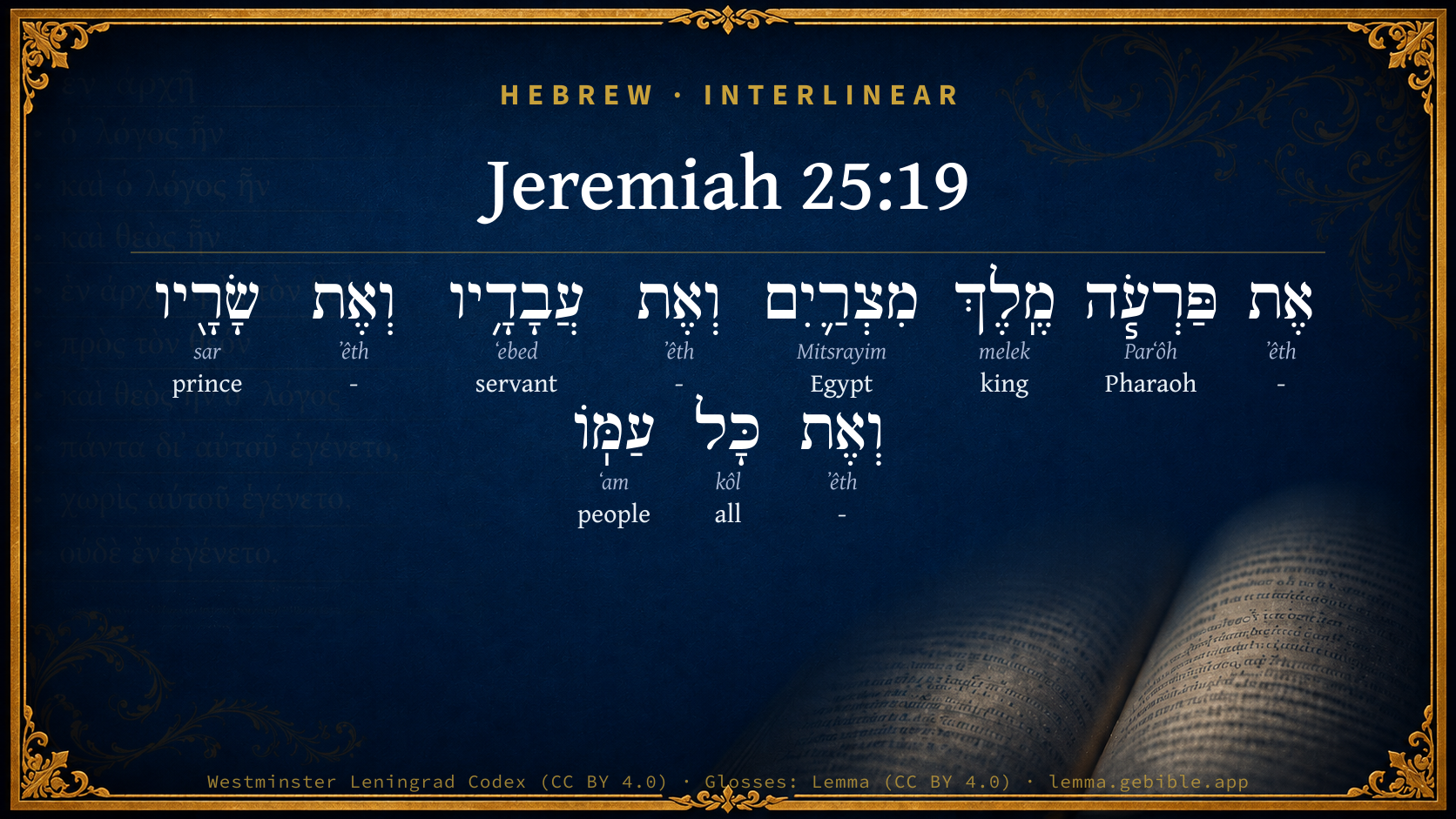
Jeremiah 25:19

Hebrew (Westminster Leningrad Codex) Jeremiah 25:19 appears in the Hebrew Old Testament. The text above is from the Westminster Leningrad Codex. Each word links to its Strong’s number, a concise gloss, and parsing drawn from the Open Scriptures Hebrew Bible morphology. Click any word for its full Brown-Driver-Briggs (BDB) entry.
Download image
Cite this verse

Jeremiah 25:19 (World English Bible). Public Domain. Lemma interlinear Bible study tool, https://lemma.gebible.app/v/jeremiah/25/19.

Show BibTeX & RIS
BibTeX
RIS
English Translation
Pharaoh king of Egypt, and his servants, and his princes, and all his people;
World English Bible · Public Domain
Download a study sheet

One document with this verse’s original text, its word-by-word gloss line, the meaning frame, cross-references with their text, attributed commentary, and full source and license credits — printable, and it pastes into notes with its structure intact.

This verse Autodidact and up

Study sheet (.html) Plain text (.txt)

A passage Seminary Student

Up to 50 verses in one chapter. A passage sheet keeps up to 6 commentary sources and 12 cross-references per verse, in the order this page ranks them, and says so on the sheet whenever that leaves anything out. Ask for a single verse and you get the Autodidact verse sheet above.

Everything on this page stays free to read, with no account — the sheet is a download of what is already on screen, not access to it.

Want to remove ads? Support Godless Engineer
Compare translations 3

The same verse in 3 English versions, stacked beneath the original-language interlinear above. Click any original word for its lexicon entry.

Each is an independent rendering of the whole verse — the interlinear is not word-aligned to these translations.

Highlighted words mark where these versions differ — a whole-verse word diff, not a word-by-word alignment.

  • World English Bible Public Domain
    Pharaoh king of Egypt, and his servants, and his princes, and all his people;
  • King James Version Public Domain
    Pharaoh king of Egypt, and his servants, and his princes, and all his people;
  • unfoldingWord Literal Text CC BY-SA 4.0
    Pharaoh, king of Egypt, and his servants and his officials and all of his people,

unfoldingWord Literal Text — © unfoldingWord, licensed CC BY-SA 4.0. Word-aligned USFM3 via Door43 (git.door43.org/unfoldingWord/en_ult).

Versions to compare (up to 4)

3 of 4 selected

Show all 18 translations

Every available English version of this verse, each an independent rendering of the whole verse.

  • World English Bible Public Domain
    Pharaoh king of Egypt, and his servants, and his princes, and all his people;
  • Berean Standard Bible Public Domain
    Pharaoh king of Egypt, his officials, his leaders, and all his people;
  • Majority Standard Bible Public Domain
    Pharaoh king of Egypt, his officials, his leaders, and all his people;
  • King James Version Public Domain
    Pharaoh king of Egypt, and his servants, and his princes, and all his people;
  • American Standard Version (1901) Public Domain
    Pharaoh king of Egypt, and his servants, and his princes, and all his people;
  • Revised Version (1885) Public Domain
    Pharaoh king of Egypt, and his servants, and his princes, and all his people;
  • Geneva Bible (1599) Public Domain
    Pharaoh also, King of Egypt, and his seruants, and his princes, and all his people:
  • Douay-Rheims (1899) Public Domain
    Pharao the king of Egypt, and his servants, and his princes, and all his people,
  • Young's Literal Translation Public Domain
    Pharaoh king of Egypt, and his servants, And his heads, and all his people,
  • Literal Standard Version CC BY-SA 4.0
    Pharaoh king of Egypt, and his servants, || And his heads, and all his people,
  • Unlocked Literal Bible CC BY-SA 4.0
    Other nations also had to drink it: Pharaoh king of Egypt and his servants; his officials and all his people;
  • unfoldingWord Literal Text CC BY-SA 4.0
    Pharaoh, king of Egypt, and his servants and his officials and all of his people,
  • Darby Bible Public Domain
    Pharaoh king of Egypt, and his servants, and his princes, and all his people;
  • World Messianic Bible Public Domain
    Pharaoh king of Egypt, with his servants, his princes, and all his people;
  • Webster's Bible Public Domain
    Pharaoh king of Egypt, and his servants, and his princes, and all his people;
  • Free Bible Version CC BY-SA 4.0
    to Pharaoh, king of Egypt, and his officials, leaders, all his people
  • Bible in Basic English Public Domain
    Pharaoh, king of Egypt, and his servants and his princes and all his people;
  • JPS Tanakh (1917) Public Domain
    Pharaoh king of Egypt, and his servants, and his princes, and all his people;

Literal Standard Version (2020), Covenant Press — licensed CC BY-SA 4.0. Text via the HelloAO Bible API (eBible.org). Unlocked Literal Bible (unfoldingWord) — licensed CC BY-SA 4.0. Text via the HelloAO Bible API (eBible.org). unfoldingWord Literal Text — © unfoldingWord, licensed CC BY-SA 4.0. Word-aligned USFM3 via Door43 (git.door43.org/unfoldingWord/en_ult). Free Bible Version, Dr. Jonathan Gallagher — licensed CC BY-SA 4.0. Text via the HelloAO Bible API (eBible.org).

Word by word

More ways to search: Search by grammar → Find every occurrence → Compare this word →

Practice this passage: Drill this verse → Learn its vocabulary →

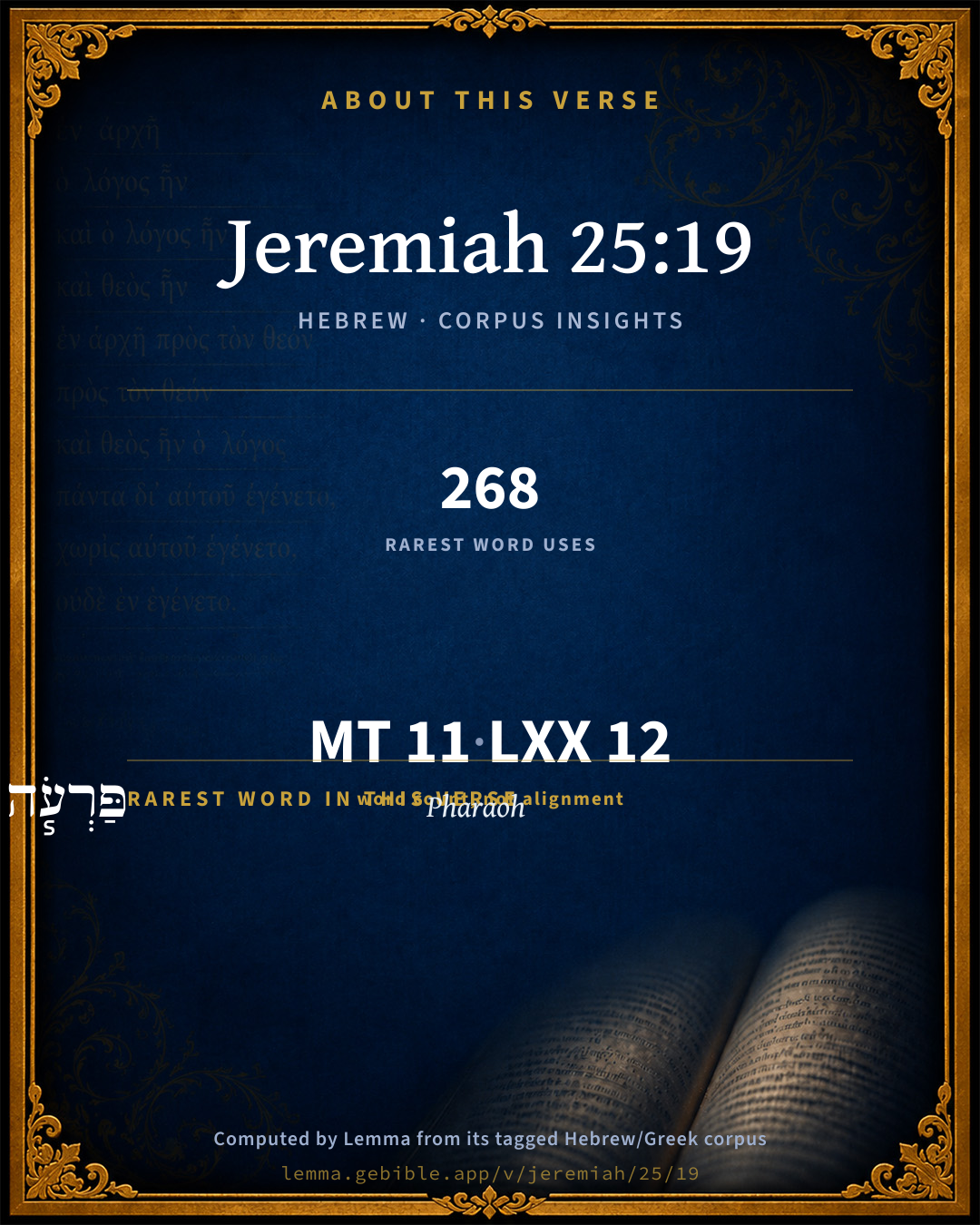
About this verse

These counts appear in no published source. They are computed here, from the morphology-tagged text and Lemma’s own curated glosses. What Lemma adds →

11
words
8
distinct lemmas
Prophets
section

Grammatical profile

  • 7 nouns
  • 4 particles

Hebrew & Septuagint length

In the original languages it is 11 Hebrew tokens and 12 Greek tokens — but the two are counted differently (Hebrew bundles its prefixes and suffixes into one token; the Greek is in lemma form), so that isn’t a like-for-like length.

Cross-references

5

Topical passages linked to Jeremiah 25:19 in the Treasury of Scripture Knowledge — connected by theme and wording, ordered by reader-vote popularity; previews shown in the World English Bible.

  • Jeremiah 46:2 Of Egypt: concerning the army of Pharaoh Necoh king of Egypt, which was by the river Euphrates in Carchemish, which Nebuchadrezzar king of Babylon struck in the fourth year of Jehoiakim the son of Josiah, king of Judah.
  • Jeremiah 46:13–26 The word that Yahweh spoke to Jeremiah the prophet, how that Nebuchadrezzar king of Babylon should come and strike the land of Egypt.
  • Nahum 3:8–10 Are you better than No-Amon, who was situated among the rivers, who had the waters around her; whose rampart was the sea, and her wall was of the sea?
  • Jeremiah 43:9–11 Take great stones in your hand, and hide them in mortar in the brick work, which is at the entry of Pharaoh's house in Tahpanhes, in the sight of the men of Judah;
  • Ezekiel 29:1–21 In the tenth year, in the tenth [month], in the twelfth [day] of the month, the word of Yahweh came to me, saying,

Cross-references courtesy of OpenBible.info (CC BY 4.0).

Hebrew and Greek witnesses Masoretic Hebrew ↔ Greek Septuagint

The same verse in the two great witnesses to the Old Testament, shown verse-for-verse.

These are two independent witnesses, not word-aligned to each other, and the Septuagint is shown in lemma (dictionary) form.

Hebrew Jeremiah 25:19 Masoretic · Westminster Leningrad Codex

אֶת פַּרְעֹ֧ה מֶֽלֶךְ מִצְרַ֛יִם וְאֶת עֲבָדָ֥יו וְאֶת שָׂרָ֖יו וְאֶת כָּל עַמּֽוֹ

Pharaoh king of Egypt, and his servants, and his princes, and all his people;

World English Bible · Public Domain

Greek LXX Structure differs

In the Septuagint, Jeremiah is about an eighth shorter than the Hebrew and arranges its material differently — the Oracles Against the Nations (Hebrew chapters 46–51) appear in the middle of the Greek book, after 25:13. Because the chapter and verse boundaries do not line up, a verse-for-verse comparison with the Hebrew is not shown.

A verse-for-verse comparison isn’t shown here because the chapters and verses don’t line up. Switch to the LXX edition with the MT / LXX toggle above to read the Greek directly.

On this verse, Keil & Delitzsch discusses the Septuagint’s reading. Read the note in Commentary ↓

Hebrew: Westminster Leningrad Codex (CC BY 4.0). Greek: Septuagint (public domain); English from a public-domain English Septuagint. How the Septuagint differs from the Hebrew →

Targum (Aramaic paraphrase)

1

The Targum is the ancient Jewish Aramaic paraphrase of the Hebrew Scriptures — an interpretive translation, not the Hebrew text itself. Onkelos (literal) and Pseudo-Jonathan (expansive) render the Torah, and Jonathan the Prophets. Coverage is partial: where no permissively-licensed English translation exists for a verse, only the Aramaic is shown. This is verse-level text, not a word-by-word alignment to the Hebrew.

  1. Targum Jonathan Prophets (Joshua–Malachi)
    יַת פַּרְעֹה מַלְכָּא מִצְרַיִם וְיַת עַבְדוֹהִי וְיַת רַבְרָבוֹהִי וְיַת כָּל עַמֵיהּ:

    (no public-domain English translation for this verse)

    Targum Jonathan — Aramaic: “Mikraot Gedolot” (public domain). English: “Sefaria Community Translation” (CC0 1.0 (public-domain dedication)); “London "Chaldee Paraphrase," 1871” (public domain). Text via Sefaria.

Commentary

Notes on Jeremiah 25:19 from classic Christian and Jewish commentators (each source and its license shown beneath its notes). The classic Christian expositions comment on the surrounding passage and are grouped to its opening verse, so a note may address several verses; the Jewish commentaries on the Tanakh (Rashi and others) are per-verse, so they appear only where the commentator wrote on this verse.

Lemma curates 59 commentaries, every one of them public domain or Creative Commons licensed, each selected and text-cleaned for this edition rather than reprinted as found. About our sources →

Trapp's Complete Commentary

John Trapp

Jer 25:19 Pharaoh king of Egypt, and his servants, and his princes, and all his people;

Ver. 19. Pharaoh king of Egypt.] Pharaohhophra, {Jer 44:30} of whom Herodotus {a} writeth that he persuaded himself and boasted, that his kingdom was so strong that no god or man could take it from him. He was afterwards hanged by his own subjects.

{a} Lib. ii.

John Trapp, A Commentary or Exposition upon All the Books of the Old and New Testament (1647–1656) — public domain. Text from a community e-Sword module.

Whedon's Commentary on the Bible

Daniel D. Whedon

19. Pharaoh, etc. — The enumeration begins with Egypt and goes northward, mentioning Uz, Edom, Moab, and Ammon on the east, and Philistia, Tyre, Zidon, and the isles of the Mediterranean on the west. Then, to the far east, the kings of Arabia and Elam, with the Medes to the northward; and finally the enumeration terminates with all the kings of the north and all the kingdoms of the world… upon the face of the earth, but mentions last of all the king of Babylon by the name of Sheshach. (Jer_25:19-26.)

Daniel D. Whedon (gen. ed.), Commentary on the Old and New Testaments (1874–1909) — public domain. Text from a community e-Sword module.

Tyndale Open Study Notes

Tyndale Open Resources

25:19-20 The foreigners who heard the prophet’s message included many refugees who fled from Judah and neighboring countries to Egypt when the Babylonians invaded. • Uz was a region on the northern border of Arabia; Ashkelon, Gaza, Ekron, and Ashdod were Philistine cities near the Mediterranean Sea.

Tyndale Open Study Notes — © Tyndale Open Resources, licensed CC BY-SA 4.0. Text via the HelloAO Bible API.

Jamieson, Fausset & Brown

Robert Jamieson, A. R. Fausset & David Brown

Pharaoh--put next after Jerusalem, because the Jews had relied most on him, and Egypt and Judea stood on a common footing (Jer 46:2, Jer 46:25).

Jamieson, Fausset & Brown — Commentary Critical and Explanatory on the Whole Bible (1871) — public domain (CC PDM 1.0). Text via the HelloAO Bible API.

Adam Clarke's Commentary

Verse 19. Pharaoh king of Egypt] This was Pharaoh-necho, who was the principal cause of instigating the neighbouring nations to form a league against the Chaldeans.

Adam Clarke's Commentary on the Bible (1810–1826) — public domain. Text from a community e-Sword/MySword module.

John Calvin's Commentaries

It may here be asked, why he connects Pharaoh with the Jews, and assigns the second place to the Egyptians rather than to other nations? The reason is evident, — because the Jews expected deliverance from them; and the cause of their irreclaimable obstinacy was, that they could not be removed from that false confidence by which the devil had once fascinated them. They departed from God by making the Egyptians their friends; and when they found themselves unequal to the Assyrians, they turned their hopes to the Egyptians rather than to God; the prophets remonstrated with them, but with no success.

As, then, the occasion of ruin to the chosen people was Egypt, and as Pharaoh was, as it were, the fountain and cause of destruction to Jerusalem, as well as to the whole people, rightly does the Prophet, after having spoken of Jerusalem and the cities of Judah, immediately mention Pharaoh in the second place; for he was a friend to the Jews, and they were so connected together that they were necessarily drawn together into destruction; for they had corrupted one another, and encouraged one another in impiety, and with united minds and confederate hearts kindled God’s wrath against themselves. The Prophet, then, could not have spoken of the Jews by themselves, but was under the necessity of connecting the Egyptians with them, for the state of both people was the same.

John Calvin's Commentaries (1540-1563) — public domain. Text from the Calvin Translation Society English edition (1840s-50s) via the Christian Classics Ethereal Library (ccel.org). Calvin's coverage is partial (roughly two-thirds of the Bible); uncommented books and verses are honest gaps, never fabricated. The 19th-century editor's footnotes and remarks are omitted so the notes are faithfully Calvin's own voice.

Ellicott's Commentary for English Readers

(19) Pharaoh king of Egypt . . .—The list of the nations begins, it will be seen, from the south and proceeds northwards; those that lay on the east and west being named, as it were, literally, according to their position. The Pharaoh of the time was Nechoh, who had been defeated at Carchemish.

A Bible Commentary for English Readers, edited by Charles John Ellicott (1878–1897) — public domain. Text from a community e-Sword module.

The Cambridge Bible for Schools and Colleges

gen. ed. J. J. S. Perowne

19. Pharaoh] a name belonging not to an individual but (cp. Kaiser and Czar) to the monarch as such. The word has been somewhat altered in shape by its transmission to us through Hebrew. It is the hieroglyph Per-âa, meaning great house (cp. Sublime Porte), and gradually became the title of the ruler himself.

The Cambridge Bible for Schools and Colleges (gen. ed. J. J. S. Perowne; Cambridge University Press, 1878–1918) — public domain. Text from a community e-Sword module.

John Gill's Exposition

Pharaoh king of Egypt,.... Who is mentioned first after the kings of Judah; not only because the Jews were in alliance with Egypt, and trusted to them; and therefore this is observed, to show the vanity of their confidence and dependence; but because the judgments of God first took place on the king of Egypt; for in this very year, in which this prophecy was delivered, Pharaohnecho king of Egypt was smitten by Nebuchadnezzar, Jer 46:2; though the prophecy had a further accomplishment in Pharaohhophra, who was given into the hands of his enemies, as foretold, Jer 44:30;

and his servants, and his princes, and all his people; his menial servants, his domestics, and his nobles and peers of the realm, and all his subjects. It expresses an utter destruction of the kingdom of Egypt; and the particulars of it may be the rather given, to show the vain trust of the Jews in that people.

John Gill's Exposition of the Whole Bible (1746–1763) — public domain (CC PDM 1.0). Text via the HelloAO Bible API.

Albert Barnes' Notes on the Bible

The arrangement is remarkable. Jeremiah begins with the south, Egypt; next Uz on the southeast, and Philistia on the southwest; next, Edom, Moab, and Ammon on the east, and Tyre, and Sidon, and the isles of the Mediterranean on the west; next, in the Far East, various Arabian nations, then northward to Media and Elam, and finally the kings of the north far and near.

Albert Barnes' Notes on the Bible (1834–1885) — public domain. Text from a community e-Sword/MySword module.

Haydock's Catholic Bible Commentary

Pharao, who was defeated (Ezechiel xxx. 25.) coming to assist Juda, (chap. xxxvii.) and again plundered after the taking of Tyre, Ezechiel xxix. 18.

George Leo Haydock (1774–1849), Haydock's Catholic Family Bible and Commentary, 1859 edition — public domain. Excludes Psalms (Douay-Rheims chapter numbering differs from Protestant) and Deuterocanonical books (Catholic canon only).

Matthew Poole's English Annotations

The Egyptians being that people whom the Jews most trusted to for help, are named as the first to whom the prophet was sent with the wine-cup of God’s fury, to let the Jews know, that if they trusted to them, their confidence was vain; for they should themselves be destroyed, which was fulfilled within the twelve years after the death of Josiah unto the time of Jehoiachin, as appears from 2Ki 24:6,7, for the king of Egypt made Jehoiakim king, 2Ki 23:34.

Matthew Poole's English Annotations on the Holy Bible (1683–1685) — public domain. Text from a community e-Sword/MySword module.

The Pulpit Commentary

Pharaoh king of Egypt. After leaving Judah and Jerusalem, the prophet turns to the far south to Egypt; then he ascends to the south-east (Uz), and the south-west (the Philistines); thence he passes to the east (Edom, Moab, Ammon); and thence to the west of the Holy Land (Phoenicia). This suggests the maritime lands "beyond the sea" (including especially Cyprus); a sudden transition brings the prophet to the Arabian tribes (Dedan, etc.), from whence he passes by the road of the northeast (Elam, Media) to the indefinitely distant north. Last of all, in solitary grandeur or infamy, Babylon is mentioned.

The Pulpit Commentary (1880–1919), ed. H.D.M. Spence-Jones & Joseph S. Exell — public domain. Text from a community e-Sword module.

Keil & Delitzsch

C. F. Keil & F. Delitzsch

The enumeration of the heathen nations begins with Egypt and goes northwards, the peoples dwelling to the east and west of Judah being ranged alongside one another. First we have in Jer 25:20 the races of Arabia and Philistia that bordered on Egypt to the east and west; and then in Jer 25:21 the Edomites, Moabites, and Ammonites to the east, and, Jer 25:22, the Phoenicians with their colonies to the west. Next we have the Arabian tribes of the desert extending eastwards from Palestine to the Euphrates (Jer 25:23, Jer 25:24); then the Elamites and Medes in the distant east (Jer 25:25), the near and distant kings of the north, and all kingdoms upon earth; last of all the king of Babylon (Jer 25:26). כּל־הערב, lxx: πάντας τοῦς συμμίκτους, and Jerome: cunctusque qui non est Aegyptius, sed in ejus regionibus commoratur. The word means originally a mixed multitude of different races that attach themselves to one people and dwell as strangers amongst them; cf. Exo 12:38 and Neh 13:3. Here it is races that in part dwelt on the borders of Egypt and were in subjection to that people. It is rendered accordingly "vassals" by Ew.; an interpretation that suits the present verse very well, but will not do in Jer 25:24. It is certainly too narrow a view, to confine the reference of the word to the mercenaries or Ionian and Carian troops by whose help Necho's father Psammetichus acquired sole supremacy (Graf), although this be the reference of the same word in Eze 30:5. The land of Uz is, acc. to the present passage and to Lam 4:21, where the daughter of Edom dwells in the land of Uz, to be sought for in the neighbourhood of Idumaea and the Egyptian border. To delete the words "and all the kings of the land of Uz" as a gloss, with Hitz. and Gr., because they are not in the lxx, is an exercise of critical violence. The lxx omitted them for the same reason as that on which Hitz. still lays stress - namely, that they manifestly do not belong to this place, but to Jer 25:23. And this argument is based on the idea that the land of Uz ( ̓Αυσῖτις) lies much farther to the north in Arabia Deserta, in the Hauran or the region of Damascus, or that it is a collective name for the whole northern region of Arabia Deserta that stretches from Idumaea as far as Syria; see Del. on Job 1:1, and Wetzstein in Del.'s Job, S. 536f. This is an assumption for which valid proofs are not before us. The late oriental legends as to Job's native country do not suffice for this. The kings of the land of the Philistines are the kings of the four towns next in order mentioned, with their territories, cf. Jos 13:3; Sa1 6:4. The fifth of the towns of the lords of the Philistines, Gath, is omitted here as it was before this, in Amo 1:7. and Zep 2:4, and later in Zac 9:5, not because Gath had already fallen into premature decay; for in Amos' time Gath was still a very important city. It is rather, apparently, because Gath had ceased to be the capital of a separate kingdom or principality. There is remaining now only a remnant of Ashdod; for after a twenty-nine years' siege, this town was taken by Psammetichus and destroyed (Herod. ii. 157), so that thus the whole territory great lost its importance. Jer 25:21. On Edom, Moab, and the Ammonites, cf. Jer 49:7-22; Jer 48:1; Jer 49:1-6. Jer 25:22. The plural: "kings of Tyre and Sidon," is to be understood as in Jer 25:18. With them are mentioned "the kings of the island" or "of the coast" land, that is, beyond the (Mediterranean) Sea. האי is not Κύπρος (Cyprus), but means, generally, the Phoenician colonies in and upon the Mediterranean. Of the Arabian tribes mentioned in Jer 25:23, the Dedanites are those descended from the Cushite Dedan and living ear Edom, with whom, however, the Abrahamic Dedanite had probably mingled; a famous commercial people, Isa 21:13; Eze 27:15, Eze 27:20; Eze 38:13; Job 6:19. Tema is not Tm beyond the Hauran (Wetzst. Reiseber. S. 21 and 93ff.; cf. on the other hand, the same in Del.'s Job, S. 526), but Tem situated on the pilgrims' route from Damascus to Mecca, between Tebk and Wadi el Kora, see Del. on Isa 21:14; here, accordingly, the Arabian tribe settled there. Buz is the Arabian race sprung from the second son of Nahor. As to "hair-corners polled," see on Jer 9:25. - The two appellations ערב and "the mixed races that dwell in the wilderness" comprehend the whole of the Arabian races, not merely those that are left after deducting the already (Jer 25:23) mentioned nomad tribes. The latter also dwelt in the wilderness, and the word ערב is a general name, not for the whole of Arabia, but for the nomadic Arabs, see on Eze 27:21, whose tribal chieftains, here called kings, are in Ezek. called נשׂיאים. In Jer 25:25 come three very remote peoples of the east and north-east: Zimri, Elamites, and Medes. The name Zimri is found only here, and has been connected by the Syr. and most comm. with Zimran, Gen 25:2, a son of Abraham and Keturah. Accordingly זמרי would stand for זמרני, and might be identified with Ζαβράμ, Ptol. vi. 7, 5, a people which occupied a territory between the Arabs and Persians - which would seem to suit our passage. The reference is certainly not to the Ζεμβρῖται in Ethiopia, in the region of the later priestly city Mero (Strabo, 786). On Elam, see on Jer 49:34.

Finally, to make the list complete, Jer 25:26 mentions the kings of the north, those near and those far, and all the kingdoms of the earth. המּמלכות with the article in stat. constr. against the rule. Hence Hitz. and Graf infer that הארץ may not be genuine, it being at the same time superfluous and not given in the lxx. This may be possible, but it is not certain; for in Isa 23:17 we find the same pleonastic mode of expression, and there are precedents for the article with the nomen regens. "The one to (or with) the other" means: according as the kingdoms of the north stand in relation to one another, far or near. - After the mention of all the kings and peoples on whom the king of Babylon is to execute judgment, it is said that he himself must at last drink the cup of wrath. שׁשׁך is, according to Jer 51:41, a name for Babylon, as Jerome states, presumably on the authority of his Jewish teacher, who followed the tradition. The name is formed acc. to the Canon Atbash, in virtue of which the letters of the alphabet were put one for the other in the inverse order (ת for א, שׁ for ב, etc.); thus שׁ would correspond to ב and כ to ל. Cf. Buxtorf, Lex. talm. s.v. אתבשׁ and de abbreviaturis hebr. p. 41. A like example is found in Jer 51:1, where כּשׂדּים is represented by לב קמי yb d. The assertion of Gesen. that this way of playing with words was not then in use, is groundless, as it also Hitz.'s, when he says it appeared first during the exile, and is consequently none of Jeremiah's work. It is also erroneous when many comm. remark, that Jeremiah made use of the mysterious name from the fear of weakening the impression of terror which the name of Babylon ought to make on their minds. These assumptions are refuted by Jer 25:12, where there is threatening of the punishment of spoliation made against the king of Babylon and the land of the Chaldeans; and by Jer 51:41, where alongside of Sheshach we find in parallelism Babylon. The Atbash is, both originally and in the present case, no mere playing with words, but a transposition of the letters so as to gain a significant meaning, as may plainly be seen in the transposition to לב , Jer 51:1. This is the case with Sheshach also, which would be a contraction of שׁכשׁך (see Ew. 158, c), from שׁכך, to sink (of the water, Gen 8:1), to crouch (of the bird-catcher, Jer 5:26). The sig. is therefore a sinking down, so that the threatening, Jer 51:64 : Babel shall sink and not rise again, constitutes a commentary on the name; cf. Hgstb. Christ. iii. p. 377. The name does not sig. humiliation, in support of which Graf has recourse partly to שׁחה, partly to the Arabic usage. For other arbitrary interpretations, see in Ges. thes. p. 1486.

(Note: As has been done with the whole or with parts of Jer 25:12-14, so too the last clause of Jer 25:26 is pronounced by Ew., Hitz., and Graf to be spurious, a gloss that had ultimately found its way into the text. This is affirmed because the clause is wanting in the lxx, and because the prophet could not fitly threaten Babylon along with the other nations (Hitz.); or because "the specification of a single kingdom seems very much out of place, after the enumeration of the countries that are to drink the cup of wrath has been concluded by the preceding comprehensive intimation, 'all the kingdoms of the earth' " (Gr.). Both reasons are valueless. By "shall drink after them" Babylon is sufficiently distinguished from the other kings and countries mentioned, and the reason is given why Babylon is not put on the same footing with them, but is to be made to drink after them.)

Keil & Delitzsch — Biblical Commentary on the Old Testament (1861–1891) — public domain (CC PDM 1.0). Text via the HelloAO Bible API. (Old Testament only.)

unfoldingWord translationNotes

Door43 World Missions Community

Connecting Statement:

This passage continues the metaphor of Yahweh's extreme anger as wine that he causes the people of the nations to drink from a cup. (See: Metaphor)

Other nations also had to drink it

The word "nations" represents the people of the nations. AT: "People from other nations also had to drink the wine from the cup" (See: Metonymy)

people of mixed heritage

Possible meanings are 1) people whose ancestors were from different people groups or 2) foreigners who lived in Egypt.

Uz

This is the name of a place. (See: How to Translate Names)

translationWords

Pharaoh

Egypt

Philistines

Ashkelon

Gaza

Ekron

remnant

Ashdod

Edom

Moab

Ammon

unfoldingWord translationNotes — © Distant Shores Media and the Door43 World Missions Community, licensed CC BY-SA 4.0. Source: git.door43.org/Door43/en_tn.

Lesson kit

Teaching starters — assembled from the data on this page, not authored interpretation. Every prompt links to the verse data it draws on. Edit before teaching.

Jeremiah, in the Prophets, opens this verse with 11 words (8 distinct Hebrew lemmas). Its most distinctive word is Parʻôh (“Pharaoh”). A historical commentator’s framing appears above. Read the whole chapter for the surrounding context.

Discussion questions

  1. The word Parʻôh carries the sense “Pharaoh.” How does it shape the verse?
  2. Jeremiah 46:2 shares this passage’s theme. How do the two illuminate each other?
  3. These translations render this verse differently; the difference is in the English rendering, not the original. What questions does that raise?
  4. Reading how Trapp's Complete Commentary and Whedon's Commentary on the Bible read this verse, where do the two commentators agree and where do they part?

Things to notice

Reading settings

Reading text

Shown beneath each verse's original-language words.

Old Testament
Old Testament edition

Read the OT as the Masoretic Hebrew (MT) or the Greek Septuagint (LXX).

English shown for the Greek Septuagint (in the Hebrew ↔ Greek comparison).

Comparing translations? Open the Compare panel on any verse page to stack up to four side by side.