Deuteronomy 6:21

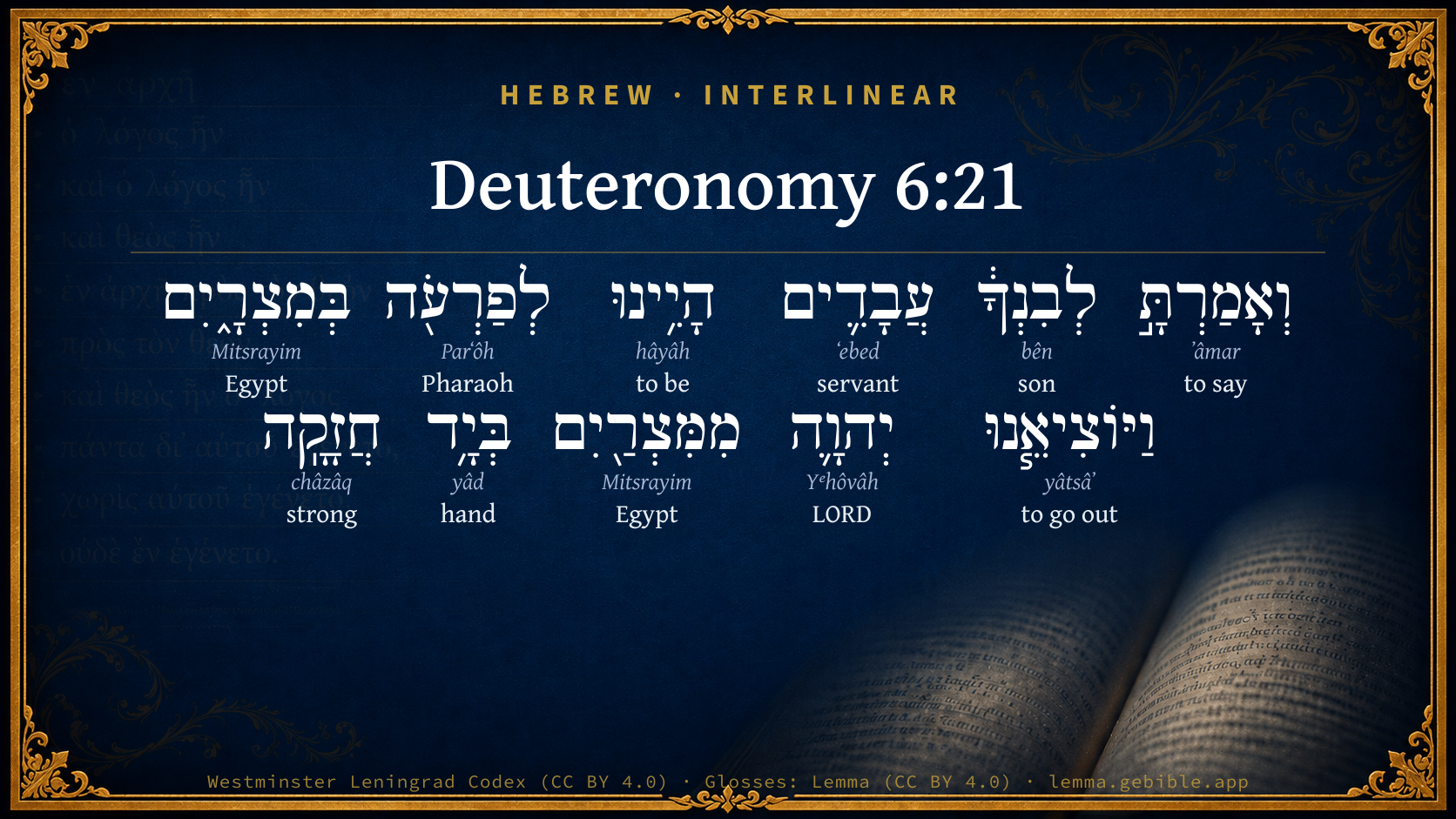
Hebrew (Westminster Leningrad Codex) Deuteronomy 6:21 appears in the Hebrew Old Testament. The text above is from the Westminster Leningrad Codex. Each word links to its Strong’s number, a concise gloss, and parsing drawn from the Open Scriptures Hebrew Bible morphology. Click any word for its full Brown-Driver-Briggs (BDB) entry.
Download image
Cite this verse

Deuteronomy 6:21 (World English Bible). Public Domain. Lemma interlinear Bible study tool, https://lemma.gebible.app/v/deuteronomy/6/21.

Show BibTeX & RIS
BibTeX
RIS
English Translation
then you shall tell your son, We were Pharaoh's bondservants in Egypt: and Yahweh brought us out of Egypt with a mighty hand;
World English Bible · Public Domain
Download a study sheet

One document with this verse’s original text, its word-by-word gloss line, the meaning frame, cross-references with their text, attributed commentary, and full source and license credits — printable, and it pastes into notes with its structure intact.

This verse Autodidact and up

Study sheet (.html) Plain text (.txt)

A passage Seminary Student

Up to 50 verses in one chapter. A passage sheet keeps up to 6 commentary sources and 12 cross-references per verse, in the order this page ranks them, and says so on the sheet whenever that leaves anything out. Ask for a single verse and you get the Autodidact verse sheet above.

Everything on this page stays free to read, with no account — the sheet is a download of what is already on screen, not access to it.

Want to remove ads? Support Godless Engineer
Compare translations 3

The same verse in 3 English versions, stacked beneath the original-language interlinear above. Click any original word for its lexicon entry.

Each is an independent rendering of the whole verse — the interlinear is not word-aligned to these translations.

Highlighted words mark where these versions differ — a whole-verse word diff, not a word-by-word alignment.

  • World English Bible Public Domain
    then you shall tell your son, We were Pharaoh's bondservants in Egypt: and Yahweh brought us out of Egypt with a mighty hand;
  • King James Version Public Domain
    Then thou shalt say unto thy son, We were Pharaoh's bondmen in Egypt; and the LORD brought us out of Egypt with a mighty hand:
  • unfoldingWord Literal Text CC BY-SA 4.0
    Then you shall say to your son, ‘We were slaves of Pharaoh in Egypt. And Yahweh brought us out from Egypt with a mighty hand.

unfoldingWord Literal Text — © unfoldingWord, licensed CC BY-SA 4.0. Word-aligned USFM3 via Door43 (git.door43.org/unfoldingWord/en_ult).

Versions to compare (up to 4)

3 of 4 selected

Show all 18 translations

Every available English version of this verse, each an independent rendering of the whole verse.

  • World English Bible Public Domain
    then you shall tell your son, We were Pharaoh's bondservants in Egypt: and Yahweh brought us out of Egypt with a mighty hand;
  • Berean Standard Bible Public Domain
    then you are to tell him, “We were slaves of Pharaoh in Egypt, but the LORD brought us out of Egypt with a mighty hand.
  • Majority Standard Bible Public Domain
    then you are to tell him, “We were slaves of Pharaoh in Egypt, but the LORD brought us out of Egypt with a mighty hand.
  • King James Version Public Domain
    Then thou shalt say unto thy son, We were Pharaoh's bondmen in Egypt; and the LORD brought us out of Egypt with a mighty hand:
  • American Standard Version (1901) Public Domain
    then thou shalt say unto thy son, We were Pharaoh's bondmen in Egypt: and Jehovah brought us out of Egypt with a mighty hand;
  • Revised Version (1885) Public Domain
    then thou shalt say unto thy son, We were Pharaoh’s bondmen in Egypt; and the LORD brought us out of Egypt with a mighty hand:
  • Geneva Bible (1599) Public Domain
    Then shalt thou say vnto thy sonne, We were Pharaohs bondmen in Egypt: but the Lord brought vs out of Egypt with a mightie hand.
  • Douay-Rheims (1899) Public Domain
    Thou shalt say to him: We were bondmen of Pharao in Egypt, and the Lord brought us out of Egypt with a strong hand.
  • Young's Literal Translation Public Domain
    then thou hast said to thy son, Servants we have been to Pharaoh in Egypt, and Jehovah bringeth us out of Egypt by a high hand;
  • Literal Standard Version CC BY-SA 4.0
    Then you have said to your son, We have been servants of Pharaoh in Egypt, and YHWH brings us out of Egypt by a high hand;
  • Unlocked Literal Bible CC BY-SA 4.0
    then you will say to your son, 'We were Pharaoh's slaves in Egypt; Yahweh brought us out of Egypt with a mighty hand,
  • unfoldingWord Literal Text CC BY-SA 4.0
    Then you shall say to your son, ‘We were slaves of Pharaoh in Egypt. And Yahweh brought us out from Egypt with a mighty hand.
  • Darby Bible Public Domain
    then thou shalt say unto thy son, We were Pharaoh's bondmen in Egypt; and Jehovah brought us out of Egypt with a powerful hand;
  • World Messianic Bible Public Domain
    then you shall tell your son, “We were Pharaoh’s slaves in Egypt. The LORD brought us out of Egypt with a mighty hand;
  • Webster's Bible Public Domain
    Then thou shalt say to thy son, We were Pharoah's bond-men in Egypt: and the LORD brought us out of Egypt with a mighty hand:
  • Free Bible Version CC BY-SA 4.0
    then you are to tell them, “Once we were slaves of Pharaoh in Egypt, but the Lord by his power led us out of Egypt.
  • Bible in Basic English Public Domain
    Then you will say to your son, We were servants under Pharaoh's yoke in Egypt; and the Lord took us out of Egypt with a strong hand:
  • JPS Tanakh (1917) Public Domain
    then thou shalt say unto thy son: 'We were Pharaoh's bondmen in Egypt; and the LORD brought us out of Egypt with a mighty hand.

Literal Standard Version (2020), Covenant Press — licensed CC BY-SA 4.0. Text via the HelloAO Bible API (eBible.org). Unlocked Literal Bible (unfoldingWord) — licensed CC BY-SA 4.0. Text via the HelloAO Bible API (eBible.org). unfoldingWord Literal Text — © unfoldingWord, licensed CC BY-SA 4.0. Word-aligned USFM3 via Door43 (git.door43.org/unfoldingWord/en_ult). Free Bible Version, Dr. Jonathan Gallagher — licensed CC BY-SA 4.0. Text via the HelloAO Bible API (eBible.org).

Word by word

More ways to search: Search by grammar → Find every occurrence → Compare this word →

Practice this passage: Drill this verse → Learn its vocabulary →

חֲזָקָֽה
châzâq
H2389
“strong”
Adjective, Adjective, Feminine, Singular, Absolute
Part of Speech
Adjective
Type
Adjective
Gender
Feminine
Number
Singular
State
Absolute
Full BDB Definition

Origin: from H2388

TWOT: 636a

strong, stout, mighty - strong - severe, sharp, hot - firm, hard - a strong one (substantive)
  1. וְאָמַרְתָּ֣ ʼâmar H559 “and · to say” Conjunction + Verb, Qal, Sequential Perfect, 2nd Person, Masculine, Singular
  2. לְבִנְךָ֔ bên H1121 “to/for · son · your” Preposition + Noun, Common, Masculine, Singular, Construct + Suffix, Personal, 2nd Person, Masculine, Singular
  3. עֲבָדִ֛ים ʻebed H5650 “servants” Noun, Common, Masculine, Plural, Absolute
  4. הָיִ֥ינוּ hâyâh H1961 “to be” Verb, Qal, Perfect, 1st Person, Common, Plural
  5. לְפַרְעֹ֖ה Parʻôh H6547 “to/for · Pharaoh” Preposition + Noun, Proper
  6. בְּמִצְרָ֑יִם Mitsrayim H4714 “in/at · Egypt” Preposition + Noun, Proper
  7. וַיּוֹצִיאֵ֧נוּ yâtsâʼ H3318 “and · to go out · us” Conjunction + Verb, Hiphil, Sequential Imperfect, 3rd Person, Masculine, Singular + Suffix, Personal, 1st Person, Common, Plural
  8. יְהוָ֛ה Yᵉhôvâh H3068 “LORD” Noun, Proper
  9. מִמִּצְרַ֖יִם Mitsrayim H4714 “from · Egypt” Preposition + Noun, Proper
  10. בְּיָ֥ד yâd H3027 “in/at · hand” Preposition + Noun, Common, Both, Singular, Absolute

About this verse

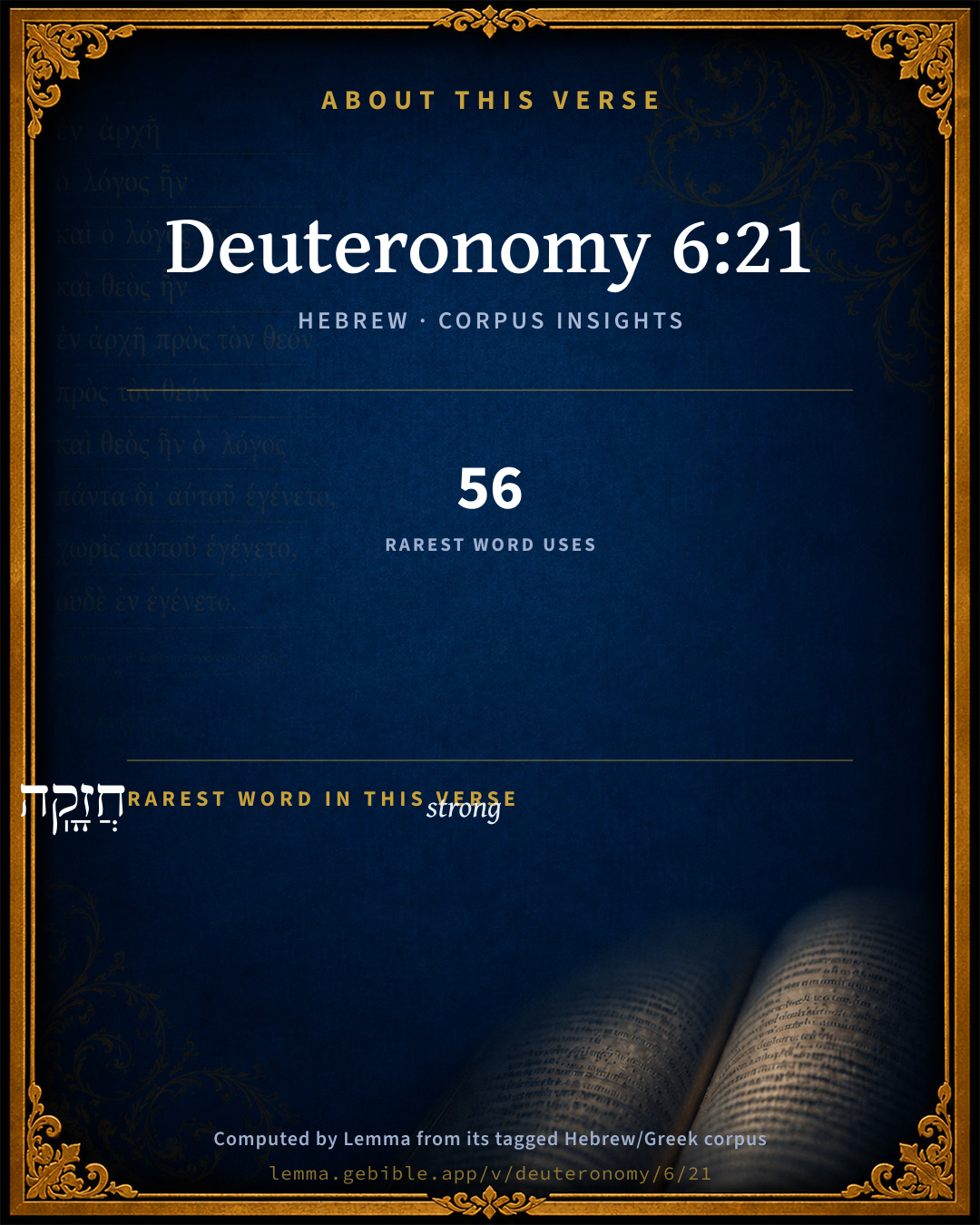
These counts appear in no published source. They are computed here, from the morphology-tagged text and Lemma’s own curated glosses. What Lemma adds →

11
words
10
distinct lemmas
Pentateuch
section

Shared distinctive vocabulary

חֲזָקָֽה strong H2389 occurs in 54 verses of the Hebrew Bible. Also found in:

Grammatical profile

  • 3 verbs
  • 7 nouns
  • 1 adjective

Verb forms

  • וְאָמַרְתָּ֣ Qal · Sequential Perfect
  • הָיִ֥ינוּ Qal · Perfect
  • וַיּוֹצִיאֵ֧נוּ Hiphil · Sequential Imperfect

Repetition

A word recurs within this verse — often emphatic in Hebrew:

  • בְּמִצְרָ֑יִם Egypt H4714 ×2

Hebrew & Septuagint length

In English translation the verse runs 23 words from the Hebrew and 33 from the Septuagint (LXX English) — the Septuagint runs noticeably longer here. See the side-by-side →

A rough comparison of the two English renderings, which tokenize alike — not a word-level alignment.

Word counts can differ between the Hebrew and the Greek without any difference in meaning — e.g. the Hebrew direct-object marker אֵת has no separate Greek word, and Greek often adds the article ὁ.

Cross-references

13

Topical passages linked to Deuteronomy 6:21 in the Treasury of Scripture Knowledge — connected by theme and wording, ordered by reader-vote popularity; previews shown in the World English Bible.

  • Romans 6:17–18 But thanks be to God, that, whereas you were bondservants of sin, you became obedient from the heart to that form of teaching whereunto you were delivered.
  • Ephesians 2:11–12 Therefore remember that once you, the Gentiles in the flesh, who are called "uncircumcision" by that which is called "circumcision," (in the flesh, made by hands);
  • Exodus 20:2 "I am Yahweh your God, who brought you out of the land of Egypt, out of the house of bondage.
  • Deuteronomy 5:6 "I am Yahweh your God, who brought you out of the land of Egypt, out of the house of bondage.
  • Deuteronomy 15:15 You shall remember that you were a bondservant in the land of Egypt, and Yahweh your God redeemed you: therefore I command you this thing today.
  • Exodus 3:19 I know that the king of Egypt won't give you permission to go, no, not by a mighty hand.
  • Exodus 13:3 Moses said to the people, "Remember this day, in which you came out from Egypt, out of the house of bondage; for by strength of hand Yahweh brought you out from this place. No leavened bread shall be eaten.
  • Deuteronomy 5:15 You shall remember that you were a servant in the land of Egypt, and Yahweh your God brought you out of there by a mighty hand and by an outstretched arm: therefore Yahweh your God commanded you to keep the Sabbath day.
  • Deuteronomy 26:5–9 You shall answer and say before Yahweh your God, A Syrian ready to perish was my father; and he went down into Egypt, and sojourned there, few in number; and he became there a nation, great, mighty, and populous.
  • Nehemiah 9:9–10 You saw the affliction of our fathers in Egypt, and heard their cry by the Red Sea,
  • Psalms 136:10–12 To him who struck down the Egyptian firstborn; For his loving kindness endures forever;
  • Isaiah 51:1 Listen to me, you who follow after righteousness, you who seek Yahweh: look to the rock whence you were hewn, and to the hold of the pit whence you were dug.
  • Jeremiah 32:20–21 who performed signs and wonders in the land of Egypt, even to this day, both in Israel and among [other] men; and made you a name, as in this day;

Cross-references courtesy of OpenBible.info (CC BY 4.0).

Hebrew and Greek witnesses Masoretic Hebrew ↔ Greek Septuagint

The same verse in the two great witnesses to the Old Testament, shown verse-for-verse.

Here the Septuagint runs noticeably longer than the Hebrew — LXX2012 (modern English Septuagint) 33 words vs World English Bible 23. A rough length comparison of the two English translations, not a word-level alignment — read both below.

These are two independent witnesses, not word-aligned to each other, and the Septuagint is shown in lemma (dictionary) form.

Hebrew Deuteronomy 6:21 Masoretic · Westminster Leningrad Codex

וְאָמַרְתָּ֣ לְבִנְךָ֔ עֲבָדִ֛ים הָיִ֥ינוּ לְפַרְעֹ֖ה בְּמִצְרָ֑יִם וַיּוֹצִיאֵ֧נוּ יְהוָ֛ה מִמִּצְרַ֖יִם בְּיָ֥ד חֲזָקָֽה

then you shall tell your son, We were Pharaoh's bondservants in Egypt: and Yahweh brought us out of Egypt with a mighty hand;

World English Bible · Public Domain

Greek LXX Deuteronomy 6:21 Septuagint · lemma form

καί εἶπον ὁ υἱός σύ οἰκέτης εἰμί ὁ φαραώ ἐν γῆ αἴγυπτος καί ἐκἄγω ἐγώ κύριος ἐκεῖθεν ἐν χείρ κραταιός καί ἐν βραχίων ὑψηλός

Then shall you say to your son, We were slaves to Pharao in the land of Egypt, and the Lord brought us forth thence with a mighty hand, and with a high arm.

LXX2012 (modern English Septuagint) · Public Domain

Hebrew: Westminster Leningrad Codex (CC BY 4.0). Greek: Septuagint (public domain); English from LXX2012 (modern English Septuagint) (Public Domain). How the Septuagint differs from the Hebrew →

Targum (Aramaic paraphrase)

2

The Targum is the ancient Jewish Aramaic paraphrase of the Hebrew Scriptures — an interpretive translation, not the Hebrew text itself. Onkelos (literal) and Pseudo-Jonathan (expansive) render the Torah, and Jonathan the Prophets. Coverage is partial: where no permissively-licensed English translation exists for a verse, only the Aramaic is shown. This is verse-level text, not a word-by-word alignment to the Hebrew.

  1. Targum Onkelos Torah (Genesis–Deuteronomy)
    וְתֵימַר לִבְרָךְ עַבְדִין הֲוֵינָא לְפַרְעֹה בְּמִצְרָיִם וְאַפְּקָנָא יְיָ מִמִצְרַיִם בִּידָא תַקִיפָא

    (no public-domain English translation for this verse)

    Targum Onkelos — Aramaic: “Onkelos Genesis” (public domain); “Onkelos Exodus” (public domain); “Onkelos Leviticus” (public domain); “Onkelos Numbers” (public domain); “Onkelos Deuteronomy” (public domain). English: “Sefaria Community Translation” (CC0 1.0 (public-domain dedication)); “J.W. Etheridge. The Targums of Onkelos and Jonathan Ben Uzziel on the Pentateuch. London: Longmans, Green, 1862” (public domain). Text via Sefaria.

  2. Targum Pseudo-Jonathan Torah (Genesis–Deuteronomy)
    וְתֵימְרוּן לִבְנֵיכוֹן מְשַׁעְבְּדִין הֲוֵינָן לְפַרְעה בְּמִצְרָיִם וְאַפֵּיקָנָא מֵימְרָא דַיְיָ מִמִּצְרַיִם בִּידָא תַּקִיפְתָּא

    then shall you say to your sons, We were servants to Pharoh in Mizraim,

    Targum Pseudo-Jonathan — Aramaic: “Targum Jonathan on Genesis” (public domain); “Targum Jonathan on Exodus” (public domain); “Targum Jonathan on Leviticus” (public domain); “Targum Jonathan on Numbers” (public domain); “Targum Jonathan on Deuteronomy” (public domain). English: “The Targum of Jonathan ben Uzziel, trans. J. W. Etheridge, London, 1862” (public domain). Text via Sefaria.

Commentary

Notes on Deuteronomy 6:21 from classic Christian and Jewish commentators (each source and its license shown beneath its notes). The classic Christian expositions comment on the surrounding passage and are grouped to its opening verse, so a note may address several verses; the Jewish commentaries on the Tanakh (Rashi and others) are per-verse, so they appear only where the commentator wrote on this verse.

Lemma curates 59 commentaries, every one of them public domain or Creative Commons licensed, each selected and text-cleaned for this edition rather than reprinted as found. About our sources →

Tyndale Open Study Notes

Tyndale Open Resources

6:21 The phrase his strong hand is an anthropomorphism (see study note on 8:2).

Tyndale Open Study Notes — © Tyndale Open Resources, licensed CC BY-SA 4.0. Text via the HelloAO Bible API.

Ellicott's Commentary for English Readers

(21) The Lord brought us out of Egypt.—The simple explanation of the obligations of the Law given in these verses is based upon the message of Jehovah to Israel from Sinai. in Exo_19:3-6 : “Ye have seen what I did unto the Egyptians, and how Ì bare you on eagles’ wings, and brought you unto myself. Now therefore, if ye will obey my voice indeed, and keep my covenant, then ye shall be a peculiar treasure unto me.” The keeping of the Law of Jehovah by Israel as a nation in the land that He gave them was the final cause of their national existence. This fundamental fact must never be forgotten. This alone would justify what had been done to Egypt. Hence the neglect of the Law must inevitably bring down the Divine vengeance.

A Bible Commentary for English Readers, edited by Charles John Ellicott (1878–1897) — public domain. Text from a community e-Sword module.

The Cambridge Bible for Schools and Colleges

gen. ed. J. J. S. Perowne

21. bondmen] See on Deu_5:6.

mighty hand] See on Deu_4:34.

The Cambridge Bible for Schools and Colleges (gen. ed. J. J. S. Perowne; Cambridge University Press, 1878–1918) — public domain. Text from a community e-Sword module.

John Gill's Exposition

In order to lead him into the spring and original of them, and to acquaint him with the goodness of God, which laid them under obligation to observe them:

we were Pharaoh's bondmen in Egypt; were brought into bondage and slavery to Pharaoh king of Egypt, into whose country their ancestors came, and where they resided many years, and at length were reduced to the utmost servitude and misery:

and the Lord brought us out of Egypt with a mighty hand; by the exertion of his mighty power, which the Egyptians and their king could not withstand, as a token of his care and kindness to us; by the ties of which we are bound in gratitude to observe his commands. The Targum of Jonathan is,"the Word of the Lord brought us, &c.''and it was Christ the Son of God that was from first to last concerned in that affair, even from the appearance to Moses in the bush to Israel's coming out of Egypt.

John Gill's Exposition of the Whole Bible (1746–1763) — public domain (CC PDM 1.0). Text via the HelloAO Bible API.

Lesson kit

Teaching starters — assembled from the data on this page, not authored interpretation. Every prompt links to the verse data it draws on. Edit before teaching.

Deuteronomy, in the Pentateuch, opens this verse with 11 words (10 distinct Hebrew lemmas). Its most distinctive word is châzâq (“strong”). The Greek Septuagint runs longer here. A historical commentator’s framing appears above. Read the whole chapter for the surrounding context.

Discussion questions

  1. The word châzâq carries the sense “strong.” How does it shape the verse?
  2. Exodus 3:19 shares the word «strong» with this verse. How do the two illuminate each other?
  3. “Egypt” occurs 2× in this one verse. What is the effect of the repetition?
  4. Compared with the Hebrew, the Septuagint runs longer here. What questions does that raise?
  5. The translations on this page render this verse differently — a whole-verse word diff, not a word-by-word alignment. What might account for the different wordings?
  6. The verb «וְאָמַרְתָּ֣» is Qal Sequential Perfect. How does its form color the action?
  7. Reading how Tyndale Open Study Notes and Ellicott's Commentary for English Readers read this verse, where do the two commentators agree and where do they part?

Things to notice

Reading settings

Reading text

Shown beneath each verse's original-language words.

Old Testament
Old Testament edition

Read the OT as the Masoretic Hebrew (MT) or the Greek Septuagint (LXX).

English shown for the Greek Septuagint (in the Hebrew ↔ Greek comparison).

Comparing translations? Open the Compare panel on any verse page to stack up to four side by side.