
Zechariah 10:11

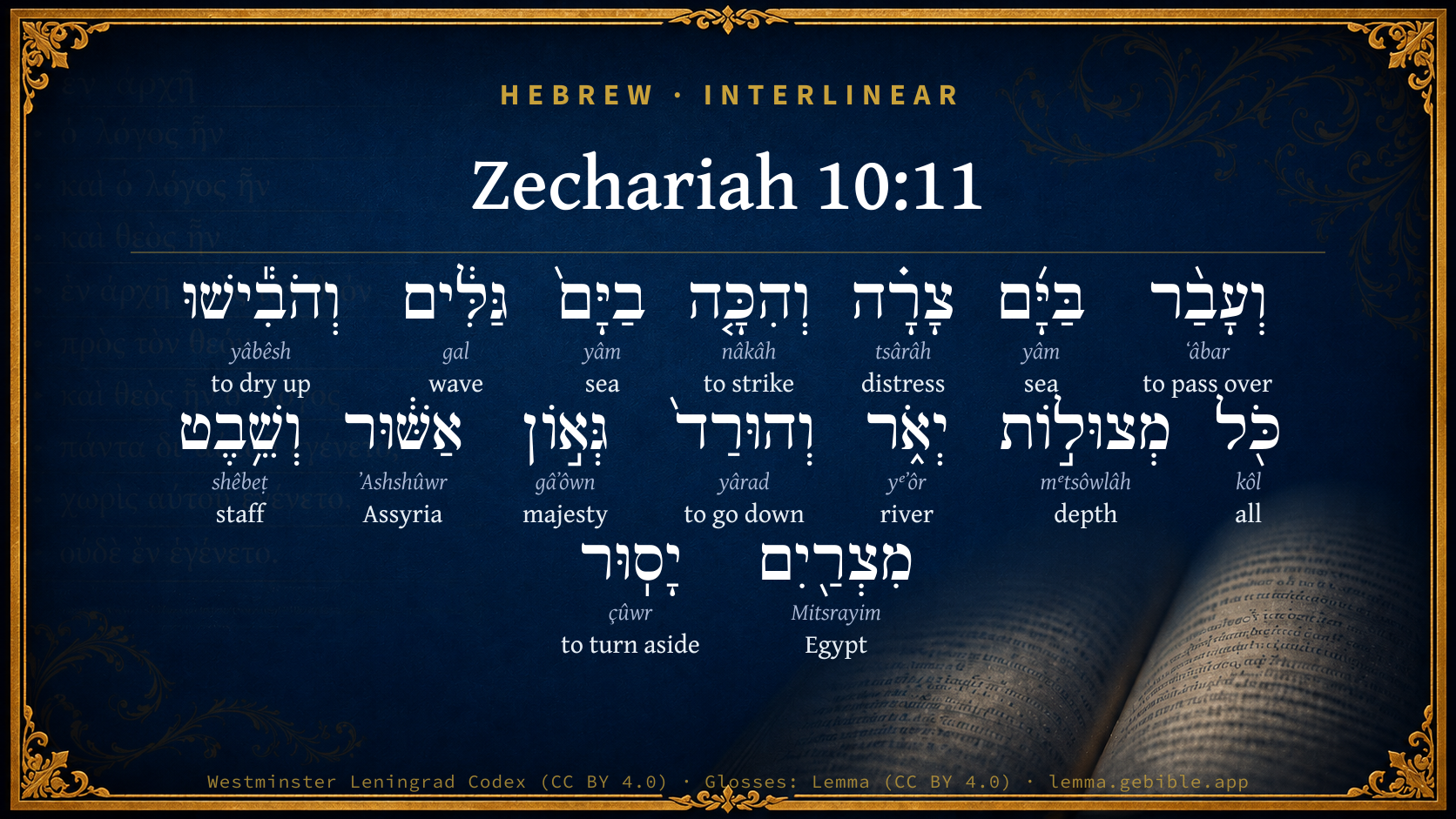
Hebrew (Westminster Leningrad Codex) Zechariah 10:11 appears in the Hebrew Old Testament. The text above is from the Westminster Leningrad Codex. Each word links to its Strong’s number, a concise gloss, and parsing drawn from the Open Scriptures Hebrew Bible morphology. Click any word for its full Brown-Driver-Briggs (BDB) entry.
Download image
Cite this verse

Zechariah 10:11 (World English Bible). Public Domain. Lemma interlinear Bible study tool, https://lemma.gebible.app/v/zechariah/10/11.

Show BibTeX & RIS
BibTeX
RIS
English Translation
He will pass through the sea of affliction, And will strike the waves in the sea, And all the depths of the Nile will dry up; And the pride of Assyria will be brought down, And the scepter of Egypt will depart.
World English Bible · Public Domain
Download a study sheet

One document with this verse’s original text, its word-by-word gloss line, the meaning frame, cross-references with their text, attributed commentary, and full source and license credits — printable, and it pastes into notes with its structure intact.

This verse Autodidact and up

Study sheet (.html) Plain text (.txt)

A passage Seminary Student

Up to 50 verses in one chapter. A passage sheet keeps up to 6 commentary sources and 12 cross-references per verse, in the order this page ranks them, and says so on the sheet whenever that leaves anything out. Ask for a single verse and you get the Autodidact verse sheet above.

Everything on this page stays free to read, with no account — the sheet is a download of what is already on screen, not access to it.

Want to remove ads? Support Godless Engineer
Compare translations 3

The same verse in 3 English versions, stacked beneath the original-language interlinear above. Click any original word for its lexicon entry.

Each is an independent rendering of the whole verse — the interlinear is not word-aligned to these translations.

Highlighted words mark where these versions differ — a whole-verse word diff, not a word-by-word alignment.

  • World English Bible Public Domain
    He will pass through the sea of affliction, And will strike the waves in the sea, And all the depths of the Nile will dry up; And the pride of Assyria will be brought down, And the scepter of Egypt will depart.
  • King James Version Public Domain
    And he shall pass through the sea with affliction, and shall smite the waves in the sea, and all the deeps of the river shall dry up: and the pride of Assyria shall be brought down, and the sceptre of Egypt shall depart away.
  • unfoldingWord Literal Text CC BY-SA 4.0
    I will pass through the sea of their affliction; I will strike the waves of that sea and will dry up all the depths of the Nile. The majesty of Assyria will be brought down, and the scepter of Egypt will go away from the Egyptians.

unfoldingWord Literal Text — © unfoldingWord, licensed CC BY-SA 4.0. Word-aligned USFM3 via Door43 (git.door43.org/unfoldingWord/en_ult).

Versions to compare (up to 4)

3 of 4 selected

Show all 18 translations

Every available English version of this verse, each an independent rendering of the whole verse.

  • World English Bible Public Domain
    He will pass through the sea of affliction, And will strike the waves in the sea, And all the depths of the Nile will dry up; And the pride of Assyria will be brought down, And the scepter of Egypt will depart.
  • Berean Standard Bible Public Domain
    They will pass through the sea of distress and strike the waves of the sea; all the depths of the Nile will dry up. The pride of Assyria will be brought down, and the scepter of Egypt will depart.
  • Majority Standard Bible Public Domain
    They will pass through the sea of distress and strike the waves of the sea; all the depths of the Nile will dry up. The pride of Assyria will be brought down, and the scepter of Egypt will depart.
  • King James Version Public Domain
    And he shall pass through the sea with affliction, and shall smite the waves in the sea, and all the deeps of the river shall dry up: and the pride of Assyria shall be brought down, and the sceptre of Egypt shall depart away.
  • American Standard Version (1901) Public Domain
    And he will pass through the sea of affliction, and will smite the waves in the sea, and all the depths of the Nile shall dry up; and the pride of Assyria shall be brought down, and the sceptre of Egypt shall depart.
  • Revised Version (1885) Public Domain
    And he shall pass through the sea of affliction, and shall smite the waves in the sea, and all the depths of the Nile shall dry up: and the pride of Assyria shall be brought down, and the sceptre of Egypt shall depart away.
  • Geneva Bible (1599) Public Domain
    And he shall goe into the sea with affliction, and shall smite the waues in the sea, and all the depthes of the riuer shall drye vp: and the pride of Asshur shall be cast downe, and the scepter of Egypt shall depart away.
  • Douay-Rheims (1899) Public Domain
    And he shall pass over the strait of the sea, and shall strike the waves in the sea, and all the depths of the river shall be confounded, and the pride of Assyria shall be humbled, and the sceptre of Egypt shall depart.
  • Young's Literal Translation Public Domain
    And He hath passed over through the sea, And hath pressed and smitten billows in the sea, And dried up have been all depths of a flood, And brought down hath been the excellency of Asshur, And the rod of Egypt doth turn aside.
  • Literal Standard Version CC BY-SA 4.0
    And He has passed over through the sea, || And has pressed and struck billows in the sea, || And all depths of a flood have been dried up, || And the excellence of Asshur has been brought down, || And the rod of Egypt turns aside.
  • Unlocked Literal Bible CC BY-SA 4.0
    I will pass through the sea of their affliction; I will strike the waves of that sea and will dry up all the depths of the Nile. The majesty of Assyria will be brought down, and the scepter of Egypt will go away from the Egyptians.
  • unfoldingWord Literal Text CC BY-SA 4.0
    I will pass through the sea of their affliction; I will strike the waves of that sea and will dry up all the depths of the Nile. The majesty of Assyria will be brought down, and the scepter of Egypt will go away from the Egyptians.
  • Darby Bible Public Domain
    And he shall pass through the sea of affliction, and shall smite the billows in the sea, and all the depths of the Nile shall dry up; and the pride of Assyria shall be brought down, and the sceptre of Egypt shall depart away.
  • World Messianic Bible Public Domain
    He will pass through the sea of affliction, and will strike the waves in the sea, and all the depths of the Nile will dry up; and the pride of Assyria will be brought down, and the scepter of Egypt will depart.
  • Webster's Bible Public Domain
    And he shall pass through the sea with affliction, and shall smite the waves in the sea, and all the deeps of the river shall dry up: and the pride of Assyria shall be brought down, and the scepter of Egypt shall depart.
  • Free Bible Version CC BY-SA 4.0
    They will pass through the sea of trouble and strike the waves of the sea, and the waters of the Nile will dry up. Assyria's pride will be brought down, and Egypt's rule will pass away.
  • Bible in Basic English Public Domain
    And they will go through the sea of Egypt, and all the deep waters of the Nile will become dry: and the pride of Assyria will be made low, and the power of Egypt will be taken away.
  • JPS Tanakh (1917) Public Domain
    And over the sea affliction shall pass, and the waves shall be smitten in the sea, and all the depths of the Nile shall dry up; and the pride of Assyria shall be brought down, and the sceptre of Egypt shall depart away.

Literal Standard Version (2020), Covenant Press — licensed CC BY-SA 4.0. Text via the HelloAO Bible API (eBible.org). Unlocked Literal Bible (unfoldingWord) — licensed CC BY-SA 4.0. Text via the HelloAO Bible API (eBible.org). unfoldingWord Literal Text — © unfoldingWord, licensed CC BY-SA 4.0. Word-aligned USFM3 via Door43 (git.door43.org/unfoldingWord/en_ult). Free Bible Version, Dr. Jonathan Gallagher — licensed CC BY-SA 4.0. Text via the HelloAO Bible API (eBible.org).

Word by word

More ways to search: Search by grammar → Find every occurrence → Compare this word →

Practice this passage: Drill this verse → Learn its vocabulary →

מְצוּל֣וֹת
mᵉtsôwlâh
H4688
“depths of”
Noun, Common, Feminine, Plural, Construct
Part of Speech
Noun
Type
Common
Gender
Feminine
Number
Plural
State
Construct
Full BDB Definition

Origin: from the same as H6683

TWOT: 1889b

depth, the deep, the deep sea
  1. וְעָבַ֨ר ʻâbar H5674 “and · to pass over” Conjunction + Verb, Qal, Perfect, 3rd Person, Masculine, Singular
  2. בַּיָּ֜ם yâm H3220 “in/at the · sea” Preposition, Determined + Noun, Common, Masculine, Singular, Absolute
  3. צָרָ֗ה tsârâh H6869 “distress” Noun, Common, Feminine, Singular, Absolute
  4. וְהִכָּ֤ה nâkâh H5221 “and · to strike” Conjunction + Verb, Hiphil, Perfect, 3rd Person, Masculine, Singular
  5. בַיָּם֙ yâm H3220 “in/at the · sea” Preposition, Determined + Noun, Common, Masculine, Singular, Absolute
  6. גַּלִּ֔ים gal H1530 “waves” Noun, Common, Masculine, Plural, Absolute
  7. וְהֹבִ֕ישׁוּ yâbêsh H3001 “and · to dry up” Conjunction + Verb, Hiphil, Perfect, 3rd Person, Common, Plural
  8. כֹּ֖ל kôl H3605 “all of” Noun, Common, Masculine, Singular, Construct
  9. יְאֹ֑ר yᵉʼôr H2975 “river” Noun, Proper
  10. וְהוּרַד֙ yârad H3381 “and · to go down” Conjunction + Verb, Hophal, Perfect, 3rd Person, Masculine, Singular
  11. גְּא֣וֹן gâʼôwn H1347 “majesty of” Noun, Common, Masculine, Singular, Construct
  12. אַשּׁ֔וּר ʼAshshûwr H804 “Assyria” Noun, Proper
  13. וְשֵׁ֥בֶט shêbeṭ H7626 “and · staff of” Conjunction + Noun, Common, Masculine, Singular, Construct
  14. מִצְרַ֖יִם Mitsrayim H4714 “Egypt” Noun, Proper
  15. יָסֽוּר çûwr H5493 “to turn aside” Verb, Qal, Imperfect, 3rd Person, Masculine, Singular

About this verse

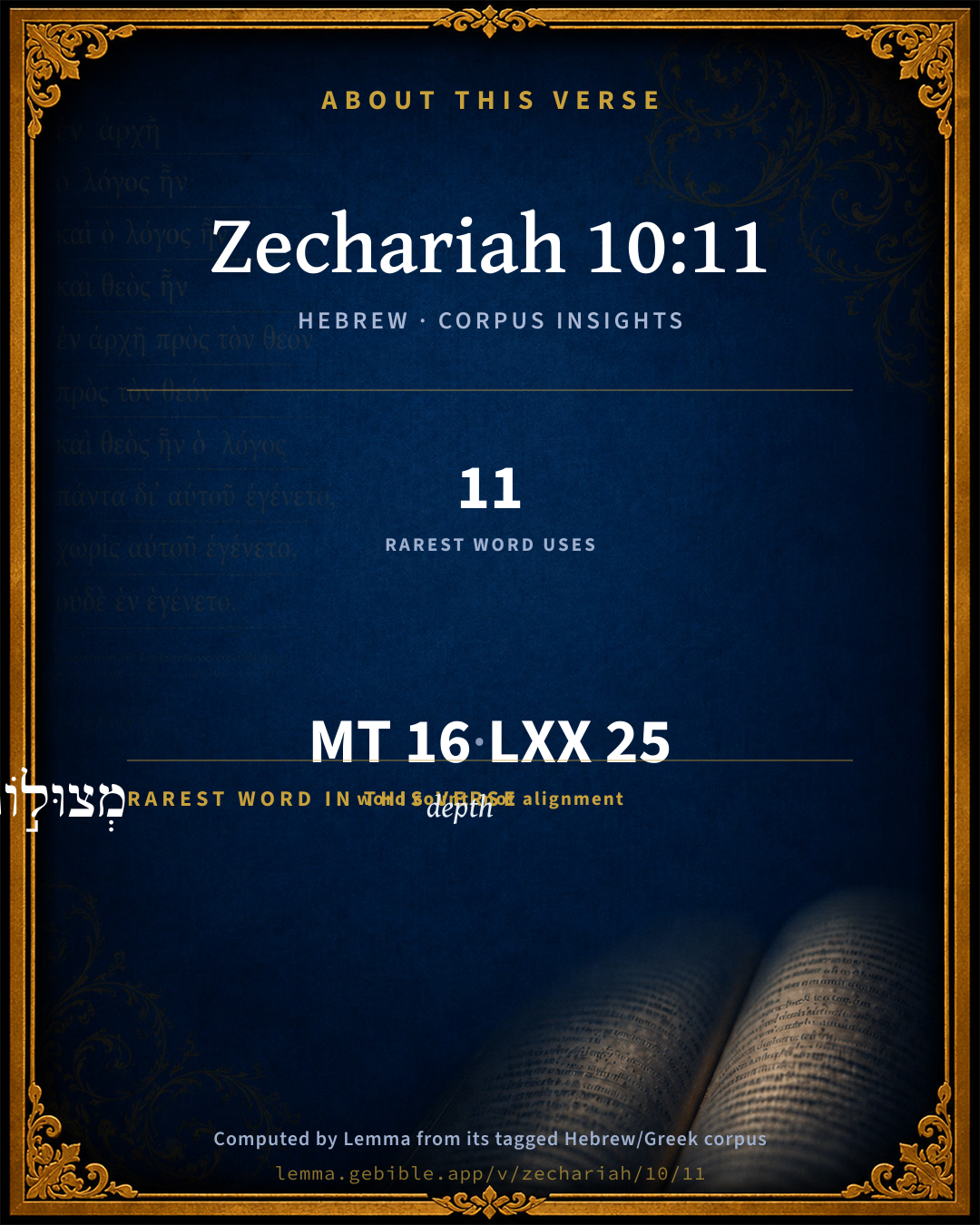
These counts appear in no published source. They are computed here, from the morphology-tagged text and Lemma’s own curated glosses. What Lemma adds →

16
words
15
distinct lemmas
Prophets
section

Notable vocabulary

The rarest word here is מְצוּל֣וֹת depth H4688 — appearing just 11 times in the whole Hebrew Bible.

Shared distinctive vocabulary

מְצוּל֣וֹת depth H4688 occurs in 11 verses of the Hebrew Bible. Also found in:

Grammatical profile

  • 5 verbs
  • 11 nouns

Verb forms

  • וְעָבַ֨ר Qal · Perfect
  • וְהִכָּ֤ה Hiphil · Perfect
  • וְהֹבִ֕ישׁוּ Hiphil · Perfect
  • וְהוּרַד֙ Hophal · Perfect
  • יָסֽוּר Qal · Imperfect

Repetition

A word recurs within this verse — often emphatic in Hebrew:

  • בַּיָּ֜ם sea H3220 ×2

Hebrew & Septuagint length

In English translation the verse runs 42 words from the Hebrew and 47 from the Septuagint (LXX English) — closely comparable.

A rough comparison of the two English renderings, which tokenize alike — not a word-level alignment.

Word counts can differ between the Hebrew and the Greek without any difference in meaning — e.g. the Hebrew direct-object marker אֵת has no separate Greek word, and Greek often adds the article ὁ.

In the original languages it is 16 Hebrew tokens and 25 Greek tokens — but the two are counted differently (Hebrew bundles its prefixes and suffixes into one token; the Greek is in lemma form), so that isn’t a like-for-like length.

Cross-references

21

Topical passages linked to Zechariah 10:11 in the Treasury of Scripture Knowledge — connected by theme and wording, ordered by reader-vote popularity; previews shown in the World English Bible.

  • Ezekiel 30:13 Thus says the Lord Yahweh: I will also destroy the idols, and I will cause the images to cease from Memphis; and there shall be no more a prince from the land of Egypt: and I will put a fear in the land of Egypt.
  • Isaiah 43:2 When you pass through the waters, I will be with you; and through the rivers, they shall not overflow you: when you walk through the fire, you shall not be burned, neither shall the flame kindle on you.
  • Micah 5:5–6 He will be our peace when Assyria invades our land, And when he marches through our fortresses, Then we will raise against him seven shepherds, And eight leaders of men.
  • Exodus 14:21–22 Moses stretched out his hand over the sea, and Yahweh caused the sea to go back by a strong east wind all the night, and made the sea dry land, and the waters were divided.
  • Psalms 66:10–12 For you, God, have tested us. You have refined us, as silver is refined.
  • Psalms 114:3 The sea saw it, and fled. The Jordan was driven back.
  • Isaiah 11:15–16 Yahweh will utterly destroy the tongue of the Egyptian sea; and with his scorching wind will he wave his hand over the River, and will strike it into seven streams, and cause men to march over in sandals.
  • Isaiah 51:10 Isn't it you who dried up the sea, the waters of the great deep; who made the depths of the sea a way for the redeemed to pass over?
  • Zephaniah 2:13 He will stretch out his hand against the north, destroy Assyria, and will make Nineveh a desolation, and dry like the wilderness.
  • Revelation 16:12 The sixth poured out his bowl on the great river, the Euphrates. Its water was dried up, that the way might be made ready for the kings that come from the sunrise.
  • Exodus 14:27–28 Moses stretched out his hand over the sea, and the sea returned to its strength when the morning appeared; and the Egyptians fled against it. Yahweh overthrew the Egyptians in the midst of the sea.
  • Joshua 3:15–17 and when those who bore the ark were come to the Jordan, and the feet of the priests who bore the ark were dipped in the brink of the water (for the Jordan overflows all its banks all the time of harvest),
  • 2 Kings 2:8 Elijah took his mantle, and wrapped it together, and struck the waters, and they were divided here and there, so that they two went over on dry ground.
  • 2 Kings 2:14 He took the mantle of Elijah that fell from him, and struck the waters, and said, Where is Yahweh, the God of Elijah? and when he also had struck the waters, they were divided here and there; and Elisha went over.
  • Ezra 6:22 and kept the feast of unleavened bread seven days with joy: for Yahweh had made them joyful, and had turned the heart of the king of Assyria to them, to strengthen their hands in the work of the house of God, the God of Israel.
  • Psalms 77:16–20 The waters saw you, God. The waters saw you, and they writhed. The depths also convulsed.
  • Psalms 114:5 What was it, you sea, that you fled? You Jordan, that you turned back?
  • Isaiah 14:25 that I will break the Assyrian in my land, and on my mountains tread him under foot: then shall his yoke depart from off them, and his burden depart from off their shoulder.
  • Isaiah 19:5–7 The waters shall fail from the sea, and the river shall be wasted and become dry.
  • Isaiah 42:15–16 I will lay waste mountains and hills, and dry up all their herbs; and I will make the rivers islands, and will dry up the pools.
  • Ezekiel 29:14–16 and I will bring back the captivity of Egypt, and will cause them to return into the land of Pathros, into the land of their birth; and they shall be there a base kingdom.

Cross-references courtesy of OpenBible.info (CC BY 4.0).

Hebrew and Greek witnesses Masoretic Hebrew ↔ Greek Septuagint

The same verse in the two great witnesses to the Old Testament, shown verse-for-verse.

These are two independent witnesses, not word-aligned to each other, and the Septuagint is shown in lemma (dictionary) form.

Hebrew Zechariah 10:11 Masoretic · Westminster Leningrad Codex

וְעָבַ֨ר בַּיָּ֜ם צָרָ֗ה וְהִכָּ֤ה בַיָּם֙ גַּלִּ֔ים וְהֹבִ֕ישׁוּ כֹּ֖ל מְצוּל֣וֹת יְאֹ֑ר וְהוּרַד֙ גְּא֣וֹן אַשּׁ֔וּר וְשֵׁ֥בֶט מִצְרַ֖יִם יָסֽוּר

He will pass through the sea of affliction, And will strike the waves in the sea, And all the depths of the Nile will dry up; And the pride of Assyria will be brought down, And the scepter of Egypt will depart.

World English Bible · Public Domain

Greek LXX Zechariah 10:11 Septuagint · lemma form

καί διαἔρχομαι ἐν θάλασσα στενός καί πατάσσω ἐν θάλασσα κῦμα καί ξηραίνω πᾶς ὁ βάθος ποταμός καί ἀποαἱρέω πᾶς ὕβρις ἀσσύριος καί σκῆπτρον αἴγυπτος περιαἱρέω

And they shall pass through a narrow sea, they shall strike the waves in the sea, and all the deep places of the rivers shall be dried up: and all the pride of the Assyrians shall be taken away, and the sceptre of Egypt shall be removed.

LXX2012 (modern English Septuagint) · Public Domain

On this verse, Joseph Benson's Commentary discusses the Septuagint’s reading. Read the note in Commentary ↓

Hebrew: Westminster Leningrad Codex (CC BY 4.0). Greek: Septuagint (public domain); English from LXX2012 (modern English Septuagint) (Public Domain). How the Septuagint differs from the Hebrew →

Targum (Aramaic paraphrase)

1

The Targum is the ancient Jewish Aramaic paraphrase of the Hebrew Scriptures — an interpretive translation, not the Hebrew text itself. Onkelos (literal) and Pseudo-Jonathan (expansive) render the Torah, and Jonathan the Prophets. Coverage is partial: where no permissively-licensed English translation exists for a verse, only the Aramaic is shown. This is verse-level text, not a word-by-word alignment to the Hebrew.

  1. Targum Jonathan Prophets (Joshua–Malachi)
    וְיִתְעַבְּדוּן לְהוֹן נִסִין וּגְבוּרָן כְּמָא דְאִתְעֲבִידוּ לַאֲבָהָתְכוֹן בְּיַמָא וְיֶחֱזוּן בְּפוּרְעֲנוּת סָנְאֵיהוֹן כְּמָא דְאִיטְרָפוּ גִבָּרַיָא כְּגַלֵי יַמָא וְיִבְהֲתוּן כָּל מַלְכֵי עַמְמַיָא וְיִבַּטֵיל תּוּקְפָא מֵאַתּוּרָאָה וְשִׁלְטָן מִצְרַיִם יֶעְדֵי:

    (no public-domain English translation for this verse)

    Targum Jonathan — Aramaic: “Mikraot Gedolot” (public domain). English: “Sefaria Community Translation” (CC0 1.0 (public-domain dedication)); “London "Chaldee Paraphrase," 1871” (public domain). Text via Sefaria.

Commentary

Notes on Zechariah 10:11 from classic Christian and Jewish commentators (each source and its license shown beneath its notes). The classic Christian expositions comment on the surrounding passage and are grouped to its opening verse, so a note may address several verses; the Jewish commentaries on the Tanakh (Rashi and others) are per-verse, so they appear only where the commentator wrote on this verse.

Lemma curates 59 commentaries, every one of them public domain or Creative Commons licensed, each selected and text-cleaned for this edition rather than reprinted as found. About our sources →

Trapp's Complete Commentary

John Trapp

Zec 10:11 And he shall pass through the sea with affliction, and shall smite the waves in the sea, and all the deeps of the river shall dry up: and the pride of Assyria shall be brought down, and the sceptre of Egypt shall depart away.

Ver. 11. And he shall pass through the sea, &c.] Who shall? The people, for want of room saith Junius; they shall enlarge their quarter into Egypt, Assyria and other nations subduing them to Christ. God shall (say others and I think better), he shall fright the sea, and miraculously deliver his people, as once he did at the Red Sea, which threatened to swallow them, but God made it to preserve them. He will remove all rubs and remoras, all obstacles and impediments; neither Egypt nor Assyria shall be able to hinder what God will have done. See Isa 11:15. The misunderstanding of this and the like texts to this might haply occasion that unhappiness that befell the Jews in Crete, A. D. 434. The devil, under the name of Moses (whom he impersonated), persuaded those poor creatures that he was sent from God, to bring them home again to their own country. This they soon believed (as they are wondrously apt to work themselves into the fool’s paradise of a sublime dotage), and, leaving all their goods to others, followed this seducer (who spent a whole year in travelling over the country for the purpose), together with their wives and children, to the top of a steep rock that hung over the sea. Thither when they were come, this mock-Moses commanded them to wrap their heads in their upper garments, and so to throw themselves from the rock toward the sea, assuring them of a safe passage. They readily obeyed him; and in that way perished a great many of them. And more had followed, but that (as God would have it) some Christian fishermen, being there at that instant, took up some of them as they were floating upon the waves and ready to perish; who afterwards returning to the rest of the Jews, told them how they had been cheated, and how narrowly they had escaped; whereupon they being all enraged (as they had reason), sought for this seducer to put him to death. But when he could not possibly be found anywhere, they soon concluded that it was the very devil, that old manslayer; and many of them, moved by this calamity, became Christians. The Jews generally believe that their Messiah when he cometh shall do such miracles as Moses wrought at the Red Sea. They tell us also that in the time of the Maccabees many Jews that had fled into Greece passed through the narrow sea of Propontis, that runs between Chalcedon and Constantinople, to go back into their own country.

And all the deeps of the rivers shall dry up] As once Jordan did before Joshua and the people; and as, Rev 16:12, Euphrates shall do before those kings of the east, which some make to be the eastern Jews; and the drying up of Euphrates to be the downfall of the Turkish empire. Event will be the best interpreter when all is done.

John Trapp, A Commentary or Exposition upon All the Books of the Old and New Testament (1647–1656) — public domain. Text from a community e-Sword module.

Joseph Benson's Commentary

Zec 10:11-12. And he shall pass through the sea with affliction — The sense might be more properly expressed, And he [Israel] shall pass through the straits of the sea: so the LXX. and the Vulgate understand the word. And [God] shall smite the waves of the sea, &c. — The expressions allude to the miraculous passage of the Israelites through the Red sea, and the river Jordan; and to God’s destroying the Egyptians, and the Assyrian, or Babylonian empire, in order to the deliverance of his people. And the verse imports that God would, in a future time, do as great things for them as he had done formerly for their fathers. In this sense the Chaldee expounds the word. Egypt and Assyria, it must be observed, being two potent kingdoms, bordering upon Judea, and being by turns either allies to the Jews, or their conquerors; and the Jews frequently either going thither for refuge, or being carried thither as captives; therefore, when the prophets foretel the general restoration of the Jewish nation, they often express it by their returning from Egypt and Assyria. We may observe, likewise, that God’s bringing his people again from these countries, and especially from Egypt, was a proverbial expression to signify any deliverance, as great or greater than these. Thus, the next clause, And the pride of Assyria shall be brought down, and the sceptre of Egypt shall depart, signifies, the enemies of God and his truth shall all be subdued, and broken in pieces, when Christ shall come in his glorious power to set up his kingdom on the earth: see Dan 2:33-34; Isa 60:12.

And I will strengthen them in the Lord — That is, I will strengthen them in myself, or I will be their helper, and give them all needful strength and protection. And they shall walk up and down in his name, saith the Lord — Their evils and actions shall be under the influence of his grace, and under the government of his laws, and he shall give them success answerable to their upright intentions.

Joseph Benson's Commentary on the Old and New Testaments (1811–1818) — public domain. Text from a community e-Sword module.

Keil & Delitzsch

C. F. Keil & F. Delitzsch

Zac 10:11. "And he goes through the sea of affliction, and smites the waves in the sea, and all the depths of the river dry up; and the pride of Asshur will be cast down, and the staff of Egypt will depart. Zac 10:12. And I make them strong in Jehovah; and they will walk in His name, is the saying of Jehovah." The subject in Zac 10:11 is Jehovah. He goes, as once He went in the pillar of cloud as the angel of the Lord in the time of Moses, through the sea of affliction. צרה, which has been interpreted in very different ways, we take as in apposition to ים, though not as a permutative, "through the sea, viz., the affliction" (C. B. Mich., Hengst.); but in this sense, "the sea, which caused distress or confinement," so that the simple reason why צרה is not connected with ים in the construct state, but placed in apposition, is that the sea might not be described as a straitened sea, or sea of anxiety. This apposition points to the fact which floated before the prophet's mind, namely, that the Israelites under Moses were so confined by the Red Sea that they thought they were lost (Exo 14:10.). The objection urged by Koehler against this view - namely, that צרה as a noun is not used in the sense of local strait or confinement - is proved to be unfounded by Jon 2:3 and Zep 1:15. All the other explanations of tsârâh are much more unnatural, being either unsuitable, like the suggestion of Koehler to take it as an exclamation, "O distress!" or grammatically untenable, like the rendering adopted by Maurer and Kliefoth, after the Chaldaeans usage, "he splits." The smiting of the waves in the sea does indeed play upon the division of the waves of the sea when the Israelites passed through the Red Sea (Exo 14:16, Exo 14:21; cf. Jos 3:13; Psa 77:17; Psa 114:5); but it affirms still more, as the following clause shows, namely, a binding or constraining of the waves, by which they are annihilated, or a drying up of the floods, like החרים in Isa 11:15. Only the floods of the Nile (יאור) are mentioned, because the allusion to the slavery of Israel in Egypt predominates, and the redemption of the Israelites out of all the lands of the nations is represented as bringing out of the slave-house of Egypt. The drying up of the flood-depths of the Nile is therefore a figure denoting the casting down of the imperial power in all its historical forms; Asshur and Egypt being mentioned by name in the last clause answering to the declaration in Zac 10:10, and the tyranny of Asshur being characterized by גּאון, pride, haughtiness (cf. Isa 10:7.), and that of Egypt by the rod of its taskmasters. in Zac 10:12 the promise for Ephraim is brought to a close with the general thought that they will obtain strength in the Lord, and walk in the power of His name. With וגבּרתּים the address reverts to its starting-point in Zac 10:6. בּיהוה stands for בּי, to point emphatically to the Lord, in whom Israel as the people of God had its strength. Walking in the name of Jehovah is to be taken as in Mic 4:5, and to be understood not as relating to the attitude of Israel towards God, or to the "self-attestation of Israel" (Koehler), but to the result, viz., walking in the strength of the Lord.

If, in conclusion, we survey the whole promise from Zac 9:11 onwards, there are two leading thoughts developed in it: (a) That those members of the covenant nation who were still scattered among the heathen should be redeemed out of their misery, and gathered together in the kingdom of the King who was coming for Zion, i.e., of the Messiah; (b) That the Lord would endow all His people with power for the conquest of the heathen. They were both fulfilled, in weak commencements only, in the times immediately following and down to the coming of Christ, by the return of many Jews out of captivity and into the land of the fathers, particularly when Galilee was strongly peopled by Israelites; and also by the protection and care which God bestowed upon the people in the contests between the powers of the world for supremacy in Palestine. The principal fulfilment is of a spiritual kind, and was effected through the gathering of the Jews into the kingdom of Christ, which commenced in the times of the apostles, and will continue till the remnant of Israel is converted to Christ its Saviour.

Keil & Delitzsch — Biblical Commentary on the Old Testament (1861–1891) — public domain (CC PDM 1.0). Text via the HelloAO Bible API. (Old Testament only.)

Tyndale Open Study Notes

Tyndale Open Resources

10:11 When the Hebrews returned to the land of Israel from exile in Babylon, they had to ford the Euphrates River; this is likened to a second exodus from Egypt (see Isa 43:2-6, 16-17).

Tyndale Open Study Notes — © Tyndale Open Resources, licensed CC BY-SA 4.0. Text via the HelloAO Bible API.

Geneva Bible (1599)

Geneva Bible translators

He alludeth to the deliverance of the people out of Egypt, whereas the Angel smote the floods and rivers.

Geneva Bible (1599) marginal notes — public domain. Text via Bolls.life.

Jamieson, Fausset & Brown

Robert Jamieson, A. R. Fausset & David Brown

pass . . . sea with affliction--Personifying the "sea"; He shall afflict the sea, that is, cause it to cease to be an obstacle to Israel's return to Palestine (Isa 11:15-16). Vulgate translates, "The strait of the sea." MAURER, "He shall cleave and smite." English Version is best (Psa 114:3). As Jehovah smote the Red Sea to make a passage for His people (Exo 14:16, Exo 14:21), so hereafter shall He make a way through every obstacle which opposes Israel's restoration.

the river--the Nile (Amo 8:8; Amo 9:5), or the Euphrates. Thus the Red Sea and the Euphrates in the former part of the verse answer to "Assyria" and "Egypt" in the latter.

sceptre of Egypt . . . depart-- (Eze 30:13).

Jamieson, Fausset & Brown — Commentary Critical and Explanatory on the Whole Bible (1871) — public domain (CC PDM 1.0). Text via the HelloAO Bible API.

Adam Clarke's Commentary

Verse 11. And he shall pass through the sea] Here is an allusion to the passage of the Red Sea, on their coming out of Egypt, and to their crossing Jordan, when they went into the promised land; the waves or waters of both were dried up, thrown from side to side, till all the people passed safely through. When they shall return from the various countries in which they now sojourn, God will work, if necessary, similar miracles to those which he formerly worked for their forefathers; and the people shall be glad to let them go, however much they may be profited by their operations in the state. Those that oppose, as Assyria and Egypt formerly did, shall be brought down, and their sceptre broken.

Adam Clarke's Commentary on the Bible (1810–1826) — public domain. Text from a community e-Sword/MySword module.

John Calvin's Commentaries

The Prophet confirms what he had said respecting the power of God, which is so great that it can easily and without any effort lay prostrate all the mighty forces of the world. As then the impediments which the Jews observed might have subverted their hope, the Prophet here removes them; he reminds the Jews that God’s power would be far superior to all the impediments which the world could throw in their way. But the expressions are figurative, and allusions are made to the history of the first redemption.

Pass through the sea shall distress. As God formerly gave to his people a passage through the Red Sea, (Exodus 14:21;) so the Prophet now testifies that this power was unchangeable, so that God could easily restore his people, though the sea was to be dried up, and rivers were to be emptied. He says first, Pass shall distress through the sea, that is, spread shall distress, etc., for so the verb עבר, ober, is to be taken here. Pass then shall distress through the sea, that is, the Lord will terrify the sea, and so shake it with his power that the waters will obey his command. But he afterwards explains himself in other words, He will smite the waves in the sea. He means that God’s command is sufficient to change the order of nature, so that the waters would immediately disappear at his bidding. He then adds, All the depths of the river shall dry up; some read, “shall be ashamed,” deriving the verb from בוש, bush; but it comes from יבש, ibesh: and this indeed means sometimes to be ashamed, but it means here to dry up. Others regard it as transitive, “The wind shall dry up the depths.” But as to the object of the Prophet, the passive or active sense of the verb is of no moment; for the Prophet no doubt means here, that there would be so much force in the very nod of God as to dry up rivers suddenly, according to what happened to Jordan; which being smitten by the rod of Moses dried up and afforded a passage to the people.

He at length speaks clearly, Cast down shall be the pride of Asshur, and the scepter of Egypt shall depart. In the preceding metaphor Zechariah alludes, as I have said, to the first redemption, as it was usual with all the Prophets to remind the people of the former miracles, that they might expect from the Lord in future what their fathers had witnessed. He now however declares, that God would be the Redeemer of his people, though the Assyrians on one side, and the Egyptians on the other, were to attempt to frustrate his purpose; for they could effect nothing by their obstinacy, as God could easily subdue both. He at last adds —

John Calvin's Commentaries (1540-1563) — public domain. Text from the Calvin Translation Society English edition (1840s-50s) via the Christian Classics Ethereal Library (ccel.org). Calvin's coverage is partial (roughly two-thirds of the Bible); uncommented books and verses are honest gaps, never fabricated. The 19th-century editor's footnotes and remarks are omitted so the notes are faithfully Calvin's own voice.

Ellicott's Commentary for English Readers

(11) He.—That is, God.

The sea with affliction.—Better, the sea [where is] affliction, or straitness; unless, with Ewald, we read “sea of affliction.” On the construction in the Hebrew, see my Student’s Commentary, pp. 95, 44.

A Bible Commentary for English Readers, edited by Charles John Ellicott (1878–1897) — public domain. Text from a community e-Sword module.

The Cambridge Bible for Schools and Colleges

gen. ed. J. J. S. Perowne

11. he] i.e. Jehovah, as He did through the Red Sea, when He gave the first great deliverance to His people.

with affliction] i.e. to His enemies. Comp. Exo_14:24-25; Exo_14:27; Exo_15:3-7. This is perhaps the best rendering of this difficult and much disputed clause. The sea of affliction, R. V.

smite the waves] Comp. Exo_15:8. See also Isa_11:15-16, where a similar reference occurs to the passage of the Red Sea.

the river] i.e. the Nile, as the Heb. word used indicates.

The Cambridge Bible for Schools and Colleges (gen. ed. J. J. S. Perowne; Cambridge University Press, 1878–1918) — public domain. Text from a community e-Sword module.

John Gill's Exposition

And he shall pass through the sea with affliction,.... Either the people of the Jews, as Israel of old did, when they came out of Egypt, to which the allusion is; or the wind shall pass through the sea, as Aben Ezra supplies it, and it shall become dry; that is, the river of Egypt: or "affliction" (r), as many supply it, shall pass through the sea; the nations, which are many as the sea, as Kimchi interprets it; and so may design that hour of temptation that shall come upon all the earth, Rev 3:10 or with which the kingdom of the beast, who rose up out of the sea, and consists of many waters, people, tongues, and nations, will be afflicted, Rev 13:1 which the Lord shall pass through and smite; or it may in general denote the sea of this world, and the afflictions of it, which the Lord causes his people to pass through, and brings them out of them:

and shall smite the waves in the sea: that is, the Lord shall smite them; repress afflictions, which are like the proud waves, not suffering them to proceed further than is for his glory and his people's good, and remove all obstacles in their way; see Isa 11:15 or destroy their enemies, which are like the proud waters, that otherwise would go over their souls, and overwhelm them; and particularly the antichristian states, at the pouring out of the vials, signified by the sea, and by fountains and rivers, Rev 16:3. Kimchi explains it of the multitude of the people:

and all the deeps of the river shall dry up; not Nile, the river of Egypt, as Jarchi and Aben Ezra (s), but the river Euphrates; see Rev 16:12 the drying up of which signifies the destruction of the Turkish empire; and the Targum paraphrases it,

"all the kings of the people shall be confounded:''

and the pride of Assyria shall be brought down; the pride of the Ottoman empire, of which the old Assyria is a part, and which has been large and powerful, that shall be destroyed; this will be at the passing away of the second woe; and then quickly comes the third, which is as follows, Rev 11:14,

and the sceptre of Egypt shall depart away; all rule and government shall cease; see Gen 49:10 meaning that the kingdom of the antichristian beast of Rome, called Egypt, Rev 11:8 shall be at an end; which will be at the blowing of the seventh trumpet, and upon and through the pouring out of the seven vials. So the Targum, the dominion of the Egyptians shall be taken away; or its rod, with which it has smote, hurt, and greatly oppressed and afflicted the saints; persecution shall now cease; it will not be in the power of the Romish antichrist to persecute any more.

(r) Pagninus, Montanus, Munster, Vatablus, Calvin, Drusius, Cocceius. (s) So Stockius, p. 891.

John Gill's Exposition of the Whole Bible (1746–1763) — public domain (CC PDM 1.0). Text via the HelloAO Bible API.

Albert Barnes' Notes on the Bible

And He - that is, Almighty God, shall pass through the sea, affliction As He says, “When thou walkest through the waters, I will be with thee; and through the rivers, they shall not oveflow thee. And shall smite the waves in the sea” Isa 43:2, as in Isaiah, “The Lord shall utterly destroy the tongue of the Egyptian sea” Isa 11:15. The image is from the deliverance of Egypt: yet it is said, that it should not be any exact repetition of the miracles of Egypt; it would be as the Red Sea Exo 14:10, Exo 14:12, which would as effectually shut them in, and in presence of which they might again think themselves lost, through which God would again bring them. But it would not be the Red sea itself; for “the sea” through which they should be brought, would be “affliction;” as our own poet speaks of “taking arms against a sea of troubles.” Cyril: “The promise of succor to those who believe in Christ is under the likeness of the things given to those of old; for as Israel was conveyed across the Red sea, braving the waves in it; “for the waters stood upright as an heap” Exo 15:8, God bringing this to pass marvelously; and as “they passed the Jordan on foot” Jos 3:17; so he says, those who are called through Moses to the knowledge of Christ, and have been saved by the ministries of the holy Apostles, they shall pass the waves of this present life, like an angrily foaming sea, and, being removed from the tumult of this life, shall, undisturbed, worship the true God. And they shall pass through temptations, like sweeping rivers, saying with great joy, in like way, “Unless the Lord had been for us, may Israel now say, the waters had drowned us, the stream had gone over our souls” Psa 124:1-5.

He shall smite the waves in the sea. There, where the strength of the powers of this world is put forth against His people, there He will bring it down. “All the deeps of the river,” that is, of the Nile ,

“Shall be dried up.” The Nile as a mighty river is substituted for the Jordan, symbolizing the greater putting forth of God’s power in the times to come.

And the pride of Asshur shall be brought down - Ribera: “When the good receive their reward, then their enemies shall have no power over them, but shall be punished by Me, because they injured My elect. - By the Assyrians and Egyptians he understands all their enemies.”

Albert Barnes' Notes on the Bible (1834–1885) — public domain. Text from a community e-Sword/MySword module.

Haydock's Catholic Bible Commentary

Sea. The Jews pretend that the Bosphorus’ straits were dried up, to afford them a passage. (St. Jerome) --- But they must produce some stronger text to prove such a miracle. No obstacles shall be able to retard God’s people, Isaias xi. 16. --- Assyria. After Epiphanes, the kingdom subsisted only about seventy years. --- Egypt. The Ptolemies excluded the natural princes, who have never regained the throne. They who had so often disturbed the Jews, were deprived of their power over them by the Syrians, and never could prevail there again after the Machabees. (Calmet) --- When the faithful are confirmed in their religion, the enemy cannot hurt them. (Worthington)

George Leo Haydock (1774–1849), Haydock's Catholic Family Bible and Commentary, 1859 edition — public domain. Excludes Psalms (Douay-Rheims chapter numbering differs from Protestant) and Deuterocanonical books (Catholic canon only).

Matthew Poole's English Annotations

The former part of this verse might be read in the preter-perfect tense, reporting what God hath done, and perhaps more agreeably with the context and design, which is no doubt to confirm the promise, and make it credible, though so many and great difficulties render it unlikely to reason: I will, saith God, Zec 10:10; I promise, who am he that hath passed through the sea, the Red Sea, and brought my people through: who hath clone this call do what he now promiseth. I am he that dried up the deeps of Jordan (when at deepest by the floods, which were then upon the river); I can remove obstacles were they as great as these, and as easily lay low the pride of enemies, or remove their sceptres, as I did to Assyria and Egypt. So the whole verse is an allusion to what God had done in the two famous deliverances of his people under the hand of Moses and Joshua, bringing them out of Egypt through the Red Sea, and through Jordan, and destroying the Egyptians; and delivering them out of Assyrian bondage, and in order thereto destroying that kingdom.

Matthew Poole's English Annotations on the Holy Bible (1683–1685) — public domain. Text from a community e-Sword/MySword module.

The Pulpit Commentary

He shall pass through the sea with affliction. In bringing his people back the Lord is ready to repeat the miracles of the Exodus. This is the general meaning of the passage; but the details present difficulties. For "he shall pass" the LXX gives, "they shall pass through." But the reference is plainly to Jehovah, as the following clause shows. The next two words are in apposition, "the sea," "affliction." Revised Version, "the sea of affliction;" Septuagint, n yalassh stenh , "in a strait sea;" or, as the Hebrew cannot be so translated, "in a sea, a strait;" Vulgate, in maris freto. It seems best to take the two words simply as, "the sea, which is affliction." The Red Sea, through which Jehovah led his people, was a figure of the sufferings which they had endured in Egypt, and brought destruction upon their enemies. (comp. Exo_14:16, Exo_14:17, Exo_14:24, etc.) Smite the waves. (Exo_15:8 Isa_11:15, 16 51:10) The river. The Nile. The drying up of the waters of the Nile is a figure of the humiliation of the nations which have been guilty of enslaving the chosen people. The Nile. the representative of Egypt, is mentioned because of the allusion to the bondage in Egypt running through the paragraph. The pride of Assyria. Pride is noted as the characteristic of Assyria. (comp. Isa_10:7, etc.; Eze_31:3, Eze_31:10) The sceptre. This may refer to the decadence of the power of Egypt, and the transference of royal authority to strangers; but, regarding the immediate context, we had better translate, "the rod of Egypt," and see in it an allusion to the oppression of the taskmasters during the sojourn in that land. All such tyranny shall be at an end. (comp. Isa_10:24)

The Pulpit Commentary (1880–1919), ed. H.D.M. Spence-Jones & Joseph S. Exell — public domain. Text from a community e-Sword module.

John Wesley's Explanatory Notes

And he passed through - The whole verse is an allusion to what God had done in the two famous deliverances of his people, bringing them out of Egypt, through the Red Sea, and through Jordan, and destroying the Egyptians, and delivering them out of Assyrian bondage, and in order thereto, destroying that kingdom.

John Wesley, Explanatory Notes Upon the Whole Bible (1754–1765) — public domain. Text via the GEBible commentary corpus.

unfoldingWord translationNotes

Door43 World Missions Community

General Information:

In verses 6-12, Yahweh is speaking to the people of Israel.

I will pass through the sea of their affliction

Scripture often refers to the sea as an image of many troubles and hardships. Here Yahweh speaks of himself accompanying the people to help them go through these afflictions. AT: "I will go with them and help them as they go through their many afflictions" (See: Metaphor)

I will strike the waves of that sea

Here to "strike" the waves is an idiom that means he will stop the waves from forming. Stopping the afflictions of his people is spoken of as calming the waves of that sea. AT: "I will cause the waves of that sea of affliction to stop" (See: Idiom and Metaphor)

will dry up all the depths of the Nile

"I will cause the Nile River to lose all its water"

The majesty of Assyria will be brought down

Here "the majesty of Assyria" probably refers to the Assyrian army. AT: "I will destroy Assyria's proud army" (See: Metonymy)

the scepter of Egypt will go away from the Egyptians

Here "the scepter of Egypt" refers to the political power of Egypt. AT: "the power of Egypt to rule other nations will end" (See: Metonymy)

I will strengthen them in myself

"I will cause them to be strong and to believe in me"

they will walk in my name

Here "in my name" is an idiom that means they will do what Yahweh wants them to do. AT: "they will honor and obey me as I want them to do" (See: Idiom)

this is Yahweh's declaration

Yahweh speaks of himself by name to express the certainty of what he is declaring. See how you translated this in Zechariah 1:4. AT: "this is what Yahweh has declared" or "this is what I, Yahweh, have declared" (See: First, Second, or Third Person)

translationWords

afflicted

Nile River

majesty

walk

name

declare

unfoldingWord translationNotes — © Distant Shores Media and the Door43 World Missions Community, licensed CC BY-SA 4.0. Source: git.door43.org/Door43/en_tn.

Rashi

Rabbi Shlomo Yitzchaki (Rashi)

And trouble shall pass through the sea And the trouble shall pass through Tyre, which is situated in the midst of the sea, it is the head of Edom.

and He shall strike The Holy One, blessed be He, Who is the One Who strikes the waves of the sea to sink Tyre.

all the depths of the river That is, Egypt.

Rashi on the Tanakh — English translations: “The Judaica Press complete Tanach with Rashi, translated by A. J. Rosenberg” (CC BY 4.0); “Pentateuch with Rashi's commentary by M. Rosenbaum and A.M. Silbermann, 1929-1934” (public domain); “The Metsudah Tanach series, Lakewood, N.J” (CC BY 4.0); and “The Book of Joshua, Metsudah Publications, 1997” (CC BY 4.0). Text via Sefaria.

Lesson kit

Teaching starters — assembled from the data on this page, not authored interpretation. Every prompt links to the verse data it draws on. Edit before teaching.

Zechariah, in the Prophets, opens this verse with 16 words (15 distinct Hebrew lemmas). Its most distinctive word is mᵉtsôwlâh (“depth”). A historical commentator’s framing appears above. Read the whole chapter for the surrounding context.

Discussion questions

  1. What does “depth” (mᵉtsôwlâh) contribute to the verse as a whole?
  2. Exodus 15:5 shares the word «depth» with this verse. How do the two illuminate each other?
  3. “sea” occurs 2× in this one verse. What is the effect of the repetition?
  4. The translations on this page render this verse differently — a whole-verse word diff, not a word-by-word alignment. What might account for the different wordings?
  5. The verb «וְעָבַ֨ר» is Qal Perfect. How does its form color the action?
  6. Reading how Trapp's Complete Commentary and Joseph Benson's Commentary read this verse, where do the two commentators agree and where do they part?

Things to notice

Reading settings

Reading text

Shown beneath each verse's original-language words.

Old Testament
Old Testament edition

Read the OT as the Masoretic Hebrew (MT) or the Greek Septuagint (LXX).

English shown for the Greek Septuagint (in the Hebrew ↔ Greek comparison).

Comparing translations? Open the Compare panel on any verse page to stack up to four side by side.