
Jeremiah 26:23

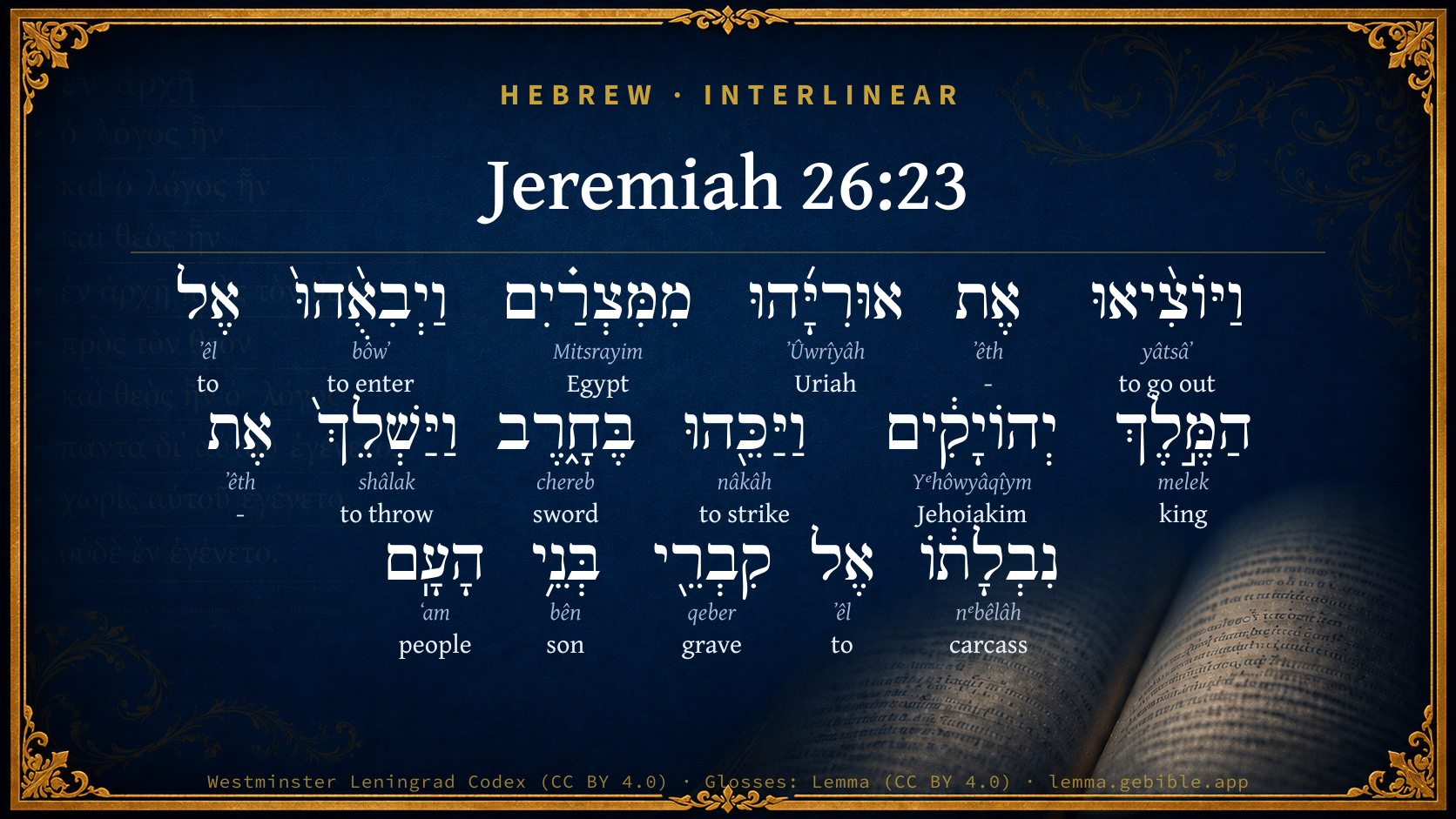
Hebrew (Westminster Leningrad Codex) Jeremiah 26:23 appears in the Hebrew Old Testament. The text above is from the Westminster Leningrad Codex. Each word links to its Strong’s number, a concise gloss, and parsing drawn from the Open Scriptures Hebrew Bible morphology. Click any word for its full Brown-Driver-Briggs (BDB) entry.
Download image
Cite this verse

Jeremiah 26:23 (World English Bible). Public Domain. Lemma interlinear Bible study tool, https://lemma.gebible.app/v/jeremiah/26/23.

Show BibTeX & RIS
BibTeX
RIS
English Translation
and they fetched forth Uriah out of Egypt, and brought him to Jehoiakim the king, who killed him with the sword, and cast his dead body into the graves of the common people.
World English Bible · Public Domain
Download a study sheet

One document with this verse’s original text, its word-by-word gloss line, the meaning frame, cross-references with their text, attributed commentary, and full source and license credits — printable, and it pastes into notes with its structure intact.

This verse Autodidact and up

Study sheet (.html) Plain text (.txt)

A passage Seminary Student

Up to 50 verses in one chapter. A passage sheet keeps up to 6 commentary sources and 12 cross-references per verse, in the order this page ranks them, and says so on the sheet whenever that leaves anything out. Ask for a single verse and you get the Autodidact verse sheet above.

Everything on this page stays free to read, with no account — the sheet is a download of what is already on screen, not access to it.

Want to remove ads? Support Godless Engineer
Compare translations 3

The same verse in 3 English versions, stacked beneath the original-language interlinear above. Click any original word for its lexicon entry.

Each is an independent rendering of the whole verse — the interlinear is not word-aligned to these translations.

Highlighted words mark where these versions differ — a whole-verse word diff, not a word-by-word alignment.

  • World English Bible Public Domain
    and they fetched forth Uriah out of Egypt, and brought him to Jehoiakim the king, who killed him with the sword, and cast his dead body into the graves of the common people.
  • King James Version Public Domain
    And they fetched forth Urijah out of Egypt, and brought him unto Jehoiakim the king; who slew him with the sword, and cast his dead body into the graves of the common people.
  • unfoldingWord Literal Text CC BY-SA 4.0
    And they brought Uriah out from Egypt, and they brought him to King Jehoiakim, and he struck him with the sword and threw his corpse into the graves of the sons of the people.

unfoldingWord Literal Text — © unfoldingWord, licensed CC BY-SA 4.0. Word-aligned USFM3 via Door43 (git.door43.org/unfoldingWord/en_ult).

Versions to compare (up to 4)

3 of 4 selected

Show all 18 translations

Every available English version of this verse, each an independent rendering of the whole verse.

  • World English Bible Public Domain
    and they fetched forth Uriah out of Egypt, and brought him to Jehoiakim the king, who killed him with the sword, and cast his dead body into the graves of the common people.
  • Berean Standard Bible Public Domain
    They brought Uriah out of Egypt and took him to King Jehoiakim, who had him put to the sword and his body thrown into the burial place of the common people.
  • Majority Standard Bible Public Domain
    They brought Uriah out of Egypt and took him to King Jehoiakim, who had him put to the sword and his body thrown into the burial place of the common people.
  • King James Version Public Domain
    And they fetched forth Urijah out of Egypt, and brought him unto Jehoiakim the king; who slew him with the sword, and cast his dead body into the graves of the common people.
  • American Standard Version (1901) Public Domain
    and they fetched forth Uriah out of Egypt, and brought him unto Jehoiakim the king, who slew him with the sword, and cast his dead body into the graves of the common people.
  • Revised Version (1885) Public Domain
    and they fetched forth Uriah out of Egypt, and brought him unto Jehoiakim the king; who slew him with the sword, and cast his dead body into the graves of the common people.
  • Geneva Bible (1599) Public Domain
    And they fet Vriiah out of Egypt, and brought him vnto Iehoiakim the King, who slew him with the sword, and cast his dead bodie into the graues of the children of the people.
  • Douay-Rheims (1899) Public Domain
    And they brought Urias out of Egypt: and brought him to king Joakim, and he slew him with the sword: and he cast his dead body into the graves of the common people.
  • Young's Literal Translation Public Domain
    And they bring out Urijah from Egypt, and bring him in unto the king Jehoiakim, and he smiteth him with a sword, and casteth his corpse unto the graves of the sons of the people.'
  • Literal Standard Version CC BY-SA 4.0
    and they bring out Urijah from Egypt, and bring him to King Jehoiakim, and he strikes him with a sword, and casts his corpse to the graves of the sons of the people.
  • Unlocked Literal Bible CC BY-SA 4.0
    They took Uriah out from Egypt and brought him to King Jehoiakim. Then Jehoiakim killed him with a sword and sent his corpse out to the graves of the ordinary people.
  • unfoldingWord Literal Text CC BY-SA 4.0
    And they brought Uriah out from Egypt, and they brought him to King Jehoiakim, and he struck him with the sword and threw his corpse into the graves of the sons of the people.
  • Darby Bible Public Domain
    and they fetched forth Urijah out of Egypt, and brought him to Jehoiakim the king; and he slew him with the sword, and cast his dead body into the graves of the children of the people.
  • World Messianic Bible Public Domain
    They fetched Uriah out of Egypt and brought him to Jehoiakim the king, who killed him with the sword and cast his dead body into the graves of the common people.
  • Webster's Bible Public Domain
    And they brought forth Urijah from Egypt, and brought him to Jehoiakim the king; who slew him with the sword, and cast his dead body into the graves of the common people.
  • Free Bible Version CC BY-SA 4.0
    They brought Uriah back from Egypt and took him to King Jehoiakim. The king killed him with a sword and had his body thrown into the public graveyard.
  • Bible in Basic English Public Domain
    And they took Uriah out of Egypt and came back with him to Jehoiakim the king; who put him to death with the sword, and had his dead body put into the resting-place of the bodies of the common people.
  • JPS Tanakh (1917) Public Domain
    and they fetched forth Uriah out of Egypt, and brought him unto Jehoiakim the king; who slew him with the sword, and cast his dead body into the graves of the children of the people.

Literal Standard Version (2020), Covenant Press — licensed CC BY-SA 4.0. Text via the HelloAO Bible API (eBible.org). Unlocked Literal Bible (unfoldingWord) — licensed CC BY-SA 4.0. Text via the HelloAO Bible API (eBible.org). unfoldingWord Literal Text — © unfoldingWord, licensed CC BY-SA 4.0. Word-aligned USFM3 via Door43 (git.door43.org/unfoldingWord/en_ult). Free Bible Version, Dr. Jonathan Gallagher — licensed CC BY-SA 4.0. Text via the HelloAO Bible API (eBible.org).

Word by word

More ways to search: Search by grammar → Find every occurrence → Compare this word →

Practice this passage: Drill this verse → Learn its vocabulary →

יְהוֹיָקִ֔ים
Yᵉhôwyâqîym
H3079
“Jehoiakim”
Noun, Proper
Part of Speech
Noun
Type
Proper
Full BDB Definition

Origin: from H3068 abbreviated and H6965 , cf. H3113

TWOT: None

Jehoiakim = "Jehovah raises up" - son of Josiah and the third from the last king of Judah; subject vassel of Nebuchadnezzar who reigned for 11 years before he died a violent death either in combat or by the hands of his own subjects
  1. וַיּוֹצִ֨יאוּ yâtsâʼ H3318 “and · to go out” Conjunction + Verb, Hiphil, Sequential Imperfect, 3rd Person, Masculine, Plural
  2. אֶת ʼêth H853 “-” Particle, Direct Object
  3. אוּרִיָּ֜הוּ ʼÛwrîyâh H223 “Uriah” Noun, Proper
  4. מִמִּצְרַ֗יִם Mitsrayim H4714 “from · Egypt” Preposition + Noun, Proper
  5. וַיְבִאֻ֨הוּ֙ bôwʼ H935 “and · to enter · him” Conjunction + Verb, Hiphil, Sequential Imperfect, 3rd Person, Masculine, Plural + Suffix, Personal, 3rd Person, Masculine, Singular
  6. אֶל ʼêl H413 “to” Preposition
  7. הַמֶּ֣לֶךְ melek H4428 “the · king” Particle, Definite Article + Noun, Common, Masculine, Singular, Absolute
  8. וַיַּכֵּ֖הוּ nâkâh H5221 “and · to strike · him” Conjunction + Verb, Hiphil, Sequential Imperfect, 3rd Person, Masculine, Singular + Suffix, Personal, 3rd Person, Masculine, Singular
  9. בֶּחָ֑רֶב chereb H2719 “in/at the · sword” Preposition, Determined + Noun, Common, Feminine, Singular, Absolute
  10. וַיַּשְׁלֵךְ֙ shâlak H7993 “and · to throw” Conjunction + Verb, Hiphil, Sequential Imperfect, 3rd Person, Masculine, Singular
  11. אֶת ʼêth H853 “-” Particle, Direct Object
  12. נִבְלָת֔וֹ nᵉbêlâh H5038 “carcass · his” Noun, Common, Feminine, Singular, Construct + Suffix, Personal, 3rd Person, Masculine, Singular
  13. אֶל ʼêl H413 “to” Preposition
  14. קִבְרֵ֖י qeber H6913 “graves of” Noun, Common, Masculine, Plural, Construct
  15. בְּנֵ֥י bên H1121 “sons of” Noun, Common, Masculine, Plural, Construct
  16. הָעָֽם ʻam H5971 “the · people” Particle, Definite Article + Noun, Common, Masculine, Singular, Absolute

About this verse

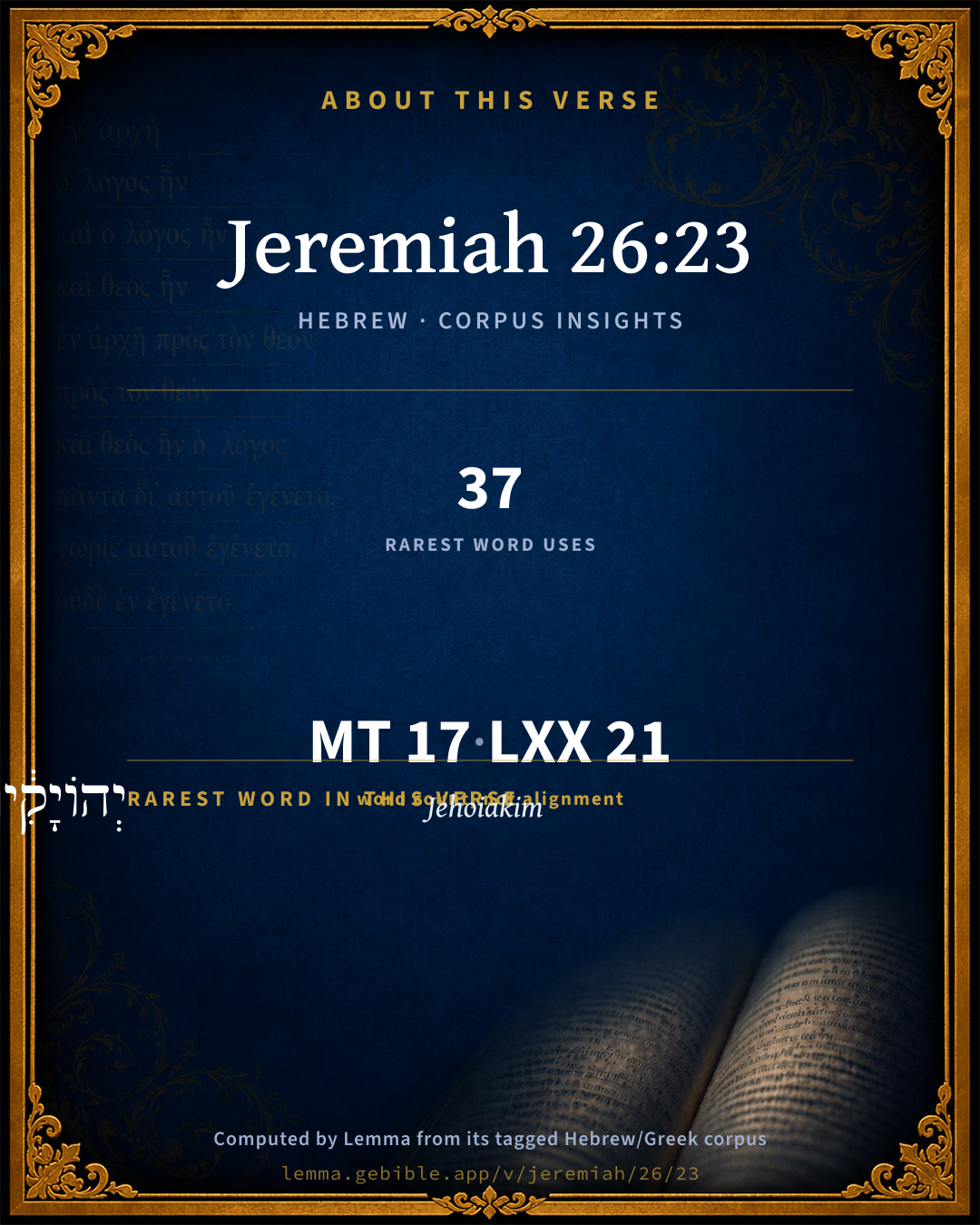
These counts appear in no published source. They are computed here, from the morphology-tagged text and Lemma’s own curated glosses. What Lemma adds →

17
words
15
distinct lemmas
Prophets
section

Shared distinctive vocabulary

יְהוֹיָקִ֔ים Jehoiakim H3079 occurs in 37 verses of the Hebrew Bible. Also found in:

Grammatical profile

  • 4 verbs
  • 9 nouns
  • 2 prepositions
  • 2 particles

Verb forms

  • וַיּוֹצִ֨יאוּ Hiphil · Sequential Imperfect
  • וַיְבִאֻ֨הוּ֙ Hiphil · Sequential Imperfect
  • וַיַּכֵּ֖הוּ Hiphil · Sequential Imperfect
  • וַיַּשְׁלֵךְ֙ Hiphil · Sequential Imperfect

Repetition

A word recurs within this verse — often emphatic in Hebrew:

  • אֶל to H413 ×2

Hebrew & Septuagint length

In the original languages it is 17 Hebrew tokens and 21 Greek tokens — but the two are counted differently (Hebrew bundles its prefixes and suffixes into one token; the Greek is in lemma form), so that isn’t a like-for-like length.

Cross-references

10

Topical passages linked to Jeremiah 26:23 in the Treasury of Scripture Knowledge — connected by theme and wording, ordered by reader-vote popularity; previews shown in the World English Bible.

  • Jeremiah 2:30 In vain have I struck your children; they received no correction: your own sword has devoured your prophets, like a destroying lion.
  • Revelation 11:7 When they have finished their testimony, the beast that comes up out of the abyss will make war with them, and overcome them, and kill them.
  • Jeremiah 22:19 He shall be buried with the burial of a donkey, drawn and cast forth beyond the gates of Jerusalem.
  • Jeremiah 26:15 Only know for certain that, if you put me to death, you will bring innocent blood on yourselves, and on this city, and on the inhabitants of it; for of a truth Yahweh has sent me to you to speak all these words in your ears.
  • Jeremiah 36:30 Therefore thus says Yahweh concerning Jehoiakim king of Judah: He shall have none to sit on the throne of David; and his dead body shall be cast out in the day to the heat, and in the night to the frost.
  • Ezekiel 19:6 He went up and down among the lions; he became a young lion, and he learned to catch the prey; he devoured men.
  • Matthew 14:10 and he sent and beheaded John in the prison.
  • Matthew 23:34–35 Therefore, behold, I send to you prophets, wise men, and scribes. Some of them you will kill and crucify; and some of them you will scourge in your synagogues, and persecute from city to city;
  • Acts 12:1–3 Now about that time, Herod the king stretched out his hands to oppress some of the assembly.
  • 1 Thessalonians 2:15 who killed both the Lord Jesus and their own prophets, and drove us out, and didn't please God, and are contrary to all men;

Cross-references courtesy of OpenBible.info (CC BY 4.0).

Hebrew and Greek witnesses Masoretic Hebrew ↔ Greek Septuagint

The same verse in the two great witnesses to the Old Testament, shown verse-for-verse.

These are two independent witnesses, not word-aligned to each other, and the Septuagint is shown in lemma (dictionary) form.

Hebrew Jeremiah 26:23 Masoretic · Westminster Leningrad Codex

וַיּוֹצִ֨יאוּ אֶת אוּרִיָּ֜הוּ מִמִּצְרַ֗יִם וַיְבִאֻ֨הוּ֙ אֶל הַמֶּ֣לֶךְ יְהוֹיָקִ֔ים וַיַּכֵּ֖הוּ בֶּחָ֑רֶב וַיַּשְׁלֵךְ֙ אֶת נִבְלָת֔וֹ אֶל קִבְרֵ֖י בְּנֵ֥י הָעָֽם

and they fetched forth Uriah out of Egypt, and brought him to Jehoiakim the king, who killed him with the sword, and cast his dead body into the graves of the common people.

World English Bible · Public Domain

Greek LXX Structure differs

In the Septuagint, Jeremiah is about an eighth shorter than the Hebrew and arranges its material differently — the Oracles Against the Nations (Hebrew chapters 46–51) appear in the middle of the Greek book, after 25:13. Because the chapter and verse boundaries do not line up, a verse-for-verse comparison with the Hebrew is not shown.

A verse-for-verse comparison isn’t shown here because the chapters and verses don’t line up. Switch to the LXX edition with the MT / LXX toggle above to read the Greek directly.

Hebrew: Westminster Leningrad Codex (CC BY 4.0). Greek: Septuagint (public domain); English from a public-domain English Septuagint. How the Septuagint differs from the Hebrew →

Targum (Aramaic paraphrase)

1

The Targum is the ancient Jewish Aramaic paraphrase of the Hebrew Scriptures — an interpretive translation, not the Hebrew text itself. Onkelos (literal) and Pseudo-Jonathan (expansive) render the Torah, and Jonathan the Prophets. Coverage is partial: where no permissively-licensed English translation exists for a verse, only the Aramaic is shown. This is verse-level text, not a word-by-word alignment to the Hebrew.

  1. Targum Jonathan Prophets (Joshua–Malachi)
    וְאַפִיקוּ יַת אוּרִיָה מִמִצְרַיִם וְאַיְתִיוּהִי לְוַת מַלְכָּא יְהוֹיָקִים וְקַטְלֵיהּ בְּחַרְבָּא וּרְמָא יַת נְבֵלְתֵּיהּ לְקִבְרֵי גָלַיָא:

    (no public-domain English translation for this verse)

    Targum Jonathan — Aramaic: “Mikraot Gedolot” (public domain). English: “Sefaria Community Translation” (CC0 1.0 (public-domain dedication)); “London "Chaldee Paraphrase," 1871” (public domain). Text via Sefaria.

Commentary

Notes on Jeremiah 26:23 from classic Christian and Jewish commentators (each source and its license shown beneath its notes). The classic Christian expositions comment on the surrounding passage and are grouped to its opening verse, so a note may address several verses; the Jewish commentaries on the Tanakh (Rashi and others) are per-verse, so they appear only where the commentator wrote on this verse.

Lemma curates 59 commentaries, every one of them public domain or Creative Commons licensed, each selected and text-cleaned for this edition rather than reprinted as found. About our sources →

Trapp's Complete Commentary

John Trapp

Jer 26:23 And they fetched forth Urijah out of Egypt, and brought him unto Jehoiakim the king; who slew him with the sword, and cast his dead body into the graves of the common people.

Ver. 23. And they set forth Uriah out of Egypt.] As they did here Sir John Cheek out of the Low Countries, and frightened him into a recantation. Not so this Uriah.

And they set forth Uriah out of Egypt.] En collusio principum mundi in parricidio.

Who slew him with the sword.] Without all law, right, or reason. So John Baptist was murdered, as if God had been nothing aware of him, said that martyr. But Jehoiakim got as little by this as he did afterwards by burning Jeremiah’s book; or as Vespasian afterwards did by banishing all the philosophers of his time, because they spake boldly against his vices and tyranny.

John Trapp, A Commentary or Exposition upon All the Books of the Old and New Testament (1647–1656) — public domain. Text from a community e-Sword module.

Geneva Bible (1599)

Geneva Bible translators

As in the first Hezekiah’s example is to be followed, so in this other Jehoiakim’s act is to be abhorred: for God’s plague did light on him, and his household.

Geneva Bible (1599) marginal notes — public domain. Text via Bolls.life.

Jamieson, Fausset & Brown

Robert Jamieson, A. R. Fausset & David Brown

graves of the common people--literally, "sons of the people" (compare Kg2 23:6). The prophets seem to have had a separate cemetery (Mat 23:29). Urijah's corpse was denied this honor, in order that he should not be regarded as a true prophet.

Jamieson, Fausset & Brown — Commentary Critical and Explanatory on the Whole Bible (1871) — public domain (CC PDM 1.0). Text via the HelloAO Bible API.

John Calvin's Commentaries

It is at length added, that they led up Uriah from Egypt, and brought him to King Jehoiakim, who slew him with the sword, and cast his dead body into the graves of the common people, by way of dishonor; for Jeremiah here calls them the graves of the common people, as we in French call shambles des charniers. The rich are honorably and splendidly buried at this day, and every one has his own grave; but when there is a vast number, the bodies are thrown together, for it would be too expensive to dig a grave for each. It seems also that there was such a practice in Judea, and that God’s Prophet was buried in this ignominious manner.

Thus they who spoke intimated that the king’s wrath so burned, that he not only put him to death, but followed up his vengeance, so that a new disgrace awaited the Prophet, even when dead, for he was cast among the obscure and ignoble common people.

I have hitherto so explained this passage as to leave it doubtful whether the probability is that the speakers were Jeremiah’s enemies or his advocates. And though, as I have declared twice or three times, I reject not the view which is different from that which I embrace, yet it seems most probable to me that the words were spoken by the godly men who defended the cause of Jeremiah. All the various reasons which lead me to this conclusion I will not here specify; for every one may himself see why I prefer this view. The common consent of almost all interpreters also influences me, from which I wish not to depart, except necessity compels me, or the thing itself makes it evident that they were mistaken. But we have seen from the beginning, that the two examples consecutively follow one another, and that nothing intervenes; it may hence be supposed, that the enemies of Jeremiah had previously performed their part. The words themselves then shew that those who commenced the discourse were those who carried it on. And that they did not mention the reason why they adduced this example is not to be wondered at; for the displeasure of the king was feared, and he had given no common proof, in his treatment of the holy Prophet, how impatiently he bore anything that trenched on his own dignity. They therefore cautiously related the matter, and left what they did not express to be collected by those who heard them. But it was easy from their words to know what they meant, — that God’s vengeance was to be dreaded; for one Prophet had been slain; what if there was to be no end to cruelty? would not God at length arise to execute judgment when his servants were so unworthily treated? As, then, the words are not completed, it seems probable to me that God’s true servants spoke thus reservedly and cautiously, because they dared not to express their thoughts openly.

Further, these words, the king sought to slay him, and the king sent men, etc., are more suitable when considered as spoken by the defenders of Jeremiah than by the ungodly and the wicked; and they also named Elnathan, that they might hand down his name with infamy to future ages. And they lastly added that the Prophet was brought up from Egypt What was very shameful seems certainly to be set here before us, that he was forcibly brought back from that land to which he had fled for an asylum, and also that he was brought to the king, that he smote him with the sword, that is, cruelly killed him; and further, that being not satisfied with this barbarous act, he caused him to be ignominiously buried. All these particulars, as I have said, seem to shew that these words may be more suitably applied to the holy men who defended the cause of Jeremiah than to his enemies. It now follows, —

John Calvin's Commentaries (1540-1563) — public domain. Text from the Calvin Translation Society English edition (1840s-50s) via the Christian Classics Ethereal Library (ccel.org). Calvin's coverage is partial (roughly two-thirds of the Bible); uncommented books and verses are honest gaps, never fabricated. The 19th-century editor's footnotes and remarks are omitted so the notes are faithfully Calvin's own voice.

Ellicott's Commentary for English Readers

(23) And they fetched forth Urijah out of Egypt.—The martyr-death of the prophet had its parallels in the earlier history of Judah. So Jezebel had slain the prophets of Jehovah with the edge of the sword (1Ki_18:4; 1Ki_19:10; 1Ki_19:14), and Zechariah the son of Jehoiada had been stoned to death at the command of Joash (2Ch_24:21), and Isaiah, as the Jewish tradition runs, had been sawn asunder (Heb_11:37). The fact now recorded was to Jewish feeling an act of brutal outrage. The body of the prophet was not allowed to rest in the sepulchre of his fathers, with the due honour of embalmment, but flung into the loathsome pits of “the sons of the people,” in the Kidron valley (2Ki_23:6). It is not without interest to those who believe in a special as well as righteous retribution, to note the fact that the king who thus added brutality to cruelty was himself afterwards “buried with the burial of an ass,” without honours or lamentations (Jer_22:18-19). For the phrase, “children of the people,” see Note on Jer_17:19. The circumstances are apparently narrated in detail either by the prophet himself or by the compiler of his prophecies, to show how narrow his escape had been.

A Bible Commentary for English Readers, edited by Charles John Ellicott (1878–1897) — public domain. Text from a community e-Sword module.

The Cambridge Bible for Schools and Colleges

gen. ed. J. J. S. Perowne

23. they fetched forth Uriah out of Egypt] As Jehoiakim was a vassal of Egypt (2Ki_23:34), the extradition of a man accused of treason was easily effected.

common people] For mg. sons of the people cp. Jer_17:19.

The Cambridge Bible for Schools and Colleges (gen. ed. J. J. S. Perowne; Cambridge University Press, 1878–1918) — public domain. Text from a community e-Sword module.

John Gill's Exposition

And they fetched forth Urijah out of Egypt,.... Having found him, they seized him, and brought him away, with the leave of the king of Egypt: which, no doubt, was easily obtained:

and brought him to Jehoiakim the king, who slew him with the sword; very probably with his own hand; or however it was done by his order, and in his presence, most likely:

and cast his dead body into the graves of the common people; either where they were buried in heaps promiscuously, as some think; or in the common burying ground; and not where persons of distinction were laid, as prophets, and others (g); this he did to reflect dishonour upon the prophet.

(g) Vid. Nicolai de Sepulchris Heb. c. 3. p. 126.

John Gill's Exposition of the Whole Bible (1746–1763) — public domain (CC PDM 1.0). Text via the HelloAO Bible API.

Albert Barnes' Notes on the Bible

Out of Egypt - As Jehoiakim was a vassal of Egypt, he would easily obtain the surrender of a man accused of treason.

Albert Barnes' Notes on the Bible (1834–1885) — public domain. Text from a community e-Sword/MySword module.

Haydock's Catholic Bible Commentary

Egypt, as a seditious person....Joakim was tributary to Pharao.

George Leo Haydock (1774–1849), Haydock's Catholic Family Bible and Commentary, 1859 edition — public domain. Excludes Psalms (Douay-Rheims chapter numbering differs from Protestant) and Deuterocanonical books (Catholic canon only).

Matthew Poole's English Annotations

These persons sent by Jehoiakim brought back the prophet by force; he was tried and cast, judged worthy to die, and put to death, and ignominiously buried, not in the sepulchres of the prophets, or any men of repute and fashion, but amongst the vulgar people; which, as also his diligence to send for Urijah, (fled into a foreign country to save his life,) showed the great malice of this prince against the Lord’s true prophets; though it had but very ill effects. The sum is, (if we take these words as the speech of Jeremiah’s enemies,) What do you tell us of what Hezekiah did, you have a later instance of it in our present king’s time, the cases of Urijah and of Jeremiah are fully parallelled. So as the case is a judged case.

Matthew Poole's English Annotations on the Holy Bible (1683–1685) — public domain. Text from a community e-Sword/MySword module.

Whedon's Commentary on the Bible

Daniel D. Whedon

23. Common people — See 2Ki_23:6. The place of this “common” burial ground was in the Kidron valley.

Daniel D. Whedon (gen. ed.), Commentary on the Old and New Testaments (1874–1909) — public domain. Text from a community e-Sword module.

The Pulpit Commentary

Into the graves of the common people; literally, of the sons of the people. (comp. Jer_17:19 2Ki_23:6) "The graves" is equivalent to "the graveyard," as Job_17:1.

The Pulpit Commentary (1880–1919), ed. H.D.M. Spence-Jones & Joseph S. Exell — public domain. Text from a community e-Sword module.

John Wesley's Explanatory Notes

Cast his body - Not in the sepulchers of the prophets, but amongst the vulgar people.

John Wesley, Explanatory Notes Upon the Whole Bible (1754–1765) — public domain. Text via the GEBible commentary corpus.

Lesson kit

Teaching starters — assembled from the data on this page, not authored interpretation. Every prompt links to the verse data it draws on. Edit before teaching.

Jeremiah, in the Prophets, opens this verse with 17 words (15 distinct Hebrew lemmas). Its most distinctive word is Yᵉhôwyâqîym (“Jehoiakim”). A historical commentator’s framing appears above. Read the whole chapter for the surrounding context.

Discussion questions

  1. The word Yᵉhôwyâqîym carries the sense “Jehoiakim.” How does it shape the verse?
  2. 2 Kings 23:34 shares the word «Jehoiakim» with this verse. How do the two illuminate each other?
  3. “to” occurs 2× in this one verse. What is the effect of the repetition?
  4. These translations render this verse differently. What is at stake in choosing one wording over another?
  5. The verb «וַיּוֹצִ֨יאוּ» is Hiphil Sequential Imperfect. How does its form color the action?
  6. Reading how Trapp's Complete Commentary and Geneva Bible (1599) read this verse, where do the two commentators agree and where do they part?

Things to notice

Reading settings

Reading text

Shown beneath each verse's original-language words.

Old Testament
Old Testament edition

Read the OT as the Masoretic Hebrew (MT) or the Greek Septuagint (LXX).

English shown for the Greek Septuagint (in the Hebrew ↔ Greek comparison).

Comparing translations? Open the Compare panel on any verse page to stack up to four side by side.