Ezekiel 31:2

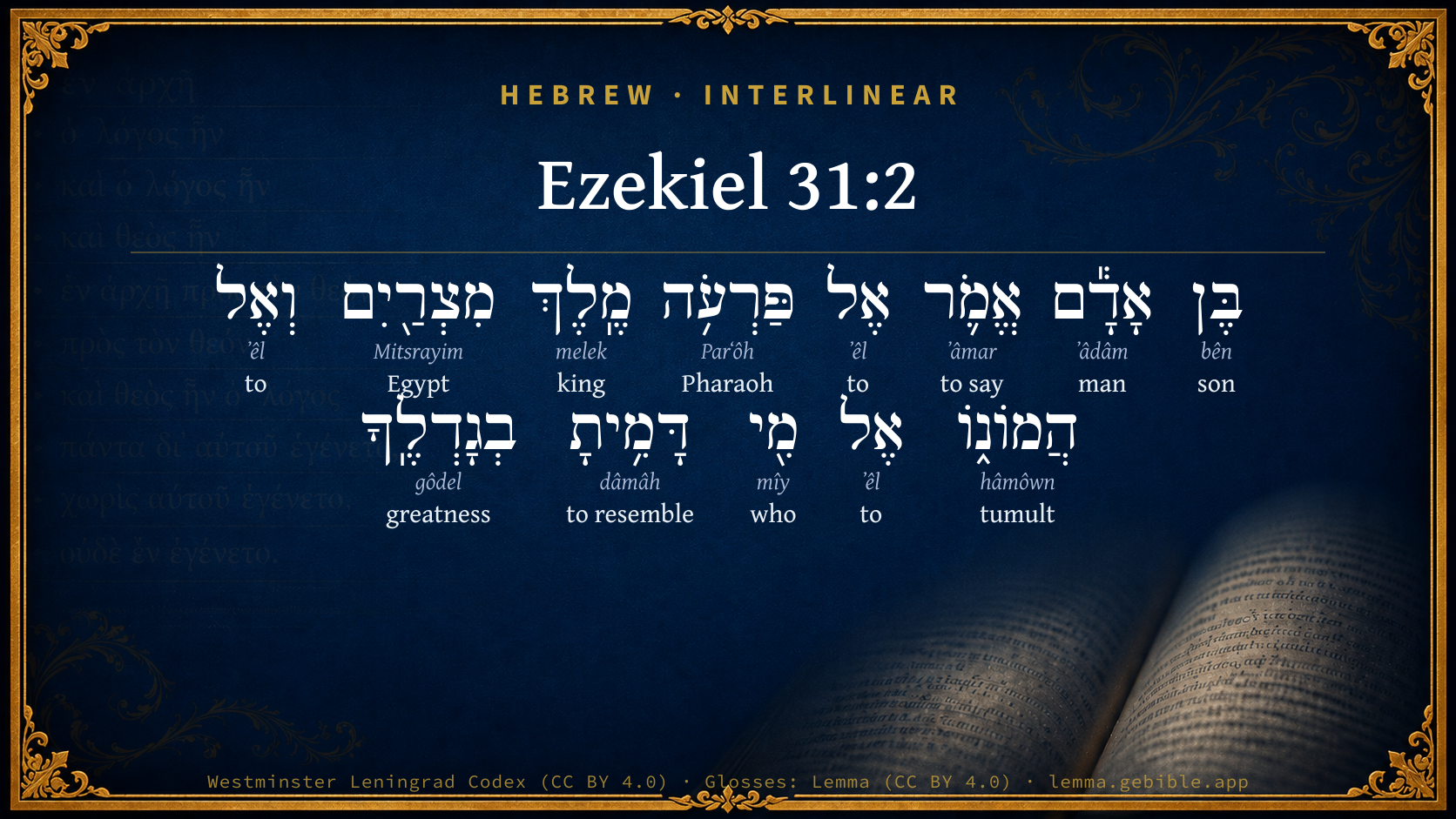
Hebrew (Westminster Leningrad Codex) Ezekiel 31:2 appears in the Hebrew Old Testament. The text above is from the Westminster Leningrad Codex. Each word links to its Strong’s number, a concise gloss, and parsing drawn from the Open Scriptures Hebrew Bible morphology. Click any word for its full Brown-Driver-Briggs (BDB) entry.
Download image
Cite this verse

Ezekiel 31:2 (World English Bible). Public Domain. Lemma interlinear Bible study tool, https://lemma.gebible.app/v/ezekiel/31/2.

Show BibTeX & RIS
BibTeX
RIS
English Translation
Son of man, tell Pharaoh king of Egypt, and to his multitude: Whom are you like in your greatness?
World English Bible · Public Domain
Download a study sheet

One document with this verse’s original text, its word-by-word gloss line, the meaning frame, cross-references with their text, attributed commentary, and full source and license credits — printable, and it pastes into notes with its structure intact.

This verse Autodidact and up

Study sheet (.html) Plain text (.txt)

A passage Seminary Student

Up to 50 verses in one chapter. A passage sheet keeps up to 6 commentary sources and 12 cross-references per verse, in the order this page ranks them, and says so on the sheet whenever that leaves anything out. Ask for a single verse and you get the Autodidact verse sheet above.

Everything on this page stays free to read, with no account — the sheet is a download of what is already on screen, not access to it.

Want to remove ads? Support Godless Engineer
Compare translations 3

The same verse in 3 English versions, stacked beneath the original-language interlinear above. Click any original word for its lexicon entry.

Each is an independent rendering of the whole verse — the interlinear is not word-aligned to these translations.

Highlighted words mark where these versions differ — a whole-verse word diff, not a word-by-word alignment.

  • World English Bible Public Domain
    Son of man, tell Pharaoh king of Egypt, and to his multitude: Whom are you like in your greatness?
  • King James Version Public Domain
    Son of man, speak unto Pharaoh king of Egypt, and to his multitude; Whom art thou like in thy greatness?
  • unfoldingWord Literal Text CC BY-SA 4.0
    “Son of man, say to Pharaoh, the king of Egypt, and to his multitudes around him, ‘In your greatness, who are you like?

unfoldingWord Literal Text — © unfoldingWord, licensed CC BY-SA 4.0. Word-aligned USFM3 via Door43 (git.door43.org/unfoldingWord/en_ult).

Versions to compare (up to 4)

3 of 4 selected

Show all 18 translations

Every available English version of this verse, each an independent rendering of the whole verse.

  • World English Bible Public Domain
    Son of man, tell Pharaoh king of Egypt, and to his multitude: Whom are you like in your greatness?
  • Berean Standard Bible Public Domain
    “Son of man, say to Pharaoh king of Egypt and to his multitude: ‘Who can be compared to your greatness?
  • Majority Standard Bible Public Domain
    “Son of man, say to Pharaoh king of Egypt and to his multitude: ‘Who can be compared to your greatness?
  • King James Version Public Domain
    Son of man, speak unto Pharaoh king of Egypt, and to his multitude; Whom art thou like in thy greatness?
  • American Standard Version (1901) Public Domain
    Son of man, say unto Pharaoh king of Egypt, and to his multitude: Whom art thou like in thy greatness?
  • Revised Version (1885) Public Domain
    Son of man, say unto Pharaoh king of Egypt, and to his multitude; Whom art thou like in thy greatness?
  • Geneva Bible (1599) Public Domain
    Sonne of man, speake vnto Pharaoh King of Egypt, and to his multitude, Whom art thou like in thy greatnesse?
  • Douay-Rheims (1899) Public Domain
    Son of man, speak to Pharao king of Egypt, and to his people: To whom art thou like in thy greatness?
  • Young's Literal Translation Public Domain
    `Son of man, say unto Pharaoh king of Egypt, and unto his multitude: To whom hast thou been like in thy greatness?
  • Literal Standard Version CC BY-SA 4.0
    “Son of man, say to Pharaoh king of Egypt, and to his multitude: To whom have you been like in your greatness?
  • Unlocked Literal Bible CC BY-SA 4.0
    “Son of man, say to Pharaoh, the king of Egypt, and to his multitudes around him, 'In your greatness, who are you like?
  • unfoldingWord Literal Text CC BY-SA 4.0
    “Son of man, say to Pharaoh, the king of Egypt, and to his multitudes around him, ‘In your greatness, who are you like?
  • Darby Bible Public Domain
    Son of man, say unto Pharaoh king of Egypt, and to his multitude: Whom art thou like in thy greatness?
  • World Messianic Bible Public Domain
    “Son of man, tell Pharaoh king of Egypt and his multitude: ‘Whom are you like in your greatness?
  • Webster's Bible Public Domain
    Son of man, speak to Pharaoh king of Egypt, and to his multitude; Whom art thou like in thy greatness?
  • Free Bible Version CC BY-SA 4.0
    “Son of man, tell Pharaoh king of Egypt and all his many people: Who is as great as you?
  • Bible in Basic English Public Domain
    Son of man, say to Pharaoh, king of Egypt, and to his people; Whom are you like in your great power?
  • JPS Tanakh (1917) Public Domain
    'Son of man, say unto Pharaoh king of Egypt, and to his multitude: whom art thou like in thy greatness?

Literal Standard Version (2020), Covenant Press — licensed CC BY-SA 4.0. Text via the HelloAO Bible API (eBible.org). Unlocked Literal Bible (unfoldingWord) — licensed CC BY-SA 4.0. Text via the HelloAO Bible API (eBible.org). unfoldingWord Literal Text — © unfoldingWord, licensed CC BY-SA 4.0. Word-aligned USFM3 via Door43 (git.door43.org/unfoldingWord/en_ult). Free Bible Version, Dr. Jonathan Gallagher — licensed CC BY-SA 4.0. Text via the HelloAO Bible API (eBible.org).

Word by word

More ways to search: Search by grammar → Find every occurrence → Compare this word →

Practice this passage: Drill this verse → Learn its vocabulary →

בְגָדְלֶֽךָ
gôdel
H1433
“in/at · greatness · your”
Preposition + Noun, Common, Masculine, Singular, Construct + Suffix, Personal, 2nd Person, Masculine, Singular
Part of Speech
Preposition + Noun
Type
Common
Gender
Masculine
Number
Singular
State
Construct
Full BDB Definition

Origin: from H1431

TWOT: 315b

greatness - greatness, magnitude - magnificence - pride, insolence (bad sense)
  1. בֶּן bên H1121 “son of” Noun, Common, Masculine, Singular, Construct
  2. אָדָ֕ם ʼâdâm H120 “man” Noun, Common, Masculine, Singular, Absolute
  3. אֱמֹ֛ר ʼâmar H559 “say” Verb, Qal, Imperative, 2nd Person, Masculine, Singular
  4. אֶל ʼêl H413 “to” Preposition
  5. פַּרְעֹ֥ה Parʻôh H6547 “Pharaoh” Noun, Proper
  6. מֶֽלֶךְ melek H4428 “king of” Noun, Common, Masculine, Singular, Construct
  7. מִצְרַ֖יִם Mitsrayim H4714 “Egypt” Noun, Proper
  8. וְאֶל ʼêl H413 “and · to” Conjunction + Preposition
  9. הֲמוֹנ֑וֹ hâmôwn H1995 “tumult · his” Noun, Common, Masculine, Singular, Construct + Suffix, Personal, 3rd Person, Masculine, Singular
  10. אֶל ʼêl H413 “to” Preposition
  11. מִ֖י mîy H4310 “who” Particle, Interrogative
  12. דָּמִ֥יתָ dâmâh H1819 “to resemble” Verb, Qal, Perfect, 2nd Person, Masculine, Singular

About this verse

These counts appear in no published source. They are computed here, from the morphology-tagged text and Lemma’s own curated glosses. What Lemma adds →

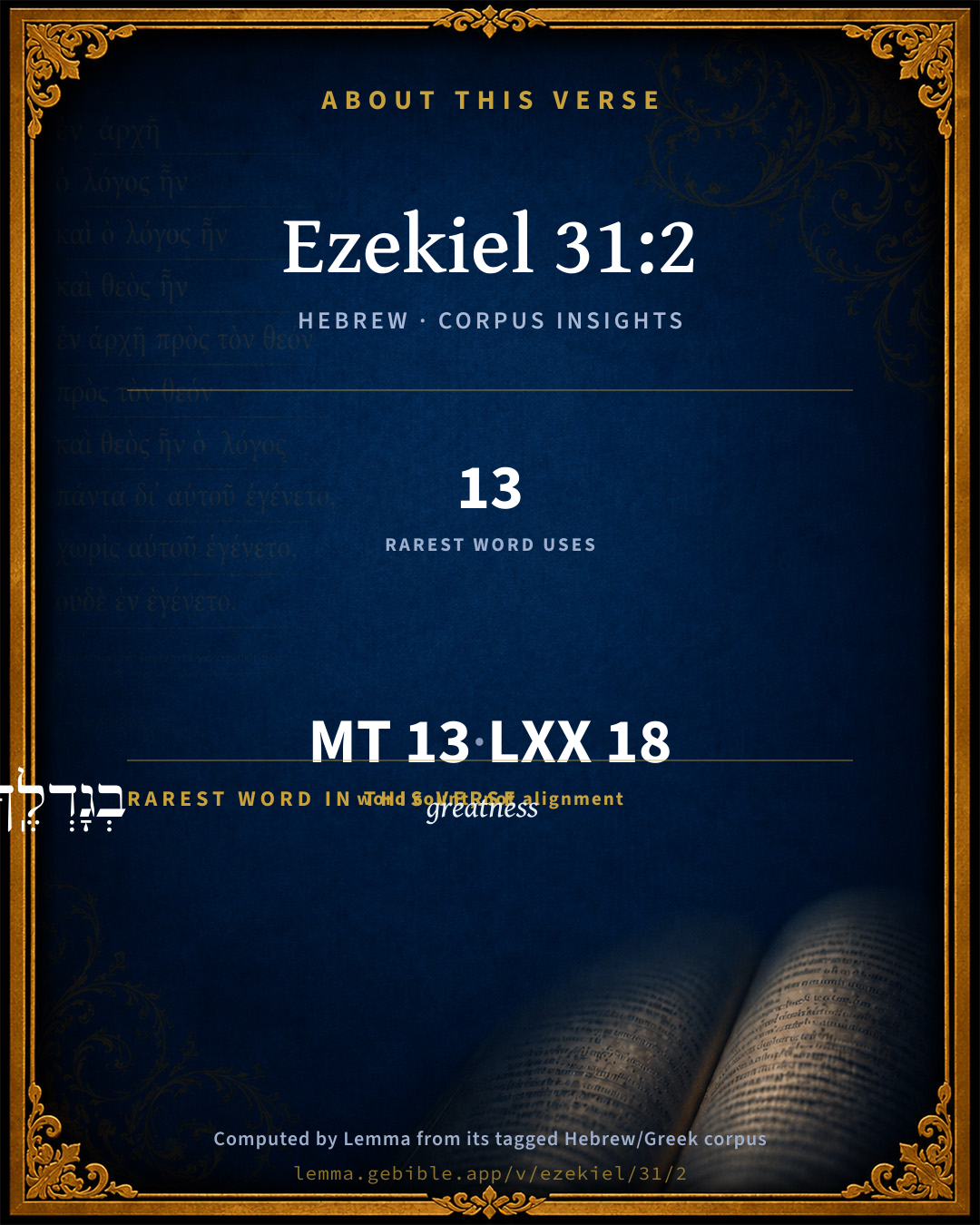
13
words
11
distinct lemmas
Prophets
section

Notable vocabulary

The rarest word here is בְגָדְלֶֽךָ greatness H1433 — appearing just 13 times in the whole Hebrew Bible.

Shared distinctive vocabulary

בְגָדְלֶֽךָ greatness H1433 occurs in 13 verses of the Hebrew Bible. Also found in:

Grammatical profile

  • 2 verbs
  • 7 nouns
  • 3 prepositions
  • 1 particle

Verb forms

  • אֱמֹ֛ר Qal · Imperative
  • דָּמִ֥יתָ Qal · Perfect

Repetition

A word recurs within this verse — often emphatic in Hebrew:

  • אֶל to H413 ×3

Hebrew & Septuagint length

In English translation the verse runs 19 words from the Hebrew and 22 from the Septuagint (LXX English) — closely comparable.

A rough comparison of the two English renderings, which tokenize alike — not a word-level alignment.

Word counts can differ between the Hebrew and the Greek without any difference in meaning — e.g. the Hebrew direct-object marker אֵת has no separate Greek word, and Greek often adds the article ὁ.

In the original languages it is 13 Hebrew tokens and 18 Greek tokens — but the two are counted differently (Hebrew bundles its prefixes and suffixes into one token; the Greek is in lemma form), so that isn’t a like-for-like length.

Cross-references

8

Topical passages linked to Ezekiel 31:2 in the Treasury of Scripture Knowledge — connected by theme and wording, ordered by reader-vote popularity; previews shown in the World English Bible.

  • Ezekiel 29:19 Therefore thus says the Lord Yahweh: Behold, I will give the land of Egypt to Nebuchadrezzar king of Babylon; and he shall carry off her multitude, and take her spoil, and take her prey; and it shall be the wages for his army.
  • Ezekiel 30:10 Thus says the Lord Yahweh: I will also make the multitude of Egypt to cease, by the hand of Nebuchadrezzar king of Babylon.
  • Ezekiel 31:18 To whom are you thus like in glory and in greatness among the trees of Eden? yet shall you be brought down with the trees of Eden to the lower parts of the earth: you shall lie in the midst of the uncircumcised, with those who are slain by the sword. This is Pharaoh and all his multitude, says the Lord Yahweh.
  • Isaiah 14:13–14 You said in your heart, I will ascend into heaven, I will exalt my throne above the stars of God; and I will sit on the mountain of congregation, in the uttermost parts of the north;
  • Jeremiah 1:5 Before I formed you in the belly I knew you, and before you came forth out of the womb I sanctified you; I have appointed you a prophet to the nations.
  • Jeremiah 1:17 You therefore gird up your loins, and arise, and speak to them all that I command you: don't be dismayed at them, lest I dismay you before them.
  • Nahum 3:8–10 Are you better than No-Amon, who was situated among the rivers, who had the waters around her; whose rampart was the sea, and her wall was of the sea?
  • Revelation 10:11 They told me, "You must prophesy again over many peoples, nations, languages, and kings."

Cross-references courtesy of OpenBible.info (CC BY 4.0).

Hebrew and Greek witnesses Masoretic Hebrew ↔ Greek Septuagint

The same verse in the two great witnesses to the Old Testament, shown verse-for-verse.

These are two independent witnesses, not word-aligned to each other, and the Septuagint is shown in lemma (dictionary) form.

Hebrew Ezekiel 31:2 Masoretic · Westminster Leningrad Codex

בֶּן אָדָ֕ם אֱמֹ֛ר אֶל פַּרְעֹ֥ה מֶֽלֶךְ מִצְרַ֖יִם וְאֶל הֲמוֹנ֑וֹ אֶל מִ֖י דָּמִ֥יתָ בְגָדְלֶֽךָ

Son of man, tell Pharaoh king of Egypt, and to his multitude: Whom are you like in your greatness?

World English Bible · Public Domain

Greek LXX Ezekiel 31:2 Septuagint · lemma form

υἱός ἄνθρωπος εἶπον πρός φαραώ βασιλεύς αἴγυπτος καί ὁ πλῆθος αὐτός τίς ὁμοιόω σεαυτοῦ ἐν ὁ ὕψος σύ

Son of man, say to Pharao king of Egypt, and to his multitude; To whom have you compared yourself in your haughtiness?

LXX2012 (modern English Septuagint) · Public Domain

Hebrew: Westminster Leningrad Codex (CC BY 4.0). Greek: Septuagint (public domain); English from LXX2012 (modern English Septuagint) (Public Domain). How the Septuagint differs from the Hebrew →

Targum (Aramaic paraphrase)

1

The Targum is the ancient Jewish Aramaic paraphrase of the Hebrew Scriptures — an interpretive translation, not the Hebrew text itself. Onkelos (literal) and Pseudo-Jonathan (expansive) render the Torah, and Jonathan the Prophets. Coverage is partial: where no permissively-licensed English translation exists for a verse, only the Aramaic is shown. This is verse-level text, not a word-by-word alignment to the Hebrew.

  1. Targum Jonathan Prophets (Joshua–Malachi)
    בַּר אָדָם אֲמַר לְפַרְעֹה מַלְכָּא דְמִצְרַיִם וּלְאִתְרְגוּשְׁתֵּהּ לְמָן דְמִיתָא בְּתוּקְפָךְ:

    (no public-domain English translation for this verse)

    Targum Jonathan — Aramaic: “Mikraot Gedolot” (public domain). English: “Sefaria Community Translation” (CC0 1.0 (public-domain dedication)); “London "Chaldee Paraphrase," 1871” (public domain). Text via Sefaria.

Commentary

Notes on Ezekiel 31:2 from classic Christian and Jewish commentators (each source and its license shown beneath its notes). The classic Christian expositions comment on the surrounding passage and are grouped to its opening verse, so a note may address several verses; the Jewish commentaries on the Tanakh (Rashi and others) are per-verse, so they appear only where the commentator wrote on this verse.

Lemma curates 59 commentaries, every one of them public domain or Creative Commons licensed, each selected and text-cleaned for this edition rather than reprinted as found. About our sources →

Trapp's Complete Commentary

John Trapp

Eze 31:2 Son of man, speak unto Pharaoh king of Egypt, and to his multitude; Whom art thou like in thy greatness?

Ver. 2. Speak unto Pharaoh.] Unto Pharaohhophra. {Eze 29:2} Say unto him (though it will be to small purpose), "Hear, and give ear, be not proud, for the Lord hath spoken it." {Jer 13:15}

Whom art thou like in thy greatness?] q.d., Thou thinkest thyself the only one, and that there is none such; but what sayest thou to the Assyrian, whom yet the Babylonian hath now laid low enough?

John Trapp, A Commentary or Exposition upon All the Books of the Old and New Testament (1647–1656) — public domain. Text from a community e-Sword module.

Tyndale Open Study Notes

Tyndale Open Resources

31:2-4 The cedar of Lebanon is a tree that was known for its visual splendor and commercial and military value. • Like a tree whose crown was among the clouds, Assyria’s military had once been strong beyond comparison to any other army.

Tyndale Open Study Notes — © Tyndale Open Resources, licensed CC BY-SA 4.0. Text via the HelloAO Bible API.

Geneva Bible (1599)

Geneva Bible translators

Meaning, that he was not like in strength to the King of the Assyrians, whom the Babylonians overcame.

Geneva Bible (1599) marginal notes — public domain. Text via Bolls.life.

Jamieson, Fausset & Brown

Robert Jamieson, A. R. Fausset & David Brown

Whom art thou like--The answer is, Thou art like the haughty king of Assyria; as he was overthrown by the Chaldeans, so shalt thou be by the same.

Jamieson, Fausset & Brown — Commentary Critical and Explanatory on the Whole Bible (1871) — public domain (CC PDM 1.0). Text via the HelloAO Bible API.

Ellicott's Commentary for English Readers

(2) His multitude.—The word means literally tumult, and applies to the multitude as influenced by whatever is the occasion of tumult: their wealth, their idols, their sources of pride of every kind.

A Bible Commentary for English Readers, edited by Charles John Ellicott (1878–1897) — public domain. Text from a community e-Sword module.

The Cambridge Bible for Schools and Colleges

gen. ed. J. J. S. Perowne

2. his multitude] The population of Egypt; hardly merely his army.

Whom art thou like] The question seems to imply that none can be compared to him; he is unapproached in his greatness; cf. Eze_31:18.

The Cambridge Bible for Schools and Colleges (gen. ed. J. J. S. Perowne; Cambridge University Press, 1878–1918) — public domain. Text from a community e-Sword module.

John Gill's Exposition

Son of man, speak unto Pharaoh king of Egypt,.... To Pharaohhophra, the then reigning king; not to him personally by word of mouth, for the prophet was now in Chaldea; but by delivering out a prophecy concerning him, and which he might have an opportunity of sending to him:

and to his multitude; the multitude of his subjects, of which he boasted, and in whom he trusted:

whom art thou like in thy greatness? look over all the records of time, and into all the empires, kingdoms, and states that have been; draw a comparison between thyself and the greatest potentate that ever was; fancy thyself to be equal to him; this will not secure thee from ruin and destruction; for as they have been humbled, and are fallen, so wilt thou be: pitch for instance on the Assyrian monarch, whose empire has been the most ancient, extensive, and flourishing, and yet now crushed; and as thou art like him in greatness, at least thou thinkest so, so thou art in pride, and wilt be in thine end; to assure of which is the drift of the following account of the king of Assyria.

John Gill's Exposition of the Whole Bible (1746–1763) — public domain (CC PDM 1.0). Text via the HelloAO Bible API.

Matthew Poole's English Annotations

Pharaoh; Apries or Hophra.

To his multitude; his numerous subjects, with the power and riches they glory in.

Whom art thou like in thy greatness? bethink thyself, what king of all before thee art thou equal with, or else greater? On what surer and more immovable foundation doth thy greatness stand, that thou dreamest of a perpetual quiet and flourishing state, in the midst of all thy sins and wickednesses?

Matthew Poole's English Annotations on the Holy Bible (1683–1685) — public domain. Text from a community e-Sword/MySword module.

The Pulpit Commentary

The parable is addressed, not to Pharaoh only, but to his multitude i.e. , as in Eze_30:4, for his auxiliary forces. It opens with one of the customary formulae of an Eastern apologue, (Mar_4:30) intended to sharpen the curiosity and win the attention of the prophet"s hearers or readers. It is significant that the question is repeated at the close of the parable, as if the prophet had left the interpretation to his readers, as our Lord does in saying, "He that hath ears to hear, let him hear."

The Pulpit Commentary (1880–1919), ed. H.D.M. Spence-Jones & Joseph S. Exell — public domain. Text from a community e-Sword module.

John Wesley's Explanatory Notes

His multitude - His numerous subjects.

John Wesley, Explanatory Notes Upon the Whole Bible (1754–1765) — public domain. Text via the GEBible commentary corpus.

Rashi

Rabbi Shlomo Yitzchaki (Rashi)

Whom are you like in your greatness In your haughtiness against Me, whom did you think to resemble?

Rashi on the Tanakh — English translations: “The Judaica Press complete Tanach with Rashi, translated by A. J. Rosenberg” (CC BY 4.0); “Pentateuch with Rashi's commentary by M. Rosenbaum and A.M. Silbermann, 1929-1934” (public domain); “The Metsudah Tanach series, Lakewood, N.J” (CC BY 4.0); and “The Book of Joshua, Metsudah Publications, 1997” (CC BY 4.0). Text via Sefaria.

Lesson kit

Teaching starters — assembled from the data on this page, not authored interpretation. Every prompt links to the verse data it draws on. Edit before teaching.

Ezekiel, in the Prophets, opens this verse with 13 words (11 distinct Hebrew lemmas). Its most distinctive word is gôdel (“greatness”). A historical commentator’s framing appears above. Read the whole chapter for the surrounding context.

Discussion questions

  1. The word gôdel carries the sense “greatness.” How does it shape the verse?
  2. How does Numbers 14:19, which shares the word «greatness», read alongside this verse?
  3. What does the repetition of “to” (3× in this one verse) do in this verse?
  4. These translations render this verse differently. What is at stake in choosing one wording over another?
  5. «אֱמֹ֛ר» is a Qal Imperative verb. How does that grammatical form shape the action described?
  6. Compare how Trapp's Complete Commentary and Tyndale Open Study Notes read this verse. Where do they agree or differ?

Things to notice

Reading settings

Reading text

Shown beneath each verse's original-language words.

Old Testament
Old Testament edition

Read the OT as the Masoretic Hebrew (MT) or the Greek Septuagint (LXX).

English shown for the Greek Septuagint (in the Hebrew ↔ Greek comparison).

Comparing translations? Open the Compare panel on any verse page to stack up to four side by side.