
1 Kings 8:16

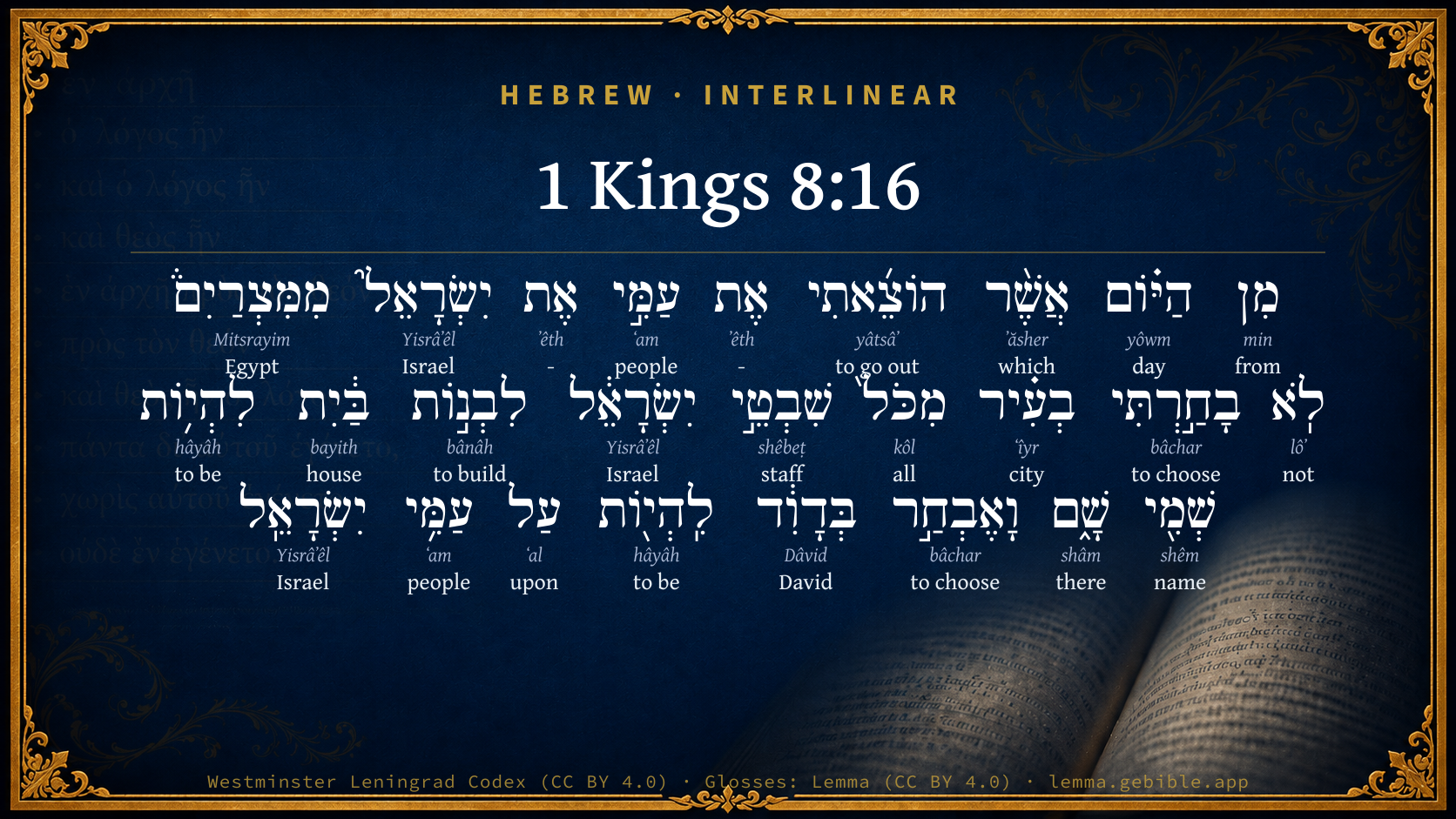
Hebrew (Westminster Leningrad Codex) 1 Kings 8:16 appears in the Hebrew Old Testament. The text above is from the Westminster Leningrad Codex. Each word links to its Strong’s number, a concise gloss, and parsing drawn from the Open Scriptures Hebrew Bible morphology. Click any word for its full Brown-Driver-Briggs (BDB) entry.
Download image
Cite this verse

1 Kings 8:16 (World English Bible). Public Domain. Lemma interlinear Bible study tool, https://lemma.gebible.app/v/1-kings/8/16.

Show BibTeX & RIS
BibTeX
RIS
English Translation
Since the day that I brought forth my people Israel out of Egypt, I chose no city out of all the tribes of Israel to build a house, that my name might be there; but I chose David to be over my people Israel.
World English Bible · Public Domain
Download a study sheet

One document with this verse’s original text, its word-by-word gloss line, the meaning frame, cross-references with their text, attributed commentary, and full source and license credits — printable, and it pastes into notes with its structure intact.

This verse Autodidact and up

Study sheet (.html) Plain text (.txt)

A passage Seminary Student

Up to 50 verses in one chapter. A passage sheet keeps up to 6 commentary sources and 12 cross-references per verse, in the order this page ranks them, and says so on the sheet whenever that leaves anything out. Ask for a single verse and you get the Autodidact verse sheet above.

Everything on this page stays free to read, with no account — the sheet is a download of what is already on screen, not access to it.

Want to remove ads? Support Godless Engineer
Compare translations 3

The same verse in 3 English versions, stacked beneath the original-language interlinear above. Click any original word for its lexicon entry.

Each is an independent rendering of the whole verse — the interlinear is not word-aligned to these translations.

Highlighted words mark where these versions differ — a whole-verse word diff, not a word-by-word alignment.

  • World English Bible Public Domain
    Since the day that I brought forth my people Israel out of Egypt, I chose no city out of all the tribes of Israel to build a house, that my name might be there; but I chose David to be over my people Israel.
  • King James Version Public Domain
    Since the day that I brought forth my people Israel out of Egypt, I chose no city out of all the tribes of Israel to build an house, that my name might be therein; but I chose David to be over my people Israel.
  • unfoldingWord Literal Text CC BY-SA 4.0
    ‘From the day when I brought out my people, Israel, from Egypt, I did not choose a city from all of the tribes of Israel to build a house for my name to be there. But I chose David to be over my people Israel.’

unfoldingWord Literal Text — © unfoldingWord, licensed CC BY-SA 4.0. Word-aligned USFM3 via Door43 (git.door43.org/unfoldingWord/en_ult).

Versions to compare (up to 4)

3 of 4 selected

Show all 18 translations

Every available English version of this verse, each an independent rendering of the whole verse.

  • World English Bible Public Domain
    Since the day that I brought forth my people Israel out of Egypt, I chose no city out of all the tribes of Israel to build a house, that my name might be there; but I chose David to be over my people Israel.
  • Berean Standard Bible Public Domain
    ‘Since the day I brought My people Israel out of Egypt, I have not chosen a city from any tribe of Israel in which to build a house so that My Name would be there. But I have chosen David to be over My people Israel.’
  • Majority Standard Bible Public Domain
    ‘Since the day I brought My people Israel out of Egypt, I have not chosen a city from any tribe of Israel in which to build a house so that My Name would be there. But I have chosen David to be over My people Israel.’
  • King James Version Public Domain
    Since the day that I brought forth my people Israel out of Egypt, I chose no city out of all the tribes of Israel to build an house, that my name might be therein; but I chose David to be over my people Israel.
  • American Standard Version (1901) Public Domain
    Since the day that I brought forth my people Israel out of Egypt, I chose no city out of all the tribes of Israel to build a house, that my name might be there; but I chose David to be over my people Israel.
  • Revised Version (1885) Public Domain
    Since the day that I brought forth my people Israel out of Egypt, I chose no city out of all the tribes of Israel to build an house, that my name might be there; but I chose David to be over my people Israel.
  • Geneva Bible (1599) Public Domain
    Since the day that I brought my people Israel out of Egypt, I chose no citie of all the tribes of Israel, to builde an house that my name might be there: but I haue chosen Dauid to be ouer my people Israel.
  • Douay-Rheims (1899) Public Domain
    Since the day that I brought my people Israel out of Egypt, I chose no city out of all the tribes of Israel, for a house to be built, that my name might be there: but I chose David to be over my people Israel.
  • Young's Literal Translation Public Domain
    From the day that I brought out My people, even Israel, from Egypt, I have not fixed on a city out of all the tribes of Israel, to build a house for My name being there; and I fix on David to be over My people Israel.
  • Literal Standard Version CC BY-SA 4.0
    From the day that I brought out My people, even Israel, from Egypt, I have not fixed on a city out of all the tribes of Israel, to build a house for My Name being there; and I fix on David to be over My people Israel.
  • Unlocked Literal Bible CC BY-SA 4.0
    'Since the day that I brought my people Israel out of Egypt, I chose no city out of all the tribes of Israel in which to build a house, in order for my name to be there. However, I chose David to rule over my people Israel.'
  • unfoldingWord Literal Text CC BY-SA 4.0
    ‘From the day when I brought out my people, Israel, from Egypt, I did not choose a city from all of the tribes of Israel to build a house for my name to be there. But I chose David to be over my people Israel.’
  • Darby Bible Public Domain
    Since the day that I brought forth my people Israel out of Egypt, I chose no city out of all the tribes of Israel to build a house in, that my name might be there; but I have chosen David to be over my people Israel.
  • World Messianic Bible Public Domain
    ‘Since the day that I brought my people Israel out of Egypt, I chose no city out of all the tribes of Israel to build a house, that my name might be there; but I chose David to be over my people Israel.’
  • Webster's Bible Public Domain
    Since the day that I brought forth my people Israel from Egypt, I have chosen no city out of all the tribes of Israel to build a house, that my name might be therein; but I chose David to be over my people Israel.
  • Free Bible Version CC BY-SA 4.0
    ‘Since the day I brought my people Israel out of Egypt I have not chosen any town of the tribes of Israel as the place to build a Temple to honor me. But I have chosen David as king over my people Israel.’
  • Bible in Basic English Public Domain
    From the day when I took my people Israel out of Egypt, no town in all the tribes of Israel has been marked out by me for the building of a house for the resting-place of my name; but I made selection of David to be king over my people Israel.
  • JPS Tanakh (1917) Public Domain
    Since the day that I brought forth My people Israel out of Egypt, I chose no city out of all the tribes of Israel to build a house, that My name might be there; but I chose David to be over My people Israel.

Literal Standard Version (2020), Covenant Press — licensed CC BY-SA 4.0. Text via the HelloAO Bible API (eBible.org). Unlocked Literal Bible (unfoldingWord) — licensed CC BY-SA 4.0. Text via the HelloAO Bible API (eBible.org). unfoldingWord Literal Text — © unfoldingWord, licensed CC BY-SA 4.0. Word-aligned USFM3 via Door43 (git.door43.org/unfoldingWord/en_ult). Free Bible Version, Dr. Jonathan Gallagher — licensed CC BY-SA 4.0. Text via the HelloAO Bible API (eBible.org).

Word by word

More ways to search: Search by grammar → Find every occurrence → Compare this word →

Practice this passage: Drill this verse → Learn its vocabulary →

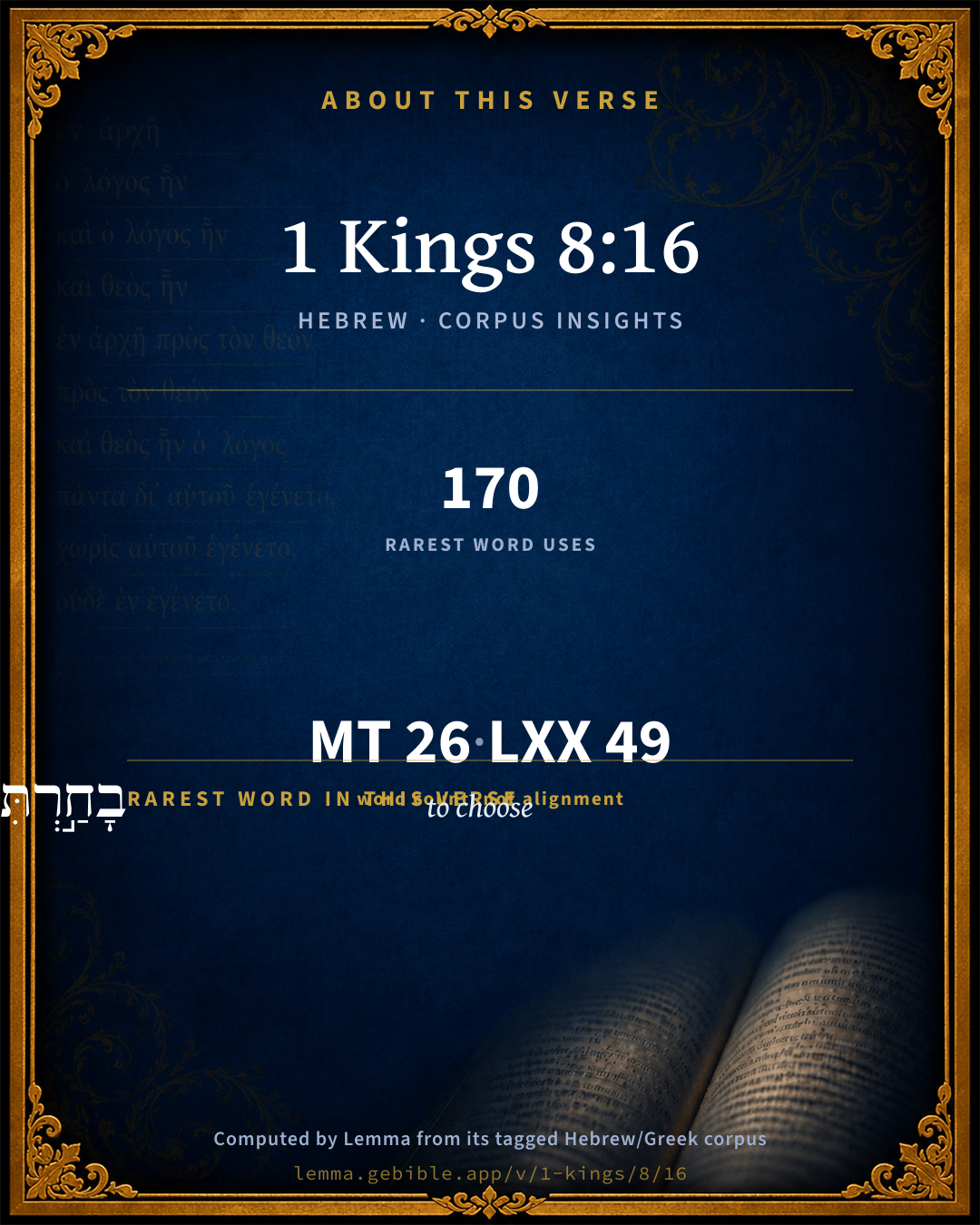
בָחַ֣רְתִּי
bâchar
H977
“to choose”
Verb, Qal, Perfect, 1st Person, Common, Singular
Part of Speech
Verb
Stem
Qal
Form
Perfect
Person
1st Person
Gender
Common
Number
Singular
Full BDB Definition

Origin: a primitive root

TWOT: 231

to choose, elect, decide for - (Qal) to choose - (Niphal) to be chosen - (Pual) to be chosen, selected
  1. מִן min H4480 “from” Preposition
  2. הַיּ֗וֹם yôwm H3117 “the · day” Particle, Definite Article + Noun, Common, Masculine, Singular, Absolute
  3. אֲשֶׁ֨ר ʼăsher H834 “which” Particle, Relative
  4. הוֹצֵ֜אתִי yâtsâʼ H3318 “to go out” Verb, Hiphil, Perfect, 1st Person, Common, Singular
  5. אֶת ʼêth H853 “-” Particle, Direct Object
  6. עַמִּ֣י ʻam H5971 “people · my” Noun, Common, Masculine, Singular, Construct + Suffix, Personal, 1st Person, Common, Singular
  7. אֶת ʼêth H853 “-” Particle, Direct Object
  8. יִשְׂרָאֵל֮ Yisrâʼêl H3478 “Israel” Noun, Proper
  9. מִמִּצְרַיִם֒ Mitsrayim H4714 “from · Egypt” Preposition + Noun, Proper
  10. לֹֽא lôʼ H3808 “not” Particle, Negative
  11. בְעִ֗יר ʻîyr H5892 “in/at · city” Preposition + Noun, Common, Feminine, Singular, Absolute
  12. מִכֹּל֙ kôl H3605 “from · all of” Preposition + Noun, Common, Masculine, Singular, Construct
  13. שִׁבְטֵ֣י shêbeṭ H7626 “staffs of” Noun, Common, Masculine, Plural, Construct
  14. יִשְׂרָאֵ֔ל Yisrâʼêl H3478 “Israel” Noun, Proper
  15. לִבְנ֣וֹת bânâh H1129 “to build” Preposition + Verb, Qal, Infinitive Construct
  16. בַּ֔יִת bayith H1004 “house” Noun, Common, Masculine, Singular, Absolute
  17. לִהְי֥וֹת hâyâh H1961 “to be” Preposition + Verb, Qal, Infinitive Construct
  18. שְׁמִ֖י shêm H8034 “name · my” Noun, Common, Masculine, Singular, Construct + Suffix, Personal, 1st Person, Common, Singular
  19. שָׁ֑ם shâm H8033 “there” Adverb
  20. וָאֶבְחַ֣ר bâchar H977 “and · to choose” Conjunction + Verb, Qal, Sequential Imperfect, 1st Person, Common, Singular
  21. בְּדָוִ֔ד Dâvid H1732 “in/at · David” Preposition + Noun, Proper
  22. לִֽהְי֖וֹת hâyâh H1961 “to be” Preposition + Verb, Qal, Infinitive Construct
  23. עַל ʻal H5921 “upon” Preposition
  24. עַמִּ֥י ʻam H5971 “people · my” Noun, Common, Masculine, Singular, Construct + Suffix, Personal, 1st Person, Common, Singular
  25. יִשְׂרָאֵֽל Yisrâʼêl H3478 “Israel” Noun, Proper

About this verse

These counts appear in no published source. They are computed here, from the morphology-tagged text and Lemma’s own curated glosses. What Lemma adds →

26
words
20
distinct lemmas
Historical
section

Grammatical profile

  • 6 verbs
  • 13 nouns
  • 2 prepositions
  • 1 adverb
  • 4 particles

Verb forms

  • הוֹצֵ֜אתִי Hiphil · Perfect
  • בָחַ֣רְתִּי Qal · Perfect
  • לִבְנ֣וֹת Qal · Infinitive Construct
  • לִהְי֥וֹת Qal · Infinitive Construct
  • וָאֶבְחַ֣ר Qal · Sequential Imperfect
  • לִֽהְי֖וֹת Qal · Infinitive Construct

Repetition

Words recur within this verse — often emphatic in Hebrew:

  • יִשְׂרָאֵל֮ Israel H3478 ×3
  • עַמִּ֣י people H5971 ×2
  • בָחַ֣רְתִּי to choose H977 ×2
  • לִהְי֥וֹת to be H1961 ×2

Hebrew & Septuagint length

In English translation the verse runs 44 words from the Hebrew and 56 from the Septuagint (LXX English) — closely comparable.

A rough comparison of the two English renderings, which tokenize alike — not a word-level alignment.

Word counts can differ between the Hebrew and the Greek without any difference in meaning — e.g. the Hebrew direct-object marker אֵת has no separate Greek word, and Greek often adds the article ὁ.

In the original languages it is 26 Hebrew tokens and 49 Greek tokens — but the two are counted differently (Hebrew bundles its prefixes and suffixes into one token; the Greek is in lemma form), so that isn’t a like-for-like length.

Cross-references

15

Topical passages linked to 1 Kings 8:16 in the Treasury of Scripture Knowledge — connected by theme and wording, ordered by reader-vote popularity; previews shown in the World English Bible.

  • 1 Samuel 16:1 Yahweh said to Samuel, How long will you mourn for Saul, seeing I have rejected him from being king over Israel? fill your horn with oil, and go: I will send you to Jesse the Bethlehemite; for I have provided me a king among his sons.
  • Deuteronomy 12:11 then it shall happen that to the place which Yahweh your God shall choose, to cause his name to dwell there, there shall you bring all that I command you: your burnt offerings, and your sacrifices, your tithes, and the heave-offering of your hand, and all your choice vows which you vow to Yahweh.
  • 2 Samuel 7:4–8 It happened the same night, that the word of Yahweh came to Nathan, saying,
  • 1 Kings 8:29 that your eyes may be open toward this house night and day, even toward the place of which you have said, My name shall be there; to listen to the prayer which your servant shall pray toward this place.
  • 1 Chronicles 28:4 However Yahweh, the God of Israel, chose me out of all the house of my father to be king over Israel forever: for he has chosen Judah to be prince; and in the house of Judah, the house of my father; and among the sons of my father he took pleasure in me to make me king over all Israel;
  • Deuteronomy 12:5 But to the place which Yahweh your God shall choose out of all your tribes, to put his name there, even to his habitation shall you seek, and there you shall come;
  • 1 Chronicles 17:5–6 for I have not lived in a house since the day that I brought up Israel, to this day, but have gone from tent to tent, and from [one] tent [to another].
  • Psalms 132:13 For Yahweh has chosen Zion. He has desired it for his habitation.
  • 1 Kings 11:36 To his son will I give one tribe, that David my servant may have a lamp always before me in Jerusalem, the city which I have chosen me to put my name there.
  • 2 Kings 23:27 Yahweh said, I will remove Judah also out of my sight, as I have removed Israel, and I will cast off this city which I have chosen, even Jerusalem, and the house of which I said, My name shall be there.
  • 2 Chronicles 6:5–11 Since the day that I brought forth my people out of the land of Egypt, I chose no city out of all the tribes of Israel to build a house in, that my name might be there; neither chose I any man to be prince over my people Israel:
  • Nehemiah 1:9 but if you return to me, and keep my commandments and do them, though your outcasts were in the uttermost part of the heavens, yet will I gather them from there, and will bring them to the place that I have chosen, to cause my name to dwell there.
  • Psalms 78:70 He also chose David his servant, And took him from the sheepfolds;
  • Psalms 89:19–20 Then you spoke in vision to your saints, And said, "I have bestowed strength on the warrior. I have exalted a young man from the people.
  • Jeremiah 7:12 But go you now to my place which was in Shiloh, where I caused my name to dwell at the first, and see what I did to it for the wickedness of my people Israel.

Cross-references courtesy of OpenBible.info (CC BY 4.0).

Hebrew and Greek witnesses Masoretic Hebrew ↔ Greek Septuagint

The same verse in the two great witnesses to the Old Testament, shown verse-for-verse.

These are two independent witnesses, not word-aligned to each other, and the Septuagint is shown in lemma (dictionary) form.

Hebrew 1 Kings 8:16 Masoretic · Westminster Leningrad Codex

מִן הַיּ֗וֹם אֲשֶׁ֨ר הוֹצֵ֜אתִי אֶת עַמִּ֣י אֶת יִשְׂרָאֵל֮ מִמִּצְרַיִם֒ לֹֽא בָחַ֣רְתִּי בְעִ֗יר מִכֹּל֙ שִׁבְטֵ֣י יִשְׂרָאֵ֔ל לִבְנ֣וֹת בַּ֔יִת לִהְי֥וֹת שְׁמִ֖י שָׁ֑ם וָאֶבְחַ֣ר בְּדָוִ֔ד לִֽהְי֖וֹת עַל עַמִּ֥י יִשְׂרָאֵֽל

Since the day that I brought forth my people Israel out of Egypt, I chose no city out of all the tribes of Israel to build a house, that my name might be there; but I chose David to be over my people Israel.

World English Bible · Public Domain

Greek LXX 1 Kings 8:16 Septuagint · lemma form

ἀπό ὅς ἡμέρα ἐκἄγω ὁ λαός ἐγώ ὁ ἰσραήλ ἐκ αἴγυπτος οὐ ἐκλέγω ἐν πόλις ἐν εἷς σκῆπτρον ἰσραήλ ὁ οἰκοδομέω οἶκος ὁ εἰμί ὁ ὄνομα ἐγώ ἐκεῖ καί ἐκλέγω ἐν ἰερουσαλήμ εἰμί ὁ ὄνομα ἐγώ ἐκεῖ καί ἐκλέγω ὁ δαυίδ ὁ εἰμί ἐπί ὁ λαός ἐγώ ὁ ἰσραήλ

From the day that I brought out my people Israel out of Egypt, I have not chosen a city in any one tribe of Israel to build a house, so that my name should be there: but I chose Jerusalem that my name should be there, and I chose David to be over my people Israel.

LXX2012 (modern English Septuagint) · Public Domain

On this verse, The Cambridge Bible for Schools and Colleges discusses the Septuagint’s reading. Read the note in Commentary ↓

Hebrew: Westminster Leningrad Codex (CC BY 4.0). Greek: Septuagint (public domain); English from LXX2012 (modern English Septuagint) (Public Domain). How the Septuagint differs from the Hebrew →

Targum (Aramaic paraphrase)

1

The Targum is the ancient Jewish Aramaic paraphrase of the Hebrew Scriptures — an interpretive translation, not the Hebrew text itself. Onkelos (literal) and Pseudo-Jonathan (expansive) render the Torah, and Jonathan the Prophets. Coverage is partial: where no permissively-licensed English translation exists for a verse, only the Aramaic is shown. This is verse-level text, not a word-by-word alignment to the Hebrew.

  1. Targum Jonathan Prophets (Joshua–Malachi)
    מִן יוֹמָא דִי אַפְקֵית יַת עַמִי יַת יִשְׂרָאֵל מִמִצְרַיִם לָא אִתְרְעֵיתִי בְּקַרְתָּא מִכֹּל שִׁבְטַיָא דְיִשְׂרָאֵל לְמִבְנֵי בֵיתָא לְאַשְׁרָאָה שְׁכִנְתִּי תַּמָן וְאִתְרְעֵיתִי בְדָוִד לְמֶהֱוֵי מַלְכָּא עַל עַמִי יִשְׂרָאֵל:

    (no public-domain English translation for this verse)

    Targum Jonathan — Aramaic: “Mikraot Gedolot” (public domain). English: “Sefaria Community Translation” (CC0 1.0 (public-domain dedication)); “London "Chaldee Paraphrase," 1871” (public domain). Text via Sefaria.

Commentary

Notes on 1 Kings 8:16 from classic Christian and Jewish commentators (each source and its license shown beneath its notes). The classic Christian expositions comment on the surrounding passage and are grouped to its opening verse, so a note may address several verses; the Jewish commentaries on the Tanakh (Rashi and others) are per-verse, so they appear only where the commentator wrote on this verse.

Lemma curates 59 commentaries, every one of them public domain or Creative Commons licensed, each selected and text-cleaned for this edition rather than reprinted as found. About our sources →

Trapp's Complete Commentary

John Trapp

1Ki 8:16 Since the day that I brought forth my people Israel out of Egypt, I chose no city out of all the tribes of Israel to build an house, that my name might be therein; but I chose David to be over my people Israel.

Ver. 16. I brought forth Israel out of Egypt.] This memorable mercy is often mentioned as a motive to real thankfulness. Deliverance commandeth obedience. But what was Egypt to hell? Pharaoh to the devil? &c. Oh, blessed be God for a Christ!

John Trapp, A Commentary or Exposition upon All the Books of the Old and New Testament (1647–1656) — public domain. Text from a community e-Sword module.

Adam Clarke's Commentary

Verse 16. Since the day, c.] Mention is here made, says Dr. Kennicott, of some one place and some one person preferred before all others and the preference is that of Jerusalem to other places, and of David to other men. In consequence of this remark, we shall see the necessity of correcting this passage by its parallel in 2Ch 6:5-6, where the thirteen Hebrew words now lost in Kings are happily preserved. Let us compare the passages: -

K. Since to day that I brought forth my people

C. Since the day that I brought forth my people

K. Israel out of Egypt, I chose no CITY

C. out of the land of Egypt, I chose no CITY

K. out of all the tribes of Israel to build a house,

C. among all the tribes of Israel to build a house in,

K. that my name might be therein; * * *

C. that my name might be there; neither chose I

K. * * * * * * *

C. any MAN to be a ruler over my people Israel:

K. * * * * * * *

C. but I have chosen JERUSALEM, that my name

K. * * * but I chose David to be

C. might be there; and have chosen DAVID to be

K. over my people Israel.

C. over my people Israel.

I would just observe here, that I do not think these thirteen words ever made a part of Kings, and consequently, are not lost from it; nor do they exist here in any of the versions; but their being found in Chronicles helps to complete the sense.

Adam Clarke's Commentary on the Bible (1810–1826) — public domain. Text from a community e-Sword/MySword module.

Ellicott's Commentary for English Readers

(16) I chose no city.—In this verse, as in some other cases, for coherence of idea, it seems necessary to correct from the fuller version in 2Ch_6:5-6, by an addition after the word “therein.” It should run: “Neither chose I any man to be ruler over my people, but I have chosen Jerusalem, that my name might be there, and I have chosen David to be over my people Israel.” The parallel in the two points referred to is exact. As there were temporary resting places for the ark—such as Gilgal, Shiloh, Kirjathjearim, and Zion—so there were rulers raised up successively for a time, and then removed. Now there was to be one fixed place as the Sanctuary of God, and one royal house of David to continue for ever.

A Bible Commentary for English Readers, edited by Charles John Ellicott (1878–1897) — public domain. Text from a community e-Sword module.

The Cambridge Bible for Schools and Colleges

gen. ed. J. J. S. Perowne

16. that my name might be therein] The expression in the Pentateuch is constant about the place which is dedicated to the worship of God: ‘God records His name there’ (Exo_20:24); ‘God chooses it to put His name there’ (Deu_12:5); ‘God chooses it to cause His name to dwell there’ (Deu_12:11). In Exo_20:24 the phrase is ‘in all places,’ because by that code it was contemplated that the place set apart for worship would be changed from time to time, and before the one permanent place was fixed upon, there would be many places where God was worshipped. Deuteronomy represents the ideal to be aimed at when the people were established in Canaan.

but I chose David] This is expanded in 2Ch_6:6 so as to include both the place and the person. ‘But I have chosen Jerusalem that my name might be there; and have chosen David to be over my people Israel.’ The LXX. also has the same clause. The language of this verse in Kings seems almost to imply some opposition (or difference in the way of choice) between the material structure and the person.

The Cambridge Bible for Schools and Colleges (gen. ed. J. J. S. Perowne; Cambridge University Press, 1878–1918) — public domain. Text from a community e-Sword module.

John Gill's Exposition

Since the day that I brought forth my people Israel out of Egypt,.... Which was now about four hundred and eighty eight years ago; see Kg1 6:1.

I chose no city out of all the tribes of Israel to build an house, that my name might be therein; he had chosen one in his mind from all eternity; but he had not made known this choice, nor the place he had chosen; he gave hints by Moses, that there was a place which he should choose, or declare he had chosen to put his name in, but did not express it, Deu 12:5 but now it was a clear case that he had chosen Jerusalem, and that was the city he always had in view, see Ch2 6:6,

but I chose David to be over my people Israel; to be their king, and to him he gave the first hint of the place where the temple was to be built, Ch1 22:1, and he chose no man, and his family with him, before him, to rule over Israel, and be concerned in such a work, see Ch2 6:5.

John Gill's Exposition of the Whole Bible (1746–1763) — public domain (CC PDM 1.0). Text via the HelloAO Bible API.

Albert Barnes' Notes on the Bible

The marginal reference completes the sense of this verse here. The passage is in accordance with archaic modes of speech, and is probably the more verbally accurate of the two.

Albert Barnes' Notes on the Bible (1834–1885) — public domain. Text from a community e-Sword/MySword module.

Matthew Poole's English Annotations

Since the day that I brought forth my people Israel out of Egypt, until David’s time; for then he did choose Jerusalem.

I chose no city, i.e. I did not declare my choice of it; for so choosing is used for declaring or executing one’s choice, as Deu 12:1; 2Ch 6:5; Zec 2:12, and things are oft said to be done when they are only manifested or declared to be such; in which sense God is said to be justified, Psa 51:4, and men to be guilty, Hos 5:15. Otherwise, to speak properly, whatsoever God chooseth, he chooseth from eternity.

That my name might be therein; that my presence, and grace, and worship, and glory might be there.

I chose David, and in and with him the tribe of Judah, of which he was, and Jerusalem, where he dwelt; which is here implied by the opposition of this to the former part of the verse.

Matthew Poole's English Annotations on the Holy Bible (1683–1685) — public domain. Text from a community e-Sword/MySword module.

The Pulpit Commentary

Since the day that I brought forth my people Israel out of Egypt, I chose no city out of all the tribes of Israel, to build a house, that my name might be therein. The chronicler adds here, "Neither chose I any man to be ruler," etc. Probably our account comes nearer to the words actually spoken. The speech in the Chronicles looks as if it had been somewhat amplified, though it only completes the sense (Rawlinson), but I chose David to be over my people Israel. Cf. Psa_78:70. This psalm pursues much the same line of thought as this address.

The Pulpit Commentary (1880–1919), ed. H.D.M. Spence-Jones & Joseph S. Exell — public domain. Text from a community e-Sword module.

John Wesley's Explanatory Notes

Since, &c. - Until David's time; for then he did chuse Jerusalem. That my name - That my presence, and grace, and worship, and glory, might be there. Chose David - And in and with him the tribe of Judah, of which he was, and Jerusalem where he dwelt.

John Wesley, Explanatory Notes Upon the Whole Bible (1754–1765) — public domain. Text via the GEBible commentary corpus.

Rashi

Rabbi Shlomo Yitzchaki (Rashi)

Since the day, etc. This is what He spoke to my father Dovid.

Rashi on the Tanakh — English translations: “The Judaica Press complete Tanach with Rashi, translated by A. J. Rosenberg” (CC BY 4.0); “Pentateuch with Rashi's commentary by M. Rosenbaum and A.M. Silbermann, 1929-1934” (public domain); “The Metsudah Tanach series, Lakewood, N.J” (CC BY 4.0); and “The Book of Joshua, Metsudah Publications, 1997” (CC BY 4.0). Text via Sefaria.

Lesson kit

Teaching starters — assembled from the data on this page, not authored interpretation. Every prompt links to the verse data it draws on. Edit before teaching.

1 Kings, in the Historical, opens this verse with 26 words (20 distinct Hebrew lemmas). Its most distinctive word is bâchar (“to choose”). A historical commentator’s framing appears above. Read the whole chapter for the surrounding context.

Discussion questions

  1. What does “to choose” (bâchar) contribute to the verse as a whole?
  2. 1 Samuel 16:1 shares this passage’s theme. How do the two illuminate each other?
  3. “Israel” occurs 3× in this one verse. What is the effect of the repetition?
  4. The translations on this page render this verse differently — a whole-verse word diff, not a word-by-word alignment. What might account for the different wordings?
  5. The verb «הוֹצֵ֜אתִי» is Hiphil Perfect. How does its form color the action?
  6. Reading how Trapp's Complete Commentary and Adam Clarke's Commentary read this verse, where do the two commentators agree and where do they part?

Things to notice

Reading settings

Reading text

Shown beneath each verse's original-language words.

Old Testament
Old Testament edition

Read the OT as the Masoretic Hebrew (MT) or the Greek Septuagint (LXX).

English shown for the Greek Septuagint (in the Hebrew ↔ Greek comparison).

Comparing translations? Open the Compare panel on any verse page to stack up to four side by side.