
Ezekiel 32:18

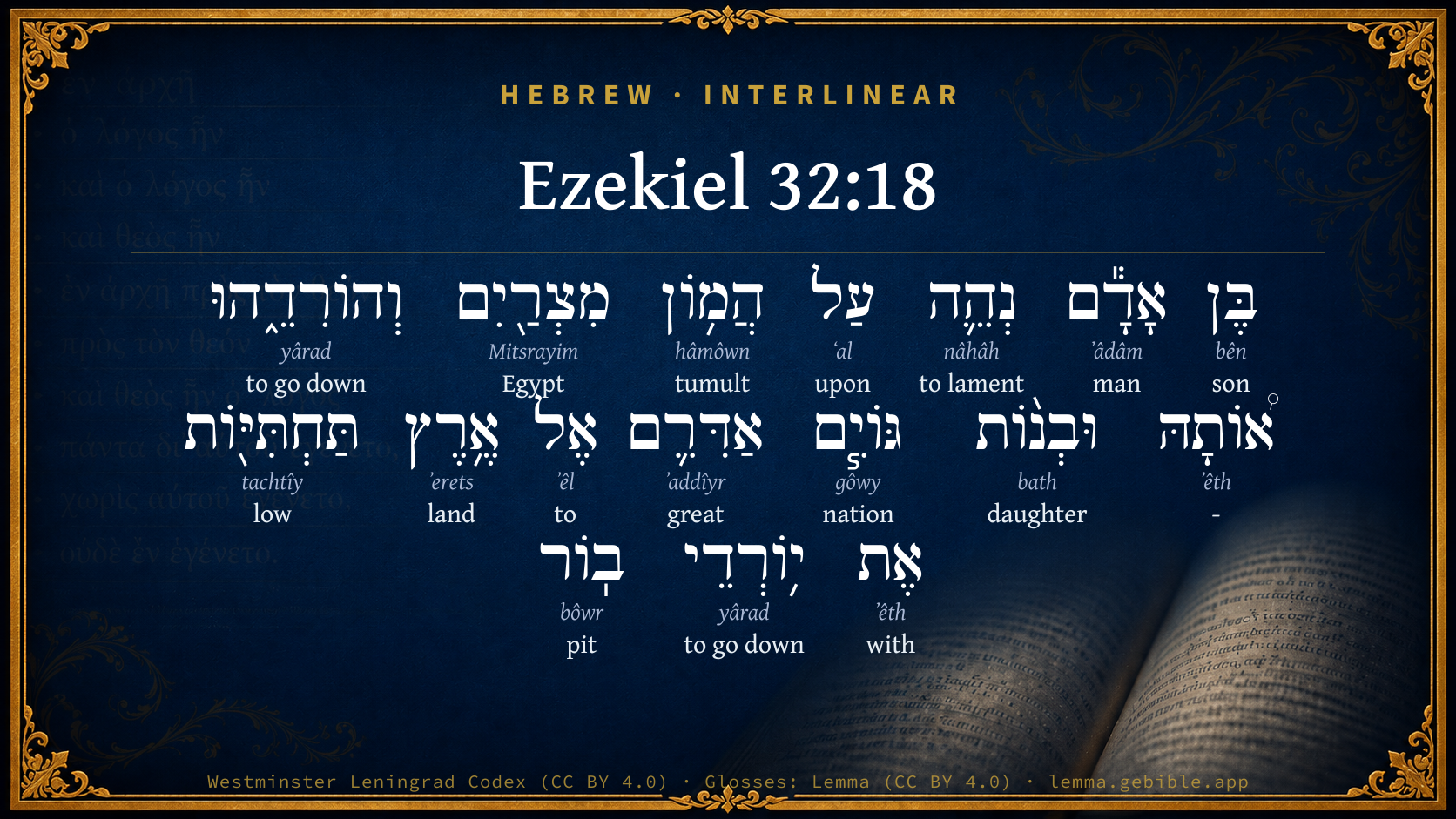
Hebrew (Westminster Leningrad Codex) Ezekiel 32:18 appears in the Hebrew Old Testament. The text above is from the Westminster Leningrad Codex. Each word links to its Strong’s number, a concise gloss, and parsing drawn from the Open Scriptures Hebrew Bible morphology. Click any word for its full Brown-Driver-Briggs (BDB) entry.
Download image
Cite this verse

Ezekiel 32:18 (World English Bible). Public Domain. Lemma interlinear Bible study tool, https://lemma.gebible.app/v/ezekiel/32/18.

Show BibTeX & RIS
BibTeX
RIS
English Translation
Son of man, wail for the multitude of Egypt, and cast them down, even her, and the daughters of the famous nations, to the lower parts of the earth, with those who go down into the pit.
World English Bible · Public Domain
Download a study sheet

One document with this verse’s original text, its word-by-word gloss line, the meaning frame, cross-references with their text, attributed commentary, and full source and license credits — printable, and it pastes into notes with its structure intact.

This verse Autodidact and up

Study sheet (.html) Plain text (.txt)

A passage Seminary Student

Up to 50 verses in one chapter. A passage sheet keeps up to 6 commentary sources and 12 cross-references per verse, in the order this page ranks them, and says so on the sheet whenever that leaves anything out. Ask for a single verse and you get the Autodidact verse sheet above.

Everything on this page stays free to read, with no account — the sheet is a download of what is already on screen, not access to it.

Want to remove ads? Support Godless Engineer
Compare translations 3

The same verse in 3 English versions, stacked beneath the original-language interlinear above. Click any original word for its lexicon entry.

Each is an independent rendering of the whole verse — the interlinear is not word-aligned to these translations.

Highlighted words mark where these versions differ — a whole-verse word diff, not a word-by-word alignment.

  • World English Bible Public Domain
    Son of man, wail for the multitude of Egypt, and cast them down, even her, and the daughters of the famous nations, to the lower parts of the earth, with those who go down into the pit.
  • King James Version Public Domain
    Son of man, wail for the multitude of Egypt, and cast them down, even her, and the daughters of the famous nations, unto the nether parts of the earth, with them that go down into the pit.
  • unfoldingWord Literal Text CC BY-SA 4.0
    “Son of man, weep for the multitudes of Egypt and bring them down— her and the daughters of majestic nations—to the lowest earth with those who have gone down to the pit.

unfoldingWord Literal Text — © unfoldingWord, licensed CC BY-SA 4.0. Word-aligned USFM3 via Door43 (git.door43.org/unfoldingWord/en_ult).

Versions to compare (up to 4)

3 of 4 selected

Show all 18 translations

Every available English version of this verse, each an independent rendering of the whole verse.

  • World English Bible Public Domain
    Son of man, wail for the multitude of Egypt, and cast them down, even her, and the daughters of the famous nations, to the lower parts of the earth, with those who go down into the pit.
  • Berean Standard Bible Public Domain
    “Son of man, wail for the multitudes of Egypt, and consign her and the daughters of the mighty nations to the depths of the earth with those who descend to the Pit:
  • Majority Standard Bible Public Domain
    “Son of man, wail for the multitudes of Egypt, and consign her and the daughters of the mighty nations to the depths of the earth with those who descend to the Pit:
  • King James Version Public Domain
    Son of man, wail for the multitude of Egypt, and cast them down, even her, and the daughters of the famous nations, unto the nether parts of the earth, with them that go down into the pit.
  • American Standard Version (1901) Public Domain
    Son of man, wail for the multitude of Egypt, and cast them down, even her, and the daughters of the famous nations, unto the nether parts of the earth, with them that go down into the pit.
  • Revised Version (1885) Public Domain
    Son of man, wail for the multitude of Egypt, and cast them down, even her, and the daughters of the famous nations, unto the nether parts of the earth, with them that go down into the pit.
  • Geneva Bible (1599) Public Domain
    Sonne of man, lament for the multitude of Egypt, and cast them downe, euen them and the daughters of the mighty nations vnto the nether partes of the earth, with them that goe downe into the pit.
  • Douay-Rheims (1899) Public Domain
    Son of man, sing a mournful song for the multitude of Egypt: and cast her down, both her, and the daughters of the mighty nations to the lowest part of the earth, with them that go down into the pit.
  • Young's Literal Translation Public Domain
    `Son of man, Wail for the multitude of Egypt, And cause it to go down, It -- and the daughters of honourable nations, Unto the earth -- the lower parts, With those going down to the pit.
  • Literal Standard Version CC BY-SA 4.0
    “Son of man, || Wail for the multitude of Egypt, || And cause it to go down, || It, and the daughters of majestic nations, || To the lower parts of the earth, || With those going down to the pit.
  • Unlocked Literal Bible CC BY-SA 4.0
    “Son of man, weep for the multitudes of Egypt and bring them down— her and the daughters of majestic nations—to the lowest earth with those who have gone down to the pit.
  • unfoldingWord Literal Text CC BY-SA 4.0
    “Son of man, weep for the multitudes of Egypt and bring them down— her and the daughters of majestic nations—to the lowest earth with those who have gone down to the pit.
  • Darby Bible Public Domain
    Son of man, wail for the multitude of Egypt, and cast them down, her and the daughters of the famous nations, unto the lower parts of the earth, with them that go down into the pit.
  • World Messianic Bible Public Domain
    “Son of man, wail for the multitude of Egypt, and cast them down, even her and the daughters of the famous nations, to the lower parts of the earth, with those who go down into the pit.
  • Webster's Bible Public Domain
    Son of man, wail for the multitude of Egypt, and cast them down, even her, and the daughters of the famous nations, to the nether parts of the earth, with them that go down into the pit.
  • Free Bible Version CC BY-SA 4.0
    “Son of man, weep for all the many Egyptians. Send them along with the people of powerful nations down into the depths of the earth with those who go down into the grave.
  • Bible in Basic English Public Domain
    Son of man, let your voice be loud in sorrow for the people of Egypt and send them down, even you and the daughters of the nations; I will send them down into the lowest parts of the earth, with those who go down into the underworld.
  • JPS Tanakh (1917) Public Domain
    'Son of man, wail for the multitude of Egypt, and cast them down, even her, with the daughters of the mighty nations, unto the nether parts of the earth, with them that go down into the pit.

Literal Standard Version (2020), Covenant Press — licensed CC BY-SA 4.0. Text via the HelloAO Bible API (eBible.org). Unlocked Literal Bible (unfoldingWord) — licensed CC BY-SA 4.0. Text via the HelloAO Bible API (eBible.org). unfoldingWord Literal Text — © unfoldingWord, licensed CC BY-SA 4.0. Word-aligned USFM3 via Door43 (git.door43.org/unfoldingWord/en_ult). Free Bible Version, Dr. Jonathan Gallagher — licensed CC BY-SA 4.0. Text via the HelloAO Bible API (eBible.org).

Word by word

More ways to search: Search by grammar → Find every occurrence → Compare this word →

Practice this passage: Drill this verse → Learn its vocabulary →

נְהֵ֛ה
nâhâh
H5091
“lament”
Verb, Qal, Imperative, 2nd Person, Masculine, Singular
Part of Speech
Verb
Stem
Qal
Form
Imperative
Person
2nd Person
Gender
Masculine
Number
Singular
Full BDB Definition

Origin: a primitive root

TWOT: 1311

to wail, lament - (Qal) to wail, lament - (Niphal) to go mourning after
  1. בֶּן bên H1121 “son of” Noun, Common, Masculine, Singular, Construct
  2. אָדָ֕ם ʼâdâm H120 “man” Noun, Common, Masculine, Singular, Absolute
  3. עַל ʻal H5921 “upon” Preposition
  4. הֲמ֥וֹן hâmôwn H1995 “tumult of” Noun, Common, Masculine, Singular, Construct
  5. מִצְרַ֖יִם Mitsrayim H4714 “Egypt” Noun, Proper
  6. וְהוֹרִדֵ֑הוּ yârad H3381 “and · go down · him” Conjunction + Verb, Hiphil, Imperative, 2nd Person, Masculine, Singular + Suffix, Personal, 3rd Person, Masculine, Singular
  7. א֠וֹתָהּ ʼêth H853 “- · her” Particle, Direct Object + Suffix, Personal, 3rd Person, Feminine, Singular
  8. וּבְנ֨וֹת bath H1323 “and · daughters of” Conjunction + Noun, Common, Feminine, Plural, Construct
  9. גּוֹיִ֧ם gôwy H1471 “nations” Noun, Common, Masculine, Plural, Absolute
  10. אַדִּרִ֛ם ʼaddîyr H117 “great” Adjective, Adjective, Masculine, Plural, Absolute
  11. אֶל ʼêl H413 “to” Preposition
  12. אֶ֥רֶץ ʼerets H776 “land” Noun, Common, Both, Singular, Absolute
  13. תַּחְתִּיּ֖וֹת tachtîy H8482 “low” Adjective, Adjective, Feminine, Plural, Absolute
  14. אֶת ʼêth H854 “with” Preposition
  15. י֥וֹרְדֵי yârad H3381 “going down” Verb, Qal, Participle Active, Masculine, Plural, Construct
  16. בֽוֹר bôwr H953 “pit” Noun, Common, Masculine, Singular, Absolute

About this verse

These counts appear in no published source. They are computed here, from the morphology-tagged text and Lemma’s own curated glosses. What Lemma adds →

17
words
16
distinct lemmas
Prophets
section

Notable vocabulary

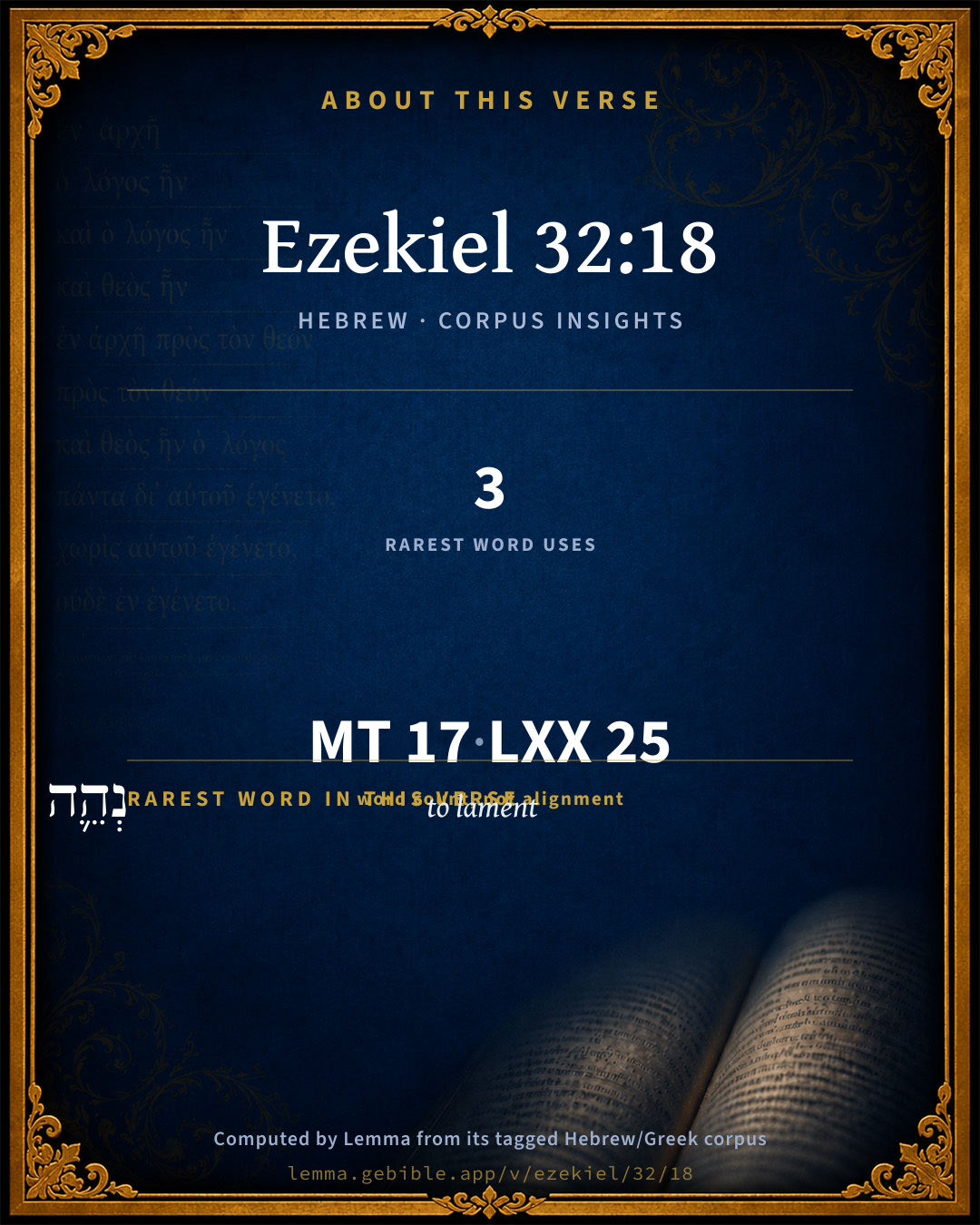
The rarest word here is נְהֵ֛ה to lament H5091 — appearing just 3 times in the whole Hebrew Bible.

Shared distinctive vocabulary

נְהֵ֛ה to lament H5091 occurs in 3 verses of the Hebrew Bible. Also found in:

Grammatical profile

  • 3 verbs
  • 8 nouns
  • 2 adjectives
  • 3 prepositions
  • 1 particle

Verb forms

  • נְהֵ֛ה Qal · Imperative
  • וְהוֹרִדֵ֑הוּ Hiphil · Imperative
  • י֥וֹרְדֵי Qal · Participle Active

Repetition

A word recurs within this verse — often emphatic in Hebrew:

  • וְהוֹרִדֵ֑הוּ to go down H3381 ×2

Hebrew & Septuagint length

In English translation the verse runs 37 words from the Hebrew and 32 from the Septuagint (LXX English) — closely comparable.

A rough comparison of the two English renderings, which tokenize alike — not a word-level alignment.

Word counts can differ between the Hebrew and the Greek without any difference in meaning — e.g. the Hebrew direct-object marker אֵת has no separate Greek word, and Greek often adds the article ὁ.

In the original languages it is 17 Hebrew tokens and 25 Greek tokens — but the two are counted differently (Hebrew bundles its prefixes and suffixes into one token; the Greek is in lemma form), so that isn’t a like-for-like length.

Cross-references

18

Topical passages linked to Ezekiel 32:18 in the Treasury of Scripture Knowledge — connected by theme and wording, ordered by reader-vote popularity; previews shown in the World English Bible.

  • Ezekiel 31:14 to the end that none of all the trees by the waters exalt themselves in their stature, neither set their top among the thick boughs, nor that their mighty ones stand up on their height, [even] all who drink water: for they are all delivered to death, to the lower parts of the earth, in the midst of the children of men, with those who go down to the pit.
  • Ezekiel 32:2 Son of man, take up a lamentation over Pharaoh king of Egypt, and tell him, You were likened to a young lion of the nations: yet are you as a monster in the seas; and you did break forth with your rivers, and troubled the waters with your feet, and fouled their rivers.
  • Jeremiah 1:10 behold, I have this day set you over the nations and over the kingdoms, to pluck up and to break down and to destroy and to overthrow, to build and to plant.
  • Ezekiel 32:16 This is the lamentation with which they shall lament; the daughters of the nations shall lament therewith; over Egypt, and over all her multitude, shall they lament therewith, says the Lord Yahweh.
  • Micah 1:8 For this I will lament and wail; I will go stripped and naked; I will howl like the jackals, And moan like the daughters of owls.
  • Isaiah 16:9 Therefore I will weep with the weeping of Jazer for the vine of Sibmah; I will water you with my tears, Heshbon, and Elealeh: for on your summer fruits and on your harvest the [battle] shout is fallen.
  • Ezekiel 26:20 then will I bring you down with those who descend into the pit, to the people of old time, and will make you to dwell in the lower parts of the earth, in the places that are desolate of old, with those who go down to the pit, that you be not inhabited; and I will set glory in the land of the living:
  • Ezekiel 31:16 I made the nations to shake at the sound of his fall, when I cast him down to Sheol with those who descend into the pit; and all the trees of Eden, the choice and best of Lebanon, all that drink water, were comforted in the lower parts of the earth.
  • Ezekiel 43:3 It was according to the appearance of the vision which I saw, even according to the vision that I saw when I came to destroy the city; and the visions were like the vision that I saw by the river Chebar; and I fell on my face.
  • Hosea 6:5 Therefore I have cut them to pieces with the prophets; I killed them with the words of my mouth. Your judgments are like a flash of lightning.
  • Psalms 30:9 "What profit is there in my destruction, if I go down to the pit? Shall the dust praise you? Shall it declare your truth?
  • Psalms 63:9 But those who seek my soul, to destroy it, Shall go into the lower parts of the earth.
  • Isaiah 14:15 Yet you shall be brought down to Sheol, to the uttermost parts of the pit.
  • Ezekiel 21:6–7 Sigh therefore, you son of man; with the breaking of your loins and with bitterness shall you sigh before their eyes.
  • Ezekiel 32:21 The strong among the mighty shall speak to him out of the midst of Sheol with those who help him: they are gone down, they lie still, even the uncircumcised, slain by the sword.
  • Ezekiel 32:24–32 There is Elam and all her multitude round about her grave; all of them slain, fallen by the sword, who are gone down uncircumcised into the lower parts of the earth, who caused their terror in the land of the living, and have borne their shame with those who go down to the pit.
  • Luke 19:41 When he drew near, he saw the city and wept over it,
  • Romans 12:15 Rejoice with those who rejoice. Weep with those who weep.

Cross-references courtesy of OpenBible.info (CC BY 4.0).

Hebrew and Greek witnesses Masoretic Hebrew ↔ Greek Septuagint

The same verse in the two great witnesses to the Old Testament, shown verse-for-verse.

These are two independent witnesses, not word-aligned to each other, and the Septuagint is shown in lemma (dictionary) form.

Hebrew Ezekiel 32:18 Masoretic · Westminster Leningrad Codex

בֶּן אָדָ֕ם נְהֵ֛ה עַל הֲמ֥וֹן מִצְרַ֖יִם וְהוֹרִדֵ֑הוּ א֠וֹתָהּ וּבְנ֨וֹת גּוֹיִ֧ם אַדִּרִ֛ם אֶל אֶ֥רֶץ תַּחְתִּיּ֖וֹת אֶת י֥וֹרְדֵי בֽוֹר

Son of man, wail for the multitude of Egypt, and cast them down, even her, and the daughters of the famous nations, to the lower parts of the earth, with those who go down into the pit.

World English Bible · Public Domain

Greek LXX Ezekiel 32:18 Septuagint · lemma form

υἱός ἄνθρωπος θρηνέω ἐπί ὁ ἰσχύς αἴγυπτος καί καταβιβάζω αὐτός ὁ θυγάτηρ ὁ ἔθνος νεκρός εἰς ὁ βάθος ὁ γῆ πρός ὁ καταβαίνω εἰς βόθρος

Son of man, lament over the strength of Egypt, for the nations shall bring down her daughters dead to the depth of the earth, to them that go down to the pit.

LXX2012 (modern English Septuagint) · Public Domain

On this verse, The Cambridge Bible for Schools and Colleges discusses the Septuagint’s reading. Read the note in Commentary ↓

Hebrew: Westminster Leningrad Codex (CC BY 4.0). Greek: Septuagint (public domain); English from LXX2012 (modern English Septuagint) (Public Domain). How the Septuagint differs from the Hebrew →

Targum (Aramaic paraphrase)

1

The Targum is the ancient Jewish Aramaic paraphrase of the Hebrew Scriptures — an interpretive translation, not the Hebrew text itself. Onkelos (literal) and Pseudo-Jonathan (expansive) render the Torah, and Jonathan the Prophets. Coverage is partial: where no permissively-licensed English translation exists for a verse, only the Aramaic is shown. This is verse-level text, not a word-by-word alignment to the Hebrew.

  1. Targum Jonathan Prophets (Joshua–Malachi)
    בַּר אָדָם אִתְנַבֵּי עַל אִתְרְגוּשַׁת מִצְרַיִם וְתַחְתָה לָהּ וּלְכַפְרָנֵי עַמְמַיָא תַקִיפַיָא אִתְנַבֵּי דְיִתְמַסְרוּן לְאַרְעָא אַרְעִיתָא עִם נַחֲתֵי גוֹב בֵית אַבְדָנָא:

    (no public-domain English translation for this verse)

    Targum Jonathan — Aramaic: “Mikraot Gedolot” (public domain). English: “Sefaria Community Translation” (CC0 1.0 (public-domain dedication)); “London "Chaldee Paraphrase," 1871” (public domain). Text via Sefaria.

Commentary

Notes on Ezekiel 32:18 from classic Christian and Jewish commentators (each source and its license shown beneath its notes). The classic Christian expositions comment on the surrounding passage and are grouped to its opening verse, so a note may address several verses; the Jewish commentaries on the Tanakh (Rashi and others) are per-verse, so they appear only where the commentator wrote on this verse.

Lemma curates 59 commentaries, every one of them public domain or Creative Commons licensed, each selected and text-cleaned for this edition rather than reprinted as found. About our sources →

Trapp's Complete Commentary

John Trapp

Eze 32:18 Son of man, wail for the multitude of Egypt, and cast them down, [even] her, and the daughters of the famous nations, unto the nether parts of the earth, with them that go down into the pit.

Ver. 18. Wail for the multitude.] Prophesy their destruction, but do it not without grief and regret.

Cast them down.] Do thou foretell it, and I will not fail to fulfil it. {Jer 1:10} {See Trapp on "Jer 1:10"} Let them know that hell gapeth for them; and here I give thee the keys thereof. So God doth to every faithful minister; {Mat 16:19} not to Peter only, nor to his pretended successor, the Pope, whom therefore Luther bravely slighted in these words of his, Contemptus est a me Romanus et favor et furor, - I care neither for the Pope’s favour nor frowns.

John Trapp, A Commentary or Exposition upon All the Books of the Old and New Testament (1647–1656) — public domain. Text from a community e-Sword module.

Tyndale Open Study Notes

Tyndale Open Resources

32:18-20 In an earlier message (31:17-18), God had declared that Egypt would go down to join the other nations in the underworld. Here that idea is expanded. Egypt’s destination was with the outcasts, along with those who fell by the sword. This place of horror, the pit, was already populated by many nations that once wielded power but had now gone down to destruction (cp. Isa 14:9-11).

Tyndale Open Study Notes — © Tyndale Open Resources, licensed CC BY-SA 4.0. Text via the HelloAO Bible API.

Geneva Bible (1599)

Geneva Bible translators

That is, prophesy, that they shall be cast down: thus the Lord giveth his Prophets power both to plant and to destroy by his word, read Jer. 1:10.

Geneva Bible (1599) marginal notes — public domain. Text via Bolls.life.

Jamieson, Fausset & Brown

Robert Jamieson, A. R. Fausset & David Brown

cast them down--that is predict that they shall be cast down (so Jer 1:10). The prophet's word was God's, and carried with it its own fulfilment.

daughters of . . . nations--that is the nations with their peoples. Egypt is to share the fate of other ancient nations once famous, now consigned to oblivion: Elam (Eze 32:24), Meshech, &c. (Eze 32:26), Edom (Eze 32:29), Zidon (Eze 32:30).

Jamieson, Fausset & Brown — Commentary Critical and Explanatory on the Whole Bible (1871) — public domain (CC PDM 1.0). Text via the HelloAO Bible API.

Adam Clarke's Commentary

Verse 18. Cast them down] Show them that they shall be cast down. Proclaim to them a casting down prophecy.

Adam Clarke's Commentary on the Bible (1810–1826) — public domain. Text from a community e-Sword/MySword module.

Ellicott's Commentary for English Readers

(18) Cast them down.—The prophet is here, as often elsewhere, told to do that which he prophesies shall be done. This is a forcible way of stating the certain fulfilment of that which is declared by Divine command.

A Bible Commentary for English Readers, edited by Charles John Ellicott (1878–1897) — public domain. Text from a community e-Sword module.

The Cambridge Bible for Schools and Colleges

gen. ed. J. J. S. Perowne

18. The lament is primarily over the multitude or nationality of Egypt.

cast them down, even her] Probably: and sink them down, thou and the daughters of famous nations. In Eze_32:16 the daughters of the nations were spoken of as chanting the dirge over Pharaoh and his multitude. The prophet (LXX. Eze_32:16) and these daughters together chant the lament. They are said to “sink the multitude down” because in their lament they describe their sinking down. The reading “thou” for “her” implies no change in the consonantal text, and the “daughters of famous nations” cannot be those that are interred, but those who inter. It is Pharaoh and his multitude who are let down into the pit (cf. Eze_32:31).

them that go down] that are gone down, Eze_26:20, Eze_31:16.

The Cambridge Bible for Schools and Colleges (gen. ed. J. J. S. Perowne; Cambridge University Press, 1878–1918) — public domain. Text from a community e-Sword module.

John Gill's Exposition

Son of man, wail for the multitude of Egypt,.... Sing a funeral song or dirge, or compose one, to be sung by the mourning women, on account of the vast numbers of the inhabitants of Egypt that shall be slain; for the prophet himself would not mourn, but rejoice, on this occasion; but this is said to show the certainty of the destruction, and the lamentation that would be made on that account:

and cast them down, even her and the daughters of the famous nations; Egypt, and all those countries, and the inhabitants of them, that were in alliance and friendship with her; that is, declare by prophecy that they shall be cast down and destroyed, or be brought down from the height of grandeur and prosperity in which they now were:

unto the nether parts of the earth, with them that go down to the pit; not unto stately sepulchres built on high, such as were made for the kings of Egypt; but unto common pits or graves, dug in the lower parts of the earth, where the meaner and common sort of people were buried; there should be no distinction between them and others, they should have one common burial. The Targum is,

"son of man, prophesy concerning the multitude of Egypt, and break her, even her, and the villages of the mighty people; prophesy that they shall be delivered unto the lowest earth, with those that go down to the pit of the house of perdition.''

John Gill's Exposition of the Whole Bible (1746–1763) — public domain (CC PDM 1.0). Text via the HelloAO Bible API.

Haydock's Catholic Bible Commentary

CHAPTER XXXII.

Down: announce this catastrophe. (Calmet) --- Apries was slain by order of Amasis. (Diodorus 1.) (Jeremias xliv. 30.)

George Leo Haydock (1774–1849), Haydock's Catholic Family Bible and Commentary, 1859 edition — public domain. Excludes Psalms (Douay-Rheims chapter numbering differs from Protestant) and Deuterocanonical books (Catholic canon only).

Matthew Poole's English Annotations

Prepare the funeral ceremonies at the burial of Egypt, compose a suitable song or speech, utter it with a like suitableness to the sad occasion. Jer 9:17-19, and Amo 5:16, use the word, and the places read will explain this.

Cast them down; either declare that they shall be cast down from their height and glory; or rather, because this was done already, lay them down as dead in the grave, bring him to his grave, as the word is used, with addition of sheol, 1Ki 2:9, and much like are Eze 26:20; 31:16.

The daughters of the famous nations; and celebrate the funerals of other cities and kingdoms, that lie buried in their own ruins and other men’s oblivion.

The nether parts of the earth; a well-known description of the state of the dead and the grave.

Go down into the pit: usually this is no more than a common description of men’s going to the dust in their burial, but here it includes more. The Egyptians affected to be buried either in the isle Chemnis, or in the pyramids, their kings and great ones thus would be laid by themselves; but Ezekiel provides them their grave among common people, buries them where they fall; for they shall not have what they account so much of in their funeral.

Matthew Poole's English Annotations on the Holy Bible (1683–1685) — public domain. Text from a community e-Sword/MySword module.

Whedon's Commentary on the Bible

Daniel D. Whedon

18. The pit — A synonym for Sheol (Psa_30:3; Psa_88:3-4, etc.).

Daniel D. Whedon (gen. ed.), Commentary on the Old and New Testaments (1874–1909) — public domain. Text from a community e-Sword module.

The Pulpit Commentary

Cast them down, etc. The prophet thinks of himself as not only the predictor, but the minister, of the Divine judgments. So it was given to Jeremiah (Jer_1:10) "to root out and to pull down," and to Amos (Amo_9:1) to "smite" and to wound. He executes the sentence, not on Egypt only, but on the other daughters of the famous nations, sc. on the nations themselves, especially those that are named in the verses that follow.

Sympathetic sorrow.

I SYMPATHETIC SORROW IS CALLED FOR BY THE TROUBLES OF OUR FELLOW MEN. Ezekiel is told by God to wail for the multitude of Egypt. He had his own troubles among the disaffected Jews; but he was not to shut himself up in the selfishness of private distress. His nation was passing through a season of terrible experiences, many of his kinsfolk driven into exile, and the remaining inhabitants threatened with fresh war-cruelties. Yet, Jew as he was, Ezekiel was to find room in his heart for grief over the distresses of Egypt. It is inhuman not to be moved by a neighbor"s trouble. We ought to widen the area of our sympathy, and embrace in it the interests and troubles of foreign nations. If a Jew should wail for Egypt, should not a Christian wail for the evils of the world? Mansion House funds for various successive foreign needs Persian and China famines, etc. are among the healthiest signs of our times, and contain a better augury of the future of England than the high price of government stock. Individually we are called upon to grieve over our neighbor"s troubles.

II SYMPATHETIC SORROW IS ESPECIALLY REQUIRED BY THE WORLD"S SIN.

1. We should grieve more over sin than over external calamity. The gambling of England is a more sorrowful sight than the wreckage that strews our coast after a disastrous gale. We mourn for the death of the good and noble; we should mourn more for the life of the wicked and ignoble. Drunkenness is a worse evil than pauperism. Profligacy is infinitely more deplorable than poverty. Therefore people who think themselves happy and do not seek our commiseration may most need it.

2. We should grieve over sin rather than coldly condemn it. The sympathizer is himself a sinner. Many who have fallen most low have been most grievously tempted; but even when the kindest charity can discover no excuse, wickedness itself should be regarded as a miserable source of grief to all right-minded people. God pitied the sinner, and sent his Son to save him. Christ wept over Jerusalem. The Christian treatment of sin is to approach it with sympathetic sorrow.

III SYMPATHETIC SORROW IS A MINISTERING ANGEL OF MERCY.

1. It is a source of consolation. Sympathy may comfort when no helping hand can relieve suffering. It is much to know that we are not alone, uncured for, and forgotten. The sympathy of God is offered to every distressed son of man. This is a type and pattern of what must be in the heart of every godly man.

2. It is an inspiration of deliverance. To be content to wail for the troubles of others, when by any effort or sacrifice we might alleviate those troubles, is to declare ourselves no better than hypocrites. Rich people who deplore the misery of their poor neighbors, and yet do nothing to relieve the burden of poverty, are guilty of shameful inconsistency and moral untruth. If they really grieved they would relieve. The first step is to feel the troubles of our fellow men; the next must be to do all in our power to help them. Happily in regard to spiritual troubles Christian people have a source of assistance to offer in the gospel of Christ.

Vers. 18-30. The world of the dead.

strong among the mighty" are the inhabitants of the under-world who once were kings and heroes on earth. Now those monarchs of the dead stir themselves as they see great Pharaoh coming to join their company, and prepare to give him a stately though a gloomy welcome.

I THERE IS A WORLD WHERE THE DEAD YET LIVE. This world only appeared to be a realm of shades and desolation to the Jews of Old Testament times. For those who have not the life of Christ in them the New Testament offers a worse prospect. Yet that some world of departed spirits exists is taught in the Old Testament as well as in the New. This agrees with the almost universal belief of man in all ages and of all nations and of most religions. There seems to be implanted in us an instinct of immortality. We cannot escape from some conception of a hereafter.

II IT IS OF SOME IMPORTANCE THAT WE SHOULD CONSIDER OUR RELATION TO THE WORLD OF THE DEAD. Religion is primarily for this life, to help us to do our daily duty. But it also bears on the future. We cannot but feel that our life is swiftly fleeting. Every year brings us nearer to the great mystery. We know full well that every soul among us will soon solve the awful riddle of futurity. Surely, then, it is of some moment that we should stand in right relations with the world of the dead, if only we can know what those relations should be.

III GOD RULES OVER THE REALMS OF THE DEAD. The psalmist, when meditating on the Divine omnipresence, exclaimed, "If I make my bed in Sheol, behold, thou art there". (Psa_139:8)

1. Therefore it is vain to hope to escape from God.by the gate of death. The suicide is mistaken if he thinks he will elude the grasp of the great Avenger.

2. God will maintain order and justice in the realm of the dead. Bad souls do not descend into a Miltonic hell, ruled over by Satan and his crew, at whose mercy they must be without the interference of God. Such a pandemonium does not exist. As far as the Bible is a guide on the subject, there seems to be a solemn order in the regions of the dead. The confusion of earth does not reach the silent realms on the other side of the dark river. If we would be well dealt with there, we must be right and straight with God"s justice here.

IV THE REALM OF THE DEAD WILL BE A DOLEFUL PLACE FOR THE SINNER. The old delights will all be extinguished. The worldly store will be left behind. If the soul has no better treasure, it will be starved and beggared. The strongest and most exalted on earth will find that their power and rank are utterly gone. There kings lie low. The guilty soul will stand naked, with all its sin exposed. There will be no shelter from wrath and punishment. Christ alone can save us from this doleful prospect, by giving us his life eternal.

V THE WORLD WILL WEAR A NEW ASPECT WHEN VIEWED FROM THE REALM OF THE DEAD. Seen from the sun, the earth must appear to be a very small planet. Many great interests, delights, and distresses of earth must seem but poor child"s play to the large sad eyes of death, but spiritual experiences must seem intensely real. Yet every man will be himself still. Pharaoh is recognized. The future is linked on to the past; it will look back on the past, and gravely judge it.

The Pulpit Commentary (1880–1919), ed. H.D.M. Spence-Jones & Joseph S. Exell — public domain. Text from a community e-Sword module.

John Wesley's Explanatory Notes

Wail - Prepare the funeral ceremonies at the burial of Egypt. The daughters - And celebrate the funerals of other cities and kingdoms that lie buried in their own ruins. The nether parts of the earth - A well known description of the state of the dead. The pit - The Egyptians affected to be buried in the Pyramids, and their kings, and great ones, would be laid by themselves; but Ezekiel provides them their grave among common people, being buried just where they fall.

John Wesley, Explanatory Notes Upon the Whole Bible (1754–1765) — public domain. Text via the GEBible commentary corpus.

Rashi

Rabbi Shlomo Yitzchaki (Rashi)

lament Weep and lament.

and bring it down, it and the daughters, etc. prophesy, about him and about all the heathens, that they will descend into the Pit of Destruction. Here the Holy One, blessed be He, showed Ezekiel that all the heathens descend to Gehinnom.

Rashi on the Tanakh — English translations: “The Judaica Press complete Tanach with Rashi, translated by A. J. Rosenberg” (CC BY 4.0); “Pentateuch with Rashi's commentary by M. Rosenbaum and A.M. Silbermann, 1929-1934” (public domain); “The Metsudah Tanach series, Lakewood, N.J” (CC BY 4.0); and “The Book of Joshua, Metsudah Publications, 1997” (CC BY 4.0). Text via Sefaria.

Lesson kit

Teaching starters — assembled from the data on this page, not authored interpretation. Every prompt links to the verse data it draws on. Edit before teaching.

Ezekiel, in the Prophets, opens this verse with 17 words (16 distinct Hebrew lemmas). Its most distinctive word is nâhâh (“to lament”). A historical commentator’s framing appears above. Read the whole chapter for the surrounding context.

Discussion questions

  1. How does “to lament” (nâhâh) shape what this verse is saying?
  2. How does 1 Samuel 7:2, which shares the word «to lament», read alongside this verse?
  3. What does the repetition of “to go down” (2× in this one verse) do in this verse?
  4. These translations render this verse differently; the difference is in the English rendering, not the original. What questions does that raise?
  5. «נְהֵ֛ה» is a Qal Imperative verb. How does that grammatical form shape the action described?
  6. Compare how Trapp's Complete Commentary and Tyndale Open Study Notes read this verse. Where do they agree or differ?

Things to notice

Reading settings

Reading text

Shown beneath each verse's original-language words.

Old Testament
Old Testament edition

Read the OT as the Masoretic Hebrew (MT) or the Greek Septuagint (LXX).

English shown for the Greek Septuagint (in the Hebrew ↔ Greek comparison).

Comparing translations? Open the Compare panel on any verse page to stack up to four side by side.