Isaiah 20:3

Hebrew (Westminster Leningrad Codex) Isaiah 20:3 appears in the Hebrew Old Testament. The text above is from the Westminster Leningrad Codex. Each word links to its Strong’s number, a concise gloss, and parsing drawn from the Open Scriptures Hebrew Bible morphology. Click any word for its full Brown-Driver-Briggs (BDB) entry.
Download image
Cite this verse

Isaiah 20:3 (World English Bible). Public Domain. Lemma interlinear Bible study tool, https://lemma.gebible.app/v/isaiah/20/3.

Show BibTeX & RIS
BibTeX
RIS
English Translation
Yahweh said, Like as my servant Isaiah has walked naked and barefoot three years for a sign and a wonder concerning Egypt and concerning Ethiopia;
World English Bible · Public Domain
Download a study sheet

One document with this verse’s original text, its word-by-word gloss line, the meaning frame, cross-references with their text, attributed commentary, and full source and license credits — printable, and it pastes into notes with its structure intact.

This verse Autodidact and up

Study sheet (.html) Plain text (.txt)

A passage Seminary Student

Up to 50 verses in one chapter. A passage sheet keeps up to 6 commentary sources and 12 cross-references per verse, in the order this page ranks them, and says so on the sheet whenever that leaves anything out. Ask for a single verse and you get the Autodidact verse sheet above.

Everything on this page stays free to read, with no account — the sheet is a download of what is already on screen, not access to it.

Want to remove ads? Support Godless Engineer
Compare translations 3

The same verse in 3 English versions, stacked beneath the original-language interlinear above. Click any original word for its lexicon entry.

Each is an independent rendering of the whole verse — the interlinear is not word-aligned to these translations.

Highlighted words mark where these versions differ — a whole-verse word diff, not a word-by-word alignment.

  • World English Bible Public Domain
    Yahweh said, Like as my servant Isaiah has walked naked and barefoot three years for a sign and a wonder concerning Egypt and concerning Ethiopia;
  • King James Version Public Domain
    And the LORD said, Like as my servant Isaiah hath walked naked and barefoot three years for a sign and wonder upon Egypt and upon Ethiopia;
  • unfoldingWord Literal Text CC BY-SA 4.0
    And Yahweh said, “Just as my servant Isaiah has gone naked and barefoot three years a sign and a wonder against Egypt and against Cush,

unfoldingWord Literal Text — © unfoldingWord, licensed CC BY-SA 4.0. Word-aligned USFM3 via Door43 (git.door43.org/unfoldingWord/en_ult).

Versions to compare (up to 4)

3 of 4 selected

Show all 18 translations

Every available English version of this verse, each an independent rendering of the whole verse.

  • World English Bible Public Domain
    Yahweh said, Like as my servant Isaiah has walked naked and barefoot three years for a sign and a wonder concerning Egypt and concerning Ethiopia;
  • Berean Standard Bible Public Domain
    Then the LORD said, “Just as My servant Isaiah has gone naked and barefoot for three years as a sign and omen against Egypt and Cush,
  • Majority Standard Bible Public Domain
    Then the LORD said, “Just as My servant Isaiah has gone naked and barefoot for three years as a sign and omen against Egypt and Cush,
  • King James Version Public Domain
    And the LORD said, Like as my servant Isaiah hath walked naked and barefoot three years for a sign and wonder upon Egypt and upon Ethiopia;
  • American Standard Version (1901) Public Domain
    And Jehovah said, Like as my servant Isaiah hath walked naked and barefoot three years for a sign and a wonder concerning Egypt and concerning Ethiopia;
  • Revised Version (1885) Public Domain
    And the LORD said, Like as my servant Isaiah hath walked naked and barefoot three years for a sign and a wonder upon Egypt and upon Ethiopia;
  • Geneva Bible (1599) Public Domain
    And the Lord said, Like as my seruant Isaiah hath walked naked, and barefoote three yeeres, as a signe and wonder vpon Egypt, and Ethiopia,
  • Douay-Rheims (1899) Public Domain
    And the Lord said: As my servant Isaias hath walked, naked and barefoot, it shall be a sign and a wonder of three years upon Egypt, and upon Ethiopia,
  • Young's Literal Translation Public Domain
    And Jehovah saith, `As My servant Isaiah hath gone naked and barefoot three years, a sign and a wonder for Egypt and for Cush,
  • Literal Standard Version CC BY-SA 4.0
    And YHWH says, “As My servant Isaiah has gone naked and barefoot three years, a sign and a wonder for Egypt and for Cush,
  • Unlocked Literal Bible CC BY-SA 4.0
    Yahweh said, “Just as my servant Isaiah has walked naked and barefoot for three years, it is a sign and an omen concerning Egypt and concerning Cush—
  • unfoldingWord Literal Text CC BY-SA 4.0
    And Yahweh said, “Just as my servant Isaiah has gone naked and barefoot three years a sign and a wonder against Egypt and against Cush,
  • Darby Bible Public Domain
    And Jehovah said, Like as my servant Isaiah hath walked naked and barefoot three years, a sign and a wonder concerning Egypt and concerning Ethiopia,
  • World Messianic Bible Public Domain
    The LORD said, “As my servant Isaiah has walked naked and barefoot three years for a sign and a wonder concerning Egypt and concerning Ethiopia,
  • Webster's Bible Public Domain
    And the LORD said, As my servant Isaiah hath walked naked and barefoot three years for a sign and wonder upon Egypt and upon Cush;
  • Free Bible Version CC BY-SA 4.0
    Then the Lord said, “In the same way that my servant Isaiah has gone naked and barefoot for three years as a sign and a warning against Egypt and Ethiopia,
  • Bible in Basic English Public Domain
    And the Lord said, As my servant Isaiah has gone unclothed and without shoes for three years as a sign and a wonder to Egypt and Ethiopia,
  • JPS Tanakh (1917) Public Domain
    And the LORD said: 'Like as My servant Isaiah hath walked naked and barefoot to be for three years a sign and a wonder upon Egypt and upon Ethiopia,

Literal Standard Version (2020), Covenant Press — licensed CC BY-SA 4.0. Text via the HelloAO Bible API (eBible.org). Unlocked Literal Bible (unfoldingWord) — licensed CC BY-SA 4.0. Text via the HelloAO Bible API (eBible.org). unfoldingWord Literal Text — © unfoldingWord, licensed CC BY-SA 4.0. Word-aligned USFM3 via Door43 (git.door43.org/unfoldingWord/en_ult). Free Bible Version, Dr. Jonathan Gallagher — licensed CC BY-SA 4.0. Text via the HelloAO Bible API (eBible.org).

Word by word

More ways to search: Search by grammar → Find every occurrence → Compare this word →

Practice this passage: Drill this verse → Learn its vocabulary →

וְיָחֵ֑ף
yâchêph
H3182
“and · barefoot”
Conjunction + Adjective, Adjective, Masculine, Singular, Absolute
Part of Speech
Conjunction + Adjective
Type
Adjective
Gender
Masculine
Number
Singular
State
Absolute
Full BDB Definition

Origin: from an unused root meaning to take off the shoes

TWOT: 861a

barefoot - bareness, being unshod (substantive)
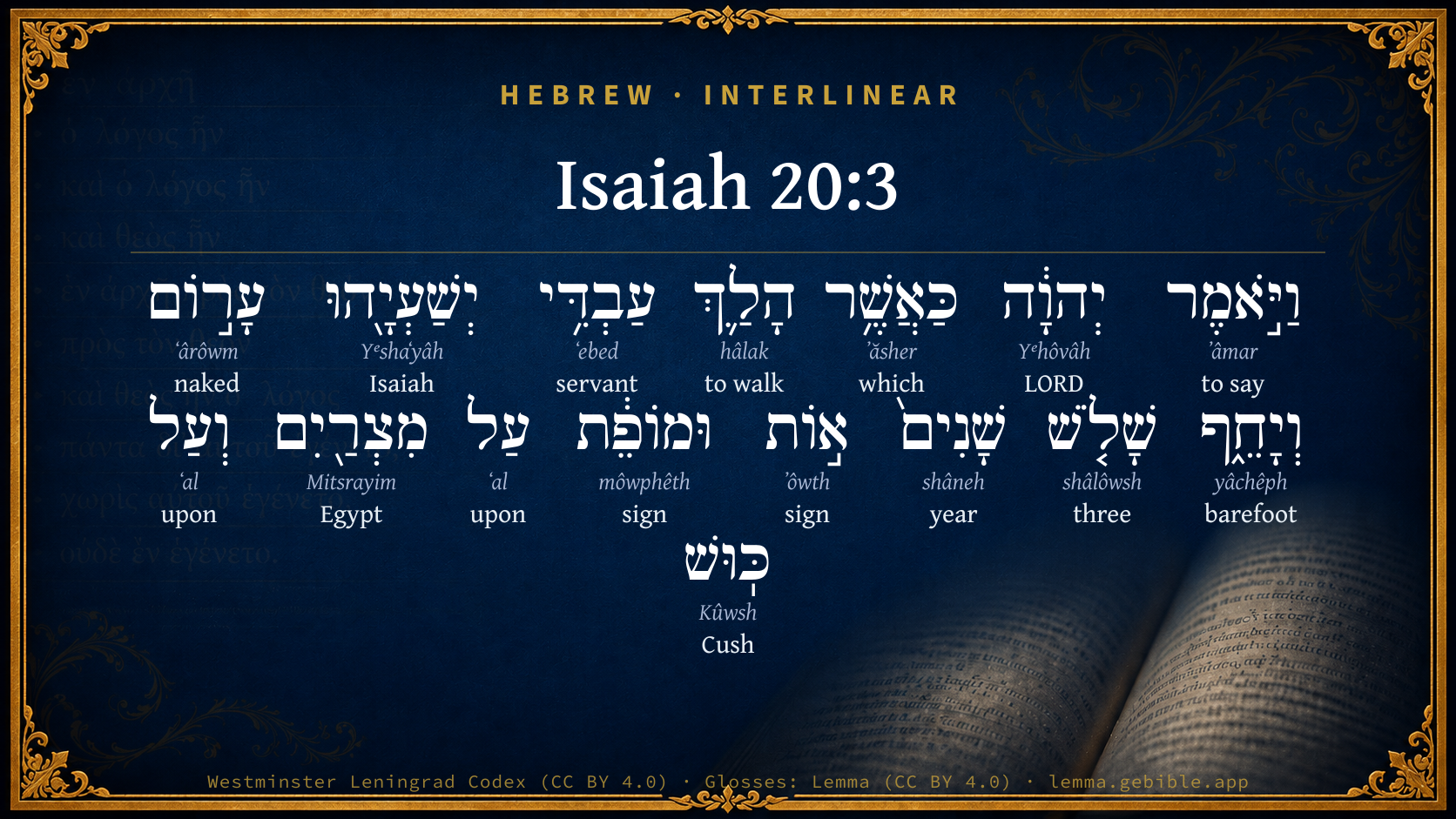
  1. וַיֹּ֣אמֶר ʼâmar H559 “and · to say” Conjunction + Verb, Qal, Sequential Imperfect, 3rd Person, Masculine, Singular
  2. יְהוָ֔ה Yᵉhôvâh H3068 “LORD” Noun, Proper
  3. כַּאֲשֶׁ֥ר ʼăsher H834 “like/as · which” Preposition + Particle, Relative
  4. הָלַ֛ךְ hâlak H1980 “to walk” Verb, Qal, Perfect, 3rd Person, Masculine, Singular
  5. עַבְדִּ֥י ʻebed H5650 “servant · my” Noun, Common, Masculine, Singular, Construct + Suffix, Personal, 1st Person, Common, Singular
  6. יְשַׁעְיָ֖הוּ Yᵉshaʻyâh H3470 “Isaiah” Noun, Proper
  7. עָר֣וֹם ʻârôwm H6174 “naked” Adjective, Adjective, Masculine, Singular, Absolute
  8. שָׁלֹ֤שׁ shâlôwsh H7969 “three” Adjective, Cardinal number, Feminine, Singular, Absolute
  9. שָׁנִים֙ shâneh H8141 “years” Noun, Common, Feminine, Plural, Absolute
  10. א֣וֹת ʼôwth H226 “sign” Noun, Common, Both, Singular, Absolute
  11. וּמוֹפֵ֔ת môwphêth H4159 “and · sign” Conjunction + Noun, Common, Masculine, Singular, Absolute
  12. עַל ʻal H5921 “upon” Preposition
  13. מִצְרַ֖יִם Mitsrayim H4714 “Egypt” Noun, Proper
  14. וְעַל ʻal H5921 “and · upon” Conjunction + Preposition
  15. כּֽוּשׁ Kûwsh H3568 “Cush” Noun, Proper

About this verse

These counts appear in no published source. They are computed here, from the morphology-tagged text and Lemma’s own curated glosses. What Lemma adds →

16
words
15
distinct lemmas
Prophets
section

Notable vocabulary

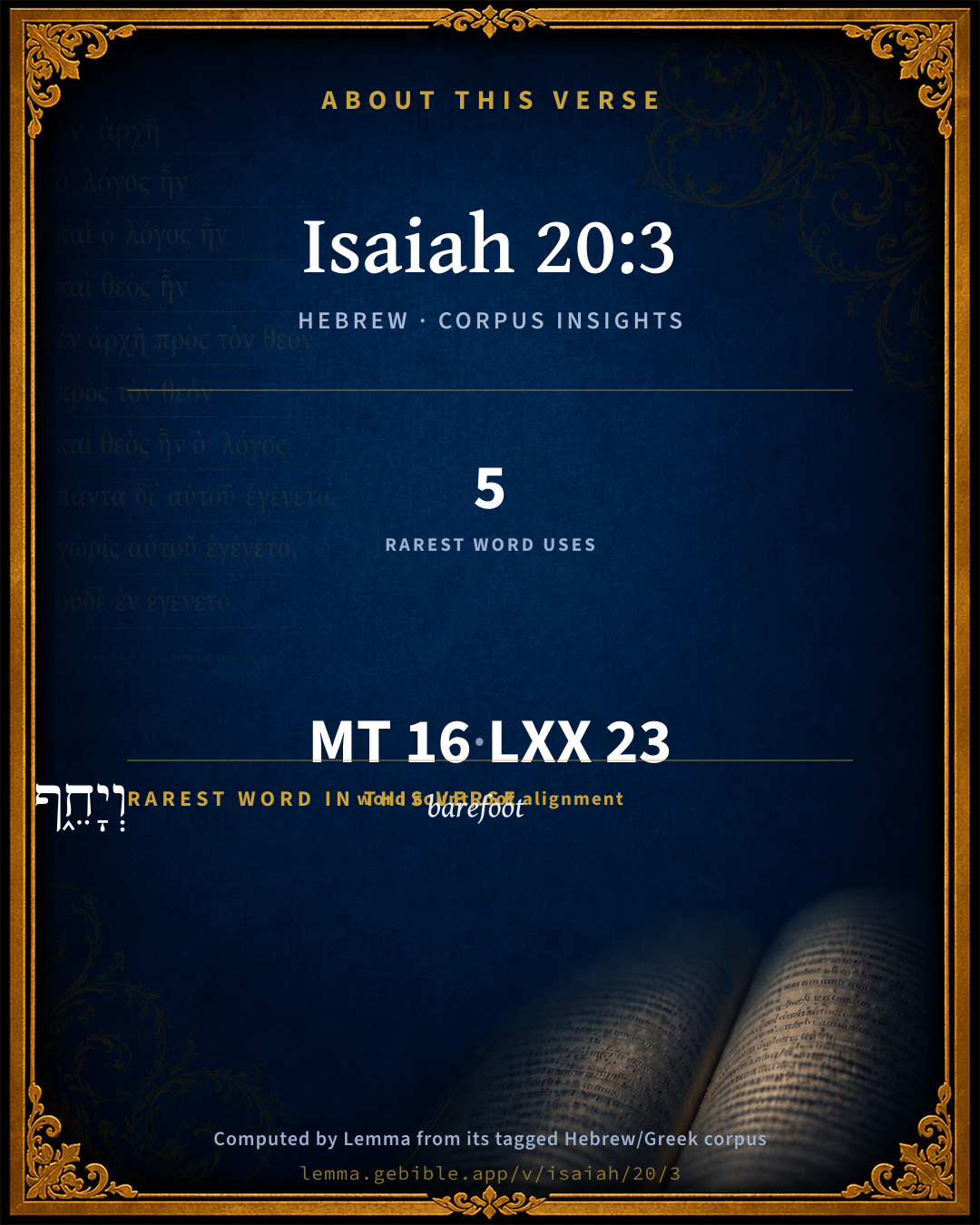
The rarest word here is וְיָחֵ֑ף barefoot H3182 — appearing just 5 times in the whole Hebrew Bible.

Shared distinctive vocabulary

וְיָחֵ֑ף barefoot H3182 occurs in 5 verses of the Hebrew Bible. Also found in:

Grammatical profile

  • 2 verbs
  • 8 nouns
  • 3 adjectives
  • 2 prepositions
  • 1 particle

Verb forms

  • וַיֹּ֣אמֶר Qal · Sequential Imperfect
  • הָלַ֛ךְ Qal · Perfect

Repetition

A word recurs within this verse — often emphatic in Hebrew:

Hebrew & Septuagint length

In English translation the verse runs 25 words from the Hebrew and 29 from the Septuagint (LXX English) — closely comparable.

A rough comparison of the two English renderings, which tokenize alike — not a word-level alignment.

Word counts can differ between the Hebrew and the Greek without any difference in meaning — e.g. the Hebrew direct-object marker אֵת has no separate Greek word, and Greek often adds the article ὁ.

In the original languages it is 16 Hebrew tokens and 23 Greek tokens — but the two are counted differently (Hebrew bundles its prefixes and suffixes into one token; the Greek is in lemma form), so that isn’t a like-for-like length.

Cross-references

7

Topical passages linked to Isaiah 20:3 in the Treasury of Scripture Knowledge — connected by theme and wording, ordered by reader-vote popularity; previews shown in the World English Bible.

  • Isaiah 8:18 Behold, I and the children whom Yahweh has given me are for signs and for wonders in Israel from Yahweh of Hosts, who dwells in Mount Zion.
  • Numbers 14:34 After the number of the days in which you spied out the land, even forty days, for every day a year, shall you bear your iniquities, even forty years, and you shall know my alienation.
  • Isaiah 18:1–7 Ah, the land of the rustling of wings, which is beyond the rivers of Ethiopia;
  • Isaiah 37:9 He heard say concerning Tirhakah king of Ethiopia, He is come out to fight against you. When he heard it, he sent messengers to Hezekiah, saying,
  • Isaiah 43:3 For I am Yahweh your God, the Holy One of Israel, your Savior; I have given Egypt as your ransom, Ethiopia and Seba in your place.
  • Ezekiel 4:5–6 For I have appointed the years of their iniquity to be to you a number of days, even three hundred ninety days: so shall you bear the iniquity of the house of Israel.
  • Revelation 11:2–3 Leave out the court which is outside of the temple, and don't measure it, for it has been given to the gentiles. They will tread the holy city under foot for forty-two months.

Cross-references courtesy of OpenBible.info (CC BY 4.0).

Hebrew and Greek witnesses Masoretic Hebrew ↔ Greek Septuagint

The same verse in the two great witnesses to the Old Testament, shown verse-for-verse.

These are two independent witnesses, not word-aligned to each other, and the Septuagint is shown in lemma (dictionary) form.

Hebrew Isaiah 20:3 Masoretic · Westminster Leningrad Codex

וַיֹּ֣אמֶר יְהוָ֔ה כַּאֲשֶׁ֥ר הָלַ֛ךְ עַבְדִּ֥י יְשַׁעְיָ֖הוּ עָר֣וֹם וְיָחֵ֑ף שָׁלֹ֤שׁ שָׁנִים֙ א֣וֹת וּמוֹפֵ֔ת עַל מִצְרַ֖יִם וְעַל כּֽוּשׁ

Yahweh said, Like as my servant Isaiah has walked naked and barefoot three years for a sign and a wonder concerning Egypt and concerning Ethiopia;

World English Bible · Public Domain

Greek LXX Isaiah 20:3 Septuagint · lemma form

καί εἶπον κύριος ὅς τρόπος πορεύομαι ησαιας ὁ παῖς ἐγώ γυμνός καί ἀνυπόδετος τρεῖς ἔτος εἰμί σημεῖον καί τέρας ὁ αἰγύπτιος καί αἰθίοψ

And the Lord said, As my servant Esaias has walked naked and barefoot three years, there shall be three years for signs and wonders to the Egyptians and Ethiopians;

LXX2012 (modern English Septuagint) · Public Domain

On this verse, John Gill's Exposition discusses the Septuagint’s reading. Read the note in Commentary ↓

Hebrew: Westminster Leningrad Codex (CC BY 4.0). Greek: Septuagint (public domain); English from LXX2012 (modern English Septuagint) (Public Domain). How the Septuagint differs from the Hebrew →

Targum (Aramaic paraphrase)

1

The Targum is the ancient Jewish Aramaic paraphrase of the Hebrew Scriptures — an interpretive translation, not the Hebrew text itself. Onkelos (literal) and Pseudo-Jonathan (expansive) render the Torah, and Jonathan the Prophets. Coverage is partial: where no permissively-licensed English translation exists for a verse, only the Aramaic is shown. This is verse-level text, not a word-by-word alignment to the Hebrew.

  1. Targum Jonathan Prophets (Joshua–Malachi)
    וַאֲמַר יְיָ כְּמָא דְהַלֵיךְ עַבְדִי יְשַׁעְיָהוּ פְחֵיחַ וְיָחֵיף תְּלַת שְׁנִין אָת וּמוֹפֵת עַל מִצְרָאֵי וְעַל כּוּשָׁאֵי:

    And the Lord said, Like as my servant Isaiah hath walked naked and barefoot three years for a sign and wonder upon Egypt and Cush:

    Targum Jonathan — Aramaic: “Mikraot Gedolot” (public domain). English: “Sefaria Community Translation” (CC0 1.0 (public-domain dedication)); “London "Chaldee Paraphrase," 1871” (public domain). Text via Sefaria.

Commentary

Notes on Isaiah 20:3 from classic Christian and Jewish commentators (each source and its license shown beneath its notes). The classic Christian expositions comment on the surrounding passage and are grouped to its opening verse, so a note may address several verses; the Jewish commentaries on the Tanakh (Rashi and others) are per-verse, so they appear only where the commentator wrote on this verse.

Lemma curates 59 commentaries, every one of them public domain or Creative Commons licensed, each selected and text-cleaned for this edition rather than reprinted as found. About our sources →

Trapp's Complete Commentary

John Trapp

Isa 20:3 And the LORD said, Like as my servant Isaiah hath walked naked and barefoot three years [for] a sign and wonder upon Egypt and upon Ethiopia;

Ver. 3. Like as my servant Isaiah.] Servants are either menial or magisterial. Prophets and preachers are of this latter sort.

Hath walked naked and barefoot three years,] i.e., Three days; a day for a year {as Eze 4:4-6} Tremellius rendereth the text thus: Hath walked naked and barefoot for a sign and wonder of the third year against the Egyptians, and against the Ethiopians - that is, for a sign that the third year after this prophecy the forces of the Egyptians and Ethiopians under the conduct of Tirhaka shall be worsted, slaughtered, and carried captive by the Assyrian monarch. And this was preached not more to their ears than to their eyes, ad fidem faciendam, for more assurance.

John Trapp, A Commentary or Exposition upon All the Books of the Old and New Testament (1647–1656) — public domain. Text from a community e-Sword module.

Joseph Benson's Commentary

Isa 20:3-6. And the Lord — Who here explains and applies the sign, said, Like as my servant hath walked naked, &c., three years — Not constantly, but when he went abroad among the people, to whom this was appointed to be a sign. Bishop Lowth says, probably three days, to show, that within three years the Egyptians and Ethiopians should be conquered and made captives by the king of Assyria, and be in the same condition, and that the town should be taken. But it is objected, that although a day is usually put for a year in the prophetic scriptures, a year is never put for a day. The former interpretation, therefore, is more probable. For a sign and wonder, &c. — Either when this judgment should come, namely, three years after this prophecy was thus uttered, or how long it should continue, namely, for three years: for some have observed, that the Assyrians spent so much time in conquering Egypt and Ethiopia. So shall the king of Assyria lead away the Egyptians — Like beasts, as ינהגis commonly used. And they shall be afraid and ashamed — Namely, all they that shall trust to them, and glory in them. In which words, “we have the consequence of the divine judgment upon the Egyptians and Ethiopians, and the scope of the prophecy, namely, to convince the inhabitants of Palestine, and among these some factious persons in Jerusalem, of the vanity of the confidence they placed in them; for when they should see the completion of this prophecy, they should then condemn their own folly for placing their expectations on so feeble a defence.” The inhabitant of this isle — Of this land, in which the prophet was, and to whose inhabitants these words were uttered. For the name of isles, or islands, is frequently given in Scripture, not only to lands encompassed with the sea, but also to such countries as were on the sea- coast, as Palestine or Canaan was. Shall say, Behold, such is our expectation — So vain is our hope, placed upon such a people as are unable to deliver themselves, and much more to deliver us: whither we flee for help — To whom we now and usually trust: and how shall we escape — Either by their help, who cannot defend themselves, or by our own strength, seeing they, who were much more potent than we are, could not escape?

Joseph Benson's Commentary on the Old and New Testaments (1811–1818) — public domain. Text from a community e-Sword module.

Tyndale Open Study Notes

Tyndale Open Resources

20:3-4 This symbolic event took place some three years before the fall of Ashdod (see 20:2). Through it, Isaiah became an object lesson for the people (see 8:18).

Tyndale Open Study Notes — © Tyndale Open Resources, licensed CC BY-SA 4.0. Text via the HelloAO Bible API.

Jamieson, Fausset & Brown

Robert Jamieson, A. R. Fausset & David Brown

three years--Isaiah's symbolical action did not continue all this time, but at intervals, to keep it before the people's mind during that period [ROSENMULLER]. Rather, join "three years" with "sign," a three years' sign, that is, a sign that a three years' calamity would come on Egypt and Ethiopia [BARNES], (Isa 8:18). This is the only instance of a strictly symbolical act performed by Isaiah. With later prophets, as Jeremiah and Ezekiel, such acts were common. In some cases they were performed, not literally, but only in prophetic vision.

wonder--rather, "omen"; conveying a threat as to the future [G. V. SMITH].

upon--in reference to, against.

Jamieson, Fausset & Brown — Commentary Critical and Explanatory on the Whole Bible (1871) — public domain (CC PDM 1.0). Text via the HelloAO Bible API.

Ellicott's Commentary for English Readers

(3) For a sign and wonder upon Egypt and upon Ethiopia.—Apparently Isaiah prophesied in act, but in silence, and did not unfold the meaning of the symbol till the three years came to an end. There are no adequate grounds for limiting his dramatic action to a single day or three days. Egypt and Ethiopia are, as in Isaiah 18, 19, closely connected, both countries being under a king of Ethiopian origin, Sabaco.

A Bible Commentary for English Readers, edited by Charles John Ellicott (1878–1897) — public domain. Text from a community e-Sword module.

John Gill's Exposition

And the Lord said,.... Here follows the explanation of the sign, and the accommodation of it to the thing signified by it:

like as my servant Isaiah hath walked naked and barefoot; not wholly naked, for that would have been very indecent and dangerous indeed; but without his upper garment, as Saul, Sa1 19:24 and David, Sa2 6:14 or with rent and ragged clothes, and old shoes, as Jarchi (k) interprets it, and which might be only when he appeared abroad; and how long he thus walked is not certain, whether only one day, as some, or three days, as others, or three years, which is not said, though our version inclines to it; but the three years next mentioned are not to be joined to Isaiah's walking, but to the thing signified by it; for the accent "athnach" is at the word which is rendered "barefoot", and distinguishes this clause from the following. The Septuagint indeed puts the phrase "three years" into both clauses, but it only belongs to the latter:

three years for a sign and wonder upon Egypt, and upon Ethiopia; that is, the prophet's walking naked and barefoot was a sign that three years after this Egypt and Ethiopia should be subdued by the Assyrians; or, that so long he should be in subduing them, or their calamities should last such a term of time. This sign was only seen by the Jews, for whose sake chiefly this prophecy was, to take off their dependence on the above nations; though probably this might be made known to the Egyptians and Ethiopians.

(k) T. Bab. Yoma, fol. 77. 1. & Sabbat, fol. 114. 1.

John Gill's Exposition of the Whole Bible (1746–1763) — public domain (CC PDM 1.0). Text via the HelloAO Bible API.

Albert Barnes' Notes on the Bible

Like as - That is, as Isaiah has gone stripped of his special garment as a prophet, so shall the Egyptians and Ethiopians be stripped of all that they value, and be carried captive into Assyria.’

Hath walked ... three years - A great deal of difficulty has been felt in the interpretation of this place, from the strong improbability that Isaiah should have gone in this manner for a space of time so long as our translation expresses. The Septuagint renders this, ‘As my servant Isaiah hath walked naked and barefoot three years, three years shall be for signs and wonders to the Egyptians and Ethiopians.’ The phrase in the Hebrew, ‘three years,’ “may” either be taken in connection with the preceding part of the sentence, as in our translation, meaning that he actually walked so long; or it may be taken with that which follows, and then it will denote that he was a sign and wonder with reference to the captivity of the Egyptians and Ethiopians; and that by this symbolic action he in some way indicated that they would be carried away captive for that space of time; or, as Aben Ezra and Abarbanel suppose, that he signified that their captivity would commence after three years. Lowth supposes that it means that his walking was for three days, and that the Hebrew text bas been corrupted. Vitringa also seems to suppose that this is possible, and that a day was a symbolic sign for a year. Rosenmuller supposes that this prophetic action was continued during three years “at intervals,” so that the subject might be kept before the mind of the people. But the supposition that this means that the symbolic action of walking naked and barefoot continued for so long a time in any manner, is highly improbable.

(1) The Hebrew does not necessarily require it. It “may” mean simply that his actions were a sign and wonder with reference to a three years’ captivity of the Egyptians.

(2) It is in itself improbable that he should so long a time walk about Jerusalem expressly as a sign and wonder, when a much shorter period would have answered the purpose as well.

(3) Such a sign would have hardly met the circumstances of the case. Asdod was taken. The Assyrian king was advancing.

The Jews were in consternation and looking to Egypt for help; and amidst this agitation and alarm, there is the highest improbability that Isaiah would be required to remain a sign and wonder for the long space of three years, when decided action was needed, and when, unless prevented, the Jews would have formed a speedy alliance with the Egyptians. I suppose, therefore, that the entire sense of the phrase will be expressed by translating it, ‘my servant Isaiah hath walked naked and barefoot, “a three years’ sign and wonder;’” that is, a sign and indication that “a three years’ calamity” would come upon Egypt and Ethiopia. Whether this means that the calamity would “commence” in three years from that time, or that it should “continue” three years, perhaps we cannot determine. Grotius thinks that it means that it would occur “after” three years; that is, that the war between the Assyrians and Ethiopians would continue during that time only. In what manner Isaiah indicated this, is not certainly known. The conjecture of Lowth is not improbable, that it was by appearing three “days” naked and barefoot, and that each day denoted a year. Or it may have been that he appeared in this manner for a short period - though but once - and “declared” that this was the design or purport of the action.

Upon Egypt ... - With reference to; or as a sign in regard to Egypt. It does not mean that he was in Egypt, but that his action “had reference” to Egypt.

And Ethiopia - Hebrew, כושׁ kûsh - (see the note at Isa 11:11). Whether this denotes the African Cush or Ethiopia, or whether it refers to the “Cush” in Arabia, cannot be determined. The latter is the more probable supposition, as it is scarcely probable that the Assyrian would extend his conquests south of Egypt so as to subdue the African Ethiopia. Probably his conquest embraced the “Cush” that was situated in the southern regions of Arabia.

Albert Barnes' Notes on the Bible (1834–1885) — public domain. Text from a community e-Sword/MySword module.

Haydock's Catholic Bible Commentary

Years. Isaias went so long, or perhaps only three days undressed, Numbers xiv. 34., and Ezechiel iv. 5. Egypt and the Arabian Ethiopia were to be abandoned to the Assyrians, in or during three years.

George Leo Haydock (1774–1849), Haydock's Catholic Family Bible and Commentary, 1859 edition — public domain. Excludes Psalms (Douay-Rheims chapter numbering differs from Protestant) and Deuterocanonical books (Catholic canon only).

Matthew Poole's English Annotations

Walked naked and barefoot three years; not constantly, but when he went abroad among the people, to whom this was appointed for a sign. Some think it was only three days, a day being usually put for a year in prophetical scriptures, as Num 14:33,34; Eze 4:4-6. But although a day be put for a year, yet a year is never put for a day.

A sign; either,

1. When this judgment should come, to wit, three years after this prophecy. Or,

2. How long it should continue, for three years; for some have observed that the Chaldeans spent so much time in conquering Egypt and Ethiopia.

Matthew Poole's English Annotations on the Holy Bible (1683–1685) — public domain. Text from a community e-Sword/MySword module.

Whedon's Commentary on the Bible

Daniel D. Whedon

3. Like as my servant — “My servant” was a term of honour applied to Abraham, Job, Moses, David; afterward to regenerate Israel; then to Messiah, in the latter chapters of this book.

Walked… barefoot three years — This time of Isaiah’s imposed extra humiliation on public occasions, was intended as an impressive portending spectacle before the people.

For a sign and wonder — Especially in relation to Egypt and Ethiopia, on which the people of Judah relied for defence, whenever Assyria’s armies, moving Egyptward, should also menace Jerusalem.

Daniel D. Whedon (gen. ed.), Commentary on the Old and New Testaments (1874–1909) — public domain. Text from a community e-Sword module.

The Pulpit Commentary

My servant Isaiah. Isaiah shares this honorable title, "my servant," with a select few among God"s saints with Abraham, (Gen_26:24) Moses, (Num_12:7) Caleb, (Num_14:24) Job, (Job_1:8 Job_42:7, Job_42:8) Eliakim, (Isa_22:20) and Zerubbabel. (Hag_2:23) It is a great acknowledgment for the Creator to make to the creature, that he really does him service. Three years. Probably from B.C. 713 to B.C. 711, or during the whole of the time that Philistia, Edom, Moab, and Judah were making representations to the Egyptians and Ethiopians, and endeavoring to obtain their aid (see G. Smith, "Eponym Canon," p. 130). It has been proposed, by an arbitrary emendation, to cut down the time to "three days;" but a three days" sign of the kind could not have been expected to have any important effect. The supposed "impropriety" of Isaiah"s having "gone naked and barefoot" for three years arises from a misconception of the word "naked." which is not to be taken literally (see the comment on ver. 2). The costume adopted would be extraordinary, especially in one of Isaiah"s rank and position; but would not be in any degree "improper." It would be simply that of working men during the greater part of the day. (see Exo_22:26, Exo_22:27)

The Pulpit Commentary (1880–1919), ed. H.D.M. Spence-Jones & Joseph S. Exell — public domain. Text from a community e-Sword module.

John Wesley's Explanatory Notes

Three years - Not constantly, but when he went abroad among the people, to whom this was appointed for a sign. A sign - When this judgment should come, namely, three years after this prophecy.

John Wesley, Explanatory Notes Upon the Whole Bible (1754–1765) — public domain. Text via the GEBible commentary corpus.

Keil & Delitzsch

C. F. Keil & F. Delitzsch

It is not till Isaiah has carried out the divine instructions, that he learns the reason for this command to strip himself, and the length of time that he is to continue so stripped. "And Jehovah said, As my servant Yesha'yahu goeth naked and barefooted, a sign and type for three years long over Egypt and over Ethiopia, so will the king of Asshur carry away the prisoners of Egypt and the exiles of Ethiopia, children and old men, naked and barefooted, and with their seat uncovered - a shame to Egypt." The expression "as he goeth" (ca'asher hâlac) stands here at the commencement of the symbolical action, but it is introduced as if with a retrospective glance at its duration for three years, unless indeed the preterite hâlac stands here, as it frequently does, to express what has already commenced, and is still continuing and customary (compare, for example, Job 1:4 and Psa 1:1). The strange and unseemly dress of the prophet, whenever he appeared in his official capacity for three whole years, was a prediction of the fall of the Egypto-Ethiopian kingdom, which was to take place at the end of these three years. Egypt and Ethiopia are as closely connected here as Israel and Judah in Isa 11:12. They were at that time one kingdom, so that the shame of Egypt was the shame of Ethiopia also. ‛Ervâh is a shameful nakedness, and ‛ervath Mitzrayim is in apposition to all that precedes it in Isa 20:4. Shēth is the seat or hinder part, as in Sa2 10:4, from shâthâh, to set or seat; it is a substantive form, like בּן, עץ, רע, שׁם, with the third radical letter dropt. Chashūphay has the same ay as the words in Isa 19:9; Jdg 5:15; Jer 22:14, which can hardly be regarded as constructive forms, as Ewald, Knobel, and Gesenius suppose (although ־י of the construct has arisen from ־י), but rather as a singular form with a collective signification. The emendations suggested, viz., chasūphē by Olshausen, and chasūphı̄ with a connecting i by Meier, are quite unnecessary.

Keil & Delitzsch — Biblical Commentary on the Old Testament (1861–1891) — public domain (CC PDM 1.0). Text via the HelloAO Bible API. (Old Testament only.)

J. A. Alexander on Isaiah

Joseph Addison Alexander

What was said to the Prophet was obviously said through him to the people.

Joseph Addison Alexander, The Prophecies of Isaiah (1846–1847; New York: Scribner, 1870–1878) — public domain. Text from a community e-Sword module.

unfoldingWord translationNotes

Door43 World Missions Community

an omen

"a warning"

concerning Egypt and concerning Cush

The place names refer to their people. AT: "concerning the people of Egypt and the people of Cush" (See: Metonymy)

the king of Assyria will lead away the captives

The king orders his army to do this task. AT: "the king of Assyria will have his army lead away the captives" (See: Metonymy)

will lead away the captives of Egypt, and the exiles of Cush

It can be stated clearly that they will first attack and capture people. AT: "will attack Egypt and Cush and capture their people and lead them away" (See: Assumed Knowledge and Implicit Information)

to the shame of Egypt

Egypt refers to the people of Egypt. AT: "which will bring shame on the people of Egypt" (See: Metonymy)

translationWords

Yahweh

servant

Isaiah

sign

Egypt

Ethiopia

king

Assyria

captive

exile

shame

unfoldingWord translationNotes — © Distant Shores Media and the Door43 World Missions Community, licensed CC BY-SA 4.0. Source: git.door43.org/Door43/en_tn.

Rashi

Rabbi Shlomo Yitzchaki (Rashi)

three years shall he go in this manner as a sign and a symbol for Egypt and for Cush, that, at the end of three years the king of Assyria shall lead the captivity of Egypt... We learn that Tartan conquered Ashdod three years prior to the downfall of Sennacherib, for his downfall was when he brought the captives of Egypt and Tirhakah the king of Cush before Jerusalem in chains, when he came to besiege Hezekiah.

Rashi on the Tanakh — English translations: “The Judaica Press complete Tanach with Rashi, translated by A. J. Rosenberg” (CC BY 4.0); “Pentateuch with Rashi's commentary by M. Rosenbaum and A.M. Silbermann, 1929-1934” (public domain); “The Metsudah Tanach series, Lakewood, N.J” (CC BY 4.0); and “The Book of Joshua, Metsudah Publications, 1997” (CC BY 4.0). Text via Sefaria.

Ibn Ezra

Rabbi Abraham ibn Ezra

ומופת And an example. Comp. And Ezekiel shall be unto you an example (Ez. 24:24).

שלש שנים וגו׳ Either in three years from that day, or three years, shall Egypt be in misfortune.

Ibn Ezra on the Tanakh — English translations: “Sefaria Community Translation” (CC0 1.0 (public-domain dedication)); “Yalkut, Sifsei Chachomim Chumash, Metsudah Publications, 2009” (CC BY 4.0); and “Commentary of Ibn Ezra on Isaiah - trans. by M. Friedlander, 1873” (public domain). Text via Sefaria.

Lesson kit

Teaching starters — assembled from the data on this page, not authored interpretation. Every prompt links to the verse data it draws on. Edit before teaching.

Isaiah, in the Prophets, opens this verse with 16 words (15 distinct Hebrew lemmas). Its most distinctive word is yâchêph (“barefoot”). A historical commentator’s framing appears above. Read the whole chapter for the surrounding context.

Discussion questions

  1. The word yâchêph carries the sense “barefoot.” How does it shape the verse?
  2. 2 Samuel 15:30 shares the word «barefoot» with this verse. How do the two illuminate each other?
  3. “upon” occurs 2× in this one verse. What is the effect of the repetition?
  4. These translations render this verse differently; the difference is in the English rendering, not the original. What questions does that raise?
  5. The verb «וַיֹּ֣אמֶר» is Qal Sequential Imperfect. How does its form color the action?
  6. Reading how Trapp's Complete Commentary and Joseph Benson's Commentary read this verse, where do the two commentators agree and where do they part?

Things to notice

Reading settings

Reading text

Shown beneath each verse's original-language words.

Old Testament
Old Testament edition

Read the OT as the Masoretic Hebrew (MT) or the Greek Septuagint (LXX).

English shown for the Greek Septuagint (in the Hebrew ↔ Greek comparison).

Comparing translations? Open the Compare panel on any verse page to stack up to four side by side.