
Jeremiah 23:7

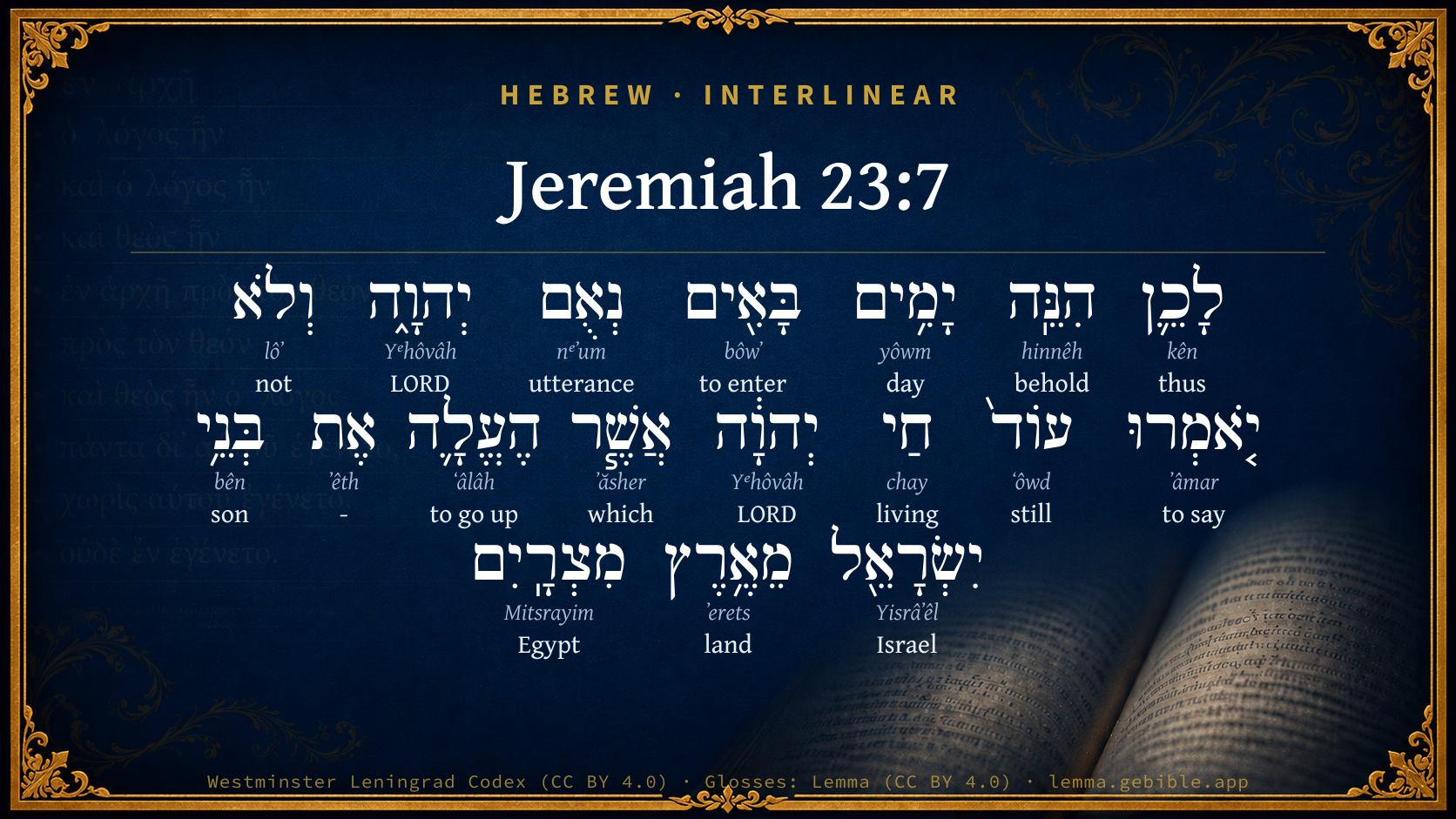
Hebrew (Westminster Leningrad Codex) Jeremiah 23:7 appears in the Hebrew Old Testament. The text above is from the Westminster Leningrad Codex. Each word links to its Strong’s number, a concise gloss, and parsing drawn from the Open Scriptures Hebrew Bible morphology. Click any word for its full Brown-Driver-Briggs (BDB) entry.
Download image
Cite this verse

Jeremiah 23:7 (World English Bible). Public Domain. Lemma interlinear Bible study tool, https://lemma.gebible.app/v/jeremiah/23/7.

Show BibTeX & RIS
BibTeX
RIS
English Translation
Therefore, behold, the days come, says Yahweh, that they shall no more say, As Yahweh lives, who brought up the children of Israel out of the land of Egypt;
World English Bible · Public Domain
Download a study sheet

One document with this verse’s original text, its word-by-word gloss line, the meaning frame, cross-references with their text, attributed commentary, and full source and license credits — printable, and it pastes into notes with its structure intact.

This verse Autodidact and up

Study sheet (.html) Plain text (.txt)

A passage Seminary Student

Up to 50 verses in one chapter. A passage sheet keeps up to 6 commentary sources and 12 cross-references per verse, in the order this page ranks them, and says so on the sheet whenever that leaves anything out. Ask for a single verse and you get the Autodidact verse sheet above.

Everything on this page stays free to read, with no account — the sheet is a download of what is already on screen, not access to it.

Want to remove ads? Support Godless Engineer
Compare translations 3

The same verse in 3 English versions, stacked beneath the original-language interlinear above. Click any original word for its lexicon entry.

Each is an independent rendering of the whole verse — the interlinear is not word-aligned to these translations.

Highlighted words mark where these versions differ — a whole-verse word diff, not a word-by-word alignment.

  • World English Bible Public Domain
    Therefore, behold, the days come, says Yahweh, that they shall no more say, As Yahweh lives, who brought up the children of Israel out of the land of Egypt;
  • King James Version Public Domain
    Therefore, behold, the days come, saith the LORD, that they shall no more say, The LORD liveth, which brought up the children of Israel out of the land of Egypt;
  • unfoldingWord Literal Text CC BY-SA 4.0
    “Therefore, behold, days are coming”—the declaration of Yahweh—“when they will no longer say, ‘As Yahweh lives, who brought the sons of Israel up from the land of Egypt,’

unfoldingWord Literal Text — © unfoldingWord, licensed CC BY-SA 4.0. Word-aligned USFM3 via Door43 (git.door43.org/unfoldingWord/en_ult).

Versions to compare (up to 4)

3 of 4 selected

Show all 18 translations

Every available English version of this verse, each an independent rendering of the whole verse.

  • World English Bible Public Domain
    Therefore, behold, the days come, says Yahweh, that they shall no more say, As Yahweh lives, who brought up the children of Israel out of the land of Egypt;
  • Berean Standard Bible Public Domain
    So behold, the days are coming, declares the LORD, when they will no longer say, ‘As surely as the LORD lives, who brought the Israelites up out of the land of Egypt.’
  • Majority Standard Bible Public Domain
    So behold, the days are coming, declares the LORD, when they will no longer say, ‘As surely as the LORD lives, who brought the Israelites up out of the land of Egypt.’
  • King James Version Public Domain
    Therefore, behold, the days come, saith the LORD, that they shall no more say, The LORD liveth, which brought up the children of Israel out of the land of Egypt;
  • American Standard Version (1901) Public Domain
    Therefore, behold, the days come, saith Jehovah, that they shall no more say, As Jehovah liveth, who brought up the children of Israel out of the land of Egypt;
  • Revised Version (1885) Public Domain
    Therefore, behold, the days come, saith the LORD, that they shall no more say, As the LORD liveth, which brought up the Children of Israel out of the land of Egypt;
  • Geneva Bible (1599) Public Domain
    Therefore behold, the dayes come, sayth the Lord, that they shall no more say, The Lord liueth, which brought vp the children of Israel out of the lande of Egypt,
  • Douay-Rheims (1899) Public Domain
    Therefore behold the days to come, saith the Lord, and they shall say no more: The Lord liveth, who brought up the children of Israel out of the land of Egypt:
  • Young's Literal Translation Public Domain
    Therefore, lo, days are coming, An affirmation of Jehovah, And they do not say any more, Jehovah liveth who brought up The sons of Israel out of the land of Egypt,
  • Literal Standard Version CC BY-SA 4.0
    Therefore, behold, days are coming,” || A declaration of YHWH, || “And they no longer say, YHWH lives who brought up || The sons of Israel out of the land of Egypt,
  • Unlocked Literal Bible CC BY-SA 4.0
    Therefore see, days are coming—this is Yahweh's declaration—when they will no longer say, 'As Yahweh lives, who brought the people of Israel up from the land of Egypt.'
  • unfoldingWord Literal Text CC BY-SA 4.0
    “Therefore, behold, days are coming”—the declaration of Yahweh—“when they will no longer say, ‘As Yahweh lives, who brought the sons of Israel up from the land of Egypt,’
  • Darby Bible Public Domain
    Therefore behold, days are coming, saith Jehovah, that they shall no more say, [As] Jehovah liveth, who brought up the children of Israel out of the land of Egypt;
  • World Messianic Bible Public Domain
    “Therefore, behold, the days come,” says the LORD, “that they will no more say, ‘As the LORD lives, who brought up the children of Israel out of the land of Egypt;’
  • Webster's Bible Public Domain
    Therefore, behold, the days come, saith the LORD, that they shall no more say, The LORD liveth, who brought the children of Israel out of the land of Egypt;
  • Free Bible Version CC BY-SA 4.0
    Look, the time is coming, declares the Lord, when people won't say anymore, “On the Lord's life, who led the Israelites out of Egypt.”
  • Bible in Basic English Public Domain
    And so, truly, the days are coming when they will say no longer, By the living Lord, who took the children of Israel up out of the land of Egypt;
  • JPS Tanakh (1917) Public Domain
    Therefore, behold, the days come, saith the LORD, that they shall no more say: 'As the LORD liveth, that brought up the children of Israel out of the land of Egypt';

Literal Standard Version (2020), Covenant Press — licensed CC BY-SA 4.0. Text via the HelloAO Bible API (eBible.org). Unlocked Literal Bible (unfoldingWord) — licensed CC BY-SA 4.0. Text via the HelloAO Bible API (eBible.org). unfoldingWord Literal Text — © unfoldingWord, licensed CC BY-SA 4.0. Word-aligned USFM3 via Door43 (git.door43.org/unfoldingWord/en_ult). Free Bible Version, Dr. Jonathan Gallagher — licensed CC BY-SA 4.0. Text via the HelloAO Bible API (eBible.org).

Word by word

More ways to search: Search by grammar → Find every occurrence → Compare this word →

Practice this passage: Drill this verse → Learn its vocabulary →

נְאֻם
nᵉʼum
H5002
“utterance of”
Noun, Common, Masculine, Singular, Construct
Part of Speech
Noun
Type
Common
Gender
Masculine
Number
Singular
State
Construct
Full BDB Definition

Origin: from H5001

TWOT: 1272a

(Qal) utterance, declaration (of prophet) - utterance, declaration, revelation (of prophet in ecstatic state) - utterance, declaration (elsewhere always preceding divine name)
  1. לָכֵ֛ן kên H3651 “to/for · thus” Preposition + Adverb
  2. הִנֵּֽה hinnêh H2009 “behold” Particle, Demonstrative
  3. יָמִ֥ים yôwm H3117 “days” Noun, Common, Masculine, Plural, Absolute
  4. בָּאִ֖ים bôwʼ H935 “entering” Verb, Qal, Participle Active, Masculine, Plural, Absolute
  5. יְהוָ֑ה Yᵉhôvâh H3068 “LORD” Noun, Proper
  6. וְלֹא lôʼ H3808 “and · not” Conjunction + Particle, Negative
  7. יֹ֤אמְרוּ ʼâmar H559 “to say” Verb, Qal, Imperfect, 3rd Person, Masculine, Plural
  8. עוֹד֙ ʻôwd H5750 “still” Adverb
  9. חַי chay H2416 “living” Adjective, Adjective, Masculine, Singular, Absolute
  10. יְהוָ֔ה Yᵉhôvâh H3068 “LORD” Noun, Proper
  11. אֲשֶׁ֧ר ʼăsher H834 “which” Particle, Relative
  12. הֶעֱלָ֛ה ʻâlâh H5927 “to go up” Verb, Hiphil, Perfect, 3rd Person, Masculine, Singular
  13. אֶת ʼêth H853 “-” Particle, Direct Object
  14. בְּנֵ֥י bên H1121 “sons of” Noun, Common, Masculine, Plural, Construct
  15. יִשְׂרָאֵ֖ל Yisrâʼêl H3478 “Israel” Noun, Proper
  16. מֵאֶ֥רֶץ ʼerets H776 “from · land of” Preposition + Noun, Common, Both, Singular, Construct
  17. מִצְרָֽיִם Mitsrayim H4714 “Egypt” Noun, Proper

About this verse

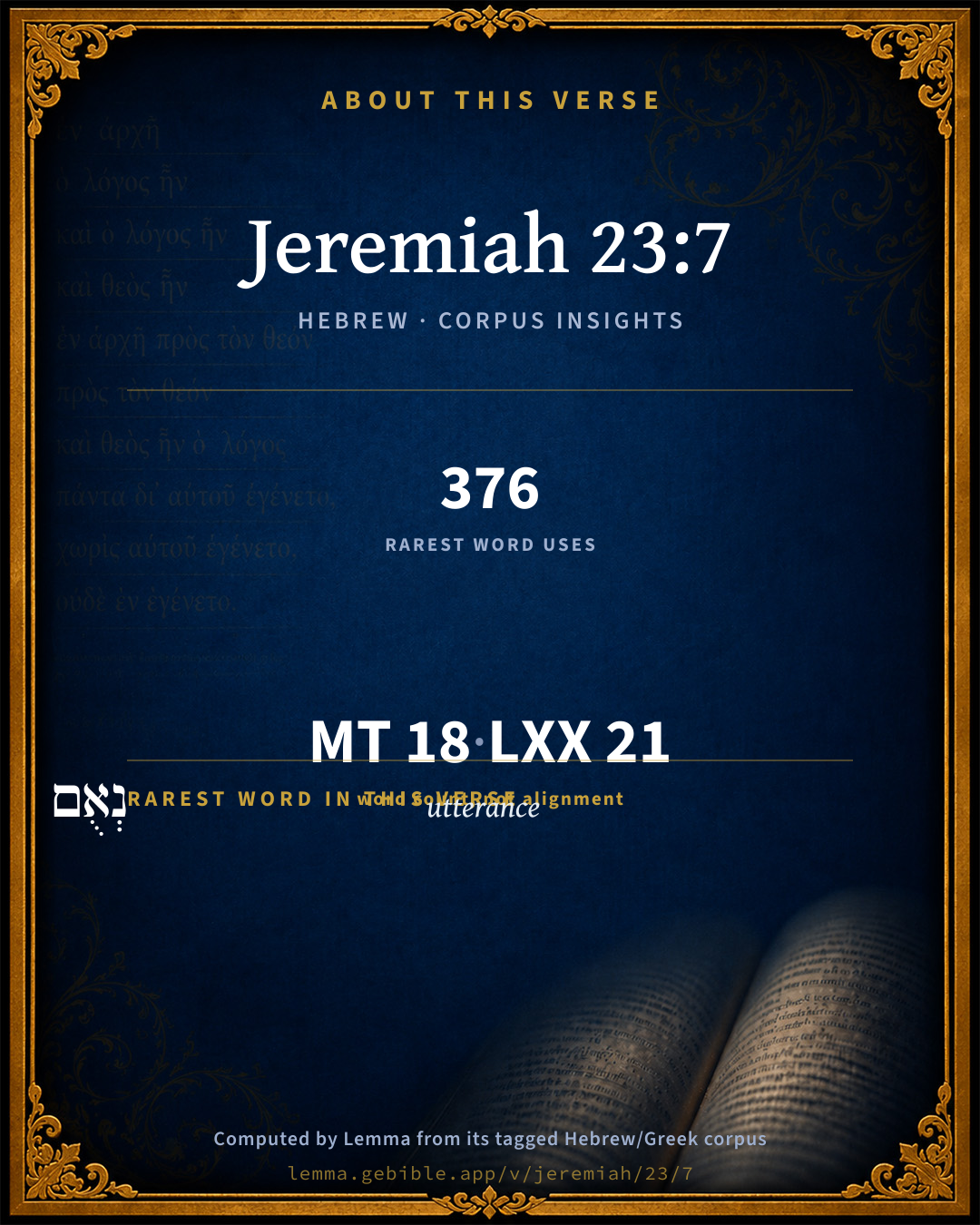
These counts appear in no published source. They are computed here, from the morphology-tagged text and Lemma’s own curated glosses. What Lemma adds →

18
words
17
distinct lemmas
Prophets
section

Grammatical profile

  • 3 verbs
  • 8 nouns
  • 1 adjective
  • 2 adverbs
  • 4 particles

Verb forms

  • בָּאִ֖ים Qal · Participle Active
  • יֹ֤אמְרוּ Qal · Imperfect
  • הֶעֱלָ֛ה Hiphil · Perfect

Repetition

A word recurs within this verse — often emphatic in Hebrew:

  • יְהוָ֑ה LORD H3068 ×2

Hebrew & Septuagint length

In the original languages it is 18 Hebrew tokens and 21 Greek tokens — but the two are counted differently (Hebrew bundles its prefixes and suffixes into one token; the Greek is in lemma form), so that isn’t a like-for-like length.

Cross-references

4

Topical passages linked to Jeremiah 23:7 in the Treasury of Scripture Knowledge — connected by theme and wording, ordered by reader-vote popularity; previews shown in the World English Bible.

  • Jeremiah 16:14–15 Therefore, behold, the days come, says Yahweh, that it shall no more be said, As Yahweh lives, who brought up the children of Israel out of the land of Egypt;
  • Jeremiah 23:3 I will gather the remnant of my flock out of all the countries where I have driven them, and will bring them again to their folds; and they shall be fruitful and multiply.
  • Isaiah 43:18–19 Don't remember the former things, neither consider the things of old.
  • Jeremiah 31:31–34 Behold, the days come, says Yahweh, that I will make a new covenant with the house of Israel, and with the house of Judah:

Cross-references courtesy of OpenBible.info (CC BY 4.0).

Hebrew and Greek witnesses Masoretic Hebrew ↔ Greek Septuagint

The same verse in the two great witnesses to the Old Testament, shown verse-for-verse.

These are two independent witnesses, not word-aligned to each other, and the Septuagint is shown in lemma (dictionary) form.

Hebrew Jeremiah 23:7 Masoretic · Westminster Leningrad Codex

לָכֵ֛ן הִנֵּֽה יָמִ֥ים בָּאִ֖ים נְאֻם יְהוָ֑ה וְלֹא יֹ֤אמְרוּ עוֹד֙ חַי יְהוָ֔ה אֲשֶׁ֧ר הֶעֱלָ֛ה אֶת בְּנֵ֥י יִשְׂרָאֵ֖ל מֵאֶ֥רֶץ מִצְרָֽיִם

Therefore, behold, the days come, says Yahweh, that they shall no more say, As Yahweh lives, who brought up the children of Israel out of the land of Egypt;

World English Bible · Public Domain

Greek LXX Structure differs

In the Septuagint, Jeremiah is about an eighth shorter than the Hebrew and arranges its material differently — the Oracles Against the Nations (Hebrew chapters 46–51) appear in the middle of the Greek book, after 25:13. Because the chapter and verse boundaries do not line up, a verse-for-verse comparison with the Hebrew is not shown.

A verse-for-verse comparison isn’t shown here because the chapters and verses don’t line up. Switch to the LXX edition with the MT / LXX toggle above to read the Greek directly.

On this verse, Ellicott's Commentary for English Readers discusses the Septuagint’s reading. Read the note in Commentary ↓

Hebrew: Westminster Leningrad Codex (CC BY 4.0). Greek: Septuagint (public domain); English from a public-domain English Septuagint. How the Septuagint differs from the Hebrew →

Targum (Aramaic paraphrase)

1

The Targum is the ancient Jewish Aramaic paraphrase of the Hebrew Scriptures — an interpretive translation, not the Hebrew text itself. Onkelos (literal) and Pseudo-Jonathan (expansive) render the Torah, and Jonathan the Prophets. Coverage is partial: where no permissively-licensed English translation exists for a verse, only the Aramaic is shown. This is verse-level text, not a word-by-word alignment to the Hebrew.

  1. Targum Jonathan Prophets (Joshua–Malachi)
    בְּכֵן הָא יוֹמַיָא אָתָן אֲמַר יְיָ וְלָא יְהוֹן מִשְׁתְּעָן עוֹד בִּגְבוּרְתָּא דַייָ וּדְאַסֵיק יַת בְּנֵי יִשְׂרָאֵל מֵאַרְעָא דְמִצְרָיִם:

    (no public-domain English translation for this verse)

    Targum Jonathan — Aramaic: “Mikraot Gedolot” (public domain). English: “Sefaria Community Translation” (CC0 1.0 (public-domain dedication)); “London "Chaldee Paraphrase," 1871” (public domain). Text via Sefaria.

Commentary

Notes on Jeremiah 23:7 from classic Christian and Jewish commentators (each source and its license shown beneath its notes). The classic Christian expositions comment on the surrounding passage and are grouped to its opening verse, so a note may address several verses; the Jewish commentaries on the Tanakh (Rashi and others) are per-verse, so they appear only where the commentator wrote on this verse.

Lemma curates 59 commentaries, every one of them public domain or Creative Commons licensed, each selected and text-cleaned for this edition rather than reprinted as found. About our sources →

Trapp's Complete Commentary

John Trapp

Jer 23:7 Therefore, behold, the days come, saith the LORD, that they shall no more say, The LORD liveth, which brought up the children of Israel out of the land of Egypt;

Ver. 7. Therefore, behold the days come.] See Jer 16:14.

John Trapp, A Commentary or Exposition upon All the Books of the Old and New Testament (1647–1656) — public domain. Text from a community e-Sword module.

The Biblical Illustrator

Joseph S. Exell

Jer_23:7-8

The Lord liveth, which brought up and which led the seed of the house of Israel out of the north country, and from all countries whither I had driven them.

Divine persistence

Faith, even our own trembling faith, can hold on, perhaps, to the past; it retires upon the past in order to fortify its position. There are its reserves, its supplies. It looks back, and as it looks the big words stand out, the high memories awaken, the ancient story revives again. God was a King of old. The works that were done upon earth, He did them Himself. We can believe it still. God was about in those days, long ago. Men met Him in the way. The hand of the Lord was upon me. Yes! in the past, in days long ago, we are sure of God; and this, not merely out of traditional habit, nor merely because it is far off and remote. No! it is rather because the present is never really grasped or understood in its true significance until it is past. The present disguises its inner glories in a suit of drab; it is busy with small affairs; it has no leisure to sit at Gods feet and brood. So the present is always being misjudged and misinterpreted by those it holds prisoners in its tiresome meshes. Only as it passes off into some quiet distance from us do the frivolous incidents drop away out of sight and hearing, and the superficial vulgarities fall back into insignificance, and the real heart of the mystery is felt in its work upon us. It is no glamorous illusion which gives wonder to the present as soon as it is past. Rather, it is become wonderful because it has shaken itself free from the illusion which veiled it from our eyes while it was still with us. We see it now in its actual worth as part and parcel of a continuous existence, not as an isolated accident that comes and goes. So it wins dignity and pathos and beauty. So strange--this transfiguration of the common-place by the past: an old brick wall, a garden walk, a turn of a lane--all can become sacred and mystical because of those unknown to us who once walked there before we were born. And this is right. This is their truth. And so, too, our past, as we turn to review it, is really recognised to have possessed an importance which escaped us when it was within our living grasp. We see now how momentous were the issues involved in this or that ordinary and temporary decision which we took as it came along, without anxiety or strain. There lay, we now acknowledge, the parting of the road for us. There and then our souls were indeed at stake. Our whole future turned on what we saw or did that day. A day at the time so unmarked, and dull, and unmomentous. How little we remembered God as we did it! Yet it was He, before whose eyes we were at that moment become a spectacle to men and angels, at that passing moment when we made our choice. Yes! it is no glamorous illusion that the past throws: it is the actuality of things which it discloses. The past reveals God at work in the acts of judgment by which we stand or fall under His searching light. Therefore it is that the Jew, reading out his national past, saw and found God at work everywhere in it. Jewish prophecy was concerned with the past, at least as much as with the future. The prophet looked back and read into the facts their deep inner interpretation. Old events were recognised by him for their spiritual value; now they were lifted into the light of the Divine will. When Israel came out of Egypt and the house of Jacob from among the strange people, Judah was His sanctuary and Israel His dominion. The sea saw that and fled. Jordan was driven back. The mountains skipped like rams, and the little hills like young sheep. Not at the moment of the deliverance could Israel have sung out that clear song of recognition. The escape out of Egypt was probably sordid enough at the moment; troubled, confused, dismal. Only long afterwards, when it had been clarified by the purifying process of time, could the prophets eye pierce below the surface disarray and see the whole scene as a vivid and unthwarted drama; only after long review with vision purged could the singer pronounce that God came from Teman and the Holy One from Mount Paran. Backed by the strong assurance that God was with our fathers, that God brought up His people out of Egypt, Faith must make its great venture and recognise that the God who was alive and active in the past is the same God to-day and for ever. This drab and dismal present which rings men ruefully round with its noisy bustle, with its troublesome futilities, holds in it urgent and supreme the living energies of God. When it has dropped away from them into the past they will see and know it. How disastrous, then, to cry out, when it is too late, Surely God was in this place and I knew it not. Why not wake up at once, in the very heart of stony and forlorn Bethel, and see now the golden stairs laid between heaven and earth? Here is the prophets task, to declare that what God did once, He may yet do again. If He brought up His people out of Egypt, He can yet deliver them out; of captivity in Babylon. Ah! that is the difficult, the impossible thing to believe. That is when and where the ordinary temper of faith collapses and recoils and surrenders. Egypt! They can see it all, feel it all Gods arm was outstretched to save, and He spake; and His great presence went out to them; and His voice was heard like the voice of a trumpet, exceeding loud. But Babylon, where they now lie in captivity! How hard and grim those iron walls of fact which hold the people fast! How relentless the immense pressure of its tyranny! Day follows day, and all days are the same; and the night comes following the day; and no watchman can tell them any news; and no cry shatters the night! Nor even are the people gathered in Babylon. They are not assembled and compact, as once in Egypt, ready to move altogether if the opportunity ever came. No; they are now hopelessly divided--scattered to the four winds; lost in detachments amid a crowd of swarming cities. Nothing can happen; there is no sign; they see not their tokens. Heaven above them is as brass, and the earth as iron. No God appears. Well enough in Egypt! We would have gone out with Moses then with willing feet; but we see no Moses now. Things are too strong for us; they shut us in. We listen, and no voice answers. It is different now; it can never be again as it once was. So we can fancy what these poor, faint souls to whom Jeremiah is writing must have murmured. As if Egypt had not looked just as hard and just as motionless to those who first heard the summons of Moses; as if it had not all been as grimly incredible then. And therefore, that same chill of despair that now overshadows them beside the willows of Babylon need not prevent another day like that of Moses arising as glorious as in Egypt. Another prophetic epoch will be known and named for ever. So the prophet announces. Once again the faith which is strong enough to face and defy the repellent facts of the present shall see its God rise as of old. We ourselves are sorely aware of conflict between our faith as it gazes back at the past, and our faith as it faces the shill and staggering present. We who can yet hold on to our belief in what happened long ago, find no heart to declare this might happen again to-day. God might be seen as visibly at work; Jesus Christ might be heard calling us with as clear a voice as that which fell on the ears of fishermen washing their nets by Galilean waters. The present wears so horribly material an appearance, and it looks so absurdly remote from Spirit and from God. There is no God here, we cry; Christ cannot be alive no angels sing here of peace and goodwill. So everything about us asserts with might and main; it defies us to say our creed in front of it without laughing or without breaking down in sobs. Yes; but was not the present always what it feels to us to-day? Did it not always look as hard and commonplace and godless? The inn at Bethlehem was as noisy and regardless as Fleet Street to-day. The people felt life then as commonplace an affair as it seems to us on Ludgate Hill to-day. The past witnesses through all its long centuries to the actual reality of the living deed done by God in our midst. Again and again in dark days those who believed it to be true have dared to realise it in their own present day afresh, and have found it answer to their appeals. There was a revival, as we say, a revival in the present of what was once for all asserted in the past. As God who had delivered men from Egypt verified Himself anew in the God who can deliver out of captivity, so Christ who rose and lived has quickened a new generation sunk in its sloth; has named a new epoch, has brought in a new day; and men have started from their sleep to find that it was true what they had always dimly believed, Christ is alive, Christ is at work here on earth; the impossible can happen; the incredible change can stir and can transform; it is all true. It shall no more be said merely that God liveth who once raised Jesus from the dead; but God liveth--our own God--who still raises in Jesus Christ those who were dead in trespasses and sins into newness of life for evermore. Why not? Why not now? The old creed is being battered by ruthless attacks on its past records, and there is only one triumphant answer--a revival of its ancient efficacy in full swing here and now. Christ, we feel, may have once raised a dead world into life, but He cannot do it again. Are we going to acquiesce in that? Are we going to try to keep our faith, and yet confine it to a day long dead? If Christ cannot do it now, then He never did it. If we resign the present to its godlessness, then we shall not long retain our belief in God in the past. No; we have but one obligation: to rally first on the past, and in its strength to dare the present. Why should not we take our belief in Jesus Christ as seriously to-day, and let it be done again? Oh, for this outrush of a great revival! We have lingered and languished so long is not the moment near for some reaction from our spiritual lethargy? The night has been so prolonged, there must surely be a streak of dawn. (H. S. Holland, D. D.)

The Biblical Illustrator, edited by Joseph S. Exell (c. 1880s–1900s) — public domain. Text from a community e-Sword module.

Joseph Benson's Commentary

Jer 23:7-8. Therefore, behold, the days come, saith the Lord — Here the prophet proceeds to fore-tel one very important, although remote, consequence of God’s raising up the righteous branch to David, namely, the great salvation which should thereby come to the Jews in the latter days of their state, which should be so illustrious as far to outshine their deliverance out of Egypt. That they shall no more say, The Lord liveth, &c. — These words we had before, Jer 16:14-15, where see the note. But here the passage seems to point more plainly than it did there to the days of the Messiah, and to compare, not so much the two deliverances themselves, giving the preference to the latter, as the two states to which the church should grow after those deliverances. About four hundred and eighty years after they were come out of Egypt, Solomon’s temple was built, 1Ki 6:1; and at that time that nation, which was so wonderfully brought out of Egypt, was gradually arrived to its height. And four hundred and ninety years (seventy weeks) after they came out of Babylon, Messiah the Prince set up the gospel temple, which was the greatest glory of that nation that was so wonderfully brought out of Babylon: see Dan 9:24-25. Now the spiritual glory of the second period of that nation, especially as transferred to the gospel church, is much more admirable and illustrious than all the temporal glory of the first period of it, in the days of Solomon; for that was no glory, compared with the glory which excelleth. Add to this, the prophet, it seems, also foretels a second gathering of the Jews from their dispersions, namely, one that should take place after the coming of the Messiah, and the ruin of their city and country by the Romans, and therefore yet future. Now this work of God, whenever it shall be effected, including, as it undoubtedly will, their conversion to Christianity, and perhaps, also, their restoration to their own land, will assuredly appear so wonderful as greatly to outshine every former deliverance wrought for that people, and therefore may well put every other out of remembrance. St. Paul calls this restoration of them, life from the dead, (Rom 9:25,) meaning that it would be a miracle as surprising as the resurrection of a multitude of dead bodies.

Joseph Benson's Commentary on the Old and New Testaments (1811–1818) — public domain. Text from a community e-Sword module.

Geneva Bible (1599)

Geneva Bible translators

Read Jer. 16:14.

Geneva Bible (1599) marginal notes — public domain. Text via Bolls.life.

Jamieson, Fausset & Brown

Robert Jamieson, A. R. Fausset & David Brown

Repeated from Jer 16:14-15. The prophet said the same things often, in order that his sayings might make the more impression. The same promise as in Jer 23:3-4. The wide dispersion of the Jews at the Babylonish captivity prefigures their present wider dispersion (Isa 11:11; Joe 3:6). Their second deliverance is to exceed far the former one from Egypt. But the deliverance from Babylon was inferior to that from Egypt in respect to the miracles performed and the numbers delivered. The final deliverance under Messiah must, therefore, be meant, of which that from Babylon was the earnest.

Jamieson, Fausset & Brown — Commentary Critical and Explanatory on the Whole Bible (1871) — public domain (CC PDM 1.0). Text via the HelloAO Bible API.

Adam Clarke's Commentary

Verse 7. The Lord liveth which brought up] See Clarke on Jer 16:14; "Jer 16:15".

Adam Clarke's Commentary on the Bible (1810–1826) — public domain. Text from a community e-Sword/MySword module.

John Calvin's Commentaries

The Prophet, after having spoken of the Redeemer who was to be sent, now sets forth in high terms that great favor of God, and says that it would be so remarkable and glorious, that the former redemption would be nothing to the greatness and excellency of this. When the children of Israel were brought up out of Egypt, God, we know, testified his power by many miracles, in order that this favor towards his people might appear the more illustrious; and rightly did the Prophets exhort and encourage the faithful to entertain good hope by calling to their minds what was then done. But our Prophet enhances the second redemption by this comparison, that hereafter the kindness of God, with which he favored his people when he delivered them from the bondage of Egypt, would not be remembered, but that something more remarkable would be done, so that all would talk of it, and that all would proclaim the immense benefit, which God would confer on them in delivering them from their exile in Babylon.

He then says that the days would come in which it would not be said, Live does Jehovah, who brought his people from Egypt, but who brought his people from the land of the North Yet he does not mean that the memory of God’s favor towards the Israelites, when he brought them from Egypt, was to be abolished; but he reasons here from the less to the greater, as though he had said that it was an evidence of God’s favor that could not be sufficiently praised, when he delivered his people from the land of Egypt, that if it were taken by itself, it was worthy of being for ever remembered; but that when compared with the second deliverance it would appear almost as nothing. The meaning is, that the second redemption would be so much more remarkable than the first, that it would obscure the remembrance of it, though it would not obliterate it.

And this passage deserves to be especially noticed, for we hence learn how much we ought to value that redemption which we have obtained through the only-begotten Son of God. And hence, also, it follows that we are more bound to God than the Fathers under the Law, as he has dealt far more bountifully with us, and has put forth his power more fully and effectually in our behalf. We further learn, that the Prophet does not in this prophecy include a few years only, but the whole kingdom of Christ and its whole progress. He indeed speaks of the return of the people to their own country, and this ought to be allowed, though Christians have been too rigid in this respect; for passing by the whole intermediate time between the return of the people and the coming of Christ, they have too violently turned the prophecies to spiritual redemption. There is no doubt but that the Prophet makes a beginning with the free return of the people from captivity; but, as I have said, Christ’s redemption is not to be separated from this, otherwise the accomplishment of the promise would not appear to us, for a small portion only returned to their own land. We also know that they were harassed with many and continual troubles, so that their condition was always miserable, for nothing is worse than a state of disquietude. We know further, that they were spoiled, and that often, and were also reduced to a state of bondage. We know how cruelly they were treated at one time by the Egyptians, and at another by the kings of Syria. Then more was promised by Jeremiah than what God has really performed, except we include in this prophecy the kingdom of Christ. But as God so restored his Church by the hand of Cyrus, that it might be a kind of prelude to a future and perfect redemption, it is no wonder that the prophets, whenever they spoke of the people’s return and of the end of their exile, should look forward to Christ and to his spiritual kingdom.

We now, then, see the design of the Prophet, when he says that the days would come in which their first redemption would not be spoken of by the people, as a remarkable or as the chief evidence of God’s favor and power, as their second redemption would far exceed it.

As to the formula or manner of speaking, Live does Jehovah, we know that the ancients used such words in making a solemn oath, and whenever they sought to animate themselves with hope under adversities. Whenever, then, they found themselves so pressed down that they had no other escape from evil than through God’s favor, they usually said that the God who had formerly been the Redeemer of his people still lived, and that there was no diminution of his power, so that he could ten times, or a hundred times, or a thousand times, if necessary, bring help to his Church and to every member of it.

John Calvin's Commentaries (1540-1563) — public domain. Text from the Calvin Translation Society English edition (1840s-50s) via the Christian Classics Ethereal Library (ccel.org). Calvin's coverage is partial (roughly two-thirds of the Bible); uncommented books and verses are honest gaps, never fabricated. The 19th-century editor's footnotes and remarks are omitted so the notes are faithfully Calvin's own voice.

Ellicott's Commentary for English Readers

(7) The days come, saith the Lord.—See Notes on Jer_16:14-15, of which the words are almost verbally a reproduction. There, however, stress is laid chiefly on the fact of the exile, here on that of the restoration. The LXX. version omits them here, but inserts them, where they are obviously out of place, at the end of the chapter. It was fitting that they should be repeated here, as connecting the hope that had before been general with the personal reign of the “Branch” of the house of David.

A Bible Commentary for English Readers, edited by Charles John Ellicott (1878–1897) — public domain. Text from a community e-Sword module.

The Cambridge Bible for Schools and Colleges

gen. ed. J. J. S. Perowne

7. they shall no more say] The exodus from Egypt, always hitherto quoted as the crowning manifestation of Jehovah’s favour, would be eclipsed by a yet more glorious deliverance.

7, 8. See on Jer_16:14-15. The LXX’s omission of the vv. here, and insertion of them in a wholly incongruous context after Jer_23:40, fall in with the supposition that, even if of Jeremiah’s authorship, they do not rightly belong to this place. See further on Jer_33:14-26.

The Cambridge Bible for Schools and Colleges (gen. ed. J. J. S. Perowne; Cambridge University Press, 1878–1918) — public domain. Text from a community e-Sword module.

John Gill's Exposition

Therefore, behold, the days come, saith the Lord,.... Or, "are coming" (i); and will begin to take place in a little time, even upon the Jews' return from Babylon; and reached to the times of Christ, to which they have a special regard; and include the whole Gospel dispensation, even the latter day glory, when the Jews shall return to, and dwell in, their own land; as Jer 23:8; shows:

that they shall no more say, the Lord liveth: the people of Israel in particular, or the Lord's people in general, shall no more swear by the living God, described as follows; or, as the Targum, declare no more the power of God, in the instance next mentioned, they had been used to do:

which brought up the children of Israel out of the land of Egypt: which, though a wonderful deliverance, and never to be forgotten; yet not to be named with the redemption and salvation wrought out by Christ the Lord our righteousness; that being a deliverance from far greater and more powerful enemies, and from the far greater bondage of sin, Satan, and the law; nor with the restoration of the Jews in the latter day, which will be a most wonderful and amazing event, Rom 11:15.

(i) "dies venientes", Montanus, Schmidt.

John Gill's Exposition of the Whole Bible (1746–1763) — public domain (CC PDM 1.0). Text via the HelloAO Bible API.

Whedon's Commentary on the Bible

Daniel D. Whedon

7, 8. Repetition of Jer_16:14-15.

Daniel D. Whedon (gen. ed.), Commentary on the Old and New Testaments (1874–1909) — public domain. Text from a community e-Sword module.

The Pulpit Commentary

Vers. 7, 8. This is another of Jeremiah"s repetitions. (see Jer_16:14, Jer_16:15) Either the Septuagint translator or the copyist of the Hebrew manuscript which he used appears to have thought that the passage might, therefore, be dispensed with. In the Septuagint it is placed at the end of the chapter (being possibly supplied from another Hebrew manuscript), and the form given in this version to the close of ver. 6 (Iwsede , combining the opening words of ver. 9) shows that ver. 9 followed immediately upon ver. 6 in the Hebrew manuscript.

The Pulpit Commentary (1880–1919), ed. H.D.M. Spence-Jones & Joseph S. Exell — public domain. Text from a community e-Sword module.

unfoldingWord translationNotes

Door43 World Missions Community

General Information:

These verses are very similar to Jeremiah 16:14-15, although not exactly the same. Compare how you translated those verses.

see

The word "see" here alerts the reader to pay attention to the important information that follows.

days are coming

A future time is spoken of as if it were an object coming toward the speaker or the hearers. AT: "the time will happen" (See: Idiom)

this is Yahweh's declaration

Yahweh speaks of himself by name to express the certainty of what he is declaring. See how you translated this in Jeremiah 1:8. AT: "this is what Yahweh has declared" or "this is what I, Yahweh, have declared" (See: First, Second, or Third Person)

As Yahweh lives

"as surely as Yahweh is alive." The people use this expression to show that what they say next is certainly true. This is a way of making a solemn promise. See how you translated this in Jeremiah 4:2. AT: "I solemnly swear" (See: Idiom)

who brought up and who led back

These two phrases mean the same thing and can be combined. AT: "who brought back" (See: Doublet)

the house of Israel

The word "house" is a metonym for the family that lives in the house. In this case it refers to the kingdom of Israel. See how you translated this in Jeremiah 3:18. AT: "Israel" or "the kingdom of Israel" (See: Metonymy)

the northern land and all the lands where they had been driven

This refers to the way the northern ten tribes of Israel were captured and spread out among the surrounding countries.

Then they will live in their own land

This refers to Israel, from where they were scattered. This can be stated explicitly. AT: "Then they will live in their own land again" (See: Assumed Knowledge and Implicit Information)

translationWords

people group

Egypt

descend

house

kingdom of Israel

unfoldingWord translationNotes — © Distant Shores Media and the Door43 World Missions Community, licensed CC BY-SA 4.0. Source: git.door43.org/Door43/en_tn.

Lesson kit

Teaching starters — assembled from the data on this page, not authored interpretation. Every prompt links to the verse data it draws on. Edit before teaching.

Jeremiah, in the Prophets, opens this verse with 18 words (17 distinct Hebrew lemmas). Its most distinctive word is nᵉʼum (“utterance”). A historical commentator’s framing appears above. Read the whole chapter for the surrounding context.

Discussion questions

  1. What does “utterance” (nᵉʼum) contribute to the verse as a whole?
  2. How does Jeremiah 16:14–15, which shares this passage’s theme, read alongside this verse?
  3. What does the repetition of “LORD” (2× in this one verse) do in this verse?
  4. The translations on this page render this verse differently — a whole-verse word diff, not a word-by-word alignment. What might account for the different wordings?
  5. «בָּאִ֖ים» is a Qal Participle Active verb. How does that grammatical form shape the action described?
  6. Compare how Trapp's Complete Commentary and The Biblical Illustrator read this verse. Where do they agree or differ?

Things to notice

Reading settings

Reading text

Shown beneath each verse's original-language words.

Old Testament
Old Testament edition

Read the OT as the Masoretic Hebrew (MT) or the Greek Septuagint (LXX).

English shown for the Greek Septuagint (in the Hebrew ↔ Greek comparison).

Comparing translations? Open the Compare panel on any verse page to stack up to four side by side.