
1 Kings 11:21

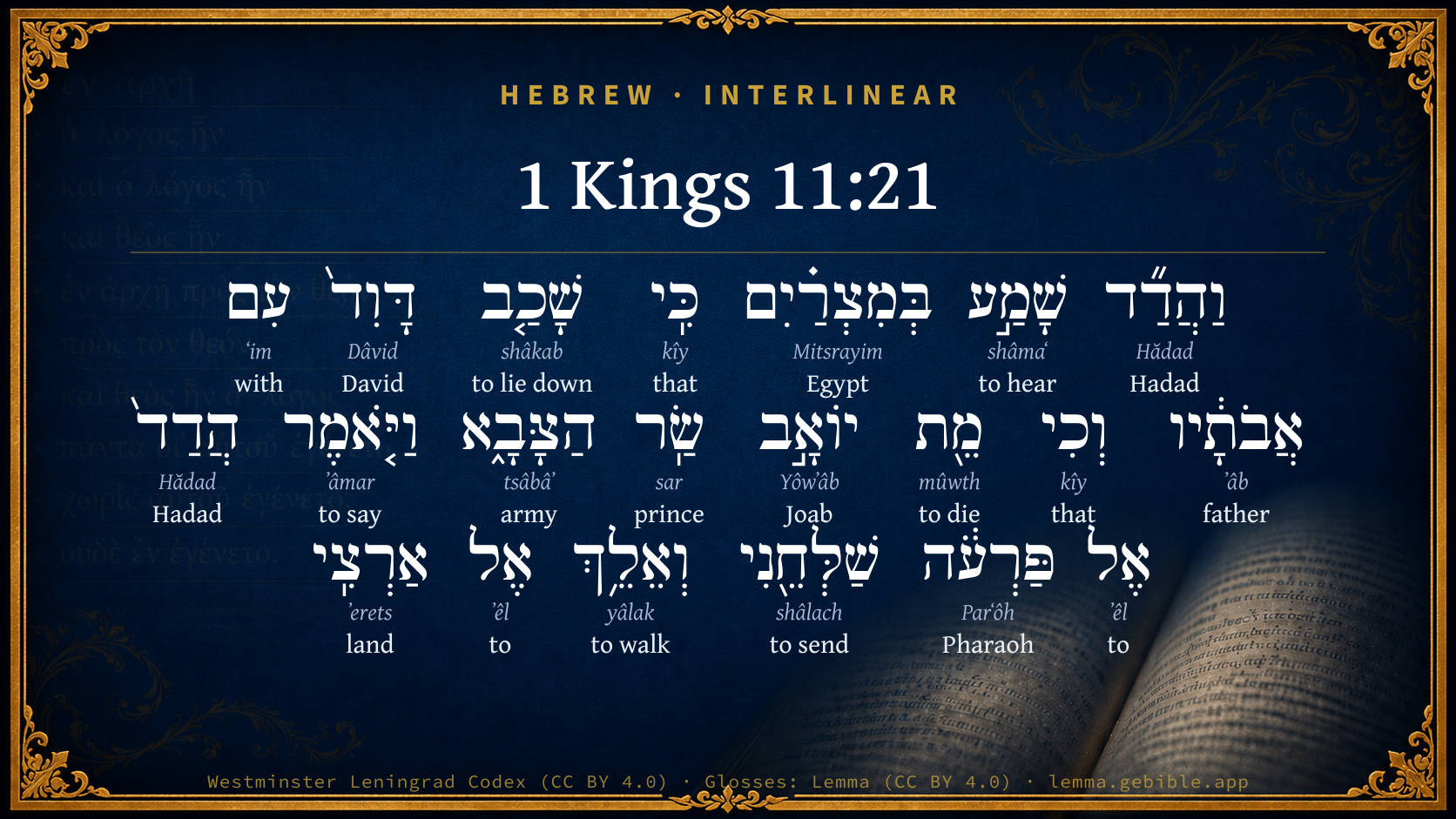
Hebrew (Westminster Leningrad Codex) 1 Kings 11:21 appears in the Hebrew Old Testament. The text above is from the Westminster Leningrad Codex. Each word links to its Strong’s number, a concise gloss, and parsing drawn from the Open Scriptures Hebrew Bible morphology. Click any word for its full Brown-Driver-Briggs (BDB) entry.
Download image
Cite this verse

1 Kings 11:21 (World English Bible). Public Domain. Lemma interlinear Bible study tool, https://lemma.gebible.app/v/1-kings/11/21.

Show BibTeX & RIS
BibTeX
RIS
English Translation
When Hadad heard in Egypt that David slept with his fathers, and that Joab the captain of the host was dead, Hadad said to Pharaoh, Let me depart, that I may go to my own country.
World English Bible · Public Domain
Download a study sheet

One document with this verse’s original text, its word-by-word gloss line, the meaning frame, cross-references with their text, attributed commentary, and full source and license credits — printable, and it pastes into notes with its structure intact.

This verse Autodidact and up

Study sheet (.html) Plain text (.txt)

A passage Seminary Student

Up to 50 verses in one chapter. A passage sheet keeps up to 6 commentary sources and 12 cross-references per verse, in the order this page ranks them, and says so on the sheet whenever that leaves anything out. Ask for a single verse and you get the Autodidact verse sheet above.

Everything on this page stays free to read, with no account — the sheet is a download of what is already on screen, not access to it.

Want to remove ads? Support Godless Engineer
Compare translations 3

The same verse in 3 English versions, stacked beneath the original-language interlinear above. Click any original word for its lexicon entry.

Each is an independent rendering of the whole verse — the interlinear is not word-aligned to these translations.

Highlighted words mark where these versions differ — a whole-verse word diff, not a word-by-word alignment.

  • World English Bible Public Domain
    When Hadad heard in Egypt that David slept with his fathers, and that Joab the captain of the host was dead, Hadad said to Pharaoh, Let me depart, that I may go to my own country.
  • King James Version Public Domain
    And when Hadad heard in Egypt that David slept with his fathers, and that Joab the captain of the host was dead, Hadad said to Pharaoh, Let me depart, that I may go to mine own country.
  • unfoldingWord Literal Text CC BY-SA 4.0
    And Hadad heard in Egypt that David had lain down with his fathers and that Joab, the commander of the army, had died. And Hadad said to Pharaoh, “Send me away, that I may go to my land.”

unfoldingWord Literal Text — © unfoldingWord, licensed CC BY-SA 4.0. Word-aligned USFM3 via Door43 (git.door43.org/unfoldingWord/en_ult).

Versions to compare (up to 4)

3 of 4 selected

Show all 18 translations

Every available English version of this verse, each an independent rendering of the whole verse.

  • World English Bible Public Domain
    When Hadad heard in Egypt that David slept with his fathers, and that Joab the captain of the host was dead, Hadad said to Pharaoh, Let me depart, that I may go to my own country.
  • Berean Standard Bible Public Domain
    When Hadad heard in Egypt that David had rested with his fathers and that Joab, the commander of the army, was dead, he said to Pharaoh, “Let me go, that I may return to my own country.”
  • Majority Standard Bible Public Domain
    When Hadad heard in Egypt that David had rested with his fathers and that Joab, the commander of the army, was dead, he said to Pharaoh, “Let me go, that I may return to my own country.”
  • King James Version Public Domain
    And when Hadad heard in Egypt that David slept with his fathers, and that Joab the captain of the host was dead, Hadad said to Pharaoh, Let me depart, that I may go to mine own country.
  • American Standard Version (1901) Public Domain
    And when Hadad heard in Egypt that David slept with his fathers, and that Joab the captain of the host was dead, Hadad said to Pharaoh, Let me depart, that I may go to mine own country.
  • Revised Version (1885) Public Domain
    And when Hadad heard in Egypt that David slept with his fathers, and that Joab the captain of the host was dead, Hadad said to Pharaoh, Let me depart, that I may go to mine own country.
  • Geneva Bible (1599) Public Domain
    And when Hadad heard in Egypt, that Dauid slept with his fathers, and that Ioab the captaine of the hoste was dead, Hadad sayde to Pharaoh, Let me depart, that I may goe to mine owne countrey.
  • Douay-Rheims (1899) Public Domain
    And when Adad heard in Egypt that David slept with his fathers, and that Joab the general of the army was dead, he add to Pharao: Let me depart, that I may go to my own country.
  • Young's Literal Translation Public Domain
    And Hadad hath heard in Egypt that David hath lain with his fathers, and that Joab head of the host is dead, and Hadad saith unto Pharaoh, `Send me away, and I go unto my land.'
  • Literal Standard Version CC BY-SA 4.0
    And Hadad has heard in Egypt that David has lain with his fathers, and that Joab head of the host is dead, and Hadad says to Pharaoh, “Send me away, and I go to my land.”
  • Unlocked Literal Bible CC BY-SA 4.0
    While he was in Egypt, Hadad heard that David had lain down with his ancestors and that Joab the captain of the host was dead, Hadad said to Pharaoh, “Let me depart, so I may go to my own country.”
  • unfoldingWord Literal Text CC BY-SA 4.0
    And Hadad heard in Egypt that David had lain down with his fathers and that Joab, the commander of the army, had died. And Hadad said to Pharaoh, “Send me away, that I may go to my land.”
  • Darby Bible Public Domain
    And Hadad heard in Egypt that David slept with his fathers, and that Joab the captain of the host was dead; and Hadad said to Pharaoh, Let me depart, that I may go to mine own country.
  • World Messianic Bible Public Domain
    When Hadad heard in Egypt that David slept with his fathers, and that Joab the captain of the army was dead, Hadad said to Pharaoh, “Let me depart, that I may go to my own country.”
  • Webster's Bible Public Domain
    And when Hadad heard in Egypt that David slept with his fathers, and that Joab the captain of the host was dead, Hadad said to Pharaoh, Let me depart, that I may go to my own country.
  • Free Bible Version CC BY-SA 4.0
    However, when news reached Hadad in Egypt that both David and Joab, the commander of the army, had died, Hadad said to Pharaoh, “Let me leave and return to my own country.”
  • Bible in Basic English Public Domain
    Now when Hadad had news in Egypt that David had been put to rest with his fathers, and that Joab, the captain of the army, was dead, he said to Pharaoh, Send me back to my country.
  • JPS Tanakh (1917) Public Domain
    And when Hadad heard in Egypt that David slept with his fathers, and that Joab the captain of the host was dead, Hadad said to Pharaoh: 'Let me depart, that I may go to mine own country.'

Literal Standard Version (2020), Covenant Press — licensed CC BY-SA 4.0. Text via the HelloAO Bible API (eBible.org). Unlocked Literal Bible (unfoldingWord) — licensed CC BY-SA 4.0. Text via the HelloAO Bible API (eBible.org). unfoldingWord Literal Text — © unfoldingWord, licensed CC BY-SA 4.0. Word-aligned USFM3 via Door43 (git.door43.org/unfoldingWord/en_ult). Free Bible Version, Dr. Jonathan Gallagher — licensed CC BY-SA 4.0. Text via the HelloAO Bible API (eBible.org).

Word by word

More ways to search: Search by grammar → Find every occurrence → Compare this word →

Practice this passage: Drill this verse → Learn its vocabulary →

וַהֲדַ֞ד
Hădad
H1908
“and · Hadad”
Conjunction + Noun, Proper
Part of Speech
Conjunction + Noun
Type
Proper
Full BDB Definition

Origin: probably of foreign origin [compare H111 ]

TWOT: 471c

Hadad = "mighty" - son of Ishmael - a king of Edom who gained an important victory over the Midianites on the field of Moab - another king of Edom, with Pau for his capital - a member of the royal house of Edom who escaped the massacre under Joab and fled with a band of followers into Egypt; after David's death, he returned to his own country
  1. שָׁמַ֣ע shâmaʻ H8085 “to hear” Verb, Qal, Perfect, 3rd Person, Masculine, Singular
  2. בְּמִצְרַ֗יִם Mitsrayim H4714 “in/at · Egypt” Preposition + Noun, Proper
  3. כִּֽי kîy H3588 “that” Conjunction
  4. שָׁכַ֤ב shâkab H7901 “to lie down” Verb, Qal, Perfect, 3rd Person, Masculine, Singular
  5. דָּוִד֙ Dâvid H1732 “David” Noun, Proper
  6. עִם ʻim H5973 “with” Preposition
  7. אֲבֹתָ֔יו ʼâb H1 “fathers · his” Noun, Common, Masculine, Plural, Construct + Suffix, Personal, 3rd Person, Masculine, Singular
  8. וְכִי kîy H3588 “and · that” Conjunction + Conjunction
  9. מֵ֖ת mûwth H4191 “to die” Verb, Qal, Perfect, 3rd Person, Masculine, Singular
  10. יוֹאָ֣ב Yôwʼâb H3097 “Joab” Noun, Proper
  11. שַֽׂר sar H8269 “prince of” Noun, Common, Masculine, Singular, Construct
  12. הַצָּבָ֑א tsâbâʼ H6635 “the · army” Particle, Definite Article + Noun, Common, Both, Singular, Absolute
  13. וַיֹּ֤אמֶר ʼâmar H559 “and · to say” Conjunction + Verb, Qal, Sequential Imperfect, 3rd Person, Masculine, Singular
  14. הֲדַד֙ Hădad H1908 “Hadad” Noun, Proper
  15. אֶל ʼêl H413 “to” Preposition
  16. פַּרְעֹ֔ה Parʻôh H6547 “Pharaoh” Noun, Proper
  17. שַׁלְּחֵ֖נִי shâlach H7971 “send · me” Verb, Piel, Imperative, 2nd Person, Masculine, Singular + Suffix, Personal, 1st Person, Common, Singular
  18. וְאֵלֵ֥ךְ yâlak H3212 “and · to walk” Conjunction + Verb, Qal, Cohortative, 1st Person, Common, Singular
  19. אֶל ʼêl H413 “to” Preposition
  20. אַרְצִֽי ʼerets H776 “land · my” Noun, Common, Both, Singular, Construct + Suffix, Personal, 1st Person, Common, Singular

About this verse

These counts appear in no published source. They are computed here, from the morphology-tagged text and Lemma’s own curated glosses. What Lemma adds →

21
words
18
distinct lemmas
Historical
section

Notable vocabulary

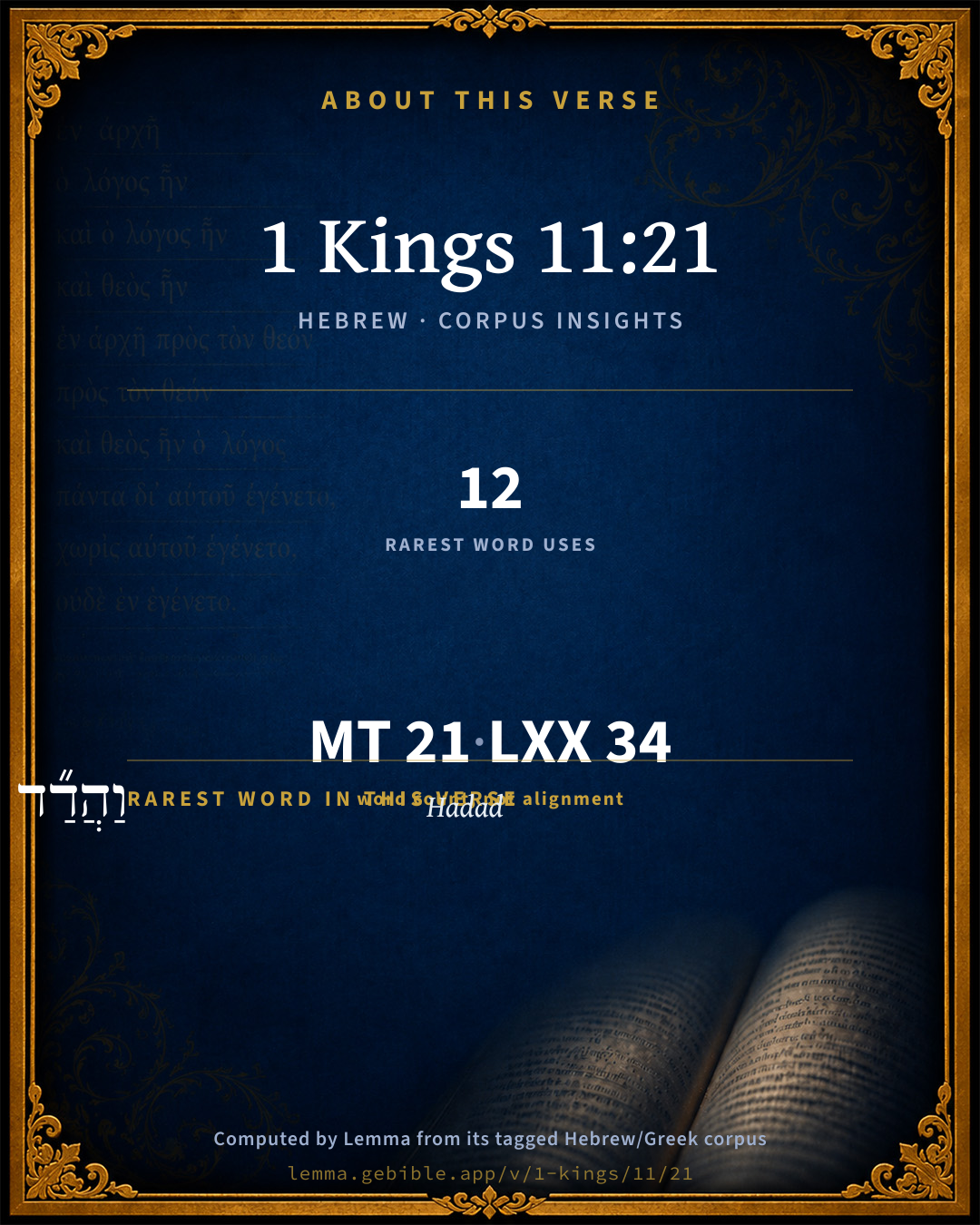
The rarest word here is וַהֲדַ֞ד Hadad H1908 — appearing just 12 times in the whole Hebrew Bible.

Shared distinctive vocabulary

וַהֲדַ֞ד Hadad H1908 occurs in 11 verses of the Hebrew Bible. Also found in:

Grammatical profile

  • 6 verbs
  • 10 nouns
  • 3 prepositions
  • 2 conjunctions

Verb forms

  • שָׁמַ֣ע Qal · Perfect
  • שָׁכַ֤ב Qal · Perfect
  • מֵ֖ת Qal · Perfect
  • וַיֹּ֤אמֶר Qal · Sequential Imperfect
  • שַׁלְּחֵ֖נִי Piel · Imperative
  • וְאֵלֵ֥ךְ Qal · Cohortative

Repetition

Words recur within this verse — often emphatic in Hebrew:

  • וַהֲדַ֞ד Hadad H1908 ×2
  • כִּֽי that H3588 ×2
  • אֶל to H413 ×2

Hebrew & Septuagint length

In English translation the verse runs 36 words from the Hebrew and 36 from the Septuagint (LXX English) — the same length.

A rough comparison of the two English renderings, which tokenize alike — not a word-level alignment.

Word counts can differ between the Hebrew and the Greek without any difference in meaning — e.g. the Hebrew direct-object marker אֵת has no separate Greek word, and Greek often adds the article ὁ.

In the original languages it is 21 Hebrew tokens and 34 Greek tokens — but the two are counted differently (Hebrew bundles its prefixes and suffixes into one token; the Greek is in lemma form), so that isn’t a like-for-like length.

Cross-references

8

Topical passages linked to 1 Kings 11:21 in the Treasury of Scripture Knowledge — connected by theme and wording, ordered by reader-vote popularity; previews shown in the World English Bible.

  • 1 Kings 2:10 David slept with his fathers, and was buried in the city of David.
  • Genesis 45:24 So he sent his brothers away, and they departed. He said to them, "See that you don't quarrel on the way."
  • Exodus 4:19 Yahweh said to Moses in Midian, "Go, return into Egypt; for all the men who sought your life are dead."
  • Joshua 2:21 She said, According to your words, so be it. She sent them away, and they departed: and she bound the scarlet line in the window.
  • 1 Samuel 9:26 They arose early: and it happened about the spring of the day, that Samuel called to Saul on the housetop, saying, Up, that I may send you away. Saul arose, and they went out both of them, he and Samuel, abroad.
  • 2 Samuel 3:21 Abner said to David, I will arise and go, and will gather all Israel to my lord the king, that they may make a covenant with you, and that you may reign over all that your soul desires. David sent Abner away; and he went in peace.
  • 1 Kings 2:34 Then Benaiah the son of Jehoiada went up, and fell on him, and killed him; and he was buried in his own house in the wilderness.
  • Matthew 2:20 "Arise and take the young child and his mother, and go into the land of Israel, for those who sought the young child's life are dead."

Cross-references courtesy of OpenBible.info (CC BY 4.0).

Hebrew and Greek witnesses Masoretic Hebrew ↔ Greek Septuagint

The same verse in the two great witnesses to the Old Testament, shown verse-for-verse.

These are two independent witnesses, not word-aligned to each other, and the Septuagint is shown in lemma (dictionary) form.

Hebrew 1 Kings 11:21 Masoretic · Westminster Leningrad Codex

וַהֲדַ֞ד שָׁמַ֣ע בְּמִצְרַ֗יִם כִּֽי שָׁכַ֤ב דָּוִד֙ עִם אֲבֹתָ֔יו וְכִי מֵ֖ת יוֹאָ֣ב שַֽׂר הַצָּבָ֑א וַיֹּ֤אמֶר הֲדַד֙ אֶל פַּרְעֹ֔ה שַׁלְּחֵ֖נִי וְאֵלֵ֥ךְ אֶל אַרְצִֽי

When Hadad heard in Egypt that David slept with his fathers, and that Joab the captain of the host was dead, Hadad said to Pharaoh, Let me depart, that I may go to my own country.

World English Bible · Public Domain

Greek LXX 1 Kings 11:21 Septuagint · lemma form

καί αδερ ἀκούω ἐν αἴγυπτος ὅτι κοιμάω δαυίδ μετά ὁ πατήρ αὐτός καί ὅτι θνήσκω ιωαβ ὁ ἄρχων ὁ στρατιά καί εἶπον αδερ πρός φαραώ ἐκ ἀπστέλλω ἐγώ καί ἀποστρέφω εἰς ὁ γῆ ἐγώ

And Ader heard in Egypt that David slept with his fathers, and that Joab the captain of the host was dead; and Ader said to Pharao, Let me go, and I will return to my country.

LXX2012 (modern English Septuagint) · Public Domain

On this verse, Ellicott's Commentary for English Readers discusses the Septuagint’s reading. Read the note in Commentary ↓

Hebrew: Westminster Leningrad Codex (CC BY 4.0). Greek: Septuagint (public domain); English from LXX2012 (modern English Septuagint) (Public Domain). How the Septuagint differs from the Hebrew →

Targum (Aramaic paraphrase)

1

The Targum is the ancient Jewish Aramaic paraphrase of the Hebrew Scriptures — an interpretive translation, not the Hebrew text itself. Onkelos (literal) and Pseudo-Jonathan (expansive) render the Torah, and Jonathan the Prophets. Coverage is partial: where no permissively-licensed English translation exists for a verse, only the Aramaic is shown. This is verse-level text, not a word-by-word alignment to the Hebrew.

  1. Targum Jonathan Prophets (Joshua–Malachi)
    וַהֲדַד שְׁמַע בְּמִצְרַיִם אֲרֵי שְׁכִיב דָוִד עִם אֲבָהָתוֹהִי וַאֲרֵי מִית יוֹאָב רַב חֵילָא וַאֲמַר הֲדַד לְפַרְעֹה שַׁלְחֵנִי וֶאֱהַךְ לְאַרְעִי:

    (no public-domain English translation for this verse)

    Targum Jonathan — Aramaic: “Mikraot Gedolot” (public domain). English: “Sefaria Community Translation” (CC0 1.0 (public-domain dedication)); “London "Chaldee Paraphrase," 1871” (public domain). Text via Sefaria.

Commentary

Notes on 1 Kings 11:21 from classic Christian and Jewish commentators (each source and its license shown beneath its notes). The classic Christian expositions comment on the surrounding passage and are grouped to its opening verse, so a note may address several verses; the Jewish commentaries on the Tanakh (Rashi and others) are per-verse, so they appear only where the commentator wrote on this verse.

Lemma curates 59 commentaries, every one of them public domain or Creative Commons licensed, each selected and text-cleaned for this edition rather than reprinted as found. About our sources →

Trapp's Complete Commentary

John Trapp

1Ki 11:21 And when Hadad heard in Egypt that David slept with his fathers, and that Joab the captain of the host was dead, Hadad said to Pharaoh, Let me depart, that I may go to mine own country.

Ver. 21. Let me depart, that I may go to mine own country.] Patriam quisque amat, non quia pulchram, sed quia suam. {a} We all naturally affect our native country. Oh that we could heaven as well! Repatriasse hoc erit, saith Bernard, to go to heaven is to go home again.

{a} Seneca.

John Trapp, A Commentary or Exposition upon All the Books of the Old and New Testament (1647–1656) — public domain. Text from a community e-Sword module.

The Biblical Illustrator

Joseph S. Exell

1Ki_11:21-22

When Hadad heard in Egypt that David slept with his fathers.

A few turns of a kaleidoscope

Let me use this text like a kaleidoscope, giving it three or four turns, and try to describe what I see. Dealing with the incident as it stands here, there is a lesson for kings and all that are in authority. And it is something like this: Do not abuse your power. In wrath, remember mercy. When you have your enemy at the point of the sword, remember mercy even while you remember justice, and pay off old scores. The national lesson we might learn is, that if we will be over severe, if we will harass the Jews, for example, as all nations have more or less combined to do, God will spread the lap of His skirt over the Jews. Vengeance is mine; I will repay. God likes to see justice done; but God will not have vindictive and sinful revenge, and He will spread the lap of His cloak over the Jews as He did over Hadad. God may find His executors of vengeance in the descendants of those with whom we deal too harshly, or our fathers before us, long, long ago. Ay, they will spread through your English cities and towns, and play the very mischief with you at voting times, and make the balance kick the beam in most undesirable and provoking fashion. We forget that God hates inhumanity, and Gods heart repents Him for those who seem to be utterly trampled under foot, and denied the right to live. He has strange ways with Him, and He is worth watching. Therefore let mercy season justice. Then there is the same lesson, not now from a national, but from a private and personal point of view. Do not be vindictive. You may have power to-day, but use it mildly; let mercy season justice, for you do not know what may happen to yourself; and long after you are gone. The roots of this business are very deep, and go very far back. In your hour of power be patient even to the evil, lest you be betrayed into sinful abuse of power. As much as lieth in you, live peaceably with all men. I know a man just now, and this is what has come to him. Years ago he was in a certain business, and he was strong and flourishing. But he dealt in a very high-handed and dictatorial manner with one under him. He cast him out, or forced him to flee. And now--it has taken some thirty years to do it, but thirty years have done it--now that man who was cast out--Hadad over again--Hadad to-day has destroyed his former masters business. He started a rival establishment, has got on and prospered, and things have so come about that he who was up is down, and he who was down is up. Therefore take care; and just because you have the ball at your foot, and you have only to kick it, kick it with discretion. Be magnanimous; the day may come when you may need all your friends. But there is a spiritual lesson. Hadad comes back to do mischief to Solomon, for he has beard things and drawn inferences. It has spread among the surrounding nations that the strength of Israel now is not so strong as it seems to be. It is far more pasteboard and stucco, than granite and marble. They come and afflict him whom erewhile they feared. So with individual men. Are there not men and women here to-day, and Solomons history and danger is theirs? You are not what you seem to be. With all your credit and reputation, you are backslidden in heart. And these old sins, like vultures, are sharpening their beaks, and they are coming round upon you. For Gods sake and thine own, take care: hie thee back to God, return to faith, and prayer, and penitence. But I want to use this text in an entirely different way. One cannot read this without wishing to apply it to a certain class of Gospel hearers in this land of ours, and very likely in this very church, to whom it may be useful. This is the time that a soul comes to when, known only to itself and to God, there comes across it yearning and discontent. You can hardly explain it to yourself, and do not like to speak about it to other people. This longing comes to you, not when you are young and struggling, but, mayhap, when you are in mid-manhood, or growing age. Ask your own heart, and it will teach you. Does it not ring responsive to my poor words this morning? It is Hadad before Pharaoh over again. The genuineness of that feeling, may be tested by this: the sacrifice it will involve. See what Hadad had to give up; see the risks he had to run. To become truly regenerate, sons of God will make a wrench. If you had become a true Christian years ago, it would have been, humanly speaking, kind of natural and easy. But now, for all these years, you have been away in exile. And you have got on, I dont deny it. But what, I repeat, is that yearning in your heart? Why are you not contented? Why cant you be at rest? Will it cost you something to put yourself right now, to go to Jesus, to become a Christian, to give up your world like Hadad, with its positions, and its honours, and its ambitions? Then all the more make the wrench. Ah yes! Thank God for times like these. All through your boyhood, or girlhood, your open youth, your busy, bustling middle life, the world sufficed. Thank God for that dissatisfaction; it is a spur in your lazy sides to send you home. What is happening to you is what happened to Noahs dove. The raven could sit pecking at any corpse on the water, and find its satisfaction there. But doves are doves, and not carnivorous. The dove found no rest for the sole of its foot, and it winged its way back across the black hills of water, back to that great ship that came drifting slowly along. Back to yon window, which is a kind of frame for the face of weather-beaten old Noah, standing there with his hand stretched out so that the weary thing may light. So Christ Jesus comes to weary hearts in London to-day. And He holds out His hand and asks for weary worldlings to light upon it. He will take you into warmth, and light, and love, and peace, and an ark of safety that will ride all storms. Gleaming lightnings may flash past, the last judgment may thunder upon the world, all things be overwhelmed in the wrath that is coming, but your soul has reached its rest, its refuge, its abiding home. (J. MNeill.)

Hadad: the pressure of destiny

David, and Joab the captain of the host of Israel, wrought great desolation in Edom; for six months did Joab remain there with all Israel, until he had cut off every male in Edom. Amongst those who escaped was a little child, comparatively speaking, an infant member of the royal house. He was so little that he could not have made his escape alone, but he was taken care of by certain Edomites of his fathers servants, and in their company he fled into Egypt. Pharaoh was very kind to his royal exile. He gave him an house, and appointed him victuals, and gave him land. With growing years he came into growing favour, and by and by he married the sister of the queen of Egypt. It would seem, then, that he did well to escape from his own ill-treated country, and to put himself under the protection of the mighty and gracious Pharaoh. It came to pass, however, that Hadad (that is the name of the Edomite) said to Pharaoh, I want to go home; let me depart, that I may go to mine own country. Pharaoh was astounded by the inquiry, and began to wonder whether Hadad had been unkindly treated in Egypt, and in the frankest manner he said, What hast thou lacked with me, that, behold, thou seekest to go to thine own country? A very proper question; to which Hadad appears to have returned an ungrateful and insufficient answer--Nothing: howbeit let me go in any wise. You will find the secret in the fourteenth verse of the chapter:--And the Lord stirred up an adversary unto Solomon, Hadad the Edomite: he was of the kings seed in Edom. It was a Divine stirring! It was a restlessness sent from God! It was a hunger created in the heart!

1. Men cannot always give an account of their impulses. We seem to have everything, yet we want something else. What that something else is, we perhaps seldom know, or if we do know, we cannot put the want into words. We have all Egypt, yet we are willing to leave it for Edom.

2. What we mistake, either in ourselves or in others, for mere restlessness may be the pressure of destiny. We blame some men roughly for desiring a change, and when we question the men themselves as to their reason, they tell us that they have been treated well, even handsomely, yet they want to go! Then we condemn them as unreasonable, and we predict many a judgment for them! Alas, how ignorant we are, and how cruel to one another!

3. We may judge of the value of our impulses by the self-denial imposed by their operation. Consider what Hadad had to lose! Except a man deny himself and take up his cross daily, he cannot be moving in the Divine direction. Remember in the cases quoted David was impelled to war, and Samuel to make revelations which must have cost his heart no small strain. Are our impulses towards self-enjoyment?

4. Is it not by some such impulse that the good man meets death with a brave heart? How else could he leave loved ones, home, manifold enjoyment, and social honour? Yet he pines for heaven. I have a desire to depart. Oh that I had wings like a dove

To thee, O dear, dear country,

Mine eyes their vigils keep.

God surely sends this home-sickness into our hearts when He is about to call us up higher.

5. Remember how possible it is to overrule our best impulses. Pharaoh said stop, Hadad begged to be allowed to go. Peter said, That be far from Thee, Lord, but Christ called him an offence, and drove him behind. Grieve not the Spirit. Quench not the Spirit. Is not the Spirit of Christ urging every man to leave the Egypt of sinful bondage? Come out from among them, and be ye separate, saith the Lord. Ye will not come unto me that ye might have life. (J. Parker, D. D.)

Hadad the Edomite (love of country)

This narrative of Hadad comes in as a short episode in the later days of King Solomon, when he was being punished for his defection. The story has an interest of its own. We wish to take this one feature--the love of country--and look at it as implanted in the human heart for a wise and Divine purpose, passing beyond this simple instance, and drawing whatever light we can from Gods providence and Word.

1. The first remark we make is, that it is a feeling not only deep in our nature, as we do not need to show, but acknowledged and approved in the Bible. This has been denied, and some have blamed, while others have praised, the Book on this account; but whether it be to its blame or praise, the feeling is there. We cannot surely fail to perceive that the love of country was employed by God to build up the place He gave the Jewish people in preserving His truth in the long period of darkness, before the time came for the Gospel to go out into the world. Their love was drawn to it before they saw it as the land of Promise. But what purposes are served by this? There is one which may seem low enough to begin with, but which has its own importance. It is one of the ways by which God secures that the earth should be inhabited. There is a dispersive force in the world which began long ago, and which has been going on ever since, the spirit of adventure and energy which seeks action and change; so waste places are peopled and tilled. But there is needed not less an adhesive power to maintain what is gained. The world must have an anchor as well as a sail. Rocky Edom is dear as fertile Egypt, and bleak, storm-struck islands more than southern Edens. If it were not for this, wars for sunny spots would be more common than they are, and kindreds and peoples could not be gathered and held together to build up communities. But the building up of communities is a part of Gods providential design. Each one in its own place brings out its own character, and, in the end, may be found to bring its own contribution to the interests of humanity. We may come to a higher view of this feeling when we think of its effect on the individual man. This love of the native soil has been one of the great springs of the poetry of the race; and whatever we may think of poetry ourselves, we cannot fail to see its power. God, who gives the bird wings for its safety and delight, has given man imagination. It is certainly His gift, if men would only use it for Him. And it can be said with truth that, apart from the region of the spirit itself, it is never more pure and purifying than when it takes for its subject the things of native land and home.

2. Another thought suggested by this feeling is that it leads to acts of great self-sacrifice and endeavour. Next to religion, there is probably nothing in human nature which has called out such a heroic spirit of martyrdom, or such long, persistent labour, as the love of native land. The grandest part of the history of nations has been the period when they have risen for independence and freedom, against the attempts to crush out their liberty or their separate life, and when they have left names of leaders which make hearts of men throb and thrill wherever they arc heard. It is a poor Christianity, because it is not a true humanity, which affects to disregard this. There is an heirloom of stimulus to a whole race in the heroic acts of those who have bequeathed them a name among the nations of the world. There are men who can be reached by the love of fellow-countrymen, when they cannot be moved by the love of their fellow-men; and it is quite possible for a man to have both. The narrower is sometimes more intense and energetic than the wider. In the annals of the civil wars in England, an officer, who had fought in many battles abroad, tells that in his first fight on English ground he heard a cry of agony in his own tongue, and he looked behind him to see who of his men was killed. He discovered that the cry came from the opposing ranks, and then first he realised what a terrible thing it was to kill his own countrymen. There are many who feel it so in our quieter times, and who can be stirred more strongly to save from destitution and death those who speak their own language, and have a nearer blood beating in their heart.

3. Another thought suggested by this feeling is, that it should enable us to understand the hearts, and work for the rights of all men. There is a rule recommended by some religious communities, that their members should have no special friendships; that they should do nothing for each other as friends. And there are some philosophers who defend this. They say that friendship is a barrier which hides from view the qualities of many who are more worthy of regard, that it is a kind of theft from the common good for the benefit of a few, and that, in a higher state of society, friendship will disappear; which amounts very much to saying that if we put out our eyes, so as not to see things that are close to us, we shall be more likely to discover those that are far away. These are the theories of men who have either had no hearts to begin with, or have managed to cover them by cobwebs of speculation. Augustine has said that we may make a ladder of the dead things within us, to climb to the highest; but there is another ladder of living things by which we can rise as high, and by which our sympathies can be travelling to and fro like the angels in the dream of Bethel. The vision begins in the dreamers own breast, and then it passes up into the skies. This is the very way in which God Himself has dealt with us. He came from the limits of the universe into this world, and became our friend, that He might lead us step by step into the fulness of Him that filleth all in all.

4. The last thought we suggest is, that this feeling may help the conception of another and a higher country. It is quite true that we find the spirit of patriotism filling the hearts of men with the highest enthusiasm, and spreading itself over masses of men and long periods, but bringing little spiritual desire. Yet it is one of the ways, as we have said, by which God keeps the heart above sensualism and utter selfishness--a kind of salt that saves nations from entire corruption. We see in the Bible that the thoughts of native land and home are more than any others the figures which God has used to convey to us conceptions about the future. They are more than figures. They have been woven into His plan of education. He made the old patriarchs exiles, in order that He might create in them the longing which went further than any land, behind or before them, in this world. The last view given us of the heavenly world is that of a land and city which have over them a Father and an Elder Brother, and for friends the nations of the saved. (J. Ker, D. D.)

Patriotic sentiment

An American citizen in a foreign city, seeing the meteor flag of his native land floating at the masthead of a ship, is inwardly moved by the associations it revives to patriotic feelings, to emotions of love, to fond anticipations of his return to the joys and repose of his fireside. But of his secret thoughts the people about him know nothing. To them the flag of his country is but as one flag among many others. They meddle not with the secret joys it kindles within his swelling breast. It is even so with the secret of the Lord in a good mans breast. He walks the street like other men. Yet while their thoughts are of things visible and earthly, his are of God and things unseen. He sees God in everything about him. God is communing with him, feasting him on holy thought, quickening his spiritual aspirations, comforting him with assurances of his sonship, and with visions of his incorruptible inheritance. (W. Hoyt, D. D.)

The Biblical Illustrator, edited by Joseph S. Exell (c. 1880s–1900s) — public domain. Text from a community e-Sword module.

Joseph Benson's Commentary

1Ki 11:21-22. Hadad said — Let me depart, that I may go to my own country — To Edom, which he hoped to recover, now that the great enemies of it, David and Joab, (whom he feared as much as David,) were dead, and Solomon was young. Thither he accordingly came; and was there even from the beginning of Solomon’s reign. And, it is probable, by the near relation which was between his wife and Solomon’s, and by Pharaoh’s intercession, he obtained his kingdom with condition of subjection and tribute to be paid by him to Solomon; which condition he kept till Solomon fell from God, and then began to be troublesome and dangerous to his house and kingdom.

Joseph Benson's Commentary on the Old and New Testaments (1811–1818) — public domain. Text from a community e-Sword module.

Ellicott's Commentary for English Readers

(21, 22) When Hadad heard.—If (as the text seems to suggest) this took place on the news of the death of David and of Joab, the scourge of Edom, it belongs, of course, to the early part of the reign of Solomon, before his power was established. The courteous evasion by the Pharaoh of that time of Hadad’s request for permission to return, may probably indicate the beginning of the change of attitude towards the powerful monarchy of Israel, which took effect in the subsequent close alliance of the kingdoms. As the text stands, the record here stops abruptly, and then recurs to Hadad by a curious allusion in 1Ki_11:25. It can hardly be doubted that there is some omission or dislocation of the text. The LXX. (in the Vatican MS.) introduces after the words “Hadad the Edomite” in 1Ki_11:14, the words “and Rezon the son of Eliadah . . . all the days of Solomon” from 1Ki_11:23-25; and then, resuming the story of Hadad, adds, after the record of his request to Pharaoh, “and Hadad returned to his land. This is the mischief which Hadad did, and he abhorred Israel, and reigned over Edom.” Josephus, on the other hand, says that at the time of the original request, Pharaoh refused permission; but that in the declining years of Solomon it was granted, and that Hadad, finding it impossible to excite rebellion in Edom, which was strongly garrisoned, joined Rezon in Syria, and with him established an independent power, and did mischief to Israel. (Ant. viii. 6, 6.) This account is itself probable enough; it accounts, moreover, for the close connection in the history (especially in the LXX. reading) between Hadad and Rezon, and for the insertion of the whole matter in this place; and accords also with the fact that, while Syria seems at once to become independent after the death of Solomon, we hear of no revolt of Edom till the time of Jelioshaphat (2 Chronicles 20).

A Bible Commentary for English Readers, edited by Charles John Ellicott (1878–1897) — public domain. Text from a community e-Sword module.

The Cambridge Bible for Schools and Colleges

gen. ed. J. J. S. Perowne

21. when Hadad heard in Egypt that David slept with his fathers] Hadad’s first attempt to depart from Egypt was therefore soon after Solomon’s accession. It is clear however from the history that it was only after some pressure that the Egyptian king allowed him to go. The mischief that he did (see 1Ki_11:25) would be by stirring up his countrymen to cast off the yoke of the Israelites. We must allow a considerable time for any revolt to be organized, and we are not told that any outbreak really took place, but only that mischief was done through Hadad’s agitation.

and that Joab the captain of the host was dead] Joab’s name would be one to spread terror, because of the severity he had displayed toward Edom. (See above, 1Ki_11:15-16.) Hadad therefore waited to hear of his death also, before he ventured to take any step for his own restoration.

The Cambridge Bible for Schools and Colleges (gen. ed. J. J. S. Perowne; Cambridge University Press, 1878–1918) — public domain. Text from a community e-Sword module.

John Gill's Exposition

Then Pharaoh said unto him, but what hast thou lacked with me,.... Either of an equipage suitable to his birth and marriage, or of provisions for his household, or of honour and respect, or of any favour from him:

that, behold, thou seekest to go into thine own country? as if not well used where he was, or would be better provided for there:

and he answered, nothing; he wanted nothing at all, had all he could wish for:

howbeit, let me go in any wise: he had such an extreme desire to go, that he begged it might not be denied him on any account; whether he acquainted Pharaoh with his view in this request is not said, but it is probable he did, and it is certain Pharaoh gave him leave to go, see Kg1 11:25.

John Gill's Exposition of the Whole Bible (1746–1763) — public domain (CC PDM 1.0). Text via the HelloAO Bible API.

Albert Barnes' Notes on the Bible

That Hadad should wait for the death of Joab before requesting leave to return to Idumaea shows how terrible an impression had been made by the severe measures which that commander had carried out twenty-five or thirty years previously 1Ki 11:16. The inability of refugees to depart from an Oriental court without the king’s leave, and his unwillingness ordinarily to grant leave, are illustrated by many passages in the history of Persia.

Albert Barnes' Notes on the Bible (1834–1885) — public domain. Text from a community e-Sword/MySword module.

Matthew Poole's English Annotations

Joab the captain of the host, whom he feared as much as David himself.

That I may go to mine own country; whither accordingly he came, and was there even from the beginning of Solomon’s reign; where he either lived as a private person, yet secretly working for the recovery of his crown when an opportunity was offered; or rather, by the near relation which was between his wife and Solomon’s; and by Pharaoh’s intercession he obtained his kingdom, with condition of subjection and tribute to be paid by him to Solomon; which condition he kept till Solomon fell from God, and then it seems he began to be troublesome to him, and dangerous to his house and kingdom.

Matthew Poole's English Annotations on the Holy Bible (1683–1685) — public domain. Text from a community e-Sword/MySword module.

The Pulpit Commentary

And when Hadad heard in Egypt that David slept with his fathers, and that Joab the captain of the host was dead It comes out very significantly here what a name of terror Joab"s had been in Edom and how deep was the impression which his bloody vengeance of a quarter of a century before had made Hadad said to Pharaoh, Let me depart Heb. send me away, that I may go to mine own country. Rawlinson cites Heb 3:132-137; Heb 5:25, Heb 5:35, Heb 5:106, Heb 5:107, to show that refugees at Oriental courts must obtain permission to leave them.

The Pulpit Commentary (1880–1919), ed. H.D.M. Spence-Jones & Joseph S. Exell — public domain. Text from a community e-Sword module.

John Wesley's Explanatory Notes

Joab - Whom he feared as much as David himself. Own country - Whither accordingly he came; and was there, even from the beginning of Solomon's reign. And it is probable, by the near relation which was between his wife and Solomon's; and, by Pharaoh's intercession, he obtained his kingdom with condition of subjection and tribute to be paid by him to Solomon; which condition he kept 'till Solomon fell from God, and then began to be troublesome, and dangerous to his house and kingdom.

John Wesley, Explanatory Notes Upon the Whole Bible (1754–1765) — public domain. Text via the GEBible commentary corpus.

Rashi

Rabbi Shlomo Yitzchaki (Rashi)

That Dovid slept. For Dovid who died of natural causes, an expression of sleeping [שכיבה] is mentioned; but for Yoav who was killed, an expression of dying [מיתה] is mentioned.. Another explanation is that concerning Dovid who was survived by a meritorious son who took his place, [an expression of] sleeping is mentioned, but concerning Yoav who was not survived by a meritorious son who took his place, [an expression of] sleeping is not mentioned, rather, [an expression of] dying [is mentioned].

Rashi on the Tanakh — English translations: “The Judaica Press complete Tanach with Rashi, translated by A. J. Rosenberg” (CC BY 4.0); “Pentateuch with Rashi's commentary by M. Rosenbaum and A.M. Silbermann, 1929-1934” (public domain); “The Metsudah Tanach series, Lakewood, N.J” (CC BY 4.0); and “The Book of Joshua, Metsudah Publications, 1997” (CC BY 4.0). Text via Sefaria.

Lesson kit

Teaching starters — assembled from the data on this page, not authored interpretation. Every prompt links to the verse data it draws on. Edit before teaching.

1 Kings, in the Historical, opens this verse with 21 words (18 distinct Hebrew lemmas). Its most distinctive word is Hădad (“Hadad”). A historical commentator’s framing appears above. Read the whole chapter for the surrounding context.

Discussion questions

  1. How does “Hadad” (Hădad) shape what this verse is saying?
  2. Genesis 36:35 shares the word «Hadad» with this verse. How do the two illuminate each other?
  3. “Hadad” occurs 2× in this one verse. What is the effect of the repetition?
  4. These translations render this verse differently. What is at stake in choosing one wording over another?
  5. The verb «שָׁמַ֣ע» is Qal Perfect. How does its form color the action?
  6. Reading how Trapp's Complete Commentary and The Biblical Illustrator read this verse, where do the two commentators agree and where do they part?

Things to notice

Reading settings

Reading text

Shown beneath each verse's original-language words.

Old Testament
Old Testament edition

Read the OT as the Masoretic Hebrew (MT) or the Greek Septuagint (LXX).

English shown for the Greek Septuagint (in the Hebrew ↔ Greek comparison).

Comparing translations? Open the Compare panel on any verse page to stack up to four side by side.