
Deuteronomy 7:15

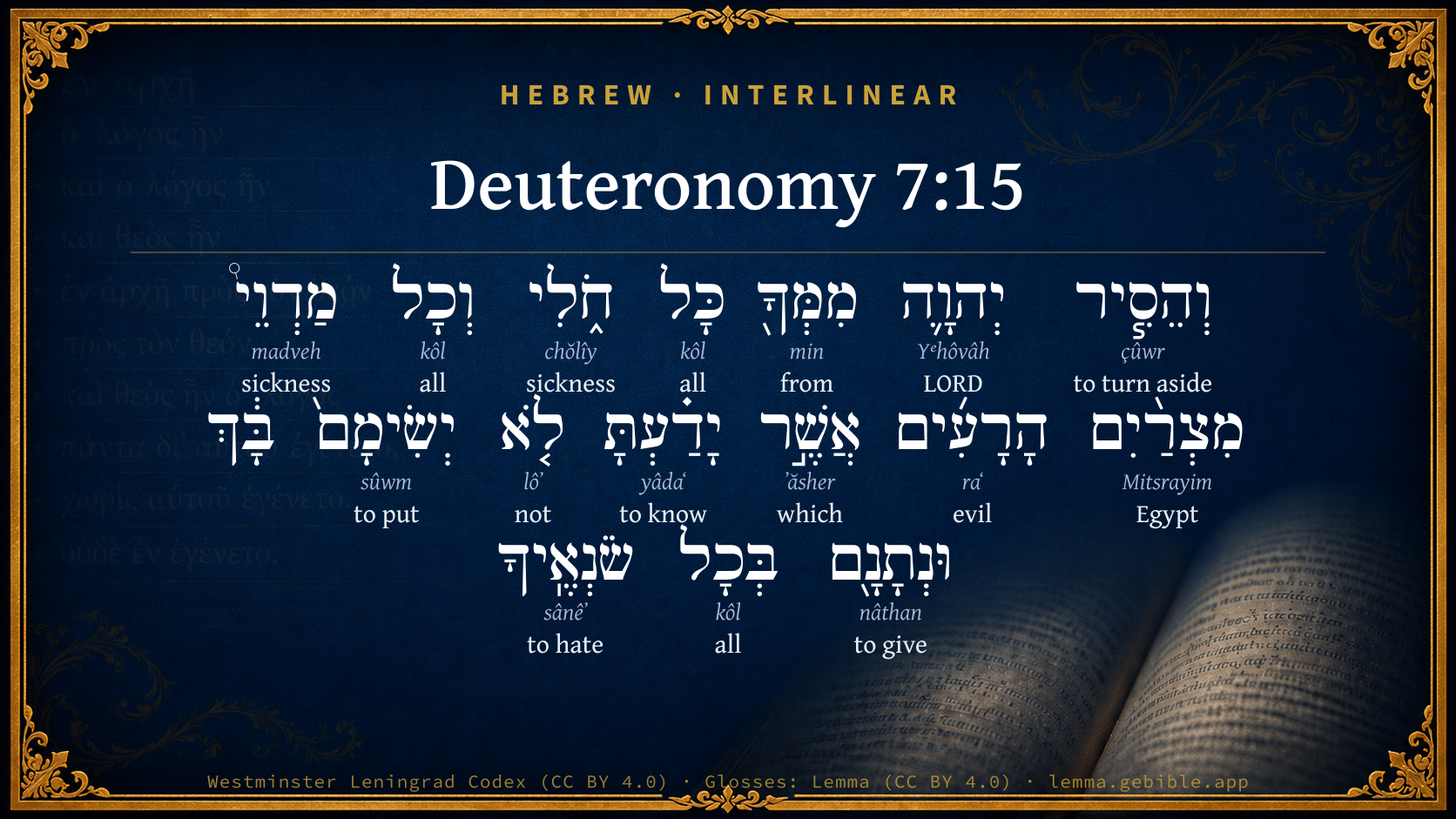
Hebrew (Westminster Leningrad Codex) Deuteronomy 7:15 appears in the Hebrew Old Testament. The text above is from the Westminster Leningrad Codex. Each word links to its Strong’s number, a concise gloss, and parsing drawn from the Open Scriptures Hebrew Bible morphology. Click any word for its full Brown-Driver-Briggs (BDB) entry.
Download image
Cite this verse

Deuteronomy 7:15 (World English Bible). Public Domain. Lemma interlinear Bible study tool, https://lemma.gebible.app/v/deuteronomy/7/15.

Show BibTeX & RIS
BibTeX
RIS
English Translation
Yahweh will take away from you all sickness; and none of the evil diseases of Egypt, which you know, will he put on you, but will lay them on all those who hate you.
World English Bible · Public Domain
Highlights
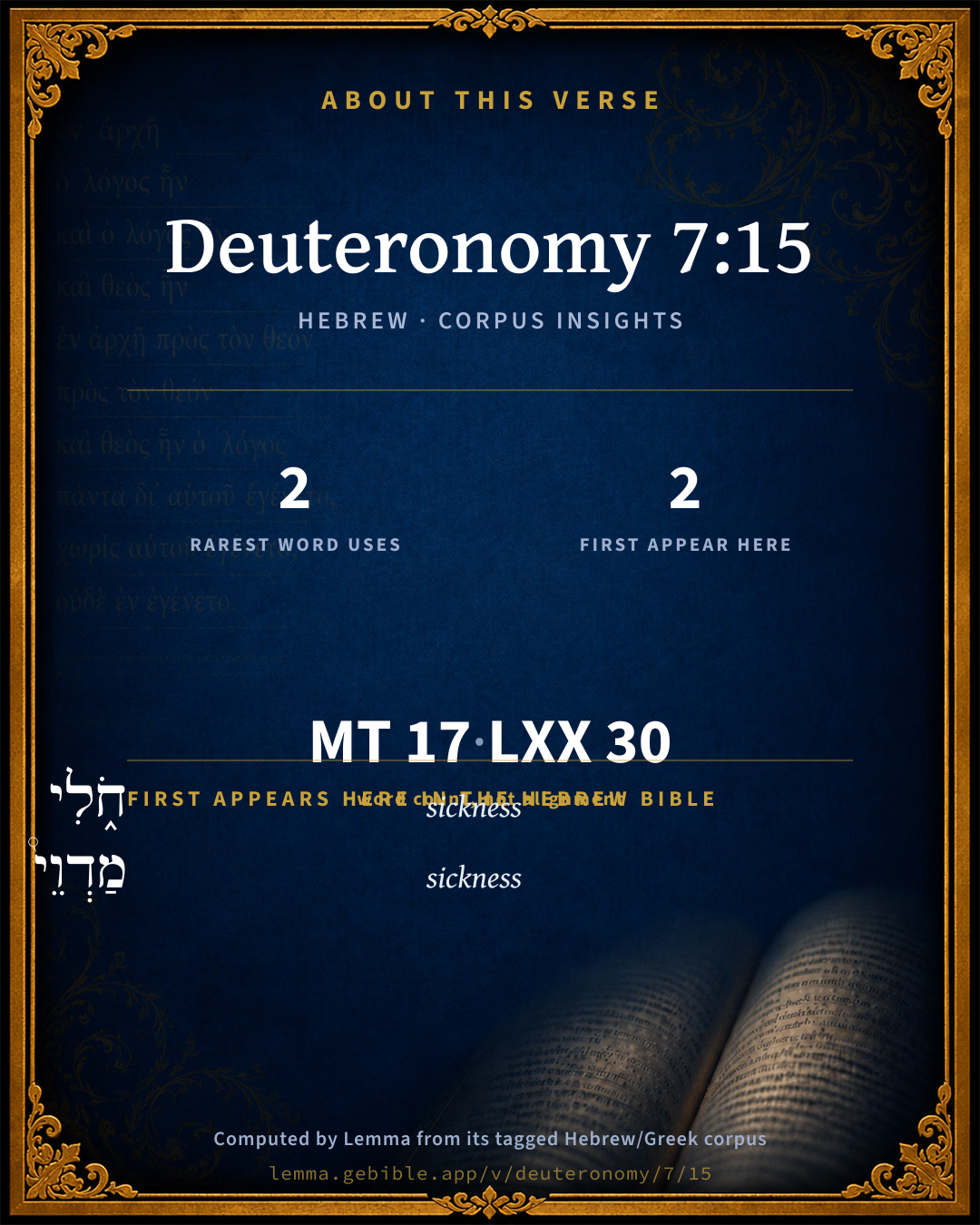
  • 2 first appearances in the Hebrew Bible
Full analysis ↓
Download a study sheet

One document with this verse’s original text, its word-by-word gloss line, the meaning frame, cross-references with their text, attributed commentary, and full source and license credits — printable, and it pastes into notes with its structure intact.

This verse Autodidact and up

Study sheet (.html) Plain text (.txt)

A passage Seminary Student

Up to 50 verses in one chapter. A passage sheet keeps up to 6 commentary sources and 12 cross-references per verse, in the order this page ranks them, and says so on the sheet whenever that leaves anything out. Ask for a single verse and you get the Autodidact verse sheet above.

Everything on this page stays free to read, with no account — the sheet is a download of what is already on screen, not access to it.

Want to remove ads? Support Godless Engineer
Compare translations 3

The same verse in 3 English versions, stacked beneath the original-language interlinear above. Click any original word for its lexicon entry.

Each is an independent rendering of the whole verse — the interlinear is not word-aligned to these translations.

Highlighted words mark where these versions differ — a whole-verse word diff, not a word-by-word alignment.

  • World English Bible Public Domain
    Yahweh will take away from you all sickness; and none of the evil diseases of Egypt, which you know, will he put on you, but will lay them on all those who hate you.
  • King James Version Public Domain
    And the LORD will take away from thee all sickness, and will put none of the evil diseases of Egypt, which thou knowest, upon thee; but will lay them upon all them that hate thee.
  • unfoldingWord Literal Text CC BY-SA 4.0
    And Yahweh will take away from you all sickness. And all of the evil diseases of Egypt that you have known, he will not put them on you, and he will set them on all those who hate you.

unfoldingWord Literal Text — © unfoldingWord, licensed CC BY-SA 4.0. Word-aligned USFM3 via Door43 (git.door43.org/unfoldingWord/en_ult).

Versions to compare (up to 4)

3 of 4 selected

Show all 18 translations

Every available English version of this verse, each an independent rendering of the whole verse.

  • World English Bible Public Domain
    Yahweh will take away from you all sickness; and none of the evil diseases of Egypt, which you know, will he put on you, but will lay them on all those who hate you.
  • Berean Standard Bible Public Domain
    And the LORD will remove from you all sickness. He will not lay upon you any of the terrible diseases you knew in Egypt, but He will inflict them on all who hate you.
  • Majority Standard Bible Public Domain
    And the LORD will remove from you all sickness. He will not lay upon you any of the terrible diseases you knew in Egypt, but He will inflict them on all who hate you.
  • King James Version Public Domain
    And the LORD will take away from thee all sickness, and will put none of the evil diseases of Egypt, which thou knowest, upon thee; but will lay them upon all them that hate thee.
  • American Standard Version (1901) Public Domain
    And Jehovah will take away from thee all sickness; and none of the evil diseases of Egypt, which thou knowest, will he put upon thee, but will lay them upon all them that hate thee.
  • Revised Version (1885) Public Domain
    And the LORD will take away from thee all sickness; and he will put none of the evil diseases of Egypt, which thou knowest, upon thee, but will lay them upon all them that hate thee.
  • Geneva Bible (1599) Public Domain
    Moreouer, the Lord will take away from thee all infirmities, and will put none of the euill diseases of Egypt (which thou knowest) vpon thee, but wil send them vpon all that hate thee.
  • Douay-Rheims (1899) Public Domain
    The Lord will take away from thee all sickness: and the grievous infirmities of Egypt, which thou knowest, he will not bring upon thee, but upon thy enemies.
  • Young's Literal Translation Public Domain
    and Jehovah hath turned aside from thee every sickness, and none of the evil diseases of Egypt (which thou hast known) doth He put on thee, and He hath put them on all hating thee.
  • Literal Standard Version CC BY-SA 4.0
    and YHWH has turned aside every sickness from you, and none of the evil diseases of Egypt (which you have known) does He put on you, and He has put them on all hating you.
  • Unlocked Literal Bible CC BY-SA 4.0
    Yahweh will take away from you all sickness; none of the evil diseases of Egypt that you have known will he put on you, but he will put them on all those who hate you.
  • unfoldingWord Literal Text CC BY-SA 4.0
    And Yahweh will take away from you all sickness. And all of the evil diseases of Egypt that you have known, he will not put them on you, and he will set them on all those who hate you.
  • Darby Bible Public Domain
    and Jehovah will take away from thee all sickness, and none of the evil infirmities of Egypt, which thou knowest, will he put upon thee; but he will lay them upon all them that hate thee.
  • World Messianic Bible Public Domain
    The LORD will take away from you all sickness; and he will put none of the evil diseases of Egypt, which you know, on you, but will lay them on all those who hate you.
  • Webster's Bible Public Domain
    And the LORD will take away from thee all sickness, and will put none of the evil diseases of Egypt (which thou knowest) upon thee; but will lay them upon all them that hate thee.
  • Free Bible Version CC BY-SA 4.0
    The Lord will keep you from having any kind of sickness. He will not let you have any of the terrible diseases you saw in Egypt, but he will let all who hate you suffer from them.
  • Bible in Basic English Public Domain
    And the Lord will take away from you all disease, and will not put on you any of the evil diseases of Egypt which you have seen, but will put them on your haters.
  • JPS Tanakh (1917) Public Domain
    And the LORD will take away from thee all sickness; and He will put none of the evil diseases of Egypt, which thou knowest, upon thee, but will lay them upon all them that hate thee.

Literal Standard Version (2020), Covenant Press — licensed CC BY-SA 4.0. Text via the HelloAO Bible API (eBible.org). Unlocked Literal Bible (unfoldingWord) — licensed CC BY-SA 4.0. Text via the HelloAO Bible API (eBible.org). unfoldingWord Literal Text — © unfoldingWord, licensed CC BY-SA 4.0. Word-aligned USFM3 via Door43 (git.door43.org/unfoldingWord/en_ult). Free Bible Version, Dr. Jonathan Gallagher — licensed CC BY-SA 4.0. Text via the HelloAO Bible API (eBible.org).

Word by word

More ways to search: Search by grammar → Find every occurrence → Compare this word →

Practice this passage: Drill this verse → Learn its vocabulary →

מַדְוֵי֩
madveh
H4064
“sicknesses of”
Noun, Common, Masculine, Plural, Construct
Part of Speech
Noun
Type
Common
Gender
Masculine
Number
Plural
State
Construct
Full BDB Definition

Origin: from H1738

TWOT: 411c

sickness, disease
  1. וְהֵסִ֧יר çûwr H5493 “and · to turn aside” Conjunction + Verb, Hiphil, Sequential Perfect, 3rd Person, Masculine, Singular
  2. יְהוָ֛ה Yᵉhôvâh H3068 “LORD” Noun, Proper
  3. מִמְּךָ֖ min H4480 “from · you” Preposition + Suffix, Personal, 2nd Person, Masculine, Singular
  4. כָּל kôl H3605 “all of” Noun, Common, Masculine, Singular, Construct
  5. חֹ֑לִי chŏlîy H2483 “sickness” Noun, Common, Masculine, Singular, Absolute
  6. וְכָל kôl H3605 “and · all of” Conjunction + Noun, Common, Masculine, Singular, Construct
  7. מִצְרַ֨יִם Mitsrayim H4714 “Egypt” Noun, Proper
  8. הָרָעִ֜ים raʻ H7451 “the · evil” Particle, Definite Article + Adjective, Adjective, Masculine, Plural, Absolute
  9. אֲשֶׁ֣ר ʼăsher H834 “which” Particle, Relative
  10. יָדַ֗עְתָּ yâdaʻ H3045 “to know” Verb, Qal, Perfect, 2nd Person, Masculine, Singular
  11. לֹ֤א lôʼ H3808 “not” Particle, Negative
  12. יְשִׂימָם֙ sûwm H7760 “to put · them” Verb, Qal, Imperfect, 3rd Person, Masculine, Singular + Suffix, Personal, 3rd Person, Masculine, Plural
  13. וּנְתָנָ֖ם nâthan H5414 “and · to give · them” Conjunction + Verb, Qal, Sequential Perfect, 3rd Person, Masculine, Singular + Suffix, Personal, 3rd Person, Masculine, Plural
  14. בְּכָל kôl H3605 “in/at · all of” Preposition + Noun, Common, Masculine, Singular, Construct
  15. שֹׂנְאֶֽיךָ sânêʼ H8130 “hating · you” Verb, Qal, Participle Active, Masculine, Plural, Construct + Suffix, Personal, 2nd Person, Masculine, Singular

About this verse

These counts appear in no published source. They are computed here, from the morphology-tagged text and Lemma’s own curated glosses. What Lemma adds →

17
words
14
distinct lemmas
Pentateuch
section

Notable vocabulary

The rarest word here is מַדְוֵי֩ sickness H4064 — appearing just 2 times in the whole Hebrew Bible.

First appearance in Scripture

These words make their first canonical appearance in the Hebrew Bible here:

  • חֹ֑לִי sickness H2483
  • מַדְוֵי֩ sickness H4064

Shared distinctive vocabulary

מַדְוֵי֩ sickness H4064 occurs in 2 verses of the Hebrew Bible. Also found in:

Grammatical profile

  • 5 verbs
  • 7 nouns
  • 1 adjective
  • 2 prepositions
  • 2 particles

Verb forms

  • וְהֵסִ֧יר Hiphil · Sequential Perfect
  • יָדַ֗עְתָּ Qal · Perfect
  • יְשִׂימָם֙ Qal · Imperfect
  • וּנְתָנָ֖ם Qal · Sequential Perfect
  • שֹׂנְאֶֽיךָ Qal · Participle Active

Repetition

A word recurs within this verse — often emphatic in Hebrew:

Hebrew & Septuagint length

In English translation the verse runs 34 words from the Hebrew and 44 from the Septuagint (LXX English) — closely comparable.

A rough comparison of the two English renderings, which tokenize alike — not a word-level alignment.

Word counts can differ between the Hebrew and the Greek without any difference in meaning — e.g. the Hebrew direct-object marker אֵת has no separate Greek word, and Greek often adds the article ὁ.

In the original languages it is 17 Hebrew tokens and 30 Greek tokens — but the two are counted differently (Hebrew bundles its prefixes and suffixes into one token; the Greek is in lemma form), so that isn’t a like-for-like length.

Cross-references

6

Topical passages linked to Deuteronomy 7:15 in the Treasury of Scripture Knowledge — connected by theme and wording, ordered by reader-vote popularity; previews shown in the World English Bible.

  • Exodus 15:26 and he said, "If you will diligently listen to the voice of Yahweh your God, and will do that which is right in his eyes, and will pay attention to his commandments, and keep all his statutes, I will put none of the diseases on you, which I have put on the Egyptians; for I am Yahweh who heals you."
  • Psalms 105:36–37 He struck also all the firstborn in their land, The first fruits of all their manhood.
  • Leviticus 26:3–4 "'If you walk in my statutes, and keep my commandments, and do them;
  • Deuteronomy 28:60 He will bring on you again all the diseases of Egypt, which you were afraid of; and they shall cleave to you.
  • Exodus 9:11 The magicians couldn't stand before Moses because of the boils; for the boils were on the magicians, and on all the Egyptians.
  • Deuteronomy 28:27 Yahweh will strike you with the boil of Egypt, and with the tumors, and with the scurvy, and with the itch, of which you can not be healed.

Cross-references courtesy of OpenBible.info (CC BY 4.0).

Hebrew and Greek witnesses Masoretic Hebrew ↔ Greek Septuagint

The same verse in the two great witnesses to the Old Testament, shown verse-for-verse.

These are two independent witnesses, not word-aligned to each other, and the Septuagint is shown in lemma (dictionary) form.

Hebrew Deuteronomy 7:15 Masoretic · Westminster Leningrad Codex

וְהֵסִ֧יר יְהוָ֛ה מִמְּךָ֖ כָּל חֹ֑לִי וְכָל מַדְוֵי֩ מִצְרַ֨יִם הָרָעִ֜ים אֲשֶׁ֣ר יָדַ֗עְתָּ לֹ֤א יְשִׂימָם֙ בָּ֔ךְ וּנְתָנָ֖ם בְּכָל שֹׂנְאֶֽיךָ

Yahweh will take away from you all sickness; and none of the evil diseases of Egypt, which you know, will he put on you, but will lay them on all those who hate you.

World English Bible · Public Domain

Greek LXX Deuteronomy 7:15 Septuagint · lemma form

καί περιαἱρέω κύριος ἀπό σύ πᾶς μαλακία καί πᾶς νόσος αἴγυπτος ὁ πονηρός ὅς ὁράω καί ὅσος γιγνώσκω οὐ ἐπιτίθημι ἐπί σύ καί ἐπιτίθημι αὐτός ἐπί πᾶς ὁ μισέω σύ

And the Lord your God shall remove from you all sickness; and none of the evil diseases of Egypt, which you have seen, and all that you have known, will he lay upon you; but he will lay them upon all that hate you.

LXX2012 (modern English Septuagint) · Public Domain

Hebrew: Westminster Leningrad Codex (CC BY 4.0). Greek: Septuagint (public domain); English from LXX2012 (modern English Septuagint) (Public Domain). How the Septuagint differs from the Hebrew →

Targum (Aramaic paraphrase)

2

The Targum is the ancient Jewish Aramaic paraphrase of the Hebrew Scriptures — an interpretive translation, not the Hebrew text itself. Onkelos (literal) and Pseudo-Jonathan (expansive) render the Torah, and Jonathan the Prophets. Coverage is partial: where no permissively-licensed English translation exists for a verse, only the Aramaic is shown. This is verse-level text, not a word-by-word alignment to the Hebrew.

  1. Targum Onkelos Torah (Genesis–Deuteronomy)
    וְיֶעְדֵי יְיָ מִנָךְ כָּל מַרְעִין וְכָל מַכְתְּשֵׁי מִצְרַיִם בִּישַׁיָא דִי יְדַעַתְּ לָא יְשַׁוִּנוּן בָּךְ וְיִתְּנִנוּן בְּכָל סָנְאָךְ

    (no public-domain English translation for this verse)

    Targum Onkelos — Aramaic: “Onkelos Genesis” (public domain); “Onkelos Exodus” (public domain); “Onkelos Leviticus” (public domain); “Onkelos Numbers” (public domain); “Onkelos Deuteronomy” (public domain). English: “Sefaria Community Translation” (CC0 1.0 (public-domain dedication)); “J.W. Etheridge. The Targums of Onkelos and Jonathan Ben Uzziel on the Pentateuch. London: Longmans, Green, 1862” (public domain). Text via Sefaria.

  2. Targum Pseudo-Jonathan Torah (Genesis–Deuteronomy)
    וְיַעֲדֵי יְיָ מִינָךְ כָּל מַרְעִין וְכָל מַכְתָּשַׁיָא דְגָרֵי יְיָ עַל מִצְרַיִם בִּישַׁיָא דִידַעְתְּ לָא יְשַׁוִּינוּן בְּכוֹן וִיגָרִינוּן בְּכָל סַנְאֵיכוֹן

    And the Lord will put away from thee all the diseases and evil plagues that He sent upon Mizraim which thou hast known; He will not put them upon you, but will send them forth upon all your enemies.

    Targum Pseudo-Jonathan — Aramaic: “Targum Jonathan on Genesis” (public domain); “Targum Jonathan on Exodus” (public domain); “Targum Jonathan on Leviticus” (public domain); “Targum Jonathan on Numbers” (public domain); “Targum Jonathan on Deuteronomy” (public domain). English: “The Targum of Jonathan ben Uzziel, trans. J. W. Etheridge, London, 1862” (public domain). Text via Sefaria.

Commentary

Notes on Deuteronomy 7:15 from classic Christian and Jewish commentators (each source and its license shown beneath its notes). The classic Christian expositions comment on the surrounding passage and are grouped to its opening verse, so a note may address several verses; the Jewish commentaries on the Tanakh (Rashi and others) are per-verse, so they appear only where the commentator wrote on this verse.

Lemma curates 59 commentaries, every one of them public domain or Creative Commons licensed, each selected and text-cleaned for this edition rather than reprinted as found. About our sources →

Trapp's Complete Commentary

John Trapp

Deu 7:15 And the LORD will take away from thee all sickness, and will put none of the evil diseases of Egypt, which thou knowest, upon thee; but will lay them upon all [them] that hate thee.

Ver. 15. And the Lord.] Health is a sweet mercy; Non est vivere, sed valere vita, {a} A sickly life is a lifeless life. A healthy body is the reward of piety. {Pro 3:8}

{a} Martial.

John Trapp, A Commentary or Exposition upon All the Books of the Old and New Testament (1647–1656) — public domain. Text from a community e-Sword module.

Joseph Benson's Commentary

Deu 7:15. The diseases of Egypt — Such as the Egyptians were infected with, either commonly, or miraculously. It seems to refer not only to the plagues of Egypt, but to some other epidemic diseases, which they remembered to have prevailed among the Egyptians, and by which God had chastised them for their national sins. The leprosy, and other cutaneous distempers, were frequent in Egypt. The Scriptures also mention the botch of Egypt, as a disease common in that country, Deu 28:27. Diseases are God’s servants, which go where he sends them, and do what he bids them.

Joseph Benson's Commentary on the Old and New Testaments (1811–1818) — public domain. Text from a community e-Sword module.

Tyndale Open Study Notes

Tyndale Open Resources

7:15 The terrible diseases . . . in Egypt were perhaps illnesses related to the plagues (e.g., Exod 9:9) or other serious diseases that regularly afflicted the Egyptians.

Tyndale Open Study Notes — © Tyndale Open Resources, licensed CC BY-SA 4.0. Text via the HelloAO Bible API.

Jamieson, Fausset & Brown

Robert Jamieson, A. R. Fausset & David Brown

the evil diseases of Egypt--(See Exo 15:26). Besides those with which Pharaoh and his subjects were visited, Egypt has always been dreadfully scourged with diseases. The testimony of Moses is confirmed by the reports of many modern writers, who tell us that, notwithstanding its equal temperature and sereneness, that country has some indigenous maladies which are very malignant, such as ophthalmia, dysentery, smallpox, and the plague.

Jamieson, Fausset & Brown — Commentary Critical and Explanatory on the Whole Bible (1871) — public domain (CC PDM 1.0). Text via the HelloAO Bible API.

Ellicott's Commentary for English Readers

(15) Evil diseases.—The word for diseases here used is found only in Deuteronomy (see Deu_28:60). It must not be forgotten that the law of Moses was in many of its details a sanitary quite as much as a moral code. Some of the associations of this word and the root from which it is derived would seem to point to those “languors” and “infirmities” which arise from neglect and violation of the laws of God, both moral and physical.

A Bible Commentary for English Readers, edited by Charles John Ellicott (1878–1897) — public domain. Text from a community e-Sword module.

The Cambridge Bible for Schools and Colleges

gen. ed. J. J. S. Perowne

15. take away … all sickness] Exo_23:25 (edit.).

evil diseases of Egypt] In Exo_15:26 (edit.) the sicknesses (another word) refers to the special plagues brought on the Egyptians by Jehovah for Israel’s sake. Here the reference is rather to the natural ailments of men of which in antiquity Egypt was notoriously the source: elephantiasis, ‘Aegypti peculiare malum’ (Pliny, H.N. xxvi. 1, 5), ophthalmia, dysentery, but especially the bubonic plague (Hecataeus of Abdera in Diod. Sic. xl. 3). See the present writer’s Hist. Geog. of the Holy Land, 157 f., 670; and cp. below note on Deu_28:27.

which thou knowest] hast had experience of, see on Deu_7:9.

The Cambridge Bible for Schools and Colleges (gen. ed. J. J. S. Perowne; Cambridge University Press, 1878–1918) — public domain. Text from a community e-Sword module.

John Gill's Exposition

And will take away from thee all sickness,.... Bodily sickness and diseases, prevent the coming of them, or remove them when come:

and will put none of the evil diseases of Egypt which thou knowest upon thee; meaning either the plagues that were inflicted upon them to oblige them to let the Israelites go, of which they had perfect knowledge; or else some noxious and nauseous diseases, which were common among, and peculiar to, the Egyptians, particularly what is called the botch of Egypt; see Exo 15:26, likewise the leprosy; See Gill on Lev 13:2; see Gill on Deu 28:27.

but will lay them upon all them that hate thee; with which God sometimes punishes his and his people's enemies; see Jdg 5:9.

John Gill's Exposition of the Whole Bible (1746–1763) — public domain (CC PDM 1.0). Text via the HelloAO Bible API.

Albert Barnes' Notes on the Bible

There seems to be here not so much as a reference to the plagues inflicted miraculously by God on Egypt (compare Exo 15:26), as to the terrible diseases with which, above other countries, Egypt was infested. Compare Deu 28:27, Deu 28:35. It is not without significance that Egypt, which represents in Scripture the world as contrasted with the Church, should thus above other lands lie under the power of disease and death.

Albert Barnes' Notes on the Bible (1834–1885) — public domain. Text from a community e-Sword/MySword module.

Haydock's Catholic Bible Commentary

Sickness, sent in punishment of sin, (Haydock) like the plagues of Egypt, Exodus ix. (Menochius) --- Egypt was afflicted with some peculiar disorders, such as the leprosy, called Elephantiasis. (Pliny, [Natural History?] xxvi. 1.) The people were also much troubled with sore eyes, or blindness, and with ulcers upon their legs. (Juvenal, Sat. xiii. 91.) One-fourth of the inhabitants of Grand Cairo have sore eyes, or are blind. (Brun.) --- Joinville speaks of the diseases which attacked the army of St. Louis in Egypt, preying chiefly upon the legs and gums, and causing them to putrify. (Calmet)

George Leo Haydock (1774–1849), Haydock's Catholic Family Bible and Commentary, 1859 edition — public domain. Excludes Psalms (Douay-Rheims chapter numbering differs from Protestant) and Deuterocanonical books (Catholic canon only).

Matthew Poole's English Annotations

The evil diseases of Egypt; such as the Egyptians were infested with, either commonly, as that botch, Deu 28:27; or miraculously and extraordinarily, from the hand of the Lord, as Exo 9:10,15. Compare Exo 23:25; Psa 105:37.

Matthew Poole's English Annotations on the Holy Bible (1683–1685) — public domain. Text from a community e-Sword/MySword module.

The Pulpit Commentary

The mercy of God should be showed to them also in preserving them from sickness, especially of a virulent and dangerous kind, such as they had seen in Egypt, where disease has in all ages readily assumed a malignant character ("Encyc. Brit.," art. "Egypt"), and where especially cutaneous diseases of the worst kind prevail. (comp. Deu_33:27) Such diseases the Lord would rather cause to fall on their enemies.

The Pulpit Commentary (1880–1919), ed. H.D.M. Spence-Jones & Joseph S. Exell — public domain. Text from a community e-Sword module.

John Wesley's Explanatory Notes

The diseases of Egypt - Such as the Egyptians were infected with, either commonly, or miraculously. It seems to refer not only to the plagues of Egypt, but to some other epidemic disease, which they remembered to have prevailed among the Egyptians, and by which God had chastised them for their national sins. Diseases are God's servants, which go where he sends them, and do what he bids them.

John Wesley, Explanatory Notes Upon the Whole Bible (1754–1765) — public domain. Text via the GEBible commentary corpus.

Ramban (Nachmanides)

Rabbi Moshe ben Nachman (Ramban / Nachmanides)

AND THE ETERNAL WILL TAKE AWAY FROM THEE ALL SICKNESS — ordinary ailments which occur in the world. He further mentioned all the evil diseases of Egypt to assure the people that He will inflict them on all who hate thee. Or it may be that he is intimating that by observing the ordinances, they will be saved from them [these evil diseases], but if they do not observe them, they [the diseases] will come upon them just as they did come upon the Egyptians, as is stated in the chastisement: And He will bring back upon thee all the diseases of Egypt etc., 28:60. I have already explained this in the section And it came to pass, when Pharaoh had let the people go. Now he mentioned as the first among the ordinances, the duty to demolish and destroy the idol-worshippers. Therefore he said, ‘v’achalta’ [literally: “and thou shalt eat”] all the peoples, meaning that you should destroy them, similar to what is said, for they are bread for us; for ‘achal’ (he hath devoured) Jacob; ‘va’achaluhu’ (yea, they have devoured him) and consumed him, and so also many similar expressions. He states thine eye shall not pity them as I have mentioned, for, through [undue] pity of the judges all law will be destroyed.

Ramban (Nachmanides) on the Tanakh — English translation: “Commentary on the Torah by Ramban (Nachmanides). Translated and annotated by Charles B. Chavel. New York, Shilo Pub. House, 1971-1976” (CC BY 4.0). Text via Sefaria.

Lesson kit

Teaching starters — assembled from the data on this page, not authored interpretation. Every prompt links to the verse data it draws on. Edit before teaching.

Deuteronomy, in the Pentateuch, opens this verse with 17 words (14 distinct Hebrew lemmas). Its most distinctive word is madveh (“sickness”). A historical commentator’s framing appears above. Read the whole chapter for the surrounding context.

Discussion questions

  1. What does “sickness” (madveh) contribute to the verse as a whole?
  2. 2 words here appear for the first time in Scripture. What is being introduced at this debut?
  3. Deuteronomy 28:60 shares the word «sickness» with this verse. How do the two illuminate each other?
  4. “all” occurs 3× in this one verse. What is the effect of the repetition?
  5. The translations on this page render this verse differently — a whole-verse word diff, not a word-by-word alignment. What might account for the different wordings?
  6. The verb «וְהֵסִ֧יר» is Hiphil Sequential Perfect. How does its form color the action?
  7. Reading how Trapp's Complete Commentary and Joseph Benson's Commentary read this verse, where do the two commentators agree and where do they part?

Things to notice

Reading settings

Reading text

Shown beneath each verse's original-language words.

Old Testament
Old Testament edition

Read the OT as the Masoretic Hebrew (MT) or the Greek Septuagint (LXX).

English shown for the Greek Septuagint (in the Hebrew ↔ Greek comparison).

Comparing translations? Open the Compare panel on any verse page to stack up to four side by side.