
Joshua 24:32

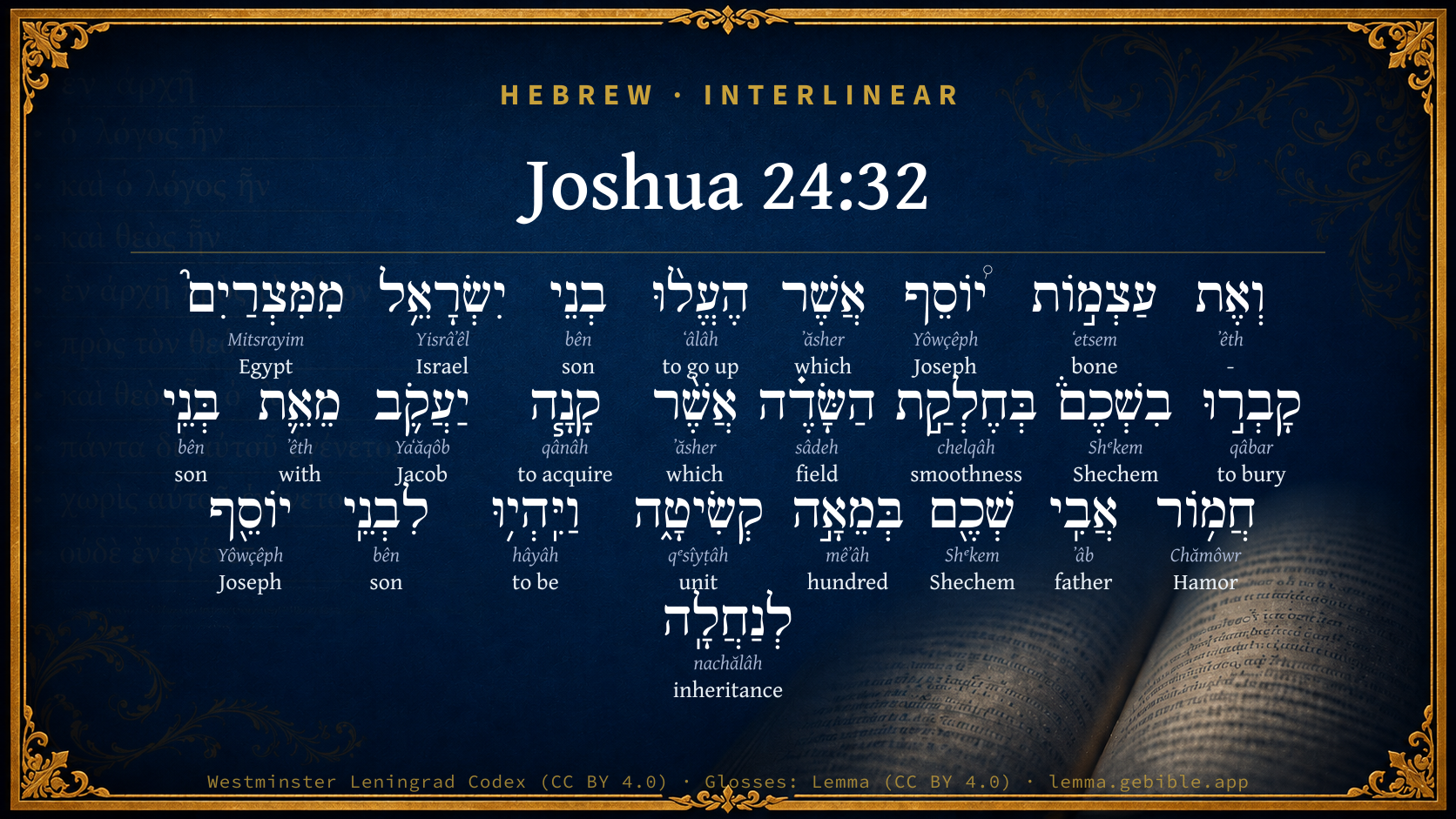
Hebrew (Westminster Leningrad Codex) Joshua 24:32 appears in the Hebrew Old Testament. The text above is from the Westminster Leningrad Codex. Each word links to its Strong’s number, a concise gloss, and parsing drawn from the Open Scriptures Hebrew Bible morphology. Click any word for its full Brown-Driver-Briggs (BDB) entry.
Download image
Cite this verse

Joshua 24:32 (World English Bible). Public Domain. Lemma interlinear Bible study tool, https://lemma.gebible.app/v/joshua/24/32.

Show BibTeX & RIS
BibTeX
RIS
English Translation
The bones of Joseph, which the children of Israel brought up out of Egypt, buried they in Shechem, in the parcel of ground which Jacob bought of the sons of Hamor the father of Shechem for a hundred pieces of money: and they became the inheritance of the children of Joseph.
World English Bible · Public Domain
Download a study sheet

One document with this verse’s original text, its word-by-word gloss line, the meaning frame, cross-references with their text, attributed commentary, and full source and license credits — printable, and it pastes into notes with its structure intact.

This verse Autodidact and up

Study sheet (.html) Plain text (.txt)

A passage Seminary Student

Up to 50 verses in one chapter. A passage sheet keeps up to 6 commentary sources and 12 cross-references per verse, in the order this page ranks them, and says so on the sheet whenever that leaves anything out. Ask for a single verse and you get the Autodidact verse sheet above.

Everything on this page stays free to read, with no account — the sheet is a download of what is already on screen, not access to it.

Want to remove ads? Support Godless Engineer
Compare translations 3

The same verse in 3 English versions, stacked beneath the original-language interlinear above. Click any original word for its lexicon entry.

Each is an independent rendering of the whole verse — the interlinear is not word-aligned to these translations.

Highlighted words mark where these versions differ — a whole-verse word diff, not a word-by-word alignment.

  • World English Bible Public Domain
    The bones of Joseph, which the children of Israel brought up out of Egypt, buried they in Shechem, in the parcel of ground which Jacob bought of the sons of Hamor the father of Shechem for a hundred pieces of money: and they became the inheritance of the children of Joseph.
  • King James Version Public Domain
    And the bones of Joseph, which the children of Israel brought up out of Egypt, buried they in Shechem, in a parcel of ground which Jacob bought of the sons of Hamor the father of Shechem for an hundred pieces of silver: and it became the inheritance of the children of Joseph.
  • unfoldingWord Literal Text CC BY-SA 4.0
    And the bones of Joseph, which the sons of Israel had brought up from Egypt, they buried in Shechem, in the portion of the field that Jacob had bought from the sons of Hamor, the father of Shechem, for 100 qesitah. And it was to the sons of Joseph for an inheritance.

unfoldingWord Literal Text — © unfoldingWord, licensed CC BY-SA 4.0. Word-aligned USFM3 via Door43 (git.door43.org/unfoldingWord/en_ult).

Versions to compare (up to 4)

3 of 4 selected

Show all 18 translations

Every available English version of this verse, each an independent rendering of the whole verse.

  • World English Bible Public Domain
    The bones of Joseph, which the children of Israel brought up out of Egypt, buried they in Shechem, in the parcel of ground which Jacob bought of the sons of Hamor the father of Shechem for a hundred pieces of money: and they became the inheritance of the children of Joseph.
  • Berean Standard Bible Public Domain
    And the bones of Joseph, which the Israelites had brought up out of Egypt, were buried at Shechem in the plot of land that Jacob had purchased from the sons of Hamor, Shechem’s father, for a hundred pieces of silver. So it became an inheritance for Joseph’s descendants.
  • Majority Standard Bible Public Domain
    And the bones of Joseph, which the Israelites had brought up out of Egypt, were buried at Shechem in the plot of land that Jacob had purchased from the sons of Hamor, Shechem’s father, for a hundred pieces of silver. So it became an inheritance for Joseph’s descendants.
  • King James Version Public Domain
    And the bones of Joseph, which the children of Israel brought up out of Egypt, buried they in Shechem, in a parcel of ground which Jacob bought of the sons of Hamor the father of Shechem for an hundred pieces of silver: and it became the inheritance of the children of Joseph.
  • American Standard Version (1901) Public Domain
    And the bones of Joseph, which the children of Israel brought up out of Egypt, buried they in Shechem, in the parcel of ground which Jacob bought of the sons of Hamor the father of Shechem for a hundred pieces of money: and they became the inheritance of the children of Joseph.
  • Revised Version (1885) Public Domain
    And the bones of Joseph, which the children of Israel brought up out of Egypt, buried they in Shechem, in the parcel of ground which Jacob bought of the sons of Hamor the father of Shechem for an hundred pieces of money: and they became the inheritance of the children of Joseph.
  • Geneva Bible (1599) Public Domain
    And the bones of Ioseph, which the children of Israel brought out of Egypt, buried they in Shechem in a parcell of ground which Iaakob bought of the sonnes of Hamor the father of Shechem, for an hundreth pieces of siluer, and the children of Ioseph had them in their inheritance.
  • Douay-Rheims (1899) Public Domain
    And the bones of Joseph which the children of Israel had taken out of Egypt, they buried in Sichem, in that part of the field which Jacob had bought of the sons of Hemor the father of Sichem, for a hundred young ewes, and it was in the possession of the sons of Joseph.
  • Young's Literal Translation Public Domain
    And the bones of Joseph, which the sons of Israel brought up out of Egypt, they buried in Shechem, in the portion of the field which Jacob bought from the sons of Hamor father of Shechem, with a hundred kesitah; and they are to the sons of Joseph for an inheritance.
  • Literal Standard Version CC BY-SA 4.0
    And the bones of Joseph, which the sons of Israel brought up out of Egypt, they buried in Shechem, in the portion of the field which Jacob bought from the sons of Hamor father of Shechem, with one hundred kesitah; and they are for an inheritance to the sons of Joseph.
  • Unlocked Literal Bible CC BY-SA 4.0
    The bones of Joseph, which the people of Israel brought up out of Egypt—they buried them at Shechem, in the piece of land that Jacob had bought from the sons of Hamor, the father of Shechem. He bought it for one hundred pieces of silver, and it became an inheritance for the descendants of Joseph.
  • unfoldingWord Literal Text CC BY-SA 4.0
    And the bones of Joseph, which the sons of Israel had brought up from Egypt, they buried in Shechem, in the portion of the field that Jacob had bought from the sons of Hamor, the father of Shechem, for 100 qesitah. And it was to the sons of Joseph for an inheritance.
  • Darby Bible Public Domain
    And the bones of Joseph, which the children of Israel had brought up out of Egypt, buried they in Shechem in the portion of the field which Jacob had bought of the sons of Hamor, Shechem's father, for a hundred kesitahs; and it became the inheritance of the children of Joseph.
  • World Messianic Bible Public Domain
    They buried the bones of Joseph, which the children of Israel brought up out of Egypt, in Shechem, in the parcel of ground which Jacob bought from the sons of Hamor the father of Shechem for a hundred pieces of silver. They became the inheritance of the children of Joseph.
  • Webster's Bible Public Domain
    And the bones of Joseph which the children of Israel brought out of Egypt, they buried in Shechem, in a parcel of ground which Jacob bought of the sons of Hamor the father of Shechem for a hundred pieces of silver; and it became the inheritance of the children of Joseph.
  • Free Bible Version CC BY-SA 4.0
    The bones of Joseph, which the Israelites had brought with them from Egypt, they buried in Shechem in the piece of ground Jacob had bought from the sons of Hamor, the father of Shechem, for one hundred pieces of silver. This land was inherited by Joseph's sons.
  • Bible in Basic English Public Domain
    And the bones of Joseph, which the children of Israel had taken up from Egypt, they put in the earth in Shechem, in the property which Jacob had got from the sons of Hamor, the father of Shechem, for a hundred shekels: and they became the heritage of the children of Joseph.
  • JPS Tanakh (1917) Public Domain
    And the bones of Joseph, which the children of Israel brought up out of Egypt, buried they in Shechem, in the parcel of ground which Jacob bought of the sons of Hamor the father of Shechem for a hundred pieces of money; and they became the inheritance of the children of Joseph.

Literal Standard Version (2020), Covenant Press — licensed CC BY-SA 4.0. Text via the HelloAO Bible API (eBible.org). Unlocked Literal Bible (unfoldingWord) — licensed CC BY-SA 4.0. Text via the HelloAO Bible API (eBible.org). unfoldingWord Literal Text — © unfoldingWord, licensed CC BY-SA 4.0. Word-aligned USFM3 via Door43 (git.door43.org/unfoldingWord/en_ult). Free Bible Version, Dr. Jonathan Gallagher — licensed CC BY-SA 4.0. Text via the HelloAO Bible API (eBible.org).

Word by word

More ways to search: Search by grammar → Find every occurrence → Compare this word →

Practice this passage: Drill this verse → Learn its vocabulary →

קְשִׂיטָ֑ה
qᵉsîyṭâh
H7192
“unit”
Noun, Common, Feminine, Singular, Absolute
Part of Speech
Noun
Type
Common
Gender
Feminine
Number
Singular
State
Absolute
Full BDB Definition

Origin: from an unused root (probably meaning to weigh out)

TWOT: 2081a

a unit of unknown value - perhaps weight, money
  1. וְאֶת ʼêth H853 “and · -” Conjunction + Particle, Direct Object
  2. עַצְמ֣וֹת ʻetsem H6106 “bones of” Noun, Common, Feminine, Plural, Construct
  3. י֠וֹסֵף Yôwçêph H3130 “Joseph” Noun, Proper
  4. אֲשֶׁר ʼăsher H834 “which” Particle, Relative
  5. הֶעֱל֨וּ ʻâlâh H5927 “to go up” Verb, Hiphil, Perfect, 3rd Person, Common, Plural
  6. בְנֵי bên H1121 “sons of” Noun, Common, Masculine, Plural, Construct
  7. יִשְׂרָאֵ֥ל Yisrâʼêl H3478 “Israel” Noun, Proper
  8. מִמִּצְרַיִם֮ Mitsrayim H4714 “from · Egypt” Preposition + Noun, Proper
  9. קָבְר֣וּ qâbar H6912 “to bury” Verb, Qal, Perfect, 3rd Person, Common, Plural
  10. בִשְׁכֶם֒ Shᵉkem H7927 “in/at · Shechem” Preposition + Noun, Proper
  11. בְּחֶלְקַ֣ת chelqâh H2513 “in/at · smoothness of” Preposition + Noun, Common, Feminine, Singular, Construct
  12. הַשָּׂדֶ֗ה sâdeh H7704 “the · field” Particle, Definite Article + Noun, Common, Masculine, Singular, Absolute
  13. אֲשֶׁ֨ר ʼăsher H834 “which” Particle, Relative
  14. קָנָ֧ה qânâh H7069 “to acquire” Verb, Qal, Perfect, 3rd Person, Masculine, Singular
  15. יַעֲקֹ֛ב Yaʻăqôb H3290 “Jacob” Noun, Proper
  16. מֵאֵ֛ת ʼêth H854 “from · with” Preposition + Preposition
  17. בְּנֵֽי bên H1121 “sons of” Noun, Common, Masculine, Plural, Construct
  18. חֲמ֥וֹר Chămôwr H2544 “Hamor” Noun, Proper
  19. אֲבִֽי ʼâb H1 “father of” Noun, Common, Masculine, Singular, Construct
  20. שְׁכֶ֖ם Shᵉkem H7927 “Shechem” Noun, Proper
  21. בְּמֵאָ֣ה mêʼâh H3967 “in/at · hundred” Preposition + Adjective, Cardinal number, Both, Singular, Absolute
  22. וַיִּֽהְי֥וּ hâyâh H1961 “and · to be” Conjunction + Verb, Qal, Sequential Imperfect, 3rd Person, Masculine, Plural
  23. לִבְנֵֽי bên H1121 “to/for · sons of” Preposition + Noun, Common, Masculine, Plural, Construct
  24. יוֹסֵ֖ף Yôwçêph H3130 “Joseph” Noun, Proper
  25. לְנַחֲלָֽה nachălâh H5159 “to/for · inheritance” Preposition + Noun, Common, Feminine, Singular, Absolute

About this verse

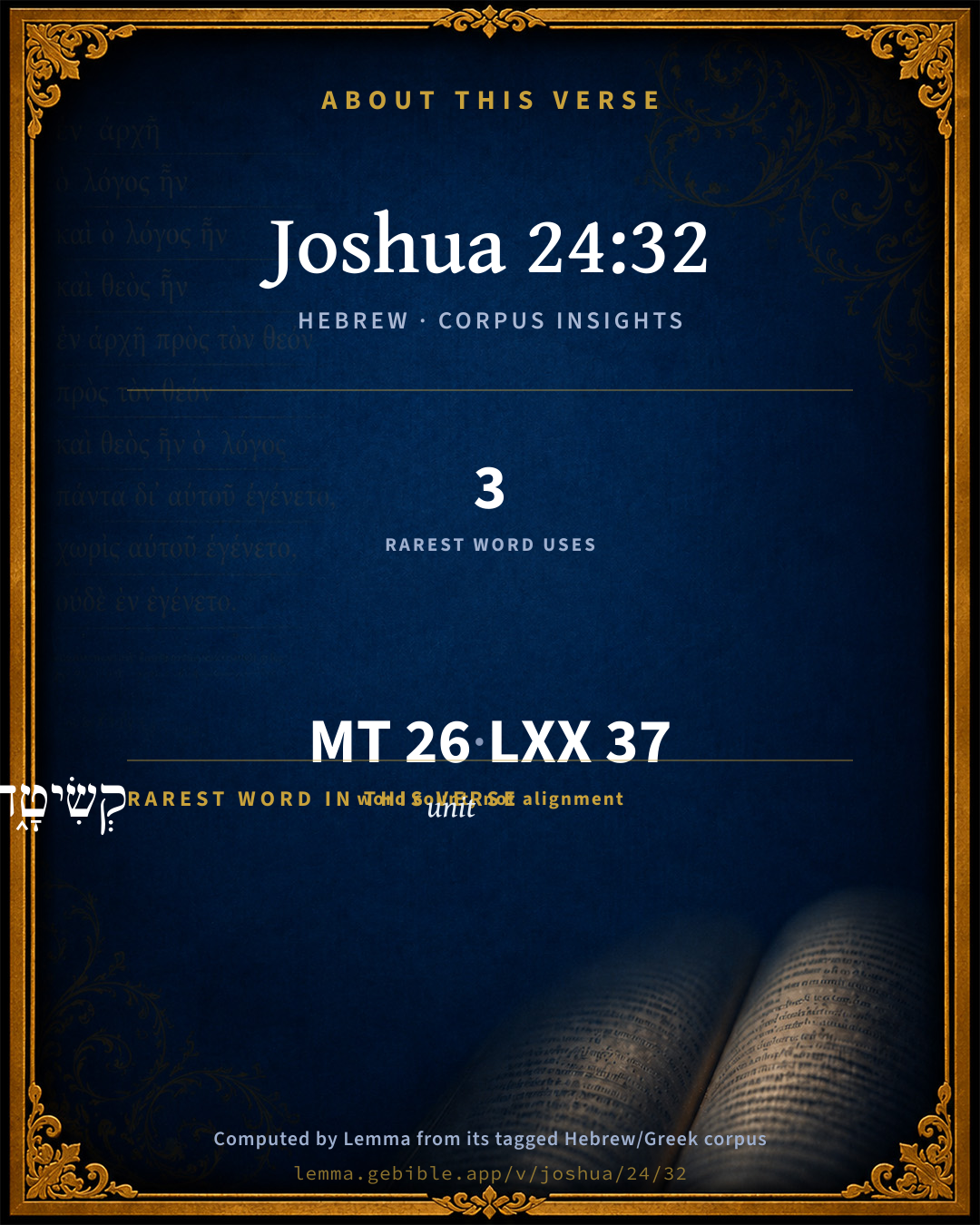
These counts appear in no published source. They are computed here, from the morphology-tagged text and Lemma’s own curated glosses. What Lemma adds →

26
words
21
distinct lemmas
Historical
section

Notable vocabulary

The rarest word here is קְשִׂיטָ֑ה unit H7192 — appearing just 3 times in the whole Hebrew Bible.

Shared distinctive vocabulary

קְשִׂיטָ֑ה unit H7192 occurs in 3 verses of the Hebrew Bible. Also found in:

Grammatical profile

  • 4 verbs
  • 17 nouns
  • 1 adjective
  • 1 preposition
  • 3 particles

Verb forms

  • הֶעֱל֨וּ Hiphil · Perfect
  • קָבְר֣וּ Qal · Perfect
  • קָנָ֧ה Qal · Perfect
  • וַיִּֽהְי֥וּ Qal · Sequential Imperfect

Repetition

Words recur within this verse — often emphatic in Hebrew:

  • בְנֵי son H1121 ×3
  • י֠וֹסֵף Joseph H3130 ×2
  • בִשְׁכֶם֒ Shechem H7927 ×2
  • אֲשֶׁר which H834 ×2

Hebrew & Septuagint length

In English translation the verse runs 51 words from the Hebrew and 48 from the Septuagint (LXX English) — closely comparable.

A rough comparison of the two English renderings, which tokenize alike — not a word-level alignment.

Word counts can differ between the Hebrew and the Greek without any difference in meaning — e.g. the Hebrew direct-object marker אֵת has no separate Greek word, and Greek often adds the article ὁ.

In the original languages it is 26 Hebrew tokens and 37 Greek tokens — but the two are counted differently (Hebrew bundles its prefixes and suffixes into one token; the Greek is in lemma form), so that isn’t a like-for-like length.

Cross-references

7

Topical passages linked to Joshua 24:32 in the Treasury of Scripture Knowledge — connected by theme and wording, ordered by reader-vote popularity; previews shown in the World English Bible.

  • Genesis 50:25 Joseph took an oath of the children of Israel, saying, "God will surely visit you, and you shall carry up my bones from here."
  • Genesis 33:19 He bought the parcel of ground, where he had spread his tent, at the hand of the children of Hamor, Shechem's father, for one hundred pieces of money.
  • Exodus 13:19 Moses took the bones of Joseph with him, for he had made the children of Israel swear, saying, "God will surely visit you, and you shall carry up my bones away from here with you."
  • Acts 7:16 and they were brought back to Shechem, and laid in the tomb that Abraham bought for a price in silver from the children of Hamor of Shechem.
  • Genesis 48:22 Moreover I have given to you one portion above your brothers, which I took out of the hand of the Amorite with my sword and with my bow."
  • John 4:5 So he came to a city of Samaria, called Sychar, near the parcel of ground that Jacob gave to his son, Joseph.
  • Hebrews 11:22 By faith, Joseph, when his end was near, made mention of the departure of the children of Israel; and gave instructions concerning his bones.

Cross-references courtesy of OpenBible.info (CC BY 4.0).

Hebrew and Greek witnesses Masoretic Hebrew ↔ Greek Septuagint

The same verse in the two great witnesses to the Old Testament, shown verse-for-verse.

These are two independent witnesses, not word-aligned to each other, and the Septuagint is shown in lemma (dictionary) form.

Hebrew Joshua 24:32 Masoretic · Westminster Leningrad Codex

וְאֶת עַצְמ֣וֹת י֠וֹסֵף אֲשֶׁר הֶעֱל֨וּ בְנֵי יִשְׂרָאֵ֥ל מִמִּצְרַיִם֮ קָבְר֣וּ בִשְׁכֶם֒ בְּחֶלְקַ֣ת הַשָּׂדֶ֗ה אֲשֶׁ֨ר קָנָ֧ה יַעֲקֹ֛ב מֵאֵ֛ת בְּנֵֽי חֲמ֥וֹר אֲבִֽי שְׁכֶ֖ם בְּמֵאָ֣ה קְשִׂיטָ֑ה וַיִּֽהְי֥וּ לִבְנֵֽי יוֹסֵ֖ף לְנַחֲלָֽה

The bones of Joseph, which the children of Israel brought up out of Egypt, buried they in Shechem, in the parcel of ground which Jacob bought of the sons of Hamor the father of Shechem for a hundred pieces of money: and they became the inheritance of the children of Joseph.

World English Bible · Public Domain

Greek LXX Joshua 24:32 Septuagint · lemma form

καί ὁ ὀστέον ιωσηφ ἀναἄγω ὁ υἱός ἰσραήλ ἐκ αἴγυπτος καί καταὀρύσσω ἐν σικιμα ἐν ὁ μερίς ὁ ἀγρός ὅς κτάομαι ἰακώβ παρά ὁ ἀμορραῖος ὁ καταοἰκέω ἐν σικιμα ἀμνάς ἑκατόν καί δίδωμι αὐτός ιωσηφ ἐν μερίς

And the children of Israel brought up the bones of Joseph out of Egypt, and buried them in Sicima, in the portion of the land which Jacob bought of the Amorites who lived in Sicima for one hundred ewe-lambs; and he gave it to Joseph for a portion.

LXX2012 (modern English Septuagint) · Public Domain

On this verse, The Pulpit Commentary discusses the Septuagint’s reading. Read the note in Commentary ↓

Hebrew: Westminster Leningrad Codex (CC BY 4.0). Greek: Septuagint (public domain); English from LXX2012 (modern English Septuagint) (Public Domain). How the Septuagint differs from the Hebrew →

Targum (Aramaic paraphrase)

1

The Targum is the ancient Jewish Aramaic paraphrase of the Hebrew Scriptures — an interpretive translation, not the Hebrew text itself. Onkelos (literal) and Pseudo-Jonathan (expansive) render the Torah, and Jonathan the Prophets. Coverage is partial: where no permissively-licensed English translation exists for a verse, only the Aramaic is shown. This is verse-level text, not a word-by-word alignment to the Hebrew.

  1. Targum Jonathan Prophets (Joshua–Malachi)
    וְיַת גַרְמֵי יוֹסֵף דְאַסִיקוּ בְּנֵי יִשְׂרָאֵל מִמִצְרַיִם קְבָרוּ בִּשְׁכֶם בְּאַחְסָנַת חַקְלָא דִקְנָא יַעֲקֹב מִבְּנֵי חֲמוֹר אֲבוּהִי דִשְׁכֶם בְּמָא חוּרְפַן וַהֲווֹ לִבְנֵי יוֹסֵף לְאַחֲסָנָא:

    (no public-domain English translation for this verse)

    Targum Jonathan — Aramaic: “Mikraot Gedolot” (public domain). English: “Sefaria Community Translation” (CC0 1.0 (public-domain dedication)); “London "Chaldee Paraphrase," 1871” (public domain). Text via Sefaria.

Commentary

Notes on Joshua 24:32 from classic Christian and Jewish commentators (each source and its license shown beneath its notes). The classic Christian expositions comment on the surrounding passage and are grouped to its opening verse, so a note may address several verses; the Jewish commentaries on the Tanakh (Rashi and others) are per-verse, so they appear only where the commentator wrote on this verse.

Lemma curates 59 commentaries, every one of them public domain or Creative Commons licensed, each selected and text-cleaned for this edition rather than reprinted as found. About our sources →

Trapp's Complete Commentary

John Trapp

Jos 24:32 And the bones of Joseph, which the children of Israel brought up out of Egypt, buried they in Shechem, in a parcel of ground which Jacob bought of the sons of Hamor the father of Shechem for an hundred pieces of silver: and it became the inheritance of the children of Joseph.

Ver. 32. Buried they in Shechem.] Where his monument was to be seen in Jerome’s time, as he testifieth in his questions upon Genesis.

John Trapp, A Commentary or Exposition upon All the Books of the Old and New Testament (1647–1656) — public domain. Text from a community e-Sword module.

Joseph Benson's Commentary

Jos 24:32. The bones of Joseph — Joseph died two hundred years before in Egypt, but gave commandment concerning his bones, that they should not rest in a grave till Israel rested in the land of promise. Now, therefore, they were deposited in that piece of ground which his father gave him near Shechem. One reason why Joshua called all Israel to Shechem, might be to attend Joseph’s bones to the grave. So that he now delivered, as it were, both Joseph’s funeral sermon, and his own farewell sermon. And if it was in the last year of his life, the occasion might well remind him of his own death now at hand. For he was just of the same age with his illustrious ancestor, who died, being one hundred and ten years old, Gen 50:26.

Joseph Benson's Commentary on the Old and New Testaments (1811–1818) — public domain. Text from a community e-Sword module.

Tyndale Open Study Notes

Tyndale Open Resources

24:32 Israel had carried the bones of Joseph out of Egypt, through the years of their journeys, and into Canaan to honor Joseph’s last request to be buried in the land God had promised Israel (Gen 50:25; Exod 13:19). • Shechem was part of the inheritance of Joseph’s descendants, at the border between Ephraim and Manasseh. Jacob had purchased the land centuries before for 100 pieces of silver.

Tyndale Open Study Notes — © Tyndale Open Resources, licensed CC BY-SA 4.0. Text via the HelloAO Bible API.

Jamieson, Fausset & Brown

Robert Jamieson, A. R. Fausset & David Brown

the bones of Joseph--They had carried these venerable relics with them in all their migrations through the desert, and deferred the burial, according to the dying charge of Joseph himself, till they arrived in the promised land. The sarcophagus, in which his mummied body had been put, was brought thither by the Israelites, and probably buried when the tribe of Ephraim had obtained their settlement, or at the solemn convocation described in this chapter.

in a parcel of ground which Jacob bought . . . for an hundred pieces of silver--Kestitah translated, "piece of silver," is supposed to mean "a lamb," the weights being in the form of lambs or kids, which were, in all probability, the earliest standard of value among pastoral people. The tomb that now covers the spot is a Mohammedan Welce, but there is no reason to doubt that the precious deposit of Joseph's remains may be concealed there at the present time.

Jamieson, Fausset & Brown — Commentary Critical and Explanatory on the Whole Bible (1871) — public domain (CC PDM 1.0). Text via the HelloAO Bible API.

Adam Clarke's Commentary

Verse 32. And the bones of Joseph] See Clarke on Ge 50:25, and on Ex 13:19. This burying of the bones of Joseph probably took place when the conquest of the land was completed, and each tribe had received its inheritance; for it is not likely that this was deferred till after the death of Joshua.

Adam Clarke's Commentary on the Bible (1810–1826) — public domain. Text from a community e-Sword/MySword module.

John Calvin's Commentaries

32. And the bones of Joseph, etc The time when the bones of Joseph were buried is not mentioned; but it is easy to infer that the Israelites had performed this duty after they obtained a peaceful habitation in the city of Shechem. For although he had not designated a particular place for a sepulchre, they thought it a mark of respect to deposit his bones in the field which Jacob had purchased. It may be, however, that this is expressed as a censure on the sluggishness of the people, to which it was owing, that Joseph could not be buried with Abraham, that locality being still in the power of the enemy. Stephen (Acts 7) mentions the bones of the twelve patriarchs, and it is not impossible that the other tribes, from feelings of emulation, gathered together the ashes of their progenitors. It is there said that the field was purchased by Abraham; but obviously an error in the name has crept in. With regard to sepulture, we must hold in general, that the very frequent mention of it in Scripture is owing to its being a symbol of the future Resurrection.

END OF THE COMMENTARY ON THE BOOK OF JOSHUA.

John Calvin's Commentaries (1540-1563) — public domain. Text from the Calvin Translation Society English edition (1840s-50s) via the Christian Classics Ethereal Library (ccel.org). Calvin's coverage is partial (roughly two-thirds of the Bible); uncommented books and verses are honest gaps, never fabricated. The 19th-century editor's footnotes and remarks are omitted so the notes are faithfully Calvin's own voice.

The Cambridge Bible for Schools and Colleges

gen. ed. J. J. S. Perowne

32. And the bones of Joseph] For the careful instructions of this patriarch respecting his remains, see Gen_50:24-25; and for their careful removal from Egypt by Moses, see Exo_13:19.

brought up out of Egypt] The body of the patriarch was embalmed, and placed in an Egyptian coffin. The sacred burden had been borne by the two tribes of the house of Joseph all through the wanderings of the wilderness, and was now reverently laid

in a parcel of ground] which Jacob had bought for a hundred pieces of silver, of the sons of Hamor (Gen_33:19), and given “to the favourite son of his favourite Rachel.”

an hundred pieces of silver] or lambs, “for an hundrid yonge scheep,” Wyclif. See Gen_33:19, margin; but comp. Act_7:16.

and it became] i. e. the plot of ground, as well as Shechem.

The Cambridge Bible for Schools and Colleges (gen. ed. J. J. S. Perowne; Cambridge University Press, 1878–1918) — public domain. Text from a community e-Sword module.

John Gill's Exposition

And Eleazar the son of Aaron died,.... Very probably in a short time after Joshua; and, according to the Samaritan Chronicle (i), he died as Joshua did, gathered the chief men of the children of Israel a little before his death, and enjoined them strict obedience to the commands of God, and took his leave of them, and then stripped himself of his holy garments, and clothed Phinehas his son with them; what his age was is not said:

and they buried him in a hill that pertaineth to Phinehas his son; or in the hill of Phinehas; which was so called from him, and might have the name given it by his father, who might possess it before him, and what adjoined to it. The Jews in the above treatise say (k), that at Avarta was a school of Phinehas in a temple of the Gentiles; that Eleazar was buried upon the hill, and Joshua below the village among the olives, and on this hill is said (l) to be a school or village of Phinehas:

which was given him in Mount Ephraim; either to Eleazar, that he might be near to Shiloh, where the tabernacle then was, as the cities given to the priests and Levites were chiefly in those tribes that lay nearest to Jerusalem; though the Jews say, as Jarchi and Kimchi relate, that Phinehas might come into the possession of that place through his wife, or it might fall to him as being a devoted field; but it is most likely it was given to his father by the children of Ephraim, for the reason before observed. The Talmudists say, that Joshua wrote his own book, which is very probable; yet the last five verses, Jos 24:29, must be written by another hand, even as the last eight verses in Deuteronomy, Deu 34:5, were written by him, as they also say; and therefore this is no more an objection to his being the writer of this book, than the addition of eight verses by him to Deuteronomy is to Moses being the writer of that; and the same Talmudists (m) also observe, that Jos 24:29, "Joshua the son of Nun, the servant of the Lord, died", &c. were written by Eleazar, and Jos 24:33, "and Eleazar, the son of Aaron, died", &c. by Phinehas, which is not improbable.

(i) Apud Hottinger. p. 524. (k) Cippi Hebraici, ut supra. (p. 32.) (l) See Weemse's Christ. Synagog, l. 1. c. 6. sect. 5. p. 157. (m) T. Bab. Bava Bathra, fol. 14. 2. & 15. 1.

Next: Judges Introduction

John Gill's Exposition of the Whole Bible (1746–1763) — public domain (CC PDM 1.0). Text via the HelloAO Bible API.

Haydock's Catholic Bible Commentary

Sichem. Joseph had charged his brethren to take his bones with them, Genesis l. 24., and Exodus xiii. 19. Masius supposes that they were solemnly interred after the altar was erected near Sichem, and the covenant ratified, when all the people were together. Others think that they deferred doing this till the country was conquered and divided. Josue would lose no time unnecessarily in performing these last rites to the revered patriarch. --- Field. Jacob had given this field to his son. He had first purchased it; (Genesis xxxiii. 19,) and when the Amorrhite had taken possession again, after the unhappy affair at Sichem, he recovered it by the sword, Genesis xlviii. 22. --- Ewes. Hebrew Kesita may denote also some species of money, though not perhaps marked with any figure of a lamb, &c. (Calmet) --- Protestants, "pieces of silver." (Haydock) --- The mausoleum of Joseph at Sichem, was to be seen in St. Jerome’s time. (q. Heb. in Gen.) (Worthington)

George Leo Haydock (1774–1849), Haydock's Catholic Family Bible and Commentary, 1859 edition — public domain. Excludes Psalms (Douay-Rheims chapter numbering differs from Protestant) and Deuterocanonical books (Catholic canon only).

Matthew Poole's English Annotations

In Shechem; not in the city of Shechem, but in a field near and belonging to it, as appears from the following words, and from Gen 33:18, and from the ancient custom of the Israelites to have their burying-places without cities, in fields or gardens.

Matthew Poole's English Annotations on the Holy Bible (1683–1685) — public domain. Text from a community e-Sword/MySword module.

The Pulpit Commentary

And the bones of Joseph. (see Gen_50:24, 25 Exo_13:19) Nothing could more fully show the reverence in which the name of Joseph was held in Israel than this scrupulous fulfilment of his commands, and the careful record of it in the authentic records of the country. This passage is another link in the chain of evidence which serves to establish the authenticity and early date of the present hook. For though Joseph"s name was always a striking one in Israelitish history, it is unquestionable that as time went on his fame was overshadowed by that of his ancestors. It is Abraham, Isaac, and Jacob on whom the national mind was fixed. It is their names that the prophets recall, the covenant with them which is constantly brought to mind. But during the Israelites" sojourn in Egypt, and while the departure from Egypt was yet recent, the conspicuous position which Joseph occupied in Egyptian history could not fail to be remembered, and the command he gave concerning his bones, as well as his conviction that the prophecy concerning their departure would be fulfilled, was not likely to be forgotten. The emphatic way in which the fulfilment of Joseph"s charge is here recorded affords a presumption for the early date of the book, as well as against the theory that it was a late compilation from early records. We are not necessarily to suppose that the interment of Joseph"s remains took place at this period. The Hebrew, as we have seen, has no pluperfect tense, (see for this Jud_1:2:10) and therefore it may have taken place, and most probably did take place, as soon as Shechem was in the hands of Israel. In a parcel of ground. Rather, in the portion of the field. (see Gen_33:19) Our word parcel is derived from particula, and was originally identical with the word particle, a little part. So Chaucer speaks of parcel- mele, i.e., by parts. Shakespere has a "parcel-gilt goblet," that is, a goblet partly gilt. It has now come to have a widely different meaning. Pieces of silver. There can be little doubt that this is the true translation. The cognate word in Arabic, signifying "justice," is apparently derived from the idea of even scales. A kindred Hebrew word signifies "truth," probably from the same original idea. Another kindred Arabic word signifies a balance. It therefore, no doubt, means a coin of a certain weight, just as the word shekel has the original signification of weight. The Rabbinical notion, that the word signified "Iambs," rests upon no solid foundation, though supported by all the ancient versions. Some commentators, however, think that a coin is meant upon which the figure of a lamb was impressed. So Vatablus and Drusius. The LXX has amnadwn , the Vulgate "centum novellis ovibus.

HOMILIES BY W.F. ADENEY Ver. 32. Joseph"s bones.

I THE BURIAL OF JOSEPH"S BONES WAS A JUSTIFICATION OF HIS FAITH. Joseph had been so sure that God would give the promised land to Israel that he had made his brethren swear to bring up his bones with them. (Gen_50:25)

(1) True faith will lead to decisive action. It is vain to profess to believe in our heavenly inheritance unless we behave consistently with our belief.

(2) Faith is concerned with the unseen and the future. If we could see all there would be no room for faith.

(3) Faith is justified on earth by providence. It waits its full justification in heaven. As Joseph"s faith was justified in the entrance into Canaan, so the old Messianic faith was justified in the advent of Christ, and the Christian faith will be justified at the "consummation of all things.

II THE BURIAL OF JOSEPH"S BONES WAS AN EXAMPLE OF DEFERENCE TO THE WISHES OF THE DEAD. It is well that children should respect the wishes of departed parents. Much good may be learnt by considering the thoughts and purposes of our ancestors. The people which has no respect for its past is wanting in reverence and in depth of national life. Yet there must be a limit to the influence of antiquity. The ancients lived in the childhood of our race; wisdom should grow with enlarged historical experience. At best they were fallible men, and cannot claim to extinguish the reason and responsibility of their descendants. New circumstances often render the rules and precedents of antiquity entirely obsolete.

III THE BURIAL OF JOSEPH"S BONES WAS AN ILLUSTRATION OF THE ONENESS OF MANKIND. Ages had passed since the death of Joseph. Yet his bones were preserved and buried in the very "parcel of ground which Jacob had bought." There is a family unity, a national unity, a church unity, a human solidarity. The past lives on in the present. Men are insensibly linked and welded together. We are members one of another. Therefore we should consider the good of each other, and of the whole community, and should take note of past experience and future requirements.

IV THE BURIAL OF JOSEPH"S BONES REMINDS US OF THE DELAY WHICH PRECEDES THE ENJOYMENT OF THE HIGHEST BLESSINGS. There were centuries of delay between the promise and the possession of Canaan. Many ages passed after the first prophecy of redemption and before the coming of Christ. The second advent of Christ has often been anticipated by the Church and longed for by His people, but it is not yet accomplished. The Christian must wait on earth during years of service before receiving his heavenly inheritance. This is occasioned

(1) by our unbelief as the unbelief of Israel deferred possession of Canaan;

(2) by the need of fitness the people needed to be trained in the wilderness; the world needed preparing for Christ, who came in the "fulness of time;" Christians must be made "meet for the inheritance of the saints in light;" the world, must be prepared for the full and perfect reign of Christ." Yet, note, the promise is not violated because the fulfilment is delayed. Finally, the Christian inheritance will not be the unconscious possession of a grave in the promised land, but the enjoyment of heaven with the faculties of an eternal life. W.F.A.

The Pulpit Commentary (1880–1919), ed. H.D.M. Spence-Jones & Joseph S. Exell — public domain. Text from a community e-Sword module.

John Wesley's Explanatory Notes

The bones of Joseph - Joseph died two hundred years before in Egypt, but gave commandment concerning his bones, that they should not rest in a grave, 'till Israel rested in the land of promise. Now therefore they were deposited in that piece of ground, which his father gave him near Shechem. One reason why Joshua called all Israel to Shechem, might be to attend Joseph's bones to the grave. So that he now delivered as it were both Joseph's funeral sermon, and his own farewell sermon. And if it was in the last year of his life, the occasion might well remind him, of his own death now at hand. For he was just of the same age with his illustrious ancestor, who died being one hundred and ten years old, Gen. i, 26.

John Wesley, Explanatory Notes Upon the Whole Bible (1754–1765) — public domain. Text via the GEBible commentary corpus.

unfoldingWord translationNotes

Door43 World Missions Community

The bones of Joseph ... they buried them at Shechem,

It may be helpful to change the order of the beginning of this sentence. AT: "The people of Israel brought the bones of Joseph up out of Egypt and buried them at Shechem"

one hundred pieces

"100 pieces" (See: Numbers)

Eleazar

name of a man (See: How to Translate Names)

Gibeah

name of a place (See: How to Translate Names)

translationWords

Joseph (OT)

Israel

Egypt

Shechem

Jacob

Hamor

Aaron

Phinehas

Ephraim

unfoldingWord translationNotes — © Distant Shores Media and the Door43 World Missions Community, licensed CC BY-SA 4.0. Source: git.door43.org/Door43/en_tn.

Rashi

Rabbi Shlomo Yitzchaki (Rashi)

They buried in Shechem. From Shechem he was stolen [kidnapped] and to Shechem they returned him.

Rashi on the Tanakh — English translations: “The Judaica Press complete Tanach with Rashi, translated by A. J. Rosenberg” (CC BY 4.0); “Pentateuch with Rashi's commentary by M. Rosenbaum and A.M. Silbermann, 1929-1934” (public domain); “The Metsudah Tanach series, Lakewood, N.J” (CC BY 4.0); and “The Book of Joshua, Metsudah Publications, 1997” (CC BY 4.0). Text via Sefaria.

Lesson kit

Teaching starters — assembled from the data on this page, not authored interpretation. Every prompt links to the verse data it draws on. Edit before teaching.

Joshua, in the Historical, opens this verse with 26 words (21 distinct Hebrew lemmas). Its most distinctive word is qᵉsîyṭâh (“unit”). A historical commentator’s framing appears above. Read the whole chapter for the surrounding context.

Discussion questions

  1. How does “unit” (qᵉsîyṭâh) shape what this verse is saying?
  2. How does Genesis 33:19, which shares the word «unit», read alongside this verse?
  3. What does the repetition of “son” (3× in this one verse) do in this verse?
  4. The translations on this page render this verse differently — a whole-verse word diff, not a word-by-word alignment. What might account for the different wordings?
  5. «הֶעֱל֨וּ» is a Hiphil Perfect verb. How does that grammatical form shape the action described?
  6. Compare how Trapp's Complete Commentary and Joseph Benson's Commentary read this verse. Where do they agree or differ?

Things to notice

Reading settings

Reading text

Shown beneath each verse's original-language words.

Old Testament
Old Testament edition

Read the OT as the Masoretic Hebrew (MT) or the Greek Septuagint (LXX).

English shown for the Greek Septuagint (in the Hebrew ↔ Greek comparison).

Comparing translations? Open the Compare panel on any verse page to stack up to four side by side.