
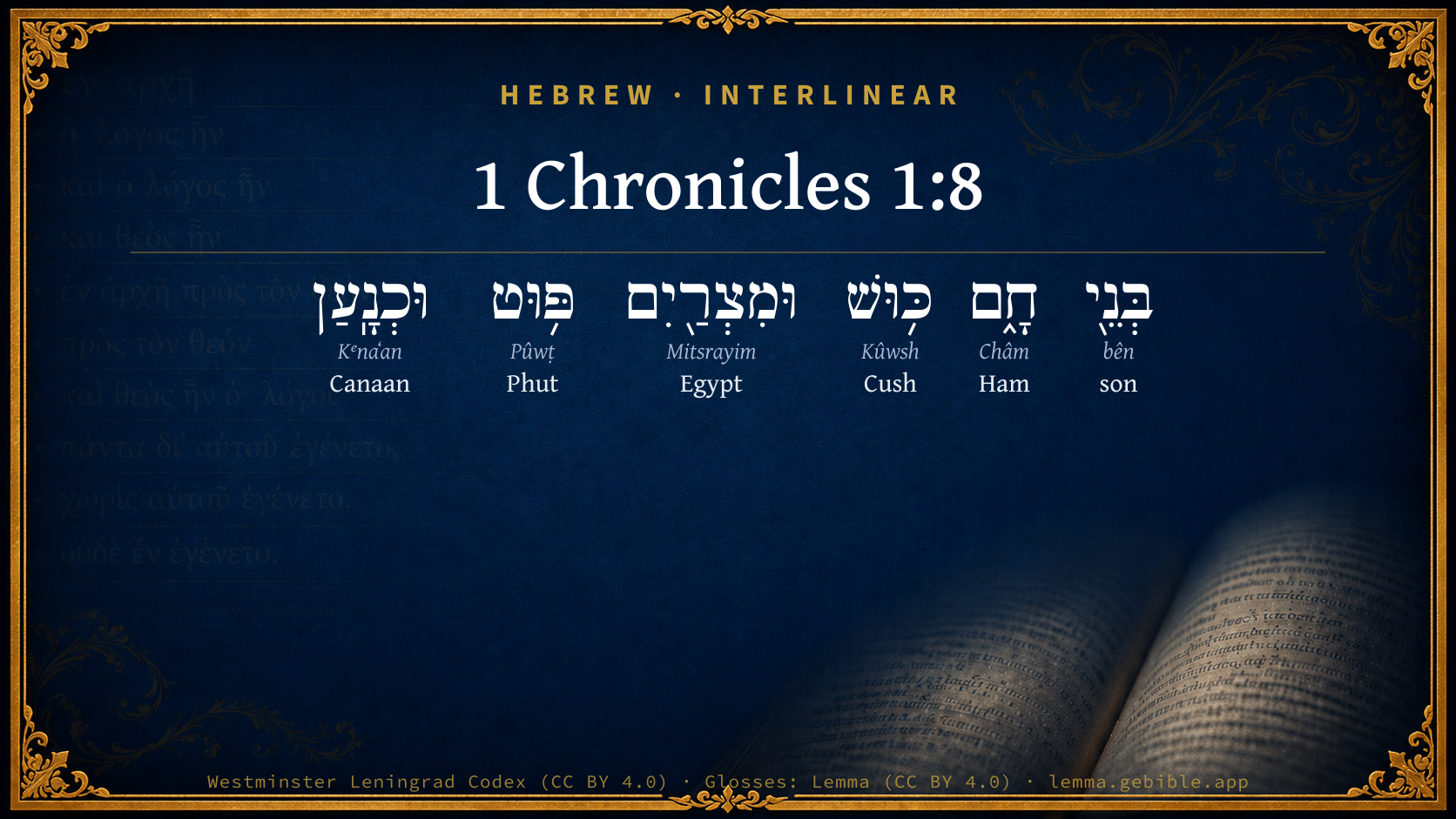
1 Chronicles 1:8

Hebrew (Westminster Leningrad Codex) 1 Chronicles 1:8 appears in the Hebrew Old Testament. The text above is from the Westminster Leningrad Codex. Each word links to its Strong’s number, a concise gloss, and parsing drawn from the Open Scriptures Hebrew Bible morphology. Click any word for its full Brown-Driver-Briggs (BDB) entry.
Download image
Cite this verse

1 Chronicles 1:8 (World English Bible). Public Domain. Lemma interlinear Bible study tool, https://lemma.gebible.app/v/1-chronicles/1/8.

Show BibTeX & RIS
BibTeX
RIS
English Translation
The sons of Ham: Cush, and Mizraim, Put, and Canaan.
World English Bible · Public Domain
Download a study sheet

One document with this verse’s original text, its word-by-word gloss line, the meaning frame, cross-references with their text, attributed commentary, and full source and license credits — printable, and it pastes into notes with its structure intact.

This verse Autodidact and up

Study sheet (.html) Plain text (.txt)

A passage Seminary Student

Up to 50 verses in one chapter. A passage sheet keeps up to 6 commentary sources and 12 cross-references per verse, in the order this page ranks them, and says so on the sheet whenever that leaves anything out. Ask for a single verse and you get the Autodidact verse sheet above.

Everything on this page stays free to read, with no account — the sheet is a download of what is already on screen, not access to it.

Want to remove ads? Support Godless Engineer
Compare translations 3

The same verse in 3 English versions, stacked beneath the original-language interlinear above. Click any original word for its lexicon entry.

Each is an independent rendering of the whole verse — the interlinear is not word-aligned to these translations.

Highlighted words mark where these versions differ — a whole-verse word diff, not a word-by-word alignment.

  • World English Bible Public Domain
    The sons of Ham: Cush, and Mizraim, Put, and Canaan.
  • King James Version Public Domain
    The sons of Ham; Cush, and Mizraim, Put, and Canaan.
  • unfoldingWord Literal Text CC BY-SA 4.0
    The sons of Ham: Cush and Egypt, Put and Canaan.

unfoldingWord Literal Text — © unfoldingWord, licensed CC BY-SA 4.0. Word-aligned USFM3 via Door43 (git.door43.org/unfoldingWord/en_ult).

Versions to compare (up to 4)

3 of 4 selected

Show all 18 translations

Every available English version of this verse, each an independent rendering of the whole verse.

  • World English Bible Public Domain
    The sons of Ham: Cush, and Mizraim, Put, and Canaan.
  • Berean Standard Bible Public Domain
    The sons of Ham: Cush, Mizraim, Put, and Canaan.
  • Majority Standard Bible Public Domain
    The sons of Ham: Cush, Mizraim, Put, and Canaan.
  • King James Version Public Domain
    The sons of Ham; Cush, and Mizraim, Put, and Canaan.
  • American Standard Version (1901) Public Domain
    The sons of Ham: Cush, and Mizraim, Put, and Canaan.
  • Revised Version (1885) Public Domain
    The sons of Ham; Cush, and Mizraim, Put, and Canaan.
  • Geneva Bible (1599) Public Domain
    The sonnes of Ham were Cush, and Mizraim, Put and Canaan.
  • Douay-Rheims (1899) Public Domain
    The sons of Cham: Chus, and Mesrai, and Phut, and Chaanan.
  • Young's Literal Translation Public Domain
    Sons of Ham: Cush, and Mizraim, Put, and Canaan.
  • Literal Standard Version CC BY-SA 4.0
    Sons of Ham: Cush, and Mizraim, Put, and Canaan.
  • Unlocked Literal Bible CC BY-SA 4.0
    The sons of Ham were Cush, Egypt, Put, and Canaan.
  • unfoldingWord Literal Text CC BY-SA 4.0
    The sons of Ham: Cush and Egypt, Put and Canaan.
  • Darby Bible Public Domain
    The sons of Ham: Cush and Mizraim, Phut and Canaan.
  • World Messianic Bible Public Domain
    The sons of Ham: Cush, Mizraim, Put, and Canaan.
  • Webster's Bible Public Domain
    The sons of Ham; Cush, and Mizraim, Put, and Canaan.
  • Free Bible Version CC BY-SA 4.0
    The sons of Ham: Cush, Mizraim, Put, and Canaan.
  • Bible in Basic English Public Domain
    The sons of Ham: Cush and Egypt, Put and Canaan.
  • JPS Tanakh (1917) Public Domain
    The sons of Ham: Cush, and Mizraim, Put, and Canaan.

Literal Standard Version (2020), Covenant Press — licensed CC BY-SA 4.0. Text via the HelloAO Bible API (eBible.org). Unlocked Literal Bible (unfoldingWord) — licensed CC BY-SA 4.0. Text via the HelloAO Bible API (eBible.org). unfoldingWord Literal Text — © unfoldingWord, licensed CC BY-SA 4.0. Word-aligned USFM3 via Door43 (git.door43.org/unfoldingWord/en_ult). Free Bible Version, Dr. Jonathan Gallagher — licensed CC BY-SA 4.0. Text via the HelloAO Bible API (eBible.org).

Word by word

More ways to search: Search by grammar → Find every occurrence → Compare this word →

Practice this passage: Drill this verse → Learn its vocabulary →

About this verse

These counts appear in no published source. They are computed here, from the morphology-tagged text and Lemma’s own curated glosses. What Lemma adds →

6
words
6
distinct lemmas
Historical
section

Notable vocabulary

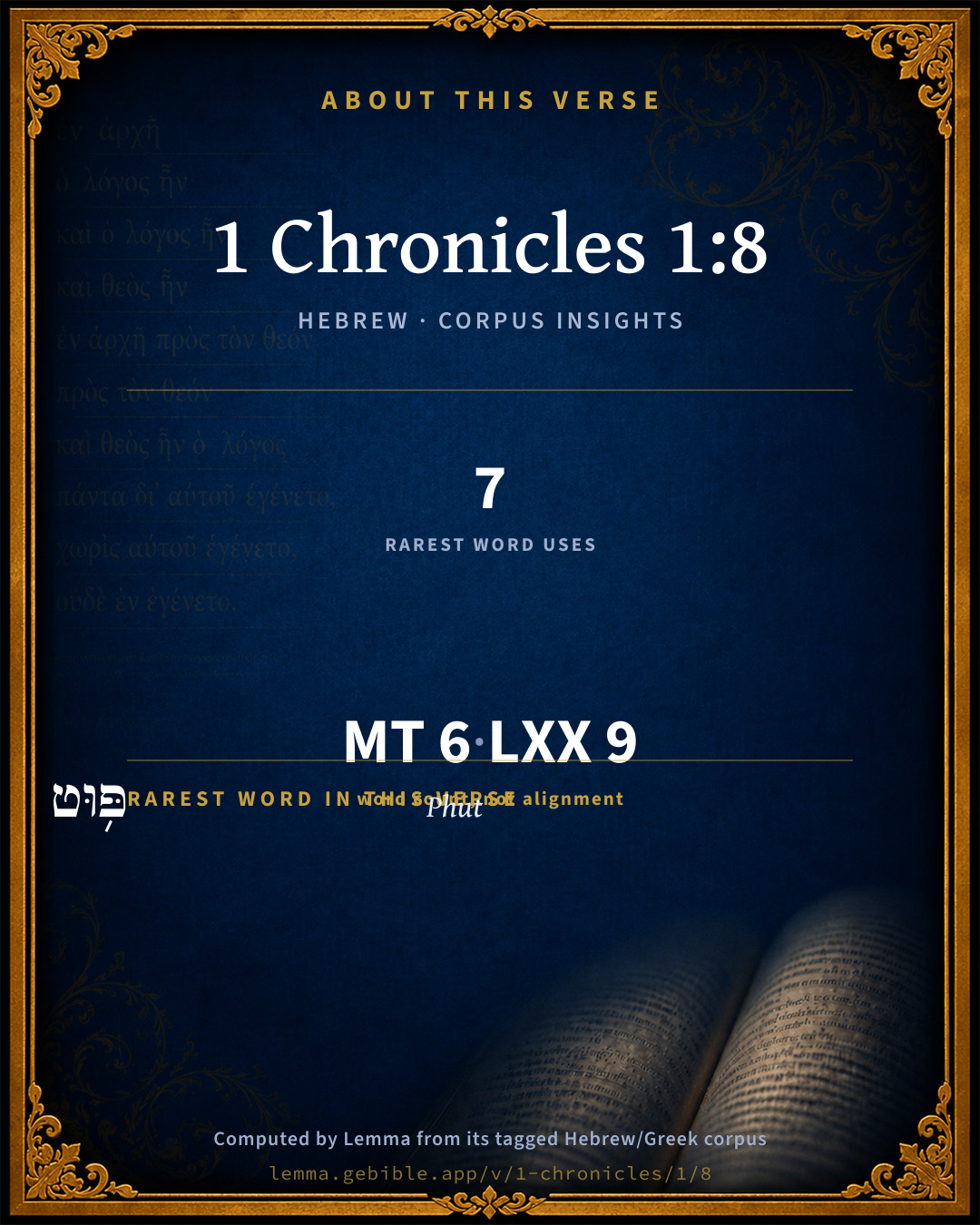
The rarest word here is פּ֥וּט Phut H6316 — appearing just 7 times in the whole Hebrew Bible.

Shared distinctive vocabulary

פּ֥וּט Phut H6316 occurs in 7 verses of the Hebrew Bible. Also found in:

Grammatical profile

  • 6 nouns

Hebrew & Septuagint length

In English translation the verse runs 10 words from the Hebrew and 11 from the Septuagint (LXX English) — closely comparable.

A rough comparison of the two English renderings, which tokenize alike — not a word-level alignment.

Word counts can differ between the Hebrew and the Greek without any difference in meaning — e.g. the Hebrew direct-object marker אֵת has no separate Greek word, and Greek often adds the article ὁ.

In the original languages it is 6 Hebrew tokens and 9 Greek tokens — but the two are counted differently (Hebrew bundles its prefixes and suffixes into one token; the Greek is in lemma form), so that isn’t a like-for-like length.

Cross-references

1

Topical passages linked to 1 Chronicles 1:8 in the Treasury of Scripture Knowledge — connected by theme and wording, ordered by reader-vote popularity; previews shown in the World English Bible.

Cross-references courtesy of OpenBible.info (CC BY 4.0).

Hebrew and Greek witnesses Masoretic Hebrew ↔ Greek Septuagint

The same verse in the two great witnesses to the Old Testament, shown verse-for-verse.

These are two independent witnesses, not word-aligned to each other, and the Septuagint is shown in lemma (dictionary) form.

Hebrew 1 Chronicles 1:8 Masoretic · Westminster Leningrad Codex

בְּנֵ֖י חָ֑ם כּ֥וּשׁ וּמִצְרַ֖יִם פּ֥וּט וּכְנָֽעַן

The sons of Ham: Cush, and Mizraim, Put, and Canaan.

World English Bible · Public Domain

Greek LXX 1 Chronicles 1:8 Septuagint · lemma form

καί υἱός χαμ χους καί μεστραιμ φουδ καί χανααν

And the sons of Cham, Chus, and Mesraim, Phud and Chanaan.

LXX2012 (modern English Septuagint) · Public Domain

Hebrew: Westminster Leningrad Codex (CC BY 4.0). Greek: Septuagint (public domain); English from LXX2012 (modern English Septuagint) (Public Domain). How the Septuagint differs from the Hebrew →

Commentary

Notes on 1 Chronicles 1:8 from classic Christian and Jewish commentators (each source and its license shown beneath its notes). The classic Christian expositions comment on the surrounding passage and are grouped to its opening verse, so a note may address several verses; the Jewish commentaries on the Tanakh (Rashi and others) are per-verse, so they appear only where the commentator wrote on this verse.

Lemma curates 59 commentaries, every one of them public domain or Creative Commons licensed, each selected and text-cleaned for this edition rather than reprinted as found. About our sources →

Ellicott's Commentary for English Readers

THE SONS OF HAM, THE DARK-SKINNED OR SWARTHY (1Ch_1:8-16).

(8) Cush.—The Greek Meroë, Assyrian Miluhha, or Kûsu, south of Egypt, in our Bibles often called Ethiopia (Isa_19:1). The Arabic gives Habesh, i.e., Ethiopia.

Mizraim.—The common Hebrew name of Egypt: strictly, “the two Miçrs”—i.e., Upper and Lower Egypt. But the name should rather be spelt Mizrim—the Egyptians; the form Mizraim being probably a mere fancy of the Jewish punctuators. The Assyrians wrote Muçum, Muçru, Muçur. The Inscription of Darius has Miçir. Maçôr was the name of the wall which protected Egypt on the north-east. Hence it gave its name to the whole of Lower Egypt.—Cush and Muçur are coupled together in the inscriptions of Esarhaddon and his son Assurbanipal.

Put.—Perhaps the Egyptian Punt, on the east coast of Africa. King Darius mentioned Pûta and Kûsu as subject to him (Behist, Inscr.). Comp. Nah_3:9; Jer_46:9; Eze_30:5. The Arabic has Kibtu, i.e., Coptland.

Canaan.—There are many proofs of an early connection between Egypt and Canaan. The Philistines were colonists from the Delta (1Ch_1:12), and Ramses II. (cir. 1350 or 1450 B.C. ) had wars and made alliance with the Hittites.

(9) Seba.—Capital of Meroë. The other names represent Arabian tribes and their districts.

Sheba.—The famous Sabaeans, whose language, the Himyaritic, has quite recently been deciphered from inscriptions.

(10) Cush begat Nimrod.—Micah (Mic_5:6) speaks of the “land of Nimrod” in connection with the “land of Asshur.” The land of Nimrod is plainly Babylonia; and some have supposed the primitive inhabitants of Babylonia—“the black-headed race” (zalmat qayqadi) as they styled themselves—to have been akin to the peoples of Muçur and Cush. At all events, Cush in this table of races appears as father of a series of mixed populations, ramifying from the north-west of the Persian Gulf in a southernly direction to the coast of Arabia. The Asiatic Cush represents that primitive Elamitic Sumerian race which occupied the north-west and north coast of the Persian Gulf; or rather that portion of it which attained to empire in Babylonia.

The name Nimrod appears to be identical with Merodach, the Accadian Amar-utu, or Amar-utuki, Assyrian Maruduk. Merodach was the tutelar deity of Babylon, as Asshur was of Assyria; and many Babylonian sovereigns bore his name. (Comp. Merodach-baladan, Isa_39:1.)

He began to be.—He was the first to become. Tradition made Nimrod the first founder of a great Oriental empire. The statement about his four cities (Gen_10:10), the first of which was Babel (Babylon), is omitted here.

Mighty.—Literally, a hero, warrior (gibbôr); a title of Merodach.

(11, 12) The names in these verses are all in the masculine plural, and obviously designate nations. Mizraim, the two Egypts, is said to have begotten the chief races inhabiting those regions—a common Oriental metaphor. The Ludim are the Ludu, or Rudu, of the hieroglyphs (Prof. Sayce thinks, the Lydian mercenaries of the Egyptian sovereigns); the Anamim are perhaps the men of An (On, Gen_41:50), Lehabim, the Lybians. The Naphtuhim seem to get their name from Noph, i.e., Memphis, and the god Ptah. Perhaps, however, the name is to be recognised in the town Napata.

(12) Pathrusim.—The men of the south (Egyptian, pe-ta-res, “the southland”), or Upper Egypt.

Casluhim . . . Caphthorim.—The men of Kaftûra, or the Delta. (See Amo_9:7 : “Have not I brought up Israel out of the land of Mizraim? and the Philistines from Caphtor?” and comp. Deu_2:23.) The Caluhim may have been a leading division of the Caphthorim.

A Bible Commentary for English Readers, edited by Charles John Ellicott (1878–1897) — public domain. Text from a community e-Sword module.

Adam Clarke's Commentary

Verse 8. The sons of Ham; Cush, and Mizraim] "Arabia and Egypt." - T.

Adam Clarke's Commentary on the Bible (1810–1826) — public domain. Text from a community e-Sword/MySword module.

The Cambridge Bible for Schools and Colleges

gen. ed. J. J. S. Perowne

8, 9 (= Gen_10:6-7). The Sons of Ham

8. The sons of Ham] Passing over for the present the Central “zone,” the writer now describes the Southern.

Cush] The Heb. name here transliterated Cush is several times translated “Ethiopia” (e.g. 2Ki_19:9; Isa_18:1) no doubt rightly. On the inscriptions of Assur-bani-pal frequent mention is made of Ku-su (Ku-u-su) “Ethiopia” in connexion with Mu-ṣur “Egypt.” The Cushites were not Negroes but a brown race like the modern Nubians (Soudanese).

Mizraim] is without doubt Egypt. In form the word seems to be dual, and it is generally said to mean the two Egypts, Upper and Lower. A singular “Mâzôr” is translated “Egypt” In 2Ki_19:24 (R.V.). Neither form is the native name of the kingdom.

Put] In Gen_10:6 “Phut” (R.V. Put). This people is mentioned among the helpers of Egypt in Jer., in Ezek. (twice) and in Nahum; “the Libyans” A.V. In Eze_27:10 it appears among the auxiliary troops of Tyre; “Phut” A.V. In all these passages R.V. has “Put.” “Put” is probably the Punt of the Egyptian monuments, i.e. the Somali coast with the parts of the coast of Arabia nearest to it.

Canaan] In Gen_9:25-27 “Canaan” is not the son of Ham, but takes Ham’s place among the sons of Noah. Canaan (“lowland”) is applied to the whole country W. of Jordan including the Hill Country of Judah and Ephraim, but perhaps the name was originally given to the sea-coast only. This coastland (including both Philistia and Phœnicia) had close political connexions with Egypt, being indeed Egypt’s highway to the E., and hence Canaan is described as the brother of Mizraim, although no near ethnological relationship existed between the mass of the population of Canaan and the Egyptians.

The Cambridge Bible for Schools and Colleges (gen. ed. J. J. S. Perowne; Cambridge University Press, 1878–1918) — public domain. Text from a community e-Sword module.

The Pulpit Commentary

Vers. 8-16. C. LIST OF THE SONS, GRANDSONS, AND GREATGRANDSONS OF HAM. This list consists of four sons of Ham, of six grandsons, including Nimrod, through Cush, the eldest son of Ham; of seven grandsons through Mizraim, the second son of Ham; of eleven grandsons through Canaan, the fourth son of Ham; of two great-grandsons through Raamah, Cush"s fourth son; thirty descendants in all. No issue is given of Put, the third son of Hem. The parallel list is found sw. (Gen_10:6-20) The names agree in the Authorized Version, with minute differences, e.g. Put here for Phut there, and so the Philistines for Philistine, Caphthorim for Caphtorim, Girgashite for Girgasite. They are similarly in agreement in the Hebrew text of the two places, with minute differences, e.g. aTb here for hTbsw there amrw for hmrw for hmrw for wOdyxi for doyxi yqirh. However, in Genesis the following statements are added to Nimrod"s name: was a mighty hunter before the Lord: wherefore it is said, Even as Nimrod the mighty. hunter before the Lord. And the beginning of his kingdom was Babel, and Erech, and Accad, and Calneh, in the land of Shinar. Out of that land went forth Asshur, and builded Nineveh, and the city Rehoboth, and Calah, and Resen between Nineveh and Calah; the same is a great city." And again, at the close of the enumeration of sons, grandsons, and great-grandsons, follow the statements, "And afterwards were the families of the Canaanites spread abroad. And the border of the Canaanites was from Sidon, as thou comsat to Gerar, unto Gaza; as thou goest, unto Sodom, and Gomorrah, and Admah, and Zeboim, even unto Lasha. These are the sons of Ham, after their families, after their tongues, in their countries, and in their nations."

The Pulpit Commentary (1880–1919), ed. H.D.M. Spence-Jones & Joseph S. Exell — public domain. Text from a community e-Sword module.

unfoldingWord translationNotes

Door43 World Missions Community

General Information:

All of the names here are names of men. (See: How to Translate Names)

translationWords

Cush

Canaan

Sheba

earth

unfoldingWord translationNotes — © Distant Shores Media and the Door43 World Missions Community, licensed CC BY-SA 4.0. Source: git.door43.org/Door43/en_tn.

Lesson kit

Teaching starters — assembled from the data on this page, not authored interpretation. Every prompt links to the verse data it draws on. Edit before teaching.

1 Chronicles, in the Historical, opens this verse with 6 words (6 distinct Hebrew lemmas). Its most distinctive word is Pûwṭ (“Phut”). A historical commentator’s framing appears above. Read the whole chapter for the surrounding context.

Discussion questions

  1. How does “Phut” (Pûwṭ) shape what this verse is saying?
  2. Genesis 10:6 shares the word «Phut» with this verse. How do the two illuminate each other?
  3. These translations render this verse differently; the difference is in the English rendering, not the original. What questions does that raise?
  4. Reading how Ellicott's Commentary for English Readers and Adam Clarke's Commentary read this verse, where do the two commentators agree and where do they part?

Things to notice

Reading settings

Reading text

Shown beneath each verse's original-language words.

Old Testament
Old Testament edition

Read the OT as the Masoretic Hebrew (MT) or the Greek Septuagint (LXX).

English shown for the Greek Septuagint (in the Hebrew ↔ Greek comparison).

Comparing translations? Open the Compare panel on any verse page to stack up to four side by side.