
Ezekiel 23:8

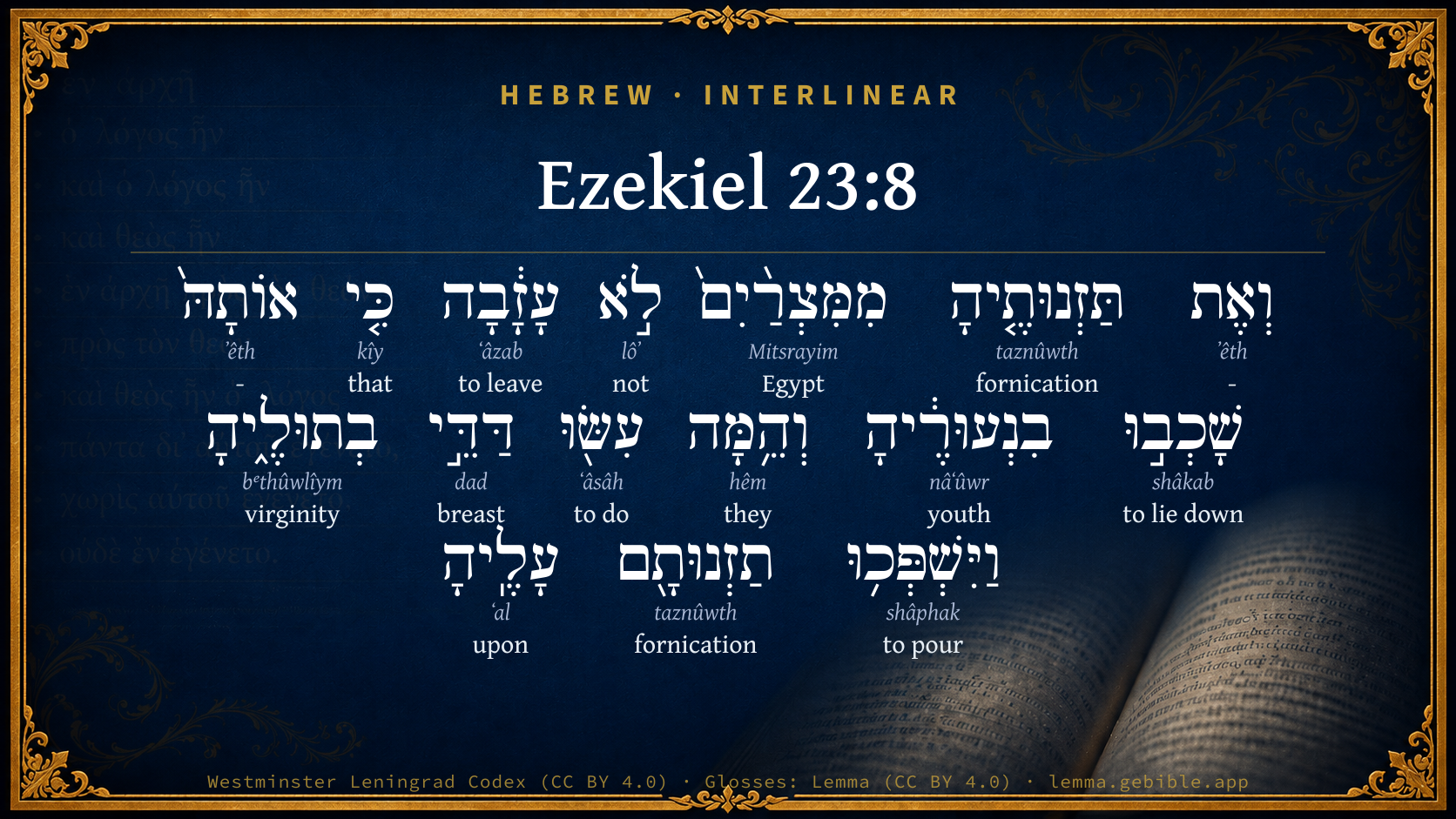
Hebrew (Westminster Leningrad Codex) Ezekiel 23:8 appears in the Hebrew Old Testament. The text above is from the Westminster Leningrad Codex. Each word links to its Strong’s number, a concise gloss, and parsing drawn from the Open Scriptures Hebrew Bible morphology. Click any word for its full Brown-Driver-Briggs (BDB) entry.
Download image
Cite this verse

Ezekiel 23:8 (World English Bible). Public Domain. Lemma interlinear Bible study tool, https://lemma.gebible.app/v/ezekiel/23/8.

Show BibTeX & RIS
BibTeX
RIS
English Translation
Neither has she left her prostitution since [the days of] Egypt; for in her youth they lay with her, and they handled the bosom of her virginity; and they poured out their prostitution on her.
World English Bible · Public Domain
Download a study sheet

One document with this verse’s original text, its word-by-word gloss line, the meaning frame, cross-references with their text, attributed commentary, and full source and license credits — printable, and it pastes into notes with its structure intact.

This verse Autodidact and up

Study sheet (.html) Plain text (.txt)

A passage Seminary Student

Up to 50 verses in one chapter. A passage sheet keeps up to 6 commentary sources and 12 cross-references per verse, in the order this page ranks them, and says so on the sheet whenever that leaves anything out. Ask for a single verse and you get the Autodidact verse sheet above.

Everything on this page stays free to read, with no account — the sheet is a download of what is already on screen, not access to it.

Want to remove ads? Support Godless Engineer
Compare translations 3

The same verse in 3 English versions, stacked beneath the original-language interlinear above. Click any original word for its lexicon entry.

Each is an independent rendering of the whole verse — the interlinear is not word-aligned to these translations.

Highlighted words mark where these versions differ — a whole-verse word diff, not a word-by-word alignment.

  • World English Bible Public Domain
    Neither has she left her prostitution since [the days of] Egypt; for in her youth they lay with her, and they handled the bosom of her virginity; and they poured out their prostitution on her.
  • King James Version Public Domain
    Neither left she her whoredoms brought from Egypt: for in her youth they lay with her, and they bruised the breasts of her virginity, and poured their whoredom upon her.
  • unfoldingWord Literal Text CC BY-SA 4.0
    For she had not left her prostitute behavior behind in Egypt, when they had lain with her when she had been a young girl, when they caressed her virgin bosom and poured out their lust upon her.

unfoldingWord Literal Text — © unfoldingWord, licensed CC BY-SA 4.0. Word-aligned USFM3 via Door43 (git.door43.org/unfoldingWord/en_ult).

Versions to compare (up to 4)

3 of 4 selected

Show all 18 translations

Every available English version of this verse, each an independent rendering of the whole verse.

  • World English Bible Public Domain
    Neither has she left her prostitution since [the days of] Egypt; for in her youth they lay with her, and they handled the bosom of her virginity; and they poured out their prostitution on her.
  • Berean Standard Bible Public Domain
    She did not give up the prostitution she began in Egypt, when men slept with her in her youth, caressed her virgin bosom, and poured out their lust upon her.
  • Majority Standard Bible Public Domain
    She did not give up the prostitution she began in Egypt, when men slept with her in her youth, caressed her virgin bosom, and poured out their lust upon her.
  • King James Version Public Domain
    Neither left she her whoredoms brought from Egypt: for in her youth they lay with her, and they bruised the breasts of her virginity, and poured their whoredom upon her.
  • American Standard Version (1901) Public Domain
    Neither hath she left her whoredoms since `the days of' Egypt; for in her youth they lay with her, and they handled the bosom of her virginity; and they poured out their whoredom upon her.
  • Revised Version (1885) Public Domain
    Neither hath, she left her whoredoms since the days of Egypt; for in her youth they lay with her, and they bruised the teats of her virginity: and they poured out their whoredom upon her.
  • Geneva Bible (1599) Public Domain
    Neither left she her fornications, learned of the Egyptians: for in her youth they lay with her, and they bruised the breasts of her virginitie, and powred their whoredome vpon her.
  • Douay-Rheims (1899) Public Domain
    Moreover also she did not forsake her fornications which she had committed in Egypt: for they also lay with her in her youth, and they bruised the breasts of her virginity, and poured out their fornication upon her.
  • Young's Literal Translation Public Domain
    And her whoredoms out of Egypt she hath not forsaken, For with her they lay in her youth, And they dealt with the loves of her virginity, And they pour out their whoredoms on her.
  • Literal Standard Version CC BY-SA 4.0
    And she has not forsaken her whoredoms out of Egypt, || For with her they lay in her youth, || And they dealt with the loves of her virginity, || And they pour out their whoredoms on her.
  • Unlocked Literal Bible CC BY-SA 4.0
    For she had not left her prostitute behavior behind in Egypt, when they had slept with her when she had been a young girl, when they first began to fondle her virgin breasts, when they first began to pour out their promiscuous behavior on her.
  • unfoldingWord Literal Text CC BY-SA 4.0
    For she had not left her prostitute behavior behind in Egypt, when they had lain with her when she had been a young girl, when they caressed her virgin bosom and poured out their lust upon her.
  • Darby Bible Public Domain
    Neither left she her whoredoms [brought] from Egypt; for in her youth they had lain with her, and had handled the breasts of her virginity, and poured their fornication upon her.
  • World Messianic Bible Public Domain
    She hasn’t left her prostitution since leaving Egypt; for in her youth they lay with her. They caressed her youthful nipples and they poured out their prostitution on her.
  • Webster's Bible Public Domain
    Neither left she her lewd deeds brought from Egypt: for in her youth they lay with her, and they first corrupted her, and poured their impurities upon her.
  • Free Bible Version CC BY-SA 4.0
    She didn't stop her prostitution that she started in Egypt—men sleeping with her when she was young, squeezing her virgin breasts and using her to satisfy their sexual appetite.
  • Bible in Basic English Public Domain
    And she has not given up her loose ways from the time when she was in Egypt; for when she was young they were her lovers, and by them her young breasts were crushed, and they let loose on her their unclean desire.
  • JPS Tanakh (1917) Public Domain
    Neither hath she left her harlotries brought from Egypt; for in her youth they lay with her, and they bruised her virgin breasts; and they poured out their lust upon her.

Literal Standard Version (2020), Covenant Press — licensed CC BY-SA 4.0. Text via the HelloAO Bible API (eBible.org). Unlocked Literal Bible (unfoldingWord) — licensed CC BY-SA 4.0. Text via the HelloAO Bible API (eBible.org). unfoldingWord Literal Text — © unfoldingWord, licensed CC BY-SA 4.0. Word-aligned USFM3 via Door43 (git.door43.org/unfoldingWord/en_ult). Free Bible Version, Dr. Jonathan Gallagher — licensed CC BY-SA 4.0. Text via the HelloAO Bible API (eBible.org).

Word by word

More ways to search: Search by grammar → Find every occurrence → Compare this word →

Practice this passage: Drill this verse → Learn its vocabulary →

דַּדֵּ֣י
dad
H1717
“breasts of”
Noun, Common, Masculine, Dual, Construct
Part of Speech
Noun
Type
Common
Gender
Masculine
Number
Dual
State
Construct
Full BDB Definition

Origin: apparently from the same as H1730

TWOT: 405

breast, nipple, teat
  1. וְאֶת ʼêth H853 “and · -” Conjunction + Particle, Direct Object
  2. תַּזְנוּתֶ֤יהָ taznûwth H8457 “fornications · her” Noun, Common, Feminine, Plural, Construct + Suffix, Personal, 3rd Person, Feminine, Singular
  3. מִמִּצְרַ֨יִם֙ Mitsrayim H4714 “from · Egypt” Preposition + Noun, Proper
  4. לֹ֣א lôʼ H3808 “not” Particle, Negative
  5. עָזָ֔בָה ʻâzab H5800 “to leave” Verb, Qal, Perfect, 3rd Person, Feminine, Singular
  6. כִּ֤י kîy H3588 “that” Conjunction
  7. אוֹתָהּ֙ ʼêth H853 “- · her” Particle, Direct Object + Suffix, Personal, 3rd Person, Feminine, Singular
  8. שָׁכְב֣וּ shâkab H7901 “to lie down” Verb, Qal, Perfect, 3rd Person, Common, Plural
  9. בִנְעוּרֶ֔יהָ nâʻûwr H5271 “in/at · youth · her” Preposition + Noun, Common, Both, Plural, Construct + Suffix, Personal, 3rd Person, Feminine, Singular
  10. וְהֵ֥מָּה hêm H1992 “and · they” Conjunction + Pronoun, Personal, 3rd Person, Masculine, Plural
  11. עִשּׂ֖וּ ʻâsâh H6213 “to do” Verb, Piel, Perfect, 3rd Person, Common, Plural
  12. בְתוּלֶ֑יהָ bᵉthûwlîym H1331 “virginity · her” Noun, Common, Both, Plural, Construct + Suffix, Personal, 3rd Person, Feminine, Singular
  13. וַיִּשְׁפְּכ֥וּ shâphak H8210 “and · to pour” Conjunction + Verb, Qal, Sequential Imperfect, 3rd Person, Masculine, Plural
  14. תַזְנוּתָ֖ם taznûwth H8457 “fornication · their” Noun, Common, Feminine, Singular, Construct + Suffix, Personal, 3rd Person, Masculine, Plural
  15. עָלֶֽיהָ ʻal H5921 “upon · her” Preposition + Suffix, Personal, 3rd Person, Feminine, Singular

About this verse

These counts appear in no published source. They are computed here, from the morphology-tagged text and Lemma’s own curated glosses. What Lemma adds →

16
words
14
distinct lemmas
Prophets
section

Notable vocabulary

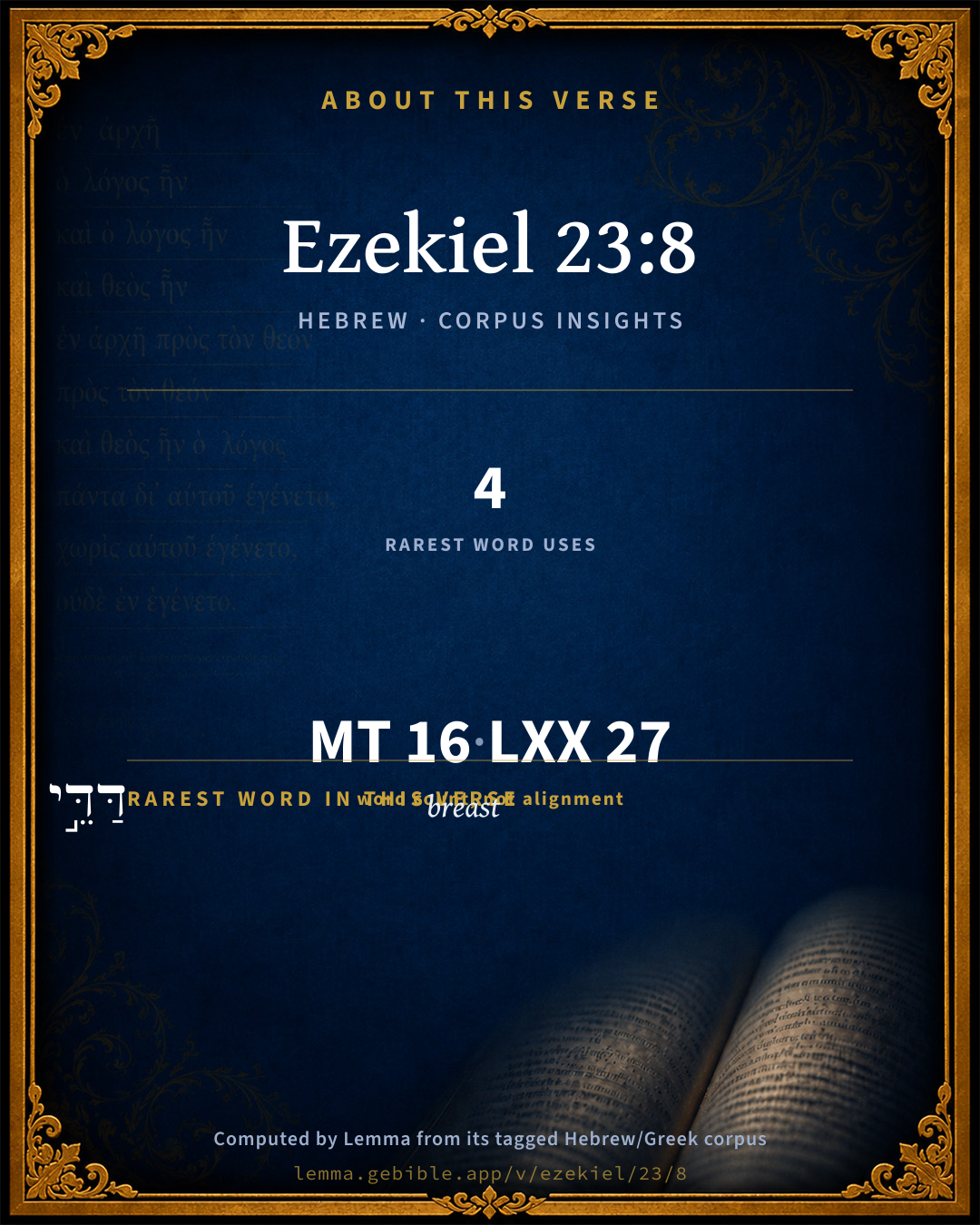
The rarest word here is דַּדֵּ֣י breast H1717 — appearing just 4 times in the whole Hebrew Bible.

Shared distinctive vocabulary

דַּדֵּ֣י breast H1717 occurs in 4 verses of the Hebrew Bible. Also found in:

Grammatical profile

  • 4 verbs
  • 6 nouns
  • 1 pronoun
  • 1 preposition
  • 1 conjunction
  • 3 particles

Verb forms

  • עָזָ֔בָה Qal · Perfect
  • שָׁכְב֣וּ Qal · Perfect
  • עִשּׂ֖וּ Piel · Perfect
  • וַיִּשְׁפְּכ֥וּ Qal · Sequential Imperfect

Repetition

A word recurs within this verse — often emphatic in Hebrew:

  • תַּזְנוּתֶ֤יהָ fornication H8457 ×2

Hebrew & Septuagint length

In English translation the verse runs 35 words from the Hebrew and 29 from the Septuagint (LXX English) — closely comparable.

A rough comparison of the two English renderings, which tokenize alike — not a word-level alignment.

Word counts can differ between the Hebrew and the Greek without any difference in meaning — e.g. the Hebrew direct-object marker אֵת has no separate Greek word, and Greek often adds the article ὁ.

In the original languages it is 16 Hebrew tokens and 27 Greek tokens — but the two are counted differently (Hebrew bundles its prefixes and suffixes into one token; the Greek is in lemma form), so that isn’t a like-for-like length.

Cross-references

7

Topical passages linked to Ezekiel 23:8 in the Treasury of Scripture Knowledge — connected by theme and wording, ordered by reader-vote popularity; previews shown in the World English Bible.

  • Exodus 32:4 He received what they handed him, and fashioned it with an engraving tool, and made it a molten calf; and they said, "These are your gods, Israel, which brought you up out of the land of Egypt."
  • Ezekiel 23:3 and they played the prostitute in Egypt; they played the prostitute in their youth; there were their breasts pressed, and there was handled the bosom of their virginity.
  • Ezekiel 23:19 Yet she multiplied her prostitution, remembering the days of her youth, in which she had played the prostitute in the land of Egypt.
  • 1 Kings 12:28 Whereupon the king took counsel, and made two calves of gold; and he said to them, It is too much for you to go up to Jerusalem: see your gods, Israel, which brought you up out of the land of Egypt.
  • 2 Kings 10:29 However from the sins of Jeroboam the son of Nebat, with which he made Israel to sin, Jehu didn't depart from after them, [to wit], the golden calves that were in Bethel, and that were in Dan.
  • 2 Kings 17:16 They forsook all the commandments of Yahweh their God, and made them molten images, even two calves, and made an Asherah, and worshiped all the host of the sky, and served Baal.
  • Ezekiel 23:21 Thus you called to memory the lewdness of your youth, in the handling of your bosom by the Egyptians for the breasts of your youth.

Cross-references courtesy of OpenBible.info (CC BY 4.0).

Hebrew and Greek witnesses Masoretic Hebrew ↔ Greek Septuagint

The same verse in the two great witnesses to the Old Testament, shown verse-for-verse.

These are two independent witnesses, not word-aligned to each other, and the Septuagint is shown in lemma (dictionary) form.

Hebrew Ezekiel 23:8 Masoretic · Westminster Leningrad Codex

וְאֶת תַּזְנוּתֶ֤יהָ מִמִּצְרַ֨יִם֙ לֹ֣א עָזָ֔בָה כִּ֤י אוֹתָהּ֙ שָׁכְב֣וּ בִנְעוּרֶ֔יהָ וְהֵ֥מָּה עִשּׂ֖וּ דַּדֵּ֣י בְתוּלֶ֑יהָ וַיִּשְׁפְּכ֥וּ תַזְנוּתָ֖ם עָלֶֽיהָ

Neither has she left her prostitution since [the days of] Egypt; for in her youth they lay with her, and they handled the bosom of her virginity; and they poured out their prostitution on her.

World English Bible · Public Domain

Greek LXX Ezekiel 23:8 Septuagint · lemma form

καί ὁ πορνεία αὐτός ἐκ αἴγυπτος οὐ ἐν καταλείπω ὅτι μετά αὐτός κοιμάω ἐν νεότης αὐτός καί αὐτός διαπαρθενεύω αὐτός καί ἐκχέω ὁ πορνεία αὐτός ἐπί αὐτός

And she forsook not her fornication with the Egyptians: for in her youth they committed fornication with her, and they deflowered her, and poured out their fornication upon her.

LXX2012 (modern English Septuagint) · Public Domain

Hebrew: Westminster Leningrad Codex (CC BY 4.0). Greek: Septuagint (public domain); English from LXX2012 (modern English Septuagint) (Public Domain). How the Septuagint differs from the Hebrew →

Targum (Aramaic paraphrase)

1

The Targum is the ancient Jewish Aramaic paraphrase of the Hebrew Scriptures — an interpretive translation, not the Hebrew text itself. Onkelos (literal) and Pseudo-Jonathan (expansive) render the Torah, and Jonathan the Prophets. Coverage is partial: where no permissively-licensed English translation exists for a verse, only the Aramaic is shown. This is verse-level text, not a word-by-word alignment to the Hebrew.

  1. Targum Jonathan Prophets (Joshua–Malachi)
    וְיַת פּוּלְחַן טַעֲוָתָא דַהֲוָה עִמָהּ מִמִצְרַיִם לָא שַׁבְקַת אֲרֵי יָתָהּ אַפְלָחוּ לְטַעֲוָתָהּ וְאִינוּן אַלִפוּהָא עוֹבָדִין בִּישִׁין וּשְׁפָכוּ טַעֲוָתְהוֹן עֲלָהּ:

    (no public-domain English translation for this verse)

    Targum Jonathan — Aramaic: “Mikraot Gedolot” (public domain). English: “Sefaria Community Translation” (CC0 1.0 (public-domain dedication)); “London "Chaldee Paraphrase," 1871” (public domain). Text via Sefaria.

Commentary

Notes on Ezekiel 23:8 from classic Christian and Jewish commentators (each source and its license shown beneath its notes). The classic Christian expositions comment on the surrounding passage and are grouped to its opening verse, so a note may address several verses; the Jewish commentaries on the Tanakh (Rashi and others) are per-verse, so they appear only where the commentator wrote on this verse.

Lemma curates 59 commentaries, every one of them public domain or Creative Commons licensed, each selected and text-cleaned for this edition rather than reprinted as found. About our sources →

Trapp's Complete Commentary

John Trapp

Eze 23:8 Neither left she her whoredoms [brought] from Egypt: for in her youth they lay with her, and they bruised the breasts of her virginity, and poured their whoredom upon her.

Ver. 8. Neither left she her idols brought from Egypt.] Witness her two golden calves brought therehence by Jeroboam, in imitation of Apis, a calf dedicated by the Egyptians to Serapis, their chief idol.

“ Quis nescit, qualia demens

Aegyptus portenta colat? ” - Juvenal.

For in her youth.] See on Eze 23:3.

And poured their whoredoms upon her.] This kind of language and the like is here and elsewhere used, not to teach men to speak or do foul things, but the contrary. Of Petronius’s Satyricon it is said, Tolle obscaena, et tollis omni: and that he was impurissimus scriptor purissimae Latinitatis. Of our prophet it may as truly be said, Tolle sancta et tollis omnia. See on Eze 23:2.

John Trapp, A Commentary or Exposition upon All the Books of the Old and New Testament (1647–1656) — public domain. Text from a community e-Sword module.

Geneva Bible (1599)

Geneva Bible translators

The holy Ghost useth these terms which seem strange to chaste ears, to cause this wicked vice of idolatry so to be abhorred, that […] any should abide to hear the name thereof.

Geneva Bible (1599) marginal notes — public domain. Text via Bolls.life.

Jamieson, Fausset & Brown

Robert Jamieson, A. R. Fausset & David Brown

whoredoms brought from Egypt--the calves set up in Dan and Beth-el by Jeroboam, answering to the Egyptian bull-formed idol Apis. Her alliances with Egypt politically are also meant (Isa 30:2-3; Isa 31:1). The ten tribes probably resumed the Egyptian rites, in order to enlist the Egyptians against Judah (Ch2 12:2-4).

Jamieson, Fausset & Brown — Commentary Critical and Explanatory on the Whole Bible (1871) — public domain (CC PDM 1.0). Text via the HelloAO Bible API.

The Cambridge Bible for Schools and Colleges

gen. ed. J. J. S. Perowne

8. Samaria intrigued with Assyria and Egypt alternately, or different parties simultaneously. Hos_7:11, “Ephraim is like a silly dove, without understanding; they call unto Egypt, they go unto Assyria.”

The Cambridge Bible for Schools and Colleges (gen. ed. J. J. S. Perowne; Cambridge University Press, 1878–1918) — public domain. Text from a community e-Sword module.

John Gill's Exposition

Neither left she her idols brought from Egypt,.... Though the Israelites took in the gods of the Assyrians into their worship, they did not relinquish the golden calves set up at Dan and Bethel, in imitation of the Egyptian deities; the idolatrous worship of which they learned in Egypt, and brought from thence:

for in her youth they lay with her; the Egyptians enticed the Israelites to idolatry when among them, as soon as they began to be a people; See Gill on Eze 23:3,

and they bruised the breasts of her virginity; who before retained the pure worship of God, and was like a chaste virgin:

and poured their whoredom upon her; expressive of the numerous acts of idolatry committed together by them.

John Gill's Exposition of the Whole Bible (1746–1763) — public domain (CC PDM 1.0). Text via the HelloAO Bible API.

Haydock's Catholic Bible Commentary

Egypt. They always retained an affection for those idols, the calf, Adonis, &c.

George Leo Haydock (1774–1849), Haydock's Catholic Family Bible and Commentary, 1859 edition — public domain. Excludes Psalms (Douay-Rheims chapter numbering differs from Protestant) and Deuterocanonical books (Catholic canon only).

Matthew Poole's English Annotations

Neither left she her whoredoms brought from Egypt; though she took in so many gods of the Assyrians, yet she did not renounce or cast off the gods of Egypt, but kept them too. It is plain the Israelites learnt idolatry in Egypt, carried it with them out of Egypt, and retained it to the last.

In her youth, & c. see Eze 23:3.

Matthew Poole's English Annotations on the Holy Bible (1683–1685) — public domain. Text from a community e-Sword/MySword module.

unfoldingWord translationNotes

Door43 World Missions Community

General Information:

Yahweh continues his metaphor in which he speaks of the cities of Jerusalem and Samaria as if they were two prostitutes. This metaphor continues through Ezekiel 23:34. (See: Metaphor)

to pour out their promiscuous behavior on her

This speaks of the men acting promiscuously towards her as if their promiscuous behavior were a large amount of water that they were pouring out on her. AT: "to act promiscuously towards her" or "to act lustfully towards her" (See: Metaphor)

I gave her into the hand of her lovers, into the hand of the Assyrians

The word "hand" refers to power or control. The two phrases have the same meaning and the second phrase explains that "her lovers" were "the Assyrians." AT: "I gave her over to her lovers, the Assyrians" (See: Metonymy and Parallelism)

they executed judgment on her

This is an idiom. AT: "they talked about her disgrace" or "she had a bad reputation among them" (See: Idiom)

translationWords

Egypt

hand

sword

shame

judge

unfoldingWord translationNotes — © Distant Shores Media and the Door43 World Missions Community, licensed CC BY-SA 4.0. Source: git.door43.org/Door43/en_tn.

Rashi

Rabbi Shlomo Yitzchaki (Rashi)

And her harlotries from Egypt she did not abandon They relied also upon the kings of Egypt, for we find (II Kings 17:4), concerning Hoshea the son of Elah, that he sent messengers to So the king of Egypt.

for they had lain with her, etc. And since then, “they poured out their harlotry upon her” - her promiscuous spirit entered her from the days of her youth.

Rashi on the Tanakh — English translations: “The Judaica Press complete Tanach with Rashi, translated by A. J. Rosenberg” (CC BY 4.0); “Pentateuch with Rashi's commentary by M. Rosenbaum and A.M. Silbermann, 1929-1934” (public domain); “The Metsudah Tanach series, Lakewood, N.J” (CC BY 4.0); and “The Book of Joshua, Metsudah Publications, 1997” (CC BY 4.0). Text via Sefaria.

Lesson kit

Teaching starters — assembled from the data on this page, not authored interpretation. Every prompt links to the verse data it draws on. Edit before teaching.

Ezekiel, in the Prophets, opens this verse with 16 words (14 distinct Hebrew lemmas). Its most distinctive word is dad (“breast”). A historical commentator’s framing appears above. Read the whole chapter for the surrounding context.

Discussion questions

  1. What does “breast” (dad) contribute to the verse as a whole?
  2. Proverbs 5:19 shares the word «breast» with this verse. How do the two illuminate each other?
  3. “fornication” occurs 2× in this one verse. What is the effect of the repetition?
  4. These translations render this verse differently; the difference is in the English rendering, not the original. What questions does that raise?
  5. The verb «עָזָ֔בָה» is Qal Perfect. How does its form color the action?
  6. Reading how Trapp's Complete Commentary and Geneva Bible (1599) read this verse, where do the two commentators agree and where do they part?

Things to notice

Reading settings

Reading text

Shown beneath each verse's original-language words.

Old Testament
Old Testament edition

Read the OT as the Masoretic Hebrew (MT) or the Greek Septuagint (LXX).

English shown for the Greek Septuagint (in the Hebrew ↔ Greek comparison).

Comparing translations? Open the Compare panel on any verse page to stack up to four side by side.