
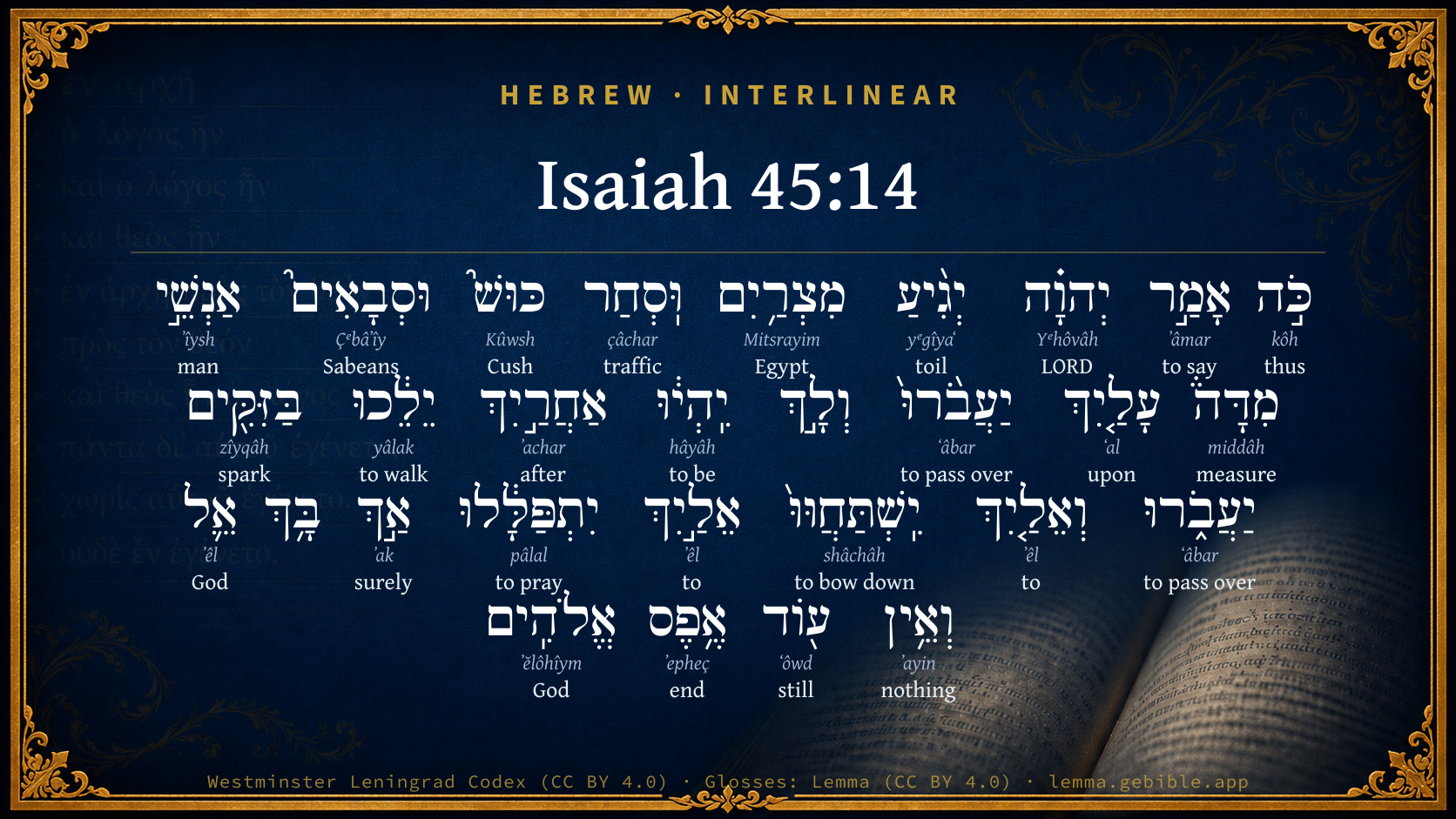
Isaiah 45:14

Hebrew (Westminster Leningrad Codex) Isaiah 45:14 appears in the Hebrew Old Testament. The text above is from the Westminster Leningrad Codex. Each word links to its Strong’s number, a concise gloss, and parsing drawn from the Open Scriptures Hebrew Bible morphology. Click any word for its full Brown-Driver-Briggs (BDB) entry.
Download image
Cite this verse

Isaiah 45:14 (World English Bible). Public Domain. Lemma interlinear Bible study tool, https://lemma.gebible.app/v/isaiah/45/14.

Show BibTeX & RIS
BibTeX
RIS
English Translation
Thus says Yahweh: "The labor of Egypt, and the merchandise of Ethiopia, and the Sabeans, men of stature, shall come over to you, and they shall be yours. They shall go after you. In chains they shall come over; and they shall fall down to you. They shall make supplication to you: 'Surely God is in you; and there is none else, there is no other god.
World English Bible · Public Domain
Highlights
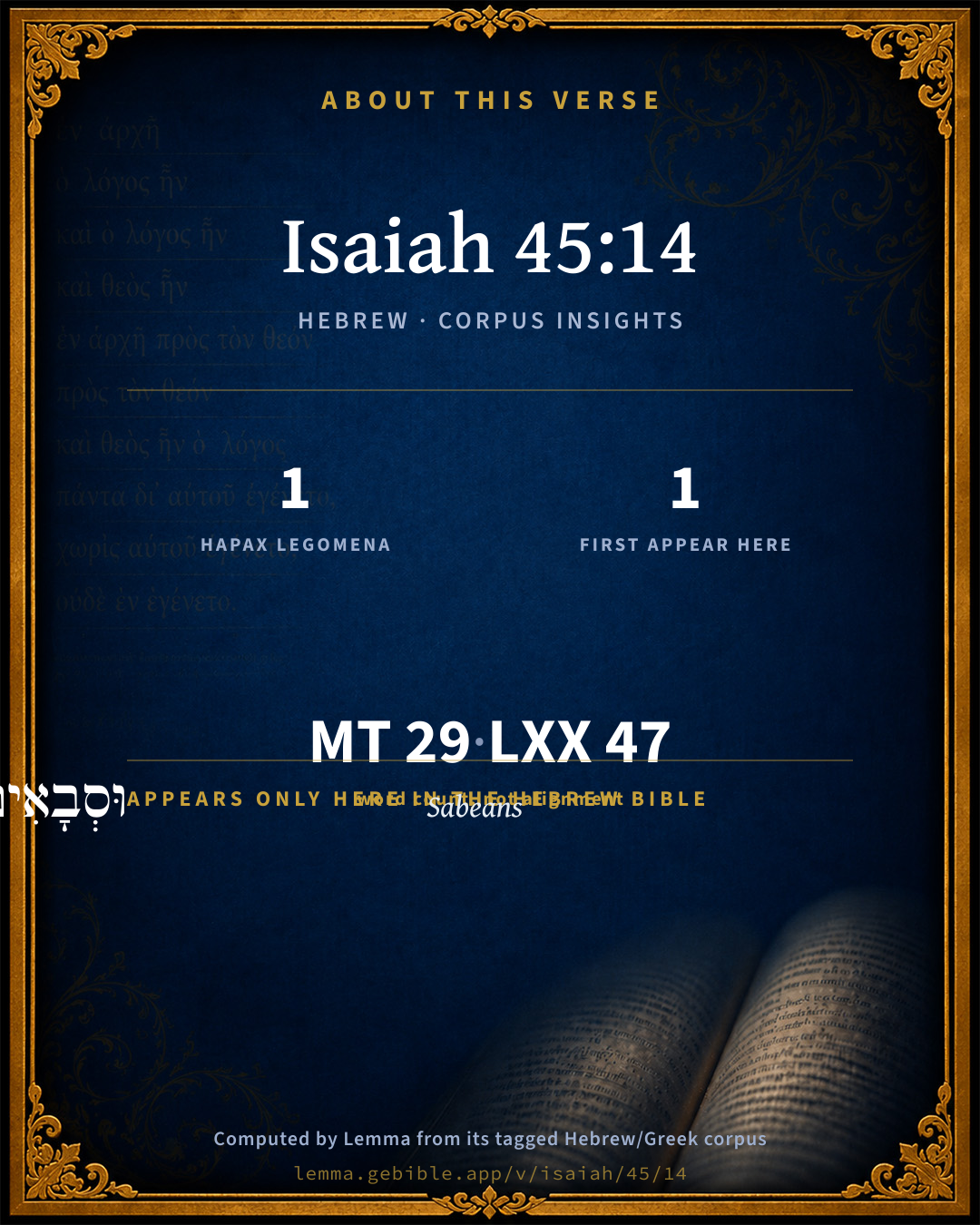
  • 1 hapax legomenon — only here in the Hebrew Bible
  • 1 first appearance in the Hebrew Bible
Full analysis ↓
Download a study sheet

One document with this verse’s original text, its word-by-word gloss line, the meaning frame, cross-references with their text, attributed commentary, and full source and license credits — printable, and it pastes into notes with its structure intact.

This verse Autodidact and up

Study sheet (.html) Plain text (.txt)

A passage Seminary Student

Up to 50 verses in one chapter. A passage sheet keeps up to 6 commentary sources and 12 cross-references per verse, in the order this page ranks them, and says so on the sheet whenever that leaves anything out. Ask for a single verse and you get the Autodidact verse sheet above.

Everything on this page stays free to read, with no account — the sheet is a download of what is already on screen, not access to it.

Want to remove ads? Support Godless Engineer
Compare translations 3

The same verse in 3 English versions, stacked beneath the original-language interlinear above. Click any original word for its lexicon entry.

Each is an independent rendering of the whole verse — the interlinear is not word-aligned to these translations.

Highlighted words mark where these versions differ — a whole-verse word diff, not a word-by-word alignment.

  • World English Bible Public Domain
    Thus says Yahweh: "The labor of Egypt, and the merchandise of Ethiopia, and the Sabeans, men of stature, shall come over to you, and they shall be yours. They shall go after you. In chains they shall come over; and they shall fall down to you. They shall make supplication to you: 'Surely God is in you; and there is none else, there is no other god.
  • King James Version Public Domain
    Thus saith the LORD, The labour of Egypt, and merchandise of Ethiopia and of the Sabeans, men of stature, shall come over unto thee, and they shall be thine: they shall come after thee; in chains they shall come over, and they shall fall down unto thee, they shall make supplication unto thee, saying, Surely God is in thee; and there is none else, there is no God.
  • unfoldingWord Literal Text CC BY-SA 4.0
    Thus says Yahweh, “The labor of Egypt and the merchandise of Cush and the Sabeans, men of stature, will pass over to you, and they will be to you. They will walk after you; they will pass over in chains. And they will bow down to you; they will pray to you, ‘Surely God with you, and there is no other, no God.’” q1

unfoldingWord Literal Text — © unfoldingWord, licensed CC BY-SA 4.0. Word-aligned USFM3 via Door43 (git.door43.org/unfoldingWord/en_ult).

Versions to compare (up to 4)

3 of 4 selected

Show all 18 translations

Every available English version of this verse, each an independent rendering of the whole verse.

  • World English Bible Public Domain
    Thus says Yahweh: "The labor of Egypt, and the merchandise of Ethiopia, and the Sabeans, men of stature, shall come over to you, and they shall be yours. They shall go after you. In chains they shall come over; and they shall fall down to you. They shall make supplication to you: 'Surely God is in you; and there is none else, there is no other god.
  • Berean Standard Bible Public Domain
    This is what the LORD says: “The products of Egypt and the merchandise of Cush, along with the Sabeans, men of stature, will come over to you and will be yours; they will trudge behind you; they will come over in chains and bow down to you. They will confess to you: ‘God is indeed with you, and there is no other; there is no other God.’”
  • Majority Standard Bible Public Domain
    This is what the LORD says: “The products of Egypt and the merchandise of Cush, along with the Sabeans, men of stature, will come over to you and will be yours; they will trudge behind you; they will come over in chains and bow down to you. They will confess to you: ‘God is indeed with you, and there is no other; there is no other God.’”
  • King James Version Public Domain
    Thus saith the LORD, The labour of Egypt, and merchandise of Ethiopia and of the Sabeans, men of stature, shall come over unto thee, and they shall be thine: they shall come after thee; in chains they shall come over, and they shall fall down unto thee, they shall make supplication unto thee, saying, Surely God is in thee; and there is none else, there is no God.
  • American Standard Version (1901) Public Domain
    Thus saith Jehovah, The labor of Egypt, and the merchandise of Ethiopia, and the Sabeans, men of stature, shall come over unto thee, and they shall be thine: they shall go after thee, in chains they shall come over; and they shall fall down unto thee, they shall make supplication unto thee, `saying', Surely God is in thee; and there is none else, there is no God.
  • Revised Version (1885) Public Domain
    Thus saith the LORD, The labour of Egypt, and the merchandise of Ethiopia, and the Sabeans, men of stature, shall come over unto thee, and they shall be thine; they shall go after thee; in chains they shall come over: and they shall fall down unto thee, they shall make supplication unto thee, saying, Surely God is in thee; and there is none else, there is no God.
  • Geneva Bible (1599) Public Domain
    Thus sayth the Lord, The labour of Egypt, and the marchandise of Ethiopia, and of the Sabeans, men of stature shall come vnto thee, and they shall be thine: they shall follow thee, and shall goe in chaines: they shall fall downe before thee, and make supplication vnto thee, saying, Surely God is in thee, and there is none other God besides.
  • Douay-Rheims (1899) Public Domain
    Thus saith the Lord: The labour of Egypt, and the merchandise of Ethiopia, and of Sabaim, men of stature shall come over to thee, and shall be thins: they shall walk after thee, they shall go bound with manacles: and they shall worship thee, and shall make supplication to thee: only in thee is God, and there is no God besides thee.
  • Young's Literal Translation Public Domain
    Thus said Jehovah, `The labour of Egypt, And the merchandise of Cush, And of the Sebaim -- men of measure, Unto thee pass over, and thine they are, After thee they go, in fetters they pass over, And unto thee they bow themselves, Unto thee they pray: Only in thee `is' God, And there is none else, no `other' God.
  • Literal Standard Version CC BY-SA 4.0
    Thus said YHWH: “The labor of Egypt, || And the merchandise of Cush, || And of the Sebaim—men of measure, || Pass over to you, and they are yours, || They go after you, they pass over in chains, || And they bow themselves to you, || They pray to you: Surely God [is] in you, || And there is none else, no [other] God.”
  • Unlocked Literal Bible CC BY-SA 4.0
    This is what Yahweh says, “The earnings of Egypt and the merchandise of Cush with the Sabeans, men of tall stature, will be brought to you. They will be yours. They will follow after you, coming in chains. They will bow down to you and plead with you saying, 'Surely God is with you, and there is no other except him.'”
  • unfoldingWord Literal Text CC BY-SA 4.0
    Thus says Yahweh, “The labor of Egypt and the merchandise of Cush and the Sabeans, men of stature, will pass over to you, and they will be to you. They will walk after you; they will pass over in chains. And they will bow down to you; they will pray to you, ‘Surely God with you, and there is no other, no God.’” q1
  • Darby Bible Public Domain
    Thus saith Jehovah: The wealth of Egypt, and the merchandise of Ethiopia and the Sabeans, men of stature, shall come over unto thee, and they shall be thine: they shall walk after thee; in chains they shall come over, and they shall bow down unto thee, they shall make supplication unto thee, [saying,] Surely ùGod is in thee; and there is none else, no other God....
  • World Messianic Bible Public Domain
    The LORD says: “The labor of Egypt, and the merchandise of Ethiopia, and the Sabeans, men of stature, will come over to you, and they will be yours. They will go after you. They shall come over in chains. They will bow down to you. They will make supplication to you: ‘Surely God is in you; and there is no one else. There is no other god.
  • Webster's Bible Public Domain
    Thus saith the LORD, The labor of Egypt, and merchandise of Cush and of the Sabeans, men of stature, shall come over to thee, and they shall be thine: they shall come after thee; in chains they shall come over, and they shall fall down to thee, they shall make supplication to thee, saying, Surely God is in thee; and there is none else, there is no God.
  • Free Bible Version CC BY-SA 4.0
    This is what the Lord says: The productive Egyptians and the Ethiopian traders, as well as the tall Sabean people, will come over to you and will belong to you. They will walk behind you in chains and bow down to you, pleading with you, saying, “God is certainly with you, and there is no other God besides him.”
  • Bible in Basic English Public Domain
    The Lord says, The workmen of Egypt, and the traders of Ethiopia, and the tall Sabaeans, will come over the sea to you, and they will be yours; they will go after you; in chains they will come over: and they will go down on their faces before you, and will make prayer to you, saying, Truly, God is among you; and there is no other God.
  • JPS Tanakh (1917) Public Domain
    Thus saith the LORD: The labour of Egypt, and the merchandise of Ethiopia, and of the Sabeans, men of stature, shall come over unto thee, and they shall be thine; they shall go after thee, in chains they shall come over; and they shall fall down unto thee, they shall make supplication unto thee: Surely God is in thee, and there is none else, there is no other God.

Literal Standard Version (2020), Covenant Press — licensed CC BY-SA 4.0. Text via the HelloAO Bible API (eBible.org). Unlocked Literal Bible (unfoldingWord) — licensed CC BY-SA 4.0. Text via the HelloAO Bible API (eBible.org). unfoldingWord Literal Text — © unfoldingWord, licensed CC BY-SA 4.0. Word-aligned USFM3 via Door43 (git.door43.org/unfoldingWord/en_ult). Free Bible Version, Dr. Jonathan Gallagher — licensed CC BY-SA 4.0. Text via the HelloAO Bible API (eBible.org).

Word by word

More ways to search: Search by grammar → Find every occurrence → Compare this word →

Practice this passage: Drill this verse → Learn its vocabulary →

וּסְבָאִים֮
Çᵉbâʼîy
H5436
“and · Sabeans”
Conjunction + Noun, Proper
Part of Speech
Conjunction + Noun
Type
Proper
Full BDB Definition

Origin: patrial from H5434

TWOT: None

Sabeans = "drunkards" - the people of Seba
  1. כֹּ֣ה kôh H3541 “thus” Adverb
  2. אָמַ֣ר ʼâmar H559 “to say” Verb, Qal, Perfect, 3rd Person, Masculine, Singular
  3. יְהוָ֗ה Yᵉhôvâh H3068 “LORD” Noun, Proper
  4. יְגִ֨יעַ yᵉgîyaʻ H3018 “toil of” Noun, Common, Masculine, Singular, Construct
  5. מִצְרַ֥יִם Mitsrayim H4714 “Egypt” Noun, Proper
  6. וּֽסְחַר çâchar H5505 “and · traffic of” Conjunction + Noun, Common, Masculine, Singular, Construct
  7. כּוּשׁ֮ Kûwsh H3568 “Cush” Noun, Proper
  8. אַנְשֵׁ֣י ʼîysh H376 “men of” Noun, Common, Masculine, Plural, Construct
  9. מִדָּה֒ middâh H4060 “measure” Noun, Common, Feminine, Singular, Absolute
  10. עָלַ֤יִךְ ʻal H5921 “upon · you” Preposition + Suffix, Personal, 2nd Person, Feminine, Singular
  11. יַעֲבֹ֨רוּ֙ ʻâbar H5674 “to pass over” Verb, Qal, Imperfect, 3rd Person, Masculine, Plural
  12. יִֽהְי֔וּ hâyâh H1961 “to be” Verb, Qal, Imperfect, 3rd Person, Masculine, Plural
  13. אַחֲרַ֣יִךְ ʼachar H310 “after · you” Preposition + Suffix, Personal, 2nd Person, Feminine, Singular
  14. יֵלֵ֔כוּ yâlak H3212 “to walk” Verb, Qal, Imperfect, 3rd Person, Masculine, Plural
  15. בַּזִּקִּ֖ים zîyqâh H2131 “in/at the · sparks” Preposition, Determined + Noun, Common, Masculine, Plural, Absolute
  16. יַעֲבֹ֑רוּ ʻâbar H5674 “to pass over” Verb, Qal, Imperfect, 3rd Person, Masculine, Plural
  17. וְאֵלַ֤יִךְ ʼêl H413 “and · to · you” Conjunction + Preposition + Suffix, Personal, 2nd Person, Feminine, Singular
  18. יִֽשְׁתַּחֲוּוּ֙ shâchâh H7812 “to bow down” Verb, Hishtaphel, Imperfect, 3rd Person, Masculine, Plural
  19. אֵלַ֣יִךְ ʼêl H413 “to · you” Preposition + Suffix, Personal, 2nd Person, Feminine, Singular
  20. יִתְפַּלָּ֔לוּ pâlal H6419 “to pray” Verb, Hithpael, Imperfect, 3rd Person, Masculine, Plural
  21. אַ֣ךְ ʼak H389 “surely” Particle, Accusative
  22. אֵ֛ל ʼêl H410 “God” Noun, Common, Masculine, Singular, Absolute
  23. וְאֵ֥ין ʼayin H369 “and · nothing” Conjunction + Particle, Negative
  24. ע֖וֹד ʻôwd H5750 “still” Adverb
  25. אֶ֥פֶס ʼepheç H657 “end of” Noun, Common, Masculine, Singular, Construct
  26. אֱלֹהִֽים ʼĕlôhîym H430 “God(s)” Noun, Common, Masculine, Plural, Absolute

About this verse

These counts appear in no published source. They are computed here, from the morphology-tagged text and Lemma’s own curated glosses. What Lemma adds →

29
words
25
distinct lemmas
Prophets
section

Notable vocabulary

1 hapax legomenon — a word that appears only here in the entire Hebrew Bible:

  • וּסְבָאִים֮ Sabeans H5436

First appearance in Scripture

This word makes its first canonical appearance in the Hebrew Bible here:

  • וּסְבָאִים֮ Sabeans H5436

Shared distinctive vocabulary

וּֽסְחַר traffic H5505 occurs in 3 verses of the Hebrew Bible. Also found in:

Grammatical profile

  • 7 verbs
  • 12 nouns
  • 6 prepositions
  • 2 adverbs
  • 2 particles

Verb forms

  • אָמַ֣ר Qal · Perfect
  • יַעֲבֹ֨רוּ֙ Qal · Imperfect
  • יִֽהְי֔וּ Qal · Imperfect
  • יֵלֵ֔כוּ Qal · Imperfect
  • יַעֲבֹ֑רוּ Qal · Imperfect
  • יִֽשְׁתַּחֲוּוּ֙ Hishtaphel · Imperfect
  • יִתְפַּלָּ֔לוּ Hithpael · Imperfect

Repetition

Words recur within this verse — often emphatic in Hebrew:

  • יַעֲבֹ֨רוּ֙ to pass over H5674 ×2
  • וְאֵלַ֤יִךְ to H413 ×2

Hebrew & Septuagint length

In English translation the verse runs 67 words from the Hebrew and 73 from the Septuagint (LXX English) — closely comparable.

A rough comparison of the two English renderings, which tokenize alike — not a word-level alignment.

Word counts can differ between the Hebrew and the Greek without any difference in meaning — e.g. the Hebrew direct-object marker אֵת has no separate Greek word, and Greek often adds the article ὁ.

In the original languages it is 29 Hebrew tokens and 47 Greek tokens — but the two are counted differently (Hebrew bundles its prefixes and suffixes into one token; the Greek is in lemma form), so that isn’t a like-for-like length.

Cross-references

33

Topical passages linked to Isaiah 45:14 in the Treasury of Scripture Knowledge — connected by theme and wording, ordered by reader-vote popularity; previews shown in the World English Bible.

  • Isaiah 49:23 Kings shall be your nursing fathers, and their queens your nursing mothers: they shall bow down to you with their faces to the earth, and lick the dust of your feet; and you shall know that I am Yahweh; and those who wait for me shall not be disappointed.
  • 1 Corinthians 14:25 And thus the secrets of his heart are revealed. So he will fall down on his face and worship God, declaring that God is among you indeed.
  • Jeremiah 16:19 Yahweh, my strength, and my stronghold, and my refuge in the day of affliction, to you shall the nations come from the ends of the earth, and shall say, Our fathers have inherited nothing but lies, [even] vanity and things in which there is no profit.
  • Isaiah 61:5–6 Strangers shall stand and feed your flocks, and foreigners shall be your plowmen and your vine-dressers.
  • Acts 10:25–26 When it happened that Peter entered, Cornelius met him, fell down at his feet, and worshiped him.
  • Zechariah 8:20–23 Thus says Yahweh of Hosts: "Many peoples, and the inhabitants of many cities will yet come;
  • Exodus 11:8 All these your servants shall come down to me, and bow down themselves to me, saying, 'Get out, and all the people who follow you; and after that I will go out.'" He went out from Pharaoh in hot anger.
  • Psalms 149:8 To bind their kings with chains, And their nobles with fetters of iron;
  • Isaiah 10:33 Behold, the Lord, Yahweh of Hosts, will lop the boughs with terror: and the high of stature shall be hewn down, and the lofty shall be brought low.
  • Isaiah 18:7 In that time shall a present be brought to Yahweh of Hosts [from] a people tall and smooth, even from a people awesome from their beginning onward, a nation that measures out and treads down, whose land the rivers divide, to the place of the name of Yahweh of Hosts, Mount Zion.
  • Isaiah 23:18 Her merchandise and her hire shall be holiness to Yahweh: it shall not be treasured nor laid up; for her merchandise shall be for those who dwell before Yahweh, to eat sufficiently, and for durable clothing.
  • Isaiah 43:3 For I am Yahweh your God, the Holy One of Israel, your Savior; I have given Egypt as your ransom, Ethiopia and Seba in your place.
  • Ezekiel 23:42 The voice of a multitude being at ease was with her: and with men of the common sort were brought drunkards from the wilderness; and they put bracelets on the hands of them [twain], and beautiful crowns on their heads.
  • Joel 3:8 And I will sell your sons and your daughters into the hands of the children of Judah, And they will sell them to the men of Sheba, To a faraway nation, For Yahweh has spoken it."
  • Revelation 3:9 Behold, I give of the synagogue of Satan, of those who say they are Jews, and they are not, but lie. Behold, I will make them to come and worship before your feet, and to know that I have loved you.
  • Numbers 13:32 They brought up an evil report of the land which they had spied out to the children of Israel, saying, The land, through which we have gone to spy it out, is a land that eats up the inhabitants of it; and all the people who we saw in it are men of great stature.
  • 2 Samuel 21:20 There was again war at Gath, where was a man of great stature, who had on every hand six fingers, and on every foot six toes, four and twenty in number; and he also was born to the giant.
  • Esther 8:17 In every province, and in every city, wherever the king's commandment and his decree came, the Jews had gladness and joy, a feast and a good day. Many from among the peoples of the land became Jews; for the fear of the Jews was fallen on them.
  • Job 1:15 and the Sabeans attacked, and took them away. Yes, they have killed the servants with the edge of the sword, and I alone have escaped to tell you."
  • Psalms 68:30–31 Rebuke the wild animal of the reeds, The multitude of the bulls, with the calves of the peoples. Being humbled, may it bring bars of silver. Scatter the nations that delight in war.
  • Psalms 72:10–15 The kings of Tarshish and of the isles will bring tribute. The kings of Sheba and Seba shall offer gifts.
  • Psalms 149:6 May the high praises of God be in their mouths, And a two-edged sword in their hand;
  • Isaiah 14:1–2 For Yahweh will have compassion on Jacob, and will yet choose Israel, and set them in their own land: and the foreigner shall join himself with them, and they shall cleave to the house of Jacob.
  • Isaiah 19:23–25 In that day shall there be a highway out of Egypt to Assyria, and the Assyrian shall come into Egypt, and the Egyptian into Assyria; and the Egyptians shall worship with the Assyrians.
  • Isaiah 44:8 Don't fear, neither be afraid: haven't I declared to you of old, and shown it? You are my witnesses. Is there a God besides me? Indeed, there is not. I don't know any Rock.
  • Isaiah 45:5–6 I am Yahweh, and there is none else; besides me there is no God. I will gird you, though you have not known me;
  • Isaiah 45:24 Only in Yahweh, it is said of me, is righteousness and strength; even to him shall men come; and all those who were incensed against him shall be disappointed.
  • Isaiah 60:5–16 Then you shall see and be radiant, and your heart shall thrill and be enlarged; because the abundance of the sea shall be turned to you, the wealth of the nations shall come to you.
  • Isaiah 61:9 Their seed shall be known among the nations, and their offspring among the peoples; all who see them shall acknowledge them, that they are the seed which Yahweh has blessed.
  • Isaiah 66:19–20 I will set a sign among them, and I will send such as escape of them to the nations, to Tarshish, Pul, and Lud, who draw the bow, to Tubal and Javan, to the isles afar off, who have not heard my fame, neither have seen my glory; and they shall declare my glory among the nations.
  • Ezekiel 31:3 Behold, the Assyrian was a cedar in Lebanon with beautiful branches, and with a forest-like shade, and of high stature; and its top was among the thick boughs.
  • 1 Corinthians 8:4–6 Therefore concerning the eating of things sacrificed to idols, we know that no idol is anything in the world, and that there is no other God but one.
  • 1 Thessalonians 1:9 For they themselves report concerning us what kind of a reception we had from you; and how you turned to God from idols, to serve a living and true God,

Cross-references courtesy of OpenBible.info (CC BY 4.0).

Hebrew and Greek witnesses Masoretic Hebrew ↔ Greek Septuagint

The same verse in the two great witnesses to the Old Testament, shown verse-for-verse.

These are two independent witnesses, not word-aligned to each other, and the Septuagint is shown in lemma (dictionary) form.

Hebrew Isaiah 45:14 Masoretic · Westminster Leningrad Codex

כֹּ֣ה אָמַ֣ר יְהוָ֗ה יְגִ֨יעַ מִצְרַ֥יִם וּֽסְחַר כּוּשׁ֮ וּסְבָאִים֮ אַנְשֵׁ֣י מִדָּה֒ עָלַ֤יִךְ יַעֲבֹ֨רוּ֙ וְלָ֣ךְ יִֽהְי֔וּ אַחֲרַ֣יִךְ יֵלֵ֔כוּ בַּזִּקִּ֖ים יַעֲבֹ֑רוּ וְאֵלַ֤יִךְ יִֽשְׁתַּחֲוּוּ֙ אֵלַ֣יִךְ יִתְפַּלָּ֔לוּ אַ֣ךְ בָּ֥ךְ אֵ֛ל וְאֵ֥ין ע֖וֹד אֶ֥פֶס אֱלֹהִֽים

Thus says Yahweh: "The labor of Egypt, and the merchandise of Ethiopia, and the Sabeans, men of stature, shall come over to you, and they shall be yours. They shall go after you. In chains they shall come over; and they shall fall down to you. They shall make supplication to you: 'Surely God is in you; and there is none else, there is no other god.

World English Bible · Public Domain

Greek LXX Isaiah 45:14 Septuagint · lemma form

οὕτως λέγω κύριος σαβαωθ κοπιάω αἴγυπτος καί ἐμπορία αἰθίοψ καί ὁ σεβωιν ἀνήρ ὑψηλός ἐπί σύ διαβαίνω καί σύ εἰμί δοῦλος καί ὀπίσω σύ ἀκολουθέω δέω χειροπέδη καί προςκυνέω σύ καί ἐν σύ προςεὔχομαι ὅτι ἐν σύ ὁ θεός εἰμί καί εἶπον οὐ εἰμί θεός πλήν σύ

Thus says the Lord of hosts, Egypt has laboured for you; and the merchandise of the Ethiopians, and the Sabeans, men of stature, shall pass over to you, and shall be your servants; and they shall follow after you bound in fetters, and shall pass over to you, and shall do obeisance to you, and make supplication to you: because God is in you; and there is no God beside you, O Lord.

LXX2012 (modern English Septuagint) · Public Domain

On this verse, Adam Clarke's Commentary discusses the Septuagint’s reading. Read the note in Commentary ↓

Hebrew: Westminster Leningrad Codex (CC BY 4.0). Greek: Septuagint (public domain); English from LXX2012 (modern English Septuagint) (Public Domain). How the Septuagint differs from the Hebrew →

Targum (Aramaic paraphrase)

1

The Targum is the ancient Jewish Aramaic paraphrase of the Hebrew Scriptures — an interpretive translation, not the Hebrew text itself. Onkelos (literal) and Pseudo-Jonathan (expansive) render the Torah, and Jonathan the Prophets. Coverage is partial: where no permissively-licensed English translation exists for a verse, only the Aramaic is shown. This is verse-level text, not a word-by-word alignment to the Hebrew.

  1. Targum Jonathan Prophets (Joshua–Malachi)
    כִּדְנַן אֲמַר יְיָ לֵיאוּת מִצְרַיִם וְתֵגָרֵי כוּשׁ וֶאֱנָשֵׁי סְבָא גַבְרִין דִסְחוֹרָא עֲלָךְ יֶעְדוּן וְדִילָךְ יְהוֹן בָּתַר פִּתְגָמָךְ יְהָכוּן בְּשַׁלְשְׁלָן יֶעְדוּן וְלִיךְ יִסְגְדוּן מִנִיךְ יִבְעוּן וְיוֹדוּן לְמֵימַר בְּקוּשְׁטָא בִיךְ אֱלָהָא וְלֵית עוֹד אֱלָהָא בַּר מִנָךְ:

    Thus saith the Lord, the wealth of Egypt, and the merchandize of Ethiopia and of the men of of the Sabeans, the men of traffic, shall come unto thee, and thine they shall be: they shall walk according to thy command; they shall pass along in chains; and they shall bow down unto thee, and shall supplicate thee, saying, Verily God is in thee, and there is no God whatever besides Him.

    Targum Jonathan — Aramaic: “Mikraot Gedolot” (public domain). English: “Sefaria Community Translation” (CC0 1.0 (public-domain dedication)); “London "Chaldee Paraphrase," 1871” (public domain). Text via Sefaria.

Commentary

Notes on Isaiah 45:14 from classic Christian and Jewish commentators (each source and its license shown beneath its notes). The classic Christian expositions comment on the surrounding passage and are grouped to its opening verse, so a note may address several verses; the Jewish commentaries on the Tanakh (Rashi and others) are per-verse, so they appear only where the commentator wrote on this verse.

Lemma curates 59 commentaries, every one of them public domain or Creative Commons licensed, each selected and text-cleaned for this edition rather than reprinted as found. About our sources →

The Cambridge Bible for Schools and Colleges

gen. ed. J. J. S. Perowne

14. The peoples mentioned are the same as those named in ch. Isa_43:3 (see on the passage) as the “ransom” given for Israel. They are apparently represented here as already conquered by Cyrus, the vicegerent and anointed of Jehovah. It has even been supposed that Cyrus is the person addressed in the verse, but this is impossible because of the words “Surely in thee is God,” which certainly could not be addressed to Cyrus. The commonly accepted interpretation that there is no thought of conquest in the passage, but only of spontaneous homage rendered to Israel by distant nations of the earth, is less natural. The idea that the “fetters” are self-imposed is a conceit not readily to be attributed to the prophet, and the whole scene strongly suggests a submission that has been preceded by humiliation and defeat. The meaning probably is that the treasures of the nations are made over to Israel by Cyrus, while the nations themselves recognise the exaltation of Israel as the goal of the Persian victories and worship Jehovah, as the only true God.

and the Sabæans, men of stature] (see on ch. Isa_18:2.) Omit “of” with R.V.; the Sabæans offer not tribute, but their persons (as slaves).

shall come over unto thee] Rather: shall pass before thee (as 1Ki_9:8; 2Ki_4:9).

in chains they shall come over] in fetters (Nah_3:10; Psa_149:8) shall they pass. The word for make supplication is in every other instance used of prayer to God. Israel is recognised as the mediator between the true God and mankind.

Surely God is in thee] In thee only is God. These of course are words of the Sabæans, &c. to Israel, expressing their acceptance of the true religion. Israel’s God has proved Himself to be the God of history, the only God. The expression appears to be alluded to by St Paul in 1Co_14:25 (“declaring that God is in you indeed”).

14–17. The collapse of the heathen religions is here dramatically represented under the image of a procession of conquered nations of Africa, who pass before Israel, as tributaries and slaves, acknowledging that Israel’s God is the only true divinity. This seems to be the sense, but see below on Isa_45:14.

The Cambridge Bible for Schools and Colleges (gen. ed. J. J. S. Perowne; Cambridge University Press, 1878–1918) — public domain. Text from a community e-Sword module.

Trapp's Complete Commentary

John Trapp

Isa 45:14 Thus saith the LORD, The labour of Egypt, and merchandise of Ethiopia and of the Sabeans, men of stature, shall come over unto thee, and they shall be thine: they shall come after thee; in chains they shall come over, and they shall fall down unto thee, they shall make supplication unto thee, [saying], Surely God [is] in thee; and [there is] none else, [there is] no God.

Ver. 14. Thus saith the Lord, The labour of Egypt.] Here he turneth his speech to Cyrus, promising him that he should be no loser by his generous carriage toward the poor people of God, his captives, whom he freely dismissed without ransom. {Isa 45:13} God’s retributions are more than bountiful.

Men of stature.] {a} The Arabians are reported to have been goodly personable men by Agatharchides, {b} an ancient writer, from whom Plutarch and Pliny borrowed much.

They shall come over unto thee.] Commodissime dicemus promissionem hanc referendum ad tempus revelati Evangelii. This was fulfilled chiefly when the gospel was preached, and nations thereby converted. {c} See Psa 45:8; Psa 149:6-8. The bonds of the Holy Spirit are stronger than adamant, salth Ambrose.

Surely God is in thee.] Or, With thee; and hence thou, O Cyrus, so prevailest and prosperest. Thus these conquered kings shall supplicate and say to Cyrus.

And there is none else, there is no God.] Hence Mohammedans seem to have taken that which, out of their Alchoran, they daily proclaim in their mosques or meeting houses, "There is no god but God, and Mohammed his counsellor." Thus those kings; but what saith the prophet?

{a} Vel proceri, i.e., potentissimi agro.

{b} Agatharch., lib. v. cap. 20.

{c} Trem. in Ps l., xxxvii.

John Trapp, A Commentary or Exposition upon All the Books of the Old and New Testament (1647–1656) — public domain. Text from a community e-Sword module.

The Biblical Illustrator

Joseph S. Exell

Isa_45:14

Surely God is in thee

Jehovah Himself present in His Church

I.

THE DIGNITY OF THE CHURCH. One cannot wonder that Solomon should have been overwhelmed with astonishment when Jehovah promised His presence in the temple that had just been erected for His worship and glory. But there is a nobler temple building for God--even that Church which is composed of living stones. It is to the presence of God therein that the text refers, and in vouch-sating His presence we may remark that Jehovah is--

1. Doing honour to His own truth.

2. Exalting His own Son.

3. Imparting His own graces.

II. THE CONSEQUENT SPIRITUALITY OF THE EXPERIENCE OF THE CHURCH. By no phrase could you more accurately describe the real Christian than by the text--Surely God is in thee. True religion is not an opinion merely of the understanding, nor external decorum merely of life, nor ecstatic raptures merely of affection. But it is nothing less than a union of our soul with God--a real participation of the Divine nature.

III. Our text, however, not only intimates the dignity of the Christian and the spirituality of his experience, but also THE HOLINESS OF HIS CONDUCT. And unless there be this there is nothing. (R. C. Dillon, D. D.)

The Biblical Illustrator, edited by Joseph S. Exell (c. 1880s–1900s) — public domain. Text from a community e-Sword module.

Joseph Benson's Commentary

Isa 45:14. Thus saith the Lord, &c. — Here the prophet turns to Jerusalem, or to the company of returning exiles, and relates some joyful consequence of the deliverance foretold, which probably chiefly respects the future admission of the Gentiles into the church of God. The labour of Egypt — The wealth gotten by their labour; and merchandise of Ethiopia — The gains of their merchandise; and of the Sabeans, men of stature — A tall and strong people; shall come over unto thee — O my city, or church. The sense is, Jerusalem shall not only be rebuilt, but the wealth and glory of other countries shall be brought to it again, as in former times. “The words,” says Lowth, “may be supposed, in some degree, verified in Cyrus’s devoting the tribute coming out of those rich provinces of Egypt, Ethiopia, and Seba, to the building and service of the temple.” To which may be added, that some of the succeeding Persian monarchs settled revenues upon the temple for the offering of sacrifices for themselves and their families, Ezr 6:10. And the same was done, in after times, by Alexander the Great, and several of the Syrian and Egyptian kings, 2Ma 3:2-3; 2Ma 5:16.” But “the place is principally meant of the flourishing state of the church, (often described under the figure of a city,) when the Gentile world should come into it, bring in their riches to the support of it, and submit themselves to its government, as being the only seat and temple of truth.” In chains they shall come over — Subdued by the rod of the Messiah’s strength, (Psa 110:2,) the power of his word, and led captive thereby: they shall confess themselves to be conquered, and shall willingly submit themselves to thee. The subjection of the Gentiles to God’s church is often expressed in Scripture by such metaphors as this; as Psa 45:5; and Psa 149:8; and Psa 68:18, compared with Eph 4:8. They shall make supplication unto thee — To obtain thy favour and society; saying, Surely God is in thee — Or, with thee. We plainly discern that God is on thy side, or in the midst of thee; and therefore we desire to join ourselves with thee; and there is none else — We are now convinced that Jehovah, thy God, is the only true God, and that idols are vain and empty nothings.

Joseph Benson's Commentary on the Old and New Testaments (1811–1818) — public domain. Text from a community e-Sword module.

Keil & Delitzsch

C. F. Keil & F. Delitzsch

The second half is uttered in the prospect, that the judgment which Cyrus brings upon the nations will prepare the way for the overthrow of heathenism, and the universal acknowledgment of the God of Israel. The heathen submit, as the first strophe or group of vv. (Isa 45:14-17) affirms, to the congregation and its God; the idolatrous are converted, whilst Israel is for ever redeemed. With the prospect of the release of the exiles, there is associated in the prophet's perspective the prospect of an expansion of the restored church, through the entrance of "the fulness of the Gentiles." "Thus saith Jehovah, The productions of Egypt, and gain of Ethiopia, and the Sabaeans, men of tall stature, will come over to thee, and belong to thee: they will come after thee; in chains they will come over, and cast themselves down to thee; they pray to thee, Surely God is in thee, and there is none else; no Deity at all." Assuming that יעברוּ has the same meaning in both cases, the prophet's meaning appears to be, that the Egyptians, Ethiopians, and Meroites (see Isa 43:3), who had been enslaved by the imperial power of Persia, would enter the miraculously emancipated congregation of Israel (Ewald). But if they were thought of as in a state of subjugation to the imperial power of Asia, who could the promise be at the same time held out that their riches would pass over into the possession of the church? And yet, on the other hand, the chains in which they come over cannot be regarded, at least in this connection, where such emphasis is laid upon the voluntary character of the surrender, as placed upon them by Israel itself (as in Isa 60:11 and Psa 149:8). We must therefore suppose that they put chains upon themselves voluntarily, and of their own accord, and thus offer themselves spontaneously to the church, to be henceforth its subjects and slaves. Egypt, Ethiopia, and Saba are the nations that we meet with in other passages, where the haereditas gentium is promised to the church, and generally in connection with Tyre (vid., Psa 68:32; Psa 72:10; compare Isa 18:7; Isa 19:16., Isa 23:18). Whilst the labour of Egypt (i.e., the productions of its labour) and the trade of Ethiopia (i.e., the riches acquired by trade) are mentioned; in the case of Saba the prophecy looks at the tall and handsome tribe itself, a tribe which Agatharchides describes as having σώματα ἀξιολογώτερα. These would place themselves at the service of the church with their invincible strength. The voluntary character of the surrender is pointed out, not only in the expression "they will come over," but also in the confession with which this is accompanied. In other cases the words hithpallēl 'el are only used of prayer to God and idols; but here it is to the church that prayer is offered. In the prophet's view, Jehovah and His church are inseparably one (compare Co1 12:12, where "Christ" stands for the church as one body, consisting of both head and members; also the use of the word "worship" in Rev 3:9, which has all the ring of a passage taken from Isaiah). אך is used here in its primary affirmative sense, as in Psa 58:11. There can be no doubt that Paul had this passage of Isaiah in his mind when writing Co1 14:24-25, ἀπαγγέλλων ὅτι ὁ Θεὸς ὄντως ἐν ὑμῖν ἐστί, or, according to a better arrangement of the words, ὅτι ὄντως (= אך) ὁ Θεὸς ἐν ὑμῖν ἐστίν. 'Ephes does not signify praeter (as a synonym of בּלעדי, זוּלתי) either here or anywhere else, but is a substantive used with a verbal force, which stands in the same relation to אין as "there is not at all (absolutely not)" to "there is not;" compare Isa 5:8; Isa 45:6; Isa 46:9, also Deu 32:36 (derivative passage, Kg2 14:26), and Amo 6:10; Sa2 9:3; vid., Isa 47:8.

Keil & Delitzsch — Biblical Commentary on the Old Testament (1861–1891) — public domain (CC PDM 1.0). Text via the HelloAO Bible API. (Old Testament only.)

Tyndale Open Study Notes

Tyndale Open Resources

45:14 Egyptians . . . Ethiopians . . . Sabeans: Israel’s restoration would bring them a new sovereignty. Foreign nations would honor God, and because they recognized God’s special blessing on his people, they would also want to honor his people.

Tyndale Open Study Notes — © Tyndale Open Resources, licensed CC BY-SA 4.0. Text via the HelloAO Bible API.

Geneva Bible (1599)

Geneva Bible translators

These people were tributaries to the Persians, and so king Artaxerxes gave this money toward the building of the Temple, Ezra 7:27.

Whereas to fore they were thine enemies, they shall now honor thee, and thou shalt rule them: which was accomplished in the time of Christ.

Geneva Bible (1599) marginal notes — public domain. Text via Bolls.life.

Jamieson, Fausset & Brown

Robert Jamieson, A. R. Fausset & David Brown

The language but cursorily alludes to Egypt, Ethiopia, and Seba, being given to Cyrus as a ransom in lieu of Israel whom he restored (Isa 43:3), but mainly and fully describes the gathering in of the Gentiles to Israel (Act 2:10-11; Act 8:27-38), especially at Israel's future restoration (Isa 2:2; Isa 14:1-2; Isa 19:18-22; Isa 60:3-14; Isa 49:23; Psa 68:31; Psa 72:10-11).

labour--wealth acquired by labor (Jer 3:24).

Sabeans . . . of stature--the men of Meroe, in Upper Egypt. HERODOTUS (3.30) calls the Ethiopians "the tallest of men" (see on Isa 18:2; Ch1 11:23).

thee--Jerusalem ("my city," Isa 45:13).

in chains-- (Psa 149:8). "The saints shall judge the world" (Co1 6:2) and "rule the nations with a rod of iron" (Zac 14:12-19; Rev 2:26-27). The "chains," in the case of the obedient, shall be the easy yoke of Messiah; as "the sword of the Spirit" also is saving to the believer, condemnatory to the unbeliever (Joh 12:48; Heb 4:12; Rev 19:15).

God is in thee-- (Jer 3:19).

Jamieson, Fausset & Brown — Commentary Critical and Explanatory on the Whole Bible (1871) — public domain (CC PDM 1.0). Text via the HelloAO Bible API.

Adam Clarke's Commentary

Verse 14. The labour of Egypt - "The wealth of Egypt"] This seems to relate to the future admission of the Gentiles into the Church of God. Compare Ps 68:32; 72:10; Ps 60:6-9. And perhaps these particular nations may be named, by a metonymy common in all poetry, for powerful and wealthy nations in general. See Clarke on Isa 60:1.

The Sabeans, men of stature - "The Sabeans, tall of stature"] That the Sabeans were of a more majestic appearance than common, is particularly remarked by Agatharchides, an ancient Greek historian quoted by Bochart, Phaleg, ii. 26, τα σωματα εστι των κατοικουντων αξιολογωτερα. So also the Septuagint understand it, rendering it ανδρες υψηλοι, "tall men." And the same phrase, אנשי מדה anshey middah, is used for persons of extraordinary stature, Nu 13:32, and 1Ch 20:6.

They shall make supplication unto thee - "They shall in suppliant guise address thee"] The conjunction ו vau is supplied by the ancient Versions, and confirmed by fifteen MSS. of Kennicott's, (seven ancient,) thirteen of De Rossi's, and six editions, ואליך veelayich. Three MSS. (two ancient) omit the ו vau before אליך elayich at the beginning of the line.

Adam Clarke's Commentary on the Bible (1810–1826) — public domain. Text from a community e-Sword/MySword module.

Ellicott's Commentary for English Readers

(14) Thus saith the Lord . . .—A new section opens. In Isa_43:3, Egypt, Ethiopia, Seba, had been given to Cyrus, as a reward, or ransom, for the deliverance of Israel. Here the prophet goes a step farther, and contemplates them as coming, in the spirit of a voluntary surrender, as proselytes to the faith of Israel, in self-imposed bondage, offering to Israel, as one with God, the “supplication” which, elsewhere, is offered to Jehovah. The promise reminds us of Psa_68:31; Psa_72:10, and yet more of Isa_19:23; Isa_9:5-7. A partial fulfilment may have been found in the command given by Cyrus, that these and other nations should assist in the work of rebuilding the Temple (Ezr_1:4). Egypt and Ethiopia send the products of their labour. The Sabæans (sc. the people of Meroe), strong, but not wealthy, come freely to offer their own labour.

A Bible Commentary for English Readers, edited by Charles John Ellicott (1878–1897) — public domain. Text from a community e-Sword module.

John Gill's Exposition

Thus saith the Lord,.... The following words are said not to Cyrus, nor to Christ, but to the church, as the feminine pronouns show; and Kimchi observes, they are directed to Jerusalem:

the labour of Egypt, and merchandise of Ethiopia, and of the Sabeans, men of stature, shall come over unto thee; a prophecy of the conversion of many in these nations, who should join themselves to the churches of Christ, formed among them, and make use of their riches, got by merchandise, labour, and industry, for the support of the interest of religion; and had its accomplishment in part, in the first times of the Gospel, which was brought into Egypt, as it is said, by the Evangelist Mark; and by which, no doubt, many were converted and formed into a church state, and others joined them. The Ethiopian eunuch, baptized by Philip, carried it into his country, where it also met with success, was embraced and professed; as it will be more so in the latter day, when the kings of Seba and Sheba shall offer gifts to Christ, and bring their riches into the church, the same with the Sabeans here; see Psa 72:10, who are said to be "men of stature"; that is, of a large and tall stature, as the men of Seba are said to be by other (w) authors; or, "men of measure" (x). The Targum renders it, "men of merchandise"; who used measures in trade and business: "and they shall be thine": give up themselves to the church, become members of it, and submit to its rule and discipline:

they shall come after thee; follow the church and its pastors, as they have them, for examples. The Targum is,

"they shall walk after thy word;''

be directed, guided, and governed by the church:

in chains they shall come over; being subdued and conquered by the grace of God, shall come in the chains of efficacious grace, drawn with the cords of love, and bands of a man; and yet shall come willingly, being made willing in the day of the power of divine grace upon their souls:

and they shall fall down unto thee, they shall make supplication unto thee; this is not to be understood of religious worship and invocation, such as is made to God, who only is the object of adoration and prayer in that sense; but is only expressive of their profound veneration and respect for the church of God, beseeching that it would receive them into, though unworthy of, its communion; see Isa 49:23,

saying, surely God is in thee, and there is none else, there is no god; induced thus to come to the church, and show all this respect unto her, from this consideration, that God is in the midst of her, of a truth, her name being "Jehovah Shammah", the Lord is there; here he grants his presence, here his word is preached, and ordinances administered; and hither converts flock, in hope of enjoying the same blessing also, being fully satisfied there is no other God but in Zion, Zac 8:23, Eze 48:35. This passage of Scripture is thus explained in the Jewish Chronicles (y): "the labour of Egypt", that is, Pharaoh king of Egypt: "and the merchandise of Ethiopia", that is, Tirhakah, king of Ethiopia: "and the Sabeans, men of stature", these are their armies:

they shall come over to thee, this is Jerusalem:

they shall be thine, peace being now made with thee:

they shall come after thee, that is, Hezekiah:

in chains they shall come over, in chains and bracelets:

they shall bow down to thee, and make supplication to thee, they shall give praise to God in the midst of thee, and say,

surely God is in thee.

(w) As by Agatharcides, l. 5. c. 50. in Gataker. (x) "viri mensurae", Vatablus, Cocceius, Pagninus, Montanus; i.e. of a large measure, as Ben Melech interprets it , Sept. "viri sublimes", V. L. (y) Seder Olam Rabba, c. 23. p. 64, 65.

John Gill's Exposition of the Whole Bible (1746–1763) — public domain (CC PDM 1.0). Text via the HelloAO Bible API.

Albert Barnes' Notes on the Bible

Thus saith the Lord - This verse is designed to denote the favors which in subsequent times would be conferred on Jerusalem, the city which Isa 45:13 was to be rebuilt. It bas reference, according to Lowth, to the conversion of the Gentiles, and their admission into the church of God. Grotius, however, understands it as addressed to Cyrus, and as meaning that, because he had released the Jews without reward, therefore God would give him the wealth of Egypt, Ethiopia, Sabaea, and that those nations should be subject to him. But in this opinion probably he stands alone, and the objections to it are so obvious that they need not be specified. Some of the Jewish interpreters suppose that it refers to the same events as those recorded in Isa 43:3, and that it relates to the fact that God had formerly given those nations for the deliverance and protection of his people. They suppose that particular reference is had to the slaughter and destruction of the army of Sennacherib. Vitringa regards it as referring to the fact that proselytes should be made from all these nations to the true religion, and finds, as he supposes, a fulfillment of it in the times of the Saviour and the apostles. In regard to the true meaning of the passage; we may observe:

1. That it refers to the times that would succeed their return from their exile; and not to events that were then past. This is apparent on the face of the passage.

2. It relates to Jerusalem, or to the people of God, and not to Cyrus. This is evident, because it was not true that these nations became subject to Cyrus after his taking Babylon, for it was not Cyrus, but his son Cambyses that invaded and subdued Egypt, and because the whole phraseology has reference to a conversion to religion, and not to the subjection involved in the conquests of war.

3. It appropriately relates to a conversion to the true God, and an embracing of the true religion. This is implied in the language in the close of the verse, ‘saying, Surely God is in thee; and there is none else, there is no God.’

4. The passage, therefore, means, that subsequent to their return from Babylon, there would be the conversion of those nations; or that they - perhaps mentioned here as the representatives of great and mighty nations in general - would be converted to the true faith, and that their wealth and power would be consecrated to the cause of Yahweh. The time when this was to be, is not fixed in the prophecy itself. It is only determined that it was to be subsequent to the return from the exile, and to be one of the consequences of that return. The fulfillment, therefore, may be sought either under the first preaching of the gospel, or in times still more remote. A more full explanation will occur in the examination of the different parts of the verse.

The labor of Egypt - That is, the fruit, or result of the labor of Egypt; the wealth of Egypt (see the word thus used in Job 10:3; Psa 78:46; Isa 55:2; Jer 3:24; Jer 20:5; Eze 23:9). The idea is, that Egypt would be converted to the true religion, and its wealth consecrated to the service of the true God. The conversion of Egypt is not unfrequently foretold Psa 68:31 :

Princes shall come out of Egypt.

Ethiopia shall soon stretch out her hands unto God.

See the notes at Isa 19:18-22 - where the conversion of Egypt is introduced and discussed at length.

And merchandise of Ethiopia - On the situation of Ethiopia, see the notes at Isa 18:1. The word ‘merchandise’ here means the same as wealth, since their wealth consisted in their traffic. That Cush or Ethiopia would be converted to the true religion and be united to the people of God, is declared in the passage above quoted from Psa 68:31; and also in various other places. Thus in Psa 67:4 : ‘Behold Philistia, and Tyre, with Ethiopia; this man was born there;’ Zep 3:10 : ‘From beyond the ruins of Ethiopia, my suppliants, even the daughters of my dispersed, shall bring mine offering.’

And of the Sabeans, men of stature - (סבאים sebâ'ı̂ym). The inhabitants of Seba (סבא sebâ', not שׁבא shebâ'). Sheba and the Sabeans of that name were a country and people of Arabia Felix - comprising a considerable part of the country now known as Yemen, lying in the southwest part of Arabia Joe 3:8; Job 1:15. That country abounded in frankincense, myrrh, spices, gold, and precious stones 1Ki 10:1; Isa 60:6; Jer 6:20. Seba, here referred to, was a different country. It was inhabited by a descendant of Cush Gen 10:7, and was probably the same as Meroe in Upper Egypt (see the notes at Isa 43:3). That this people was distinguished for height of stature is expressly affirmed by Herodotus (iii. 20), who says of the Ethiopians, among whom the Sabeans are to be reckoned, that they were ‘the tallest of men’ (λέγονται εἶναι μέγιστοι ἀνθρώπων legontai einai megistoi anthrōpōn); and Solinus affirms that the Ethiopians are ‘twelve feet high.’ Agatharchides, an ancient Greek poet, quoted by Bochart (Phaleg. ii. 26), says of the Sabeans, τὰ σώματά ἐστι τῶν κατοικούντων ἀξιολογωτερα ta sōmata esti tōn katoikountōn achiologōtera - ‘the bodies of those who dwell there are worthy of special remark.’ This shows at least a coincidence between the accounts of Scripture and of profane writers. This country is alluded to by Solomon in Psa 72:10 :

The kings of Tarshish and of the isles shall bring presents;

The kings of Sheba and Seba shall offer gifts.

They are connected here with the Egyptians, and with the inhabitants of Ethiopia or Cush; and their conversion to the true religion would occur probably about the same time. Doubtless the Christian religion was early introduced into these countries, for among those converted on the day of Pentecost, were foreigners from Egypt, and the adjacent countries Act 2:10-11, who would carry the gospel with them on their return. See also the ease of the eunuch of Ethiopia Act 8:26-39, by whom, undoubtedly, the gospel was conveyed to that region The first bishop of Ethiopia was Frumentius, who was made bishop of that country about 330 a.d. There is a current tradition among the Ethiopians that the Queen of Sheba, who visited Solomon, was called Maqueda, and that she was not from Arabia, but was a queen of their own country. They say that she adopted the Jewish religion, and introduced it among her people; and the eunuch, who was treasurer under Queen Candace, was probably a Jew by religion if not by birth. Yet there will be in future times a more signal fulfillment of this prophecy, when the inhabitants of these countries, and the people of all other nations, shall be converted to the true religion, and shall give themselves to God (compare the notes at Isa 60:3-14). That prophecy has a remarkable similarity to this, and indeed is little more than a beautiful expansion of it.

Shall come over unto thee - To thy religion; or shall be united to thee in the worship of the true God. It denotes a change not of place, but of character, and of religion.

And they shall be thine - A part of thy people; united to thee. The whole language of this description, however, is taken from the custom in the conquests of war, where one nation is made subject to another, and is led along in chains. It is here figurative, denoting that the true religion would make rapid and extensive conquests among the pagan; that is, that the true religion would everywhere triumph over all others. The phrase ‘shall come over,’ denotes that their subjection would be voluntary, and that they should freely abandon their own systems; while the phrases ‘shall be thine,’ ‘in chains,’ denote the triumphant and mighty power of the truth.

They shall come after thee - You shall precede them in the honor of having conveyed to them the true religion, and in that priority of rank which always belongs to those who are first blessed with intelligence, and with the revelation of God.

In chains shall they come over - Language taken from conquests, when subjugated nations are led along as captives; and here denoting the power of that truth which would subdue their false systems, and bring them into complete and entire subjection to the true religion. This does not mean that it would be against their will, or that they could not have resisted it; but merely that they would be in fact as entirely subject to the true religion as are prisoners of war, in chains, to the will of their conquerors (see the notes at Isa 14:1-2).

And they shall fall down unto thee - Recognizing thee as having the knowledge of the true God. To fall down is indicative of reverence; and it means here that Jerusalem would be honored as being the source from where the true religion should emanate (compare Luk 24:47). An expression similar to that used here occurs in Isa 49:23 : ‘And kings - and queens - shall bow down to thee with their face toward the earth, and lick up the dust of thy feet.’

They shall make supplication unto thee - Lowth renders this, ‘And in suppliant guise address thee.’ The Hebrew properly means, they shall pray unto thee; but the idea is, that they should come as suppliants to Jerusalem, confessing that there was the knowledge of the only true God, and praying her inhabitants to impart to them an acquaintance with the true religion (see the notes at Isa 2:3). The idea indicated by this is, that there would be a condition of anxious solicitude among pagan nations on the subject of the true religion, and that they would seek counsel and direction from those who were in possession of it. Such a state has already existed to some extent among the pagan; and the Scriptures, I think, lead us to suppose that the final spread and triumph of the gospel will be preceded by such an inquiry prevailing extensively in the pagan world. God will show them the folly of idolatry; he will raise up reformers among themselves; the extension of commercial contact will acquaint them with the comparative happiness and prosperity of Christian nations; and the growing consciousness of their own inferiority will lead them to desire that which has conferred so extensive benefits on other lands, and lead them to come as suppliants, and ask that teachers and the ministers of religious may be sent to them. One of the most remarkable characteristics of the present time is, that pagan nations are becoming increasingly sensible of their ignorance and comparative degradation; that they welcome the ministers and teachers sent out from Christian lands; and the increased commerce of the world is thus preparing the world for the final spread of the gospel.

God is in thee - In Jerusalem; or thou art in possession of the only true system of religion, and art the worshipper of the only true God (see Isa 49:7; Isa 60:14).

Albert Barnes' Notes on the Bible (1834–1885) — public domain. Text from a community e-Sword/MySword module.

Haydock's Catholic Bible Commentary

Stature: the people of Saba were the tallest and best proportioned in Arabia. (Agathar. v. 50.) --- Cyrus possessed all these countries. He sent the Egyptians home in the third year of his reign, at Babylon, the year of the world 3470, Ezechiel xxix. 11. They never became subject to the Jews; but embraced the religion of Christ, acknowledging him for God, ver. 15. (Calmet) --- Besides thee. Protestants, "Surely God is in thee, and there is none else, there is no God." Those whom we have hitherto adored, deserved not the name. Vulgate and Septuagint make the people address Christ, the God-man. (Haydock)

George Leo Haydock (1774–1849), Haydock's Catholic Family Bible and Commentary, 1859 edition — public domain. Excludes Psalms (Douay-Rheims chapter numbering differs from Protestant) and Deuterocanonical books (Catholic canon only).

Matthew Poole's English Annotations

The labour of Egypt; the wealth gotten by their labour. Men of stature; a tall and strong people, who yet shall use their strength not to oppose thee, but to serve thee, and to bring their labour to thee.

Shall come over unto thee; either,

1. To thee, O Cyrus: because thou wast so generous as to dismiss my people freely, I will give thee another and a better recompence, even the labour of Egypt, &c. Or,

2. To thee, O my city, or my captivity or captive people. For it is not to be neglected, that there are no less than six pronouns in this verse, all which are of the feminine gender; which seems not to agree to Cyrus. It is true which is objected by the most learned author of this part of the English Annotations, that the Scripture oft speaks of states and kingdoms in the feminine gender; but when it speaks of any particular king or emperor, it constantly speaks of him in the masculine gender, as it doth of Cyrus in this very chapter, Isa 45:1, and elsewhere. And thus the sense of the place seems to be this, Jerusalem shall not only be rebuilt, but the wealth and glory of other countries shall be brought to it again, as it was in former times; which although it was in part verified in Jerusalem, yet it was much more fully accomplished in the church of the gospel, which is oft expressed in Scripture under the name of Jerusalem; and in the accession of the Gentiles to that church, which began in Jerusalem, and from thence spread itself into all the parts of the world. And this sense seems best to agree with the latter part of this and with the following verse, as we shall see.

In chains they shall come over; they shall be taken captive by thee, and willingly submit themselves to thee; which was accomplished in the conversion of the Gentiles, whose subjection to God’s church is oft expressed in Scripture under such metaphors as this; as Psa 45:5; 149:8, &c.; Psa 68:18, compared with Eph 4:8.

They shall make supplication, unto thee; to obtain thy favour and society.

Surely God is in thee, or, with thee. We plainly discern that God is on thy side, or in the midst of thee; and therefore we desire to join ourselves with thee.

There is none else, there is no God; we are now convinced that thou art the only true God, and that idols are vain and empty nothings; which was but very obscurely fulfilled in Cyrus’s time, but was most evidently and eminently accomplished in the days of the Messiah, of whom Cyrus was a type; as also this deliverance of the Jews from Babylon by Cyrus was a type of the redemption of God’s people by Christ.

Matthew Poole's English Annotations on the Holy Bible (1683–1685) — public domain. Text from a community e-Sword/MySword module.

Whedon's Commentary on the Bible

Daniel D. Whedon

14, 15. The labour of Egypt — The profits of labour upon her productive soil were the wealth of Egypt. See note on Isa_43:3. The restoration to Zion is here contemplated as if already accomplished. The idea of the verse, superadded to that of Isa_43:3, is as if it contained a promise of large portions of the Gentile world coming over to Israel when they shall be restored. And as they surrender they shall seem to say: “Only in Israel is God, (EL, Mighty One,) and there is none else, no God, (Elohim,) none for one moment to be called by that name.

Verily thou art a God that hidest thyself — Namely, in thy mysterious but gracious providences. The good he designed to bring to his people was not yet made apparent; but his heart of love was yearning over them, and his wisdom employed in working out for them a great deliverance.

God… the Saviour — So termed because of his purpose to redeem them from their captivity.

Daniel D. Whedon (gen. ed.), Commentary on the Old and New Testaments (1874–1909) — public domain. Text from a community e-Sword module.

The Pulpit Commentary

Vers. 14-25. THE CONVERSION" OF THE GENTILES A CONSEQUENCE OF THE RESTORATION AND SALVATION OF ISRAEL. "With the prospect of the release of the exiles is associated," says Delitzsch, "in the prophet"s perspective, the prospect of an expansion of the restored Church, through the entrance of the fulness of the Gentiles." Egypt, Ethiopia, and Saba are especially mentioned here, as in Isa_43:3, as among the first to come in (vers. 14, 15). Later on, a more general influx is spoken of (ver. 20); and, finally, a prospect is held out of an ultimate universal conversion (ver. 23). At the same time, judgment is denounced against the idolaters who persist in their idolatry (vers. 16, 20), and they are warned that they will have no share in the coming glories of the Israel of God.

The labour of Egypt, and merchandise of Ethiopia and of the Sabaeans; i.e. "the laborious Egyptians, and the traffic-loving Ethiopians and Sabaeans." Their buildings and their husbandry alike justify what is said of the Egyptians, while the very ancient traffic between Egypt and Ethiopia is sufficient ground for the assignment of a commercial character to the Ethiopians and the Sabaeans. Men of stature. (On the tall stature of the Ethiopians, see Herod., 3:20; and comp. Isa_18:2, with the comment) Shall come over unto thee. Knobel understands that they would give their aid to the rebuilding of the temple; but this they certainly did not do, and Isaiah"s words certainly do not imply it. He is again speaking of the great conversion of the nations, which he connected with the restoration of the Jews to their own land, (Isa_11:12 Isa_18:7 Isa_19:18-25, etc.) and which may be considered to have begun then, but only to have had its full accomplishment in the Messianic period. In chains they shall come over. Ready to serve the Church as slaves and servants not literally wearing chains. They shall fall down unto thee, etc. The Church, as informed with the Spirit of God, shall Seem to them a holy thing, and therefore an object of worship. (comp. Rev_3:9) There is such a union between Christ and his Church, that worship, in a qualified sense, may be paid the Church without unfitness.

Vers. 14-23. The conversion of the Gentiles gradual, but ultimately complete.

Three stages in the conversion of the Gentiles seem to be marked one in ver. 3; another in ver. 20; a third in ver. 23.

I THE FIRST STAGE. The nations within a certain moderate radius of Palestine are naturally the first to come in Egypt and Ethiopia, in Africa; and by parity of reasoning, Syria, Mesopotamia, and Asia Minor, in Asia; Greece, Italy, and Southern Gaul, in Europe. This was very much the range of Hebrew influence during the five centuries preceding Christianity, and of Christian influence during two centuries afterwards.

II THE SECOND STAGE. The circle gradually widens, and a time comes when the gospel may be said, roughly, to have penetrated everywhere, and "the earth" to be "full of the knowledge of the Lord, as the waters cover the sea". (Isa_11:9) Missionaries have visited the remotest ends of the earth; and the nations generally may be challenged to "assemble themselves, and come," and make their choice between true religion and their own false and absurd systems (ver. 20). But conversion has not kept pace with preaching. On many nations very little, on some no, impression has been made. Prayer is still offered widely to deities "that cannot save." This is the state of things at the present day. Scarcely a nation in the world has not heard of the salvation of God; but a large number as much as three-fourths of the population of the globe, we are told have not yet accepted it.

III THE THIRD STAGE. God has "sworn by himself, the word is gone out of his mouth in righteousness, and shall not return that ultimately "unto him every knee shall how, and every tongue shall swear" (ver. 23). In "a new heaven and a new earth" (Isa_65:17) the Messiah, u the Ancient of days", (Dan_7:6) will rule over a kingdom which will contain "all people, nations, and languages". (Dan_7:14) How this will be brought about, what exactly will be the scene of the kingdom, what the condition of its members, is not revealed, otherwise than in mystical words, and cannot be laid down with definiteness; but in that kingdom, beyond a doubt," all people will fall down before Jehovah, all nations will do him service the prophecies of Isaiah will have full effect: "all flesh will worship before the Lord". (Isa_66:23)

Vers. 14-17. The conversion of Egypt.

In this conversion of the nations to true religion the Divine goodness and providence will be at last recognized. They are represented as going over to Israel of their own accord, and surrendering to her their wealth. And they will be brought at last to the great confession, "Of a truth God is in thee, and there is none beside no Godhead at all.

I HISTORY AS THE CONCEALMENT OF GOD. So it often appears. The weak are down-trodden; the proud and tyrannical are in the ascendant. Israel in her prostrate condition and insignificance seemed to imply a God impotent to save. And so it is in the personal life and history. There are sufferings which obscure the light of faith, and seem to give the lie to the most deep-seated religious hopes. But God is where he was, though our view pierces not to him. "He"s in his heaven; all"s right with the world!

II HISTORY THE UNVEILING OF GOD. "Now we are forced to own that Israel"s God is the absolutely Strong One, able and willing to deliver all who trust in him." Then in a moment they who have trusted in idols are covered with confusion, together with the artificers of them. And Israel is saved with an everlasting salvation. "Time, like a dome of many-coloured glass, stains the white radiance of eternity." What is all life and time, nature and human fashion, but a veiling of God? How can we see him except "through a glass darkly"? What is thinking but dreaming, and dreams what but pictured screens, concealing and revealing the truth? We are in bondage to sense, to belief, to fancy. But our deliverance draws near; and no confusion will await them that have believed to the end. J.

The Pulpit Commentary (1880–1919), ed. H.D.M. Spence-Jones & Joseph S. Exell — public domain. Text from a community e-Sword module.

John Wesley's Explanatory Notes

The labour - The wealth gotten by their labour. Thee - Jerusalem shall not only be rebuilt, but the wealth and glory of other countries shall be brought to it again. This was in part verified in Jerusalem; but it was much more fully accomplished in the church of the gospel, in the accession of the Gentiles to that church which began in Jerusalem, and from thence spread itself into all the parts of the world. Come over - They shall be taken captive by thee, and willingly submit themselves to thee.

John Wesley, Explanatory Notes Upon the Whole Bible (1754–1765) — public domain. Text via the GEBible commentary corpus.

J. A. Alexander on Isaiah

Joseph Addison Alexander

“Thus saith Jehovah, The toil of Egypt and the gain of Cush and the Sebaim men of measure unto thee shall pass, and to thee shall they belong, after thee shall they go, in chains shall they pass over (or along); and unto thee shall they bow themselves, to thee shall they pray (saying), Only in thee (is) God, and there is none besides, no (other) God.” The first clause specifies labor and traffic as the two great sources of wealth, here put for wealth itself, or for the people who possessed it. For the true sense of the geographical or national names here mentioned, see above, on Isa 43:3. In both places they are named by way of sample for the heathen world. To the reasons before given for this interpretation we may here add the general reference to idolaters in v. 16. The meaning ‘men of measure’, (i.e., of extraordinary stature), is determined by the analogy of Num 13:32; 1Ch 11:23; 1Ch 20:6, and confirmed by the description of the Ethiopians in ancient history, Herodotus speaking of them as ‘the largest of men.’ Their stature is here mentioned to enhance the glory and importance of the conquest. Whether the chains are here considered as imposed by their conquerors, or by themselves in token of a voluntary submission, is a question which the words themselves leave undecided. The same thing may be said of the prostration mentioned afterwards, which in itself might be considered as denoting the customary oriental act of obeisance or civil adoration, although usually found in such connections as require it to be taken in a religious sense, which is here further indicated by the addition of the verb to pray. These strong expressions were employed because the explanation was to follow. Instead of saying, they shall worship God who dwells in thee, the Prophet makes his language more expressive by saying, they shall worship thee; and then immediately explains his own language by adding their acknowledgment, only in thee is God, or to give the Hebrew word its full force, an almighty God, implying that the gods of other nations were but gods in name. This exclusive recognition of the God of Israel is then repeated in a way which may to some seem tautological, but which is really emphatic in a high degree. The question now presents itself, in what sense the subjection of the nations is here promised. That a literal conquest of Ethiopia and Egypt by the Jews themselves is here predicted, none can maintain but those who wish to fasten on Isaiah the charge of ignorance or gross imposture. The most natural interpretation of the passage is the common one, which makes it a prophecy of moral and spiritual conquests, to be wrought by the church over the nations, and, as one illustrious example, by the Jews’ religion over the heathenism of many countries, not excepting the literal Ethiopia, as we learn from Act 8:27.

Joseph Addison Alexander, The Prophecies of Isaiah (1846–1847; New York: Scribner, 1870–1878) — public domain. Text from a community e-Sword module.

Kretzmann's Popular Commentary

Paul E. Kretzmann

The Glorification of Israel an Appeal to the World

v. 14. Thus saith the Lord, in foretelling the overthrow of the Gentiles everywhere, The labor of Egypt, that which the Egyptians had gained by their labor, and merchandise of Ethiopia, what the Ethiopians gathered by their commercial activities, and of the Sabeans, men of stature, the inhabitants of Meroe in Upper Egypt being known far and wide on account of their great size, shall come over unto thee, and they shall be thine, freely submitting themselves; they shall come after thee, in chains they shall come over, as though bound hand and foot, and they shall fall down unto thee, acknowledging Israel as their superior, they shall make supplication unto thee, saying, Surely God is in thee, and there is none else, there is no (other true) God. Israel is here declared to be the nation of the one true God.

v. 15. Verily, thou art a God that hidest Thyself, O God of Israel, the Savior, that is, the God of Israel, whom even the heathen must acknowledge as the only God, keeps Himself hidden, His essence is above and beyond human reason. Cf Rom 11:33; 1 Corinthians 2.

v. 16. They shall be ashamed and also confounded, all of them, the Lord Himself says concerning the makers and worshipers of idols; they shall go to confusion together that are makers of idols, heaped with shame and disgrace on account of the foolishness of their actions. Note that throughout this section the heaping of synonymous expressions emphasizes the point which the Lord wishes to make.

v. 17. But Israel, as typifying and representing the Church of God, shall be saved in the Lord with an everlasting salvation, namely, in the spiritual Israel, the kingdom of the Messiah, by the redemption of Christ; ye shall not be ashamed nor confounded world without end, be shielded forever from the disgrace which will strike the unbelievers. This assurance is now further substantiated.

v. 18. For thus saith the Lord, that created the heavens; God Himself, that formed the earth and made it; He hath established it; He created it not in vain, He formed it to be inhabited, or, with the emphasis of the original tongue: "For thus saith Jehovah, the Creator of the heavens—He is God! The Former of the earth and its Maker—He has prepared it! Not empty He created it, for inhabiting He prepared it. " I am the Lord, and there is none else. The work of creation is a mighty and convincing proof for the deity of Jehovah. But the same holds true of the Word of His revelation.

v. 19. I have not spoken in secret, in a dark place of the earth, as the diviners, the necromancers, and the oracle-mongers of the heathen were wont to do; I said not unto the seed of Jacob, Seek ye Me in vain, on the basis of an empty promise. I, the Lord, speak righteousness, proclaiming the salvation assured by the covenant between Him and Israel; I declare things that are right, unmixed with hypocrisy and wickedness. The Word of God reveals Him with regard to both His essence and His attributes; in it and by it we have free access to the redemption made by Christ Jesus. Therefore the Lord’s challenge to the heathen goes forth once more, bidding them appear before the tribunal of justice:

v. 20. Assemble yourselves and come; draw near together, in an organized body, for a formal hearing, ye that are escaped of the nations, the campaigns of Cyrus being regarded as brought to a close in this connection, and the mass of remaining heathen being addressed. They have no knowledge that set up the wood of their graven image and pray unto a god that cannot save, they are lacking in understanding, as may be seen from the fact that they carried away their idols in their hasty flight, appealing to gods that could not help them.

v. 21. Tell ye and bring them near, show proofs; yea, let them take counsel together, to consider whether they have any evidence to offer which would equal the testimony of Jehovah for His own divinity: Who hath declared this from ancient time? namely, the prophecy of Israel’s elevation above the heathen. Who hath told it from that time? even from the time of the patriarchs, Gen 12:18; Gen 22:17. Have not I, the Lord? And there is no (true) God else beside Me, He has brought abundant proofs for His deity; a just God, faithful to His covenant, and a Savior, the only one in whom all men have salvation; there is none beside Me. On the basis of this clear proof, therefore, the invitation goes forth:

v. 22. Look unto Me and be ye saved, all the ends of the earth, the turning to the Lord in true repentance being followed by the imparting of salvation, or, more exactly, as His call produces repentance, it also works faith, thereby granting salvation full and free, and His call goes out to all men: For I am God, and there is none else, a declaration which is repeated time and again in order to convince the idolaters, to cause them to accept the true God.

v. 23. I have sworn by Myself, the most solemn formula which can be used, the word is gone out of My mouth in righteousness and shall not return, since it expresses His covenant faithfulness, That unto Me every knee shall bow, in acknowledging His sovereignty, every tongue shall swear, most solemnly affirming the conviction of the heart. Cf Php 2:10-11.

v. 24. Surely, shall one say, namely, such as turn to the Lord in true repentance and faith, in the Lord have I righteousness and strength, the salvation of the covenant, the Messianic redemption, the strength of the Holy Spirit. Even to Him shall men come, and all that are incensed against Him shall be ashamed, that is, those who refuse to accept Him in faith will be obliged to acknowledge him as their Judge; those who will not believe shall be damned.

v. 25. In the Lord shall all the seed of Israel, the spiritual seed, believers from all nations of the earth, be justified, possess the salvation assured by the covenant, and shall glory, giving praise and honor to God for His grace and mercy.

Paul E. Kretzmann, Popular Commentary of the Bible (1921–1924) — public domain. Text from a community e-Sword module.

unfoldingWord translationNotes

Door43 World Missions Community

The earnings of Egypt and the merchandise of Cush with the Sabeans, men of tall stature, will be brought to you

This can be stated in active form. AT: "The people of Egypt, Cush, and the tall people of Seba, will bring to you their earnings and their merchandise" (See: Active or Passive)

The earnings of Egypt

"The profits of Egypt"

Sabeans

These are people from the nation of Seba. (See: How to Translate Names)

to you

Here "you" refers to the people of Jerusalem. (See: Forms of You)

translationWords

Yahweh

Egypt

Ethiopia

bow

God

Israel

Savior

unfoldingWord translationNotes — © Distant Shores Media and the Door43 World Missions Community, licensed CC BY-SA 4.0. Source: git.door43.org/Door43/en_tn.

Rashi

Rabbi Shlomo Yitzchaki (Rashi)

The toil of Egypt etc. I have informed how I will save My children from the hand of Babylon, for I have aroused Cyrus for that purpose with My righteousness. I further inform you of the salvation from Sennacherib that will take place in the days of Hezekiah. When he returns (supra 36:36) from marching upon Tirhaka, king of Cush, he will return to Jerusalem with all the valuable treasures of Cush, and Egypt, who will go to aid Cush, in his possession, and he will come with those spoils and fall in Jerusalem, and Hezekiah and his people will plunder everything. So is it delineated in Seder Olam (ch. 23) that it is stated concerning Sennacherib.

men of stature Tall people.

over to you Jerusalem.

they shall come over in chains For Sennacherib brought them there, with neck-irons fastened to them, and after his defeat, Hezekiah stood and released all those captives, who became converted to Judaism and recognized the kingdom of Heaven.

Only in you is God They will acknowledge that there is no God but the Lord alone. ([Mss. and K’li Paz read:] but to Israel.)

Rashi on the Tanakh — English translations: “The Judaica Press complete Tanach with Rashi, translated by A. J. Rosenberg” (CC BY 4.0); “Pentateuch with Rashi's commentary by M. Rosenbaum and A.M. Silbermann, 1929-1934” (public domain); “The Metsudah Tanach series, Lakewood, N.J” (CC BY 4.0); and “The Book of Joshua, Metsudah Publications, 1997” (CC BY 4.0). Text via Sefaria.

Ibn Ezra

Rabbi Abraham ibn Ezra

The labour of Egypt, etc. This verse shows that Cyrus was also to conquer Egypt, and to carry the inhabitants thereof away into captivity; the way, as is well known, led through. Palestine, which is situated in the midst between Elam and Egypt.

Men of measure. Men of great measure; for all men have a certain measure; comp. show thyself a man═show thyself a brave man (1 Kgs. 2:2).

Surely God is in thee. These are the words which they will confess and declare; this was in fact the case after the return of Israel from the Babylonian captivity.

Ibn Ezra on the Tanakh — English translations: “Sefaria Community Translation” (CC0 1.0 (public-domain dedication)); “Yalkut, Sifsei Chachomim Chumash, Metsudah Publications, 2009” (CC BY 4.0); and “Commentary of Ibn Ezra on Isaiah - trans. by M. Friedlander, 1873” (public domain). Text via Sefaria.

Lesson kit

Teaching starters — assembled from the data on this page, not authored interpretation. Every prompt links to the verse data it draws on. Edit before teaching.

Isaiah, in the Prophets, opens this verse with 29 words (25 distinct Hebrew lemmas). Its most distinctive word is Çᵉbâʼîy (“Sabeans”). A historical commentator’s framing appears above. Read the whole chapter for the surrounding context.

Discussion questions

  1. What does “Sabeans” (Çᵉbâʼîy) contribute to the verse as a whole?
  2. 1 word here appears nowhere else in the Hebrew Bible. Why might the author reach for such rare wording?
  3. This is the first place “Sabeans” appears in Scripture (first appears here). What does its debut here establish?
  4. How does Proverbs 3:14, which shares the word «traffic», read alongside this verse?
  5. What does the repetition of “to pass over” (2× in this one verse) do in this verse?
  6. These translations render this verse differently; the difference is in the English rendering, not the original. What questions does that raise?
  7. «אָמַ֣ר» is a Qal Perfect verb. How does that grammatical form shape the action described?
  8. Compare how The Cambridge Bible for Schools and Colleges and Trapp's Complete Commentary read this verse. Where do they agree or differ?

Things to notice

  • 1 word in this verse appears nowhere else in the Hebrew Bible.
  • 1 word makes its first canonical appearance in Scripture here.
  • This verse counts 29 Hebrew ↔ 47 Greek words.
  • These translations choose different wording for 25 words in this verse.
  • “to pass over” occurs 2× in this single verse.

Reading settings

Reading text

Shown beneath each verse's original-language words.

Old Testament
Old Testament edition

Read the OT as the Masoretic Hebrew (MT) or the Greek Septuagint (LXX).

English shown for the Greek Septuagint (in the Hebrew ↔ Greek comparison).

Comparing translations? Open the Compare panel on any verse page to stack up to four side by side.