
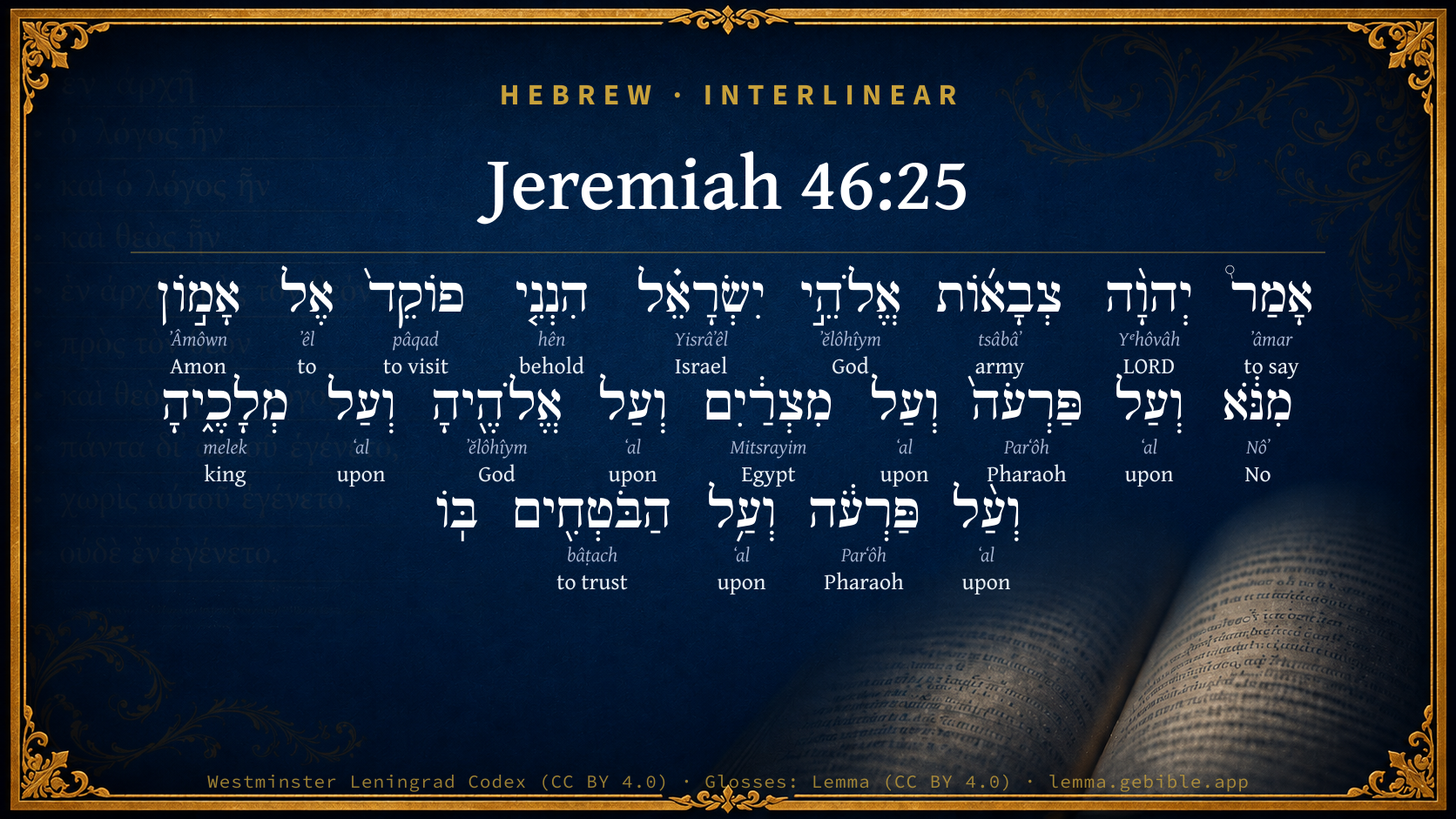
Jeremiah 46:25

Hebrew (Westminster Leningrad Codex) Jeremiah 46:25 appears in the Hebrew Old Testament. The text above is from the Westminster Leningrad Codex. Each word links to its Strong’s number, a concise gloss, and parsing drawn from the Open Scriptures Hebrew Bible morphology. Click any word for its full Brown-Driver-Briggs (BDB) entry.
Download image
Cite this verse

Jeremiah 46:25 (World English Bible). Public Domain. Lemma interlinear Bible study tool, https://lemma.gebible.app/v/jeremiah/46/25.

Show BibTeX & RIS
BibTeX
RIS
English Translation
Yahweh of Hosts, the God of Israel, says: Behold, I will punish Amon of No, and Pharaoh, and Egypt, with her gods, and her kings; even Pharaoh, and those who trust in him:
World English Bible · Public Domain
Highlights
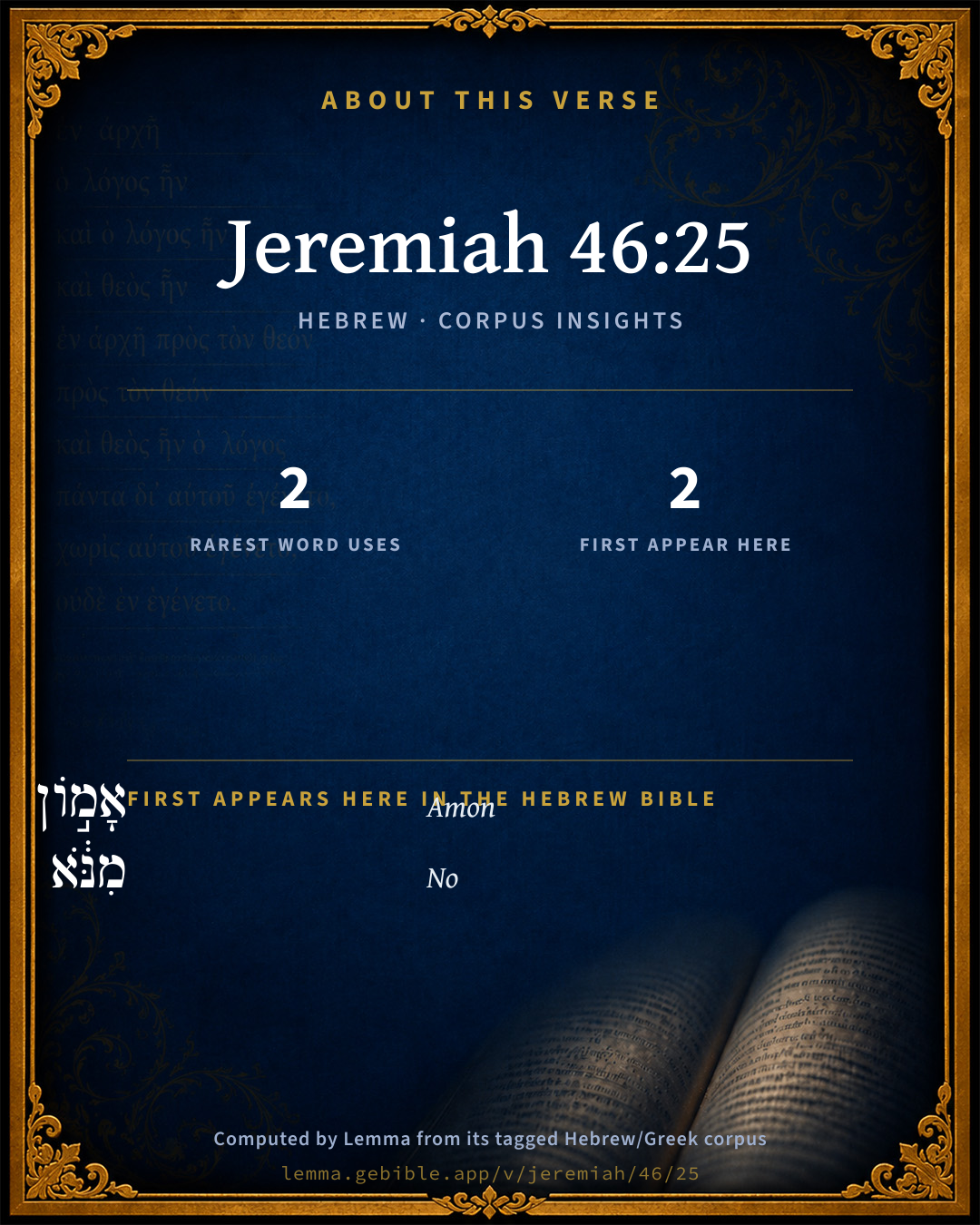
  • 2 first appearances in the Hebrew Bible
Full analysis ↓
Download a study sheet

One document with this verse’s original text, its word-by-word gloss line, the meaning frame, cross-references with their text, attributed commentary, and full source and license credits — printable, and it pastes into notes with its structure intact.

This verse Autodidact and up

Study sheet (.html) Plain text (.txt)

A passage Seminary Student

Up to 50 verses in one chapter. A passage sheet keeps up to 6 commentary sources and 12 cross-references per verse, in the order this page ranks them, and says so on the sheet whenever that leaves anything out. Ask for a single verse and you get the Autodidact verse sheet above.

Everything on this page stays free to read, with no account — the sheet is a download of what is already on screen, not access to it.

Want to remove ads? Support Godless Engineer
Compare translations 3

The same verse in 3 English versions, stacked beneath the original-language interlinear above. Click any original word for its lexicon entry.

Each is an independent rendering of the whole verse — the interlinear is not word-aligned to these translations.

Highlighted words mark where these versions differ — a whole-verse word diff, not a word-by-word alignment.

  • World English Bible Public Domain
    Yahweh of Hosts, the God of Israel, says: Behold, I will punish Amon of No, and Pharaoh, and Egypt, with her gods, and her kings; even Pharaoh, and those who trust in him:
  • King James Version Public Domain
    The LORD of hosts, the God of Israel, saith; Behold, I will punish the multitude of No, and Pharaoh, and Egypt, with their gods, and their kings; even Pharaoh, and all them that trust in him:
  • unfoldingWord Literal Text CC BY-SA 4.0
    Yahweh of hosts, the God of Israel, says, “See, I am about to punish Amon of Thebes, Pharaoh, Egypt and her gods, her kings the Pharaohs, and those who trust in them.

unfoldingWord Literal Text — © unfoldingWord, licensed CC BY-SA 4.0. Word-aligned USFM3 via Door43 (git.door43.org/unfoldingWord/en_ult).

Versions to compare (up to 4)

3 of 4 selected

Show all 18 translations

Every available English version of this verse, each an independent rendering of the whole verse.

  • World English Bible Public Domain
    Yahweh of Hosts, the God of Israel, says: Behold, I will punish Amon of No, and Pharaoh, and Egypt, with her gods, and her kings; even Pharaoh, and those who trust in him:
  • Berean Standard Bible Public Domain
    The LORD of Hosts, the God of Israel, says: “Behold, I am about to punish Amon god of Thebes, along with Pharaoh, Egypt with her gods and kings, and those who trust in Pharaoh.
  • Majority Standard Bible Public Domain
    The LORD of Hosts, the God of Israel, says: “Behold, I am about to punish Amon god of Thebes, along with Pharaoh, Egypt with her gods and kings, and those who trust in Pharaoh.
  • King James Version Public Domain
    The LORD of hosts, the God of Israel, saith; Behold, I will punish the multitude of No, and Pharaoh, and Egypt, with their gods, and their kings; even Pharaoh, and all them that trust in him:
  • American Standard Version (1901) Public Domain
    Jehovah of hosts, the God of Israel, saith: Behold, I will punish Amon of No, and Pharaoh, and Egypt, with her gods, and her kings; even Pharaoh, and them that trust in him:
  • Revised Version (1885) Public Domain
    The LORD of hosts, the God of Israel, saith: Behold, I will punish Amon of No, and Pharaoh, and Egypt, with her gods, and her kings; even Pharaoh, and them that trust in him:
  • Geneva Bible (1599) Public Domain
    Thus saith the Lord of hostes, the God of Israel, Behold, I will visite the common people of No and Pharaoh, and Egypt, with their gods and their Kings, euen Pharaoh, and al them that trust in him,
  • Douay-Rheims (1899) Public Domain
    The Lord of hosts the God of Israel hath said: Behold I will visit upon the tumult of Alexandria, and upon Pharao, and upon Egypt, and upon her gods, and upon her kings, and upon Pharao, upon them that trust in him.
  • Young's Literal Translation Public Domain
    Said hath Jehovah of Hosts, God of Israel: Lo, I am seeing after Amon of No, And after Pharaoh, and after Egypt, And after her gods, and after her kings, And after Pharaoh, and after those trusting in him,
  • Literal Standard Version CC BY-SA 4.0
    YHWH of Hosts, God of Israel, has said: Behold, I am seeing after Amon of No, || And after Pharaoh, and after Egypt, || And after her gods, and after her kings, || And after Pharaoh, and after those trusting in him,
  • Unlocked Literal Bible CC BY-SA 4.0
    Yahweh of hosts, the God of Israel, says, “See, I am about to punish Amon of Thebes, Pharaoh, Egypt and her gods, her kings the Pharaohs, and those who trust in them.
  • unfoldingWord Literal Text CC BY-SA 4.0
    Yahweh of hosts, the God of Israel, says, “See, I am about to punish Amon of Thebes, Pharaoh, Egypt and her gods, her kings the Pharaohs, and those who trust in them.
  • Darby Bible Public Domain
    Jehovah of hosts, the God of Israel, saith, Behold, I will punish Amon of No, and Pharaoh, and Egypt, and her gods, and her kings; yea, Pharaoh and them that confide in him.
  • World Messianic Bible Public Domain
    The LORD of Hosts, the God of Israel, says: “Behold, I will punish Amon of No, and Pharaoh, and Egypt, with her gods and her kings, even Pharaoh, and those who trust in him.
  • Webster's Bible Public Domain
    The LORD of hosts, the God of Israel saith: Behold, I will punish the multitude of No, and Pharaoh, and Egypt, with their gods, and their kings; even Pharaoh, and all them that trust in him:
  • Free Bible Version CC BY-SA 4.0
    The Lord Almighty, the God of Israel, says: Watch, because I will punish Amon, the god of Thebes, and Pharaoh. I will punish the people of Egypt with their gods and kings, and everyone who trusts in Pharaoh.
  • Bible in Basic English Public Domain
    The Lord of armies, the God of Israel, has said: See, I will send punishment on Amon of No and on Pharaoh and on those who put their faith in him;
  • JPS Tanakh (1917) Public Domain
    The LORD of hosts, the God of Israel, saith: Behold, I will punish Amon of No, and Pharaoh, and Egypt, with her gods, and her kings; even Pharaoh, and them that trust in him;

Literal Standard Version (2020), Covenant Press — licensed CC BY-SA 4.0. Text via the HelloAO Bible API (eBible.org). Unlocked Literal Bible (unfoldingWord) — licensed CC BY-SA 4.0. Text via the HelloAO Bible API (eBible.org). unfoldingWord Literal Text — © unfoldingWord, licensed CC BY-SA 4.0. Word-aligned USFM3 via Door43 (git.door43.org/unfoldingWord/en_ult). Free Bible Version, Dr. Jonathan Gallagher — licensed CC BY-SA 4.0. Text via the HelloAO Bible API (eBible.org).

Word by word

More ways to search: Search by grammar → Find every occurrence → Compare this word →

Practice this passage: Drill this verse → Learn its vocabulary →

אָמ֣וֹן
ʼÂmôwn
H528
“Amon”
Noun, Proper
Part of Speech
Noun
Type
Proper
Full BDB Definition

Origin: of Egyptian derivation

TWOT: None

Amon or Amun = "to nourish: to be faithful" - an Egyptian god, originally the local god of Thebes, later head of the Egyptian pantheon
  1. אָמַר֩ ʼâmar H559 “to say” Verb, Qal, Perfect, 3rd Person, Masculine, Singular
  2. יְהוָ֨ה Yᵉhôvâh H3068 “LORD” Noun, Proper
  3. צְבָא֜וֹת tsâbâʼ H6635 “armies” Noun, Common, Both, Plural, Absolute
  4. אֱלֹהֵ֣י ʼĕlôhîym H430 “God(s) of” Noun, Common, Masculine, Plural, Construct
  5. יִשְׂרָאֵ֗ל Yisrâʼêl H3478 “Israel” Noun, Proper
  6. הִנְנִ֤י hên H2005 “behold · me” Particle, Demonstrative + Suffix, Personal, 1st Person, Common, Singular
  7. פוֹקֵד֙ pâqad H6485 “visiting” Verb, Qal, Participle Active, Masculine, Singular, Absolute
  8. אֶל ʼêl H413 “to” Preposition
  9. מִנֹּ֔א Nôʼ H4996 “from · No” Preposition + Noun, Proper
  10. וְעַל ʻal H5921 “and · upon” Conjunction + Preposition
  11. פַּרְעֹה֙ Parʻôh H6547 “Pharaoh” Noun, Proper
  12. וְעַל ʻal H5921 “and · upon” Conjunction + Preposition
  13. מִצְרַ֔יִם Mitsrayim H4714 “Egypt” Noun, Proper
  14. וְעַל ʻal H5921 “and · upon” Conjunction + Preposition
  15. אֱלֹהֶ֖יהָ ʼĕlôhîym H430 “God(s) · her” Noun, Common, Masculine, Plural, Construct + Suffix, Personal, 3rd Person, Feminine, Singular
  16. וְעַל ʻal H5921 “and · upon” Conjunction + Preposition
  17. מְלָכֶ֑יהָ melek H4428 “kings · her” Noun, Common, Masculine, Plural, Construct + Suffix, Personal, 3rd Person, Feminine, Singular
  18. וְעַ֨ל ʻal H5921 “and · upon” Conjunction + Preposition
  19. פַּרְעֹ֔ה Parʻôh H6547 “Pharaoh” Noun, Proper
  20. וְעַ֥ל ʻal H5921 “and · upon” Conjunction + Preposition
  21. הַבֹּטְחִ֖ים bâṭach H982 “the · trusting” Particle, Definite Article + Verb, Qal, Participle Active, Masculine, Plural, Absolute

About this verse

These counts appear in no published source. They are computed here, from the morphology-tagged text and Lemma’s own curated glosses. What Lemma adds →

23
words
15
distinct lemmas
Prophets
section

Notable vocabulary

The rarest word here is אָמ֣וֹן Amon H528 — appearing just 2 times in the whole Hebrew Bible.

First appearance in Scripture

These words make their first canonical appearance in the Hebrew Bible here:

  • אָמ֣וֹן Amon H528
  • מִנֹּ֔א No H4996

Shared distinctive vocabulary

אָמ֣וֹן Amon H528 occurs in 2 verses of the Hebrew Bible. Also found in:

Grammatical profile

  • 3 verbs
  • 11 nouns
  • 8 prepositions
  • 1 particle

Verb forms

  • אָמַר֩ Qal · Perfect
  • פוֹקֵד֙ Qal · Participle Active
  • הַבֹּטְחִ֖ים Qal · Participle Active

Repetition

Words recur within this verse — often emphatic in Hebrew:

  • וְעַל upon H5921 ×6
  • אֱלֹהֵ֣י God H430 ×2
  • פַּרְעֹה֙ Pharaoh H6547 ×2

Cross-references

13

Topical passages linked to Jeremiah 46:25 in the Treasury of Scripture Knowledge — connected by theme and wording, ordered by reader-vote popularity; previews shown in the World English Bible.

  • Zephaniah 2:11 Yahweh will be awesome to them, for he will famish all the gods of the land. Men will worship him, everyone from his place, even all the shores of the nations.
  • Exodus 12:12 For I will go through the land of Egypt in that night, and will strike all the firstborn in the land of Egypt, both man and animal. Against all the gods of Egypt I will execute judgments: I am Yahweh.
  • Isaiah 20:5–6 They shall be dismayed and confounded, because of Ethiopia their expectation, and of Egypt their glory.
  • Jeremiah 43:12–13 I will kindle a fire in the houses of the gods of Egypt; and he shall burn them, and carry them away captive: and he shall array himself with the land of Egypt, as a shepherd puts on his garment; and he shall go forth from there in peace.
  • Isaiah 19:1 The burden of Egypt. Behold, Yahweh rides on a swift cloud, and comes to Egypt: and the idols of Egypt shall tremble at his presence; and the heart of Egypt shall melt in the midst of it.
  • Isaiah 30:2–3 that set out to go down into Egypt, and have not asked at my mouth; to strengthen themselves in the strength of Pharaoh, and to take refuge in the shadow of Egypt!
  • Isaiah 31:1–3 Woe to those who go down to Egypt for help, and rely on horses, and trust in chariots because they are many, and in horsemen because they are very strong, but they don't look to the Holy One of Israel, neither seek Yahweh!
  • Jeremiah 17:5–6 Thus says Yahweh: Cursed is the man who trusts in man, and makes flesh his arm, and whose heart departs from Yahweh.
  • Jeremiah 42:14–16 saying, No; but we will go into the land of Egypt, where we shall see no war, nor hear the sound of the trumpet, nor have hunger of bread; and there will we dwell:
  • Ezekiel 30:13–16 Thus says the Lord Yahweh: I will also destroy the idols, and I will cause the images to cease from Memphis; and there shall be no more a prince from the land of Egypt: and I will put a fear in the land of Egypt.
  • Ezekiel 32:9–12 I will also vex the hearts of many peoples, when I shall bring your destruction among the nations, into the countries which you have not known.
  • Ezekiel 39:6–7 I will send a fire on Magog, and on those who dwell securely in the isles; and they shall know that I am Yahweh.
  • Nahum 3:8–9 Are you better than No-Amon, who was situated among the rivers, who had the waters around her; whose rampart was the sea, and her wall was of the sea?

Cross-references courtesy of OpenBible.info (CC BY 4.0).

Hebrew and Greek witnesses Masoretic Hebrew ↔ Greek Septuagint

The same verse in the two great witnesses to the Old Testament, shown verse-for-verse.

These are two independent witnesses, not word-aligned to each other, and the Septuagint is shown in lemma (dictionary) form.

Hebrew Jeremiah 46:25 Masoretic · Westminster Leningrad Codex

אָמַר֩ יְהוָ֨ה צְבָא֜וֹת אֱלֹהֵ֣י יִשְׂרָאֵ֗ל הִנְנִ֤י פוֹקֵד֙ אֶל אָמ֣וֹן מִנֹּ֔א וְעַל פַּרְעֹה֙ וְעַל מִצְרַ֔יִם וְעַל אֱלֹהֶ֖יהָ וְעַל מְלָכֶ֑יהָ וְעַ֨ל פַּרְעֹ֔ה וְעַ֥ל הַבֹּטְחִ֖ים בּֽוֹ

Yahweh of Hosts, the God of Israel, says: Behold, I will punish Amon of No, and Pharaoh, and Egypt, with her gods, and her kings; even Pharaoh, and those who trust in him:

World English Bible · Public Domain

Greek LXX Structure differs

In the Septuagint, Jeremiah is about an eighth shorter than the Hebrew and arranges its material differently — the Oracles Against the Nations (Hebrew chapters 46–51) appear in the middle of the Greek book, after 25:13. Because the chapter and verse boundaries do not line up, a verse-for-verse comparison with the Hebrew is not shown.

A verse-for-verse comparison isn’t shown here because the chapters and verses don’t line up. Switch to the LXX edition with the MT / LXX toggle above to read the Greek directly.

On this verse, Joseph Benson's Commentary discusses the Septuagint’s reading. Read the note in Commentary ↓

Hebrew: Westminster Leningrad Codex (CC BY 4.0). Greek: Septuagint (public domain); English from a public-domain English Septuagint. How the Septuagint differs from the Hebrew →

Targum (Aramaic paraphrase)

1

The Targum is the ancient Jewish Aramaic paraphrase of the Hebrew Scriptures — an interpretive translation, not the Hebrew text itself. Onkelos (literal) and Pseudo-Jonathan (expansive) render the Torah, and Jonathan the Prophets. Coverage is partial: where no permissively-licensed English translation exists for a verse, only the Aramaic is shown. This is verse-level text, not a word-by-word alignment to the Hebrew.

  1. Targum Jonathan Prophets (Joshua–Malachi)
    אֲמַר יְיָ צְבָאוֹת אֱלָהָא דְיִשְׂרָאֵל הָא אֲנָא מַסְעַר עַל אִתְרְגוּשַׁת אֲלַכְּסַנְדְרַיָא וְעַל פַּרְעֹה וְעַל מִצְרַיִם וְעַל טַעֲוָתָהָא וְעַל מַלְכְּהָא וְעַל פַּרְעֹה וְעַל דְמִתְרַחֲצִין עֲלוֹהִי:

    (no public-domain English translation for this verse)

    Targum Jonathan — Aramaic: “Mikraot Gedolot” (public domain). English: “Sefaria Community Translation” (CC0 1.0 (public-domain dedication)); “London "Chaldee Paraphrase," 1871” (public domain). Text via Sefaria.

Commentary

Notes on Jeremiah 46:25 from classic Christian and Jewish commentators (each source and its license shown beneath its notes). The classic Christian expositions comment on the surrounding passage and are grouped to its opening verse, so a note may address several verses; the Jewish commentaries on the Tanakh (Rashi and others) are per-verse, so they appear only where the commentator wrote on this verse.

Lemma curates 59 commentaries, every one of them public domain or Creative Commons licensed, each selected and text-cleaned for this edition rather than reprinted as found. About our sources →

Trapp's Complete Commentary

John Trapp

Jer 46:25 The LORD of hosts, the God of Israel, saith; Behold, I will punish the multitude of No, and Pharaoh, and Egypt, with their gods, and their kings; even Pharaoh, and [all] them that trust in him:

Ver. 25. The Lord of hosts, the God of Israel, saith.] And shall he say and not do? {Num 23:19} Shall the word of God be broken {Joh 10:35}

John Trapp, A Commentary or Exposition upon All the Books of the Old and New Testament (1647–1656) — public domain. Text from a community e-Sword module.

Joseph Benson's Commentary

Jer 46:25-26. Behold, I will punish the multitude of No — Hebrew, מנא אמון, Amon of No, which, says Blaney, “is the literal translation, and we need seek for no other.” Amon, or Ammon, as the word is generally written, was the name by which the Egyptians called Jupiter, who had a celebrated temple at Thebes, famous for its hundred gates in Homer’s time, and supposed to be the same city with No here mentioned. Here Jupiter was worshipped in a distinguished manner, on which account the place was called Diospolis, the city of Jupiter, which name the LXX. have put for No, Eze 30:14-16. If therefore No be Thebes, or Diospolis, as it seems evident it is, then Amman of No signifies the deity of the place, the Theban Jupiter, as Herodotus styles him, lib. 2. cap. 42. As, on the other hand, נא אמון, No-ammon, Nah 3:8, should be rendered, No of Amman, which exactly corresponds with the Greek Διοσπολις, or, city of Jupiter. But very different from these is the term, את המון נא, used Eze 30:15, which indeed signifies the multitude, or numerous inhabitants of No; although, from the similitude of the words אמון and המון, Amon and Hamon, our translators, and others besides them, have confounded them together. Some have supposed No to mean Alexandria, the great emporium of Egypt; and the Chaldee and Vulgate have rendered it so. But Alexandria was not built till ages after the time when Jeremiah prophesied: and it does not appear that there had been before any city, at least any considerable one, standing upon the spot which the founder made the object of his choice. And Pharaoh and Egypt, with their gods and their kings — The same divine vengeance, which falls upon the idol Ammon and his worshippers, shall reach the rest of Egypt with their respective idols and governors. “When an idolatrous nation,” says Blaney, “is doomed to destruction, God is said to execute vengeance upon the idols of the country: see Jer 43:12-13. Accordingly, here Ammon of No, the principal deity, and Pharaoh, the principal man, among the Egyptians, are marked out in the first place as the primary objects of divine visitation; then follows, in the gross, Egypt with all her gods, and all her kings; which latter term is explained to include both Pharaoh himself, and those subordinate rulers who were dependant upon him for the rank and authority they held. And afterward it shall be inhabited, as in the days of old — At the end of forty years Egypt was to begin to recover itself, as Ezekiel foretels, Eze 29:13.

Joseph Benson's Commentary on the Old and New Testaments (1811–1818) — public domain. Text from a community e-Sword module.

Tyndale Open Study Notes

Tyndale Open Resources

46:25-26 Amon was a fertility god worshiped in Thebes, the capital of Southern Egypt. Amon’s idol, in the form of a ram, represented the sun. The Egyptians thought that this god was very powerful, but like all the other deities of Egypt, it would be destroyed by the all-powerful God of Israel. The Pharaoh, who claimed to be the son of the sun-god, would suffer the same fate. • the land will recover: In 601 BC, Nebuchadnezzar attacked Egypt, did great damage, and then withdrew. He invaded the land again in 568–567 BC (43:8-13; Ezek 29:19).

Tyndale Open Study Notes — © Tyndale Open Resources, licensed CC BY-SA 4.0. Text via the HelloAO Bible API.

Geneva Bible (1599)

Geneva Bible translators

Some take the Hebrew word Amon for the King’s name of No, that is, of Alexandria.

Geneva Bible (1599) marginal notes — public domain. Text via Bolls.life.

Jamieson, Fausset & Brown

Robert Jamieson, A. R. Fausset & David Brown

multitude--Hebrew, "Amon" (Nah 3:8, Margin, "No-Ammon"), the same as Thebes or Diospolis in Upper Egypt, where Jupiter Ammon had his famous temple. In English Version, "multitude" answers to "populous No" (Nah 3:8; Eze 30:15). The reference to "their gods" which follows, makes the translation more likely, "Ammon of No," that is, No and her idol Ammon; so the Chaldee Version. So called either from Ham, the son of Noah; or, the "nourisher," as the word means.

their kings--the kings of the nations in league with Egypt.

Jamieson, Fausset & Brown — Commentary Critical and Explanatory on the Whole Bible (1871) — public domain (CC PDM 1.0). Text via the HelloAO Bible API.

Adam Clarke's Commentary

Verse 25. The multitude of No] אמון מנא Amon minno, the Amon of No, called by the Greeks Διοσπολις, or Jupiter's city. It was the famous Thebes, celebrated anciently for its hundred gates. Amon was the name by which the Egyptians called Jupiter, who had a famous temple at Thebes.

The word Pharaoh is twice repeated here; and Dr. Dahler thinks that one may design Pharaoh Hophrah, and the other Amasis, the new king.

Adam Clarke's Commentary on the Bible (1810–1826) — public domain. Text from a community e-Sword/MySword module.

John Calvin's Commentaries

The Prophet speaks again in God’s name, and sets God’s glory in opposition to the perverseness of his own nation; for, as it has been said, he effected but little when he threatened the Egyptians. For the Jews, believing that land to be impregnable, were secure; because they thought that the Egyptians would come to their aid, and so they believed that they were fortified against any hostile power. As then the Jews were inebriated with this false confidence, the Prophet was constrained, not only with many words to enlarge on this subject, but also to introduce God as the judge.

He then does not speak here in his own words, but says, Jehovah of hosts, the God of Israel, hath spoken, Behold I, etc. It was a form of speaking much more forcible than if the Prophet had repeated in his own name what God had committed to him; and yet the Jews were not moved: but still this mode of speaking was calculated to break down their obduracy. he then says, Behold, I will visit the multitude, etc. The word אמון, amun, is to be taken here for המון, emun; א, aleph, is put for ה, he; though some render it “king,” but improperly: I will visit the multitude which is from Alexandria We know that this was a celebrated city of Egypt, though it had not yet this name; for Alexander was not born, who called it by his own name; but it had its old name נא, na, and it was so called by the Hebrews. In after time it was called Alexandria, its name having been changed.

But there is here a statement of a part for the whole, for the Prophet included the whole of Egypt; what is general is comprehended under what is particular; for God spared not the other cities of Egypt; and it appears from the context that the prophecy extended to all parts of that land, not one angle, even the least, being excepted. But as Alexandria might have remained safe, while the other cities were destroyed, it is here especially mentioned, as though he had said, that nothing would be safe in Egypt. Behold, he says, I will visit the multitude, etc. It was a very populous city, as we gather from heathen writers; and hence it was that it was full of pride, for they thought it sufficiently safe when they had as it were a proportionate army. But the Prophet derides this vain glory, and says that the vast number of people in Alexandria would avail nothing to prevent the Chaldeans to take possession of it.

I will visit, he says, the whole people, and then Pharaoh and Egypt We now clearly see that the city named was the chief city, and that its multitude was expressly mentioned, that the Egyptians might know, that they could not escape destruction, because they had war with God, and not with men; for as long as they looked on the Chaldeans alone, they remained secure. But the Prophet awakens them from their lethargy, and says, that they were not to look on what the Chaldeans of themselves could do, for they would carry on war under the banner of God, and under his guidance would, without any difficulty, penetrate through the whole of Egypt. Hence he says, I will visit Pharaoh and Egypt

He adds, and her gods. We know that that land was very much given to superstitions, that the Egyptians had imbibed gross and shameful errors, though otherwise remarkable for their wisdom and knowledge. But God had smitten them with madness, so that they were become almost like brute beasts. Besides, as they thought that they had perfect safety in their idols, the Prophet shakes off this confidence, and declares that God would not only be the judge of men but also of the idols. For we know that men strengthen themselves against God’s threatenings either by superstition or by confidence in their own strength: as long as they depend on the world, they gather from all quarters some grounds of hope; and hence it is, that they think that they will be safe though in opposition to God’s will. The Prophet beats down this folly when he says, Behold, I will visit the multitude of Alexandria, and adds, I will visit the gods of Egypt. As the unbelieving, when they find earthly aids not sufficient for them, flee to God, but not in the right way, for they become vain in their foolish thoughts; hence is the reason why the Prophet threatens the idols of Egypt.

He adds, her kings. There was indeed but one king in Egypt, why then does he mention kings? This may be explained of successors; but I prefer taking “kings” here as meaning the satraps and princes, for we know that the kingdom was very opulent, that it had many equal to kings. I therefore think that the Prophet adorned the princes and satraps of Egypt with this high title; and he confirms this opinion by what immediately follows, even — Pharaoh and those who trust in him He repeats the name of Pharaoh, and when he says that he would visit those who trust in him, I doubt not but that the Prophet points out those whom he had before designated “kings.” We now then perceive the real meaning, that though Pharaoh had many defenses, being strengthened by a great multitude of men, and had also mighty satraps, yet all this would prove fading and evanescent, when he would have to carry on war with God: and God declares here that he would be the general of the whole war guiding and directing the Chaldeans. It now follows, —

John Calvin's Commentaries (1540-1563) — public domain. Text from the Calvin Translation Society English edition (1840s-50s) via the Christian Classics Ethereal Library (ccel.org). Calvin's coverage is partial (roughly two-thirds of the Bible); uncommented books and verses are honest gaps, never fabricated. The 19th-century editor's footnotes and remarks are omitted so the notes are faithfully Calvin's own voice.

Ellicott's Commentary for English Readers

(25) The multitude of No.—More accurately, I will punish Amon No. The first word is the Egyptian Ammon or Hammon, but is probably used also, with a natural paronomasia on the name of the city, in its Hebrew sense of “multitude.” “No” here, and as No Amon in Nah_3:8, stands for Thebes, the capital of Upper Egypt. The name appears in the form NIA in Assyrian inscriptions. Compare also Eze_30:14-16.

A Bible Commentary for English Readers, edited by Charles John Ellicott (1878–1897) — public domain. Text from a community e-Sword module.

The Cambridge Bible for Schools and Colleges

gen. ed. J. J. S. Perowne

25. Amon of No] i.e. the chief god worshipped in No (cp. No-Amon, Nah_3:8). Thebes, the capital of Upper Egypt (now Luxor), a city of great interest from its remains of antiquity in the way of sculpture and tombs. It supplanted Memphis as a great centre, but declined under the Ptolemies. See Eze_30:14 ff. Amon was represented in various ways, e.g. as a figure with a ram’s head and human body. “In course of time he absorbed into himself almost all the other deities of Egypt.” Sayce, Anc. Empires, p. 63.

and Pharaoh … her kings] omit with LXX.

them that trust in him] those Jews who still persistently trusted in Egypt as a support against Babylon.

The Cambridge Bible for Schools and Colleges (gen. ed. J. J. S. Perowne; Cambridge University Press, 1878–1918) — public domain. Text from a community e-Sword module.

John Gill's Exposition

The Lord of hosts, the God of Israel, saith,.... These titles are often given to the Lord, and set before prophecies that come from him; and, according to Kimchi, the reason why he is here spoken of as the God of Israel was, because the vengeance threatened to the Egyptians should come upon them, as a punishment for using Israel ill; as Shishak king of Egypt, and Pharaohnecho, who slew Josiah:

behold, I will punish the multitude of No; the inhabitants of it, which were many, called "populous No", Nah 3:8; a famous city in Egypt. Some take it to be Diospolis or Thebes; and others (p) the same that is now called Alexandria; and so the Targum renders it; and which is followed by the Vulgate Latin version: and Jarchi calls it the seignory or government of Alexandria; and takes Amon, the word for "multitude", to signify the prince of this place; and so Kimchi and Ben Melech interpret it, king of a city called No: rather Jupiter Ammon (q) is meant, an idol of the Egyptians, which had a temple in Thebes, and was worshipped in it; and who had his name from Ham, the son of Noah. Hillerus (r), by various arguments, endeavours to prove that No is the same city with Memphis, and that No Amon signifies "the habitation of the nourished"; that is, of Apis, which was nourished here. But be he who he will, or the place what it will, he or that would certainly be punished;

and Pharaoh, and Egypt, with their gods, and their kings; Pharaoh, the present king of Egypt, who was Pharaohhophra, and all the land of Egypt; and all their numerous idols, which were many indeed; and the several governors of the nomes or provinces into which the land was distributed; these should be punished, and suffer in the general calamity;

even Pharaoh, and all them that trust in him; the Jews that dwelt in Egypt, and who thought themselves safe under his protection; such who went along with Johanan thither, contrary to the will of God; these should not escape punishment, but be involved in the same destruction.

(p) R. David Ganz. Chronolog. par. 2. fol. 10. 1. Elias in Tishbi, p. 11. (q) Vid. Schmidt in loc & Stockium, p. 71. So Bochart. Phaleg. l. 1. c. 1. col. 5, 6. (r) Onomastic. Sacr. p. 571, &c.

John Gill's Exposition of the Whole Bible (1746–1763) — public domain (CC PDM 1.0). Text via the HelloAO Bible API.

Albert Barnes' Notes on the Bible

The multitude of No - Rather, Amon of No. Ammon or Jupiter-Ammon was the first of the supreme triad of Thebes. He was the deity invisible and unfathomable, whose name signifies “the concealed.” No-Amon, is the sacred city of Thebes, the capital of Upper Egypt. First then Yahweh’s anger falls upon the representatives of the highest divine and human powers, Amon of No and Pharaoh. It next punishes Egypt generally, and her gods and her kings, for each city had its special divinity, and inferior rulers were placed in the several parts of the country. Finally, Pharaoh is again mentioned, with “all who trust in him,” i. e., the Jews, who had made Egypt their confidence and not God.

Albert Barnes' Notes on the Bible (1834–1885) — public domain. Text from a community e-Sword/MySword module.

Haydock's Catholic Bible Commentary

Visit upon. That is, punish. --- Alexandria. In the Hebrew No; which was the ancient name of the city, to which Alexander [the Great] gave afterwards the name of Alexandria; (Challoner) or this city was built near Rachotes, the harbour. "Ammon of No" was rather Diospolis, (Ezechiel xxx. 14.; Septuagint) in the [Nile] Delta, north of Busiris. Ammon was the chief god adored at No, Nahum iii. 8. Alexandrian Septuagint, "I will revenge myself on Ammon, her son, on Egypt, or Pharao, and on them." (Haydock) --- Ammon was of their invention, and for this the people were justly punished. It means also, "a multitude." --- Kings. Chap. xlii. 12. Apries was slain, (chap. xliv. 33.; Calmet) and his two successors perished miserably by sentence of Cambyses. (Herodotus iii. 14, 16.)

George Leo Haydock (1774–1849), Haydock's Catholic Family Bible and Commentary, 1859 edition — public domain. Excludes Psalms (Douay-Rheims chapter numbering differs from Protestant) and Deuterocanonical books (Catholic canon only).

Matthew Poole's English Annotations

The Lord of hosts, the God of Israel, saith: these names are often in conjunction given unto God, the first signifying his power or ability to do what he either promiseth or threateneth, the other speaking his kindness and near relation to the Jews.

Behold, I will punish the multitude of No: there are great critical disputes about this phrase, whether the word translated

multitude signifies so, (as it doth Jer 52:15) and if so, whether it should not be multitude from No; or whether it signifies the nourisher, (as some would have it,) because No (which some think is the same city with that at this time called Alexandria, being a great place of merchandise) nourished all the adjacent parts; but it is no easy thing to resolve the question, nor is the resolution of it of much moment to us. By those that trusted in Pharaoh the Jews are most probably meant, who all along in their prosperity put too much confidence in Egypt, and after that Jerusalem was taken some of them (as we before heard) fled into Egypt for sanctuary.

Matthew Poole's English Annotations on the Holy Bible (1683–1685) — public domain. Text from a community e-Sword/MySword module.

Whedon's Commentary on the Bible

Daniel D. Whedon

25. Multitude of No — Rather, Amon of No, referring to the principal idol of Egypt, whose chief seat was at Thebes, here called “No.”

Daniel D. Whedon (gen. ed.), Commentary on the Old and New Testaments (1874–1909) — public domain. Text from a community e-Sword module.

The Pulpit Commentary

The multitude of No; rather, Amen of No. Amon-Ra, or rather Amen-Ra, was the name adopted at Thebes (Homer"s Thebes "of the hundred gateways," "Iliad," 9:383, called here "No," and in Nah_3:8 "No of Anion") from the time of the eleventh dynasty, for the sungod Ra. Amen (Amen) signifies "hidden," for it is the mysterious, invisible deity who manifests himself in bodily form in the sun. From this name comes the classic designation, Jupiter-Ammon. Their gods... their kings; rather, her gods... her kings (viz. Egypt"s). The "kings" are probably the high officials of the state, not a few of whom were either by birth or marriage members of the royal family. Even Pharaoh, and all them that trust in him. With a suggestive allusion to the many in Judah who "trusted" in that "broken reed". (Isa_36:6)

The Pulpit Commentary (1880–1919), ed. H.D.M. Spence-Jones & Joseph S. Exell — public domain. Text from a community e-Sword module.

Scofield Reference Notes

C. I. Scofield

trust

(See Scofield "Psa 2:12").

The Scofield Reference Bible (1917 edition), notes by C. I. Scofield — public domain. Text from a community e-Sword module.

unfoldingWord translationNotes

Door43 World Missions Community

Amon of Thebes

"Amon" is the king of the Egyptian gods. "Thebes" is the capital of the northern part of Egypt, and here it represents the people of Thebes. AT: "Amon, god of Thebes" or "Amon, god of the people of Thebes" (See: How to Translate Names and Metonymy)

Egypt and her gods

Here "Egypt" represents the people. AT: "all the people of Egypt and the gods they worship" (See: Metonymy)

I am giving them into the hand of the ones seeking their lives

Here "hand" represents power or control. The phrase "seeking their lives" is an idiom that mean to want to kill someone. AT: "I will allow those who are wanting to kill them to defeat them" (See: Metonymy and Idiom)

and into the hand of Nebuchadnezzar king of Babylon and his servants

Here "hand" represents power or control. "Nebuchadnezzar ... his servants" names specifically "the ones seeking their lives." AT: "that is, I will allow Nebuchadnezzar king of Babylon and his servants to defeat the Egyptians" (See: Metonymy)

Then after this Egypt will be inhabited

This can be stated in active form. AT: "Then after this, people will live in Egypt again" (See: Active or Passive)

translationWords

Yahweh of hosts

God

Israel

punish

Pharaoh

Egypt

false god

trust

hand

life

Nebuchadnezzar

king

Babylon

servant

declare

unfoldingWord translationNotes — © Distant Shores Media and the Door43 World Missions Community, licensed CC BY-SA 4.0. Source: git.door43.org/Door43/en_tn.

Rashi

Rabbi Shlomo Yitzchaki (Rashi)

upon Amon Heb. אל אמון, [lit. to Amon,] upon Amon, upon the prince Amon. There are some that are an expression of greatness. Cf. “Are you greater than the greatness of No (מִנֹא אָמוֹן)?” (Nahum 3: 8).

of No The great Alexandria (les seigneurs d’Alexandria in O.F.).

Rashi on the Tanakh — English translations: “The Judaica Press complete Tanach with Rashi, translated by A. J. Rosenberg” (CC BY 4.0); “Pentateuch with Rashi's commentary by M. Rosenbaum and A.M. Silbermann, 1929-1934” (public domain); “The Metsudah Tanach series, Lakewood, N.J” (CC BY 4.0); and “The Book of Joshua, Metsudah Publications, 1997” (CC BY 4.0). Text via Sefaria.

Lesson kit

Teaching starters — assembled from the data on this page, not authored interpretation. Every prompt links to the verse data it draws on. Edit before teaching.

Jeremiah, in the Prophets, opens this verse with 23 words (15 distinct Hebrew lemmas). Its most distinctive word is ʼÂmôwn (“Amon”). A historical commentator’s framing appears above. Read the whole chapter for the surrounding context.

Discussion questions

  1. What does “Amon” (ʼÂmôwn) contribute to the verse as a whole?
  2. 2 words here appear for the first time in Scripture. What is being introduced at this debut?
  3. Nahum 3:8 shares the word «Amon» with this verse. How do the two illuminate each other?
  4. “upon” occurs 6× in this one verse. What is the effect of the repetition?
  5. These translations render this verse differently. What is at stake in choosing one wording over another?
  6. The verb «אָמַר֩» is Qal Perfect. How does its form color the action?
  7. Reading how Trapp's Complete Commentary and Joseph Benson's Commentary read this verse, where do the two commentators agree and where do they part?

Things to notice

  • 2 words make their first canonical appearance in Scripture here.
  • These translations choose different wording for 16 words in this verse.
  • “upon” occurs 6× in this single verse.
  • 15 distinct Hebrew lemmas span 23 words in this verse.

Reading settings

Reading text

Shown beneath each verse's original-language words.

Old Testament
Old Testament edition

Read the OT as the Masoretic Hebrew (MT) or the Greek Septuagint (LXX).

English shown for the Greek Septuagint (in the Hebrew ↔ Greek comparison).

Comparing translations? Open the Compare panel on any verse page to stack up to four side by side.