
Jeremiah 37:5

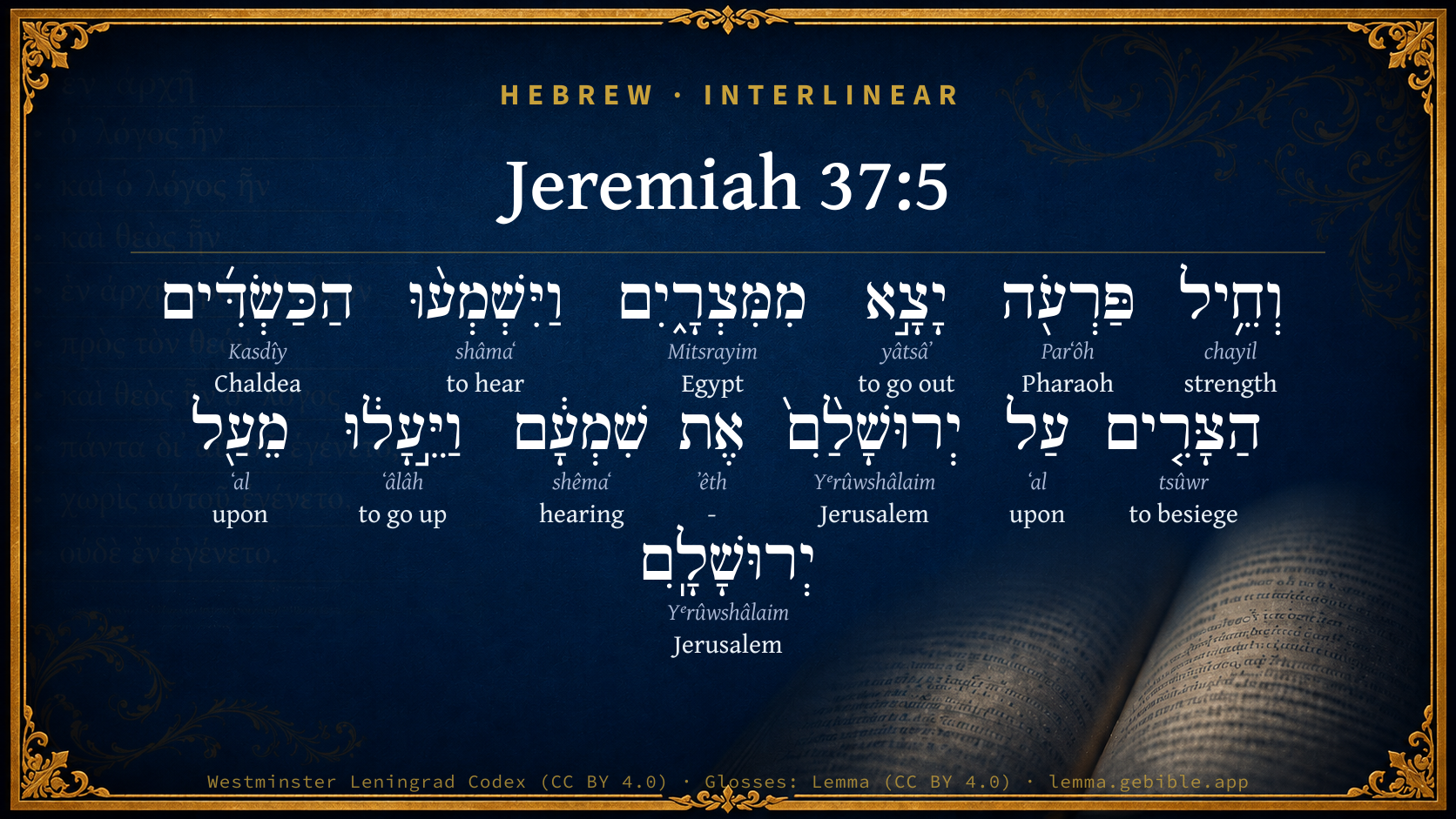
Hebrew (Westminster Leningrad Codex) Jeremiah 37:5 appears in the Hebrew Old Testament. The text above is from the Westminster Leningrad Codex. Each word links to its Strong’s number, a concise gloss, and parsing drawn from the Open Scriptures Hebrew Bible morphology. Click any word for its full Brown-Driver-Briggs (BDB) entry.
Download image
Cite this verse

Jeremiah 37:5 (World English Bible). Public Domain. Lemma interlinear Bible study tool, https://lemma.gebible.app/v/jeremiah/37/5.

Show BibTeX & RIS
BibTeX
RIS
English Translation
Pharaoh's army was come forth out of Egypt; and when the Chaldeans who were besieging Jerusalem heard news of them, they broke up from Jerusalem.
World English Bible · Public Domain
Download a study sheet

One document with this verse’s original text, its word-by-word gloss line, the meaning frame, cross-references with their text, attributed commentary, and full source and license credits — printable, and it pastes into notes with its structure intact.

This verse Autodidact and up

Study sheet (.html) Plain text (.txt)

A passage Seminary Student

Up to 50 verses in one chapter. A passage sheet keeps up to 6 commentary sources and 12 cross-references per verse, in the order this page ranks them, and says so on the sheet whenever that leaves anything out. Ask for a single verse and you get the Autodidact verse sheet above.

Everything on this page stays free to read, with no account — the sheet is a download of what is already on screen, not access to it.

Want to remove ads? Support Godless Engineer
Compare translations 3

The same verse in 3 English versions, stacked beneath the original-language interlinear above. Click any original word for its lexicon entry.

Each is an independent rendering of the whole verse — the interlinear is not word-aligned to these translations.

Highlighted words mark where these versions differ — a whole-verse word diff, not a word-by-word alignment.

  • World English Bible Public Domain
    Pharaoh's army was come forth out of Egypt; and when the Chaldeans who were besieging Jerusalem heard news of them, they broke up from Jerusalem.
  • King James Version Public Domain
    Then Pharaoh's army was come forth out of Egypt: and when the Chaldeans that besieged Jerusalem heard tidings of them, they departed from Jerusalem.
  • unfoldingWord Literal Text CC BY-SA 4.0
    Pharaoh’s army came out from Egypt, and the Chaldeans who were besieging Jerusalem heard the news about them and left Jerusalem.

unfoldingWord Literal Text — © unfoldingWord, licensed CC BY-SA 4.0. Word-aligned USFM3 via Door43 (git.door43.org/unfoldingWord/en_ult).

Versions to compare (up to 4)

3 of 4 selected

Show all 18 translations

Every available English version of this verse, each an independent rendering of the whole verse.

  • World English Bible Public Domain
    Pharaoh's army was come forth out of Egypt; and when the Chaldeans who were besieging Jerusalem heard news of them, they broke up from Jerusalem.
  • Berean Standard Bible Public Domain
    Pharaoh’s army had left Egypt, and when the Chaldeans who were besieging Jerusalem heard the report, they withdrew from Jerusalem.
  • Majority Standard Bible Public Domain
    Pharaoh’s army had left Egypt, and when the Chaldeans who were besieging Jerusalem heard the report, they withdrew from Jerusalem.
  • King James Version Public Domain
    Then Pharaoh's army was come forth out of Egypt: and when the Chaldeans that besieged Jerusalem heard tidings of them, they departed from Jerusalem.
  • American Standard Version (1901) Public Domain
    And Pharaoh's army was come forth out of Egypt; and when the Chaldeans that were besieging Jerusalem heard tidings of them, they brake up from Jerusalem.
  • Revised Version (1885) Public Domain
    And Pharaoh’s army was come forth out of Egypt: and when the Chaldeans that besieged Jerusalem heard tidings of them, they brake up from Jerusalem.
  • Geneva Bible (1599) Public Domain
    Then Pharaohs hoste was come out of Egypt: and when the Caldeans that besieged Ierusalem, heard tidings of them, they departed from Ierusalem)
  • Douay-Rheims (1899) Public Domain
    And the word of the Lord came to Jeremias the prophet, saying:
  • Young's Literal Translation Public Domain
    and the force of Pharaoh hath come out of Egypt, and the Chaldeans, who are laying siege against Jerusalem, hear their report, and go up from off Jerusalem.
  • Literal Standard Version CC BY-SA 4.0
    and the force of Pharaoh has come out of Egypt, and the Chaldeans who are laying siege against Jerusalem hear their report, and go up from off Jerusalem.
  • Unlocked Literal Bible CC BY-SA 4.0
    Pharaoh's army came out from Egypt, and the Chaldeans who were besieging Jerusalem heard the news about them and left Jerusalem.
  • unfoldingWord Literal Text CC BY-SA 4.0
    Pharaoh’s army came out from Egypt, and the Chaldeans who were besieging Jerusalem heard the news about them and left Jerusalem.
  • Darby Bible Public Domain
    And Pharaoh's army was come forth out of Egypt; and when the Chaldeans that besieged Jerusalem heard tidings of them, they went up from Jerusalem.
  • World Messianic Bible Public Domain
    Pharaoh’s army had come out of Egypt; and when the Kasdim who were besieging Jerusalem heard news of them, they withdrew from Jerusalem.
  • Webster's Bible Public Domain
    Then Pharaoh's army had come from Egypt: and when the Chaldeans that besieged Jerusalem heard tidings of them, they departed from Jerusalem.
  • Free Bible Version CC BY-SA 4.0
    Pharaoh's army was advancing from Egypt, and when the Babylonian army heard about it, they moved away from Jerusalem.
  • Bible in Basic English Public Domain
    And Pharaoh's army had come out from Egypt: and the Chaldaeans, who were attacking Jerusalem, hearing news of them, went away from Jerusalem.)
  • JPS Tanakh (1917) Public Domain
    And Pharaoh's army was come forth out of Egypt; and when the Chaldeans that besieged Jerusalem heard tidings of them, they broke up from Jerusalem.

Literal Standard Version (2020), Covenant Press — licensed CC BY-SA 4.0. Text via the HelloAO Bible API (eBible.org). Unlocked Literal Bible (unfoldingWord) — licensed CC BY-SA 4.0. Text via the HelloAO Bible API (eBible.org). unfoldingWord Literal Text — © unfoldingWord, licensed CC BY-SA 4.0. Word-aligned USFM3 via Door43 (git.door43.org/unfoldingWord/en_ult). Free Bible Version, Dr. Jonathan Gallagher — licensed CC BY-SA 4.0. Text via the HelloAO Bible API (eBible.org).

Word by word

More ways to search: Search by grammar → Find every occurrence → Compare this word →

Practice this passage: Drill this verse → Learn its vocabulary →

שִׁמְעָ֔ם
shêmaʻ
H8088
“hearing · their”
Noun, Common, Masculine, Singular, Construct + Suffix, Personal, 3rd Person, Masculine, Plural
Part of Speech
Noun
Type
Common
Gender
Masculine
Number
Singular
State
Construct
Full BDB Definition

Origin: from H8085

TWOT: 2412b

report, a hearing
  1. וְחֵ֥יל chayil H2428 “and · strength of” Conjunction + Noun, Common, Masculine, Singular, Construct
  2. פַּרְעֹ֖ה Parʻôh H6547 “Pharaoh” Noun, Proper
  3. יָצָ֣א yâtsâʼ H3318 “to go out” Verb, Qal, Perfect, 3rd Person, Masculine, Singular
  4. מִמִּצְרָ֑יִם Mitsrayim H4714 “from · Egypt” Preposition + Noun, Proper
  5. וַיִּשְׁמְע֨וּ shâmaʻ H8085 “and · to hear” Conjunction + Verb, Qal, Sequential Imperfect, 3rd Person, Masculine, Plural
  6. הַכַּשְׂדִּ֜ים Kasdîy H3778 “the · Chaldea” Particle, Definite Article + Noun, Proper
  7. הַצָּרִ֤ים tsûwr H6696 “the · besieging” Particle, Definite Article + Verb, Qal, Participle Active, Masculine, Plural, Absolute
  8. עַל ʻal H5921 “upon” Preposition
  9. יְרוּשָׁלִַ֨ם֙ Yᵉrûwshâlaim H3389 “Jerusalem” Noun, Proper
  10. אֶת ʼêth H853 “-” Particle, Direct Object
  11. וַיֵּ֣עָל֔וּ ʻâlâh H5927 “and · to go up” Conjunction + Verb, Niphal, Sequential Imperfect, 3rd Person, Masculine, Plural
  12. מֵעַ֖ל ʻal H5921 “from · upon” Preposition + Preposition
  13. יְרוּשָׁלִָֽם Yᵉrûwshâlaim H3389 “Jerusalem” Noun, Proper

About this verse

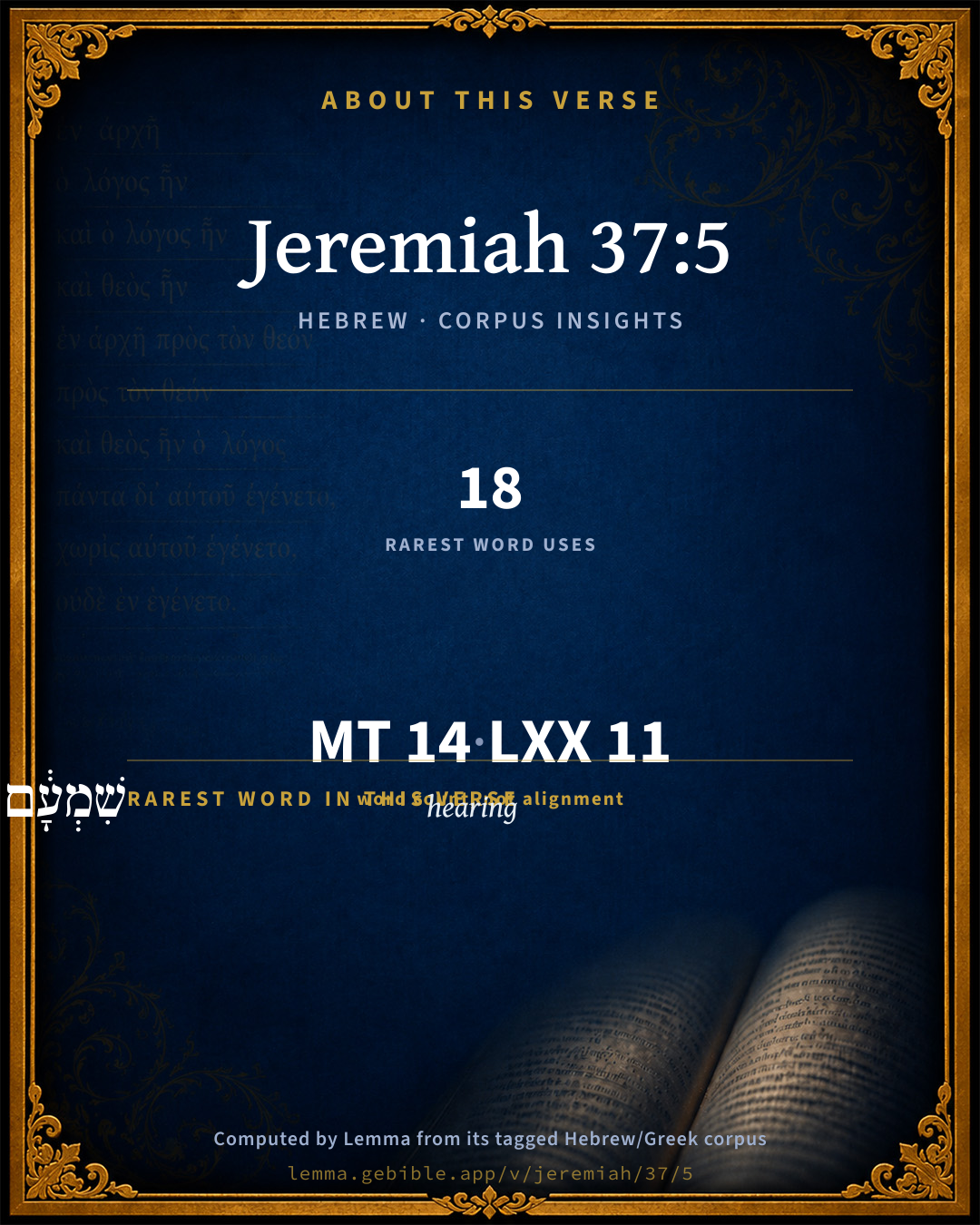
These counts appear in no published source. They are computed here, from the morphology-tagged text and Lemma’s own curated glosses. What Lemma adds →

14
words
12
distinct lemmas
Prophets
section

Notable vocabulary

The rarest word here is שִׁמְעָ֔ם hearing H8088 — appearing just 18 times in the whole Hebrew Bible.

Shared distinctive vocabulary

שִׁמְעָ֔ם hearing H8088 occurs in 17 verses of the Hebrew Bible. Also found in:

Grammatical profile

  • 4 verbs
  • 7 nouns
  • 2 prepositions
  • 1 particle

Verb forms

  • יָצָ֣א Qal · Perfect
  • וַיִּשְׁמְע֨וּ Qal · Sequential Imperfect
  • הַצָּרִ֤ים Qal · Participle Active
  • וַיֵּ֣עָל֔וּ Niphal · Sequential Imperfect

Repetition

Words recur within this verse — often emphatic in Hebrew:

  • עַל upon H5921 ×2
  • יְרוּשָׁלִַ֨ם֙ Jerusalem H3389 ×2

Hebrew & Septuagint length

In the original languages it is 14 Hebrew tokens and 11 Greek tokens — but the two are counted differently (Hebrew bundles its prefixes and suffixes into one token; the Greek is in lemma form), so that isn’t a like-for-like length.

Cross-references

5

Topical passages linked to Jeremiah 37:5 in the Treasury of Scripture Knowledge — connected by theme and wording, ordered by reader-vote popularity; previews shown in the World English Bible.

  • Ezekiel 17:15 But he rebelled against him in sending his ambassadors into Egypt, that they might give him horses and much people. Shall he prosper? shall he escape who does such things? shall he break the covenant, and yet escape?
  • 2 Kings 24:7 The king of Egypt didn't come again out of his land any more; for the king of Babylon had taken, from the brook of Egypt to the river Euphrates, all that pertained to the king of Egypt.
  • Jeremiah 34:21 Zedekiah king of Judah and his princes will I give into the hand of their enemies, and into the hand of those who seek their life, and into the hand of the king of Babylon's army, who have gone away from you.
  • Jeremiah 37:11 It happened that, when the army of the Chaldeans was broken up from Jerusalem for fear of Pharaoh's army,
  • Jeremiah 37:7 Thus says Yahweh, the God of Israel, Thus shall you tell the king of Judah, who sent you to me to inquire of me: Behold, Pharaoh's army, which is come forth to help you, shall return to Egypt into their own land.

Cross-references courtesy of OpenBible.info (CC BY 4.0).

Hebrew and Greek witnesses Masoretic Hebrew ↔ Greek Septuagint

The same verse in the two great witnesses to the Old Testament, shown verse-for-verse.

These are two independent witnesses, not word-aligned to each other, and the Septuagint is shown in lemma (dictionary) form.

Hebrew Jeremiah 37:5 Masoretic · Westminster Leningrad Codex

וְחֵ֥יל פַּרְעֹ֖ה יָצָ֣א מִמִּצְרָ֑יִם וַיִּשְׁמְע֨וּ הַכַּשְׂדִּ֜ים הַצָּרִ֤ים עַל יְרוּשָׁלִַ֨ם֙ אֶת שִׁמְעָ֔ם וַיֵּ֣עָל֔וּ מֵעַ֖ל יְרוּשָׁלִָֽם

Pharaoh's army was come forth out of Egypt; and when the Chaldeans who were besieging Jerusalem heard news of them, they broke up from Jerusalem.

World English Bible · Public Domain

Greek LXX Structure differs

In the Septuagint, Jeremiah is about an eighth shorter than the Hebrew and arranges its material differently — the Oracles Against the Nations (Hebrew chapters 46–51) appear in the middle of the Greek book, after 25:13. Because the chapter and verse boundaries do not line up, a verse-for-verse comparison with the Hebrew is not shown.

A verse-for-verse comparison isn’t shown here because the chapters and verses don’t line up. Switch to the LXX edition with the MT / LXX toggle above to read the Greek directly.

Hebrew: Westminster Leningrad Codex (CC BY 4.0). Greek: Septuagint (public domain); English from a public-domain English Septuagint. How the Septuagint differs from the Hebrew →

Targum (Aramaic paraphrase)

1

The Targum is the ancient Jewish Aramaic paraphrase of the Hebrew Scriptures — an interpretive translation, not the Hebrew text itself. Onkelos (literal) and Pseudo-Jonathan (expansive) render the Torah, and Jonathan the Prophets. Coverage is partial: where no permissively-licensed English translation exists for a verse, only the Aramaic is shown. This is verse-level text, not a word-by-word alignment to the Hebrew.

  1. Targum Jonathan Prophets (Joshua–Malachi)
    וּמַשִׁרְיַת פַּרְעֹה נַפְקָא מִמִצְרַיִם וּשְׁמָעוּ כַשְׂדָאֵי דְצַיְרִין עַל יְרוּשְׁלֵם יַת שִׁמְעֲהוֹן וְאִסְתַּלָקוּ מֵעַל יְרוּשְׁלֵם:

    (no public-domain English translation for this verse)

    Targum Jonathan — Aramaic: “Mikraot Gedolot” (public domain). English: “Sefaria Community Translation” (CC0 1.0 (public-domain dedication)); “London "Chaldee Paraphrase," 1871” (public domain). Text via Sefaria.

Commentary

Notes on Jeremiah 37:5 from classic Christian and Jewish commentators (each source and its license shown beneath its notes). The classic Christian expositions comment on the surrounding passage and are grouped to its opening verse, so a note may address several verses; the Jewish commentaries on the Tanakh (Rashi and others) are per-verse, so they appear only where the commentator wrote on this verse.

Lemma curates 59 commentaries, every one of them public domain or Creative Commons licensed, each selected and text-cleaned for this edition rather than reprinted as found. About our sources →

Trapp's Complete Commentary

John Trapp

Jer 37:5 Then Pharaoh’s army was come forth out of Egypt: and when the Chaldeans that besieged Jerusalem heard tidings of them, they departed from Jerusalem.

Ver. 5. Then Pharaoh’s army was come out of Egypt.] This, then, seemeth to be the occasion that moved Zedekiah to send to the prophet for his prayers - viz., that God would be pleased to prosper the Egyptians coming to raise the siege, and to keep off the Chaldeans from returning to Jerusalem. But God had before signified his will to the contrary; and the Jews, trusting to human helps, took not a right course for their own preservation. See Jer 34:17-22

John Trapp, A Commentary or Exposition upon All the Books of the Old and New Testament (1647–1656) — public domain. Text from a community e-Sword module.

Tyndale Open Study Notes

Tyndale Open Resources

37:5 The Babylonians began their siege of Jerusalem in 588 BC. But they left Jerusalem because the army of Pharaoh Hophra was coming to help Judah. The Babylonians hoped to block and defeat the Egyptians, which they did.

Tyndale Open Study Notes — © Tyndale Open Resources, licensed CC BY-SA 4.0. Text via the HelloAO Bible API.

Geneva Bible (1599)

Geneva Bible translators

To help the Jews.

Hebrew, went up.

Geneva Bible (1599) marginal notes — public domain. Text via Bolls.life.

Jamieson, Fausset & Brown

Robert Jamieson, A. R. Fausset & David Brown

After this temporary diversion, caused by Pharaoh in favor of Jerusalem, the Egyptians returned no more to its help (Kg2 24:7). Judea had the misfortune to lie between the two great contending powers, Babylon and Egypt, and so was exposed to the alternate inroads of the one or the other. Josiah, taking side with Assyria, fell in battle with Pharaoh-necho at Megiddo (Kg2 23:29). Zedekiah, seeking the Egyptian alliance in violation of his oath, was now about to be taken by Nebuchadnezzar (Ch2 36:13; Eze 17:15, Eze 17:17).

Jamieson, Fausset & Brown — Commentary Critical and Explanatory on the Whole Bible (1871) — public domain (CC PDM 1.0). Text via the HelloAO Bible API.

Adam Clarke's Commentary

Verse 5. Then Pharaoh's army] This was Pharao-hophra or Apries, who then reigned in Egypt in place of his father Necho. See Eze 29:6, &c. Nebuchadnezzar, hearing that the Egyptian army, on which the Jews so much depended, was on their march to relieve the city, suddenly raised the siege, and went to meet them. In the interim Zedekiah sent to Jeremiah to inquire of the Lord to know whether they might consider themselves in safety.

Adam Clarke's Commentary on the Bible (1810–1826) — public domain. Text from a community e-Sword/MySword module.

Ellicott's Commentary for English Readers

(5) Then Pharaoh’s army was come forth out of Egypt.—The despatch of the Egyptian army was the result of negotiations which Zedekiah had opened with Pharaoh-Hophra, with a view to resisting the power of Nebuchadnezzar (Eze_17:15). Like the Egyptian armies in general, it was strong in chariots and horses (Eze_17:15; Isa_31:1; Isa_36:9), and able to carry out the operations of a siege (Eze_17:17). In Jer_44:30 we have the full name of the Egyptian king.

A Bible Commentary for English Readers, edited by Charles John Ellicott (1878–1897) — public domain. Text from a community e-Sword module.

The Cambridge Bible for Schools and Colleges

gen. ed. J. J. S. Perowne

5. when the Chaldeans … heard tidings of them, they brake up] We do not know whether the retreat on the part of the Egyptians which followed was due to a defeat from the Chaldaeans, or not. The former is at least suggested by Eze_30:21. Pharaoh Hophra (called Apries by Herodotus) reigned b.c. 590–571. For his overthrow see ch. Jer_44:30.

The Cambridge Bible for Schools and Colleges (gen. ed. J. J. S. Perowne; Cambridge University Press, 1878–1918) — public domain. Text from a community e-Sword module.

John Gill's Exposition

Then Pharaoh's army was come forth out of Egypt,.... At the time the above message was sent to Jeremiah. Zedekiah, though he had took an oath of homage to the king of Babylon, rebelled against him, and entered into a league with the king of Egypt, to whom he sent for succours in his distress; and who, according to agreement, sent his army out of Egypt to break up the siege of Jerusalem; for though the king of Egypt came no more in person out of his land, after his defeat at Carchemish by Nebuchadnezzar, in the fourth year of Jehoiakim, Jer 46:2; yet he sent his army to the relief of Jerusalem:

and when the Chaldeans that besieged Jerusalem; which was in the ninth year of Zedekiah's reign that they first besieged it, and is the time here referred to, Jer 39:1;

heard tidings of them; the Egyptian army, and of its coming out against them; the rumour of which might be spread by the Jews themselves, to intimidate them; or which might come to them by spies they had in all parts to give them intelligence of what was doing; and what they had was good and certain, and on which they acted:

they departed from Jerusalem: not through fear, but to meet the Egyptian army, and give them battle, before they could be joined by any considerable force of the Jews. It was at this time the covenant was broken about the manumission of servants, Jer 34:10; which conduct ill agrees with their desire of the prophet's prayer.

John Gill's Exposition of the Whole Bible (1746–1763) — public domain (CC PDM 1.0). Text via the HelloAO Bible API.

Albert Barnes' Notes on the Bible

Then - And. Pharaoh-Hophra Jer 44:30, the Apries of Herodotus, probably withdrew without giving Nebuchadnezzar battle. After a reign of 25 years, he was dethroned by Amasis, but allowed to inhabit his palace at Sais, where finally he was strangled.

Albert Barnes' Notes on the Bible (1834–1885) — public domain. Text from a community e-Sword/MySword module.

Matthew Poole's English Annotations

Zedekiah was set up by the king of Babylon, instead of Jehoiachin, whom the king of Babylon had carried into Babylon. Zedekiah (as is usual in those cases, and as it appeareth, Eze 17:16) had taken an oath of allegiance to the king of Babylon, but brake it, and the covenant which he made with him, Jer 37:16 and, Jer 37:15,

rebelled against him, and sent his ambassador into Egypt for horses, and much people. Now the king of Egypt came in person no more after the great overthrow given him in Carchemish, by the river Euphrates, of which we read Jer 46:2, which was thirteen or fourteen years before this; yet he sent an army at Zedekiah’s request to relieve him, at this time besieged by the armies of the king of Babylon. The Chaldeans that were in the siege of Jerusalem hearing of it, raised the siege for a time, during which time (probably) it was that Zedekiah sent to the prophet to pray for them.

Matthew Poole's English Annotations on the Holy Bible (1683–1685) — public domain. Text from a community e-Sword/MySword module.

Whedon's Commentary on the Bible

Daniel D. Whedon

5. Pharaoh’s army — Pharaoh Hophra. He reigned twenty-five years, and was then dethroned by Amasis. According to Nagelsbach, this was the first or second year of his reign, and seventeen years after the battle of Carchemish.

They departed — Whether he was defeated or withdrew without giving battle we do not know. The language suggests the latter.

Daniel D. Whedon (gen. ed.), Commentary on the Old and New Testaments (1874–1909) — public domain. Text from a community e-Sword module.

The Pulpit Commentary

Then Pharaoh"s army, etc.; rather, And Pharaoh"s army had, etc.; as a further description of the circumstances under which the embassy was sent. The withdrawal of the Chaldeans seemed to offer a gleam of hope. The Pharaoh referred to was the Hophra of the Jews, the Apries of Herodotus, the Uah-ab-ra of the monuments. His interference was useless; indeed, Hophra was one of the most unfortunate of the Egyptian kings. (see Jer_44:30)

Self-deception.

"Deceive not yourselves.

I THE CHARACTERISTICS OF SELF-DECEPTION. As fallible beings, surrounded with mystery, and often beset by illusions we are likely to fall into unavoidable mistakes for which we cannot be held responsible. There are other errors which we might avoid if we took the right means for ascertaining the facts; but from indifference, or from indolence, or from unwillingness to see an unpleasant truth that is already half suspected, we neglect these means, and thus land ourselves in a delusion. This is self-deception.

1. It may be conscious and deliberate. The very notion is paradoxical. But we are not logical machines; our belief is often most inconsistent. Our will and feelings have great influence over our convictions. We rarely contemplate things in the white light of truth. And in so far as we permit our vision to be blinded by passion or distorted by prejudice, we may deceive ourselves.

2. This self-deception may be unconscious. Yet it is culpable if we voluntarily neglect the means of seeing things as they are. We may not know that we are deceiving ourselves. But we must know that we are not doing all we can to avoid delusions.

II THE OCCASIONS OF SELF-DECEPTION.

1. These may be found in the superficial appearance of events. The outward seeming does not correspond with the inward verity. The temptation is to rest satisfied with the mere appearance and assume that it is an index of the underlying fact. Thus when the Chaldean army retreated from before Jerusalem at the advance of Pharaoh-Hopbra, Zedekiah was ready to believe that his revolt was successful.

2. Occasions may be found in our own inclinations. Zedekiah wished to see no more of the Chaldean army, and "the wish was father to the thought.

3. They may be found in preconceived notions. We expect the facts to verify our opinions, and we contrive to make them do so by ignoring what will not agree with them, and selecting for consideration only what is favourable. All this may be traced in the history of religious delusions. People blind themselves to the thought of future judgment because, on the surface of life and for the present, all goes well. They are toe ready to form their creed according in their inclination, dropping out unpleasant ideas as though there were no dark truths in existence. They go to the Bible for confirmation of their own "views" rather than for instruction, and, if need be, correction of them, and of course they have eyes only to see those texts which make for this confirmation. Note: Jeremiah tried to deliver the Jews from self-deception. A Divine revelation is necessary to save us from religious self-deception. The Bible aims at this result as well as at enlightening our ignorance.

III THE EVIL OF SELF-DECEPTION.

1. It is disloyal to truth. It is our duty not to rest in a delusion. The obligation of truthfulness reaches to our thinking as well as to our speaking.

2. It is dangerous to our own souls. Facts remain unchanged whatever fanciful notions we may weave about them till they are quite unrecognizable, and when the time for action comes, they will act as they are, not as we think them. The careless, who decline to consider a future judgment, are not the less amenable to it. Those people who have sought refuge in the Roman Catholic Church from the torment of doubt have not done anything to settle the facts about which they were troubled; like the ostrich, who hides his head in a bush, they have quieted their doubt by turning from it; but if it was well grounded originally, it must be ultimately confirmed to their undoing.

Vers. 5-10. Hopes that betray.

The king, continuing in his rebellion against God as well as against Nebuchadnezzar, invoked the aid of Pharaoh-Necho. At the tidings of his advance the Chaldeans raised the siege, but only that they might defeat the Egyptians, and return again in greater force and fury.

I THE NATURE OF THESE HOPES.

1. They are based upon human means alone.

2. They arise from following the dictates of our own will and wisdom.

II HOW THEY BETRAY.

1. They are full of promise, and gain confidence.

2. They must fail,

a. because they are inadequate to the real need, and

b. they are opposed to the will of God.

3. They spiritually ruin. They lead us first to ignore and then to resist the will of God. In this alone is our welfare secured. For although the first expression and demand of that will be gloomy and severe, the end of it to the obedient is peace and salvation. M. (1Pe_1:3-9)

Building on the sand.

Such was the conduct of the people who encouraged themselves to hope from the withdrawal of the armies of Babylon from around Jerusalem that now they were delivered for good and all, and had no further cause for fear. They misread facts, interpreting them according to their desires rather than according to the truth. It was true that the army of Egypt was advancing and that of Babylon retreating. But, as the onflux of the wave does not prove that the tide is coming in nor its reflux that the tide is going out, so this temporary advance and retreat told of no permanent results or of what the real issue should be. But yet they thought it did. It was a case of building on the sands of unwarranted hope rather than on the rock of the Word of God. Hope ever tells a flattering tale, but never so much so as when she promises peace to those to whom God has said there shall be no peace. Now, concerning such building on the sand, note

I THE FOUNDATION. There are many such; e.g.:

1. Reasonings from the observed prosperity of the wicked.

2. The assertions or suggestions of the sin loving heart: that there is no God; if there be, he is too merciful to punish sin; repentance at last will do; the efficacy of sacraments, etc. These are all of them instances of 1.

3. The slow footedness of God"s judgments. "Because sentence against an evil work is not executed speedily, therefore the hearts of the sons of men are steadfastly set in them to do evil." And God is long suffering, not willing that any should perish.

II THE STRUCTURES RAISED THEREUPON. They are often characterized by much material comfort. Worldly prosperity is not too weighty for them. Great freedom from anxiety, "Not in trouble as other men are." They are very attractive, and seem to be the abodes of true happiness. Mirth, festivity, and song abound in them often far more than in those which are built upon the rock.

III THE OVERTHROW. This always comes, it came in the instance given here. The armies of Babylon did come back. It may come in this life. There are warnings of it every day. But if not now, then in the great day of judgment. And this overthrow will make us full of sorrow according to the days wherein we have never been afflicted, and the years wherein, as we have thought, we have seen no evil.

CONCLUSION. Read the events of God"s providence, not by the light of thy sin-loving heart, but by the light of God"s sure Word, of God"s Spirit within thee, and of God"s not partial but complete dealing with men, taking in the whole of life, and, if needs be, eternity also. "Be not deceived. C.

The Pulpit Commentary (1880–1919), ed. H.D.M. Spence-Jones & Joseph S. Exell — public domain. Text from a community e-Sword module.

Rashi

Rabbi Shlomo Yitzchaki (Rashi)

Now Pharaoh’s army had left Egypt to aid Judah.

Rashi on the Tanakh — English translations: “The Judaica Press complete Tanach with Rashi, translated by A. J. Rosenberg” (CC BY 4.0); “Pentateuch with Rashi's commentary by M. Rosenbaum and A.M. Silbermann, 1929-1934” (public domain); “The Metsudah Tanach series, Lakewood, N.J” (CC BY 4.0); and “The Book of Joshua, Metsudah Publications, 1997” (CC BY 4.0). Text via Sefaria.

Lesson kit

Teaching starters — assembled from the data on this page, not authored interpretation. Every prompt links to the verse data it draws on. Edit before teaching.

Jeremiah, in the Prophets, opens this verse with 14 words (12 distinct Hebrew lemmas). Its most distinctive word is shêmaʻ (“hearing”). A historical commentator’s framing appears above. Read the whole chapter for the surrounding context.

Discussion questions

  1. The word shêmaʻ carries the sense “hearing.” How does it shape the verse?
  2. Genesis 29:13 shares the word «hearing» with this verse. How do the two illuminate each other?
  3. “upon” occurs 2× in this one verse. What is the effect of the repetition?
  4. These translations render this verse differently; the difference is in the English rendering, not the original. What questions does that raise?
  5. The verb «יָצָ֣א» is Qal Perfect. How does its form color the action?
  6. Reading how Trapp's Complete Commentary and Tyndale Open Study Notes read this verse, where do the two commentators agree and where do they part?

Things to notice

Reading settings

Reading text

Shown beneath each verse's original-language words.

Old Testament
Old Testament edition

Read the OT as the Masoretic Hebrew (MT) or the Greek Septuagint (LXX).

English shown for the Greek Septuagint (in the Hebrew ↔ Greek comparison).

Comparing translations? Open the Compare panel on any verse page to stack up to four side by side.