Ezekiel 29:2

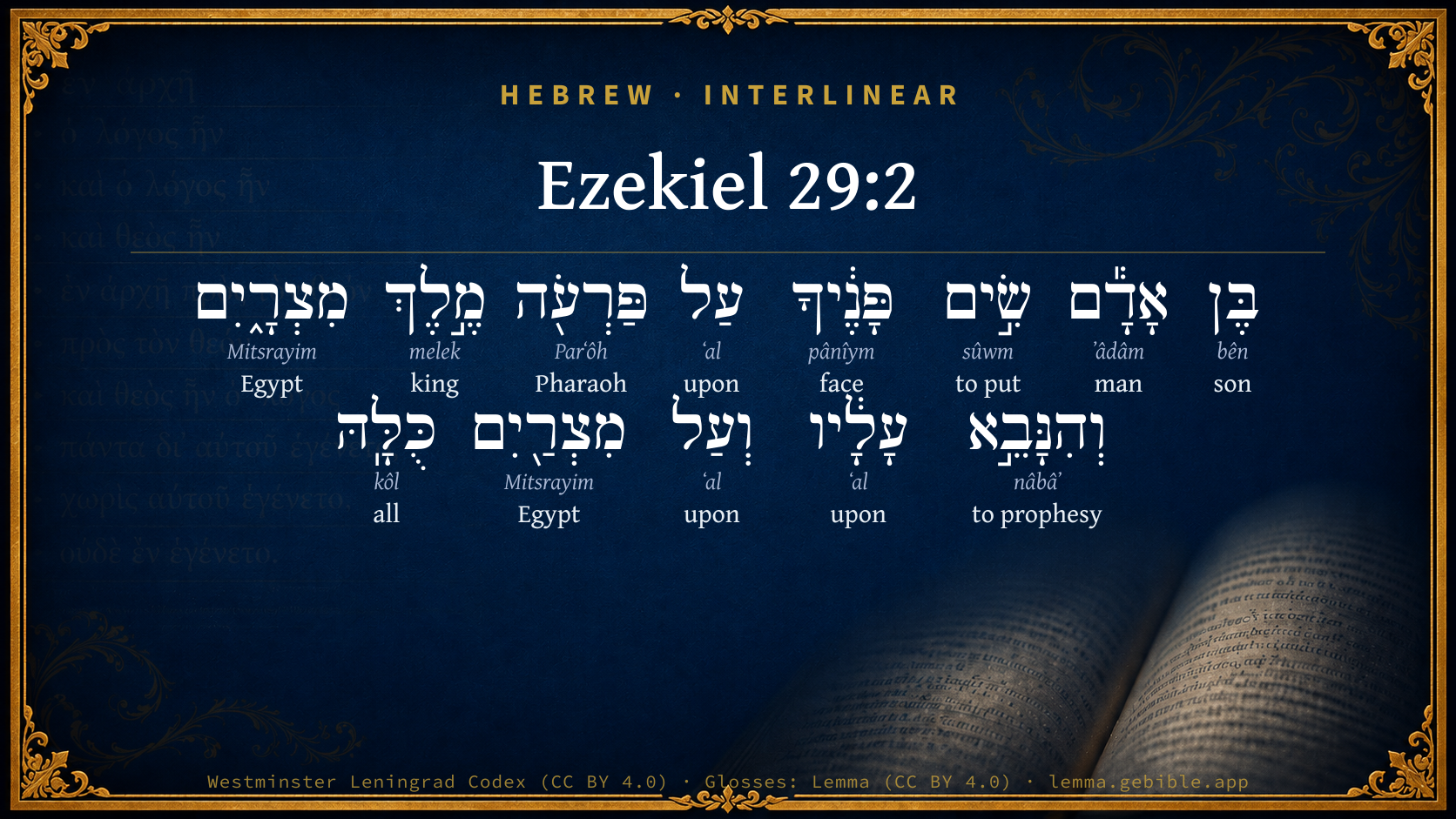
Hebrew (Westminster Leningrad Codex) Ezekiel 29:2 appears in the Hebrew Old Testament. The text above is from the Westminster Leningrad Codex. Each word links to its Strong’s number, a concise gloss, and parsing drawn from the Open Scriptures Hebrew Bible morphology. Click any word for its full Brown-Driver-Briggs (BDB) entry.
Download image
Cite this verse

Ezekiel 29:2 (World English Bible). Public Domain. Lemma interlinear Bible study tool, https://lemma.gebible.app/v/ezekiel/29/2.

Show BibTeX & RIS
BibTeX
RIS
English Translation
Son of man, set your face against Pharaoh king of Egypt, and prophesy against him, and against all Egypt;
World English Bible · Public Domain
Download a study sheet

One document with this verse’s original text, its word-by-word gloss line, the meaning frame, cross-references with their text, attributed commentary, and full source and license credits — printable, and it pastes into notes with its structure intact.

This verse Autodidact and up

Study sheet (.html) Plain text (.txt)

A passage Seminary Student

Up to 50 verses in one chapter. A passage sheet keeps up to 6 commentary sources and 12 cross-references per verse, in the order this page ranks them, and says so on the sheet whenever that leaves anything out. Ask for a single verse and you get the Autodidact verse sheet above.

Everything on this page stays free to read, with no account — the sheet is a download of what is already on screen, not access to it.

Want to remove ads? Support Godless Engineer
Compare translations 3

The same verse in 3 English versions, stacked beneath the original-language interlinear above. Click any original word for its lexicon entry.

Each is an independent rendering of the whole verse — the interlinear is not word-aligned to these translations.

Highlighted words mark where these versions differ — a whole-verse word diff, not a word-by-word alignment.

  • World English Bible Public Domain
    Son of man, set your face against Pharaoh king of Egypt, and prophesy against him, and against all Egypt;
  • King James Version Public Domain
    Son of man, set thy face against Pharaoh king of Egypt, and prophesy against him, and against all Egypt:
  • unfoldingWord Literal Text CC BY-SA 4.0
    “Son of man, set your face against Pharaoh, the king of Egypt; prophesy against him and against all of Egypt.

unfoldingWord Literal Text — © unfoldingWord, licensed CC BY-SA 4.0. Word-aligned USFM3 via Door43 (git.door43.org/unfoldingWord/en_ult).

Versions to compare (up to 4)

3 of 4 selected

Show all 18 translations

Every available English version of this verse, each an independent rendering of the whole verse.

  • World English Bible Public Domain
    Son of man, set your face against Pharaoh king of Egypt, and prophesy against him, and against all Egypt;
  • Berean Standard Bible Public Domain
    “Son of man, set your face against Pharaoh king of Egypt and prophesy against him and against all Egypt.
  • Majority Standard Bible Public Domain
    “Son of man, set your face against Pharaoh king of Egypt and prophesy against him and against all Egypt.
  • King James Version Public Domain
    Son of man, set thy face against Pharaoh king of Egypt, and prophesy against him, and against all Egypt:
  • American Standard Version (1901) Public Domain
    Son of man, set thy face against Pharaoh king of Egypt, and prophesy against him, and against all Egypt;
  • Revised Version (1885) Public Domain
    Son of man, set thy face against Pharaoh king of Egypt, and prophesy against him, and against all Egypt:
  • Geneva Bible (1599) Public Domain
    Sonne of man, set thy face against Pharaoh the King of Egypt, and prophecie against him, and against all Egypt.
  • Douay-Rheims (1899) Public Domain
    Son of man, set thy face against Pharao king of Egypt: and thou shalt prophesy of him, and of all Egypt:
  • Young's Literal Translation Public Domain
    `Son of man, set thy face against Pharaoh king of Egypt, and prophesy concerning him, and concerning Egypt -- all of it.
  • Literal Standard Version CC BY-SA 4.0
    “Son of man, set your face against Pharaoh king of Egypt, and prophesy concerning him, and concerning Egypt—all of it.
  • Unlocked Literal Bible CC BY-SA 4.0
    “Son of man, set your face against Pharaoh, the king of Egypt; prophesy against him and against all of Egypt.
  • unfoldingWord Literal Text CC BY-SA 4.0
    “Son of man, set your face against Pharaoh, the king of Egypt; prophesy against him and against all of Egypt.
  • Darby Bible Public Domain
    Son of man, set thy face against Pharaoh king of Egypt, and prophesy against him, and against the whole of Egypt;
  • World Messianic Bible Public Domain
    “Son of man, set your face against Pharaoh king of Egypt, and prophesy against him and against all Egypt.
  • Webster's Bible Public Domain
    Son of man, set thy face against Pharaoh king of Egypt, and prophesy against him, and against all Egypt:
  • Free Bible Version CC BY-SA 4.0
    “Son of man, face towards Pharaoh king of Egypt and prophesy against him and the whole of Egypt.
  • Bible in Basic English Public Domain
    Son of man, let your face be turned against Pharaoh, king of Egypt, and be a prophet against him and against all Egypt:
  • JPS Tanakh (1917) Public Domain
    'Son of man, set thy face against Pharaoh king of Egypt, and prophesy against him, and against all Egypt;

Literal Standard Version (2020), Covenant Press — licensed CC BY-SA 4.0. Text via the HelloAO Bible API (eBible.org). Unlocked Literal Bible (unfoldingWord) — licensed CC BY-SA 4.0. Text via the HelloAO Bible API (eBible.org). unfoldingWord Literal Text — © unfoldingWord, licensed CC BY-SA 4.0. Word-aligned USFM3 via Door43 (git.door43.org/unfoldingWord/en_ult). Free Bible Version, Dr. Jonathan Gallagher — licensed CC BY-SA 4.0. Text via the HelloAO Bible API (eBible.org).

Word by word

More ways to search: Search by grammar → Find every occurrence → Compare this word →

Practice this passage: Drill this verse → Learn its vocabulary →

וְהִנָּבֵ֣א
nâbâʼ
H5012
“and · prophesy”
Conjunction + Verb, Niphal, Imperative, 2nd Person, Masculine, Singular
Part of Speech
Conjunction + Verb
Stem
Niphal
Form
Imperative
Person
2nd Person
Gender
Masculine
Number
Singular
Full BDB Definition

Origin: a primitive root

TWOT: 1277

to prophesy - (Niphal) - to prophesy - under influence of divine spirit - of false prophets - (Hithpael) - to prophesy - under influence of divine spirit - of false prophets
  1. בֶּן bên H1121 “son of” Noun, Common, Masculine, Singular, Construct
  2. אָדָ֕ם ʼâdâm H120 “man” Noun, Common, Masculine, Singular, Absolute
  3. שִׂ֣ים sûwm H7760 “put” Verb, Qal, Imperative, 2nd Person, Masculine, Singular
  4. פָּנֶ֔יךָ pânîym H6440 “face(s) · your” Noun, Common, Both, Plural, Construct + Suffix, Personal, 2nd Person, Masculine, Singular
  5. עַל ʻal H5921 “upon” Preposition
  6. פַּרְעֹ֖ה Parʻôh H6547 “Pharaoh” Noun, Proper
  7. מֶ֣לֶךְ melek H4428 “king of” Noun, Common, Masculine, Singular, Construct
  8. מִצְרָ֑יִם Mitsrayim H4714 “Egypt” Noun, Proper
  9. עָלָ֔יו ʻal H5921 “upon · him” Preposition + Suffix, Personal, 3rd Person, Masculine, Singular
  10. וְעַל ʻal H5921 “and · upon” Conjunction + Preposition
  11. מִצְרַ֖יִם Mitsrayim H4714 “Egypt” Noun, Proper
  12. כֻּלָּֽהּ kôl H3605 “all · her” Noun, Common, Masculine, Singular, Construct + Suffix, Personal, 3rd Person, Feminine, Singular

About this verse

These counts appear in no published source. They are computed here, from the morphology-tagged text and Lemma’s own curated glosses. What Lemma adds →

13
words
10
distinct lemmas
Prophets
section

Grammatical profile

  • 2 verbs
  • 8 nouns
  • 3 prepositions

Verb forms

  • שִׂ֣ים Qal · Imperative
  • וְהִנָּבֵ֣א Niphal · Imperative

Repetition

Words recur within this verse — often emphatic in Hebrew:

  • עַל upon H5921 ×3
  • מִצְרָ֑יִם Egypt H4714 ×2

Hebrew & Septuagint length

In English translation the verse runs 19 words from the Hebrew and 21 from the Septuagint (LXX English) — closely comparable.

A rough comparison of the two English renderings, which tokenize alike — not a word-level alignment.

Word counts can differ between the Hebrew and the Greek without any difference in meaning — e.g. the Hebrew direct-object marker אֵת has no separate Greek word, and Greek often adds the article ὁ.

In the original languages it is 13 Hebrew tokens and 18 Greek tokens — but the two are counted differently (Hebrew bundles its prefixes and suffixes into one token; the Greek is in lemma form), so that isn’t a like-for-like length.

Cross-references

15

Topical passages linked to Ezekiel 29:2 in the Treasury of Scripture Knowledge — connected by theme and wording, ordered by reader-vote popularity; previews shown in the World English Bible.

  • Ezekiel 6:2 Son of man, set your face toward the mountains of Israel, and prophesy to them,
  • Jeremiah 44:30 Thus says Yahweh, Behold, I will give Pharaoh Hophra king of Egypt into the hand of his enemies, and into the hand of those who seek his life; as I gave Zedekiah king of Judah into the hand of Nebuchadrezzar king of Babylon, who was his enemy, and sought his life.
  • Jeremiah 46:2–16 Of Egypt: concerning the army of Pharaoh Necoh king of Egypt, which was by the river Euphrates in Carchemish, which Nebuchadrezzar king of Babylon struck in the fourth year of Jehoiakim the son of Josiah, king of Judah.
  • Isaiah 18:1–19:17 Ah, the land of the rustling of wings, which is beyond the rivers of Ethiopia;
  • Isaiah 20:1–6 In the year that Tartan came to Ashdod, when Sargon the king of Assyria sent him, and he fought against Ashdod and took it;
  • Jeremiah 9:25–26 Behold, the days come, says Yahweh, that I will punish all those who are circumcised in [their] uncircumcision:
  • Jeremiah 25:18–19 [to wit], Jerusalem, and the cities of Judah, and the kings of it, and the princes of it, to make them a desolation, an astonishment, a hissing, and a curse, as it is this day;
  • Jeremiah 43:8–13 Then came the word of Yahweh to Jeremiah in Tahpanhes, saying,
  • Ezekiel 20:46 Son of man, set your face toward the south, and drop [your word] toward the south, and prophesy against the forest of the field in the South;
  • Ezekiel 21:2 Son of man, set your face toward Jerusalem, and drop [your word] toward the sanctuaries, and prophesy against the land of Israel;
  • Ezekiel 25:2 Son of man, set your face toward the children of Ammon, and prophesy against them:
  • Ezekiel 28:21–22 Son of man, set your face toward Sidon, and prophesy against it,
  • Ezekiel 30:1–32:32 The word of Yahweh came again to me, saying,
  • Joel 3:19 Egypt will be a desolation, And Edom will be a desolate wilderness, For the violence done to the children of Judah, Because they have shed innocent blood in their land.
  • Zechariah 14:18–19 If the family of Egypt doesn't go up, and doesn't come, neither will it rain on them. This will be the plague with which Yahweh will strike the nations that don't go up to keep the feast of tents.

Cross-references courtesy of OpenBible.info (CC BY 4.0).

Hebrew and Greek witnesses Masoretic Hebrew ↔ Greek Septuagint

The same verse in the two great witnesses to the Old Testament, shown verse-for-verse.

These are two independent witnesses, not word-aligned to each other, and the Septuagint is shown in lemma (dictionary) form.

Hebrew Ezekiel 29:2 Masoretic · Westminster Leningrad Codex

בֶּן אָדָ֕ם שִׂ֣ים פָּנֶ֔יךָ עַל פַּרְעֹ֖ה מֶ֣לֶךְ מִצְרָ֑יִם וְהִנָּבֵ֣א עָלָ֔יו וְעַל מִצְרַ֖יִם כֻּלָּֽהּ

Son of man, set your face against Pharaoh king of Egypt, and prophesy against him, and against all Egypt;

World English Bible · Public Domain

Greek LXX Ezekiel 29:2 Septuagint · lemma form

υἱός ἄνθρωπος στηρίζω ὁ πρόσωπον σύ ἐπί φαραώ βασιλεύς αἴγυπτος καί προφητεύω ἐπί αὐτός καί ἐπί αἴγυπτος ὅλος

Son of man, set your face against Pharao king of Egypt, and prophesy against him, and against the whole of Egypt:

LXX2012 (modern English Septuagint) · Public Domain

Hebrew: Westminster Leningrad Codex (CC BY 4.0). Greek: Septuagint (public domain); English from LXX2012 (modern English Septuagint) (Public Domain). How the Septuagint differs from the Hebrew →

Targum (Aramaic paraphrase)

1

The Targum is the ancient Jewish Aramaic paraphrase of the Hebrew Scriptures — an interpretive translation, not the Hebrew text itself. Onkelos (literal) and Pseudo-Jonathan (expansive) render the Torah, and Jonathan the Prophets. Coverage is partial: where no permissively-licensed English translation exists for a verse, only the Aramaic is shown. This is verse-level text, not a word-by-word alignment to the Hebrew.

  1. Targum Jonathan Prophets (Joshua–Malachi)
    בַּר אָדָם קַבֵּיל נְבוּאָה עַל פַּרְעֹה מַלְכָּא דְמִצְרָיִם וְאִתְנַבֵּי עֲלוֹהִי וְעַל מִצְרָאֵי כּוּלְהוֹן:

    (no public-domain English translation for this verse)

    Targum Jonathan — Aramaic: “Mikraot Gedolot” (public domain). English: “Sefaria Community Translation” (CC0 1.0 (public-domain dedication)); “London "Chaldee Paraphrase," 1871” (public domain). Text via Sefaria.

Commentary

Notes on Ezekiel 29:2 from classic Christian and Jewish commentators (each source and its license shown beneath its notes). The classic Christian expositions comment on the surrounding passage and are grouped to its opening verse, so a note may address several verses; the Jewish commentaries on the Tanakh (Rashi and others) are per-verse, so they appear only where the commentator wrote on this verse.

Lemma curates 59 commentaries, every one of them public domain or Creative Commons licensed, each selected and text-cleaned for this edition rather than reprinted as found. About our sources →

Trapp's Complete Commentary

John Trapp

Eze 29:2 Son of man, set thy face against Pharaoh king of Egypt, and prophesy against him, and against all Egypt:

Ver. 2. Set thy face against Pharaoh.] This was Pharaohhophra, whom Herodotus {a} calleth Apries, and saith that he gave out that no god, how great soever, could deprive him of his kingdom. Dionysius, the tyrant of Sicily, also was wont to say that his kingdom was tied unto him with chains of adamant; but it proved otherwise. Noli gloriari. Do not brag!

And against all Egypt.] Which held itself able to hold out against all the world, and is therefore here threatened at large in this and the three next chapters.

{a} In Euterp.

John Trapp, A Commentary or Exposition upon All the Books of the Old and New Testament (1647–1656) — public domain. Text from a community e-Sword module.

Joseph Benson's Commentary

Eze 29:2-3. Set thy face against Pharaoh — Pharaoh being a common name to all the kings of Egypt, this prince was called Pharaoh-hophra: by way of distinction, by Jer 44:30, and Apries by Herodotus. The word תנים, tannim, signifies any great fish, but seems to be here used to signify the crocodile, a fish in a manner peculiar to the river Nile, to which the king of Egypt is compared, on account of his dominions lying upon that river, which he boasted himself of, on account of the prodigious fertility which the overflowing of the Nile caused. It is spoken of here as rivers, on account of its many mouths, or channels. The word Pharaoh signifies a crocodile in the Arabic tongue. Among the ancients, Michaelis tells us, the crocodile was a symbol of Egypt, and appears so on the Roman coins. Milton seems to have had this sublime passage in view, when he said, Par. Lost, 12:190

— — — — Thus with ten wounds The river-dragon, tamed, at length submits.

My river is my own — That is, the kingdom of Egypt, watered by the Nile, is mine. I have made it for myself — It is my own indefeisible right and property, which I cannot be dispossessed of. This king was, indeed, exceeding prosperous, and reigned uninterrupted for twenty-five years; by which he was so elated, as we learn from Herodotus, that he was wont to boast, that not even any god could dispossess him of his kingdom.

Joseph Benson's Commentary on the Old and New Testaments (1811–1818) — public domain. Text from a community e-Sword module.

Adam Clarke's Commentary

Verse 2. Set thy face against Pharaoh king of Egypt] This was Pharaoh-hophra or Pharaoh-apries, whom we have so frequently met with in the prophecies of Jeremiah, and much of whose history has been given in the notes.

Adam Clarke's Commentary on the Bible (1810–1826) — public domain. Text from a community e-Sword/MySword module.

John Gill's Exposition

Son of man, set thy face against Pharaoh king of Egypt,.... Pharaoh was a name common to all the kings of Egypt; the name of this king was Pharaohhophra, Jer 44:30, and who, by Herodotus (x), is called Apries:

and prophesy against him, and against all Egypt; prophesy of his destruction, and of the destruction of the whole land that is under his dominion.

(x) Euterpe, sive l. 2. c. 161.

John Gill's Exposition of the Whole Bible (1746–1763) — public domain (CC PDM 1.0). Text via the HelloAO Bible API.

Haydock's Catholic Bible Commentary

Pharao, Ephree, Jeremias xliv 30. He came to assist Sedecias; but the Chaldeans raised the siege, went to meet him, an defeated his army. After they had subdued the neighbouring nations, Tyre, &c., they fell upon Egypt. (The year of the world 3433.) (Calmet)

George Leo Haydock (1774–1849), Haydock's Catholic Family Bible and Commentary, 1859 edition — public domain. Excludes Psalms (Douay-Rheims chapter numbering differs from Protestant) and Deuterocanonical books (Catholic canon only).

Matthew Poole's English Annotations

Set thy face: see Eze 20:46; 21:2.

Pharaoh; Hophra, as the Scripture styles him, Jer 44:30; the Greek authors call him Apries, and Vaphres: most like he was grandson to Necho, who slew Josiah in fight, 2Ch 35:23,24.

Prophesy against him; in prophetic style and authority declare what shall be done to him in his person.

All Egypt; the whole multitude of Egyptians; for it is the place for the people dwelling in it.

Matthew Poole's English Annotations on the Holy Bible (1683–1685) — public domain. Text from a community e-Sword/MySword module.

Lesson kit

Teaching starters — assembled from the data on this page, not authored interpretation. Every prompt links to the verse data it draws on. Edit before teaching.

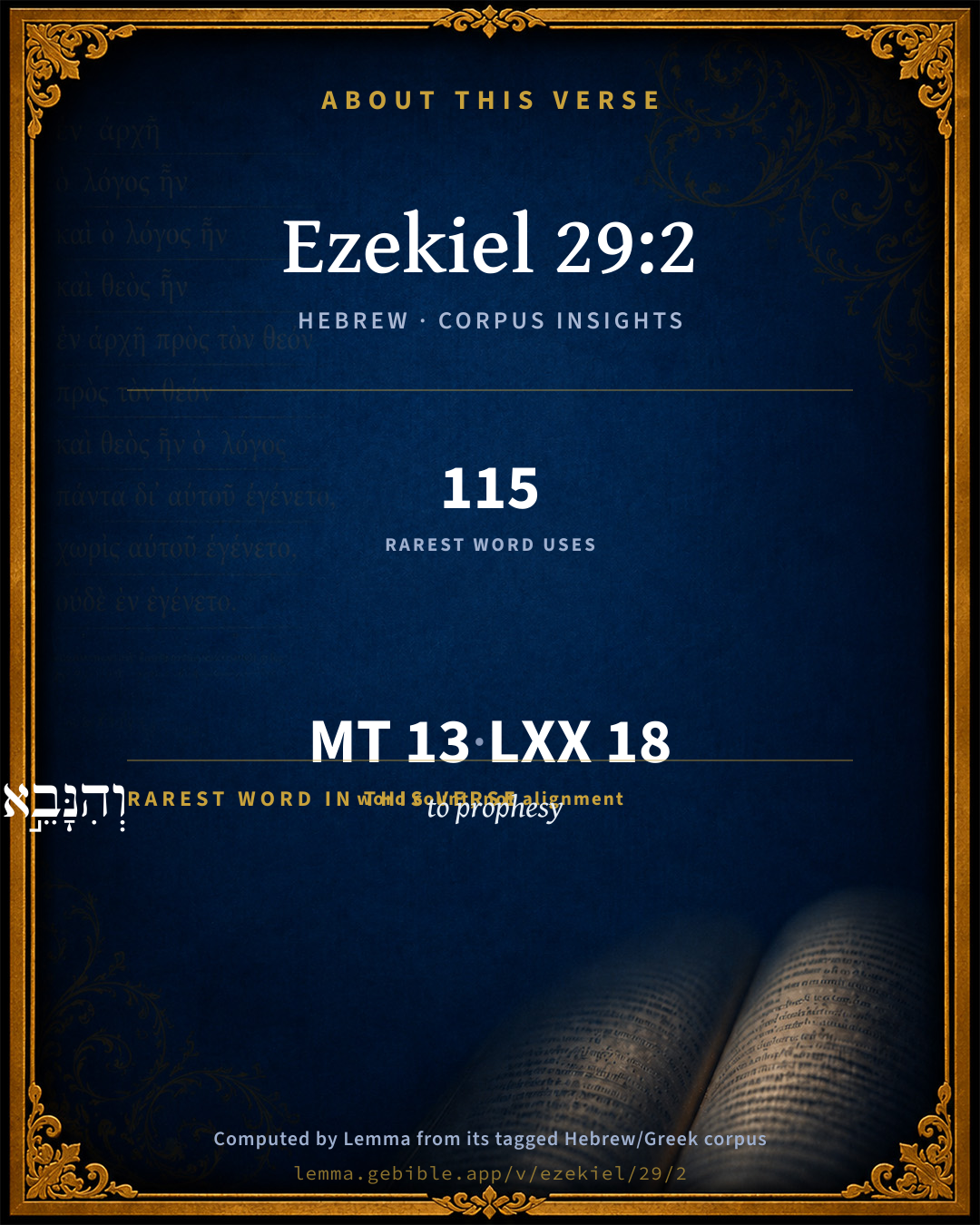
Ezekiel, in the Prophets, opens this verse with 13 words (10 distinct Hebrew lemmas). Its most distinctive word is nâbâʼ (“to prophesy”). A historical commentator’s framing appears above. Read the whole chapter for the surrounding context.

Discussion questions

  1. The word nâbâʼ carries the sense “to prophesy.” How does it shape the verse?
  2. Ezekiel 6:2 shares this passage’s theme. How do the two illuminate each other?
  3. “upon” occurs 3× in this one verse. What is the effect of the repetition?
  4. The verb «שִׂ֣ים» is Qal Imperative. How does its form color the action?
  5. Reading how Trapp's Complete Commentary and Joseph Benson's Commentary read this verse, where do the two commentators agree and where do they part?

Things to notice

Reading settings

Reading text

Shown beneath each verse's original-language words.

Old Testament
Old Testament edition

Read the OT as the Masoretic Hebrew (MT) or the Greek Septuagint (LXX).

English shown for the Greek Septuagint (in the Hebrew ↔ Greek comparison).

Comparing translations? Open the Compare panel on any verse page to stack up to four side by side.