Ezekiel 30:10

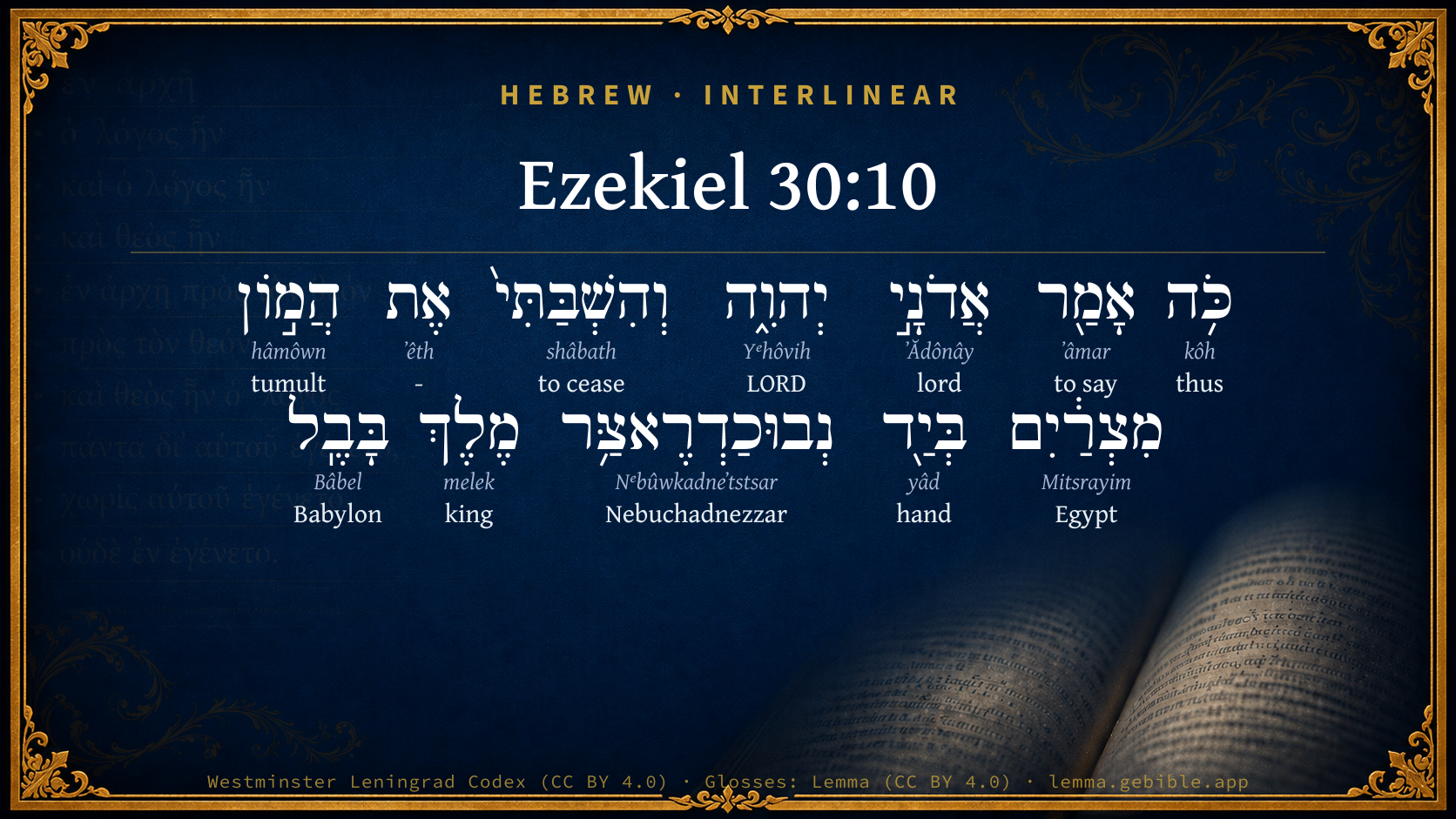
Hebrew (Westminster Leningrad Codex) Ezekiel 30:10 appears in the Hebrew Old Testament. The text above is from the Westminster Leningrad Codex. Each word links to its Strong’s number, a concise gloss, and parsing drawn from the Open Scriptures Hebrew Bible morphology. Click any word for its full Brown-Driver-Briggs (BDB) entry.
Download image
Cite this verse

Ezekiel 30:10 (World English Bible). Public Domain. Lemma interlinear Bible study tool, https://lemma.gebible.app/v/ezekiel/30/10.

Show BibTeX & RIS
BibTeX
RIS
English Translation
Thus says the Lord Yahweh: I will also make the multitude of Egypt to cease, by the hand of Nebuchadrezzar king of Babylon.
World English Bible · Public Domain
Download a study sheet

One document with this verse’s original text, its word-by-word gloss line, the meaning frame, cross-references with their text, attributed commentary, and full source and license credits — printable, and it pastes into notes with its structure intact.

This verse Autodidact and up

Study sheet (.html) Plain text (.txt)

A passage Seminary Student

Up to 50 verses in one chapter. A passage sheet keeps up to 6 commentary sources and 12 cross-references per verse, in the order this page ranks them, and says so on the sheet whenever that leaves anything out. Ask for a single verse and you get the Autodidact verse sheet above.

Everything on this page stays free to read, with no account — the sheet is a download of what is already on screen, not access to it.

Want to remove ads? Support Godless Engineer
Compare translations 3

The same verse in 3 English versions, stacked beneath the original-language interlinear above. Click any original word for its lexicon entry.

Each is an independent rendering of the whole verse — the interlinear is not word-aligned to these translations.

Highlighted words mark where these versions differ — a whole-verse word diff, not a word-by-word alignment.

  • World English Bible Public Domain
    Thus says the Lord Yahweh: I will also make the multitude of Egypt to cease, by the hand of Nebuchadrezzar king of Babylon.
  • King James Version Public Domain
    Thus saith the Lord GOD; I will also make the multitude of Egypt to cease by the hand of Nebuchadrezzar king of Babylon.
  • unfoldingWord Literal Text CC BY-SA 4.0
    The Lord Yahweh says this: I will make an end of the multitudes of Egypt by the hand of Nebuchadnezzar, the king of Babylon.

unfoldingWord Literal Text — © unfoldingWord, licensed CC BY-SA 4.0. Word-aligned USFM3 via Door43 (git.door43.org/unfoldingWord/en_ult).

Versions to compare (up to 4)

3 of 4 selected

Show all 18 translations

Every available English version of this verse, each an independent rendering of the whole verse.

  • World English Bible Public Domain
    Thus says the Lord Yahweh: I will also make the multitude of Egypt to cease, by the hand of Nebuchadrezzar king of Babylon.
  • Berean Standard Bible Public Domain
    This is what the Lord GOD says: I will put an end to the hordes of Egypt by the hand of Nebuchadnezzar king of Babylon.
  • Majority Standard Bible Public Domain
    This is what the Lord GOD says: I will put an end to the hordes of Egypt by the hand of Nebuchadnezzar king of Babylon.
  • King James Version Public Domain
    Thus saith the Lord GOD; I will also make the multitude of Egypt to cease by the hand of Nebuchadrezzar king of Babylon.
  • American Standard Version (1901) Public Domain
    Thus saith the Lord Jehovah: I will also make the multitude of Egypt to cease, by the hand of Nebuchadrezzar king of Babylon.
  • Revised Version (1885) Public Domain
    Thus saith the Lord GOD: I will also make the multitude of Egypt to cease, by the hand of Nebuchadrezzar king of Babylon.
  • Geneva Bible (1599) Public Domain
    Thus sayth the Lord God, I will also make the multitude of Egypt to cease by the hand of Nebuchad-nezzar King of Babel.
  • Douay-Rheims (1899) Public Domain
    Thus saith the Lord God: I will make the multitude of Egypt to cease by the hand of Nabuchodonosor the king of Babylon.
  • Young's Literal Translation Public Domain
    Thus said the Lord Jehovah: I have caused the multitude of Egypt to cease, By the hand of Nebuchadrezzar king of Babylon,
  • Literal Standard Version CC BY-SA 4.0
    Thus said Lord YHWH: I have caused the multitude of Egypt to cease, || By the hand of Nebuchadnezzar king of Babylon,
  • Unlocked Literal Bible CC BY-SA 4.0
    The Lord Yahweh says this: I will make an end of the multitudes of Egypt by the hand of Nebuchadnezzar, the king of Babylon.
  • unfoldingWord Literal Text CC BY-SA 4.0
    The Lord Yahweh says this: I will make an end of the multitudes of Egypt by the hand of Nebuchadnezzar, the king of Babylon.
  • Darby Bible Public Domain
    Thus saith the Lord Jehovah: I will also make the multitude of Egypt to cease by the hand of Nebuchadrezzar king of Babylon.
  • World Messianic Bible Public Domain
    “‘The Lord GOD says: “I will also make the multitude of Egypt to cease, by the hand of Nebuchadnezzar king of Babylon.
  • Webster's Bible Public Domain
    Thus saith the Lord GOD; I will also make the multitude of Egypt to cease by the hand of Nebuchadrezzar king of Babylon.
  • Free Bible Version CC BY-SA 4.0
    This is what the Lord God says: I will use Nebuchadnezzar king of Babylon to take away Egypt's wealth.
  • Bible in Basic English Public Domain
    This is what the Lord has said: I will put an end to great numbers of the people of Egypt by the hand of Nebuchadrezzar, king of Babylon.
  • JPS Tanakh (1917) Public Domain
    Thus saith the Lord GOD: I will also make the multitude of Egypt to cease, by the hand of Nebuchadrezzar king of Babylon.

Literal Standard Version (2020), Covenant Press — licensed CC BY-SA 4.0. Text via the HelloAO Bible API (eBible.org). Unlocked Literal Bible (unfoldingWord) — licensed CC BY-SA 4.0. Text via the HelloAO Bible API (eBible.org). unfoldingWord Literal Text — © unfoldingWord, licensed CC BY-SA 4.0. Word-aligned USFM3 via Door43 (git.door43.org/unfoldingWord/en_ult). Free Bible Version, Dr. Jonathan Gallagher — licensed CC BY-SA 4.0. Text via the HelloAO Bible API (eBible.org).

Word by word

More ways to search: Search by grammar → Find every occurrence → Compare this word →

Practice this passage: Drill this verse → Learn its vocabulary →

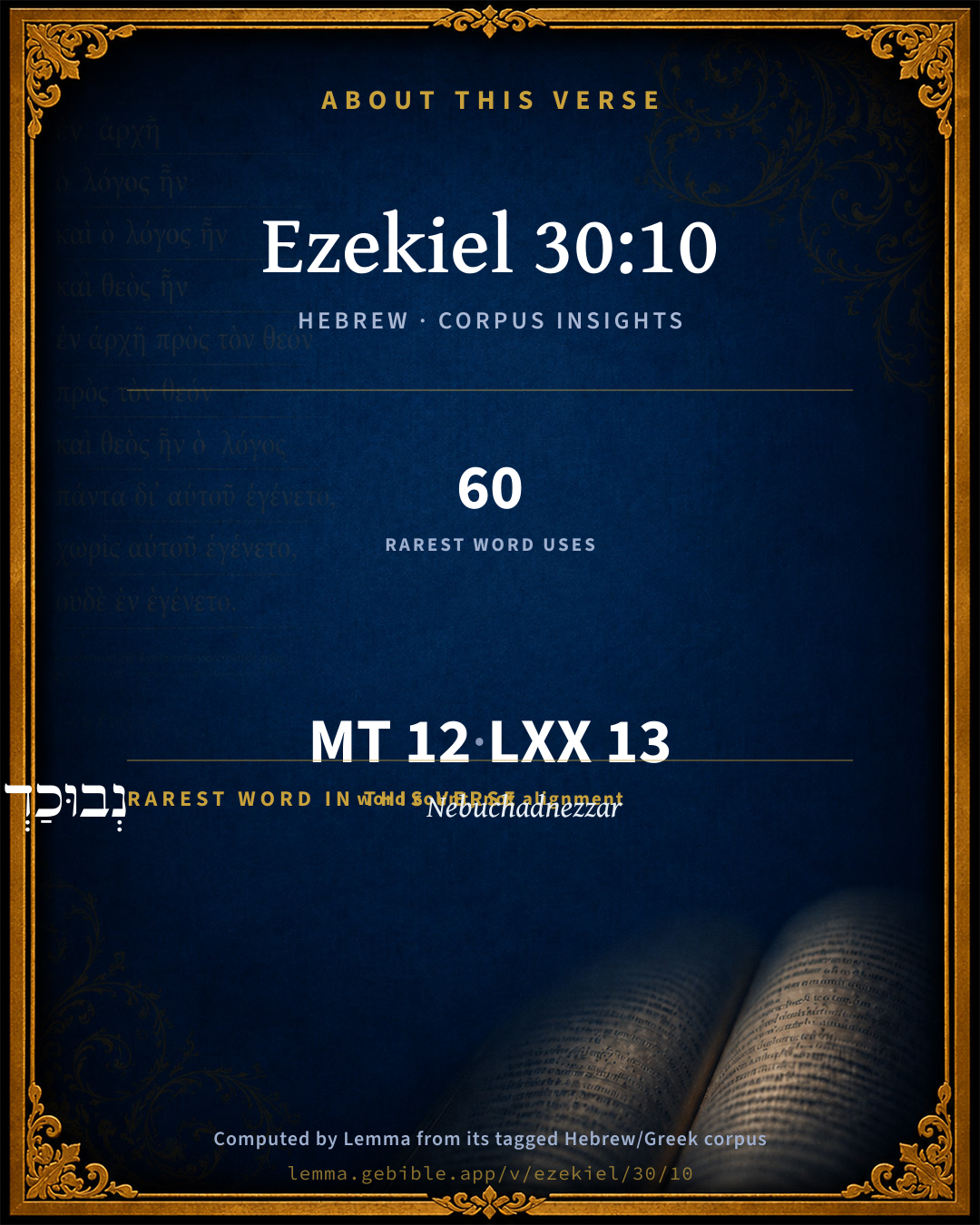
נְבוּכַדְרֶאצַּ֥ר
Nᵉbûwkadneʼtstsar
H5019
“Nebuchadnezzar”
Noun, Proper
Part of Speech
Noun
Type
Proper
Full BDB Definition

Origin: of foreign derivation

TWOT: None

Nebuchadnezzar or Nebuchadrezzar = "may Nebo protect the crown" - the great king of Babylon who captured Jerusalem and carried Judah captive
  1. כֹּ֥ה kôh H3541 “thus” Adverb
  2. אָמַ֖ר ʼâmar H559 “to say” Verb, Qal, Perfect, 3rd Person, Masculine, Singular
  3. אֲדֹנָ֣י ʼĂdônây H136 “Lord · my” Noun, Common, Masculine, Plural, Construct + Suffix, Personal, 1st Person, Common, Singular
  4. יְהוִ֑ה Yᵉhôvih H3069 “LORD” Noun, Proper
  5. וְהִשְׁבַּתִּי֙ shâbath H7673 “and · to cease” Conjunction + Verb, Hiphil, Sequential Perfect, 1st Person, Common, Singular
  6. אֶת ʼêth H853 “-” Particle, Direct Object
  7. הֲמ֣וֹן hâmôwn H1995 “tumult of” Noun, Common, Masculine, Singular, Construct
  8. מִצְרַ֔יִם Mitsrayim H4714 “Egypt” Noun, Proper
  9. בְּיַ֖ד yâd H3027 “in/at · hand of” Preposition + Noun, Common, Both, Singular, Construct
  10. מֶלֶךְ melek H4428 “king of” Noun, Common, Masculine, Singular, Construct
  11. בָּבֶֽל Bâbel H894 “Babylon” Noun, Proper

About this verse

These counts appear in no published source. They are computed here, from the morphology-tagged text and Lemma’s own curated glosses. What Lemma adds →

12
words
12
distinct lemmas
Prophets
section

Shared distinctive vocabulary

נְבוּכַדְרֶאצַּ֥ר Nebuchadnezzar H5019 occurs in 58 verses of the Hebrew Bible. Also found in:

Grammatical profile

  • 2 verbs
  • 8 nouns
  • 1 adverb
  • 1 particle

Verb forms

  • אָמַ֖ר Qal · Perfect
  • וְהִשְׁבַּתִּי֙ Hiphil · Sequential Perfect

Hebrew & Septuagint length

In English translation the verse runs 23 words from the Hebrew and 22 from the Septuagint (LXX English) — closely comparable.

A rough comparison of the two English renderings, which tokenize alike — not a word-level alignment.

Word counts can differ between the Hebrew and the Greek without any difference in meaning — e.g. the Hebrew direct-object marker אֵת has no separate Greek word, and Greek often adds the article ὁ.

In the original languages it is 12 Hebrew tokens and 13 Greek tokens — but the two are counted differently (Hebrew bundles its prefixes and suffixes into one token; the Greek is in lemma form), so that isn’t a like-for-like length.

Cross-references

4

Topical passages linked to Ezekiel 30:10 in the Treasury of Scripture Knowledge — connected by theme and wording, ordered by reader-vote popularity; previews shown in the World English Bible.

  • Ezekiel 29:19 Therefore thus says the Lord Yahweh: Behold, I will give the land of Egypt to Nebuchadrezzar king of Babylon; and he shall carry off her multitude, and take her spoil, and take her prey; and it shall be the wages for his army.
  • Ezekiel 29:4–5 I will put hooks in your jaws, and I will cause the fish of your rivers to stick to your scales; and I will bring you up out of the midst of your rivers, with all the fish of your rivers which stick to your scales.
  • Ezekiel 30:24–25 I will strengthen the arms of the king of Babylon, and put my sword in his hand: but I will break the arms of Pharaoh, and he shall groan before him with the groanings of a deadly wounded man.
  • Ezekiel 32:11–16 For thus says the Lord Yahweh: The sword of the king of Babylon shall come on you.

Cross-references courtesy of OpenBible.info (CC BY 4.0).

Hebrew and Greek witnesses Masoretic Hebrew ↔ Greek Septuagint

The same verse in the two great witnesses to the Old Testament, shown verse-for-verse.

These are two independent witnesses, not word-aligned to each other, and the Septuagint is shown in lemma (dictionary) form.

Hebrew Ezekiel 30:10 Masoretic · Westminster Leningrad Codex

כֹּ֥ה אָמַ֖ר אֲדֹנָ֣י יְהוִ֑ה וְהִשְׁבַּתִּי֙ אֶת הֲמ֣וֹן מִצְרַ֔יִם בְּיַ֖ד נְבוּכַדְרֶאצַּ֥ר מֶלֶךְ בָּבֶֽל

Thus says the Lord Yahweh: I will also make the multitude of Egypt to cease, by the hand of Nebuchadrezzar king of Babylon.

World English Bible · Public Domain

Greek LXX Ezekiel 30:10 Septuagint · lemma form

ὅδε λέγω κύριος κύριος καί ἀποὀλλύω πλῆθος αἰγύπτιος διά χείρ ναβουχοδονοσορ βασιλεύς βαβυλών

Thus says the Lord God; I will also destroy the multitude of the Egyptians by the hand of Nabuchodonosor king of Babylon,

LXX2012 (modern English Septuagint) · Public Domain

Hebrew: Westminster Leningrad Codex (CC BY 4.0). Greek: Septuagint (public domain); English from LXX2012 (modern English Septuagint) (Public Domain). How the Septuagint differs from the Hebrew →

Targum (Aramaic paraphrase)

1

The Targum is the ancient Jewish Aramaic paraphrase of the Hebrew Scriptures — an interpretive translation, not the Hebrew text itself. Onkelos (literal) and Pseudo-Jonathan (expansive) render the Torah, and Jonathan the Prophets. Coverage is partial: where no permissively-licensed English translation exists for a verse, only the Aramaic is shown. This is verse-level text, not a word-by-word alignment to the Hebrew.

  1. Targum Jonathan Prophets (Joshua–Malachi)
    כִּדְנַן אֲמַר יְיָ אֱלֹהִים וַאֲבַטֵיל יַת אִתְרְגוּשַׁת מִצְרַיִם בְּיַד נְבוּכַדְרֶאצַר מַלְכָּא דְבָבֶל:

    (no public-domain English translation for this verse)

    Targum Jonathan — Aramaic: “Mikraot Gedolot” (public domain). English: “Sefaria Community Translation” (CC0 1.0 (public-domain dedication)); “London "Chaldee Paraphrase," 1871” (public domain). Text via Sefaria.

Commentary

Notes on Ezekiel 30:10 from classic Christian and Jewish commentators (each source and its license shown beneath its notes). The classic Christian expositions comment on the surrounding passage and are grouped to its opening verse, so a note may address several verses; the Jewish commentaries on the Tanakh (Rashi and others) are per-verse, so they appear only where the commentator wrote on this verse.

Lemma curates 59 commentaries, every one of them public domain or Creative Commons licensed, each selected and text-cleaned for this edition rather than reprinted as found. About our sources →

Trapp's Complete Commentary

John Trapp

Eze 30:10 Thus saith the Lord GOD; I will also make the multitude of Egypt to cease by the hand of Nebuchadrezzar king of Babylon.

Ver. 10. I will also make the multitude.] Or, The great noise and hurry. They shall have no more cause to complain that they are too many of them, so that they cannot one live by another.

John Trapp, A Commentary or Exposition upon All the Books of the Old and New Testament (1647–1656) — public domain. Text from a community e-Sword module.

Joseph Benson's Commentary

Eze 30:10-12. I will make the multitude of Egypt to cease — I will diminish the number of its inhabitants. I will make the rivers dry — The fertility of Egypt depending on the rise and overflowing of the Nile, the meaning of the metaphor is, I will destroy the plenty, prosperity, and strength of Egypt. And sell the land into the hand of the wicked — Namely, the haughty and cruel Babylonians. To sell, signifies here to deliver up, as men do goods which they sell. Compare Deu 32:30; Jdg 2:14; and Jdg 4:9.

Joseph Benson's Commentary on the Old and New Testaments (1811–1818) — public domain. Text from a community e-Sword module.

Keil & Delitzsch

C. F. Keil & F. Delitzsch

The executors of the judgment. - Eze 30:10. Thus saith the Lord Jehovah, And I will put an end to the tumult of Egypt through Nebuchadnezzar king of Babylon. Eze 30:11. He and his people with him, violent of the nations, will be brought to destroy the land; they will draw their swords against Egypt, and fill the land with slain. Eze 30:12. And I will make the rivers dry, and sell the land into the hand of wicked men, and lay waste the land and its fulness by the hand of foreigners; I Jehovah have spoken it. - המון cannot be understood as signifying either the multitude of people only, or the abundance of possessions alone; for השׁבּית is not really applicable to either of these meanings. They are evidently both included in the המון, which signifies the tumult of the people in the possession and enjoyment of their property (cf. Eze 26:13). The expression is thus specifically explained in Eze 30:11 and Eze 30:12. Nebuchadnezzar will destroy the land with his men of war, slaying the people with its possessions. עריצי, as in Eze 28:7. מוּבאים, as in Eze 23:42. 'הריק וגו, cf. Eze 12:14, Eze 12:28; 7. חלל...מלאוּ, as in Eze 11:6. יארים, the arms and canals of the Nile, by which the land was watered, and on which the fertility and prosperity of Egypt depended. The drying up of the arms of the Nile must not be restricted, therefore, to the fact that God would clear away the hindrances to the entrance of the Chaldeans into the land, but embraces also the removal of the natural resources on which the country depended. מכר, to sell a land or people into the hand of any one, i.e., to deliver it into his power (cf. Deu 32:30; Jdg 2:14, etc.). For the fact itself, see Isa 19:4-6. For 'השׁמּתי וגו, see Eze 19:7.

Keil & Delitzsch — Biblical Commentary on the Old Testament (1861–1891) — public domain (CC PDM 1.0). Text via the HelloAO Bible API. (Old Testament only.)

Jamieson, Fausset & Brown

Robert Jamieson, A. R. Fausset & David Brown

the multitude--the large population.

Jamieson, Fausset & Brown — Commentary Critical and Explanatory on the Whole Bible (1871) — public domain (CC PDM 1.0). Text via the HelloAO Bible API.

The Cambridge Bible for Schools and Colleges

gen. ed. J. J. S. Perowne

10. The instrument whom Jehovah uses is here named for the first time, except in the later passage, ch. Eze_29:17-21.

The Cambridge Bible for Schools and Colleges (gen. ed. J. J. S. Perowne; Cambridge University Press, 1878–1918) — public domain. Text from a community e-Sword module.

John Gill's Exposition

Thus saith the Lord God, I will make the multitude of Egypt to cease,.... The vast numbers of people that inhabited Egypt; some of its cities were very populous, especially the city No, after mentioned; but now the numbers should be greatly lessened, and the whole land sadly depopulated: or the "noise" (r), "tumult", and hurry of it; which is very great where there are large numbers of people, and which ceases when they are cut off. The Syriac version renders it, the riches of Egypt. Now the instrument God would make use of to do all this is mentioned by name, as follows,

by the hand of Nebuchadrezzar king of Babylon; the then greatest monarch in the world.

(r) "strepitum", Vatablus, Cocceius.

John Gill's Exposition of the Whole Bible (1746–1763) — public domain (CC PDM 1.0). Text via the HelloAO Bible API.

Matthew Poole's English Annotations

The multitude; the numerous families and tribes. To cease; to dwindle and decrease.

By the hand; by the army, power, and conduct of Nebuchadrezzar.

Matthew Poole's English Annotations on the Holy Bible (1683–1685) — public domain. Text from a community e-Sword/MySword module.

Whedon's Commentary on the Bible

Daniel D. Whedon

10, 11. Compare Ezekiel 28, 29.

Daniel D. Whedon (gen. ed.), Commentary on the Old and New Testaments (1874–1909) — public domain. Text from a community e-Sword module.

The Pulpit Commentary

Vers. 10, 11. By the hand of Nebuchadnezzar. Hitherto (on the assumption that Eze_29:17-21) stands by itself, and that we are still in the prophetic message of (Eze_29:1-16) the predictions have been general. Now Ezekiel, following in the footsteps of Jeremiah, (Eze 46) specifies the Chaldean king and his people, the terrible of the nations (as in Eze_28:7 Eze_31:12, et al.) as those who were to execute the Divine judgments.

The Pulpit Commentary (1880–1919), ed. H.D.M. Spence-Jones & Joseph S. Exell — public domain. Text from a community e-Sword module.

Kretzmann's Popular Commentary

Paul E. Kretzmann

The Sentence Carried Out

v. 10. Thus saith the Lord God, I will also make the multitude of Egypt, the large population of the country, with all the wealth possessed by them, to cease by the hand of Nebuchadnezzar, king of Babylon, who would, in every way, put an end to the prosperity of the country.

v. 11. He and his people with him, the terrible of the nations, for the Chaldean soldiers were known for the fierceness of their fighting, shall be brought to destroy the land, that being the expressed object of their campaign; and they shall draw their swords against Egypt and fill the land with the slain, those pierced through in the ruthless slaughter.

v. 12. And I will make the rivers dry, thereby taking away from the land some of its natural means of defense and the sources of its prosperity, Deu 32:30, and sell the land into the hand of the wicked, like a slave sold into the power of a strange master; and I will make the land waste, and all that is therein, by the hand of strangers, so that everything would be beaten down and ruined; I, the Lord, have spoken it. The description is given from the standpoint of the Egyptians, for according to their conception the Chaldeans were not only strangers, but wicked as well.

v. 13. Thus saith the Lord God, I will also destroy the idols, Isa 19:1, and I will cause their images to cease out of Noph, that is, Memphis, the ancient capital of Lower Egypt; and there shall be no more a prince of the land of Egypt, namely, with the glory of time ancient Pharaohs, who were, at the same time, clothed with divine honor; and I will put a fear in the land of Egypt, so that they would be continually under its burden, without a native prince to assist them. Cf Jer 46:25.

v. 14. And I will make Pathros, that is, Upper Egypt, desolate and will set fire in Zoan, the old Tanis, on a branch of the Nile in Lower Egypt, and will execute judgments in No, or No-Amon, that is, Thebes, the very ancient metropolis of Upper Egypt.

v. 15. And I will pour my fury upon Sin, that is, Pelusium, on one of the branches of the Nile in its delta, the strength of Egypt, for, being surrounded with swamps, it was hard to attack, and thus kept many an enemy back from the northeastern frontier; and I will cut off the multitude of No.

v. 16. And I will set fire in Egypt, bitter and destructive warfare: Sin shall have great pain, and No shall be rent asunder, overthrown as if by highway robbers, and Noph shall have distresses daily, literally, "and Noph—besiegers by day," overrunning the city with an utter disregard of any defense. Note the continual change from Upper to Lower Egypt, to emphasize the fact that every part of Egypt would be included in time punishment meted out by the Lord.

v. 17. The young men of Aven, of Heliopolis, the great city of idols in Lower Egypt, and of Pibeseth, of Boubastis, on a canal in the delta of the Nile, the center of cat-worship in Egypt, shall fall by the sword, although both of them were known on account of their valiant garrisons; and these cities shall go into captivity, that is, the inhabitants, those not belonging to the warrior caste.

v. 18. At Tehaphnehes, that is, Taphne, a border city near Pelusium, also the day shall be darkened, with the shadow of the approaching calamity, when I shall break there the yokes of Egypt, Cf Lev 20:13, so that Egypt would never again be a mistress of nations, keeping them in slavery. It was in the last-named city that the hand of Jews under the leadership of Johanan had dragged the unwilling Jeremiah, and so they were also included in the Lord’s punishment upon Egypt. And the pomp of her strength, of which Egypt had boasted throughout the centuries, shall cease in her; as for her, a cloud shall cover her, namely, that of this catastrophe, and her daughters, her cities with their inhabitants, shall go into captivity.

v. 19. Thus will I execute judgments in Egypt, according to the entire description of the paragraph; and they shall know that I am the Lord, this knowledge being forced upon their unwilling minds by the almighty evidences of God’s wrath.

Paul E. Kretzmann, Popular Commentary of the Bible (1921–1924) — public domain. Text from a community e-Sword module.

unfoldingWord translationNotes

Door43 World Missions Community

The Lord Yahweh says this

The word "this" refers to what follows. See how you translated this in Ezekiel 5:5.

I will make an end of the multitudes of Egypt

"I will make it so that Egypt will no longer have many people."

by the hand of Nebuchadnezzar

Here "the hand" represents Nebuchadnezzar's military power. Nebuchadnezzar will be the one who brings this punishment about.

He and his army with him ... will be brought to destroy the land

This can be stated in active form. AT: "I will bring Nebuchadnezzar and his army ... to destroy the land" (See: Active or Passive)

He and his army ... will be brought to destroy the land

This can be stated in active form. AT: "I will cause him and his army ... to go destroy the land of Egypt" (See: Active or Passive)

He and his army with him, the terror of nations

Yahweh calls Nebuchadnezzar "the terror of the nations" because all of the nations are greatly afraid of his army. AT: "He and his army with him, the one who terrifies many nations" (See: Abstract Nouns)

they will draw out their swords against Egypt

Here "draw out their swords" represents fighting with their swords. AT: "they will use their swords and fight against Egypt" (See: Metonymy)

fill the land with those who have been killed

This is an exaggeration to show that the Babylonians will kill very many Egyptians. There will be so many dead Egyptians that it will seem that their dead bodies cover all of the land of Egypt. AT: "kill so many people that it will seem like dead bodies are everywhere" (See: Hyperbole and Generalization)

translationWords

hand

Nebuchadnezzar

king

Babylon

nation

die

unfoldingWord translationNotes — © Distant Shores Media and the Door43 World Missions Community, licensed CC BY-SA 4.0. Source: git.door43.org/Door43/en_tn.

Lesson kit

Teaching starters — assembled from the data on this page, not authored interpretation. Every prompt links to the verse data it draws on. Edit before teaching.

Ezekiel, in the Prophets, opens this verse with 12 words (12 distinct Hebrew lemmas). Its most distinctive word is Nᵉbûwkadneʼtstsar (“Nebuchadnezzar”). A historical commentator’s framing appears above. Read the whole chapter for the surrounding context.

Discussion questions

  1. How does “Nebuchadnezzar” (Nᵉbûwkadneʼtstsar) shape what this verse is saying?
  2. How does 2 Kings 24:1, which shares the word «Nebuchadnezzar», read alongside this verse?
  3. These translations render this verse differently. What is at stake in choosing one wording over another?
  4. «אָמַ֖ר» is a Qal Perfect verb. How does that grammatical form shape the action described?
  5. Compare how Trapp's Complete Commentary and Joseph Benson's Commentary read this verse. Where do they agree or differ?

Things to notice

Reading settings

Reading text

Shown beneath each verse's original-language words.

Old Testament
Old Testament edition

Read the OT as the Masoretic Hebrew (MT) or the Greek Septuagint (LXX).

English shown for the Greek Septuagint (in the Hebrew ↔ Greek comparison).

Comparing translations? Open the Compare panel on any verse page to stack up to four side by side.