Ezekiel 29:6

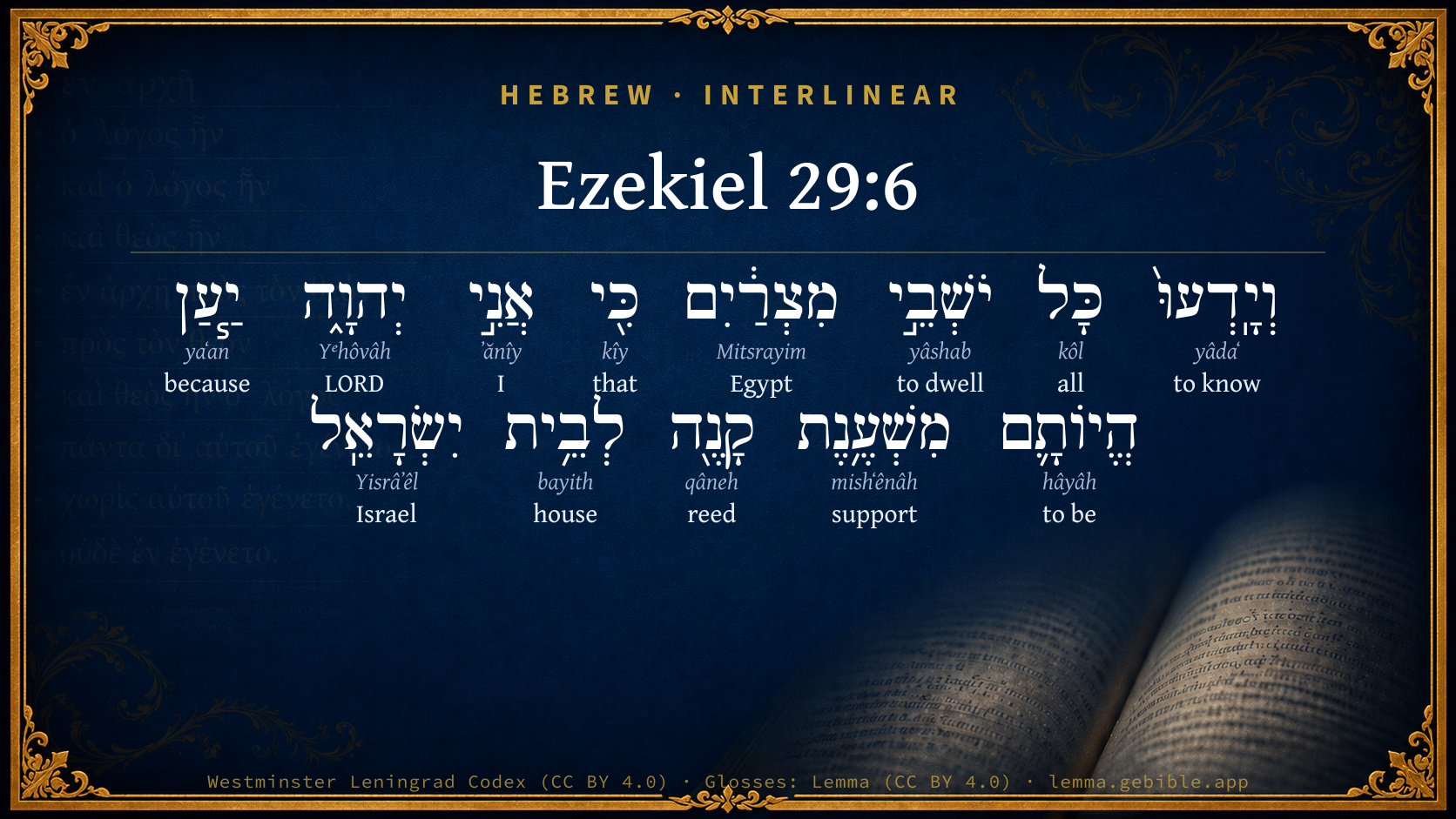
Hebrew (Westminster Leningrad Codex) Ezekiel 29:6 appears in the Hebrew Old Testament. The text above is from the Westminster Leningrad Codex. Each word links to its Strong’s number, a concise gloss, and parsing drawn from the Open Scriptures Hebrew Bible morphology. Click any word for its full Brown-Driver-Briggs (BDB) entry.
Download image
Cite this verse

Ezekiel 29:6 (World English Bible). Public Domain. Lemma interlinear Bible study tool, https://lemma.gebible.app/v/ezekiel/29/6.

Show BibTeX & RIS
BibTeX
RIS
English Translation
All the inhabitants of Egypt shall know that I am Yahweh, because they have been a staff of reed to the house of Israel.
World English Bible · Public Domain
Download a study sheet

One document with this verse’s original text, its word-by-word gloss line, the meaning frame, cross-references with their text, attributed commentary, and full source and license credits — printable, and it pastes into notes with its structure intact.

This verse Autodidact and up

Study sheet (.html) Plain text (.txt)

A passage Seminary Student

Up to 50 verses in one chapter. A passage sheet keeps up to 6 commentary sources and 12 cross-references per verse, in the order this page ranks them, and says so on the sheet whenever that leaves anything out. Ask for a single verse and you get the Autodidact verse sheet above.

Everything on this page stays free to read, with no account — the sheet is a download of what is already on screen, not access to it.

Want to remove ads? Support Godless Engineer
Compare translations 3

The same verse in 3 English versions, stacked beneath the original-language interlinear above. Click any original word for its lexicon entry.

Each is an independent rendering of the whole verse — the interlinear is not word-aligned to these translations.

Highlighted words mark where these versions differ — a whole-verse word diff, not a word-by-word alignment.

  • World English Bible Public Domain
    All the inhabitants of Egypt shall know that I am Yahweh, because they have been a staff of reed to the house of Israel.
  • King James Version Public Domain
    And all the inhabitants of Egypt shall know that I am the LORD, because they have been a staff of reed to the house of Israel.
  • unfoldingWord Literal Text CC BY-SA 4.0
    Then all the inhabitants of Egypt will know that I am Yahweh, because they have been a reed stalk to the house of Israel.

unfoldingWord Literal Text — © unfoldingWord, licensed CC BY-SA 4.0. Word-aligned USFM3 via Door43 (git.door43.org/unfoldingWord/en_ult).

Versions to compare (up to 4)

3 of 4 selected

Show all 18 translations

Every available English version of this verse, each an independent rendering of the whole verse.

  • World English Bible Public Domain
    All the inhabitants of Egypt shall know that I am Yahweh, because they have been a staff of reed to the house of Israel.
  • Berean Standard Bible Public Domain
    Then all the people of Egypt will know that I am the LORD. For you were only a staff of reeds to the house of Israel.
  • Majority Standard Bible Public Domain
    Then all the people of Egypt will know that I am the LORD. For you were only a staff of reeds to the house of Israel.
  • King James Version Public Domain
    And all the inhabitants of Egypt shall know that I am the LORD, because they have been a staff of reed to the house of Israel.
  • American Standard Version (1901) Public Domain
    And all the inhabitants of Egypt shall know that I am Jehovah, because they have been a staff of reed to the house of Israel.
  • Revised Version (1885) Public Domain
    And all the inhabitants of Egypt shall know that I am the LORD, because they have been a staff of reed to the house of Israel.
  • Geneva Bible (1599) Public Domain
    And al the inhabitants of Egypt shall know that I am the Lord, because they haue ben a staffe of reede to the house of Israel.
  • Douay-Rheims (1899) Public Domain
    And all the inhabitants of Egypt shall know that I am the Lord: because thou hast been a staff of a reed to the house of Israel.
  • Young's Literal Translation Public Domain
    And known have all inhabitants of Egypt That I `am' Jehovah, Because of their being a staff of reed to the house of Israel.
  • Literal Standard Version CC BY-SA 4.0
    And all inhabitants of Egypt have known || That I [am] YHWH, || Because of their being a staff of reed to the house of Israel.
  • Unlocked Literal Bible CC BY-SA 4.0
    Then all the inhabitants of Egypt will know that I am Yahweh, because they have been a reed stalk to the house of Israel.
  • unfoldingWord Literal Text CC BY-SA 4.0
    Then all the inhabitants of Egypt will know that I am Yahweh, because they have been a reed stalk to the house of Israel.
  • Darby Bible Public Domain
    And all the inhabitants of Egypt shall know that I [am] Jehovah, because they have been a staff of reed to the house of Israel.
  • World Messianic Bible Public Domain
    “‘“All the inhabitants of Egypt will know that I am the LORD, because they have been a staff of reed to the house of Israel.
  • Webster's Bible Public Domain
    And all the inhabitants of Egypt shall know that I am the LORD, because they have been a staff of reed to the house of Israel.
  • Free Bible Version CC BY-SA 4.0
    Then everyone in Egypt will know that I am the Lord. When you had to deal with the people of Israel you were like a flimsy walking stick made from a reed.
  • Bible in Basic English Public Domain
    And it will be clear to all the people of Egypt that I am the Lord, because you have been a false support to the children of Israel.
  • JPS Tanakh (1917) Public Domain
    And all the inhabitants of Egypt shall know that I am the LORD, because they have been a staff of reed to the house of Israel.

Literal Standard Version (2020), Covenant Press — licensed CC BY-SA 4.0. Text via the HelloAO Bible API (eBible.org). Unlocked Literal Bible (unfoldingWord) — licensed CC BY-SA 4.0. Text via the HelloAO Bible API (eBible.org). unfoldingWord Literal Text — © unfoldingWord, licensed CC BY-SA 4.0. Word-aligned USFM3 via Door43 (git.door43.org/unfoldingWord/en_ult). Free Bible Version, Dr. Jonathan Gallagher — licensed CC BY-SA 4.0. Text via the HelloAO Bible API (eBible.org).

Word by word

More ways to search: Search by grammar → Find every occurrence → Compare this word →

Practice this passage: Drill this verse → Learn its vocabulary →

מִשְׁעֶ֥נֶת
mishʻênâh
H4938
“support of”
Noun, Common, Feminine, Singular, Construct
Part of Speech
Noun
Type
Common
Gender
Feminine
Number
Singular
State
Construct
Full BDB Definition

Origin: from H4937

TWOT: 2434c , 2434d

support (of every kind), staff
  1. וְיָֽדְעוּ֙ yâdaʻ H3045 “and · to know” Conjunction + Verb, Qal, Sequential Perfect, 3rd Person, Common, Plural
  2. כָּל kôl H3605 “all of” Noun, Common, Masculine, Singular, Construct
  3. יֹשְׁבֵ֣י yâshab H3427 “dwelling” Verb, Qal, Participle Active, Masculine, Plural, Construct
  4. מִצְרַ֔יִם Mitsrayim H4714 “Egypt” Noun, Proper
  5. כִּ֖י kîy H3588 “that” Conjunction
  6. אֲנִ֣י ʼănîy H589 “I” Pronoun, Personal, 1st Person, Common, Singular
  7. יְהוָ֑ה Yᵉhôvâh H3068 “LORD” Noun, Proper
  8. יַ֧עַן yaʻan H3282 “because” Conjunction
  9. הֱיוֹתָ֛ם hâyâh H1961 “to be · them” Verb, Qal, Infinitive Construct + Suffix, Personal, 3rd Person, Masculine, Plural
  10. קָנֶ֖ה qâneh H7070 “reed” Noun, Common, Masculine, Singular, Absolute
  11. לְבֵ֥ית bayith H1004 “to/for · house of” Preposition + Noun, Common, Masculine, Singular, Construct
  12. יִשְׂרָאֵֽל Yisrâʼêl H3478 “Israel” Noun, Proper

About this verse

These counts appear in no published source. They are computed here, from the morphology-tagged text and Lemma’s own curated glosses. What Lemma adds →

13
words
13
distinct lemmas
Prophets
section

Notable vocabulary

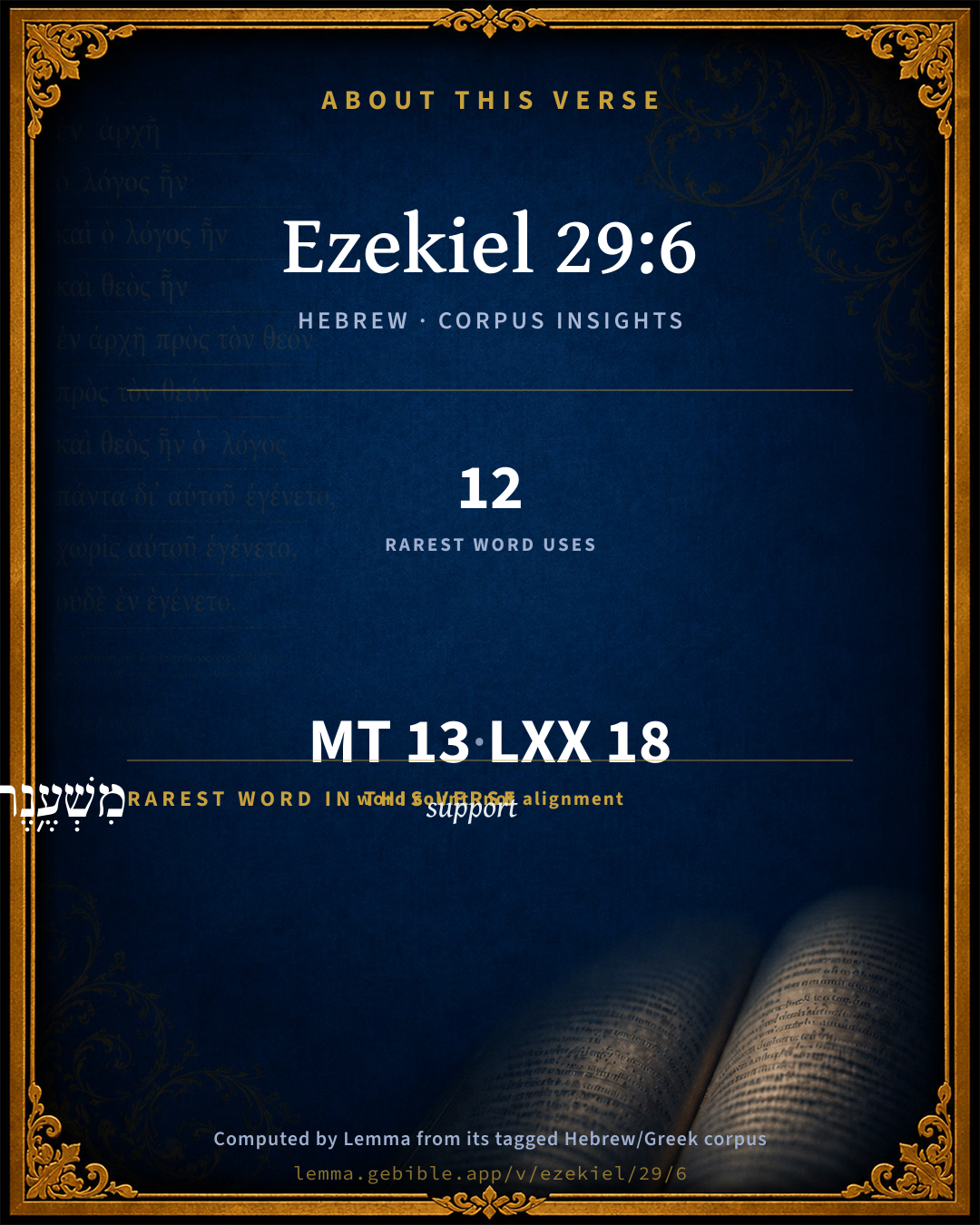
The rarest word here is מִשְׁעֶ֥נֶת support H4938 — appearing just 12 times in the whole Hebrew Bible.

Shared distinctive vocabulary

מִשְׁעֶ֥נֶת support H4938 occurs in 11 verses of the Hebrew Bible. Also found in:

Grammatical profile

  • 3 verbs
  • 7 nouns
  • 1 pronoun
  • 2 conjunctions

Verb forms

  • וְיָֽדְעוּ֙ Qal · Sequential Perfect
  • יֹשְׁבֵ֣י Qal · Participle Active
  • הֱיוֹתָ֛ם Qal · Infinitive Construct

Hebrew & Septuagint length

In English translation the verse runs 24 words from the Hebrew and 26 from the Septuagint (LXX English) — closely comparable.

A rough comparison of the two English renderings, which tokenize alike — not a word-level alignment.

Word counts can differ between the Hebrew and the Greek without any difference in meaning — e.g. the Hebrew direct-object marker אֵת has no separate Greek word, and Greek often adds the article ὁ.

In the original languages it is 13 Hebrew tokens and 18 Greek tokens — but the two are counted differently (Hebrew bundles its prefixes and suffixes into one token; the Greek is in lemma form), so that isn’t a like-for-like length.

Cross-references

11

Topical passages linked to Ezekiel 29:6 in the Treasury of Scripture Knowledge — connected by theme and wording, ordered by reader-vote popularity; previews shown in the World English Bible.

  • 2 Kings 18:21 Now, behold, you trust on the staff of this bruised reed, even on Egypt; whereon if a man lean, it will go into his hand, and pierce it: so is Pharaoh king of Egypt to all who trust on him.
  • Isaiah 36:6 Behold, you trust on the staff of this bruised reed, even on Egypt, whereon if a man lean, it will go into his hand, and pierce it: so is Pharaoh king of Egypt to all who trust on him.
  • Exodus 9:14 For this time I will send all my plagues against your heart, against your officials, and against your people; that you may know that there is none like me in all the earth.
  • Exodus 14:18 The Egyptians shall know that I am Yahweh, when I have gotten myself honor over Pharaoh, over his chariots, and over his horsemen."
  • Isaiah 20:5–6 They shall be dismayed and confounded, because of Ethiopia their expectation, and of Egypt their glory.
  • Isaiah 30:2–7 that set out to go down into Egypt, and have not asked at my mouth; to strengthen themselves in the strength of Pharaoh, and to take refuge in the shadow of Egypt!
  • Isaiah 31:1–3 Woe to those who go down to Egypt for help, and rely on horses, and trust in chariots because they are many, and in horsemen because they are very strong, but they don't look to the Holy One of Israel, neither seek Yahweh!
  • Jeremiah 2:36 Why go you about so much to change your way? you shall be ashamed of Egypt also, as you were ashamed of Assyria.
  • Lamentations 4:17 Our eyes do yet fail [in looking] for our vain help: In our watching we have watched for a nation that could not save.
  • Ezekiel 28:22–24 and say, Thus says the Lord Yahweh: Behold, I am against you, Sidon; and I will be glorified in the midst of you; and they shall know that I am Yahweh, when I shall have executed judgments in her, and shall be sanctified in her.
  • Ezekiel 28:26 They shall dwell securely therein; yes, they shall build houses, and plant vineyards, and shall dwell securely, when I have executed judgments on all those who do them despite round about them; and they shall know that I am Yahweh their God.

Cross-references courtesy of OpenBible.info (CC BY 4.0).

Hebrew and Greek witnesses Masoretic Hebrew ↔ Greek Septuagint

The same verse in the two great witnesses to the Old Testament, shown verse-for-verse.

These are two independent witnesses, not word-aligned to each other, and the Septuagint is shown in lemma (dictionary) form.

Hebrew Ezekiel 29:6 Masoretic · Westminster Leningrad Codex

וְיָֽדְעוּ֙ כָּל יֹשְׁבֵ֣י מִצְרַ֔יִם כִּ֖י אֲנִ֣י יְהוָ֑ה יַ֧עַן הֱיוֹתָ֛ם מִשְׁעֶ֥נֶת קָנֶ֖ה לְבֵ֥ית יִשְׂרָאֵֽל

All the inhabitants of Egypt shall know that I am Yahweh, because they have been a staff of reed to the house of Israel.

World English Bible · Public Domain

Greek LXX Ezekiel 29:6 Septuagint · lemma form

καί γιγνώσκω πᾶς ὁ καταοἰκέω αἴγυπτος ὅτι ἐγώ εἰμί κύριος ἀντί ὅς γίγνομαι ῥάβδος καλάμινος ὁ οἶκος ἰσραήλ

And all the dwellers in Egypt shall know that I am the Lord, because you have been a staff of reed to the house of Israel.

LXX2012 (modern English Septuagint) · Public Domain

Hebrew: Westminster Leningrad Codex (CC BY 4.0). Greek: Septuagint (public domain); English from LXX2012 (modern English Septuagint) (Public Domain). How the Septuagint differs from the Hebrew →

Targum (Aramaic paraphrase)

1

The Targum is the ancient Jewish Aramaic paraphrase of the Hebrew Scriptures — an interpretive translation, not the Hebrew text itself. Onkelos (literal) and Pseudo-Jonathan (expansive) render the Torah, and Jonathan the Prophets. Coverage is partial: where no permissively-licensed English translation exists for a verse, only the Aramaic is shown. This is verse-level text, not a word-by-word alignment to the Hebrew.

  1. Targum Jonathan Prophets (Joshua–Malachi)
    וְיֵדְעוּן כָּל יַתְבֵי מִצְרַיִם אֲרֵי אֲנָא יְיָ חֲלַף דַהֲווֹ סְמַךְ קַנְיָא רְעִיעָא לְבֵית יִשְׂרָאֵל:

    (no public-domain English translation for this verse)

    Targum Jonathan — Aramaic: “Mikraot Gedolot” (public domain). English: “Sefaria Community Translation” (CC0 1.0 (public-domain dedication)); “London "Chaldee Paraphrase," 1871” (public domain). Text via Sefaria.

Commentary

Notes on Ezekiel 29:6 from classic Christian and Jewish commentators (each source and its license shown beneath its notes). The classic Christian expositions comment on the surrounding passage and are grouped to its opening verse, so a note may address several verses; the Jewish commentaries on the Tanakh (Rashi and others) are per-verse, so they appear only where the commentator wrote on this verse.

Lemma curates 59 commentaries, every one of them public domain or Creative Commons licensed, each selected and text-cleaned for this edition rather than reprinted as found. About our sources →

Ellicott's Commentary for English Readers

(6) A staff of reed.—In Isa_36:6 the dependence of Judah upon Egypt is described as trust “in the staff of this broken reed;” but notwithstanding all warnings, they still trusted, especially at the time of this prophecy, and proved in their experience the truth of the Divine word. The figure is taken from the reeds, which grew abundantly on the banks of the Nile, and the statement is historically amplified in the following verse, where the reference is to be understood not of any single fact so much as of a continual, often repeated result. There should be a period in the middle of Eze_29:6, the first half forming the conclusion of the previous denunciation, and the second half being closely connected with Eze_29:7-9. Eze_29:7 is parenthetical.

A Bible Commentary for English Readers, edited by Charles John Ellicott (1878–1897) — public domain. Text from a community e-Sword module.

Trapp's Complete Commentary

John Trapp

Eze 29:6 And all the inhabitants of Egypt shall know that I [am] the LORD, because they have been a staff of reed to the house of Israel.

Ver. 6. And all the inhabitants, &c.] Shall feel my power in their just destruction, though they think themselves insuperable.

Because they have been a staff of reed.] See this fully expounded in the next words; see also on Isa 36:6 Jer 37:7-8. Egypt was a reedy country; as Pliny {a} telleth us, Arando autem ipsa per se fluctuat, et in necessitate eludit.

{a} Lib. xiii. cap. 11.

John Trapp, A Commentary or Exposition upon All the Books of the Old and New Testament (1647–1656) — public domain. Text from a community e-Sword module.

Joseph Benson's Commentary

Eze 29:6-7. Because they have been a staff of reed to the house of Israel — This expression, a staff of reed, is very emphatical, to signify a confidence which has failed those that depended upon it, or has done them more hurt than good; for if a reed is leaned upon as a staff, it most certainly bends under the weight and breaks, and the splinters sometimes run into the hand of him who leaned upon it. Though the Jews were greatly blamed by God for entering into alliance with the Egyptians, yet we find God here declaring that he would punish the Egyptians for not having performed their engagements to the Israelites; for though God forbade the Israelites to seek the alliance of the Egyptians, this nevertheless did not excuse the Egyptians in their breach of faith. When they took hold of thee by thy hand — When they relied on thee for help; thou didst break — Or, thou wast crushed, as Newcome renders it; and rend all their shoulder — Or, their arm. The sense is, that the Egyptians proved a destruction to the Jewish people, who expected to be helped by them: see Jer 37:5; Jer 37:7; 2Ki 24:7. This king of Egypt came with a great army to raise the siege of Jerusalem, but would not venture a battle with the Chaldeans, and marched back again, leaving Jerusalem to be taken by them.

Joseph Benson's Commentary on the Old and New Testaments (1811–1818) — public domain. Text from a community e-Sword module.

Tyndale Open Study Notes

Tyndale Open Resources

29:6-7 Egypt’s sin is once again associated with Israel. Egypt was a staff made of reeds that repeatedly pretended to support Israel, while lacking the will and the substance to deliver the promised aid. Egypt constantly incited rebellion in Israel against Assyria and Babylonia without ever really providing help (cp. 2 Kgs 18:21). Although trusting in this cracked staff was Israel’s sin, Egypt was also guilty and would face God’s wrath for raising false hopes.

Tyndale Open Study Notes — © Tyndale Open Resources, licensed CC BY-SA 4.0. Text via the HelloAO Bible API.

Geneva Bible (1599)

Geneva Bible translators

Read 2 Kings 18:21; Isa. 36:6.

Geneva Bible (1599) marginal notes — public domain. Text via Bolls.life.

Jamieson, Fausset & Brown

Robert Jamieson, A. R. Fausset & David Brown

staff of reed to . . . Israel--alluding to the reeds on the banks of the Nile, which broke if one leaned upon them (see on Eze 29:4; Isa 36:6). All Israel's dependence on Egypt proved hurtful instead of beneficial (Isa 30:1-5).

Jamieson, Fausset & Brown — Commentary Critical and Explanatory on the Whole Bible (1871) — public domain (CC PDM 1.0). Text via the HelloAO Bible API.

Adam Clarke's Commentary

Verse 6. They have been a staff of reed] An inefficient and faithless ally. The Israelites expected assistance from them when Nebuchadnezzar came against Jerusalem; and they made a feint to help them, but retired when Nebuchadnezzar went against them. Thus were the Jews deceived and ultimately ruined, see Eze 29:7.

Adam Clarke's Commentary on the Bible (1810–1826) — public domain. Text from a community e-Sword/MySword module.

The Cambridge Bible for Schools and Colleges

gen. ed. J. J. S. Perowne

6. The people of Egypt shall learn as of old who it is that sends such judgments upon them.

staff of reed] A staff or stay which was but a reed, and broke when leant upon (Eze_29:7). Cf. Isa_36:6; 2Ki_18:21. The figure of the reed was natural when speaking of Egypt.

The Cambridge Bible for Schools and Colleges (gen. ed. J. J. S. Perowne; Cambridge University Press, 1878–1918) — public domain. Text from a community e-Sword module.

John Gill's Exposition

And all the inhabitants of Egypt shall know that I am the Lord,.... Who could eject their king from his kingdom, and deliver him into the hands of his enemy; though he thought no God could, as he boastingly said, before observed:

because they have been a staff of reed to the house of Israel; alluding to the country of Egypt, which abounded with reeds that grew upon the banks of the river Nile, and other rivers. This signifies that either the Egyptians were weak, and could not help the people of Israel when they applied to them; or rather that they were treacherous and deceitful, and would not assist them, according to agreement; and were even pernicious and hurtful to them, as a broken reed; see Isa 36:6. The Targum renders it,

"the staff of a reed broken.''

John Gill's Exposition of the Whole Bible (1746–1763) — public domain (CC PDM 1.0). Text via the HelloAO Bible API.

Albert Barnes' Notes on the Bible

Staff of reed - The “reed” was especially appropriate to Egypt as the natural product of its river.

Albert Barnes' Notes on the Bible (1834–1885) — public domain. Text from a community e-Sword/MySword module.

Haydock's Catholic Bible Commentary

Israel, tempting them to rebel. (St. Jerome) --- He promised more than he was able or strove to perform, though he made a show of giving aid.

George Leo Haydock (1774–1849), Haydock's Catholic Family Bible and Commentary, 1859 edition — public domain. Excludes Psalms (Douay-Rheims chapter numbering differs from Protestant) and Deuterocanonical books (Catholic canon only).

Matthew Poole's English Annotations

This mighty overthrow shall be known through all Egypt, and as it shall fill them with fears and troubles, so it should be a convincing argument to them that God had done this, and punished them, and their proud king, who used to say, as Herodotus reports, that God could not turn him out of his kingdom. Because they, both king, princes, counsellors, and people of Egypt,

have been a staff of reed; treacherously, as next verse, dealt with the Jews, whom they seduced to trust and depend on them, and then perfidiously broke promise with them. It was the sin of the Jews to trust Egypt; it was Egypt’s great sin to falsify promise with the Jews, and for this God now punisheth Egypt.

Matthew Poole's English Annotations on the Holy Bible (1683–1685) — public domain. Text from a community e-Sword/MySword module.

The Pulpit Commentary

A staff of reed unto the house of Israel. Ezekiel reproduces the familiar image of 2Ki_18:21; Isa_36:6. The proverb had not ceased to be true, though the rulers were different. Here, again, the imagery is strictly local. The reeds were as characteristic of the Nile as the crocodiles. (Exo_1:3; Job_40:21) The image of the reed is continued in Ver. 7, and the effect of trusting to its support is described in detail.

Vers. 6, 7. A staff of reed.

Egypt is here compared to a staff of reed that had been trusted by Israel and had failed her in the hour of need. Earlier than this the Jews were warned not to trust Egypt because the old empire of the Nile had become weak as one of the reeds that grew by her sacred river. The confidence would be fatal, for the staff would break and pierce the hand of one who leaned upon it. (Isa_36:6) It was common for the prophets to warn the Jews against the mistake of going down to Egypt for help. (Isa_31:1) Now, however, Egypt is blamed for being so false and treacherous an ally as she proved herself in the time of Judah"s need.

I WEAKNESS IS CULPABLE. Egypt ought not to have been weak as a Nile reed. In her friendship, at all events, she should have shown more stamina. Moral weakness is certainly blameworthy. There is a great mistake in pleading weakness as an excuse for failure of duty. God never calls upon any one to do more than he is able to accomplish. If, therefore, his strength fails, and he cannot perform his task or face his temptations, the blame lies at his own door. We ought to be strong in soul. We have not even the excuse of Egypt a heathen nation that knew not the true God. With inexhaustible fountains of spiritual strength within our reach in the gospel of Christ, it is our own fault if we become as worthless reeds when we should be like strong trees of the Lord.

II FAILING FRIENDSHIP IS OF THE NATURE OF TREACHERY, We can wrong our friend without lifting a finger to hurt him, if we are found wanting in the time of need. Of all places friendship is the last in which weakness should be discovered. A true friend will make it a point of honor to be at his very best to give expected help, ever- though he be weak and suffer defeat in pursuing his own interests. He is a trustworthy friend of Christ who is weak as a reed when called upon to do any service or make any sacrifice for his Master. It is treason to Christ to be found wanting in the day of duty or danger.

III THERE IS NO PROTECTION IN THE PLEA OF WEAKNESS. Egypt was not saved on account of her weakness. She found no excuse in her inability to help her allies. She ought to have been able to help them. They who refuse to go into the Lord"s battle because they have not moral strength with which to fight the will not therefore be permitted to shelter themselves in peace and quiet. They may escape the wounds of the field, but they will encounter the ills of an attack at home. No soul can be safe in neglecting duty, shunning peril, or fleeing from the place where Christ would have him stand.

IV WEAKNESS MAY BE CONQUERED. The reed-like character may be made stout as an oak. God can make the feeble strong. "To them that have no might he increaseth strength". (Isa_40:29) Thus St. Paul could say, "When I am weak, then am I strong". (2Co_12:10) Christ will not break the bruised reed; but he will not leave it bowed and useless. He will strengthen it. The secret of this transformation from weakness to strength is faith. They were the heroes of faith who, according to the Epistle to the Hebrews, "out of weakness were made strong". (Heb_11:34)

Vers. 6, 7. The "staff of reed.

The figure is a very striking and effective one, however it may have been distasteful to the house of Israel, and even more so to the vaunted prowess of Egypt.

I THE SINFUL AND FOOLISH TRUST OF ISRAEL IN EGYPT. The circumstances in which Judah was placed at the time were such as to make it madness on the part of the remnant at Jerusalem to seek help from Egypt. Not only so; they were strictly forbidden upon Divine authority to act in this manner. In quietness and confidence lay their safety, in returning and rest, as Isaiah most powerfully and urgently represented to the people; not in the horsemen and the chariots of Egypt.

II THE HELPLESSNESS OF EGYPT AS A FRIEND AND DELIVERER. Why Egypt was at this time so powerless to help those who sought her alliance may not be perfectly clear to us; but the fact is so, and of this the events are sufficient evidence. It was a vain confidence which the Jews placed in the great and ancient world-power on the banks of the Nile. They thought they grasped a staff strong and trustworthy, and they found it "a staff of reed.

III THE INJURY INFLICTED UPON ISRAEL BY THE FAILURE OF EGYPT"S AID. Not only did the helper prove helpless; not only did the staff, when leant upon, bend and break. Those who applied for help received hurt instead of aid; the reed broke and pierced the hand that grasped it and trusted in its support. Jerusalem was all the worse for turning to Egypt for assistance against Babylon, the victorious and, just then, irresistible power.

IV THE COMMON CONFUSION OF THOSE WHO FOOLISHLY TRUSTED AND OF THOSE WHO PLACED CONFIDENCE IN THEM. Babylon rose; but Egypt and Judah fell. "All their loins shook;" i.e. the consequences of their policy were trouble, fear, and misery to both. Both incurred the hostility of the power which they in vain leagued with each other to resist.

V THE MORAL AND RELIGIOUS LESSON OF THE INCIDENT AND EXPERIENCE HERE DESCRIBED. There is a proneness among all nations to be guided in their alliances, aims, and efforts by considerations of worldly policy and expediency. Too seldom do they ask themselves What is right? What is in accordance with the eternal Reason and Righteousness which rule the world? What, in a word, is the course which God approves and enjoins? The proceedings undertaken at the instigation of worldly expediency, and in violation of Divine law, may meet with apparent and temporary success. But the Lord reigneth; and sooner or later action which he disapproves shall issue in disappointment and disaster. T.

The Pulpit Commentary (1880–1919), ed. H.D.M. Spence-Jones & Joseph S. Exell — public domain. Text from a community e-Sword module.

unfoldingWord translationNotes

Door43 World Missions Community

General Information:

Yahweh continues giving Ezekiel his message to Pharaoh.

know that I am Yahweh

When Yahweh says that people will know that he is Yahweh, he is implying that they will know that he is the one true God who has supreme authority and power. See how you translated this in Ezekiel 6:7. AT: "understand that I am Yahweh, the one true God" or "realize that I, Yahweh, have supreme power and authority" (See: Assumed Knowledge and Implicit Information)

they have been a reed stalk

The word "they" refers to the inhabitants of Egypt. A reed stalk is unreliable because it is easily broken. Yahweh speaks of them as a reed stalk because the people of Israel relied on the Egyptians to help them in war, but the Egyptians did not help them. AT: "they have been as unreliable as a reed stalk" (See: Metaphor)

reed

a plant that grows near water and looks like very large grass

stalk

the part of a reed that is long and like a thick stick. People can use them like sticks, but the stalks of reeds are not as strong as wood and can break suddenly.

When they took hold of you in their hand

God speaks of Israel relying on Egypt as if they were taking hold of a reed stalk in order to use it as a crutch. AT: "When they relied on you" (See: Metaphor)

When they took hold of you

The word "they" refers to the Israelites and the word "you" refers to Pharaoh or Pharaoh and Egypt.

you caused their legs to be unsteady

Because Egypt did not help the Israelites, the Israelites could not defend themselves against their enemy, the Babylonians. God speaks of the Israelites being unable to defend themselves as if their legs were unsteady. AT: "you caused them to be like people whose legs are unsteady" (See: Metaphor)

translationWords

Egypt

unfoldingWord translationNotes — © Distant Shores Media and the Door43 World Missions Community, licensed CC BY-SA 4.0. Source: git.door43.org/Door43/en_tn.

Rashi

Rabbi Shlomo Yitzchaki (Rashi)

a prop of reeds Many times they relied on them: in the days of Sennacherib and in the days of Nebuchadnezzar, but it did not avail them, just like this reed, which is soft and does not support the one who leans on it.

Rashi on the Tanakh — English translations: “The Judaica Press complete Tanach with Rashi, translated by A. J. Rosenberg” (CC BY 4.0); “Pentateuch with Rashi's commentary by M. Rosenbaum and A.M. Silbermann, 1929-1934” (public domain); “The Metsudah Tanach series, Lakewood, N.J” (CC BY 4.0); and “The Book of Joshua, Metsudah Publications, 1997” (CC BY 4.0). Text via Sefaria.

Lesson kit

Teaching starters — assembled from the data on this page, not authored interpretation. Every prompt links to the verse data it draws on. Edit before teaching.

Ezekiel, in the Prophets, opens this verse with 13 words (13 distinct Hebrew lemmas). Its most distinctive word is mishʻênâh (“support”). A historical commentator’s framing appears above. Read the whole chapter for the surrounding context.

Discussion questions

  1. How does “support” (mishʻênâh) shape what this verse is saying?
  2. Exodus 21:19 shares the word «support» with this verse. How do the two illuminate each other?
  3. These translations render this verse differently; the difference is in the English rendering, not the original. What questions does that raise?
  4. The verb «וְיָֽדְעוּ֙» is Qal Sequential Perfect. How does its form color the action?
  5. Reading how Ellicott's Commentary for English Readers and Trapp's Complete Commentary read this verse, where do the two commentators agree and where do they part?

Things to notice

Reading settings

Reading text

Shown beneath each verse's original-language words.

Old Testament
Old Testament edition

Read the OT as the Masoretic Hebrew (MT) or the Greek Septuagint (LXX).

English shown for the Greek Septuagint (in the Hebrew ↔ Greek comparison).

Comparing translations? Open the Compare panel on any verse page to stack up to four side by side.