
2 Samuel 7:6

Hebrew (Westminster Leningrad Codex) 2 Samuel 7:6 appears in the Hebrew Old Testament. The text above is from the Westminster Leningrad Codex. Each word links to its Strong’s number, a concise gloss, and parsing drawn from the Open Scriptures Hebrew Bible morphology. Click any word for its full Brown-Driver-Briggs (BDB) entry.
Download image
Cite this verse

2 Samuel 7:6 (World English Bible). Public Domain. Lemma interlinear Bible study tool, https://lemma.gebible.app/v/2-samuel/7/6.

Show BibTeX & RIS
BibTeX
RIS
English Translation
for I have not lived in a house since the day that I brought up the children of Israel out of Egypt, even to this day, but have walked in a tent and in a tent.
World English Bible · Public Domain
Download a study sheet

One document with this verse’s original text, its word-by-word gloss line, the meaning frame, cross-references with their text, attributed commentary, and full source and license credits — printable, and it pastes into notes with its structure intact.

This verse Autodidact and up

Study sheet (.html) Plain text (.txt)

A passage Seminary Student

Up to 50 verses in one chapter. A passage sheet keeps up to 6 commentary sources and 12 cross-references per verse, in the order this page ranks them, and says so on the sheet whenever that leaves anything out. Ask for a single verse and you get the Autodidact verse sheet above.

Everything on this page stays free to read, with no account — the sheet is a download of what is already on screen, not access to it.

Want to remove ads? Support Godless Engineer
Compare translations 3

The same verse in 3 English versions, stacked beneath the original-language interlinear above. Click any original word for its lexicon entry.

Each is an independent rendering of the whole verse — the interlinear is not word-aligned to these translations.

Highlighted words mark where these versions differ — a whole-verse word diff, not a word-by-word alignment.

  • World English Bible Public Domain
    for I have not lived in a house since the day that I brought up the children of Israel out of Egypt, even to this day, but have walked in a tent and in a tent.
  • King James Version Public Domain
    Whereas I have not dwelt in any house since the time that I brought up the children of Israel out of Egypt, even to this day, but have walked in a tent and in a tabernacle.
  • unfoldingWord Literal Text CC BY-SA 4.0
    For I have not lived in a house from the day of my bringing up the sons of Israel from Egypt and to this day, but I have been going about in a tent and in a dwelling.

unfoldingWord Literal Text — © unfoldingWord, licensed CC BY-SA 4.0. Word-aligned USFM3 via Door43 (git.door43.org/unfoldingWord/en_ult).

Versions to compare (up to 4)

3 of 4 selected

Show all 18 translations

Every available English version of this verse, each an independent rendering of the whole verse.

  • World English Bible Public Domain
    for I have not lived in a house since the day that I brought up the children of Israel out of Egypt, even to this day, but have walked in a tent and in a tent.
  • Berean Standard Bible Public Domain
    For I have not dwelt in a house from the day I brought the Israelites up out of Egypt until this day, but I have moved about with a tent as My dwelling.
  • Majority Standard Bible Public Domain
    For I have not dwelt in a house from the day I brought the Israelites up out of Egypt until this day, but I have moved about with a tent as My dwelling.
  • King James Version Public Domain
    Whereas I have not dwelt in any house since the time that I brought up the children of Israel out of Egypt, even to this day, but have walked in a tent and in a tabernacle.
  • American Standard Version (1901) Public Domain
    for I have not dwelt in a house since the day that I brought up the children of Israel out of Egypt, even to this day, but have walked in a tent and in a tabernacle.
  • Revised Version (1885) Public Domain
    for I have not dwelt in an house since the day that I brought up the children of Israel out of Egypt, even to this day, but have walked in a tent and in a tabernacle.
  • Geneva Bible (1599) Public Domain
    For I haue dwelt in no house since the time that I brought the children of Israel out of Egypt vnto this day, but haue walked in a tent and tabernacle.
  • Douay-Rheims (1899) Public Domain
    Whereas I have not dwelt in a house from the day that I brought the children of Israel out of the land of Egypt even to this day: but have walked in a tabernacle, and in a tent.
  • Young's Literal Translation Public Domain
    for I have not dwelt in a house even from the day of My bringing up the sons of Israel out of Egypt, even unto this day, and am walking up and down in a tent and in a tabernacle.
  • Literal Standard Version CC BY-SA 4.0
    For I have not dwelt in a house even from the day of My bringing up the sons of Israel out of Egypt, even to this day, and am walking up and down in a tent and in a dwelling place.
  • Unlocked Literal Bible CC BY-SA 4.0
    For I have not lived in a house from the day that I brought up the people of Israel out of Egypt until this present day; instead, I have been moving about in a tent, a tabernacle.
  • unfoldingWord Literal Text CC BY-SA 4.0
    For I have not lived in a house from the day of my bringing up the sons of Israel from Egypt and to this day, but I have been going about in a tent and in a dwelling.
  • Darby Bible Public Domain
    For I have not dwelt in a house since the day that I brought up the children of Israel out of Egypt, even to this day, but I went about in a tent and in a tabernacle.
  • World Messianic Bible Public Domain
    For I have not lived in a house since the day that I brought the children of Israel up out of Egypt, even to this day, but have moved around in a tent and in a tabernacle.
  • Webster's Bible Public Domain
    Whereas I have not dwelt in any house since the time that I brought the children of Israel out of Egypt, even to this day, but have walked in a tent, and in a tabernacle.
  • Free Bible Version CC BY-SA 4.0
    For I have never lived in a house, from the time I led the Israelites out of Egypt up till now. I have always moved from place to place, living in a tent and a Tabernacle.
  • Bible in Basic English Public Domain
    For from the day when I took the children of Israel up out of Egypt till this day, I have had no house, but have gone from place to place in a tent.
  • JPS Tanakh (1917) Public Domain
    for I have not dwelt in a house since the day that I brought up the children of Israel out of Egypt, even to this day, but have walked in a tent and in a tabernacle.

Literal Standard Version (2020), Covenant Press — licensed CC BY-SA 4.0. Text via the HelloAO Bible API (eBible.org). Unlocked Literal Bible (unfoldingWord) — licensed CC BY-SA 4.0. Text via the HelloAO Bible API (eBible.org). unfoldingWord Literal Text — © unfoldingWord, licensed CC BY-SA 4.0. Word-aligned USFM3 via Door43 (git.door43.org/unfoldingWord/en_ult). Free Bible Version, Dr. Jonathan Gallagher — licensed CC BY-SA 4.0. Text via the HelloAO Bible API (eBible.org).

Word by word

More ways to search: Search by grammar → Find every occurrence → Compare this word →

Practice this passage: Drill this verse → Learn its vocabulary →

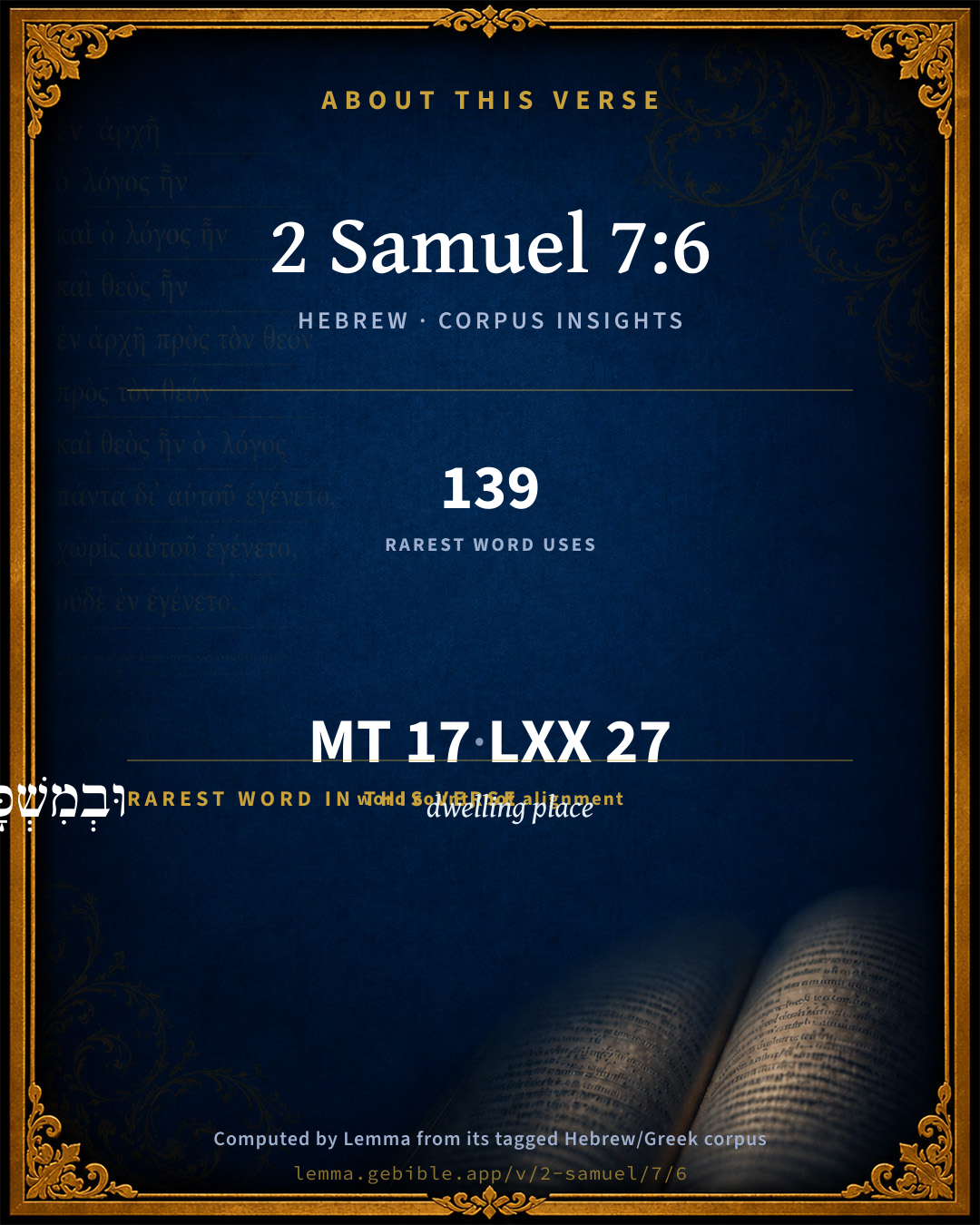
וּבְמִשְׁכָּֽן
mishkân
H4908
“and · in/at · dwelling place”
Conjunction + Preposition + Noun, Common, Masculine, Singular, Absolute
Part of Speech
Conjunction + Preposition + Noun
Type
Common
Gender
Masculine
Number
Singular
State
Absolute
Full BDB Definition

Origin: from H7931

TWOT: 2387c

dwelling place, tabernacle - dwelling-place - dwellings
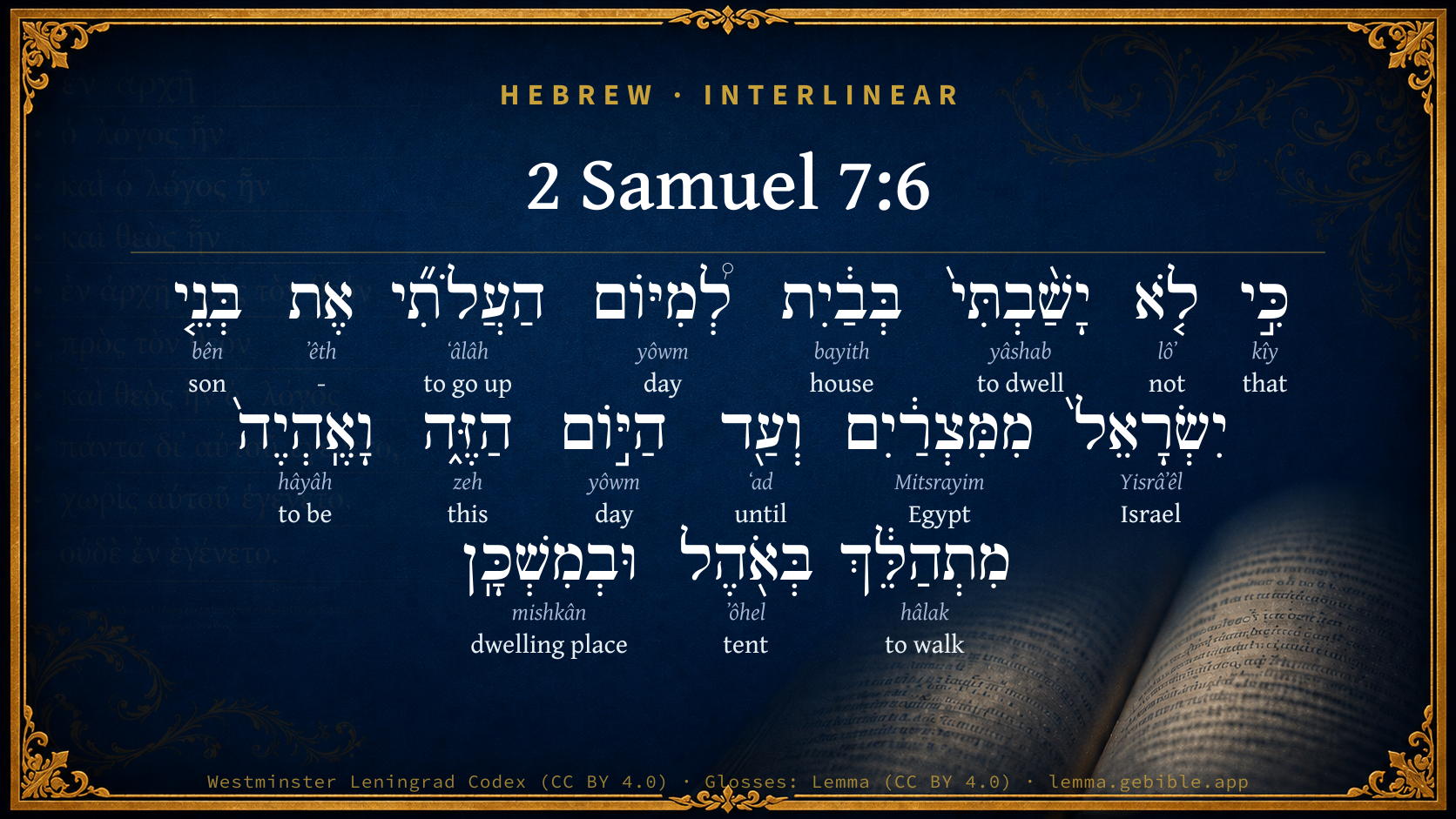
  1. כִּ֣י kîy H3588 “that” Conjunction
  2. לֹ֤א lôʼ H3808 “not” Particle, Negative
  3. יָשַׁ֨בְתִּי֙ yâshab H3427 “to dwell” Verb, Qal, Perfect, 1st Person, Common, Singular
  4. בְּבַ֔יִת bayith H1004 “in/at · house” Preposition + Noun, Common, Masculine, Singular, Absolute
  5. לְ֠מִיּוֹם yôwm H3117 “to/for · from · day of” Preposition + Preposition + Noun, Common, Masculine, Singular, Construct
  6. הַעֲלֹתִ֞י ʻâlâh H5927 “to go up · me” Verb, Hiphil, Infinitive Construct + Suffix, Personal, 1st Person, Common, Singular
  7. אֶת ʼêth H853 “-” Particle, Direct Object
  8. בְּנֵ֤י bên H1121 “sons of” Noun, Common, Masculine, Plural, Construct
  9. יִשְׂרָאֵל֙ Yisrâʼêl H3478 “Israel” Noun, Proper
  10. מִמִּצְרַ֔יִם Mitsrayim H4714 “from · Egypt” Preposition + Noun, Proper
  11. וְעַ֖ד ʻad H5704 “and · until” Conjunction + Preposition
  12. הַיּ֣וֹם yôwm H3117 “the · day” Particle, Definite Article + Noun, Common, Masculine, Singular, Absolute
  13. הַזֶּ֑ה zeh H2088 “the · this” Particle, Definite Article + Pronoun, Demonstrative, Masculine, Singular
  14. וָאֶֽהְיֶה֙ hâyâh H1961 “and · to be” Conjunction + Verb, Qal, Sequential Imperfect, 1st Person, Common, Singular
  15. מִתְהַלֵּ֔ךְ hâlak H1980 “walking” Verb, Hithpael, Participle Active, Masculine, Singular, Absolute
  16. בְּאֹ֖הֶל ʼôhel H168 “in/at · tent” Preposition + Noun, Common, Masculine, Singular, Absolute

About this verse

These counts appear in no published source. They are computed here, from the morphology-tagged text and Lemma’s own curated glosses. What Lemma adds →

17
words
16
distinct lemmas
Historical
section

Grammatical profile

  • 4 verbs
  • 8 nouns
  • 1 pronoun
  • 1 preposition
  • 1 conjunction
  • 2 particles

Verb forms

  • יָשַׁ֨בְתִּי֙ Qal · Perfect
  • הַעֲלֹתִ֞י Hiphil · Infinitive Construct
  • וָאֶֽהְיֶה֙ Qal · Sequential Imperfect
  • מִתְהַלֵּ֔ךְ Hithpael · Participle Active

Repetition

A word recurs within this verse — often emphatic in Hebrew:

  • לְ֠מִיּוֹם day H3117 ×2

Hebrew & Septuagint length

In English translation the verse runs 36 words from the Hebrew and 37 from the Septuagint (LXX English) — closely comparable.

A rough comparison of the two English renderings, which tokenize alike — not a word-level alignment.

Word counts can differ between the Hebrew and the Greek without any difference in meaning — e.g. the Hebrew direct-object marker אֵת has no separate Greek word, and Greek often adds the article ὁ.

In the original languages it is 17 Hebrew tokens and 27 Greek tokens — but the two are counted differently (Hebrew bundles its prefixes and suffixes into one token; the Greek is in lemma form), so that isn’t a like-for-like length.

Cross-references

13

Topical passages linked to 2 Samuel 7:6 in the Treasury of Scripture Knowledge — connected by theme and wording, ordered by reader-vote popularity; previews shown in the World English Bible.

  • 1 Kings 8:16 Since the day that I brought forth my people Israel out of Egypt, I chose no city out of all the tribes of Israel to build a house, that my name might be there; but I chose David to be over my people Israel.
  • Exodus 40:18–19 Moses raised up the tent, and laid its sockets, and set up the boards of it, and put in the bars of it, and raised up its pillars.
  • Joshua 18:1 The whole congregation of the children of Israel assembled themselves together at Shiloh, and set up the tent of meeting there: and the land was subdued before them.
  • Exodus 40:34–38 Then the cloud covered the tent of meeting, and the glory of Yahweh filled the tent.
  • Exodus 33:14–15 He said, "My presence will go with you, and I will give you rest."
  • Leviticus 26:23–24 "'If by these things you won't be reformed to me, but will walk contrary to me;
  • Leviticus 26:27–28 "'If you in spite of this won't listen to me, but walk contrary to me;
  • Numbers 10:33–36 They set forward from the Mount of Yahweh three days' journey; and the ark of the covenant of Yahweh went before them three days' journey, to seek out a resting-place for them.
  • Deuteronomy 23:14 for Yahweh your God walks in the midst of your camp, to deliver you, and to give up your enemies before you; therefore shall your camp be holy, that he may not see an unclean thing in you, and turn away from you.
  • 1 Chronicles 17:5–6 for I have not lived in a house since the day that I brought up Israel, to this day, but have gone from tent to tent, and from [one] tent [to another].
  • Acts 7:44 "Our fathers had the tent of the testimony in the wilderness, even as he who spoke to Moses commanded him to make it according to the pattern that he had seen;
  • 2 Corinthians 6:16 What agreement has a temple of God with idols? For you are a temple of the living God. Even as God said, "I will dwell in them, and walk in them; and I will be their God, and they will be my people."
  • Revelation 2:1 To the angel of the assembly in Ephesus write: "He who holds the seven stars in his right hand, he who walks among the seven golden lampstands says these things:

Cross-references courtesy of OpenBible.info (CC BY 4.0).

Hebrew and Greek witnesses Masoretic Hebrew ↔ Greek Septuagint

The same verse in the two great witnesses to the Old Testament, shown verse-for-verse.

These are two independent witnesses, not word-aligned to each other, and the Septuagint is shown in lemma (dictionary) form.

Hebrew 2 Samuel 7:6 Masoretic · Westminster Leningrad Codex

כִּ֣י לֹ֤א יָשַׁ֨בְתִּי֙ בְּבַ֔יִת לְ֠מִיּוֹם הַעֲלֹתִ֞י אֶת בְּנֵ֤י יִשְׂרָאֵל֙ מִמִּצְרַ֔יִם וְעַ֖ד הַיּ֣וֹם הַזֶּ֑ה וָאֶֽהְיֶה֙ מִתְהַלֵּ֔ךְ בְּאֹ֖הֶל וּבְמִשְׁכָּֽן

for I have not lived in a house since the day that I brought up the children of Israel out of Egypt, even to this day, but have walked in a tent and in a tent.

World English Bible · Public Domain

Greek LXX 2 Samuel 7:6 Septuagint · lemma form

ὅτι οὐ καταοικέω ἐν οἶκος ἀπό ὅς ἡμέρα ἀναἄγω ἐκ αἴγυπτος ὁ υἱός ἰσραήλ ἕως ὁ ἡμέρα οὗτος καί εἰμί ἐν περιπατέω ἐν κατάλυμα καί ἐν σκηνή

For I have not lived in a house from the day that I brought up the children of Israel out of Egypt to this day, but I have been walking in a lodge and in a tent,

LXX2012 (modern English Septuagint) · Public Domain

Hebrew: Westminster Leningrad Codex (CC BY 4.0). Greek: Septuagint (public domain); English from LXX2012 (modern English Septuagint) (Public Domain). How the Septuagint differs from the Hebrew →

Targum (Aramaic paraphrase)

1

The Targum is the ancient Jewish Aramaic paraphrase of the Hebrew Scriptures — an interpretive translation, not the Hebrew text itself. Onkelos (literal) and Pseudo-Jonathan (expansive) render the Torah, and Jonathan the Prophets. Coverage is partial: where no permissively-licensed English translation exists for a verse, only the Aramaic is shown. This is verse-level text, not a word-by-word alignment to the Hebrew.

  1. Targum Jonathan Prophets (Joshua–Malachi)
    אֲרֵי לָא אִשְׁרִיתִי שְׁכִנְתִּי בְּבֵיתָא מִיוֹמָא דִי אַסְקֵית יַת בְּנֵי יִשְׂרָאֵל מִמִצְרַיִם וְעַד יוֹמָא הָדֵין וַהֲוֵיתִי מַשְׁרִי שְׁכִנְתִּי בְּמַשְׁכְּנִין וּבִירִיעָן:

    (no public-domain English translation for this verse)

    Targum Jonathan — Aramaic: “Mikraot Gedolot” (public domain). English: “Sefaria Community Translation” (CC0 1.0 (public-domain dedication)); “London "Chaldee Paraphrase," 1871” (public domain). Text via Sefaria.

Commentary

Notes on 2 Samuel 7:6 from classic Christian and Jewish commentators (each source and its license shown beneath its notes). The classic Christian expositions comment on the surrounding passage and are grouped to its opening verse, so a note may address several verses; the Jewish commentaries on the Tanakh (Rashi and others) are per-verse, so they appear only where the commentator wrote on this verse.

Lemma curates 59 commentaries, every one of them public domain or Creative Commons licensed, each selected and text-cleaned for this edition rather than reprinted as found. About our sources →

Trapp's Complete Commentary

John Trapp

2Sa 7:6 Whereas I have not dwelt in [any] house since the time that I brought up the children of Israel out of Egypt, even to this day, but have walked in a tent and in a tabernacle.

Ver. 6. But have walked in a tent and in a tubernacle.] By tent, some understand the hangings made of goats’ hair; and by tabernacle or habitacle, the sanctuary itself. See Exo 26:6. The ark was transportative hitherto, till settled in Solomon’s temple: so till we come to heaven, we are in continual motion.

John Trapp, A Commentary or Exposition upon All the Books of the Old and New Testament (1647–1656) — public domain. Text from a community e-Sword module.

Tyndale Open Study Notes

Tyndale Open Resources

7:6 never lived in a house: Prior to the building of the Temple in one fixed location, God’s dwelling was the Tabernacle, a mobile, tentlike structure. The text here uses language of human experience to describe a truth about God (see study notes on Exod 29:18; Deut 8:2). Although God is omnipresent, he chose the Tabernacle and Temple as his “dwelling place” in ancient Israel (see study note on 2 Chr 2:5-6; cp. Acts 17:24).

Tyndale Open Study Notes — © Tyndale Open Resources, licensed CC BY-SA 4.0. Text via the HelloAO Bible API.

John Gill's Exposition

Whereas I have not dwelt in any house,.... Fixed, stated, habitation:

since the time that I brought up the children of Israel out of Egypt,

even to this day; a space of five or six hundred years, though he might before:

but have walked in a tent and in a tabernacle; moving from place to place while in the wilderness, and since in the land of Canaan, first at Gilgal, then at Shiloh, afterwards at Nob, and now at Gibeon. "Tent" and "tabernacle" are distinguished, though they were but one building and habitation; the tent was the curtains of goats' hair, and the tabernacle the linen curtains, see Exo 26:1. In Ch1 17:5 it is "from tent to tent, and from one tabernacle to another"; which does not intend variety of tabernacles, but change of place.

John Gill's Exposition of the Whole Bible (1746–1763) — public domain (CC PDM 1.0). Text via the HelloAO Bible API.

Albert Barnes' Notes on the Bible

Have walked - Implying the frequent moving of the tabernacle, in the times of the Judges, as opposed to a settled resting in one place. The word tent, refers especially to the outward covering of skins, etc.: the tabernacle denotes the framework of beards and bars. Observe the constant reference to the Exodus and to the details as given in the books of Moses.

Albert Barnes' Notes on the Bible (1834–1885) — public domain. Text from a community e-Sword/MySword module.

Matthew Poole's English Annotations

These two seem thus to be distinguished; the one may note the curtains and hangings within, the other the frame of boards, and coverings upon it.

Matthew Poole's English Annotations on the Holy Bible (1683–1685) — public domain. Text from a community e-Sword/MySword module.

The Pulpit Commentary

I have walked in a tent and in a tabernacle; literally, I have walked continually; that is, I have ever been a wanderer, first, in the wilderness, and subsequently at Gilgal, Shiloh, Nob, and Gibeon. Instead of a "tabernacle," the Hebrew has a "dwelling." This may refer to the houses of Abinadab and Obed-Edom, but the words more probably signify "a tent that was my dwelling."

The Pulpit Commentary (1880–1919), ed. H.D.M. Spence-Jones & Joseph S. Exell — public domain. Text from a community e-Sword module.

John Wesley's Explanatory Notes

Tent and tabernacle - These two seem thus to be distinguished, the one may note the curtains and hangings within, the other the frame of boards, and coverings upon it.

John Wesley, Explanatory Notes Upon the Whole Bible (1754–1765) — public domain. Text via the GEBible commentary corpus.

Keil & Delitzsch

C. F. Keil & F. Delitzsch

The reason assigned for this answer: "I have not dwelt in a house from the day of the bringing up of Israel out of Egypt even to this day, but I was wandering about in a tent and in a dwelling." "And in a dwelling" (mishcan) is to be taken as explanatory, viz., in a tent which was my dwelling. As a tent is a traveller's dwelling, so, as long as God's dwelling was a tent, He himself appeared as if travelling or going from place to place. "In the whole of the time that I walked among all the children of Israel, ... have I spoken a word to one of the tribes of Israel, whom I commanded to feed my people, saying, Wherefore have ye not built me a cedar house?" A "cedar house" is equivalent to a palace built of costly materials. The expression ישׂראל שׁבטי אחד ("one of the tribes of Israel") is a striking one, as the feeding of the nation does not appear to be a duty belonging to the "tribes," and in the Chronicles we have שׁפטי (judges) instead of שׁבטי (tribes). But if שׁפטי had been the original expression used in the text, it would be impossible to explain the origin and general acceptance of the word שׁבטי. For this very reason, therefore, we must regard שׁבטי as the original word, and understand it as referring to the tribes, which had supplied the nation with judges and leaders before the tie of David, since the feeding, i.e., the government of Israel, which was in the hands of the judges, was transferred to the tribes to which the judges belonged. This view is confirmed by Psa 78:67-68, where the election of David as prince, and of Zion as the site of the sanctuary, is described as the election of the tribe of Judah and the rejection of the tribe of Ephraim. On the other hand, the assumption of Thenius, that שׁבטי, "shepherd-staffs," is used poetically for shepherds, cannot be established on the ground of Lev 27:32 and Mic 7:14. Jehovah gave two reasons why David's proposal to build Him a temple should not be carried out: (1) He had hitherto lived in a tent in the midst of His people; (2) He had not commanded any former prince or tribe to build a temple. This did not involve any blame, as though there had been something presumptuous in David's proposal, or in the fact that he had thought of undertaking such a work without an express command from God, but simply showed that it was not because of any negligence on the part of the former leaders of the people that they had not thought of erecting a temple, and that even now the time for carrying out such a work as that had not yet come.

Keil & Delitzsch — Biblical Commentary on the Old Testament (1861–1891) — public domain (CC PDM 1.0). Text via the HelloAO Bible API. (Old Testament only.)

unfoldingWord translationNotes

Door43 World Missions Community

did I ever say anything to any of Israel's leaders whom I appointed to shepherd my people Israel, saying, "Why have you not built me a house of cedar?"

This has a quotation within a quotation. The direct quotation can be stated as an indirect quotation. AT: "did I ever ask any of Israel's leaders, whom I appointed to shepherd my people Israel, why they had not built me a house of cedar?" (See: Quotes Within Quotes and Direct and Indirect Quotations)

did I ever say anything to any of Israel's leaders

Yahweh uses a question to emphasize that he never asked any of Israel's leaders to build him a house. AT: "I never said anything to any of Israel's leaders" (See: Rhetorical Question)

whom I appointed to shepherd my people Israel

Those who are leaders of the people of Israel are spoken of as if they were shepherds and the people were sheep. (See: Metaphor)

Why have you not built me a house of cedar?

If Yahweh had asked the leaders this question, he would have been using a question to scold them for not building him a house of cedar. But, Yahweh said previously that he did not ask them this question. AT: "You should have built me a house of cedar." (See: Rhetorical Question)

translationWords

people group

Israel

Egypt

tabernacle

appoint

shepherd

people of God

unfoldingWord translationNotes — © Distant Shores Media and the Door43 World Missions Community, licensed CC BY-SA 4.0. Source: git.door43.org/Door43/en_tn.

Rashi

Rabbi Shlomo Yitzchaki (Rashi)

Within a tent and the Mishkan. The Mishkan of Shiloh had no roof, it had walls made of stone underneath and curtains on top [as its covering].

Rashi on the Tanakh — English translations: “The Judaica Press complete Tanach with Rashi, translated by A. J. Rosenberg” (CC BY 4.0); “Pentateuch with Rashi's commentary by M. Rosenbaum and A.M. Silbermann, 1929-1934” (public domain); “The Metsudah Tanach series, Lakewood, N.J” (CC BY 4.0); and “The Book of Joshua, Metsudah Publications, 1997” (CC BY 4.0). Text via Sefaria.

Lesson kit

Teaching starters — assembled from the data on this page, not authored interpretation. Every prompt links to the verse data it draws on. Edit before teaching.

2 Samuel, in the Historical, opens this verse with 17 words (16 distinct Hebrew lemmas). Its most distinctive word is mishkân (“dwelling place”). A historical commentator’s framing appears above. Read the whole chapter for the surrounding context.

Discussion questions

  1. How does “dwelling place” (mishkân) shape what this verse is saying?
  2. 1 Kings 8:16 shares this passage’s theme. How do the two illuminate each other?
  3. “day” occurs 2× in this one verse. What is the effect of the repetition?
  4. These translations render this verse differently. What is at stake in choosing one wording over another?
  5. The verb «יָשַׁ֨בְתִּי֙» is Qal Perfect. How does its form color the action?
  6. Reading how Trapp's Complete Commentary and Tyndale Open Study Notes read this verse, where do the two commentators agree and where do they part?

Things to notice

Reading settings

Reading text

Shown beneath each verse's original-language words.

Old Testament
Old Testament edition

Read the OT as the Masoretic Hebrew (MT) or the Greek Septuagint (LXX).

English shown for the Greek Septuagint (in the Hebrew ↔ Greek comparison).

Comparing translations? Open the Compare panel on any verse page to stack up to four side by side.