
Hosea 8:13

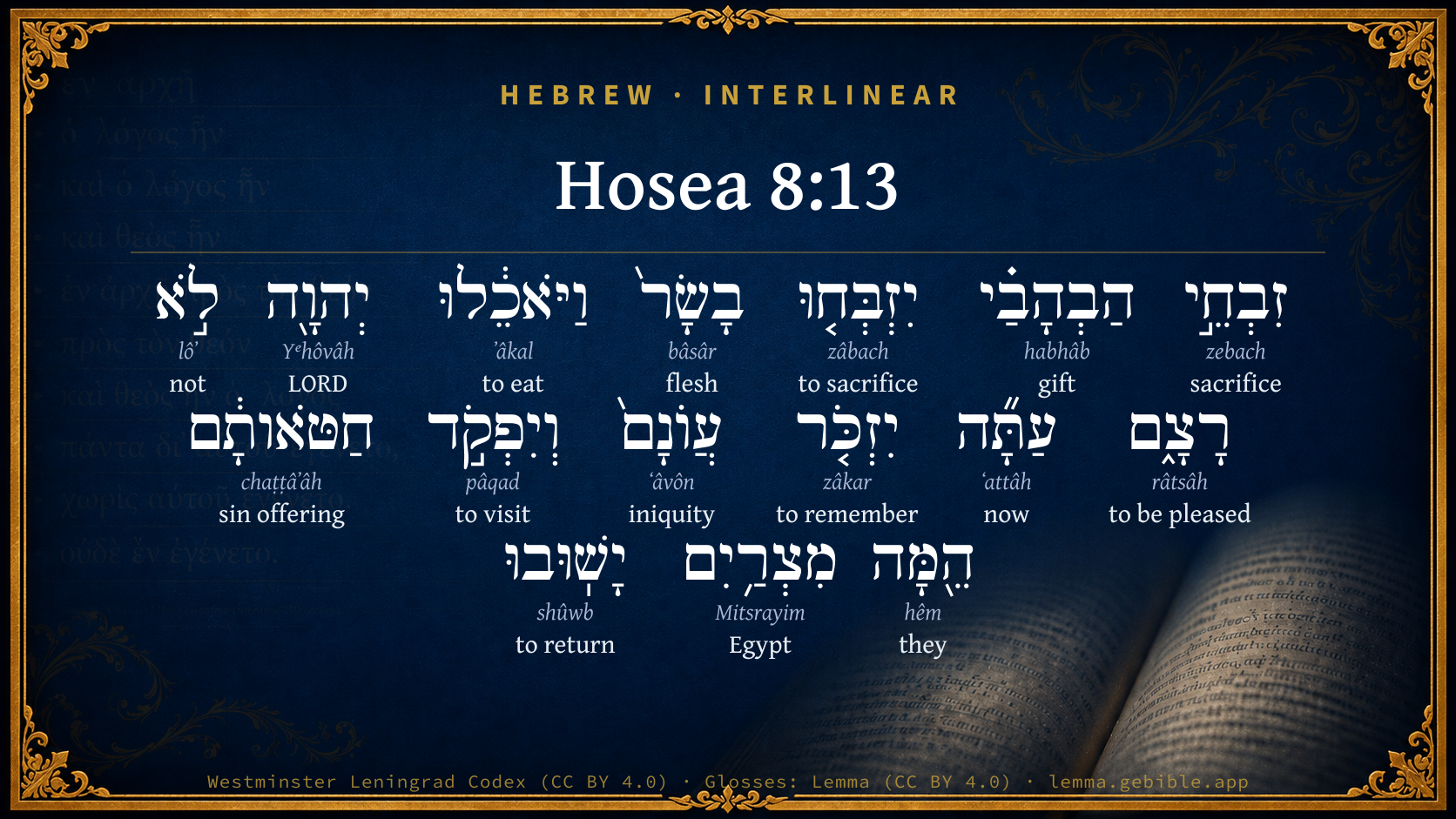
Hebrew (Westminster Leningrad Codex) Hosea 8:13 appears in the Hebrew Old Testament. The text above is from the Westminster Leningrad Codex. Each word links to its Strong’s number, a concise gloss, and parsing drawn from the Open Scriptures Hebrew Bible morphology. Click any word for its full Brown-Driver-Briggs (BDB) entry.
Download image
Cite this verse

Hosea 8:13 (World English Bible). Public Domain. Lemma interlinear Bible study tool, https://lemma.gebible.app/v/hosea/8/13.

Show BibTeX & RIS
BibTeX
RIS
English Translation
As for the sacrifices of my offerings, they sacrifice flesh and eat it; But Yahweh doesn't accept them. Now he will remember their iniquity, And punish their sins. They will return to Egypt.
World English Bible · Public Domain
Highlights
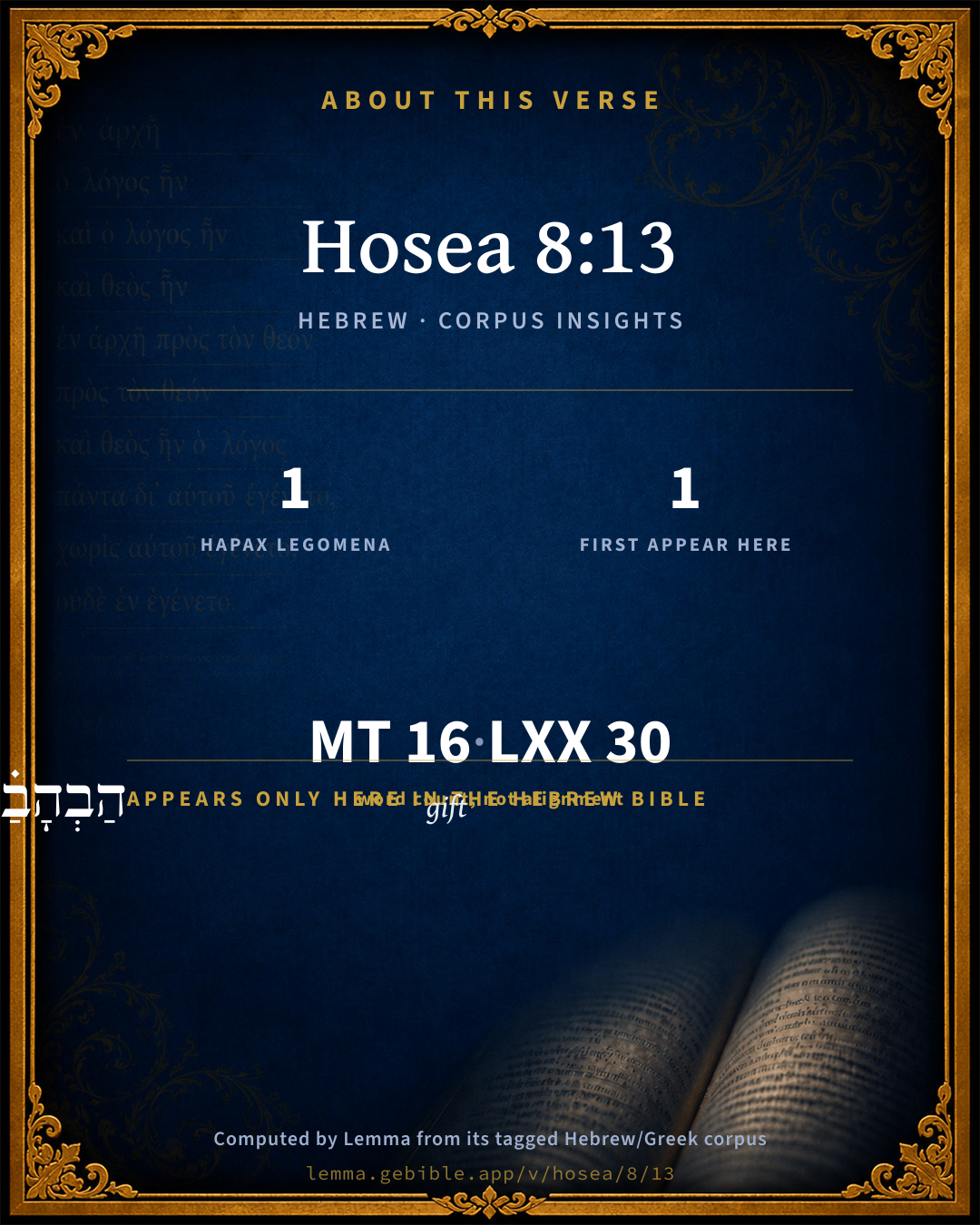
  • 1 hapax legomenon — only here in the Hebrew Bible
  • 1 first appearance in the Hebrew Bible
Full analysis ↓
Download a study sheet

One document with this verse’s original text, its word-by-word gloss line, the meaning frame, cross-references with their text, attributed commentary, and full source and license credits — printable, and it pastes into notes with its structure intact.

This verse Autodidact and up

Study sheet (.html) Plain text (.txt)

A passage Seminary Student

Up to 50 verses in one chapter. A passage sheet keeps up to 6 commentary sources and 12 cross-references per verse, in the order this page ranks them, and says so on the sheet whenever that leaves anything out. Ask for a single verse and you get the Autodidact verse sheet above.

Everything on this page stays free to read, with no account — the sheet is a download of what is already on screen, not access to it.

Want to remove ads? Support Godless Engineer
Compare translations 3

The same verse in 3 English versions, stacked beneath the original-language interlinear above. Click any original word for its lexicon entry.

Each is an independent rendering of the whole verse — the interlinear is not word-aligned to these translations.

Highlighted words mark where these versions differ — a whole-verse word diff, not a word-by-word alignment.

  • World English Bible Public Domain
    As for the sacrifices of my offerings, they sacrifice flesh and eat it; But Yahweh doesn't accept them. Now he will remember their iniquity, And punish their sins. They will return to Egypt.
  • King James Version Public Domain
    They sacrifice flesh for the sacrifices of mine offerings, and eat it; but the LORD accepteth them not; now will he remember their iniquity, and visit their sins: they shall return to Egypt.
  • unfoldingWord Literal Text CC BY-SA 4.0
    The sacrifices of my gifts they sacrifice flesh and they eat. Yahweh does not accept them. Now he will remember their iniquity and punish their sins. They, they will return to Egypt.

unfoldingWord Literal Text — © unfoldingWord, licensed CC BY-SA 4.0. Word-aligned USFM3 via Door43 (git.door43.org/unfoldingWord/en_ult).

Versions to compare (up to 4)

3 of 4 selected

Show all 18 translations

Every available English version of this verse, each an independent rendering of the whole verse.

  • World English Bible Public Domain
    As for the sacrifices of my offerings, they sacrifice flesh and eat it; But Yahweh doesn't accept them. Now he will remember their iniquity, And punish their sins. They will return to Egypt.
  • Berean Standard Bible Public Domain
    Though they offer sacrifices as gifts to Me, and though they eat the meat, the LORD does not accept them. Now He will remember their iniquity and punish their sins: They will return to Egypt.
  • Majority Standard Bible Public Domain
    Though they offer sacrifices as gifts to Me, and though they eat the meat, the LORD does not accept them. Now He will remember their iniquity and punish their sins: They will return to Egypt.
  • King James Version Public Domain
    They sacrifice flesh for the sacrifices of mine offerings, and eat it; but the LORD accepteth them not; now will he remember their iniquity, and visit their sins: they shall return to Egypt.
  • American Standard Version (1901) Public Domain
    As for the sacrifices of mine offerings, they sacrifice flesh and eat it; but Jehovah accepteth them not: now will he remember their iniquity, and visit their sins; they shall return to Egypt.
  • Revised Version (1885) Public Domain
    As for the sacrifices of mine offerings, they sacrifice flesh and eat it; but the LORD accepteth them not: now will he remember their iniquity, and visit their sins; they shall return to Egypt.
  • Geneva Bible (1599) Public Domain
    They sacrifice flesh for ye sacrifices of mine offerings, and eate it: but the Lord accepteth them not: now will he remember their iniquitie, and visite their sinnes: they shall returne to Egypt.
  • Douay-Rheims (1899) Public Domain
    They shall offer victims, they shall sacrifice flesh, and shall eat it, and the Lord will not receive them: now will he remember their iniquity, and will visit their sins: they shall return to Egypt.
  • Young's Literal Translation Public Domain
    The sacrifices of Mine offerings! They sacrifice flesh, and they eat, Jehovah hath not accepted them, Now doth He remember their iniquity, And inspect their sin, They -- `to' Egypt they turn back.
  • Literal Standard Version CC BY-SA 4.0
    The sacrifices of My offerings! They sacrifice flesh, and they eat, || YHWH has not accepted them, || Now He remembers their iniquity, || And inspects their sin, || They return [to] Egypt.
  • Unlocked Literal Bible CC BY-SA 4.0
    As for the sacrifices of my offerings, they sacrifice meat and eat it, but I, Yahweh, do not accept them. Now I will think about their iniquity and punish their sins. They will return to Egypt.
  • unfoldingWord Literal Text CC BY-SA 4.0
    The sacrifices of my gifts they sacrifice flesh and they eat. Yahweh does not accept them. Now he will remember their iniquity and punish their sins. They, they will return to Egypt.
  • Darby Bible Public Domain
    They sacrifice flesh [for] the sacrifices of mine offerings, and eat it; Jehovah hath no delight in them. Now will he remember their iniquity, and visit their sins: they shall return to Egypt.
  • World Messianic Bible Public Domain
    As for the sacrifices of my offerings, they sacrifice meat and eat it, but the LORD doesn’t accept them. Now he will remember their iniquity, and punish their sins. They will return to Egypt.
  • Webster's Bible Public Domain
    They sacrifice flesh for the sacrifices of my offerings, and eat it; but the LORD accepteth them not; now will he remember their iniquity, and visit their sins: they shall return to Egypt.
  • Free Bible Version CC BY-SA 4.0
    They present me with their sacrifices, and they eat the meat, but I, the Lord, do not accept them. Now he will remember their wickedness, and punish them for their sins. They will return to Egypt.
  • Bible in Basic English Public Domain
    He gives the offerings of his lovers, and takes the flesh for food; but the Lord has no pleasure in them; now he will keep in mind their evil-doing and give them the punishment of their sins; they will go back to Egypt.
  • JPS Tanakh (1917) Public Domain
    As for the sacrifices that are made by fire unto Me, let them sacrifice flesh and eat it, for the LORD accepteth them not. Now will He remember their iniquity, and punish their sins; they shall return to Egypt.

Literal Standard Version (2020), Covenant Press — licensed CC BY-SA 4.0. Text via the HelloAO Bible API (eBible.org). Unlocked Literal Bible (unfoldingWord) — licensed CC BY-SA 4.0. Text via the HelloAO Bible API (eBible.org). unfoldingWord Literal Text — © unfoldingWord, licensed CC BY-SA 4.0. Word-aligned USFM3 via Door43 (git.door43.org/unfoldingWord/en_ult). Free Bible Version, Dr. Jonathan Gallagher — licensed CC BY-SA 4.0. Text via the HelloAO Bible API (eBible.org).

Word by word

More ways to search: Search by grammar → Find every occurrence → Compare this word →

Practice this passage: Drill this verse → Learn its vocabulary →

הַבְהָבַ֗י
habhâb
H1890
“gifts · my”
Noun, Common, Masculine, Plural, Construct + Suffix, Personal, 1st Person, Common, Singular
Part of Speech
Noun
Type
Common
Gender
Masculine
Number
Plural
State
Construct
Full BDB Definition

Origin: by reduplication from H3051

TWOT: 849b

gift, offering
  1. זִבְחֵ֣י zebach H2077 “sacrifices of” Noun, Common, Masculine, Plural, Construct
  2. יִזְבְּח֤וּ zâbach H2076 “to sacrifice” Verb, Qal, Imperfect, 3rd Person, Masculine, Plural
  3. בָשָׂר֙ bâsâr H1320 “flesh” Noun, Common, Masculine, Singular, Absolute
  4. וַיֹּאכֵ֔לוּ ʼâkal H398 “and · to eat” Conjunction + Verb, Qal, Sequential Imperfect, 3rd Person, Masculine, Plural
  5. יְהוָ֖ה Yᵉhôvâh H3068 “LORD” Noun, Proper
  6. לֹ֣א lôʼ H3808 “not” Particle, Negative
  7. רָצָ֑ם râtsâh H7521 “to be pleased · them” Verb, Qal, Perfect, 3rd Person, Masculine, Singular + Suffix, Personal, 3rd Person, Masculine, Plural
  8. עַתָּ֞ה ʻattâh H6258 “now” Adverb
  9. יִזְכֹּ֤ר zâkar H2142 “to remember” Verb, Qal, Imperfect, 3rd Person, Masculine, Singular
  10. עֲוֺנָם֙ ʻâvôn H5771 “iniquity · their” Noun, Common, Both, Singular, Construct + Suffix, Personal, 3rd Person, Masculine, Plural
  11. וְיִפְקֹ֣ד pâqad H6485 “and · to visit” Conjunction + Verb, Qal, Imperfect, 3rd Person, Masculine, Singular
  12. חַטֹּאותָ֔ם chaṭṭâʼâh H2403 “sin offerings · their” Noun, Common, Feminine, Plural, Construct + Suffix, Personal, 3rd Person, Masculine, Plural
  13. הֵ֖מָּה hêm H1992 “they” Pronoun, Personal, 3rd Person, Masculine, Plural
  14. מִצְרַ֥יִם Mitsrayim H4714 “Egypt” Noun, Proper
  15. יָשֽׁוּבוּ shûwb H7725 “to return” Verb, Qal, Imperfect, 3rd Person, Masculine, Plural

About this verse

These counts appear in no published source. They are computed here, from the morphology-tagged text and Lemma’s own curated glosses. What Lemma adds →

16
words
16
distinct lemmas
Prophets
section

Notable vocabulary

1 hapax legomenon — a word that appears only here in the entire Hebrew Bible:

  • הַבְהָבַ֗י gift H1890

First appearance in Scripture

This word makes its first canonical appearance in the Hebrew Bible here:

  • הַבְהָבַ֗י gift H1890

Shared distinctive vocabulary

רָצָ֑ם to be pleased H7521 occurs in 55 verses of the Hebrew Bible. Also found in:

Grammatical profile

  • 6 verbs
  • 7 nouns
  • 1 pronoun
  • 1 adverb
  • 1 particle

Verb forms

  • יִזְבְּח֤וּ Qal · Imperfect
  • וַיֹּאכֵ֔לוּ Qal · Sequential Imperfect
  • רָצָ֑ם Qal · Perfect
  • יִזְכֹּ֤ר Qal · Imperfect
  • וְיִפְקֹ֣ד Qal · Imperfect
  • יָשֽׁוּבוּ Qal · Imperfect

Hebrew & Septuagint length

In English translation the verse runs 33 words from the Hebrew and 43 from the Septuagint (LXX English) — closely comparable.

A rough comparison of the two English renderings, which tokenize alike — not a word-level alignment.

Word counts can differ between the Hebrew and the Greek without any difference in meaning — e.g. the Hebrew direct-object marker אֵת has no separate Greek word, and Greek often adds the article ὁ.

In the original languages it is 16 Hebrew tokens and 30 Greek tokens — but the two are counted differently (Hebrew bundles its prefixes and suffixes into one token; the Greek is in lemma form), so that isn’t a like-for-like length.

Cross-references

22

Topical passages linked to Hosea 8:13 in the Treasury of Scripture Knowledge — connected by theme and wording, ordered by reader-vote popularity; previews shown in the World English Bible.

  • Hosea 9:6 For, behold, they have gone away from destruction. Egypt will gather them up. Memphis will bury them. Nettles will possess their pleasant things of silver. Thorns will be in their tents.
  • Hosea 9:9 They have deeply corrupted themselves, As in the days of Gibeah. He will remember their iniquity. He will punish them for their sins.
  • Amos 5:22 Yes, though you offer me your burnt offerings and meal-offerings, I will not accept them; Neither will I regard the peace offerings of your fat animals.
  • Amos 8:7 Yahweh has sworn by the pride of Jacob, "Surely I will never forget any of their works.
  • Exodus 20:3 You shall have no other gods before me.
  • Deuteronomy 28:68 Yahweh will bring you into Egypt again with ships, by the way of which I said to you, You shall see it no more again: and there you shall sell yourselves to your enemies for bondservants and for bondmaids, and no man shall buy you.
  • Isaiah 1:11 "What are the multitude of your sacrifices to me?," says Yahweh. "I have had enough of the burnt offerings of rams, And the fat of fed animals. I don't delight in the blood of bulls, Or of lambs, Or of male goats.
  • Jeremiah 14:10 Thus says Yahweh to this people, Even so have they loved to wander; they have not refrained their feet: therefore Yahweh does not accept them; now will he remember their iniquity, and visit their sins.
  • Hosea 5:6 They will go with their flocks and with their herds to seek Yahweh; But they won't find him. He has withdrawn himself from them.
  • Hosea 9:3–4 They won't dwell in Yahweh's land; But Ephraim will return to Egypt, And they will eat unclean food in Assyria.
  • Hosea 11:5 "They won't return into the land of Egypt; But the Assyrian will be their king, Because they refused to repent.
  • Exodus 32:34 Now go, lead the people to the place of which I have spoken to you. Behold, my angel shall go before you. Nevertheless in the day when I punish, I will punish them for their sin."
  • 1 Samuel 15:22 Samuel said, Has Yahweh as great delight in burnt offerings and sacrifices, as in obeying the voice of Yahweh? Behold, to obey is better than sacrifice, and to listen than the fat of rams.
  • Proverbs 21:27 The sacrifice of the wicked is an abomination: How much more, when he brings it with a wicked mind!
  • Jeremiah 7:21–23 Thus says Yahweh of Hosts, the God of Israel: Add your burnt offerings to your sacrifices, and eat you flesh.
  • Hosea 4:9 It will be, like people, like priest; And I will punish them for their ways, And will repay them for their deeds.
  • Hosea 7:2 They don't consider in their hearts that I remember all their wickedness. Now their own deeds have engulfed them. They are before my face.
  • Hosea 7:16 They return, but not to the Most High. They are like a faulty bow. Their princes will fall by the sword for the rage of their tongue. This will be their derision in the land of Egypt.
  • Hosea 12:11 If Gilead is wicked, Surely they are worthless. In Gilgal they sacrifice bulls. Indeed, their altars are like heaps in the furrows of the field.
  • 1 Corinthians 11:20 When therefore you assemble yourselves together, it is not possible to eat the Lord's supper.
  • 1 Corinthians 11:29 For he who eats and drinks in an unworthy manner eats and drinks judgment to himself, if he doesn't discern the Lord's body.
  • Revelation 16:19 The great city was divided into three parts, and the cities of the nations fell. Babylon the great was remembered in the sight of God, to give to her the cup of the wine of the fierceness of his wrath.

Cross-references courtesy of OpenBible.info (CC BY 4.0).

Hebrew and Greek witnesses Masoretic Hebrew ↔ Greek Septuagint

The same verse in the two great witnesses to the Old Testament, shown verse-for-verse.

These are two independent witnesses, not word-aligned to each other, and the Septuagint is shown in lemma (dictionary) form.

Hebrew Hosea 8:13 Masoretic · Westminster Leningrad Codex

זִבְחֵ֣י הַבְהָבַ֗י יִזְבְּח֤וּ בָשָׂר֙ וַיֹּאכֵ֔לוּ יְהוָ֖ה לֹ֣א רָצָ֑ם עַתָּ֞ה יִזְכֹּ֤ר עֲוֺנָם֙ וְיִפְקֹ֣ד חַטֹּאותָ֔ם הֵ֖מָּה מִצְרַ֥יִם יָשֽׁוּבוּ

As for the sacrifices of my offerings, they sacrifice flesh and eat it; But Yahweh doesn't accept them. Now he will remember their iniquity, And punish their sins. They will return to Egypt.

World English Bible · Public Domain

Greek LXX Hosea 8:13 Septuagint · lemma form

διότι ἐάν θύω θυσία καί ἐσθίω κρέας κύριος οὐ προςδέχομαι αὐτός νῦν μιμνήσκω ὁ ἀδικία αὐτός καί ἐκδικέω ὁ ἁμαρτία αὐτός αὐτός εἰς αἴγυπτος ἀποστρέφω καί ἐν ἀσσύριος ἀκάθαρτος ἐσθίω

For if they should offer a sacrifice, and eat flesh, the lord will not accept them: now will he remember their iniquities, and will take vengeance on their sins: they have returned to Egypt, and they shall eat unclean things among the Assyrians.

LXX2012 (modern English Septuagint) · Public Domain

On this verse, The Pulpit Commentary discusses the Septuagint’s reading. Read the note in Commentary ↓

Hebrew: Westminster Leningrad Codex (CC BY 4.0). Greek: Septuagint (public domain); English from LXX2012 (modern English Septuagint) (Public Domain). How the Septuagint differs from the Hebrew →

Targum (Aramaic paraphrase)

1

The Targum is the ancient Jewish Aramaic paraphrase of the Hebrew Scriptures — an interpretive translation, not the Hebrew text itself. Onkelos (literal) and Pseudo-Jonathan (expansive) render the Torah, and Jonathan the Prophets. Coverage is partial: where no permissively-licensed English translation exists for a verse, only the Aramaic is shown. This is verse-level text, not a word-by-word alignment to the Hebrew.

  1. Targum Jonathan Prophets (Joshua–Malachi)
    דִבְחִין דִמְגַבָּן מִן אוֹנָס דִבְחִין בִּסְרָא וְאָכְלִין וְקָדָם יְיָ לָא רַעֲוָא בְהוֹן כְּעַן יִסְעַר חוֹבֵיהוֹן וְיִתְפְּרַע עִוְיַתְהוֹן אִינוּן לְמִצְרַיִם יְתוּבוּן:

    (no public-domain English translation for this verse)

    Targum Jonathan — Aramaic: “Mikraot Gedolot” (public domain). English: “Sefaria Community Translation” (CC0 1.0 (public-domain dedication)); “London "Chaldee Paraphrase," 1871” (public domain). Text via Sefaria.

Commentary

Notes on Hosea 8:13 from classic Christian and Jewish commentators (each source and its license shown beneath its notes). The classic Christian expositions comment on the surrounding passage and are grouped to its opening verse, so a note may address several verses; the Jewish commentaries on the Tanakh (Rashi and others) are per-verse, so they appear only where the commentator wrote on this verse.

Lemma curates 59 commentaries, every one of them public domain or Creative Commons licensed, each selected and text-cleaned for this edition rather than reprinted as found. About our sources →

Trapp's Complete Commentary

John Trapp

Hos 8:13 They sacrifice flesh [for] the sacrifices of mine offerings, and eat [it; but] the LORD accepteth them not; now will he remember their iniquity, and visit their sins: they shall return to Egypt.

Ver. 13. They sacrifice flesh in the sacrifices of mine offerings, and eat it] q.d. They would seem not to have rejected the great things of my law, not to be such strangers thereunto; since they were much in sacrificing according to the law. But their hypocrisy is most hateful: in that first, they offer (with Cain) non personam, sed opus personae, as Luther saith; not themselves, but their bare sacrifices, Isa 66:3, which is but as a brainless head and soulless body; it is but flesh, as it is here called in contempt and scorn. See the like, Jer 7:21 Hos 9:4. And think the same of all external services, si careant anima sua, id est recta in Deum fide, et erecta in illum mente, if not performed in faith and obedience. Secondly, they pretended to serve God, when indeed they only served their own bellies, as those, Rom 16:18, sought their own ends, Php 2:21, catered for the flesh, Rom 13:14, insigne donum quo afficior (as Luther paraphraseth the text) carnem offertis quam vos ipsi voratis, i.e. A goodly gift it is that you give me, viz. the flesh of your peace offerings which yourselves may feast with; and you therefore multiply sacrifices, that you may gorge yourselves with good cheer. Now one egg is not more like to another than these old fleshmongers were to the Popish flesh flies at this day. It was an honest complaint of one of them: We, saith he, handle the Scripture, tantum utnos pascat et vestiat, only that it may feed us and clothe us. And it is evident to all the world that their masses, pilgrimages, festivals, vowed presents and memorials, &c., are only to pamper their paunches; which made them so angry with Erasmus and Luther for meddling.

But the Lord accepteth them not] How should he, pray, when there was nothing but flesh, nothing but self in them. See the like, Jer 4:10 Amo 5:22 Isa 1:10, where God telleth them that their sacrifices were grievous and offensive to all his several senses, nay, to his very soul too. "The sacrifice of the wicked is abomination to the Lord," Pro 15:8, yea, though he bring it with never so good an intent, Pro 21:27; how much more if he bring ex rapina holocaustum, a sacrifice of what he hath got by rapine and robbery! and so the Chaldee carrieth the sense of the former words; the sacrifices of mine offerings, quae collecta sunt ex iniuria, saith he, which were gathered and gotten by wrong dealing: how then should the Lord accept them?

Now will he remember their iniquity] Even while they are sacrificing, let them not think to blind his eyes with the smoke of their offerings, to stop his mouth with their rich gifts and donaries; to bribe him into a connivance; to expiate and set off their sins with their sacrifices; for God will remember them, and punish them. Yea, now will he do it, in the time of their holy duties; he will come upon them then in his wrath, as Pilate came upon the Galileans, and mingled their blood with their sacrifices, Luk 13:2. Sure it is that sin (brought into God’s holy presence) petitions against the sinner, as Esther did against Haman at the banquet of wine, Est 7:6; picks out the time of prayer and other duties to accuse and call for vengeance. Take we heed, lest while we are confessing our sins (which yet we close with, and will not forsake) and judging ourselves worthy to be destroyed, God say not, Out of thine own mouth will I condemn thee, thou graceless person, that hast so much impudence as to bring thy Cozbi into my presence, {Num 25:18} then, when all the people (as on a fastday) are weeping before the door of the tabernacle. God will be sanctified of all that draw nigh unto him; one way or other he will be sanctified, either in them, or on them, Lev 10:3. Of such he saith, as Solomon once did of Adonijah, "If he show himself a worthy man, there shall not a hair of his head fall to the earth: but if wickedness shall be found in him, he shal1 die," 1Ki 1:52. If any defile the temple of God, him shall God destroy, 1Co 3:17.

They shall return to Egypt] They had a mind to run thither for refuge; they sent also to So, king of Egypt, for that purpose, 2Ki 17:4. Instead of making their peace with God, they betook themselves to base shifts, and sought help of the creature. This is the guise of graceless men when distressed. But they shall soon have enough of Egypt, Hos 9:8; Hos 9:6. Their strength (or their Egypt) had been to have sat still, in expectation of help from heaven, Isa 30:7, and to have considered that the last and greatest curse denounced against their disobedience was, "And the Lord shall bring thee into Egypt," &c., Deu 28:68.

John Trapp, A Commentary or Exposition upon All the Books of the Old and New Testament (1647–1656) — public domain. Text from a community e-Sword module.

Joseph Benson's Commentary

Hos 8:13. They sacrifice flesh, &c., and eat it, but the Lord accepteth them not — They offer sacrifices indeed, but their sacrifices are not acceptable to God, not being offered with a pious and devout mind. Dr. Wheeler translates the clause, They have sacrificed the choicest sacrifices, and have eaten flesh: Jehovah taketh not delight therein. Now will he remember their iniquity, &c. — God supported the Jews, that they might support the true religion; which as they had now neglected to do, there was no reason why God should support and defend them against their enemies. They shall return to Egypt — Going into Egypt seems to have been a proverbial expression for extreme misery; and may here denote, that they should go into a state of captivity and bondage as bad as that which their forefathers had suffered in Egypt. Or else, taken literally, it might be intended to signify, that they should seek the alliance and friendship of Egypt, contrary to the faith they had given to the Assyrians, which would bring on their destruction. This proved to be the case, as the reader will see by consulting 2Ki 17:4-5, “The king of Israel sent messengers to So, king of Egypt, and brought no presents to the king of Assyria, as he had done year by year; therefore the king of Assyria shut him up, and bound him in prison. Then the king of Assyria came up throughout the land, took Samaria, and carried Israel away into Assyria.”

Joseph Benson's Commentary on the Old and New Testaments (1811–1818) — public domain. Text from a community e-Sword module.

Tyndale Open Study Notes

Tyndale Open Resources

8:13 I do not accept their sacrifices: See 6:6; Isa 1:10-17; Amos 5:21-24; Mic 6:6-8. • They will return to Egypt, the place of slavery (Deut 28:68). God’s dealings with Israel did not end with judgment. The divine purpose of judgment was to restore Israel to the status they had when they came out of Egypt, so that they could experience a new beginning (see Hos 2:14-15).

Tyndale Open Study Notes — © Tyndale Open Resources, licensed CC BY-SA 4.0. Text via the HelloAO Bible API.

Geneva Bible (1599)

Geneva Bible translators

Saying that they offer it to the Lord, but he accepteth no service, which he himself hath not appointed.

Geneva Bible (1599) marginal notes — public domain. Text via Bolls.life.

Jamieson, Fausset & Brown

Robert Jamieson, A. R. Fausset & David Brown

sacrifices of mine offerings--that is, which they offer to Me.

eat it--Their own carnal gratification is the object which they seek, not My honor.

now--that is, "speedily."

shall return to Egypt-- (Hos 9:3, Hos 9:6; Hos 11:11). The same threat as in Deu 28:68. They fled thither to escape from the Assyrians (compare as to Judah, Jer. 42:1-44:30), when these latter had overthrown their nation. But see on Hos 9:3.

Jamieson, Fausset & Brown — Commentary Critical and Explanatory on the Whole Bible (1871) — public domain (CC PDM 1.0). Text via the HelloAO Bible API.

Adam Clarke's Commentary

Verse 13. They sacrifice flesh] Bp. Newcome translates thus: "They sacrifice gifts appointed unto me, and eat flesh." They offer to their idols the things which belong to Jehovah; or, while pretending to offer unto the Lord, they eat and drink idolatrously; and therefore the Lord will not accept them.

They shall return to Egypt.] Many of them did return to Egypt after the conquest of Palestine by Shalmaneser, and many after the ruin of Jerusalem by Nebuchadnezzar; but they had in effect returned to Egypt by setting up the worship of the golden calves, which were in imitation of the Egyptian Apis.

Adam Clarke's Commentary on the Bible (1810–1826) — public domain. Text from a community e-Sword/MySword module.

John Calvin's Commentaries

Interpreters think that the Israelites are here derided because they trusted in their own ceremonies, and that their sacrifices are reproachfully called flesh. But we must see whether the words of the Prophet contain something deeper. For the word הבהב, ebeb, some rightly expound, in my judgment, as meaning “sacrifices,” either burnt or roasted; it is a word of four letters. Others derive it from יהב, ieb, which signifies “to give gifts;” and hence they render thus, “sacrifices of my gifts;” and this is the more received opinion. I view the Prophet here as not only blaming the Israelites for putting vain trust in their own ceremonies, which were perverted and vicious; but also as adducing something more gross, and by which it could be proved, that their folly was even ridiculous, yea, to profane men and children. When we only read, The sacrifices of my gifts, which they ought to have offered to me, the sense seems frigid; but when we read, “The sacrifices of my burnt-offerings! they offer flesh”, the meaning is, So palpable is their contempt, that they cannot but be condemned even by children. How so? Because for burnt-offerings they offer flesh to me; that is they fear lest any portion of the sacrifices should be lost: and when they ought, when offering burnt-sacrifices, to burn the flesh, they keep it entire, that they may stuff themselves. Hence they make a great display in sacrificing: and yet it appears to be palpable mockery, for they turn burnt-offerings into peace-offerings, that the flesh may remain entire for them to eat it. And no doubt, it has ever been a vice dominant in hypocrites to connect gain with superstitions. How much soever, then, idolaters may show themselves to be wholly devoted to God, they yet will take care that nothing be lost.

The Prophet then seems now to reprove this vice; I yet allow that the Israelites are blamed for thinking that God is pacified by sacrifices which were of themselves of no value, as we have had before a similar declaration. But I join both views together — that they offered to God vain sacrifices without piety, and then, that they offered flesh for burnt-offerings, and thus fed themselves and cared not for the worship of God. The sacrifices then of my burnt-offerings they offer; but what do they offer? Flesh Nor does he seem to have mentioned in vain the word flesh. Some say that all sacrifices are here called flesh by way of contempt; but there seems rather to me to be a contrast made between burnt sacrifices and flesh; because the people of Israel wished to take care of themselves and to have a rich repast, when the Lord required a burnt-offering to be presented to him: and he afterwards adds, and they eat By the word eating, he confirms what I have already said, that is, that he here reproves in the Israelites the vice of being intent only on cramming themselves, and of only putting forth the name of God as a vain pretence, while they were only anxious to feed themselves.

It is the same with the Papists of our day, when they celebrate their festivals; they indulge themselves, and think that the more they drink and eat, the more God is bound to them. This is their zeal; they eat flesh, and yet think that they offer sacrifices to God. They offer, then, their stomach to God, when it is thus well filled. Such are the oblations of the Papists. So also the Prophet now says, “They eat the flesh which they ought to have burned.”

The Lord, he says, will not accept them Here again he briefly shows, that while hypocrites thus make pretences, they are self-deceived, and will at last find out how vainly they have lied to God and men: “God will not accept them.” He here repudiates, in the name of God, their sacrifices; for whatever they might promise to themselves, it was enough that they devised for themselves these modes of worship; for God had never commanded a word respecting them.

It then follows, Now will he remember their iniquity, and visit their sins The Prophet denounces a future punishment, lest hypocrites should flatter themselves, when God’s fury is not immediately kindled against them, for it is usual with them to abuse the patience of God. Hence Hosea now forewarns them, and says, “Though God may connive for a time, there is yet no reason for the Israelites to think that they shall be free from punishment: God will at length,” he says, “remember their iniquity.” He uses a common form of speaking, which everywhere occurs in Scripture: God is said to remember when he really, and as with a stretched-out hand, shows himself to be an avenger. “The Lord now spares you; but he will, in a short time, show how much he abominates these your impure sacrifices: He will remember, then, your iniquity Visitation follows this remembering, as the effect the cause.

They shall flee, he says, to Egypt The Prophet, I doubt not, intimates here, that vain would be all the escapes which the Israelites would seek; and though God might allow them to flee to Egypt, yet it would be, he says, without any advantage: “Go, flee to Egypt, but your flight will be useless.” The Prophet expressed this distinctly, that the people might know that they had to do with God, against whom they could make no defense, and that they might no longer deceive themselves by foolish imaginations. And though the people were blinded by so great an obstinacy, that this admonition had no effect; yet they were thus rendered the more inexcusable. It now follows —

John Calvin's Commentaries (1540-1563) — public domain. Text from the Calvin Translation Society English edition (1840s-50s) via the Christian Classics Ethereal Library (ccel.org). Calvin's coverage is partial (roughly two-thirds of the Bible); uncommented books and verses are honest gaps, never fabricated. The 19th-century editor's footnotes and remarks are omitted so the notes are faithfully Calvin's own voice.

Ellicott's Commentary for English Readers

(13) They sacrifice flesh . . .—Should be, “They sacrifice the sacrifices of my gifts—flesh, and eat it.” Clear reference to the Mosaic institute. Ye shall go back to Egypt, says the prophet, and there learn again the bitter lessons of the past—either the positive return to Egypt or the disastrous hankering after Egyptian alliances.

A Bible Commentary for English Readers, edited by Charles John Ellicott (1878–1897) — public domain. Text from a community e-Sword module.

The Cambridge Bible for Schools and Colleges

gen. ed. J. J. S. Perowne

13. They sacrifice, &c.] Rather, My sacrificial gifts they sacrifice; (yea,) flesh, and they eat it; i.e., their sacrifices are a mere form, Jehovah abhors them; the only positive result is that the sacrificer has the luxury of a dinner of flesh-meat. (Comp. a similar accusation against the priests, Hos_4:8.) That sensual appetites were partly concerned in the offering of sacrifices even in times of national trouble may perhaps be inferred from Isa_22:13, the eating of animal food being only allowed, especially we may suppose in Jerusalem, in connexion with a sacrificial act; comp. Lev_17:3-6; Deu_13:15-16 (a mitigation of a primitive rule). [The word rendered ‘gifts’ is uncertain.]

now] The climax of Israel’s iniquity has been reached; Jehovah will now prove in act that He has not forgotten their transgressions.

they shall return to Egypt] Some think this is a kind of poetical expression for being carried into captivity—a most unnatural supposition. In Isa_7:18 we find a threat of a double invasion from Egypt and from Assyria, and why can we not imagine that a people who were ever vacillating between Egyptian and Assyrian alliances should be threatened with an Egyptian as well as an Assyrian captivity? Comp. the prophecies of restoration from Egypt in Isa_11:11; Mic_7:12. The word ‘return’ is pointed with the terrible associations of the ‘house of bondage’; comp. Deu_28:68. Hosea repeats the threat in Hos_9:3; Hos_9:6, Hos_11:5.

The Cambridge Bible for Schools and Colleges (gen. ed. J. J. S. Perowne; Cambridge University Press, 1878–1918) — public domain. Text from a community e-Sword module.

John Gill's Exposition

They sacrifice flesh for the sacrifices of mine offerings,

and eat it,.... Or, "as to the sacrifices mine offerings" or "gifts, they sacrifice flesh, and eat it" (o); these sacrifices, which, according to the law, should given to God when they offered them, they did not give them to him, they took them to themselves, and ate them; they were carnal offerings, and offered with a carnal mind, without faith and piety, without any regard to the glory of God, but merely for the sake of caring: the Targum interprets it of sacrifices got by rapine, which God hates, Isa 61:8;

but the Lord accepteth them not; neither the sacrifices, nor the sacrificers, but despised and abhorred them; no sacrifice was acceptable to God but what was offered according to law, and where he directed, and in the faith of Christ, and through him:

now will he remember their iniquities, and visit their sins; he will not pardon them, but punish for them; so far were their sacrifices making atonement for them, as they expected, they added to the measure of their iniquities:

they shall return into Egypt; either flee thither for refuge, many of them it seems did, when the king of Assyria entered their land, and besieged Samaria; where they lived miserably, as in exile, and were there buried, and never returned to their own land any more; see Hos 9:3; or they should be carried captive into Assyria, where they should be in a like state of bondage as their fathers were in Egypt. Some render it, "they return into Egypt" (p); and consider it not as their punishment, but as their sin; that when the Lord was about to visit them for their transgressions, they being made tributary to the Assyrians, instead of returning to the Lord, and humbling themselves before him, they sent to the king of Egypt for help, Kg2 17:4.

(o) "quod attinet ad sacrificia donariorum meorum, sacrificant illi quidem carnem, et comedunt", Piscator, De Dieu; "quantum ad sacrificia", &c. Schmidt. So Reinbeck. De Accent. Hebr. p. 445. (p) "illi in Aegyptum redeunt", Cocceius; "revertuntur", Schmidt. So Tarnovius.

John Gill's Exposition of the Whole Bible (1746–1763) — public domain (CC PDM 1.0). Text via the HelloAO Bible API.

Albert Barnes' Notes on the Bible

They sacrifice flesh for the sacrifices of Mine offerings, and eat it; but the Lord accepteth them not - As they rejected God’s law, so God rejected their “sacrifices,” which were not offered according to His law. They, doubtless, thought much of their sacrifices; and this the prophet perhaps expresses by an intensive form ; “the sacrifices of My gifts, gifts,” as though they thought, that they were ever giving. God accounted such sacrifices, not being hallowed by the end for which He instituted them, as mere “flesh.” They “offered flesh” and “ate” it. Such was the beginning, and such the only end. “He” would “not accept them.” Nay, contrariwise, “now,” now while they were offering the sacrifices, God would show in deed that He “remembered” the sins, for which they were intended to atone. God seems to man to forget his sins, when He forbears to punish them; to “remember” them, when He punishes.

They shall return to Egypt - God had commanded them to return no more to Egypt Deu 17:16 of their own mind. But He had threatened that, on their disobedience, “the Lord would bring them back to Egypt by the way, whereof He spake unto them, Thou shalt see it no more again” Deu 28:68. Hosea also foretells to them, that they (i. e., many of them) should go to Egypt and perish there Hos 9:3, Hos 9:6. Thence also, as from Assyria, they were to be restored Hos 12:11. Most probably then, Hosea means to threaten an actual return to Egypt, as we are told, that some of the two tribes did go therefor refuse, against the express command of God Jer. 42–43. The main part of the ten tribes were taken to Assyria, yet as they were, even under Hosea, conspiring with Egypt 2Ki 17:4, such as could, (it is likely) took refuge there. Else, as future deliverance, temporal or spiritual, is foretold under the image of the deliverance out of Egypt, so, contrariwise, the threat, “they shall return to Egypt,” may be, in figure, a cancelling of the covenant, whereby God had promised, that His people should not return: a threat of renewed bondage, “like” the Egyptian; an abandonment of them to the state, from which God once had freed them and had made them His people.

Albert Barnes' Notes on the Bible (1834–1885) — public domain. Text from a community e-Sword/MySword module.

Haydock's Catholic Bible Commentary

Egypt, to escape the Assyrian, chap. ix. 3. (Calmet) --- They have imitated the Egyptian idols. (St. Jerome) --- Osee had applied to their king for aid, 4 Kings xvii. 4.

George Leo Haydock (1774–1849), Haydock's Catholic Family Bible and Commentary, 1859 edition — public domain. Excludes Psalms (Douay-Rheims chapter numbering differs from Protestant) and Deuterocanonical books (Catholic canon only).

Matthew Poole's English Annotations

They sacrifice; or, As for sacrifices, my gifts, so some, taking the words absolute and in apposition, read them, and perhaps they are plainer and closer connected with the former when so taken. I have written to them, and they count it a strange thing; and the sacrifices and gifts which they call mine, I tell you what I account them to be; as for sacrifices, which now they pretend to give me, it is flesh they sacrifice, and eat it when they have done, and I account no more of it: they sacrifice that they may feast and fill themselves with wine and mirth, and what is that to me?

The Lord accepteth them not; neither owneth them as his, nor taketh any pleasure at all in them. These sacrifices shall never expiate their sins, nor reconcile me to them, saith God. I think here is a meiosis in these words, they may be a softer expression of hatred and detestation, which God bears towards such.

Now will he remember their iniquity, and visit their sins; in his just and hot displeasure, he will reckon with them, and, by punishing them for all, make them know he remembers all their sins. Here remembering and visiting are the same, and include punishment.

They shall return to Egypt; either alluding to their bondage in Egypt; so Assyria shall use them. Or else it is an upbraiding them for and minding them of their perfidiousness to Shalmaneser. They had been ever covenant-breakers with God and man; this last part of treachery God will punish. Or else, they shall return to Egypt, i.e. many shall to save their lives flee from the Assyrian into Egypt, and there seek their safety; and if they preserve their life there, the punishment of their sins shall follow them; exile, with misery as bad as captivity, shall be their lot there. So Hos 9:6.

Matthew Poole's English Annotations on the Holy Bible (1683–1685) — public domain. Text from a community e-Sword/MySword module.

The Pulpit Commentary

Vers. 13, 14. For the sacrifice of mine offerings, they sacrifice flesh and eat it; but the Lord accepteth them not. The mention of altars naturally suggests that of sacrifices, and, as a matter of fact, with the multiplication of those altars they multiplied their sacrifices, so that the latter kept pace with the former, and a due proportionateness maintained between them. And yet, numerous as those sacrifices were, they were not real sacrifices; they were no more and no better than slaying so many animals and feasting on their flesh; the spirit of devotion was absent, therefore God did not accept them. Now will he remember their iniquity, and visit their sins: they shall return to Egypt. The turning-point was now reached, their iniquity was full, and the time of punishment had arrived. God had delivered their fathers out of the bondage of Egypt; now he will send their posterity into a bondage similar to or even worse than that of Egypt. For Israel hath forgotten his Maker, and buildeth temples (or, palaces). Here Israel"s sin, with the consequent suffering, is traced to its source. The origin of all was their forgetfulness of God and false confidence in man them-selves and others or both. And Judah hath multiplied fenced cities. Israel forgot his Maker, and built shrines on high places, "consecrating," as Jerome says, "whole hills and mountains and shady trees to Baal and Ashtaroth and other idols." Judah also, though aware that Israel had renounced the love of Jehovah and had been punished for their sins, did not return to God, but trusted in fenced cities. But I will send a fire upon his cities, and it shall devour the palaces thereof . To the word for "city" the masculine suffix is attached; while with "palaces" the feminine suffix is employed. With the proper names of peoples either gender is used:

(a) the masculine with reference to the people or population, and the feminine in relation to the country; or the reference may be to Israel and Judah, the masculine referring to their respective peoples, and feminine to their lands; though

(b) Aben Ezra refers the feminine suffix of "palaces" to ry, city, which is feminine.

(c) The Septuagint has ta yemelia , foundations, instead of palaces.

The Pulpit Commentary (1880–1919), ed. H.D.M. Spence-Jones & Joseph S. Exell — public domain. Text from a community e-Sword module.

John Wesley's Explanatory Notes

They shall return - Many shall fly from the Assyrian into Egypt.

John Wesley, Explanatory Notes Upon the Whole Bible (1754–1765) — public domain. Text via the GEBible commentary corpus.

Keil & Delitzsch

C. F. Keil & F. Delitzsch

"Slain-offerings for gifts they sacrifice; flesh, and eat: Jehovah has no pleasure in them: now will He remember their transgression, and visit their sins: they will return to Egypt. Hos 8:14. And Israel forgot its Creator, and built palaces: and Judah multiplied fortified cities: and I shall send fire into its cities, and it will devour its castles." With the multiplication of the altars they increased the number of the sacrifices. הבהבי is a noun in the plural with the suffix, and is formed from יהב by reduplication. The slain-offerings of my sacrificial gifts, equivalent to the gifts of slain-offerings presented to me continually, they sacrifice as flesh, and eat it; that is to say, they are nothing more than flesh, which they slay and eat, and not sacrifices in which Jehovah takes delight, or which could expiate their sins. Therefore the Lord will punish their sins; they will return to Egypt, i.e., be driven away into the land of bondage, out of which God once redeemed His people. These words are simply a special application of the threat, held out by Moses in Deu 28:68, to the degenerate ten tribes. Egypt is merely a type of the land of bondage, as in Hos 9:3, Hos 9:6. In Hos 8:14 the sin of Israel is traced back to its root. This is forgetfulness of God, and deification of their own power, and manifests itself in the erection of היכלות, palaces, not idolatrous temples. Judah also makes itself partaker of this sin, by multiplying the fortified cities, and placing its confidence in fortifications. These castles of false security the Lord will destroy. The 'armânōth answer to the hēkhâloth. The suffixes attached to בּעריו and ארמנתיה refer to both kingdoms: the masculine suffix to Israel and Judah, as a people; the feminine to the two as a land, as in Lam 2:5.

Keil & Delitzsch — Biblical Commentary on the Old Testament (1861–1891) — public domain (CC PDM 1.0). Text via the HelloAO Bible API. (Old Testament only.)

unfoldingWord translationNotes

Door43 World Missions Community

General Information:

Yahweh is speaking.

They will return to Egypt

Because of their sin, God will send his people away as slaves to the Egyptians.

translationWords

sacrifice

Yahweh

iniquity

punish

sin

Egypt

Israel

Maker

palace

Judah

fire

stronghold

unfoldingWord translationNotes — © Distant Shores Media and the Door43 World Missions Community, licensed CC BY-SA 4.0. Source: git.door43.org/Door43/en_tn.

Rashi

Rabbi Shlomo Yitzchaki (Rashi)

As for the sacrifices they burn before Me Heb. זִבְחֵי הַבְהָבַי. The sacrifice of My burnt offerings that they scorch in the fire which is upon My altar.

let them slaughter the flesh and eat [it] Why do I need them to bring them? Let them slaughter so that they have flesh to eat and eat them, for I do not desire them.

Rashi on the Tanakh — English translations: “The Judaica Press complete Tanach with Rashi, translated by A. J. Rosenberg” (CC BY 4.0); “Pentateuch with Rashi's commentary by M. Rosenbaum and A.M. Silbermann, 1929-1934” (public domain); “The Metsudah Tanach series, Lakewood, N.J” (CC BY 4.0); and “The Book of Joshua, Metsudah Publications, 1997” (CC BY 4.0). Text via Sefaria.

Lesson kit

Teaching starters — assembled from the data on this page, not authored interpretation. Every prompt links to the verse data it draws on. Edit before teaching.

Hosea, in the Prophets, opens this verse with 16 words (16 distinct Hebrew lemmas). Its most distinctive word is habhâb (“gift”). A historical commentator’s framing appears above. Read the whole chapter for the surrounding context.

Discussion questions

  1. What does “gift” (habhâb) contribute to the verse as a whole?
  2. This verse holds 1 word here found nowhere else in the Hebrew Bible. What might the rare word draw attention to?
  3. The word “gift” first appears here in Scripture. What is being introduced at this debut?
  4. Genesis 33:10 shares the word «to be pleased» with this verse. How do the two illuminate each other?
  5. These translations render this verse differently. What is at stake in choosing one wording over another?
  6. The verb «יִזְבְּח֤וּ» is Qal Imperfect. How does its form color the action?
  7. Reading how Trapp's Complete Commentary and Joseph Benson's Commentary read this verse, where do the two commentators agree and where do they part?

Things to notice

Reading settings

Reading text

Shown beneath each verse's original-language words.

Old Testament
Old Testament edition

Read the OT as the Masoretic Hebrew (MT) or the Greek Septuagint (LXX).

English shown for the Greek Septuagint (in the Hebrew ↔ Greek comparison).

Comparing translations? Open the Compare panel on any verse page to stack up to four side by side.