Ezekiel 29:9

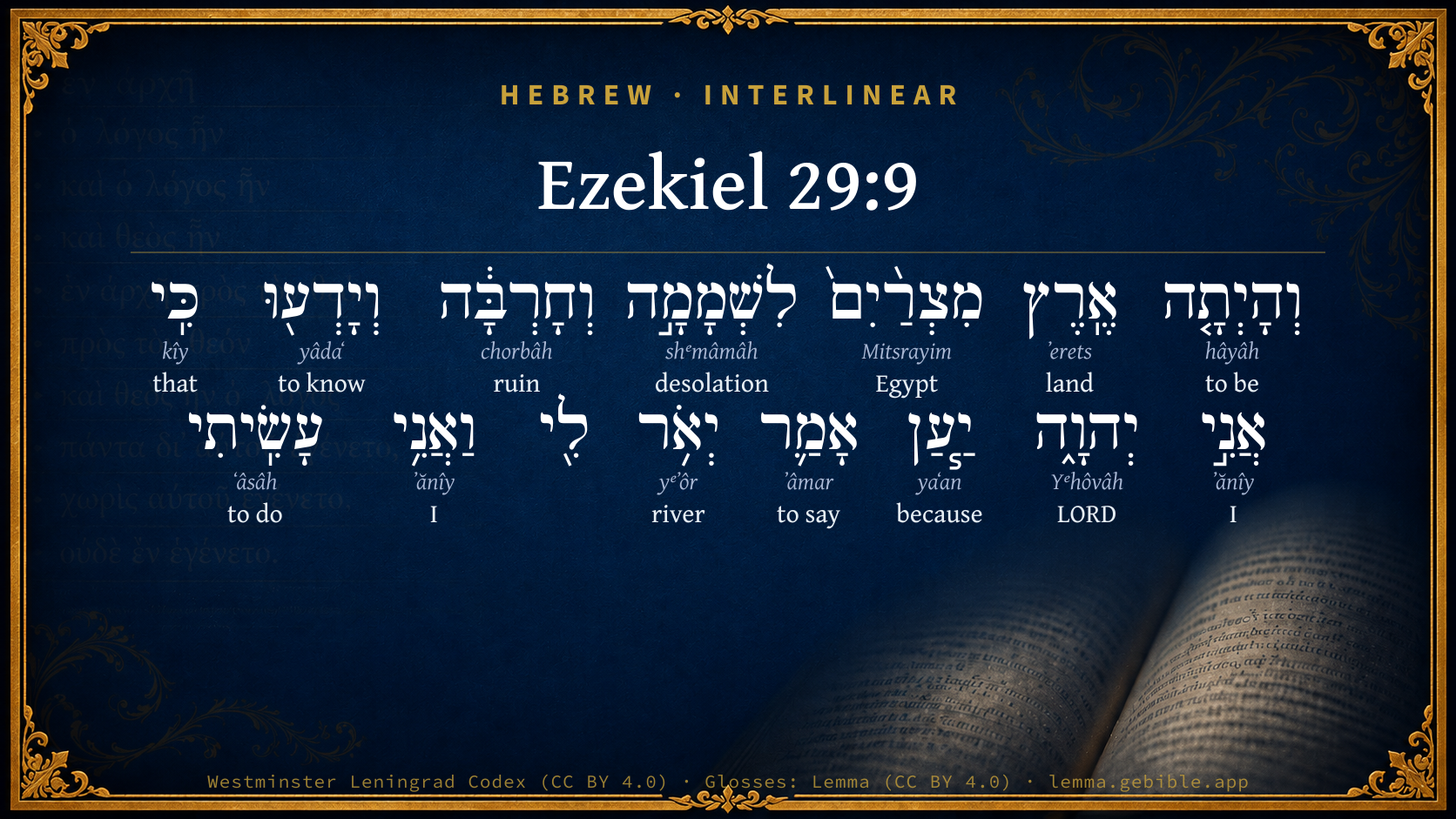
Hebrew (Westminster Leningrad Codex) Ezekiel 29:9 appears in the Hebrew Old Testament. The text above is from the Westminster Leningrad Codex. Each word links to its Strong’s number, a concise gloss, and parsing drawn from the Open Scriptures Hebrew Bible morphology. Click any word for its full Brown-Driver-Briggs (BDB) entry.
Download image
Cite this verse

Ezekiel 29:9 (World English Bible). Public Domain. Lemma interlinear Bible study tool, https://lemma.gebible.app/v/ezekiel/29/9.

Show BibTeX & RIS
BibTeX
RIS
English Translation
The land of Egypt shall be a desolation and a waste; and they shall know that I am Yahweh. Because he has said, The river is mine, and I have made it;
World English Bible · Public Domain
Download a study sheet

One document with this verse’s original text, its word-by-word gloss line, the meaning frame, cross-references with their text, attributed commentary, and full source and license credits — printable, and it pastes into notes with its structure intact.

This verse Autodidact and up

Study sheet (.html) Plain text (.txt)

A passage Seminary Student

Up to 50 verses in one chapter. A passage sheet keeps up to 6 commentary sources and 12 cross-references per verse, in the order this page ranks them, and says so on the sheet whenever that leaves anything out. Ask for a single verse and you get the Autodidact verse sheet above.

Everything on this page stays free to read, with no account — the sheet is a download of what is already on screen, not access to it.

Want to remove ads? Support Godless Engineer
Compare translations 3

The same verse in 3 English versions, stacked beneath the original-language interlinear above. Click any original word for its lexicon entry.

Each is an independent rendering of the whole verse — the interlinear is not word-aligned to these translations.

Highlighted words mark where these versions differ — a whole-verse word diff, not a word-by-word alignment.

  • World English Bible Public Domain
    The land of Egypt shall be a desolation and a waste; and they shall know that I am Yahweh. Because he has said, The river is mine, and I have made it;
  • King James Version Public Domain
    And the land of Egypt shall be desolate and waste; and they shall know that I am the LORD: because he hath said, The river is mine, and I have made it.
  • unfoldingWord Literal Text CC BY-SA 4.0
    So the land of Egypt will become desolate and a ruin. Then they will know that I am Yahweh, because the sea monster had said, “The river is mine, for I have made it.”

unfoldingWord Literal Text — © unfoldingWord, licensed CC BY-SA 4.0. Word-aligned USFM3 via Door43 (git.door43.org/unfoldingWord/en_ult).

Versions to compare (up to 4)

3 of 4 selected

Show all 18 translations

Every available English version of this verse, each an independent rendering of the whole verse.

  • World English Bible Public Domain
    The land of Egypt shall be a desolation and a waste; and they shall know that I am Yahweh. Because he has said, The river is mine, and I have made it;
  • Berean Standard Bible Public Domain
    The land of Egypt will become a desolate wasteland. Then they will know that I am the LORD. Because you said, ‘The Nile is mine; I made it,’
  • Majority Standard Bible Public Domain
    The land of Egypt will become a desolate wasteland. Then they will know that I am the LORD. Because you said, ‘The Nile is mine; I made it,’
  • King James Version Public Domain
    And the land of Egypt shall be desolate and waste; and they shall know that I am the LORD: because he hath said, The river is mine, and I have made it.
  • American Standard Version (1901) Public Domain
    And the land of Egypt shall be a desolation and a waste; and they shall know that I am Jehovah. Because he hath said, The river is mine, and I have made it;
  • Revised Version (1885) Public Domain
    And the land of Egypt shall be a desolation and a waste; and they shall know that I am the LORD: because he hath said, The river is mine, and I have made it.
  • Geneva Bible (1599) Public Domain
    And the land of Egypt shalbe desolate, and waste, and they shall know that I am ye Lord: because he hath said, The riuer is mine, and I haue made it,
  • Douay-Rheims (1899) Public Domain
    And the land of Egypt shall become a desert, and a wilderness: and they shall know that I am the Lord: because thou hast said: The river is mine, and I made
  • Young's Literal Translation Public Domain
    And the land of Egypt hath been for a desolation and a waste, And they have known that I `am' Jehovah. Because he said: The flood `is' mine, and I made `it'.
  • Literal Standard Version CC BY-SA 4.0
    And the land of Egypt has been for a desolation and a ruin, || And they have known that I [am] YHWH, || Because he said: The flood [is] mine, and I made [it].
  • Unlocked Literal Bible CC BY-SA 4.0
    So the land of Egypt will become desolate and a ruin. Then they will know that I am Yahweh, because the sea monster had said, “The river is mine, for I have made it.”
  • unfoldingWord Literal Text CC BY-SA 4.0
    So the land of Egypt will become desolate and a ruin. Then they will know that I am Yahweh, because the sea monster had said, “The river is mine, for I have made it.”
  • Darby Bible Public Domain
    And the land of Egypt shall be a desolation and a waste: and they shall know that I [am] Jehovah, because he saith, The river is mine, and I made it.
  • World Messianic Bible Public Domain
    The land of Egypt will be a desolation and a waste. Then they will know that I am the LORD. “‘“Because he has said, ‘The river is mine, and I have made it,’
  • Webster's Bible Public Domain
    And the land of Egypt shall be desolate and waste; and they shall know that I am the LORD: because he hath said, The river is mine, and I have made it.
  • Free Bible Version CC BY-SA 4.0
    Egypt will become an empty wasteland. Then they will know that I am the Lord. Because you said, ‘The Nile belongs to me; I made it,’
  • Bible in Basic English Public Domain
    And the land of Egypt will be an unpeopled waste; and they will be certain that I am the Lord: because he has said, The Nile is mine, and I made it.
  • JPS Tanakh (1917) Public Domain
    And the land of Egypt shall be desolate and waste, and they shall know that I am the LORD; because he hath said: The river is mine, and I have made it.

Literal Standard Version (2020), Covenant Press — licensed CC BY-SA 4.0. Text via the HelloAO Bible API (eBible.org). Unlocked Literal Bible (unfoldingWord) — licensed CC BY-SA 4.0. Text via the HelloAO Bible API (eBible.org). unfoldingWord Literal Text — © unfoldingWord, licensed CC BY-SA 4.0. Word-aligned USFM3 via Door43 (git.door43.org/unfoldingWord/en_ult). Free Bible Version, Dr. Jonathan Gallagher — licensed CC BY-SA 4.0. Text via the HelloAO Bible API (eBible.org).

Word by word

More ways to search: Search by grammar → Find every occurrence → Compare this word →

Practice this passage: Drill this verse → Learn its vocabulary →

וְחָרְבָּ֔ה
chorbâh
H2723
“and · ruin”
Conjunction + Noun, Common, Feminine, Singular, Absolute
Part of Speech
Conjunction + Noun
Type
Common
Gender
Feminine
Number
Singular
State
Absolute
Full BDB Definition

Origin: from H2721

TWOT: 731d

a place laid waste, ruin, waste, desolation
  1. וְהָיְתָ֤ה hâyâh H1961 “and · to be” Conjunction + Verb, Qal, Sequential Perfect, 3rd Person, Feminine, Singular
  2. אֶֽרֶץ ʼerets H776 “land of” Noun, Common, Both, Singular, Construct
  3. מִצְרַ֨יִם֙ Mitsrayim H4714 “Egypt” Noun, Proper
  4. לִשְׁמָמָ֣ה shᵉmâmâh H8077 “to/for · desolation” Preposition + Noun, Common, Feminine, Singular, Absolute
  5. וְיָדְע֖וּ yâdaʻ H3045 “and · to know” Conjunction + Verb, Qal, Sequential Perfect, 3rd Person, Common, Plural
  6. כִּֽי kîy H3588 “that” Conjunction
  7. אֲנִ֣י ʼănîy H589 “I” Pronoun, Personal, 1st Person, Common, Singular
  8. יְהוָ֑ה Yᵉhôvâh H3068 “LORD” Noun, Proper
  9. יַ֧עַן yaʻan H3282 “because” Conjunction
  10. אָמַ֛ר ʼâmar H559 “to say” Verb, Qal, Perfect, 3rd Person, Masculine, Singular
  11. יְאֹ֥ר yᵉʼôr H2975 “river” Noun, Proper
  12. וַאֲנִ֥י ʼănîy H589 “and · I” Conjunction + Pronoun, Personal, 1st Person, Common, Singular
  13. עָשִֽׂיתִי ʻâsâh H6213 “to do” Verb, Qal, Perfect, 1st Person, Common, Singular

About this verse

These counts appear in no published source. They are computed here, from the morphology-tagged text and Lemma’s own curated glosses. What Lemma adds →

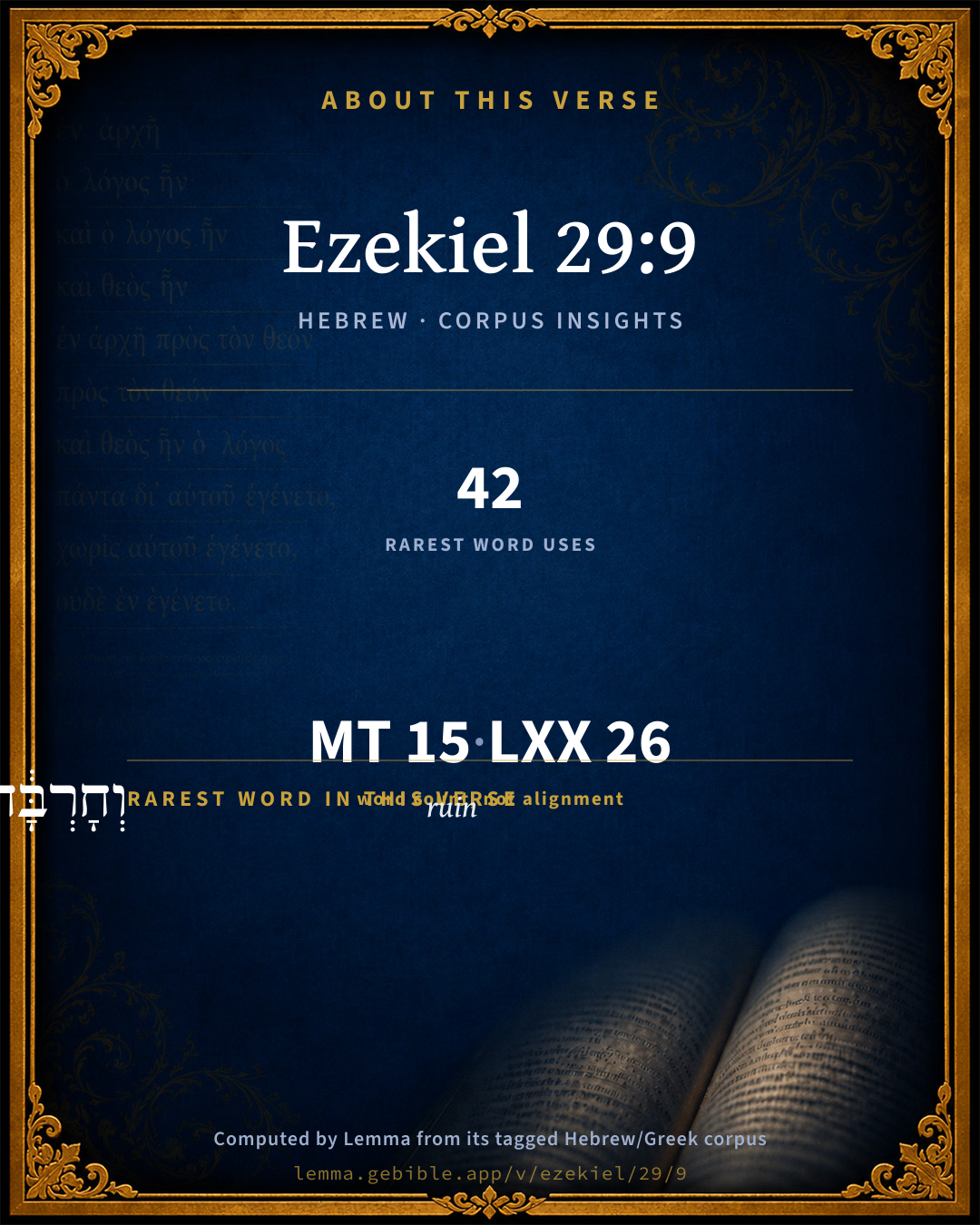
15
words
13
distinct lemmas
Prophets
section

Shared distinctive vocabulary

וְחָרְבָּ֔ה ruin H2723 occurs in 42 verses of the Hebrew Bible. Also found in:

Grammatical profile

  • 4 verbs
  • 6 nouns
  • 2 pronouns
  • 1 preposition
  • 2 conjunctions

Verb forms

  • וְהָיְתָ֤ה Qal · Sequential Perfect
  • וְיָדְע֖וּ Qal · Sequential Perfect
  • אָמַ֛ר Qal · Perfect
  • עָשִֽׂיתִי Qal · Perfect

Repetition

A word recurs within this verse — often emphatic in Hebrew:

  • אֲנִ֣י I H589 ×2

Hebrew & Septuagint length

In English translation the verse runs 32 words from the Hebrew and 30 from the Septuagint (LXX English) — closely comparable.

A rough comparison of the two English renderings, which tokenize alike — not a word-level alignment.

Word counts can differ between the Hebrew and the Greek without any difference in meaning — e.g. the Hebrew direct-object marker אֵת has no separate Greek word, and Greek often adds the article ὁ.

In the original languages it is 15 Hebrew tokens and 26 Greek tokens — but the two are counted differently (Hebrew bundles its prefixes and suffixes into one token; the Greek is in lemma form), so that isn’t a like-for-like length.

Cross-references

8

Topical passages linked to Ezekiel 29:9 in the Treasury of Scripture Knowledge — connected by theme and wording, ordered by reader-vote popularity; previews shown in the World English Bible.

  • Ezekiel 29:3 speak, and say, Thus says the Lord Yahweh: Behold, I am against you, Pharaoh king of Egypt, the great monster that lies in the midst of his rivers, that has said, My river is my own, and I have made it for myself.
  • Proverbs 16:18 Pride goes before destruction, And a haughty spirit before a fall.
  • Proverbs 18:12 Before destruction the heart of man is proud, But before honor is humility.
  • Ezekiel 29:10–12 therefore, behold, I am against you, and against your rivers, and I will make the land of Egypt an utter waste and desolation, from the tower of Seveneh even to the border of Ethiopia.
  • Proverbs 29:23 A man's pride brings him low, But one of lowly spirit gains honor.
  • Jeremiah 43:10–13 and tell them, Thus says Yahweh of Hosts, the God of Israel: Behold, I will send and take Nebuchadrezzar the king of Babylon, my servant, and will set his throne on these stones that I have hidden; and he shall spread his royal pavilion over them.
  • Ezekiel 30:7–8 They shall be desolate in the midst of the countries that are desolate; and her cities shall be in the midst of the cities that are wasted.
  • Ezekiel 30:13–19 Thus says the Lord Yahweh: I will also destroy the idols, and I will cause the images to cease from Memphis; and there shall be no more a prince from the land of Egypt: and I will put a fear in the land of Egypt.

Cross-references courtesy of OpenBible.info (CC BY 4.0).

Hebrew and Greek witnesses Masoretic Hebrew ↔ Greek Septuagint

The same verse in the two great witnesses to the Old Testament, shown verse-for-verse.

These are two independent witnesses, not word-aligned to each other, and the Septuagint is shown in lemma (dictionary) form.

Hebrew Ezekiel 29:9 Masoretic · Westminster Leningrad Codex

וְהָיְתָ֤ה אֶֽרֶץ מִצְרַ֨יִם֙ לִשְׁמָמָ֣ה וְחָרְבָּ֔ה וְיָדְע֖וּ כִּֽי אֲנִ֣י יְהוָ֑ה יַ֧עַן אָמַ֛ר יְאֹ֥ר לִ֖י וַאֲנִ֥י עָשִֽׂיתִי

The land of Egypt shall be a desolation and a waste; and they shall know that I am Yahweh. Because he has said, The river is mine, and I have made it;

World English Bible · Public Domain

Greek LXX Ezekiel 29:9 Septuagint · lemma form

καί εἰμί ὁ γῆ αἴγυπτος ἀπώλεια καί ἔρημος καί γιγνώσκω ὅτι ἐγώ εἰμί κύριος ἀντί ὁ λέγω σύ ὁ ποταμός ἐγώ εἰμί καί ἐγώ ποιέω αὐτός

and the land of Egypt shall be ruined and desert; and they shall know that I am the Lord; because you say, The rivers are mine, and I made them.

LXX2012 (modern English Septuagint) · Public Domain

Hebrew: Westminster Leningrad Codex (CC BY 4.0). Greek: Septuagint (public domain); English from LXX2012 (modern English Septuagint) (Public Domain). How the Septuagint differs from the Hebrew →

Targum (Aramaic paraphrase)

1

The Targum is the ancient Jewish Aramaic paraphrase of the Hebrew Scriptures — an interpretive translation, not the Hebrew text itself. Onkelos (literal) and Pseudo-Jonathan (expansive) render the Torah, and Jonathan the Prophets. Coverage is partial: where no permissively-licensed English translation exists for a verse, only the Aramaic is shown. This is verse-level text, not a word-by-word alignment to the Hebrew.

  1. Targum Jonathan Prophets (Joshua–Malachi)
    וּתְהֵי אַרְעָא דְמִצְרָיִם לְאִישְׁתְּמָמוּ וְחוּרְבָּא וְיֵדְעוּן אֲרֵי אֲנָא יְיָ חֲלַף דַאֲמַר מַלְכוּתָא דִילִי וַאֲנָא כַבְּשֵׁית:

    (no public-domain English translation for this verse)

    Targum Jonathan — Aramaic: “Mikraot Gedolot” (public domain). English: “Sefaria Community Translation” (CC0 1.0 (public-domain dedication)); “London "Chaldee Paraphrase," 1871” (public domain). Text via Sefaria.

Commentary

Notes on Ezekiel 29:9 from classic Christian and Jewish commentators (each source and its license shown beneath its notes). The classic Christian expositions comment on the surrounding passage and are grouped to its opening verse, so a note may address several verses; the Jewish commentaries on the Tanakh (Rashi and others) are per-verse, so they appear only where the commentator wrote on this verse.

Lemma curates 59 commentaries, every one of them public domain or Creative Commons licensed, each selected and text-cleaned for this edition rather than reprinted as found. About our sources →

Trapp's Complete Commentary

John Trapp

Eze 29:9 And the land of Egypt shall be desolate and waste; and they shall know that I [am] the LORD: because he hath said, The river [is] mine, and I have made [it].

Ver. 9. Because he hath said, The river is mine, and I have made it.] With this proud speech he is twice twitted. {see Eze 29:3} The Egyptians so trusted in their river Nile, as if they needed no help from heaven.

“ Aegyptus sine nube ferax, ”

saith Claudian. {a} And Lucan to like purpose:

“ Terra suis contenta bonis, non indiga mercis

Aut Iovis; in solo tanta est fiducia Nile. ”

How much better might God have said to these Egyptians, than Vespasian did, Haurite a me tanquam a Nile, Come ye to me, "the fountain of living waters," and "hew not out thus to yourselves broken cisterns that can hold no water!" But they used in mockery to tell the Grecians, that if God should forget to rain, they might chance to starve for it; they thought the rain was of God, but not the river:

“ Te propter nullos tellus tua postulat imbres:

Arida nee pluvio supplicat herba Iovi. ”

- Tibul. de Nilo.

God therefore threateneth here to dry it up, and so he did; ingratitude forfeiteth all. In the reign of Cleopatra, Nile overflowed not the banks for two years together, saith Seneca. He brings in Callimachus, telling of a time wherein it had not done so for nine years’ time. Hence Ovid: {b}

“ Creditur Aegyptus caruisse iuvantibus arva

Imbribus, atque annis sicca fuisse novem. ”

Thus their gold flowing {c} and fruit giving {d} river failed them, because they attributed too much to it. In Joseph’s time they had seven years’ famine.

{a} Epigram. 6.

{b} Art., lib. i.

{c} χρυσοροας. - Athenaeus.

{d} καρπ ωδοτης. - Nazianz.

John Trapp, A Commentary or Exposition upon All the Books of the Old and New Testament (1647–1656) — public domain. Text from a community e-Sword module.

Geneva Bible (1599)

Geneva Bible translators

Thus God cannot suffer that man should arrogate anything to himself, or put his trust in anything save in him alone.

Geneva Bible (1599) marginal notes — public domain. Text via Bolls.life.

Jamieson, Fausset & Brown

Robert Jamieson, A. R. Fausset & David Brown

I am the Lord--in antithesis to the blasphemous boast repeated here from Eze 29:3, "The river is mine, and I have made it."

Jamieson, Fausset & Brown — Commentary Critical and Explanatory on the Whole Bible (1871) — public domain (CC PDM 1.0). Text via the HelloAO Bible API.

Ellicott's Commentary for English Readers

(9) Because he hath said.—Again, as in Eze_29:6, the division of the verses is very unfortunate. The expression “shall know that I am the Lord,” so common in Ezekiel, always closes a train of thought. The new sentence begins with the reason for the judgment upon Egypt—because of its pride.

A Bible Commentary for English Readers, edited by Charles John Ellicott (1878–1897) — public domain. Text from a community e-Sword module.

The Cambridge Bible for Schools and Colleges

gen. ed. J. J. S. Perowne

9. The ungodly overweening pride of Egypt is chiefly mentioned as the cause of its humiliation. It is a common idea that pride draws forth the judgment of Jehovah, who is alone exalted (Isaiah 2, 3). The prophet assumes that this pride is irreligious and an offence against Jehovah. However sedulously devoted the Egyptians might be in serving their own gods, their religion did not prevent this self-deification, which was an offence against him who was God alone.

The Cambridge Bible for Schools and Colleges (gen. ed. J. J. S. Perowne; Cambridge University Press, 1878–1918) — public domain. Text from a community e-Sword module.

John Gill's Exposition

And the land of Egypt shall be desolate and waste,.... Men few or none being left in it, to till it, nor cattle found upon it:

and they shall know that I am the Lord; by these judgments executed upon them, now foretold; and which when come to pass, they will be obliged to acknowledge the omniscience and omnipotence of Jehovah:

because thou hast said, the river is mine, and I have made it; See Gill on Eze 29:3; this insolent expression was highly resented by the Lord, as appears by the repetition of it. The Targum is here, as before,

"the kingdom is mine, and I have subdued it;''

but, notwithstanding this vaunt, he could not keep it.

John Gill's Exposition of the Whole Bible (1746–1763) — public domain (CC PDM 1.0). Text via the HelloAO Bible API.

Matthew Poole's English Annotations

The land of Egypt; that part here intended, say some, and in the 10th verse, bounded from Syene to the borders of Ethiopia; nor is this inconsistent with that Eze 29:2, against all Egypt, for all Egypt suffered much, though all were not equally wasted, and turned into a desolation, as these parts shall be. Desolate; a desolation, i.e. most desolate, and wasteness by the sword of the enemy, and by drought, as the word imports both: and this latter part of the judgment was executed by the folly of the twelve Egyptian roitelets, who made a mighty lake, Morris, to fill which they much drained and weakened Nilus, that it could not, as before it did, water and fertilize the land; suitable to Isa 19:5.

He hath said, & c.: see Eze 29:3.

Matthew Poole's English Annotations on the Holy Bible (1683–1685) — public domain. Text from a community e-Sword/MySword module.

The Pulpit Commentary

The pride of creation.

In the insanity of his pride, Pharaoh is supposed even to claim the mighty Nile, that great work of nature on which the wealth and even the very life of his people depended, as a creation of his own imperial power. Such a foolish boast illustrates in an extreme form the common mistake of claiming to create what has in fact been received as a gift of God.

I NOTE THE PREVALENCE OF THE PRIDE OF CREATION. This is seen with many kinds of success.

1. National greatness. The proud nation glories in having built up its own greatness. The mighty monarch regards himself as the maker of his empire.

2. Private fortune. One who has risen from the ranks regards himself as a self-made man. His success he attributes to his own ability and energy; and his ability and energy he regards as springing from himself.

3. Skilful inventions. Man does indeed seem to create with his brain. We say that Homer created the "Iliad;" Phidias, the Elgin Marbles; Watt, the steam-engine; Stephenson, the locomotive. The thought that constituted or shaped these great works of genius was bred in the brains of the men who originated them.

4. Personal character. Men commonly regard themselves as the architects of their own characters. If there is growth in wisdom or strength, the strong temptation is to think that this growth is due to their own thought and effort. But

II CONSIDER THE FOLLY OF THE PRIDE OF CREATION. This pride springs from a delusion. Certainly it did with Pharaoh. He make the Nile! The Nile made him! Egypt was just the child of the Nile. Her wealth depended on the ministry of the mighty river. Floods gathered from melting snows on distant African mountains far beyond the territory or even the knowledge of the Pharaohs, swelled its waters so that they overflowed their banks and spread fertility on the narrow strips of river-side called Egypt. But this is but an evident instance of what is true in less conspicuous ways. All great things, all new things, all things that exist, come from God. They spring from God, and they depend on him.

1. In nature. God is the Creator and Preserver of nature. He not only made the stone that the sculptor chisels; he made the laws of matter and the fundamental principles of art along which the sculptor must work. National greatness largely depends on geographical and other physical conditions of Divine creation.

2. In providence. God is still in the world, ruling it according to his own thought for his own great purposes. He overrules the government of kings. In private life he helps one on to prosperity, and sends another needful adversity through those turns of events, those conjunctions of circumstances, which the wisest cannot foresee and which the ablest cannot modify.

3. In grace. For the higher good of life spiritual attainments are necessary. Without these attainments Fra. Angelico could not have painted his beautiful angels, Milton could not have written his grand epics, Luther could not have wrought his Titanic revolution. God"s inward grace makes souls and characters good and great.

III AVOID THE SIN OF THE PRIDE OF CREATION. This pride is positively wicked. It robs God of his rightful honor. It is distinctly ungrateful. Indeed, it is atheistic; and practical atheism of this character is far worse morally than the intellectual atheism that denies the being of God as a proposition in academic discussions. Such a sinful pride destroys a man"s sense of dependence, his remembrance of obligations, his consciousness of responsibility, that admission of his own littleness which is necessary for humility as well as that feeling of God"s greatness and goodness which is at the root of religion.

The Pulpit Commentary (1880–1919), ed. H.D.M. Spence-Jones & Joseph S. Exell — public domain. Text from a community e-Sword module.

Lesson kit

Teaching starters — assembled from the data on this page, not authored interpretation. Every prompt links to the verse data it draws on. Edit before teaching.

Ezekiel, in the Prophets, opens this verse with 15 words (13 distinct Hebrew lemmas). Its most distinctive word is chorbâh (“ruin”). A historical commentator’s framing appears above. Read the whole chapter for the surrounding context.

Discussion questions

  1. The word chorbâh carries the sense “ruin.” How does it shape the verse?
  2. How does Leviticus 26:31, which shares the word «ruin», read alongside this verse?
  3. What does the repetition of “I” (2× in this one verse) do in this verse?
  4. The translations on this page render this verse differently — a whole-verse word diff, not a word-by-word alignment. What might account for the different wordings?
  5. «וְהָיְתָ֤ה» is a Qal Sequential Perfect verb. How does that grammatical form shape the action described?
  6. Compare how Trapp's Complete Commentary and Geneva Bible (1599) read this verse. Where do they agree or differ?

Things to notice

Reading settings

Reading text

Shown beneath each verse's original-language words.

Old Testament
Old Testament edition

Read the OT as the Masoretic Hebrew (MT) or the Greek Septuagint (LXX).

English shown for the Greek Septuagint (in the Hebrew ↔ Greek comparison).

Comparing translations? Open the Compare panel on any verse page to stack up to four side by side.