Isaiah 43:3

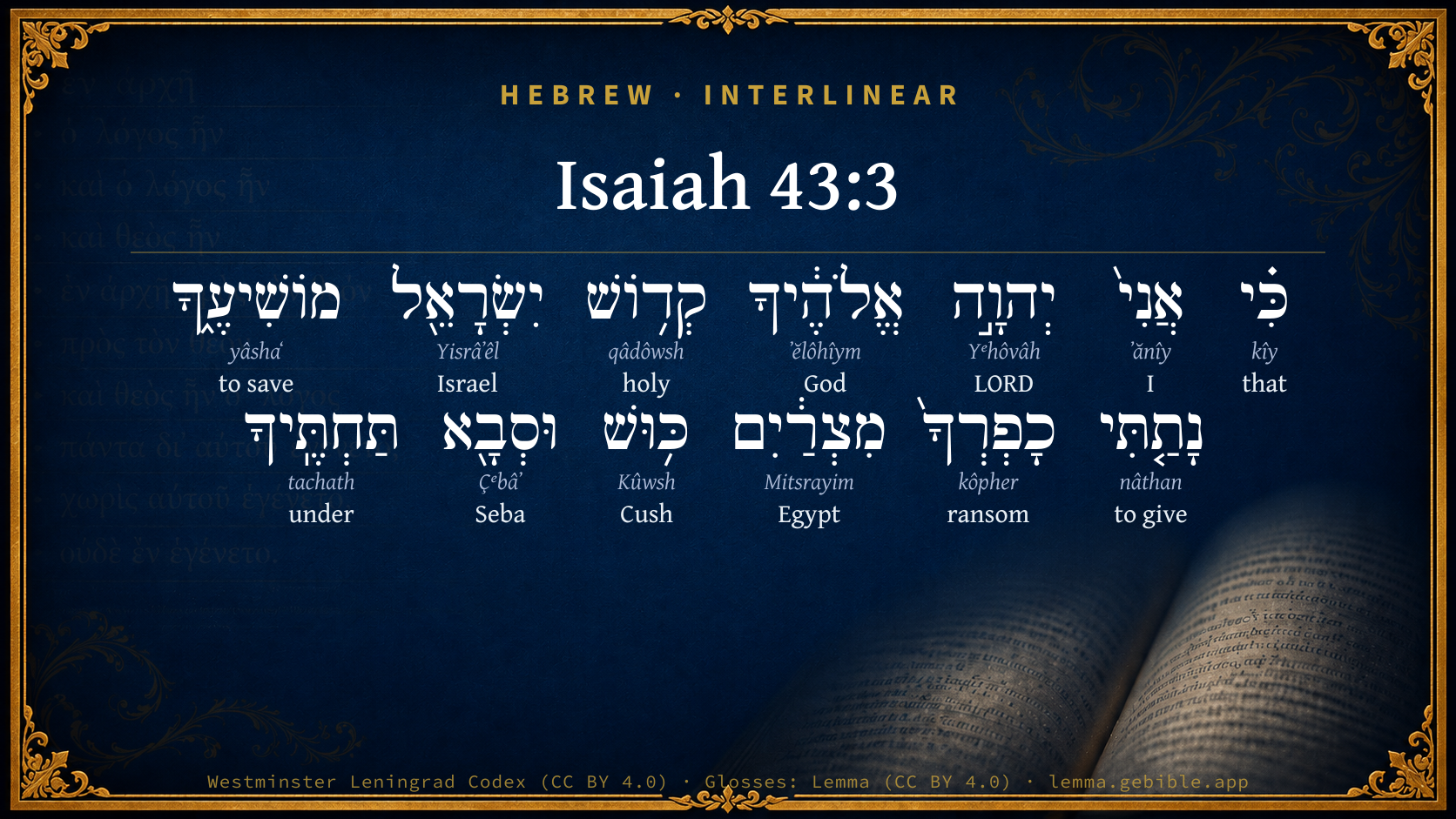
Hebrew (Westminster Leningrad Codex) Isaiah 43:3 appears in the Hebrew Old Testament. The text above is from the Westminster Leningrad Codex. Each word links to its Strong’s number, a concise gloss, and parsing drawn from the Open Scriptures Hebrew Bible morphology. Click any word for its full Brown-Driver-Briggs (BDB) entry.
Download image
Cite this verse

Isaiah 43:3 (World English Bible). Public Domain. Lemma interlinear Bible study tool, https://lemma.gebible.app/v/isaiah/43/3.

Show BibTeX & RIS
BibTeX
RIS
English Translation
For I am Yahweh your God, the Holy One of Israel, your Savior; I have given Egypt as your ransom, Ethiopia and Seba in your place.
World English Bible · Public Domain
Download a study sheet

One document with this verse’s original text, its word-by-word gloss line, the meaning frame, cross-references with their text, attributed commentary, and full source and license credits — printable, and it pastes into notes with its structure intact.

This verse Autodidact and up

Study sheet (.html) Plain text (.txt)

A passage Seminary Student

Up to 50 verses in one chapter. A passage sheet keeps up to 6 commentary sources and 12 cross-references per verse, in the order this page ranks them, and says so on the sheet whenever that leaves anything out. Ask for a single verse and you get the Autodidact verse sheet above.

Everything on this page stays free to read, with no account — the sheet is a download of what is already on screen, not access to it.

Want to remove ads? Support Godless Engineer
Compare translations 3

The same verse in 3 English versions, stacked beneath the original-language interlinear above. Click any original word for its lexicon entry.

Each is an independent rendering of the whole verse — the interlinear is not word-aligned to these translations.

Highlighted words mark where these versions differ — a whole-verse word diff, not a word-by-word alignment.

  • World English Bible Public Domain
    For I am Yahweh your God, the Holy One of Israel, your Savior; I have given Egypt as your ransom, Ethiopia and Seba in your place.
  • King James Version Public Domain
    For I am the LORD thy God, the Holy One of Israel, thy Saviour: I gave Egypt for thy ransom, Ethiopia and Seba for thee.
  • unfoldingWord Literal Text CC BY-SA 4.0
    For I Yahweh your God, the Holy of Israel, your Savior. I give Egypt your ransom, Cush and Seba in place of you.

unfoldingWord Literal Text — © unfoldingWord, licensed CC BY-SA 4.0. Word-aligned USFM3 via Door43 (git.door43.org/unfoldingWord/en_ult).

Versions to compare (up to 4)

3 of 4 selected

Show all 18 translations

Every available English version of this verse, each an independent rendering of the whole verse.

  • World English Bible Public Domain
    For I am Yahweh your God, the Holy One of Israel, your Savior; I have given Egypt as your ransom, Ethiopia and Seba in your place.
  • Berean Standard Bible Public Domain
    For I am the LORD your God, the Holy One of Israel, your Savior; I give Egypt for your ransom, Cush and Seba in your place.
  • Majority Standard Bible Public Domain
    For I am the LORD your God, the Holy One of Israel, your Savior; I give Egypt for your ransom, Cush and Seba in your place.
  • King James Version Public Domain
    For I am the LORD thy God, the Holy One of Israel, thy Saviour: I gave Egypt for thy ransom, Ethiopia and Seba for thee.
  • American Standard Version (1901) Public Domain
    For I am Jehovah thy God, the Holy One of Israel, thy Saviour; I have given Egypt as thy ransom, Ethiopia and Seba in thy stead.
  • Revised Version (1885) Public Domain
    For I am the LORD thy God, the Holy One of Israel, thy saviour; I have given Egypt as thy ransom, Ethiopia and Seba for thee.
  • Geneva Bible (1599) Public Domain
    For I am the Lord thy God, the holy one of Israel, thy Sauiour: I gaue Egypt for thy ransome, Ethiopia, and Seba for thee.
  • Douay-Rheims (1899) Public Domain
    For I am the Lord thy God, the Holy One of Israel, thy Saviour: I have given Egypt for thy atonement, Ethiopia and Saba for thee.
  • Young's Literal Translation Public Domain
    For I -- Jehovah thy God, The Holy One of Israel, thy Saviour, I have appointed Egypt thine atonement, Cush and Seba in thy stead.
  • Literal Standard Version CC BY-SA 4.0
    For I—your God YHWH, || The Holy One of Israel, your Savior, || I have appointed Egypt your atonement, || Cush and Seba in your stead.
  • Unlocked Literal Bible CC BY-SA 4.0
    For I am Yahweh your God, the Holy One of Israel, your Savior. I have given Egypt as your ransom, Cush and Seba in exchange for you.
  • unfoldingWord Literal Text CC BY-SA 4.0
    For I Yahweh your God, the Holy of Israel, your Savior. I give Egypt your ransom, Cush and Seba in place of you.
  • Darby Bible Public Domain
    For I [am] Jehovah thy God, the Holy One of Israel, thy Saviour: I gave Egypt for thy ransom, Ethiopia and Seba for thee.
  • World Messianic Bible Public Domain
    For I am the LORD your God, the Holy One of Israel, your Savior. I have given Egypt as your ransom, Ethiopia and Seba in your place.
  • Webster's Bible Public Domain
    For I am the LORD thy God, the Holy One of Israel, thy Savior: I gave Egypt for thy ransom, Cush and Seba for thee.
  • Free Bible Version CC BY-SA 4.0
    For I am the Lord your God, the Holy One of Israel, your Savior. I gave Egypt to pay for your freedom; I traded Ethiopia and Seba for you.
  • Bible in Basic English Public Domain
    For I am the Lord your God, the Holy One of Israel, your saviour; I have given Egypt as a price for you, Ethiopia and Seba for you.
  • JPS Tanakh (1917) Public Domain
    For I am the LORD thy God, The Holy One of Israel, thy Saviour; I have given Egypt as thy ransom, Ethiopia and Seba for thee.

Literal Standard Version (2020), Covenant Press — licensed CC BY-SA 4.0. Text via the HelloAO Bible API (eBible.org). Unlocked Literal Bible (unfoldingWord) — licensed CC BY-SA 4.0. Text via the HelloAO Bible API (eBible.org). unfoldingWord Literal Text — © unfoldingWord, licensed CC BY-SA 4.0. Word-aligned USFM3 via Door43 (git.door43.org/unfoldingWord/en_ult). Free Bible Version, Dr. Jonathan Gallagher — licensed CC BY-SA 4.0. Text via the HelloAO Bible API (eBible.org).

Word by word

More ways to search: Search by grammar → Find every occurrence → Compare this word →

Practice this passage: Drill this verse → Learn its vocabulary →

וּסְבָ֖א
Çᵉbâʼ
H5434
“and · Seba”
Conjunction + Noun, Proper
Part of Speech
Conjunction + Noun
Type
Proper
Full BDB Definition

Origin: of foreign origin

TWOT: None

Seba = "drink thou" - a son of Cush (noun proper masculine) - a nation south of Palestine, perhaps Ethiopia (noun proper locative)
  1. כִּ֗י kîy H3588 “that” Conjunction
  2. אֲנִי֙ ʼănîy H589 “I” Pronoun, Personal, 1st Person, Common, Singular
  3. יְהוָ֣ה Yᵉhôvâh H3068 “LORD” Noun, Proper
  4. אֱלֹהֶ֔יךָ ʼĕlôhîym H430 “God(s) · your” Noun, Common, Masculine, Plural, Construct + Suffix, Personal, 2nd Person, Masculine, Singular
  5. קְד֥וֹשׁ qâdôwsh H6918 “holy of” Adjective, Adjective, Masculine, Singular, Construct
  6. יִשְׂרָאֵ֖ל Yisrâʼêl H3478 “Israel” Noun, Proper
  7. מוֹשִׁיעֶ֑ךָ yâshaʻ H3467 “saving · you” Verb, Hiphil, Participle Active, Masculine, Singular, Construct + Suffix, Personal, 2nd Person, Masculine, Singular
  8. נָתַ֤תִּי nâthan H5414 “to give” Verb, Qal, Perfect, 1st Person, Common, Singular
  9. כָפְרְךָ֙ kôpher H3724 “ransom · your” Noun, Common, Masculine, Singular, Construct + Suffix, Personal, 2nd Person, Masculine, Singular
  10. מִצְרַ֔יִם Mitsrayim H4714 “Egypt” Noun, Proper
  11. כּ֥וּשׁ Kûwsh H3568 “Cush” Noun, Proper
  12. תַּחְתֶּֽיךָ tachath H8478 “under · you” Preposition + Suffix, Personal, 2nd Person, Masculine, Singular

About this verse

These counts appear in no published source. They are computed here, from the morphology-tagged text and Lemma’s own curated glosses. What Lemma adds →

13
words
13
distinct lemmas
Prophets
section

Notable vocabulary

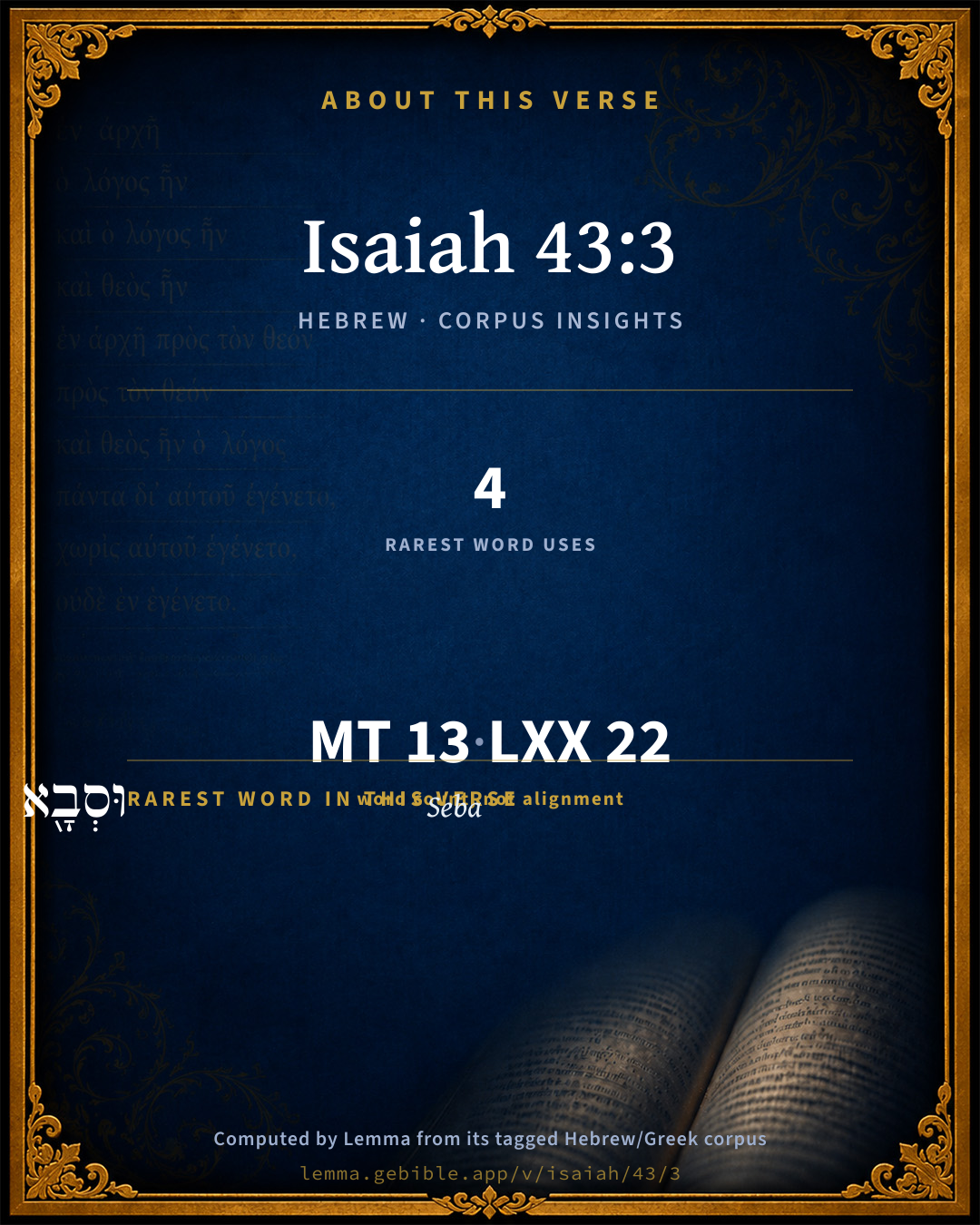
The rarest word here is וּסְבָ֖א Seba H5434 — appearing just 4 times in the whole Hebrew Bible.

Shared distinctive vocabulary

וּסְבָ֖א Seba H5434 occurs in 4 verses of the Hebrew Bible. Also found in:

Grammatical profile

  • 2 verbs
  • 7 nouns
  • 1 adjective
  • 1 pronoun
  • 1 preposition
  • 1 conjunction

Verb forms

  • מוֹשִׁיעֶ֑ךָ Hiphil · Participle Active
  • נָתַ֤תִּי Qal · Perfect

Hebrew & Septuagint length

In English translation the verse runs 26 words from the Hebrew and 28 from the Septuagint (LXX English) — closely comparable.

A rough comparison of the two English renderings, which tokenize alike — not a word-level alignment.

Word counts can differ between the Hebrew and the Greek without any difference in meaning — e.g. the Hebrew direct-object marker אֵת has no separate Greek word, and Greek often adds the article ὁ.

In the original languages it is 13 Hebrew tokens and 22 Greek tokens — but the two are counted differently (Hebrew bundles its prefixes and suffixes into one token; the Greek is in lemma form), so that isn’t a like-for-like length.

Cross-references

16

Topical passages linked to Isaiah 43:3 in the Treasury of Scripture Knowledge — connected by theme and wording, ordered by reader-vote popularity; previews shown in the World English Bible.

  • Isaiah 60:16 You shall also suck the milk of the nations, and shall suck the breast of kings; and you shall know that I, Yahweh, am your Savior, and your Redeemer, the Mighty One of Jacob.
  • Isaiah 45:15 Most assuredly you are a God who hid yourself, God of Israel, the Savior.'
  • 2 Chronicles 14:9–14 There came out against them Zerah the Ethiopian with an army of a million troops, and three hundred chariots; and he came to Mareshah.
  • Isaiah 49:26 I will feed those who oppress you with their own flesh; and they shall be drunken with their own blood, as with sweet wine: and all flesh shall know that I, Yahweh, am your Savior, and your Redeemer, the Mighty One of Jacob.
  • Exodus 20:2 "I am Yahweh your God, who brought you out of the land of Egypt, out of the house of bondage.
  • Proverbs 21:18 The wicked is a ransom for the righteous; The treacherous for the upright.
  • Isaiah 45:21 Declare you, and bring [it] forth; yes, let them take counsel together: who has shown this from ancient time? who has declared it of old? Haven't I, Yahweh? and there is no God else besides me, a just God and a Savior; there is no one besides me.
  • Titus 3:4–6 But when the kindness of God our Savior and his love toward mankind appeared,
  • Jude 1:25 to God our Savior, who alone is wise, be glory and majesty, dominion and power, both now and forever. Amen.
  • Hosea 13:4 "Yet I am Yahweh your God from the land of Egypt; And you will know no god but me, And besides me there is no savior.
  • Proverbs 11:8 A righteous person is delivered out of trouble, And the wicked takes his place.
  • Isaiah 30:11 get out of the way, turn aside out of the path, cause the Holy One of Israel to cease from before us."
  • Isaiah 41:14 Don't be afraid, you worm Jacob, and you men of Israel; I will help you, says Yahweh, and your Redeemer is the Holy One of Israel.
  • Exodus 10:7 Pharaoh's servants said to him, "How long will this man be a snare to us? Let the men go, that they may serve Yahweh, their God. Don't you yet know that Egypt is destroyed?"
  • Isaiah 20:3 Yahweh said, Like as my servant Isaiah has walked naked and barefoot three years for a sign and a wonder concerning Egypt and concerning Ethiopia;
  • Titus 2:10–14 not stealing, but showing all good fidelity; that they may adorn the doctrine of God, our Savior, in all things.

Cross-references courtesy of OpenBible.info (CC BY 4.0).

Hebrew and Greek witnesses Masoretic Hebrew ↔ Greek Septuagint

The same verse in the two great witnesses to the Old Testament, shown verse-for-verse.

These are two independent witnesses, not word-aligned to each other, and the Septuagint is shown in lemma (dictionary) form.

Hebrew Isaiah 43:3 Masoretic · Westminster Leningrad Codex

כִּ֗י אֲנִי֙ יְהוָ֣ה אֱלֹהֶ֔יךָ קְד֥וֹשׁ יִשְׂרָאֵ֖ל מוֹשִׁיעֶ֑ךָ נָתַ֤תִּי כָפְרְךָ֙ מִצְרַ֔יִם כּ֥וּשׁ וּסְבָ֖א תַּחְתֶּֽיךָ

For I am Yahweh your God, the Holy One of Israel, your Savior; I have given Egypt as your ransom, Ethiopia and Seba in your place.

World English Bible · Public Domain

Greek LXX Isaiah 43:3 Septuagint · lemma form

ὅτι ἐγώ κύριος ὁ θεός σύ ὁ ἅγιος ἰσραήλ ὁ σώζω σύ ποιέω σύ ἄλλαγμα αἴγυπτος καί αἰθιοπία καί σοήνη ὑπέρ σύ

For I am the Lord your God, the Holy One of Israel, that saves you: I have made Egypt and Ethiopia your ransom, and given Soene for you.

LXX2012 (modern English Septuagint) · Public Domain

On this verse, Trapp's Complete Commentary discusses the Septuagint’s reading. Read the note in Commentary ↓

Hebrew: Westminster Leningrad Codex (CC BY 4.0). Greek: Septuagint (public domain); English from LXX2012 (modern English Septuagint) (Public Domain). How the Septuagint differs from the Hebrew →

Targum (Aramaic paraphrase)

1

The Targum is the ancient Jewish Aramaic paraphrase of the Hebrew Scriptures — an interpretive translation, not the Hebrew text itself. Onkelos (literal) and Pseudo-Jonathan (expansive) render the Torah, and Jonathan the Prophets. Coverage is partial: where no permissively-licensed English translation exists for a verse, only the Aramaic is shown. This is verse-level text, not a word-by-word alignment to the Hebrew.

  1. Targum Jonathan Prophets (Joshua–Malachi)
    אֲרֵי אֲנָא יְיָ אֱלָהָךְ קַדִישָׁא דְיִשְׂרָאֵל פַּרְקָךְ יְהָבֵית חֲלִיפָךְ מִצְרָאֵי כּוּשׁ וּסְבָא תְּחוֹתָךְ:

    Because I am the Lord thy God, the Holy One of Israel, thy Saviour: I gave Egypt in exchange for thee, Ethiopia, and Seba, in thy stead.

    Targum Jonathan — Aramaic: “Mikraot Gedolot” (public domain). English: “Sefaria Community Translation” (CC0 1.0 (public-domain dedication)); “London "Chaldee Paraphrase," 1871” (public domain). Text via Sefaria.

Commentary

Notes on Isaiah 43:3 from classic Christian and Jewish commentators (each source and its license shown beneath its notes). The classic Christian expositions comment on the surrounding passage and are grouped to its opening verse, so a note may address several verses; the Jewish commentaries on the Tanakh (Rashi and others) are per-verse, so they appear only where the commentator wrote on this verse.

Lemma curates 59 commentaries, every one of them public domain or Creative Commons licensed, each selected and text-cleaned for this edition rather than reprinted as found. About our sources →

Trapp's Complete Commentary

John Trapp

Isa 43:3 For I [am] the LORD thy God, the Holy One of Israel, thy Saviour: I gave Egypt [for] thy ransom, Ethiopia and Seba for thee.

Ver. 3. I gave Egypt for thy ransom.] Quasi victimam piacularem a Sennacheribo mactandam loco Iudcea, in exchange for thee; so the Septuagint render it. This was done when Tirhakah, king of Egypt and Ethiopia, was beaten by Sennacherib, who was then making towards Jerusalem, which he had already devoured in his hopes. {Isa 37:9} Thus, "The righteous is delivered out of trouble, and the wicked cometh in his stead." {Pro 11:8} Saul and his people were afflicted by the Philistines, that David might escape. {1Sa 23:27-28} The Canaanites were rooted out, to make room for the Israelites. Charles V, and Francis, the French king, after a mutual agreement to root out Lutheranism, fall together by the ears, and the Church all the while hath her halcyons. So the Turks and Persians are at deadly feud, to the great safeguard of Christendom; and the Popish party are as a bulwark between those Mohammedans and the Protestants.

John Trapp, A Commentary or Exposition upon All the Books of the Old and New Testament (1647–1656) — public domain. Text from a community e-Sword module.

The Biblical Illustrator

Joseph S. Exell

Isa_43:3

For I am the Lord thy God

Jehovahs valuation of His people

I.

THE LORDS DECLARATION OF HIS OWN NAME. I am Jehovah thy God, the Holy One of Israel, thy Saviour. He gives His name thus to distinguish Himself from false gods. He also sets forth His name at large, for the comfort of His people. There is something in every name of God which may breed faith in our souls. I think He also does it to excite our wonder mad gratitude. Let us devoutly think of each of these names separately.

I. Jehovah, thy God. Jehovah, the glorious I AM, signifies self-existence. He borrows nothing from others; indeed, all live by His permit and power. He is as complete without His creatures as with them. Jehovah, again, is a name of immutability. I AM THAT I AM was His name to Moses. Furthermore, Jehovah means sovereignty. Jehovah reigneth, let the people tremble.

2. The Holy One of Israel, thy Saviour. What a New Testament combination this is--The Holy One, thy Saviour! It reminds us of the words--Just, and the justifier of him that believeth. Here we have one so holy as to be separate from sinners and yet the Saviour of sinners. Since the Holy One of Israel is our Saviour, we are confident that He will save us from all sin. The glorious Lord, who here styles Himself Jehovah thy God, the Holy One of Israel, thy Saviour, the Creator of all things, and their Preserver, is come very near to you. In the next verse He saith, Since thou wast precious in My sight thou hast been honourable, and I have loved thee. Mark, I have loved thee. It is not enough that He thinks kindly, and deals tenderly; but He loves! Remember also that this Holy Lord is working upon you still, that you may reflect His glory. I have created him for My glory, I have formed him; yea, I have made him (verse 7). He has begun our new creation, He is carrying it on, and He is completing it.

II. THE LORDS ESTIMATE OF HIS PEOPLE. Whatever we may think of the Israel of God, the Lord thinks more of it than words can express. I gave Egypt for thy ransom, Ethiopia and Seba for thee. When the Lord chose a nation to be the depository of His sacred oracles, He might have selected Egypt if He had willed to do so. Egypt was in the known world the oldest nation. Egypt contained the wisest and most civilised people of early times. Its very ruins are the wonder of the ages. Its records show an extraordinary progress in literature, architecture, and the arts and sciences. Egypt was also the most powerful of empires in the olden times. Before the banners of Assyria and, Babylon and Medo-Persia came to the front, the dragon of Egypt was a mighty ensign. Yet the Lord did not choose the sons of Ham, but passed by Egypt, Ethiopia, and Seba. The Lord chose the seed of Abraham, and the family of Jacob: He multiplied them, and instructed them, and made them to be His own peculiar people. In the course of history the claims of various countries came into collision with those of Israel, and Egypt proudly oppressed Israel. What did God do? Did He hesitate as to which of the two peoples should be preserved? No; the Lord brought out Israel, and turned His artillery upon Egypt. In the days of King Asa, the Ethiopians came up against Judah to the number of a million of men; but they were destroyed before the Lord, and before His host: thus was Ethiopia given for Israel. Cambyses conquered Egypt, and destroyed many of its cities, and never since has there been a native prince sitting upon the throne of Pharaoh. God gave to the King of Persia, Egypt and the neighbouring cities as the ransom price of His people. Thus the Lord did of old on the behalf of His literal Israel, and what does this fact say to us? It means this--Gods chosen are immeasurably precious in His sight. They are the centre of Gods design. Gods intent was to produce a race that should be honourable in His sight, and well-beloved of His soul. This design would be costly, even to Jehovah Himself. To carry out this purpose, men, having fallen, must be redeemed by blood. To carry out His Divine resolve He spared not His own Son, but freely delivered Him up for us all. But even then men could not be saved unless the Holy Ghost should condescend to come and live in their bodies. Henceforth everything shall be sacrificed for us. God will give all that He has to save His beloved ones. He will make the whole o nature and providence subservient to the complete salvation of His chosen. Kings shall be born and buried; empires shall rise and fall; republics and systems shall come and go; and all shall be the scaffold for the building of the house of God, which is His Church. It is Gods grandest, highest purpose to gather together in one the whole company of His redeemed in Christ Jesus their Lord and to make them like their Head.

III. THE OUTCOME OF THIS.

1. If it be so, that the glorious God has really and of a truth loved us, His people, and valued us at a mighty price, then see how secure His people are!

2. Note, next, the honour which God puts upon them. God has put us poor sinners among His honourables. I know one who, in her unconverted state, had fallen into sad sin, and the remembrance thereof was painful; but the Lord removed the shame by laying home to her soul these gracious words, Since thou wast precious in My sight, thou hast been honourable.

3. The certainty of the Lords gathering together all His people. I will bring thy seed, etc. (verses 5-7). If God has determined to glorify Himself by us and in us, let us be in accord with Him. What love we ought to bear to God! (C. H. Spurgeon.)

I gave Egypt for thy ransom

Gods redemption of Israel

An amplification of the phrase, I have redeemed thee (Isa_43:1). (J. A. Alexander.)

Egypt, Ethiopia, Seba

I give Egypt as thy ransom. The meaning appears to be that Cyrus will be compensated for the emancipation of Israel by the conquest of these African nations which did not belong to the Babylonian Empire. As a matter of fact, the conquest of Egypt was effected by Cambyses, the son and successor of Cyrus, although it is said to have been contemplated by Cyrus himself (Herod. 1:153), and it is actually (though wrongly) attributed to him by Xenophon. (Prof J. Skinner, D. D.)

Gen_10:7; Psa_72:10; Isa_45:14) was, according to Josephus, Merge, the northern province of Ethiopia, lying between the Blue and the White Nile. (Prof J. Skinner, D. D.)

The Biblical Illustrator, edited by Joseph S. Exell (c. 1880s–1900s) — public domain. Text from a community e-Sword module.

Joseph Benson's Commentary

Isa 43:3-4. I gave Egypt for thy ransom — Some think this was fulfilled when God smote the firstborn and others in Egypt, and afterward drowned Pharaoh and his host in the Red sea, for the safety and benefit of his people. But it is more “commonly referred to the time of Sennacherib’s invasion; who, when he was just ready to fall upon Jerusalem, soon after his entering Judea, was providentially diverted from that design, and turned his arms against the Egyptians; and their allies the Cushean Arabians, with their neighbours the Sabeans, probably joined with them, under Tirhakah: see chap. 20., and 37:9. Or, as there are some reasonable objections to this opinion, perhaps it may mean, more generally, that God had often saved his people at the expense of other nations, whom he had, as it were, in their stead, given up to destruction.” — Bishop Lowth. Since thou wast precious, &c., thou hast been honourable — That is, from the time that I chose thee for my precious and peculiar treasure and people, I have had a great esteem and affection for thee. Bishop Lowth translates the clause, Because thou hast been precious in my sight, thou hast been honoured, &c. Vitringa thinks the prophet refers to the deliverance from Sennacherib, whereby God abundantly showed that the Jewish nation was precious and honourable in his sight; and the men, in the last clause, refers to the Assyrians, and the people to the Chaldeans. The Assyrians suffered a fearful slaughter (chap. 37:36) for the sake of the Jews, and the empire of the Chaldees was to be overturned by the Medes and Persians to procure their deliverance. In both which instances God abundantly testified that his church was precious, and honourable in his sight, and much beloved by him.

Joseph Benson's Commentary on the Old and New Testaments (1811–1818) — public domain. Text from a community e-Sword module.

Geneva Bible (1599)

Geneva Bible translators

I turned Sennacherib’s power against these countries, and made them to suffer that affliction which thou shouldest have done, and so were as the payment of thy ransom, Isa. 37:9.

Geneva Bible (1599) marginal notes — public domain. Text via Bolls.life.

Jamieson, Fausset & Brown

Robert Jamieson, A. R. Fausset & David Brown

Egypt for thy ransom--Either Egypt or Israel must perish; God chose that Egypt, though so much more mighty, should be destroyed, in order that His people might be delivered; thus Egypt stood, instead of Israel, as a kind of "ransom." The Hebrew, kopher, means properly "that with which anything is overlaid," as the pitch with which the ark was overlaid; hence that which covers over sins, an atonement. Nebuchadnezzar had subdued Egypt, Ethiopia (Hebrew, Cush), and Saba (descended from Cush, Gen 10:7, probably Meroe of Ethiopia, a great island formed by the Astaboras and the Nile, conquered by Cambyses, successor of Cyrus). Cyrus received these from God with the rest of the Babylonian dominions, in consideration of his being about to deliver Israel. However, the reference may be to the three years' war in which Sargon overcame these countries, and so had his attention diverted from Israel (see on Isa 20:1) [VITRINGA]. But the reference is probably more general, namely, to all the instances in which Jehovah sacrificed mighty heathen nations, when the safety of Israel required it.

Jamieson, Fausset & Brown — Commentary Critical and Explanatory on the Whole Bible (1871) — public domain (CC PDM 1.0). Text via the HelloAO Bible API.

Adam Clarke's Commentary

Verse 3. I gave Egypt for thy ransom] This is commonly supposed to refer to the time of Sennacherib's invasion; who, when he was just ready to fall upon Jerusalem, soon after his entering Judea, was providentially diverted from that design, and turned his arms against the Egyptians, and their allies the Cushean Arabians, with their neighbours the Sabeans, probably joined with them under Tirhakah. See Isa 20:1-6 and Isa 37:9. Or as there are some reasonable objections to this opinion, perhaps it may mean more generally that God has often saved his people at the expense of other nations, whom he had, as it were in their stead, given up to destruction. Vitringa explains this of Shalmaneser's designs upon the kingdom of Judea after he had destroyed that of Samaria, from which he was diverted by carrying the war against the Egyptians, Cusheans, and Sabeans; but of this I think he has no clear proof in history. It is not to be wondered at that many things of this kind should remain very obscure for the want of the light of history, which in regard to these times is extremely deficient.

"Did not Cyrus overcome these nations? and might they not be given for releasing the Jews? It seems to have been so from Isa 45:14." - Secker.

Kimchi refers all this to the deliverance of Jerusalem from the invasion of Sennacherib. Tirhakah, king of Ethiopia, had come out to war against the king of Assyria, who was there - upon obliged to raise the siege of Jerusalem. Thus the Ethiopians, Egyptians, and Sabeans were delivered into the hands of the Assyrians as a ransom for Israel. - Kimchi. I cannot help thinking this to be a very rational solution of the text.

Adam Clarke's Commentary on the Bible (1810–1826) — public domain. Text from a community e-Sword/MySword module.

Ellicott's Commentary for English Readers

(3) I gave Egypt for thy ransom . . .—Speaking after the manner of men, the prophet paints Jehovah as surrendering Egypt and other kingdoms to the arms of Cyrus, as if they were a price paid to him for liberating the Jews of Babylon. Ethiopia (Heb., Cûsh) may be taken of either the Asiatic or African people that bore that name—Seba as Meroe, between the Blue and White Nile, the modern Dâr Sennâr. Historically, the words find a fulfilment in the conquest of Egypt by Cambyses, who carried into effect his father’s plans. For the thought of the “ransom” comp. Pro_11:8; Pro_21:18, and the next verse. As a man would sacrifice any number of slaves to ransom a son, so was it in Jehovah’s dealings with His people.

A Bible Commentary for English Readers, edited by Charles John Ellicott (1878–1897) — public domain. Text from a community e-Sword module.

The Cambridge Bible for Schools and Colleges

gen. ed. J. J. S. Perowne

3. thy Saviour] or, “Deliverer”; a favourite designation of Jehovah with this prophet; Isa_43:11, ch. Isa_45:15; Isa_45:21, Isa_49:26 (Isa_60:16, Isa_63:8). The second half of the verse shews on how large a scale this deliverance is to be executed.

I give Egypt as thy ransom …] The meaning appears to be that Cyrus will be compensated for the emancipation of Israel by the conquest of these African nations, which did not belong to the Babylonian Empire. As a matter of fact the conquest of Egypt was effected by Cambyses, the son and successor of Cyrus, although it is said to have been contemplated by Cyrus himself (Herod. 1:153) and is actually (though wrongly) attributed to him by Xenophon (Cyrop. VIII. 6. 20).

Seba (Gen_10:7; Psa_72:10; ch. Isa_45:14) was, according to Josephus, Meroë, the northern province of Ethiopia, lying between the Blue and the White Nile.

ransom is strictly a money payment by which a man escapes the forfeit of his life (see Exo_21:30; Num_35:31 f.; Pro_6:35 &c.).

The Cambridge Bible for Schools and Colleges (gen. ed. J. J. S. Perowne; Cambridge University Press, 1878–1918) — public domain. Text from a community e-Sword module.

John Gill's Exposition

For I am the Lord thy God, the Holy One of Israel, thy Saviour,.... The Lord is the covenant God of his people, holy in himself, and the sanctifier of them, and their Saviour in time of trouble; and therefore need no doubt of his presence and support amidst all their afflictions; and besides they should call to mind past experiences of his goodness, to encourage their faith in him, as to present help and assistance:

I gave Egypt for thy ransom; he sacrificed the Egyptians instead of the Israelites; he destroyed the firstborn of Egypt, and saved Israel his firstborn; he drowned the Egyptians in the Red sea, when the Israelites passed safely through it; and the destruction of the former was to make way for the salvation of the latter, and so said to be a ransom for them; see Pro 11:8,

Ethiopia and Seba for thee; this refers either to the rumour brought to Sennacherib of Tirhakah king of Ethiopia coming against him to war, which diverted him from the siege of Jerusalem for a time, and caused him to turn his forces upon the Ethiopians and Sabeans, whereby the Jews had a respite, Kg2 19:9 or rather to the overthrow of the Ethiopians in the time of Asa, Ch2 14:9 or to the king of Assyria, perhaps Shalmaneser's being diverted from Palestine and Judea, and turning his forces upon Egypt and Ethiopia, as in Isa 20:1 and the Lord, by putting his people in mind of these instances, suggests hereby that he will sacrifice all their enemies, rather than they shall be destroyed, and therefore they need not fear.

John Gill's Exposition of the Whole Bible (1746–1763) — public domain (CC PDM 1.0). Text via the HelloAO Bible API.

Albert Barnes' Notes on the Bible

For I am the Lord thy God - This verse continues the statement of the reasons why he would protect them. He was Yahweh their God. He was not only the true God, but he was the God who had entered into solemn covenant with them, and who would therefore protect and defend them.

The Holy One of Israel - It was one of his characteristics that he was the God of Israel. Other nations worshipped other gods. He was the God of Israel; and as it was presumed that a god would protect his own people, so he bound himself to deliver them.

Thy Saviour - This was another characteristic. He had saved them in days of peril; and he had assumed toward them the relation of a Saviour; and he would maintain that character.

I gave Egypt for thy ransom - This is a very important passage in regard to the meaning of the word ‘ransom.’ The word נתתי nâthattı̂y - ‘I gave’ is rendered by Gesenius (Commentary in loc.), and by Noyes, in the future, ‘I will give.’ Gesenius supposes that it refers to the fact that the countries specified would be made desolate, in order to effect the deliverance of the Jews. He observes that although Cyrus did not conquer them, yet that it was done by his successors. In particular, he refers to the fact that Cambyses invaded and subdued Egypt (Herod. iii. 15); and that he then entered into, and subdued Ethiopia and Meroe (Strabo xvii.; Jos. Ant. ii. 10. 2). But the word properly refers to the past time, and the scope of the passage requires us to understand it of past events. For God is giving a reason why his people might expect protection, and the reason here is, that he had been their deliverer, and that his purpose to protect them was so fixed and determined, that he had even brought ruin on nations more mighty and numerous than themselves, in order to effect their deliverance.

The argument is, that if he had suffered Egypt, Ethiopia, and Seba to be desolated and ruined instead of them, or in order to effect their deliverance, they had nothing to fear from Babylon or any other hostile nation, but that he would effect their deliverance even at the expense of the overthrow of the most mighty kingdoms. The word rendered ‘ransom’ here is כפר kôpher. It is derived from כפר kâphar - whence the Latin cooperio; the Italian coprire, the French couvrir; the Norman coverer, and converer; and the English cover, and means literally to cover; to cover over; to overlay with anything, as pitch, as in Gen 6:14. Hence, to cover over sins; to overlook; to forgive; and hence, to make an expiation for sins, or to atone for transgression so that it may be forgiven Gen 32:21; Exo 30:15; Lev 4:20; 5:26; Lev 11:24; Lev 16:6; Psa 65:4; Psa 78:38; Pro 16:14; Jer. 18:25; Eze 45:20; Dan 9:24. The noun (כפר kôpher) means:

1. A village or hamlet, as beans a cover or shelter to the inhabitants (1Sa 6:18; compare the word כפר kâphâr in 1Ch 27:25; Neh 6:2; Son 6:12).

2. Pitch, as a material for overlaying Gen 6:14.

3. The cypressflower, the alhenna of the Arabs, so called because the powder of the leaves was used to cover over or besmear the nails in order to produce the reddish color which Oriental femmes regarded as an ornament (Simonis; Son 1:14; Son 4:13, margin.)

4. A ransom; a price of redemption, or an expiation; so called because by it sins were covered over, concealed, or removed Exo 29:36; Exo 30:10, Exo 30:16. In such an expiation, that which was offered as the ransom was supposed to take the place of that for which the expiation was made, and this idea is distinctly retained in the versions of this passage.

Thus the Septuagint, Ἐποίησα ἄλλαγμά σου Αἴγυπτον, κ.τ.λ. Epoiēsa allagma sou Aigupton, etc. - ‘I made Egypt, etc., thy ἄλλαγμα allagma - a commutation for thee; a change for thee; I put it in thy place, and it was destroyed instead of thee.’ So the Chaldee, ‘I gave the Egyptians as a commutation for thee’ (חליפך chălı̂ypâk). So the Syriac, ‘I gave Egypt in thy place.’ The true interpretation, therefore, is, that Egypt was regarded as having been given up to desolation and destruction instead of the Israelites. One of them must perish; and God chose that Egypt, though so much more mighty and powerful, should be reduced to desolation in order to deliver his people. They took their place, and were destroyed instead of the Hebrews, in order that they might be delivered from the bondage under which they groaned. This may be used as a striking illustration of the atonement made for sin, when the Lord Jesus, the expiatory offering, was made to suffer in the stead - ἄλλαγμα allagma - of his people, and in order that sinners might live.

And if God’s giving up the Egyptians to destruction - themselves so guilty and deserving of death - in order to save his people, was a proof of his love for them, how much greater is the demonstration of his love when he gives his own holy Son to the bitter pains of death on a cross, in order that his church may be redeemed! There has been much variety, as has already been intimated, in the interpretation of this, and in regard to the time and events referred to. It has, by many, been supposed to refer to the invasion by Sennacherib, who, when he was about to fall upon Jerusalem, turned his arms against the Egyptians and their allies, by which means Jerusalem was saved by devoting those nations to desolation. Vitringa explains it of Shalmaneser’s design upon the kingdom of Judah, after he had destroyed that of Samaria, from which he was diverted by carrying the war against the Egyptians, Cusheans, and Sabeans. But of this, Lowth says, there is no clear proof in history.

Seeker supposes that it refers to the fact that Cyrus overcame those nations, and that they were given him for releasing the Jews. Lowth says, ‘perhaps it may mean, generally, that God had often saved his people at the expense of other nations, whom he had as it were in their stead given up to destruction.’ The exact historical facts in the case cannot be clearly made out; nor is this to be wondered at, that many things of this nature should remain obscure for want of the light of history, which in regard to those times is extremely deficient. In regard to Egypt, however, I think the case is clear. Nothing is more manifest than that the prophet refers to that great and wonderful fact - the commonplace illustration of the sacred writers - that the Egyptians were destroyed in order to effect the deliverance of the Jews, and were thus given as a ransom for them.

Ethiopia - Hebrew, ‘Cush.’ In regard to this country, see the note at Isa 18:1. It is not improbable that the prophet here refers to the facts referred to in that chapter, and the destruction which it is there said would come upon that land.

And Seba - This was the name of a people descended from Cush Gen 10:7; and hence, the name of the country which they occupied. According to Josephus (Ant. ii. 10. 2), it seems to have been Meroe, a province of Ethiopia, distinguished for its wealth and commerce, surrounded by the two arms or branches of the Nile. There still remain the ruins of a metropolis of the same name, not far from the town of Shandy (Keppel’s Travels in Nubia and Arabia, 1829). Meroe is a great island or peninsula in the north of Ethiopia, and is formed by the Nile, and the Astaboras, which unites with the Nile. It was probably anciently called Seba, and was conquered by Cambyses, the successor of Cyrus, and by him called Meroe, after his sister. That it was near to Ethiopia is apparent from the fact that it is mentioned in connection with it (compare Psa 72:10; Isa 45:14 : Herod. iii. 20). They would naturally ally themselves to the Ethiopians. and share the same fate.

Albert Barnes' Notes on the Bible (1834–1885) — public domain. Text from a community e-Sword/MySword module.

Haydock's Catholic Bible Commentary

Ethiopia. Hebrew, "Chus," the isle of Meroe, (Grotius) or the country bordering on the Red Sea, chap. xlv. 14. These were given to indemnify Cyrus. They obtained their liberty to return home, after 40 years, Ezechiel xxix. 11.

George Leo Haydock (1774–1849), Haydock's Catholic Family Bible and Commentary, 1859 edition — public domain. Excludes Psalms (Douay-Rheims chapter numbering differs from Protestant) and Deuterocanonical books (Catholic canon only).

Matthew Poole's English Annotations

I gave Egypt for thy ransom: this was fulfilled either,

1. When God smote the Egyptians, both first-born and others, in Egypt, and drowned Pharaoh and his host in the Red Sea, for the safety and benefit of his people; or,

2. When the king of Assyria, either Sennacherib, as many think, or rather Esar-haddon, who designed to revenge his father’s disgrace and loss before Jerusalem upon the Jews, but was diverted and directed by God to employ his forces against Egypt, and Ethiopia, and Seba, as it follows. See Poole "Isa 20:1", &c. Ethiopia and Seba; the Sabeans, who were confederate with the Ethiopians or Cushites.

Matthew Poole's English Annotations on the Holy Bible (1683–1685) — public domain. Text from a community e-Sword/MySword module.

Whedon's Commentary on the Bible

Daniel D. Whedon

3, 4. I gave — Prophetic preterit for I will give.

Egypt for thy ransom — Ransom from exile in Babylon through Cyrus. At a later time Cambyses took Egypt and made her subject, along with Ethiopia and Seba, on the upper Nile. Seba being, according to Josephus, between the Black and the White Nile branches. For the value Jehovah set on his recovered Israel he gave the restoring world-power those peoples who, for deserved judgment, received humiliation. This is simple amplification of meaning to the words, “I have redeemed thee,” etc., in Isa_43:1.

Ransom — An idea from a law of Moses requiring the firstborn to be ransomed. Israel was Jehovah’s firstborn. “Egypt,” rather than others who also became subject, from her connexion with the first slavery of Israel. See Exo_1:11.

Daniel D. Whedon (gen. ed.), Commentary on the Old and New Testaments (1874–1909) — public domain. Text from a community e-Sword module.

The Pulpit Commentary

The Holy One of Israel. (comp. Isa_41:14, Isa_41:20, with the comment) Thy Saviour. He who had saved them front Pharaoh, (Exo_14:23-31) from Jabin, (Jud_1:4) from Midian, (Jud_1:7) from the Philistines, (2Sa_8:1) from Zerah, (2Ch_14:9-15) from Sennacherib. (Isa_37:36) The term is first used of God by David in 2Sa_22:3 and Psa_106:21 (if that psalm be Davidical). It is also applied to God once in Jeremiah, (Jer_14:8) and once in Hosea. (Hos_13:4) With Isaiah, in these later chapters it is a favourite epithet, being used of God no fewer than eight times (see ver. Isa_45:15, 21 47:15 49:26 60:16 63:8) With his eye fixed on the deliverance of Israel out of the double captivity of sin and of Babylon, he naturally had much before him this aspect of Jehovah. I gave Egypt for thy ransom, etc.; rather, I have given; that is to say, "In my counsels I have already assigned to the Persians, as compensation for their letting thee go free, the broad countries of Egypt, Ethiopia, and Seba." Even the latest date assigned by sceptical critics to "the Second Isaiah" would make this a most remarkable prophecy. Egypt was not reduced, nor was Ethiopia made tributary to Persia until several years after the death of Cyrus, whose son, Cambyses, effected the conquests about B.C. 527-6. Human foresight could not, in the lifetime of Cyrus, have predicted with any certainty what would be the result of collision between Egypt and Persia; much less could it have ventured on the improbable supposition that the remote Ethiopia would submit itself to the Achae-menisn yoke. Yet this was the result of the invasion of Cambyses, who made Egypt a Persian province, and forced the Ethiopians to submit to the payment of an annual tribute (see Herod., 3:97; 7:69). And Seba. If "Seba" is "the land of Meroe, which is enclosed between the White and Blue Niles" (Delitzsch), it may be questioned whether really this ever formed a portion of the Persian empire. But Isaiah has probably no very distinct knowledge of the geographical position of Seba, or of the relations between the Sabaeans and the rest of the Ethiopians. He couples the two together, both here and in Isa_45:14, as forming two portions of one nation. The subjection of the Ethiopians involves, in his eyes, the subjection of the Sabaeans. And we cannot say that he is wrong, since it is not at all clear that the Sabaeans were not generally spread through Ethiopia, or at any rate scattered in various parts of the country.

Vers. 3-7. The goodness of God to man.

The abounding grace of God to the children of men is brought out very strikingly here. It is seen in

I THE HIGH PURPOSE FOR WHICH HE CREATES US. "I have created him for my glory." There is no end so lofty in itself and so elevating in its influence for which God could have made mankind as this. It is for this, primarily, that the very highest intelligences in the heavenly spheres have their being.

II THE PROFOUND INTEREST HE TAKES IN US. "Thou wast precious in my sight... I have loved thee." God regards the children of. (Psa_33:13, Psa_33:14) He attends to their requests, and meets their. (Psa_145:15, Psa_145:19) He pities them in their griefs. (Psa_103:8) He yearns over them with parental love. (see Isa_31:2 2Pe_3:9) He disciplines them with parental solicitude. (Heb_12:5-11)

III THE HONOUR WHICH HE CONFERS UPON US. "Thou hast been honourable." In Christ Jesus we are honoured in many ways. We are "made priests and kings unto God." What manner of honour as well as of love the Father hath shown us, that we should be called the sons of God; and that we should also be made his heirs, and also "labourers together with him"! (1Co_3:9)

IV THE SACRIFICIAL MEANS HE EMPLOYS ON OUR BEHALF. "I gave Egypt for thy ransom... I will give men for thee." That which is of immeasurably greater value than gold or silver, than property of any kind men, human lives, God would give for Israel. For us he has given that which is of far greater account than any nation or any multitude of men his own well-beloved Son: "God so loved the world," etc.; "He spared not his own Son;" "He gave himself" for us.

V HIS PURPOSE TO GATHER HIS CHILDREN TOGETHER to one place of rest and joy (vers. 5, 6). C.

God the Savior.

"I am the Lord thy God, the Holy One of Israel, thy Saviour." As we know God, he is a Triune Being Father, Son, and Holy Ghost; and Scripture traces the whole work of salvation to God thus apprehended. Salvation is not the work of one Person of the Trinity, but the work of the whole personality of God. This is the truth which may be unfolded from the expression in this text.

I SALVATION IS THE WORK OF THE DIVINE TRINITY. This is variously taught in Holy Scripture, but the most complete and precise expression of the truth may be found in Tit_3:4-6, which Conybeare and Howson render thus: "But when God our Saviour made manifest his kindness and love of men, he saved us, not through the works of righteousness which we had done, but according to his own mercy, by the laver of regeneration, and the renewing of the Holy Spirit, which he richly poured forth upon us, by Jesus Christ our Saviour." The love of God appeared. The regenerations and renewings are by the Holy Spirit. And that Divine Spirit is shed on us abundantly through Jesus Christ. God is our Saviour. Jesus Christ is our Saviour. The Holy Ghost is our Saviour. And yet we have not three Saviours, but one Saviour. Young Christians, in the earlier stages of religious apprehension, are wont to grasp firmly the one truth Jesus is the Saviour. Many Christian people grow old in experience without coming to realize that this is a central truth, which has another truth on each side of it. On one side this truth God is. the Saviour. On the other side the Holy Ghost is the Saviour. Jesus Christ is declared to be God "manifest in the flesh;" God the Father manifest, so that we may apprehend him; and God the Holy Ghost manifest, so that we may realize his gracious inworkings. We know God the Father and God the Holy Ghost through Christ, the manifested Son. Such enlarging of our thought to embrace the full Divine agency in our redemption involves no kind of dishonour to the Lord Jesus. In his part and sphere he is the only One, the only "Name." As the Manifester and M ediator, he stands alone. His sphere is manes earthly life; he is God with us. He shares our humanity; bears a human name; lives through a human, lot; perfects an obedience in the flesh; endures the final testing of a painful and ignominious human death; and in his redemptive work in the human spheres he has none to share with him. When we speak of separate Persons in the Divine Trinity, we must apprehend the most absolute unity of purpose in them; and the differences of operation which we can trace are simply gracious modes of reaching men so as to be a perfect redemptive power on them. The Father-God, in his Divine fatherly love, initiates the redemptive purpose, and forms, in his infinite wisdom, the redemptive plan. God the Son executes that part of the Divine plan which required manifestation in man"s earthly sphere in the sphere of the senses. God the Spirit is entrusted with that part of the Divine plan which concerned man"s inward state the renewal of his mind and feeling and will.

II THE ONE FOUNTAIN AND SOURCE OF OUR SALVATION, WHATEVER ITS FORM OR ITS AGENCY MAY BE, IS THE DIVINE LOVE. "We are saved by grace." We too often speak of the "mercy" of God, as if it were only an attribute belonging to him. Nay, it is far better than an attribute it is God: "God is love." But when that love gains expression in man"s sphere, so that we may apprehend it, we find it is working out a marvellous purpose, even the full redemption of a sinful race; and we see it in the blessed life of the redeeming Son and in the inward grace of the renewing Spirit. But all is of God. All is of free, sovereign, unbought, unconstrained, unmerited love. He saved us. He sent the Son. He sheds the Spirit. It is our Father in heaven whose fatherly love pitied us, yearned for us, and found the gracious ways in which to bring the prodigals home, and to make the prodigals sons again. It is the grace of God that bringeth salvation." We may have laid hold of the truth that Christ for us is the Gift of grace. It may be that we need to gain firm hold of that other and answering truth, that the Holy Ghost in us is the Provision of grace. We want more than the doctrine concerning these high things. We want a living impression, which gives to them practical and persuasive power on our hearts. When we can really feel that our salvation is throughout, from beginning to ending, from predestination to calling, from calling to justification, from justification to sanctification, and right through to glorification, wholly of grace, then the last lingering confidence in our own doings will pass right away, and we shall rejoice altogether in God our Saviour. R.T.

The Pulpit Commentary (1880–1919), ed. H.D.M. Spence-Jones & Joseph S. Exell — public domain. Text from a community e-Sword module.

John Wesley's Explanatory Notes

I gave Egypt - This was fulfilled when the king of Assyria, Esar-haddon, who designed to revenge his father's disgrace, upon the Jews, was diverted and directed by God to employ his forces against Egypt, and Ethiopia, and Seba. Seba - The Sabaeans were confederate with the Ethiopians.

John Wesley, Explanatory Notes Upon the Whole Bible (1754–1765) — public domain. Text via the GEBible commentary corpus.

Keil & Delitzsch

C. F. Keil & F. Delitzsch

Just as in Isa 43:1, kı̄ (for), with all that follows, assigns the reason for the encouraging "Fear not;" so here a second kı̄ introduces the reason for the promise which ensures them against the dangers arising from either water or fire. "For I Jehovah am thy God; (I) the Holy One of Israel, thy Saviour: I give up Egypt as a ransom for thee, Ethiopia and Seba in thy stead. Because thou art dear in my eyes, highly esteemed, and I loved thee; I give up men in thy stead, and peoples for thy life." Both "Jehovah" and "the Holy One of Israel" are in apposition to "I" ('ănı̄), the force of which is continued in the second clause. The preterite nâthattı̄ (I have given), as the words "I will give" in Isa 43:4 clearly show, states a fact which as yet is only completed so far as the purpose is concerned. "A ransom:" kōpher (λύτρον) is literally the covering - the person making the payment. סבא is the land of Mero, which is enclosed between the White and Blue Nile, the present Dr Sennr, district of Sennr (Sen-rti, i.e., island of Sen), or the ancient Meriotic priestly state settled about this enclosed land, probably included in the Mudrya (Egypt) of the Achaemenidian arrowheaded inscriptions; though it is uncertain whether the Kusiya (Heb. Kūshı̄m) mentioned there are the predatory tribe of archers called Κοσσαῖοι (Strabo, xi. 13, 6), whose name has been preserved in the present Chuzistan, the eastern Ethiopians of the Greeks (as Lassen and Rawlinson suppose), or the African Ethiopians of the Bible, as Oppert imagines. The fact that Egypt was only conquered by Cambyses, and not by Cyrus, who merely planned it (Herod. i. 153), and to whom it is only attributed by a legend (Xen. Cyr. viii. 6, 20, λἐγεται καταστρἐψσασθαι Αἰγυπτον), does no violence to the truth of the promise. It is quite enough that Egypt and the neighbouring kingdoms were subjugated by the new imperial power of Persia, and that through that empire the Jewish people recovered their long-lost liberty. The free love of God was the reason for His treating Israel according to the principle laid down in Pro 11:8; Pro 21:18. מאשׁר does not signify ex quo tempore here, but is equivalent to אשׁר מפּני in Exo 19:18; Jer 44:23; for if it indicated the terminus a quo, it would be followed by a more distinct statement of the fact of their election. The personal pronoun "and I" (va'ănı̄) is introduced in consequence of the change of persons. In the place of ונתתּי (perf. cons.), ואתּן commended itself, as the former had already been used in a somewhat different function. All that composed the chosen nation are here designated as "man" (âdâm), because there was nothing in them but what was derived from Adam. תּחת has here a strictly substitutionary meaning throughout.

Keil & Delitzsch — Biblical Commentary on the Old Testament (1861–1891) — public domain (CC PDM 1.0). Text via the HelloAO Bible API. (Old Testament only.)

J. A. Alexander on Isaiah

Joseph Addison Alexander

“For I, Jehovah, thy God, the Holy One of Israel, thy Savior, have given (as) thy ransom Egypt, Ethiopia, and Seba, instead of thee.” This is an amplification of the phrase I have redeemed thee in v. 1. As the Israelite under the Mosaic law was obliged to redeem his first-born by the payment of a price, or by the substitution of some other object, so Jehovah secured Israel as His own by giving up the other nations, here represented by a single group, just as the forest-trees are represented in Isa 41:19 by a few well-known species. The group here selected is composed of three contiguous and kindred nations. Cush, which was placed by the older writers either wholly or partly in Arabia, is admitted by the moderns to be coincident with the Ethiopia of the Greek geographers. Seba is now commonly supposed, on the authority of Josephus, to be Meroe, a part of Ethiopia surrounded by the branches of the Nile, and celebrated by the ancient writers for its wealth and commerce. The connection of the countries was not only geographical but genealogical. According to Gen 10:6-7, Cush was the brother of Mizraim and the father of Seba. According to this exegetical hypothesis, the same essential meaning might have been conveyed by the mention of any other group of nations. At the same time, it may be admitted that the mention of Egypt was probably suggested by its intimate connection with the history of Israel, and by its actual sacrifice, in some sort, to the safety of the latter at the period of the exodus. Many interpreters go further and suppose that the words would have been applicable to no other nations than those specifically mentioned, and that the Prophet here alludes to the real or anticipated conquest of these countries by Cyrus, as a sort of compensation for the loss of Israel. But the necessity of this prosaic explanation is precluded by the prophetic usage of specifying individuals as representatives of classes, while the sense thus put upon ransom or atonement is extremely forced and far-fetched. That the terms although specific were designed to have a wider application, may be safely inferred from the generic expressions substituted for them in the next verse. The essential idea of ransom here is that of vicarious compensation. The insertion of the substantive verb in the first clause, so as to make it a distinct proposition (I am Jehovah), greatly weakens the whole sentence. The description of the speaker in the first clause is intended to conciliate regard to what he says in the other. It was in the character, not only of an absolute and sovereign God, but in that of Israel’s God, his Holy One, his Savior, that Jehovah had thus chosen him to the exclusion of all other nations.

Joseph Addison Alexander, The Prophecies of Isaiah (1846–1847; New York: Scribner, 1870–1878) — public domain. Text from a community e-Sword module.

Rashi

Rabbi Shlomo Yitzchaki (Rashi)

I have given Egypt as your ransom And they were your ransom, for their firstborn died, and you, My firstborn son, although you were deserving of destruction, as it is said in Ezekiel (20:8): “And I thought to pour out My fury upon them...in the land of Egypt.”

Rashi on the Tanakh — English translations: “The Judaica Press complete Tanach with Rashi, translated by A. J. Rosenberg” (CC BY 4.0); “Pentateuch with Rashi's commentary by M. Rosenbaum and A.M. Silbermann, 1929-1934” (public domain); “The Metsudah Tanach series, Lakewood, N.J” (CC BY 4.0); and “The Book of Joshua, Metsudah Publications, 1997” (CC BY 4.0). Text via Sefaria.

Ibn Ezra

Rabbi Abraham ibn Ezra

I gave Egypt for thy ransom. The Egyptians shall be afflicted by the kings of Media.

Ibn Ezra on the Tanakh — English translations: “Sefaria Community Translation” (CC0 1.0 (public-domain dedication)); “Yalkut, Sifsei Chachomim Chumash, Metsudah Publications, 2009” (CC BY 4.0); and “Commentary of Ibn Ezra on Isaiah - trans. by M. Friedlander, 1873” (public domain). Text via Sefaria.

Lesson kit

Teaching starters — assembled from the data on this page, not authored interpretation. Every prompt links to the verse data it draws on. Edit before teaching.

Isaiah, in the Prophets, opens this verse with 13 words (13 distinct Hebrew lemmas). Its most distinctive word is Çᵉbâʼ (“Seba”). A historical commentator’s framing appears above. Read the whole chapter for the surrounding context.

Discussion questions

  1. The word Çᵉbâʼ carries the sense “Seba.” How does it shape the verse?
  2. How does Genesis 10:7, which shares the word «Seba», read alongside this verse?
  3. These translations render this verse differently. What is at stake in choosing one wording over another?
  4. «מוֹשִׁיעֶ֑ךָ» is a Hiphil Participle Active verb. How does that grammatical form shape the action described?
  5. Compare how Trapp's Complete Commentary and The Biblical Illustrator read this verse. Where do they agree or differ?

Things to notice

Reading settings

Reading text

Shown beneath each verse's original-language words.

Old Testament
Old Testament edition

Read the OT as the Masoretic Hebrew (MT) or the Greek Septuagint (LXX).

English shown for the Greek Septuagint (in the Hebrew ↔ Greek comparison).

Comparing translations? Open the Compare panel on any verse page to stack up to four side by side.