
Ezekiel 29:10

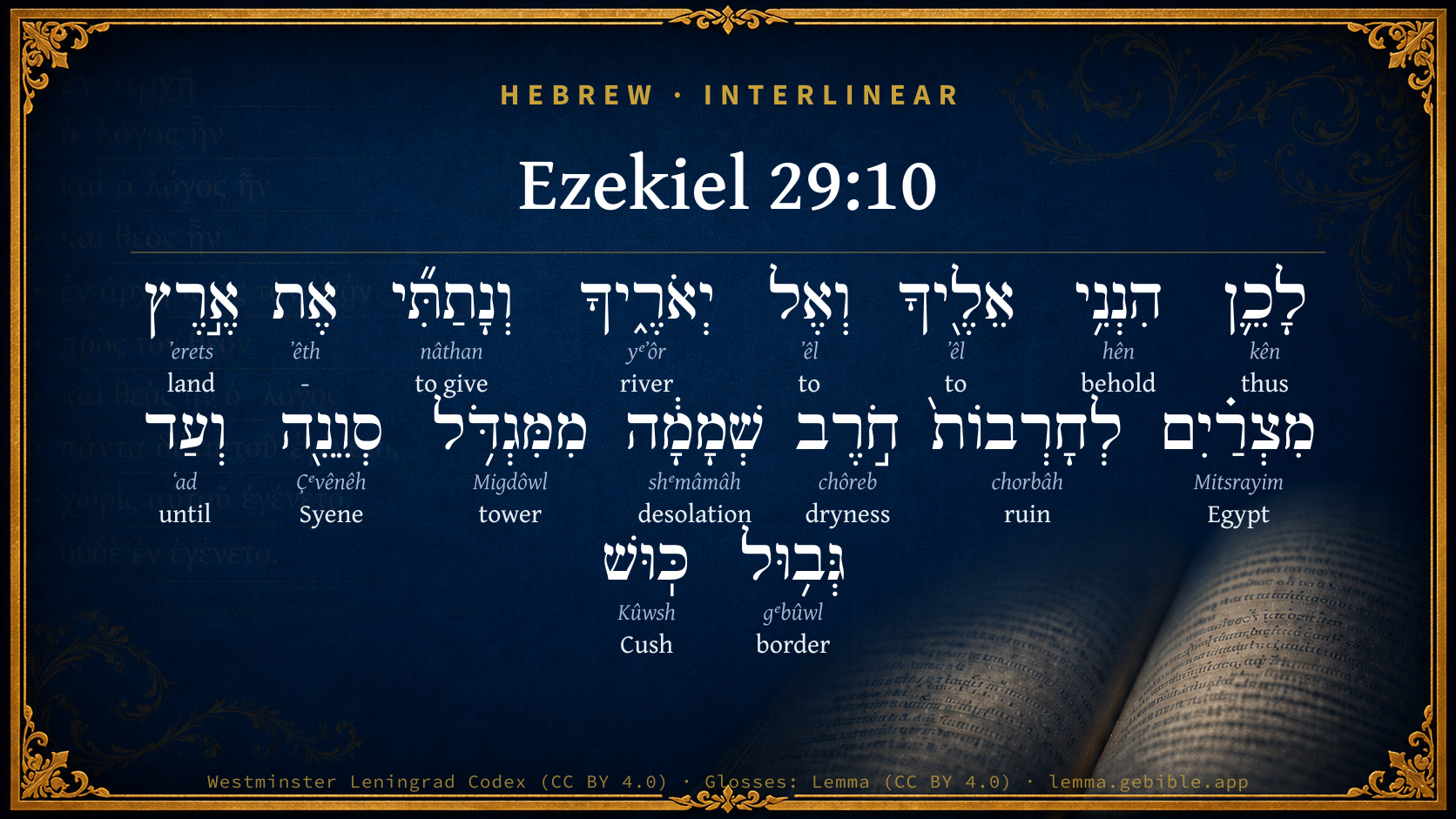
Hebrew (Westminster Leningrad Codex) Ezekiel 29:10 appears in the Hebrew Old Testament. The text above is from the Westminster Leningrad Codex. Each word links to its Strong’s number, a concise gloss, and parsing drawn from the Open Scriptures Hebrew Bible morphology. Click any word for its full Brown-Driver-Briggs (BDB) entry.
Download image
Cite this verse

Ezekiel 29:10 (World English Bible). Public Domain. Lemma interlinear Bible study tool, https://lemma.gebible.app/v/ezekiel/29/10.

Show BibTeX & RIS
BibTeX
RIS
English Translation
therefore, behold, I am against you, and against your rivers, and I will make the land of Egypt an utter waste and desolation, from the tower of Seveneh even to the border of Ethiopia.
World English Bible · Public Domain
Highlights
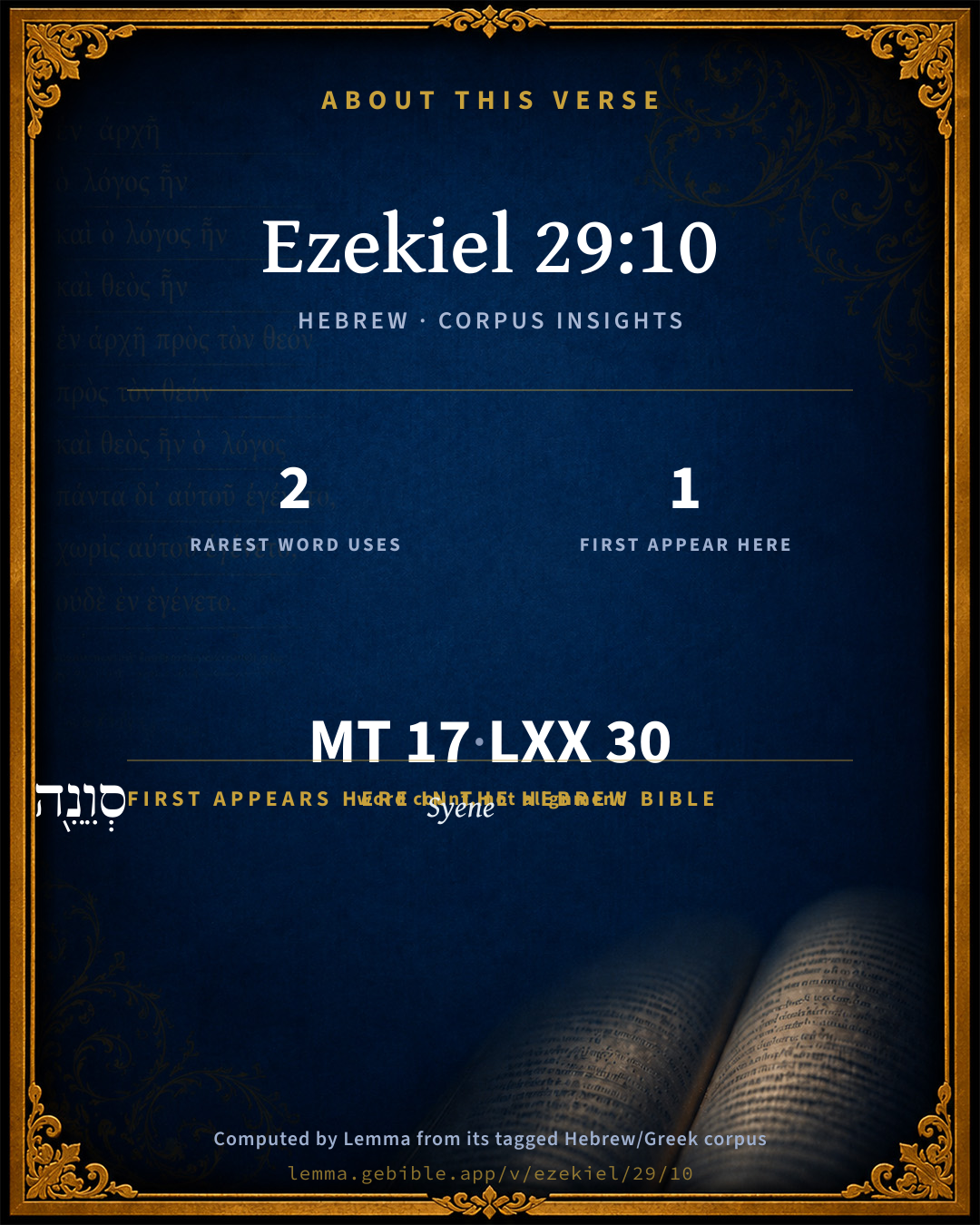
  • 1 first appearance in the Hebrew Bible
Full analysis ↓
Download a study sheet

One document with this verse’s original text, its word-by-word gloss line, the meaning frame, cross-references with their text, attributed commentary, and full source and license credits — printable, and it pastes into notes with its structure intact.

This verse Autodidact and up

Study sheet (.html) Plain text (.txt)

A passage Seminary Student

Up to 50 verses in one chapter. A passage sheet keeps up to 6 commentary sources and 12 cross-references per verse, in the order this page ranks them, and says so on the sheet whenever that leaves anything out. Ask for a single verse and you get the Autodidact verse sheet above.

Everything on this page stays free to read, with no account — the sheet is a download of what is already on screen, not access to it.

Want to remove ads? Support Godless Engineer
Compare translations 3

The same verse in 3 English versions, stacked beneath the original-language interlinear above. Click any original word for its lexicon entry.

Each is an independent rendering of the whole verse — the interlinear is not word-aligned to these translations.

Highlighted words mark where these versions differ — a whole-verse word diff, not a word-by-word alignment.

  • World English Bible Public Domain
    therefore, behold, I am against you, and against your rivers, and I will make the land of Egypt an utter waste and desolation, from the tower of Seveneh even to the border of Ethiopia.
  • King James Version Public Domain
    Behold, therefore I am against thee, and against thy rivers, and I will make the land of Egypt utterly waste and desolate, from the tower of Syene even unto the border of Ethiopia.
  • unfoldingWord Literal Text CC BY-SA 4.0
    Therefore, behold! I am against you and against your river, so I will give the land of Egypt over to desolation and waste, and you will become a wasteland from the Migdol to Syene and the borders of Cush.

unfoldingWord Literal Text — © unfoldingWord, licensed CC BY-SA 4.0. Word-aligned USFM3 via Door43 (git.door43.org/unfoldingWord/en_ult).

Versions to compare (up to 4)

3 of 4 selected

Show all 18 translations

Every available English version of this verse, each an independent rendering of the whole verse.

  • World English Bible Public Domain
    therefore, behold, I am against you, and against your rivers, and I will make the land of Egypt an utter waste and desolation, from the tower of Seveneh even to the border of Ethiopia.
  • Berean Standard Bible Public Domain
    therefore I am against you and against your rivers. I will turn the land of Egypt into a ruin, a desolate wasteland from Migdol to Syene, and as far as the border of Cush.
  • Majority Standard Bible Public Domain
    therefore I am against you and against your rivers. I will turn the land of Egypt into a ruin, a desolate wasteland from Migdol to Syene, and as far as the border of Cush.
  • King James Version Public Domain
    Behold, therefore I am against thee, and against thy rivers, and I will make the land of Egypt utterly waste and desolate, from the tower of Syene even unto the border of Ethiopia.
  • American Standard Version (1901) Public Domain
    therefore, behold, I am against thee, and against thy rivers, and I will make the land of Egypt an utter waste and desolation, from the tower of Seveneh even unto the border of Ethiopia.
  • Revised Version (1885) Public Domain
    therefore behold, I am against thee, and against thy rivers, and will make the land of Egypt an utter waste and desolation, from the tower of Seveneh even unto the border of Ethiopia.
  • Geneva Bible (1599) Public Domain
    Behold, therefore I come vpon thee, and vpon thy riuers, and I will make the land of Egypt vtterly waste and desolate from the towre of Seueneh, euen vnto the borders of the blacke Mores.
  • Douay-Rheims (1899) Public Domain
    Therefore, behold I come against thee, and thy rivers: and I will make the land of Egypt utterly desolate, and wasted by the sword, from the tower of Syene, even to the borders of Ethiopia.
  • Young's Literal Translation Public Domain
    Therefore, lo, I `am' against thee, and against thy floods, And have given the land of Egypt for wastes, A waste, a desolation, from Migdol to Syene, And unto the border of Cush.
  • Literal Standard Version CC BY-SA 4.0
    Therefore, behold, I [am] against you, and against your floods, || And have given the land of Egypt for ruins, || A dry place, a desolation, from Migdol to Syene, || And to the border of Cush.
  • Unlocked Literal Bible CC BY-SA 4.0
    Therefore, behold! I am against you and against your river, so I will give the land of Egypt over to desolation and waste, and you will become a wasteland from the Migdol to Syene and the borders of Cush.
  • unfoldingWord Literal Text CC BY-SA 4.0
    Therefore, behold! I am against you and against your river, so I will give the land of Egypt over to desolation and waste, and you will become a wasteland from the Migdol to Syene and the borders of Cush.
  • Darby Bible Public Domain
    Therefore behold, I am against thee, and against thy rivers, and I will make the land of Egypt deserts of wasteness and desolation, from Migdol to Syene, even unto the border of Ethiopia.
  • World Messianic Bible Public Domain
    therefore, behold, I am against you and against your rivers. I will make the land of Egypt an utter waste and desolation, from the tower of Seveneh even to the border of Ethiopia.
  • Webster's Bible Public Domain
    Behold, therefore, I am against thee, and against thy rivers, and I will make the land of Egypt utterly waste and desolate, from the tower of Syene even to the border of Cush.
  • Free Bible Version CC BY-SA 4.0
    that's why I'm condemning you and your river. I will ruin Egypt, making it into an empty wasteland all the way from Migdol in the north to Syene in the south, and up to the border with Cush.
  • Bible in Basic English Public Domain
    See, then, I am against you and against your streams, and I will make the land of Egypt an unpeopled waste, from Migdol to Syene, even as far as the edge of Ethiopia.
  • JPS Tanakh (1917) Public Domain
    Therefore, behold, I am against thee, and against thy rivers, and I will make the land of Egypt utterly waste and desolate, from Migdol to Syene even unto the border of Ethiopia.

Literal Standard Version (2020), Covenant Press — licensed CC BY-SA 4.0. Text via the HelloAO Bible API (eBible.org). Unlocked Literal Bible (unfoldingWord) — licensed CC BY-SA 4.0. Text via the HelloAO Bible API (eBible.org). unfoldingWord Literal Text — © unfoldingWord, licensed CC BY-SA 4.0. Word-aligned USFM3 via Door43 (git.door43.org/unfoldingWord/en_ult). Free Bible Version, Dr. Jonathan Gallagher — licensed CC BY-SA 4.0. Text via the HelloAO Bible API (eBible.org).

Word by word

More ways to search: Search by grammar → Find every occurrence → Compare this word →

Practice this passage: Drill this verse → Learn its vocabulary →

סְוֵנֵ֖ה
Çᵉvênêh
H5482
“Syene”
Noun, Proper
Part of Speech
Noun
Type
Proper
Full BDB Definition

Origin: of Egyptian derivation

TWOT: None

Syene = "her veiling (?)" - a town of Egypt on the frontier of Cush or Ethiopia
  1. לָכֵ֛ן kên H3651 “to/for · thus” Preposition + Adverb
  2. הִנְנִ֥י hên H2005 “behold · me” Particle, Demonstrative + Suffix, Personal, 1st Person, Common, Singular
  3. אֵלֶ֖יךָ ʼêl H413 “to · you” Preposition + Suffix, Personal, 2nd Person, Masculine, Singular
  4. וְאֶל ʼêl H413 “and · to” Conjunction + Preposition
  5. יְאֹרֶ֑יךָ yᵉʼôr H2975 “rivers · your” Noun, Common, Masculine, Plural, Construct + Suffix, Personal, 2nd Person, Masculine, Singular
  6. וְנָתַתִּ֞י nâthan H5414 “and · to give” Conjunction + Verb, Qal, Sequential Perfect, 1st Person, Common, Singular
  7. אֶת ʼêth H853 “-” Particle, Direct Object
  8. אֶ֣רֶץ ʼerets H776 “land of” Noun, Common, Both, Singular, Construct
  9. מִצְרַ֗יִם Mitsrayim H4714 “Egypt” Noun, Proper
  10. לְחָרְבוֹת֙ chorbâh H2723 “to/for · ruins of” Preposition + Noun, Common, Feminine, Plural, Construct
  11. חֹ֣רֶב chôreb H2721 “dryness” Noun, Common, Masculine, Singular, Absolute
  12. שְׁמָמָ֔ה shᵉmâmâh H8077 “desolation” Noun, Common, Feminine, Singular, Absolute
  13. מִמִּגְדֹּ֥ל Migdôwl H4024 “from · tower” Preposition + Noun, Proper
  14. וְעַד ʻad H5704 “and · until” Conjunction + Preposition
  15. גְּב֥וּל gᵉbûwl H1366 “border of” Noun, Common, Masculine, Singular, Construct
  16. כּֽוּשׁ Kûwsh H3568 “Cush” Noun, Proper

About this verse

These counts appear in no published source. They are computed here, from the morphology-tagged text and Lemma’s own curated glosses. What Lemma adds →

17
words
16
distinct lemmas
Prophets
section

Notable vocabulary

The rarest word here is סְוֵנֵ֖ה Syene H5482 — appearing just 2 times in the whole Hebrew Bible.

First appearance in Scripture

This word makes its first canonical appearance in the Hebrew Bible here:

  • סְוֵנֵ֖ה Syene H5482

Shared distinctive vocabulary

סְוֵנֵ֖ה Syene H5482 occurs in 2 verses of the Hebrew Bible. Also found in:

Grammatical profile

  • 1 verb
  • 10 nouns
  • 3 prepositions
  • 1 adverb
  • 2 particles

Verb forms

  • וְנָתַתִּ֞י Qal · Sequential Perfect

Repetition

A word recurs within this verse — often emphatic in Hebrew:

  • אֵלֶ֖יךָ to H413 ×2

Hebrew & Septuagint length

In English translation the verse runs 34 words from the Hebrew and 38 from the Septuagint (LXX English) — closely comparable.

A rough comparison of the two English renderings, which tokenize alike — not a word-level alignment.

Word counts can differ between the Hebrew and the Greek without any difference in meaning — e.g. the Hebrew direct-object marker אֵת has no separate Greek word, and Greek often adds the article ὁ.

In the original languages it is 17 Hebrew tokens and 30 Greek tokens — but the two are counted differently (Hebrew bundles its prefixes and suffixes into one token; the Greek is in lemma form), so that isn’t a like-for-like length.

Cross-references

7

Topical passages linked to Ezekiel 29:10 in the Treasury of Scripture Knowledge — connected by theme and wording, ordered by reader-vote popularity; previews shown in the World English Bible.

  • Ezekiel 30:12 I will make the rivers dry, and will sell the land into the hand of evil men; and I will make the land desolate, and all that is therein, by the hand of strangers: I, Yahweh, have spoken it.
  • Exodus 14:2 "Speak to the children of Israel, that they turn back and encamp before Pihahiroth, between Migdol and the sea, before Baal Zephon. You shall encamp opposite it by the sea.
  • Jeremiah 44:1 The word that came to Jeremiah concerning all the Jews who lived in the land of Egypt, who lived at Migdol, and at Tahpanhes, and at Memphis, and in the country of Pathros, saying,
  • Jeremiah 46:14 Declare you in Egypt, and publish in Migdol, and publish in Memphis and in Tahpanhes: say you, Stand forth, and prepare you; for the sword has devoured round about you.
  • Ezekiel 29:11 No foot of man shall pass through it, nor foot of animal shall pass through it, neither shall it be inhabited forty years.
  • Ezekiel 30:6–9 Thus says Yahweh: They also who uphold Egypt shall fall; and the pride of her power shall come down: from the tower of Seveneh shall they fall in it by the sword, says the Lord Yahweh.
  • Habakkuk 3:8 Was Yahweh displeased with the rivers? Was your anger against the rivers, Or your wrath against the sea, That you rode on your horses, On your chariots of salvation?

Cross-references courtesy of OpenBible.info (CC BY 4.0).

Hebrew and Greek witnesses Masoretic Hebrew ↔ Greek Septuagint

The same verse in the two great witnesses to the Old Testament, shown verse-for-verse.

These are two independent witnesses, not word-aligned to each other, and the Septuagint is shown in lemma (dictionary) form.

Hebrew Ezekiel 29:10 Masoretic · Westminster Leningrad Codex

לָכֵ֛ן הִנְנִ֥י אֵלֶ֖יךָ וְאֶל יְאֹרֶ֑יךָ וְנָתַתִּ֞י אֶת אֶ֣רֶץ מִצְרַ֗יִם לְחָרְבוֹת֙ חֹ֣רֶב שְׁמָמָ֔ה מִמִּגְדֹּ֥ל סְוֵנֵ֖ה וְעַד גְּב֥וּל כּֽוּשׁ

therefore, behold, I am against you, and against your rivers, and I will make the land of Egypt an utter waste and desolation, from the tower of Seveneh even to the border of Ethiopia.

World English Bible · Public Domain

Greek LXX Ezekiel 29:10 Septuagint · lemma form

διά οὗτος ἰδού ἐγώ ἐπί σύ καί ἐπί πᾶς ὁ ποταμός σύ καί δίδωμι γῆ αἴγυπτος εἰς ἔρημος καί ῥομφαία καί ἀπώλεια ἀπό μάγδωλος καί συήνη καί ἕως ὅριον αἰθίοψ

Therefore, behold, I am against you, and against all your rivers, and I will give up the land of Egypt to desolation, and the sword, and destruction, from Magdol and Syene even to the borders of the Ethiopians.

LXX2012 (modern English Septuagint) · Public Domain

On this verse, John Gill's Exposition discusses the Septuagint’s reading. Read the note in Commentary ↓

Hebrew: Westminster Leningrad Codex (CC BY 4.0). Greek: Septuagint (public domain); English from LXX2012 (modern English Septuagint) (Public Domain). How the Septuagint differs from the Hebrew →

Targum (Aramaic paraphrase)

1

The Targum is the ancient Jewish Aramaic paraphrase of the Hebrew Scriptures — an interpretive translation, not the Hebrew text itself. Onkelos (literal) and Pseudo-Jonathan (expansive) render the Torah, and Jonathan the Prophets. Coverage is partial: where no permissively-licensed English translation exists for a verse, only the Aramaic is shown. This is verse-level text, not a word-by-word alignment to the Hebrew.

  1. Targum Jonathan Prophets (Joshua–Malachi)
    בְּכֵן הָא אֲנָא שְׁלַח רוּגְזִי עֲלָךְ וְעַל מַלְכְּוָתָךְ וְאֶתֵּן יַת אַרְעָא דְמִצְרַיִם לְחוֹרֶב צָדוּ וּשְׁמָמוּ מִמִגְדַל סְוֵנָה וְעַד תְּחוּם כּוּשׁ:

    (no public-domain English translation for this verse)

    Targum Jonathan — Aramaic: “Mikraot Gedolot” (public domain). English: “Sefaria Community Translation” (CC0 1.0 (public-domain dedication)); “London "Chaldee Paraphrase," 1871” (public domain). Text via Sefaria.

Commentary

Notes on Ezekiel 29:10 from classic Christian and Jewish commentators (each source and its license shown beneath its notes). The classic Christian expositions comment on the surrounding passage and are grouped to its opening verse, so a note may address several verses; the Jewish commentaries on the Tanakh (Rashi and others) are per-verse, so they appear only where the commentator wrote on this verse.

Lemma curates 59 commentaries, every one of them public domain or Creative Commons licensed, each selected and text-cleaned for this edition rather than reprinted as found. About our sources →

Trapp's Complete Commentary

John Trapp

Eze 29:10 Behold, therefore I [am] against thee, and against thy rivers, and I will make the land of Egypt utterly waste [and] desolate, from the tower of Syene even unto the border of Ethiopia.

Ver. 10. And against thy rivers.] The jealous God will down with the earthly idol, whatever it be. See on Eze 29:9.

And I will make the land of Egypt utterly waste.] Heb., Waste of wastes.

From the tower of Syene,] i.e., From south to north.

John Trapp, A Commentary or Exposition upon All the Books of the Old and New Testament (1647–1656) — public domain. Text from a community e-Sword module.

Joseph Benson's Commentary

Eze 29:10-12. Behold, I am against thee and thy rivers — Since thou hast opposed me, I will set myself against thee, and bring down the strength and glory of thy kingdom, wherein thou magnifiest thyself so much. From the tower of Syene, even unto the border of Ethiopia — If we follow this translation, we must understand the word Cush, rendered here Ethiopia, of Arabia, as it is often taken: see note on Jer 13:23. For Syene was to the south of Egypt, under the tropic of Cancer, and bordering on African Ethiopia: see Pliny’s Nat. Hist., 50. 5. c. 9. But the words may be properly translated thus: From Migdol to Syene, even to the borders of Ethiopia: compare Eze 30:5; Eze 30:9. Migdol was a town near the Red sea, mentioned Exo 14:2; Jer 44:1; Jer 46:14, (where see the notes,) at the entrance of Egypt from Palestine; whereas Syene was at the other end of the country. What is said here of the devastation of Egypt, appears from this to be spoken only of a part of it, and not the whole. No foot of man shall pass through it, &c. — The intestine wars of the Egyptians, and the invasion of Nebuchadnezzar, made some provinces of Egypt, which were most the scenes of action, quite desolate; out of which state they did not wholly recover for the space of forty years. And her cities shall be desolate forty years — “We cannot prove, indeed, from heathen authors, that this desolation of the country continued exactly forty years, though it is likely enough that this, as well as the other conquered countries, did not shake off the Babylonish yoke till the time of Cyrus, which was about forty years after the conquest of Egypt by Nebuchadnezzar: but we are assured by Berosus, that Nebuchadnezzar took several captives in Egypt, and carried them to Babylon; and from Megasthenes we learn, that he transplanted and settled others in Pontus. So true it is that they were scattered among the nations, and dispersed through the countries, and might, upon the dissolution of the Babylonian empire, return to their native country.” — Bishop Newton.

Joseph Benson's Commentary on the Old and New Testaments (1811–1818) — public domain. Text from a community e-Sword module.

Geneva Bible (1599)

Geneva Bible translators

Hebrew, Cush, or Ethiopia.

Geneva Bible (1599) marginal notes — public domain. Text via Bolls.life.

Jamieson, Fausset & Brown

Robert Jamieson, A. R. Fausset & David Brown

from the tower of Syene--GROTIUS translates, "from Migdol (a fortress near Pelusium on the north of Suez) to Syene (in the farthest south)"; that is, from one end of Egypt to the other. So "from Migdol to Syene," Eze 30:6, Margin. However, English Version rightly refers Syene to Seveneh, that is, Sebennytus, in the eastern delta of the Nile, the capital of the Lower Egyptian kings. The Sebennyte Pharaohs, with the help of the Canaanites, who, as shepherds or merchants, ranged the desert of Suez, extended their borders beyond the narrow province east of the delta, to which they had been confined by the Pharaohs of Upper Egypt. The defeated party, in derision, named the Sebennyte or Lower Egyptians foreigners and shepherd-kings (a shepherd being an abomination in Egypt, Gen 46:34). They were really a native dynasty. Thus, in English Version, "Ethiopia" in the extreme south is rightly contrasted with Sebennytus or Syene in the north.

Jamieson, Fausset & Brown — Commentary Critical and Explanatory on the Whole Bible (1871) — public domain (CC PDM 1.0). Text via the HelloAO Bible API.

Adam Clarke's Commentary

Verse 10. From the tower of Syene] ממגדל מונה mimmigdol seveneh, "from Migdol to Syene." Syene, now called Essuan, was the last city in Egypt, going towards Ethiopia. It was famous for a well into which the rays of the sun fell perpendicularly at midday.

Adam Clarke's Commentary on the Bible (1810–1826) — public domain. Text from a community e-Sword/MySword module.

Ellicott's Commentary for English Readers

(10) From the tower of Syene.—The word here translated “tower” is a proper name, Migdol, a town, mentioned in Exo_14:2, near Suez. Syene has in the original the affix denoting towards, and the translation should therefore be, from Migdol to Syene, even unto the border of Ethiopia; in other words, “the whole length of the land.” Syene was a town on the extreme southern border of Egypt, represented by the modern Assouan, which is situated near its ruins. There is a like error of translation in Eze_30:6.

A Bible Commentary for English Readers, edited by Charles John Ellicott (1878–1897) — public domain. Text from a community e-Sword module.

The Cambridge Bible for Schools and Colleges

gen. ed. J. J. S. Perowne

10. the tower of Syene] Rather: from Migdol unto Syene—from Lower Egypt to the southern border of Upper Egypt. Migdol is said to have been situated 12 miles S. of Pelusium, upon the N. border of Lower Egypt (Exo_14:2; Jer_44:1; Jer_46:14; Num_33:7). Syene (ch. Eze_30:6), the modern Assouan, on the S. border of Upper Egypt. Cush or Ethiopia lay to the south of Pathros or Upper Egypt; its capital lay near the 4th Cataract, between Abu Hamed and old Dongola.

The Cambridge Bible for Schools and Colleges (gen. ed. J. J. S. Perowne; Cambridge University Press, 1878–1918) — public domain. Text from a community e-Sword module.

John Gill's Exposition

Behold, therefore, I am against thee, and against thy rivers,.... Against the king of Egypt, and against his subjects, the many people he ruled over; as the Lord is against spiritual Egypt, and the head of it, and the antichristian states, signified by many waters, rivers, and fountains; see Rev 11:8,

and I will make the land of Egypt utterly waste and desolate; partly by a civil war, and partly by a foreign enemy; especially those parts of it which were the seat of war:

from the tower of Syene even unto the border of Ethiopia; or the tower of Seveneh; according to Herodotus (i), Syene was a city of Thebais, where he was told were two mountains, which gave rise to the Nile. Pliny (k) says it was six hundred twenty five miles from Alexandria; and it is by him, as well as Strabo (l), placed under the tropic of Cancer; who both say, in the summer solstice, at noon, no shadow is cast there; to which the poet Lucan (m) refers, It is now called Essuaen; which city, as Mr. Norden (n) says, who lately travelled in those parts, is situated on the eastern shore of the Nile; and he relates that there remain still some marks of the place where the ancient city stood; as to the rest, it is so covered with earth, that there is nothing but rubbish, from which, in some places, one would judge that there were formerly magnificent buildings here. The utter destruction of which, with the rest of Egypt prophesied of, appears to have been fulfilled. This place is famous for being the place of the banishment of Juvenal the poet, where he died, being eighty years of age. The tower of Syene, Jerom says, remained to his days, and was subject to the Roman government, where are the cataracts of the Nile; and to which place, from our sea, he says, the Nile is navigable: but, according to Pliny. (o), Syene itself was on the border of Ethiopia; and so say Pausanias (p) and Solinus (q): and, according to Seneca (r), it was the extreme part of Egypt. So Josephus (s) says the south border of Egypt is Syene, which separates it from Ethiopia; and that between Pelusium (the entrance of Egypt) and Syene are two hundred and fifty miles. It lay between Egypt and Ethiopia, so that it might seem doubtful to which it belonged. It seems better therefore to take "Migdol", rendered a "tower", for the proper name of a place, as the Septuagint do; and such a place there was in Egypt, Jer 44:1, a town on the Red sea, Exo 14:2, so that the one was on the border of Egypt on one side, and the other on the other: and the words may be rendered (t), "from Migdol to Syene, even to the border of Ethiopia"; from one end of it to the other: it denotes the utter desolation of the country, from one end to the other. Unless by Cush, rendered "Ethiopia", is meant Arabia, as it often is, and is thought by some to be intended here; which was on the northern border of Egypt, as Syene was, a city in Thebais, near to Ethiopia, on the southern border of it; so that this describes Egypt from south to north; but the former account seems best.

(i) Euterpe, sive l. 2. c. 28. (k) Nat. Hist. l. 2. c. 73. (l) Geograph. l. 2. p. 65, 78. (m) "Umbras nusquan flectente", Syene. Pharsal. l. 2. v. 587. (n) Travels in Egypt and Nubis, vol. 1. p. 143. vol. 2. p. 97, 103. (o) Nat. Hist. l. 5. c. 9. (p) Arcadica, sive l. 8. p. 518. (q) Polyhistor, c. 45. (r) Apud Servium in Virgil. Aeneid. l. 6. p. 1011. (s) De Bello Jud. l. 5. c. 10. sect. 5. (t) See Prideaux's Connexion, part 1. B. 2. p. 93. So the words are rendered by Hillerus, Onomast. Sacr. p. 672. who observes, that Syene is now called by the Arabs "Asuan", from the Ethiopic word "Wasou", which signifies to terminate or finish, this being the border of Ethiopia.

John Gill's Exposition of the Whole Bible (1746–1763) — public domain (CC PDM 1.0). Text via the HelloAO Bible API.

Albert Barnes' Notes on the Bible

From the tower of Syene - Or, as in the margin, “Migdol” (“tower”) was about two miles from Suez. “Syene” was the most southern town in Egypt, on the borders of Ethiopia, in the Thebaid, on the eastern bank of the Nile. The modern Assvan lies a little to the northeast of the ancient Syene.

We have no record of the circumstances of the Chaldsaean invasion of Egypt, but it is possible that it did not take place until after the fall of Tyre. We gather of what nature it must have been by comparing the description of the results of Assyrian conquest (Isa 37:25 ff). Minute fulfillment of every detail of prophecy is not to be insisted upon, but only the general fact that Egypt would for a time, described as 40 years, be in a state of collapse. No great stress is to be laid on the exact number of years. The number of years passed in the wilderness became to the Hebrews a significant period of chastisement.

Nebuchadnezzars occupation of Egypt was of no long duration, and his ravages, though severe, must have been partial. Peace with Babylon was favorable to the development of home-works, but since the peace was in truth subjugation, it was hollow and in fact ruinous. Further, it is to be remembered that God fulfils His decree by a gradual rather than an immediate process. The ravages of Nebuchadnezzar were the beginning of the end, and all the desolation which followed may be looked upon as a continuous fulfillment of God’s decree. The savage fury with which Cambyses swept over Egypt amply realized all that Ezekiel foretold. Many places recovered some wealth and prosperity, but from the time of Herodotus the kingdom never again became really independent. Egyptian rulers gave place to Persian, Persian to the successors of Alexander the Great, who gave place in turn to Rome. So thoroughly was the prophecy of Ezekiel fulfilled Eze 29:14-15.

Albert Barnes' Notes on the Bible (1834–1885) — public domain. Text from a community e-Sword/MySword module.

Haydock's Catholic Bible Commentary

Tower; or rather (Calmet) Hebrew and Septuagint, "from Magdol to Syene." (Haydock) --- This was on the frontiers of Ethiopia, below the cataracts. (Pliny, [Natural History?] v. 9.)

George Leo Haydock (1774–1849), Haydock's Catholic Family Bible and Commentary, 1859 edition — public domain. Excludes Psalms (Douay-Rheims chapter numbering differs from Protestant) and Deuterocanonical books (Catholic canon only).

Matthew Poole's English Annotations

I am against thee: see Eze 28:22.

Thy rivers: see Eze 29:4.

Waste: see Eze 29:9.

The tower; thus, as a common name, we, and the French, and others read it; but some account it a proper name of a town or city, called Magdalum, for aught I know the old Migdol, Exo 14:2; Num 33:7,8; it was on the Red Sea side, north-east of Egypt: from this part unto Syene.

Syene; a city on the east of Nilus over against Arabia, saith one; a city that is just below the great cataract or fall of Nilus toward Ethiopia, and such a boundary between Ethiopia and Egypt as admits dispute to which it belongs. Ethiopia: now, to dispute nothing of this geography, it seems likely to me, that what we render Ethiopia is not so well and plainly rendered; for Syene being so near to Ethiopia, we must look some place of Egypt at some greater distance from Syene than this Ethiopia is; if then it were translated, the border of Cush, to whom Moses assigns Arabia, Gen 10:7. Let us suppose then Magdalum, instead of

the tower, as one term; Syene on the edge of Ethiopia, as another; and the opposite point on the Red Sea towards Arabia; and then almost all Egypt is comprised herein, from north-east to south-east, down the Red Sea, thence to the westward as far as Ethiopia, and thence up the Nile as high northward as Magdalum.

Matthew Poole's English Annotations on the Holy Bible (1683–1685) — public domain. Text from a community e-Sword/MySword module.

Whedon's Commentary on the Bible

Daniel D. Whedon

10. From the tower of Syene — Rather, as margin of A.V., “from Migdol to Syene” (Sunnu). Migdol (Eze_30:6; Exodus 45:2; Num_33:7; Jer_44:1; Jer_46:14) was near to the ancient Pelusium (Tel Farama), and was the great frontier city and recognized north boundary of Egypt in the time of Ezekiel and Herodotus. This fort (Magdolon) guarded the point where the great Syrian highways crossed the canal of Sesostris — the shortest route to Syria. (See F. Ll. Griffith, Qantarah, pp. 100-103.) Syene (Assouan) was the southernmost town of Upper Egypt, lying on the border of Nubia. The expression took in all Egypt, just as “from Dan to Beer-sheba” meant all Palestine. (See Maspero, Recueil de Travaux en Philippians et Arch., 1892.)

Daniel D. Whedon (gen. ed.), Commentary on the Old and New Testaments (1874–1909) — public domain. Text from a community e-Sword module.

The Pulpit Commentary

From the tower of Syene, etc. The Authorized Version is misleading, as Syene was itself on the border of Ethiopia. Better, with the Revised Version margin, from Migdol to Syene, even to the border of Ethiopia. The Migdol (equivalent to "tower") so named is mentioned in the "Itinerarium" of Antoninus (p. 171, edit. Wafael), and was about twelve miles from Pelusium, and thus represented the northern extremity of Egypt; as Syene, identified with the modern Assouan, represented the southern, being the last fortified town in Egypt proper. The expedition of Psammis against Ethiopia, as above, had probably given prominence to the latter fortress. So taken, the phrase corresponded to the familiar "from Dan to Beersheba" of Jud_1:20:1, etc.

The Pulpit Commentary (1880–1919), ed. H.D.M. Spence-Jones & Joseph S. Exell — public domain. Text from a community e-Sword module.

John Wesley's Explanatory Notes

Syene - Boundary between Ethiopia and Egypt; that is, all Egypt from northeast to southwest.

John Wesley, Explanatory Notes Upon the Whole Bible (1754–1765) — public domain. Text via the GEBible commentary corpus.

Scofield Reference Notes

C. I. Scofield

from the tower

Or, from Migdol to Syene. Exo 14:2; Jer 44:1.

The Scofield Reference Bible (1917 edition), notes by C. I. Scofield — public domain. Text from a community e-Sword module.

Lesson kit

Teaching starters — assembled from the data on this page, not authored interpretation. Every prompt links to the verse data it draws on. Edit before teaching.

Ezekiel, in the Prophets, opens this verse with 17 words (16 distinct Hebrew lemmas). Its most distinctive word is Çᵉvênêh (“Syene”). A historical commentator’s framing appears above. Read the whole chapter for the surrounding context.

Discussion questions

  1. What does “Syene” (Çᵉvênêh) contribute to the verse as a whole?
  2. This is the first place “Syene” appears in Scripture (first appears here). What does its debut here establish?
  3. How does Ezekiel 30:6, which shares the word «Syene», read alongside this verse?
  4. What does the repetition of “to” (2× in this one verse) do in this verse?
  5. These translations render this verse differently; the difference is in the English rendering, not the original. What questions does that raise?
  6. «וְנָתַתִּ֞י» is a Qal Sequential Perfect verb. How does that grammatical form shape the action described?
  7. Compare how Trapp's Complete Commentary and Joseph Benson's Commentary read this verse. Where do they agree or differ?

Things to notice

Reading settings

Reading text

Shown beneath each verse's original-language words.

Old Testament
Old Testament edition

Read the OT as the Masoretic Hebrew (MT) or the Greek Septuagint (LXX).

English shown for the Greek Septuagint (in the Hebrew ↔ Greek comparison).

Comparing translations? Open the Compare panel on any verse page to stack up to four side by side.