Hosea 9:3

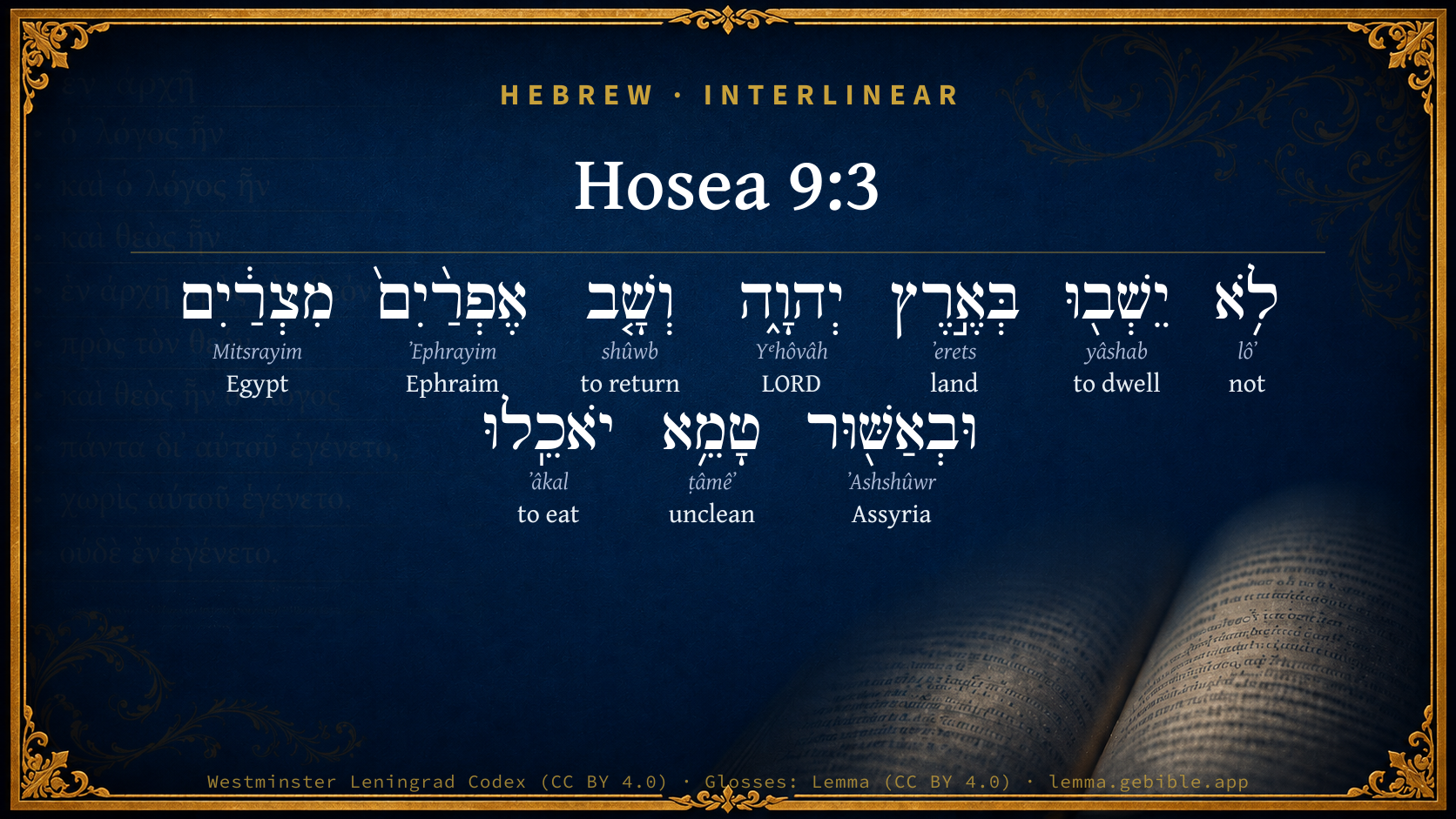
Hebrew (Westminster Leningrad Codex) Hosea 9:3 appears in the Hebrew Old Testament. The text above is from the Westminster Leningrad Codex. Each word links to its Strong’s number, a concise gloss, and parsing drawn from the Open Scriptures Hebrew Bible morphology. Click any word for its full Brown-Driver-Briggs (BDB) entry.
Download image
Cite this verse

Hosea 9:3 (World English Bible). Public Domain. Lemma interlinear Bible study tool, https://lemma.gebible.app/v/hosea/9/3.

Show BibTeX & RIS
BibTeX
RIS
English Translation
They won't dwell in Yahweh's land; But Ephraim will return to Egypt, And they will eat unclean food in Assyria.
World English Bible · Public Domain
Download a study sheet

One document with this verse’s original text, its word-by-word gloss line, the meaning frame, cross-references with their text, attributed commentary, and full source and license credits — printable, and it pastes into notes with its structure intact.

This verse Autodidact and up

Study sheet (.html) Plain text (.txt)

A passage Seminary Student

Up to 50 verses in one chapter. A passage sheet keeps up to 6 commentary sources and 12 cross-references per verse, in the order this page ranks them, and says so on the sheet whenever that leaves anything out. Ask for a single verse and you get the Autodidact verse sheet above.

Everything on this page stays free to read, with no account — the sheet is a download of what is already on screen, not access to it.

Want to remove ads? Support Godless Engineer
Compare translations 3

The same verse in 3 English versions, stacked beneath the original-language interlinear above. Click any original word for its lexicon entry.

Each is an independent rendering of the whole verse — the interlinear is not word-aligned to these translations.

Highlighted words mark where these versions differ — a whole-verse word diff, not a word-by-word alignment.

  • World English Bible Public Domain
    They won't dwell in Yahweh's land; But Ephraim will return to Egypt, And they will eat unclean food in Assyria.
  • King James Version Public Domain
    They shall not dwell in the LORD's land; but Ephraim shall return to Egypt, and they shall eat unclean things in Assyria.
  • unfoldingWord Literal Text CC BY-SA 4.0
    They will not dwell in the land of Yahweh, and Ephraim will return Egypt, and in Assyria they will eat unclean.

unfoldingWord Literal Text — © unfoldingWord, licensed CC BY-SA 4.0. Word-aligned USFM3 via Door43 (git.door43.org/unfoldingWord/en_ult).

Versions to compare (up to 4)

3 of 4 selected

Show all 18 translations

Every available English version of this verse, each an independent rendering of the whole verse.

  • World English Bible Public Domain
    They won't dwell in Yahweh's land; But Ephraim will return to Egypt, And they will eat unclean food in Assyria.
  • Berean Standard Bible Public Domain
    They will not remain in the land of the LORD; Ephraim will return to Egypt and eat unclean food in Assyria.
  • Majority Standard Bible Public Domain
    They will not remain in the land of the LORD; Ephraim will return to Egypt and eat unclean food in Assyria.
  • King James Version Public Domain
    They shall not dwell in the LORD's land; but Ephraim shall return to Egypt, and they shall eat unclean things in Assyria.
  • American Standard Version (1901) Public Domain
    They shall not dwell in Jehovah's land; but Ephraim shall return to Egypt, and they shall eat unclean food in Assyria.
  • Revised Version (1885) Public Domain
    They shall not dwell in the LORD’S land; but Ephraim shall return to Egypt, and they shall eat unclean food in Assyria.
  • Geneva Bible (1599) Public Domain
    They wil not dwel in the Lordes lande, but Ephraim will returne to Egypt, and they will eate vncleane things in Asshur.
  • Douay-Rheims (1899) Public Domain
    They shall not dwell in the Lord's land: Ephraim is returned to Egypt, and hath eaten unclean things among the Assyrians.
  • Young's Literal Translation Public Domain
    They do not abide in the land of Jehovah, And turned back hath Ephraim `to' Egypt, And in Asshur an unclean thing they eat.
  • Literal Standard Version CC BY-SA 4.0
    They do not abide in the land of YHWH, || And Ephraim has turned back [to] Egypt, || And they eat an unclean thing in Asshur.
  • Unlocked Literal Bible CC BY-SA 4.0
    They will not continue to live in Yahweh's land; instead, Ephraim will return to Egypt, and one day they will eat unclean food in Assyria.
  • unfoldingWord Literal Text CC BY-SA 4.0
    They will not dwell in the land of Yahweh, and Ephraim will return Egypt, and in Assyria they will eat unclean.
  • Darby Bible Public Domain
    They shall not dwell in Jehovah's land; but Ephraim shall return to Egypt, and in Assyria shall they eat that which is unclean.
  • World Messianic Bible Public Domain
    They won’t dwell in the LORD’s land; but Ephraim will return to Egypt, and they will eat unclean food in Assyria.
  • Webster's Bible Public Domain
    They shall not dwell in the LORD'S land; but Ephraim shall return to Egypt, and they shall eat unclean things in Assyria.
  • Free Bible Version CC BY-SA 4.0
    You will not stay in the Lord's land, instead Ephraim will return to Egypt, and will eat unclean food in Assyria.
  • Bible in Basic English Public Domain
    They will have no resting-place in the Lord's land, but Ephraim will go back to Egypt, and they will take unclean food in Assyria.
  • JPS Tanakh (1917) Public Domain
    They shall not dwell in the LORD'S land; but Ephraim shall return to Egypt, and they shall eat unclean food in Assyria.

Literal Standard Version (2020), Covenant Press — licensed CC BY-SA 4.0. Text via the HelloAO Bible API (eBible.org). Unlocked Literal Bible (unfoldingWord) — licensed CC BY-SA 4.0. Text via the HelloAO Bible API (eBible.org). unfoldingWord Literal Text — © unfoldingWord, licensed CC BY-SA 4.0. Word-aligned USFM3 via Door43 (git.door43.org/unfoldingWord/en_ult). Free Bible Version, Dr. Jonathan Gallagher — licensed CC BY-SA 4.0. Text via the HelloAO Bible API (eBible.org).

Word by word

More ways to search: Search by grammar → Find every occurrence → Compare this word →

Practice this passage: Drill this verse → Learn its vocabulary →

About this verse

These counts appear in no published source. They are computed here, from the morphology-tagged text and Lemma’s own curated glosses. What Lemma adds →

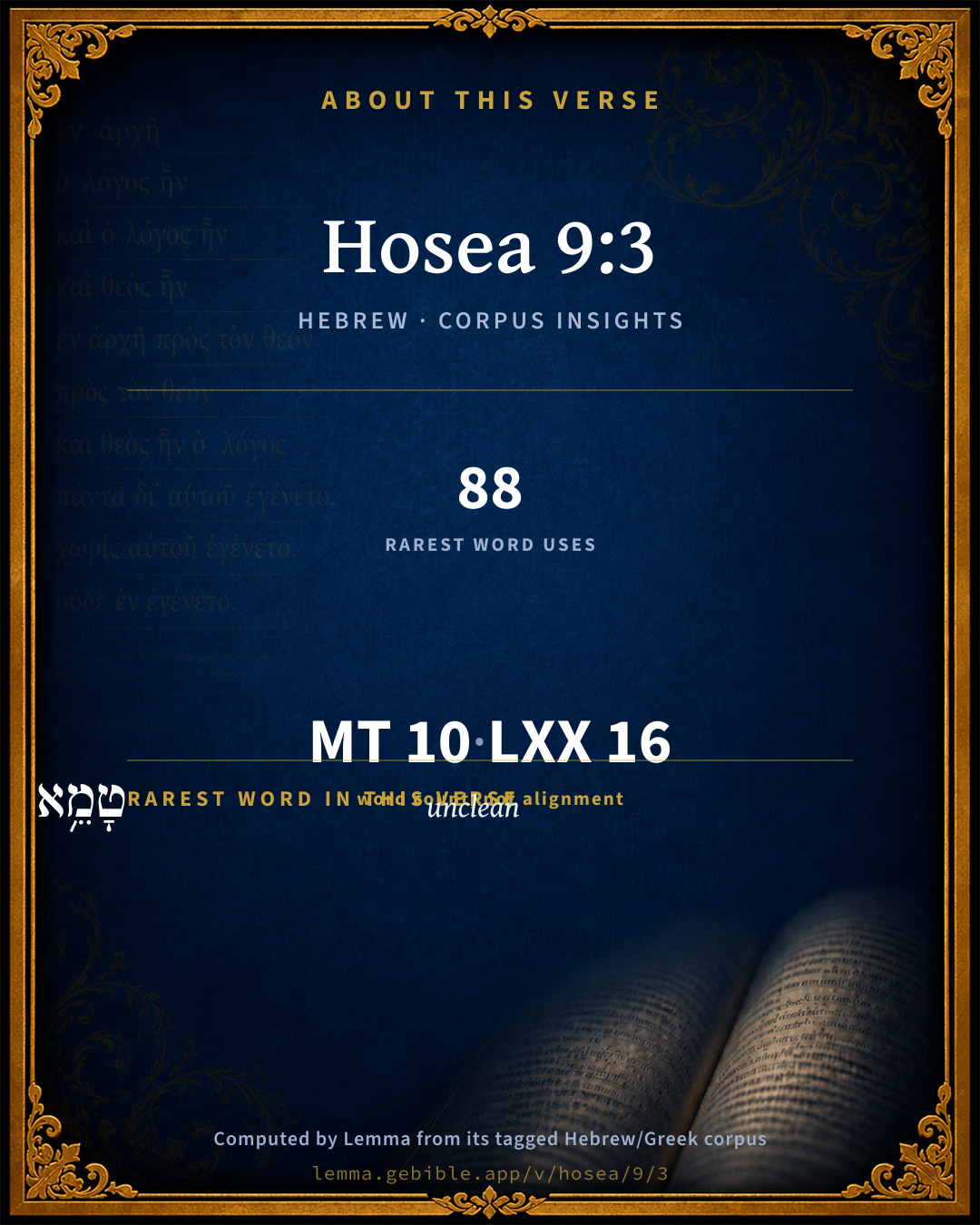
10
words
10
distinct lemmas
Prophets
section

Grammatical profile

  • 3 verbs
  • 5 nouns
  • 1 adjective
  • 1 particle

Verb forms

  • יֵשְׁב֖וּ Qal · Imperfect
  • וְשָׁ֤ב Qal · Sequential Perfect
  • יֹאכֵֽלוּ Qal · Imperfect

Hebrew & Septuagint length

In English translation the verse runs 20 words from the Hebrew and 20 from the Septuagint (LXX English) — the same length.

A rough comparison of the two English renderings, which tokenize alike — not a word-level alignment.

Word counts can differ between the Hebrew and the Greek without any difference in meaning — e.g. the Hebrew direct-object marker אֵת has no separate Greek word, and Greek often adds the article ὁ.

In the original languages it is 10 Hebrew tokens and 16 Greek tokens — but the two are counted differently (Hebrew bundles its prefixes and suffixes into one token; the Greek is in lemma form), so that isn’t a like-for-like length.

Cross-references

21

Topical passages linked to Hosea 9:3 in the Treasury of Scripture Knowledge — connected by theme and wording, ordered by reader-vote popularity; previews shown in the World English Bible.

  • Ezekiel 4:13 Yahweh said, Even thus shall the children of Israel eat their bread unclean, among the nations where I will drive them.
  • Hosea 8:13 As for the sacrifices of my offerings, they sacrifice flesh and eat it; But Yahweh doesn't accept them. Now he will remember their iniquity, And punish their sins. They will return to Egypt.
  • Leviticus 25:23 "'The land shall not be sold in perpetuity, for the land is mine; for you are strangers and live as foreigners with me.
  • Jeremiah 2:7 I brought you into a plentiful land, to eat the fruit of it and the goodness of it; but when you entered, you defiled my land, and made my heritage an abomination.
  • Hosea 7:11 "Ephraim is like an easily deceived dove, without understanding. They call to Egypt. They go to Assyria.
  • Deuteronomy 4:26 I call heaven and earth to witness against you this day, that you shall soon utterly perish from off the land whereunto you go over the Jordan to possess it; you shall not prolong your days on it, but shall utterly be destroyed.
  • Deuteronomy 28:63 It shall happen that as Yahweh rejoiced over you to do you good, and to multiply you, so Yahweh will rejoice over you to cause you to perish, and to destroy you; and you shall be plucked from off the land where you go in to possess it.
  • Joshua 23:15 It shall happen, that as all the good things are come on you of which Yahweh your God spoke to you, so will Yahweh bring on you all the evil things, until he have destroyed you from off this good land which Yahweh your God has given you.
  • 1 Kings 9:7 then will I cut off Israel out of the land which I have given them; and this house, which I have made holy for my name, will I cast out of my sight; and Israel shall be a proverb and a byword among all peoples.
  • 2 Kings 17:6 In the ninth year of Hoshea the king of Assyria took Samaria, and carried Israel away to Assyria, and placed them in Halah, and on the Habor, the river of Gozan, and in the cities of the Medes.
  • Jeremiah 16:18 First I will recompense their iniquity and their sin double, because they have polluted my land with the carcasses of their detestable things, and have filled my inheritance with their abominations.
  • Daniel 1:8 But Daniel purposed in his heart that he would not defile himself with the king's dainties, nor with the wine which he drank: therefore he requested of the prince of the eunuchs that he might not defile himself.
  • Hosea 9:6 For, behold, they have gone away from destruction. Egypt will gather them up. Memphis will bury them. Nettles will possess their pleasant things of silver. Thorns will be in their tents.
  • Leviticus 18:28 that the land not vomit you out also, when you defile it, as it vomited out the nation that was before you.
  • Leviticus 20:22 "'You shall therefore keep all my statutes, and all my ordinances, and do them; that the land, where I am bringing you to dwell, may not vomit you out.
  • Deuteronomy 28:68 Yahweh will bring you into Egypt again with ships, by the way of which I said to you, You shall see it no more again: and there you shall sell yourselves to your enemies for bondservants and for bondmaids, and no man shall buy you.
  • Isaiah 11:15–16 Yahweh will utterly destroy the tongue of the Egyptian sea; and with his scorching wind will he wave his hand over the River, and will strike it into seven streams, and cause men to march over in sandals.
  • Hosea 11:5 "They won't return into the land of Egypt; But the Assyrian will be their king, Because they refused to repent.
  • Hosea 11:11 They will come trembling like a bird out of Egypt, And like a dove out of the land of Assyria; And I will settle them in their houses," says Yahweh.
  • Micah 2:10 Arise, and depart! For this is not your resting place, Because of uncleanness that destroys, Even with a grievous destruction.
  • Acts 10:14 But Peter said, "Not so, Lord; for I have never eaten anything that is common or unclean."

Cross-references courtesy of OpenBible.info (CC BY 4.0).

Hebrew and Greek witnesses Masoretic Hebrew ↔ Greek Septuagint

The same verse in the two great witnesses to the Old Testament, shown verse-for-verse.

These are two independent witnesses, not word-aligned to each other, and the Septuagint is shown in lemma (dictionary) form.

Hebrew Hosea 9:3 Masoretic · Westminster Leningrad Codex

לֹ֥א יֵשְׁב֖וּ בְּאֶ֣רֶץ יְהוָ֑ה וְשָׁ֤ב אֶפְרַ֨יִם֙ מִצְרַ֔יִם וּבְאַשּׁ֖וּר טָמֵ֥א יֹאכֵֽלוּ

They won't dwell in Yahweh's land; But Ephraim will return to Egypt, And they will eat unclean food in Assyria.

World English Bible · Public Domain

Greek LXX Hosea 9:3 Septuagint · lemma form

οὐ καταοἰκέω ἐν ὁ γῆ ὁ κύριος καταοἰκέω ἐφράιμ εἰς αἴγυπτος καί ἐν ἀσσύριος ἀκάθαρτος ἐσθίω

They lived not in the Lord's land: Ephraim lived in Egypt, and they shall eat unclean things among the Assyrians.

LXX2012 (modern English Septuagint) · Public Domain

Hebrew: Westminster Leningrad Codex (CC BY 4.0). Greek: Septuagint (public domain); English from LXX2012 (modern English Septuagint) (Public Domain). How the Septuagint differs from the Hebrew →

Targum (Aramaic paraphrase)

1

The Targum is the ancient Jewish Aramaic paraphrase of the Hebrew Scriptures — an interpretive translation, not the Hebrew text itself. Onkelos (literal) and Pseudo-Jonathan (expansive) render the Torah, and Jonathan the Prophets. Coverage is partial: where no permissively-licensed English translation exists for a verse, only the Aramaic is shown. This is verse-level text, not a word-by-word alignment to the Hebrew.

  1. Targum Jonathan Prophets (Joshua–Malachi)
    לָא יְתוּבוּן בַּאֲרַע שְׁכִנְתָּא דַייָ וִיתוּבוּן דְבֵית אֶפְרַיִם לְמִצְרַיִם לְאַתּוּר יִגְלוֹן מְסָאָב יֵיכְלוּן:

    (no public-domain English translation for this verse)

    Targum Jonathan — Aramaic: “Mikraot Gedolot” (public domain). English: “Sefaria Community Translation” (CC0 1.0 (public-domain dedication)); “London "Chaldee Paraphrase," 1871” (public domain). Text via Sefaria.

Commentary

Notes on Hosea 9:3 from classic Christian and Jewish commentators (each source and its license shown beneath its notes). The classic Christian expositions comment on the surrounding passage and are grouped to its opening verse, so a note may address several verses; the Jewish commentaries on the Tanakh (Rashi and others) are per-verse, so they appear only where the commentator wrote on this verse.

Lemma curates 59 commentaries, every one of them public domain or Creative Commons licensed, each selected and text-cleaned for this edition rather than reprinted as found. About our sources →

Trapp's Complete Commentary

John Trapp

Hos 9:3 They shall not dwell in the LORD’S land; but Ephraim shall return to Egypt, and they shall eat unclean [things] in Assyria.

Ver. 3. They shall not dwell in the Lord’s land] Because they would not live by the Lord’s laws, they shall therefore be turned out of his house (so this land was called, Hos 9:8) as rebellious children, that are a disturbance and a disgrace to their father’s family; they shall hold no longer as tenants of him, the chief landlord, because so backward to send a lamb (as rent or a homage penny) to the ruler of the land, Isa 16:1; they were tenants at will, and held upon condition of obedience, Lev 18:28, it was divided among them by lot; Joshua divided it among them, and left none to himself. The people gave him a portion, and he was content with it; though it were but a mean one in the barren mountains, as Jerome noteth. He had the promise that God would never leave him nor forsake him; and he well knew that if he trusted in the Lord, and did good, he should "dwell in the land and be verily fed," Psa 37:3. He and Caleb were of another spirit, and fulfilled after God; therefore they only of all that generation entered the promised land, the Lord’s land; which because Moses might not do, it was a great grief to him. These idolaters here are threatened to be cashiered and cast out of this good land, and to have their pleasant land laid desolate, to be spewed out, as the Canaanites had been before them, Lev 18:28, and so consequently to be deprived of God’s favour, help, and protection; and altogether disprivileged, yea, disinherited. This was a heavy judgment to them, and must be a warning to us, that yet live in the bosom of the Church, and under the joyful sound; that we forfeit not our present enjoyments, that we sin not away our precious privileges, as the seven Churches and others have done. Alterius perditio tua sit cautio. We stand upon our good behaviour, as they did; see Deu 30:19-20.

But Ephraim shall return to Egypt] Which they ought to have been sensible of as a punishment long since threatened, Deu 28:68, {see Hos 8:13, See Trapp on "Hos 8:13"} though now, of their own accord, they returned to it, for fear of the Assyrian (whom by their false dealing they had justly incensed), yet that should not shelter them, but God’s hand would find them out, and fetch them thence into captivity. Often they had been warned not to go down to Egypt for help; and they must needs be hard bestead that fled thither. True it is, that the Egyptians are renowned in histories for a thankful people (Diod. Sic. l. 2), and the Israelites are charged not to abhor an Egyptian, because they were once strangers in his land, and had tasted of his courtesies, Deu 23:7. But in addition, they could not but know how hardly the Egyptians had dealt with their forefathers, and bow treacherously also with them; and that they ought not, de iure, concerning the law, to have returned thither upon any terms. Sed Deus quem destruit dementat, Bug God, who he destroyed, makes mad, and although here they were resolved for Egypt, yet, Hos 11:5, God resolveth otherwise; and voluntas Dei necessitas rei, his will shall stand when all is done.

And they shall eat unclean things in Assyria] Things forbidden by the law, as swine’s flesh, &c.; they shall be forced to eat or starve; they must not look for liberty of conscience in Assyria, nor have that favour to make a difference of meat as Daniel had, Dan 1:8, but as Ezekiel baked his barley cakes with man’s dung, even so, said the Lord, shall the children of Israel eat their defiled bread among the heathen whither I will drive them. So haughty they were grown, that their father’s house could not hold them; therefore they shall be glad of husks with hogs (as that prodigal), they shall eat as the heathens, since they would needs act as the heathens. They thought it was hard with them in their own land, when the floors and the winepress would not feed them, Hos 9:2; but now it is far worse, when, forced by hard hunger, they are glad of any meat, be it clean or unclean; neither have they any more mind to be so merry with other nations, as Hos 9:1, or cause so to be; their stomachs craving, and themselves (with Drusus in Tacitus) ready to eat the stuffings of their bed; or (with the Jews in the last siege of Jerusalem) not only to feed upon dogs, rats, cats, &c., but the leather of their shoes, belts, shields, bridles, yea, ox dung was a precious dish unto them, and the shreddings of pot herbs cast out and trodden underfoot (Pontanus. Hegesippus).

John Trapp, A Commentary or Exposition upon All the Books of the Old and New Testament (1647–1656) — public domain. Text from a community e-Sword module.

The Biblical Illustrator

Joseph S. Exell

Hos_9:3

They shall not dwell in the Lords land.

The Lords land

Before, God was to them as a father taking maintenance away from them, leaving them to suffer want: but here His anger increases, and He puts them out of His house; as a nation out of His land. God would make them know that it was His land, that they were but tenants at will, and enjoyed the land upon conditions of obedience. It is a good meditation for us to dwell upon, that we are Gods stewards; the Lord is the great landlord of all the world. The earth is the Lords, and the fulness thereof. The land of Canaan was Jehovahs land in some special senses.

1. It was a land that God had espied as a special place for His people.

2. It was the land of promise.

3. It was a land given by oath (Gen_24:7).

4. It was a land which the Lord brought His people into by a mighty hand, and with an outstretched arm.

5. It was a land divided by lot. The possession that any man had was ordered by God Himself by lot.

6. It was a land wherein God dwelt Himself, a land that God called His own rest. It was the land wherein were the ordinances and worship of God, and His honour dwelt there, and so it had a peculiar blessing upon it above every land on the face of the whole earth.

7. It was a land over which Gods eye was in a more special manner.

8. This land was typical of the rest of the Church in heaven. Then it would be a great judgment of God to drive men out of this land for their sin. To be cast out of those mercies which God by an extraordinary providence has brought to us is a sore and grievous evil. (Jeremiah Burroughs.)

And they shall eat unclean things in Assyria.

The sting of Divine judgment

Here we have the degradation of sin. To be ceremonially clean or pure was the joy and pride of Israel. The Jews would not eat things that were common or unclean, and by this mark they were distinguished from other people. Whilst Israel lived even in nominal piety, how superficial soever it might be, God gave him protection against degradation; but when Israel turned away adulterously from God, and sought satisfaction at forbidden fountains and altars, then the Lord brought upon Israel the misery of this degradation and shame. Israel was forced to eat things that were unclean, things that were killed with the blood in them, things that revolted the sense of the nation, and went dead against all the prejudices of education. Thus a badge was taken from the shoulder of Israel, a distinction was removed from the chosen people; they could have borne reproaches on the ground of moral disobedience with comparative indifference, but to have social boundaries and distinctions broken down was a judgment which Israel keenly felt. But the Lord will seize the sinner at some point, for He cannot be baffled in judgment or thwarted in the application of His righteousness. The Lords judgments are ordered according to our apostasy; God will strike most where we feel most; He will follow our pride and our vanity, and smite them so as to bring upon them our keenest shame. God will not content Himself with some general judgment; He will specifically scrutinise and either reward or punish according to the result of His inquest. (Joseph Parker, D. D.)

The Biblical Illustrator, edited by Joseph S. Exell (c. 1880s–1900s) — public domain. Text from a community e-Sword module.

Joseph Benson's Commentary

Hos 9:3. They shall not dwell in the Lord’s land, but Ephraim shall return into Egypt — God will turn them out of that inheritance he gave to their fathers, and they shall be carried into captivity or become exiles a second time in Egypt. When Shalmaneser made the ten tribes captive, such as were able to escape the conqueror fled into Egypt, having implored the aid of that country against the Assyrians. And they shall eat unclean things in Assyria — They have transgressed my law, in eating unclean things in their own land; and the time shall come when they shall be forced by their imperious masters the Assyrians to eat unclean things, whether they will or not. They will have no choice left them, but, as slaves, will be forced to eat what is given them.

Joseph Benson's Commentary on the Old and New Testaments (1811–1818) — public domain. Text from a community e-Sword module.

Tyndale Open Study Notes

Tyndale Open Resources

9:3 God would exile the Israelites to Assyria in 722 BC. There, in an unclean land, they would eat ceremonially unclean food, further separating themselves from their covenant with the Lord.

Tyndale Open Study Notes — © Tyndale Open Resources, licensed CC BY-SA 4.0. Text via the HelloAO Bible API.

Jamieson, Fausset & Brown

Robert Jamieson, A. R. Fausset & David Brown

return to Egypt--(See on Hos 8:13). As in Hos 11:5 it is said, "He shall not return into . . . Egypt." FAIRBAIRN thinks it is not the exact country that is meant, but the bondage state with which, from past experience, Egypt was identified in their minds. Assyria was to be a second Egypt to them. Deu 28:68, though threatening a return to Egypt, speaks (Deu 28:36) of their being brought to a nation which neither they nor their fathers had known, showing that it is not the literal Egypt, but a second Egypt-like bondage that is threatened.

eat unclean things in Assyria--reduced by necessity to eat meats pronounced unclean by the Mosaic law (Eze 4:13). See Kg2 17:6.

Jamieson, Fausset & Brown — Commentary Critical and Explanatory on the Whole Bible (1871) — public domain (CC PDM 1.0). Text via the HelloAO Bible API.

Adam Clarke's Commentary

Verse 3. But Ephraim shall return to Egypt] See on Ho 8:13.

Adam Clarke's Commentary on the Bible (1810–1826) — public domain. Text from a community e-Sword/MySword module.

John Calvin's Commentaries

The Prophet proclaims here a heavier punishment — that the Lord would drive them into exile. It was indeed a dreadful repudiation, when they were deprived of the land of Canaan, which was the Lord’s rest, as it is called in the Psalms, (Psalm 132:14.) While they dwelt in the land of Canaan, they lived as it were in the habitations of God, and could have a sure hope that he would be a father to them: but when they were thence expelled, the Lord testified that he regarded them as aliens; it was the same as when a father disinherits his son. The Prophet now threatens them not only with the want of food, but also with repudiation, which was far more grievous — They shall not dwell, he says, in the Lord’s land

There is an elegant play on words in the verbs here used; ישבו, ishebu, and ושב, usheb; the one is from ישב, isheb, and the other from שוב, shub. ‘They shall not dwell in the Lord’s land; but Ephraim shall return into Egypt:’ and the other circumstance is still more dreadful. In Assyria they shall eat what is unclean; for it was the same as if the Lord intended to blend that holy people with the profane Gentiles, so that there should be afterwards no difference; for the uncleanness of which the Prophet speaks would have the effect of destroying the distinction which the adoption of God made between that people and the profane nations. It was indeed by badges that the Lord retained the people of Israel, when he ordered them to abstain from unclean meats: but when they differed nothing, as to common food, from the Gentiles, it was evident that they were rejected by God, and that the holiness which belonged to them through the free covenant of God was obliterated. They shall eat, then, what is unclean in Assyria; that is, “They shall not now be under my care and protection; they shall live according to their own will, as the other nations. I have hitherto preserved them under some restraint; but now, as they will not bear to live under my law, they shall have their own liberty, and shall be profane like the rest of the world, so that they shall become involved in all the defilements and pollutions of the Gentiles.” This is the meaning.

And now we ought to consider, whether it be right, when we are among idolaters, to conform to the rites approved by them. This place, no doubt, as other places, most clearly shows, that nothing more grievous can happen to us than the doing away of all difference between us and the profane despisers of God, even in the outward manner of living. Had the Prophet said, “The Israelites shall now be hungry in a far country; — the Lord has hitherto fed them with plenty, for he has performed what he had formerly promised by Moses; this land has in every way been blessed, and has supplied us with great abundance of wine, wheat, and oil; yea, honey has flowed like water; but they shall now be constrained to pine away with want among their enemies:” — Had the Prophet said this, it would have been a grievous and severe denunciation; but now he fills them, as it has been already said, with much greater horror, for he says, ‘They shall eat what is unclean.’ There seemed to be some great importance belonging to the external rite: but the outward profession was the badge of divine adoption. When therefore the people loosened the reins and ate indiscriminately any meat, and made no choice according to the directions of the law, then the distinction was removed, so that they ceased to be the people of God. It is the same also, at this day, with those who turn aside from a sincere profession of their faith and associate with the Papists; they renounce, as far as they can, the favour of God, and abandon themselves to the will of Satan.

Let us then know that it is a dreadful judgement of God, when we are not allowed to profess our faith by outward worship; and when the ungodly so rule, as to put us under the necessity of which the Prophet here speaks, even of eating unclean things, that is, of being implicated in their profane superstitions. It is then a favour, to be highly valued, when we are permitted to abstain from all defilements and to worship God purely, so that no one may contaminate himself by dissimulation: but when we are compelled, under the tyranny of the ungodly, to conform to impure superstitions, it is a sign of the dreadful judgement of God; and there is nothing by which any one can excuse himself in this respect or extenuate his fault, as many do, whom yet conscience bites within, though they deem it sufficient to spread forth their own excuses before the eyes of men. But there is nothing by which such men can either flatter themselves, or dazzle the eyes of the simple; for it is an extreme reproach, when people, who ought to be sacred to God and to profess outwardly his pure worship, suffer themselves to be polluted with unclean food. It follows —

John Calvin's Commentaries (1540-1563) — public domain. Text from the Calvin Translation Society English edition (1840s-50s) via the Christian Classics Ethereal Library (ccel.org). Calvin's coverage is partial (roughly two-thirds of the Bible); uncommented books and verses are honest gaps, never fabricated. The 19th-century editor's footnotes and remarks are omitted so the notes are faithfully Calvin's own voice.

Ellicott's Commentary for English Readers

(3, 4) Canaan, the land of Jehovah, is holy, Assyria unholy (Amo_7:17), where there was no temple or sacred ordinances. Since meat was not a divinely sanctioned food, except in connection with a Jehovah festival, it became in the land of exile unclean. This became true in the eyes of Hosea of all eating. “In the family every feast was a Eucharistic sacrifice” (W. R. Smith, Old Testament in the Jewish Church, pp. 235 and 237). (Comp. Eze_4:13.)

A Bible Commentary for English Readers, edited by Charles John Ellicott (1878–1897) — public domain. Text from a community e-Sword module.

The Cambridge Bible for Schools and Colleges

gen. ed. J. J. S. Perowne

3. in the Lord’s land] ‘For I the Lord dwell among the children of Israel’, Num_35:34. The expression originated in the popular belief that as, for example, Chemosh was the God of the Amorites, so Jehovah was the God of the Israelites (Jdg_11:24), a belief which could lead even Jonah to imagine that he could ‘flee unto Tarshish from the presence of Jehovah’ (Jon_1:3).

shall return to Egypt, &c.] A repetition of the threat so well calculated to deter the Israelites from disobedience (see on Hos_8:13).

shall eat unclean things in Assyria] Comp. Eze_4:13, ‘Even thus shall the children of Israel eat their bread defiled among the nations whither I will drive them.’ The prospect held out is not that the captive Israelites would be reduced to the necessity of eating prohibited food, but that, since all heathen lands were ‘unclean’ (Amo_7:17), all the products of the soil would also be unclean. The ‘uncleanness’ in both cases was caused by the absence of sanctuaries dedicated to Jehovah. See the foll. notes.

The Cambridge Bible for Schools and Colleges (gen. ed. J. J. S. Perowne; Cambridge University Press, 1878–1918) — public domain. Text from a community e-Sword module.

John Gill's Exposition

They shall not dwell in the Lord's land,.... The land of Israel, or Canaan; which, though all the earth is the Lord's, was peculiarly his; which he had chosen for himself, and for this people; where he had his temple, and caused his Shechinah or divine Majesty to dwell in a very special manner, and where his worship and service were performed. So the Targum calls it the land of the Shechinah or majesty of the Lord. Sometimes it is called Immanuel's land, where the Messiah Immanuel, God with us, was to be born, and dwell, and where he did. Kimchi wrongly interprets this of Jerusalem only; and others of Judea; but it designs the whole land of promise, which God save by promise to the fathers of this people, and put them in the possession of, the tenure of which they held by their obedience; but they not living according to will, and in obedience to his laws, who was Lord of the land, sole Proprietor and Governor of it, he turned them out of it, and would not suffer them to continue any longer in it; and which was a great punishment indeed, to be driven out of such a land, a land flowing with milk and honey, and where they had been favoured with privileges and blessings of every kind;

but Ephraim shall return to Egypt; or the ten tribes; that is, some of them, who should flee thither for refuge and sustenance; when the Assyrian should invade their land, and besiege Samaria, they should go thither again, where their ancestors had formerly been in a state of bondage: this is prophesied of them, Deu 28:68;

and they shall eat unclean things in Assyria; that is, Ephraim or the ten tribes, the far greater part of there, should be taken captive, and carried into Assyria, and there eat food which by their law was unclean, as things sacrificed to idols, swine's flesh, and many others; or food that was not fit for men to eat, which nature abhorred; such bread as Ezekiel was bid to make and eat, Eze 4:9. This may be understood even of them that went to Egypt for help against the Assyrians, or for shelter from them, or for food to eat in the time of famine; who should be brought back again, and carried into Assyria, and there live a miserable and an uncomfortable life; who had been used to enjoy corn and wine, and plenty of all good things, to which these unclean things may be opposed.

John Gill's Exposition of the Whole Bible (1746–1763) — public domain (CC PDM 1.0). Text via the HelloAO Bible API.

Albert Barnes' Notes on the Bible

They shall not dwell in the Lord’s land. The earth is the Lord’s and the fulness thereof - Yet He had chosen the land of Canaan, there to place His people; there, above others, to work His miracles; there to reveal Himself; there to send His Son to take our flesh. He had put Israel in possession of it, to hold it under Him on condition of obedience. Contrariwise, God had denounced to them again and again; “if thine heart turn away, so that thou wilt not hear, but shalt be drawn away, ye shall not prolong your days upon the land, whither thou passest over Jordan to possess it” Deu 30:17-18. The fifth commandment, “the first commandment with promise” Eph 5:2, still implies the same condition, “that thy days may be logit in the land which the Lord thy God giveth thee.” God makes the express reserve that the land is His. “The land shall not be sold forever, for the land is Mine, for ye are strangers and sojourners with Me.” Lev 25:23. It was then an aggravation of their sin, that they had sinned in God’s land. It was to sin in His special presence. To offer its first-fruits to idols, was to disown God as its Lord, and to own His adversary. In removing them, then, from His land, God removed them from occasions of sin.

But Ephraim shall return to Egypt - He had broken the covenant, whereon God had promised, that they should not return there (see above the note at Hos 8:13). They had recourse to Egypt against the will of God. Against their own will, they should be sent back there, in banishment and distress, as of old, and in separation from their God.

And they shall eat unclean things in Assyria - So in Ezekiel, “The children of Israel shall eat their defiled bread among the Gentiles, whither I will drive them” Eze 4:13. “Not to eat things common or unclean” was one of the marks which God had given them. whereby he distinguished them as His people. While God owned them as His people, He would protect them against such necessity. The histories of Daniel, of Eleazar and the Maccabees (Dan 1:8; 2 Macc. 6; 7), show how sorely pious Jews felt the compulsion to eat things unclean. Yet this doubtless Israel had done in his own land, if not in other ways, at least in eating things offered to idols. Now then, through necessity or they were to be forced, for their sustenance to eat tilings unclean, such as were, to them, all things killed with the blood in them, i. e., as almost all things are killed now. They who had willfully transgressed God’s law, should now be forced to live in the habitual breach of that law, in a matter which placed them on a level with the pagan. People, who have no scruple about breaking God’s moral law, feel keenly the removal of any distinction, which places them above others. They had been as pagan; they should be in the condition of pagan.

Albert Barnes' Notes on the Bible (1834–1885) — public domain. Text from a community e-Sword/MySword module.

Haydock's Catholic Bible Commentary

Egypt, through distress, chap viii. 13. (St. Jerome, ver. 6.) (Worthington) --- Sua afforded no protection, and the country proved a grave to those who retired thither. --- Unclean. The people observed these prescriptions, though they neglected the more important duties. Only some pious souls, like Tobias, Daniel, &c., refrained from such meats in exile. (Calmet) --- Ezechiel (iv. 9.) foreshewed this by his bread. (St. Jerome)

George Leo Haydock (1774–1849), Haydock's Catholic Family Bible and Commentary, 1859 edition — public domain. Excludes Psalms (Douay-Rheims chapter numbering differs from Protestant) and Deuterocanonical books (Catholic canon only).

Matthew Poole's English Annotations

They, who worship idols, and give my glory to them, depending on them, and ascribing to them what I alone give them,

shall not dwell in the Lord’s land; though they have been in possession many years, and though now they seem out of fear of losing it, being great at home and in peace with neighbours abroad, yet in midst of this prosperity and security, let them note it, they shall not much longer dwell in the Lord’s land, which God gave them according to promise, with express condition that they should obey him and fear him, and him only, Deu 6:2,3, and with express menace of exile and ruin if they forgot God, Deu 8:19,20. This land, which is the Lord’s propriety, and theirs only on condition, and this condition broken, shall be their possession no longer.

Ephraim shall return to Egypt; many of Ephraim, for it is not meant of all or the most part; but of the more timorous, wary, and who consult their safety beforehand, many shall flee into Egypt, and shift out of the enemies’ reach. So again Hos 9:6.

They shall eat unclean things in Assyria; the residue who flee not into Egypt shall be carried captives, and in Assyria be forced to eat forbidden meats, called here unclean, such as polluted the eater.

Matthew Poole's English Annotations on the Holy Bible (1683–1685) — public domain. Text from a community e-Sword/MySword module.

The Pulpit Commentary

They shall not dwell in the Lord"s land; but Ephraim shall return to Egypt, and they shall eat unclean things in Assyria. The Lord"s land was Canaan, which Jehovah chose to dwell there by visible symbol of the Shechinah-glory, and which he gave to Israel as his people. Israel expected to have it for a permanent place of abode, but that hope was frustrated by their sin. The remaining clauses of the verse may be understood either

(1) that Ephraim would return to Egypt to obtain auxiliaries, but to no purpose, for they would be carried away captive and be compelled to eat unclean things in the land of Assyria; or

(2) the prophet threatens that some of them would go as exiles into Egypt, and others of them into Assyria This latter explanation is much to be preferred; while with regard to Egypt the threats, ring thus understood would re-echo a crier prophecy in Deu_28:68, "The Lord shall bring thee into Egypt again with ships, by the way whereof I spake unto thee, Thou shalt see it no more again: and there ye shall be sold unto your enemies for bondmen and bondwomen, and no man shall buy you." In Assyria also they would be obliged to cat things ceremonially unclean, as it would be impossible to conform to the requirements of the Law, according to which the eating of certain animals was prohibited. There is yet

(3) another interpretation, which takes Assyria to be the place of exile, while Egypt figuratively represents the condition of that exile, namely, a state of hard bondage and sore oppression, such as Israel endured in Egypt in the days of yore.

HOMILIES BY J.R. THOMSON Ver. 3. "The Lord"s land.

Canaan was a land very dear to the Hebrew heart. Few things could cause the children of Israel deeper grief than the prospect of exile and banishment. When absent from their native and sacred soil, their thoughts were with the fair hills and fertile valleys of Palestine, its fenced cities, and above all its metropolis, the center of religious worship and sacrifice. Accordingly the heart of Christendom has ever regarded "the holy land" as the symbol of spiritual privilege and enjoyment and fellowship. Christians dwell in "the Lord"s land.

I IT IS THE LAND OF PROMISE, as assured to them by a gracious and "covenant-keeping" God, even as Canaan was promised to the descendants of the patriarchs.

II IT IS A LAND OF SPIRITUAL PLENTY. Canaan was represented as a "land flowing with milk and honey," and in this is a figure of the sufficient provision which God has made in the gospel for the spiritual needs of his obedient, loyal people.

III IT IS A LAND OF DIVINE FAVOR. Palestine was denominated a good land, upon which the eyes of the Lord rested "from the beginning of the year until the end of the year." Upon the citizens of the heavenly Canaan God ever lifts the light of his countenance.

IV IT IS A LAND OF REST, Even as Israel rested in the promised inheritance after the wanderings of the wilderness, so Christians find that where God dwells, and where he appoints their habitation, there is rest spiritual and eternal. T.

The Pulpit Commentary (1880–1919), ed. H.D.M. Spence-Jones & Joseph S. Exell — public domain. Text from a community e-Sword module.

John Wesley's Explanatory Notes

Ephraim - Many of Ephraim shall fly into Egypt. And they - The residue shall be carried captive into Assyria.

John Wesley, Explanatory Notes Upon the Whole Bible (1754–1765) — public domain. Text via the GEBible commentary corpus.

Keil & Delitzsch

C. F. Keil & F. Delitzsch

"They will not remain in the land of Jehovah: Ephraim returns to Egypt, and they will eat unclean things in the land of Asshur. Hos 9:4. They will not pour out wine to Jehovah, and their slain-offerings will not please Him: like bread of mourning are they to Him; all who eat it become unclean: for their bread is for themselves, it does not come into the house of Jehovah." Because they have fallen away from Jehovah, He will drive them out of His land. The driving away is described as a return to Egypt, as in Hos 8:13; but Asshur is mentioned immediately afterwards as the actual land of banishment. That this threat is not to be understood as implying that they will be carried away to Egypt as well as to Assyria, but that Egypt is referred to here and in Hos 9:6, just as in Hos 8:13, simply as a type of the land of captivity, so that Assyria is represented as a new Egypt, may be clearly seen from the words themselves, in which eating unclean bread in Assyria is mentioned as the direct consequence of their return to Egypt; whereas neither here nor in Hos 9:6 is their being carried away to Assyria mentioned at all; but, on the contrary, in Hos 9:6, Egypt only is introduced as the place where they are to find their grave. This is still more evident from the fact that Hosea throughout speaks of Asshur alone, as the rod of the wrath of God for His rebellious people. The king of Asshur is king Jareb (striver), to whom Ephraim goes for help, and by whom it will be put to shame (Hos 5:13; Hos 10:6); and it is from the Assyrian king Salman that devastation and destruction proceed (Hos 10:14). And, lastly, it is expressly stated in Hos 11:5, that Israel will not return to Egypt, but to Asshur, who will be its king. By the allusion to Egypt, therefore, the carrying away to Assyria is simply represented as a state of bondage and oppression, resembling the sojourn of Israel in Egypt in the olden time, or else the threat contained in Deu 28:68 is simply transferred to Ephraim. They will eat unclean things in Assyria, not only inasmuch as when, under the oppression of their heathen rulers, they will not be able to observe the laws of food laid down in the law, or will be obliged to eat unclean things from simple want and misery; but also inasmuch as all food, which was not sanctified to the Lord by the presentation of the first-fruits, was unclean food to Israel (Hengstenberg). In Assyria these offerings would cease with the whole of the sacrificial ritual; and the food which was clean in itself would thereby become unclean outside the land of Jehovah (cf. Eze 4:13). This explanation of טמא is required by Hos 9:4, in which a further reason is assigned for the threat. For what we have there is not a description of the present attitude of Israel towards Jehovah, but a picture of the miserable condition of the people in exile. The verbs are pure futures. In Assyria they will neither be able to offer wine to the Lord as a drink-offering, nor such slain-offerings as we well-pleasing to Him. For Israel could only offer sacrifices to its God at the place where He made known His name by revelation, and therefore not in exile, where He had withdrawn His gracious presence from it. The drink-offerings are mentioned, as pars pro toto, in the place of all the meat-offerings and drink-offerings, i.e., of the bloodless gifts, which were connected with the zebhâchı̄m, or burnt-offerings and thank-offerings (shelâmı̄m, Num 15:2-15, Num 15:28-29), and could never be omitted when the first-fruits were offered (Lev 23:13, Lev 23:18). "Their sacrifices:" zibhchēhem belongs to יערבוּ־לו (shall be pleasing to Him), notwithstanding the previous segholta, because otherwise the subject to יערבו would be wanting, and there is evidently quite as little ground for supplying נס'כיהם from the preceding clause, as Hitzig proposes, as for assuming that ערב here means to mix. Again, we must not infer from the words, "their slain-offerings will not please Him," that the Israelites offered sacrifices when in exile. The meaning is simply that the sacrifices, which they might wish to offer to Jehovah there, would not be well-pleasing to Him. We must not repeat זבחיהם as the subject to the next clause להם ... כּלחם, in the sense of "their sacrifices will be to them like mourners' bread," which would give no suitable meaning; for though the sacrifices are called bread of God, they are never called the bread of men. The subject may be supplied very readily from kelechem (like bread) thus: their bread, or food, would be to them like mourners' bread; and the correctness of this is proved by the explanatory clause, "for their bread," etc. Lechem 'ōnı̄m, bread of affliction, i.e., of those who mourn for the dead (cf. Deu 26:14), in other words, the bread eaten at funeral meals. This was regarded as unclean, because the corpse defiled the house, and all who came in contact with it, for seven days (Num 19:14). Their bread would resemble bread of this kind, because it had not been sanctified by the offering of the first-fruits. "For their bread will not come into the house of Jehovah," viz., to be sanctified, "for their souls," i.e., to serve for the preservation of their life.

Keil & Delitzsch — Biblical Commentary on the Old Testament (1861–1891) — public domain (CC PDM 1.0). Text via the HelloAO Bible API. (Old Testament only.)

unfoldingWord translationNotes

Door43 World Missions Community

General Information:

Hosea the prophet is speaking.

Yahweh's land

This expression signals that Yahweh continues to view the land of Israel as his property, not the property of the Israelites.

unclean food

This is food that the Israelites would normally refuse to eat because it would make them unacceptable to Yahweh. (See: Metaphor)

Their sacrifices will be to them like mourners' food

Here "mourners' food" refers to what people would eat while they mourning because they were defiled and not acceptable to God. This means Yahweh will consider the people's sacrifices to be defiled and he will not accept them. (See: Simile)

For their food will be for themselves only; it will not come into the house of Yahweh

The people of Israel will have food to eat, but Yahweh will not accept it as a sacrifice.

it will not come into the house of Yahweh

The unclean food is spoken of as if it were able to go places by itself. Of course, people actually had to take it with them. (See: Personification)

translationWords

Yahweh

Ephraim

Egypt

clean

Assyria

wine

sacrifice

mourn

defile

house of God

unfoldingWord translationNotes — © Distant Shores Media and the Door43 World Missions Community, licensed CC BY-SA 4.0. Source: git.door43.org/Door43/en_tn.

Rashi

Rabbi Shlomo Yitzchaki (Rashi)

They shall not stay in the land of the Lord Heb. יֵשְׁבוּ, they shall not stay in their land.

Rashi on the Tanakh — English translations: “The Judaica Press complete Tanach with Rashi, translated by A. J. Rosenberg” (CC BY 4.0); “Pentateuch with Rashi's commentary by M. Rosenbaum and A.M. Silbermann, 1929-1934” (public domain); “The Metsudah Tanach series, Lakewood, N.J” (CC BY 4.0); and “The Book of Joshua, Metsudah Publications, 1997” (CC BY 4.0). Text via Sefaria.

Lesson kit

Teaching starters — assembled from the data on this page, not authored interpretation. Every prompt links to the verse data it draws on. Edit before teaching.

Hosea, in the Prophets, opens this verse with 10 words (10 distinct Hebrew lemmas). Its most distinctive word is ṭâmêʼ (“unclean”). A historical commentator’s framing appears above. Read the whole chapter for the surrounding context.

Discussion questions

  1. How does “unclean” (ṭâmêʼ) shape what this verse is saying?
  2. Ezekiel 4:13 shares this passage’s theme. How do the two illuminate each other?
  3. These translations render this verse differently; the difference is in the English rendering, not the original. What questions does that raise?
  4. The verb «יֵשְׁב֖וּ» is Qal Imperfect. How does its form color the action?
  5. Reading how Trapp's Complete Commentary and The Biblical Illustrator read this verse, where do the two commentators agree and where do they part?

Things to notice

Reading settings

Reading text

Shown beneath each verse's original-language words.

Old Testament
Old Testament edition

Read the OT as the Masoretic Hebrew (MT) or the Greek Septuagint (LXX).

English shown for the Greek Septuagint (in the Hebrew ↔ Greek comparison).

Comparing translations? Open the Compare panel on any verse page to stack up to four side by side.