
Exodus 18:8

Hebrew (Westminster Leningrad Codex) Exodus 18:8 appears in the Hebrew Old Testament. The text above is from the Westminster Leningrad Codex. Each word links to its Strong’s number, a concise gloss, and parsing drawn from the Open Scriptures Hebrew Bible morphology. Click any word for its full Brown-Driver-Briggs (BDB) entry.
Download image
Cite this verse

Exodus 18:8 (World English Bible). Public Domain. Lemma interlinear Bible study tool, https://lemma.gebible.app/v/exodus/18/8.

Show BibTeX & RIS
BibTeX
RIS
English Translation
Moses told his father-in-law all that Yahweh had done to Pharaoh and to the Egyptians for Israel's sake, all the hardships that had come on them on the way, and how Yahweh delivered them.
World English Bible · Public Domain
Highlights Full analysis ↓
Download a study sheet

One document with this verse’s original text, its word-by-word gloss line, the meaning frame, cross-references with their text, attributed commentary, and full source and license credits — printable, and it pastes into notes with its structure intact.

This verse Autodidact and up

Study sheet (.html) Plain text (.txt)

A passage Seminary Student

Up to 50 verses in one chapter. A passage sheet keeps up to 6 commentary sources and 12 cross-references per verse, in the order this page ranks them, and says so on the sheet whenever that leaves anything out. Ask for a single verse and you get the Autodidact verse sheet above.

Everything on this page stays free to read, with no account — the sheet is a download of what is already on screen, not access to it.

Want to remove ads? Support Godless Engineer
Compare translations 3

The same verse in 3 English versions, stacked beneath the original-language interlinear above. Click any original word for its lexicon entry.

Each is an independent rendering of the whole verse — the interlinear is not word-aligned to these translations.

Highlighted words mark where these versions differ — a whole-verse word diff, not a word-by-word alignment.

  • World English Bible Public Domain
    Moses told his father-in-law all that Yahweh had done to Pharaoh and to the Egyptians for Israel's sake, all the hardships that had come on them on the way, and how Yahweh delivered them.
  • King James Version Public Domain
    And Moses told his father in law all that the LORD had done unto Pharaoh and to the Egyptians for Israel's sake, and all the travail that had come upon them by the way, and how the LORD delivered them.
  • unfoldingWord Literal Text CC BY-SA 4.0
    And Moses related to his father-in-law all that Yahweh had done to Pharaoh and to Egypt on account of Israel, all the hardship that found them along the way, and of Yahweh rescuing them.

unfoldingWord Literal Text — © unfoldingWord, licensed CC BY-SA 4.0. Word-aligned USFM3 via Door43 (git.door43.org/unfoldingWord/en_ult).

Versions to compare (up to 4)

3 of 4 selected

Show all 18 translations

Every available English version of this verse, each an independent rendering of the whole verse.

  • World English Bible Public Domain
    Moses told his father-in-law all that Yahweh had done to Pharaoh and to the Egyptians for Israel's sake, all the hardships that had come on them on the way, and how Yahweh delivered them.
  • Berean Standard Bible Public Domain
    Then Moses recounted to his father-in-law all that the LORD had done to Pharaoh and the Egyptians for Israel’s sake, all the hardships they had encountered along the way, and how the LORD had delivered them.
  • Majority Standard Bible Public Domain
    Then Moses recounted to his father-in-law all that the LORD had done to Pharaoh and the Egyptians for Israel’s sake, all the hardships they had encountered along the way, and how the LORD had delivered them.
  • King James Version Public Domain
    And Moses told his father in law all that the LORD had done unto Pharaoh and to the Egyptians for Israel's sake, and all the travail that had come upon them by the way, and how the LORD delivered them.
  • American Standard Version (1901) Public Domain
    And Moses told his father-in-law all that Jehovah had done unto Pharaoh and to the Egyptians for Israel's sake, all the travail that had come upon them by the way, and how Jehovah delivered them.
  • Revised Version (1885) Public Domain
    And Moses told his father in law all that the LORD had done unto Pharaoh and to the Egyptians for Israel’s sake, all the travail that had come upon them by the way, and how the LORD delivered them.
  • Geneva Bible (1599) Public Domain
    Then Moses told his father in law all that the Lord had done vnto Pharaoh, and to the Egyptians for Israels sake, and all the trauaile that had come vnto them by the way, and howe the Lord deliuered them.
  • Douay-Rheims (1899) Public Domain
    Moses told his kinsman all that the Lord had done to Pharao, and the Egyptians, in favour of Israel: and all the labour which had befallen them in the journey, and that the Lord had delivered them.
  • Young's Literal Translation Public Domain
    and Moses recounteth to his father-in-law all that Jehovah hath done to Pharaoh, and to the Egyptians, on account of Israel, all the travail which hath found them in the way, and Jehovah doth deliver them.
  • Literal Standard Version CC BY-SA 4.0
    and Moses recounts to his father-in-law all that YHWH has done to Pharaoh, and to the Egyptians, on account of Israel, all the travail which has found them in the way, and [how] YHWH delivers them.
  • Unlocked Literal Bible CC BY-SA 4.0
    Moses told his father-in-law all that Yahweh had done to Pharaoh and the Egyptians for Israel's sake, about all the hardships that had come to them along the way, and how Yahweh had rescued them.
  • unfoldingWord Literal Text CC BY-SA 4.0
    And Moses related to his father-in-law all that Yahweh had done to Pharaoh and to Egypt on account of Israel, all the hardship that found them along the way, and of Yahweh rescuing them.
  • Darby Bible Public Domain
    And Moses told his father-in-law all that Jehovah had done to Pharaoh and to the Egyptians for Israel's sake; all the trouble that had befallen them on the way, and [how] Jehovah had delivered them.
  • World Messianic Bible Public Domain
    Moses told his father-in-law all that the LORD had done to Pharaoh and to the Egyptians for Israel’s sake, all the hardships that had come on them on the way, and how the LORD delivered them.
  • Webster's Bible Public Domain
    And Moses told his father-in-law all that the LORD had done to Pharaoh, and to the Egyptians for Israel's sake, and all the travail that had come upon them by the way, and how the LORD delivered them.
  • Free Bible Version CC BY-SA 4.0
    Moses told his father-in-law about everything the Lord had done to Pharaoh and the Egyptians on behalf of the Israelites, about all the troubles they had experienced on the way, and about how the Lord had saved them.
  • Bible in Basic English Public Domain
    And Moses gave his father-in-law an account of all the Lord had done to Pharaoh and to the Egyptians because of Israel, and of all the troubles which had come on them by the way, and how the Lord had given them salvation.
  • JPS Tanakh (1917) Public Domain
    And Moses told his father-in-law all that the LORD had done unto Pharaoh and to the Egyptians for Israel's sake, all the travail that had come upon them by the way, and how the LORD delivered them.

Literal Standard Version (2020), Covenant Press — licensed CC BY-SA 4.0. Text via the HelloAO Bible API (eBible.org). Unlocked Literal Bible (unfoldingWord) — licensed CC BY-SA 4.0. Text via the HelloAO Bible API (eBible.org). unfoldingWord Literal Text — © unfoldingWord, licensed CC BY-SA 4.0. Word-aligned USFM3 via Door43 (git.door43.org/unfoldingWord/en_ult). Free Bible Version, Dr. Jonathan Gallagher — licensed CC BY-SA 4.0. Text via the HelloAO Bible API (eBible.org).

Word by word

More ways to search: Search by grammar → Find every occurrence → Compare this word →

Practice this passage: Drill this verse → Learn its vocabulary →

הַתְּלָאָה֙
tᵉlâʼâh
H8513
“the · toil”
Particle, Definite Article + Noun, Common, Feminine, Singular, Absolute
Part of Speech
Particle + Noun
Type
Common
Gender
Feminine
Number
Singular
State
Absolute
Full BDB Definition

Origin: from H3811

TWOT: 1066a

toil, hardship, distress, weariness
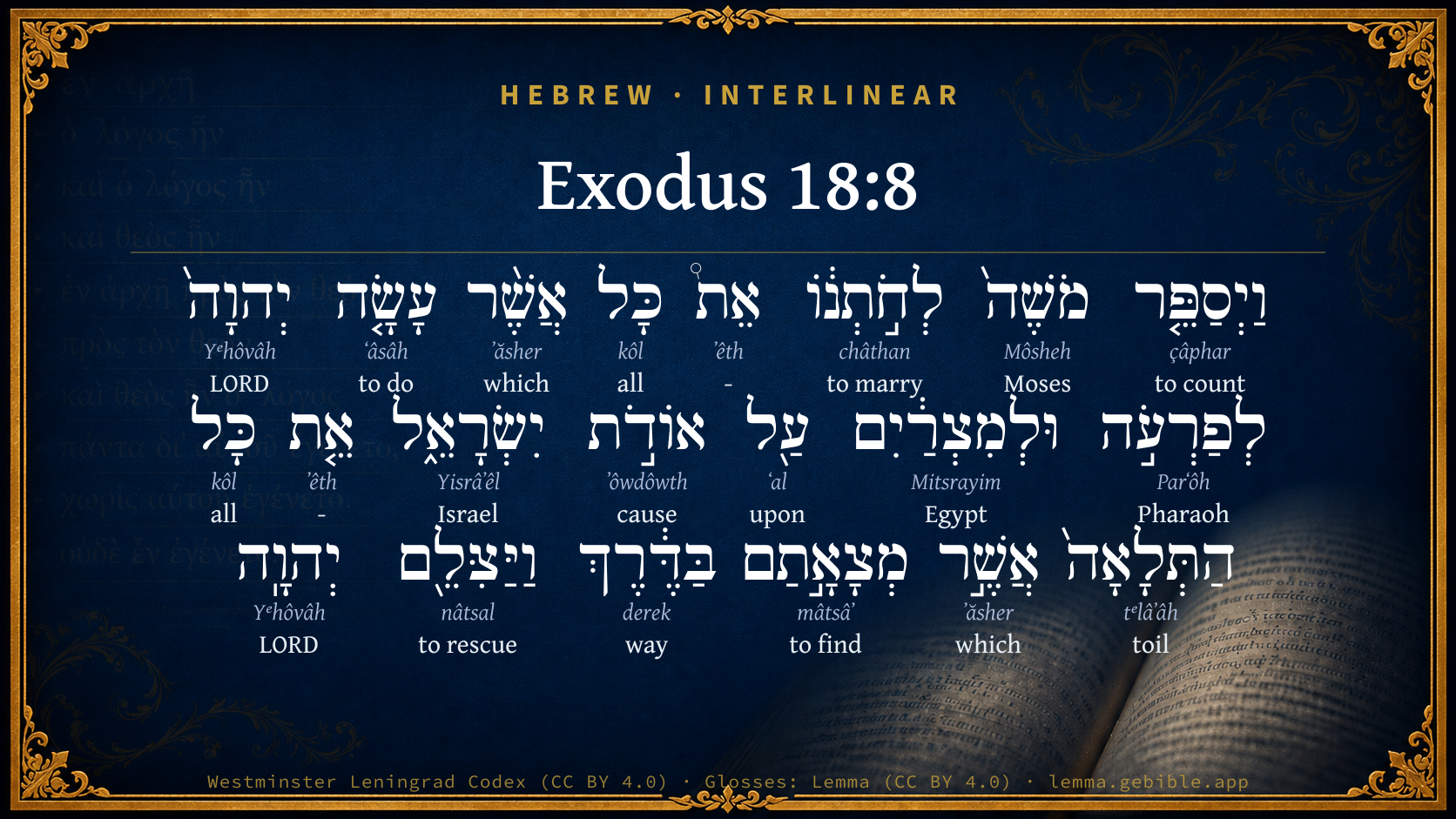
  1. וַיְסַפֵּ֤ר çâphar H5608 “and · to count” Conjunction + Verb, Piel, Sequential Imperfect, 3rd Person, Masculine, Singular
  2. מֹשֶׁה֙ Môsheh H4872 “Moses” Noun, Proper
  3. לְחֹ֣תְנ֔וֹ châthan H2859 “to/for · marrying · him” Preposition + Verb, Qal, Participle Active, Masculine, Singular, Construct + Suffix, Personal, 3rd Person, Masculine, Singular
  4. אֵת֩ ʼêth H853 “-” Particle, Direct Object
  5. כָּל kôl H3605 “all of” Noun, Common, Masculine, Singular, Construct
  6. אֲשֶׁ֨ר ʼăsher H834 “which” Particle, Relative
  7. עָשָׂ֤ה ʻâsâh H6213 “to do” Verb, Qal, Perfect, 3rd Person, Masculine, Singular
  8. יְהוָה֙ Yᵉhôvâh H3068 “LORD” Noun, Proper
  9. לְפַרְעֹ֣ה Parʻôh H6547 “to/for · Pharaoh” Preposition + Noun, Proper
  10. וּלְמִצְרַ֔יִם Mitsrayim H4714 “and · to/for · Egypt” Conjunction + Preposition + Noun, Proper
  11. עַ֖ל ʻal H5921 “upon” Preposition
  12. אוֹדֹ֣ת ʼôwdôwth H182 “cause of” Noun, Common, Feminine, Plural, Construct
  13. יִשְׂרָאֵ֑ל Yisrâʼêl H3478 “Israel” Noun, Proper
  14. אֵ֤ת ʼêth H853 “-” Particle, Direct Object
  15. כָּל kôl H3605 “all of” Noun, Common, Masculine, Singular, Construct
  16. אֲשֶׁ֣ר ʼăsher H834 “which” Particle, Relative
  17. מְצָאָ֣תַם mâtsâʼ H4672 “to find · them” Verb, Qal, Perfect, 3rd Person, Feminine, Singular + Suffix, Personal, 3rd Person, Masculine, Plural
  18. בַּדֶּ֔רֶךְ derek H1870 “in/at the · way” Preposition, Determined + Noun, Common, Both, Singular, Absolute
  19. וַיַּצִּלֵ֖ם nâtsal H5337 “and · to rescue · them” Conjunction + Verb, Hiphil, Sequential Imperfect, 3rd Person, Masculine, Singular + Suffix, Personal, 3rd Person, Masculine, Plural
  20. יְהוָֽה Yᵉhôvâh H3068 “LORD” Noun, Proper

About this verse

These counts appear in no published source. They are computed here, from the morphology-tagged text and Lemma’s own curated glosses. What Lemma adds →

21
words
17
distinct lemmas
Pentateuch
section

Notable vocabulary

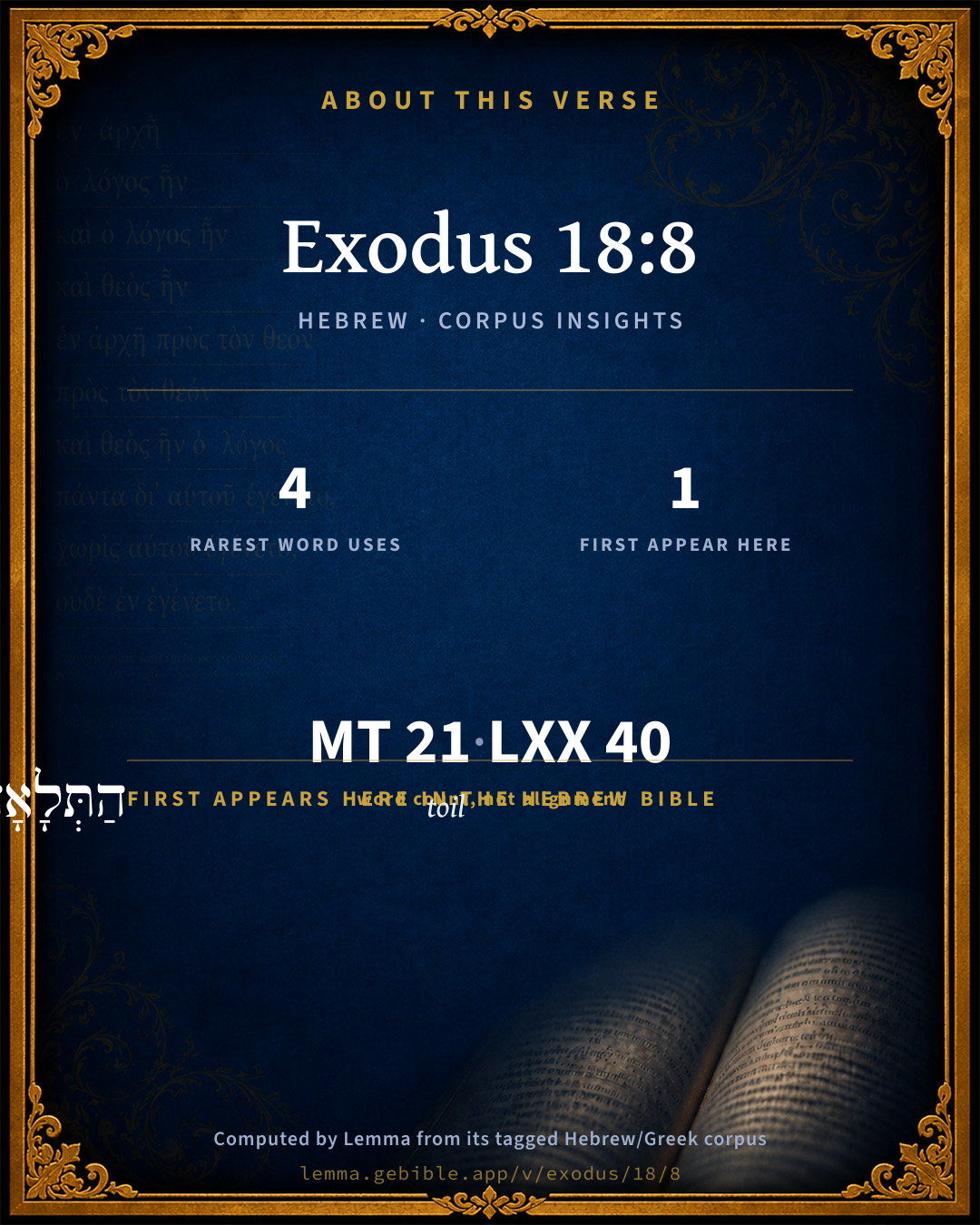
The rarest word here is הַתְּלָאָה֙ toil H8513 — appearing just 4 times in the whole Hebrew Bible.

First appearance in Scripture

This word makes its first canonical appearance in the Hebrew Bible here:

  • הַתְּלָאָה֙ toil H8513

Shared distinctive vocabulary

הַתְּלָאָה֙ toil H8513 occurs in 4 verses of the Hebrew Bible. Also found in:

Grammatical profile

  • 5 verbs
  • 11 nouns
  • 1 preposition
  • 4 particles

Verb forms

  • וַיְסַפֵּ֤ר Piel · Sequential Imperfect
  • לְחֹ֣תְנ֔וֹ Qal · Participle Active
  • עָשָׂ֤ה Qal · Perfect
  • מְצָאָ֣תַם Qal · Perfect
  • וַיַּצִּלֵ֖ם Hiphil · Sequential Imperfect

Repetition

Words recur within this verse — often emphatic in Hebrew:

  • כָּל all H3605 ×2
  • יְהוָה֙ LORD H3068 ×2
  • אֲשֶׁ֨ר which H834 ×2

Hebrew & Septuagint length

In English translation the verse runs 34 words from the Hebrew and 53 from the Septuagint (LXX English) — the Septuagint runs noticeably longer here. See the side-by-side →

A rough comparison of the two English renderings, which tokenize alike — not a word-level alignment.

Word counts can differ between the Hebrew and the Greek without any difference in meaning — e.g. the Hebrew direct-object marker אֵת has no separate Greek word, and Greek often adds the article ὁ.

In the original languages it is 21 Hebrew tokens and 40 Greek tokens — but the two are counted differently (Hebrew bundles its prefixes and suffixes into one token; the Greek is in lemma form), so that isn’t a like-for-like length.

Cross-references

17

Topical passages linked to Exodus 18:8 in the Treasury of Scripture Knowledge — connected by theme and wording, ordered by reader-vote popularity; previews shown in the World English Bible.

  • Numbers 20:14 Moses sent messengers from Kadesh to the king of Edom, Thus says your brother Israel, You know all the travail that has happened to us:
  • Nehemiah 9:9–15 You saw the affliction of our fathers in Egypt, and heard their cry by the Red Sea,
  • Nehemiah 9:32 Now therefore, our God, the great, the mighty, and the awesome God, who keep covenant and loving kindness, don't let all the travail seem little before you, that has come on us, on our kings, on our princes, and on our priests, and on our prophets, and on our fathers, and on all your people, since the time of the kings of Assyria to this day.
  • Psalms 78:42–43 They didn't remember his hand, Nor the day when he redeemed them from the adversary;
  • Psalms 81:7 You called in trouble, and I delivered you. I answered you in the secret place of thunder. I tested you at the waters of Meribah." Selah.
  • Psalms 106:10 He saved them from the hand of him who hated them, And redeemed them from the hand of the enemy.
  • Psalms 107:2 Let the redeemed by Yahweh say so, Whom he has redeemed from the hand of the adversary,
  • Psalms 145:4–12 One generation will commend your works to another, And will declare your mighty acts.
  • Genesis 44:34 For how will I go up to my father, if the boy isn't with me? Lest I see the evil that will come on my father."
  • Exodus 15:6 Your right hand, Yahweh, is glorious in power, Your right hand, Yahweh, dashes the enemy in pieces.
  • Exodus 15:16 Terror and dread falls on them. By the greatness of your arm they are as still as a stone; Until your people pass over, Yahweh, Until the people pass over who you have purchased.
  • Exodus 15:22–24 Moses led Israel onward from the Red Sea, and they went out into the wilderness of Shur; and they went three days in the wilderness, and found no water.
  • Exodus 16:3 and the children of Israel said to them, "We wish that we had died by the hand of Yahweh in the land of Egypt, when we sat by the flesh-pots, when we ate our fill of bread, for you have brought us out into this wilderness, to kill this whole assembly with hunger."
  • Exodus 18:1 Now Jethro, the priest of Midian, Moses' father-in-law, heard of all that God had done for Moses, and for Israel his people, how that Yahweh had brought Israel out of Egypt.
  • Psalms 66:16 Come, and hear, all you who fear God. I will declare what he has done for my soul.
  • Psalms 71:17–20 God, you have taught me from my youth. Until now, I have declared your wondrous works.
  • Psalms 105:1–2 Give thanks to Yahweh! Call on his name! Make his doings known among the peoples.

Cross-references courtesy of OpenBible.info (CC BY 4.0).

Hebrew and Greek witnesses Masoretic Hebrew ↔ Greek Septuagint

The same verse in the two great witnesses to the Old Testament, shown verse-for-verse.

Here the Septuagint runs noticeably longer than the Hebrew — LXX2012 (modern English Septuagint) 53 words vs World English Bible 34. A rough length comparison of the two English translations, not a word-level alignment — read both below.

These are two independent witnesses, not word-aligned to each other, and the Septuagint is shown in lemma (dictionary) form.

Hebrew Exodus 18:8 Masoretic · Westminster Leningrad Codex

וַיְסַפֵּ֤ר מֹשֶׁה֙ לְחֹ֣תְנ֔וֹ אֵת֩ כָּל אֲשֶׁ֨ר עָשָׂ֤ה יְהוָה֙ לְפַרְעֹ֣ה וּלְמִצְרַ֔יִם עַ֖ל אוֹדֹ֣ת יִשְׂרָאֵ֑ל אֵ֤ת כָּל הַתְּלָאָה֙ אֲשֶׁ֣ר מְצָאָ֣תַם בַּדֶּ֔רֶךְ וַיַּצִּלֵ֖ם יְהוָֽה

Moses told his father-in-law all that Yahweh had done to Pharaoh and to the Egyptians for Israel's sake, all the hardships that had come on them on the way, and how Yahweh delivered them.

World English Bible · Public Domain

Greek LXX Exodus 18:8 Septuagint · lemma form

καί διαἡγέομαι μωυσῆς ὁ γαμβρός πᾶς ὅσος ποιέω κύριος ὁ φαραώ καί ὁ αἰγύπτιος ἕνεκεν ὁ ἰσραήλ καί πᾶς ὁ μόχθος ὁ γίγνομαι αὐτός ἐν ὁ ὁδός καί ὅτι ἐκαἱρέω αὐτός κύριος ἐκ χείρ φαραώ καί ἐκ χείρ ὁ αἰγύπτιος

And Moses related to his father-in-law all things that the Lord did to Pharao and all the Egyptians for Israel's sake, and all the labor that had befallen them in the way, and that the Lord had rescued them out of the hand of Pharao, and out of the hand of the Egyptians.

LXX2012 (modern English Septuagint) · Public Domain

On this verse, The Pulpit Commentary discusses the Septuagint’s reading. Read the note in Commentary ↓

Hebrew: Westminster Leningrad Codex (CC BY 4.0). Greek: Septuagint (public domain); English from LXX2012 (modern English Septuagint) (Public Domain). How the Septuagint differs from the Hebrew →

Targum (Aramaic paraphrase)

2

The Targum is the ancient Jewish Aramaic paraphrase of the Hebrew Scriptures — an interpretive translation, not the Hebrew text itself. Onkelos (literal) and Pseudo-Jonathan (expansive) render the Torah, and Jonathan the Prophets. Coverage is partial: where no permissively-licensed English translation exists for a verse, only the Aramaic is shown. This is verse-level text, not a word-by-word alignment to the Hebrew.

  1. Targum Onkelos Torah (Genesis–Deuteronomy)
    וְאִשְׁתָּעִי משֶׁה לַחֲמוּהִי יָת כָּל דִי עֲבַד יְיָ לְפַרְעֹה וּלְמִצְרָאֵי עַל עֵסַק יִשְׂרָאֵל יָת כָּל עַקְתָא דִי אַשְׁכַּחְתִּנוּן בְּאָרְחָא וְשֵׁזְבָנוּן יְיָ:

    (no public-domain English translation for this verse)

    Targum Onkelos — Aramaic: “Onkelos Genesis” (public domain); “Onkelos Exodus” (public domain); “Onkelos Leviticus” (public domain); “Onkelos Numbers” (public domain); “Onkelos Deuteronomy” (public domain). English: “Sefaria Community Translation” (CC0 1.0 (public-domain dedication)); “J.W. Etheridge. The Targums of Onkelos and Jonathan Ben Uzziel on the Pentateuch. London: Longmans, Green, 1862” (public domain). Text via Sefaria.

  2. Targum Pseudo-Jonathan Torah (Genesis–Deuteronomy)
    וְתַנִי משֶׁה לְחָמוֹי יַת כָּל מַה דְּעָבַד יְיָ לְפַרְעה וּלְמִצְרָאֵי עַל עֵיסַק יִשְרָאֵל יַת כָּל עַקְתָא דְאַשְׁכְּחַתְנוּן בְּאָרְחָא עַל יַמָא דְסוּף וּבְמָרָה וּבִרְפִידִים וְהֵיךְ אַגַח עִמְהוֹן עֲמָלֵק וְשֵׁיזְבִינוּן יְיָ

    And Mosheh recounted to his father-in-law all that the Lord had done to Pharoh and to the Mizraee on behalf of Israel; all the hardship they had found in the way, at the sea of Suph, and at Marah, and at Rephidim, and how Amalek had fought with them, and the Lord had delivered them.

    Targum Pseudo-Jonathan — Aramaic: “Targum Jonathan on Genesis” (public domain); “Targum Jonathan on Exodus” (public domain); “Targum Jonathan on Leviticus” (public domain); “Targum Jonathan on Numbers” (public domain); “Targum Jonathan on Deuteronomy” (public domain). English: “The Targum of Jonathan ben Uzziel, trans. J. W. Etheridge, London, 1862” (public domain). Text via Sefaria.

Commentary

Notes on Exodus 18:8 from classic Christian and Jewish commentators (each source and its license shown beneath its notes). The classic Christian expositions comment on the surrounding passage and are grouped to its opening verse, so a note may address several verses; the Jewish commentaries on the Tanakh (Rashi and others) are per-verse, so they appear only where the commentator wrote on this verse.

Lemma curates 59 commentaries, every one of them public domain or Creative Commons licensed, each selected and text-cleaned for this edition rather than reprinted as found. About our sources →

Trapp's Complete Commentary

John Trapp

Exo 18:8 And Moses told his father in law all that the LORD had done unto Pharaoh and to the Egyptians for Israel’s sake, [and] all the travail that had come upon them by the way, and [how] the LORD delivered them.

Ver. 8. All that the Lord had done.] It is not enough to relate God’s mercies to us in the lump, and by wholesale; but we must instance the particulars both to God and men.

That had come upon them.] Heb., Had found them; yet not without a providence. {Job 5:6} God cuts us out our various conditions: it is his hand that finds us when we suffer aught.

John Trapp, A Commentary or Exposition upon All the Books of the Old and New Testament (1647–1656) — public domain. Text from a community e-Sword module.

Ellicott's Commentary for English Readers

(8) Moses told . . . All.—Jethro had only heard previously a very imperfect account of the transactions. (See Note 2 on Exo_18:1.) Moses now told him all the particulars.

A Bible Commentary for English Readers, edited by Charles John Ellicott (1878–1897) — public domain. Text from a community e-Sword module.

The Cambridge Bible for Schools and Colleges

gen. ed. J. J. S. Perowne

8. the travail] lit. weariness: cf. Num_20:14 (in a similar connexion), Lam_3:5, Neh_9:32†.

8–12. Jethro rejoices to hear of the deliverances vouchsafed to Israel; and offers in thankfulness a sacrifice (v. 12), in which Aaron and the elders of Israel take part as his guests.

The Cambridge Bible for Schools and Colleges (gen. ed. J. J. S. Perowne; Cambridge University Press, 1878–1918) — public domain. Text from a community e-Sword module.

John Gill's Exposition

And Moses told his father in law all that the Lord had done unto Pharaoh,.... After the proper civilities had passed, and Jethro had been refreshed with food and drink, as is highly probable, they entered into a conversation about what had lately passed, which Jethro had had a general report of, and which had brought him hither, and therefore it would be very entertaining to him to have the particulars of it; and Moses begins with what the Lord had done to Pharaoh, how he had inflicted his plagues upon him one after another, and at last slew his firstborn, and destroyed him and his host in the Red sea:

and to the Egyptians, for Israel's sake; the several plagues affecting them, especially the last, the slaughter of their firstborn; and who also were spoiled of their riches by the Israelites, and a numerous army of them drowned in the Red sea, and all because of the people of Israel; because they had made their lives bitter in hard bondage, had refused to let them go out of the land, and when they were departed pursued after them to fetch them back or cut them off:

and all the travail that had come upon them by the way; to the Red sea, and at Marah, and Rephidim, and how Amalek fought with them, as the Targum of Jonathan observes; what a fright they were put into, when pursued by Pharaoh and his host behind them, the rocks on each side of them, and the sea before them; their want of water in the wilderness, not being able to drink of the waters at Marah because bitter; their hunger, having no bread nor flesh in the wilderness of Sin, and their violent thirst, and no water to allay it, in the plains of Rephidim, and where also they were attacked by an army of the Amalekites:

and how the Lord delivered them; out of all this travail and trouble, and out of the hands of all their enemies, Egyptians and Amalekites.

John Gill's Exposition of the Whole Bible (1746–1763) — public domain (CC PDM 1.0). Text via the HelloAO Bible API.

Matthew Poole's English Annotations

For Israel’s sake, or, concerning Israel’s business.

Matthew Poole's English Annotations on the Holy Bible (1683–1685) — public domain. Text from a community e-Sword/MySword module.

Whedon's Commentary on the Bible

Daniel D. Whedon

8. Moses told — A thrilling tale! Such wonders as the plagues of Egypt and the miracles of the exodus would have speedily become the subject of national song and history. The presumption, in the absence of any evidence, that Moses would also commit the great events of his time to writing, is far greater than that he would not. By the travail that found them by the way we understand the hunger and thirst and exhaustion which caused the people to murmur; also the war with Amalek.

Daniel D. Whedon (gen. ed.), Commentary on the Old and New Testaments (1874–1909) — public domain. Text from a community e-Sword module.

The Pulpit Commentary

Moses told his father-in-law. Jethro had heard in Midian the general outline of what had happened (verse 1). Moses now gave him a full and complete narrative (misphar) of the transactions. Compare Jos_2:23; where the same verb is used. All the travail. Literally, "the weariness." Compare Mal_1:13, where the same word is used. The Lord delivered them. The Septuagint adds "from the hand of Pharaoh and from the hand of the Egyptians.

The Pulpit Commentary (1880–1919), ed. H.D.M. Spence-Jones & Joseph S. Exell — public domain. Text from a community e-Sword module.

Rashi

Rabbi Shlomo Yitzchaki (Rashi)

ויספר משה לחתנו AND MOSES RELATED TO HIS FATHER-IN-LAW [ALL THAT THE LORD HAD DONE] — in order to allure his heart that he might attach him to the Torah (Mekhilta).

את כל התלאה ALL THE TRAVAIL that they had experienced at the Red Sea, and that caused by Amalek (Mekhilta).

התלאה — The ל and א are part of the primary form of the word and the ת is a formative letter and a part of the primary form of the noun which sometimes is omitted from it. Similar examples are תרומה and תנופה and תקומה and תנואה.

Rashi on the Tanakh — English translations: “The Judaica Press complete Tanach with Rashi, translated by A. J. Rosenberg” (CC BY 4.0); “Pentateuch with Rashi's commentary by M. Rosenbaum and A.M. Silbermann, 1929-1934” (public domain); “The Metsudah Tanach series, Lakewood, N.J” (CC BY 4.0); and “The Book of Joshua, Metsudah Publications, 1997” (CC BY 4.0). Text via Sefaria.

Lesson kit

Teaching starters — assembled from the data on this page, not authored interpretation. Every prompt links to the verse data it draws on. Edit before teaching.

Exodus, in the Pentateuch, opens this verse with 21 words (17 distinct Hebrew lemmas). Its most distinctive word is tᵉlâʼâh (“toil”). The Greek Septuagint runs longer here. A historical commentator’s framing appears above. Read the whole chapter for the surrounding context.

Discussion questions

  1. How does “toil” (tᵉlâʼâh) shape what this verse is saying?
  2. This is the first place “toil” appears in Scripture (first appears here). What does its debut here establish?
  3. How does Numbers 20:14, which shares the word «toil», read alongside this verse?
  4. What does the repetition of “all” (2× in this one verse) do in this verse?
  5. The Septuagint runs longer here than the Hebrew. What might account for the difference?
  6. The translations on this page render this verse differently — a whole-verse word diff, not a word-by-word alignment. What might account for the different wordings?
  7. «וַיְסַפֵּ֤ר» is a Piel Sequential Imperfect verb. How does that grammatical form shape the action described?
  8. Compare how Trapp's Complete Commentary and Ellicott's Commentary for English Readers read this verse. Where do they agree or differ?

Things to notice

Reading settings

Reading text

Shown beneath each verse's original-language words.

Old Testament
Old Testament edition

Read the OT as the Masoretic Hebrew (MT) or the Greek Septuagint (LXX).

English shown for the Greek Septuagint (in the Hebrew ↔ Greek comparison).

Comparing translations? Open the Compare panel on any verse page to stack up to four side by side.