
Jeremiah 7:25

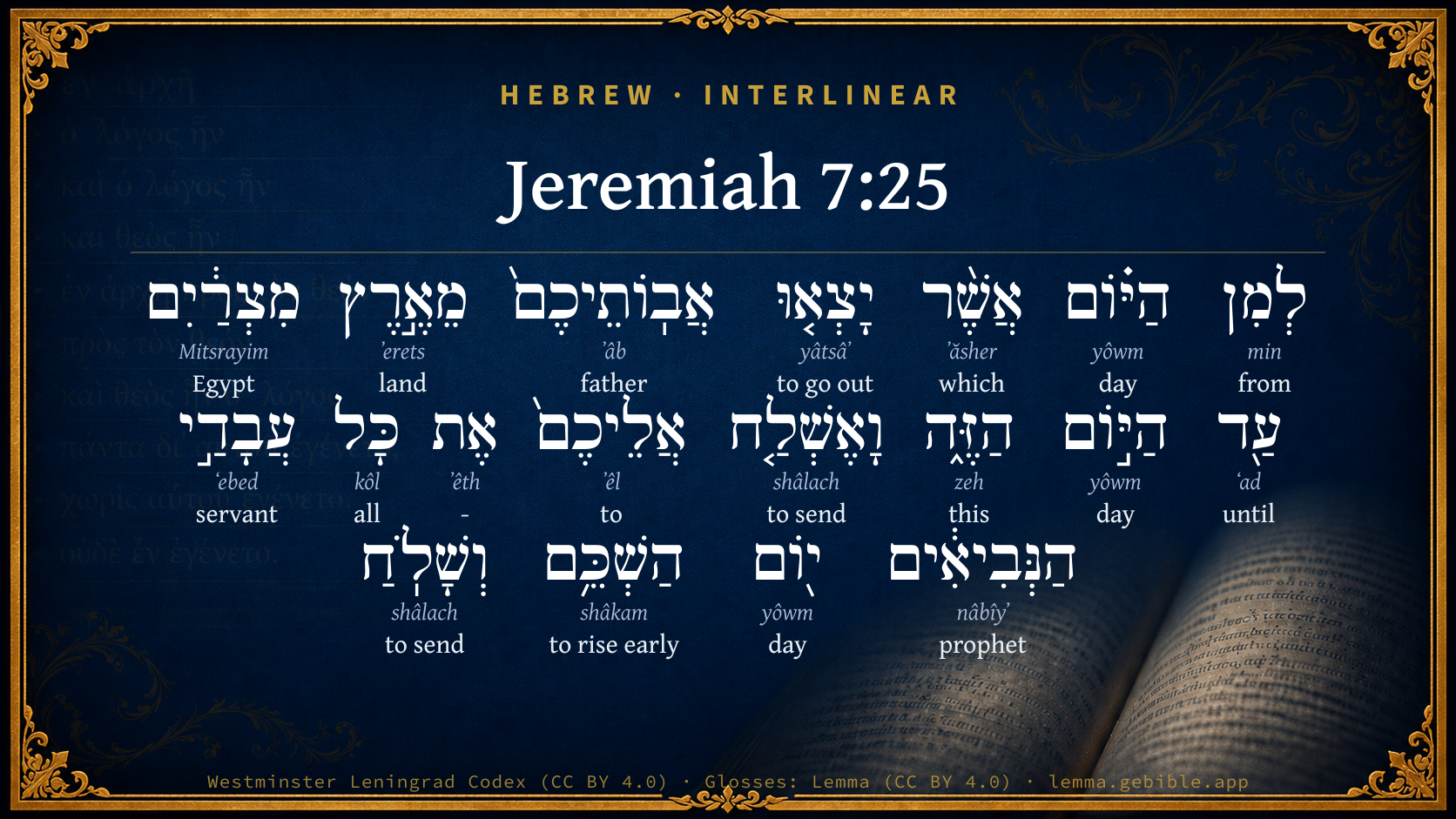
Hebrew (Westminster Leningrad Codex) Jeremiah 7:25 appears in the Hebrew Old Testament. The text above is from the Westminster Leningrad Codex. Each word links to its Strong’s number, a concise gloss, and parsing drawn from the Open Scriptures Hebrew Bible morphology. Click any word for its full Brown-Driver-Briggs (BDB) entry.
Download image
Cite this verse

Jeremiah 7:25 (World English Bible). Public Domain. Lemma interlinear Bible study tool, https://lemma.gebible.app/v/jeremiah/7/25.

Show BibTeX & RIS
BibTeX
RIS
English Translation
Since the day that your fathers came forth out of the land of Egypt to this day, I have sent to you all my servants the prophets, daily rising up early and sending them:
World English Bible · Public Domain
Download a study sheet

One document with this verse’s original text, its word-by-word gloss line, the meaning frame, cross-references with their text, attributed commentary, and full source and license credits — printable, and it pastes into notes with its structure intact.

This verse Autodidact and up

Study sheet (.html) Plain text (.txt)

A passage Seminary Student

Up to 50 verses in one chapter. A passage sheet keeps up to 6 commentary sources and 12 cross-references per verse, in the order this page ranks them, and says so on the sheet whenever that leaves anything out. Ask for a single verse and you get the Autodidact verse sheet above.

Everything on this page stays free to read, with no account — the sheet is a download of what is already on screen, not access to it.

Want to remove ads? Support Godless Engineer
Compare translations 3

The same verse in 3 English versions, stacked beneath the original-language interlinear above. Click any original word for its lexicon entry.

Each is an independent rendering of the whole verse — the interlinear is not word-aligned to these translations.

Highlighted words mark where these versions differ — a whole-verse word diff, not a word-by-word alignment.

  • World English Bible Public Domain
    Since the day that your fathers came forth out of the land of Egypt to this day, I have sent to you all my servants the prophets, daily rising up early and sending them:
  • King James Version Public Domain
    Since the day that your fathers came forth out of the land of Egypt unto this day I have even sent unto you all my servants the prophets, daily rising up early and sending them:
  • unfoldingWord Literal Text CC BY-SA 4.0
    From the day that your fathers went out from the land of Egypt until this day, I have sent all of my servants, the prophets, to you; day rising early and sending.

unfoldingWord Literal Text — © unfoldingWord, licensed CC BY-SA 4.0. Word-aligned USFM3 via Door43 (git.door43.org/unfoldingWord/en_ult).

Versions to compare (up to 4)

3 of 4 selected

Show all 18 translations

Every available English version of this verse, each an independent rendering of the whole verse.

  • World English Bible Public Domain
    Since the day that your fathers came forth out of the land of Egypt to this day, I have sent to you all my servants the prophets, daily rising up early and sending them:
  • Berean Standard Bible Public Domain
    From the day your fathers came out of the land of Egypt until this day, I have sent you all My servants the prophets again and again.
  • Majority Standard Bible Public Domain
    From the day your fathers came out of the land of Egypt until this day, I have sent you all My servants the prophets again and again.
  • King James Version Public Domain
    Since the day that your fathers came forth out of the land of Egypt unto this day I have even sent unto you all my servants the prophets, daily rising up early and sending them:
  • American Standard Version (1901) Public Domain
    Since the day that your fathers came forth out of the land of Egypt unto this day, I have sent unto you all my servants the prophets, daily rising up early and sending them:
  • Revised Version (1885) Public Domain
    Since the day that your fathers came forth out of the land of Egypt unto this day, I have sent unto you all my servants the prophets, daily rising up early and sending them:
  • Geneva Bible (1599) Public Domain
    Since the day that your fathers came vp out of the lande of Egypt, vnto this day, I haue euen sent vnto you al my seruants the Prophets, rising vp earely euery day, and sending them.
  • Douay-Rheims (1899) Public Domain
    From the day that their fathers came out of the land of Egypt, even to this day. And I have sent to you all my servants the prophets from day to day, rising up early and sending.
  • Young's Literal Translation Public Domain
    Even from the day when your fathers Went out of the land of Egypt till this day, I send to you all my servants the prophets, Daily rising early and sending,
  • Literal Standard Version CC BY-SA 4.0
    Even from the day when your fathers || Went out of the land of Egypt until this day, || I send all My servants the prophets to you, || Daily rising early and sending,
  • Unlocked Literal Bible CC BY-SA 4.0
    Ever since the day when your ancestors went out from the land of Egypt until this day, I have sent every one of my servants, my prophets, to you. I persisted in sending them.
  • unfoldingWord Literal Text CC BY-SA 4.0
    From the day that your fathers went out from the land of Egypt until this day, I have sent all of my servants, the prophets, to you; day rising early and sending.
  • Darby Bible Public Domain
    Since the day that your fathers came forth out of the land of Egypt, unto this day, have I sent unto you all my servants the prophets, daily rising up early and sending them;
  • World Messianic Bible Public Domain
    Since the day that your fathers came out of the land of Egypt to this day, I have sent to you all my servants the prophets, daily rising up early and sending them.
  • Webster's Bible Public Domain
    Since the day that your fathers came forth from the land of Egypt to this day I have even sent to you all my servants the prophets, daily rising early and sending them:
  • Free Bible Version CC BY-SA 4.0
    From the time your forefathers left Egypt until now, I have sent you time after time my servants the prophets.
  • Bible in Basic English Public Domain
    From the day when your fathers came out of Egypt till this day, I have sent my servants the prophets to you, getting up early every day and sending them:
  • JPS Tanakh (1917) Public Domain
    even since the day that your fathers came forth out of the land of Egypt unto this day; and though I have sent unto you all My servants the prophets, sending them daily betimes and often,

Literal Standard Version (2020), Covenant Press — licensed CC BY-SA 4.0. Text via the HelloAO Bible API (eBible.org). Unlocked Literal Bible (unfoldingWord) — licensed CC BY-SA 4.0. Text via the HelloAO Bible API (eBible.org). unfoldingWord Literal Text — © unfoldingWord, licensed CC BY-SA 4.0. Word-aligned USFM3 via Door43 (git.door43.org/unfoldingWord/en_ult). Free Bible Version, Dr. Jonathan Gallagher — licensed CC BY-SA 4.0. Text via the HelloAO Bible API (eBible.org).

Word by word

More ways to search: Search by grammar → Find every occurrence → Compare this word →

Practice this passage: Drill this verse → Learn its vocabulary →

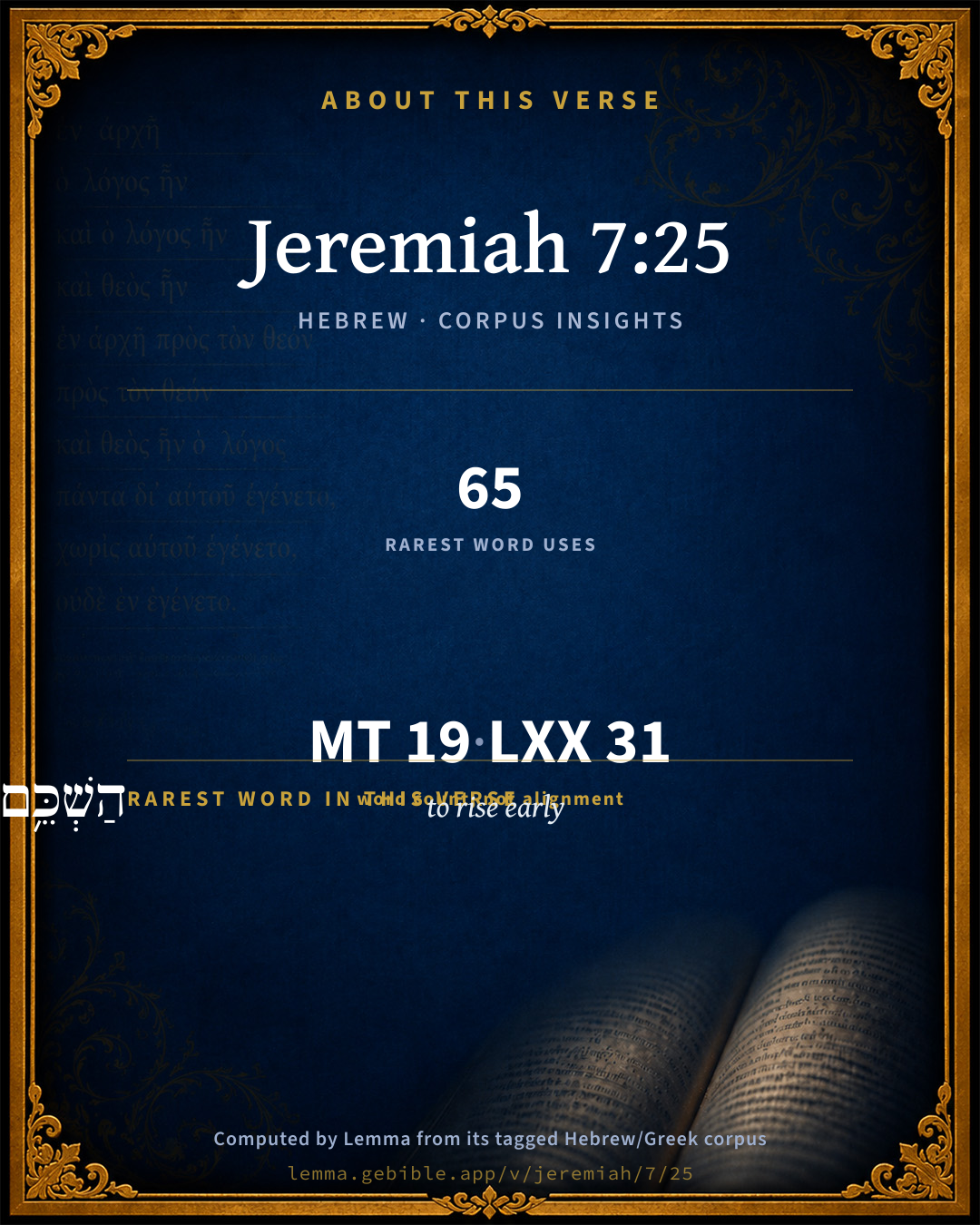
הַשְׁכֵּ֥ם
shâkam
H7925
“to rise early”
Verb, Hiphil, Infinitive Absolute
Part of Speech
Verb
Stem
Hiphil
Form
Infinitive Absolute
Full BDB Definition

Origin: a primitive root

TWOT: 2386

to rise or start early - (Hiphil) - to rise early, make an early start - early (as adverb)
  1. לְמִן min H4480 “to/for · from” Preposition + Preposition
  2. הַיּ֗וֹם yôwm H3117 “the · day” Particle, Definite Article + Noun, Common, Masculine, Singular, Absolute
  3. אֲשֶׁ֨ר ʼăsher H834 “which” Particle, Relative
  4. יָצְא֤וּ yâtsâʼ H3318 “to go out” Verb, Qal, Perfect, 3rd Person, Common, Plural
  5. אֲבֽוֹתֵיכֶם֙ ʼâb H1 “fathers · your” Noun, Common, Masculine, Plural, Construct + Suffix, Personal, 2nd Person, Masculine, Plural
  6. מֵאֶ֣רֶץ ʼerets H776 “from · land of” Preposition + Noun, Common, Both, Singular, Construct
  7. מִצְרַ֔יִם Mitsrayim H4714 “Egypt” Noun, Proper
  8. עַ֖ד ʻad H5704 “until” Preposition
  9. הַיּ֣וֹם yôwm H3117 “the · day” Particle, Definite Article + Noun, Common, Masculine, Singular, Absolute
  10. הַזֶּ֑ה zeh H2088 “the · this” Particle, Definite Article + Pronoun, Demonstrative, Masculine, Singular
  11. וָאֶשְׁלַ֤ח shâlach H7971 “and · to send” Conjunction + Verb, Qal, Sequential Imperfect, 1st Person, Common, Singular
  12. אֲלֵיכֶם֙ ʼêl H413 “to · you” Preposition + Suffix, Personal, 2nd Person, Masculine, Plural
  13. אֶת ʼêth H853 “-” Particle, Direct Object
  14. כָּל kôl H3605 “all of” Noun, Common, Masculine, Singular, Construct
  15. עֲבָדַ֣י ʻebed H5650 “servants · my” Noun, Common, Masculine, Plural, Construct + Suffix, Personal, 1st Person, Common, Singular
  16. הַנְּבִיאִ֔ים nâbîyʼ H5030 “the · prophets” Particle, Definite Article + Noun, Common, Masculine, Plural, Absolute
  17. י֖וֹם yôwm H3117 “day” Noun, Common, Masculine, Singular, Absolute
  18. וְשָׁלֹֽחַ shâlach H7971 “and · to send” Conjunction + Verb, Qal, Infinitive Absolute

About this verse

These counts appear in no published source. They are computed here, from the morphology-tagged text and Lemma’s own curated glosses. What Lemma adds →

19
words
16
distinct lemmas
Prophets
section

Grammatical profile

  • 4 verbs
  • 9 nouns
  • 1 pronoun
  • 3 prepositions
  • 2 particles

Verb forms

  • יָצְא֤וּ Qal · Perfect
  • וָאֶשְׁלַ֤ח Qal · Sequential Imperfect
  • הַשְׁכֵּ֥ם Hiphil · Infinitive Absolute
  • וְשָׁלֹֽחַ Qal · Infinitive Absolute

Repetition

Words recur within this verse — often emphatic in Hebrew:

  • הַיּ֗וֹם day H3117 ×3
  • וָאֶשְׁלַ֤ח to send H7971 ×2

Hebrew & Septuagint length

In the original languages it is 19 Hebrew tokens and 31 Greek tokens — but the two are counted differently (Hebrew bundles its prefixes and suffixes into one token; the Greek is in lemma form), so that isn’t a like-for-like length.

Cross-references

17

Topical passages linked to Jeremiah 7:25 in the Treasury of Scripture Knowledge — connected by theme and wording, ordered by reader-vote popularity; previews shown in the World English Bible.

  • 2 Chronicles 36:15 Yahweh, the God of their fathers, sent to them by his messengers, rising up early and sending, because he had compassion on his people, and on his dwelling-place:
  • Jeremiah 25:4 Yahweh has sent to you all his servants the prophets, rising up early and sending them, (but you have not listened, nor inclined your ear to hear),
  • Nehemiah 9:26 Nevertheless they were disobedient, and rebelled against you, and cast your law behind their back, and killed your prophets that testified against them to turn them again to you, and they committed awful blasphemies.
  • Jeremiah 7:13 Now, because you have done all these works, says Yahweh, and I spoke to you, rising up early and speaking, but you didn't hear; and I called you, but you didn't answer:
  • Ezekiel 2:3 He said to me, Son of man, I send you to the children of Israel, to nations that are rebellious, which have rebelled against me: they and their fathers have transgressed against me even to this very day.
  • Matthew 21:34–36 When the season for the fruit drew near, he sent his servants to the farmers, to receive his fruit.
  • Luke 20:10–12 At the proper season, he sent a servant to the farmers to collect his share of the fruit of the vineyard. But the farmers beat him, and sent him away empty.
  • Deuteronomy 9:7 Remember, don't forget, how you provoked Yahweh your God to wrath in the wilderness: from the day that you went forth out of the land of Egypt, until you came to this place, you have been rebellious against Yahweh.
  • Deuteronomy 9:21–24 I took your sin, the calf which you had made, and burnt it with fire, and stamped it, grinding it very small, until it was as fine as dust: and I cast the dust of it into the brook that descended out of the mountain.
  • 1 Samuel 8:7–8 Yahweh said to Samuel, Listen to the voice of the people in all that they tell you; for they have not rejected you, but they have rejected me, that I should not be king over them.
  • Ezra 9:7 Since the days of our fathers we have been exceeding guilty to this day; and for our iniquities have we, our kings, and our priests, been delivered into the hand of the kings of the lands, to the sword, to captivity, and to plunder, and to confusion of face, as it is this day.
  • Nehemiah 9:16–18 But they and our fathers dealt proudly and hardened their neck, and didn't listen to your commandments,
  • Nehemiah 9:30 Yet many years did you bear with them, and testified against them by your Spirit through your prophets: yet would they not give ear: therefore gave you them into the hand of the peoples of the lands.
  • Psalms 106:13–22 They soon forgot his works. They didn't wait for his counsel,
  • Jeremiah 32:30–31 For the children of Israel and the children of Judah have done only that which was evil in my sight from their youth; for the children of Israel have only provoked me to anger with the work of their hands, says Yahweh.
  • Ezekiel 20:5–32 and tell them, Thus says the Lord Yahweh: In the day when I chose Israel, and swore to the seed of the house of Jacob, and made myself known to them in the land of Egypt, when I swore to them, saying, I am Yahweh your God;
  • Ezekiel 23:2–3 Son of man, there were two women, the daughters of one mother:

Cross-references courtesy of OpenBible.info (CC BY 4.0).

Hebrew and Greek witnesses Masoretic Hebrew ↔ Greek Septuagint

The same verse in the two great witnesses to the Old Testament, shown verse-for-verse.

These are two independent witnesses, not word-aligned to each other, and the Septuagint is shown in lemma (dictionary) form.

Hebrew Jeremiah 7:25 Masoretic · Westminster Leningrad Codex

לְמִן הַיּ֗וֹם אֲשֶׁ֨ר יָצְא֤וּ אֲבֽוֹתֵיכֶם֙ מֵאֶ֣רֶץ מִצְרַ֔יִם עַ֖ד הַיּ֣וֹם הַזֶּ֑ה וָאֶשְׁלַ֤ח אֲלֵיכֶם֙ אֶת כָּל עֲבָדַ֣י הַנְּבִיאִ֔ים י֖וֹם הַשְׁכֵּ֥ם וְשָׁלֹֽחַ

Since the day that your fathers came forth out of the land of Egypt to this day, I have sent to you all my servants the prophets, daily rising up early and sending them:

World English Bible · Public Domain

Greek LXX Structure differs

In the Septuagint, Jeremiah is about an eighth shorter than the Hebrew and arranges its material differently — the Oracles Against the Nations (Hebrew chapters 46–51) appear in the middle of the Greek book, after 25:13. Because the chapter and verse boundaries do not line up, a verse-for-verse comparison with the Hebrew is not shown.

A verse-for-verse comparison isn’t shown here because the chapters and verses don’t line up. Switch to the LXX edition with the MT / LXX toggle above to read the Greek directly.

Hebrew: Westminster Leningrad Codex (CC BY 4.0). Greek: Septuagint (public domain); English from a public-domain English Septuagint. How the Septuagint differs from the Hebrew →

Targum (Aramaic paraphrase)

1

The Targum is the ancient Jewish Aramaic paraphrase of the Hebrew Scriptures — an interpretive translation, not the Hebrew text itself. Onkelos (literal) and Pseudo-Jonathan (expansive) render the Torah, and Jonathan the Prophets. Coverage is partial: where no permissively-licensed English translation exists for a verse, only the Aramaic is shown. This is verse-level text, not a word-by-word alignment to the Hebrew.

  1. Targum Jonathan Prophets (Joshua–Malachi)
    לְמִן יוֹמָא דִנְפָקוּ אֲבָהַתְכוֹן מֵאַרְעָא דְמִצְרַיִם עַד יוֹמָא הָדֵין וּשְׁלָחֵית לְוַתְכוֹן יַת כָּל עֲבָדַי נְבִיַיָא יוֹם מַקְדִים וּמְשַׁלַח:

    (no public-domain English translation for this verse)

    Targum Jonathan — Aramaic: “Mikraot Gedolot” (public domain). English: “Sefaria Community Translation” (CC0 1.0 (public-domain dedication)); “London "Chaldee Paraphrase," 1871” (public domain). Text via Sefaria.

Commentary

Notes on Jeremiah 7:25 from classic Christian and Jewish commentators (each source and its license shown beneath its notes). The classic Christian expositions comment on the surrounding passage and are grouped to its opening verse, so a note may address several verses; the Jewish commentaries on the Tanakh (Rashi and others) are per-verse, so they appear only where the commentator wrote on this verse.

Lemma curates 59 commentaries, every one of them public domain or Creative Commons licensed, each selected and text-cleaned for this edition rather than reprinted as found. About our sources →

Trapp's Complete Commentary

John Trapp

Jer 7:25 Since the day that your fathers came forth out of the land of Egypt unto this day I have even sent unto you all my servants the prophets, daily rising up early and sending [them]:

Ver. 25. Since the day.] The Church hath never wanted preachers of the truth. See my True Treasure, pp. 7, 8. Woe to the world because of this!

Daily rising up early.] See on Jer 7:13.

John Trapp, A Commentary or Exposition upon All the Books of the Old and New Testament (1647–1656) — public domain. Text from a community e-Sword module.

Geneva Bible (1599)

Geneva Bible translators

Read verse 13.

Which was about fourteen hundred years.

Geneva Bible (1599) marginal notes — public domain. Text via Bolls.life.

Jamieson, Fausset & Brown

Robert Jamieson, A. R. Fausset & David Brown

rising . . . early-- (Jer 7:13).

Jamieson, Fausset & Brown — Commentary Critical and Explanatory on the Whole Bible (1871) — public domain (CC PDM 1.0). Text via the HelloAO Bible API.

John Calvin's Commentaries

God complains of the perverse wickedness of the people, — that he had lost all his labor in endeavoring to lead them to repentance, not only in one age, but that the children succeeded their fathers in their corruptions, and that thus the imitation had become perpetual. This might indeed appear as an extenuation of their fault; they might have pleaded as the Papists at this day do; who have no pretext more specious, than when they bring against us the Fathers and antiquity. But God shews in this place and elsewhere that the children are not excused by the examples of their fathers; but on the contrary, that it is an aggravation of the crime, when men thus harden themselves, and think that a continued indulgence in vices avails them for a precedent; for God does not thus permit himself to be deprived of his own right. This passage then deserves particular notice; for God not only condemned those who were then living and whom Jeremiah addressed, but also connected with them the dead, in order to prove their greater obstinacy, as impiety had been as it were handed down from one age to another.

From the day, he says, in which your fathers came forth from the land of Egypt unto this day, have I sent to you, etc. We know how intractable the people had been from the beginning; for they did all they could to reject Moses, the minister of a favor so remarkable and invaluable. And after their deliverance, they were continually either clamoring against God, or openly contending with Moses and Aaron, or running into gross idolatry, or giving loose reins to their lusts; in short, there was no end to their course of sinning: and yet Moses daily endeavored to restore them to obedience. It was this great contumacy that God now refers to; and he says, that the Israelites did not then begin to be disobedient, but that they had ever been of such a disposition as not to bear to be corrected, as he will tell us hereafter. It was not necessary here to adduce examples to shew that the people had been indomitable; for this was evident from sacred history. It was enough to remind them, that the hardness and obstinacy of the fathers had descended to their children, so that they might know that they were twofold and treblefold guilty before God, for they had imitated the perverseness which God had before severely punished; nor was it unknown to them how God had brought judgments on their fathers. It was therefore to provoke God most wantonly, when they overlooked and disregarded such dreadful vengeances as he had executed on their progenitors. We shall hereafter see similar declarations; nay, this way of speaking occurs everywhere in the prophets, that is, that their race had been from the beginning perverse and rebellious, and that they had also in all ages despised the favor of God and obstinately resisted the prophets.

But God reminds them here, that from the day they came forth from the land of Egypt he had never ceased to speak to them even to the time of Jeremiah: this his perseverance greatly aggravated the sin of the people. Had God spoken only once, it would have been sufficient for their condemnation: but inasmuch as he had borne with their perverse conduct, and never ceased from day to day kindly to call them to himself and to promise them pardon and to offer salvation to them — inasmuch then as God had thus persevered, the more fully discovered was the irreclaimable impiety of the people. We indeed know how dreadful a punishment must await those who dare thus to abuse the forbearance of God and openly to scorn his word, when he invites them a hundred or a thousand times to repentance.

He afterwards adds, that he had sent all his servants, etc In the same sense is to be taken the universal particle, כל, cal, “all.” Had God sent only one prophet, there would have remained no excuse for the Israelites; but as he had continually sent one after another, to train them up like an army, how great was their madness to despise so large a number? We indeed know that there were never wanting prophets among the people, as Moses had promised in the eighteenth chapter of Deuteronomy. As then God had dealt bountifully with the people, so that prophets had never ceased but continually succeeded one another, hence surely the baseness of their impious obstinacy became more evident; for they had not despised God only for one day, nor disregarded one prophet, or two or three, but resisted all the prophets, though they had been sent in great number. I sent, he says, all my servants

Then he adds, daily This is mentioned for the same purpose, even to shew that God had never been wearied, and that they had resisted as it were designedly his goodness, while he was incessant in kindly exhorting them to repentance. He says, by rising early and sending As we have said elsewhere, the verb שכם, shecam, properly means to rise early. God here commends the authority of prophetic instruction by ascribing to himself what is done by men. With him, indeed, as we all know, there is no change; hence the expression, to rise up, as applied to him, is not strictly true; but what he commanded his servants to do, he transfers, as we have said, to himself, in order that he might more sharply reprove the ingratitude of the people; as though he had said, that he had been most carefully attentive to secure their salvation, but that they had been torpid and wholly indifferent.

We may hence learn a useful doctrine, — that God rises to invite us, and also to receive us, whenever his word is proclaimed among us, by which he testifies to us his paternal love. God then not only employs men to lead us to himself, but comes forth in a manner himself to meet us, and rises early as one solicitous for our salvation. This commendation of divine truth may be of great benefit to the faithful, and induce them to recumb confidently and with tranquil minds on God’s promises; for they are the same as though God himself had spoken them to us. But here is also reproved the impiety of those who slumber and sleep, while God thus watches in order to promote their salvation, and who lend not an ear, when he rises early to come to them in order to draw them to himself.

John Calvin's Commentaries (1540-1563) — public domain. Text from the Calvin Translation Society English edition (1840s-50s) via the Christian Classics Ethereal Library (ccel.org). Calvin's coverage is partial (roughly two-thirds of the Bible); uncommented books and verses are honest gaps, never fabricated. The 19th-century editor's footnotes and remarks are omitted so the notes are faithfully Calvin's own voice.

Ellicott's Commentary for English Readers

(25) Daily rising up.—Stress is laid on the continual succession of prophets as witnesses of the Truth from the beginning. The prophet was not tied to the actual letter of his statement, and the prominence given to Samuel, as the first who bore the name of prophet (1Sa_9:9), seems at first against him. On the other hand, the gift of prophecy (as seen in Num_11:25-29) was bestowed freely even during the wilderness wanderings, and the mention of prophets (Jdg_4:4; Jdg_6:8) and men of God (Jdg_13:6), perhaps, also, that of the “angel” or messenger of God, in Jdg_5:23, as well as the honour paid to seers before the time of Samuel (1Sa_9:8), show that, great as he was, it was that name and the organisation, rather than the gift, that were new in his ministry.

A Bible Commentary for English Readers, edited by Charles John Ellicott (1878–1897) — public domain. Text from a community e-Sword module.

The Cambridge Bible for Schools and Colleges

gen. ed. J. J. S. Perowne

25, 26. Repeated substantially in ch. Jer_11:7 f.

The Cambridge Bible for Schools and Colleges (gen. ed. J. J. S. Perowne; Cambridge University Press, 1878–1918) — public domain. Text from a community e-Sword module.

John Gill's Exposition

Since the day that your fathers came forth out of the land of Egypt unto this day,.... That is, in all generations; ever since their first coming out of Egypt, they had been disobedient to the commands of God, and had walked after their own hearts' lusts, and had gone backward, and not forward; for this is not to be connected with what follows:

I have even sent unto you all my servants the prophets, daily rising up early, and sending them; which should be rendered, "although I have sent" (x); which is an aggravation of their sin, that they should continue in their disobedience, though the Lord sent to them to exhort and warn them, not one, or two, of his servants the prophets, but all of them, and that daily; who rose early in the morning, which denotes their care and diligence to do their message; and which, because they were sent of the Lord, and did his work as he directed them, it is attributed to himself; and of these there was a constant succession, from the time of their coming out of Egypt unto that day; which shows the goodness of God to that people, and their slothfulness, hardness, and obstinacy.

(x) "et quamvis miserim", Ar. lnterpr. "cum tamen mitterem", Syr.

John Gill's Exposition of the Whole Bible (1746–1763) — public domain (CC PDM 1.0). Text via the HelloAO Bible API.

Matthew Poole's English Annotations

God seems to upbraid them with their stock, they came of a perverse kind, their very fathers were so before them, and they have continued in their perverseness, Neh 9:16,17; they did not now begin to be rebellious, but it had been their practice all along; never ceasing from the time their fathers came out of Egypt to the days of Jeremiah.

I have even sent unto you all my servants the prophets; God tells them what care he had taken to inform them in their duty and happiness, not once or twice, but sending messengers to them seasonably and constantly, from first to last, 2Ch 36:15 Neh 9:29,30 Am 2:10,11. See Poole "Jer 7:13", and See Poole "Jer 25:3", See Poole "Jer 25:4", &c. The church of God hath never wanted teachers raised up and sent by God.

Matthew Poole's English Annotations on the Holy Bible (1683–1685) — public domain. Text from a community e-Sword/MySword module.

Whedon's Commentary on the Bible

Daniel D. Whedon

25. Since the day, etc. — From the first, God had been seeking to enforce that one great lesson of obedience and submission. Every prophet had come on that errand. Every priest had been consecrated to that work. Every ritual observance had this for its deep and significant lesson.

Daniel D. Whedon (gen. ed.), Commentary on the Old and New Testaments (1874–1909) — public domain. Text from a community e-Sword module.

John Wesley's Explanatory Notes

Since the day - The church of God hath never wanted teachers raised up and sent by God.

John Wesley, Explanatory Notes Upon the Whole Bible (1754–1765) — public domain. Text via the GEBible commentary corpus.

Rashi

Rabbi Shlomo Yitzchaki (Rashi)

sending them day [after day] every fresh morn Every day sending them early.

Rashi on the Tanakh — English translations: “The Judaica Press complete Tanach with Rashi, translated by A. J. Rosenberg” (CC BY 4.0); “Pentateuch with Rashi's commentary by M. Rosenbaum and A.M. Silbermann, 1929-1934” (public domain); “The Metsudah Tanach series, Lakewood, N.J” (CC BY 4.0); and “The Book of Joshua, Metsudah Publications, 1997” (CC BY 4.0). Text via Sefaria.

Lesson kit

Teaching starters — assembled from the data on this page, not authored interpretation. Every prompt links to the verse data it draws on. Edit before teaching.

Jeremiah, in the Prophets, opens this verse with 19 words (16 distinct Hebrew lemmas). Its most distinctive word is shâkam (“to rise early”). A historical commentator’s framing appears above. Read the whole chapter for the surrounding context.

Discussion questions

  1. How does “to rise early” (shâkam) shape what this verse is saying?
  2. How does 2 Chronicles 36:15, which shares this passage’s theme, read alongside this verse?
  3. What does the repetition of “day” (3× in this one verse) do in this verse?
  4. These translations render this verse differently. What is at stake in choosing one wording over another?
  5. «יָצְא֤וּ» is a Qal Perfect verb. How does that grammatical form shape the action described?
  6. Compare how Trapp's Complete Commentary and Geneva Bible (1599) read this verse. Where do they agree or differ?

Things to notice

Reading settings

Reading text

Shown beneath each verse's original-language words.

Old Testament
Old Testament edition

Read the OT as the Masoretic Hebrew (MT) or the Greek Septuagint (LXX).

English shown for the Greek Septuagint (in the Hebrew ↔ Greek comparison).

Comparing translations? Open the Compare panel on any verse page to stack up to four side by side.