
Nahum 3:9

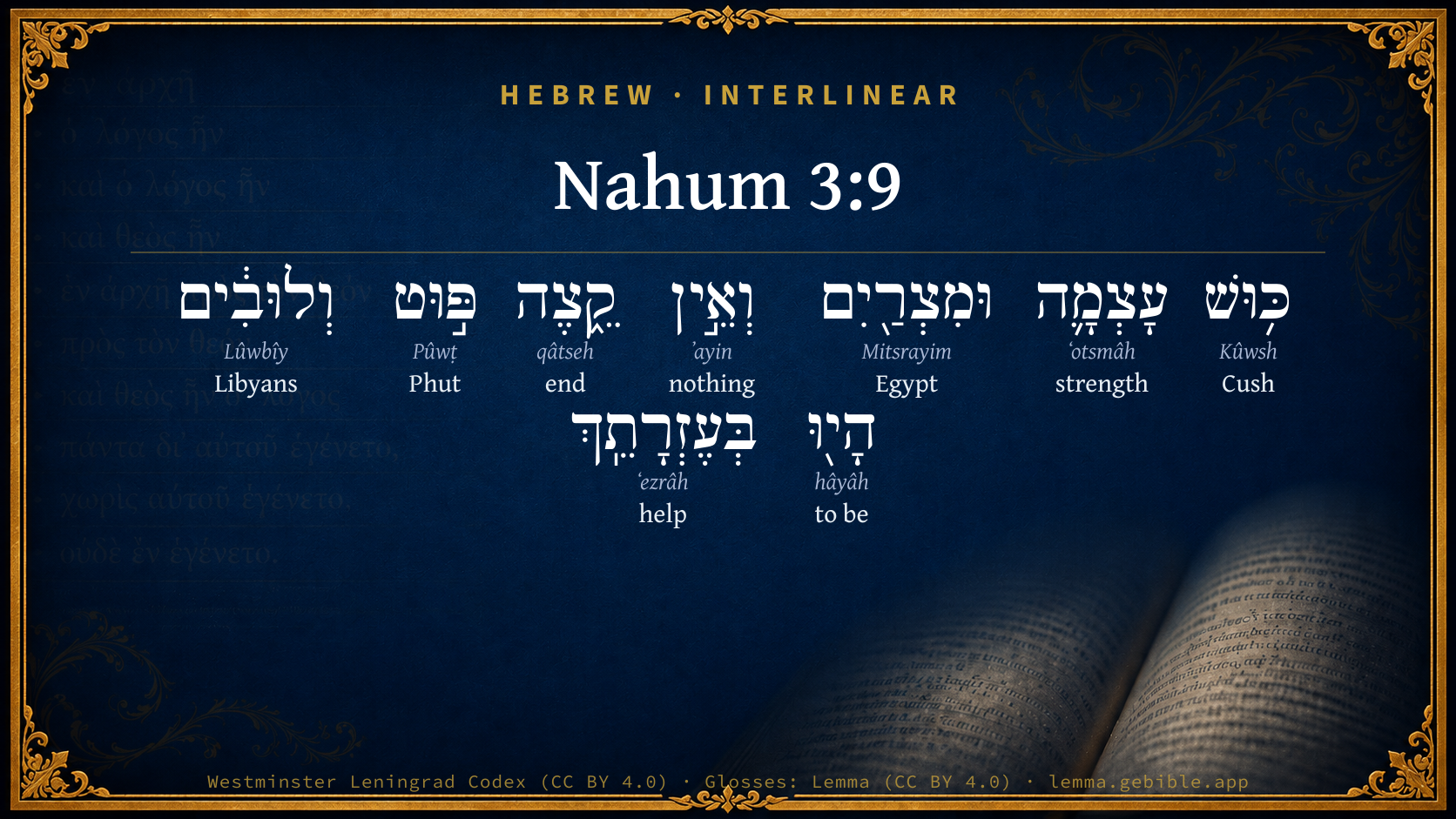
Hebrew (Westminster Leningrad Codex) Nahum 3:9 appears in the Hebrew Old Testament. The text above is from the Westminster Leningrad Codex. Each word links to its Strong’s number, a concise gloss, and parsing drawn from the Open Scriptures Hebrew Bible morphology. Click any word for its full Brown-Driver-Briggs (BDB) entry.
Download image
Cite this verse

Nahum 3:9 (World English Bible). Public Domain. Lemma interlinear Bible study tool, https://lemma.gebible.app/v/nahum/3/9.

Show BibTeX & RIS
BibTeX
RIS
English Translation
Cush and Egypt were her boundless strength. Put and Libya were her helpers.
World English Bible · Public Domain
Download a study sheet

One document with this verse’s original text, its word-by-word gloss line, the meaning frame, cross-references with their text, attributed commentary, and full source and license credits — printable, and it pastes into notes with its structure intact.

This verse Autodidact and up

Study sheet (.html) Plain text (.txt)

A passage Seminary Student

Up to 50 verses in one chapter. A passage sheet keeps up to 6 commentary sources and 12 cross-references per verse, in the order this page ranks them, and says so on the sheet whenever that leaves anything out. Ask for a single verse and you get the Autodidact verse sheet above.

Everything on this page stays free to read, with no account — the sheet is a download of what is already on screen, not access to it.

Want to remove ads? Support Godless Engineer
Compare translations 3

The same verse in 3 English versions, stacked beneath the original-language interlinear above. Click any original word for its lexicon entry.

Each is an independent rendering of the whole verse — the interlinear is not word-aligned to these translations.

Highlighted words mark where these versions differ — a whole-verse word diff, not a word-by-word alignment.

  • World English Bible Public Domain
    Cush and Egypt were her boundless strength. Put and Libya were her helpers.
  • King James Version Public Domain
    Ethiopia and Egypt were her strength, and it was infinite; Put and Lubim were thy helpers.
  • unfoldingWord Literal Text CC BY-SA 4.0
    Cush and Egypt her strength, and there was no end; Put and Libya were among your allies.

unfoldingWord Literal Text — © unfoldingWord, licensed CC BY-SA 4.0. Word-aligned USFM3 via Door43 (git.door43.org/unfoldingWord/en_ult).

Versions to compare (up to 4)

3 of 4 selected

Show all 18 translations

Every available English version of this verse, each an independent rendering of the whole verse.

  • World English Bible Public Domain
    Cush and Egypt were her boundless strength. Put and Libya were her helpers.
  • Berean Standard Bible Public Domain
    Cush and Egypt were her boundless strength; Put and Libya were her allies.
  • Majority Standard Bible Public Domain
    Cush and Egypt were her boundless strength; Put and Libya were her allies.
  • King James Version Public Domain
    Ethiopia and Egypt were her strength, and it was infinite; Put and Lubim were thy helpers.
  • American Standard Version (1901) Public Domain
    Ethiopia and Egypt were her strength, and it was infinite; Put and Lubim were thy helpers.
  • Revised Version (1885) Public Domain
    Ethiopia and Egypt were her strength, and it was infinite; Put and Lubim were thy helpers.
  • Geneva Bible (1599) Public Domain
    Ethiopia and Egypt were her strength, and there was none ende: Put and Lubim were her helpers.
  • Douay-Rheims (1899) Public Domain
    Ethiopia and Egypt were the strength thereof, and there is no end: Africa and the Libyans were thy helpers.
  • Young's Literal Translation Public Domain
    Cush her might, and Egypt, and there is no end. Put and Lubim have been for thy help.
  • Literal Standard Version CC BY-SA 4.0
    Cush her might, and Egypt, and there is no end. Put and Lubim have been for your help.
  • Unlocked Literal Bible CC BY-SA 4.0
    Cush and Egypt were her strength, and there was no end to it; Put and Libya were allies to her.
  • unfoldingWord Literal Text CC BY-SA 4.0
    Cush and Egypt her strength, and there was no end; Put and Libya were among your allies.
  • Darby Bible Public Domain
    Ethiopia was her strength, and Egypt, and it was infinite; Phut and the Libyans were her helpers.
  • World Messianic Bible Public Domain
    Cush and Egypt were her boundless strength. Put and Libya were her helpers.
  • Webster's Bible Public Domain
    Cush and Egypt were her strength, and it was infinite; Put and Lubim were thy helpers.
  • Free Bible Version CC BY-SA 4.0
    The city ruled Egypt and Ethiopia. Put and Libya were its allies.
  • Bible in Basic English Public Domain
    Ethiopia was her strength and Egyptians without number; Put and Lubim were her helpers.
  • JPS Tanakh (1917) Public Domain
    Ethiopia and Egypt were thy strength, and it was infinite; Put and Lubim were thy helpers.

Literal Standard Version (2020), Covenant Press — licensed CC BY-SA 4.0. Text via the HelloAO Bible API (eBible.org). Unlocked Literal Bible (unfoldingWord) — licensed CC BY-SA 4.0. Text via the HelloAO Bible API (eBible.org). unfoldingWord Literal Text — © unfoldingWord, licensed CC BY-SA 4.0. Word-aligned USFM3 via Door43 (git.door43.org/unfoldingWord/en_ult). Free Bible Version, Dr. Jonathan Gallagher — licensed CC BY-SA 4.0. Text via the HelloAO Bible API (eBible.org).

Word by word

More ways to search: Search by grammar → Find every occurrence → Compare this word →

Practice this passage: Drill this verse → Learn its vocabulary →

About this verse

These counts appear in no published source. They are computed here, from the morphology-tagged text and Lemma’s own curated glosses. What Lemma adds →

9
words
9
distinct lemmas
Prophets
section

Notable vocabulary

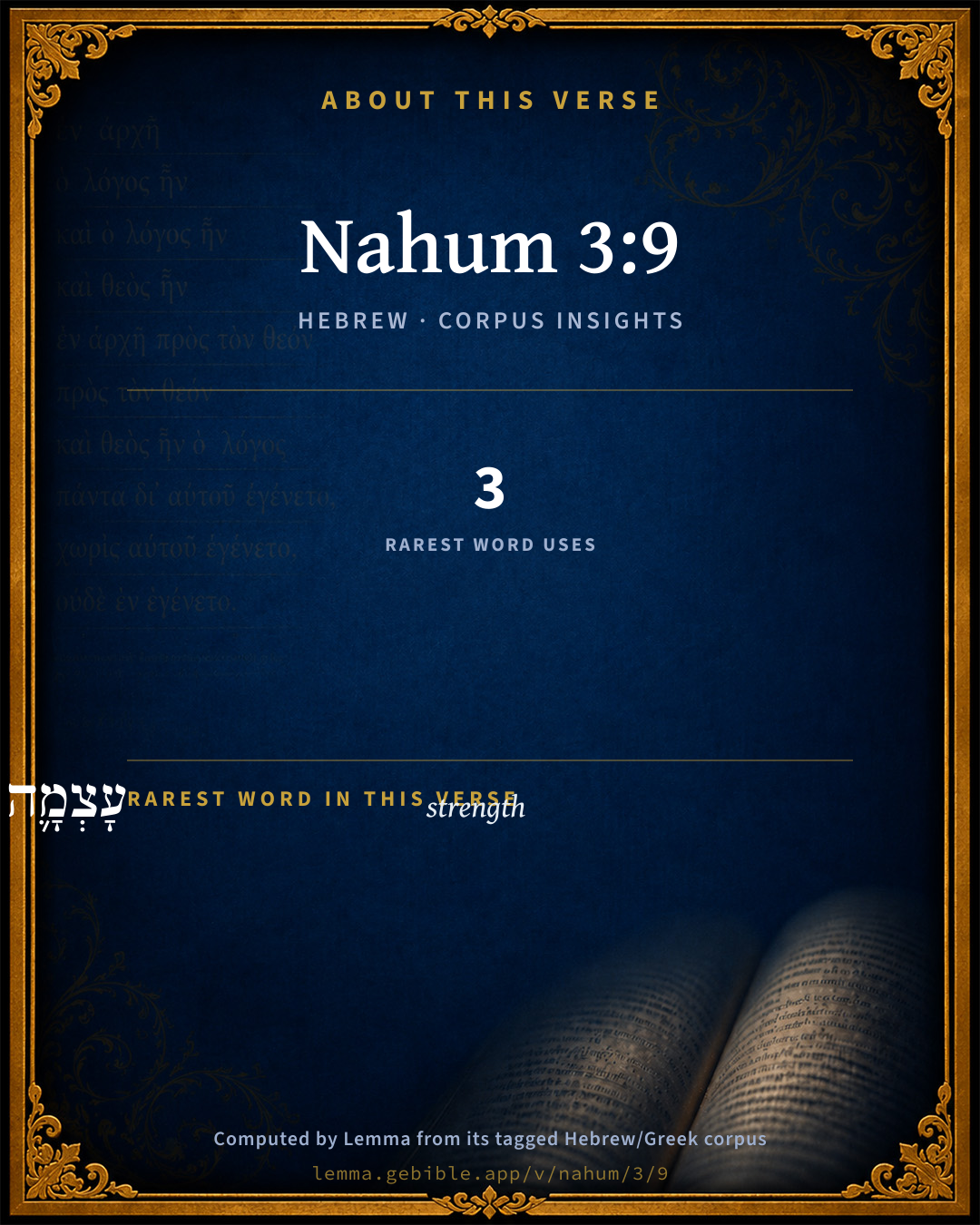
The rarest word here is עָצְמָ֛ה strength H6109 — appearing just 3 times in the whole Hebrew Bible.

Shared distinctive vocabulary

עָצְמָ֛ה strength H6109 occurs in 3 verses of the Hebrew Bible. Also found in:

Grammatical profile

  • 1 verb
  • 7 nouns
  • 1 particle

Verb forms

  • הָי֖וּ Qal · Perfect

Hebrew & Septuagint length

In English translation the verse runs 13 words from the Hebrew and 24 from the Septuagint (LXX English) — the Septuagint runs noticeably longer here. See the side-by-side →

A rough comparison of the two English renderings, which tokenize alike — not a word-level alignment.

Word counts can differ between the Hebrew and the Greek without any difference in meaning — e.g. the Hebrew direct-object marker אֵת has no separate Greek word, and Greek often adds the article ὁ.

Cross-references

8

Topical passages linked to Nahum 3:9 in the Treasury of Scripture Knowledge — connected by theme and wording, ordered by reader-vote popularity; previews shown in the World English Bible.

  • Ezekiel 27:10 Persia and Lud and Put were in your army, your men of war: they hanged the shield and helmet in you; they set forth your comeliness.
  • Ezekiel 30:5 Ethiopia, and Put, and Lud, and all the mixed people, and Cub, and the children of the land that is in league, shall fall with them by the sword.
  • Genesis 10:6 The sons of Ham: Cush, Mizraim, Put, and Canaan.
  • 2 Chronicles 12:3 with twelve hundred chariots, and sixty thousand horsemen. The people were without number who came with him out of Egypt: the Lubim, the Sukkiim, and the Ethiopians.
  • Isaiah 20:5 They shall be dismayed and confounded, because of Ethiopia their expectation, and of Egypt their glory.
  • Jeremiah 46:9 Go up, you horses; and rage, you chariots; and let the mighty men go forth: Cush and Put, who handle the shield; and the Ludim, who handle and bend the bow.
  • Ezekiel 38:5 Persia, Cush, and Put with them, all of them with shield and helmet;
  • 1 Chronicles 1:8 The sons of Ham: Cush, and Mizraim, Put, and Canaan.

Cross-references courtesy of OpenBible.info (CC BY 4.0).

Hebrew and Greek witnesses Masoretic Hebrew ↔ Greek Septuagint

The same verse in the two great witnesses to the Old Testament, shown verse-for-verse.

Here the Septuagint runs noticeably longer than the Hebrew — LXX2012 (modern English Septuagint) 24 words vs World English Bible 13. A rough length comparison of the two English translations, not a word-level alignment — read both below.

These are two independent witnesses, not word-aligned to each other, and the Septuagint is shown in lemma (dictionary) form.

Hebrew Nahum 3:9 Masoretic · Westminster Leningrad Codex

כּ֥וּשׁ עָצְמָ֛ה וּמִצְרַ֖יִם וְאֵ֣ין קֵ֑צֶה פּ֣וּט וְלוּבִ֔ים הָי֖וּ בְּעֶזְרָתֵֽךְ

Cush and Egypt were her boundless strength. Put and Libya were her helpers.

World English Bible · Public Domain

Greek LXX Nahum 3:9 Septuagint · lemma form

καί αἰθιοπία ὁ ἰσχύς αὐτός καί αἴγυπτος καί οὐ εἰμί πέρας ὁ φυγή καί λίβυες γίγνομαι βοηθός αὐτός

And Ethiopia is her strength, and Egypt; and there was no limit of the flight of her enemies; and the Libyans became her helpers.

LXX2012 (modern English Septuagint) · Public Domain

On this verse, The Pulpit Commentary discusses the Septuagint’s reading. Read the note in Commentary ↓

Hebrew: Westminster Leningrad Codex (CC BY 4.0). Greek: Septuagint (public domain); English from LXX2012 (modern English Septuagint) (Public Domain). How the Septuagint differs from the Hebrew →

Targum (Aramaic paraphrase)

1

The Targum is the ancient Jewish Aramaic paraphrase of the Hebrew Scriptures — an interpretive translation, not the Hebrew text itself. Onkelos (literal) and Pseudo-Jonathan (expansive) render the Torah, and Jonathan the Prophets. Coverage is partial: where no permissively-licensed English translation exists for a verse, only the Aramaic is shown. This is verse-level text, not a word-by-word alignment to the Hebrew.

  1. Targum Jonathan Prophets (Joshua–Malachi)
    כּוּשׁ סוּמְכָתָהָא וּמִצְרַיִם וְלֵית סוֹף פּוּטָאֵי וְלוּבָאֵי הֲווֹ בְּסַעֲדִיךְ:

    (no public-domain English translation for this verse)

    Targum Jonathan — Aramaic: “Mikraot Gedolot” (public domain). English: “Sefaria Community Translation” (CC0 1.0 (public-domain dedication)); “London "Chaldee Paraphrase," 1871” (public domain). Text via Sefaria.

Commentary

Notes on Nahum 3:9 from classic Christian and Jewish commentators (each source and its license shown beneath its notes). The classic Christian expositions comment on the surrounding passage and are grouped to its opening verse, so a note may address several verses; the Jewish commentaries on the Tanakh (Rashi and others) are per-verse, so they appear only where the commentator wrote on this verse.

Lemma curates 59 commentaries, every one of them public domain or Creative Commons licensed, each selected and text-cleaned for this edition rather than reprinted as found. About our sources →

The Cambridge Bible for Schools and Colleges

gen. ed. J. J. S. Perowne

9. Ethiopia and Egypt] Heb. Cush and Egypt. At this time Egypt and Cush, the country south of Upper Egypt, were virtually one, as the 25th or Ethiopian dynasty were on the throne (from 728–662), with No or Thebes as their capital. Jer_46:9.

and it was infinite] A favourite phrase of the prophet, Nah_2:9, Nah_3:3; Nah_3:9; cf. Isa_2:7.

Put and Lubim] Gen_10:6 Phut is one of the four sons of Ham. Eze_30:5, Phut appears in the armies of Egypt (Jer_46:9), Eze_38:5 among the followers of Gog, and Eze_27:10 among the mercenaries of Tyre. Sept. sometimes renders Lybians, here Phut and Lybians seem distinguished. The place of Phut is usually sought on the N. coast of Africa, west of Egypt, though the views of scholars are divergent. In Isa_66:19 Phut is perhaps to be read for Phul.

thy helpers] The versions render her helpers.

The Cambridge Bible for Schools and Colleges (gen. ed. J. J. S. Perowne; Cambridge University Press, 1878–1918) — public domain. Text from a community e-Sword module.

Trapp's Complete Commentary

John Trapp

Nah 3:9 Ethiopia and Egypt [were] her strength, and [it was] infinite; Put and Lubim were thy helpers.

Ver. 9. Ethiopia and Egypt were her strength] No was the metropolis of Egypt, and knew no end of her power, as bearing rule over Ethiopia the strong and Egypt the infinite, Chus valida et Egyptii infiniti (some read this text), and as having all the rest of the peoples inhabiting Africa and Libya for her confederates. See Jer 46:9, where the prophet speaketh of such people as brought aid to Egypt against the Chaldees, but were foiled and worsted. Of the huge armies that Ethiopia was able to raise see 2Ch 14:9; 2Ch 16:8. Egypt for her strength was called Rahab, Psa 87:4; Psa 89:10 that is, mighty and proud.

Put and Lubim were thy helpers] By Put Jerome understandeth Africa (which was over beside Alexandria, the sea between), a waste continent, thrice as big as Europe; and by Lubim Libya, a considerable part of that continent sometimes put for the whole. These would have been helpers to No, but could not; because overpowered by Nebuchadnezzar, sent against them by God. Leagues entered into with wicked men profit not those whom God will punish. The Grecian Churches, A.D. 1438, being afraid of the Turks, sent and subjected themselves to the Bishop of Rome, that they might have the help of the Latin Churches; but shortly after they were destroyed, and their empire subdued, and swallowed up in the Turkish greatness. It is gathered by some out of Rev 16:14-16, that the Pope and his adherents shall, towards the end of the world, for the restoring of his decayed authority, call in the help not only of Popish princes, but of foreign states, out of Asia, Africa, and America, to suppress the heretics (as they call us) and to root out religion; but with evil success, for they shall associate themselves only to be broken in pieces, Isa 8:9; these auxiliaries, shall, speed no better than those subsidiary Syrians did, 2Sa 10:18-19; they shall receive a famous foil at Armageddon, such as Sisera did at the waters of Megiddo, Jdg 5:19, and a voice from the throne shall say, "It is done," Nah 3:16-17.

John Trapp, A Commentary or Exposition upon All the Books of the Old and New Testament (1647–1656) — public domain. Text from a community e-Sword module.

Tyndale Open Study Notes

Tyndale Open Resources

3:9-10 Thebes fell to the Assyrians under King Ashurbanipal in 663 BC. Before Ashurbanipal’s victory, Thebes had seemed to have unconquerable defenses, as well as the help of all Egypt and its allies: Ethiopia, Put (perhaps the fabled land of Punt, located near what is now coastal Somalia), and Libya. None of these, however, had effectively protected Thebes. • babies were dashed to death: Ancient conquerors had the heinous practice of exterminating the infants of their enemies in this way (2 Kgs 8:12; Ps 137:9; Isa 13:16, 18). • Soldiers threw dice for the spoils of war, while the leaders of the conquered people were bound in chains (see 2 Kgs 25:7; Jer 40:1, 4; Joel 3:3; Obad 1:11).

Tyndale Open Study Notes — © Tyndale Open Resources, licensed CC BY-SA 4.0. Text via the HelloAO Bible API.

Geneva Bible (1599)

Geneva Bible translators

Or, thine.

Geneva Bible (1599) marginal notes — public domain. Text via Bolls.life.

Jamieson, Fausset & Brown

Robert Jamieson, A. R. Fausset & David Brown

Ethiopia--Hebrew, Cush. Ethiopia is thought at this time to have been mistress of Upper Egypt.

Egypt--Lower Egypt.

her strength--her safeguard as an ally.

it was infinite--The resources of these, her allies, were endless.

Put--or Phut (Gen 10:6); descended from Ham (Eze 27:10). From a root meaning a bow; as they were famed as archers [GESENIUS]. Probably west of Lower Egypt. JOSEPHUS [Antiquities, 1:6.2] identifies it with Mauritania (compare Jer 46:9, Margin; Eze 38:5).

Lubim--the Libyans, whose capital was Cyrene; extending along the Mediterranean west of Egypt (Ch2 12:3; Ch2 16:8; Act 2:10). As, however, the Lubim are always connected with the Egyptians and Ethiopians, they are perhaps distinct from the Libyans. The Lubim were probably at first wandering tribes, who afterwards were settled under Carthage in the region of Cyrene, under the name Libyans.

thy--No's.

helpers--literally, "in thy help," that is, among thy auxiliaries.

Jamieson, Fausset & Brown — Commentary Critical and Explanatory on the Whole Bible (1871) — public domain (CC PDM 1.0). Text via the HelloAO Bible API.

Adam Clarke's Commentary

Verse 9. Ethiopia and Egypt were her strength] The land of Cush, not far from Diospolis; for it was in Arabia, on the Red Sea.

Put and Lubim] A part of Africa and Libya, which were all within reach of forming alliances with No-Ammon or Diospolis.

Adam Clarke's Commentary on the Bible (1810–1826) — public domain. Text from a community e-Sword/MySword module.

John Gill's Exposition

Ethiopia and Egypt were her strength,.... That is, the strength, support, protection, and defence of No, whether Alexandria, or Thebes, or Memphis: Egypt was, for these cities were in it, and subject to it; or, if this was a free city, as some think, yet in alliance with Egypt, and under its protection; and in like connection it was with Ethiopia, that is, Arabia, a country that lay near to it; and yet, though it was strengthened by such powerful neighbours and allies, it was not secure from the devastation of the enemy:

and it was infinite; or there was "no end" (o); of its strength, or of the number of its allies, or the forces they were able to bring in its defence. The Ethiopians were very numerous, as may be learnt from Ch2 14:9 and so were the Egyptians, to whom some interpreters strictly connect this sentence. In the times of Amasis, as Mela (p) relates, there were twenty thousand cities inhabited in it; and Josephus (q) says there were in it seven hundred and fifty myriads of men; as Sethon, king of Egypt, and Tirhakah, king of Ethiopia, were about this time the allies of the Jews, in whom they trusted, no doubt they were confederate together, and so both the strength of this city; see Isa 36:6,

Put and Lubim, were thy helpers; Put, or the Putim, were the people of the Moors, that dwelt in Mauritania; and Lubim were the Lybians that bordered on Egypt, and whose country is sometimes reckoned a part of it. The Jews (r) say Lybia is Egypt; see Act 2:10 these several people were the confederates of No; and helped them, not only by their commerce with them, but in time of war assisted them against their enemies; and yet, though so strengthened by alliances, were not safe and secure; and therefore Nineveh could not depend upon such helps and helpers.

(o) "non est finis", Pagninus, Montanus, Munster, Cocceius. (p) De Orbis Situ. l. 1. c. 9. (q) De Bello Jud. l. 2. c. 16. sect. 4. (r) T. Hieros. Celaim, c. 8. fol. 31. 3.

John Gill's Exposition of the Whole Bible (1746–1763) — public domain (CC PDM 1.0). Text via the HelloAO Bible API.

Albert Barnes' Notes on the Bible

Ethiopia and Egypt were her strength - Literally, “Egypt was strength , and Ethiopia, and boundless.” He sets forth first the imperial might of No; then her strength from foreign, subdued power. The capital is a sort of impersonation of the might of the state; No, of Egypt, as Nineveh, of Assyria. When the head was cut off or the heart ceased to beat, all was lost. The might of Egypt and Ethiopia was the might of No, concentrated in her. They were strength, and that strength unmeasured by any human standard. Boundless was the strength, which Nineveh had subdued: boundless, the store Nah 2:10 which she had accumulated for the spoiler; boundless Nah 3:3 the carcasses of her slain. “And it was infinite.” “The people that came up with the king out of Egypt, were without number” 2Ch 12:3. The Egyptians connected with Thebes are counted by a pagan author at seven million. Put or Phut is mentioned third among the sons of Ham, after Cash anal Mizraim Gen 10:6. They are mentioned with the Ethiopians in Pharaoh’s army at the Euphrates , as joined with them in the visitation of Egypt Eze 30:5; with Cush in the army of Gog Eze 38:15; with Lud in that of Tyre Eze 29:10; a country and river of that name were, Josephus tells us , “frequently mentioned by Greek historians.” They dwelt in the Libya, conterminous to the Canopic mouth of the Nile .

And Lubim - These came up against Judah in the army of Shishak 2Ch 12:3 against Rehoboam, and with the Ethiopians, “a huge host” under Zerah the Ethiopian against Asa . The Ribou or Libou appear on the monuments as a people conquered by Menephthes and Rameses III . They were still to be united with Egypt and the Ethiopians in the times of Antiochus Epiphanes Dan 11:43; so their connection with Egypt was not broken by its fall. Those unwearied enemies had become incorporated with her; and were now her help. These were (English Margin) in thy help; set upon it, given up to it. The prophet appeals to No herself, as it were, “Thou hadst strength.” Then he turns away, to speak of her, unwilling to look on the miseries which he has to portray to Nineveh, as the preludes of her own. Without God, vain is the help of man.

Albert Barnes' Notes on the Bible (1834–1885) — public domain. Text from a community e-Sword/MySword module.

Haydock's Catholic Bible Commentary

Ethiopia; Chus, in Arabia, not far from Diospolis.

George Leo Haydock (1774–1849), Haydock's Catholic Family Bible and Commentary, 1859 edition — public domain. Excludes Psalms (Douay-Rheims chapter numbering differs from Protestant) and Deuterocanonical books (Catholic canon only).

Matthew Poole's English Annotations

It is not very probable that this Ethiopia should be that remote country that lay south of Egypt, though in truth it is possible, and while Egypt was in friendship with No Amon, or Alexandria, the aids might in length of time come from Ethiopia, or Abyssinia. But there was a Cush, an Ethiopia, in Arabia, near to Egypt and Alexandria, whose people were likest to undertake the assistance of Alexandria their neighbour. See 2Ch 14:9; Eze 30:4,5; Hab 3:7. This No, or Alexandria, was either a city subject to, and was part of Egypt, or if (as some conjecture) it was a free city, it was in league with Egypt.

Were her strength; furnishing soldiers and warlike assistance on all occasions to Alexandria, which relied on these confederates.

It was infinite; they never made an end of their confederacies and warlike provisions. It is reported, that when Amasis reigned Egypt reckoned twenty thousand cities, and when Zerah king of Ethiopia came against Asa it was with an army of ten hundred thousand men, and three hundred (thousand) chariots; these were the associates of Alexandria.

Put, or Phuteans, or the Moors, who lie along westward of Alexandria.

Lubim; the people that inhabited the parts of Africa, and thought to be that which is now called Cyrene: see Eze 30.

Were thy helpers, O Alexandria.

Matthew Poole's English Annotations on the Holy Bible (1683–1685) — public domain. Text from a community e-Sword/MySword module.

The Pulpit Commentary

Ethiopia and Egypt were her strength. Urdamaneh, or Rudammon, in whose time this capture of No-Amon took place, was son and successor of Tirhalrah, who is called expressly King of Ethiopia. (2Ki_19:9 Isa_37:9) Egypt. The Egyptians proper, combined with the Ethiopians, formed the kingdom of Egypt under the twenty-fifth, the Ethiopian, dynasty. And it was infinite. The power of Egypt was boundless, its forces in numerable. (see 2Ch_12:3) Pusey notes a remark of Cato (in Steph. Byzant. ap. Boch., 4:27) that the Egyptians connected with Thebes amounted to seven millions. In Isaiah 18-20. Ethiopia and Egypt are represented as combined against Assyria, and conquered by it (Wordsworth). Septuagint, Ouk esth terav thv fughv , "There was no limit of the flight." This is thought by Jerome to be connected with the previous verses, and to refer to Nineveh. Put and Lubim were thy helpers. No- Amon is here suddenly addressed. Put, or Punt, designates either a part of Arabia or that part of the coast of Egypt opposite to it (see Ebers, "AEgypt. und die Buch. Mos.," p. 64, etc.). Luhim are the Lybians, dwelling on the west of the Canopic mouth of the Nile. Thus the enumeration of the forces of Thebes is regularly arranged, beginning with the south, Ethiopia, then through Egypt proper to the north, and then to the provinces on the east and west (Knabenbauer). The Vulgate translates the two terms, Africa et Libya. The LXX combines them in one, Libuev . These peoples are named together elsewhere: e.g. Jer_46:9 Eze_27:10 Eze_30:5 Eze_38:5.

The Pulpit Commentary (1880–1919), ed. H.D.M. Spence-Jones & Joseph S. Exell — public domain. Text from a community e-Sword module.

John Wesley's Explanatory Notes

Her strength - Furnishing soldiers and warlike assistance. It was infinite - There was no end to their confidence and warlike provisions. Put - Or the Moors, who lie westward of Alexandria. Lubim - The people that inhabited that which is now called Cyrene.

John Wesley, Explanatory Notes Upon the Whole Bible (1754–1765) — public domain. Text via the GEBible commentary corpus.

Rashi

Rabbi Shlomo Yitzchaki (Rashi)

Cush was [its] strength—The Cushites were its strength.

Put and the Lubim—The Putim and the Lubim, who were your helpers, were also in her [Assyria’s] army.

Rashi on the Tanakh — English translations: “The Judaica Press complete Tanach with Rashi, translated by A. J. Rosenberg” (CC BY 4.0); “Pentateuch with Rashi's commentary by M. Rosenbaum and A.M. Silbermann, 1929-1934” (public domain); “The Metsudah Tanach series, Lakewood, N.J” (CC BY 4.0); and “The Book of Joshua, Metsudah Publications, 1997” (CC BY 4.0). Text via Sefaria.

Lesson kit

Teaching starters — assembled from the data on this page, not authored interpretation. Every prompt links to the verse data it draws on. Edit before teaching.

Nahum, in the Prophets, opens this verse with 9 words (9 distinct Hebrew lemmas). Its most distinctive word is ʻotsmâh (“strength”). The Greek Septuagint runs longer here. A historical commentator’s framing appears above. Read the whole chapter for the surrounding context.

Discussion questions

  1. How does “strength” (ʻotsmâh) shape what this verse is saying?
  2. How does Isaiah 40:29, which shares the word «strength», read alongside this verse?
  3. The Septuagint runs longer here than the Hebrew. What might account for the difference?
  4. These translations render this verse differently; the difference is in the English rendering, not the original. What questions does that raise?
  5. «הָי֖וּ» is a Qal Perfect verb. How does that grammatical form shape the action described?
  6. Compare how The Cambridge Bible for Schools and Colleges and Trapp's Complete Commentary read this verse. Where do they agree or differ?

Things to notice

Reading settings

Reading text

Shown beneath each verse's original-language words.

Old Testament
Old Testament edition

Read the OT as the Masoretic Hebrew (MT) or the Greek Septuagint (LXX).

English shown for the Greek Septuagint (in the Hebrew ↔ Greek comparison).

Comparing translations? Open the Compare panel on any verse page to stack up to four side by side.