
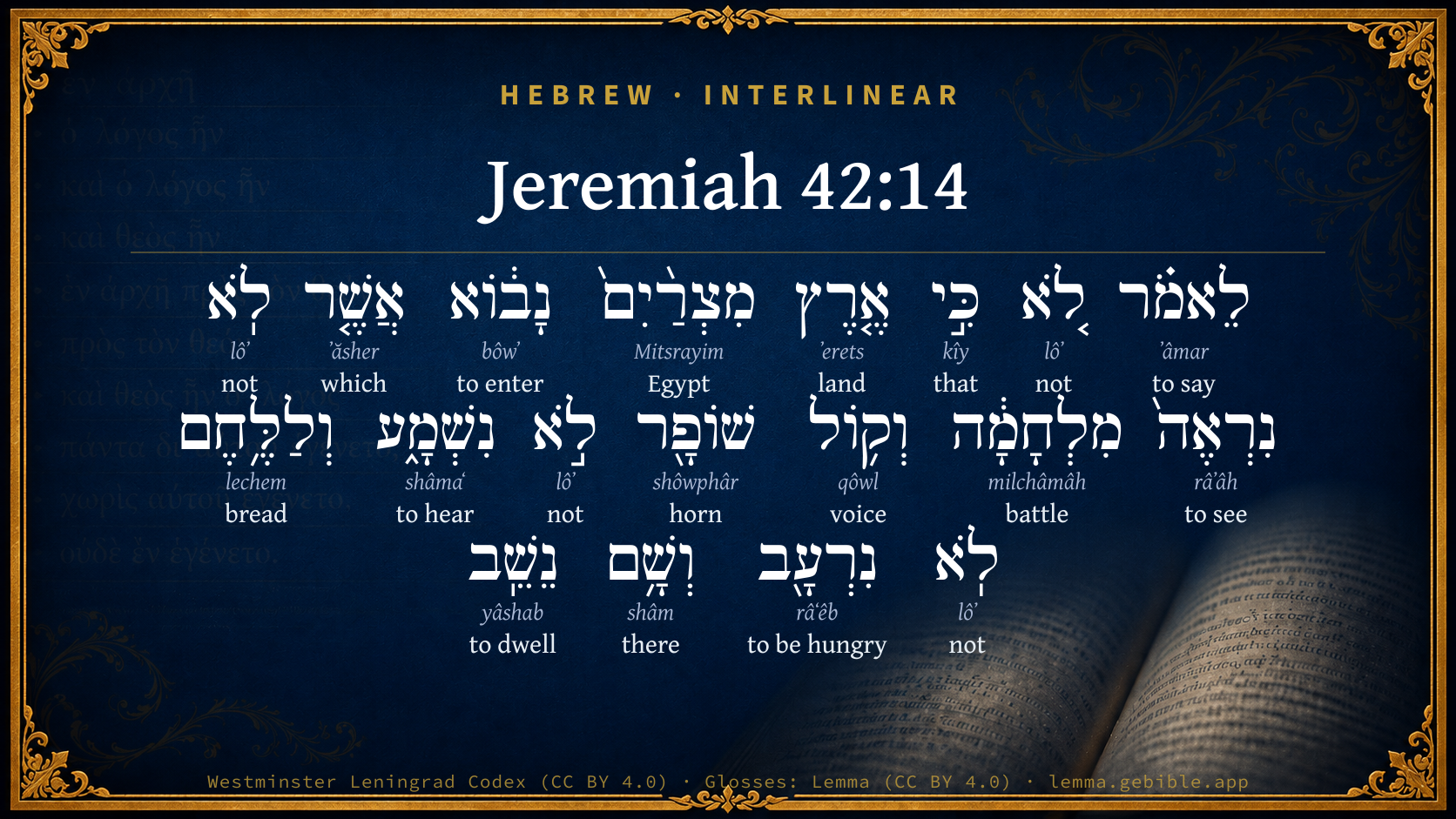
Jeremiah 42:14

Hebrew (Westminster Leningrad Codex) Jeremiah 42:14 appears in the Hebrew Old Testament. The text above is from the Westminster Leningrad Codex. Each word links to its Strong’s number, a concise gloss, and parsing drawn from the Open Scriptures Hebrew Bible morphology. Click any word for its full Brown-Driver-Briggs (BDB) entry.
Download image
Cite this verse

Jeremiah 42:14 (World English Bible). Public Domain. Lemma interlinear Bible study tool, https://lemma.gebible.app/v/jeremiah/42/14.

Show BibTeX & RIS
BibTeX
RIS
English Translation
saying, No; but we will go into the land of Egypt, where we shall see no war, nor hear the sound of the trumpet, nor have hunger of bread; and there will we dwell:
World English Bible · Public Domain
Download a study sheet

One document with this verse’s original text, its word-by-word gloss line, the meaning frame, cross-references with their text, attributed commentary, and full source and license credits — printable, and it pastes into notes with its structure intact.

This verse Autodidact and up

Study sheet (.html) Plain text (.txt)

A passage Seminary Student

Up to 50 verses in one chapter. A passage sheet keeps up to 6 commentary sources and 12 cross-references per verse, in the order this page ranks them, and says so on the sheet whenever that leaves anything out. Ask for a single verse and you get the Autodidact verse sheet above.

Everything on this page stays free to read, with no account — the sheet is a download of what is already on screen, not access to it.

Want to remove ads? Support Godless Engineer
Compare translations 3

The same verse in 3 English versions, stacked beneath the original-language interlinear above. Click any original word for its lexicon entry.

Each is an independent rendering of the whole verse — the interlinear is not word-aligned to these translations.

Highlighted words mark where these versions differ — a whole-verse word diff, not a word-by-word alignment.

  • World English Bible Public Domain
    saying, No; but we will go into the land of Egypt, where we shall see no war, nor hear the sound of the trumpet, nor have hunger of bread; and there will we dwell:
  • King James Version Public Domain
    Saying, No; but we will go into the land of Egypt, where we shall see no war, nor hear the sound of the trumpet, nor have hunger of bread; and there will we dwell:
  • unfoldingWord Literal Text CC BY-SA 4.0
    Suppose that you say, “No! We will go to the land of Egypt, where we will not see any war, where we will not hear the sound of the trumpet, and we will not go hungry for food. We will live there.”

unfoldingWord Literal Text — © unfoldingWord, licensed CC BY-SA 4.0. Word-aligned USFM3 via Door43 (git.door43.org/unfoldingWord/en_ult).

Versions to compare (up to 4)

3 of 4 selected

Show all 18 translations

Every available English version of this verse, each an independent rendering of the whole verse.

  • World English Bible Public Domain
    saying, No; but we will go into the land of Egypt, where we shall see no war, nor hear the sound of the trumpet, nor have hunger of bread; and there will we dwell:
  • Berean Standard Bible Public Domain
    and if you say, ‘No, but we will go to the land of Egypt and live there, where we will not see war or hear the sound of the ram’s horn or hunger for bread,’
  • Majority Standard Bible Public Domain
    and if you say, ‘No, but we will go to the land of Egypt and live there, where we will not see war or hear the sound of the ram’s horn or hunger for bread,’
  • King James Version Public Domain
    Saying, No; but we will go into the land of Egypt, where we shall see no war, nor hear the sound of the trumpet, nor have hunger of bread; and there will we dwell:
  • American Standard Version (1901) Public Domain
    saying, No; but we will go into the land of Egypt, where we shall see no war, nor hear the sound of the trumpet, nor have hunger of bread; and there will we dwell:
  • Revised Version (1885) Public Domain
    saying, No; but we will go into the land of Egypt, where we shall see no war, nor hear the sound of the trumpet, nor have hunger of bread; and there will we dwell:
  • Geneva Bible (1599) Public Domain
    Saying, Nay, but we will goe into the land of Egypt, where we shall see no warre, nor heare the sounde of the trumpet, nor haue hunger of bread, and there will we dwell,
  • Douay-Rheims (1899) Public Domain
    Saying: No, but we will go into the land of Egypt: where we shall see no war, nor hear the sound of the trumpet, nor suffer hunger: and there we will dwell.
  • Young's Literal Translation Public Domain
    saying, No; but the land of Egypt we enter, that we see no war, and the sound of a trumpet do not hear, and for bread be not hungry; and there do we dwell.
  • Literal Standard Version CC BY-SA 4.0
    saying, No; but we enter the land of Egypt, that we see no war, and do not hear the sound of a horn, and are not hungry for bread; and we dwell there—
  • Unlocked Literal Bible CC BY-SA 4.0
    Suppose that you say, “No! We will go to the land of Egypt, where we will not see any war, where we will not hear the sound of the trumpet, and we will not go hungry for food. We will live there.”
  • unfoldingWord Literal Text CC BY-SA 4.0
    Suppose that you say, “No! We will go to the land of Egypt, where we will not see any war, where we will not hear the sound of the trumpet, and we will not go hungry for food. We will live there.”
  • Darby Bible Public Domain
    saying, No; but we will go into the land of Egypt, where we shall see no war, nor hear the sound of the trumpet, nor have hunger for bread; and there will we dwell;
  • World Messianic Bible Public Domain
    saying, “No, but we will go into the land of Egypt, where we will see no war, nor hear the sound of the shofar, nor have hunger of bread; and there we will dwell;”’
  • Webster's Bible Public Domain
    Saying, No; but we will go into the land of Egypt, where we shall see no war, nor hear the sound of the trumpet, nor hunger for bread; and there will we dwell:
  • Free Bible Version CC BY-SA 4.0
    or if you say instead, “No, we're going to Egypt to live there, where we won't experience war or hear trumpets sounding or go hungry;”
  • Bible in Basic English Public Domain
    Saying, No, but we will go into the land of Egypt, where we will not see war, or be hearing the sound of the horn, or be in need of food; there we will make our living-place;
  • JPS Tanakh (1917) Public Domain
    saying: No; but we will go into the land of Egypt, where we shall see no war, nor hear the sound of the horn, nor have hunger of bread; and there will we abide;

Literal Standard Version (2020), Covenant Press — licensed CC BY-SA 4.0. Text via the HelloAO Bible API (eBible.org). Unlocked Literal Bible (unfoldingWord) — licensed CC BY-SA 4.0. Text via the HelloAO Bible API (eBible.org). unfoldingWord Literal Text — © unfoldingWord, licensed CC BY-SA 4.0. Word-aligned USFM3 via Door43 (git.door43.org/unfoldingWord/en_ult). Free Bible Version, Dr. Jonathan Gallagher — licensed CC BY-SA 4.0. Text via the HelloAO Bible API (eBible.org).

Word by word

More ways to search: Search by grammar → Find every occurrence → Compare this word →

Practice this passage: Drill this verse → Learn its vocabulary →

נִרְעָ֖ב
râʻêb
H7456
“to be hungry”
Verb, Qal, Imperfect, 1st Person, Common, Plural
Part of Speech
Verb
Stem
Qal
Form
Imperfect
Person
1st Person
Gender
Common
Number
Plural
Full BDB Definition

Origin: a primitive root

TWOT: 2183

to be hungry, be voracious - (Qal) to be hungry - (Hiphil) to allow one to be hungry, allow to hunger
  1. לֵאמֹ֗ר ʼâmar H559 “to say” Preposition + Verb, Qal, Infinitive Construct
  2. לֹ֚א lôʼ H3808 “not” Particle, Negative
  3. כִּ֣י kîy H3588 “that” Conjunction
  4. אֶ֤רֶץ ʼerets H776 “land of” Noun, Common, Both, Singular, Construct
  5. מִצְרַ֨יִם֙ Mitsrayim H4714 “Egypt” Noun, Proper
  6. נָב֔וֹא bôwʼ H935 “to enter” Verb, Qal, Imperfect, 1st Person, Common, Plural
  7. אֲשֶׁ֤ר ʼăsher H834 “which” Particle, Relative
  8. לֹֽא lôʼ H3808 “not” Particle, Negative
  9. נִרְאֶה֙ râʼâh H7200 “to see” Verb, Qal, Imperfect, 1st Person, Common, Plural
  10. מִלְחָמָ֔ה milchâmâh H4421 “battle” Noun, Common, Feminine, Singular, Absolute
  11. וְק֥וֹל qôwl H6963 “and · voice of” Conjunction + Noun, Common, Masculine, Singular, Construct
  12. שׁוֹפָ֖ר shôwphâr H7782 “horn” Noun, Common, Masculine, Singular, Absolute
  13. לֹ֣א lôʼ H3808 “not” Particle, Negative
  14. נִשְׁמָ֑ע shâmaʻ H8085 “to hear” Verb, Qal, Imperfect, 1st Person, Common, Plural
  15. וְלַלֶּ֥חֶם lechem H3899 “and · to/for the · bread” Conjunction + Preposition, Determined + Noun, Common, Both, Singular, Absolute
  16. לֹֽא lôʼ H3808 “not” Particle, Negative
  17. וְשָׁ֥ם shâm H8033 “and · there” Conjunction + Adverb
  18. נֵשֵֽׁב yâshab H3427 “to dwell” Verb, Qal, Imperfect, 1st Person, Common, Plural

About this verse

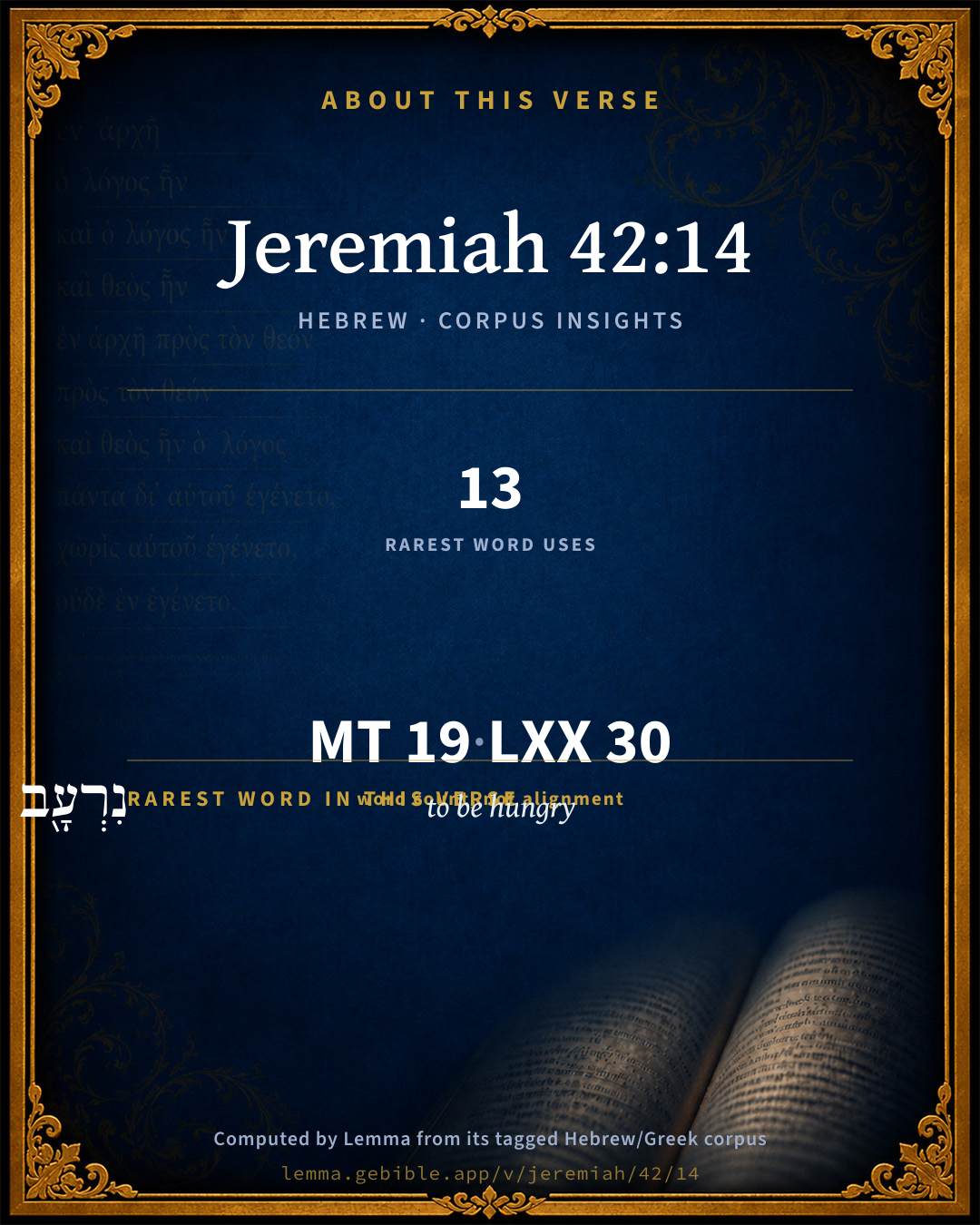
These counts appear in no published source. They are computed here, from the morphology-tagged text and Lemma’s own curated glosses. What Lemma adds →

19
words
16
distinct lemmas
Prophets
section

Notable vocabulary

The rarest word here is נִרְעָ֖ב to be hungry H7456 — appearing just 13 times in the whole Hebrew Bible.

Shared distinctive vocabulary

נִרְעָ֖ב to be hungry H7456 occurs in 13 verses of the Hebrew Bible. Also found in:

Grammatical profile

  • 6 verbs
  • 6 nouns
  • 1 conjunction
  • 1 adverb
  • 5 particles

Verb forms

  • לֵאמֹ֗ר Qal · Infinitive Construct
  • נָב֔וֹא Qal · Imperfect
  • נִרְאֶה֙ Qal · Imperfect
  • נִשְׁמָ֑ע Qal · Imperfect
  • נִרְעָ֖ב Qal · Imperfect
  • נֵשֵֽׁב Qal · Imperfect

Repetition

A word recurs within this verse — often emphatic in Hebrew:

Hebrew & Septuagint length

In the original languages it is 19 Hebrew tokens and 30 Greek tokens — but the two are counted differently (Hebrew bundles its prefixes and suffixes into one token; the Greek is in lemma form), so that isn’t a like-for-like length.

Cross-references

11

Topical passages linked to Jeremiah 42:14 in the Treasury of Scripture Knowledge — connected by theme and wording, ordered by reader-vote popularity; previews shown in the World English Bible.

  • Jeremiah 4:19 My anguish, my anguish! I am pained at my very heart; my heart is disquieted in me; I can't hold my peace; because you have heard, O my soul, the sound of the trumpet, the alarm of war.
  • Jeremiah 41:17 and they departed, and lived in Geruth Chimham, which is by Bethlehem, to go to enter into Egypt,
  • Exodus 16:3 and the children of Israel said to them, "We wish that we had died by the hand of Yahweh in the land of Egypt, when we sat by the flesh-pots, when we ate our fill of bread, for you have brought us out into this wilderness, to kill this whole assembly with hunger."
  • Numbers 11:4–5 The mixed multitude that was among them lusted exceedingly: and the children of Israel also wept again, and said, Who shall give us flesh to eat?
  • Isaiah 31:1 Woe to those who go down to Egypt for help, and rely on horses, and trust in chariots because they are many, and in horsemen because they are very strong, but they don't look to the Holy One of Israel, neither seek Yahweh!
  • Jeremiah 4:21 How long shall I see the standard, and hear the sound of the trumpet?
  • Exodus 17:3 The people were thirsty for water there; and the people murmured against Moses, and said, "Why have you brought us up out of Egypt, to kill us, our children, and our livestock with thirst?"
  • Numbers 16:13 is it a small thing that you have brought us up out of a land flowing with milk and honey, to kill us in the wilderness, but you must needs make yourself also a prince over us?
  • Deuteronomy 29:19 and it happen, when he hears the words of this curse, that he bless himself in his heart, saying, I shall have peace, though I walk in the stubbornness of my heart, to destroy the moist with the dry.
  • Isaiah 30:16 but you said, No, for we will flee on horses; therefore shall you flee: and, We will ride on the swift; therefore shall those who pursue you be swift.
  • Jeremiah 43:7 and they came into the land of Egypt; for they didn't obey the voice of Yahweh: and they came to Tahpanhes.

Cross-references courtesy of OpenBible.info (CC BY 4.0).

Hebrew and Greek witnesses Masoretic Hebrew ↔ Greek Septuagint

The same verse in the two great witnesses to the Old Testament, shown verse-for-verse.

These are two independent witnesses, not word-aligned to each other, and the Septuagint is shown in lemma (dictionary) form.

Hebrew Jeremiah 42:14 Masoretic · Westminster Leningrad Codex

לֵאמֹ֗ר לֹ֚א כִּ֣י אֶ֤רֶץ מִצְרַ֨יִם֙ נָב֔וֹא אֲשֶׁ֤ר לֹֽא נִרְאֶה֙ מִלְחָמָ֔ה וְק֥וֹל שׁוֹפָ֖ר לֹ֣א נִשְׁמָ֑ע וְלַלֶּ֥חֶם לֹֽא נִרְעָ֖ב וְשָׁ֥ם נֵשֵֽׁב

saying, No; but we will go into the land of Egypt, where we shall see no war, nor hear the sound of the trumpet, nor have hunger of bread; and there will we dwell:

World English Bible · Public Domain

Greek LXX Structure differs

In the Septuagint, Jeremiah is about an eighth shorter than the Hebrew and arranges its material differently — the Oracles Against the Nations (Hebrew chapters 46–51) appear in the middle of the Greek book, after 25:13. Because the chapter and verse boundaries do not line up, a verse-for-verse comparison with the Hebrew is not shown.

A verse-for-verse comparison isn’t shown here because the chapters and verses don’t line up. Switch to the LXX edition with the MT / LXX toggle above to read the Greek directly.

Hebrew: Westminster Leningrad Codex (CC BY 4.0). Greek: Septuagint (public domain); English from a public-domain English Septuagint. How the Septuagint differs from the Hebrew →

Targum (Aramaic paraphrase)

1

The Targum is the ancient Jewish Aramaic paraphrase of the Hebrew Scriptures — an interpretive translation, not the Hebrew text itself. Onkelos (literal) and Pseudo-Jonathan (expansive) render the Torah, and Jonathan the Prophets. Coverage is partial: where no permissively-licensed English translation exists for a verse, only the Aramaic is shown. This is verse-level text, not a word-by-word alignment to the Hebrew.

  1. Targum Jonathan Prophets (Joshua–Malachi)
    לְמֵימָר לָא אֱלָהֵין לְאַרְעָא דְמִצְרָיִם נֵיעוּל דְלָא נֶחֱזֵי עָבְדֵי קְרָבָא וְקַל שׁוֹפְרָא לָא נִשְׁמַע וּלְלַחְמָא לָא נִיכְפָן וְתַמָן נִתֵּיב:

    (no public-domain English translation for this verse)

    Targum Jonathan — Aramaic: “Mikraot Gedolot” (public domain). English: “Sefaria Community Translation” (CC0 1.0 (public-domain dedication)); “London "Chaldee Paraphrase," 1871” (public domain). Text via Sefaria.

Commentary

Notes on Jeremiah 42:14 from classic Christian and Jewish commentators (each source and its license shown beneath its notes). The classic Christian expositions comment on the surrounding passage and are grouped to its opening verse, so a note may address several verses; the Jewish commentaries on the Tanakh (Rashi and others) are per-verse, so they appear only where the commentator wrote on this verse.

Lemma curates 59 commentaries, every one of them public domain or Creative Commons licensed, each selected and text-cleaned for this edition rather than reprinted as found. About our sources →

Trapp's Complete Commentary

John Trapp

Jer 42:14 Saying, No; but we will go into the land of Egypt, where we shall see no war, nor hear the sound of the trumpet, nor have hunger of bread; and there will we dwell:

Ver. 14. Saying, No; but we will go into the land of Egypt.] Infamous for idolatry, luxury, and the oppression of your ancestors there, besides God’s express prohibition and {Deu 17:16} commination of it, as the last and greatest plague. "The Lord shall bring thee unto Egypt." {Deu 28:68}

And there will we dwell.] The prophet now, by their looks, or some other way, perceived their purpose so to do, whatever they had promised. {Jer 42:5-6}

John Trapp, A Commentary or Exposition upon All the Books of the Old and New Testament (1647–1656) — public domain. Text from a community e-Sword module.

Jamieson, Fausset & Brown

Robert Jamieson, A. R. Fausset & David Brown

where we shall see no war--Here they betray their impiety in not believing God's promise (Jer 42:10-11), as if He were a liar (Jo1 5:10).

Jamieson, Fausset & Brown — Commentary Critical and Explanatory on the Whole Bible (1871) — public domain (CC PDM 1.0). Text via the HelloAO Bible API.

John Calvin's Commentaries

He adds, Saying, No; for we will go into the land of Egypt, where we shall not see war, etc. here the Prophet discovers the very fountain of rebellion, namely, that they paid no regard to God’s favor. They were indeed exposed to many dangers in their own land, which produced fear and trembling, and its desolation also might have filled them with horror and weariness; but as God had declared that their safety would be cared for by him, how great and how base an ingratitude it was to deem as nothing that aid which he had freely promised! The Prophet then, in condemning their disobedience, shews at the same time the cause of it, even that unbelief led them away from rendering obedience to God. If, then, ye say, No, — this word was a proof of their obstinacy; but he adds, We shall go into Egypt, where we shall not see war, where we shall not hear the sound of the trumpet, as though, indeed, the promise of God were false or void. But the Prophet here discovers their hidden impiety, that they did not recumb on God’s promise. They promised then to themselves a peaceable life in Egypt. Was it in their power to effect this? and God, what could he do? he had declared that they would be safe and secure in the land of Canaan. It was to charge God with falsehood, to hope for rest in Egypt, and to imagine nothing but disturbances in the land where God bade them to remain in quietness.

We now then see why he says, We shall go into Egypt, where we shall not see war, nor hear the sound of the trumpet, nor hunger for bread They promised to themselves an abundance of all blessings, for the land of Egypt was fruitful. But could not God afflict them with want? The Egyptians, we know, had also been sometimes visited with famine. We hence see why God so much condemned the design of the people as to their going into Egypt; for they entertained vain hopes, and at the same time charged God indirectly with falsehood.

John Calvin's Commentaries (1540-1563) — public domain. Text from the Calvin Translation Society English edition (1840s-50s) via the Christian Classics Ethereal Library (ccel.org). Calvin's coverage is partial (roughly two-thirds of the Bible); uncommented books and verses are honest gaps, never fabricated. The 19th-century editor's footnotes and remarks are omitted so the notes are faithfully Calvin's own voice.

Ellicott's Commentary for English Readers

(14) No; but we will go into the land of Egypt.—The thoughts that were in the hearts of the applicants are stated with dramatic vividness. Egypt, then under Apries (the Pharaoh-hophra of Jer_44:30), seemed to them so safe and peaceful. As of old, it was still the granary of the East, and its plenteous harvests formed a bright contrast to the famine which they had experienced during the invasion of the Chaldæans. Jeremiah, however, has simply to reject the plan, as from first to last he had resisted altogether the thought of an Egyptian alliance (Jer_2:36; Jer_37:7): there would be no safety nor peace nor plenty found in acting on it. Ezekiel’s prophecies as to Egypt and her king were in this respect in harmony with Jeremiah’s (Eze_17:11-18; Ezekiel 29-32), and were, as nearly as possible, contemporary with them.

A Bible Commentary for English Readers, edited by Charles John Ellicott (1878–1897) — public domain. Text from a community e-Sword module.

The Cambridge Bible for Schools and Colleges

gen. ed. J. J. S. Perowne

14. we shall see no war] We shall be in a land further from Babylon, and therefore not so liable to invasion.

The Cambridge Bible for Schools and Colleges (gen. ed. J. J. S. Perowne; Cambridge University Press, 1878–1918) — public domain. Text from a community e-Sword module.

John Gill's Exposition

And now therefore hear the word of the Lord, ye remnant of Judah,.... A small remnant indeed, a few that were left in the land; who ought therefore to have admired the distinguishing goodness of Providence in preserving them in it; where they should have continued and made use of their privilege, to the glory of God and their mutual good:

thus saith the Lord of hosts, the God of Israel; the Lord of armies above and below, the Lord God omnipotent, and so able to protect them in their land; and who had a peculiar favour to Israel, and stood in a particular relation to them, and therefore would do it, of which they had no reason to doubt; but, disobliging him, what judgments might they not expect?

if you wholly set your faces to enter into Egypt: are resolved upon it, and are actually engaged in it; turning their faces from Judea towards Egypt, and obstinately pursuing it, nor can be reclaimed from it: the phrase expresses their resolution, impudence, and obstinacy:

and go to sojourn there: to be sojourners and strangers there, as their fathers had been before; the remembrance of which was enough to set them against going into Egypt any more.

John Gill's Exposition of the Whole Bible (1746–1763) — public domain (CC PDM 1.0). Text via the HelloAO Bible API.

Albert Barnes' Notes on the Bible

Egypt had lost the battle of Carchemish, but it had not been the scene itself of military operations; while Judaea, from the date of the battle of Megiddo, had perpetually been exposed to the actual horrors of war.

Albert Barnes' Notes on the Bible (1834–1885) — public domain. Text from a community e-Sword/MySword module.

Matthew Poole's English Annotations

The sense of the words is obvious, they thought that their life in the land of Judah would be at best an uneasy life, where they should be continually alarmed with the noise of war; and though they could not fear the want of bread in a land that flowed with milk and honey, yet they also considered that Egypt was a very fruitful country, by the overflowing of Nilus; and the prospect of this made them quit that usual fondness which people have of their native country. From whence appears that their great sin was unbelief; they would not take the promise of God for a security to them for a quiet and peaceable abode in Judah, but would fancy noises of drums and trumpets, and fear where no fear was. The prophet saw they were resolved into Egypt they would go, to live a more certain easy life (as they fancied); he therefore tells them, that if after their sending him to God to inquire for them, and promising a compliance with his will, and hearing now what that will was, this were their resolution, he had another word from God to them.

Matthew Poole's English Annotations on the Holy Bible (1683–1685) — public domain. Text from a community e-Sword/MySword module.

Whedon's Commentary on the Bible

Daniel D. Whedon

JEREMIAH’S ANSWER, (B) DESTRUCTION IN EGYPT, Jer_42:13-18.

14. Egypt,… no war — A natural thought for the reason that in the recent troublous times the land of Egypt had been in a state of tranquillity. Egypt had indeed been defeated at Carchemish, but no battle had been fought on her own soil.

Daniel D. Whedon (gen. ed.), Commentary on the Old and New Testaments (1874–1909) — public domain. Text from a community e-Sword module.

Rashi

Rabbi Shlomo Yitzchaki (Rashi)

the sound of the horn which the lookouts sound to warn the people.

Rashi on the Tanakh — English translations: “The Judaica Press complete Tanach with Rashi, translated by A. J. Rosenberg” (CC BY 4.0); “Pentateuch with Rashi's commentary by M. Rosenbaum and A.M. Silbermann, 1929-1934” (public domain); “The Metsudah Tanach series, Lakewood, N.J” (CC BY 4.0); and “The Book of Joshua, Metsudah Publications, 1997” (CC BY 4.0). Text via Sefaria.

Lesson kit

Teaching starters — assembled from the data on this page, not authored interpretation. Every prompt links to the verse data it draws on. Edit before teaching.

Jeremiah, in the Prophets, opens this verse with 19 words (16 distinct Hebrew lemmas). Its most distinctive word is râʻêb (“to be hungry”). A historical commentator’s framing appears above. Read the whole chapter for the surrounding context.

Discussion questions

  1. The word râʻêb carries the sense “to be hungry.” How does it shape the verse?
  2. Genesis 41:55 shares the word «to be hungry» with this verse. How do the two illuminate each other?
  3. “not” occurs 4× in this one verse. What is the effect of the repetition?
  4. These translations render this verse differently; the difference is in the English rendering, not the original. What questions does that raise?
  5. The verb «לֵאמֹ֗ר» is Qal Infinitive Construct. How does its form color the action?
  6. Reading how Trapp's Complete Commentary and Jamieson, Fausset & Brown read this verse, where do the two commentators agree and where do they part?

Things to notice

Reading settings

Reading text

Shown beneath each verse's original-language words.

Old Testament
Old Testament edition

Read the OT as the Masoretic Hebrew (MT) or the Greek Septuagint (LXX).

English shown for the Greek Septuagint (in the Hebrew ↔ Greek comparison).

Comparing translations? Open the Compare panel on any verse page to stack up to four side by side.