Ezekiel 16:26

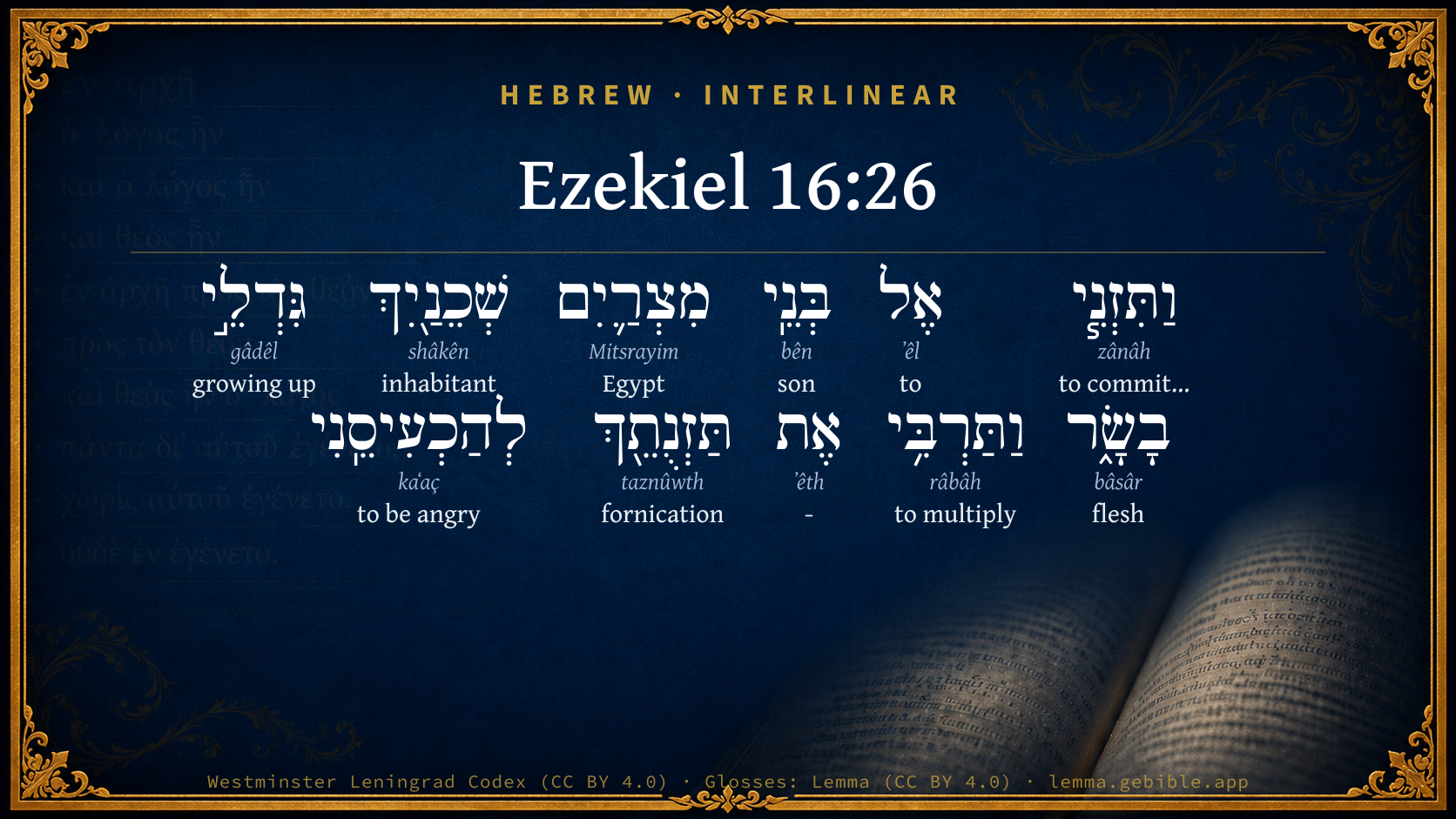
Hebrew (Westminster Leningrad Codex) Ezekiel 16:26 appears in the Hebrew Old Testament. The text above is from the Westminster Leningrad Codex. Each word links to its Strong’s number, a concise gloss, and parsing drawn from the Open Scriptures Hebrew Bible morphology. Click any word for its full Brown-Driver-Briggs (BDB) entry.
Download image
Cite this verse

Ezekiel 16:26 (World English Bible). Public Domain. Lemma interlinear Bible study tool, https://lemma.gebible.app/v/ezekiel/16/26.

Show BibTeX & RIS
BibTeX
RIS
English Translation
You have also committed sexual immorality with the Egyptians, your neighbors, great of flesh; and have multiplied your prostitution, to provoke me to anger.
World English Bible · Public Domain
Download a study sheet

One document with this verse’s original text, its word-by-word gloss line, the meaning frame, cross-references with their text, attributed commentary, and full source and license credits — printable, and it pastes into notes with its structure intact.

This verse Autodidact and up

Study sheet (.html) Plain text (.txt)

A passage Seminary Student

Up to 50 verses in one chapter. A passage sheet keeps up to 6 commentary sources and 12 cross-references per verse, in the order this page ranks them, and says so on the sheet whenever that leaves anything out. Ask for a single verse and you get the Autodidact verse sheet above.

Everything on this page stays free to read, with no account — the sheet is a download of what is already on screen, not access to it.

Want to remove ads? Support Godless Engineer
Compare translations 3

The same verse in 3 English versions, stacked beneath the original-language interlinear above. Click any original word for its lexicon entry.

Each is an independent rendering of the whole verse — the interlinear is not word-aligned to these translations.

Highlighted words mark where these versions differ — a whole-verse word diff, not a word-by-word alignment.

  • World English Bible Public Domain
    You have also committed sexual immorality with the Egyptians, your neighbors, great of flesh; and have multiplied your prostitution, to provoke me to anger.
  • King James Version Public Domain
    Thou hast also committed fornication with the Egyptians thy neighbours, great of flesh; and hast increased thy whoredoms, to provoke me to anger.
  • unfoldingWord Literal Text CC BY-SA 4.0
    You have acted like a prostitute with the Egyptians, your lustful neighbors, and you committed many more acts of prostitution, provoking me to anger.

unfoldingWord Literal Text — © unfoldingWord, licensed CC BY-SA 4.0. Word-aligned USFM3 via Door43 (git.door43.org/unfoldingWord/en_ult).

Versions to compare (up to 4)

3 of 4 selected

Show all 18 translations

Every available English version of this verse, each an independent rendering of the whole verse.

  • World English Bible Public Domain
    You have also committed sexual immorality with the Egyptians, your neighbors, great of flesh; and have multiplied your prostitution, to provoke me to anger.
  • Berean Standard Bible Public Domain
    You prostituted yourself with your lustful neighbors, the Egyptians, and increased your promiscuity to provoke Me to anger.
  • Majority Standard Bible Public Domain
    You prostituted yourself with your lustful neighbors, the Egyptians, and increased your promiscuity to provoke Me to anger.
  • King James Version Public Domain
    Thou hast also committed fornication with the Egyptians thy neighbours, great of flesh; and hast increased thy whoredoms, to provoke me to anger.
  • American Standard Version (1901) Public Domain
    Thou hast also committed fornication with the Egyptians, thy neighbors, great of flesh; and hast multiplied thy whoredom, to provoke me to anger.
  • Revised Version (1885) Public Domain
    Thou hast also committed fornication with the Egyptians, thy neighbours, great of flesh; and hast multiplied thy whoredom, to provoke me to anger.
  • Geneva Bible (1599) Public Domain
    Thou hast also committed fornication with the Egyptians thy neighbours, which haue great members, and hast encreased thy whoredome, to prouoke me.
  • Douay-Rheims (1899) Public Domain
    And thou hast committed fornication with the Egyptians thy neighbours, men of large bodies, and hast multiplied thy fornications to provoke me.
  • Young's Literal Translation Public Domain
    And dost go a-whoring unto sons of Egypt, Thy neighbours -- great of appetite! And thou dost multiply thy whoredoms, To provoke Me to anger.
  • Literal Standard Version CC BY-SA 4.0
    And go whoring to sons of Egypt, || Your neighbors—great of appetite! And you multiply your whoredoms, || To provoke Me to anger.
  • Unlocked Literal Bible CC BY-SA 4.0
    You have acted like a prostitute with the Egyptians, your lustful neighbors, and you committed many more acts of prostitution, provoking me to anger.
  • unfoldingWord Literal Text CC BY-SA 4.0
    You have acted like a prostitute with the Egyptians, your lustful neighbors, and you committed many more acts of prostitution, provoking me to anger.
  • Darby Bible Public Domain
    And thou didst commit fornication with the Egyptians thy neighbours, great of flesh; and didst multiply thy whoredom to provoke me to anger.
  • World Messianic Bible Public Domain
    You have also committed sexual immorality with the Egyptians, your neighbors, great of flesh; and have multiplied your prostitution, to provoke me to anger.
  • Webster's Bible Public Domain
    Thou hast also committed fornication with the Egyptians thy neighbors, great of flesh; and hast multiplied thy lewd deeds, to provoke me to anger.
  • Free Bible Version CC BY-SA 4.0
    You gave yourself as a prostitute to your Egyptian neighbors with their large sexual organs, making me angry as you became even more promiscuous.
  • Bible in Basic English Public Domain
    And you went with the Egyptians, your neighbours, great of flesh; increasing your loose ways, moving me to wrath.
  • JPS Tanakh (1917) Public Domain
    Thou hast also played the harlot with the Egyptians, thy neighbours, great of flesh; and hast multiplied thy harlotry, to provoke Me.

Literal Standard Version (2020), Covenant Press — licensed CC BY-SA 4.0. Text via the HelloAO Bible API (eBible.org). Unlocked Literal Bible (unfoldingWord) — licensed CC BY-SA 4.0. Text via the HelloAO Bible API (eBible.org). unfoldingWord Literal Text — © unfoldingWord, licensed CC BY-SA 4.0. Word-aligned USFM3 via Door43 (git.door43.org/unfoldingWord/en_ult). Free Bible Version, Dr. Jonathan Gallagher — licensed CC BY-SA 4.0. Text via the HelloAO Bible API (eBible.org).

Word by word

More ways to search: Search by grammar → Find every occurrence → Compare this word →

Practice this passage: Drill this verse → Learn its vocabulary →

גִּדְלֵ֣י
gâdêl
H1432
“growing up”
Verb, Qal, Participle Active, Masculine, Plural, Construct
Part of Speech
Verb
Stem
Qal
Form
Participle Active
Gender
Masculine
Number
Plural
State
Construct
Full BDB Definition

Origin: from H1431

TWOT: 315a

becoming great, growing up
  1. וַתִּזְנִ֧י zânâh H2181 “and · to commit fornication” Conjunction + Verb, Qal, Sequential Imperfect, 2nd Person, Feminine, Singular
  2. אֶל ʼêl H413 “to” Preposition
  3. בְּנֵֽי bên H1121 “sons of” Noun, Common, Masculine, Plural, Construct
  4. מִצְרַ֛יִם Mitsrayim H4714 “Egypt” Noun, Proper
  5. שְׁכֵנַ֖יִךְ shâkên H7934 “inhabitant · your” Adjective, Adjective, Masculine, Plural, Construct + Suffix, Personal, 2nd Person, Feminine, Singular
  6. בָשָׂ֑ר bâsâr H1320 “flesh” Noun, Common, Masculine, Singular, Absolute
  7. וַתַּרְבִּ֥י râbâh H7235 “and · to multiply” Conjunction + Verb, Hiphil, Sequential Imperfect, 2nd Person, Feminine, Singular
  8. אֶת ʼêth H853 “-” Particle, Direct Object
  9. תַּזְנֻתֵ֖ךְ taznûwth H8457 “fornication · your” Noun, Common, Feminine, Singular, Construct + Suffix, Personal, 2nd Person, Feminine, Singular
  10. לְהַכְעִיסֵֽנִי kaʻaç H3707 “to be angry · me” Preposition + Verb, Hiphil, Infinitive Construct + Suffix, Personal, 1st Person, Common, Singular

About this verse

These counts appear in no published source. They are computed here, from the morphology-tagged text and Lemma’s own curated glosses. What Lemma adds →

11
words
11
distinct lemmas
Prophets
section

Notable vocabulary

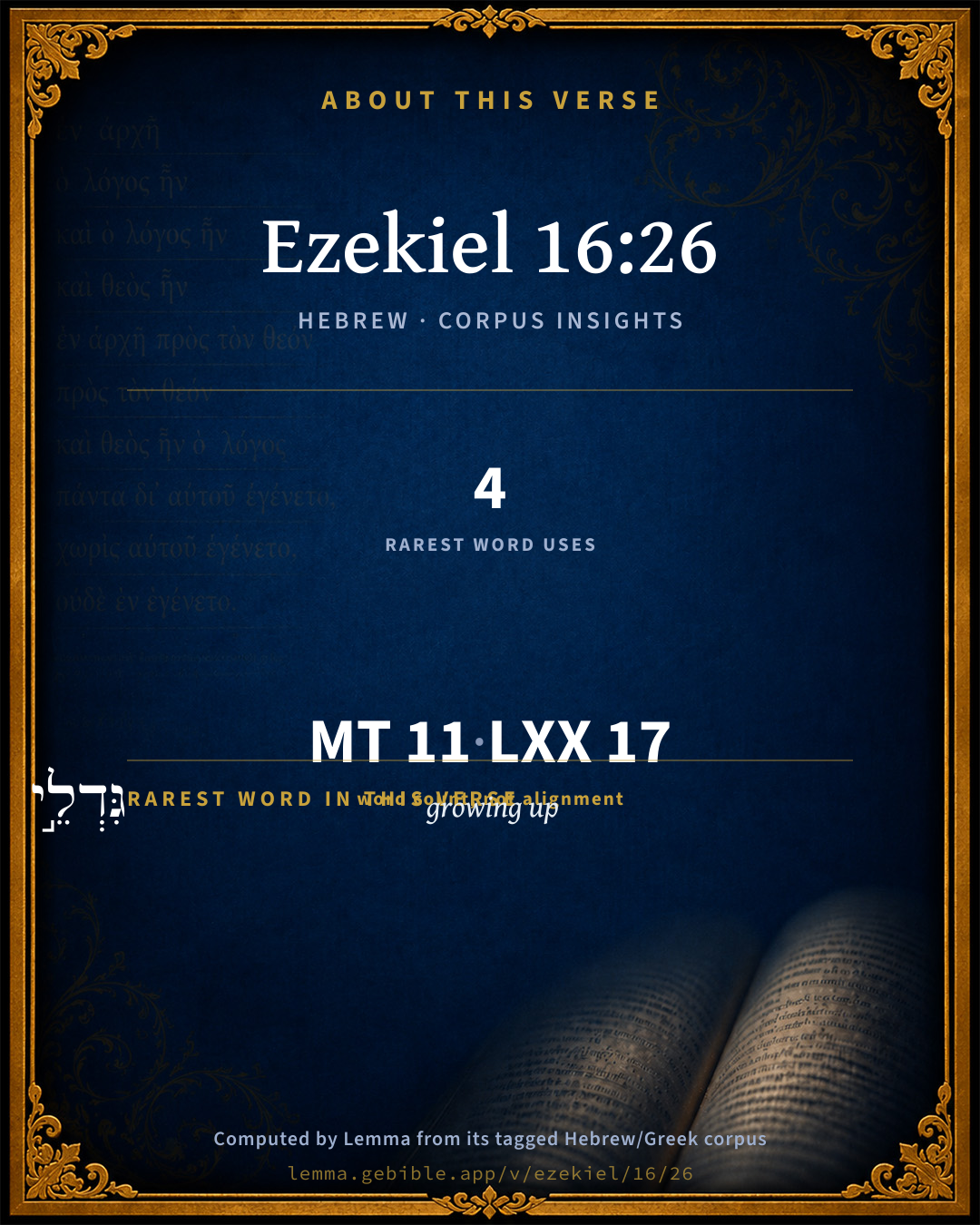
The rarest word here is גִּדְלֵ֣י growing up H1432 — appearing just 4 times in the whole Hebrew Bible.

Shared distinctive vocabulary

גִּדְלֵ֣י growing up H1432 occurs in 4 verses of the Hebrew Bible. Also found in:

Grammatical profile

  • 4 verbs
  • 4 nouns
  • 1 adjective
  • 1 preposition
  • 1 particle

Verb forms

  • וַתִּזְנִ֧י Qal · Sequential Imperfect
  • גִּדְלֵ֣י Qal · Participle Active
  • וַתַּרְבִּ֥י Hiphil · Sequential Imperfect
  • לְהַכְעִיסֵֽנִי Hiphil · Infinitive Construct

Hebrew & Septuagint length

In English translation the verse runs 24 words from the Hebrew and 25 from the Septuagint (LXX English) — closely comparable.

A rough comparison of the two English renderings, which tokenize alike — not a word-level alignment.

Word counts can differ between the Hebrew and the Greek without any difference in meaning — e.g. the Hebrew direct-object marker אֵת has no separate Greek word, and Greek often adds the article ὁ.

In the original languages it is 11 Hebrew tokens and 17 Greek tokens — but the two are counted differently (Hebrew bundles its prefixes and suffixes into one token; the Greek is in lemma form), so that isn’t a like-for-like length.

Cross-references

12

Topical passages linked to Ezekiel 16:26 in the Treasury of Scripture Knowledge — connected by theme and wording, ordered by reader-vote popularity; previews shown in the World English Bible.

  • Ezekiel 23:19–21 Yet she multiplied her prostitution, remembering the days of her youth, in which she had played the prostitute in the land of Egypt.
  • Ezekiel 20:7–8 I said to them, Cast you away every man the abominations of his eyes, and don't defile yourselves with the idols of Egypt; I am Yahweh your God.
  • Exodus 32:4 He received what they handed him, and fashioned it with an engraving tool, and made it a molten calf; and they said, "These are your gods, Israel, which brought you up out of the land of Egypt."
  • Deuteronomy 29:16–17 (for you know how we lived in the land of Egypt, and how we came through the midst of the nations through which you passed;
  • Joshua 24:14 Now therefore fear Yahweh, and serve him in sincerity and in truth; and put away the gods which your fathers served beyond the River, and in Egypt; and serve you Yahweh.
  • Isaiah 30:21 and your ears shall hear a word behind you, saying, This is the way, walk you in it; when you turn to the right hand, and when you turn to the left.
  • Jeremiah 7:18–19 The children gather wood, and the fathers kindle the fire, and the women knead the dough, to make cakes to the queen of the sky, and to pour out drink-offerings to other gods, that they may provoke me to anger.
  • Ezekiel 8:10 So I went in and saw; and see, every form of creeping things, and abominable animals, and all the idols of the house of Israel, portrayed on the wall round about.
  • Ezekiel 8:14 Then he brought me to the door of the gate of Yahweh's house which was toward the north; and see, there sat the women weeping for Tammuz.
  • Ezekiel 8:17 Then he said to me, Have you seen [this], son of man? Is it a light thing to the house of Judah that they commit the abominations which they commit here? for they have filled the land with violence, and have turned again to provoke me to anger: and, behold, they put the branch to their nose.
  • Ezekiel 23:3 and they played the prostitute in Egypt; they played the prostitute in their youth; there were their breasts pressed, and there was handled the bosom of their virginity.
  • Ezekiel 23:8 Neither has she left her prostitution since [the days of] Egypt; for in her youth they lay with her, and they handled the bosom of her virginity; and they poured out their prostitution on her.

Cross-references courtesy of OpenBible.info (CC BY 4.0).

Hebrew and Greek witnesses Masoretic Hebrew ↔ Greek Septuagint

The same verse in the two great witnesses to the Old Testament, shown verse-for-verse.

These are two independent witnesses, not word-aligned to each other, and the Septuagint is shown in lemma (dictionary) form.

Hebrew Ezekiel 16:26 Masoretic · Westminster Leningrad Codex

וַתִּזְנִ֧י אֶל בְּנֵֽי מִצְרַ֛יִם שְׁכֵנַ֖יִךְ גִּדְלֵ֣י בָשָׂ֑ר וַתַּרְבִּ֥י אֶת תַּזְנֻתֵ֖ךְ לְהַכְעִיסֵֽנִי

You have also committed sexual immorality with the Egyptians, your neighbors, great of flesh; and have multiplied your prostitution, to provoke me to anger.

World English Bible · Public Domain

Greek LXX Ezekiel 16:26 Septuagint · lemma form

καί ἐκπορνεύω ἐπί ὁ υἱός αἴγυπτος ὁ ὁμορέω σύ ὁ μεγαλόσαρκος καί πολλαχῶς ἐκπορνεύω ὁ παραὀργίζω ἐγώ

And you did go a-whoring after the children of Egypt your neighbors, great of flesh; and did go a-whoring, often to provoke me to anger.

LXX2012 (modern English Septuagint) · Public Domain

Hebrew: Westminster Leningrad Codex (CC BY 4.0). Greek: Septuagint (public domain); English from LXX2012 (modern English Septuagint) (Public Domain). How the Septuagint differs from the Hebrew →

Targum (Aramaic paraphrase)

1

The Targum is the ancient Jewish Aramaic paraphrase of the Hebrew Scriptures — an interpretive translation, not the Hebrew text itself. Onkelos (literal) and Pseudo-Jonathan (expansive) render the Torah, and Jonathan the Prophets. Coverage is partial: where no permissively-licensed English translation exists for a verse, only the Aramaic is shown. This is verse-level text, not a word-by-word alignment to the Hebrew.

  1. Targum Jonathan Prophets (Joshua–Malachi)
    וּטְעֵית בָּתַר בְּנֵי מִצְרַיִם קְרִיבַיִךְ מְסַרְבְּלֵי בְּסַר וְאַסְגֵית יַת טַעֲוָתַיִךְ לְאַרְגָזָא קֳדָמַי:

    (no public-domain English translation for this verse)

    Targum Jonathan — Aramaic: “Mikraot Gedolot” (public domain). English: “Sefaria Community Translation” (CC0 1.0 (public-domain dedication)); “London "Chaldee Paraphrase," 1871” (public domain). Text via Sefaria.

Commentary

Notes on Ezekiel 16:26 from classic Christian and Jewish commentators (each source and its license shown beneath its notes). The classic Christian expositions comment on the surrounding passage and are grouped to its opening verse, so a note may address several verses; the Jewish commentaries on the Tanakh (Rashi and others) are per-verse, so they appear only where the commentator wrote on this verse.

Lemma curates 59 commentaries, every one of them public domain or Creative Commons licensed, each selected and text-cleaned for this edition rather than reprinted as found. About our sources →

Trapp's Complete Commentary

John Trapp

Eze 16:26 Thou hast also committed fornication with the Egyptians thy neighbours, great of flesh; and hast increased thy whoredoms, to provoke me to anger.

Ver. 26. Great of flesh.] Torosi, scil., propter potentiam et petulantiam. The prophet persisteth in the metaphor, from the manner of shamelessly lascivious women: such as was Messalina, the wife of Claudius the emperor; and she in Apuleius that entertained the ass. See Eze 23:20. Flesh is here and elsewhere taken for the privities, quod est membrum prorsus carneum.

John Trapp, A Commentary or Exposition upon All the Books of the Old and New Testament (1647–1656) — public domain. Text from a community e-Sword module.

Tyndale Open Study Notes

Tyndale Open Resources

16:26-29 Jerusalem actively promoted promiscuity in pursuing Egypt, the Assyrians, and Babylonia in alliances that were financially costly and that rarely delivered the expected benefits. These alliances would have been just as reprehensible if they had delivered tangible political benefits, because they demonstrated lack of trust in the Lord. Inevitably, they also led Israel into worship of the allied nations’ gods.

Tyndale Open Study Notes — © Tyndale Open Resources, licensed CC BY-SA 4.0. Text via the HelloAO Bible API.

Geneva Bible (1599)

Geneva Bible translators

He noteth the great impiety of this people, who first falling from God to seek help at strange nations, did also at length embrace their idolatry, thinking thereby to make their amity more strong.

Geneva Bible (1599) marginal notes — public domain. Text via Bolls.life.

Jamieson, Fausset & Brown

Robert Jamieson, A. R. Fausset & David Brown

fornication with . . . Egyptians--alliances with Egypt, cemented by sharing their idolatries.

great of flesh--of powerful virile parts; figuratively for the gross and lustful religion of Egypt (for example, Isis, &c.), which alone could satisfy the abominable lust of Israel (Eze 20:7-8; Eze 23:19-21).

to provoke me--wantonly and purposely.

Jamieson, Fausset & Brown — Commentary Critical and Explanatory on the Whole Bible (1871) — public domain (CC PDM 1.0). Text via the HelloAO Bible API.

Adam Clarke's Commentary

Verse 26. Great of flesh] The most extensive idolaters. Bene vasatis-longa mensura incognita nervy - Juv. Sat. ix. 34. This is the allusion.

Adam Clarke's Commentary on the Bible (1810–1826) — public domain. Text from a community e-Sword/MySword module.

John Calvin's Commentaries

I Mentioned at the beginning of the chapter, that the Prophet blames the Jews not for one single kind of fornication, but for two different kinds. Interpreters do not observe this, but think that the Prophet is always discoursing of idols and superstitions. But if we prudently weigh all the circumstances, what I have said will not appear doubtful, namely, that the Jews were condemned not only for vitiating the worship of God by their perverse fictions, but for flying, now to the Egyptians, now to the Assyrians, and thus involving themselves in unlawful covenants. It is a very common method with the Prophets to call such covenants fornications: for as a wife ought to lie under the shadow of her husband, so God wished the Jews to be content under his protection. But as soon as any danger frightened them, they fled tremblingly to either Egypt, or Assyria, or Chaldea. We see, then, that they had in some sense renounced God’s help, since they could not rest under his protection, but were hurried hither and thither by vague impulse. After the Prophet had inveighed against their superstitions, he now approaches another crime, namely, the Jews implicating themselves in forbidden treaties. He begins with Egypt. God had clearly forbidden the elect people to have any dealings with Egypt. Even if God had not made known the reason, yet they ought to have obeyed his command. But I have already explained the reason why God was unwilling that the Israelites should enter into any covenant with the Egyptians, because he wished to try their faith and patience, and if they would fly to his help when any danger pressed upon them, as the saying is, like a sacred anchor. There was also another reason, because from the time when God drew his people out from thence, he wished them separated from that nation which had raged so cruelly against their miserable guests. As far as the Chaldmans and Assyrians are concerned, the former reason prevailed thus far, that it was not lawful for them to distrust God’s aid in their dangers.

Now, therefore, we understand the Prophet’s meaning when he says, that the Jews had committed fornication with the sons of Egypt He adds, they were gross in flesh. He means that they were foul and immodest, and were inflamed with disgraceful lust. He uses a grosser simile by and by, for the perfidy of this detestable people could not be sufficiently condemned. The Prophet here says reproachfully, you have committed fornication with the Egyptians, as a licentious woman acting most basely. He adds, you have multiplied thy fornications: he speaks to the people under the character of a woman, as we have formerly seen: to irritate me. Here the Prophet takes away all excuse for error from the impious people. He says, therefore, since they so wandered after these impure desires, that they had not fallen through ignorance, since they knew well enough what God had commanded in his law. And there is no doubt that they darkened their own minds, as the impious always dig hiding-places for themselves, and have specious pretexts, by which they not only hide their malice before men, but also deceive themselves. Hence it is probable that the Jews were not free from such pretenses. But, on the other hand, we must remark that they were abundantly instructed by God’s law what was lawful and right. Since, therefore, through neglect of the law they were so ravenous in impious desires, the Prophet says that they had purposely and designedly entered into a contest with God. For if any one raises the question whether it is lawful to enter into an alliance with the impious, the answer is easy, that we must beware of all alliances which may couple us under the same yoke; for we are naturally enough inclined towards all vices: and when we invent fresh occasions for sin we tempt God. And when any one joins himself in too great familiarity with the impious, it is just like using a fan to inflame his corrupt affections, which, as I have said, were already sufficiently flagrant in his mind. We must take care, therefore, as far as we can, not to make agreements with the impious. But, if necessity compels us, this conduct cannot be thought wrong in itself, as we see that Abraham entered into an agreement with his neighbors, though their religion was different. (Genesis 21:27,32.) But because he could not otherwise obtain peace, that was a kind of agreement by which Abraham hoped to acquire peace for himself. (Genesis 14:13; Isaiah 51:2.) Nor did he hesitate to use the assistance of allies when he succored his nephew. But if we seek the principle and the cause which induced Abraham to enter into a treaty with his neighbors, we shall find his intention to be nothing else but to dwell at home in peace, and to be safe from all injury. He was solitary, as Isaiah calls him: he had, indeed, a numerous family, but no offspring; and hence he could not escape making treaties with his neighbors. But when the Lord placed the people in the land of Canaan on the condition of defending them there, of protecting them on all sides, and of opposing all their foes, we see them enclosed, as it were, by his protection, so as to render all treaties useless; since they could not treat with either the Egyptians or the Assyrians without at the same time withdrawing themselves from God’s aid.

As far as we are concerned, I have said that we have more freedom, if we are only careful that the lusts of the flesh do not entice us to seek alliances which may entangle us in the sins of others; for it is difficult to retain the favor of those with whom we associate, unless we entirely agree with them. If they are impious, they will draw us into contempt of God and adulterous rites, and so it will happen that one evil will spring from another. Nothing, therefore, is better than to reef our sails, and to look to God alone, and to have our minds fixed on him, and not to allow any kind of alliance, unless necessity compels us. And though we must prudently take care that no condition be mingled with it which may draw us off from the pure and sincere worship of God, since the devil is always cleverly plotting against the sons of God, and draws them into hidden snares. When, therefore, we are about to contract an alliance, we should always take care lest our liberty be in any degree abridged, and lest we be drawn aside by stealthy and concealed arts from the simple worship of God. It now follows —

John Calvin's Commentaries (1540-1563) — public domain. Text from the Calvin Translation Society English edition (1840s-50s) via the Christian Classics Ethereal Library (ccel.org). Calvin's coverage is partial (roughly two-thirds of the Bible); uncommented books and verses are honest gaps, never fabricated. The 19th-century editor's footnotes and remarks are omitted so the notes are faithfully Calvin's own voice.

Ellicott's Commentary for English Readers

(26) The Egyptians . . . great of flesh.—The Egyptians are properly named first, because, even in the golden calf of the wilderness, the Israelites turned with avidity to the worship of Egypt. This tendency seems to have been only suppressed, not extinguished, during the subsequent ages, and remained ever ready to develop itself, as in the calves of Jeroboam (1Ki_12:28-30); but it received great accession of strength during the reigns of Solomon and his successors. The Egyptians are called “great of flesh” from the character of their popular worship, which was a thoroughly sensuous nature worship. The connection of Israel with Egypt in the latter part of the monarchy was not only religious, but political, in bold defiance of the reiterated Divine commands. Especially at this time, a great part of the work of Jeremiah was to oppose the tendency of the successive kings of Judah to alliance with Egypt.

A Bible Commentary for English Readers, edited by Charles John Ellicott (1878–1897) — public domain. Text from a community e-Sword module.

The Cambridge Bible for Schools and Colleges

gen. ed. J. J. S. Perowne

26. Egyptian idolatry.

hast also committed] and thou didst commit. The narrative tense should be used throughout.

great of flesh] In an obscene sense. Cf. ch. Eze_23:20. The expression is chosen probably to represent the brutality of the Egyptian idolatries, which in some ways were baser than those of any people.

The Cambridge Bible for Schools and Colleges (gen. ed. J. J. S. Perowne; Cambridge University Press, 1878–1918) — public domain. Text from a community e-Sword module.

John Gill's Exposition

Behold, therefore I have stretched out my hand over thee,.... His chastising and correcting hand, to show his resentment at their sins, and bring them to a sense of them, and repentance for them:

and have diminished thine ordinary food; their stated allowances, the common mercies and blessings of life they had been indulged with, but now were lessened; and particularly a famine was brought upon them, as well as they were deprived of other favours for their sins; God dealing with them as husbands with their wanton wives, who keep them to stricter allowance, and closer confinement, in order to check and tame them:

and delivered thee unto the will of them that hate thee, the daughters of the Philistines; which perhaps may refer to the times of Ahaz, when the Philistines invaded the cities of the low country, and of the south of Judah, and took many of their cities, and brought Judah low, Ch2 28:18;

which are ashamed of thy lewd way: of their inconstancy in changing their religion, relinquishing the worship of the true God, and embracing that of others, when they abode by their ancient religion and worship, Jer 2:10. The Targum is,

"to whom if I had sent my prophets, they would have been ashamed;''

see Mat 11:21.

John Gill's Exposition of the Whole Bible (1746–1763) — public domain (CC PDM 1.0). Text via the HelloAO Bible API.

Albert Barnes' Notes on the Bible

Egyptian idolatry, a worship of the powers of nature, was eminently sensual. The idolatry here spoken of is not so much that which Israel brought with them from Egypt, as the idolatry introduced in the time of Solomon and Rehoboam.

Albert Barnes' Notes on the Bible (1834–1885) — public domain. Text from a community e-Sword/MySword module.

Haydock's Catholic Bible Commentary

Bodies. Literally, "flesh." (Haydock) (Juvenal ix. 34.) (Menochius) --- The Egyptians are tall, but meagre. (Valle. Ep. xi.) --- They were the most dissolute in their worship, and corrupted most other nations as well as the Jews, chap. xx. 8., and xxiii. 3.

George Leo Haydock (1774–1849), Haydock's Catholic Family Bible and Commentary, 1859 edition — public domain. Excludes Psalms (Douay-Rheims chapter numbering differs from Protestant) and Deuterocanonical books (Catholic canon only).

Matthew Poole's English Annotations

Committed fornication; both figuratively and literally understood; worshipped Egypt’s gods, made covenants with them, kept up a commerce of trade with them, and prostituted themselves to their lusts too, by cohabitation, while the servitude lasted, and by nearness of place, when in Canaan. The Jewish nation retained too much inclination to those idolatrous and lustful neighbours.

Great of flesh; politically they were great in power, and like to defend and help the Jews; naturally of big make, and men of great stature, and such as insatiable adulteresses would covet; and these considerations induced adulterous and idolatrous Israel to unite with them in leagues and religion.

To anger; to a fierceness of anger for its degree, and to an abhorring and contemning of the person against whom this anger is stirred.

Matthew Poole's English Annotations on the Holy Bible (1683–1685) — public domain. Text from a community e-Sword/MySword module.

Whedon's Commentary on the Bible

Daniel D. Whedon

26. Great of flesh — Not obesity, but fleshliness. The Egyptians were given up to the lusts of the flesh. The animalism of the Egyptian religion — which was explained mystically by its most spiritual teachers — was taken literally by foreign proselytes, who made this a most coarse and beastly cult.

Daniel D. Whedon (gen. ed.), Commentary on the Old and New Testaments (1874–1909) — public domain. Text from a community e-Sword module.

The Pulpit Commentary

With the Egyptians. The words point to political and commercial alliances, in themselves a whoredom (Isa_23:17; Nah_3:4) such as Zedekiah, like some of his predecessors, had trusted in, as well as to the adoption of Egyptian worship, such as we have seen in Eze_8:10, the one leading naturally to the other. The words, great of flesh, may point, as we interpret the parable, to the supposed strength of the stout and stalwart soldiers, the chariots and horses of the Egyptians, but possibly also may be an euphemism for the mere animal vigour which stimulated passion.

The Pulpit Commentary (1880–1919), ed. H.D.M. Spence-Jones & Joseph S. Exell — public domain. Text from a community e-Sword module.

John Wesley's Explanatory Notes

Great of flesh - Naturally of a big, make, and men of great stature.

John Wesley, Explanatory Notes Upon the Whole Bible (1754–1765) — public domain. Text via the GEBible commentary corpus.

Rashi

Rabbi Shlomo Yitzchaki (Rashi)

great of flesh Having a large male organ.

Rashi on the Tanakh — English translations: “The Judaica Press complete Tanach with Rashi, translated by A. J. Rosenberg” (CC BY 4.0); “Pentateuch with Rashi's commentary by M. Rosenbaum and A.M. Silbermann, 1929-1934” (public domain); “The Metsudah Tanach series, Lakewood, N.J” (CC BY 4.0); and “The Book of Joshua, Metsudah Publications, 1997” (CC BY 4.0). Text via Sefaria.

Lesson kit

Teaching starters — assembled from the data on this page, not authored interpretation. Every prompt links to the verse data it draws on. Edit before teaching.

Ezekiel, in the Prophets, opens this verse with 11 words (11 distinct Hebrew lemmas). Its most distinctive word is gâdêl (“growing up”). A historical commentator’s framing appears above. Read the whole chapter for the surrounding context.

Discussion questions

  1. What does “growing up” (gâdêl) contribute to the verse as a whole?
  2. Genesis 26:13 shares the word «growing up» with this verse. How do the two illuminate each other?
  3. These translations render this verse differently. What is at stake in choosing one wording over another?
  4. The verb «וַתִּזְנִ֧י» is Qal Sequential Imperfect. How does its form color the action?
  5. Reading how Trapp's Complete Commentary and Tyndale Open Study Notes read this verse, where do the two commentators agree and where do they part?

Things to notice

Reading settings

Reading text

Shown beneath each verse's original-language words.

Old Testament
Old Testament edition

Read the OT as the Masoretic Hebrew (MT) or the Greek Septuagint (LXX).

English shown for the Greek Septuagint (in the Hebrew ↔ Greek comparison).

Comparing translations? Open the Compare panel on any verse page to stack up to four side by side.