
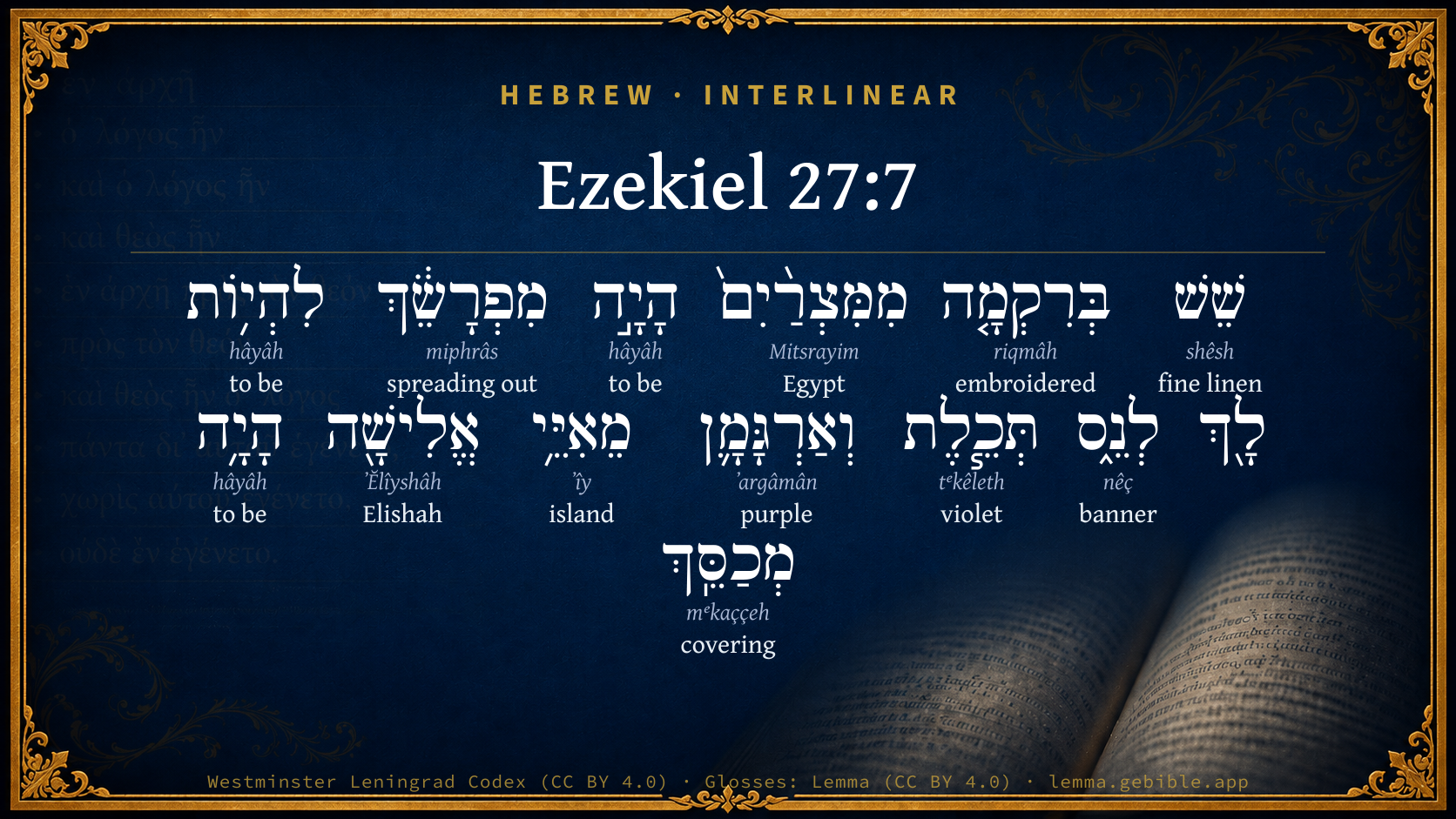
Ezekiel 27:7

Hebrew (Westminster Leningrad Codex) Ezekiel 27:7 appears in the Hebrew Old Testament. The text above is from the Westminster Leningrad Codex. Each word links to its Strong’s number, a concise gloss, and parsing drawn from the Open Scriptures Hebrew Bible morphology. Click any word for its full Brown-Driver-Briggs (BDB) entry.
Download image
Cite this verse

Ezekiel 27:7 (World English Bible). Public Domain. Lemma interlinear Bible study tool, https://lemma.gebible.app/v/ezekiel/27/7.

Show BibTeX & RIS
BibTeX
RIS
English Translation
Of fine linen with embroidered work from Egypt was your sail, that it might be to you for an ensign; blue and purple from the isles of Elishah was your awning.
World English Bible · Public Domain
Download a study sheet

One document with this verse’s original text, its word-by-word gloss line, the meaning frame, cross-references with their text, attributed commentary, and full source and license credits — printable, and it pastes into notes with its structure intact.

This verse Autodidact and up

Study sheet (.html) Plain text (.txt)

A passage Seminary Student

Up to 50 verses in one chapter. A passage sheet keeps up to 6 commentary sources and 12 cross-references per verse, in the order this page ranks them, and says so on the sheet whenever that leaves anything out. Ask for a single verse and you get the Autodidact verse sheet above.

Everything on this page stays free to read, with no account — the sheet is a download of what is already on screen, not access to it.

Want to remove ads? Support Godless Engineer
Compare translations 3

The same verse in 3 English versions, stacked beneath the original-language interlinear above. Click any original word for its lexicon entry.

Each is an independent rendering of the whole verse — the interlinear is not word-aligned to these translations.

Highlighted words mark where these versions differ — a whole-verse word diff, not a word-by-word alignment.

  • World English Bible Public Domain
    Of fine linen with embroidered work from Egypt was your sail, that it might be to you for an ensign; blue and purple from the isles of Elishah was your awning.
  • King James Version Public Domain
    Fine linen with broidered work from Egypt was that which thou spreadest forth to be thy sail; blue and purple from the isles of Elishah was that which covered thee.
  • unfoldingWord Literal Text CC BY-SA 4.0
    Your sails were made from colorful linen from Egypt that served as your banner; the colors of blue and purple from the coasts of Elishah are used for the awning on your boat.

unfoldingWord Literal Text — © unfoldingWord, licensed CC BY-SA 4.0. Word-aligned USFM3 via Door43 (git.door43.org/unfoldingWord/en_ult).

Versions to compare (up to 4)

3 of 4 selected

Show all 18 translations

Every available English version of this verse, each an independent rendering of the whole verse.

  • World English Bible Public Domain
    Of fine linen with embroidered work from Egypt was your sail, that it might be to you for an ensign; blue and purple from the isles of Elishah was your awning.
  • Berean Standard Bible Public Domain
    Of embroidered fine linen from Egypt they made your sail, which served as your banner. Of blue and purple from the coasts of Elishah they made your awning.
  • Majority Standard Bible Public Domain
    Of embroidered fine linen from Egypt they made your sail, which served as your banner. Of blue and purple from the coasts of Elishah they made your awning.
  • King James Version Public Domain
    Fine linen with broidered work from Egypt was that which thou spreadest forth to be thy sail; blue and purple from the isles of Elishah was that which covered thee.
  • American Standard Version (1901) Public Domain
    Of fine linen with broidered work from Egypt was thy sail, that it might be to thee for an ensign; blue and purple from the isles of Elishah was thine awning.
  • Revised Version (1885) Public Domain
    Of fine linen with broidered work from Egypt was thy sail, that it might be to thee for an ensign; blue and purple from the isles of Elishah was thine awning.
  • Geneva Bible (1599) Public Domain
    Fine linen with broydered woorke, brought from Egypt, was spread ouer thee to be thy sayle, blue silke and purple, brought from the yles of Elishah, was thy couering.
  • Douay-Rheims (1899) Public Domain
    Fine broidered linen from Egypt was woven for thy sail, to be spread on thy mast: blue and purple from the islands of Elisa, were made thy covering.
  • Young's Literal Translation Public Domain
    Of fine linen with embroidery from Egypt hath been thy sail, To be to thee for an ensign, Of blue and purple from isles of Elishah hath been thy covering.
  • Literal Standard Version CC BY-SA 4.0
    Your sail has been of fine linen with embroidery from Egypt, || To be for your ensign, || Your covering has been of blue and purple from islands of Elishah.
  • Unlocked Literal Bible CC BY-SA 4.0
    Your sails were made from colorful linen from Egypt that served as your banner; the colors of blue and purple from the coasts of Elishah are used for the awning on your boat.
  • unfoldingWord Literal Text CC BY-SA 4.0
    Your sails were made from colorful linen from Egypt that served as your banner; the colors of blue and purple from the coasts of Elishah are used for the awning on your boat.
  • Darby Bible Public Domain
    Byssus with broidered work from Egypt was thy sail, to serve thee for a banner; blue and purple from the isles of Elishah was thine awning.
  • World Messianic Bible Public Domain
    Your sail was of fine linen with embroidered work from Egypt, that it might be to you for a banner. Blue and purple from the islands of Elishah was your awning.
  • Webster's Bible Public Domain
    Fine linen with broidered work from Egypt was that which thou spreadest forth to be thy sail; blue and purple from the isles of Elishah was that which covered thee.
  • Free Bible Version CC BY-SA 4.0
    They made your sail with the best linen from Egypt—this was your flag that everyone recognized. They used cloth dyed blue and purple from the coastlands of Elishah to make your awnings.
  • Bible in Basic English Public Domain
    The best linen with needlework from Egypt was your sail, stretched out to be a flag for you; blue and purple from the sea-lands of Elishah gave you shade.
  • JPS Tanakh (1917) Public Domain
    Of fine linen with richly woven work from Egypt was thy sail, that it might be to thee for an ensign; blue and purple from the isles of Elishah was thine awning.

Literal Standard Version (2020), Covenant Press — licensed CC BY-SA 4.0. Text via the HelloAO Bible API (eBible.org). Unlocked Literal Bible (unfoldingWord) — licensed CC BY-SA 4.0. Text via the HelloAO Bible API (eBible.org). unfoldingWord Literal Text — © unfoldingWord, licensed CC BY-SA 4.0. Word-aligned USFM3 via Door43 (git.door43.org/unfoldingWord/en_ult). Free Bible Version, Dr. Jonathan Gallagher — licensed CC BY-SA 4.0. Text via the HelloAO Bible API (eBible.org).

Word by word

More ways to search: Search by grammar → Find every occurrence → Compare this word →

Practice this passage: Drill this verse → Learn its vocabulary →

מִפְרָשֵׂ֔ךְ
miphrâs
H4666
“spreading out · your”
Noun, Common, Masculine, Singular, Construct + Suffix, Personal, 2nd Person, Feminine, Singular
Part of Speech
Noun
Type
Common
Gender
Masculine
Number
Singular
State
Construct
Full BDB Definition

Origin: from H6566

TWOT: 1832a

spreading out, thing spread out
  1. שֵׁשׁ shêsh H8336 “fine linen” Adjective, Cardinal number, Feminine, Singular, Absolute
  2. בְּרִקְמָ֤ה riqmâh H7553 “in/at · embroidered” Preposition + Noun, Common, Feminine, Singular, Absolute
  3. מִמִּצְרַ֨יִם֙ Mitsrayim H4714 “from · Egypt” Preposition + Noun, Proper
  4. הָיָ֣ה hâyâh H1961 “to be” Verb, Qal, Perfect, 3rd Person, Masculine, Singular
  5. לִהְי֥וֹת hâyâh H1961 “to be” Preposition + Verb, Qal, Infinitive Construct
  6. לְנֵ֑ס nêç H5251 “to/for · banner” Preposition + Noun, Common, Masculine, Singular, Absolute
  7. תְּכֵ֧לֶת tᵉkêleth H8504 “violet” Noun, Common, Feminine, Singular, Absolute
  8. וְאַרְגָּמָ֛ן ʼargâmân H713 “and · purple” Conjunction + Noun, Common, Masculine, Singular, Absolute
  9. מֵאִיֵּ֥י ʼîy H339 “from · islands of” Preposition + Noun, Common, Masculine, Plural, Construct
  10. אֱלִישָׁ֖ה ʼĔlîyshâh H473 “Elishah” Noun, Proper
  11. הָיָ֥ה hâyâh H1961 “to be” Verb, Qal, Perfect, 3rd Person, Masculine, Singular
  12. מְכַסֵּֽךְ mᵉkaççeh H4374 “covering · your” Noun, Common, Masculine, Singular, Construct + Suffix, Personal, 2nd Person, Feminine, Singular

About this verse

These counts appear in no published source. They are computed here, from the morphology-tagged text and Lemma’s own curated glosses. What Lemma adds →

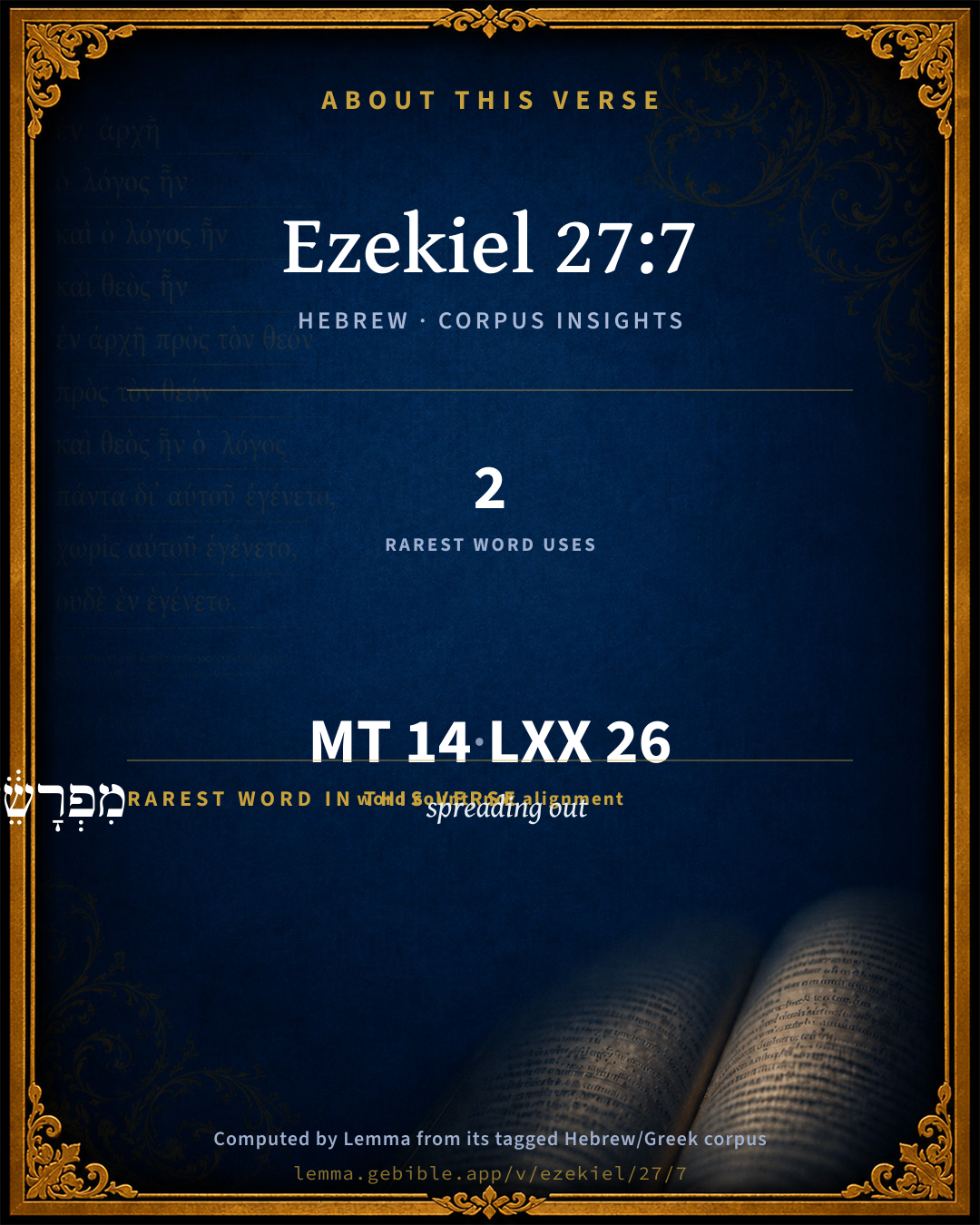
14
words
11
distinct lemmas
Prophets
section

Notable vocabulary

The rarest word here is מִפְרָשֵׂ֔ךְ spreading out H4666 — appearing just 2 times in the whole Hebrew Bible.

Shared distinctive vocabulary

מִפְרָשֵׂ֔ךְ spreading out H4666 occurs in 2 verses of the Hebrew Bible. Also found in:

Grammatical profile

  • 3 verbs
  • 9 nouns
  • 1 adjective
  • 1 preposition

Verb forms

  • הָיָ֣ה Qal · Perfect
  • לִהְי֥וֹת Qal · Infinitive Construct
  • הָיָ֥ה Qal · Perfect

Repetition

A word recurs within this verse — often emphatic in Hebrew:

  • הָיָ֣ה to be H1961 ×3

Hebrew & Septuagint length

In English translation the verse runs 31 words from the Hebrew and 32 from the Septuagint (LXX English) — closely comparable.

A rough comparison of the two English renderings, which tokenize alike — not a word-level alignment.

Word counts can differ between the Hebrew and the Greek without any difference in meaning — e.g. the Hebrew direct-object marker אֵת has no separate Greek word, and Greek often adds the article ὁ.

In the original languages it is 14 Hebrew tokens and 26 Greek tokens — but the two are counted differently (Hebrew bundles its prefixes and suffixes into one token; the Greek is in lemma form), so that isn’t a like-for-like length.

Cross-references

7

Topical passages linked to Ezekiel 27:7 in the Treasury of Scripture Knowledge — connected by theme and wording, ordered by reader-vote popularity; previews shown in the World English Bible.

  • Exodus 25:4 blue, purple, scarlet, fine linen, goats' hair,
  • Jeremiah 10:9 There is silver beaten into plates, which is brought from Tarshish, and gold from Uphaz, the work of the artificer and of the hands of the goldsmith; blue and purple for their clothing; they are all the work of skillful men.
  • Genesis 10:4 The sons of Javan: Elishah, Tarshish, Kittim, and Dodanim.
  • Isaiah 19:9 Moreover those who work in combed flax, and those who weave white cloth, shall be confounded.
  • 1 Kings 10:28 The horses which Solomon had were brought out of Egypt; and the king's merchants received them in droves, each drove at a price.
  • 1 Chronicles 1:7 The sons of Javan: Elishah, and Tarshish, Kittim, and Rodanim.
  • Proverbs 7:16 I have spread my couch with carpets of tapestry, With striped cloths of the yarn of Egypt.

Cross-references courtesy of OpenBible.info (CC BY 4.0).

Hebrew and Greek witnesses Masoretic Hebrew ↔ Greek Septuagint

The same verse in the two great witnesses to the Old Testament, shown verse-for-verse.

These are two independent witnesses, not word-aligned to each other, and the Septuagint is shown in lemma (dictionary) form.

Hebrew Ezekiel 27:7 Masoretic · Westminster Leningrad Codex

שֵׁשׁ בְּרִקְמָ֤ה מִמִּצְרַ֨יִם֙ הָיָ֣ה מִפְרָשֵׂ֔ךְ לִהְי֥וֹת לָ֖ךְ לְנֵ֑ס תְּכֵ֧לֶת וְאַרְגָּמָ֛ן מֵאִיֵּ֥י אֱלִישָׁ֖ה הָיָ֥ה מְכַסֵּֽךְ

Of fine linen with embroidered work from Egypt was your sail, that it might be to you for an ensign; blue and purple from the isles of Elishah was your awning.

World English Bible · Public Domain

Greek LXX Ezekiel 27:7 Septuagint · lemma form

βύσσος μετά ποικιλία ἐκ αἴγυπτος γίγνομαι σύ στρωμνή ὁ περιτίθημι σύ δόξα καί περιβάλλω σύ ὑάκινθος καί πορφύρα ἐκ ὁ νήσος ελισαι καί γίγνομαι περιβόλαιον σύ

Fine linen with embroidery from Egypt supplied the couch, to put honor upon you, and to clothe you with blue and purple from the isles of Elisai; and they became your coverings.

LXX2012 (modern English Septuagint) · Public Domain

On this verse, Haydock's Catholic Bible Commentary discusses the Septuagint’s reading. Read the note in Commentary ↓

Hebrew: Westminster Leningrad Codex (CC BY 4.0). Greek: Septuagint (public domain); English from LXX2012 (modern English Septuagint) (Public Domain). How the Septuagint differs from the Hebrew →

Targum (Aramaic paraphrase)

1

The Targum is the ancient Jewish Aramaic paraphrase of the Hebrew Scriptures — an interpretive translation, not the Hebrew text itself. Onkelos (literal) and Pseudo-Jonathan (expansive) render the Torah, and Jonathan the Prophets. Coverage is partial: where no permissively-licensed English translation exists for a verse, only the Aramaic is shown. This is verse-level text, not a word-by-word alignment to the Hebrew.

  1. Targum Jonathan Prophets (Joshua–Malachi)
    בּוּץ וְצִיוּרִין מִמְצְרַיִם הֲוָה פְּרָסִיךְ לְמֶהֱוֵי לִיךְ לְאָת תִּכְלָא וְאַרְגְוָנָא מִמְדִינַת אִיטַלְיָא הֲוַת כְּסוּתִיךְ:

    (no public-domain English translation for this verse)

    Targum Jonathan — Aramaic: “Mikraot Gedolot” (public domain). English: “Sefaria Community Translation” (CC0 1.0 (public-domain dedication)); “London "Chaldee Paraphrase," 1871” (public domain). Text via Sefaria.

Commentary

Notes on Ezekiel 27:7 from classic Christian and Jewish commentators (each source and its license shown beneath its notes). The classic Christian expositions comment on the surrounding passage and are grouped to its opening verse, so a note may address several verses; the Jewish commentaries on the Tanakh (Rashi and others) are per-verse, so they appear only where the commentator wrote on this verse.

Lemma curates 59 commentaries, every one of them public domain or Creative Commons licensed, each selected and text-cleaned for this edition rather than reprinted as found. About our sources →

Trapp's Complete Commentary

John Trapp

Eze 27:7 Fine linen with broidered work from Egypt was that which thou spreadest forth to be thy sail; blue and purple from the isles of Elishah was that which covered thee.

Ver. 7. Fine linen.] When coarse canvas might have served the turn as well.

From Egypt.] Which is held to be the finest, whitest, and costliest. Oh this unnecessary bravery! Luxus est anteambulo ruinae: Luxury portends your ruin, how many hath it utterly undone! When a man shall see a cloak embroidered over with woods and parks and lordships, and lined with obligations and bonds and statutes, will not the beggar soon catch such a prodigal by the back?

From the isles of Elishah,] i.e., Of Italy, saith the Chaldee paraphrast; of Greece, say others; the Fortunate islands, say some, which are called the Elysian islands for their pleasure and plenty.

Was that which covered thee.] The poop deck of thy ships. Of Cleopatra’s sumptuous ship or barge, the poop deck whereof was of gold, the oars silver, the sails purple, &c., see Plutarch in Anton.

John Trapp, A Commentary or Exposition upon All the Books of the Old and New Testament (1647–1656) — public domain. Text from a community e-Sword module.

Tyndale Open Study Notes

Tyndale Open Resources

27:7 Elishah refers to part of Cyprus.

Tyndale Open Study Notes — © Tyndale Open Resources, licensed CC BY-SA 4.0. Text via the HelloAO Bible API.

Jamieson, Fausset & Brown

Robert Jamieson, A. R. Fausset & David Brown

broidered . . . sail--The ancients embroidered their sails often at great expense, especially the Egyptians, whose linen, still preserved in mummies, is of the finest texture.

Elishah--Greece; so called from Elis, a large and ancient division of Peloponnesus. Pausanias says that the best of linen was produced in it, and in no other part of Greece; called by HOMER, Alisium.

that which covered thee--thy awning.

Jamieson, Fausset & Brown — Commentary Critical and Explanatory on the Whole Bible (1871) — public domain (CC PDM 1.0). Text via the HelloAO Bible API.

Adam Clarke's Commentary

Verse 7. Fine linen] שש shesh, cotton cloth. In this sense the word is generally to be understood.

To be thy sail] Probably the flag - ensign or pennant, is meant.

Blue and purple from the isles of Elishah] Elis, a part of the Peloponnesus.

Adam Clarke's Commentary on the Bible (1810–1826) — public domain. Text from a community e-Sword/MySword module.

Ellicott's Commentary for English Readers

(7) Fine linen with broidered work.—To a modern sailor “fine linen “may seem both an extravagant and an insufficient material for a ship’s sails, but the State ships of antiquity were often fitted out in this way, and the sails embroidered in colours in place of a pennon. The clause literally is, Linen with embroidery from Egypt was for thy spreading out (sail), to be to thee for a sign.

Isles of Elishah.—In Gen_10:4, 1Ch_1:7, Elishah is mentioned among the sons of Javan, or Ionia. The regions here referred to are the coasts of Asia Minor, where an abundant supply of the murex (from which came the famous purple dye) was obtained, when the quantity on the Tyrian coast was insufficient for its manufactures. “That which covered thee” is the awning spread over the ship’s deck.

A Bible Commentary for English Readers, edited by Charles John Ellicott (1878–1897) — public domain. Text from a community e-Sword module.

The Cambridge Bible for Schools and Colleges

gen. ed. J. J. S. Perowne

7. The rigging and furnishing of the ship. Her sail (ancient ships usually had but one) was embroidered byssus, fine linen, out of Egypt (Eze_16:10). Render: broidered byssus of Egypt was thy sail, to serve to thee for a pennon. The flag proper seems not to have been used in ancient navigation, its purpose was served by the sail, as for example at the battle of Actium the ship of Antony was distinguished by its purple sail. The word seems to mean sail, Isa_33:23. On “broidered” cf. ch. Eze_16:10; Eze_16:13; Eze_16:18.

that which covered thee] lit. thy covering (in Isa_14:11 a coverlet, cf. Isa_23:18), either an awning, or more probably a cabin, the sides and roof of which were of the fine stuffs named.

the isles of Elishah] In Gen_10:4 Elishah is one of the sons of Javan, i.e. Ionia or Grecian Asia. The Targ. renders “country of Italy.” Ges. combines the name with Elis, and understands the Peloponnesus in general, which was certainly noted for the dyes referred to in the verse.

8 seq. The manning of the ship. The inhabitants of Sidon and Arvad were her rowers, and her own wise men her steersmen.

thy mariners] rowers. Sidon lay to the N. of Tyre, about half way between it and Beirut, and was probably the oldest Phœnician town, Tyre being a colony. Sidon is the firstborn of Canaan (Gen_10:15), and is called Great Sidon in Jos_19:28. It is frequently referred to in Homer (e.g. Il. 7. 290), who does not mention Tyre. At a later time Tyre eclipsed her mother in power and wealth. Arvad (Aradus) lay greatly more to the N. It was built on a small island, over two miles from the mainland, and, being without natural harbours, piers were laboriously constructed of huge blocks of stone, 16 feet long by 7 broad, quarried on the island. It was dependent for water upon the mainland, but when its supply was cut off recourse was had to a powerful spring of fresh water which was known to rise under the sea in the channel between the town and the mainland. This spring was isolated and the water brought by a tube to the surface. The spring is said still to exist. Arvad, now Ruwâd, or, Ruweideh, is often mentioned in the Assyrian Annals. Tiglath-pileser I. (c. 1100) embarked on ships of Arvad and sailed out into “the great sea,” Del., Parad. p. 281 (the same expression is used by another king of himself, Schrader, KAT. p. 184, on 1Ki_5:13, cf. p. 104). See chart of Arvad, Rawl., Phœn. p. 74.

The Cambridge Bible for Schools and Colleges (gen. ed. J. J. S. Perowne; Cambridge University Press, 1878–1918) — public domain. Text from a community e-Sword module.

John Gill's Exposition

The inhabitants of Zidon and Arvad were thy mariners,.... Zidon was a city in Phoenicia, near to Tyre, and older than that, by whose inhabitants it was built; see the notes on Isa 23:2 and Arvad was an island in Phoenicia, to the south of Zidon, not far from Tyre. Mr. Maundrell (g) says it is about a league distant from the shore; and is now called by the Turks Ruad. It seemed to the eye to be not above four to six hundred yards long, and wholly filled up with tall buildings like castles: its ancient inhabitants, he observes, were famous for navigation, and had a command upon the continent as far as Gabale later mentioned, Dr. Shaw (h) says it is at present called Rouwadde; and that the prospect of it from the continent is wonderfully magnificent; promising at a distance a continued train of fine buildings and impregnable fortifications; but this is entirely owing to the height and rockiness of its situation; for at present all the strength and beauty it can boast of lies in a weak unfortified castle, with a few small cannon to defend it; so that the prophecy of Jeremiah appears to be fulfilled,

Arpad is confounded, Jer 49:23. This is the Aradus of Strabo, and other writers; and which he says is distant from the land, two and an half miles, and is about a mile in circumference; and is said to be built by the Sidonians (k); the inhabitants of it are the same with the Arvadite, Gen 10:18, these places brought up abundance of seafaring men, and which furnished Tyre with rowers, as the word (l) signifies; which was the most slavish work in navigation:

thy wise men, O Tyrus, that were in thee, were thy pilots; such, as had learnt the art of navigation; were well versed in geography; understood the charts; knew the shores of different places; where were creeks and promontories, rocks and sands; these were brought up among themselves, and made pilots or governors, as the Targum renders it; who have their names here from the "ropes" (m) the sails are fastened to; and which they loosened or contracted, as they saw fit.

(g) Journey from Aleppo, &c. p. 19. Ed. 7. (h) Travels, p. 267. Ed. 2. (k) Geograph. 1. 16. p. 518. (l) "remiges", V. L. Pagninus, Junius & Tremellius, Piscator, Polanus, Cocceius, Starckius. (m) a "funis, ita dicuntur a contrahendis aut laxandis funibus veli", Vatablus.

John Gill's Exposition of the Whole Bible (1746–1763) — public domain (CC PDM 1.0). Text via the HelloAO Bible API.

Albert Barnes' Notes on the Bible

Or, “Fine linen Gen 41:42 with embroidery from Egypt was” thy sail that it might be to thee for a banner. Sails from Egypt were worked with various figures upon them which served as a device. Their boats had no separate pennons.

Blue and purple - Tyrian purple was famous. The Tyrians no doubt imported from the neighboring coasts the mollusks from which they dyed the fine linen of Egypt.

Isles of Elishah - See Gen 10:4. Elishah is considered equivalent to the Greek AEolis on the western coast of Asia Minor. This and the islands adjacent would very naturally have commerce with the Tyrians. In early days the supply of the murex from the coast of Phoenicia had been insufficient for the Tyrian manufactures. The isles of Greece abounded in the mollusks.

That which covered thee - As an awning.

Albert Barnes' Notes on the Bible (1834–1885) — public domain. Text from a community e-Sword/MySword module.

Haydock's Catholic Bible Commentary

Linen. Cotton, (Exodus xxv. 4.) used for standards. Septuagint, "for bed coverlets," or for sails. --- Mast. Cleopatra and Caligula were still more sumptuous in their sails. --- Elisa, or Elis, famous for purple: yet Tyre was more so.

George Leo Haydock (1774–1849), Haydock's Catholic Family Bible and Commentary, 1859 edition — public domain. Excludes Psalms (Douay-Rheims chapter numbering differs from Protestant) and Deuterocanonical books (Catholic canon only).

Matthew Poole's English Annotations

Fine linen; whereas thrift teaches us to use the coarse linen for like purposes, these prodigal Tyrians used the finest silken sails, as we may render the words.

With broidered work; divers figures, curiously drawn with the needle in this fine linen, which made exceeding costly sails; yet pride and wantonness in some of them went to the charges of it.

From Egypt; where was much of this fine linen, and many of these neat embroiderers.

Blue, or violet colour, and purple; both rich and noble colours: the garments of great men and princes were made hereof, Gen 41:42; Pro 31:22; see Eze 16:10.

From the isles of Elishah; either from the sea-coast of Æolis in the Lesser Asia, the inhabitants whereof were excellent in the skill of dying wool; or from Peloponnesus, in which is one country called Elis, famous for fine linen, and about the mouth of the river Eurotas. The fishing for the purple fish was fatuously known, so that it might be this place beside the isles of the Ægean and Cretian seas, as Cos, Nysirus, (called from its purples Porphyris,) Cythera, and the Cyclades, which are many; some twelve of better note we might name, as now called Andro, Parlo, Zea, Sdilli, Micoli, &c.

That which covered thee: he speaks not here of garments, but of the coverings they used in their ships or galleys. Their tilts, as our boatmen call them, the clothes they spread over their heads on ship-board, to keep them from sun and weather, were such as be fitted kings and princes for costliness and beauty.

Matthew Poole's English Annotations on the Holy Bible (1683–1685) — public domain. Text from a community e-Sword/MySword module.

Whedon's Commentary on the Bible

Daniel D. Whedon

7. Fine linen — R.V., “Of fine linen with broidered work from Egypt was thy sail, that it might be to thee for an ensign” (or, “cabin,” Davidson). An ancient sail of this kind, made of separate pieces tied together, and hauling up like a Venetian blind, can now be seen in the Liverpool museum (Wilkinson, 2:213 N.). Cecil Torr (Ancient Ships, 1894) gives pictures of ancient Phoenician ships, 700 B.C., with one mast and one yard carrying a square sail. This sail is formed of many pieces as also in an Athenian ship, 600 B.C. He shows that the sails of this era were generally of linen, though sometimes of the fiber of papyrus or of flax. They were often colored, vermilion being generally the badge of an admiral or monarch. In an Egyptian sail 600 B.C. several different colors are used. These ships had animals carved on the prows for figureheads and quite generally a huge eye “to see her way” says Torr; but more probably to guard her from the evil eye of the demons of the deep. On broidered work, see Eze_16:10.

Blue and purple, etc. — R.V., “blue and purple from the isles of Elishah was thine awning.” This awning (literally, covering) may have been a cabin the sides and roof of which were composed of colored linen (Davidson). In the most ancient descriptions of a ship (see note Eze_27:4) there is mention of a cabin.

The isles of Elishah must have some close connection with the son of Javan (Gen_10:4). Movers identifies Elishah with Carthage because of Elissa, its founder. Dillmann locates it in South Italy. Sayce (Hastings’s Dictionary of the Bible, 1898), because of a Tel-el-Amarna letter from the king of Alasia (Egyptian, Alsa), locates it closer to the Mediterranean coast, possibly Cyprus. But this was not the usual name for Cyprus, and Thothmes III includes Alsa among his Syrian conquests. It seems better to say, as the dye was common in many parts of the Mediterranean, that this is probably a term referring to the isles of Greece or some one of its colonies. This dye, which cannot now be obtained, cost one hundred denarii (over twenty dollars) a pound in the last days of the Roman republic.

Daniel D. Whedon (gen. ed.), Commentary on the Old and New Testaments (1874–1909) — public domain. Text from a community e-Sword module.

The Pulpit Commentary

For the fine linen of Egypt, the Byssus famous in its commerce, see Gen_41:42; Exo_26:36. This, which took the place of the coarse canvas of the common ships, was made more magnificent by being embroidered with purple or crimson, with gold borders. The ship of Antony and Cleopatra had purple sails, which, as they swelled out with the wind, served as a banner. The ancient ships had no flags or pennons. So the Revised Version renders, of fine linen, was thy sail, that it might be to thee for an ensign. The word for "sail" in the Authorized Version is rendered" banner" in Psa_60:4; Isa_13:2, and "ensign" in Isa_11:12. The isles of Elishah. The name appears in Gen_10:4 as one of the sons of Javan. It has been identified, on the ground chiefly of similarity of sound, with Ells, Hellas, or Aeolia. Laconia has been suggested as being famous for the murex which supplied the purple dye. The Targum gives Italy. Sicily also has been conjectured. The murex is common all over the Mediterranean, but Cythera and Abydos are named as having been specially famous for it. Probably, as in the case of "Chittim," the word was used with considerable latitude. The latter clause of the verse describes the awning over the deck of the queenly ship. Was Ezekiel describing what he had actually seen in the state-ship of Tyro?

The Pulpit Commentary (1880–1919), ed. H.D.M. Spence-Jones & Joseph S. Exell — public domain. Text from a community e-Sword module.

John Wesley's Explanatory Notes

The isles of Elishah - Probably the sea-coast of Aeolis in the lesser Asia, the inhabitants whereof were excellent in the skill of dying wool. Which covered - He speaks of the coverings they used in their ships or galleys: their tilts, as our boat-men call them.

John Wesley, Explanatory Notes Upon the Whole Bible (1754–1765) — public domain. Text via the GEBible commentary corpus.

Rashi

Rabbi Shlomo Yitzchaki (Rashi)

Linen with embroidery linen cloth made with pictures and embroideries.

your sail [Heb. מִפְרָשֵּׂךּ,] that which is called voile in French, a sail.

to be to you for a staff to spread it on the pole of cedar and to raise it on the mast. נֵס is in the language of the Mishnah כְּלוֹנֵס, and in French perche, pole, rod.

was your covering as a tent and a roof over the entire surface of the ship.

Rashi on the Tanakh — English translations: “The Judaica Press complete Tanach with Rashi, translated by A. J. Rosenberg” (CC BY 4.0); “Pentateuch with Rashi's commentary by M. Rosenbaum and A.M. Silbermann, 1929-1934” (public domain); “The Metsudah Tanach series, Lakewood, N.J” (CC BY 4.0); and “The Book of Joshua, Metsudah Publications, 1997” (CC BY 4.0). Text via Sefaria.

Lesson kit

Teaching starters — assembled from the data on this page, not authored interpretation. Every prompt links to the verse data it draws on. Edit before teaching.

Ezekiel, in the Prophets, opens this verse with 14 words (11 distinct Hebrew lemmas). Its most distinctive word is miphrâs (“spreading out”). A historical commentator’s framing appears above. Read the whole chapter for the surrounding context.

Discussion questions

  1. How does “spreading out” (miphrâs) shape what this verse is saying?
  2. How does Job 36:29, which shares the word «spreading out», read alongside this verse?
  3. What does the repetition of “to be” (3× in this one verse) do in this verse?
  4. These translations render this verse differently. What is at stake in choosing one wording over another?
  5. «הָיָ֣ה» is a Qal Perfect verb. How does that grammatical form shape the action described?
  6. Compare how Trapp's Complete Commentary and Tyndale Open Study Notes read this verse. Where do they agree or differ?

Things to notice

Reading settings

Reading text

Shown beneath each verse's original-language words.

Old Testament
Old Testament edition

Read the OT as the Masoretic Hebrew (MT) or the Greek Septuagint (LXX).

English shown for the Greek Septuagint (in the Hebrew ↔ Greek comparison).

Comparing translations? Open the Compare panel on any verse page to stack up to four side by side.