
Jeremiah 11:4

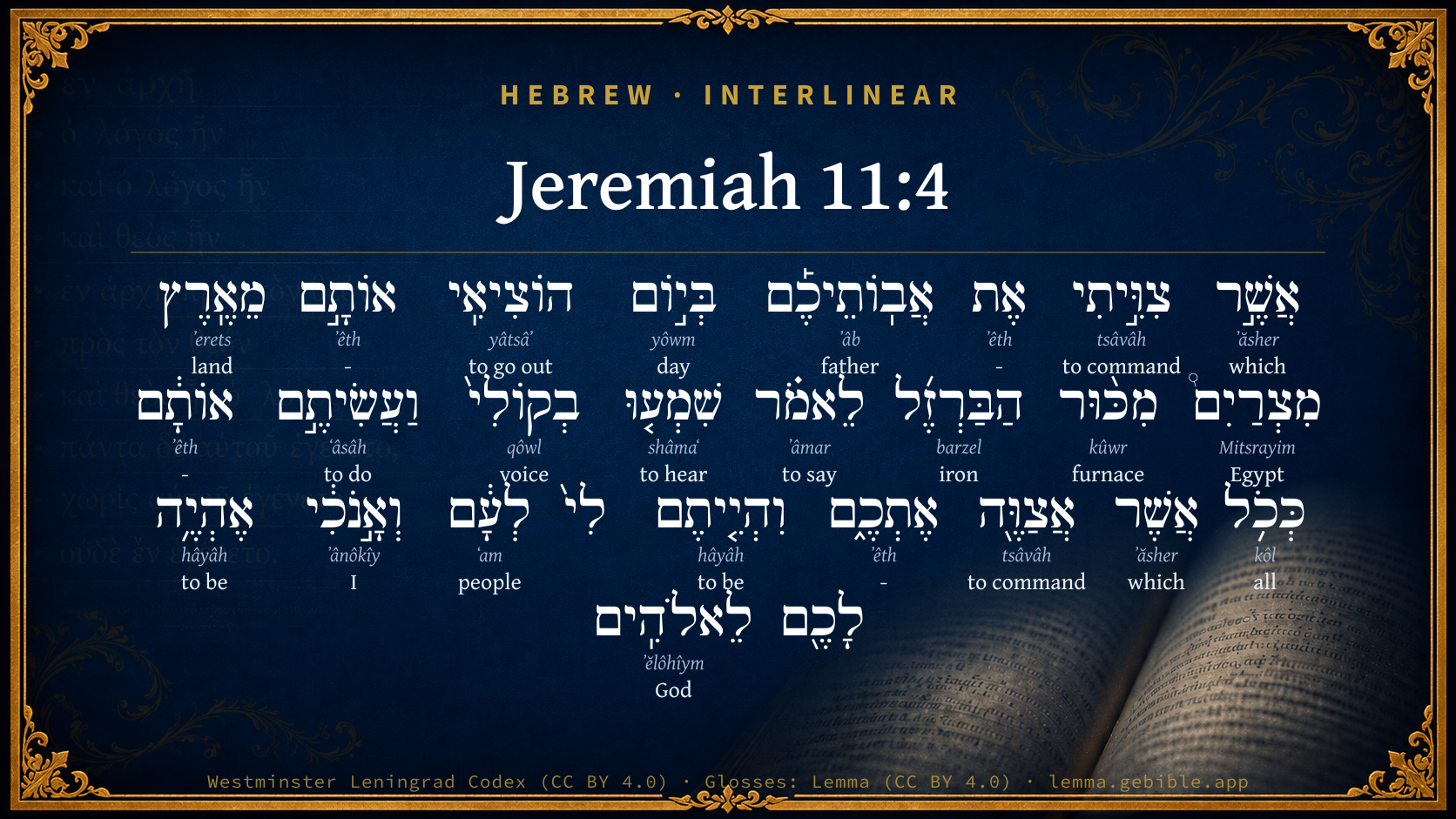
Hebrew (Westminster Leningrad Codex) Jeremiah 11:4 appears in the Hebrew Old Testament. The text above is from the Westminster Leningrad Codex. Each word links to its Strong’s number, a concise gloss, and parsing drawn from the Open Scriptures Hebrew Bible morphology. Click any word for its full Brown-Driver-Briggs (BDB) entry.
Download image
Cite this verse

Jeremiah 11:4 (World English Bible). Public Domain. Lemma interlinear Bible study tool, https://lemma.gebible.app/v/jeremiah/11/4.

Show BibTeX & RIS
BibTeX
RIS
English Translation
which I commanded your fathers in the day that I brought them forth out of the land of Egypt, out of the iron furnace, saying, Obey my voice, and do them, according to all which I command you: so shall you be my people, and I will be your God;
World English Bible · Public Domain
Download a study sheet

One document with this verse’s original text, its word-by-word gloss line, the meaning frame, cross-references with their text, attributed commentary, and full source and license credits — printable, and it pastes into notes with its structure intact.

This verse Autodidact and up

Study sheet (.html) Plain text (.txt)

A passage Seminary Student

Up to 50 verses in one chapter. A passage sheet keeps up to 6 commentary sources and 12 cross-references per verse, in the order this page ranks them, and says so on the sheet whenever that leaves anything out. Ask for a single verse and you get the Autodidact verse sheet above.

Everything on this page stays free to read, with no account — the sheet is a download of what is already on screen, not access to it.

Want to remove ads? Support Godless Engineer
Compare translations 3

The same verse in 3 English versions, stacked beneath the original-language interlinear above. Click any original word for its lexicon entry.

Each is an independent rendering of the whole verse — the interlinear is not word-aligned to these translations.

Highlighted words mark where these versions differ — a whole-verse word diff, not a word-by-word alignment.

  • World English Bible Public Domain
    which I commanded your fathers in the day that I brought them forth out of the land of Egypt, out of the iron furnace, saying, Obey my voice, and do them, according to all which I command you: so shall you be my people, and I will be your God;
  • King James Version Public Domain
    Which I commanded your fathers in the day that I brought them forth out of the land of Egypt, from the iron furnace, saying, Obey my voice, and do them, according to all which I command you: so shall ye be my people, and I will be your God:
  • unfoldingWord Literal Text CC BY-SA 4.0
    that I commanded your fathers on the day of my bringing them out from the land of Egypt, from the furnace of iron, saying, ‘Listen to my voice and you are to do according to all that I command you, so you will be to me for a people and I will be to you for God,’

unfoldingWord Literal Text — © unfoldingWord, licensed CC BY-SA 4.0. Word-aligned USFM3 via Door43 (git.door43.org/unfoldingWord/en_ult).

Versions to compare (up to 4)

3 of 4 selected

Show all 18 translations

Every available English version of this verse, each an independent rendering of the whole verse.

  • World English Bible Public Domain
    which I commanded your fathers in the day that I brought them forth out of the land of Egypt, out of the iron furnace, saying, Obey my voice, and do them, according to all which I command you: so shall you be my people, and I will be your God;
  • Berean Standard Bible Public Domain
    which I commanded your forefathers when I brought them out of the land of Egypt, out of the iron furnace, saying, ‘Obey Me, and do everything I command you, and you will be My people, and I will be your God.’
  • Majority Standard Bible Public Domain
    which I commanded your forefathers when I brought them out of the land of Egypt, out of the iron furnace, saying, ‘Obey Me, and do everything I command you, and you will be My people, and I will be your God.’
  • King James Version Public Domain
    Which I commanded your fathers in the day that I brought them forth out of the land of Egypt, from the iron furnace, saying, Obey my voice, and do them, according to all which I command you: so shall ye be my people, and I will be your God:
  • American Standard Version (1901) Public Domain
    which I commanded your fathers in the day that I brought them forth out of the land of Egypt, out of the iron furnace, saying, Obey my voice, and do them, according to all which I command you: so shall ye be my people, and I will be your God;
  • Revised Version (1885) Public Domain
    which I commanded your fathers in the day that I brought them forth out of the land of Egypt, out of the iron furnace, saying, Obey my voice, and do them, according to all which I command you: so shall ye be my people, and I will be your God:
  • Geneva Bible (1599) Public Domain
    Which I commanded vnto your fathers, when I brought them out of the lande of Egypt, from the yron fornace, saying, Obey my voyce, and doe according to all these things, which I commande you: so shall ye be my people, and I will be your God,
  • Douay-Rheims (1899) Public Domain
    Which I commanded your fathers in the day that I brought them out of the land of Egypt, from the iron furnace, saying: Hear ye my voice, and do all things that I command you: and you shall be my people, and I will be your God:
  • Young's Literal Translation Public Domain
    That I commanded your fathers, In the day of My bringing them out from the land of Egypt, Out of the iron furnace, saying, Hearken to My voice, and ye have done them, According to all that I command you, And ye have been to Me for a people, And I am to you for God,
  • Literal Standard Version CC BY-SA 4.0
    That I commanded your fathers, || In the day of My bringing them out from the land of Egypt, || Out of the iron furnace, saying, Listen to My voice, and you have done them, || According to all that I command you, || And you have been to Me for a people, || And I am to you for God,
  • Unlocked Literal Bible CC BY-SA 4.0
    This is the covenant that I commanded your ancestors to keep the day I brought them out from the land of Egypt, from the furnace for smelting iron. I said, “Listen to my voice and do all of these things just as I have commanded you, for you will be my people and I will be your God.”
  • unfoldingWord Literal Text CC BY-SA 4.0
    that I commanded your fathers on the day of my bringing them out from the land of Egypt, from the furnace of iron, saying, ‘Listen to my voice and you are to do according to all that I command you, so you will be to me for a people and I will be to you for God,’
  • Darby Bible Public Domain
    which I commanded your fathers in the day that I brought them forth out of the land of Egypt, from the iron furnace, saying, Hearken unto my voice and do them, according to all that I command you; so shall ye be my people, and I will be your God:
  • World Messianic Bible Public Domain
    which I commanded your fathers in the day that I brought them out of the land of Egypt, out of the iron furnace,’ saying, ‘Obey my voice and do them, according to all which I command you; so you shall be my people, and I will be your God;
  • Webster's Bible Public Domain
    Which I commanded your fathers in the day that I brought them forth from the land of Egypt, from the iron furnace, saying, Obey my voice, and do them, according to all which I command you: so shall ye be my people, and I will be your God:
  • Free Bible Version CC BY-SA 4.0
    I made this agreement with your forefathers when I led them out of Egypt, out of the iron-making furnace, saying, “Obey me, and do everything I order you to do, and you will be my people, and I will be your God.”
  • Bible in Basic English Public Domain
    To the order which I gave your fathers on the day when I took them out of the land of Egypt, out of the oven of iron, saying, Give ear to my voice, and do all the orders I have given you: so you will be my people, and I will be your God:
  • JPS Tanakh (1917) Public Domain
    which I commanded your fathers in the day that I brought them forth out of the land of Egypt, out of the iron furnace, saying: Hearken to My voice, and do them, according to all which I command you; so shall ye be My people, and I will be your God;

Literal Standard Version (2020), Covenant Press — licensed CC BY-SA 4.0. Text via the HelloAO Bible API (eBible.org). Unlocked Literal Bible (unfoldingWord) — licensed CC BY-SA 4.0. Text via the HelloAO Bible API (eBible.org). unfoldingWord Literal Text — © unfoldingWord, licensed CC BY-SA 4.0. Word-aligned USFM3 via Door43 (git.door43.org/unfoldingWord/en_ult). Free Bible Version, Dr. Jonathan Gallagher — licensed CC BY-SA 4.0. Text via the HelloAO Bible API (eBible.org).

Word by word

More ways to search: Search by grammar → Find every occurrence → Compare this word →

Practice this passage: Drill this verse → Learn its vocabulary →

מִכּ֨וּר
kûwr
H3564
“from · furnace of”
Preposition + Noun, Common, Masculine, Singular, Construct
Part of Speech
Preposition + Noun
Type
Common
Gender
Masculine
Number
Singular
State
Construct
Full BDB Definition

Origin: from an unused root meaning properly, to dig through

TWOT: 967b , 968

furnace, forge, smelting furnace or pot (noun masculine) - (Qal) to bore, pierce, dig, hew (verb)
  1. אֲשֶׁ֣ר ʼăsher H834 “which” Particle, Relative
  2. צִוִּ֣יתִי tsâvâh H6680 “to command” Verb, Piel, Perfect, 1st Person, Common, Singular
  3. אֶת ʼêth H853 “-” Particle, Direct Object
  4. אֲבֽוֹתֵיכֶ֡ם ʼâb H1 “fathers · your” Noun, Common, Masculine, Plural, Construct + Suffix, Personal, 2nd Person, Masculine, Plural
  5. בְּי֣וֹם yôwm H3117 “in/at · day of” Preposition + Noun, Common, Masculine, Singular, Construct
  6. הוֹצִיאִֽי yâtsâʼ H3318 “to go out · me” Verb, Hiphil, Infinitive Construct + Suffix, Personal, 1st Person, Common, Singular
  7. אוֹתָ֣ם ʼêth H853 “- · them” Particle, Direct Object + Suffix, Personal, 3rd Person, Masculine, Plural
  8. מֵאֶֽרֶץ ʼerets H776 “from · land of” Preposition + Noun, Common, Both, Singular, Construct
  9. מִצְרַיִם֩ Mitsrayim H4714 “Egypt” Noun, Proper
  10. הַבַּרְזֶ֜ל barzel H1270 “the · iron” Particle, Definite Article + Noun, Common, Masculine, Singular, Absolute
  11. לֵאמֹ֗ר ʼâmar H559 “to say” Preposition + Verb, Qal, Infinitive Construct
  12. שִׁמְע֤וּ shâmaʻ H8085 “hear” Verb, Qal, Imperative, 2nd Person, Masculine, Plural
  13. בְקוֹלִי֙ qôwl H6963 “in/at · voice · my” Preposition + Noun, Common, Masculine, Singular, Construct + Suffix, Personal, 1st Person, Common, Singular
  14. וַעֲשִׂיתֶ֣ם ʻâsâh H6213 “and · to do” Conjunction + Verb, Qal, Sequential Perfect, 2nd Person, Masculine, Plural
  15. אוֹתָ֔ם ʼêth H853 “- · them” Particle, Direct Object + Suffix, Personal, 3rd Person, Masculine, Plural
  16. כְּכֹ֥ל kôl H3605 “like/as · all” Preposition + Noun, Common, Masculine, Singular, Absolute
  17. אֲשֶׁר ʼăsher H834 “which” Particle, Relative
  18. אֲצַוֶּ֖ה tsâvâh H6680 “to command” Verb, Piel, Imperfect, 1st Person, Common, Singular
  19. אֶתְכֶ֑ם ʼêth H853 “- · you” Particle, Direct Object + Suffix, Personal, 2nd Person, Masculine, Plural
  20. וִהְיִ֤יתֶם hâyâh H1961 “and · to be” Conjunction + Verb, Qal, Sequential Perfect, 2nd Person, Masculine, Plural
  21. לְעָ֔ם ʻam H5971 “to/for · people” Preposition + Noun, Common, Masculine, Singular, Absolute
  22. וְאָ֣נֹכִ֔י ʼânôkîy H595 “and · I” Conjunction + Pronoun, Personal, 1st Person, Common, Singular
  23. אֶהְיֶ֥ה hâyâh H1961 “to be” Verb, Qal, Imperfect, 1st Person, Common, Singular
  24. לֵאלֹהִֽים ʼĕlôhîym H430 “to/for · God(s)” Preposition + Noun, Common, Masculine, Plural, Absolute

About this verse

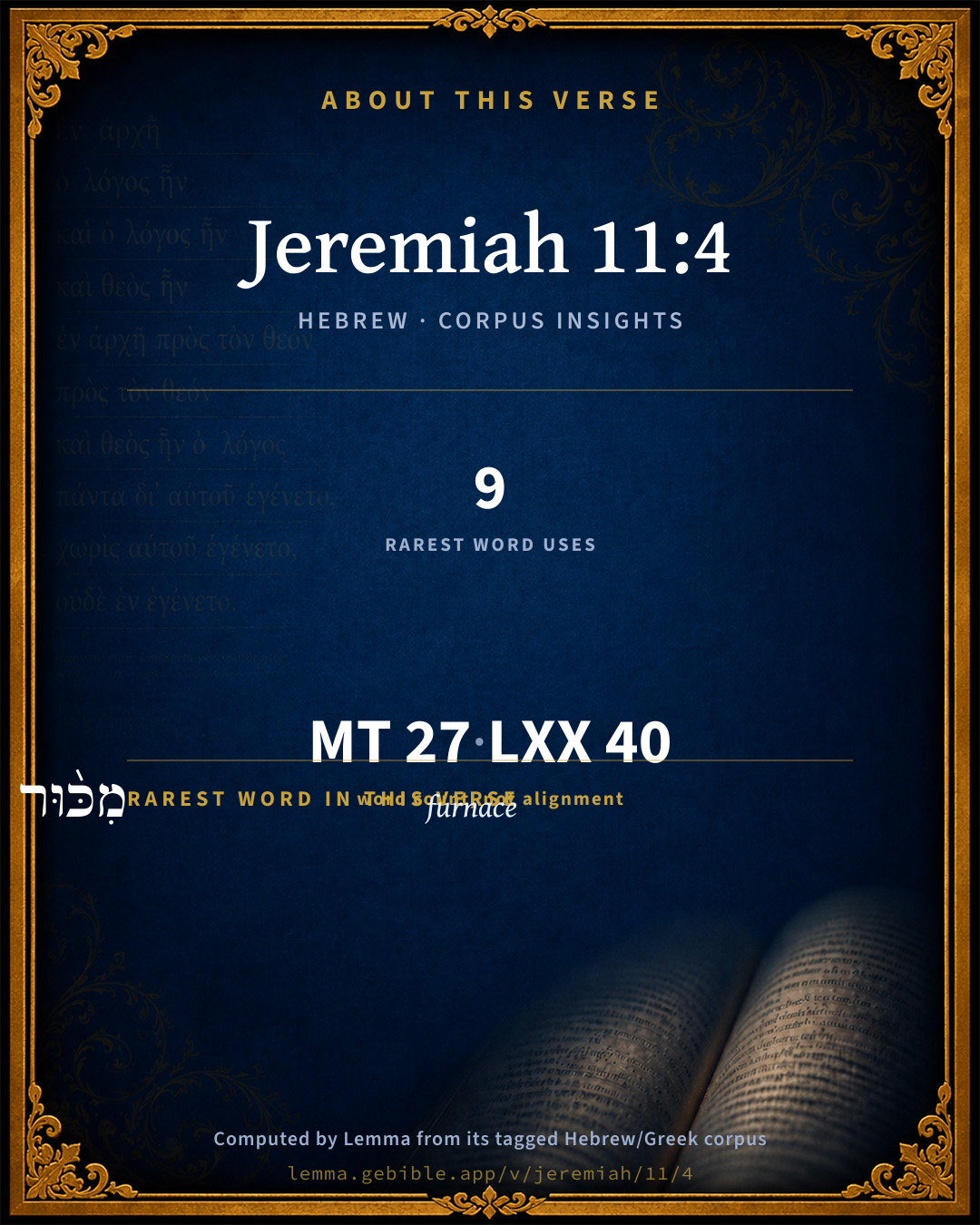
These counts appear in no published source. They are computed here, from the morphology-tagged text and Lemma’s own curated glosses. What Lemma adds →

27
words
19
distinct lemmas
Prophets
section

Notable vocabulary

The rarest word here is מִכּ֨וּר furnace H3564 — appearing just 9 times in the whole Hebrew Bible.

Shared distinctive vocabulary

מִכּ֨וּר furnace H3564 occurs in 9 verses of the Hebrew Bible. Also found in:

Grammatical profile

  • 8 verbs
  • 10 nouns
  • 1 pronoun
  • 2 prepositions
  • 6 particles

Verb forms

  • צִוִּ֣יתִי Piel · Perfect
  • הוֹצִיאִֽי Hiphil · Infinitive Construct
  • לֵאמֹ֗ר Qal · Infinitive Construct
  • שִׁמְע֤וּ Qal · Imperative
  • וַעֲשִׂיתֶ֣ם Qal · Sequential Perfect
  • אֲצַוֶּ֖ה Piel · Imperfect
  • וִהְיִ֤יתֶם Qal · Sequential Perfect
  • אֶהְיֶ֥ה Qal · Imperfect

Repetition

Words recur within this verse — often emphatic in Hebrew:

  • צִוִּ֣יתִי to command H6680 ×2
  • וִהְיִ֤יתֶם to be H1961 ×2
  • אֲשֶׁ֣ר which H834 ×2

Hebrew & Septuagint length

In the original languages it is 27 Hebrew tokens and 40 Greek tokens — but the two are counted differently (Hebrew bundles its prefixes and suffixes into one token; the Greek is in lemma form), so that isn’t a like-for-like length.

Cross-references

33

Topical passages linked to Jeremiah 11:4 in the Treasury of Scripture Knowledge — connected by theme and wording, ordered by reader-vote popularity; previews shown in the World English Bible.

  • Leviticus 26:12 I will walk among you, and will be your God, and you will be my people.
  • Deuteronomy 4:20 But Yahweh has taken you, and brought you forth out of the iron furnace, out of Egypt, to be to him a people of inheritance, as at this day.
  • Jeremiah 7:22–23 For I didn't speak to your fathers, nor command them in the day that I brought them out of the land of Egypt, concerning burnt offerings or sacrifices:
  • 1 Kings 8:51 (for they are your people, and your inheritance, which you brought forth out of Egypt, from the midst of the furnace of iron);
  • Jeremiah 24:7 I will give them a heart to know me, that I am Yahweh: and they shall be my people, and I will be their God; for they shall return to me with their whole heart.
  • Zechariah 8:8 and I will bring them, and they will dwell in the midst of Jerusalem; and they will be my people, and I will be their God, in truth and in righteousness."
  • 2 Corinthians 6:16 What agreement has a temple of God with idols? For you are a temple of the living God. Even as God said, "I will dwell in them, and walk in them; and I will be their God, and they will be my people."
  • Genesis 17:8 I will give to you, and to your seed after you, the land where you are traveling, all the land of Canaan, for an everlasting possession. I will be their God."
  • Exodus 24:3–8 Moses came and told the people all the words of Yahweh, and all the ordinances; and all the people answered with one voice, and said, "All the words which Yahweh has spoken will we do."
  • Leviticus 26:3 "'If you walk in my statutes, and keep my commandments, and do them;
  • Deuteronomy 11:27 the blessing, if you shall listen to the commandments of Yahweh your God, which I command you this day;
  • Jeremiah 26:13 Now therefore amend your ways and your doings, and obey the voice of Yahweh your God; and Yahweh will repent him of the evil that he has pronounced against you.
  • Jeremiah 30:22 You shall be my people, and I will be your God.
  • Jeremiah 31:31–33 Behold, the days come, says Yahweh, that I will make a new covenant with the house of Israel, and with the house of Judah:
  • Ezekiel 11:20 that they may walk in my statutes, and keep my ordinances, and do them: and they shall be my people, and I will be their God.
  • Ezekiel 14:11 that the house of Israel may go no more astray from me, neither defile themselves any more with all their transgressions; but that they may be my people, and I may be their God, says the Lord Yahweh.
  • Ezekiel 36:28 You shall dwell in the land that I gave to your fathers; and you shall be my people, and I will be your God.
  • Ezekiel 37:23 neither shall they defile themselves any more with their idols, nor with their detestable things, nor with any of their transgressions; but I will save them out of all their dwelling-places, in which they have sinned, and will cleanse them: so shall they be my people, and I will be their God.
  • Zechariah 13:9 I will bring the third part into the fire, And will refine them as silver is refined, And will test them like gold is tested. They will call on my name, and I will hear them. I will say, 'It is my people;' And they will say, 'Yahweh is my God.'"
  • Hebrews 8:8–10 For finding fault with them, he said, "Behold, the days come," says the Lord, "That I will make a new covenant with the house of Israel and with the house of Judah;
  • Exodus 20:6 and showing loving kindness to thousands of those who love me and keep my commandments.
  • Deuteronomy 5:2–3 Yahweh our God made a covenant with us in Horeb.
  • Deuteronomy 28:1–14 It shall happen, if you shall listen diligently to the voice of Yahweh your God, to observe to do all his commandments which I command you this day, who Yahweh your God will set you on high above all the nations of the earth:
  • Deuteronomy 29:10–15 You stand this day all of you before Yahweh your God; your heads, your tribes, your elders, and your officers, even all the men of Israel,
  • 1 Samuel 15:22 Samuel said, Has Yahweh as great delight in burnt offerings and sacrifices, as in obeying the voice of Yahweh? Behold, to obey is better than sacrifice, and to listen than the fat of rams.
  • Isaiah 48:10 Behold, I have refined you, but not as silver; I have chosen you in the furnace of affliction.
  • Jeremiah 32:28 Therefore thus says Yahweh: Behold, I will give this city into the hand of the Chaldeans, and into the hand of Nebuchadrezzar king of Babylon, and he shall take it:
  • Ezekiel 20:6–12 in that day I swore to them, to bring them forth out of the land of Egypt into a land that I had searched out for them, flowing with milk and honey, which is the glory of all lands.
  • Ezekiel 37:27 My tent also shall be with them; and I will be their God, and they shall be my people.
  • Zechariah 6:15 Those who are far off shall come and build in the temple of Yahweh; and you shall know that Yahweh of hosts has sent me to you. This will happen, if you will diligently obey the voice of Yahweh your God."'"
  • Matthew 28:20 teaching them to observe all things that I commanded you. Behold, I am with you always, even to the end of the age." Amen.
  • Hebrews 5:9 Having been made perfect, he became to all of those who obey him the author of eternal salvation,
  • Exodus 23:21–22 Pay attention to him, and listen to his voice. Don't provoke him, for he will not pardon your disobedience, for my name is in him.

Cross-references courtesy of OpenBible.info (CC BY 4.0).

Hebrew and Greek witnesses Masoretic Hebrew ↔ Greek Septuagint

The same verse in the two great witnesses to the Old Testament, shown verse-for-verse.

These are two independent witnesses, not word-aligned to each other, and the Septuagint is shown in lemma (dictionary) form.

Hebrew Jeremiah 11:4 Masoretic · Westminster Leningrad Codex

אֲשֶׁ֣ר צִוִּ֣יתִי אֶת אֲבֽוֹתֵיכֶ֡ם בְּי֣וֹם הוֹצִיאִֽי אוֹתָ֣ם מֵאֶֽרֶץ מִצְרַיִם֩ מִכּ֨וּר הַבַּרְזֶ֜ל לֵאמֹ֗ר שִׁמְע֤וּ בְקוֹלִי֙ וַעֲשִׂיתֶ֣ם אוֹתָ֔ם כְּכֹ֥ל אֲשֶׁר אֲצַוֶּ֖ה אֶתְכֶ֑ם וִהְיִ֤יתֶם לִי֙ לְעָ֔ם וְאָ֣נֹכִ֔י אֶהְיֶ֥ה לָכֶ֖ם לֵאלֹהִֽים

which I commanded your fathers in the day that I brought them forth out of the land of Egypt, out of the iron furnace, saying, Obey my voice, and do them, according to all which I command you: so shall you be my people, and I will be your God;

World English Bible · Public Domain

Greek LXX Structure differs

In the Septuagint, Jeremiah is about an eighth shorter than the Hebrew and arranges its material differently — the Oracles Against the Nations (Hebrew chapters 46–51) appear in the middle of the Greek book, after 25:13. Because the chapter and verse boundaries do not line up, a verse-for-verse comparison with the Hebrew is not shown.

A verse-for-verse comparison isn’t shown here because the chapters and verses don’t line up. Switch to the LXX edition with the MT / LXX toggle above to read the Greek directly.

Hebrew: Westminster Leningrad Codex (CC BY 4.0). Greek: Septuagint (public domain); English from a public-domain English Septuagint. How the Septuagint differs from the Hebrew →

Targum (Aramaic paraphrase)

1

The Targum is the ancient Jewish Aramaic paraphrase of the Hebrew Scriptures — an interpretive translation, not the Hebrew text itself. Onkelos (literal) and Pseudo-Jonathan (expansive) render the Torah, and Jonathan the Prophets. Coverage is partial: where no permissively-licensed English translation exists for a verse, only the Aramaic is shown. This is verse-level text, not a word-by-word alignment to the Hebrew.

  1. Targum Jonathan Prophets (Joshua–Malachi)
    דְפַקְדֵית יַת אֲבָהַתְכוֹן בְּיוֹמָא דְאַפְקֵית יַתְהוֹן מֵאַרְעָא מִצְרַיִם מִכּוּרָא דְפַרְזְלָא לְמֵימַר קַבִּילוּ לְמֵימְרִי וְתַעְבִדוּן יַתְהוֹן כְּכָל דְאַפְקֵיד יַתְכוֹן וּתְהוֹן קֳדָמַי לְעַם וַאֲנָא אֱהֶוֵי לְכוֹן לֶאֱלָהּ:

    (no public-domain English translation for this verse)

    Targum Jonathan — Aramaic: “Mikraot Gedolot” (public domain). English: “Sefaria Community Translation” (CC0 1.0 (public-domain dedication)); “London "Chaldee Paraphrase," 1871” (public domain). Text via Sefaria.

Commentary

Notes on Jeremiah 11:4 from classic Christian and Jewish commentators (each source and its license shown beneath its notes). The classic Christian expositions comment on the surrounding passage and are grouped to its opening verse, so a note may address several verses; the Jewish commentaries on the Tanakh (Rashi and others) are per-verse, so they appear only where the commentator wrote on this verse.

Lemma curates 59 commentaries, every one of them public domain or Creative Commons licensed, each selected and text-cleaned for this edition rather than reprinted as found. About our sources →

Trapp's Complete Commentary

John Trapp

Jer 11:4 Which I commanded your fathers in the day [that] I brought them forth out of the land of Egypt, from the iron furnace, saying, Obey my voice, and do them, according to all which I command you: so shall ye be my people, and I will be your God:

Ver. 4. From the iron furnace.] Where iron is melted, and a fierce fire required.

Obey my voice.] See Jer 7:23.

John Trapp, A Commentary or Exposition upon All the Books of the Old and New Testament (1647–1656) — public domain. Text from a community e-Sword module.

The Biblical Illustrator

Joseph S. Exell

Jer_11:4

Obey My voice, and do them.

Obedience of primary import

Much is said about the demoralising effects of army life. Perhaps there is a tendency to moral decline in the army, but one thing about army life is good. It is a good thing to learn the lesson of implicit obedience to properly constituted authority. A Christian must learn this lesson. No man can be a Christian who does not obey God. And why should this be thought a difficult thing? Soldiers do not complain because they are required to obey. The hard thing about a soldiers life is to be required to obey an unreasonable and incompetent leader. Many officers are superior to the men in the ranks only in official position. In all other respects they are inferior. But the Christian is never subjected to this sort of humiliation. He has but one Leader. The pastor is not the Master. Christians are all comrades, all brethren, all equal before one Lord. One is yore Master. What He says, we will do. Where He sends, we will go. (Christian Age.)

The Biblical Illustrator, edited by Joseph S. Exell (c. 1880s–1900s) — public domain. Text from a community e-Sword module.

Tyndale Open Study Notes

Tyndale Open Resources

11:4 The Egyptians knew how to smelt iron, but the iron-smelting furnace of Egypt was also a metaphor for the Israelites’ slavery in that land from which the Lord had rescued them. God had also promised to be uniquely theirs if they would be uniquely his (Exod 6:7).

Tyndale Open Study Notes — © Tyndale Open Resources, licensed CC BY-SA 4.0. Text via the HelloAO Bible API.

Jamieson, Fausset & Brown

Robert Jamieson, A. R. Fausset & David Brown

in the day--that is, when. The Sinaitic covenant was made some time after the exodus, but the two events are so connected as to be viewed as one.

iron furnace-- (Deu 4:20; Kg1 8:51). "Furnace" expresses the searching ordeal; "iron," the long duration of it. The furnace was of earth, not of iron (Psa 12:6); a furnace, in heat and duration enough to melt even iron. God's deliverance of them from such an ordeal aggravates their present guilt.

do them--namely, the words of the covenant (Jer 11:3).

so, &c.-- (Lev 26:3, Lev 26:12).

Jamieson, Fausset & Brown — Commentary Critical and Explanatory on the Whole Bible (1871) — public domain (CC PDM 1.0). Text via the HelloAO Bible API.

The Cambridge Bible for Schools and Colleges

gen. ed. J. J. S. Perowne

4. in the day, etc.] Cp. Jer_7:23.

the iron furnace] The place where iron is smelted represents figuratively the scene of the affliction. See for the expression Deu_4:20; 1Ki_8:51; and cp. Isa_48:10.

and do them] probably introduced by mistake from Jer_11:6.

The Cambridge Bible for Schools and Colleges (gen. ed. J. J. S. Perowne; Cambridge University Press, 1878–1918) — public domain. Text from a community e-Sword module.

John Gill's Exposition

That I may perform the oath which I have sworn unto your fathers,.... Abraham, Isaac, and Jacob:

to give them a land flowing with milk and honey: that is, abounding with plenty of all kind of provisions; see Exo 3:8,

as it is this day; the land of Canaan continued to those times a very fruitful country; it was as it was promised it should be, and which was a clear thing; their eyes saw it, and the day bore witness to it:

then answered I, and said; that is, the Prophet Jeremiah, to whom the above order was given:

so be it, O Lord; or, "Amen, Lord" (f); either agreeing to publish what the Lord commanded him; or as wishing that the land of Canaan might continue the same fruitful land it was, and the people of the Jews in it, they keeping the words of this covenant; or else as assenting that the curse might fall upon the men that did not observe them, alluding to Deu 27:15. This is the sense of Abarbinel; Jarchi and Kimchi observe, that the word "Lord" is vocative, and in the language of prayer.

(f) "Amen, Domine", Pagninus: Montanus; "Amen, O Jehovah", Schmidt, Cocceius.

John Gill's Exposition of the Whole Bible (1746–1763) — public domain (CC PDM 1.0). Text via the HelloAO Bible API.

Albert Barnes' Notes on the Bible

From the iron furnace - Rather, out of “the iron furnace,” Egypt (see Deu 4:20). The constant reference to Deuteronomy shows how great had been the effect upon Jeremiah’s mind of the public recitation of the “Book of the covenant” found in the temple.

Albert Barnes' Notes on the Bible (1834–1885) — public domain. Text from a community e-Sword/MySword module.

Haydock's Catholic Bible Commentary

Fathers. God chooses his people for obedience, not for kindred, &c. (St. Jerome) (Worthington)

George Leo Haydock (1774–1849), Haydock's Catholic Family Bible and Commentary, 1859 edition — public domain. Excludes Psalms (Douay-Rheims chapter numbering differs from Protestant) and Deuterocanonical books (Catholic canon only).

Matthew Poole's English Annotations

Which I commanded your fathers, which law (that you by your restipulation made a formal covenant) I that am the Lord, and so had a sovereign power to lay laws upon my creatures, commanded your fathers, in the day that I brought them forth out of the land of Egypt, from the iron furnace; and obliged them to obedience before I laid my law upon them, by bringing them out of the land of Egypt, from the furnace wherein iron is melted, which may either be taken literally (probably that was a piece of their work in Egypt) or metaphorically, serving at iron furnaces being a very hard and servile labour.

Saying, Obey my voice, and do them, according to all which I command you; for which kindness I required no more of them but a gentler service to me, in obeying my voice as to the things of this law which I gave them in charge.

So shall ye be my people, and I will be your God; nor did I only lay my commands upon them, but I also encouraged them to the obedience of it, by my gracious promise, that if they would, they should be a people, I would bless, protect, and defend, and bear the name of my people, and I would be their God to own and bless them.

Matthew Poole's English Annotations on the Holy Bible (1683–1685) — public domain. Text from a community e-Sword/MySword module.

Whedon's Commentary on the Bible

Daniel D. Whedon

4. Iron furnace — A phrase first used with the same reference in Deu_4:20. Primarily it suggests the sufferings there of the Israelites; also, the purpose of that affliction: for the one purpose of all suffering to God’s people is purification — the separation of the gold from the dross, the precious from the base.

Daniel D. Whedon (gen. ed.), Commentary on the Old and New Testaments (1874–1909) — public domain. Text from a community e-Sword module.

The Pulpit Commentary

From the iron furnace; rather, out of the iron furnace. It is Egypt which is thus described. (comp. Deu_4:20 1Ki_8:51) The oppression in Egypt was like the furnace in which iron is rendered malleable by heat. (so Isa_48:10, "I have tested thee in the furnace of affliction

The precious recompenses of obedience.

"Obey my voice... according to all which I command you: so shall ye be," etc. The earlier verses of this chapter form part of that earnest reminder which Jeremiah was commanded by God to address to the men of Judah and Jerusalem concerning a transaction with which they had all had very much to do. That transaction was their solemnly pledging themselves, as they had done during King Josiah"s recent reign, to observe the ancient covenant which the Lord God had made with their fathers. The sixty or seventy years before King Josiah"s time had been years dreary and degraded in the national life of the people. Even Hezekiah, the last pious King of Judah before Josiah, had secured only a very partial reformation, and in the days of his godless son Manasseh, and in those of his even worse grandson Amon, who "sinned more and more," the religious life of the people all but died out. The sacred Scriptures in which this covenant was contained had, during these miserable years, been neglected and put out of sight as writings for which they had no longer love nor use; as a book which we do not want is either got rid of or put away on some high shelf, to make room for others which we mere highly prize. "The nation did not want to hear the Law which testified against their multiplied transgressions, nor to listen to a condemnation of the idols they had chosen." But in King Josiah"s reign, in some out-of-the-way corner, buried beneath no one knows what worthless rubbish, a copy of the despised Word of God was discovered. It produced on the pious monarch a profound impression. He was overwhelmed with shame and dismay when he compared the commands of the covenant of God with the actual conduct of the people. He shuddered to think of the judgments which must come upon them and which had already come upon the neighboring nation of Israel unless they repented and turned to God. But he did not waste time in unavailing regrets. He at once took practical measures to bring about that religious reformation which he saw to be so much needed. He therefore summoned all the people of Judah to Jerusalem, and caused the book of the Law to be publicly read to them; then he made all the people renew the covenant which they had so long forgotten. For a time it seemed as if the reformation and repentance were real; but the old idolatries began to make their appearance again after a while, and when Jeremiah was sent from God to remind them of their violated vows they had fallen back into a condition as evil as, if not worse than, that of former days. Therefore the prophet opens his commission by the awful denunciation of Jehovah"s curse upon the disobedient. He would startle and arouse them, if it might but be possible, so that they might awake to righteousness and to God ere wrath arose against them and there should be no remedy. And here he tells of the precious recompenses of obedience, "So shall ye... God." Consider, then

I THESE PROMISES.

1. Ye shall be my people." Now, by this is meant, amongst other blessings, that they shall be the object of his care. How many are the proofs that this is a constituent part of the heritage of his people I Were not Israel so? Did he not watch over them continuously? "He suffered no man to do them harm; yea, he reproved kings for their sakes." "He gave his angels charge over them to keep them in all their ways." The race of Pharaoh, the cruel thirst of the hot, waterless sands, the threatened famine of the breadless desert, the marauding Amalekite, the pestilence that walked in darkness, and the destruction that wasted at noonday, not one of these was suffered to harm them. How full are the Law, the prophets, and the psalms with sweet assurances of the tender care of God over his people! Nor does the New Testament come behind the Old in like gracious declarations. And the experience of all God"s people swells the volume of testimony to his loving solicitude and watchfulness over us. "And such honor have all his saints." And to be of his people means also to be the abode of his Spirit. That Spirit should dwell in them, rule and mould them after the Divine will. True, God"s ancient people do once and again seem to have been utterly abandoned of that Holy Spirit. But there was ever a faithful remnant, ever a godly few, of whom the Lord was wont to say, "They shall be mine in that day when I make up my jewels." And we must remember that there were long periods in Israel"s history when, as a nation, they lived under the blessed guidance of that Spirit. These more happy periods are passed over in silence, as all such in the records of nations are, so that the saying has passed into a proverb, "Happy the nation that has no history." It is of the sad, troubled times that history tells, not of the long, eventless, peaceful times. When at rest, they walk in the fear of the Lord, and possess the comfort of the Holy Ghost, and are multiplied." Oh the joy of this possession of his Spirit! The thought of losing it made the contrite psalmist cry out m his agony, Cast me not away from thy presence, and take not thy Holy Spirit from me." "I will put my Spirit within you" was ever one of the choicest promises of God to his people, and one of the surest tokens that they were his people. And it is so still. To be his is to be guided and governed of that good Spirit, to have our understandings purified, our affections wisely controlled, our hearts, our wills, under his direction always, so that we turn away from what is evil and cleave to that which is good. And it includes, furthermore, the being made the channels of his grace . Others shall be blessed through us, as it was said to Abraham, "In thee and in thy seed shall all the nations of the earth be blessed." God"s people are the salt of the earth, the light of the world. How unspeakably great and blessed is the influence of the true people of God! In their presence impurity, profanity, selfishness, sin in all its forms, hide their shameful heads and slink away, whilst all things lovely and of good report flock around them and attend upon them continually. And finally they become the inmates of the home of God. The heavenly inheritance, of which the earthly Canaan, the land promised to the fathers of Israel, was the type and symbol, becomes theirs. They enter it through the gates of death, and these gates once passed, they are in his presence, where "there is fullness of joy, and at his right hand there is," etc. Such are some of the elements of this great joy of God taking us for his people, a joy which, of his infinite mercy, may he make us all to know.

2. "I will be your God." This cannot mean less than that he will be known to them as their God. They shall be able to realize his existence, Ms presence, his constant nearness to them. True, the God of Israel, whose promise this is, was not known by any organ of sense; he was no material God that their hands could handle; he spake with no human voice that their ears could hear; he appeared to them in no visible form that their eyes could see; he was manifested then, as now, only to their spirits. But when they worshipped him in spirit they felt that he was at their right hand, so that they could not be moved. Hence they went about their daily work and engaged in all the occupations of their lives, consciously realizing the presence of God; so that they constantly spoke of him "as their God, our God," my God, so near, so real, so present was he to them. They could not if they would, and they would not if they could, escape from his presence or withdraw from the observation of his eye, or from the guidance and guardianship of his hand. In such manifestation of himself to them did he fulfill his word, "I will be your God." Nor was this all. Not only was he realized by them but rejoiced in. "I will go unto the altar of God, unto God my exceeding joy," was the delighted declaration of the saints of old and is so of the saints today. Such joy had they in him that, when all earthly affairs were disastrous for them, when the fig tree did not blossom, and when there was no fruit in the vine, and the labor of the olive failed, and the fields yielded no meat, when the flock was cut off from the fold and there were no herds in the stall, when, that is, ruin stared them in the face and met them on every side, nevertheless they could rejoice in the Lord, and joy in the God of their salvation. "My soul shall make her boast in the Lord," was their perpetual song; and it is the song still of all those to whom God has said, "I will be your God." And his word came true yet further by their coming to resemble him. It is ever the result of worship to conform the worshipper to the deity he worships. Hence it was said of the worshippers of idols, "They that make them are like unto them, so is every one that trusteth in them." Accordingly it has ever Been found that they who bowed down to gods impure, cruel, and treacherous, became them selves impure, cruel, and treacherous. But, on the other hand, they who have worshipped the God of Israel have become like him, righteous, just, and true, merciful, and pure, and good. "I will be your God" meant, therefore, "I will make you like myself," and this promise God ever fulfils. And it means also, I will be your rest." The soul whose God the Lord is, reposes on him. The storms of life may rage, its tempests beat, but firm and unmoved are they who rest their souls on God." Everything may appear to be slipping away from a man, and he may seem to be like one gliding down a steep, smooth slope, ever faster and faster to the precipice over which he will be hurled into destruction, unable to grasp any friendly rock or branch, or to find foothold anywhere and men"s circumstances are like that sometimes; but they to whom this word, "I will be your God," is fulfilled, do find foothold in God and can stay themselves upon him. Hence, when heart and flesh fail, God is the Strength of their heart and their Portion forevermore.

II THE CONDITION OF THEIR FULFILMENT. They were faithfully to do the commandments which he had made known to them: "Obey my voice, so," etc. And this condition is not abrogated; it is in as full force today as it was in the days of old. But when it is complied with, then, not merely by the gracious appointment of God, but also in the way of natural result, there follows the enjoyment of the promised blessings. For:

1. Obedience tends to such enjoyment of God, inasmuch as it prevents the rising of those mists whereby the sight of God is shut out from the soul. Travelers along the Rhine or over the mountains of Switzerland know to their cost how often the most glorious scenery the world contains is completely hidden from their view by the uprising of some wretched mist, wrapping in cold, dark, impenetrable fog all that upon which their eyes would have so delightedly rested. They want to gaze upon all that loveliness; they have come for that very purpose; but they cannot for those thick clouds. And oh, what a beautiful vision is the face of God! How good it is to gaze upon him, and to behold the shining of his countenance! And this we should do were it not for those mists with which disobedience to God"s will ever blots out all that otherwise we should so delightedly see. "If our hearts condemn us not, then have we confidence toward God;" but when they do condemn us, confidence vanishes, and, as by a veil of impenetrable cloud, the face of God is hidden from our view. We have lost him; we cannot realize him; he is as if he were not, and the soul is forlorn and wretched and exposed to all manner of ill. Now, this sad experience, which is as common as it is sad, shows how the obeying of the voice of God must tend to the enjoyment of him, inasmuch as it prevents all that which hides God from our souls.

2. And before obedience that wall of the rebellious will, which more than aught else displeases and dishonors God and keeps him out from the soul, falls down flat," as did the walls of Jericho before the obedient tribes of Israel. That will must be subdued, that stronghold of evil must be pulled down, and obedience is the strong hand that accomplishes this much-needed work. That strong fortress cast down, the soul becomes the possession of God, and the hitherto rebellious forces of the soul own him as their God. Or, to take another similitude, obedience unbars that fastened door before which the Lord Jesus has stood so long and knocked, but in vain, for admission. He desires to enter and to make us the glad partakers of his grace. But till that door be unbarred all this cannot be.

3. Obedience, furthermore, keeps us in those paths along which alone God is to be met. Full well we know that there are paths innumerable along which men go, along which we have gone ourselves; but God is never to be met with in them. But along the path by which obedience leads us, there we do meet with him, and are blessed by him.

4. And without this obedience God cannot carry out his purposes of grace. This is what we are told in the verse that follows our text. God asks for obedience, "that I may perform the oath which I have sworn unto," etc. Therefore without this he is held back from what he earnestly desires, and he cannot do the things that he would, God cannot admit the ungodly and the disobedient into the blessed land of promise. To do that would be to perpetuate forever the sins and sorrows of time. ThereforeThose holy gates forever bar Pollution, sin, and shame.

But "blessed are they that do his commandments, that they," etc. (Rev_22:14) Now, the first step of this obedience that which introduces to all these recompenses is to surrender to the Lord Jesus Christ. C. (Joh_6:28, Joh_6:29)

The Pulpit Commentary (1880–1919), ed. H.D.M. Spence-Jones & Joseph S. Exell — public domain. Text from a community e-Sword module.

Lesson kit

Teaching starters — assembled from the data on this page, not authored interpretation. Every prompt links to the verse data it draws on. Edit before teaching.

Jeremiah, in the Prophets, opens this verse with 27 words (19 distinct Hebrew lemmas). Its most distinctive word is kûwr (“furnace”). A historical commentator’s framing appears above. Read the whole chapter for the surrounding context.

Discussion questions

  1. What does “furnace” (kûwr) contribute to the verse as a whole?
  2. How does Deuteronomy 4:20, which shares the word «furnace», read alongside this verse?
  3. What does the repetition of “to command” (2× in this one verse) do in this verse?
  4. These translations render this verse differently; the difference is in the English rendering, not the original. What questions does that raise?
  5. «צִוִּ֣יתִי» is a Piel Perfect verb. How does that grammatical form shape the action described?
  6. Compare how Trapp's Complete Commentary and The Biblical Illustrator read this verse. Where do they agree or differ?

Things to notice

Reading settings

Reading text

Shown beneath each verse's original-language words.

Old Testament
Old Testament edition

Read the OT as the Masoretic Hebrew (MT) or the Greek Septuagint (LXX).

English shown for the Greek Septuagint (in the Hebrew ↔ Greek comparison).

Comparing translations? Open the Compare panel on any verse page to stack up to four side by side.