
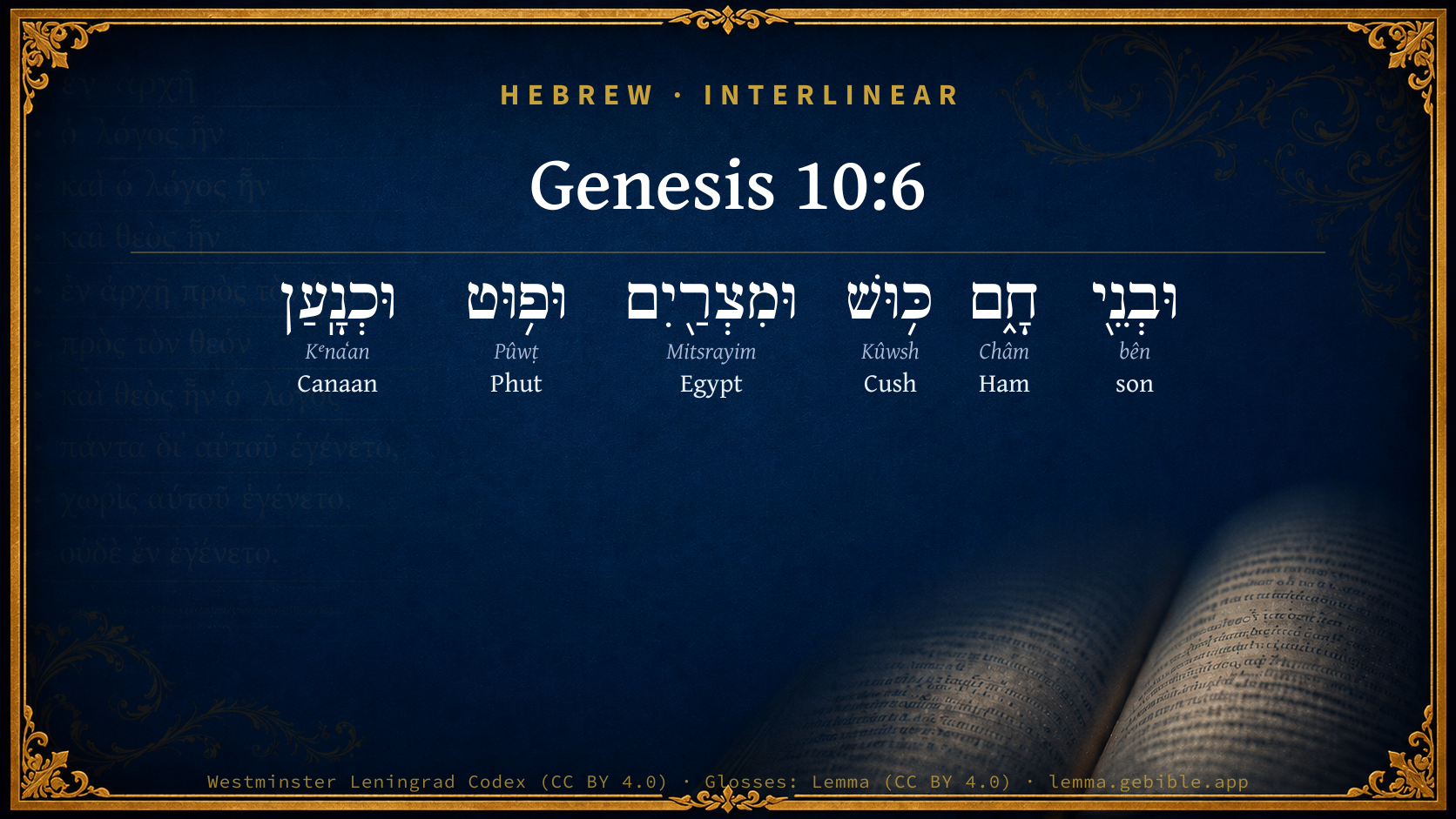
Genesis 10:6

Hebrew (Westminster Leningrad Codex) Genesis 10:6 appears in the Hebrew Old Testament. The text above is from the Westminster Leningrad Codex. Each word links to its Strong’s number, a concise gloss, and parsing drawn from the Open Scriptures Hebrew Bible morphology. Click any word for its full Brown-Driver-Briggs (BDB) entry.
Download image
Cite this verse

Genesis 10:6 (World English Bible). Public Domain. Lemma interlinear Bible study tool, https://lemma.gebible.app/v/genesis/10/6.

Show BibTeX & RIS
BibTeX
RIS
English Translation
The sons of Ham: Cush, Mizraim, Put, and Canaan.
World English Bible · Public Domain
Highlights
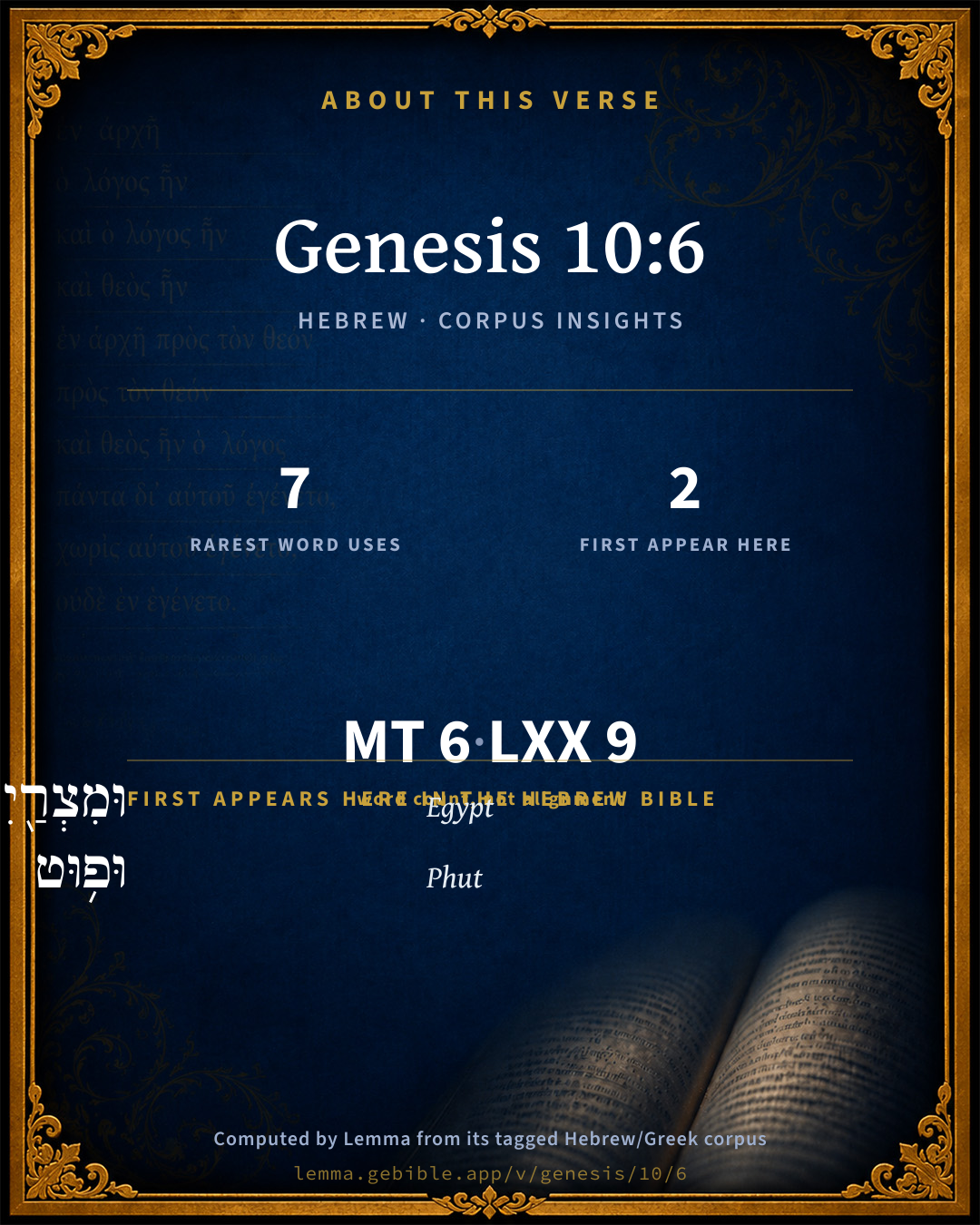
  • 2 first appearances in the Hebrew Bible
Full analysis ↓
Download a study sheet

One document with this verse’s original text, its word-by-word gloss line, the meaning frame, cross-references with their text, attributed commentary, and full source and license credits — printable, and it pastes into notes with its structure intact.

This verse Autodidact and up

Study sheet (.html) Plain text (.txt)

A passage Seminary Student

Up to 50 verses in one chapter. A passage sheet keeps up to 6 commentary sources and 12 cross-references per verse, in the order this page ranks them, and says so on the sheet whenever that leaves anything out. Ask for a single verse and you get the Autodidact verse sheet above.

Everything on this page stays free to read, with no account — the sheet is a download of what is already on screen, not access to it.

Want to remove ads? Support Godless Engineer
Compare translations 3

The same verse in 3 English versions, stacked beneath the original-language interlinear above. Click any original word for its lexicon entry.

Each is an independent rendering of the whole verse — the interlinear is not word-aligned to these translations.

Highlighted words mark where these versions differ — a whole-verse word diff, not a word-by-word alignment.

  • World English Bible Public Domain
    The sons of Ham: Cush, Mizraim, Put, and Canaan.
  • King James Version Public Domain
    And the sons of Ham; Cush, and Mizraim, and Phut, and Canaan.
  • unfoldingWord Literal Text CC BY-SA 4.0
    And the sons of Ham Cush and Mizraim and Put and Canaan.

unfoldingWord Literal Text — © unfoldingWord, licensed CC BY-SA 4.0. Word-aligned USFM3 via Door43 (git.door43.org/unfoldingWord/en_ult).

Versions to compare (up to 4)

3 of 4 selected

Show all 18 translations

Every available English version of this verse, each an independent rendering of the whole verse.

  • World English Bible Public Domain
    The sons of Ham: Cush, Mizraim, Put, and Canaan.
  • Berean Standard Bible Public Domain
    The sons of Ham: Cush, Mizraim, Put, and Canaan.
  • Majority Standard Bible Public Domain
    The sons of Ham: Cush, Mizraim, Put, and Canaan.
  • King James Version Public Domain
    And the sons of Ham; Cush, and Mizraim, and Phut, and Canaan.
  • American Standard Version (1901) Public Domain
    And the sons of Ham: Cush, and Mizraim, and Put, and Canaan.
  • Revised Version (1885) Public Domain
    And the sons of Ham; Cush, and Mizraim, and Put, and Canaan.
  • Geneva Bible (1599) Public Domain
    Moreouer, ye sonnes of Ham were Cush, and Mizraim, and Put, and Canaan.
  • Douay-Rheims (1899) Public Domain
    And the sons of Cham: Chus, and Mesram, and Phuth, and Chanaan.
  • Young's Literal Translation Public Domain
    And sons of Ham `are' Cush, and Mitzraim, and Phut, and Canaan.
  • Literal Standard Version CC BY-SA 4.0
    And sons of Ham [are] Cush, and Mitzraim, and Phut, and Canaan.
  • Unlocked Literal Bible CC BY-SA 4.0
    The sons of Ham were Cush, Mizraim, Put, and Canaan.
  • unfoldingWord Literal Text CC BY-SA 4.0
    And the sons of Ham Cush and Mizraim and Put and Canaan.
  • Darby Bible Public Domain
    And the sons of Ham: Cush, and Mizraim, and Phut, and Canaan.
  • World Messianic Bible Public Domain
    The sons of Ham were: Cush, Mizraim, Put, and Canaan.
  • Webster's Bible Public Domain
    And the sons of Ham; Cush, and Mizraim, and Phut, and Canaan.
  • Free Bible Version CC BY-SA 4.0
    The sons of Ham: Cush, Mizraim, Put, and Canaan.
  • Bible in Basic English Public Domain
    And the sons of Ham: Cush and Mizraim and Put and Canaan.
  • JPS Tanakh (1917) Public Domain
    And the sons of Ham: Cush, and Mizraim, and Put, and Canaan.

Literal Standard Version (2020), Covenant Press — licensed CC BY-SA 4.0. Text via the HelloAO Bible API (eBible.org). Unlocked Literal Bible (unfoldingWord) — licensed CC BY-SA 4.0. Text via the HelloAO Bible API (eBible.org). unfoldingWord Literal Text — © unfoldingWord, licensed CC BY-SA 4.0. Word-aligned USFM3 via Door43 (git.door43.org/unfoldingWord/en_ult). Free Bible Version, Dr. Jonathan Gallagher — licensed CC BY-SA 4.0. Text via the HelloAO Bible API (eBible.org).

Word by word

More ways to search: Search by grammar → Find every occurrence → Compare this word →

Practice this passage: Drill this verse → Learn its vocabulary →

About this verse

These counts appear in no published source. They are computed here, from the morphology-tagged text and Lemma’s own curated glosses. What Lemma adds →

6
words
6
distinct lemmas
Pentateuch
section

Notable vocabulary

The rarest word here is וּפ֥וּט Phut H6316 — appearing just 7 times in the whole Hebrew Bible.

First appearance in Scripture

These words make their first canonical appearance in the Hebrew Bible here:

  • וּמִצְרַ֖יִם Egypt H4714
  • וּפ֥וּט Phut H6316

Shared distinctive vocabulary

וּפ֥וּט Phut H6316 occurs in 7 verses of the Hebrew Bible. Also found in:

Grammatical profile

  • 6 nouns

Hebrew & Septuagint length

In English translation the verse runs 9 words from the Hebrew and 11 from the Septuagint (LXX English) — closely comparable.

A rough comparison of the two English renderings, which tokenize alike — not a word-level alignment.

Word counts can differ between the Hebrew and the Greek without any difference in meaning — e.g. the Hebrew direct-object marker אֵת has no separate Greek word, and Greek often adds the article ὁ.

In the original languages it is 6 Hebrew tokens and 9 Greek tokens — but the two are counted differently (Hebrew bundles its prefixes and suffixes into one token; the Greek is in lemma form), so that isn’t a like-for-like length.

Cross-references

10

Topical passages linked to Genesis 10:6 in the Treasury of Scripture Knowledge — connected by theme and wording, ordered by reader-vote popularity; previews shown in the World English Bible.

  • 1 Chronicles 1:8–16 The sons of Ham: Cush, and Mizraim, Put, and Canaan.
  • Genesis 9:22 Ham, the father of Canaan, saw the nakedness of his father, and told his two brothers outside.
  • 1 Chronicles 4:40 They found fat pasture and good, and the land was wide, and quiet, and peaceable; for those who lived there before were of Ham.
  • Psalms 78:51 And struck all the firstborn in Egypt, The chief of their strength in the tents of Ham.
  • Psalms 105:23 Israel also came into Egypt. Jacob sojourned in the land of Ham.
  • Psalms 105:27 They performed miracles among them, And wonders in the land of Ham.
  • Psalms 106:22 Wondrous works in the land of Ham, And awesome things by the Red Sea.
  • Isaiah 11:11 It shall happen in that day, that the Lord will set his hand again the second time to recover the remnant of his people, who shall remain, from Assyria, and from Egypt, and from Pathros, and from Cush, and from Elam, and from Shinar, and from Hamath, and from the islands of the sea.
  • Jeremiah 46:9 Go up, you horses; and rage, you chariots; and let the mighty men go forth: Cush and Put, who handle the shield; and the Ludim, who handle and bend the bow.
  • Ezekiel 27:10 Persia and Lud and Put were in your army, your men of war: they hanged the shield and helmet in you; they set forth your comeliness.

Cross-references courtesy of OpenBible.info (CC BY 4.0).

Hebrew and Greek witnesses Masoretic Hebrew ↔ Greek Septuagint

The same verse in the two great witnesses to the Old Testament, shown verse-for-verse.

These are two independent witnesses, not word-aligned to each other, and the Septuagint is shown in lemma (dictionary) form.

Hebrew Genesis 10:6 Masoretic · Westminster Leningrad Codex

וּבְנֵ֖י חָ֑ם כּ֥וּשׁ וּמִצְרַ֖יִם וּפ֥וּט וּכְנָֽעַן

The sons of Ham: Cush, Mizraim, Put, and Canaan.

World English Bible · Public Domain

Greek LXX Genesis 10:6 Septuagint · lemma form

υἱός δέ χαμ χους καί μεσραιμ φουδ καί χανααν

And the sons of Cham, Chus, and Mesrain, Phud, and Chanaan.

LXX2012 (modern English Septuagint) · Public Domain

On this verse, Albert Barnes' Notes on the Bible discusses the Septuagint’s reading. Read the note in Commentary ↓

Hebrew: Westminster Leningrad Codex (CC BY 4.0). Greek: Septuagint (public domain); English from LXX2012 (modern English Septuagint) (Public Domain). How the Septuagint differs from the Hebrew →

Targum (Aramaic paraphrase)

2

The Targum is the ancient Jewish Aramaic paraphrase of the Hebrew Scriptures — an interpretive translation, not the Hebrew text itself. Onkelos (literal) and Pseudo-Jonathan (expansive) render the Torah, and Jonathan the Prophets. Coverage is partial: where no permissively-licensed English translation exists for a verse, only the Aramaic is shown. This is verse-level text, not a word-by-word alignment to the Hebrew.

  1. Targum Onkelos Torah (Genesis–Deuteronomy)
    וּבְנֵי חָם כּוּשׁ וּמִצְרַיִם וּפוּט וּכְנָעַן

    And the sons of Cham, Kush, and Mizraim, and Phut, and Kenaan.

    Targum Onkelos — Aramaic: “Onkelos Genesis” (public domain); “Onkelos Exodus” (public domain); “Onkelos Leviticus” (public domain); “Onkelos Numbers” (public domain); “Onkelos Deuteronomy” (public domain). English: “Sefaria Community Translation” (CC0 1.0 (public-domain dedication)); “J.W. Etheridge. The Targums of Onkelos and Jonathan Ben Uzziel on the Pentateuch. London: Longmans, Green, 1862” (public domain). Text via Sefaria.

  2. Targum Pseudo-Jonathan Torah (Genesis–Deuteronomy)
    וּבְנוֹי דְחָם כּוּשׁ וּמִצְרַיִם וּפוּט וּכְנָעַן וְשׁוּם אַרְכָיוֹתְהוֹם עַרְבַיָא וּמִצְרַיִם וְאַלִיחְרוֹק וּכְנָעַן

    And the sons of Cham, Kush, and Mizraim, and Phut, and Kenaan. And the name of their provinces, Arabia, and Mizraim, and Alichrok, and Kenaan.

    Targum Pseudo-Jonathan — Aramaic: “Targum Jonathan on Genesis” (public domain); “Targum Jonathan on Exodus” (public domain); “Targum Jonathan on Leviticus” (public domain); “Targum Jonathan on Numbers” (public domain); “Targum Jonathan on Deuteronomy” (public domain). English: “The Targum of Jonathan ben Uzziel, trans. J. W. Etheridge, London, 1862” (public domain). Text via Sefaria.

Commentary

Notes on Genesis 10:6 from classic Christian and Jewish commentators (each source and its license shown beneath its notes). The classic Christian expositions comment on the surrounding passage and are grouped to its opening verse, so a note may address several verses; the Jewish commentaries on the Tanakh (Rashi and others) are per-verse, so they appear only where the commentator wrote on this verse.

Lemma curates 59 commentaries, every one of them public domain or Creative Commons licensed, each selected and text-cleaned for this edition rather than reprinted as found. About our sources →

Ellicott's Commentary for English Readers

(6) Ham.—Many derive this word from a Hebrew root, and explain it as signifying hot, sunburnt, and so swarthy. Japheth they connect with a word signifying to be fair; and so Ham is the progenitor of dark races, Japheth of those of a fair complexion, while the olive- coloured spring from Shem. More probably it is Chemi, the old name of Egypt, “the land of Ham” (Psa_78:51), called by Plutarch Chemia, and was taken from the black colour of the soil.

The Hamites are grouped in four principal divisions:—

1. Cush. Aethiopia, but not that of Africa, but of Asia. The home of the Cushites was on the Tigris and Euphrates, where Nimrod raised them to great power. Thence they spread into the southern peninsula of Arabia, and crossing the Red Sea at a later date, colonised Nubia and Abyssinia. In the Bible Cush is watered by the Gihon (Gen_2:13); and Zipporah, the wife of Moses, and daughter of a priest of Midian, is in Num_12:1 called a Cushite. Their high rank in old time is marked by the place held by them in the Iliad of Homer.

2. Mizraim. Egypt. In form the word is a dual, and may point to the division of the country into Upper and Lower Egypt. If we choose to interpret a Hamite word by a Hebrew root, it may signify the narrowed land, but it is safer to leave these words till increased knowledge shall enable us to decide with some security upon their meaning. For the ancient name of Mizraim see Gen_10:6, and for its extent see Gen_10:14. From the study of the skulls and bodies of a large number of mummies Brugsch-Bey in his recent history has come to the conclusion that the ancient Egyptians did not belong to any African race, but to the great Caucasian family, “but not of the Pelasgic or Semitic branches, but of a third, Cushite.” He adds that the cradle of the Egyptian nation must be sought in Central Asia.

3. Phut. The Lybians of North Africa.

4. Canaan. See Note on Gen_10:15-19.

A Bible Commentary for English Readers, edited by Charles John Ellicott (1878–1897) — public domain. Text from a community e-Sword module.

Trapp's Complete Commentary

John Trapp

Gen 10:6 And the sons of Ham; Cush, and Mizraim, and Phut, and Canaan.

Ver. 6. Cush.] Ethiopians came of him. {Psa 7:1. title} Wicked Saul, for his black deeds, is called Cush. {confer Jer 13:23 Amo 9:7}

Mizraim.] From whom came the Egyptians. Turks and Arabians call Egypt Mesra, or Masra, at this day. {a}

{a} Chald. parap.

John Trapp, A Commentary or Exposition upon All the Books of the Old and New Testament (1647–1656) — public domain. Text from a community e-Sword module.

Albert Barnes' Notes on the Bible

- XXXII. Ham

6. מצרים mı̂tsrayı̂m, “Mitsraim.” מצר mētser, “straitness, limit, pressure.” מצור mātsôr, “distress, siege, mound, bulwark; Egypt.” מצרים mı̂tsrayı̂m, “perhaps double Egypt, lower and upper.” פוּט pûṭ, “Put, troubled.”

7. סבא sebā', “Seba, drinking (man, Ethiopian).” סבתה sabtâh, “Sabtah.” רעמה ra‛mâh, “Ra‘mah, shaking, trembling.” סבתכא sabtekā', “Sabtekha.” שׁבא shēbā', “Sheba, captive?” דדן dedān, “Dedan, going slowly?”

8. נמרד nı̂mrod, “Nimrod, strong, rebel.”

10. בבל bābel, “Babel; related: pour, mingle, confound.” ארך 'erek, “Erek, length.” אכד 'akad, “Akkad, fortress.” כלנה kalneh, “Kalneh.” שׁנער shı̂n‛ār, “Shin‘ar.”

11. נינוה nı̂ynevēh, “Nineveh, dwelling?” עיר רחבח rechobot 'ı̂yr, “Rechoboth ‘ir, streets of a city.” כלח kelach, “Kelach, completion, end, age.”

12. רסן resen, “Resen, bridle, bit.”

13. לוּדים lûdı̂ym, “Ludim, born?” ענמים ‛ǎnāmı̂ym, “‘Anamim, possession, sheep. להבים lı̂hābı̂ym, “Lehabim, fiery, flaming?” נפתהים naptuchı̂ym, “Naphtuchim, opening.”

14. פתרסים patrusı̂ym, “Pathrusim.” כסלחים kasluchı̂ym, “Kasluchim.” פלשׁתים pelı̂shtı̂ym, “Pelishtim”, Αλλόφυλοι Allophuloi, “related: break, scatter; Aethiopic “migrate.” כפתרים kaptorı̂ym, “Kaphtorim; related: crown, capital.”

15. צידון tsı̂ydon, “Tsidon, hunting.” צת chēt, “Cheth, breaking, affrighting.”

16. יבוּסי yebûsı̂y, “Jebusi; related: tread.” אמרי 'emorı̂y, “Emori; related: Say, be high.” גגשׁי gı̂rgāshı̂y, “Girgashi; related: clay, clod.”

17. צוּי chı̂vı̂y, “Chivvi; related: live.” ערקי ‛arqı̂y, “‘Arqi; related: gnaw, sting.” סיני sı̂ynı̂y, “Sini; related: mud, clay.”

18. ארודי 'arvādı̂y, “Arvadi; related: roam, ramble.” צמרי; tsemārı̂y, “Tsemari; noun: wool; verb: cover.” חמתי chāmātı̂y, “Chamathi; noun: fastness; verb: guard.”

19. גרר gerār, “Gerar; related: draw, saw, abide.” עזה 'azâh, ‘Azzah, strong.” סדם sedom, “Sodom; related: shut, stop.” עמרה 'amorâh, “‘Amorah; noun: sheaf; verb: bind.” אדמה 'admâh, “Admah; adjective: red; noun: soil.” צבים tseboyı̂m, “Tseboim, gazelles; verb: go forth, shine.” לשׁע lesha‛, “Lesha; verb: pierce, cleave.”

Gen 10:6

And the sons of Ham. - Ham the youngest of the three brothers Gen 9:24, is placed here because he agrees with Japheth in becoming estranged from the true God, and because the last place as the more important is reserved for Shem. As the name of Japheth is preserved in the Ιαπετος Iapetos of the Greeks, so Chain is supposed to appear in Chemi of the Coptic, χημία cheemia of Plutarch, Chine of the Rosetta Stone, an old name of Egypt. This country is also called the land of Ham in Scripture Psa 78:51; Psa 105:23, Psa 105:27; Psa 106:22. But this term was of more comprehensive import, as we find some ancient inhabitants of a region in the south of Judah, said to have come from Ham 1Ch 4:40. Thirty primitive nations sprang from Ham. Of these, only four were immediate descendants.

(15) Kush has left traces of his name perhaps in the Caucasus, the Caspian, and the Cossaei of Khusistan. There is an allusion in Amos (Amo 9:7) to his migration to the land south of Egypt which bears his name. This name is preserved in Gheez, the name of the ancient language of the people, and some say even in Habesh. It is possible, that some of the Kushites went toward India. To Ethiopia, however, the name generally refers in Scripture. The Ethiopians were called by Homer (Odyssey I. 23), ἔσχατοι ἀνδρῶν eschatoi andrōn, “remotest of men.”

(16) Mizraim is the ordinary name for Egypt in the Hebrew scriptures. The singular form, Mazor, is found in later books 2Ki 19:24; Isa 19:6; Isa 37:25.

(17) Put has with one consent been placed beyond Egypt, in the north of the continent of Africa. He is mentioned along with Lubim as the helper of Nineveh (Nab. Isa 3:9), and with Kush, as forming part of the army of Neko Jer 46:9. His descendants penetrated far westward. A river bearing the name of Phutes has been mentioned in Mauretania, and an inland country is designated by the name of Futa. The name may be preserved also in Buto, the capital of lower Egypt, on the Sebennytic mouth of the Nile.

(18) Kenaan settled in the country called after his name. There are some grounds for believing that this land was previously inhabited by Shemites, as the land was Shemitic. If so, the Kenaanites came in as intruders, and followed the language of their predecessors. But of this hereafter.

Gen 10:7

Kush had five sons and two grandsons, who were reckoned among the founders of nations.

(19) Seba is associated with Kush Isa 43:3; Isa 45:14. Josephus (Ant. I. 6, 2; II. 10, 2) places him in Meroe, a country almost insulated by the Nile and its branches, the Astapus (Blue Nile) and Astaboras (Atbarah).

(20) Havilah occurs as the name of a country in the antediluvian times. The present Havilah may refer to a tribe in Africa, called Avalitae, lying south of Bab-el-mandeb, which corresponds very well with the situation of Kush and Seba. This nation, however, may also have a representative in the Χαυλοταῖοι Chaulotaioi of Strabo (xvi. 728), situated on the Persian Gulf, where some other Kushites were to be found. The fragments of this nation may have separated by migration, and left its name in both localities.

(21) Sabtah, Josephus finds in the Astaborans of Ethiopia, others in Sabota, a town in southwest Arabia.

(22) Ramah is traced in Rhegma on the southeast of Arabia.

(23) Sabteka is the third name, beginning with the same syllable. Such names are frequent from the Persian Gulf to the coast of Africa. Some find this place on the coast of Abyssinia, others in Samydake on the east side of the Persian Gulf. From Ramah are two tribes descended.

(24) Sheba, and (25) Dedan, lying in the south of Arabia or on the Persian Gulf. Daden, an island in the gulf, now Barhein, may represent the latter.

Gen 10:8-12

In this episode Gen 10:8-12, the author turns aside from the table of nations to notice the origin of the first great empires that were established on the earth. “And Kush begat Nimrod.” The author had before enumerated the sons of Kush, who were heads of nations. Here he singles out one of his sons or descendants, who became the first potentate of whom we have any record. He notices his qualities for rising to this position among men. “He began to be a mighty one in the land. He was mighty in hunting, before the Lord.” Hunting is a comprehensive term, indicating the taking of any species of animal, whether of the air, the sea, or the land. Nimrod’s distinction in this respect was so great as to become proverbial. The expression, “before the Lord,” intimates, not merely that the Lord was cognizant of his proceedings, for he knoweth all things, but that Nimrod himself made no secret his designs, pursued them with a bold front and a high hand, and at the same time was aware of the name and will of Yahweh. This defiant air gives a new character to his hunting, which seems to have extended even to man, as the term is sometimes so applied (1Sa 24:12 (1Sa 24:11), Jer 16:16). His name, which literally means “we shall rebel,” is in keeping with the practice of an arbitrary and violent control over men’s persons and property.

Gen 10:10

The beginning or first seat and the extent of his kingdom among men are then described. It consists of four towns - Babel and Erek and Akkad and Kalneh, in the land of Shinar. The number four is characteristic of Nimrod’s kingdom. It is the mark of the four quarters of the earth, of universality in point of extent, and therefore of ambition. The site of Babel (Babylon) has been discovered in certain ruins near Hillah, chiefly on the opposite or eastern bank of the Euphrates, where there is a square mound called Babil by the natives. Erek has been traced also on the east bank of the Euphrates, about one hundred miles southeast of Babil, or half way between the city and the confluence of the rivers. It is the Orchoe of the Greeks, and the ruins now bear the name of Urka, or Warka. This name appears as Huruk on the cuneiform inscriptions of the place. Akkad, in the Septuagint. Archad, Col. Taylor finds in Akkerkoof, north of Babel, and about nine miles west of the Tigris, where it approaches the Euphrates. Here there is a hill or mound of ruins called Tel Nimrud. Rawlinson finds the name Akkad frequent in the inscriptions, and mentions Kingi Akkad as part of the kingdom of Urukh, but without identifying the site. Kalneh, Kalno, Isa 10:9; Kanneh, Eze 27:23, is regarded by Jerome, and the Targum of Jonathan, as the same with Ktesiphon on the Tigris, in the district of Chalonitis. Its ruins are near Takti Kesra. Rawlinson identifies it with Niffer, but without assigning satisfactory grounds. The sites of these towns fix that of Shinar, which is evidently the lower part of Mesopotamia, or, more precisely, the country west of the Tigris, and south of Is, or Hit, on the Euphrates, and Samara on the Tigris. It is otherwise called Babylonia and Chaldaea.

Gen 10:11, Gen 10:12

Out of that land came he forth to Asshur. - This may be otherwise rendered, “out of that land came forth Asshur.” The probabilities in favor of the former translations are the following: First. The discourse relates to Nimrod. Second. The words admit of it. Third. The word Asshur has occurred hitherto only as the name of a country. Fourth. Asshur, the person, was considerably older than Nimrod, and had probably given name to Asshur before Nimrod’s projects began. Fifth. Asshur would have been as great a man as Nimrod, if he had founded Nineveh and its contiguous towns; which does not appear from the text. Sixth. “The beginning of his kingdom” implies the addition to it contained in these verses. Seventh. And the phrases “in the land of Shinar, out of that land,” and the need of some definite locality for the second four cities, are in favor of the former rendering.

Asshur was a country intersected by the Tigris. It included the part of Mesopotamia north of Shinar, and the region between the Tigris and Mount Zagros. Its extension westward is undefined by any natural boundary, and seems to have varied at different times. Nineveh was a well-known city of antiquity, situated opposite Mosul on the Tigris. The country in which it was placed is called by Strabo Aturia, a variation seemingly of Asshur. It’s remains are now marked by the names Nebbi-yunus and Koyunjik. Rehoboth-ir, the city broadway or market, has not been identified. Kelah is said to be now marked by the ruin called Nimrud. This lies on the left bank of the Tigris, near its confluence with the greater Zab, Its name seems to be preserved in the Calachene of Strabo. It was about twenty miles south of Nineveh. It is possible, however, so far as we can conjecture from conflicting authorities, that Kelah may be Kileh Sherghat, about fifty miles south of Mosul, on the right bank of the Tigris. Resen is placed by the text, between Nineveh and Kelah, and is therefore probably represented by Selamiyeh, a village about half way between Koyunjik and Nimrud. If Kelah, however, be Kileh Sherghat, Resen will coincide with Nimrud. “That is the great city.”

This refers most readily to Resen, and will suit very well if it be Nimrud, which was evidently extensive. It may, however, refer to Nineveh. This completion of Nimrod’s kingdom, we see, contains also four cities. The Babylonian and Assyrian monarchies were akin in origin, and allied in their history and in their fall. They were too near each other to be independent, and their mutual jealousies at length brought about the ruin of the northern capital. A Kushite, and therefore a Hamite, founded this first world-monarchy or tyranny. Another Hamite power arose simultaneously in Egypt. A branch of the Kushites seem to have gone eastward, and spread over India. But another branch spread through the South of Arabia, and, crossing into Africa, came into contact, sometimes into alliance, and sometimes into collision with the Egyptian monarchy. The eastern empire is noticed particularly, because it intruded into Shemitic ground, and aimed continually at extending its sway over the nations descended from Shem.

Gen 10:13-14

Mizraim has seven sons, from whom are derived eight nations.

(26) the Ludim are probably mentioned in Isa 66:19, in connection with Tarshish and Put; in Jer 46:9, in connection with Kush and Put; and in Eze 27:10; Eze 30:5, in connection with Put. In all these instances the name is in the singular, but in our text in the plural, expressly denoting the nation of which Lud was the progenitor. The Ludim were distinguished for the use of the bow. They were, doubtless, an African tribe, related to the Egyptians, and well known to the prophets, though their country cannot now be pointed out. Josephus intimates that they were destroyed, as well as other tribes descended from Mizraim, in the Ethiopic war of the time of Moses; but they still existed in the times of Ezekiel. Movers finds them in the Lewatah, a tribe of Berbers. Others place them in Mauretania. Pliny mentions a river Laud in Tingitana.

(27) the Anamim are not elsewhere mentioned.

(28) the Lehabim are generally identified with the Lubim 2Ch 12:3; 2Ch 16:8; Dan 2:43; Nah 3:9, who are introduced in connection with the Kushim. They are probably the Libyans, who lay to the west of Egypt, and, extending from the Mediterranean indefinitely to the south, came into contact with the Kushites of Abyssinia.

(29) the Naphtuhim Bochart places in Nephthys, near Pelusium on the Lake Sirbonis. Others find a trace of them in Napata, a town of Meroe. This agrees with the indications of Josephus and the Targum of Jonathan.

(30) the Pathrusim have their place in Pathros, a name of upper Egypt or the Thebais. It is arranged by Isaiah Isa 2:11 between Egypt and Kush.

(31) the Kasluhim are supposed by some to be represented by the Colchians, whom Herodotus (ii. 104) traces to Egypt. It is possible the Colchians may have been a colony from them. But their original seat must have been somewhere on the coast of the Red Sea.

(32) Philistim, who came from (31). The Philistines dwelt on the coast of the Mediterranean, from the border of Egypt to Joppa. They had five principal cities, - Gaza, Ashdod, Ashkelon, Gath, and Ekron. They gave the name פלשׁת peleshet, Pelesheth, to the whole of Kenaan, from which is derived the Greek name Παλαιστὶνη Palaistinee “Palaestina.” They are stated by the text to be a colony or offshoot of the Kasluhim.

(33) Kaphtorim. From Jer 47:4, it appears that Kaphtor was a coastland. From Amo 9:7, we learn that the Philistines came from this land. Hence, we conclude that the Kaphtorim dwelt on the coast of the Red Sea, adjacent to the Kasluchim, and left their name, perhaps, in Koptos and Αἴγυπτος Aiguptos. Cappadocia, Crete, and Cyprus only slightly resemble the name, and have no other recommendation. The Kasluhim may have been their southern neighbors, and thus the Philistines may have occupied a part of Kaphtor, before their settlement on the coast of the Great Sea, within the borders of Kenaan, where they would, of course, be another tribe (ἀλλόφυλοι allophuloi). This account of these descendants of Mizraim agrees best with the hint of Josephus, that many of them bordered on the Ethiopians; and perished, or perhaps were forced to migrate, in the Ethiopic or other wars (i. 6, 3). Thus, it appears that the descendants of Mizraim were settled in Africa, with the exception of the Philistines, who migrated into the country to which they gave their name.

Gen 10:15-19

From Kenaan are descended eleven nations:

(34) Zidon is styled his first-born. The name is retained in the well-known town on the coast of Phoenicia, which is accordingly of the highest antiquity among the cities of that region. The Sidonians were reckoned co-extensive with the Phoenicians, and are mentioned by Homer (Iliad 23:743; Odyssey 4:618).

(35) Heth. This tribe dwelt about Hebron and in the mountains around, and perhaps still further north in the districts extending toward the Euphrates Gen 23:3; Num 13:29; Jos 1:4. Esau took wives from the Hittites Gen 26:34-35, and some part of the nation existed even after the captivity Ezr 9:1.

(36) the Jebusite has his chief seat in and around Jerusalem, which was called Jebus, from his chief; and the citadel of which was wrested from him only in the time of David 2Sa 5:7.

(37) the Amorite was one of the most important and extensive tribes of Kenaan. Five kings of this nation dwelt in the mountains afterward occupied by Judah Gen 14:7, Gen 14:13; Num 13:29; Jos 10:5, and two on the east of the Jordon, in Heshbon and Bashan, north of Moab Num 21:13; Deu 4:47. The eastern Amorites were conquered under Moses, the western under Joshua. A remnant of them were made bondsmen by Solomon 1Ki 9:20. They survived the captivity Ezr 9:1.

(38) the Girgashite seems to have lain on the west of the Jordan, and the name may be preserved in the reading Γεργεσηνῶν Gergesēnōn, of Mat 8:28. The town of the Gergesenes is supposed to have been at the southeast of the lake of Gennesaret Gen 15:21; Deu 7:1; Jos 24:11.

(39) the Hivite was found at Shalem, Gibeon, and also at the foot of Hermon and Antilibanus Gen 34:2; Jos 9:7; Jos 11:3; Jdg 3:3. The former were also classed under the Amorites Gen 48:22; 2Sa 21:2. With the exception of four cities of the Gibeonites, they were conquered by Joshua Jos 9:17; Jos 11:3, Jos 11:19.

(40) the Arkite probably dwelt near a town called Arke or Caesarea Libani, lying some miles north of Tripolis, at the foot of Lebanon. Its ruins are still extant at Tel Arka.

(41) the Sinite is supposed to have dwelt in Sinna, a town mentioned by Strabo, called Sine by Jerome, and Syn in the fifteenth century (Strab. xvi. 2, 18; Hieron. Quaest. in Gen., Breitenbach, Travels, p. 47), not far from Arke.

(42) the Arvadite dwelt in Arvad, Aradus, now Ruad, a Phoenician town on an island of the same name.

(43) the Zemarite has been traced in the town Σίμυρα Simura, the ruins of which were found by Shaw at the western foot of Lebanon, under the name of Sumra.

(44) the Hamathite was the inhabitant of Hamath, called Hamath Rabbah (the great), by the Greeks Epiphaneia, and at present Hamah. It is situated on the Orontes, and held an important place in the history of Israel. The land of Hamath was of great extent, including the town of Riblab 2Ki 25:21 and reaching even to Antioch. The entrance of Hamath חמת בוא bô' chamāt, the northern part of the valley between Lebanon and Antilibanus, formed the utmost boundary of Palestine to the north Num 13:21; Jos 13:5; 1Ki 8:65. Its king was in alliance with David 2Sa 8:10.

And afterward were the families of the Kenaanites spread abroad. - After the confusion of tongues were these nations formed; and after the formation of these Kenaanic tribes occurred the dispersion spoken of in the text. We do not know what was the original seat of the Kenaanites; or whether the dispersion here mentioned was violent or not. Its primary result, however, seems to have been their settlement in the country of which the boundaries are next described. It is not improbable that this land was allotted to a portion of the Shemites, and occupied by them when the Kenaanites entered and established themselves among them Gen 40:15. The Kenaanites probably had the same grasping tendency which displayed itself in Nimrod, their kinsman; and therefore seized upon the country with a high hand, and called it after their name. Their expulsion, on the conquest of the land by the Israelites, and their commercial activity, led to a still further dispersion; as colonies were sent out by them to the distant shores of the Mediterranean, to Asia Minor, Greece, Africa, Spain, and even the British Isles. But it can scarcely be supposed that reference is here made to these subsequent events in their history.

Gen 10:19

The border of Kenaan, as here described, extends along the coast from Zidon in the direction of (as thou goest unto) Gerar, which lay between Kadesh and Shur Gen 20:1, and has its name preserved in the Wady el-Jerur, which is nearly in a line connecting Ain el-Weibeh and Suez. It turns at Azzah (Gaza), and passes to the cities of the plain, of which the later history is so memorable. Its terminating point is Lesha, which is generally supposed to be Callirrhoe, to the northeast of the Dead Sea, so called from the hot springs which form a stream flowing into the lake. It is possible, however, that Lesha is only another variation of Laish and Leshem, a city belonging to the Sidonians, and situated near the sources of the Jordan. Thus, we have the western, southern, and eastern border briefly given in this verse. It is manifest, however, that they did not confine themselves to these limits, but “afterward spread abroad” into the adjacent regions. The Hittite went to the northeast; the Amorite crossed the Jordan, and occupied a great part of Peraea; the Hivite, the Arkite, the Sinite, the Arvadite, the Zemarite, and the Hamathite stretched far north of the boundary.

Gen 10:20

The list of the Hamites is summed up Gen 10:20 in the usual form. It appears that Ham occupied Africa and a certain portion of Asia along the eastern coast of the Mediterranean, in the south of Arabia, about the lower valley of the Frat and Diljah, and perhaps along the south of Asia. In extent of territory, Japheth ultimately far exceeded, as he occupied most of Asia and almost all of Europe and the New World. Ham is next to him, as he inherited Africa and a portion of Asia. Some of his descendants have also been forcibly transplanted to the New Hemisphere. But in point of political contact with Shem, Japheth, in early times, sinks comparatively into the shade, and Ham assumes the prominent place. Babylon, Kush, Egypt, and Kenaan are the powers which come into contact with Shem, in that central line of human history which is traced in the Bible. Hence, it is that in the table of nations special attention is directed to Kush, Nimrod, Mizraim, and to the tribes and borders of Kenaan.

Albert Barnes' Notes on the Bible (1834–1885) — public domain. Text from a community e-Sword/MySword module.

Whedon's Commentary on the Bible

Daniel D. Whedon

SONS OF HAM, Gen_10:6-20.

The three first sons of Ham settled in Northern Africa. 1) The Ethiopians (Cushites) of the Upper Nile. 2) The Egyptians (Mizraim) of the Lower Nile. 3) The Libyans (the Phutites) west of the Egyptians, in the east of Northern Africa. The Cushites appear to have removed from the high North-east, (of Central Asia,) passing over India, Babylonia, and Arabia, in their course towards the south. The Canaanites settled between the Mediterranean Sea and the Jordan, and gave their name to the country.

The name Poeni (Φοινος) blood-red, denotes the original Hamitic colour of the Phenicians. Eastward from these the various families of the Hamites occupied the whole country of Arabia to the Persian Gulf; and under Nimrod they became the people of the first great empire, Babylonia. See Lange.

6. Ham — Or rather Cham, is from a root signifying to be hot, and hence burnt, black. The Hamites are dark-skinned peoples, dwelling mainly in the torrid zone. Ham is used frequently in Scripture for Egypt and the Egyptians, an Hamitic country and people. It, or its Egyptian equivalent, was also the common name for that land and people among the Egyptians themselves. It is written with two letters in the hieroglyphic language, K M, and occurs in the form Ch M E more than ten times on the Rosetta Stone.

The Hamites are presented here, 1) as Cushite Ethiopians, Assyrians, Babylonians; 2) Egyptians; 3) Lybyans; 4) and Canaanites.

Cush — Ethiopia in the Sept. and Vulg., and so often rendered in our version. Isa_43:3; Isa_45:14, etc. Monumental and linguistic research has now established the long-disputed theory that there was an Asiatic as well as an African Cush. Lepsius finds the name in Egypt on monuments of the sixth dynasty, and Rawlinson proves an ethnic connexion between the Ethiopians and the primitive Babylonians. The later Babylonians were Shemitic in origin, but Knobel shows (Volk., p. 246) that the Cushites primarily peopled Babylonia and spread eastward to India. Thus has it been shown by the research of our own day that the Asiatic kingdoms of Nineveh and Babylon are Hamitic in origin. The African and the Asiatic Cush freely communicated with each other through Meroe, on the upper Nile, and the Red Sea, by caravans and ships.

Mizraim — This is the Hebrew name for Egypt and the Egyptians. It is primarily a geographical word, in the dual number, well rendered by Lewis the Narrows, a designation singularly descriptive of Egypt, which is a narrow strip of verdure threaded by the Nile, hundreds of miles in length and only a dozen or so in breadth, stretching from Ethiopia to the Mediterranean, and separating the deserts of Africa and Asia. The name was naturally imposed by the first Hamite settlers, and afterwards transferred from the country to its inhabitants.

Phut — Lybyans, in the wide sense of the word inhabitants of the North African coast west of Egypt. Ptolemy and Pliny mention a river Phtuth, (φθουθ,) in north-western Africa. The Egyptian designation of Lybya is Phet, from Pet, Coptic Phit, a bow, by which symbol it is represented in the hieroglyphics. (Knobel, p. 296.) Jeremiah (xlvi, 9) associates Phut (Lybyans) with Cush, (Ethiopians,) as rising up against Pharaoh-necho; and Nahum (Nah_3:9) makes Phut an ally with Nineveh in connexion with Ethiopia and Egypt.

Canaan — Rather, Kenaan, from a root signifying to be low.

Hengstenberg supposes that Ham thus named his son in a tyrannical spirit, to denote the obedience which he exacted from him, though so irreverent himself, while God’s secret providence had a national humiliation in view in permitting the child to receive this name. Comp. Gen_9:25, and the note. Some understand Kenaan as geographical, signifying Lowland, but this is not in harmony with Noah’s prophecy in Gen_9:25, etc. Herodian states that the ancient name of Phenicia (Palm-land) was Χνα, or Kenaan.

Daniel D. Whedon (gen. ed.), Commentary on the Old and New Testaments (1874–1909) — public domain. Text from a community e-Sword module.

Tyndale Open Study Notes

Tyndale Open Resources

10:6 The peoples descended from Ham’s four sons (Egyptians, Babylonians, Assyrians, Canaanites) were Israel’s most hostile neighbors. • Cush was possibly in Ethiopia or ancient Nubia (northern Sudan). • Mizraim was the ancient name for Egypt (50:11). • Put was in Libya. • Canaan encompassed southern Syria, Phoenicia, and Palestine west of the Jordan River. In Moses’ time, Egypt and Canaan were provinces of the same empire. Ham’s descendants were excluded from the blessing of Shem’s line (9:20-28).

Tyndale Open Study Notes — © Tyndale Open Resources, licensed CC BY-SA 4.0. Text via the HelloAO Bible API.

Geneva Bible (1599)

Geneva Bible translators

Of Cush and Mizraim came the Ethiopians and Egyptians.

Geneva Bible (1599) marginal notes — public domain. Text via Bolls.life.

Matthew Henry's Commentary

That which is observable and improvable in these verses is the account here given of Nimrod, Gen 10:8-10. He is here represented as a great man in his day: He began to be a mighty one in the earth, that is, whereas those that went before him were content to stand upon the same level with their neighbours, and though every man bore rule in his own house yet no man pretended any further, Nimrod's aspiring mind could not rest here; he was resolved to tower above his neighbours, not only to be eminent among them, but to lord it over them. The same spirit that actuated the giants before the flood (who became mighty men, and men of renown, Gen 6:4), now revived in him, so soon was that tremendous judgment which the pride and tyranny of those mighty men brought upon the world forgotten. Note, There are some in whom ambition and affectation of dominion seem to be bred in the bone; such there have been and will be, notwithstanding the wrath of God often revealed from heaven against them. Nothing on this side hell will humble and break the proud spirits of some men, in this like Lucifer, Isa 14:14, Isa 14:15. Now,

I. Nimrod was a great hunter; with this he began, and for this became famous to a proverb. Every great hunter is, in remembrance of him, called a Nimrod. 1. Some think he did good with his hunting, served his country by ridding it of the wild beasts which infested it, and so insinuated himself into the affections of his neighbours, and got to be their prince. Those that exercise authority either are, or at least would be called, benefactors, Luk 22:25. 2. Others think that under pretence of hunting he gathered men under his command, in pursuit of another game he had to play, which was to make himself master of the country and to bring them into subjection. He was a mighty hunter, that is, he was a violent invader of his neighbours' rights and properties, and a persecutor of innocent men, carrying all before him, and endeavouring to make all his own by force and violence. He thought himself a mighty prince, but before the Lord (that is, in God's account) he was but a mighty hunter. Note, Great conquerors are but great hunters. Alexander and Caesar would not make such a figure in scripture-history as they do in common history; the former is represented in prophecy but as a he-goat pushing, Dan 8:5. Nimrod was a mighty hunter against the Lord, so the Septuagint; that is, (1.) He set up idolatry, as Jeroboam did, for the confirming of his usurped dominion. That he might set up a new government, he set up a new religion upon the ruin of the primitive constitution of both. Babel was the mother of harlots. Or, (2.) He carried on his oppression and violence in defiance of God himself, daring Heaven with his impieties, as if he and his huntsmen could out-brave the Almighty, and were a match for the Lord of hosts and all his armies. As if it were a small thing to weary men, he thinks to weary my God also, Isa 7:13.

II. Nimrod was a great ruler: The beginning of his kingdom was Babel, Gen 10:10. Some way or other, by arts or arms, he got into power, either being chosen to it or forcing his way to it; and so laid the foundations of a monarchy, which was afterwards a head of gold, and the terror of the mighty, and bade fair to be universal. It does not appear that he had any right to rule by birth; but either his fitness for government recommended him, as some think, to an election, or by power and policy he advanced gradually, and perhaps insensibly, into the throne. See the antiquity of civil government, and particularly that form of it which lodges the sovereignty in a single person. If Nimrod and his neighbours began, other nations soon learned to incorporate under one head for their common safety and welfare, which, however it began, proved so great a blessing to the world that things were reckoned to go ill indeed when there was no king in Israel.

III. Nimrod was a great builder. Probably he was architect in the building of Babel, and there he began his kingdom; but, when his project to rule all the sons of Noah was baffled by the confusion of tongues, out of that land he went forth into Assyria (so the margin reads it, Gen 10:11) and built Nineveh, etc., that, having built these cities, he might command them and rule over them. Observe, in Nimrod, the nature of ambition. 1. It is boundless. Much would have more, and still cries, Give, give. 2. It is restless. Nimrod, when he had four cities under his command, could not be content till he had four more. 3. It is expensive. Nimrod will rather be at the charge of rearing cities than not have the honour of ruling them. The spirit of building is the common effect of a spirit of pride. 4. It is daring, and will stick at nothing. Nimrod's name signifies rebellion, which (if indeed he did abuse his power to the oppression of his neighbours) teaches us that tyrants to men are rebels to God, and their rebellion is as the sin of witchcraft.

Matthew Henry's Commentary on the Whole Bible (1708–1710) — public domain (CC PDM 1.0). Text via the HelloAO Bible API.

Jamieson, Fausset & Brown

Robert Jamieson, A. R. Fausset & David Brown

sons of Ham--emigrated southward, and their settlements were: Cush in Arabia, Canaan in the country known by his name, and Mizraim in Egypt, Upper and Lower. It is generally thought that his father accompanied him and personally superintended the formation of the settlement, whence Egypt was called "the land of Ham" [Psa 105:23, Psa 105:27; Psa 106:22].

Jamieson, Fausset & Brown — Commentary Critical and Explanatory on the Whole Bible (1871) — public domain (CC PDM 1.0). Text via the HelloAO Bible API.

Adam Clarke's Commentary

Verse 6. Cush] Who peopled the Arabic nome near the Red Sea in Lower Egypt. Some think the Ethiopians descended from him.

Mizraim] This family certainly peopled Egypt; and both in the East and in the West, Egypt is called Mezr and Mezraim.

Phut] Who first peopled an Egyptian nome or district, bordering on Libya.

Canaan.] He who first peopled the land so called, known also by the name of the Promised Land.

Adam Clarke's Commentary on the Bible (1810–1826) — public domain. Text from a community e-Sword/MySword module.

The Cambridge Bible for Schools and Colleges

gen. ed. J. J. S. Perowne

6–20. The Sons of Ham

6. The races described as “the sons of Ham” are first traced in the most southerly regions. If the name has any connexion with Kamt, the native name of Egypt, it is noticeable that it is here applied to the parent stock of peoples, not only in Egypt, but also in South Arabia, Phoenicia, and Syria. “Ham” is used as a synonym for Egypt in Psa_78:51; Psa_105:23; Psa_105:27; Psa_106:22.

Cush] A name of frequent occurrence in the O.T. for Ethiopia and the Ethiopians, i.e. the country and the people between Egypt and Abyssinia; the “Kas,” or “Kes,” of the Egyptian inscriptions. Cf. on Gen_2:13.

Mizraim] The regular Hebrew name for Egypt. Cf. the Assyrian Muṣur. The termination “-aim” denotes the dual number; and hence it has been supposed that “Mizraim” means the two “Mizrs,” i.e. Upper and Lower Egypt. But we cannot rely on this for certain. “Mizraim” is the Hebrew name for Egypt without necessarily containing an allusion to this geographical division. It is best not to press the grammatical meaning that may be claimed to underlie the popular pronunciation of a geographical name; cf. Ephraim, Naharaim, Jerusalaim (= Jerusalem).

Put] Mentioned also in Eze_27:10; Eze_38:5; Jer_46:9; Nah_3:9. In these passages “Put” is mentioned together with the composite materials of an Egyptian mercenary army. It is generally identified with the Libyans. Pliny mentions a river “Fut” in Libya. In Nah_3:9 Put is associated with the “Lubim,” and with Ethiopia and Egypt. Punt occurs in Egyptian inscriptions for the African “littoral” of the Red Sea.

Canaan] This is the land of Phoenicia, probably in its widest sense, like Kinaḥi in the Tel-el-Amarna tablets (1400 b.c.). The Canaanites were Semites, and spoke a language which closely resembled Hebrew, and was more akin to Aramaean and Assyrian than Egyptian. Canaan was possibly associated by Israelite tradition with Egypt on account of the general similarity of its culture. Perhaps the Israelites, who regarded the Egyptians and the Canaanites as their two racial foes, and as the two corrupters of their faith, classed them together for that reason among “the sons of Ham.”

The Cambridge Bible for Schools and Colleges (gen. ed. J. J. S. Perowne; Cambridge University Press, 1878–1918) — public domain. Text from a community e-Sword module.

John Gill's Exposition

And the sons of Ham,.... Next to the sons of Japheth, the sons of Ham are reckoned; these, Josephus (z) says, possessed the land from Syria, and the mountains of Amanus and Lebanon; laying hold on whatever was towards the sea, claiming to themselves the countries unto the ocean, whose names, some of them, are entirely lost, and others so greatly changed and deflected into other tongues, that they can scarcely be known, and few whose names are preserved entire; and the same observation will hold good of others. Four of the sons of Ham are mentioned:

Cush, and Mizraim, and Phut, and Canaan; the first of these, Cush, Josephus (a) says, has suffered no loss by time; for the Ethiopians, whose prince he was, are to this day by themselves, and all in Asia, called Chusaeans: but though this word Cush, as used in Scripture, is generally rendered by us Ethiopia, this must not be understood of Ethiopia in Africa, but in Arabia; and indeed is always to be understood of one part of Arabia, and which was near to the land of Judea; so Moses's wife is called an Ethiopian, when she was an Arabian, or of Midian, Num 12:1 and Chusan and Midian are mentioned together, Hab 3:7 see Kg2 19:9, Ch2 14:9 and Bochart (b) has shown, by various arguments, that the land of Cush was Arabia; and so the Targum of Jonathan interprets it here Arabia. There was a city called Cutha in Erac, a province in the country of Babylon (c), where Nimrod the son of Cush settled, which probably was called so from his father's name. Here the eastern writers say (d) Abraham was born, and is the same place mentioned in Kg2 17:24. The second son of Ham was Mizraim, the same with the Misor of Sanchoniatho (e), and the Menes of Herodotus (f), the first king of Egypt, and the builder of the city of Memphis in Egypt, called by the Turks to this day Mitzir (g). Mitzraim is a name by which Egypt is frequently called in Scripture, and this man was the father of the Egyptians; and because Egypt was inhabited by a son of Ham, it is sometimes called the land of Ham, Psa 105:23. The word is of the dual number, and serves to express Egypt by, which was divided into two parts, lower and upper Egypt. Josephus says (h), we call Egypt, Mestres, and all the Egyptians that inhabit it, Mestraeans; so the country is called by Cedrenus (i), Mestre; and Kairo, a principal city in it, is to this day by the Arabians called Al-messer, as Dr. Shaw (k) relates. The third son of Ham is Phut; of whom Josephus (l) says, that he founded Libya, calling the inhabitants of it after his name, Phuteans; and observes, that there is a river in the country of the Moors of his name; and that many of the Greek historians, who make mention of this river, also make mention of a country adjacent to it, called Phute: mention is made of this river as in Mauritania, both by Pliny (m) and Ptolemy (n) and by the latter of a city called Putea: this Phut is the Apollo Pythius of the Heathens, as some think. The last son of Ham is Canaan, the father of the Canaanites, a people well known in Scripture. Concerning these sons of Ham, there is a famous fragment of Eupolemus preserved in Eusebius (o); and is this;"the Babylonians say, that the first was Belus, called Cronus or Saturn (that is, Noah), and of him was begotten another Belus and Chanaan (it should be read Cham), and he (i.e. Ham) begat Chanaan, the father of the Phoenicians; and of him another son, Chus, was begotten, whom the Greeks call Asbolos, the father of the Ethiopians, and the brother of Mestraim, the father of the Egyptians.''

(z) Ut supra. (Antiqu. l. 1. c. 6. sect 1.) (a) Ibid. (b) Phaleg. l. 4. c. 2. (c) Vid. Hyde Hist. Relig. Pers. c. 2. p. 39, 40. (d) Vid. Hyde Hist. Relig. Pers. c. 2. p. 72. (e) Apud Euseb. Evangel. Praepar. l. 1. p. 36. (f) Enterpe sive, l. 2. c. 4. 99. (g) See Cumberland's Sanchoniatho, p. 59. (h) Ut supra. (Antiqu. l. 1. c. 6. sect 1.) (i) Apud Grotium de vera Christ. Relig. l. 1. p. 8. & Ainsworth in loc. (k) Travels, ch. 3. p. 294. Ed. 2. (l) Ut supra. (Antiqu. l. 1. c. 6. sect 1.) (m) Nat. Hist. l. 5. c. 1. (n) Geograph. l. 4. c. 1, 3. (o) Praepar. Evangel. l. 9. c. 17. p. 419.

John Gill's Exposition of the Whole Bible (1746–1763) — public domain (CC PDM 1.0). Text via the HelloAO Bible API.

Matthew Poole's English Annotations

The posterity of

Ham were disposed into the parts south from Babel, both in Asia and Africa. See 1Ch 4:40; Psa 105:27.

Cush was father both of the Ethiopians and the Arabians; who, as it seems, sent forth a colony from themselves more eastward, even near to India. See Gen 2:13; 2Ki 19:9; Job 28:19; Jer 13:23; 46:9.

Mizraim was father of the Egyptians, who are generally known in Scripture by that name.

Of

Phut sprung the Libyans, among whom is the river Put, and the Moors. See Jer 46:9; Eze 27:10; 30:5; Nah 3:9.

Canaan was the cursed parent of that accursed race of the Canaanites, well known in Scripture, Gen 10:15.

Matthew Poole's English Annotations on the Holy Bible (1683–1685) — public domain. Text from a community e-Sword/MySword module.

The Pulpit Commentary

And the sons of Ham. These, who occupy the second place, that the list might conclude with the Shemites as the line of promise, number thirty, of whom only four were immediate descendants. Their territory generally embraced the southern portions of the globe. Hence the name Ham has been connected with smj; to be warm, though Kalisch declares it to be not of Hebrew, but Egyptian origin, appearing in the Chme of the Rosetta Stone. The most usual ancient name of the country was Kern, the black land. Scripture speaks of Egypt as the land of Ham (Psa_78:51 Psa_105:23 Psa_106:22) Cush. Ethiopia, including Arabia "quae mater est," and Abyssinia "quae colonia" (Michaelis, Rosenm The original settlement of Cush, however, is believed to have been on the Upper Nile, whence he afterwards spread to Arabia, Babylonia, India (Knobel, Kalisch, Lange, Rawlinson). Murphy thinks he may have started from the Caucasus, the Caspian, and. the Cossaei of Khusistan, and. migrated south (to Egypt) and east (to India). Josephus mentions that in his day Ethiopia was called Cush; the Syriac translates ajnhoy (Act_8:27) by Cuschaeos; the ancient Egyptian name of Ethiopia was Keesh, Kish, or Kush ("Records of the Past, 4:7). The Cushites are described as of a black color (Jer_13:23) and of great stature. (Isa_45:14) And Mizraim . A dual form probably designed to represent the two Egypts, upper and lower (Gesenius, Keil, Kalisch), though it has been discovered in ancient Egyptian as the name of a Hittite chief (circa B.C. 1300, contemporary with Rameses II), written in hieroglyphics Mazrima, Ma being the sign for the dual. The old Egyptian name is Kemi, Chemi, with obvious reference to Ham; the name Egypt being probably derived from Kaphtah, the land of Ptah. The singular form Mazor is found in later books (2Ki_19:24; and Isa_19:6 Isa_35:2-5) usually denotes Lower Egypt. And Phut. Phet (Old Egyptian), Phaiat (Coptic); the Libyans in the north of Africa (Josephus, LXX, Gesenins, Bochart). Kalisch suggests Buto"or Butos, the capital of the delta of the Nile. And Canaan. Hebrew, Kenaan. (vide on Gen_9:25) The extent of the territory occupied by the fourth son of Ham is defined in vers. 15, 19.

The Pulpit Commentary (1880–1919), ed. H.D.M. Spence-Jones & Joseph S. Exell — public domain. Text from a community e-Sword module.

Keil & Delitzsch

C. F. Keil & F. Delitzsch

Descendants of Ham. - Cush: the Ethiopians of the ancients, who not only dwelt in Africa, but were scattered over the whole of Southern Asia, and originally, in all probability, settled in Arabia, where the tribes that still remained, mingled with Shemites, and adopted a Shemitic language. Mizraim is Egypt: the dual form was probably transferred from the land to the people, referring, however, not to the double strip, i.e., the two strips of land into which the country is divided by the Nile, but to the two Egypts, Upper and Lower, two portions of the country which differ considerably in their climate and general condition. The name is obscure, and not traceable to any Semitic derivation; for the term מצור in Isa 19:6, etc., is not to be regarded as an etymological interpretation, but as a significant play upon the word. The old Egyptian name is Kemi (Copt. Chmi, Kme), which, Plutarch says, is derived from the dark ash-grey colour of the soil covered by the slime of the Nile, but which it is much more correct to trace to Ham, and to regard as indicative of the Hamitic descent of its first inhabitants. Put denotes the Libyans in the wider sense of the term (old Egypt. Phet; Copt. Phaiat), who were spread over Northern Africa as far as Mauritania, where even in the time of Jerome a river with the neighbouring district still bore the name of Phut; cf. Bochart, Phal. iv. 33. On Canaan, see Gen 9:25.

Gen 10:7

Descendants of Cush. Seba: the inhabitants of Mero; according to Knobel, the northern Ethiopians, the ancient Blemmyer, and modern Bisharin. Havilah: the Αὐαλῖται or Ἀβαλῖται of the ancients, the Macrobian Ethiopians in modern Habesh. Sabtah: the Ethiopians inhabiting Hadhramaut, whose chief city was called Sabatha or Sabota. Raamah: Ῥεγμά, the inhabitants of a city and bay of that name in south-eastern Arabia (Oman). Sabtecah: the Ethiopians of Caramania, dwelling to the east of the Persian Gulf, where the ancients mention a seaport town and a river Σαμυδάκη. The descendants of Raamah, Sheba and Dedan, are to be sought in the neighbourhood of the Persian Gulf, "from which the Sabaean and Dedanitic Cushites spread to the north-west, where they formed mixed tribes with descendants of Joktan and Abraham." See notes on Gen 10:28 and Gen 25:3.

Gen 10:8-9

Besides the tribes already named, there sprang from Cush Nimrod, the founder of the first imperial kingdom, the origin of which is introduced as a memorable event into the genealogy of the tribes, just as on other occasions memorable events are interwoven with the genealogical tables (cf. Ch1 2:7, Ch1 2:23; Ch1 4:22-23, Ch1 4:39-41).

(Note: These analogies overthrow the assertion that the verses before us have been interpolated by the Jehovist into the Elohistic document; since the use of the name Jehovah is no proof of difference of authorship, nor the use of ילד for הוליד, as the former also occurs in Gen 10:13, Gen 10:15, Gen 10:24, and Gen 10:26.)

Nimrod "began to be a mighty one in the earth." גּבּר is used here, as in Gen 6:4, to denote a man who makes himself renowned for bold and daring deeds. Nimrod was mighty in hunting, and that in opposition to Jehovah (ἐναντίον κυρίον, lxx); not before Jehovah in the sense of, according to the purpose and will of Jehovah, still less, like לאלהים in Jon 3:3, or τῷ Θεῷ in Act 7:20, in a simply superlative sense. The last explanation is not allowed by the usage of the language, the second is irreconcilable with the context. The name itself, Nimrod from מרד, "we will revolt," points to some violent resistance to God. It is so characteristic that it can only have been given by his contemporaries, and thus have become a proper name.

(Note: This was seen even by Perizonius (Origg. Babyl. p. 183), who says, "Crediderim hominem hunc utpote venatorem ferocem et sodalium comitatu succinctum semper in ore habuisse et ingeminasse, ad reliquos in rebellionem excitandos, illud nimrod, nimrod, h.e. rebellemus, rebellemus, atque inde postea ab aliis, etiam ab ipso Mose, hoc vocabalo tanquam proprio nomine designatium," and who supports his opinion by other similar instances in history.)

In addition to this, Nimrod as a mighty hunter founded a powerful kingdom; and the founding of this kingdom is shown by the verb ותּהי with ו consec. to have been the consequence or result of his strength in hunting, so that the hunting was most intimately connected with the establishment of the kingdom. Hence, if the expression "a mighty hunter" relates primarily to hunting in the literal sense, we must add to the literal meaning the figurative signification of a "hunter of men" ("trapper of men by stratagem and force," Herder); Nimrod the hunter became a tyrant, a powerful hunter of men. This course of life gave occasion to the proverb, "like Nimrod, a mighty hunter against the Lord," which immortalized not his skill in hunting beasts, but the success of his hunting of men in the establishment of an imperial kingdom by tyranny and power. But if this be the meaning of the proverb, יהוה לפני "in the face of Jehovah" can only mean in defiance of Jehovah, as Josephus and the Targums understand it. And the proverb must have arisen when other daring and rebellious men followed in Nimrod's footsteps, and must have originated with those who saw in such conduct an act of rebellion against the God of salvation, in other words, with the possessors of the divine promises of grace.

(Note: This view of Nimrod and his deeds is favoured by the Eastern legend, which not only makes him the builder of the tower of Babel, which was to reach to heaven, but has also placed him among the constellations of heaven as a heaven-storming giant, who was chained by God in consequence. Vid., Herzog's Real-Encycl. Art. Nimrod.)

Gen 10:10

"And the beginning of his kingdom was Babel," the well-known city of Babylon on the Euphrates, which from the time of Nimrod downwards has been the symbol of the power of the world in its hostility to God; - "and Erech" (Ὀρέχ, lxx), one of the seats of the Cutheans (Samaritans), Ezr 4:9, no doubt Orcho, situated, according to Rawlinson, on the site of the present ruins of Warka, thirty hours' journey to the south-east of Babel; - and Accad (Ἀρχάδ, lxx), a place not yet determined, though, judging from its situation between Erech and Calneh, it was not far from either, and Pressel is probably right in identifying it with the ruins of Niffer, to the south of Hillah; - "and Calneh:" this is found by early writers on the cite of Ctesiphon, now a great heap of ruins, twenty hours north-east of Babel. These four cities were in the land of Shinar, i.e., of the province of Babylon, on the Lower Euphrates and Tigris.

Gen 10:11-12

From Shinar Nimrod went to Assyria אשּׁוּר is the accusative of direction), the country on the east of the Tigris, and there built four cities, or probably a large imperial city composed of the four cities, or probably a large imperial city composed of the four cities named. As three of these cities - Rehoboth-Ir, i.e., city markets (not "street-city," as Bunsen interprets it), Chelach, and Resen - are not met with again, whereas Nineveh was renowned in antiquity for its remarkable size (vid., Jon 3:3), the words "this is the great city" must apply not to Resen, but to Nineveh. This is grammatically admissible, if we regard the last three names as subordinate to the first, taking as the sign of subordination (Ewald, 339a), and render the passage thus: "he built Nineveh, with Rehoboth-Ir, Cheloch, and Resen between Nineveh and Chelach, this is the great city." From this it follows that the four places formed a large composite city, a large range of towns, to which the name of the (well-known) great city of Nineveh was applied, in distinction from Nineveh in the more restricted sense, with which Nimrod probably connected the other three places so as to form one great capital, possibly also the chief fortress of his kingdom on the Tigris. These four cities most likely correspond to the ruins on the east of the Tigris, which Layard has so fully explored, viz., Nebbi Ynus and Kouyunjik opposite to Mosul, Khorsabad five hours to the north, and Nimrud eight hours to the south of Mosul.

(Note: This supposition of Rawlinson, Grote, M. v. Niebuhr, Knobel, Delitzsch and others, has recently been adopted by Ewald also.)

Gen 10:13-14

From Mizraim descended Ludim: not the Semitic Ludim (Gen 10:22), but, according to Movers, the old tribe of the Lewtah dwelling on the Syrtea, according to others, the Moorish tribes collectively. Whether the name is connected with the Laud flumen (Plin. v. 1) is uncertain; in any case Knobel is wrong in thinking of Ludian Shemites, whether Hyksos, who forced their way to Egypt, or Egyptianized Arabians. Anamim: inhabitants of the Delta, according to Knobel. He associates the Enemetiei'm of the lxx with Sanemhit, or Northern Egypt: "tsanemhit, i.e., pars, regio septentrionis." Lehabim (= Lubim, Nah 3:9) are, according to Josephus, the Δἰβνες or Δύβιες, not the great Libyan tribe (Phut, v. 6), which Nahum distinguishes from them, but the Libyaegyptii of the ancients. Naphtuchim: in Knobel's opinion, the Middle Egyptians, as the nation of Pthah, the god of Memphis: but Bochart is more probably correct in associating the name with Νέφθυς in Plut. de Is., the northern coast line of Egypt. Pathrusim: inhabitants of Pathros, Παθούρης, Egypt. Petrs, land of the south; i.e., Upper Egypt, the Thebais of the ancients. Casluchim: according to general admission the Colchians, who descended from the Egyptians (Herod. ii. 104), though the connection of the name with Cassiotis is uncertain. "From thence (i.e., from Casluchim, which is the name of both people and country) proceeded the Philistines." Philistim, lxx Φυλιστιείμ or Ἀλλόφλοι, lit., emigrants or immigrants from the Ethiopic fallâsa. This is not at variance with Amo 9:7 and Jer 47:4, according to which the Philistines came from Caphtor, so that there is no necessity to transpose the relative clause after Philistim. The two statements may be reconciled on the simple supposition that the Philistian nation was primarily a Casluchian colony, which settled on the south-eastern coast line of the Mediterranean between Gaza (Gen 10:19) and Pelusium, but was afterwards strengthened by immigrants from Caphtor, and extended its territory by pressing out the Avim (Deu 2:23, cf. Jos 13:3). Caphtorim: according to the old Jewish explanation, the Cappadocians; but according to Lakemacher's opinion, which has been revived by Ewald, etc., the Cretans. This is not decisively proved, however, either by the name Cherethites, given to the Philistines in Sa1 30:14; Zep 2:5, and Eze 25:16, or by the expression "isle of Caphtor" in Jer 47:4.

Gen 10:15-20

From Canaan descended "Zidon his first-born, and Heth." Although Zidon occurs in Gen 10:19 and throughout the Old Testament as the name of the oldest capital of the Phoenicians, here it must be regarded as the name of a person, not only because of the apposition "his first-born," and the verb ילד, "begat," but also because the name of a city does not harmonize with the names of the other descendants of Canaan, the analogy of which would lead us to expect the nomen gentile "Sidonian" (Jdg 3:3, etc.); and lastly, because the word Zidon, from צוּד to hunt, to catch, is not directly applicable to a sea-port and commercial town, and there are serious objections upon philological grounds to Justin's derivation, "quam a piscium ubertate Sidona appellaverunt, nam piscem Phoenices Sidon vocant" (var. hist. 18, 3). Heth is also the name of a person, from which the term Hittite (Gen 25:9; Num 13:29), equivalent to "sons of Heth" (Gen 23:5), is derived. "The Jebusite:" inhabitants of Jebus, afterwards called Jerusalem. "The Amorite:" not the inhabitants of the mountain or heights, for the derivation from אמיר, "summit," is not established, but a branch of the Canaanites, descended from Emor (Amor), which was spread far and wide over the mountains of Judah and beyond the Jordan in the time of Moses, so that in Gen 15:16; Gen 48:22, all the Canaanites are comprehended by the name. "The Girgashites," Γεργεσαῖος (lxx), are also mentioned in Gen 15:21; Deu 7:1, and Jos 24:11; but their dwelling-place is unknown, as the reading Γεργεσηνοί in Mat 8:28 is critically suspicious. "The Hivites" dwelt in Sichem (Gen 34:2), at Gibeon (Jos 9:7), and at the foot of Hermon (Jos 11:3); the meaning of the word is uncertain. "The Arkites:" inhabitants of Ἀρκή, to the north of Tripolis at the foot of Lebanon, the ruins of which still exist (vid., Robinson). "The Sinite:" the inhabitants of Sin or Sinna, a place in Lebanon not yet discovered. "The Arvadite," or Aradians, occupied from the eighth century before Christ, the small rocky island of Arados to the north of Tripolis. "The Zemarite:" the inhabitants of Simyra in Eleutherus. "The Hamathite:" the inhabitants or rather founders of Hamath on the most northerly border of Palestine (Num 13:21; Num 34:8), afterwards called Epiphania, on the river Orontes, the present Hamh, with 100,000 inhabitants. The words in Gen 10:18, "and afterward were the families of the Canaanites spread abroad," mean that they all proceeded from one local centre as branches of the same tribe, and spread themselves over the country, the limits of which are given in two directions, with evident reference to the fact that it was afterwards promised to the seed of Abraham for its inheritance, viz., from north to south, - "from Sidon, in the direction (lit., as thou comest) towards Gerar (see Gen 20:1), unto Gaza," the primitive Avvite city of the Philistines (Deu 2:23), now called Guzzeh, at the S.W. corner of Palestine, - and thence from west to east, in the direction towards Sodom, Gomorrah, Admah, and Zeboim (see Gen 19:24) to Lesha," i.e., Calirrhoe, a place with sulphur baths, on the eastern side of the Dead Sea, in Wady Serka Maein (Seetzen and Ritter).

Keil & Delitzsch — Biblical Commentary on the Old Testament (1861–1891) — public domain (CC PDM 1.0). Text via the HelloAO Bible API. (Old Testament only.)

Kretzmann's Popular Commentary

Paul E. Kretzmann

The Sons of Ham

v. 6. And the sons of Ham: Cush, and Mizraim, and Phut, and Canaan. Their descendants are to be found later in Ethiopia, Egypt, Libya, and the land of Canaan.

v. 7. And the sons of Cush: Seba, and Havilah, and Sabtah, and Raamah, and Sabtechah; and the sons of Ra amah: Sheba and Dedan. Their descendants afterward lived in Northeastern Africa, in Arabia, and along the Gulf of Persia.

v. 8. And Cush begat Nimrod; he began to be a mighty one in the earth.

v. 9. He was a mighty hunter before the Lord; wherefore it is said, Even as Nimrod, the mighty hunter before the Lord.

v. 10. And the beginning of his kingdom was Babel, and Erech, and Accad, and Calneh, in the land of Shinar. One son of Cush is here singled out on account of his extraordinary ability and mighty conquests. This was Nimrod, whose feats of hunting were not only so unusual as to become proverbial among all the nations of his day, but who also established a great kingdom on the Euphrates and Tigris rivers, with Babylon as its capital and other mighty cities, the ruins of which have in part been discovered. But his work was undertaken over against God, in opposition to Jehovah, in the haughtiness and pride of his own mind, a fact which also made him a tyrant toward men, as the text implies.

v. 11. Out of that land went forth Asshur, and builded Nineveh, and the city Rehoboth, and Calah,

v. 12. and Resen between Nineveh and Calah; the same is a great city. Out of the land of Babylon Nimrod, not satisfied with his conquests, marched forth into the land toward the north, which was afterwards known as Asshur, or Assyria. Here he built the great city of Nineveh, which consisted of four quarters, Nineveh proper, the southern section, Rehoboth, the eastern section, Calah, toward the north, and Resen, in the center. So great was this complex of cities that it was afterward described as having a circumference of four hundred and eighty stadia, or about fifty-five miles, which agrees well with the account in the book of Jonah, Gen 3:3.

v. 13. And Mizraim begat Ludim, and Anamim, and Lehabim, and Baphtuhim,

v. 14. and Pathrusim, and Casluhim, (out of whom came Philistim,) and Caphtorim. These nations were afterwards found in Egypt proper, along the Mediterranean toward the northwest and northeast as far as Philistia, and on the islands of the Mediterranean.

Paul E. Kretzmann, Popular Commentary of the Bible (1921–1924) — public domain. Text from a community e-Sword module.

unfoldingWord translationNotes

Door43 World Missions Community

Mizraim

Mizraim is the Hebrew name for "Egypt."

translationWords

Cush

Canaan

unfoldingWord translationNotes — © Distant Shores Media and the Door43 World Missions Community, licensed CC BY-SA 4.0. Source: git.door43.org/Door43/en_tn.

Radak

Rabbi David Kimhi (Radak)

ובני חם, Cham is mentioned after Yaphet; if Yaphet was the junior of the three sons, he was mentioned ahead of Cham because of his superior character qualities. If he was older than Cham, he would qualify for earlier mention on that account alone. The Torah left the list of the descendants of Shem last, in order to preserve the continuity of the report which continues with the lives of the patriarchs who are all descendants of Shem.

Radak on the Tanakh — English translations: “Sefaria Community Translation” (CC0 1.0 (public-domain dedication)); “Eliyahu Munk, HaChut Hameshulash” (CC BY 4.0); “Rabbi Mike Feuer, Jerusalem Anthology” (CC BY 4.0); and “R. David Kimhi on the first book of Psalms, Translated by R.G. Finch, London, 1919” (public domain). Text via Sefaria.

Lesson kit

Teaching starters — assembled from the data on this page, not authored interpretation. Every prompt links to the verse data it draws on. Edit before teaching.

Genesis, in the Pentateuch, opens this verse with 6 words (6 distinct Hebrew lemmas). Its most distinctive word is Pûwṭ (“Phut”). A historical commentator’s framing appears above. Read the whole chapter for the surrounding context.

Discussion questions

  1. How does “Phut” (Pûwṭ) shape what this verse is saying?
  2. 2 words make their first appearance in Scripture here. What does this debut establish?
  3. How does 1 Chronicles 1:8, which shares the word «Phut», read alongside this verse?
  4. The translations on this page render this verse differently — a whole-verse word diff, not a word-by-word alignment. What might account for the different wordings?
  5. Compare how Ellicott's Commentary for English Readers and Trapp's Complete Commentary read this verse. Where do they agree or differ?

Things to notice

Reading settings

Reading text

Shown beneath each verse's original-language words.

Old Testament
Old Testament edition

Read the OT as the Masoretic Hebrew (MT) or the Greek Septuagint (LXX).

English shown for the Greek Septuagint (in the Hebrew ↔ Greek comparison).

Comparing translations? Open the Compare panel on any verse page to stack up to four side by side.