
Exodus 12:39

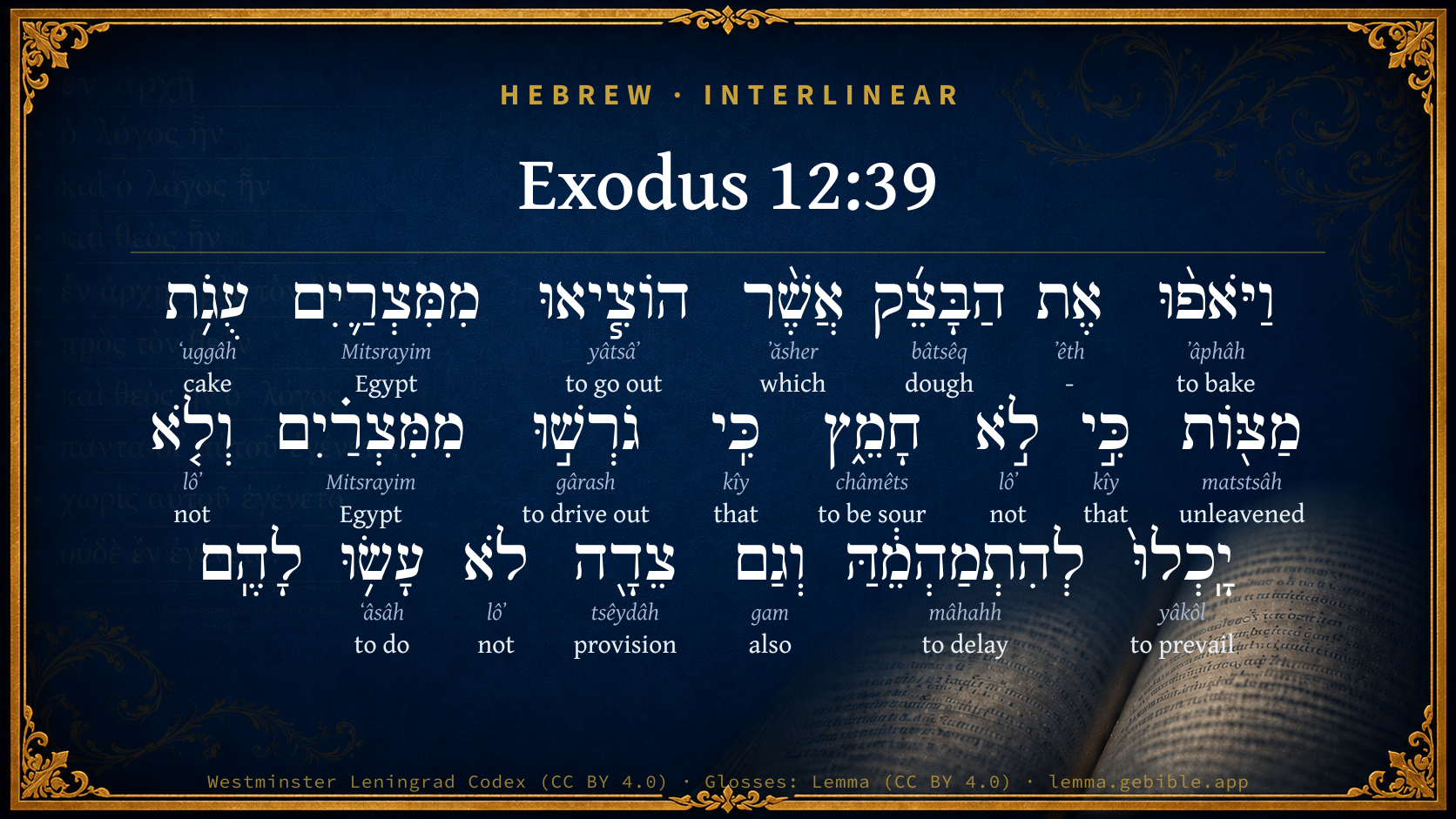
Hebrew (Westminster Leningrad Codex) Exodus 12:39 appears in the Hebrew Old Testament. The text above is from the Westminster Leningrad Codex. Each word links to its Strong’s number, a concise gloss, and parsing drawn from the Open Scriptures Hebrew Bible morphology. Click any word for its full Brown-Driver-Briggs (BDB) entry.
Download image
Cite this verse

Exodus 12:39 (World English Bible). Public Domain. Lemma interlinear Bible study tool, https://lemma.gebible.app/v/exodus/12/39.

Show BibTeX & RIS
BibTeX
RIS
English Translation
They baked unleavened cakes of the dough which they brought forth out of Egypt; for it wasn't leavened, because they were thrust out of Egypt, and couldn't wait, neither had they prepared for themselves any food.
World English Bible · Public Domain
Download a study sheet

One document with this verse’s original text, its word-by-word gloss line, the meaning frame, cross-references with their text, attributed commentary, and full source and license credits — printable, and it pastes into notes with its structure intact.

This verse Autodidact and up

Study sheet (.html) Plain text (.txt)

A passage Seminary Student

Up to 50 verses in one chapter. A passage sheet keeps up to 6 commentary sources and 12 cross-references per verse, in the order this page ranks them, and says so on the sheet whenever that leaves anything out. Ask for a single verse and you get the Autodidact verse sheet above.

Everything on this page stays free to read, with no account — the sheet is a download of what is already on screen, not access to it.

Want to remove ads? Support Godless Engineer
Compare translations 3

The same verse in 3 English versions, stacked beneath the original-language interlinear above. Click any original word for its lexicon entry.

Each is an independent rendering of the whole verse — the interlinear is not word-aligned to these translations.

Highlighted words mark where these versions differ — a whole-verse word diff, not a word-by-word alignment.

  • World English Bible Public Domain
    They baked unleavened cakes of the dough which they brought forth out of Egypt; for it wasn't leavened, because they were thrust out of Egypt, and couldn't wait, neither had they prepared for themselves any food.
  • King James Version Public Domain
    And they baked unleavened cakes of the dough which they brought forth out of Egypt, for it was not leavened; because they were thrust out of Egypt, and could not tarry, neither had they prepared for themselves any victual.
  • unfoldingWord Literal Text CC BY-SA 4.0
    And they baked the dough that they brought from Egypt into unleavened bread, for it was not leavened, because they were driven out of Egypt, and they could not delay. And furthermore, they had not made provisions for themselves.

unfoldingWord Literal Text — © unfoldingWord, licensed CC BY-SA 4.0. Word-aligned USFM3 via Door43 (git.door43.org/unfoldingWord/en_ult).

Versions to compare (up to 4)

3 of 4 selected

Show all 18 translations

Every available English version of this verse, each an independent rendering of the whole verse.

  • World English Bible Public Domain
    They baked unleavened cakes of the dough which they brought forth out of Egypt; for it wasn't leavened, because they were thrust out of Egypt, and couldn't wait, neither had they prepared for themselves any food.
  • Berean Standard Bible Public Domain
    Since their dough had no leaven, the people baked what they had brought out of Egypt into unleavened loaves. For when they had been driven out of Egypt, they could not delay and had not prepared any provisions for themselves.
  • Majority Standard Bible Public Domain
    Since their dough had no leaven, the people baked what they had brought out of Egypt into unleavened loaves. For when they had been driven out of Egypt, they could not delay and had not prepared any provisions for themselves.
  • King James Version Public Domain
    And they baked unleavened cakes of the dough which they brought forth out of Egypt, for it was not leavened; because they were thrust out of Egypt, and could not tarry, neither had they prepared for themselves any victual.
  • American Standard Version (1901) Public Domain
    And they baked unleavened cakes of the dough which they brought forth out of Egypt; for it was not leavened, because they were thrust out of Egypt, and could not tarry, neither had they prepared for themselves any victuals.
  • Revised Version (1885) Public Domain
    And they baked unleavened cakes of the dough which they brought forth out of Egypt, for it was not leavened; because they were thrust out of Egypt, and could not tarry, neither had they prepared for themselves any victual.
  • Geneva Bible (1599) Public Domain
    And they baked the dough which they brought out of Egypt, and made vnleauened cakes: for it was not leauened, because they were thrust out of Egypt, neither coulde they tarie, nor yet prepare themselues vitailes.
  • Douay-Rheims (1899) Public Domain
    And they baked the meal, which a little before they had brought out of Egypt, in dough: and they made earth cakes unleavened: for it could not be leavened, the Egyptians pressing them to depart, and not suffering them to make any stay: neither did they think of preparing any meat.
  • Young's Literal Translation Public Domain
    And they bake with the dough which they have brought out from Egypt unleavened cakes, for it hath not fermented; for they have been cast out of Egypt, and have not been able to delay, and also provision they have not made for themselves.
  • Literal Standard Version CC BY-SA 4.0
    And they bake unleavened cakes with the dough which they have brought out from Egypt, for it has not fermented; for they have been cast out of Egypt, and have not been able to delay, and also they have not made provision for themselves.
  • Unlocked Literal Bible CC BY-SA 4.0
    They baked bread without yeast in the dough that they brought from Egypt. It was without yeast because they had been driven out of Egypt and could not delay to prepare food.
  • unfoldingWord Literal Text CC BY-SA 4.0
    And they baked the dough that they brought from Egypt into unleavened bread, for it was not leavened, because they were driven out of Egypt, and they could not delay. And furthermore, they had not made provisions for themselves.
  • Darby Bible Public Domain
    And they baked the dough that they brought forth out of Egypt into unleavened cakes, for it was not leavened; for they were driven out of Egypt, and could not wait; neither had they prepared for themselves any food.
  • World Messianic Bible Public Domain
    They baked unleavened cakes of the dough which they brought out of Egypt; for it wasn’t leavened, because they were thrust out of Egypt, and couldn’t wait, and they had not prepared any food for themselves.
  • Webster's Bible Public Domain
    And they baked unleavened cakes of the dough which they brought from Egypt, for it was not leavened: because they were driven from Egypt, and could not tarry, neither had they prepared for themselves any victuals.
  • Free Bible Version CC BY-SA 4.0
    Since their bread dough didn't have any yeast, the Israelites baked what they had brought out of Egypt into loaves without yeast. This was because when they were driven out of Egypt they had to leave in a hurry and didn't have time to prepare food for themselves.
  • Bible in Basic English Public Domain
    And they made unleavened cakes from the paste which they had taken out of Egypt; it was not leavened, for they had been sent out of Egypt so quickly, that they had no time to make any food ready.
  • JPS Tanakh (1917) Public Domain
    And they baked unleavened cakes of the dough which they brought forth out of Egypt, for it was not leavened; because they were thrust out of Egypt, and could not tarry, neither had they prepared for themselves any victual.

Literal Standard Version (2020), Covenant Press — licensed CC BY-SA 4.0. Text via the HelloAO Bible API (eBible.org). Unlocked Literal Bible (unfoldingWord) — licensed CC BY-SA 4.0. Text via the HelloAO Bible API (eBible.org). unfoldingWord Literal Text — © unfoldingWord, licensed CC BY-SA 4.0. Word-aligned USFM3 via Door43 (git.door43.org/unfoldingWord/en_ult). Free Bible Version, Dr. Jonathan Gallagher — licensed CC BY-SA 4.0. Text via the HelloAO Bible API (eBible.org).

Word by word

More ways to search: Search by grammar → Find every occurrence → Compare this word →

Practice this passage: Drill this verse → Learn its vocabulary →

הַבָּצֵ֜ק
bâtsêq
H1217
“the · dough”
Particle, Definite Article + Noun, Common, Masculine, Singular, Absolute
Part of Speech
Particle + Noun
Type
Common
Gender
Masculine
Number
Singular
State
Absolute
Full BDB Definition

Origin: from H1216

TWOT: 269a

dough (unleavened)
  1. וַיֹּאפ֨וּ ʼâphâh H644 “and · to bake” Conjunction + Verb, Qal, Sequential Imperfect, 3rd Person, Masculine, Plural
  2. אֶת ʼêth H853 “-” Particle, Direct Object
  3. אֲשֶׁ֨ר ʼăsher H834 “which” Particle, Relative
  4. הוֹצִ֧יאוּ yâtsâʼ H3318 “to go out” Verb, Hiphil, Perfect, 3rd Person, Common, Plural
  5. מִמִּצְרַ֛יִם Mitsrayim H4714 “from · Egypt” Preposition + Noun, Proper
  6. עֻגֹ֥ת ʻuggâh H5692 “cakes” Noun, Common, Feminine, Plural, Absolute
  7. מַצּ֖וֹת matstsâh H4682 “unleavened bread” Noun, Common, Feminine, Plural, Absolute
  8. כִּ֣י kîy H3588 “that” Conjunction
  9. לֹ֣א lôʼ H3808 “not” Particle, Negative
  10. חָמֵ֑ץ châmêts H2556 “to be sour” Verb, Qal, Perfect, 3rd Person, Masculine, Singular
  11. כִּֽי kîy H3588 “that” Conjunction
  12. גֹרְשׁ֣וּ gârash H1644 “to drive out” Verb, Pual, Perfect, 3rd Person, Common, Plural
  13. מִמִּצְרַ֗יִם Mitsrayim H4714 “from · Egypt” Preposition + Noun, Proper
  14. וְלֹ֤א lôʼ H3808 “and · not” Conjunction + Particle, Negative
  15. יָֽכְלוּ֙ yâkôl H3201 “to prevail” Verb, Qal, Perfect, 3rd Person, Common, Plural
  16. לְהִתְמַהְמֵ֔הַּ mâhahh H4102 “to delay” Preposition + Verb, Hithpalpel, Infinitive Construct
  17. וְגַם gam H1571 “and · also” Conjunction + Particle, Accusative
  18. צֵדָ֖ה tsêydâh H6720 “provision” Noun, Common, Both, Singular, Absolute
  19. לֹא lôʼ H3808 “not” Particle, Negative
  20. עָשׂ֥וּ ʻâsâh H6213 “to do” Verb, Qal, Perfect, 3rd Person, Common, Plural

About this verse

These counts appear in no published source. They are computed here, from the morphology-tagged text and Lemma’s own curated glosses. What Lemma adds →

22
words
17
distinct lemmas
Pentateuch
section

Notable vocabulary

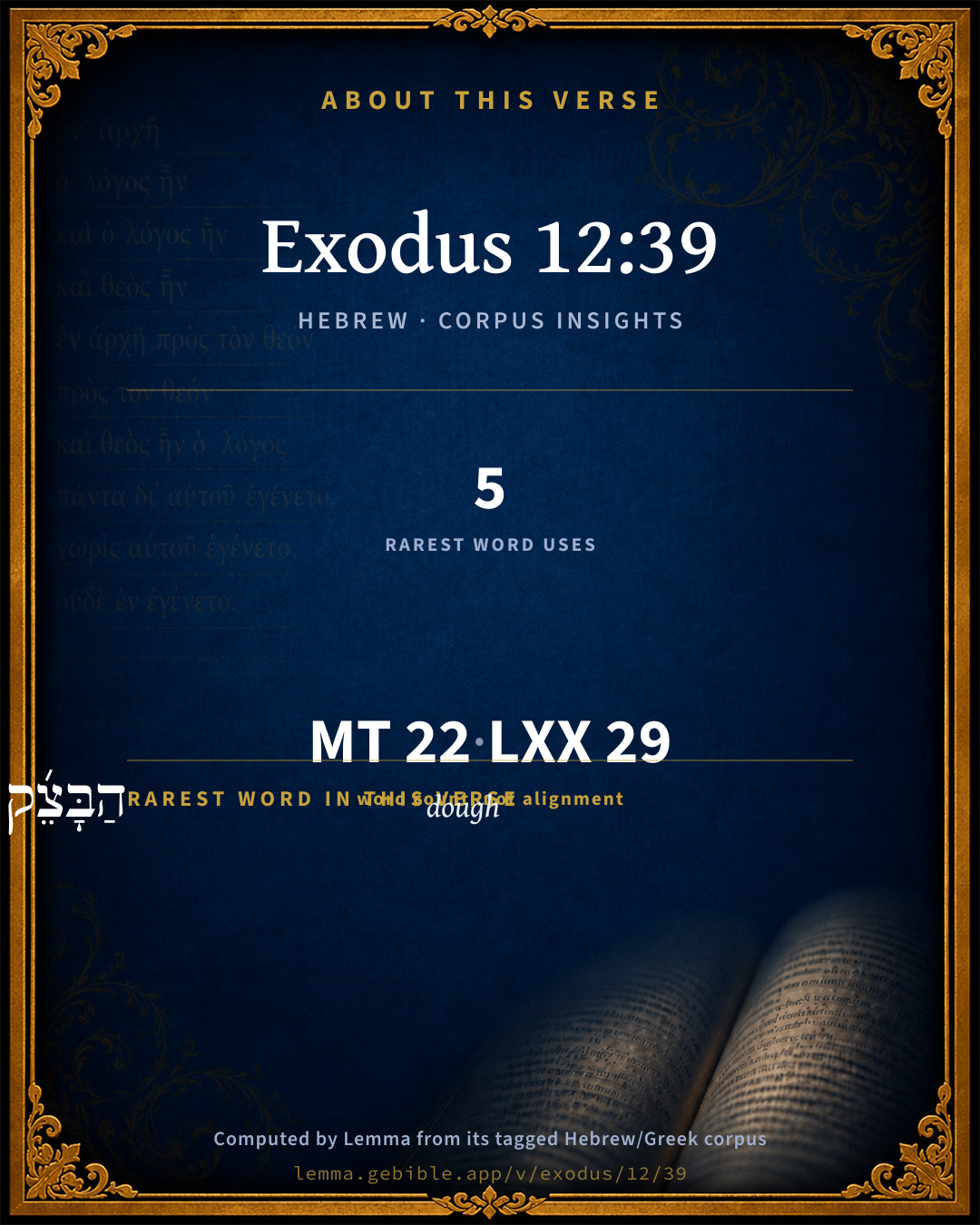
The rarest word here is הַבָּצֵ֜ק dough H1217 — appearing just 5 times in the whole Hebrew Bible.

Shared distinctive vocabulary

הַבָּצֵ֜ק dough H1217 occurs in 5 verses of the Hebrew Bible. Also found in:

Grammatical profile

  • 7 verbs
  • 6 nouns
  • 1 preposition
  • 2 conjunctions
  • 6 particles

Verb forms

  • וַיֹּאפ֨וּ Qal · Sequential Imperfect
  • הוֹצִ֧יאוּ Hiphil · Perfect
  • חָמֵ֑ץ Qal · Perfect
  • גֹרְשׁ֣וּ Pual · Perfect
  • יָֽכְלוּ֙ Qal · Perfect
  • לְהִתְמַהְמֵ֔הַּ Hithpalpel · Infinitive Construct
  • עָשׂ֥וּ Qal · Perfect

Repetition

Words recur within this verse — often emphatic in Hebrew:

  • מִמִּצְרַ֛יִם Egypt H4714 ×2
  • לֹ֣א not H3808 ×3
  • כִּ֣י that H3588 ×2

Hebrew & Septuagint length

In English translation the verse runs 36 words from the Hebrew and 40 from the Septuagint (LXX English) — closely comparable.

A rough comparison of the two English renderings, which tokenize alike — not a word-level alignment.

Word counts can differ between the Hebrew and the Greek without any difference in meaning — e.g. the Hebrew direct-object marker אֵת has no separate Greek word, and Greek often adds the article ὁ.

In the original languages it is 22 Hebrew tokens and 29 Greek tokens — but the two are counted differently (Hebrew bundles its prefixes and suffixes into one token; the Greek is in lemma form), so that isn’t a like-for-like length.

Cross-references

3

Topical passages linked to Exodus 12:39 in the Treasury of Scripture Knowledge — connected by theme and wording, ordered by reader-vote popularity; previews shown in the World English Bible.

  • Exodus 6:1 Yahweh said to Moses, "Now you shall see what I will do to Pharaoh, for by a strong hand he shall let them go, and by a strong hand he shall drive them out of his land."
  • Exodus 11:1 Yahweh said to Moses, "Yet one plague more will I bring on Pharaoh, and on Egypt; afterwards he will let you go. When he lets you go, he will surely thrust you out altogether.
  • Exodus 12:31–33 He called for Moses and Aaron by night, and said, "Rise up, get out from among my people, both you and the children of Israel; and go, serve Yahweh, as you have said!

Cross-references courtesy of OpenBible.info (CC BY 4.0).

Hebrew and Greek witnesses Masoretic Hebrew ↔ Greek Septuagint

The same verse in the two great witnesses to the Old Testament, shown verse-for-verse.

These are two independent witnesses, not word-aligned to each other, and the Septuagint is shown in lemma (dictionary) form.

Hebrew Exodus 12:39 Masoretic · Westminster Leningrad Codex

וַיֹּאפ֨וּ אֶת הַבָּצֵ֜ק אֲשֶׁ֨ר הוֹצִ֧יאוּ מִמִּצְרַ֛יִם עֻגֹ֥ת מַצּ֖וֹת כִּ֣י לֹ֣א חָמֵ֑ץ כִּֽי גֹרְשׁ֣וּ מִמִּצְרַ֗יִם וְלֹ֤א יָֽכְלוּ֙ לְהִתְמַהְמֵ֔הַּ וְגַם צֵדָ֖ה לֹא עָשׂ֥וּ לָהֶֽם

They baked unleavened cakes of the dough which they brought forth out of Egypt; for it wasn't leavened, because they were thrust out of Egypt, and couldn't wait, neither had they prepared for themselves any food.

World English Bible · Public Domain

Greek LXX Exodus 12:39 Septuagint · lemma form

καί πέσσω ὁ σταῖς ὅς ἐκφέρω ἐκ αἴγυπτος ἐγκρυφίας ἄζυμος οὐ γάρ ζύμομαι ἐκβάλλω γάρ αὐτός ὁ αἰγύπτιος καί οὐ δύναμαι ἐπιμένω οὐδέ ἐπισιτισμός ποιέω ἑαυτοῦ εἰς ὁ ὁδός

And they baked the dough which they brought out of Egypt, unleavened cakes, for it had not been leavened; for the Egyptians cast them out, and they could not remain, neither did they prepare provision for themselves for the journey.

LXX2012 (modern English Septuagint) · Public Domain

On this verse, The Cambridge Bible for Schools and Colleges discusses the Septuagint’s reading. Read the note in Commentary ↓

Hebrew: Westminster Leningrad Codex (CC BY 4.0). Greek: Septuagint (public domain); English from LXX2012 (modern English Septuagint) (Public Domain). How the Septuagint differs from the Hebrew →

Targum (Aramaic paraphrase)

2

The Targum is the ancient Jewish Aramaic paraphrase of the Hebrew Scriptures — an interpretive translation, not the Hebrew text itself. Onkelos (literal) and Pseudo-Jonathan (expansive) render the Torah, and Jonathan the Prophets. Coverage is partial: where no permissively-licensed English translation exists for a verse, only the Aramaic is shown. This is verse-level text, not a word-by-word alignment to the Hebrew.

  1. Targum Onkelos Torah (Genesis–Deuteronomy)
    וַאֲפוֹ יָת לַיְשָׁא דִי אַפִּיקוּ מִמִצְרַיִם גְרִיצָן פַּטִירָן אֲרֵי לָא חֲמָע אֲרֵי אִתָּרָכוּ מִמִצְרַיִם וְלָא יָכִילוּ לְאִתְעַכָּבָא וְאַף זְוָדִין לָא עֲבָדוּ לְהוֹן:

    (no public-domain English translation for this verse)

    Targum Onkelos — Aramaic: “Onkelos Genesis” (public domain); “Onkelos Exodus” (public domain); “Onkelos Leviticus” (public domain); “Onkelos Numbers” (public domain); “Onkelos Deuteronomy” (public domain). English: “Sefaria Community Translation” (CC0 1.0 (public-domain dedication)); “J.W. Etheridge. The Targums of Onkelos and Jonathan Ben Uzziel on the Pentateuch. London: Longmans, Green, 1862” (public domain). Text via Sefaria.

  2. Targum Pseudo-Jonathan Torah (Genesis–Deuteronomy)
    וַהֲווֹ קַטְעִין מִן לִישָׁא דְאַפִּיקוּ מִמִּצְרַיִם וְסַדְרִין עַל רֵישֵׁיהוֹן וּמִתְאַפֵּי לְהוֹן מְחוּמְתָּא דְשִׁימְשָׁא חֲרִירַן פַּטִירַן אֲרוּם לָא חָמִיעַ אֲרוּם אִיתְרִיכוּ מִמִּצְרַיִם וְלָא יָכִילוּ לְמִישְׁהֵי וְסַפִּיקָא לְהוֹן לְמֵיכַל עַד חֲמֵיסַר יוֹמִין לְיַרְחָא דְאִיָּיר מְטוֹל דִּזְוָודִין לָא עֲבָדוּ לְהוֹן

    And they divided the dough which they brought out of Mizraim, which they had carried on their heads, and it was baked for them by the heat of the sun, (into) unleavened cakes, because it had not fermented; for the Mizraee had thrust them out, neither could they delay; and it was sufficient for them to eat until the fifteenth of the month Ijar; because they had not prepared provision for the way.

    Targum Pseudo-Jonathan — Aramaic: “Targum Jonathan on Genesis” (public domain); “Targum Jonathan on Exodus” (public domain); “Targum Jonathan on Leviticus” (public domain); “Targum Jonathan on Numbers” (public domain); “Targum Jonathan on Deuteronomy” (public domain). English: “The Targum of Jonathan ben Uzziel, trans. J. W. Etheridge, London, 1862” (public domain). Text via Sefaria.

Commentary

Notes on Exodus 12:39 from classic Christian and Jewish commentators (each source and its license shown beneath its notes). The classic Christian expositions comment on the surrounding passage and are grouped to its opening verse, so a note may address several verses; the Jewish commentaries on the Tanakh (Rashi and others) are per-verse, so they appear only where the commentator wrote on this verse.

Lemma curates 59 commentaries, every one of them public domain or Creative Commons licensed, each selected and text-cleaned for this edition rather than reprinted as found. About our sources →

Trapp's Complete Commentary

John Trapp

Exo 12:39 And they baked unleavened cakes of the dough which they brought forth out of Egypt, for it was not leavened; because they were thrust out of Egypt, and could not tarry, neither had they prepared for themselves any victual.

Ver. 39. And they baked unleavened cakes.] A memorial of which sweet mercy they kept on foot by that yearly feast of unleavened cakes. {Deu 16:3}

John Trapp, A Commentary or Exposition upon All the Books of the Old and New Testament (1647–1656) — public domain. Text from a community e-Sword module.

Ellicott's Commentary for English Readers

(39) Unleavened cakes.—Such are commonly eaten by the Arabs, who make them by mixing flour with water, and attaching round pieces of the dough to the insides of their ovens after they have heated them.

A Bible Commentary for English Readers, edited by Charles John Ellicott (1878–1897) — public domain. Text from a community e-Sword module.

The Cambridge Bible for Schools and Colleges

gen. ed. J. J. S. Perowne

39. Cf. v. 34; and for unleavened cakes see on v. 8. Here, however, there is an independent word for ‘cakes,’ the one found in Gen_18:6, 1Ki_19:6 al., and probably denoting cakes baked rapidly by being placed on the ‘hot stones’ (1 K. l.c.),—i.e. stones heated by a fire having been made upon them (EB. i. 604),—and covered with the hot ashes: LXX. ἐγκρυφίαι, Vulg. subcinericii panes.

thrust out] Exo_6:1 (Heb.), Exo_11:1.

The Cambridge Bible for Schools and Colleges (gen. ed. J. J. S. Perowne; Cambridge University Press, 1878–1918) — public domain. Text from a community e-Sword module.

John Gill's Exposition

And it came to pass at the end of four hundred and thirty years,.... As soon as completed:

even the selfsame day it came to pass, that all the hosts of the Lord went out from the land of Egypt; which was the fifteenth of Nisan; and Jarchi says it was on the fifteenth of Nisan that the decree was made known to Abraham between the pieces, concerning the affliction of his posterity four hundred years in a land not theirs; but this is not to be depended on; yet it looks as if at the close of the four hundred and thirty years, from the date of them, exactly to a day, the children of Israel, the armies of the Lord, came out of Egypt in great order: however, it seems certain by this that they all came out the same day, which was very wonderful that such a large number should be collected together, and that they should march out of the land on one and the same day; and it is pretty plain it was in the daytime, and very likely in the midst of the day; for they were not to stir out of their houses till morning, and then they had what remained of the passover to burn, as well as many other things to do, it is very probable, and some which they could not do; so that they did not go by night, or by stealth, but openly at noon day; and the words will bear to be rendered, "in the strength or body of the day" (r), when it is at its height, as it is at noon; and so the Jews represent the Lord speaking after this manner (s),"If I bring out Israel by night, the Egyptians will say, now he does his work after the manner of thieves; but behold, I will bring them out in the midst of the day, in the strength of the sun, as is said, "and it was in the selfsame day", &c.''

(r) "in corpore diei hujus", Pagninus, Montanus; "in the body" or "strength of that day", Ainsworth. (s) Pirke Eliezer, c. 48. fol. 58. 2.

John Gill's Exposition of the Whole Bible (1746–1763) — public domain (CC PDM 1.0). Text via the HelloAO Bible API.

Matthew Poole's English Annotations

It was not leavened; both because leaven was forbidden to them at that time, and because the great haste required gave them not time for leavening it.

They were thrust out of Egypt; not by force, but by importunate requests, as was observed on Exo 12:33. Thus men are said to be driven to worship the sun, moon, &c., when they are persuaded to it, Deu 4:19.

Matthew Poole's English Annotations on the Holy Bible (1683–1685) — public domain. Text from a community e-Sword/MySword module.

Whedon's Commentary on the Bible

Daniel D. Whedon

39. Unleavened cakes — See on Exo_12:8.

Daniel D. Whedon (gen. ed.), Commentary on the Old and New Testaments (1874–1909) — public domain. Text from a community e-Sword module.

The Pulpit Commentary

Unleavened cakes. Some of the modern Arabs make such cakes by simply mixing flour with water, and attaching flat circular pieces of the dough thus formed to the sides of their ovens after they have heated them. (Niebuhr, Description de l"Arabie,?. 45, and pl. 1, F.) Others put a lump of dough into the ashes of a wood fire, and cover it over with the embers for a short time (Layard, Nineveh and Babylon, p. 288). All Arab bread is unleavened. They were thrust out of Egypt. Compare ver.

33.

The Pulpit Commentary (1880–1919), ed. H.D.M. Spence-Jones & Joseph S. Exell — public domain. Text from a community e-Sword module.

John Wesley's Explanatory Notes

Thrust out - By importunate entreaties.

John Wesley, Explanatory Notes Upon the Whole Bible (1754–1765) — public domain. Text via the GEBible commentary corpus.

Rashi

Rabbi Shlomo Yitzchaki (Rashi)

עגת מצות means a cake of (made of) unleavened dough (Mekhilta); dough which has not become leavened is termed מצה.

וגם צדה לא עשו להם NEITHER HAD THEY MADE FOR THEMSELVES ANY PROVISION for the journey. This is stated to tell how praiseworthy Israel was: that they did not say, “How can we go forth into the wilderness without provisions?” But they had faith and set forth. This it is that is referred to more explicitly in the prophets: (Jeremiah 2:1) “I remember for thee the affection of thy youth, the love of thine espousals, how thou wentest after me in the wilderness in a land that was not sown”. What reward is afterwards set forth there? “Israel is the Lord’s hallowed portion etc.” (Mekhilta).

Rashi on the Tanakh — English translations: “The Judaica Press complete Tanach with Rashi, translated by A. J. Rosenberg” (CC BY 4.0); “Pentateuch with Rashi's commentary by M. Rosenbaum and A.M. Silbermann, 1929-1934” (public domain); “The Metsudah Tanach series, Lakewood, N.J” (CC BY 4.0); and “The Book of Joshua, Metsudah Publications, 1997” (CC BY 4.0). Text via Sefaria.

Ramban (Nachmanides)

Rabbi Moshe ben Nachman (Ramban / Nachmanides)

AND THEY BAKED UNLEAVENED CAKES OF THE DOUGH. The meaning thereof is that they baked unleavened bread of the dough because of the precept which they were commanded: There shall be no leaven found in your homes, for whosoever eateth that which is leavened, that soul shall be cut off from the congregation of Israel.

BECAUSE THEY WERE THRUST OUT OF EGYPT. The sense of it is that they baked the dough on the road because they had been driven out of Egypt, and could not wait to bake it in the city and carry the unleavened bread. Therefore they carried the dough, and their kneading-troughs were bound up in their clothes upon their shoulders, and they hurried and baked it before it was leavened on the road, or in Succoth, where they arrived in a short while as our Rabbis have said.

Ramban (Nachmanides) on the Tanakh — English translation: “Commentary on the Torah by Ramban (Nachmanides). Translated and annotated by Charles B. Chavel. New York, Shilo Pub. House, 1971-1976” (CC BY 4.0). Text via Sefaria.

Lesson kit

Teaching starters — assembled from the data on this page, not authored interpretation. Every prompt links to the verse data it draws on. Edit before teaching.

Exodus, in the Pentateuch, opens this verse with 22 words (17 distinct Hebrew lemmas). Its most distinctive word is bâtsêq (“dough”). A historical commentator’s framing appears above. Read the whole chapter for the surrounding context.

Discussion questions

  1. The word bâtsêq carries the sense “dough.” How does it shape the verse?
  2. How does Exodus 12:34, which shares the word «dough», read alongside this verse?
  3. What does the repetition of “Egypt” (2× in this one verse) do in this verse?
  4. These translations render this verse differently; the difference is in the English rendering, not the original. What questions does that raise?
  5. «וַיֹּאפ֨וּ» is a Qal Sequential Imperfect verb. How does that grammatical form shape the action described?
  6. Compare how Trapp's Complete Commentary and Ellicott's Commentary for English Readers read this verse. Where do they agree or differ?

Things to notice

Reading settings

Reading text

Shown beneath each verse's original-language words.

Old Testament
Old Testament edition

Read the OT as the Masoretic Hebrew (MT) or the Greek Septuagint (LXX).

English shown for the Greek Septuagint (in the Hebrew ↔ Greek comparison).

Comparing translations? Open the Compare panel on any verse page to stack up to four side by side.