Deuteronomy 4:37

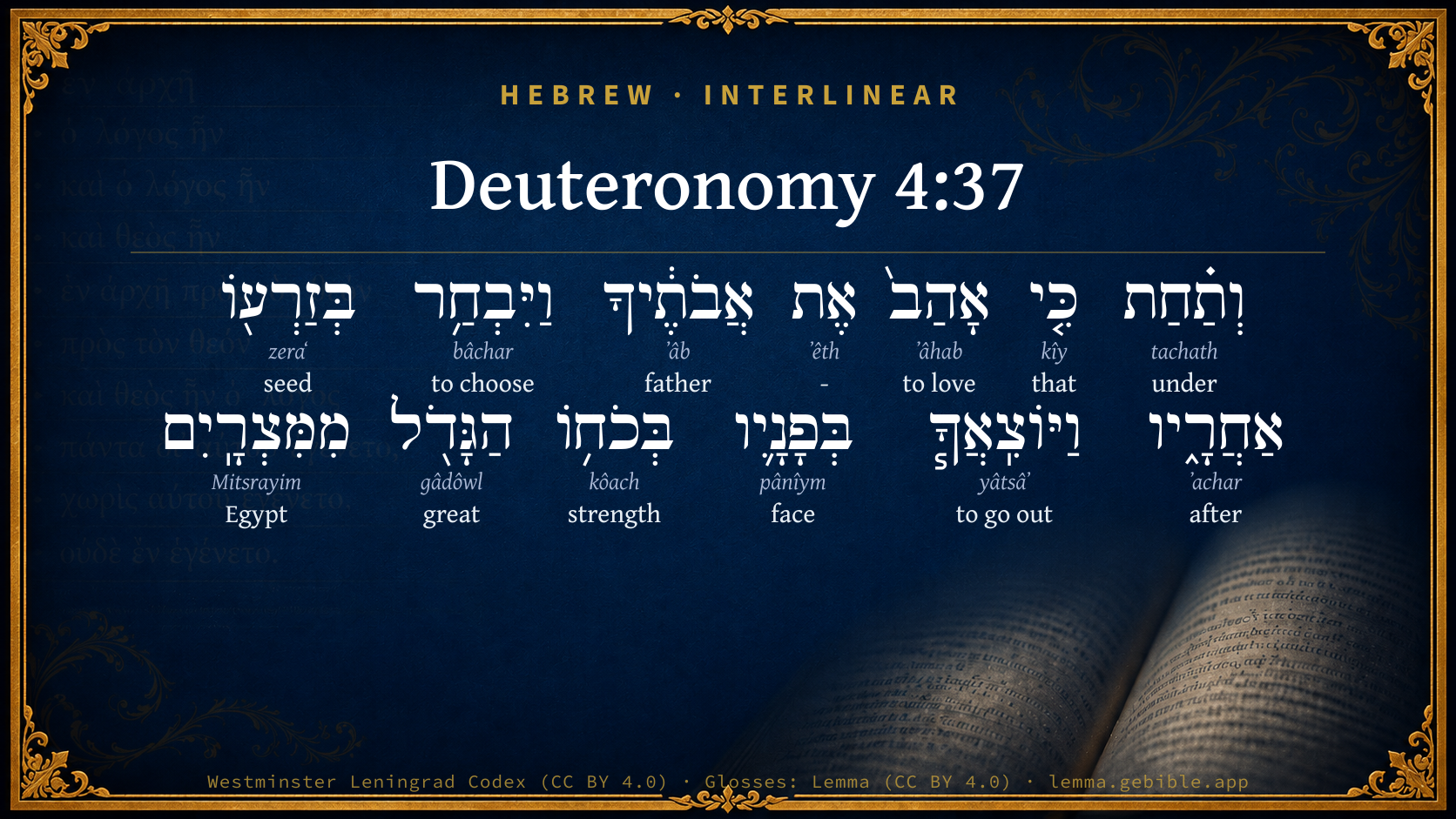
Hebrew (Westminster Leningrad Codex) Deuteronomy 4:37 appears in the Hebrew Old Testament. The text above is from the Westminster Leningrad Codex. Each word links to its Strong’s number, a concise gloss, and parsing drawn from the Open Scriptures Hebrew Bible morphology. Click any word for its full Brown-Driver-Briggs (BDB) entry.
Download image
Cite this verse

Deuteronomy 4:37 (World English Bible). Public Domain. Lemma interlinear Bible study tool, https://lemma.gebible.app/v/deuteronomy/4/37.

Show BibTeX & RIS
BibTeX
RIS
English Translation
Because he loved your fathers, therefore he chose their seed after them, and brought you out with his presence, with his great power, out of Egypt;
World English Bible · Public Domain
Download a study sheet

One document with this verse’s original text, its word-by-word gloss line, the meaning frame, cross-references with their text, attributed commentary, and full source and license credits — printable, and it pastes into notes with its structure intact.

This verse Autodidact and up

Study sheet (.html) Plain text (.txt)

A passage Seminary Student

Up to 50 verses in one chapter. A passage sheet keeps up to 6 commentary sources and 12 cross-references per verse, in the order this page ranks them, and says so on the sheet whenever that leaves anything out. Ask for a single verse and you get the Autodidact verse sheet above.

Everything on this page stays free to read, with no account — the sheet is a download of what is already on screen, not access to it.

Want to remove ads? Support Godless Engineer
Compare translations 3

The same verse in 3 English versions, stacked beneath the original-language interlinear above. Click any original word for its lexicon entry.

Each is an independent rendering of the whole verse — the interlinear is not word-aligned to these translations.

Highlighted words mark where these versions differ — a whole-verse word diff, not a word-by-word alignment.

  • World English Bible Public Domain
    Because he loved your fathers, therefore he chose their seed after them, and brought you out with his presence, with his great power, out of Egypt;
  • King James Version Public Domain
    And because he loved thy fathers, therefore he chose their seed after them, and brought thee out in his sight with his mighty power out of Egypt;
  • unfoldingWord Literal Text CC BY-SA 4.0
    And because he loved your fathers, then he chose his seed after him and brought you out from Egypt with his face, with his great power

unfoldingWord Literal Text — © unfoldingWord, licensed CC BY-SA 4.0. Word-aligned USFM3 via Door43 (git.door43.org/unfoldingWord/en_ult).

Versions to compare (up to 4)

3 of 4 selected

Show all 18 translations

Every available English version of this verse, each an independent rendering of the whole verse.

  • World English Bible Public Domain
    Because he loved your fathers, therefore he chose their seed after them, and brought you out with his presence, with his great power, out of Egypt;
  • Berean Standard Bible Public Domain
    Because He loved your fathers, He chose their descendants after them and brought you out of Egypt by His presence and great power,
  • Majority Standard Bible Public Domain
    Because He loved your fathers, He chose their descendants after them and brought you out of Egypt by His presence and great power,
  • King James Version Public Domain
    And because he loved thy fathers, therefore he chose their seed after them, and brought thee out in his sight with his mighty power out of Egypt;
  • American Standard Version (1901) Public Domain
    And because he loved thy fathers, therefore he chose their seed after them, and brought thee out with his presence, with his great power, out of Egypt;
  • Revised Version (1885) Public Domain
    And because he loved thy fathers, therefore he chose their seed after them, and brought thee out with his presence, with his great power, out of Egypt;
  • Geneva Bible (1599) Public Domain
    And because hee loued thy fathers, therefore hee chose their seede after them, and hath brought thee out of Egypt in his sight by his mightie power,
  • Douay-Rheims (1899) Public Domain
    Because he loved thy fathers, and chose their seed after them. And he brought thee out of Egypt, going before thee with his great power,
  • Young's Literal Translation Public Domain
    `And because that He hath loved thy fathers, He doth also fix on their seed after them, and doth bring thee out, in His presence, by His great power, from Egypt:
  • Literal Standard Version CC BY-SA 4.0
    And because that He has loved your fathers, He also fixes on their seed after them, and brings you out in His presence, by His great power, from Egypt,
  • Unlocked Literal Bible CC BY-SA 4.0
    Because he loved your fathers, he chose their descendants after them, and brought you out of Egypt with his presence, with his great power;
  • unfoldingWord Literal Text CC BY-SA 4.0
    And because he loved your fathers, then he chose his seed after him and brought you out from Egypt with his face, with his great power
  • Darby Bible Public Domain
    And because he loved thy fathers, and chose their seed after them, he brought thee out with his countenance, with his great power, out of Egypt,
  • World Messianic Bible Public Domain
    Because he loved your fathers, therefore he chose their offspring after them, and brought you out with his presence, with his great power, out of Egypt;
  • Webster's Bible Public Domain
    And because he loved thy fathers, therefore he chose their seed after them, and brought thee out of Egypt in his sight with his mighty power.
  • Free Bible Version CC BY-SA 4.0
    Because he loved your forefathers, he chose you, their descendants. He himself led you out of Egypt by his great power,
  • Bible in Basic English Public Domain
    And because of his love for your fathers, he took their seed and made it his, and he himself, present among you, took you out of Egypt by his great power;
  • JPS Tanakh (1917) Public Domain
    And because He loved thy fathers, and chose their seed after them, and brought thee out with His presence, with His great power, out of Egypt,

Literal Standard Version (2020), Covenant Press — licensed CC BY-SA 4.0. Text via the HelloAO Bible API (eBible.org). Unlocked Literal Bible (unfoldingWord) — licensed CC BY-SA 4.0. Text via the HelloAO Bible API (eBible.org). unfoldingWord Literal Text — © unfoldingWord, licensed CC BY-SA 4.0. Word-aligned USFM3 via Door43 (git.door43.org/unfoldingWord/en_ult). Free Bible Version, Dr. Jonathan Gallagher — licensed CC BY-SA 4.0. Text via the HelloAO Bible API (eBible.org).

Word by word

More ways to search: Search by grammar → Find every occurrence → Compare this word →

Practice this passage: Drill this verse → Learn its vocabulary →

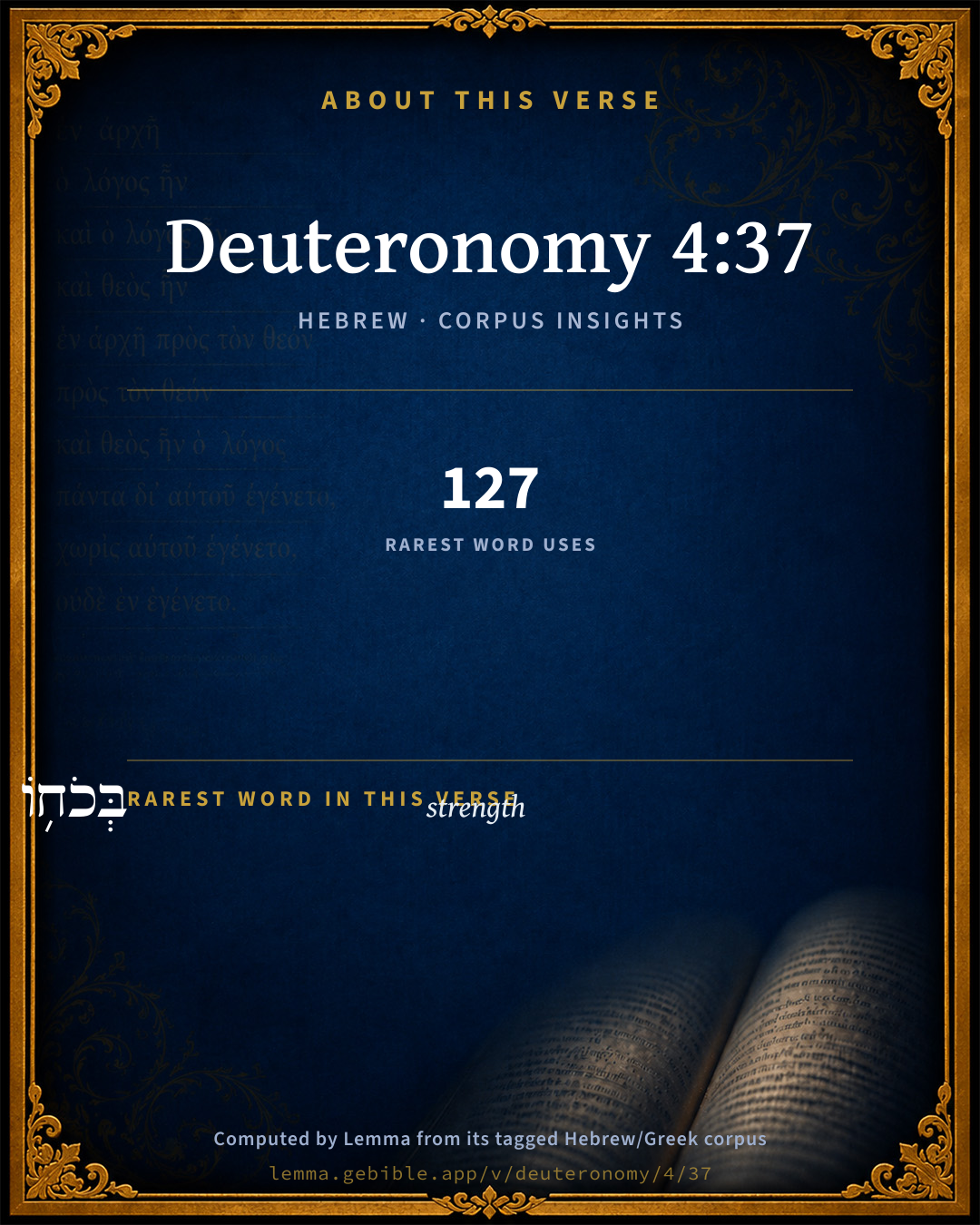
בְּכֹח֥וֹ
kôach
H3581
“in/at · strength · his”
Preposition + Noun, Common, Masculine, Singular, Construct + Suffix, Personal, 3rd Person, Masculine, Singular
Part of Speech
Preposition + Noun
Type
Common
Gender
Masculine
Number
Singular
State
Construct
Full BDB Definition

Origin: from an unused root meaning to be firm

TWOT: 973 . 1

strength, power, might - human strength - strength (of angels) - power (of God) - strength (of animals) - strength, produce, wealth (of soil) - a small reptile, probably a kind of lizard, which is unclean - perhaps an extinct animal, exact meaning is unknown
  1. וְתַ֗חַת tachath H8478 “and · under” Conjunction + Preposition
  2. כִּ֤י kîy H3588 “that” Conjunction
  3. אָהַב֙ ʼâhab H157 “to love” Verb, Qal, Perfect, 3rd Person, Masculine, Singular
  4. אֶת ʼêth H853 “-” Particle, Direct Object
  5. אֲבֹתֶ֔יךָ ʼâb H1 “fathers · your” Noun, Common, Masculine, Plural, Construct + Suffix, Personal, 2nd Person, Masculine, Singular
  6. וַיִּבְחַ֥ר bâchar H977 “and · to choose” Conjunction + Verb, Qal, Sequential Imperfect, 3rd Person, Masculine, Singular
  7. בְּזַרְע֖וֹ zeraʻ H2233 “in/at · seed · his” Preposition + Noun, Common, Masculine, Singular, Construct + Suffix, Personal, 3rd Person, Masculine, Singular
  8. אַחֲרָ֑יו ʼachar H310 “after · him” Preposition + Suffix, Personal, 3rd Person, Masculine, Singular
  9. וַיּוֹצִֽאֲךָ֧ yâtsâʼ H3318 “and · to go out · you” Conjunction + Verb, Hiphil, Sequential Imperfect, 3rd Person, Masculine, Singular + Suffix, Personal, 2nd Person, Masculine, Singular
  10. בְּפָנָ֛יו pânîym H6440 “in/at · face(s) · his” Preposition + Noun, Common, Both, Plural, Construct + Suffix, Personal, 3rd Person, Masculine, Singular
  11. הַגָּדֹ֖ל gâdôwl H1419 “the · great” Particle, Definite Article + Adjective, Adjective, Masculine, Singular, Absolute
  12. מִמִּצְרָֽיִם Mitsrayim H4714 “from · Egypt” Preposition + Noun, Proper

About this verse

These counts appear in no published source. They are computed here, from the morphology-tagged text and Lemma’s own curated glosses. What Lemma adds →

13
words
13
distinct lemmas
Pentateuch
section

Grammatical profile

  • 3 verbs
  • 5 nouns
  • 1 adjective
  • 2 prepositions
  • 1 conjunction
  • 1 particle

Verb forms

  • אָהַב֙ Qal · Perfect
  • וַיִּבְחַ֥ר Qal · Sequential Imperfect
  • וַיּוֹצִֽאֲךָ֧ Hiphil · Sequential Imperfect

Hebrew & Septuagint length

In English translation the verse runs 26 words from the Hebrew and 25 from the Septuagint (LXX English) — closely comparable.

A rough comparison of the two English renderings, which tokenize alike — not a word-level alignment.

Word counts can differ between the Hebrew and the Greek without any difference in meaning — e.g. the Hebrew direct-object marker אֵת has no separate Greek word, and Greek often adds the article ὁ.

Cross-references

22

Topical passages linked to Deuteronomy 4:37 in the Treasury of Scripture Knowledge — connected by theme and wording, ordered by reader-vote popularity; previews shown in the World English Bible.

  • Deuteronomy 10:15 Only Yahweh had a delight in your fathers to love them, and he chose their seed after them, even you above all peoples, as at this day.
  • Exodus 13:3 Moses said to the people, "Remember this day, in which you came out from Egypt, out of the house of bondage; for by strength of hand Yahweh brought you out from this place. No leavened bread shall be eaten.
  • Exodus 13:9 It shall be for a sign to you on your hand, and for a memorial between your eyes, that the law of Yahweh may be in your mouth; for with a strong hand Yahweh has brought you out of Egypt.
  • Exodus 13:14 It shall be, when your son asks you in time to come, saying, 'What is this?' that you shall tell him, 'By strength of hand Yahweh brought us out from Egypt, from the house of bondage;
  • Exodus 33:14 He said, "My presence will go with you, and I will give you rest."
  • Isaiah 63:9 In all their affliction he was afflicted, and the angel of his presence saved them: in his love and in his pity he redeemed them; and he bore them, and carried them all the days of old.
  • Isaiah 63:11–12 Then he remembered the days of old, Moses [and] his people, [saying], Where is he who brought them up out of the sea with the shepherds of his flock? where is he who put his holy Spirit in the midst of them?
  • Deuteronomy 4:34 Or has God tried to go and take him a nation from the midst of [another] nation, by trials, by signs, and by wonders, and by war, and by a mighty hand, and by an outstretched arm, and by great terrors, according to all that Yahweh your God did for you in Egypt before your eyes?
  • Deuteronomy 7:7–9 Yahweh didn't set his love on you, nor choose you, because you were more in number than any people; for you were the fewest of all peoples:
  • Deuteronomy 9:5 Not for your righteousness, or for the uprightness of your heart, do you go in to possess their land; but for the wickedness of these nations Yahweh your God does drive them out from before you, and that he may establish the word which Yahweh swore to your fathers, to Abraham, to Isaac, and to Jacob.
  • 2 Chronicles 16:9 For the eyes of Yahweh run back and forth throughout the whole earth, to show himself strong in the behalf of them whose heart is perfect toward him. Herein you have done foolishly; for from henceforth you shall have wars.
  • Psalms 32:8 I will instruct you and teach you in the way which you shall go. I will counsel you with my eye on you.
  • Psalms 34:15 Yahweh's eyes are toward the righteous. His ears listen to their cry.
  • Psalms 105:6–10 You seed of Abraham, his servant, You children of Jacob, his chosen ones.
  • Psalms 114:1–6 When Israel went forth out of Egypt, The house of Jacob from a people of foreign language;
  • Psalms 136:10–15 To him who struck down the Egyptian firstborn; For his loving kindness endures forever;
  • Isaiah 41:8–9 But you, Israel, my servant, Jacob whom I have chosen, the seed of Abraham my friend,
  • Isaiah 51:9–11 Awake, awake, put on strength, arm of Yahweh; awake, as in the days of old, the generations of ancient times. Isn't it you who did cut Rahab in pieces, who pierced the monster?
  • Jeremiah 31:1 At that time, says Yahweh, will I be the God of all the families of Israel, and they shall be my people.
  • Malachi 1:2 "I have loved you," says Yahweh. Yet you say, "How have you loved us?" "Wasn't Esau Jacob's brother?" says Yahweh, "Yet I loved Jacob;
  • Luke 1:72–73 To show mercy towards our fathers, To remember his holy covenant,
  • Romans 9:5 of whom are the fathers, and from whom is Christ as concerning the flesh, who is over all, God, blessed forever. Amen.

Cross-references courtesy of OpenBible.info (CC BY 4.0).

Hebrew and Greek witnesses Masoretic Hebrew ↔ Greek Septuagint

The same verse in the two great witnesses to the Old Testament, shown verse-for-verse.

These are two independent witnesses, not word-aligned to each other, and the Septuagint is shown in lemma (dictionary) form.

Hebrew Deuteronomy 4:37 Masoretic · Westminster Leningrad Codex

וְתַ֗חַת כִּ֤י אָהַב֙ אֶת אֲבֹתֶ֔יךָ וַיִּבְחַ֥ר בְּזַרְע֖וֹ אַחֲרָ֑יו וַיּוֹצִֽאֲךָ֧ בְּפָנָ֛יו בְּכֹח֥וֹ הַגָּדֹ֖ל מִמִּצְרָֽיִם

Because he loved your fathers, therefore he chose their seed after them, and brought you out with his presence, with his great power, out of Egypt;

World English Bible · Public Domain

Greek LXX Deuteronomy 4:37 Septuagint · lemma form

διά ὁ ἀγαπάω αὐτός ὁ πατήρ σύ καί ἐκλέγω ὁ σπέρμα αὐτός μετά αὐτός σύ καί ἐκἄγω σύ αὐτός ἐν ὁ ἰσχύς αὐτός ὁ μέγας ἐκ αἴγυπτος

Because he loved your fathers, he also chose you their seed after them, and he brought you himself with his great strength out of Egypt,

LXX2012 (modern English Septuagint) · Public Domain

On this verse, The Cambridge Bible for Schools and Colleges discusses the Septuagint’s reading. Read the note in Commentary ↓

Hebrew: Westminster Leningrad Codex (CC BY 4.0). Greek: Septuagint (public domain); English from LXX2012 (modern English Septuagint) (Public Domain). How the Septuagint differs from the Hebrew →

Targum (Aramaic paraphrase)

2

The Targum is the ancient Jewish Aramaic paraphrase of the Hebrew Scriptures — an interpretive translation, not the Hebrew text itself. Onkelos (literal) and Pseudo-Jonathan (expansive) render the Torah, and Jonathan the Prophets. Coverage is partial: where no permissively-licensed English translation exists for a verse, only the Aramaic is shown. This is verse-level text, not a word-by-word alignment to the Hebrew.

  1. Targum Onkelos Torah (Genesis–Deuteronomy)
    וָחֳלַף אֲרֵי רְחִים יָת אֲבָהָתָךְ וְאִתִּרְעֵי בִּבְנוֹהִי בַּתְרוֹהִי וְאַפְּקָךְ בְּמֵימְרֵהּ בְּחֵילֵהּ רַבָּא מִמִצְרָיִם

    (no public-domain English translation for this verse)

    Targum Onkelos — Aramaic: “Onkelos Genesis” (public domain); “Onkelos Exodus” (public domain); “Onkelos Leviticus” (public domain); “Onkelos Numbers” (public domain); “Onkelos Deuteronomy” (public domain). English: “Sefaria Community Translation” (CC0 1.0 (public-domain dedication)); “J.W. Etheridge. The Targums of Onkelos and Jonathan Ben Uzziel on the Pentateuch. London: Longmans, Green, 1862” (public domain). Text via Sefaria.

  2. Targum Pseudo-Jonathan Torah (Genesis–Deuteronomy)
    וְחוֹלַף דִּרֵחֵים יַת אֲבָהַתְכוֹן אַבְרָהָם וְיִצְחָק וְאִתְרְעֵי בִּבְנוֹי דְיַעֲקב בַּתְרוֹי וְאַפְקִינְכוֹן בְּאַפֵּי רְעוּתֵיהּ בְּחֵילֵיהּ רַב מִמִּצְרָיִם

    And because He loved thy fathers Abraham and Izhak, therefore hath He pleasure in the children of Jakob after him, and hath brought you in His lovingkindness and power from Mizraim,

    Targum Pseudo-Jonathan — Aramaic: “Targum Jonathan on Genesis” (public domain); “Targum Jonathan on Exodus” (public domain); “Targum Jonathan on Leviticus” (public domain); “Targum Jonathan on Numbers” (public domain); “Targum Jonathan on Deuteronomy” (public domain). English: “The Targum of Jonathan ben Uzziel, trans. J. W. Etheridge, London, 1862” (public domain). Text via Sefaria.

Commentary

Notes on Deuteronomy 4:37 from classic Christian and Jewish commentators (each source and its license shown beneath its notes). The classic Christian expositions comment on the surrounding passage and are grouped to its opening verse, so a note may address several verses; the Jewish commentaries on the Tanakh (Rashi and others) are per-verse, so they appear only where the commentator wrote on this verse.

Lemma curates 59 commentaries, every one of them public domain or Creative Commons licensed, each selected and text-cleaned for this edition rather than reprinted as found. About our sources →

Trapp's Complete Commentary

John Trapp

Deu 4:37 And because he loved thy fathers, therefore he chose their seed after them, and brought thee out in his sight with his mighty power out of Egypt;

Ver. 37. Therefore he chose.] He chose for his love, and then loved for his choice: after God’s example, deligas quem diligas.

John Trapp, A Commentary or Exposition upon All the Books of the Old and New Testament (1647–1656) — public domain. Text from a community e-Sword module.

Joseph Benson's Commentary

Deu 4:37. Brought thee out in his sight — Keeping his eye fixed on thee, as a father doth on his beloved child. He himself was present with thee, and marched along with thee in the pillar of cloud and fire. With his mighty power — And not by any natural strength of thy own, thou wast delivered from that bondage in which all the thousands of Israel so long lived in Egypt.

Joseph Benson's Commentary on the Old and New Testaments (1811–1818) — public domain. Text from a community e-Sword module.

Keil & Delitzsch

C. F. Keil & F. Delitzsch

All this He did from love to the fathers of Israel (the patriarchs): "and indeed because He loved thy fathers, He chose his seed (the seed of Abraham, the first of the patriarchs) after him, and brought thee (Israel) out of Egypt by His face with great power, to drive out...and to bring thee, to give thee their land...so that thou mightest know and take to heart...and keep His laws," etc. With regard to the construction of these verses, the clause כּי ותחת (and because) in Deu 4:37 is not to be regarded as dependent upon what precedes, as Schultz supposes; nor are Deu 4:37 and Deu 4:38 to be taken as the protasis, and Deu 4:39, Deu 4:40 as the apodosis (as Knobel maintains). Both forms of construction are forced and unnatural. The verses form an independent thought; and the most important point, which was to bind Israel to faithfulness towards Jehovah, is given as the sum and substance of the whole address, and placed as a protasis at the head of the period. The only thing that admits of dispute, is whether the apodosis commences with ויּבחר ("He chose," Deu 4:37), or only with ויּוצאך ("brought thee out"). Either is possible; and it makes no difference, so far as the main thought is concerned, whether we regard the choice of Israel, or simply the deliverance from Egypt, in which that choice was carried into practical effect, as the consequence of the love of Jehovah to the patriarchs. - The copula ו before תהת is specially emphatic, "and truly," and indicates that the sum and substance of the whole discourse is about to follow, or the one thought in which the whole appeal culminates. It was the love of God to the fathers, not the righteousness of Israel (Deu 9:5), which lay at the foundation of the election of their posterity to be the nation of Jehovah's possession, and also of all the miracles of grace which were performed in connection with their deliverance out of Egypt. Moses returns to this thought again at Deu 10:15, for the purpose of impressing it upon the minds of the people as the one motive which laid them under the strongest obligation to circumcise the foreskin of their heart, and walk in the fear and love of the Lord their God (Deu 10:12.). - The singular suffixes in זרעו (his seed) and אחריו after him) refer to Abraham, whom Moses had especially in his mind when speaking of "thy fathers," because he was pre-eminently the lover of God (Isa 41:8; Ch2 20:7), and also the beloved or friend of God (Jam 2:23; cf. Gen 18:17.). "By His face" points back to Exo 33:14. The face of Jehovah was Jehovah in His personal presence, in His won person, who brought Israel out of Egypt, to root out great and mighty nations before it, and give it their land for an inheritance. "As this day" (clearly shows), viz., by the destruction of Sihon and Og, which gave to the Israelites a practical pledge that the Canaanites in like manner would be rooted out before them. The expression "as this day" does not imply, therefore, that the Canaanites were already rooted out from their land.

Keil & Delitzsch — Biblical Commentary on the Old Testament (1861–1891) — public domain (CC PDM 1.0). Text via the HelloAO Bible API. (Old Testament only.)

Geneva Bible (1599)

Geneva Bible translators

Freely, and not of their deserts.

Geneva Bible (1599) marginal notes — public domain. Text via Bolls.life.

Ellicott's Commentary for English Readers

(37) Because he loved thy fathers.—The reasons for God’s choice of Israel are frequently stated in this book; and they are always stated in such a way as to enforce the doctrine of God’s sovereignty, and to show the Israelites that their own merit was in no way the ground of God’s choice.

A Bible Commentary for English Readers, edited by Charles John Ellicott (1878–1897) — public domain. Text from a community e-Sword module.

The Cambridge Bible for Schools and Colleges

gen. ed. J. J. S. Perowne

37. And because he loved thy fathers] So Hos_11:1 f. In Pent. only here and Deu_10:15; but cp. Deu_7:8; Deu_7:13, Deu_23:5. The free grace and election of God is to the prophets and D the original motive of the wonderful and unparalleled history.

and chose their seed after them] So Sam., LXX, Syr., Targ. and Vulg. Heb. has his seed after him which would mean Abraham. The change to the Sg. is interesting as showing how easily a writer passed from one number to the other. On chose see Deu_7:6.

The Cambridge Bible for Schools and Colleges (gen. ed. J. J. S. Perowne; Cambridge University Press, 1878–1918) — public domain. Text from a community e-Sword module.

John Gill's Exposition

And because he loved thy fathers,.... Not their immediate fathers, whose carcasses fell in the wilderness, and entered not into the good land because of their unbelief, but their more remote fathers or ancestors, Abraham, Isaac, and Jacob, who had some singular testimonies of the love of God to them, Abraham is called their friend of God, and Isaac was the son of promise in whom the seed was called; and Jacob is particularly said to be loved by God, when Esau was hated:

therefore he chose their seed after them; not to eternal life and salvation, but to the enjoyment of external blessings and privileges, to be called by his name, and to set up his name and worship among them, and to be a special people to him above all people on the earth, as to outward favours, both civil and ecclesiastical:

and brought thee out in his sight with his mighty power out of Egypt; which was done not only in the sight of the Egyptians openly, they not daring to hinder them, as the wonders wrought to oblige them to let them go out, done in the sight of the Israelites as before observed, but in the sight of God, he going before them in the pillar of cloud and fire, smiling upon them the Israelites, and looking with a frown upon the host of the Egyptians, and conducting the people by the angel of his presence.

John Gill's Exposition of the Whole Bible (1746–1763) — public domain (CC PDM 1.0). Text via the HelloAO Bible API.

Matthew Poole's English Annotations

In his sight; keeping his eye fixed upon him, as the father doth on his beloved child. Or, with his presence, i.e. he did not send them forth by Moses, but he himself was present with them, and as it were marched along with them, in the pillar of cloud and fire.

Matthew Poole's English Annotations on the Holy Bible (1683–1685) — public domain. Text from a community e-Sword/MySword module.

The Pulpit Commentary

And because he loved thy fathers (cf. Gen_15:5-7; Exo_13:15-17, etc.) Inasmuch as God had loved their fathers, the patriarchs, and had chosen them their descendants to be his people, and had delivered them out of Egypt, that he might establish them in the Promised Land, having driven out thence nations mightier than they, therefore were they to consider in their heart and acknowledge that Jehovah alone is God, and that in the wide universe there is no other. The apodosis in this sentence begins at ver. 39, and not, as in the Authorized Version, at "he chose," in ver. 37, nor at "brought thee," as some suggest. Because he loved thy fathers, and chose his i.e. Abraham"s seed after him, and brought thee, etc., for all this thou shalt keep his statutes, etc. In his sight; literally, in his face, i.e. in his presence, by himself present with them; with special reference to Exo_33:14, where the same word is used as here. Onkelos has hero "by his Word," and the rabbins explain it of "the angel of his presence, as it is said," Isa_63:9. (Bechai, fol. 194 b.).

Vers. 37, 38. The dispossession of the Canaanites.

(See Homiletics, Deu_1:1-8)

Beloved for the fathers" sake.

We learn, taking this verse with the context

I THAT THE PIETY OF ANCESTORS IS REMEMBERED BY GOD IN HIS DEALINGS WITH THE DESCENDANTS. He remembers:

1. Their piety.

2. The love he bore them.

3. His promises.

4. Their prayers.

II THAT THE PIETY OF ANCESTORS IS A FREQUENT GROUND OF LONG-SUFFERING AND FORBEARANCE. It was SO with Israel; (Deu_9:5) Solomon, (1Ki_12:12) etc.

III YET THAT THE PIETY OF ANCESTORS WILL NOT OF ITSELF SECURE SALVATION. The Jews were not to be exempted from chastisement for personal transgressions. If "they abide still in unbelief", (Rom_11:23) they cannot be saved. There cannot be salvation without personal faith and obedience. J.O.

The Pulpit Commentary (1880–1919), ed. H.D.M. Spence-Jones & Joseph S. Exell — public domain. Text from a community e-Sword module.

John Wesley's Explanatory Notes

In his sight - Keeping his eye fixed upon him, as the father doth on his beloved child.

John Wesley, Explanatory Notes Upon the Whole Bible (1754–1765) — public domain. Text via the GEBible commentary corpus.

unfoldingWord translationNotes

Door43 World Missions Community

General Information:

Moses continues to speak to the people of Israel if they were one man, so all instances of "you" and "your" are singular. (See: Forms of You)

your fathers

This refers to Abraham, Isaac, Jacob, and Jacob's sons.

with his presence, with his great power

"with the great power that comes from his presence" or "with his great power"

translationWords

love

ancestor

descend

Egypt

power

cast out

nation

inherit

unfoldingWord translationNotes — © Distant Shores Media and the Door43 World Missions Community, licensed CC BY-SA 4.0. Source: git.door43.org/Door43/en_tn.

Rashi

Rabbi Shlomo Yitzchaki (Rashi)

ותחת כי אהב AND BECAUSE HE LOVED — i.e., and all this was because He loved thy fathers.

ויוצאך בפניו AND HE BROUGHT THEE OUT BEFORE HIM — like a man who leads his son before him, as it is said, (Exodus 14:19) “And the angel of the Lord that went [before them] moved and went behind them" (see Rashi on that verse). — Another explanation of ויוצאך בפניו AND HE BROUGHT THEE FORTH IN HIS PRESENCE: — i.e. in the presence of his fathers, as it is said, (Psalms 78:12; see Rashi on that verse), “In the presence of their fathers He did wonders". Do not be surprised that it refers to them (the fathers) in the singular number (by בפניו), for you see it has already written about them in the singular number, viz., “And he chose his seed after him" (instead of “their seed after them").

Rashi on the Tanakh — English translations: “The Judaica Press complete Tanach with Rashi, translated by A. J. Rosenberg” (CC BY 4.0); “Pentateuch with Rashi's commentary by M. Rosenbaum and A.M. Silbermann, 1929-1934” (public domain); “The Metsudah Tanach series, Lakewood, N.J” (CC BY 4.0); and “The Book of Joshua, Metsudah Publications, 1997” (CC BY 4.0). Text via Sefaria.

Lesson kit

Teaching starters — assembled from the data on this page, not authored interpretation. Every prompt links to the verse data it draws on. Edit before teaching.

Deuteronomy, in the Pentateuch, opens this verse with 13 words (13 distinct Hebrew lemmas). Its most distinctive word is kôach (“strength”). A historical commentator’s framing appears above. Read the whole chapter for the surrounding context.

Discussion questions

  1. How does “strength” (kôach) shape what this verse is saying?
  2. How does Deuteronomy 10:15, which shares this passage’s theme, read alongside this verse?
  3. These translations render this verse differently. What is at stake in choosing one wording over another?
  4. «אָהַב֙» is a Qal Perfect verb. How does that grammatical form shape the action described?
  5. Compare how Trapp's Complete Commentary and Joseph Benson's Commentary read this verse. Where do they agree or differ?

Things to notice

Reading settings

Reading text

Shown beneath each verse's original-language words.

Old Testament
Old Testament edition

Read the OT as the Masoretic Hebrew (MT) or the Greek Septuagint (LXX).

English shown for the Greek Septuagint (in the Hebrew ↔ Greek comparison).

Comparing translations? Open the Compare panel on any verse page to stack up to four side by side.