Hosea 13:4

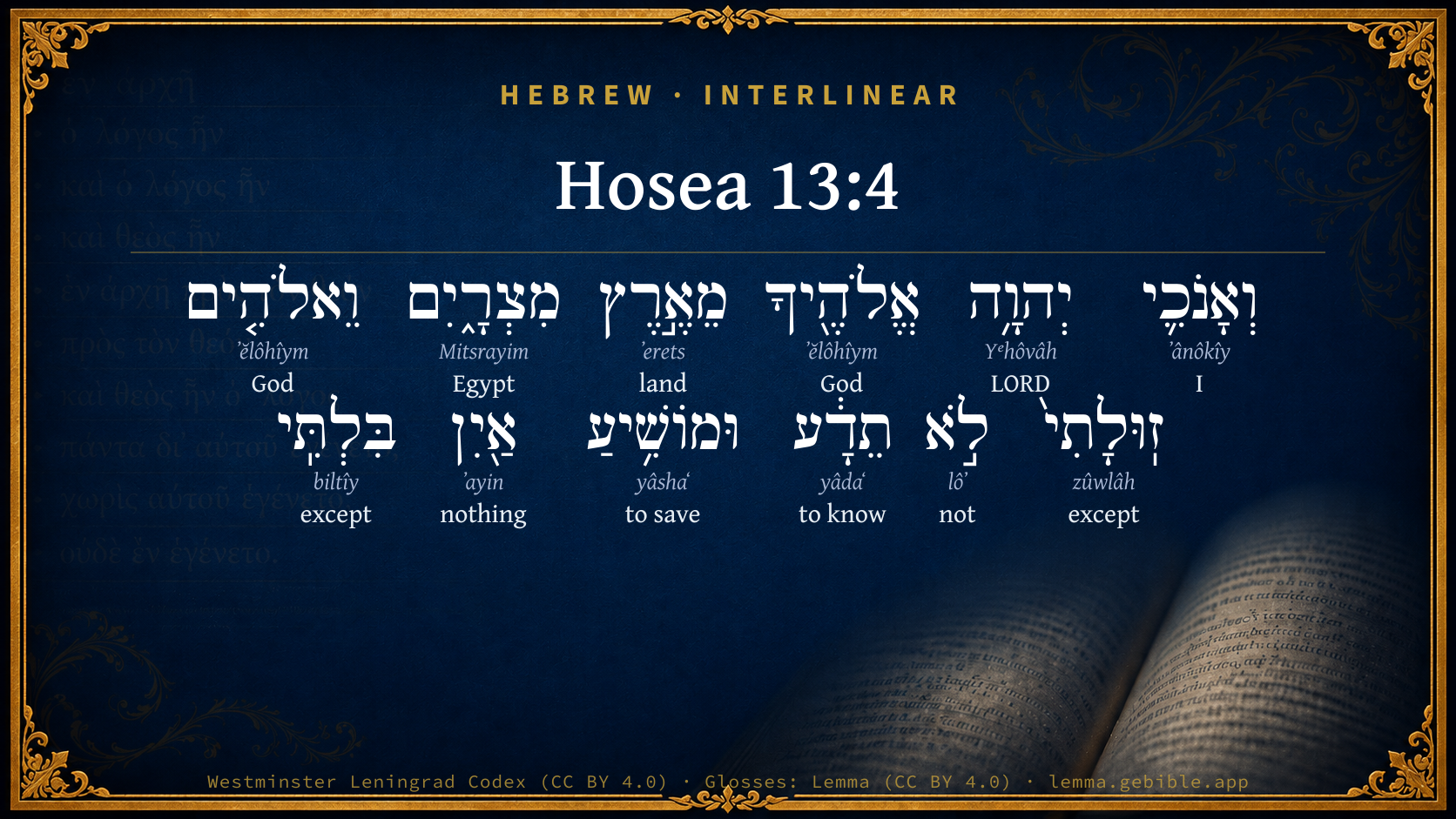
Hebrew (Westminster Leningrad Codex) Hosea 13:4 appears in the Hebrew Old Testament. The text above is from the Westminster Leningrad Codex. Each word links to its Strong’s number, a concise gloss, and parsing drawn from the Open Scriptures Hebrew Bible morphology. Click any word for its full Brown-Driver-Briggs (BDB) entry.
Download image
Cite this verse

Hosea 13:4 (World English Bible). Public Domain. Lemma interlinear Bible study tool, https://lemma.gebible.app/v/hosea/13/4.

Show BibTeX & RIS
BibTeX
RIS
English Translation
"Yet I am Yahweh your God from the land of Egypt; And you will know no god but me, And besides me there is no savior.
World English Bible · Public Domain
Download a study sheet

One document with this verse’s original text, its word-by-word gloss line, the meaning frame, cross-references with their text, attributed commentary, and full source and license credits — printable, and it pastes into notes with its structure intact.

This verse Autodidact and up

Study sheet (.html) Plain text (.txt)

A passage Seminary Student

Up to 50 verses in one chapter. A passage sheet keeps up to 6 commentary sources and 12 cross-references per verse, in the order this page ranks them, and says so on the sheet whenever that leaves anything out. Ask for a single verse and you get the Autodidact verse sheet above.

Everything on this page stays free to read, with no account — the sheet is a download of what is already on screen, not access to it.

Want to remove ads? Support Godless Engineer
Compare translations 3

The same verse in 3 English versions, stacked beneath the original-language interlinear above. Click any original word for its lexicon entry.

Each is an independent rendering of the whole verse — the interlinear is not word-aligned to these translations.

Highlighted words mark where these versions differ — a whole-verse word diff, not a word-by-word alignment.

  • World English Bible Public Domain
    "Yet I am Yahweh your God from the land of Egypt; And you will know no god but me, And besides me there is no savior.
  • King James Version Public Domain
    Yet I am the LORD thy God from the land of Egypt, and thou shalt know no god but me: for there is no saviour beside me.
  • unfoldingWord Literal Text CC BY-SA 4.0
    Yet I Yahweh your God from the land of Egypt, and you will not know a god except me, and there is no savior besides me.

unfoldingWord Literal Text — © unfoldingWord, licensed CC BY-SA 4.0. Word-aligned USFM3 via Door43 (git.door43.org/unfoldingWord/en_ult).

Versions to compare (up to 4)

3 of 4 selected

Show all 18 translations

Every available English version of this verse, each an independent rendering of the whole verse.

  • World English Bible Public Domain
    "Yet I am Yahweh your God from the land of Egypt; And you will know no god but me, And besides me there is no savior.
  • Berean Standard Bible Public Domain
    Yet I am the LORD your God ever since the land of Egypt; you know no God but Me, for there is no Savior besides Me.
  • Majority Standard Bible Public Domain
    Yet I am the LORD your God ever since the land of Egypt; you know no God but Me, for there is no Savior besides Me.
  • King James Version Public Domain
    Yet I am the LORD thy God from the land of Egypt, and thou shalt know no god but me: for there is no saviour beside me.
  • American Standard Version (1901) Public Domain
    Yet I am Jehovah thy God from the land of Egypt; and thou shalt know no god but me, and besides me there is no saviour.
  • Revised Version (1885) Public Domain
    Yet I am the LORD thy God from the land of Egypt; and thou shalt know no god but me, and beside me there is no saviour.
  • Geneva Bible (1599) Public Domain
    Yet I am the Lord thy God from the land of Egypt, and thou shalt knowe no God but me: for there is no Sauiour beside me.
  • Douay-Rheims (1899) Public Domain
    But I am the Lord thy God from the land of Egypt: and thou shalt know no God but me, and there is no saviour beside me.
  • Young's Literal Translation Public Domain
    And I `am' Jehovah thy God from the land of Egypt, And a God besides Me thou dost not know, And a Saviour -- there is none save Me.
  • Literal Standard Version CC BY-SA 4.0
    And I [am] your God YHWH from the land of Egypt, || And you do not know a God besides Me, || And a Savior—there is none except Me.
  • Unlocked Literal Bible CC BY-SA 4.0
    But I am Yahweh your God from the land of Egypt. You must acknowledge no God but me; you must acknowledge that besides me, there is no other savior.
  • unfoldingWord Literal Text CC BY-SA 4.0
    Yet I Yahweh your God from the land of Egypt, and you will not know a god except me, and there is no savior besides me.
  • Darby Bible Public Domain
    Yet I [am] Jehovah thy God from the land of Egypt, and thou hast known no God but me; and there is no saviour besides me.
  • World Messianic Bible Public Domain
    “Yet I am the LORD your God from the land of Egypt; and you shall acknowledge no god but me, and besides me there is no savior.
  • Webster's Bible Public Domain
    Yet I am the LORD thy God from the land of Egypt, and thou shalt know no God but me: for there is no savior besides me.
  • Free Bible Version CC BY-SA 4.0
    Yet I am the Lord your God who brought you out of the land of Egypt. You shall know no other gods but me. None can save you except me.
  • Bible in Basic English Public Domain
    But I am the Lord your God, from the land of Egypt; you have knowledge of no other God and there is no saviour but me.
  • JPS Tanakh (1917) Public Domain
    Yet I am the LORD thy God from the land of Egypt; and thou knowest no God but Me, and beside Me there is no saviour.

Literal Standard Version (2020), Covenant Press — licensed CC BY-SA 4.0. Text via the HelloAO Bible API (eBible.org). Unlocked Literal Bible (unfoldingWord) — licensed CC BY-SA 4.0. Text via the HelloAO Bible API (eBible.org). unfoldingWord Literal Text — © unfoldingWord, licensed CC BY-SA 4.0. Word-aligned USFM3 via Door43 (git.door43.org/unfoldingWord/en_ult). Free Bible Version, Dr. Jonathan Gallagher — licensed CC BY-SA 4.0. Text via the HelloAO Bible API (eBible.org).

Word by word

More ways to search: Search by grammar → Find every occurrence → Compare this word →

Practice this passage: Drill this verse → Learn its vocabulary →

זֽוּלָתִי֙
zûwlâh
H2108
“except · me”
Preposition + Suffix, Personal, 1st Person, Common, Singular
Part of Speech
Preposition
Full BDB Definition

Origin: from H2107

TWOT: 537a

a removal, a putting away (noun feminine) - except, besides, with the exception of, with removal of (preposition) - except that (conjunction)
  1. וְאָנֹכִ֛י ʼânôkîy H595 “and · I” Conjunction + Pronoun, Personal, 1st Person, Common, Singular
  2. יְהוָ֥ה Yᵉhôvâh H3068 “LORD” Noun, Proper
  3. אֱלֹהֶ֖יךָ ʼĕlôhîym H430 “God(s) · your” Noun, Common, Masculine, Plural, Construct + Suffix, Personal, 2nd Person, Masculine, Singular
  4. מֵאֶ֣רֶץ ʼerets H776 “from · land of” Preposition + Noun, Common, Both, Singular, Construct
  5. מִצְרָ֑יִם Mitsrayim H4714 “Egypt” Noun, Proper
  6. וֵאלֹהִ֤ים ʼĕlôhîym H430 “and · God(s)” Conjunction + Noun, Common, Masculine, Plural, Absolute
  7. לֹ֣א lôʼ H3808 “not” Particle, Negative
  8. תֵדָ֔ע yâdaʻ H3045 “to know” Verb, Qal, Imperfect, 2nd Person, Masculine, Singular
  9. וּמוֹשִׁ֥יעַ yâshaʻ H3467 “and · saving” Conjunction + Verb, Hiphil, Participle Active, Masculine, Singular, Absolute
  10. אַ֖יִן ʼayin H369 “nothing” Particle, Negative
  11. בִּלְתִּֽי biltîy H1115 “except · me” Preposition + Suffix, Personal, 1st Person, Common, Singular

About this verse

These counts appear in no published source. They are computed here, from the morphology-tagged text and Lemma’s own curated glosses. What Lemma adds →

12
words
11
distinct lemmas
Prophets
section

Notable vocabulary

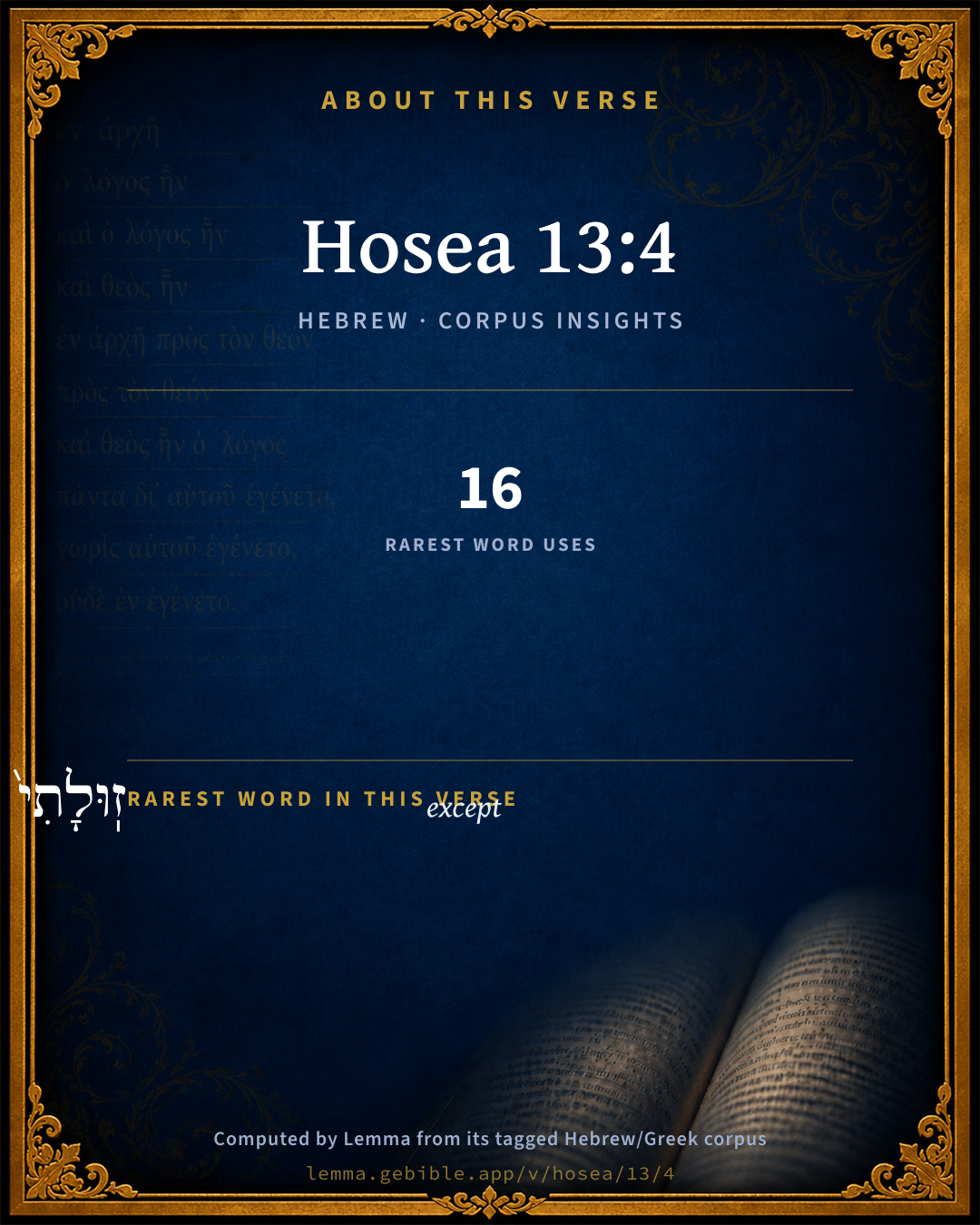
The rarest word here is זֽוּלָתִי֙ except H2108 — appearing just 16 times in the whole Hebrew Bible.

Shared distinctive vocabulary

זֽוּלָתִי֙ except H2108 occurs in 16 verses of the Hebrew Bible. Also found in:

Grammatical profile

  • 2 verbs
  • 5 nouns
  • 1 pronoun
  • 2 prepositions
  • 2 particles

Verb forms

  • תֵדָ֔ע Qal · Imperfect
  • וּמוֹשִׁ֥יעַ Hiphil · Participle Active

Repetition

A word recurs within this verse — often emphatic in Hebrew:

  • אֱלֹהֶ֖יךָ God H430 ×2

Hebrew & Septuagint length

In English translation the verse runs 26 words from the Hebrew and 63 from the Septuagint (LXX English) — the Septuagint runs noticeably longer here. See the side-by-side →

A rough comparison of the two English renderings, which tokenize alike — not a word-level alignment.

Word counts can differ between the Hebrew and the Greek without any difference in meaning — e.g. the Hebrew direct-object marker אֵת has no separate Greek word, and Greek often adds the article ὁ.

Cross-references

8

Topical passages linked to Hosea 13:4 in the Treasury of Scripture Knowledge — connected by theme and wording, ordered by reader-vote popularity; previews shown in the World English Bible.

  • Isaiah 45:21–22 Declare you, and bring [it] forth; yes, let them take counsel together: who has shown this from ancient time? who has declared it of old? Haven't I, Yahweh? and there is no God else besides me, a just God and a Savior; there is no one besides me.
  • Hosea 12:9 "But I am Yahweh your God from the land of Egypt. I will yet again make you to dwell in tents, As in the days of the solemn feast.
  • Exodus 20:2–3 "I am Yahweh your God, who brought you out of the land of Egypt, out of the house of bondage.
  • Isaiah 43:10–13 You are my witnesses, says Yahweh, and my servant whom I have chosen; that you may know and believe me, and understand that I am he: before me there was no God formed, neither shall there be after me.
  • Isaiah 43:3 For I am Yahweh your God, the Holy One of Israel, your Savior; I have given Egypt as your ransom, Ethiopia and Seba in your place.
  • Acts 4:12 There is salvation in none other, for neither is there any other name under heaven, that is given among men, by which we must be saved!"
  • Psalms 81:9–10 There shall be no strange god in you, Neither shall you worship any foreign god.
  • Isaiah 44:6–8 Thus says Yahweh, the King of Israel, and his Redeemer, Yahweh of Hosts: I am the first, and I am the last; and besides me there is no God.

Cross-references courtesy of OpenBible.info (CC BY 4.0).

Hebrew and Greek witnesses Masoretic Hebrew ↔ Greek Septuagint

The same verse in the two great witnesses to the Old Testament, shown verse-for-verse.

Here the Septuagint runs noticeably longer than the Hebrew — LXX2012 (modern English Septuagint) 63 words vs World English Bible 26. A rough length comparison of the two English translations, not a word-level alignment — read both below.

These are two independent witnesses, not word-aligned to each other, and the Septuagint is shown in lemma (dictionary) form.

Hebrew Hosea 13:4 Masoretic · Westminster Leningrad Codex

וְאָנֹכִ֛י יְהוָ֥ה אֱלֹהֶ֖יךָ מֵאֶ֣רֶץ מִצְרָ֑יִם וֵאלֹהִ֤ים זֽוּלָתִי֙ לֹ֣א תֵדָ֔ע וּמוֹשִׁ֥יעַ אַ֖יִן בִּלְתִּֽי

"Yet I am Yahweh your God from the land of Egypt; And you will know no god but me, And besides me there is no savior.

World English Bible · Public Domain

Greek LXX Hosea 13:4 Septuagint · lemma form

ἐγώ δέ κύριος ὁ θεός σύ στερεόω οὐρανός καί κτίζω γῆ ὅς ὁ χείρ κτίζω πᾶς ὁ στρατιά ὁ οὐρανός καί οὐ παραδεικνύω σύ αὐτός ὁ πορεύομαι ὀπίσω αὐτός καί ἐγώ ἀναἄγω σύ ἐκ γῆ αἴγυπτος καί θεός πλήν ἐγώ οὐ γιγνώσκω καί σώζω οὐ εἰμί πάρεξ ἐγώ

But I am the Lord your God that establishes the heaven, and creates the earth, whose hands have framed the whole host of heaven: but I showed them not to you that you should go after them: and I brought you up out of the land of Egypt, and you shall know no God but me; and there is no Saviour beside me.

LXX2012 (modern English Septuagint) · Public Domain

On this verse, Adam Clarke's Commentary discusses the Septuagint’s reading. Read the note in Commentary ↓

Hebrew: Westminster Leningrad Codex (CC BY 4.0). Greek: Septuagint (public domain); English from LXX2012 (modern English Septuagint) (Public Domain). How the Septuagint differs from the Hebrew →

Targum (Aramaic paraphrase)

1

The Targum is the ancient Jewish Aramaic paraphrase of the Hebrew Scriptures — an interpretive translation, not the Hebrew text itself. Onkelos (literal) and Pseudo-Jonathan (expansive) render the Torah, and Jonathan the Prophets. Coverage is partial: where no permissively-licensed English translation exists for a verse, only the Aramaic is shown. This is verse-level text, not a word-by-word alignment to the Hebrew.

  1. Targum Jonathan Prophets (Joshua–Malachi)
    וַאֲנָא יְיָ אֱלָהָךְ דְאַסַקְתָּךְ מֵאַרְעָא דְמִצְרַיִם וֶאֱלָהָא בַּר מִנִי לָא תֵדָע וּפָרִיק לֵית אֶלָא אֲנָא:

    (no public-domain English translation for this verse)

    Targum Jonathan — Aramaic: “Mikraot Gedolot” (public domain). English: “Sefaria Community Translation” (CC0 1.0 (public-domain dedication)); “London "Chaldee Paraphrase," 1871” (public domain). Text via Sefaria.

Commentary

Notes on Hosea 13:4 from classic Christian and Jewish commentators (each source and its license shown beneath its notes). The classic Christian expositions comment on the surrounding passage and are grouped to its opening verse, so a note may address several verses; the Jewish commentaries on the Tanakh (Rashi and others) are per-verse, so they appear only where the commentator wrote on this verse.

Lemma curates 59 commentaries, every one of them public domain or Creative Commons licensed, each selected and text-cleaned for this edition rather than reprinted as found. About our sources →

Trapp's Complete Commentary

John Trapp

Hos 13:4 Yet I [am] the LORD thy God from the land of Egypt, and thou shalt know no god but me: for [there is] no saviour beside me.

Ver. 4. Yet I am the Lord thy God, &c.] Yet for all the sorrow; and though I thus threaten thee: "for since I spake against thee, I do earnestly remember thee still," &c., Jer 31:20. It is easy to observe all along this chapter, an interchange of menaces and mercies, as in the preceding verse and this, so Hos 13:8-9; Hos 13:13-14; Hos 13:16; Hos 14:1, to show how soon the Lord repents him of the evil, and how ready to show mercy to the worst that return. If men could but find a penitent heart, he would easily find a pitying heart; like as David would have been friends with Absalom after all the unkindness, would he have been but better at last. To reduce Ephraim it was, that this chapter, like checquer work, is made up of promises and threatenings; that the tartness of the one might make him the better to taste the sweetness of the other.

Yet I am the Lord thy God from the land of Egypt] See the note on Hos 12:9. He was their God before, Gen 17:7, but then he mainly manifested himself so to be, when he brought them thence with a strong hand, and so declared himself to be Jehovah, Exo 6:2; yea, I am ready to show thee the like mercy still; for "I remember" (saith he) "the kindness of thy youth, the love of thine espousals, when thou wentest after me in the wilderness, in a land that was not sown," Jer 2:2.

And thou shalt know no God but me] i.e. Effectually acknowledge, worship, serve, love, none save me, Deu 13:2 Gal 5:9. Thou shalt experience none other. It is a blessed thing to be ignorant of false worship; and not to be insighted into, or versed in, the depths of Satan, Rev 2:24. Thou shalt not inquire how these nations worshipped their gods, Deu 12:30. Ahaz got hurt by seeing the altar at Damascus: many that will needs see the Popish service are insnared thereby.

For there is no Saviour beside me] This is a title that God much glorieth in; see Isa 60:16; Isa 63:1 Act 5:31; and we should go often to him in this name, as Jer 14:8, since "he is able to save them to the uttermost that come unto him," Heb 7:25, to save them perpetually, and perfectly, εις το παντελες. He is a sole Saviour, a thorough Saviour, a Saviour in solidum; and doth not his work to the halves, as Papists make it. How blasphemous is that direction of theirs to dying men, to say, Join, Lord, mine obedience with those things which Christ suffered for me.

John Trapp, A Commentary or Exposition upon All the Books of the Old and New Testament (1647–1656) — public domain. Text from a community e-Sword module.

The Preacher's Complete Homiletical Commentary

Joseph S. Exell (gen. ed.)

CRITICAL NOTES.]

Hos_13:4. Yet] Another contrast between the idolatry of Israel and the mercy of God to them (cf. Hos_12:10).

HOMILETICS

GOD THE ONLY SAVIOUR.—Hos_13:4

The people may be worthless, and driven away like smoke, but God is the same as of old. None else should be their Saviour. They should know and worship no other but Jehovah.

I. This character of God is declared in his word. Since we cannot know God but by revelation, how precious is that volume in which all manifestations of him are embodied. We are constantly reminded of his attributes and relations. The knowledge of them is of supreme consequence, and repeatedly set before us, that we may not forget. “There is one God; and there is none other god but he.” “I am the Lord, and there is none else: there is no god beside me.” “Thou shalt have none other gods but me.” “Is there a god besides me? Yea, there is no god; I know not any.” “I am the Lord, that is my name; and my glory will I not give to another; neither my praise to graven images.”

II. This character of God is displayed in his providence. “The Lord thy God from the land of Egypt.” Israel are not only reminded of God’s revelations previously given, but of his character displayed in his providence towards them. The events of their history are briefly stated, and their own experience testifies to the truth of God’s word. He had guided and provided for them unceasingly, and saved when there was no strange God among them. Men have abundant proofs in their own lives that God alone can save. In sickness and distress, in domestic and national history, the goodness of God has been displayed. The sinner and the saint have been delivered from dangers, and can declare this. “Ye are even my witnesses. Is there a God beside me?”

III. In proportion as we know this character of God are we obligated to him. “Thou shalt know no God but me.” It is not enough to acknowledge God as a Saviour. His claims and glory must not be shared with another. He has natural and moral rights over us. We owe duties and homage to him. We must evince our belief, and express our regard, by constant obedience to his law, studious efforts to do and delight in his will, in enjoyments and sufferings, and recognizing his presence in his word, providence, and grace. We are forbidden to indulge in atheism, polytheism, and idolatry. We must know and fear God only. We must love and serve him, with all our heart, soul, and strength.

NO SAVIOUR BESIDE GOD.—Hos_13:4

There is no Saviour beside me.

I. What the words imply. That God is—

1. A powerful Saviour, proved from the nature of redemption and the events of providence. No sins can limit his grace, no enemy baffle his skill. Save to the uttermost (Heb_7:25).

2. A constant Saviour. Present with Israel in Egypt, the wilderness, and the land of Canaan. Present with us in every time of need.

3. An only Saviour. No other could do what he did for Israel. No other can pardon our sins, renew our hearts, and save our souls. There is salvation in none other, “for there is none other name under heaven given among men, whereby we must be saved.”

II. What the words forbid. They forbid—

1. The worship of images. We are not to make any likeness of things in heaven above, earth beneath, or in the waters under the earth. God is the object of supreme worship and affection; incapable of representation to the senses, like false deities of men.

2. The worship of God by images. We dishonour God when we attempt to worship him “in gold, or silver, or stone, graven by art and man’s device” (Act_17:29).

3. All hypocrisy and formality in worship. Excessive use of forms and ceremonies is forbidden. God is a spirit, and all worship must be in spirit and in truth. Is he the only Saviour? Then let us thank him and trust him more. In private and in public, let us earnestly and constantly look to him. “Whosoever shall call upon the name of the Lord shall be saved.”

ILLUSTRATIONS TO CHAPTER 13

Hos_13:4. Thy God. The claims of God are enforced by reference to that particular event by which the Hebrews were separated from the nations, to remind them, and the world by them, that the character of God is displayed in the agency of his providence, and that in proportion to our knowledge of that character are our obligations to him. Each individual is here addressed, that each may feel that he has means of knowing, and constantly surrounded with motives for personally loving God.

The Preacher's Complete Homiletical Commentary (gen. ed. Joseph S. Exell; Funk & Wagnalls, c. 1892) — public domain (pre-1929). A full-Bible homiletical/sermon-outline anthology covering 65 of 66 books (2 John is absent from the source module). Text from a community e-Sword module.

Tyndale Open Study Notes

Tyndale Open Resources

13:4-5 there is no other savior: The Lord had proved this to Israel during the Exodus and the wilderness wandering.

Tyndale Open Study Notes — © Tyndale Open Resources, licensed CC BY-SA 4.0. Text via the HelloAO Bible API.

Geneva Bible (1599)

Geneva Bible translators

He calleth them to repentance, and reproveth their ingratitude.

Geneva Bible (1599) marginal notes — public domain. Text via Bolls.life.

Jamieson, Fausset & Brown

Robert Jamieson, A. R. Fausset & David Brown

(Hos 12:9; Isa 43:11).

no saviour--temporal as well as spiritual.

besides me-- (Isa 45:21).

Jamieson, Fausset & Brown — Commentary Critical and Explanatory on the Whole Bible (1871) — public domain (CC PDM 1.0). Text via the HelloAO Bible API.

Adam Clarke's Commentary

Verse 4. I am the Lord thy God] This was the first discovery I made of myself to you, and the first commandment I gave; and I showed you that besides me there was no Saviour. There is a remarkable addition in the Septuagint here: "But I am Jehovah thy God, who stretched out the heavens and created the earth. And I showed them not to thee, that thou shouldest walk after them. And I brought thee up out of the land of Egypt," &c. This might have been once in the Hebrew text.

Adam Clarke's Commentary on the Bible (1810–1826) — public domain. Text from a community e-Sword/MySword module.

John Calvin's Commentaries

The Prophet now repeats the sentence which we have noticed in the last chapter for the sake of amplifying the sin of the people. For had they never known sound doctrine, had they never been brought up in the law, there would have been some colour for alleviating their fault; because they might have excused themselves by saying, that as they had never known true religion, they had gone astray according to the common practice of men; but as they had from infancy been taught sound doctrine, as God had brought them up as it were in his own bosom, as they had learned from their first years what it was to worship God purely, when they thus retook themselves to the superstitions of the heathens, what could there be for an excuse for them? We then see the bearing of the complaint, when God says, that he had been the God of Israel from the land of Egypt

I am then, he says, Jehovah your God. By calling himself Jehovah, he glances at all their fictitious gods; as though he said “I am doubtless justly, and in mine own rights your God; for I am of myself — I am the Creator of the world, no one can take away my power: but whence have these their divinity, except from the madness of men?” He says further, I am thy God, O Israel; that is, “I have manifested myself to thee from the land of Egypt, from thy very nativity. When I redeemed thee from Egypt I brought thee out as it were from the womb to the light of life; for Egypt was to thee like the grave. Thou didst then begin to live, and to be some sort of people, when I stretched forth my hand to thee.”

And now also ought to be noticed what I have said before, that the people were redeemed on this condition, that they should devote themselves wholly to God. As we are at this day Christ’s, and no one of us ought to live according to his own will, for Christ died and rose again for this end, that he might be the Lord of the living and of the dead: so also then, the Israelites had been redeemed by God, that they might offer themselves wholly to Him. And since God ruled by this right over the people of Israel, how shameful and inexcusable was their defections when the people wilfully abandoned themselves to the superstitions of the Gentiles?

A God, he says, besides me thou oughtest not to know These words the Prophet had not before used. This sentence, then, is fuller, for it more clearly explains the import of what he had said, that God had purchased Israel for himself by bringing them out of Egypt, and that is, that Israel ought to have been content with this one Redeemer, and not to seek for themselves other gods. A God, then, besides me thou shalt not know. For if this one God was sufficient for redeeming his people, what do the people now mean, when they wander, and seek aid here and there? For they ought to render to God the life received from him, which they now enjoy, and ought to acknowledge to be sufficiently safe under his protection. We now then see why this was added, Thou shalt not know a God besides me

A reason, confirmatory of this, follows: For no one, he says, is a Saviour except me The copulative ו, vau, ought to be regarded here as a causative, For no one, etc., or, Surely no one is a Saviour except me. And this is a remarkable passage; for we learn that the worship of God does not consist in words, but in faith, and hope, and prayer. The Papists of the present day think that they do not profane the worship of God, though they fly to statues, though they pray to dead men, though they look here and there for the accomplishment of their hopes. How so? Because they ever retain the only true God, that is, they do not ascribe the name of God to Christopher or to Antony. The Papists think themselves free from all blame, since God retains his own name. But we see how differently the matter is regarded by the Lord. “I am,” he says, “the only true God.” How is this? “Because I am the only Saviour: feign not to thyself another God, for thou shalt find none that will save thee.” Then God puts an especial value on the honour that is due to him from hope and prayer; that is, when our soul recumbs on him alone, and when we seek and hope for salvation from no other but from him. We see then how useful is the doctrine contained in this passage, in which the Prophet clearly shows, that the Israelites acted absurdly and shamefully when they formed another god for themselves, for no Saviour, except the one true God, can be found.

John Calvin's Commentaries (1540-1563) — public domain. Text from the Calvin Translation Society English edition (1840s-50s) via the Christian Classics Ethereal Library (ccel.org). Calvin's coverage is partial (roughly two-thirds of the Bible); uncommented books and verses are honest gaps, never fabricated. The 19th-century editor's footnotes and remarks are omitted so the notes are faithfully Calvin's own voice.

Ellicott's Commentary for English Readers

(4) The LXX. have an addition which was not found by Jerome in any Hebrew copy of his day, and was pronounced by him to be spurious: “I am the Lord thy God, that establisheth the heavens and createth the earth, whose hands have fashioned all the host of heaven; but I did not show them to thee that thou shouldest go after them, and I brought thee up out of the land of Egypt, and thou shalt know,” &c.

A Bible Commentary for English Readers, edited by Charles John Ellicott (1878–1897) — public domain. Text from a community e-Sword module.

The Cambridge Bible for Schools and Colleges

gen. ed. J. J. S. Perowne

4. Yet I am the Lord thy God] Hosea persistently refuses to recognize that the god whom the Israelites worship is really Israel’s God, Jehovah. The use of an idolatrous symbol has so unspiritualized the object of their worship that the mere retention of the name Jehovah gives them no claim upon Hosea’s sympathy. The prophet therefore introduces Jehovah as expostulating with the Israelites for the abandonment of their hereditary religion.

thou shalt know no god but me] Rather, thou knowest, &c.; the experience of history bore witness to Jehovah’s help, and his alone. Comp. Deu_32:12. Hosea however does not deny the existence of other gods besides Jehovah; only their equality to Him in power. It was only by degrees that the truth involved in the revelation of Jehovah was fully realized. See Introduction.

The Cambridge Bible for Schools and Colleges (gen. ed. J. J. S. Perowne; Cambridge University Press, 1878–1918) — public domain. Text from a community e-Sword module.

John Gill's Exposition

Yet I am the Lord thy God from the land of Egypt,.... Which brought thee out from thence, as the Targum; and ever since, from that time to this, had shown a regard unto them, as the Lord their God, both in the wilderness, as later mentioned, and in the land of Canaan, where they had been continued, and followed with instances of goodness to that day, and yet find sinned in so gross a manner; which argued great ingratitude in them, and forgetfulness of the Lord, and his mercies:

and thou shalt know no God but me; they ought to have known, acknowledged, and worshipped no other god, as was enjoined them in the law: or, "thou knowest not" (b); they did not know any other, which they in their own consciences were obliged to confess, if appealed to; however, they should know no other; by sad experience they would find that there was no other that could be of any service to them; their images and idols being unable to help them:

for there is no saviour besides me; that could save them out of their troubles, and deliver them out of their distresses; no other that is, or can be, the author, either of temporal or of spiritual and eternal salvation.

(b) "non novisti, vel cognovisti", Liveleus, Drusius, Rivet.

John Gill's Exposition of the Whole Bible (1746–1763) — public domain (CC PDM 1.0). Text via the HelloAO Bible API.

Albert Barnes' Notes on the Bible

Yet - , (literally, and) I am the Lord thy God from the land of Egypt God was still the same God who had sheltered them with His providence, ever since He had delivered them from Egypt. He had the same power and will to help them. Therefore their duty was the same, and their destruction arose, not from any change in Him, but from themselves. “God is the God of the ungodly, by creation and general providence.”

And thou shalt - (i. e., oughtest to) know no God but Me, for (literally, and) there is not a Saviour but me “To be God and Lord and Saviour are incommunicable properties of God. Wherefore God often claimed these titles to Himself, from the time He revealed Himself to Israel. In the song of Moses, which they were commanded to rehearse, He says, “See now that I, I am He, and there is no God with Me: I kill, and I make alive; I wound, and I heal; neither is there any that can deliver out of My hand” Deu 32:39. Isaiah repeats this same, “Is there a God besides Me? yea there is no God; I know not any” Isa 44:8; and “There is no God else besides Me, a just God and a Saviour; there is none else. Look unto Me and be ye saved, for I am God and there is none else” Isa 45:21, Isa 45:2; and, “I am the Lord, that is My Name; and My glory will I not give to another; neither My praise to graven images” Isa 42:8. : “That God and Saviour is Christ; God, because He created; Saviour, because, being made Man, He saved. Whence He willed to be called Jesus, i. e., Saviour. Truly “beside” Him, “there is no Saviour; neither is there salvation in any other, for there is none other name under heaven, given among men, whereby we must be saved” Act 4:12. “It is not enough to recognize in God this quality of a Saviour. It must not be shared with “any other.” Whoso associates with God any power whatever to decide on man’s salvation makes an idol, and introduces a new God.”

Albert Barnes' Notes on the Bible (1834–1885) — public domain. Text from a community e-Sword/MySword module.

Matthew Poole's English Annotations

Yet, though thou hast so revolted, and chosen other gods, it is not occasioned by any change in me,

I am what I was,

the Lord, the mighty God, the everlasting God, Jehovah. Thy God from the land of Egypt; thy God who alone brought thee out of Egypt, and who hath maintained thy lot; the calves and Baal were not known amongst you then. And since I alone brought thee out of Egypt, and saved thee with wonderful salvations many times since, why dost thou seek gods thou needest not, gods that cannot help?

Thou shalt know no god but me; I forbade thee to know any other god but me, in gratitude thou shouldst know no other; if there were any other, in point of interest thou shouldst have known, i.e. worshipped, trusted, and obeyed, none but me. And finally, by woeful experience thou shalt know that calves and Baal are no gods, they cannot save thee nor themselves; thou shalt know I am God alone, who can destroy those who would not obey me.

For there no saviour beside me; when thy idols cannot save thee out of the hands of those I deliver thee up to, then thou shalt see, what now thou wilt not, that there is no saviour but me; none who can deliver from all evil, and who can enrich with all blessings, who can pardon sin and save the sinner.

Matthew Poole's English Annotations on the Holy Bible (1683–1685) — public domain. Text from a community e-Sword/MySword module.

Whedon's Commentary on the Bible

Daniel D. Whedon

4-8. Love — Ingratitude — Destruction. The conduct of Israel was the more shocking because Jehovah had always proved himself ready to be their helper and friend.

I am Jehovah — Here the emphasis is upon the assistance rendered by Jehovah to Israel throughout their entire history (compare Hos_12:9).

Thou shalt know — Better, R.V. margin, “knowest.” The prophet appeals to present and past experiences.

No god but me — Israel found no god able to help and to save besides the one who delivered them out of Egypt; the entire history revealed him and him alone as saviour and friend. Indeed, there is no other deliverer. How serious has been the mistake of the people (Hos_2:5 ff.).

Daniel D. Whedon (gen. ed.), Commentary on the Old and New Testaments (1874–1909) — public domain. Text from a community e-Sword module.

The Pulpit Commentary

Vers. 4, 5. These verses make it evident that the punishment inflicted on Israel could not reasonably be accounted too severe; such had been the goodness of Jehovah and the gross ingratitude of Israel.

Yet I am the Lord thy God from the land of Egypt. The prophet here commences a recital of God"s favors to Israel from ancient times, all which they forgot, ungratefully and impiously turning aside from the worship of Jehovah. Jehovah had been Israel"s God long before, but never before had the evidence of his power and love to his people been so signal and conspicuous as at the period of the Exodus and onward. And thou shalt know no god but me. The use of dte in the imperfect is to connect the future with the past. It may be rendered either

(1) "Thou knowest," viz. a God of such wonderful attestation thou knowest or findest not beside me the opposite of the statement, "Let us go after other gods, which thou hast not known, and let us serve them"; (Deu_13:3) or

(2) "Thou shouldest not know or recognize any god beside me. So Kimchi: "Thou shouldest not know other gods, nor serve them beside me, for ye see there is no helper Beside me." Likewise Rashi: "Thou shouldest not rebel against me." Also Aben Ezra: "How hast thou turned to kiss the calf, which does not save nor satisfy, and hast left him who has been thy God from ancient days, who has helped thee and knows all thy necessities." The word yjilWz (from lWz, which, as the cognate Arabic signifies, "to go forth or away") is synonymous with yTilBi.

The only Savior.

The prophets were in the habit of appealing to the past history of Israel as a nation when they would urge the people to repent of present sin, and would encourage them to seek Divine favor and acceptance. Certainly the records of the past proved that only in returning and in rest had the people ever been saved, and that when they had turned elsewhere than to Jehovah they had only met with disappointment and misery.

I THE VANITY AND INSUFFICIENCY OF ALL EARTHLY HELPERS.

1. As Israel, when seeking help and deliverance from the deities of the heathen, ever found such a refuge vain, so will all men who look elsewhere than to the Most High experience certain and bitter disappointment. "The idols of the heathen have ears, but they hear not... they that make them are like unto them; so is every one that trusteth in them.

2. Even the best-intentioned of human friends and counselors are powerless to aid and save. The lesson has to be learned afresh by every generation that the help of man is vain. "It is better to trust in the Lord than to put your confidence in princes.

II THE SOLE SUFFICIENCY OF GOD AS A MIGHTY SAVIOR.

1. He has wisdom to devise appropriate means of deliverance. Many an instance in Israel"s history might have been quoted, in order to produce this conviction. And we, as Christians, have the one supreme evidence of God"s infinite wisdom in the provision of spiritual and eternal salvation in the gospel of the Lord Jesus Christ, in whom is the wisdom as well as the power of God.

2. The heavenly King has the disposition to deliver. Salvation is not only his prerogative; it is his delight. Mercy and compassion animate him in his treatment of the children of men. "God so loved the world," etc. There is no pity like Divine pity.

3. For an all-sufficient authority and efficacious power to rescue man from sin and death we must look above. The Eternal is "mighty to save." And in appointing his Son to be the Savior, he has laid help upon One who is mightySo strong to deliver, So good to redeem, The weakest believer That hangs upon him. T.

The Pulpit Commentary (1880–1919), ed. H.D.M. Spence-Jones & Joseph S. Exell — public domain. Text from a community e-Sword module.

John Wesley's Explanatory Notes

Thou shalt know - I forbad thee to know any other God but me, in gratitude thou shouldest know no other.

John Wesley, Explanatory Notes Upon the Whole Bible (1754–1765) — public domain. Text via the GEBible commentary corpus.

Keil & Delitzsch

C. F. Keil & F. Delitzsch

"And yet I am Jehovah thy God from the land of Egypt hither; and thou knowest no God beside me, and there is no helper beside me. Hos 13:5. I knew thee in the desert, in the land of burning heats." As in Hos 12:10, a contrast is drawn here again between the idolatry of the people and the uninterrupted self-attestation of Jehovah to the faithless nation. From Egypt hither Israel has known no other God than Jehovah, i.e., has found no other God to be a helper and Saviour. Even in the desert He knew Israel, i.e., adopted it in love. ידע, to know, when applied to God, is an attestation of His love and care (compare Amo 3:2; Isa 58:3, etc.). The ἁπ. λεγ. תּלאוּבת, from לאב, Arab. lâb, med. Vav, to thirst, signifies burning heat, in which men famish with thirst (for the fact, compare Deu 8:15).

Keil & Delitzsch — Biblical Commentary on the Old Testament (1861–1891) — public domain (CC PDM 1.0). Text via the HelloAO Bible API. (Old Testament only.)

unfoldingWord translationNotes

Door43 World Missions Community

General Information:

Yahweh is speaking of his people as if they had been a flock of sheep that he found wandering in the wilderness. He says that he claimed them there for his own.

I knew you in the wilderness

Yahweh claimed the Hebrew people as his own special people, and he took care of them there.

When you had pasture, then you became full

The image of sheep is continued with this expression.

your heart became lifted up

Becoming arrogant is spoken of as one's heart being lifted up. AT: "you became proud" (See:Metaphor)

translationWords

Yahweh

God

Egypt

Savior

know

desert

heart

unfoldingWord translationNotes — © Distant Shores Media and the Door43 World Missions Community, licensed CC BY-SA 4.0. Source: git.door43.org/Door43/en_tn.

Rashi

Rabbi Shlomo Yitzchaki (Rashi)

And I am the Lord your God and you should not have rebelled against Me

Rashi on the Tanakh — English translations: “The Judaica Press complete Tanach with Rashi, translated by A. J. Rosenberg” (CC BY 4.0); “Pentateuch with Rashi's commentary by M. Rosenbaum and A.M. Silbermann, 1929-1934” (public domain); “The Metsudah Tanach series, Lakewood, N.J” (CC BY 4.0); and “The Book of Joshua, Metsudah Publications, 1997” (CC BY 4.0). Text via Sefaria.

Lesson kit

Teaching starters — assembled from the data on this page, not authored interpretation. Every prompt links to the verse data it draws on. Edit before teaching.

Hosea, in the Prophets, opens this verse with 12 words (11 distinct Hebrew lemmas). Its most distinctive word is zûwlâh (“except”). The Greek Septuagint runs longer here. A historical commentator’s framing appears above. Read the whole chapter for the surrounding context.

Discussion questions

  1. What does “except” (zûwlâh) contribute to the verse as a whole?
  2. Deuteronomy 1:36 shares the word «except» with this verse. How do the two illuminate each other?
  3. “God” occurs 2× in this one verse. What is the effect of the repetition?
  4. Compared with the Hebrew, the Septuagint runs longer here. What questions does that raise?
  5. The translations on this page render this verse differently — a whole-verse word diff, not a word-by-word alignment. What might account for the different wordings?
  6. The verb «תֵדָ֔ע» is Qal Imperfect. How does its form color the action?
  7. Reading how Trapp's Complete Commentary and The Preacher's Complete Homiletical Commentary read this verse, where do the two commentators agree and where do they part?

Things to notice

Reading settings

Reading text

Shown beneath each verse's original-language words.

Old Testament
Old Testament edition

Read the OT as the Masoretic Hebrew (MT) or the Greek Septuagint (LXX).

English shown for the Greek Septuagint (in the Hebrew ↔ Greek comparison).

Comparing translations? Open the Compare panel on any verse page to stack up to four side by side.