
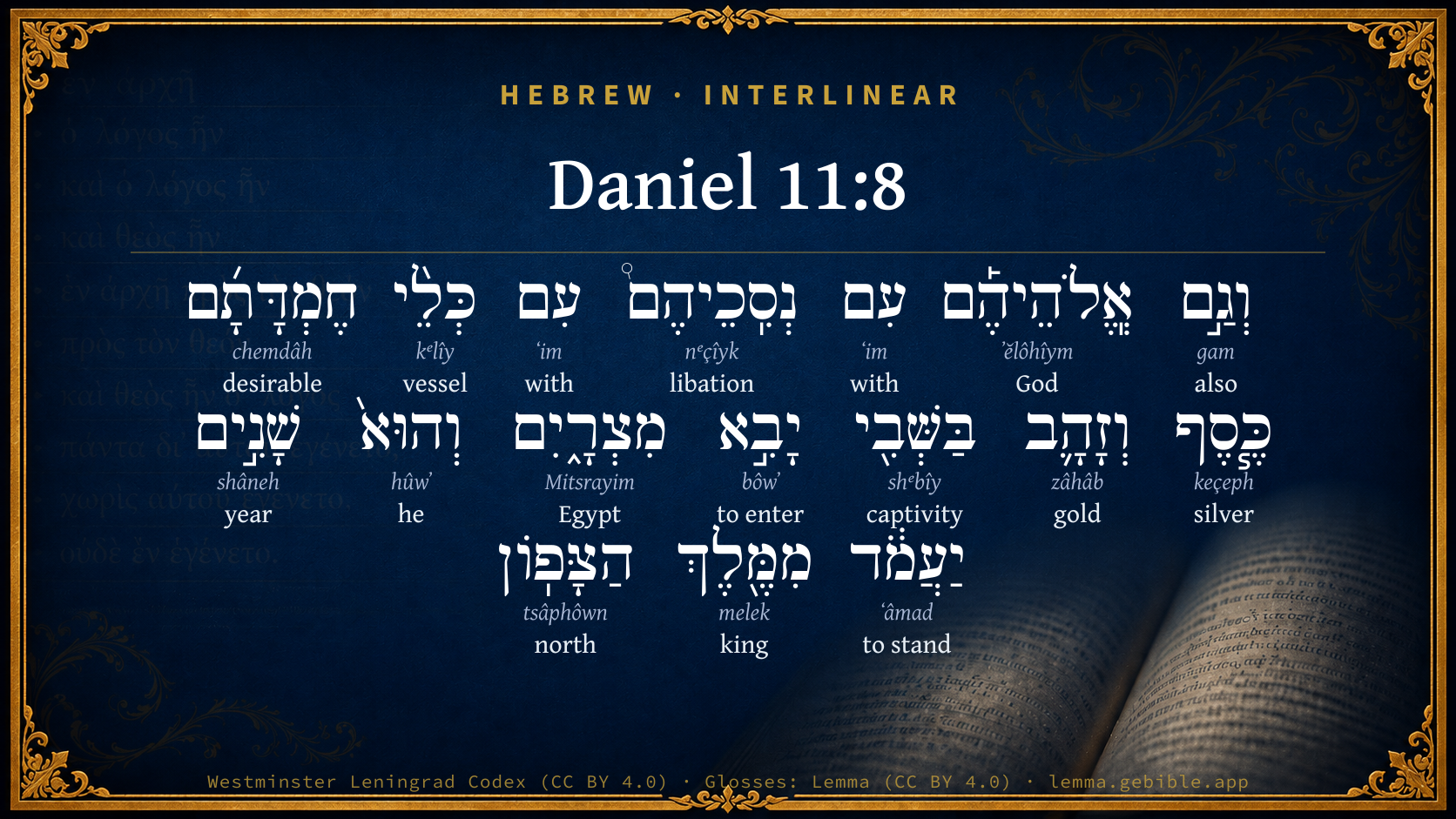
Daniel 11:8

Hebrew (Westminster Leningrad Codex) Daniel 11:8 appears in the Hebrew Old Testament. The text above is from the Westminster Leningrad Codex. Each word links to its Strong’s number, a concise gloss, and parsing drawn from the Open Scriptures Hebrew Bible morphology. Click any word for its full Brown-Driver-Briggs (BDB) entry.
Download image
Cite this verse

Daniel 11:8 (World English Bible). Public Domain. Lemma interlinear Bible study tool, https://lemma.gebible.app/v/daniel/11/8.

Show BibTeX & RIS
BibTeX
RIS
English Translation
Also their gods, with their molten images, [and] with their goodly vessels of silver and of gold, shall he carry captive into Egypt; and he shall refrain some years from the king of the north.
World English Bible · Public Domain
Download a study sheet

One document with this verse’s original text, its word-by-word gloss line, the meaning frame, cross-references with their text, attributed commentary, and full source and license credits — printable, and it pastes into notes with its structure intact.

This verse Autodidact and up

Study sheet (.html) Plain text (.txt)

A passage Seminary Student

Up to 50 verses in one chapter. A passage sheet keeps up to 6 commentary sources and 12 cross-references per verse, in the order this page ranks them, and says so on the sheet whenever that leaves anything out. Ask for a single verse and you get the Autodidact verse sheet above.

Everything on this page stays free to read, with no account — the sheet is a download of what is already on screen, not access to it.

Want to remove ads? Support Godless Engineer
Compare translations 3

The same verse in 3 English versions, stacked beneath the original-language interlinear above. Click any original word for its lexicon entry.

Each is an independent rendering of the whole verse — the interlinear is not word-aligned to these translations.

Highlighted words mark where these versions differ — a whole-verse word diff, not a word-by-word alignment.

  • World English Bible Public Domain
    Also their gods, with their molten images, [and] with their goodly vessels of silver and of gold, shall he carry captive into Egypt; and he shall refrain some years from the king of the north.
  • King James Version Public Domain
    And shall also carry captives into Egypt their gods, with their princes, and with their precious vessels of silver and of gold; and he shall continue more years than the king of the north.
  • unfoldingWord Literal Text CC BY-SA 4.0
    He will also carry away as booty to Egypt their gods along with their cast metal images and their precious vessels of silver and gold. For some years he will stay away from the king of the North.

unfoldingWord Literal Text — © unfoldingWord, licensed CC BY-SA 4.0. Word-aligned USFM3 via Door43 (git.door43.org/unfoldingWord/en_ult).

Versions to compare (up to 4)

3 of 4 selected

Show all 18 translations

Every available English version of this verse, each an independent rendering of the whole verse.

  • World English Bible Public Domain
    Also their gods, with their molten images, [and] with their goodly vessels of silver and of gold, shall he carry captive into Egypt; and he shall refrain some years from the king of the north.
  • Berean Standard Bible Public Domain
    He will take even their gods captive to Egypt, with their metal images and their precious vessels of silver and gold. For some years he will stay away from the king of the North,
  • Majority Standard Bible Public Domain
    He will take even their gods captive to Egypt, with their metal images and their precious vessels of silver and gold. For some years he will stay away from the king of the North,
  • King James Version Public Domain
    And shall also carry captives into Egypt their gods, with their princes, and with their precious vessels of silver and of gold; and he shall continue more years than the king of the north.
  • American Standard Version (1901) Public Domain
    And also their gods, with their molten images, `and' with their goodly vessels of silver and of gold, shall he carry captive into Egypt; and he shall refrain some years from the king of the north.
  • Revised Version (1885) Public Domain
    And also their gods, with their molten images, and with their goodly vessels of silver and of gold, shall he carry captive into Egypt; and he shall refrain some years from the king of the north.
  • Geneva Bible (1599) Public Domain
    And shall also carie captiues into Egypt their gods with their molten images, and with their precious vessels of siluer and of golde, and he shall continue more yeeres then the King of the North.
  • Douay-Rheims (1899) Public Domain
    And he shall also carry away captive into Egypt their gods, and their graven things, and their precious vessels of gold and silver: he shall prevail against the king of the north.
  • Young's Literal Translation Public Domain
    and also their gods, with their princes, with their desirable vessels of silver and gold, into captivity he bringeth `into' Egypt; and he doth stand more years than the king of the north.
  • Literal Standard Version CC BY-SA 4.0
    and also their gods, with their princes, with their desirable vessels of silver and gold, he brings in captivity [to] Egypt; and he stands more years than the king of the north.
  • Unlocked Literal Bible CC BY-SA 4.0
    He will carry off to Egypt their gods along with their cast metal figures and their precious vessels of silver and of gold. For some years he will stay away from the king of the North.
  • unfoldingWord Literal Text CC BY-SA 4.0
    He will also carry away as booty to Egypt their gods along with their cast metal images and their precious vessels of silver and gold. For some years he will stay away from the king of the North.
  • Darby Bible Public Domain
    He shall also carry captive into Egypt their gods, with their princes, and their precious vessels of silver and of gold; and he shall subsist for more years than the king of the north;
  • World Messianic Bible Public Domain
    He will also carry their gods with their molten images, and with their goodly vessels of silver and of gold, captive into Egypt. He will refrain some years from the king of the north.
  • Webster's Bible Public Domain
    And shall also carry captives into Egypt their gods, with their princes, and with their precious vessels of silver and of gold; and he shall continue more years than the king of the north.
  • Free Bible Version CC BY-SA 4.0
    In addition he will take back with him to Egypt the idols of their gods, along with their expensive vessels of silver and gold. For some years he will leave the king of the north alone.
  • Bible in Basic English Public Domain
    And their gods and their metal images and their fair vessels of silver and gold he will take away into the south; and for some years he will keep away from the king of the north.
  • JPS Tanakh (1917) Public Domain
    and also their gods, with their molten images, and with their precious vessels of silver and of gold, shall he bring into captivity into Egypt; and he shall desist some years from the king of the north.

Literal Standard Version (2020), Covenant Press — licensed CC BY-SA 4.0. Text via the HelloAO Bible API (eBible.org). Unlocked Literal Bible (unfoldingWord) — licensed CC BY-SA 4.0. Text via the HelloAO Bible API (eBible.org). unfoldingWord Literal Text — © unfoldingWord, licensed CC BY-SA 4.0. Word-aligned USFM3 via Door43 (git.door43.org/unfoldingWord/en_ult). Free Bible Version, Dr. Jonathan Gallagher — licensed CC BY-SA 4.0. Text via the HelloAO Bible API (eBible.org).

Word by word

More ways to search: Search by grammar → Find every occurrence → Compare this word →

Practice this passage: Drill this verse → Learn its vocabulary →

נְסִֽכֵיהֶם֩
nᵉçîyk
H5257
“princes · their”
Noun, Common, Masculine, Plural, Construct + Suffix, Personal, 3rd Person, Masculine, Plural
Part of Speech
Noun
Type
Common
Gender
Masculine
Number
Plural
State
Construct
Full BDB Definition

Origin: from H5258

TWOT: 1375b , 1377a

poured out, libation, molten image, one anointed - libation, drink-offering - molten image - prince, anointed one
  1. וְגַ֣ם gam H1571 “and · also” Conjunction + Particle, Accusative
  2. אֱֽלֹהֵיהֶ֡ם ʼĕlôhîym H430 “God(s) · their” Noun, Common, Masculine, Plural, Construct + Suffix, Personal, 3rd Person, Masculine, Plural
  3. עִם ʻim H5973 “with” Preposition
  4. עִם ʻim H5973 “with” Preposition
  5. כְּלֵ֨י kᵉlîy H3627 “vessels of” Noun, Common, Masculine, Plural, Construct
  6. חֶמְדָּתָ֜ם chemdâh H2532 “desirable · their” Noun, Common, Feminine, Singular, Construct + Suffix, Personal, 3rd Person, Masculine, Plural
  7. כֶּ֧סֶף keçeph H3701 “silver” Noun, Common, Masculine, Singular, Absolute
  8. וְזָהָ֛ב zâhâb H2091 “and · gold” Conjunction + Noun, Common, Masculine, Singular, Absolute
  9. בַּשְּׁבִ֖י shᵉbîy H7628 “in/at the · captivity” Preposition, Determined + Noun, Common, Both, Singular, Absolute
  10. יָבִ֣א bôwʼ H935 “to enter” Verb, Hiphil, Imperfect, 3rd Person, Masculine, Singular
  11. מִצְרָ֑יִם Mitsrayim H4714 “Egypt” Noun, Proper
  12. וְהוּא֙ hûwʼ H1931 “and · he” Conjunction + Pronoun, Personal, 3rd Person, Masculine, Singular
  13. שָׁנִ֣ים shâneh H8141 “years” Noun, Common, Feminine, Plural, Absolute
  14. יַעֲמֹ֔ד ʻâmad H5975 “to stand” Verb, Qal, Imperfect, 3rd Person, Masculine, Singular
  15. מִמֶּ֖לֶךְ melek H4428 “from · king of” Preposition + Noun, Common, Masculine, Singular, Construct
  16. הַצָּפֽוֹן tsâphôwn H6828 “the · north” Particle, Definite Article + Noun, Common, Feminine, Singular, Absolute

About this verse

These counts appear in no published source. They are computed here, from the morphology-tagged text and Lemma’s own curated glosses. What Lemma adds →

17
words
16
distinct lemmas
Prophets
section

Notable vocabulary

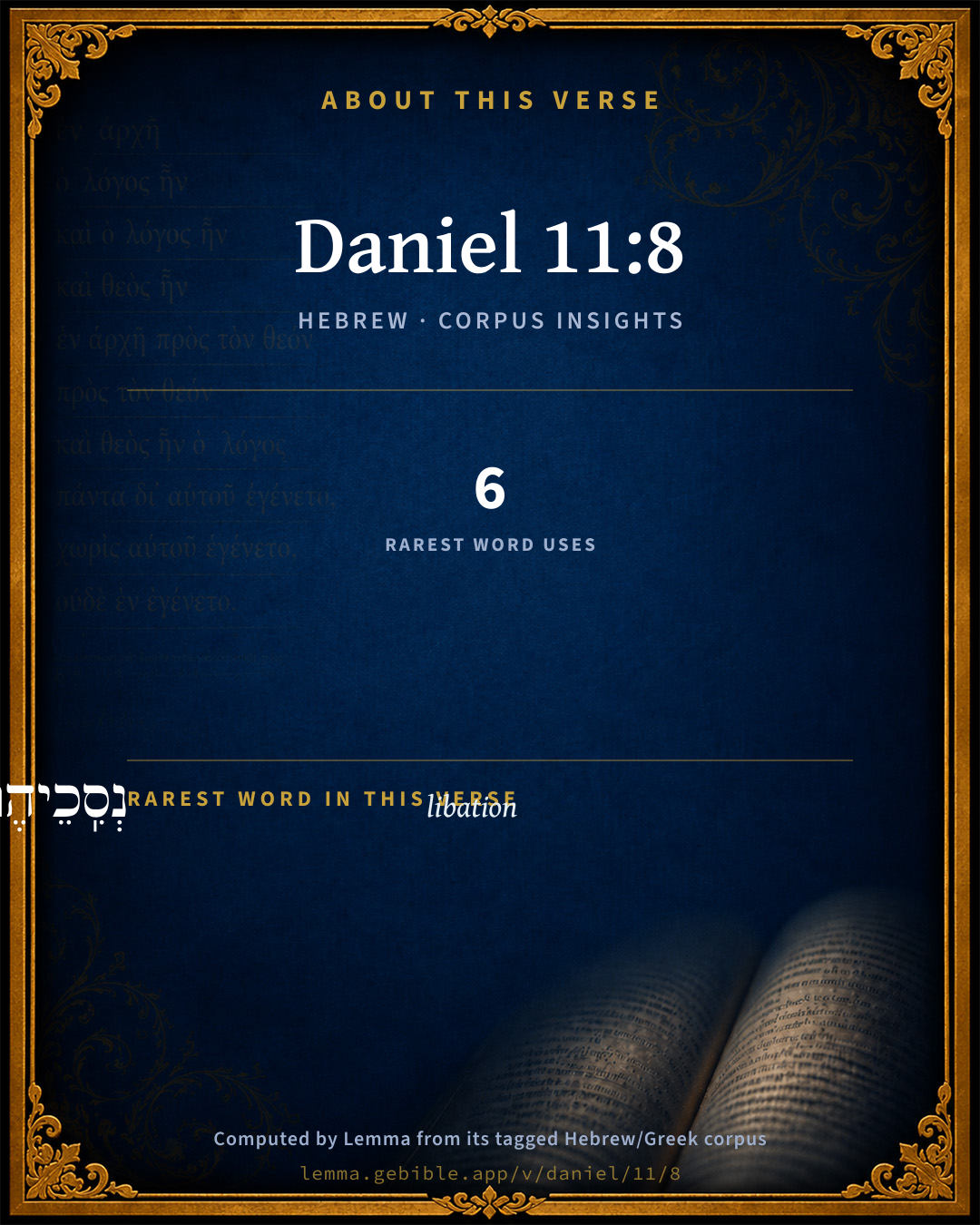
The rarest word here is נְסִֽכֵיהֶם֩ libation H5257 — appearing just 6 times in the whole Hebrew Bible.

Shared distinctive vocabulary

נְסִֽכֵיהֶם֩ libation H5257 occurs in 6 verses of the Hebrew Bible. Also found in:

Grammatical profile

  • 2 verbs
  • 11 nouns
  • 1 pronoun
  • 2 prepositions
  • 1 particle

Verb forms

  • יָבִ֣א Hiphil · Imperfect
  • יַעֲמֹ֔ד Qal · Imperfect

Repetition

A word recurs within this verse — often emphatic in Hebrew:

Hebrew & Septuagint length

In English translation the verse runs 35 words from the Hebrew and 37 from the Septuagint (LXX English) — closely comparable.

A rough comparison of the two English renderings, which tokenize alike — not a word-level alignment.

Word counts can differ between the Hebrew and the Greek without any difference in meaning — e.g. the Hebrew direct-object marker אֵת has no separate Greek word, and Greek often adds the article ὁ.

Cross-references

15

Topical passages linked to Daniel 11:8 in the Treasury of Scripture Knowledge — connected by theme and wording, ordered by reader-vote popularity; previews shown in the World English Bible.

  • Isaiah 37:19 and have cast their gods into the fire: for they were no gods, but the work of men's hands, wood and stone; therefore they have destroyed them.
  • Isaiah 46:1–2 Bel bows down, Nebo stoops; their idols are on the animals, and on the cattle: the things that you carried about are made a load, a burden to the weary [animal].
  • Jeremiah 43:12–13 I will kindle a fire in the houses of the gods of Egypt; and he shall burn them, and carry them away captive: and he shall array himself with the land of Egypt, as a shepherd puts on his garment; and he shall go forth from there in peace.
  • Genesis 31:30 Now, you want to be gone, because you sore longed after your father's house, but why have you stolen my gods?"
  • Exodus 12:12 For I will go through the land of Egypt in that night, and will strike all the firstborn in the land of Egypt, both man and animal. Against all the gods of Egypt I will execute judgments: I am Yahweh.
  • Numbers 33:4 while the Egyptians were burying all their firstborn, whom Yahweh had struck among them: on their gods also Yahweh executed judgments.
  • Deuteronomy 12:3 and you shall break down their altars, and dash in pieces their pillars, and burn their Asherim with fire; and you shall cut down the engraved images of their gods; and you shall destroy their name out of that place.
  • Judges 18:24 He said, you have taken away my gods which I made, and the priest, and are gone away, and what have I more? and how then say you to me, What ails you?
  • Isaiah 2:16 For all the ships of Tarshish, And for all pleasant imagery.
  • Jeremiah 46:25 Yahweh of Hosts, the God of Israel, says: Behold, I will punish Amon of No, and Pharaoh, and Egypt, with her gods, and her kings; even Pharaoh, and those who trust in him:
  • Daniel 1:2–3 The Lord gave Jehoiakim king of Judah into his hand, with part of the vessels of the house of God; and he carried them into the land of Shinar to the house of his god: and he brought the vessels into the treasure-house of his god.
  • Daniel 10:3 I ate no pleasant bread, neither came flesh nor wine into my mouth, neither did I anoint myself at all, until three whole weeks were fulfilled.
  • Hosea 8:6 For this is even from Israel! The workman made it, and it is no God; Indeed, the calf of Samaria shall be broken in pieces.
  • Hosea 10:5–6 The inhabitants of Samaria will be in terror for the calves of Beth Aven; For its people will mourn over it, Along with its priests who rejoiced over it, For its glory, because it has departed from it.
  • Hosea 13:15 Though he is fruitful among his brothers, an east wind will come, The breath of Yahweh coming up from the wilderness; And his spring will become dry, And his fountain will be dried up. He will plunder the storehouse of treasure.

Cross-references courtesy of OpenBible.info (CC BY 4.0).

Hebrew and Greek witnesses Masoretic Hebrew ↔ Greek Septuagint

The same verse in the two great witnesses to the Old Testament, shown verse-for-verse.

These are two independent witnesses, not word-aligned to each other, and the Septuagint is shown in lemma (dictionary) form.

Hebrew Daniel 11:8 Masoretic · Westminster Leningrad Codex

וְגַ֣ם אֱֽלֹהֵיהֶ֡ם עִם נְסִֽכֵיהֶם֩ עִם כְּלֵ֨י חֶמְדָּתָ֜ם כֶּ֧סֶף וְזָהָ֛ב בַּשְּׁבִ֖י יָבִ֣א מִצְרָ֑יִם וְהוּא֙ שָׁנִ֣ים יַעֲמֹ֔ד מִמֶּ֖לֶךְ הַצָּפֽוֹן

Also their gods, with their molten images, [and] with their goodly vessels of silver and of gold, shall he carry captive into Egypt; and he shall refrain some years from the king of the north.

World English Bible · Public Domain

Greek LXX Daniel 11:8 Septuagint · lemma form

καί ὁ θεός αὐτός καταστρέφω μετά ὁ χωνευτός αὐτός καί ὁ ὄχλος αὐτός μετά ὁ σκεῦος ὁ ἐπιθύμημα αὐτός ὁ ἀργύριον καί ὁ χρυσίον ἐν αἰχμαλωσία ἀποφέρω εἰς αἴγυπτος καί εἰμί ἔτος βασιλεύς βορέας

Yes, he shall carry with a body of captives into Egypt their gods with their molten images, and all their precious vessels of silver and gold; and he shall last longer than the king of the north.

LXX2012 (modern English Septuagint) · Public Domain

On this verse, The Pulpit Commentary discusses the Septuagint’s reading. Read the note in Commentary ↓

Hebrew: Westminster Leningrad Codex (CC BY 4.0). Greek: Septuagint (public domain); English from LXX2012 (modern English Septuagint) (Public Domain). How the Septuagint differs from the Hebrew →

Commentary

Notes on Daniel 11:8 from classic Christian and Jewish commentators (each source and its license shown beneath its notes). The classic Christian expositions comment on the surrounding passage and are grouped to its opening verse, so a note may address several verses; the Jewish commentaries on the Tanakh (Rashi and others) are per-verse, so they appear only where the commentator wrote on this verse.

Lemma curates 59 commentaries, every one of them public domain or Creative Commons licensed, each selected and text-cleaned for this edition rather than reprinted as found. About our sources →

Trapp's Complete Commentary

John Trapp

Dan 11:8 And shall also carry captives into Egypt their gods, with their princes, [and] with their precious vessels of silver and of gold; and he shall continue [more] years than the king of the north.

Ver. 8. And shall also carry captive their gods.] Goodly gods they were the while, and likely to defend their worshippers! He brought back also the Egyptian idols, carried away by Cambyses, rather in scorn of all religion than hatred of idolatry, and was thereupon called by that superstitious people, Euergetes, that is, Benefactor. See Luk 22:25.

John Trapp, A Commentary or Exposition upon All the Books of the Old and New Testament (1647–1656) — public domain. Text from a community e-Sword module.

Geneva Bible (1599)

Geneva Bible translators

For this Ptolemy reigned six and forty years.

Geneva Bible (1599) marginal notes — public domain. Text via Bolls.life.

Jamieson, Fausset & Brown

Robert Jamieson, A. R. Fausset & David Brown

carry . . . into Egypt their gods, &c.--Ptolemy, on hearing of a sedition in Egypt, returned with forty thousand talents of silver, precious vessels, and twenty-four hundred images, including Egyptian idols, which Cambyses had carried from Egypt into Persia. The idolatrous Egyptians were so gratified, that they named him Euergetes, or "benefactor."

continue more years--Ptolemy survived Seleucus four years, reigning in all forty-six years. MAURER translates, "Then he for several years shall desist from (contending with) the king of the north" (compare Dan 11:9).

Jamieson, Fausset & Brown — Commentary Critical and Explanatory on the Whole Bible (1871) — public domain (CC PDM 1.0). Text via the HelloAO Bible API.

Adam Clarke's Commentary

Verse 8. He shall continue more years] Seleucus Callinicus died (an exile) by a fall from his horse; and Ptolemy Euergetes survived him four or five years.-Bp. Newton.

Adam Clarke's Commentary on the Bible (1810–1826) — public domain. Text from a community e-Sword/MySword module.

John Calvin's Commentaries

The angel explains more fully what he had already stated briefly, namely, Ptolemy should be the conqueror, and spoil the whole of Syria almost according to his pleasure. Profane writers also shew us the great number of images which were taken away, and how Egypt recovered its gods of silver and gold which it had lost a long time ago. Thus the event proved the truth of the angel’s prophecy. The particle גם gem, is interposed for the sake of amplifying the subject, to inform us of the unequal condition of the peace, and how Ptolemy exercised the rights of a conqueror in spoiling the whole of Syria according to his lust. It is added, He shall stand for more years than the king of the north. Some restrict this to the duration of the life of each king, and others extend it farther. Probably the angel speaks of Ptolemy Euergetes, who reigned forty-six years. As God extended his life so long, we are not surprised at the angel’s saying it should last longer than the king of Syria’s. This explanation is applicable to the present case, for if he had died before, Callinicus might have recovered the effects of the war; but as Ptolemy survived, he dared not attempt any-thing, being assured of the utter fruitlessness of any effort against the king who had vanquished him. It follows: —

John Calvin's Commentaries (1540-1563) — public domain. Text from the Calvin Translation Society English edition (1840s-50s) via the Christian Classics Ethereal Library (ccel.org). Calvin's coverage is partial (roughly two-thirds of the Bible); uncommented books and verses are honest gaps, never fabricated. The 19th-century editor's footnotes and remarks are omitted so the notes are faithfully Calvin's own voice.

Ellicott's Commentary for English Readers

(8) He shall continue.—Apparently the meaning is (comp. the use of the preposition in Dan_11:31) “He shall stand on the side of [i.e., as an ally of] the northern king several years.” Others translate, “He shall abstain from the king of the north some years.” In either case the sense is nearly the same. The reference is said to be to the cessation of hostilities between Ptolemy and Seleucus, but there is nothing in these verses which leads us to infer what history states as a fact, that the northern king was completely crippled by a serious defeat, and that his fleet was dispersed by a storm.

A Bible Commentary for English Readers, edited by Charles John Ellicott (1878–1897) — public domain. Text from a community e-Sword module.

The Cambridge Bible for Schools and Colleges

gen. ed. J. J. S. Perowne

8. And also their gods, with their molten images, and with their precious vessels of silver and of gold, shall he bring into captivity into Egypt] The custom of carrying off the gods of a conquered nation was common in antiquity: the capture of its gods implied naturally that the nation’s strongest support had passed into the hands of the victors. Cf. Isa_46:1-2; Jer_48:7; Jer_49:3. On the present occasion Jerome, following Porphyry, states that Ptolemy brought back with him 40,000 talents of silver and 2,500 precious vessels and images of gods, among the latter being those which Cambyses had carried off from Egypt 280 years before (cf. the Canopus decree, ll. 9–10: Mahaffy, p. 230). In consequence of the recovery of these images, it was said, the Egyptians conferred upon him the title of Euergetes (‘Benefactor’).

precious vessels] lit. vessels of desire: the same expression, 2Ch_32:27; 2Ch_36:10; Hos_13:15; Neh_2:9; Jer_25:34.

and he shall refrain some years from (R.V.)] i.e. desist from attacking. ‘Refrain’ is lit. stand: cf. in the Heb. Gen_29:35, 2Ki_4:6.

The Cambridge Bible for Schools and Colleges (gen. ed. J. J. S. Perowne; Cambridge University Press, 1878–1918) — public domain. Text from a community e-Sword module.

John Gill's Exposition

And shall also carry captive into Egypt their gods, with their princes,.... Jerom relates, from the historians he conversed with, that Ptolemy carried captive with him into Egypt two thousand five hundred images; among which were many of the idols which Cambyses, when he conquered Egypt, carried from thence; and Ptolemy replacing them in their proper temples, gained him the affection of his people the Egyptians, who were much addicted to idolatry; hence they gave him the name of Euergetes, that is, "the benefactor":

and with their precious vessels of silver and of gold; the same writer reports, that he brought with him out of Syria, and the places he conquered, forty thousand talents of silver, and precious vessels; vessels of gold and silver, a prodigious number:

and he shall continue more years than the king of the north; according to the canon of Ptolemy, this king of Egypt reigned twenty five years; and, as Dr. Prideaux (d) observes, outlived Seleucus king of Syria four years.

(d) Connexion, part 2. B. 2. p. 81.

John Gill's Exposition of the Whole Bible (1746–1763) — public domain (CC PDM 1.0). Text via the HelloAO Bible API.

Albert Barnes' Notes on the Bible

And shall also carry captives into Egypt their gods ... - That is, their idols. Jerome (in loc.) says that Ptolemy took with him, on his return, forty thousand talents of silver, a vast number of precious vessels of gold, and images to the number of two thousand four hundred, among which were many of the Egyptian idols, which Cambyses, on his conquering Egypt, had carried into Persia. These Ptolemy restored to the temple to which they belonged, and by this much endeared himself to his people. It was on account of the service which he thus rendered to his country that he was called Euergetes, that is, the Benefactor. - Prideaux, iii. 121. In 1631, an inscription on an ancient marble in honor of this action of Euergetes was published by Allatius: “Sacris quoe ab Egypto Persoe abstulerant receptis, ac cum reliqua congesta gaza in Egyptum relatis.” - Wintle.

And he shall continue more years than the king of the north - Ptolemy Euergetes survived Seleucus about four years. - Prideaux, iii. 122. He reigned twenty-five years.

Albert Barnes' Notes on the Bible (1834–1885) — public domain. Text from a community e-Sword/MySword module.

Haydock's Catholic Bible Commentary

Gods. He took back what Cambyses had conveyed out of Egypt; and it was on this account that the people styled him "benefactor." (St. Jerome) (Calmet) --- North. Seleucus Callinicus. (Challoner) --- If Evergetes had not been recalled into Egypt by civil broils, he would have seized all the kingdom of Seleucus. (Just. xvii.) --- As he passed by Jerusalem (ver. 9.) he made great presents, and caused victims of thanksgiving to be offered up. (Jos. [Josephus?] c. Ap. ii.)

George Leo Haydock (1774–1849), Haydock's Catholic Family Bible and Commentary, 1859 edition — public domain. Excludes Psalms (Douay-Rheims chapter numbering differs from Protestant) and Deuterocanonical books (Catholic canon only).

Matthew Poole's English Annotations

With their precious vessels of silver and of gold; which with other vessels amounted to two thousand five hundred, among which were the images which Cambyses long before had carried out of Egypt into Persia; for which good act the Egyptians called this Ptolemy, Euergetes, the Benefactor.

He shall continue more years than the king of the north; he continued forty-six years, and had subdued all Seleucus’s kingdom, had he not been recalled.

Matthew Poole's English Annotations on the Holy Bible (1683–1685) — public domain. Text from a community e-Sword/MySword module.

Whedon's Commentary on the Bible

Daniel D. Whedon

8. He shall also carry away with him into Egypt “their gods, with their molten images, and with their desirable things of silver and gold; then shall he desist some years from attacking the king of the north.” It is said that the silver captured amounted to forty thousand talents, and that there were two thousand five hundred of these images, including those which Cambyses had carried off from Egypt in one of his campaigns. It has been said that it was this great triumph which gained for the king the name Euergetes (“magnificent”). If the A.V. is to be followed, he shall continue more years than the king of the north — This refers to the fact that Ptolemy outlived Seleucus II several years. The other rendering, as given above, is, however, permissible and contains a more significant statement.

Daniel D. Whedon (gen. ed.), Commentary on the Old and New Testaments (1874–1909) — public domain. Text from a community e-Sword module.

The Pulpit Commentary

And shall also carry captives into Egypt their gods, with their princes, and with their precious vessels of silver and of gold; and he shall continue more years than the king of the north. The version of the LXX is again very different from that of the Massoretic text, "And their gods, with them that moulded them, he shall subdue (katastreyei), and their multitudes with the vessels of their desirable things, the silver and the gold, shall go into captivity in Egypt, and the year shall be to the king of the north." Theodotion. as so frequently is the case, takes a place intermediate between the Massoretic and the version of the LXX His rendering is, "And their gods, with those that moulded them, all their desirable vessels of gold and silver, he shall carry with the captivity into Egypt, and he shall prevail over the king of the north." Both the Greek versions take (nesikhayhem) as derived from nasak, "to pour out," hence "to mould," "to form a molten image," reading the word noskeem. The Syriac differs from both the Greek renderings and also from the Massoretic, "And even he shall terrify them, and their desirable vessels of silver and gold and the captives he shall carry down to Egypt, and twice (literally, "one, two") shall rise against the king of the north." The Vulgate differs in meaning from all the preceding, but the text it is drawn from does not differ consonantly from that of the Massoretes, "And besides their gods. and their graven images, precious vessels too of silver and gold, he shall lead captive into Egypt, he shall prevail against the king of the north." The word n"sikhayeem is rendered, in the Revised Version, "molten images a meaning given to the word by Furst, Gesenius, and Winer, with reference to this verse. The meaning assigned to the word in the Authorized is drawn from Rashi, and is in accordance with the usage of Ezekiel (32:30). And shall also carry caprices into Egypt their gods, with their princes. As we have said, Ptolemy Euergetes conquered all Syria and Mesopotamia to beyond the Tigris. From this we learn he carried off immense booty, and among the articles taken were images of their gods. And not only the gods of Syria, but the images of the Egyptian gods, which had been carried into Syria from Egypt by Cambyses, nearly three centuries before. If this doubtful word, nasakeem, is taken to mean "images," it is difficult to see the reference of the prenominal suffix. Does it mean that the gods themselves, and the images of these gods, were taken? That is to say, does it mean that gods of the Syrians were taken, and also their images, as if the images and the gods were different? From this, notwithstanding the general consensus of interpreters, we feel ourselves necessitated to differ, and to make the word mean "princes," although there is no prominence, in the few accounts we have of this expedition, to any captives of such rank as to be called princes. And with their precious vessels of silver and of gold. This rendering, although retained in the Revised, is scarcely grammatically accurate, as the noun for "vessels" is already defined by the prenominal suffix. On the other hand, this word cannot readily be in apposition, as the article would be needed. Professor Bevan would make it "in silver and gold." We feel inclined to regard this as a somewhat irregular construction, as if a ray had dropped out before psik, "silver," though most of the versions regard these nouns as in the genitive after "vessels." And he shall continue more years than the king of the north It is a matter of fact that Euergetes survived Seleueus Callinicus, his sister"s stepson, about four years. Hitzig and Ewald would render," He shall refrain for some years from attacking the king of the north." This rendering has the advantage that it escapes from the purely unimportant personal statement that Ptolemy should survive Callinicus. That the king of the north was allotted to regain the greater part of the dominions which had been wrested from him, without any counter effort on the part of Ptolemy, is more important. Keil objects to this that the emphatic position of aWhw is against this, and would support the rendering of the Vulgate, Ipse prevalebit adversus regem Aquilouis. Both versions are so far grammatically defensible; yet both are a little strained: both are in accordance with history.

The Pulpit Commentary (1880–1919), ed. H.D.M. Spence-Jones & Joseph S. Exell — public domain. Text from a community e-Sword module.

John Wesley's Explanatory Notes

He shall continue more years - He continued forty-six years.

John Wesley, Explanatory Notes Upon the Whole Bible (1754–1765) — public domain. Text via the GEBible commentary corpus.

Keil & Delitzsch

C. F. Keil & F. Delitzsch

To bring the subjugated kingdom wholly under his power, he shall carry away its gods along with all the precious treasures into Egypt. The carrying away of the images of the gods was a usual custom with conquerors; cf. Isa 46:1., Jer 48:7; Jer 49:3. In the images the gods themselves were carried away; therefore they are called "their gods." נסכיהם signifies here not drink-offerings, but molten images; the form is analogous to the plur. פּסילים, formed from פּסל; on the contrary, נסיכם libationes, Deu 32:38, stands for נסכּיהם, Isa 41:29. The suffix is not to be referred to אלהים, but, like the suffix in חמדּתם, to the inhabitants of the conquered country. וזהב כּסף are in apposition to חמדּתם כּלי, not the genitive of the subject (Kran.), because an attributive genitive cannot follow a noun determined by a suffix. Hv., v. Leng., Maurer, Hitzig, Ewald, and Klief. translate 'וגו יעמד שׁנים והוּא: he shall during (some) years stand off from the king of the north. Literally this translation may perhaps be justified, for עמד, c. מן, Gen 29:35, has the meaning of "to leave off," and the expression "to stand off from war" may be used concisely for "to desist from making war" upon one. But this interpretation does not accord with the connection. First, it is opposed by the expressive והוּא, which cannot be understood, if nothing further should be said than that the king of the south, after he had overthrown the fortresses of the enemies' country, and had carried away their gods and their treasures, abstained from war for some years. The והוּא much rather leads us to this, that the passage introduced by it states some new important matter which does not of itself appear from the subjugation of the enemy and his kingdom. To this is to be added, that the contents of Dan 11:9, where the subject to בּא can only be the king of the north, do not accord with the abstaining of the king of the south from warring against the king of the north. By Ewald's remark, "With such miserable marchings to and fro they mutually weaken themselves," the matter is not made intelligible. For the penetrating of the king of the south into the fortresses of his enemy, and the carrying away of his gods and his treasures, was not a miserable, useless expedition; but then we do not understand how the completely humbled king of the north, after his conqueror abstained from war, was in the condition to penetrate into his kingdom and then to return to his own land. Would his conqueror have suffered him to do this? We must, therefore, with Kranichfeld, Gesenius, de Wette, and Winer, after the example of the Syriac and Vulgate, take מן יעמד in the sense of: to stand out before, מן in the sense of מפּני, contra, as in Psa 43:1 it is construed with ריב, which is supported by the circumstance that עמד in Dan 11:6, Dan 11:15, Dan 11:17, and Dan 11:25, has this meaning. By this not only is והוּא rightly translated: and he, the same who penetrated into the fortresses of his adversary and carried away his gods, shall also take his stand against him, assert his supremacy for years; but also Dan 11:9 contains a suitable addition, for it shows how he kept his ground. The king of the north shall after some time invade the kingdom of the king of the south, but shall return to his own land, namely, because he can effect nothing. Kran. takes the king of the south as the subject to וּבא, Dan 11:9; but this is impossible, for then the word must be בּמלכוּתו, particularly in parallelism with אדמתו. As the words stand, הנגב מלך, can only be the genitive to בּמלכוּת; thus the supposition that "the king of the south is the subject" is excluded, because the expression, "the king of the south comes into the kingdom of the south and returns to his own land," has no meaning when, according to the context, the south denotes Egypt. With the וּבא there also begins a change of the subject, which, though it appears contrary to the idiom of the German [and English] language, is frequently found in Hebrew; e.g., in Dan 11:11 and Dan 11:9. By the mention of an expedition of the king of the north into the kingdom of the king of the south, from which he again returned without having effected anything, the way is opened for passing to the following description of the supremacy of the king of the north over the king of the south.

Keil & Delitzsch — Biblical Commentary on the Old Testament (1861–1891) — public domain (CC PDM 1.0). Text via the HelloAO Bible API. (Old Testament only.)

Rashi

Rabbi Shlomo Yitzchaki (Rashi)

their princes [as translated,] their princes.

Rashi on the Tanakh — English translations: “The Judaica Press complete Tanach with Rashi, translated by A. J. Rosenberg” (CC BY 4.0); “Pentateuch with Rashi's commentary by M. Rosenbaum and A.M. Silbermann, 1929-1934” (public domain); “The Metsudah Tanach series, Lakewood, N.J” (CC BY 4.0); and “The Book of Joshua, Metsudah Publications, 1997” (CC BY 4.0). Text via Sefaria.

Lesson kit

Teaching starters — assembled from the data on this page, not authored interpretation. Every prompt links to the verse data it draws on. Edit before teaching.

Daniel, in the Prophets, opens this verse with 17 words (16 distinct Hebrew lemmas). Its most distinctive word is nᵉçîyk (“libation”). A historical commentator’s framing appears above. Read the whole chapter for the surrounding context.

Discussion questions

  1. What does “libation” (nᵉçîyk) contribute to the verse as a whole?
  2. How does Deuteronomy 32:38, which shares the word «libation», read alongside this verse?
  3. What does the repetition of “with” (2× in this one verse) do in this verse?
  4. These translations render this verse differently. What is at stake in choosing one wording over another?
  5. «יָבִ֣א» is a Hiphil Imperfect verb. How does that grammatical form shape the action described?
  6. Compare how Trapp's Complete Commentary and Geneva Bible (1599) read this verse. Where do they agree or differ?

Things to notice

Reading settings

Reading text

Shown beneath each verse's original-language words.

Old Testament
Old Testament edition

Read the OT as the Masoretic Hebrew (MT) or the Greek Septuagint (LXX).

English shown for the Greek Septuagint (in the Hebrew ↔ Greek comparison).

Comparing translations? Open the Compare panel on any verse page to stack up to four side by side.