Isaiah 19:4

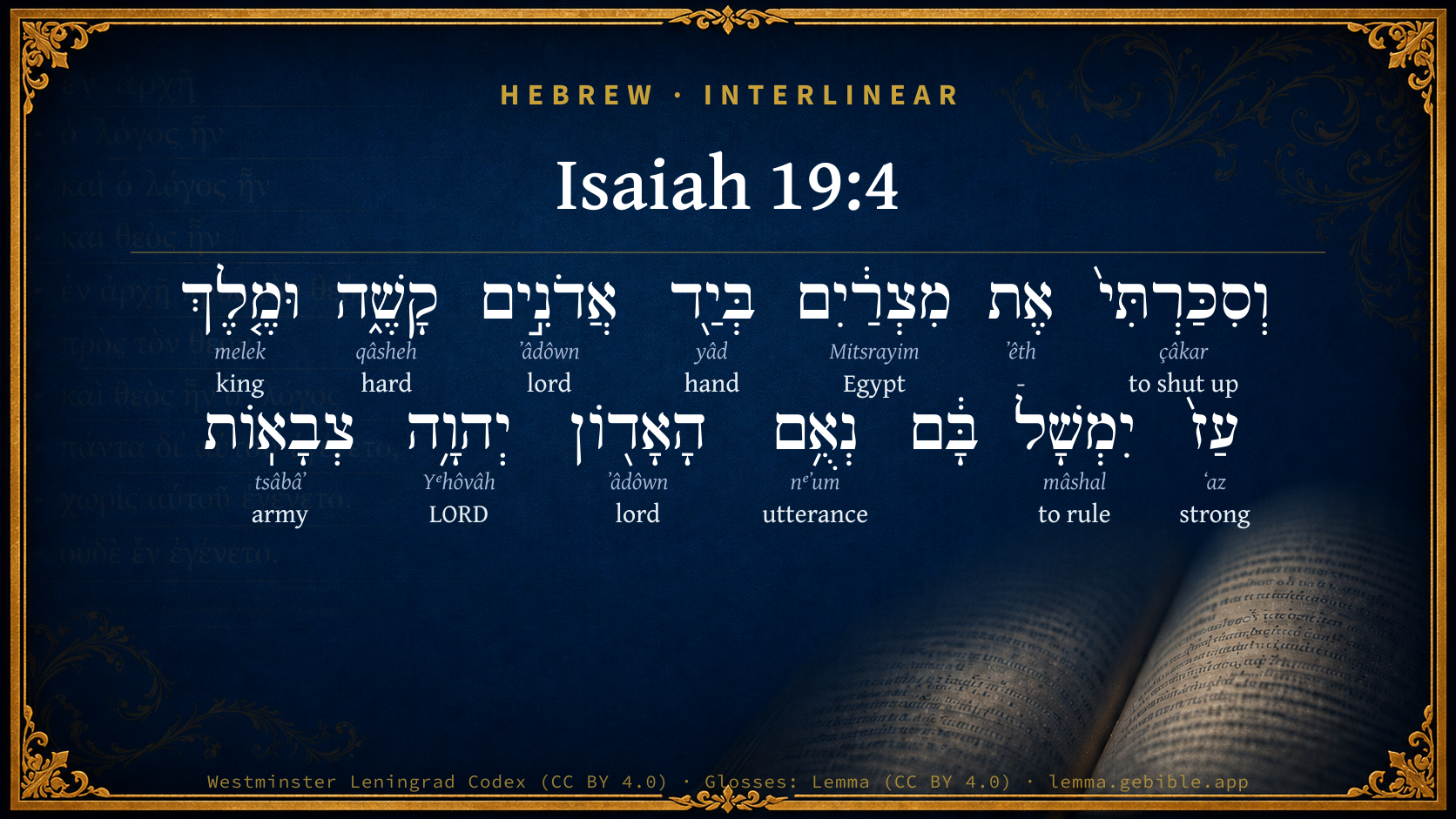
Hebrew (Westminster Leningrad Codex) Isaiah 19:4 appears in the Hebrew Old Testament. The text above is from the Westminster Leningrad Codex. Each word links to its Strong’s number, a concise gloss, and parsing drawn from the Open Scriptures Hebrew Bible morphology. Click any word for its full Brown-Driver-Briggs (BDB) entry.
Download image
Cite this verse

Isaiah 19:4 (World English Bible). Public Domain. Lemma interlinear Bible study tool, https://lemma.gebible.app/v/isaiah/19/4.

Show BibTeX & RIS
BibTeX
RIS
English Translation
I will give over the Egyptians into the hand of a cruel lord; and a fierce king shall rule over them, says the Lord, Yahweh of Hosts.
World English Bible · Public Domain
Download a study sheet

One document with this verse’s original text, its word-by-word gloss line, the meaning frame, cross-references with their text, attributed commentary, and full source and license credits — printable, and it pastes into notes with its structure intact.

This verse Autodidact and up

Study sheet (.html) Plain text (.txt)

A passage Seminary Student

Up to 50 verses in one chapter. A passage sheet keeps up to 6 commentary sources and 12 cross-references per verse, in the order this page ranks them, and says so on the sheet whenever that leaves anything out. Ask for a single verse and you get the Autodidact verse sheet above.

Everything on this page stays free to read, with no account — the sheet is a download of what is already on screen, not access to it.

Want to remove ads? Support Godless Engineer
Compare translations 3

The same verse in 3 English versions, stacked beneath the original-language interlinear above. Click any original word for its lexicon entry.

Each is an independent rendering of the whole verse — the interlinear is not word-aligned to these translations.

Highlighted words mark where these versions differ — a whole-verse word diff, not a word-by-word alignment.

  • World English Bible Public Domain
    I will give over the Egyptians into the hand of a cruel lord; and a fierce king shall rule over them, says the Lord, Yahweh of Hosts.
  • King James Version Public Domain
    And the Egyptians will I give over into the hand of a cruel lord; and a fierce king shall rule over them, saith the Lord, the LORD of hosts.
  • unfoldingWord Literal Text CC BY-SA 4.0
    And I will deliver Egypt into the hand of a hard master, and a fierce king will rule over them” —the declaration of the Lord, Yahweh of Armies.

unfoldingWord Literal Text — © unfoldingWord, licensed CC BY-SA 4.0. Word-aligned USFM3 via Door43 (git.door43.org/unfoldingWord/en_ult).

Versions to compare (up to 4)

3 of 4 selected

Show all 18 translations

Every available English version of this verse, each an independent rendering of the whole verse.

  • World English Bible Public Domain
    I will give over the Egyptians into the hand of a cruel lord; and a fierce king shall rule over them, says the Lord, Yahweh of Hosts.
  • Berean Standard Bible Public Domain
    I will deliver the Egyptians into the hands of harsh masters, and a fierce king will rule over them,” declares the Lord GOD of Hosts.
  • Majority Standard Bible Public Domain
    I will deliver the Egyptians into the hands of a harsh master, and a fierce king will rule over them,” declares the Lord GOD of Hosts.
  • King James Version Public Domain
    And the Egyptians will I give over into the hand of a cruel lord; and a fierce king shall rule over them, saith the Lord, the LORD of hosts.
  • American Standard Version (1901) Public Domain
    And I will give over the Egyptians into the hand of a cruel lord; and a fierce king shall rule over them, saith the Lord, Jehovah of hosts.
  • Revised Version (1885) Public Domain
    And I will give over the Egyptians into the hand of a cruel lord; and a fierce king shall rule over them, saith the Lord, the LORD of hosts.
  • Geneva Bible (1599) Public Domain
    And I will deliuer the Egyptians into the hand of the cruell Lordes, and a mightie King shall rule ouer them, sayth the Lord God of hostes.
  • Douay-Rheims (1899) Public Domain
    And I will deliver Egypt into the hand of cruel masters, and a strong king shall rule over them, saith the Lord the God of hosts.
  • Young's Literal Translation Public Domain
    And I have delivered the Egyptians Into the hand of a hard lord, And a strong king doth rule over them, An affirmation of the Lord, Jehovah of Hosts.
  • Literal Standard Version CC BY-SA 4.0
    And I have delivered the Egyptians || Into the hand of a hard lord, || And a strong king rules over them, || A declaration of the Lord, YHWH of Hosts.
  • Unlocked Literal Bible CC BY-SA 4.0
    I will give the Egyptians into the hand of a harsh master, and a strong king will rule over them— this is the declaration of the Lord Yahweh of hosts.”
  • unfoldingWord Literal Text CC BY-SA 4.0
    And I will deliver Egypt into the hand of a hard master, and a fierce king will rule over them” —the declaration of the Lord, Yahweh of Armies.
  • Darby Bible Public Domain
    And the Egyptians will I give over into the hand of a cruel lord, and a fierce king shall rule over them, saith the Lord, Jehovah of hosts.
  • World Messianic Bible Public Domain
    I will give over the Egyptians into the hand of a cruel lord. A fierce king will rule over them,” says the Lord, GOD of Hosts.
  • Webster's Bible Public Domain
    And the Egyptians will I give over into the hand of a cruel lord; and a fierce king shall rule over them, saith the Lord, the LORD of hosts.
  • Free Bible Version CC BY-SA 4.0
    I will hand the Egyptians over to a harsh dictator. A cruel king will rule over them, declares the Lord.
  • Bible in Basic English Public Domain
    And I will give the Egyptians into the hand of a cruel lord; and a hard king will be their ruler, says the Lord, the Lord of armies.
  • JPS Tanakh (1917) Public Domain
    And I will give over the Egyptians into the hand of a cruel lord; and a fierce king shall rule over them, saith the Lord, the LORD of hosts.

Literal Standard Version (2020), Covenant Press — licensed CC BY-SA 4.0. Text via the HelloAO Bible API (eBible.org). Unlocked Literal Bible (unfoldingWord) — licensed CC BY-SA 4.0. Text via the HelloAO Bible API (eBible.org). unfoldingWord Literal Text — © unfoldingWord, licensed CC BY-SA 4.0. Word-aligned USFM3 via Door43 (git.door43.org/unfoldingWord/en_ult). Free Bible Version, Dr. Jonathan Gallagher — licensed CC BY-SA 4.0. Text via the HelloAO Bible API (eBible.org).

Word by word

More ways to search: Search by grammar → Find every occurrence → Compare this word →

Practice this passage: Drill this verse → Learn its vocabulary →

וְסִכַּרְתִּי֙
çâkar
H5534
“and · to shut up”
Conjunction + Verb, Piel, Sequential Perfect, 1st Person, Common, Singular
Part of Speech
Conjunction + Verb
Stem
Piel
Form
Sequential Perfect
Person
1st Person
Gender
Common
Number
Singular
Full BDB Definition

Origin: a primitive root

TWOT: 1497 , 1498

to shut up, stop up - (Niphal) to be stopped, be shut up - (Piel) to shut up, give over
  1. אֶת ʼêth H853 “-” Particle, Direct Object
  2. מִצְרַ֔יִם Mitsrayim H4714 “Egypt” Noun, Proper
  3. בְּיַ֖ד yâd H3027 “in/at · hand of” Preposition + Noun, Common, Both, Singular, Construct
  4. אֲדֹנִ֣ים ʼâdôwn H113 “lords” Noun, Common, Masculine, Plural, Absolute
  5. קָשֶׁ֑ה qâsheh H7186 “hard” Adjective, Adjective, Masculine, Singular, Absolute
  6. וּמֶ֤לֶךְ melek H4428 “and · king” Conjunction + Noun, Common, Masculine, Singular, Absolute
  7. עַז֙ ʻaz H5794 “strong” Adjective, Adjective, Masculine, Singular, Absolute
  8. יִמְשָׁל mâshal H4910 “to rule” Verb, Qal, Imperfect, 3rd Person, Masculine, Singular
  9. נְאֻ֥ם nᵉʼum H5002 “utterance of” Noun, Common, Masculine, Singular, Construct
  10. הָאָד֖וֹן ʼâdôwn H113 “the · lord” Particle, Definite Article + Noun, Common, Masculine, Singular, Absolute
  11. יְהוָ֥ה Yᵉhôvâh H3068 “LORD” Noun, Proper
  12. צְבָאֽוֹת tsâbâʼ H6635 “armies” Noun, Common, Both, Plural, Absolute

About this verse

These counts appear in no published source. They are computed here, from the morphology-tagged text and Lemma’s own curated glosses. What Lemma adds →

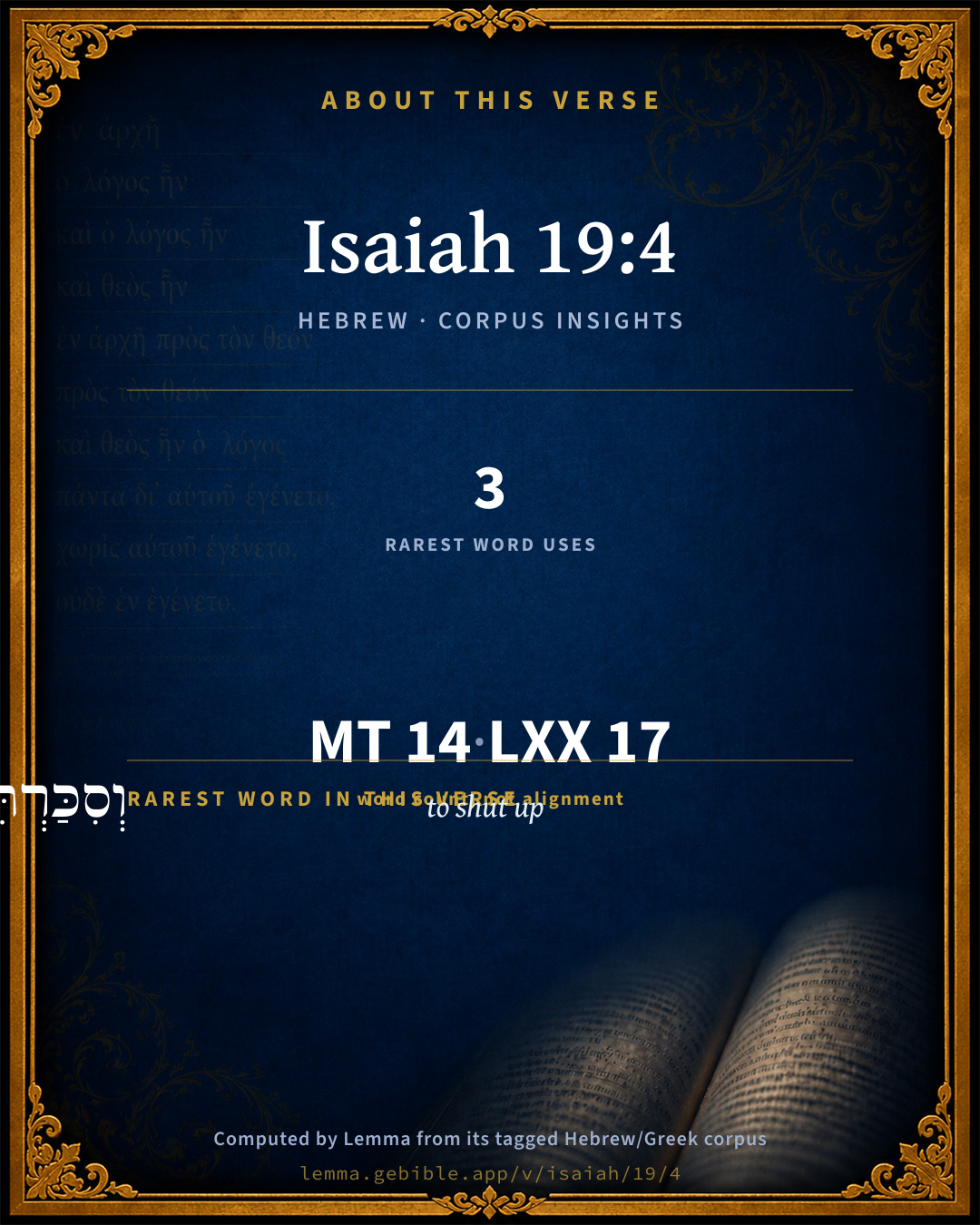
14
words
12
distinct lemmas
Prophets
section

Notable vocabulary

The rarest word here is וְסִכַּרְתִּי֙ to shut up H5534 — appearing just 3 times in the whole Hebrew Bible.

Shared distinctive vocabulary

וְסִכַּרְתִּי֙ to shut up H5534 occurs in 3 verses of the Hebrew Bible. Also found in:

Grammatical profile

  • 2 verbs
  • 8 nouns
  • 2 adjectives
  • 1 preposition
  • 1 particle

Verb forms

  • וְסִכַּרְתִּי֙ Piel · Sequential Perfect
  • יִמְשָׁל Qal · Imperfect

Repetition

A word recurs within this verse — often emphatic in Hebrew:

  • אֲדֹנִ֣ים lord H113 ×2

Hebrew & Septuagint length

In English translation the verse runs 27 words from the Hebrew and 26 from the Septuagint (LXX English) — closely comparable.

A rough comparison of the two English renderings, which tokenize alike — not a word-level alignment.

Word counts can differ between the Hebrew and the Greek without any difference in meaning — e.g. the Hebrew direct-object marker אֵת has no separate Greek word, and Greek often adds the article ὁ.

In the original languages it is 14 Hebrew tokens and 17 Greek tokens — but the two are counted differently (Hebrew bundles its prefixes and suffixes into one token; the Greek is in lemma form), so that isn’t a like-for-like length.

Cross-references

6

Topical passages linked to Isaiah 19:4 in the Treasury of Scripture Knowledge — connected by theme and wording, ordered by reader-vote popularity; previews shown in the World English Bible.

  • Isaiah 20:4 so shall the king of Assyria lead away the captives of Egypt, and the exiles of Ethiopia, young and old, naked and barefoot, and with buttocks uncovered, to the shame of Egypt.
  • Jeremiah 46:26 and I will deliver them into the hand of those who seek their lives, and into the hand of Nebuchadrezzar king of Babylon, and into the hand of his servants; and afterwards it shall be inhabited, as in the days of old, says Yahweh.
  • Ezekiel 29:19 Therefore thus says the Lord Yahweh: Behold, I will give the land of Egypt to Nebuchadrezzar king of Babylon; and he shall carry off her multitude, and take her spoil, and take her prey; and it shall be the wages for his army.
  • 1 Samuel 23:7 It was told Saul that David was come to Keilah. Saul said, God has delivered him into my hand; for he is shut in, by entering into a town that has gates and bars.
  • Psalms 31:8 You have not shut me up into the hand of the enemy. You have set my feet in a large place.
  • Isaiah 19:2 I will stir up the Egyptians against the Egyptians: and they shall fight everyone against his brother, and everyone against his neighbor; city against city, [and] kingdom against kingdom.

Cross-references courtesy of OpenBible.info (CC BY 4.0).

Hebrew and Greek witnesses Masoretic Hebrew ↔ Greek Septuagint

The same verse in the two great witnesses to the Old Testament, shown verse-for-verse.

These are two independent witnesses, not word-aligned to each other, and the Septuagint is shown in lemma (dictionary) form.

Hebrew Isaiah 19:4 Masoretic · Westminster Leningrad Codex

וְסִכַּרְתִּי֙ אֶת מִצְרַ֔יִם בְּיַ֖ד אֲדֹנִ֣ים קָשֶׁ֑ה וּמֶ֤לֶךְ עַז֙ יִמְשָׁל בָּ֔ם נְאֻ֥ם הָאָד֖וֹן יְהוָ֥ה צְבָאֽוֹת

I will give over the Egyptians into the hand of a cruel lord; and a fierce king shall rule over them, says the Lord, Yahweh of Hosts.

World English Bible · Public Domain

Greek LXX Isaiah 19:4 Septuagint · lemma form

καί παραδίδωμι αἴγυπτος εἰς χείρ ἄνθρωπος κύριος σκληρός καί βασιλεύς σκληρός κυριεύω αὐτός ὅδε λέγω κύριος σαβαωθ

And I will deliver Egypt into the hands of men, of cruel lords; and cruel kings shall rule over them: thus says the Lord of hosts.

LXX2012 (modern English Septuagint) · Public Domain

On this verse, Adam Clarke's Commentary discusses the Septuagint’s reading. Read the note in Commentary ↓

Hebrew: Westminster Leningrad Codex (CC BY 4.0). Greek: Septuagint (public domain); English from LXX2012 (modern English Septuagint) (Public Domain). How the Septuagint differs from the Hebrew →

Targum (Aramaic paraphrase)

1

The Targum is the ancient Jewish Aramaic paraphrase of the Hebrew Scriptures — an interpretive translation, not the Hebrew text itself. Onkelos (literal) and Pseudo-Jonathan (expansive) render the Torah, and Jonathan the Prophets. Coverage is partial: where no permissively-licensed English translation exists for a verse, only the Aramaic is shown. This is verse-level text, not a word-by-word alignment to the Hebrew.

  1. Targum Jonathan Prophets (Joshua–Malachi)
    וְאֶמְסַר יַת מִצְרָאֵי בְּיַד רִבּוֹן קְשֵׁי וּמְלַךְ תַּקִיף יִשְׁלוֹט בְּהוֹן אֲמַר רִבּוֹן עַלְמָא יְיָ צְבָאוֹת:

    And I will deliver the Egyptians into the hand of a cruel lord; and a fierce king shall rule over them, saith the Lord of the world, the Lord of hosts.

    Targum Jonathan — Aramaic: “Mikraot Gedolot” (public domain). English: “Sefaria Community Translation” (CC0 1.0 (public-domain dedication)); “London "Chaldee Paraphrase," 1871” (public domain). Text via Sefaria.

Commentary

Notes on Isaiah 19:4 from classic Christian and Jewish commentators (each source and its license shown beneath its notes). The classic Christian expositions comment on the surrounding passage and are grouped to its opening verse, so a note may address several verses; the Jewish commentaries on the Tanakh (Rashi and others) are per-verse, so they appear only where the commentator wrote on this verse.

Lemma curates 59 commentaries, every one of them public domain or Creative Commons licensed, each selected and text-cleaned for this edition rather than reprinted as found. About our sources →

Trapp's Complete Commentary

John Trapp

Isa 19:4 And the Egyptians will I give over into the hand of a cruel lord; and a fierce king shall rule over them, saith the Lord, the LORD of hosts.

Ver. 4. And the Egyptians will I give over.] Heb., Shut up - sc., as fishes in a pond.

Into the hand of a cruel lord.] Heb., Lords - viz., those twelve tyrants that reigned after Sethon, and were put down by Psammeticus, one of their own number, who afterwards reigned alone and with rigour. {a}

And a fierce king,] viz., Psammeticus, the father of that Pharaohnecho who slew Josiah. {2Ki 23:29} This fierce king reigned fifty-four years, and by his harshness caused 200,000 of his men of war to leave him, and to go into Ethiopia.

{a} Herodot.

John Trapp, A Commentary or Exposition upon All the Books of the Old and New Testament (1647–1656) — public domain. Text from a community e-Sword module.

Joseph Benson's Commentary

Isa 19:4. The Egyptians will I give into the hand of a cruel lord, &c. — This is the second calamity here threatened, and the most essential part of the prophecy; and “it may with great truth and propriety be understood of Nebuchadnezzar and the Babylonians, whose dominion was very grievous to the conquered nations: but with the greatest propriety and justice may be applied to the Persians, and especially to Cambyses and Ochus; one of whom put the yoke upon the neck of the Egyptians, and the other riveted it there, and who are both branded in history for cruel tyrants and monsters of men.” — Bishop Newton.

Joseph Benson's Commentary on the Old and New Testaments (1811–1818) — public domain. Text from a community e-Sword module.

Tyndale Open Study Notes

Tyndale Open Resources

19:4 hard, cruel master: In 671 BC, the Assyrian king Esarhaddon invaded Egypt and destroyed the royal city of Memphis. In 663 BC, Ashurbanipal attacked and destroyed Thebes (see Nah 3:8-10).

Tyndale Open Study Notes — © Tyndale Open Resources, licensed CC BY-SA 4.0. Text via the HelloAO Bible API.

Jamieson, Fausset & Brown

Robert Jamieson, A. R. Fausset & David Brown

cruel lord--"Sargon," in Hebrew it is lords; but plural is often used to express greatness, where, one alone is meant (Gen 39:2). The parallel word "king" (singular) proves it. NEWTON makes the general reference to be to Nebuchadnezzar, and a particular reference to Cambyses, son of Cyrus (who killed the Egyptian god, Apis), and Ochus, Persian conquerors of Egypt, noted for their "fierce cruelty." GESENIUS refers it to Psammetichus, who had brought into Egypt Greek and other foreign mercenaries to subdue the other eleven princes of the dodecarchy.

Jamieson, Fausset & Brown — Commentary Critical and Explanatory on the Whole Bible (1871) — public domain (CC PDM 1.0). Text via the HelloAO Bible API.

Adam Clarke's Commentary

Verse 4. A cruel lord - "Cruel lords"] Nebuchadnezzar in the first place, and afterwards the whole succession of Persian kings, who in general were hard masters, and grievously oppressed the country. Note, that for קשה kasheh, lord, a MS. reads קשים kashim, lords, agreeable to which is the rendering of the Septuagint, Syriac, and Vulgate.

Adam Clarke's Commentary on the Bible (1810–1826) — public domain. Text from a community e-Sword/MySword module.

Ellicott's Commentary for English Readers

(4) Into the hand of a cruel lord.—The later history of Egypt presents so many pictures of oppressive government, that it is hard to say to which of them the picture thus drawn bears most resemblance. Sargon, or Esarhaddon, or Psammetichus, who became king of Egypt on the breaking up of the dodecarchy, or Nebuchadnezzar, or Cambyses, has, each in his turn, been identified as presenting the features of the “cruel lord.”

A Bible Commentary for English Readers, edited by Charles John Ellicott (1878–1897) — public domain. Text from a community e-Sword module.

The Cambridge Bible for Schools and Colleges

gen. ed. J. J. S. Perowne

4. R.V. And I will give over (lit. “shut up”) the Egyptians into the hand of a cruel (“hard”) lord (in Hebr. plur. of majesty), &c. The words suggest a foreign ruler and are quite applicable to any Assyrian monarch likely to undertake the conquest of Egypt. Esarhaddon in 672 and again Asshurbanipal in 662 ravaged the country as far as Thebes; the Empire was broken up into twenty petty principalities, and all attempts at revolt were sternly suppressed until 645, when Psammetichus, one of the native princes, succeeded in shaking off the Assyrian yoke and uniting Egypt under his own sway.

the Lord, the Lord of hosts] here, as always, in confirmation of a threat. See on Isa_1:24.

The Cambridge Bible for Schools and Colleges (gen. ed. J. J. S. Perowne; Cambridge University Press, 1878–1918) — public domain. Text from a community e-Sword module.

John Gill's Exposition

And the Egyptians will I give over into the hands of a cruel lord,.... Not of Sennacherib king of Assyria, which way go many interpreters, both Christian and Jewish, as Aben Ezra, Jarchi, and Kimchi; nor of Nebuchadnezzar king of Babylon, as in Jer 46:25 but either of the twelve tyrants that rose up after the death of Sethon above mentioned; for the word is in the plural number, "lords", though the adjective rendered "cruel" is singular; or else Psammiticus, the father of Pharaohnecho, that slew Josiah; and who conquered the other eleven tyrants, and ruled alone, for the space of fifty four years, with great rigour; and the same is designed in the next clause:

and a fierce king shall rule over them; it is reported of Psammiticus, that he gave such offence to his subjects, that two hundred thousand of his soldiers left him, and went into Ethiopia (a). Vitringa interprets this of the Persian emperors, into whose hands Egypt fell, as Cambyses and Ochus; and who, according to historians, were very cruel princes. That there might be no doubt of the sure and certain accomplishment of this prophecy, it is added,

saith the Lord, the Lord of hosts; of the armies above and below; and who does what he pleases among the kings and kingdoms of the earth.

(a) See Raleigh's History of the World, B. 2. c. 27. sect. 3. p. 357.

John Gill's Exposition of the Whole Bible (1746–1763) — public domain (CC PDM 1.0). Text via the HelloAO Bible API.

Albert Barnes' Notes on the Bible

And the Egyptians - The Egyptian nation; the entire people, though divided into factions and contending with each other.

Will I give over - Margin, ‘Shut up.’ The Hebrew word (סכר sākar) usually has the sense of shutting up, or closing. Here it means that these contentions would be “closed” or concluded by their being delivered to of a single master. The Septuagint renders it, Παραδώσω Paradōsō - ‘I will surrender.’

Into the hands of a cruel lord - Hebrew, ‘Lords of cruelty, or severity.’ The word rendered ‘lord,’ meaning master, is in the Hebrew in the plural number (אדנים 'ădônı̂y). It is, however, generally supposed that it is pluralis excellentiae - denoting majesty and dignity, and applicable to a “single” monarch. The connection requires this, for the state here described would be different from that where “many” rule, and it seems to suppose that “one” should succeed to the many who had been contending. In the parallel member, also, a name in the singular number is used - ‘a fierce king;’ and as this evidently denotes the same, it follows that the word here is used to denote a single monarch. The plural form is often thus used in the Hebrew (see Psa 7:10; Eze 29:3; Hos 12:1). God here claims jurisdiction over the nation, and says that “he” will do it - a most striking illustration of the power which he asserts over contending people to deliver them to whomsoever he will.

Dr. Newton supposes that this was Nebuchadnezzar, or more properly Cambyses, by whom Egypt was made subject to the authority of Persia, and who was eminently a cruel man, a madman. But the more probable interpretation is that which refers it to Psammetichus. twelve kings were in contention, of whom he was one. He called in the aid of the Arabians, the pirates of Caria and Iona (Herodot. ii. 152; see the Analysis of the chapter; Diod. i. 66). This was in the twentieth year of the reign of Manasseh. Psammetichus reigned fifty-four years and was succeeded by Nechus his son, called in Scripture Pharaoh-Necho, and often mentioned under that name. Psammetichus, during a considerable part of his reign, was engaged in wars with Assyria and Palestine. He is here called a ‘cruel lord;’ that is, an oppressive monarch, probably because he secured the kingdom by bringing in to his aid foreign mercenaries - robbers and pirates, and because his wars made his government oppressive and burdensome.

A fierce king - Hebrew, ‘A king of strength’ - a description particularly applicable to one who, like Psammetichus, had subdued eleven rivals, and who had obtained the kingdom by conquest.

Albert Barnes' Notes on the Bible (1834–1885) — public domain. Text from a community e-Sword/MySword module.

Haydock's Catholic Bible Commentary

Masters. Twelve kings. Psammitichus, one of them, shall gain the ascendancy.

George Leo Haydock (1774–1849), Haydock's Catholic Family Bible and Commentary, 1859 edition — public domain. Excludes Psalms (Douay-Rheims chapter numbering differs from Protestant) and Deuterocanonical books (Catholic canon only).

Matthew Poole's English Annotations

A fierce king; either,

1. The king of Assyria or Chaldea; or,

2. Those twelve petty kings, the singular number being put for the plural; or,

3. Psammetichus, who being at first one of those twelve kings, waged war with the rest, and subdued them, and conquered all the land of Egypt, and ruled it with rigour.

Matthew Poole's English Annotations on the Holy Bible (1683–1685) — public domain. Text from a community e-Sword/MySword module.

Whedon's Commentary on the Bible

Daniel D. Whedon

4. A fierce king — Rather, a strong, powerful king, but such as proved a cruel master. As without much doubt the prophecy is general, this one character may apply to several rulers — Nebuchadnezzar, Psammetichus, and Cambyses — the most merciless of whom, however, was Psammetichus. See SMITH’S Dictionary of Biography.

Daniel D. Whedon (gen. ed.), Commentary on the Old and New Testaments (1874–1909) — public domain. Text from a community e-Sword module.

The Pulpit Commentary

The Egyptians will I give over into the hand of a cruel lord. It has been observed above that Piankhi will not answer to this description. It will, however, well suit Esarhaddon. Esarhaddon, soon after his accession, cut off the heads of Abdi-Milkut, King of Sidon, and of Sanduarri, King of Kundi, and hung them round the necks of two of their chief officers (G. Smith, "Eponym Canon," pp. 137-139). In an expedition which he made into Arabia, he slew eight of the sovereigns, two of them being women ("Records of the Past," vol. 3. pp. 106, 107). On conquering Egypt he treated it with extreme severity. Not only did he divide up the country into twenty governments, but he changed the names of the towns, and assigned to his twenty governors, as their main duty, that they were "to slay, plunder, and spoil" their subjects (G. Smith, "History of Asshur-bani-pal," p. 37, 1. 7; comp. p. 16, 1. 7). He certainly well deserved the appellations of "a cruel lord," "a fierce king."

The Pulpit Commentary (1880–1919), ed. H.D.M. Spence-Jones & Joseph S. Exell — public domain. Text from a community e-Sword module.

John Wesley's Explanatory Notes

A fierce king - Psammetichus, who being at first one of those twelve kings, waged war with the rest, and subdued them, and conquered all the land of Egypt and ruled it with rigor.

John Wesley, Explanatory Notes Upon the Whole Bible (1754–1765) — public domain. Text via the GEBible commentary corpus.

J. A. Alexander on Isaiah

Joseph Addison Alexander

“And I will shut up Egypt in the hands of a hard master, and a strong king shall rule over them, saith the Lord, Jehovah of Hosts.” Master, literally masters, a pluralis majestaticus, elsewhere applied to individual men (Gen 42:30; Gen 42:33; 2Ki 2:3; 2Ki 2:5; 2Ki 2:16). The king here mentioned is identified, according to various hypotheses, with Sethos, Psammetichus, Sennacherib, Sargon, Nebuchadnezzar, Cambyses, Ochus, and Charlemagne! The very multiplicity of these explanations shows how fanciful they are, and naturally leads us to conclude that the Prophet is describing in a general way the political vicissitudes of Egypt, one of which would be subjection to an arbitrary power, whether foreign or domestic, or to both at different periods of its history.

Joseph Addison Alexander, The Prophecies of Isaiah (1846–1847; New York: Scribner, 1870–1878) — public domain. Text from a community e-Sword module.

Rashi

Rabbi Shlomo Yitzchaki (Rashi)

And I will deliver וְסִכַּרְתִּי, And I will deliver. Alternatively, it can be interpreted as an expression like (Gen. 8:2): “And the fountains of the deep were stopped up (וַיִּסָּכְרוּ).” I will stop him up and bind him.

into the hands of a harsh master Heb. אֲדֹנִים קָשֶׁה. Any expression of lordship is used in the plural, even for a singular. Comp. (ibid. 39:20) “Joseph’s master (אֲדֹנֵי)”; (ibid. 16) “Until his master (אֲדֹנָיו) came.”

and a mighty king The king of Assyria.

Rashi on the Tanakh — English translations: “The Judaica Press complete Tanach with Rashi, translated by A. J. Rosenberg” (CC BY 4.0); “Pentateuch with Rashi's commentary by M. Rosenbaum and A.M. Silbermann, 1929-1934” (public domain); “The Metsudah Tanach series, Lakewood, N.J” (CC BY 4.0); and “The Book of Joshua, Metsudah Publications, 1997” (CC BY 4.0). Text via Sefaria.

Ibn Ezra

Rabbi Abraham ibn Ezra

וסכרתי And I will give over. The כ is here, according to some, substituted for נ, but, in fact, only the silent letters interchange; it is rather to be compared with ויסכרו and were stopped (Gen. 8:2).

אדנים קשה A cruel lord. The grammatical irregularity is already explained (Ex. 21:4).

And a fierce king. The king of Assyria.

Ibn Ezra on the Tanakh — English translations: “Sefaria Community Translation” (CC0 1.0 (public-domain dedication)); “Yalkut, Sifsei Chachomim Chumash, Metsudah Publications, 2009” (CC BY 4.0); and “Commentary of Ibn Ezra on Isaiah - trans. by M. Friedlander, 1873” (public domain). Text via Sefaria.

Lesson kit

Teaching starters — assembled from the data on this page, not authored interpretation. Every prompt links to the verse data it draws on. Edit before teaching.

Isaiah, in the Prophets, opens this verse with 14 words (12 distinct Hebrew lemmas). Its most distinctive word is çâkar (“to shut up”). A historical commentator’s framing appears above. Read the whole chapter for the surrounding context.

Discussion questions

  1. What does “to shut up” (çâkar) contribute to the verse as a whole?
  2. How does Genesis 8:2, which shares the word «to shut up», read alongside this verse?
  3. What does the repetition of “lord” (2× in this one verse) do in this verse?
  4. These translations render this verse differently; the difference is in the English rendering, not the original. What questions does that raise?
  5. «וְסִכַּרְתִּי֙» is a Piel Sequential Perfect verb. How does that grammatical form shape the action described?
  6. Compare how Trapp's Complete Commentary and Joseph Benson's Commentary read this verse. Where do they agree or differ?

Things to notice

Reading settings

Reading text

Shown beneath each verse's original-language words.

Old Testament
Old Testament edition

Read the OT as the Masoretic Hebrew (MT) or the Greek Septuagint (LXX).

English shown for the Greek Septuagint (in the Hebrew ↔ Greek comparison).

Comparing translations? Open the Compare panel on any verse page to stack up to four side by side.