
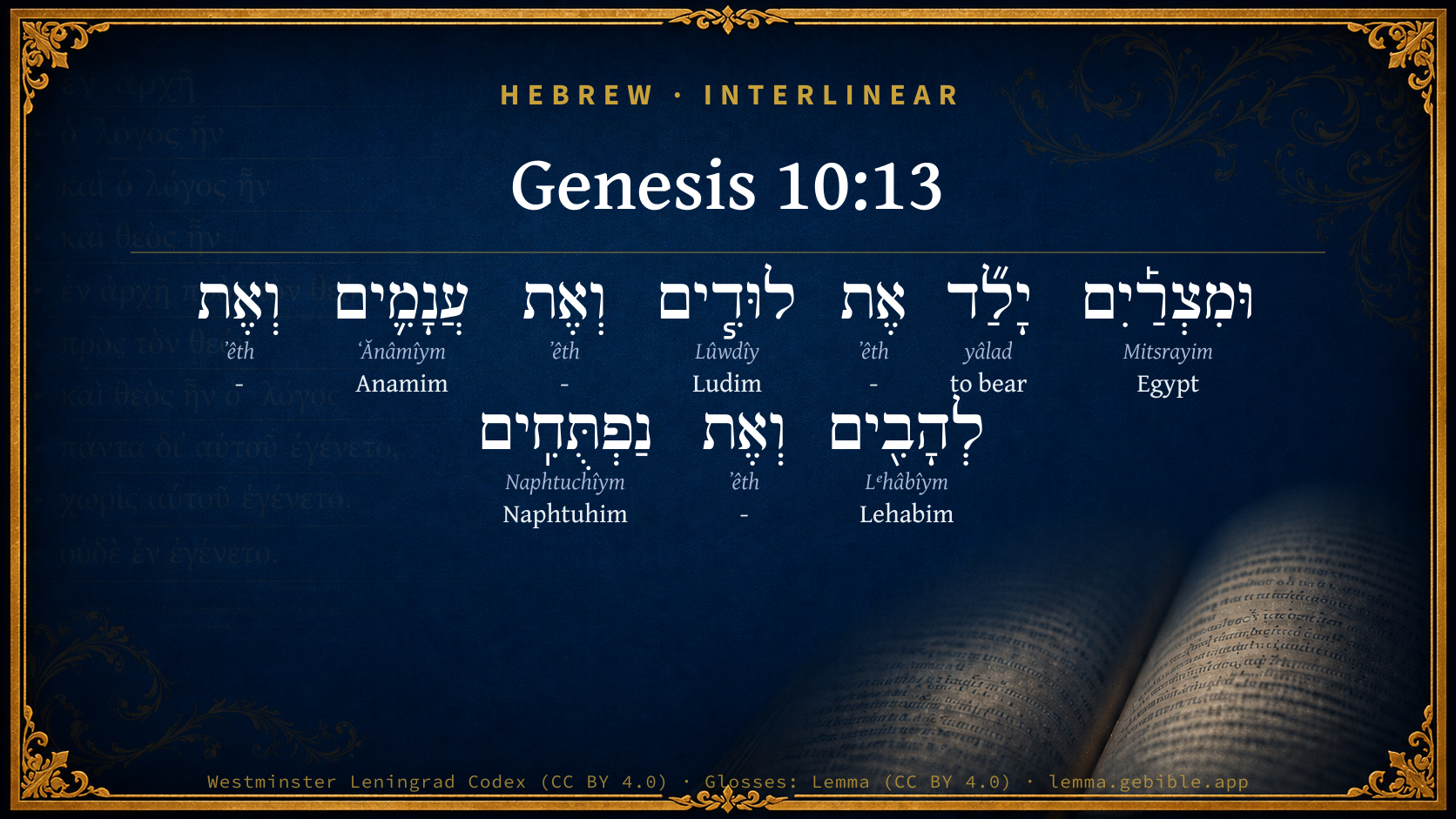
Genesis 10:13

Hebrew (Westminster Leningrad Codex) Genesis 10:13 appears in the Hebrew Old Testament. The text above is from the Westminster Leningrad Codex. Each word links to its Strong’s number, a concise gloss, and parsing drawn from the Open Scriptures Hebrew Bible morphology. Click any word for its full Brown-Driver-Briggs (BDB) entry.
Download image
Cite this verse

Genesis 10:13 (World English Bible). Public Domain. Lemma interlinear Bible study tool, https://lemma.gebible.app/v/genesis/10/13.

Show BibTeX & RIS
BibTeX
RIS
English Translation
Mizraim became the father of Ludim, Anamim, Lehabim, Naphtuhim,
World English Bible · Public Domain
Highlights Full analysis ↓
Download a study sheet

One document with this verse’s original text, its word-by-word gloss line, the meaning frame, cross-references with their text, attributed commentary, and full source and license credits — printable, and it pastes into notes with its structure intact.

This verse Autodidact and up

Study sheet (.html) Plain text (.txt)

A passage Seminary Student

Up to 50 verses in one chapter. A passage sheet keeps up to 6 commentary sources and 12 cross-references per verse, in the order this page ranks them, and says so on the sheet whenever that leaves anything out. Ask for a single verse and you get the Autodidact verse sheet above.

Everything on this page stays free to read, with no account — the sheet is a download of what is already on screen, not access to it.

Want to remove ads? Support Godless Engineer
Compare translations 3

The same verse in 3 English versions, stacked beneath the original-language interlinear above. Click any original word for its lexicon entry.

Each is an independent rendering of the whole verse — the interlinear is not word-aligned to these translations.

Highlighted words mark where these versions differ — a whole-verse word diff, not a word-by-word alignment.

  • World English Bible Public Domain
    Mizraim became the father of Ludim, Anamim, Lehabim, Naphtuhim,
  • King James Version Public Domain
    And Mizraim begat Ludim, and Anamim, and Lehabim, and Naphtuhim,
  • unfoldingWord Literal Text CC BY-SA 4.0
    And Mizraim fathered the Ludim and the Anamim and the Lehabim and the Naphtuhim

unfoldingWord Literal Text — © unfoldingWord, licensed CC BY-SA 4.0. Word-aligned USFM3 via Door43 (git.door43.org/unfoldingWord/en_ult).

Versions to compare (up to 4)

3 of 4 selected

Show all 18 translations

Every available English version of this verse, each an independent rendering of the whole verse.

  • World English Bible Public Domain
    Mizraim became the father of Ludim, Anamim, Lehabim, Naphtuhim,
  • Berean Standard Bible Public Domain
    Mizraim was the father of the Ludites, the Anamites, the Lehabites, the Naphtuhites,
  • Majority Standard Bible Public Domain
    Mizraim was the father of the Ludites, the Anamites, the Lehabites, the Naphtuhites,
  • King James Version Public Domain
    And Mizraim begat Ludim, and Anamim, and Lehabim, and Naphtuhim,
  • American Standard Version (1901) Public Domain
    And Mizraim begat Ludim, and Anamim, and Lehabim, and Naphtuhim,
  • Revised Version (1885) Public Domain
    And Mizraim begat Ludim, and Anamim, and Lehabim, and Naphtuhim,
  • Geneva Bible (1599) Public Domain
    And Mizraim begate Ludim, and Anamim, and Lehabim, and Naphtuhim.
  • Douay-Rheims (1899) Public Domain
    And Mesraim begot Ludim, and Anamim, and Laabim, Nepthuim,
  • Young's Literal Translation Public Domain
    And Mitzraim hath begotten the Ludim, and the Anamim, and the Lehabim, and the Naphtuhim,
  • Literal Standard Version CC BY-SA 4.0
    And Mitzraim has begotten the Ludim, and the Anamim, and the Lehabim, and the Naphtuhim,
  • Unlocked Literal Bible CC BY-SA 4.0
    Mizraim became the father of the Ludites, the Anamites, the Lehabites, the Naphtuhites,
  • unfoldingWord Literal Text CC BY-SA 4.0
    And Mizraim fathered the Ludim and the Anamim and the Lehabim and the Naphtuhim
  • Darby Bible Public Domain
    -- And Mizraim begot the Ludim, and the Anamim, and the Lehabim, and the Naphtuhim,
  • World Messianic Bible Public Domain
    Mizraim became the father of Ludim, Anamim, Lehabim, Naphtuhim,
  • Webster's Bible Public Domain
    And Mizraim begat Ludim, and Anamim, and Lehabim, and Naphtuhim.
  • Free Bible Version CC BY-SA 4.0
    Mizraim was the father of the Ludites, the Anamites, the Lehabites, the Naphtuhites,
  • Bible in Basic English Public Domain
    And Mizraim was the father of the Ludim and Anamim and Lehabim and Naphtuhim;
  • JPS Tanakh (1917) Public Domain
    And Mizraim begot Ludim, and Anamim, and Lehabim, and Naphtuhim,

Literal Standard Version (2020), Covenant Press — licensed CC BY-SA 4.0. Text via the HelloAO Bible API (eBible.org). Unlocked Literal Bible (unfoldingWord) — licensed CC BY-SA 4.0. Text via the HelloAO Bible API (eBible.org). unfoldingWord Literal Text — © unfoldingWord, licensed CC BY-SA 4.0. Word-aligned USFM3 via Door43 (git.door43.org/unfoldingWord/en_ult). Free Bible Version, Dr. Jonathan Gallagher — licensed CC BY-SA 4.0. Text via the HelloAO Bible API (eBible.org).

Word by word

More ways to search: Search by grammar → Find every occurrence → Compare this word →

Practice this passage: Drill this verse → Learn its vocabulary →

About this verse

These counts appear in no published source. They are computed here, from the morphology-tagged text and Lemma’s own curated glosses. What Lemma adds →

10
words
7
distinct lemmas
Pentateuch
section

Notable vocabulary

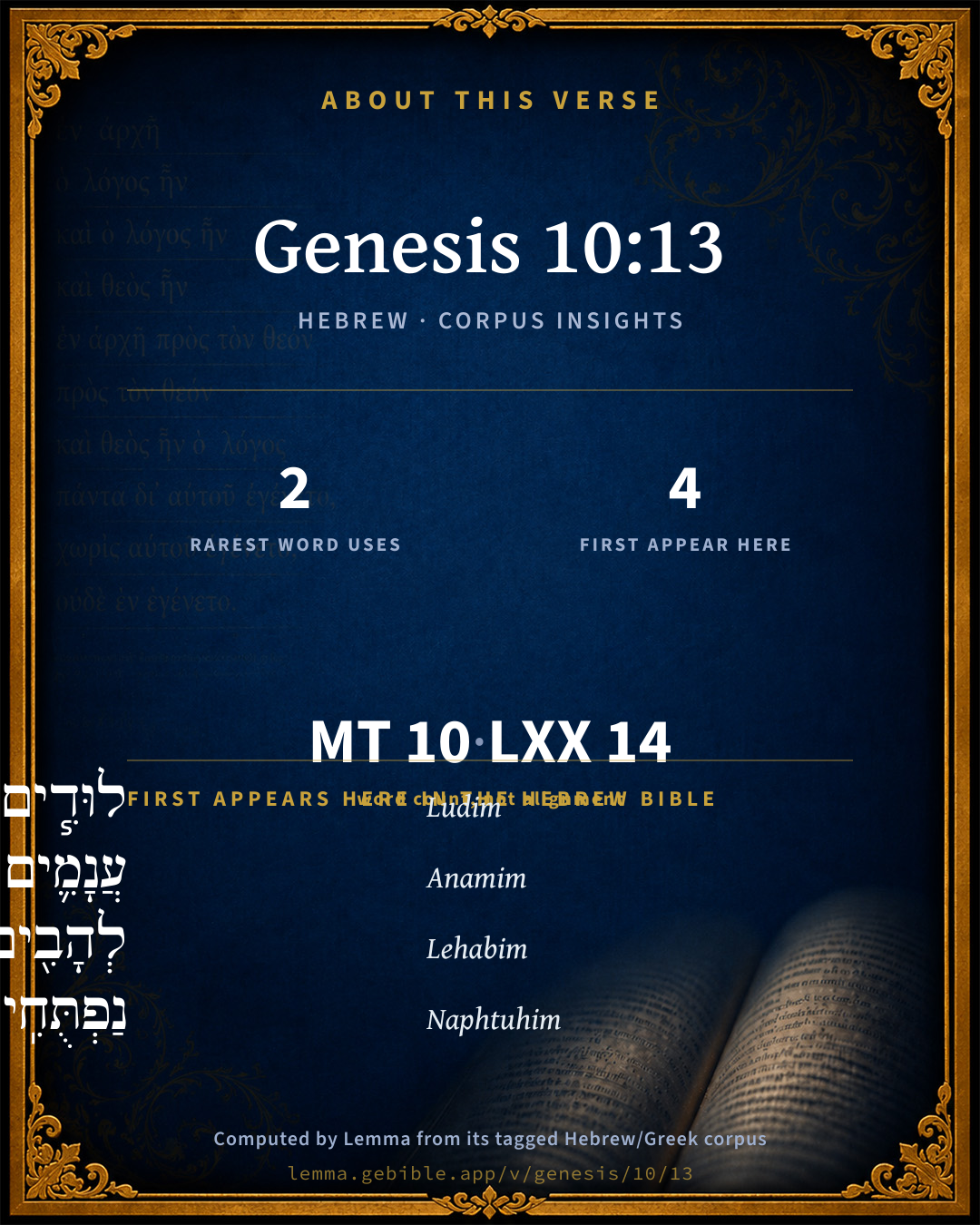
The rarest word here is עֲנָמִ֛ים Anamim H6047 — appearing just 2 times in the whole Hebrew Bible.

First appearance in Scripture

These words make their first canonical appearance in the Hebrew Bible here:

  • לוּדִ֧ים Ludim H3866
  • עֲנָמִ֛ים Anamim H6047
  • לְהָבִ֖ים Lehabim H3853
  • נַפְתֻּחִֽים Naphtuhim H5320

Shared distinctive vocabulary

עֲנָמִ֛ים Anamim H6047 occurs in 2 verses of the Hebrew Bible. Also found in:

Grammatical profile

  • 1 verb
  • 5 nouns
  • 4 particles

Verb forms

  • יָלַ֞ד Qal · Perfect

Hebrew & Septuagint length

In English translation the verse runs 9 words from the Hebrew and 14 from the Septuagint (LXX English) — the Septuagint runs noticeably longer here. See the side-by-side →

A rough comparison of the two English renderings, which tokenize alike — not a word-level alignment.

Word counts can differ between the Hebrew and the Greek without any difference in meaning — e.g. the Hebrew direct-object marker אֵת has no separate Greek word, and Greek often adds the article ὁ.

In the original languages it is 10 Hebrew tokens and 14 Greek tokens — but the two are counted differently (Hebrew bundles its prefixes and suffixes into one token; the Greek is in lemma form), so that isn’t a like-for-like length.

Cross-references

3

Topical passages linked to Genesis 10:13 in the Treasury of Scripture Knowledge — connected by theme and wording, ordered by reader-vote popularity; previews shown in the World English Bible.

  • 1 Chronicles 1:11–12 Mizraim became the father of Ludim, and Anamim, and Lehabim, and Naphtuhim,
  • Jeremiah 46:9 Go up, you horses; and rage, you chariots; and let the mighty men go forth: Cush and Put, who handle the shield; and the Ludim, who handle and bend the bow.
  • Ezekiel 30:5 Ethiopia, and Put, and Lud, and all the mixed people, and Cub, and the children of the land that is in league, shall fall with them by the sword.

Cross-references courtesy of OpenBible.info (CC BY 4.0).

Hebrew and Greek witnesses Masoretic Hebrew ↔ Greek Septuagint

The same verse in the two great witnesses to the Old Testament, shown verse-for-verse.

Here the Septuagint runs noticeably longer than the Hebrew — LXX2012 (modern English Septuagint) 14 words vs World English Bible 9. A rough length comparison of the two English translations, not a word-level alignment — read both below.

These are two independent witnesses, not word-aligned to each other, and the Septuagint is shown in lemma (dictionary) form.

Hebrew Genesis 10:13 Masoretic · Westminster Leningrad Codex

וּמִצְרַ֡יִם יָלַ֞ד אֶת לוּדִ֧ים וְאֶת עֲנָמִ֛ים וְאֶת לְהָבִ֖ים וְאֶת נַפְתֻּחִֽים

Mizraim became the father of Ludim, Anamim, Lehabim, Naphtuhim,

World English Bible · Public Domain

Greek LXX Genesis 10:13 Septuagint · lemma form

καί μεσραιμ γεννάω ὁ λουδιιμ καί ὁ ενεμετιιμ καί ὁ λαβιιμ καί ὁ νεφθαλιιμ

And Mesrain begot the Ludiim, and the Nephthalim, and the Enemetiim, and the Labiim,

LXX2012 (modern English Septuagint) · Public Domain

On this verse, The Cambridge Bible for Schools and Colleges discusses the Septuagint’s reading. Read the note in Commentary ↓

Hebrew: Westminster Leningrad Codex (CC BY 4.0). Greek: Septuagint (public domain); English from LXX2012 (modern English Septuagint) (Public Domain). How the Septuagint differs from the Hebrew →

Targum (Aramaic paraphrase)

2

The Targum is the ancient Jewish Aramaic paraphrase of the Hebrew Scriptures — an interpretive translation, not the Hebrew text itself. Onkelos (literal) and Pseudo-Jonathan (expansive) render the Torah, and Jonathan the Prophets. Coverage is partial: where no permissively-licensed English translation exists for a verse, only the Aramaic is shown. This is verse-level text, not a word-by-word alignment to the Hebrew.

  1. Targum Onkelos Torah (Genesis–Deuteronomy)
    וּמִצרָאֵי (בכל הס':וּמִצְרַיִם) אוֹלִיד יָת לוּדָאֵי וְיָת עֲנָמָאֵי וְיָת לְהָבָאֵי וְיָת נַפְתּוּחָאֵי

    And Mizraim begat the Ludaee, and Anamaee, and Lehabaee, and Naphtuhaee,

    Targum Onkelos — Aramaic: “Onkelos Genesis” (public domain); “Onkelos Exodus” (public domain); “Onkelos Leviticus” (public domain); “Onkelos Numbers” (public domain); “Onkelos Deuteronomy” (public domain). English: “Sefaria Community Translation” (CC0 1.0 (public-domain dedication)); “J.W. Etheridge. The Targums of Onkelos and Jonathan Ben Uzziel on the Pentateuch. London: Longmans, Green, 1862” (public domain). Text via Sefaria.

  2. Targum Pseudo-Jonathan Torah (Genesis–Deuteronomy)
    וּמִצְרַיִם אוֹלִיד יַת נִיוַוטָאֵי וְיַת מַרְטִיוֹטָאֵי וְיַת לִיוַוקָאֵי וְיַת פַּנְטַסְכִּינָאֵי

    And Mizraim begat the Nivatee, and the Mariotee, and the Livakee, and the Pantascinee,

    Targum Pseudo-Jonathan — Aramaic: “Targum Jonathan on Genesis” (public domain); “Targum Jonathan on Exodus” (public domain); “Targum Jonathan on Leviticus” (public domain); “Targum Jonathan on Numbers” (public domain); “Targum Jonathan on Deuteronomy” (public domain). English: “The Targum of Jonathan ben Uzziel, trans. J. W. Etheridge, London, 1862” (public domain). Text via Sefaria.

Commentary

Notes on Genesis 10:13 from classic Christian and Jewish commentators (each source and its license shown beneath its notes). The classic Christian expositions comment on the surrounding passage and are grouped to its opening verse, so a note may address several verses; the Jewish commentaries on the Tanakh (Rashi and others) are per-verse, so they appear only where the commentator wrote on this verse.

Lemma curates 59 commentaries, every one of them public domain or Creative Commons licensed, each selected and text-cleaned for this edition rather than reprinted as found. About our sources →

The Cambridge Bible for Schools and Colleges

gen. ed. J. J. S. Perowne

13. Mizraim] In Gen_10:6, “the sons of Ham” are Cush, Mizraim, Put, and Canaan. The “sons of Cush” were given in Gen_10:7. In Gen_10:13-14 the genealogy is continued with the “sons of Mizraim.” The intervening passage (Gen_10:8-12) has been a parenthesis. The names here mentioned are probably tribes on the borders of Egypt.

Ludim] Mentioned also in Jer_46:9; presumably the same as Lud in Isa_66:19; Eze_27:10; Eze_30:5.

the Anamim] W. Max Müller suggests that these are the Kinamim who dwelt in the largest and southernmost oasis, designated in the Egyptian inscriptions K’n’mt. Very strange is the reading of the LXX Αἰνεμετιείμ. Cf. 1Ch_1:11.

Lehabim] Possibly the same as the “Libyans,” who appear as Lubim in 2Ch_12:3; 2Ch_16:8; Dan_11:43; Nah_3:9. The Libyans were the African tribes west of Cyrene.

Naphtuhim] The Egyptologist Erman suggests that this name is the corruption of the word P-t-mḥi, the Egyptian designation for the dwellers in the north, i.e. the Delta of Egypt (Z. A. T. W. 1890, pp. 118, 119).

Another suggestion is that it represents the name of the third great oasis, between Ammon and K’n’mt, bearing the name of Ferâfia. Cf. 1Ch_1:11.

The Cambridge Bible for Schools and Colleges (gen. ed. J. J. S. Perowne; Cambridge University Press, 1878–1918) — public domain. Text from a community e-Sword module.

Trapp's Complete Commentary

John Trapp

Gen 10:13 And Mizraim begat Ludim, and Anamim, and Lehabim, and Naphtuhim,

Ver. 13, 14, Ludim and Anamim.] Aben-Ezra thinks that these were names of provinces, and that in every province there was a family; whence also the names are all plural.

John Trapp, A Commentary or Exposition upon All the Books of the Old and New Testament (1647–1656) — public domain. Text from a community e-Sword module.

Tyndale Open Study Notes

Tyndale Open Resources

10:13-14 The Ludites were Lydian tribes west of the Nile delta. • The identity of the Anamites is uncertain. They were possibly Egyptians near Cyrene, west of Egypt. • The Lehabites were possibly a Libyan tribe. • The Naphtuhites inhabited northern Egypt. • The Pathrusites inhabited southern Egypt. • The Casluhites possibly inhabited an Egyptian district also known as Cyrenaica. • The Caphtorites were Cretans (see Jer 47:4; Amos 9:7). • The Philistines from Crete were sea people who lived intermittently in southwest Canaan during the period of the Exodus and later (Exod 13:17; Amos 9:7). They were among Israel’s most troublesome enemies during the early monarchy (see 1–2 Samuel).

Tyndale Open Study Notes — © Tyndale Open Resources, licensed CC BY-SA 4.0. Text via the HelloAO Bible API.

Geneva Bible (1599)

Geneva Bible translators

Of Lud came the Lydians.

Geneva Bible (1599) marginal notes — public domain. Text via Bolls.life.

Adam Clarke's Commentary

Verse 13. Mizraim begat Ludim] Supposed to mean the inhabitants of the Mareotis, a canton in Egypt, for the name Ludim is evidently the name of a people.

Anamim] According to Bochart, the people who inhabited the district about the temple of Jupiter Ammon.

Lehabim] The Libyans, or a people who dwelt on the west of the Thebaid, and were called Libyo-Egyptians.

Naphtuhim] Even the conjectures can scarcely fix a place for these people. Bochart seems inclined to place them in Marmarica, or among the Troglodytae.

Adam Clarke's Commentary on the Bible (1810–1826) — public domain. Text from a community e-Sword/MySword module.

Ellicott's Commentary for English Readers

(13, 14) “With Mizraim are connected seven inferior African races, the names of which are given in the plural, namely:—

1. The Ludim.—There were two races of this name: one Semitic, descended from Lud, the son of Shem (Gen_10:22), and mentioned in Isa_66:19; the other Hamite, and subject to the Pharaohs ( Jer_46:9; Eze_30:5). They seem to have inhabited the Nile valley, but their exact position is unknown.

2. The Anamim.—Knobel gives some reasons for supposing this race to have inhabited the Delta.

3. The Lehabim.—Probably the same as the Lubim of 2Ch_12:3; 2Ch_16:8; Dan_11:43; Nah_3:9. Their home was on the western side of the Delta.

4. The Naphtuhim.—Knobel explains these as “the people of Phthah, the deity worshipped at Memphis.” If so, they were the true Egyptians, as Egypt is Kah-Phthah, “the land of Phthah,’ or more correctly, according to Canon Cook, Ai-Capth. (See Note on Capthorim.)

5. The Pathrusim.—People of Pathros, or Upper Egypt. According to Canon Cook, Pa-t-res means “the land of the south.”

6. The Casluhim.—Probably the people of Cassiotis, a mountainous district to the east of Pelusium.

7. The Philistim.—The word Philistine means emigrant, and is translated alien, foreigner, by the LXX We are here told that they came into Palestine as colonists from the Casluhim; but in Jer_47:4, Amo_9:7, they are described as a colony from Caphtor. Probably the first Philistine settlers in Gerar (Gen_26:1), and in the towns conquered by Judah (Jdg_1:18), were Casluchians; but afterwards, at the time when they struggled with Israel for empire, in the days of Samson, Eli, and Saul, there had been a second and larger immigration from Crete. As they seem to have spoken a Semitic tongue, they had apparently adopted the language of the Canaanites among whom they had settled, and especially of the Avim (Deu_2:23). The objection to their being of Egyptian origin, brought from their neglect of the rite of circumcision, has but little weight. The Israelites all but discontinued it (Jos_5:5), and colonists escaped from the dominion of the priests might gladly dispense with such a custom. There is also much reason for believing that the institution of circumcision in Egypt was of a date subsequent to this emigration.

8. The Caphtorim are generally connected with Crete, but Egyptologers derive the name from Kah-Phthah, “the land of Phthah.” According to this, the Caphtorim, like the Naphtuhim, would have been true Egyptians, and the Delta, with Memphis, for their capital, would have been their original home. The need of expansion, joined to the seafaring habits learnt on the shores of the Delta, may easily have led them to colonise Crete, while others of the race were going as settlers into Palestine. It is worth notice that while Cyprus and Rhodes are given to the sons of Javan (Gen_10:4), no mention is there made of Crete.

It is plain from this survey that Mizraim at this time was not of very great extent, these seven tribes being confined to the lands closely bordering on the Delta and the upper part of the Nile valley. There is nothing to indicate that the great city of Thebes had as yet come into existence.

A Bible Commentary for English Readers, edited by Charles John Ellicott (1878–1897) — public domain. Text from a community e-Sword module.

John Gill's Exposition

And Mizraim begat Ludim,.... Mizraim was the second son of Ham, of whom See Gill on Gen 10:6. Ludim he is said to beget, the word being plural, is not the name of a man, but of his posterity; and the sense is, that Mizraim begat the father of the Ludim, whose name very probably was Lud, which name is preserved in Isa 66:19. These Ludim are the same with the Lydians, Jer 46:9 and whose country is called Lydia, Eze 30:5 but to be distinguished from Lydia in Asia Minor, and the Lydians there who sprung from Lud, a son of Shem, Gen 10:22 for, as these sprung from Mizraim, the founder of Egypt, they must be somewhere thereabout; and Bochart (f) has proved, by various arguments, that they are the Ethiopians in Africa, now called Abyssines, whose country lies to the south of Egypt, a people formerly famous for archery, as Lud and the Lydians are said to be, Isa 66:19 and whoever reads the accounts Diodorus Siculus (g) gives of the Egyptians and Ethiopians, will easily discern a likeness between them, and that the one sprung from the other; both deifying their kings; showing a like carefulness about their funerals; both using hieroglyphics; having the like order of priests, who used shaving; and circumcision was common to them both, as Herodotus observes (h):

and Ananzim, and Lehabim, and Naphtuhim: the name of the father of the Anamim very probably was Anam, though we have no account of him elsewhere: according to Hillerus (i), the Anamim were called so from the pastoral life they led; and, by a transposition of letters, were the same with the Maeonians, who inhabited that tract of land in Asia which was washed by the river Maeonia, or Maeander, and bordered on Lydia; but, as these were the descendants of Mizraim, they must be sought for somewhere about Egypt: much better therefore does Mr. Broughton (k) take them to be the Nubians and Numidians, which were near both Egypt and Ethiopia; though Bochart (l) seems to be most correct, in making them to be the Ammonians, who, Herodotus says, were a colony of the Egyptians and Ethiopians; these lived about Ammon and Nasamonitis, and in that part of Lybia in which the temple of Jupiter Ammon stood, and are the Nomades, that lived a pastoral life; and Bochart (m) thinks they are called Anamim, from Anam, which, in the Arabic language, signifies a "sheep", because they fed sheep, and lived upon them, and clothed themselves with their skins. The word Lehabim, the name of another people from Mizraim, signifies "flames"; and were so called, as Jarchi observes, because their faces were like flames, see Isa 13:8 burnt with the heat of the sun, living near the torrid zone; and therefore could not be the Lycians, as Hillerus (n) thinks, the inhabitants of a country in Asia, between Caria and Pamphylia, formerly called Lycia, now Aidimelli, which he observes abounds with places that have their names from fire and flames, as Mount Chimaera, the cities Hephaestium, Myra, Lemyra, Habessus, Telmessus, Balbura, and Sirbis; but these were too far from Egypt, near which it is more probable the Lehabim were, and seem to be the same with the Lubim, which came with Shishak out of Egypt to invade Judea, Ch2 12:3 and who were called Lybians, Jer 46:9 and their country Lybia, Eze 30:5 of which Leo Africanus (a) says, that it is a desert, dry and sandy, having neither fountains nor springs; which was near Egypt as well as Ethiopia, with which it is joined in the above place, see Act 2:10. The word Naphtuhim, the name of another people that sprung from Mizraim, according to Hillerus (o), signifies "open"; and he thinks they are the Pamphylians, who used to admit promiscuously all into their ports and towns, which were open to all strangers, and even robbers, for the sake of commerce; but, as these were a people in lesser Asia, they cannot be the people here meant. Bochart (p) observes, from Plutarch, that the Egyptians used to call the extreme parts of a country, and abrupt places and mountains adjoining to the sea, Nepthys, the same with Nephthuah; and therefore he is of opinion, that these Naphtuhim dwelt on the shores of the Mediterranean sea, near Egypt, in Marmorica; not far from whence was the temple of Aptuchus, mentioned by Ptolemy (q), and placed by him in Cyrene, which carries in it some trace of the name of Naphtuhim; and he suspects that Neptune had his name from hence; he being a Lybian god, as Herodotus (r) says; for none ever used his name before the Lybians, who always honoured him as a god: and it may be observed, from Strabo (s), that many of the temples of Neptune were on the sea shore. Some place these people about Memphis, the name of which was Noph, Isa 19:13 but perhaps it may be much better to place them in the country of Nepate, between Syene and Meroc, where Candace, queen of Ethiopia, had her royal palace in the times of Strabo (t).

(f) Phaleg. l. 4. c. 26. (g) Bibliothec. l. 2. p. 143, &c. (h) Euterpe sive, l. 2. c. 104. (i) Onomastic. Sacr. p. 283. (k) See his Works, p. 4, 60. (l) Phaleg. l. 4. c. 30. col. 284. (m) Ib. c. 42. (n) Onomastic. Sacr. p. 281, 583. (a) Descriptio Africae, l. 1. p. 74. (o) Onomastic Sacr. p. 161, 178, 283, 421. (p) Phaleg. l. 4. c. 26. (q) Geograph. l. 4. c. 4. (r) Herodot. Thalia, sive, l. 3. c. 21. Euterpe sive, l. 2. c. 50. (s) Geograph, l. 8. p. 237. (t) Geograph. l. 17. p. 564.

John Gill's Exposition of the Whole Bible (1746–1763) — public domain (CC PDM 1.0). Text via the HelloAO Bible API.

Matthew Poole's English Annotations

Of

Ludim and the following names here and Gen 10:14, observe two things:

1. They are not the names of persons, but of people or nations; and the word father is here understood; Ludim, for the father of the people called Ludim, and so the rest.

2. That they are the several nations dwelling in Africa, springing from the Egyptians, which, as they multiplied, went further and further westward and southward from Egypt.

Matthew Poole's English Annotations on the Holy Bible (1683–1685) — public domain. Text from a community e-Sword/MySword module.

Whedon's Commentary on the Bible

Daniel D. Whedon

13. Mizraim — The descendants of Mizraim formed the Egyptian nations. Comp. note on Gen_10:6. The names of these seven Egyptian peoples cannot all be with certainty identified. All these words are plurals in im.

Ludim — Must be distinguished from the Shemitic Lud. Gen_10:22. A warlike people of Northern Africa, associated by the prophets with the Lybyans and Ethiopians as those who handle the bow and shield.

Isa_66:19; Jer_46:9; Eze_27:10, etc. It is possible, but not probable, that the prophets in the above passages may refer to the Shemitic Lud. Some (Movers) make this a Mauritanian race; others (Knobel) assign them to Northeast Egypt.

Anamim — Inhabitants of the Nile Delta.

Lehabim — Elsewhere called Lubim, Lybyans, yet not the Lybyans proper, who descended from Phut, but the Egyptian Lybyans, dwelling west of the Nile Delta. Shishak, king of Egypt, had them in the army which he led against Jerusalem in the days of Rehoboam, (2Ch_12:3,) and Nahum and Daniel associate them with the Ethiopians.

Naphtuhim — Middle Egyptians, people of Phtah, which is the name of an Egyptian god. Memphis means the dwelling of Phtah. (Gesen., Champol.)

Daniel D. Whedon (gen. ed.), Commentary on the Old and New Testaments (1874–1909) — public domain. Text from a community e-Sword module.

The Pulpit Commentary

And Mizraim begat Ludim. An African tribe, a colony of the Egyptians, like the next seven, which are "nomina non singulorum hominum sed populorum" (Aben Ezra, Michaelis, Rosenm Kalisch, Murphy); probably referred to in connection with Tarshish and Put, (Isa_66:19) with Kush and Put, (Jer_46:9) and in connection with Put. (Eze_27:10 Eze_30:5) Lud (ver. 22) was Shemitic. And Anamim. Not elsewhere mentioned; the inhabitants of the Delta (Knobel). And Lehabim. Lubim (2Ch_12:3 Dan_2:43; Nah_3:9) Libyans; (Dan_11:43) probably the Libyaus west of Egypt (Michaelis, Kalisch, Murphy). And Naphtuhim. Nephthys, near Pelusium; on the Lake Sirbenis (Bochart); the Libyan town Napata (Kalisch); the people of Middle Egypt (Knobel).

The Pulpit Commentary (1880–1919), ed. H.D.M. Spence-Jones & Joseph S. Exell — public domain. Text from a community e-Sword module.

Rashi

Rabbi Shlomo Yitzchaki (Rashi)

להבים LEHABIM — So called because their faces were fiery as a flame.

Rashi on the Tanakh — English translations: “The Judaica Press complete Tanach with Rashi, translated by A. J. Rosenberg” (CC BY 4.0); “Pentateuch with Rashi's commentary by M. Rosenbaum and A.M. Silbermann, 1929-1934” (public domain); “The Metsudah Tanach series, Lakewood, N.J” (CC BY 4.0); and “The Book of Joshua, Metsudah Publications, 1997” (CC BY 4.0). Text via Sefaria.

Ramban (Nachmanides)

Rabbi Moshe ben Nachman (Ramban / Nachmanides)

AND MITZRAIM BEGOT. Scripture mentions the descendants of Mitzraim but does not specify their habitation as it does concerning the others. With the sons of Japheth it mentioned the isles, with the sons of Cush it mentioned the land of Shinar and Asshur, and with the sons of Canaan it mentioned the boundaries of their land, and likewise with the sons of Shem. This was because Mitzraim (Egypt), the land of his habitation, was known for it was called by his name, and all his children lived around Egypt, and the names of their countries were also like their names. Thus we find for Pathrusim, [one of the children of Mitzraim], the land of Pathrus, which is part of the land of Egypt, as it says, And I will put a fear in the land of Egypt. And I will make Pathros desolate; Into the land of their origin., 29:14. The verse reads: And I turn the captivity of Egypt, and will cause them to return into the land of Pathros, into the land of their origin. This shows that the land of Pathros is near Egypt. Similarly, Lud and all the Arabians, 30:5. were also around Egypt, and the names of their countries were like their names. So also the land of the Philistines was called Philistia, and so it is written [in Exodus 15:14], the inhabitants of Philistia.But Rabbi Abraham ibn Ezra said that these [names — Ludim, and Anamim, etc., in Verses 13-14] — are names of countries, and in each and every country there dwelled one family. This is why the names are all in the plural form, [that is, on account of the persons in the family, hence Ludim and not “Lud”]. And the real proof [that these are names of countries is the expression], ‘misham’ (whence) went forth, for this word misham alludes to a place. In the opinion of the commentators, the meaning of the expression, that went forth, is that they begot them, just as in the expression, And kings shall come out of thy loins. Now Rashi wrote: “They [the Philistines] were descended from both of them [the Pathrusim and the Casluhim], for the Pathrusim and Casluhim used to live together in promiscuous intercourse, and the Philistines were their offspring. Thus in Bereshith Rabbah.” In my opinion, by way of the plain meaning of Scripture, the Casluhim dwelled in a city of that name — which was part of the land of Caphtor where the Caphtorim their brethren were — and they went forth from there, meaning from the Caphtorim who were of the seed of Casluhim. And they went in order to look for a resting-place for themselves, and they left the land to their brethren and conquered for themselves a land by the name of Philistia, after which they came to be called Philistines. This is why Scripture says, The Caphtorim, that came forth out of Caphtor, destroyed them, and dwelt in their stead, the Caphtorim being of the sons of Casluhim, dwellers of the land of Caphtor.

Ramban (Nachmanides) on the Tanakh — English translation: “Commentary on the Torah by Ramban (Nachmanides). Translated and annotated by Charles B. Chavel. New York, Shilo Pub. House, 1971-1976” (CC BY 4.0). Text via Sefaria.

Radak

Rabbi David Kimhi (Radak)

ומצרים, we do not know why Cham called the name of his son מצרים with the letter י, and the letter ם at the end. We do not find a parallel to this except amongst the sons of יון in verse 4, who was a descendant of Yaphet, where we encounter כתים and דודנים. (plural mode) Perhaps, the spelling of the name מצרים is related to something that happened at the time he was born. Most names in those days were related to some incident of which the father had foreknowledge and wanted to be remembered. According to Bereshit Rabbah 37 all the offspring of מצרים listed are spelled with the ending ים. This ending, which also means yam, sea, is an allusion to the Egyptians being drowned in the sea.

Radak on the Tanakh — English translations: “Sefaria Community Translation” (CC0 1.0 (public-domain dedication)); “Eliyahu Munk, HaChut Hameshulash” (CC BY 4.0); “Rabbi Mike Feuer, Jerusalem Anthology” (CC BY 4.0); and “R. David Kimhi on the first book of Psalms, Translated by R.G. Finch, London, 1919” (public domain). Text via Sefaria.

Lesson kit

Teaching starters — assembled from the data on this page, not authored interpretation. Every prompt links to the verse data it draws on. Edit before teaching.

Genesis, in the Pentateuch, opens this verse with 10 words (7 distinct Hebrew lemmas). Its most distinctive word is ʻĂnâmîym (“Anamim”). The Greek Septuagint runs longer here. A historical commentator’s framing appears above. Read the whole chapter for the surrounding context.

Discussion questions

  1. The word ʻĂnâmîym carries the sense “Anamim.” How does it shape the verse?
  2. 4 words make their first appearance in Scripture here. What does this debut establish?
  3. How does 1 Chronicles 1:11, which shares the word «Anamim», read alongside this verse?
  4. The Septuagint runs longer here than the Hebrew. What might account for the difference?
  5. The translations on this page render this verse differently — a whole-verse word diff, not a word-by-word alignment. What might account for the different wordings?
  6. «יָלַ֞ד» is a Qal Perfect verb. How does that grammatical form shape the action described?
  7. Compare how The Cambridge Bible for Schools and Colleges and Trapp's Complete Commentary read this verse. Where do they agree or differ?

Things to notice

Reading settings

Reading text

Shown beneath each verse's original-language words.

Old Testament
Old Testament edition

Read the OT as the Masoretic Hebrew (MT) or the Greek Septuagint (LXX).

English shown for the Greek Septuagint (in the Hebrew ↔ Greek comparison).

Comparing translations? Open the Compare panel on any verse page to stack up to four side by side.