
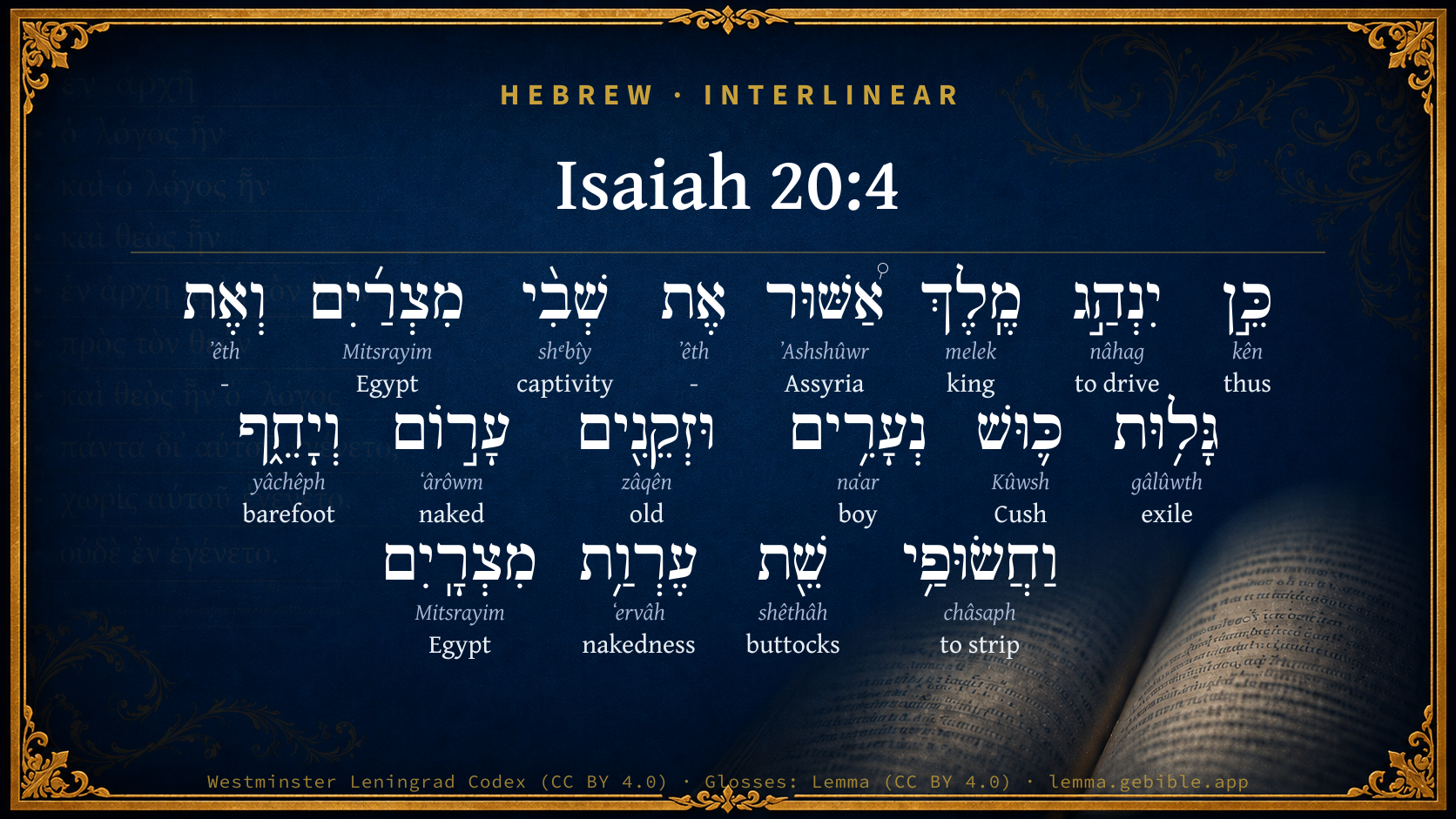
Isaiah 20:4

Hebrew (Westminster Leningrad Codex) Isaiah 20:4 appears in the Hebrew Old Testament. The text above is from the Westminster Leningrad Codex. Each word links to its Strong’s number, a concise gloss, and parsing drawn from the Open Scriptures Hebrew Bible morphology. Click any word for its full Brown-Driver-Briggs (BDB) entry.
Download image
Cite this verse

Isaiah 20:4 (World English Bible). Public Domain. Lemma interlinear Bible study tool, https://lemma.gebible.app/v/isaiah/20/4.

Show BibTeX & RIS
BibTeX
RIS
English Translation
so shall the king of Assyria lead away the captives of Egypt, and the exiles of Ethiopia, young and old, naked and barefoot, and with buttocks uncovered, to the shame of Egypt.
World English Bible · Public Domain
Download a study sheet

One document with this verse’s original text, its word-by-word gloss line, the meaning frame, cross-references with their text, attributed commentary, and full source and license credits — printable, and it pastes into notes with its structure intact.

This verse Autodidact and up

Study sheet (.html) Plain text (.txt)

A passage Seminary Student

Up to 50 verses in one chapter. A passage sheet keeps up to 6 commentary sources and 12 cross-references per verse, in the order this page ranks them, and says so on the sheet whenever that leaves anything out. Ask for a single verse and you get the Autodidact verse sheet above.

Everything on this page stays free to read, with no account — the sheet is a download of what is already on screen, not access to it.

Want to remove ads? Support Godless Engineer
Compare translations 3

The same verse in 3 English versions, stacked beneath the original-language interlinear above. Click any original word for its lexicon entry.

Each is an independent rendering of the whole verse — the interlinear is not word-aligned to these translations.

Highlighted words mark where these versions differ — a whole-verse word diff, not a word-by-word alignment.

  • World English Bible Public Domain
    so shall the king of Assyria lead away the captives of Egypt, and the exiles of Ethiopia, young and old, naked and barefoot, and with buttocks uncovered, to the shame of Egypt.
  • King James Version Public Domain
    So shall the king of Assyria lead away the Egyptians prisoners, and the Ethiopians captives, young and old, naked and barefoot, even with their buttocks uncovered, to the shame of Egypt.
  • unfoldingWord Literal Text CC BY-SA 4.0
    thus the king of Assyria will lead away the captivity of Egypt and the exile of Cush, young men and old, naked and barefoot, and uncovered of buttock, the nakedness of Egypt.

unfoldingWord Literal Text — © unfoldingWord, licensed CC BY-SA 4.0. Word-aligned USFM3 via Door43 (git.door43.org/unfoldingWord/en_ult).

Versions to compare (up to 4)

3 of 4 selected

Show all 18 translations

Every available English version of this verse, each an independent rendering of the whole verse.

  • World English Bible Public Domain
    so shall the king of Assyria lead away the captives of Egypt, and the exiles of Ethiopia, young and old, naked and barefoot, and with buttocks uncovered, to the shame of Egypt.
  • Berean Standard Bible Public Domain
    so the king of Assyria will lead away the captives of Egypt and the exiles of Cush, young and old alike, naked and barefoot, with bared buttocks—to Egypt’s shame.
  • Majority Standard Bible Public Domain
    so the king of Assyria will lead away the captives of Egypt and the exiles of Cush, young and old alike, naked and barefoot, with bared buttocks—to Egypt’s shame.
  • King James Version Public Domain
    So shall the king of Assyria lead away the Egyptians prisoners, and the Ethiopians captives, young and old, naked and barefoot, even with their buttocks uncovered, to the shame of Egypt.
  • American Standard Version (1901) Public Domain
    so shall the king of Assyria lead away the captives of Egypt, and the exiles of Ethiopia, young and old, naked and barefoot, and with buttocks uncovered, to the shame of Egypt.
  • Revised Version (1885) Public Domain
    so shall the king of Assyria lead away the captives of Egypt, and the exiles of Ethiopia, young and old, naked and barefoot, and with buttocks uncovered, to the shame of Egypt.
  • Geneva Bible (1599) Public Domain
    So shall the King of Asshur take away the captiuitie of Egypt, and the captiuitie of Ethiopia, both yong men and olde men, naked and barefoote, with their buttockes vncouered, to the shame of Egypt.
  • Douay-Rheims (1899) Public Domain
    So shall the king of the Assyrians lead away the prisoners of Egypt, and the captivity of Ethiopia, young and old. naked and barefoot, with their buttocks uncovered to the shame of Egypt.
  • Young's Literal Translation Public Domain
    so doth the king of Asshur lead the captivity of Egypt, and the removal of Cush, young and old, naked and barefoot, with seat uncovered -- the nakedness of Egypt;
  • Literal Standard Version CC BY-SA 4.0
    so the king of Asshur leads the captivity of Egypt, and the expulsion of Cush, young and old, naked and barefoot, with seat uncovered—the nakedness of Egypt;
  • Unlocked Literal Bible CC BY-SA 4.0
    in this way the king of Assyria will lead away the captives of Egypt, and the exiles of Cush, young and old, naked and barefoot, and with buttocks uncovered, to the shame of Egypt.
  • unfoldingWord Literal Text CC BY-SA 4.0
    thus the king of Assyria will lead away the captivity of Egypt and the exile of Cush, young men and old, naked and barefoot, and uncovered of buttock, the nakedness of Egypt.
  • Darby Bible Public Domain
    so shall the king of Assyria lead away the captives of Egypt and the exiles of Ethiopia, young and old, naked and barefoot, and with buttocks uncovered, [to] the shame of Egypt.
  • World Messianic Bible Public Domain
    so the king of Assyria will lead away the captives of Egypt and the exiles of Ethiopia, young and old, naked and barefoot, and with buttocks uncovered, to the shame of Egypt.
  • Webster's Bible Public Domain
    So shall the king of Assyria lead away the Egyptians prisoners, and the Cushites captives, young and old, naked and barefoot, even with their hind-parts uncovered, to the shame of Egypt.
  • Free Bible Version CC BY-SA 4.0
    so shall the king of Assyria lead the Egyptian prisoners and the Ethiopian exiles, both young and old, naked and barefoot. Their buttocks will be bare, to Egypt's shame.
  • Bible in Basic English Public Domain
    So will the king of Assyria take away the prisoners of Egypt and those forced out of Ethiopia, young and old, unclothed and without shoes, and with backs uncovered, to the shame of Egypt.
  • JPS Tanakh (1917) Public Domain
    so shall the king of Assyria lead away the captives of Egypt, and the exiles of Ethiopia, young and old, naked and barefoot, and with buttocks uncovered, to the shame of Egypt.

Literal Standard Version (2020), Covenant Press — licensed CC BY-SA 4.0. Text via the HelloAO Bible API (eBible.org). Unlocked Literal Bible (unfoldingWord) — licensed CC BY-SA 4.0. Text via the HelloAO Bible API (eBible.org). unfoldingWord Literal Text — © unfoldingWord, licensed CC BY-SA 4.0. Word-aligned USFM3 via Door43 (git.door43.org/unfoldingWord/en_ult). Free Bible Version, Dr. Jonathan Gallagher — licensed CC BY-SA 4.0. Text via the HelloAO Bible API (eBible.org).

Word by word

More ways to search: Search by grammar → Find every occurrence → Compare this word →

Practice this passage: Drill this verse → Learn its vocabulary →

שֵׁ֖ת
shêthâh
H8357
“buttocks”
Noun, Common, Masculine, Singular, Absolute
Part of Speech
Noun
Type
Common
Gender
Masculine
Number
Singular
State
Absolute
Full BDB Definition

Origin: from H7896

TWOT: 2478a

seat (of body), buttocks
  1. כֵּ֣ן kên H3651 “thus” Particle, Demonstrative
  2. יִנְהַ֣ג nâhag H5090 “to drive” Verb, Qal, Imperfect, 3rd Person, Masculine, Singular
  3. מֶֽלֶךְ melek H4428 “king of” Noun, Common, Masculine, Singular, Construct
  4. אַ֠שּׁוּר ʼAshshûwr H804 “Assyria” Noun, Proper
  5. אֶת ʼêth H853 “-” Particle, Direct Object
  6. שְׁבִ֨י shᵉbîy H7628 “captivity of” Noun, Common, Both, Singular, Construct
  7. מִצְרַ֜יִם Mitsrayim H4714 “Egypt” Noun, Proper
  8. וְאֶת ʼêth H853 “and · -” Conjunction + Particle, Direct Object
  9. גָּל֥וּת gâlûwth H1546 “exile of” Noun, Common, Feminine, Singular, Construct
  10. כּ֛וּשׁ Kûwsh H3568 “Cush” Noun, Proper
  11. נְעָרִ֥ים naʻar H5288 “boys” Noun, Common, Masculine, Plural, Absolute
  12. וּזְקֵנִ֖ים zâqên H2205 “and · old” Conjunction + Adjective, Adjective, Masculine, Plural, Absolute
  13. עָר֣וֹם ʻârôwm H6174 “naked” Adjective, Adjective, Masculine, Singular, Absolute
  14. וְיָחֵ֑ף yâchêph H3182 “and · barefoot” Conjunction + Adjective, Adjective, Masculine, Singular, Absolute
  15. וַחֲשׂוּפַ֥י châsaph H2834 “and · stripped” Conjunction + Verb, Qal, Participle Passive, Masculine, Plural, Construct
  16. עֶרְוַ֥ת ʻervâh H6172 “nakedness of” Noun, Common, Feminine, Singular, Construct
  17. מִצְרָֽיִם Mitsrayim H4714 “Egypt” Noun, Proper

About this verse

These counts appear in no published source. They are computed here, from the morphology-tagged text and Lemma’s own curated glosses. What Lemma adds →

18
words
16
distinct lemmas
Prophets
section

Notable vocabulary

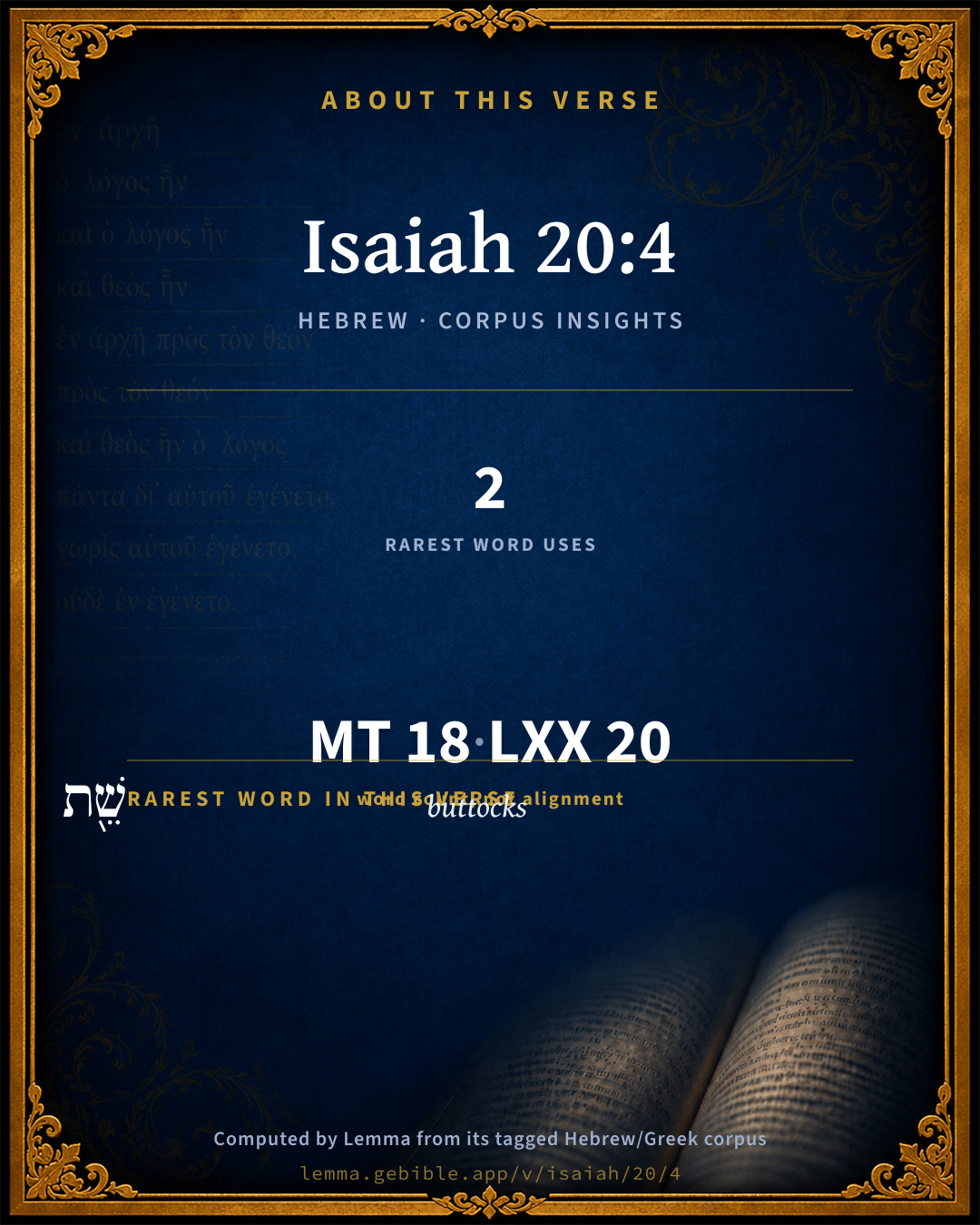
The rarest word here is שֵׁ֖ת buttocks H8357 — appearing just 2 times in the whole Hebrew Bible.

Shared distinctive vocabulary

שֵׁ֖ת buttocks H8357 occurs in 2 verses of the Hebrew Bible. Also found in:

Grammatical profile

  • 2 verbs
  • 10 nouns
  • 3 adjectives
  • 3 particles

Verb forms

  • יִנְהַ֣ג Qal · Imperfect
  • וַחֲשׂוּפַ֥י Qal · Participle Passive

Repetition

A word recurs within this verse — often emphatic in Hebrew:

  • מִצְרַ֜יִם Egypt H4714 ×2

Hebrew & Septuagint length

In English translation the verse runs 32 words from the Hebrew and 29 from the Septuagint (LXX English) — closely comparable.

A rough comparison of the two English renderings, which tokenize alike — not a word-level alignment.

Word counts can differ between the Hebrew and the Greek without any difference in meaning — e.g. the Hebrew direct-object marker אֵת has no separate Greek word, and Greek often adds the article ὁ.

In the original languages it is 18 Hebrew tokens and 20 Greek tokens — but the two are counted differently (Hebrew bundles its prefixes and suffixes into one token; the Greek is in lemma form), so that isn’t a like-for-like length.

Cross-references

10

Topical passages linked to Isaiah 20:4 in the Treasury of Scripture Knowledge — connected by theme and wording, ordered by reader-vote popularity; previews shown in the World English Bible.

  • Isaiah 19:4 I will give over the Egyptians into the hand of a cruel lord; and a fierce king shall rule over them, says the Lord, Yahweh of Hosts.
  • Jeremiah 13:22 If you say in your heart, Why are these things come on me? for the greatness of your iniquity are your skirts uncovered, and your heels suffer violence.
  • Jeremiah 13:26 Therefore will I also uncover your skirts on your face, and your shame shall appear.
  • 2 Samuel 10:4 So Hanun took David's servants, and shaved off the one half of their beards, and cut off their garments in the middle, even to their buttocks, and sent them away.
  • Isaiah 3:17 Therefore the Lord brings sores on the crown of the head of the women of Zion, And Yahweh will make their scalps bald."
  • Isaiah 47:3 Your nakedness shall be uncovered, yes, your shame shall be seen: I will take vengeance, and will spare no man.
  • Jeremiah 46:26 and I will deliver them into the hand of those who seek their lives, and into the hand of Nebuchadrezzar king of Babylon, and into the hand of his servants; and afterwards it shall be inhabited, as in the days of old, says Yahweh.
  • Ezekiel 30:18 At Tehaphnehes also the day shall withdraw itself, when I shall break there the yokes of Egypt, and the pride of her power shall cease in her: as for her, a cloud shall cover her, and her daughters shall go into captivity.
  • Micah 1:11 Pass on, inhabitant of Shaphir, in nakedness and shame. The inhabitant of Zaanan won't come out. The wailing of Beth Ezel will take from you his protection.
  • Revelation 3:18 I counsel you to buy from me gold refined by fire, that you may become rich; and white garments, that you may clothe yourself, and that the shame of your nakedness may not be revealed; and eye salve to anoint your eyes, that you may see.

Cross-references courtesy of OpenBible.info (CC BY 4.0).

Hebrew and Greek witnesses Masoretic Hebrew ↔ Greek Septuagint

The same verse in the two great witnesses to the Old Testament, shown verse-for-verse.

These are two independent witnesses, not word-aligned to each other, and the Septuagint is shown in lemma (dictionary) form.

Hebrew Isaiah 20:4 Masoretic · Westminster Leningrad Codex

כֵּ֣ן יִנְהַ֣ג מֶֽלֶךְ אַ֠שּׁוּר אֶת שְׁבִ֨י מִצְרַ֜יִם וְאֶת גָּל֥וּת כּ֛וּשׁ נְעָרִ֥ים וּזְקֵנִ֖ים עָר֣וֹם וְיָחֵ֑ף וַחֲשׂוּפַ֥י שֵׁ֖ת עֶרְוַ֥ת מִצְרָֽיִם

so shall the king of Assyria lead away the captives of Egypt, and the exiles of Ethiopia, young and old, naked and barefoot, and with buttocks uncovered, to the shame of Egypt.

World English Bible · Public Domain

Greek LXX Isaiah 20:4 Septuagint · lemma form

ὅτι οὕτως ἄγω βασιλεύς ἀσσύριος ὁ αἰχμαλωσία αἴγυπτος καί αἰθίοψ νεανίσκος καί πρεσβύτης γυμνός καί ἀνυπόδετος ἀνακαλύπτω ὁ αἰσχύνη αἴγυπτος

for thus shall the king of the Assyrians lead the captivity of Egypt and the Ethiopians, young men and old, naked and barefoot, having the shame of Egypt exposed.

LXX2012 (modern English Septuagint) · Public Domain

Hebrew: Westminster Leningrad Codex (CC BY 4.0). Greek: Septuagint (public domain); English from LXX2012 (modern English Septuagint) (Public Domain). How the Septuagint differs from the Hebrew →

Targum (Aramaic paraphrase)

1

The Targum is the ancient Jewish Aramaic paraphrase of the Hebrew Scriptures — an interpretive translation, not the Hebrew text itself. Onkelos (literal) and Pseudo-Jonathan (expansive) render the Torah, and Jonathan the Prophets. Coverage is partial: where no permissively-licensed English translation exists for a verse, only the Aramaic is shown. This is verse-level text, not a word-by-word alignment to the Hebrew.

  1. Targum Jonathan Prophets (Joshua–Malachi)
    כֵּן יְדַבֵּר מַלְכָּא דְאַתּוּר יַת שְׁבִי מִצְרַיִם וְיַת גָלוּת כּוּשׁ עוּלֵימִין וְסָבִין פְּחִיחִין וִיחֵיפִין וּגְסָן עֶרְיָה קְלָן מִצְרָיִם:

    So shall the king of Assyria lead the captives, and the captivity of Cush, the young and old, naked and barefoot, even with their shame uncovered, to the disgrace of Egypt.

    Targum Jonathan — Aramaic: “Mikraot Gedolot” (public domain). English: “Sefaria Community Translation” (CC0 1.0 (public-domain dedication)); “London "Chaldee Paraphrase," 1871” (public domain). Text via Sefaria.

Commentary

Notes on Isaiah 20:4 from classic Christian and Jewish commentators (each source and its license shown beneath its notes). The classic Christian expositions comment on the surrounding passage and are grouped to its opening verse, so a note may address several verses; the Jewish commentaries on the Tanakh (Rashi and others) are per-verse, so they appear only where the commentator wrote on this verse.

Lemma curates 59 commentaries, every one of them public domain or Creative Commons licensed, each selected and text-cleaned for this edition rather than reprinted as found. About our sources →

Trapp's Complete Commentary

John Trapp

Isa 20:4 So shall the king of Assyria lead away the Egyptians prisoners, and the Ethiopians captives, young and old, naked and barefoot, even with [their] buttocks uncovered, to the shame of Egypt.

Ver. 4. So shall the king of Assyria lead away.] As men used to lead or drive cattle, for so the Hebrew word Nahag denotes: so are poor captives led; and so shall the Lord also one day "lead forth with" or in company of "the workers of iniquity" (notorious offenders) all such as "turn aside unto their crooked ways," hypocrites and dissemblers; whenas "peace shall be upon Israel, upon the pure in heart." {Psa 125:5}

Young and old.] Young men are for action, old men for counsel. {a} Eργα νεων, βουλαι δε τεροντων. {b} They were all carried away together in a sad and sorry condition, little better, and sometimes more bitter, than death itself.

Even with their buttocks uncovered.] Vel ad ludibrium, vel ad libidinem hostium, for the enemies either to scorn at, or to feed their filthy eyes upon. Thus and for such a purpose dealt the mitred fathers with the poor Albigenses, those ancient Protestants in France, when they had forced them to take quarter for their lives, voluerunt episcopi viros et mulieres nudos egredi, &c. The bishops wished the men and women to be led forth nude. And so Tilly dealt with the miserable citizens at the sack of Magdeburg; and much worse than so dealeth the devil with all his wretched captives, whom he driveth away hellward, naked and barefoot with their buttocks uncovered, the shame of their nakedness exposed to public view for want of the white raiment of Christ’s righteousness that they might be clothed. {Rev 3:18}

{a} Consilia senum, hastae iuvenum sunt.

{b} Pindar.

John Trapp, A Commentary or Exposition upon All the Books of the Old and New Testament (1647–1656) — public domain. Text from a community e-Sword module.

Jamieson, Fausset & Brown

Robert Jamieson, A. R. Fausset & David Brown

buttocks uncovered--BELZONI says that captives are found represented thus on Egyptian monuments (Isa 47:2-3; Nah 3:5, Nah 3:8-9), where as here, Egypt and Ethiopia are mentioned as in alliance.

Jamieson, Fausset & Brown — Commentary Critical and Explanatory on the Whole Bible (1871) — public domain (CC PDM 1.0). Text via the HelloAO Bible API.

Ellicott's Commentary for English Readers

(4) So shall the king of Assyria lead away the Egyptians . . .—The prediction did not receive its fulfilment in the reign either of Sargon or Sennacherib, but Esarhaddon subdued the whole of Egypt, carried off its treasures, and appointed satraps over its provinces (Budge’s Esarhaddon, pp. 111-129). The prophet paints the brutality with which prisoners were treated on a march in vivid colours. What would men say of their boasted policy of an Egypto-Cushite alliance when they saw that as its disastrous issue? It may be noted that Rabshakeh’s scornful phrase, “This bruised reed,” seems to imply that Assyria had ceased to fear the power of Egypt; and Nahum (Nah_3:8) speaks of No (i.e., No-Amun or Thebes) as having, when he wrote, been conquered, and his people carried into captivity.

A Bible Commentary for English Readers, edited by Charles John Ellicott (1878–1897) — public domain. Text from a community e-Sword module.

The Cambridge Bible for Schools and Colleges

gen. ed. J. J. S. Perowne

4. The apodosis. lead away] as in 1Sa_30:2.

the Egyptians prisoners … captives] Better as R.V. the captives of Egypt and the exiles of Ethiopia. The two words for exile are both abstracts used in a concrete sense; the corresponding verbs denote, the one the act of making captive, the other the act of going into exile (lit. leaving the land bare).

to the shame] The word means “nakedness,” and the construction is difficult.

The Cambridge Bible for Schools and Colleges (gen. ed. J. J. S. Perowne; Cambridge University Press, 1878–1918) — public domain. Text from a community e-Sword module.

John Gill's Exposition

So shall the king of Assyria lead away the Egyptians prisoners, and the Ethiopians captives,.... As beasts are led or driven, being taken prisoners, and carried captive by the king of Assyria, namely Sargon, whoever is intended by him:

young and old; without any regard to age, sparing none for their tender years or gray hairs:

naked and barefoot; as prisoners of war commonly are, being stripped by their conquerors of their clothes, and having only a few rags given them to cover their nakedness with, and obliged to travel without shoes on their feet:

even with their buttocks uncovered, to the shame of Egypt; having no clothes on them to cover those parts; or the skirts of their garments cut off, as David's servants were by the Ammonites, Sa2 10:4 and this to humble and mortify the pride of the Egyptians.

John Gill's Exposition of the Whole Bible (1746–1763) — public domain (CC PDM 1.0). Text via the HelloAO Bible API.

Albert Barnes' Notes on the Bible

So shall the king of Assyria - The emphasis here is on the word “so.” As Isaiah has walked naked, that is, stripped off his usual clothing, “so” shall the Egyptians and Ethiopians be led away “stripped” of all their possessions.

The Egyptians prisoners, and the Ethiopians captives - The Egyptians and Ethiopians, or Cushites, were often united in an alliance, and appear to have been when this prophecy was delivered. Thus Nah 3:8 :

Ethiopia and Egypt were her strength, and it was infinite;

Put and Lubim were thy helpers.

To the shame of Egypt - It shall be a disgrace to them to be subdued, and to be carried captive in so humiliating a manner. It is remarked by Belzoni (‘Operations and Recent Discoveries in Egypt and Nubia’), that in the figures on the remains of their temples, prisoners are often represented as naked, or only in aprons, with disheveled hair, and with their hands chained. He also remarks, that on a “bas-relief,” on the recently-discovered graves of the kings of Thebes, a multitude of “Egyptian and Ethiopian prisoners” are represented - showing that Egypt and Ethiopia were sometimes “allied,” alike in mutual defense and in bondage (compare Isa 47:2, and Nah 3:5).

Albert Barnes' Notes on the Bible (1834–1885) — public domain. Text from a community e-Sword/MySword module.

Haydock's Catholic Bible Commentary

Shame. Thus captives were generally exposed to sale, chap. xlvii. 2., and Nahum iii. 5.

George Leo Haydock (1774–1849), Haydock's Catholic Family Bible and Commentary, 1859 edition — public domain. Excludes Psalms (Douay-Rheims chapter numbering differs from Protestant) and Deuterocanonical books (Catholic canon only).

Matthew Poole's English Annotations

Lead away, like beasts, of which this word is commonly used.

Their buttocks uncovered; having their garments cut off by the middle, to the discovery of their buttocks and their secret parts. Compare 2Sa 10:4; Isa 47:2.

Matthew Poole's English Annotations on the Holy Bible (1683–1685) — public domain. Text from a community e-Sword/MySword module.

Whedon's Commentary on the Bible

Daniel D. Whedon

4, 5. So — Thus, in like manner, as the prophet in his comparative nakedness.

Shall the king of Assyria — In this expedition Assyria’s success is assured by the prophet. Precisely when this occurred is not easy to settle, as some imagine. Not even Rawlinson, in his Five Great Monarchies, vol. ii, page 416, (which see,) does this satisfactorily. Nor is it, as regards prophecy, very material.

Lead away the Egyptians prisoners… Ethiopians captives — This picture of naked captives taken in war, is found on the monuments in Egypt. See Isa_47:2-3; also Nah_3:5; Nah_3:8-9. The doctrine of the prophecy is: Vain is the reliance of Judah on Egypt and Ethiopia.

Daniel D. Whedon (gen. ed.), Commentary on the Old and New Testaments (1874–1909) — public domain. Text from a community e-Sword module.

The Pulpit Commentary

So shall the King of Assyria lead away the Egyptians prisoners, and the Ethiopians captives. In Sennacherib"s annals for the year B.C. 701, twelve years after this prophecy was given, we find the following passage: "The kings of Egypt, and the archers, chariots, and horsemen of the King of Meroe, a force without number, gathered and came to the aid of Ekron. In the neighborhood of Eltekeh their ranks were arrayed before me, and they urged on their soldiers. In the service of Asshur, my lord, I fought with them, and I accomplished their overthrow. The charioteers and sons of the kings of Egypt, and the charioteers of the King of Meres, alive in the midst of the battle, my hand captured " (G. Smith, "Eponym Canon," pp. 133, 134). Young and old. The intermixture of young and old, of full-grown males with women leading children by the hand or carrying them upon the shoulder, in the Assyrian sculptures, strikes us even on the most cursory inspection of them. Naked and barefoot. Assyrian captives are ordinarily represented "barefoot." Most commonly they wear a single tunic, reaching from the neck to the knees, or sometimes to the ankles, and girt about the waist with a girdle. It is probable that Egyptian and Ethiopian prisoners would be even more scantily clad, since the ordinary Egyptian tunic began at the waist and ended considerably above the knee.

The Pulpit Commentary (1880–1919), ed. H.D.M. Spence-Jones & Joseph S. Exell — public domain. Text from a community e-Sword module.

John Wesley's Explanatory Notes

Uncovered - Having their garments cut off by the middle.

John Wesley, Explanatory Notes Upon the Whole Bible (1754–1765) — public domain. Text via the GEBible commentary corpus.

J. A. Alexander on Isaiah

Joseph Addison Alexander

“So shall the king of Assyria lead the captivity (i.e., the captives) of Egypt and the exiles of Ethiopia, young and old; naked and barefoot, with their buttocks uncovered, the nakedness (or disgrace) of Egypt.” This verse completes the comparison begun in that before it. It is also clear from a comparison of the type and antitype, that the nakedness of v. 2 was a partial one, since captives were not commonly reduced to a state of absolute nudity. This is confirmed by the addition of the word barefoot in both cases, which would be superfluous if naked had its strictest sense. Connected as Egypt and Ethiopia were in fact and in the foregoing context, either name includes the other. The King of Assyria here meant is either Sennacherib or Sargon himself. Some suppose this prediction to have been fulfilled in the conquest of No-Ammon (i.e., Diospolis or Thebes) mentioned in Nah 3:8 as a recent event. How long beforehand the prediction was uttered, is a question of small moment and one which cannot be decided. There is no ground, however, for the supposition that the interval was so short as to convert the prophecy into a mere conjecture or an act of sagacious forecast.

Joseph Addison Alexander, The Prophecies of Isaiah (1846–1847; New York: Scribner, 1870–1878) — public domain. Text from a community e-Sword module.

Rashi

Rabbi Shlomo Yitzchaki (Rashi)

with bare buttocks (וַחֲשׂוּפַי), like חֲשׂוּף, and the yud is superfluous, like the yud of חַלּוֹנָי (the window), חוֹרָי, (nets), שָׂדָי (the field).

buttocks Near the anus. Comp. (II Sam. 10:4): “And he cut off their garments in half, up to their buttocks (שְׁתוֹתֵיהֶם).” This retribution was due them because of Ham their ancestor, who saw his father’s nakedness and did not cover it, payment in kind.

Rashi on the Tanakh — English translations: “The Judaica Press complete Tanach with Rashi, translated by A. J. Rosenberg” (CC BY 4.0); “Pentateuch with Rashi's commentary by M. Rosenbaum and A.M. Silbermann, 1929-1934” (public domain); “The Metsudah Tanach series, Lakewood, N.J” (CC BY 4.0); and “The Book of Joshua, Metsudah Publications, 1997” (CC BY 4.0). Text via Sefaria.

Ibn Ezra

Rabbi Abraham ibn Ezra

Ethiopia, that came to help them.

וַחְַשׁוּפַי And my naked people. The first person refers either to the prophet, the people whose nakedness he indicated by going naked, or to God; the people whom God hath made bare.

שת The back. Comp. 2 Sam. 10:14.

ערות מצרים Either, To the shame of Egypt; or join וחשופי, mentioned before, also to ערות, so that ערות מצרים is in apposition to. שת

Ibn Ezra on the Tanakh — English translations: “Sefaria Community Translation” (CC0 1.0 (public-domain dedication)); “Yalkut, Sifsei Chachomim Chumash, Metsudah Publications, 2009” (CC BY 4.0); and “Commentary of Ibn Ezra on Isaiah - trans. by M. Friedlander, 1873” (public domain). Text via Sefaria.

Lesson kit

Teaching starters — assembled from the data on this page, not authored interpretation. Every prompt links to the verse data it draws on. Edit before teaching.

Isaiah, in the Prophets, opens this verse with 18 words (16 distinct Hebrew lemmas). Its most distinctive word is shêthâh (“buttocks”). A historical commentator’s framing appears above. Read the whole chapter for the surrounding context.

Discussion questions

  1. What does “buttocks” (shêthâh) contribute to the verse as a whole?
  2. How does 2 Samuel 10:4, which shares the word «buttocks», read alongside this verse?
  3. What does the repetition of “Egypt” (2× in this one verse) do in this verse?
  4. The translations on this page render this verse differently — a whole-verse word diff, not a word-by-word alignment. What might account for the different wordings?
  5. «יִנְהַ֣ג» is a Qal Imperfect verb. How does that grammatical form shape the action described?
  6. Compare how Trapp's Complete Commentary and Jamieson, Fausset & Brown read this verse. Where do they agree or differ?

Things to notice

Reading settings

Reading text

Shown beneath each verse's original-language words.

Old Testament
Old Testament edition

Read the OT as the Masoretic Hebrew (MT) or the Greek Septuagint (LXX).

English shown for the Greek Septuagint (in the Hebrew ↔ Greek comparison).

Comparing translations? Open the Compare panel on any verse page to stack up to four side by side.